

Introduction
The 4th millennium BCE represents a turning point in the prehistory of southern Scandinavia, corresponding with the establishment and spread of agriculture, and the beginning of the Neolithic period. It is also the time when the very first copper items appear in the archaeological record. The Neolithic is identified by a set of practices, materials, and innovations attributed to the so-called Trichterbecherkultur (TRB) or Funnel Beaker complex (eg, Kossian Reference Kossian2005; Midgley Reference Midgley2008; Sørensen Reference Sørensen2014). The early phase of the TRB coincides with the Early Neolithic (EN) I, dated to c. 4000 to 3500 BCE. Copper-based artefacts occur throughout the EN, with a peak during the EN II (c. 3500–3300 BCE), which according to Müller (Reference Müller, Ling, Chacon and Kristiansen2022, 26) coincides with an economic boom and the emergence of social competition. A drastic decrease in copper artefacts characterises the following Middle Neolithic period (MN, c. 3300–2800 BCE; see Klassen Reference Klassen2000; Nørgaard et al. Reference Nørgaard, Pernicka and Vandkilde2021; Brozio et al. Reference Brozio, Stos-Gale, Müller, Müller-Scheeßel, Schultrich, Fritsch, Jürgens and Skorna2023), suggesting that in southern Scandinavia copper was not economically important until the Late Neolithic (2350–1700 BCE) when metallurgy was fully adopted and metal artefacts became common again, especially from c. 2000 BCE, when new cultural influences and trade networks with western and continental Europe developed (Vandkilde Reference Vandkilde1996; Brozio et al. Reference Brozio, Stos-Gale, Müller, Müller-Scheeßel, Schultrich, Fritsch, Jürgens and Skorna2023, 22).
The first copper artefacts to be imported to Scandinavia consist almost exclusively of axeheads but some ornaments (bead and spiral bands) are also known. The largest concentrations of copper flat axeheads dating to the 5th and 4th millennium BCE are found in central and northern central Europe (Magnusson Staaf Reference Magnusson Staaf1996, 144; Klassen Reference Klassen2000). The circulation, if not the manufacture, of such axeheads is partly contemporary with the well-known jadeite axeheads that were widely distributed across Europe at this time, likely embodying powerful symbolism (eg, Pétrequin et al. Reference Pétrequin, Sheridan, Gauthier, Cassen, Errera, Kerig and Shennan2015). The relation between copper and Alpine jadeite axeheads has been discussed by Klassen et al. (Reference Klassen, Cassen, Pétrequin, Pétrequin, Cassen, Errera, Klassen, Sheridan and Pétrequin2012); based on the similarities in shape, it has been suggested that some copper axeheads could be imitations of jadeite examples. Whether or not they were imitating their jadeite counterparts, it has been proposed that early copper artefacts represented symbols of power due to the prestigious and exotic value of the copper they are made from, rather than due to their value as functional artefacts (Klassen Reference Klassen2000, 351-58; Klassen et al. Reference Klassen, Cassen, Pétrequin, Pétrequin, Cassen, Errera, Klassen, Sheridan and Pétrequin2012; see also Müller Reference Müller, Ling, Chacon and Kristiansen2022). However, since most of them have been found as single deposits, their social and cultural meanings remain difficult to assess.
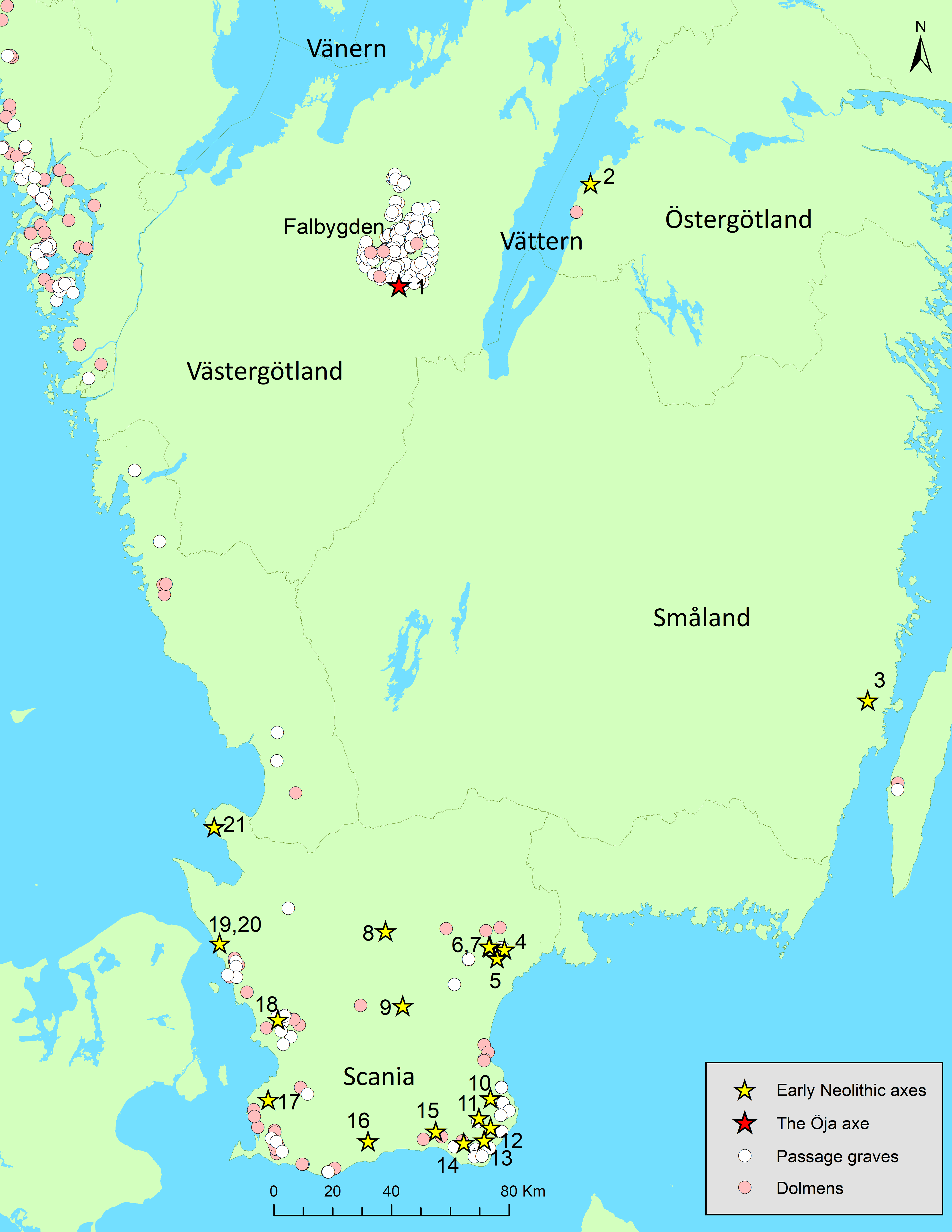
From a geographical point of view, the TRB copper finds in Scandinavia are found mainly in modern day Denmark (primarily Funen and south-west Jutland) and in the coastal area of the Swedish southernmost province of Scania (Oldeberg Reference Oldeberg1974; Randsborg Reference Randsborg and Ryan1979; Klassen Reference Klassen2000). They are typically distributed in the same areas where megalithic graves, such as dolmens and passage graves, occur (eg, Klassen Reference Klassen2014). In Sweden, only a few EN copper artefacts have been found outside Scania (Figure 1) and only one example comes from western Sweden: the Öja axehead, from an inland site in the region of Västergötland. Together with the Roglösa axehead from Östergötland (Figure 1: 2), they represent the two most northerly TRB copper axehead finds of EN Europe. The Öja axehead, which is the focus of the present study, was recovered in Falbygden, well-known for its unique concentration of Neolithic megalithic monuments (see for example Sjögren Reference Sjögren2003; Blank Reference Blank2021).
A distribution map of Early Neolithic flat axeheads with known find spots in Sweden. See Table 1 for more information.

In this study, we aim to contribute to the current understanding of early copper finds in Scandinavia by reviewing the earlier literature and presenting an updated catalogue of the EN TRB copper artefacts from Sweden. Additionally, we report on new lead isotope and elemental analyses of the Öja axehead. The acquired data, when compared with copper production and circulation across the continent during the 5th and 4th millennium BCE, sheds novel light on the discussion about TRB exchange networks in Scandinavia and beyond.
Early metallurgy in Europe: problems and challenges
The earliest copper artefacts in Europe appear in the Balkans around 6000 BCE and become more common in the period c. 5400 to 4600 BCE, during the Vinča culture at settlement sites such as Belovode and Pločnik, Serbia (Radivojević et al. Reference Radivojević, Roberts, Marić, Kuzmanović-Cvetković and Rehren2021). Around 5000 BCE copper becomes widely available in Bulgaria as evidenced by the finds in the Varna cemetery (Ivanov Reference Ivanov and Lichardus1991) and other Chalcolithic sites (Todorova Reference Todorova1978; Reference Todorova1981). Mining of copper in the Vinča period is demonstrated by dated archaeological evidence of mine shafts (see below), malachite and azurite ores discovered at various sites, and slag and copper tools in contemporary settlements (Radivojević Reference Radivojević2012; Reference Radivojević, Radivojević, Roberts, Marić, Kuzmanović Cvetković and Rehren2021; Radivojević & Roberts Reference Radivojević, Roberts, Radivojević, Roberts, Marić, Kuzmanović Cvetković and Rehren2021).
One of earliest, if not the earliest, European continental site with evidence of copper smelting is Belovode in eastern Serbia dated to the beginning of the 5th millennium BCE (O’Brien Reference O’Brien2015; Radivojević et al. Reference Radivojević, Rehren, Pernicka, Šljivar, Brauns and Borić2010). In central Europe, the evidence of copper metallurgy has been dated as early as the second part of the 5th millennium and documented at Mariahilfberg in the Austrian Tyrol in association with the Münchshöfen culture (Höppner et al. Reference Höppner, Bartelheim, Huijsmans, Krauss, Martinek, Pernicka and Schwab2005). Analyses of copper artefacts from Bulgaria (Gale et al. Reference Gale, Stos-Gale, Radouncheva, Ivanov, Lilov, Todorov, Panayotov, Craddock and Lang2003) and Poland (Kowalski et al. Reference Kowalski, Stos-Gale, Adamczak, Maas, Woodhead, Garbacz-Klempka, Kozicka, Kofel and Matuszczyk2024; Reference Kowalski, Adamczak, Garbacz-Klempka, Degryse, Stos-Gale, Kozicka, Chudziak, Krzyszowski and Jedynak2019; Wilk et al. Reference Wilk, Stos-Gale, Schwab, Zastawny, Sych, Kiełtyka-Sołtysiak and Momot2024) indicate that in the 5th and 4th millennium BCE copper was smelted in several central and south-eastern European regions. Early evidence for the production of copper artefacts has been documented in north Alpine areas between c. 3800 and 3300 BCE at sites related to the Mondsee, Altheim and Pfyn groups (Ruttkay et al. Reference Ruttkay, Cichocki, Pernicka, Pucher and Menotti2004; Frank & Pernicka Reference Frank, Pernicka, Midgley and Sanders2012) and at several TRB-related sites in Czechia, south Poland and central Germany, where for example copper slag and crucibles have been found (Gebauer et al. Reference Gebauer, Sørensen, Taube and Wielandt2020, fig. 9; Gebauer et al. Reference Gebauer, Bendtsen, Sørensen, Nørgaard and Reiter2025, fig. 2). In EN Scandinavia, the only evidence from a TRB context that can be connected to metallurgy (cold forging and pyrotechnical processes) is a crucible and a possible tuyère from an EN context beneath a MN long barrow at Lønt, in southern Denmark (Gebauer et al. Reference Gebauer, Sørensen, Taube and Wielandt2020). In addition, deliberate fracturing of flat axeheads by hot shortening has been suggested at Lackalänga in Scania as well as at Neuenkirchen and Nadrensee in Mecklenburg in northern Germany (Klassen Reference Klassen2000, table 27, 100A–B; Skorna Reference Skorna, Risch, Pernicka and Meller2024, 66). In the TRB communities of Denmark and Poland, it has been proposed that metalworking was associated with enclosures (Klassen Reference Klassen2014; Gebauer et al. Reference Gebauer, Sørensen, Taube and Wielandt2020).
According to Klassen (Reference Klassen2000, 235) copper importation and metallurgical know-how in southern Scandinavia followed a three-step development. In the first phase (4500–3800 BCE) copper axeheads were imported from the Balkan region. In a second phase (3800–3500 BCE) modifications, such as annealing and hammering, of the copper imports took place locally. In the third phase (3500–3000 BCE) local types of axeheads were produced in the TRB communities in northern central Europe and southern Scandinavia.
Early Neolithic copper artefacts and finds indicating metallurgy (casting and cold hammering) are also known from the northern Fenno-Scanian area within Rhomp-Pit Ware and Comb Ware contexts (eg, Vandkilde Reference Vandkilde1996, 262; Nordqvist & Herva Reference Nordqvist and Herva2013; Melheim Reference Melheim2015, 139). The early metal assemblages from this area mainly consist of unworked and worked pieces of copper, small artefacts, and on a few occasions adzes and other tools normally made of native copper using simple techniques (Nordqvist & Herva Reference Nordqvist and Herva2013; Ikäheimo & Nordqvist Reference Ikäheimo and Nordqvist2017). No connections between the northern TRB and the Rhomp-Pit Ware or the Comb Ware groups have been observed (Melheim Reference Melheim2015, 11).
To our knowledge, the Balkan mines for which there is solid archaeometallurgical evidence of exploitation during the south-eastern European Chalcolithic (c. 5000–3700 BCE) are: Ai Bunar (Černych Reference Černych1978) in central Bulgaria and Rudna Glava in eastern Serbia (Jovanović & Ottaway Reference Jovanović and Ottaway1976; Jovanović Reference Jovanović and Domergue1989). The Ai Bunar mine has been confirmed as the source of pigments found in Chalcolithic sites in Bulgaria (Gale et al. Reference Gale, Stos-Gale, Radouncheva, Ivanov, Lilov, Todorov, Panayotov, Craddock and Lang2003, 158). It is very interesting that Rudna Glava, despite being the earliest documented (confirmed by radiocarbon analyses) copper mine of the whole of Eurasia has an isotopic and elemental fingerprint that has not yet been recognised in any local artefacts from the period. Instead, the source for most of the Vinča copper finds, according to lead isotopes, seems to be found at Majdanpek, which is also one of the largest copper ore deposits of the region, lying only 19 km north of Rudna Glava (Radivojević & Roberts Reference Radivojević, Roberts, Radivojević, Roberts, Marić, Kuzmanović Cvetković and Rehren2021, 216). The lead isotope analyses of copper artefacts from the Varna cemetery suggest that some mines in south-east and central Bulgaria, located in the ore districts of Burgas-Varli Briag and Panagyurishte, were exploited in that period (Gale et al. Reference Gale, Stos-Gale, Radouncheva, Ivanov, Lilov, Todorov, Panayotov, Craddock and Lang2003, 162).
According to lead isotope results, the exploitation of the Majdanpek mines alternates between phases of intense use at the time of the Vinča culture during the local Early Chalcolithic (c. 5000–4600 BCE) and Late Chalcolithic (c. 4100–3700 BCE) and a period of inactivity, when intense production is instead registered in Bulgaria at the mines of Ai Bunar (c. 4600–4100 BCE). After 3700 BCE isotopic evidence shows that new sources from the central Balkans and the Carpathian basin come into use (Radivojević & Roberts Reference Radivojević, Roberts, Radivojević, Roberts, Marić, Kuzmanović Cvetković and Rehren2021, 224-5), intriguing given the increased presence of copper artefacts in the central Mediterranean and in the northern Alpine region. Many questions relating to the organisation of early metal production remain open.
Early copper and the results of lead and elemental analyses
In 2001 Klassen and Stürup published an influential study conducting lead isotope analyses on 38 Neolithic TRB finds from northern Europe for the first time, with the aim of tracing the origin of the copper that they were made from. The authors divided the studied objects into two groups based on the elemental composition of the metal: the Mondsee, and the Riesebusch copper. The copper of the Mondsee finds, the dominating type in Central Europe, named after the Mondsee pile dwelling sites (c. 3800–2800 BCE), is characterised by a significant presence of arsenic and traces of antimony, nickel and silver. The Riesebusch copper finds, mainly found in the western Baltic area and named after the hoard from eastern Holstein (c. 3500–3300 BCE), on the other hand, were made of arsenical copper with impurities only of antimony. Based on the results from the lead isotope analyses, the authors concluded that the origin of the copper used to produce both the Mondsee and the Riesebusch artefacts was to be found in the eastern Alpine region (Klassen & Stürup Reference Klassen and Stürup2001). This result contradicted earlier suggestions, based on chemical analysis, of the ores originating from the island of Helgoland off the coast of Schleswig-Holstein (Lorenzen Reference Lorenzen1965; see also Magnusson Staaf Reference Magnusson Staaf1996, 100; O’Brien Reference O’Brien2015, 156). Klassen and Stürup (Reference Klassen and Stürup2001, 67) concluded that the reason for the different elemental compositions was probably to be found in diverging production processes and that the Riesebusch copper had been likely worked at much lower smelting temperatures then the Mondsee type. Klassen and Stürup’s (2001) analyses were successful in excluding the possibility that the copper used for such early finds was of Middle Scandinavian origin, but the claim that it could have been made from ores of east Alpine origin, already questioned by Frank and Pernicka (Reference Frank, Pernicka, Midgley and Sanders2012), has recently been completely revised.
The new analyses of three Bygholm type axeheads, six flat axeheads, and an arm spiral from different Danish TRB sites, demonstrated that their copper closely matches ore deposits in Serbia and Bulgaria (Nørgaard et al. Reference Nørgaard, Pernicka and Vandkilde2021). Such results were confirmed soon after by the study of 45 TRB copper artefacts from Denmark, Germany, and Sweden (of which 15 finds had already been analysed by Klassen and Stürup (Reference Klassen and Stürup2001)). Almost all were isotopically consistent with the copper mineral from ore deposits in the mountain areas of Serbia and Bulgaria in south-eastern Europe (Brozio et al. Reference Brozio, Stos-Gale, Müller, Müller-Scheeßel, Schultrich, Fritsch, Jürgens and Skorna2023). Furthermore, according to these recent studies (Nørgaard et al. Reference Nørgaard, Pernicka and Vandkilde2021; Brozio et al. Reference Brozio, Stos-Gale, Müller, Müller-Scheeßel, Schultrich, Fritsch, Jürgens and Skorna2023, 21) the exploitation of eastern Alpine copper ores cannot be attested before c. 3300 BCE, thus excluding the possibility altogether that those ore deposits could have been used to produce any EN artefact.
Early copper artefacts in TRB contexts
The limited number of copper artefacts dated to the 5th and 4th millennium BCE have an uneven distribution throughout the area where the TRB culture can be found (Midgley Reference Midgley2008, 144; Klassen Reference Klassen2014, fig. 134). The most common category of EN copper-based artefacts in Scandinavia and northern Germany is undoubtedly represented by the flat axeheads followed by ornaments like beads, rings, and spirals. Copper awls and sheet discs have been also recorded, and a limited number of elaborated polygonal axeheads date to this early phase of the Neolithic (eg, Forssander Reference Forssander1936; Oldeberg Reference Oldeberg1974; Klassen 2000; Reference Klassen2004). Some stone axeheads, such as the polygonal battle axeheads and the butt pointed axeheads, have been interpreted as replicas of copper axeheads (Klassen Reference Klassen2000, 146; Gebauer et al. Reference Gebauer, Bendtsen, Sørensen, Nørgaard and Reiter2025, 170) and several researchers have also emphasised the connection between the early copper axeheads and amber (Klassen Reference Klassen2000, 262; Larsson Reference Larsson and Butrimas2001; Ramstad et al. Reference Ramstad, Axelsson, Strinnholm, Fowler, Harding and Hofmann2015).
In south Scandinavia, EN copper axeheads never appear in burials nor in settlement contexts, but are mostly found as single depositions (Vandkilde Reference Vandkilde1996; Klassen Reference Klassen2000; Visser Reference Visser2021). A few hoards, containing more than one copper object, are known from Scania in Sweden (Fjälkinge), Denmark (eg, Bygholm, Søby Hede and Årupgård), Germany (eg, Riesebusch) and Austria (Lödersdorf and Stollhof) (Oldeberg Reference Oldeberg1974; Randsborg Reference Randsborg and Ryan1979; Klassen Reference Klassen2000; Skorna Reference Skorna2022). The Bygholm hoard has had a central role in establishing the chronological framework for these early copper finds as it contained four trapezoidal flat axeheads, three arm spirals, a dagger, and a decorated Funnel Beaker typologically dated to c. 3500 to 3300 BCE.
Previous research has focused on questions concerning the origin of the copper ores, trade routes across the continent, and the spread of early metallurgy (Forssander Reference Forssander1936; Lorenzen Reference Lorenzen1965; Cullberg Reference Cullberg1968; Oldeberg Reference Oldeberg1974; Randsborg Reference Randsborg and Ryan1979; Liversage Reference Liversage and Poulsen1989; Vandkilde Reference Vandkilde1996; Klassen Reference Klassen2000, Reference Klassen2004; Klassen & Stürup Reference Klassen and Stürup2001; Gebauer et al. Reference Gebauer, Sørensen, Taube and Wielandt2020; Nørgaard et al. Reference Nørgaard, Pernicka and Vandkilde2021; Skorna Reference Skorna2022; Brozio et al. Reference Brozio, Stos-Gale, Müller, Müller-Scheeßel, Schultrich, Fritsch, Jürgens and Skorna2023). Attention has also been paid to the contextual evidence, and the socio-cultural significance of the copper artefacts (eg, Magnusson Staaf Reference Magnusson Staaf1996; Klassen et al. Reference Klassen, Cassen, Pétrequin, Pétrequin, Cassen, Errera, Klassen, Sheridan and Pétrequin2012; Müller Reference Müller, Bergerbrant and Sabatini2013; Reference Müller, Ling, Chacon and Kristiansen2022; Skorna Reference Skorna2022; Gebauer et al. Reference Gebauer, Bendtsen, Sørensen, Nørgaard and Reiter2025); intrinsic difficulties being represented by the fact that the majority of these finds are single, isolated finds.
Since the accurate work of Lutz Klassen (Reference Klassen2000), no updated catalogues of EN copper-based artefacts from Scandinavia and northern Europe have been published. As the finds are scarce, and the number of analysed artefacts is limited, even just a few overlooked or new finds can provide important insights to assess the proportions and characteristics of the phenomenon, especially in peripheral areas such as Sweden.
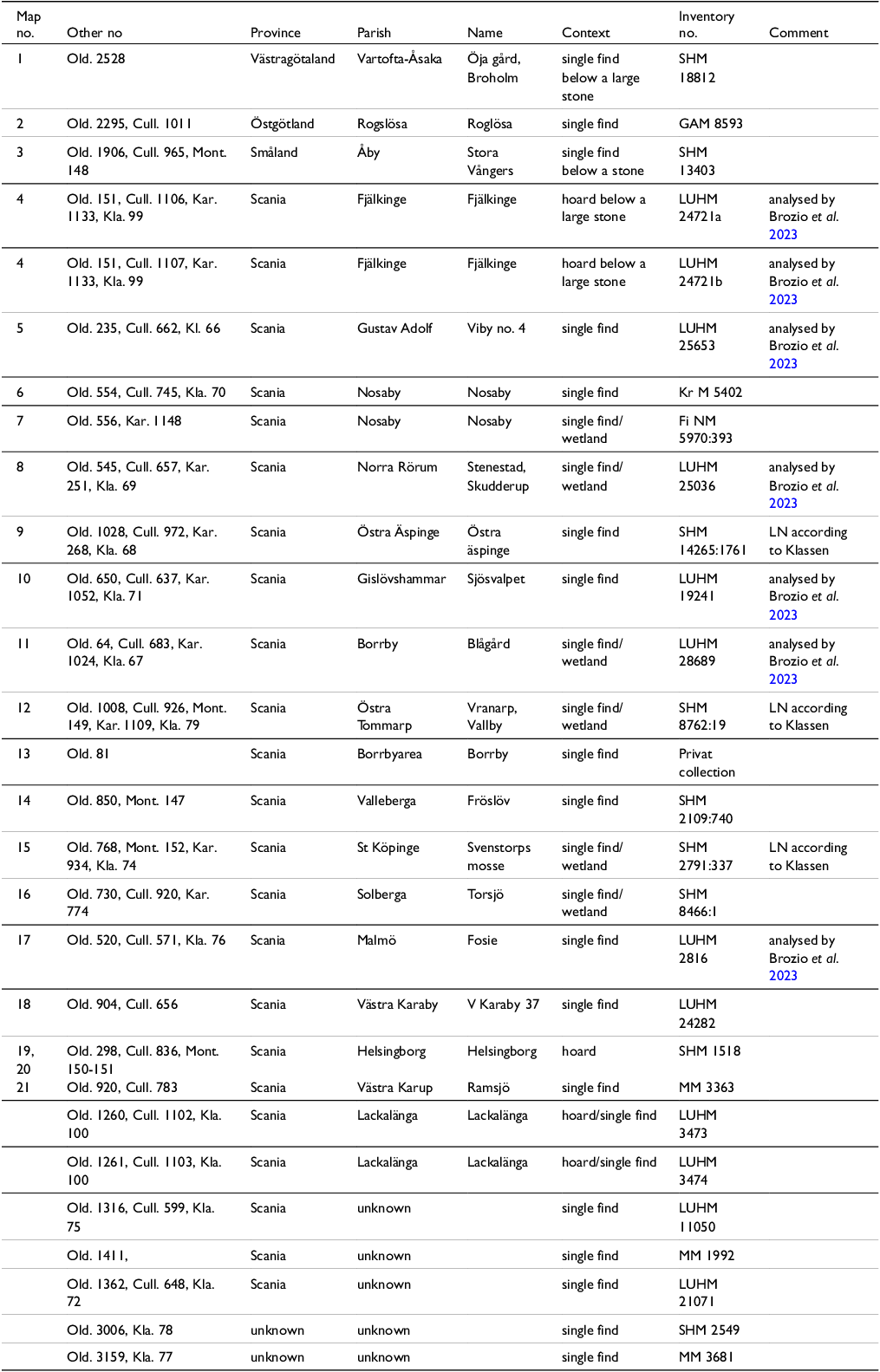
In modern Sweden, 29 EN flat axeheads have been found and documented (Table 1; Figure 1), most of them (24) found in Scania. Only three examples come from other regions of southern Sweden: one from Västergötland, one from Östergötland (close to the western shore of the Lake Vättern), and one from the coastal part of Småland (see Figure 1). So far, no EN flat axeheads have been found along the Swedish west coast, north of Scania, where concentrations of TRB megalithic graves are known (Figure 1). In addition to the flat axeheads, one EN polygonal battle axehead of copper (type K) is known from Oxie, Scania (Montelius Reference Montelius1917, no. 288; Forssander Reference Forssander1936, table III; Oldeberg Reference Oldeberg1974, no. 1417; Klassen Reference Klassen2000, table 17). Polygonal copper axeheads are rare in northern TRB contexts, although copies in stone are widely distributed (Klassen Reference Klassen2000, 215, 146).
EN copper axeheads from Sweden. Data based on Montelius Reference Montelius1917, Forssander Reference Forssander1936, Cullberg Reference Cullberg1968, Oldeberg Reference Oldeberg1974, Karsten Reference Karsten1994, Klassen Reference Klassen2000 and museum collections. The flat axeheads re-classified as Late Neolithic by Vandkilde (Reference Vandkilde2017) are not included in the list

Our revision of the available documentation confirms the long-known relationship between the distribution of EN copper axeheads and the coastal areas of Scania (Larsson Reference Larsson1984; Karsten Reference Karsten1994; Figure 1). However, inland sites also exist, such as Öja in the area of Falbygden. The updated catalogue also reveals that the EN TRB copper axeheads found in Sweden mostly appear as single finds, often below large stone slabs and in wetlands (Table 1).
Falbygden and the Öja copper axehead
Falbygden is located in the south-western Swedish province of Västergötland in between Sweden’s largest lakes, Vänern and Vättern (Figure 1), close to river systems which connect it with the southern part of the country and elsewhere. The calcareous phosphate-rich soils and the abundant water resources make the local land particularly fertile and a favourable place for early farming communities (Sjögren Reference Sjögren2003; Blank et al. Reference Blank, Sjögren, Knipper, Frei and Storå2018).
When compared with the surrounding regions, Falbygden stands out for the impressive number of recorded EN flint axeheads (Blomqvist Reference Blomqvist2009), and for the numerous megalithic graves (Sjögren Reference Sjögren2003), which began to be constructed in the second part of the EN (Blank et al. Reference Blank, Sjögren and Storå2020; Sjögren et al. Reference Sjögren, Blank, Ahlström, Axelsson, Dreibrodt and Müller2023). Furthermore, depositions of flint axeheads and amber (Sjögren Reference Sjögren2003), human remains in wetlands (Sjögren et al. Reference Sjögren, Ahlström, Blank, Price, Frei and Hollund2017), and traces of cultivation determined by means of pollen analyses (Enevold Reference Enevold2019) demonstrate that TRB groups were thriving in Falbygden by the first phase of the EN. Additionally, the presence of both flint and amber, which are not local resources and were necessarily imported, likely from Scania or Denmark, or both (Sjögren Reference Sjögren2003; Ramstad et al. Reference Ramstad, Axelsson, Strinnholm, Fowler, Harding and Hofmann2015), suggests that well-established exchange networks were established throughout the Neolithic period.
The Öja axehead was found in 1918 when the owner of the Öja farm removed a large stone while working in the field at Broholm, in Vartofta-Åsaka parish (Raä 133:1) in Falbygden. The axe had been placed under a stone measuring 2 x 3 m, about 0.5 m below ground (Svensson Reference Svensson1928). The characteristics of the context suggest that the axehead was intentionally deposited, likely for ritual purposes or as part of prestige strategies, as has been hypothesised for other northern European TRB copper axeheads (eg, Visser Reference Visser2021; Müller Reference Müller, Ling, Chacon and Kristiansen2022, 31). The closest archaeological site (only 25 m from the find spot of the axehead) is a passage grave in the same field, which is typologically dated to the MN. The passage grave has never been investigated, and its exact chronology is unknown; considering that there is a close correspondence between early copper finds and the megalithic tombs (Karsten Reference Karsten1994; Klassen Reference Klassen2000), the proximity of those two localities is intriguing.
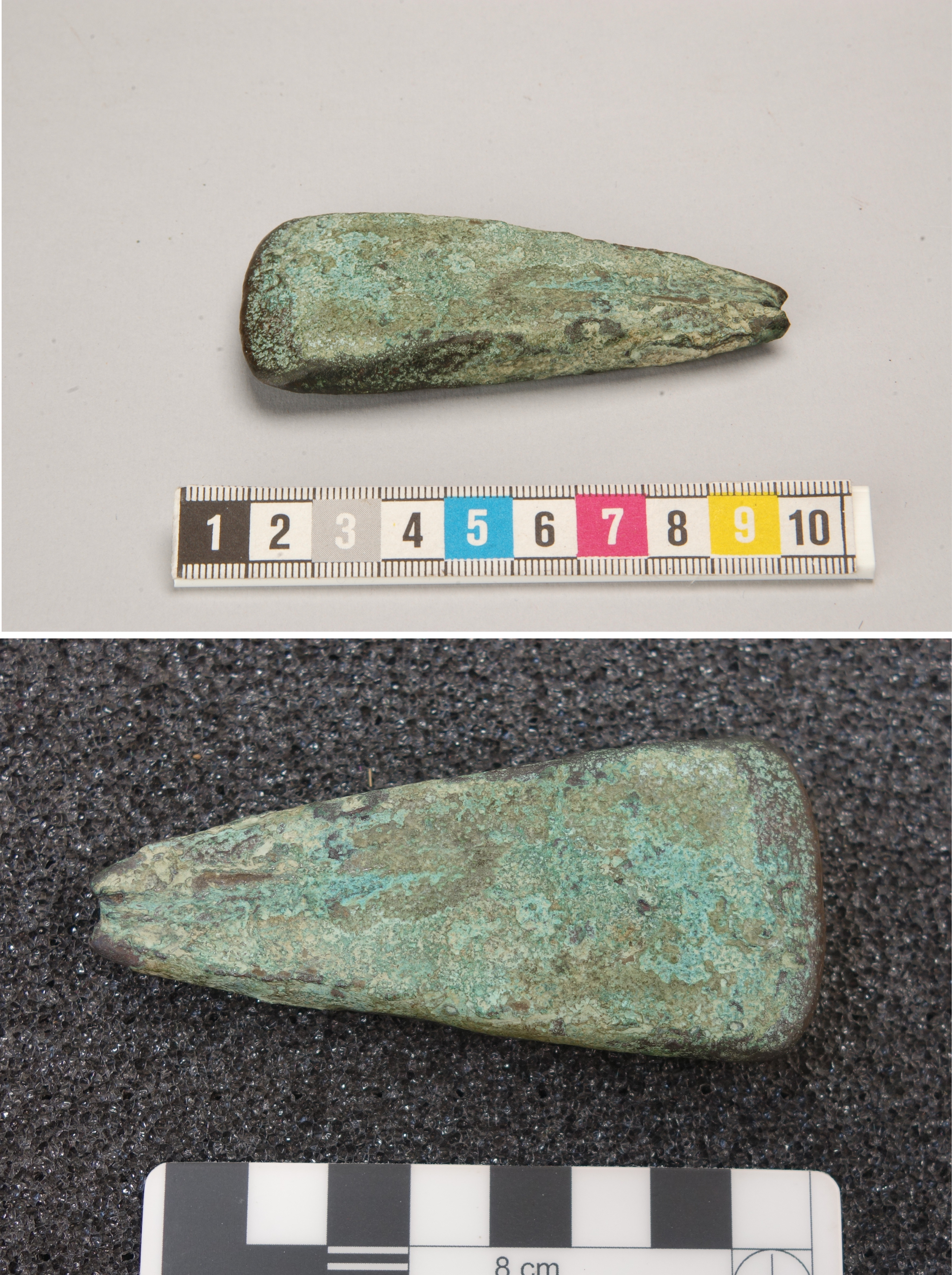
The flat axehead is 8.8 cm long, 1.2 cm thick, 4.2 cm wide at the edge and weighs 202.3 g. It is characterised by a rectangular cross-section with flat faces, and an unusually indented, very narrow butt end of c. 1 cm width (Figure 2). The axehead is apparently undamaged, but on one face the indentation at the butt end extends with a significant c. 4 cm long shallow groove, splitting the narrower upper half of the face into two distinct sections. In the 1940s optical emission spectroscopy analysis was performed on this axehead to determine its chemical composition. The results showed that it was composed of copper with some traces of tin, silver and bismuth (Oldeberg Reference Oldeberg1942, 198–9). No other archeometallurgical analyses have been carried out on this axehead.
The Öja copper axehead. Above: photograph by Sara Kusmin, SHM (Swedish National Historical Museum), CC BY 4.0. Below: photograph taken by Malou Blank.

The dating of this axehead has been discussed in earlier research (Klassen Reference Klassen2000, 215; Blomqvist Reference Blomqvist2009). On the basis of its close resemblance to the point butted flint axeheads, which are considered chronological markers of the EN I period in Scandinavia, Blomqvist (Reference Blomqvist2009) suggested that the Öja find could be considered the earliest copper axe in Scandinavia. Klassen (Reference Klassen2000, 215) proposed an EN date for the Öja axehead, possibly to the second part of that period (3500–3300 BCE), based on its typology and on similarities to other axeheads with chemical compositions pointing to an ENII date.
In this study, we see, from a morphological and taxonomic point of view, close similarities between the Öja axe and Vandkilde’s (1996, 54-5) type 6 axeheads, characterised by a triangular shape and a pointed butt. Only two other axeheads are included in this type, the axehead from Vantore, Denmark, and the axehead from Schwabstedt in southern Schleswig-Holstein, Germany. They have quite different length to width ratios, with the Vantore axehead being significantly more elongated than the Schwabstedt one (Vandkilde Reference Vandkilde1996, 55). The Öja axehead would fit well in such a wide variability range. It shares proportions with the Schwabstedt axehead and the presence of a narrow butt end with the axehead from Vantore, although the indentation is unique to the west Swedish axehead from Öja. Both Vantore and Schwabstedt are single finds and have been dated to an early phase of the Neolithic based on similarities of their shape with a one-piece clay casting mould from Attersee in Austria (see Mayer Reference Mayer1977, table 12), belonging to the Mondsee group (Vandkilde Reference Vandkilde1996, 55). In a later study (Klassen et al. Reference Klassen, Cassen, Pétrequin, Pétrequin, Cassen, Errera, Klassen, Sheridan and Pétrequin2012) Vandkilde’s type 6 is included in the so-called Kaka type. The Kaka triangular flat axeheads are tentatively dated to 4000 to 3800/3700 BCE due to their close relation to the Greenlaw and Chenoise types of Alpine jade axehead (Klassen et al. Reference Klassen, Cassen, Pétrequin, Pétrequin, Cassen, Errera, Klassen, Sheridan and Pétrequin2012). Considering the anomaly represented by the peculiar, indented butt end of the Öja axe, some likeness can be seen with Klassen’s Belsdorf type (Klassen et al. Reference Klassen, Cassen, Pétrequin, Pétrequin, Cassen, Errera, Klassen, Sheridan and Pétrequin2012, fig. 8) although there is a difference in the thickness of the rectangular cross-section. The Belsdorf type is dated to c. 3700 to 3300 BCE, but no detailed account for this more advanced chronological horizon is provided (cf. Klassen et al. Reference Klassen, Cassen, Pétrequin, Pétrequin, Cassen, Errera, Klassen, Sheridan and Pétrequin2012, 1289). From a typological point of view, the Öja axehead remains rather unique, and although there is no doubt it should be considered an EN artefact, it is not possible to provide a more precise date for its manufacture. Depositions of axeheads were recurrent throughout the TRB period (c. 4000-2800 BCE) and therefore a more specific date is difficult to determine.
To investigate the provenance of the metal used to produce the Öja find and contribute to the debate about TRB early copper artefacts in southern Scandinavia, we performed isotope and elemental analyses on one metal sample drilled from the axehead.
The new analyses of the Öja axehead
Methods
The Öja axehead was subjected to chemical and lead isotope analyses. The sampling of the metal was performed at the facilities of the National Historical Museum (SHM) in Stockholm, where the item is stored. To avoid damaging the large triangular faces of the axe a c. 2 mm-deep hole was drilled on one side of the axehead. The hole was made with a portable drill equipped with a tungsten carbide bit of 1.5 mm diameter. Before sampling, the superficial corroded layer of metal was removed and only drill shavings from uncorroded layers below the surface were collected for analysis. The drill shavings were split into two separate groups and sent for lead isotope and chemical analyses, respectively.
Before drilling, the chemical composition of this axehead was checked using pXRF. pXRF analyses were also performed on the drill-shavings before being sent for further analyses. The accuracy of the obtained measurements confirms that pXRF, when proper settings and multiple tests are performed, is a useful tool to quickly assess the chemical composition of the objects under study (see Supplementary Material S1).
Wavelength dispersive analyses (WDS) by electron microprobe analysis (EPMA)
The elemental composition of major, minor, and trace elements was measured by means of wavelength dispersive analyses (WDS) by electron microprobe analysis (EPMA), using the JEOL JXA-8530 F instrument at the Centre for Experimental Mineralogy, Petrology and Geochemistry at Uppsala University. EPMA analyses are widely used in archeometallurgical studies (eg, Ling et al. Reference Ling, Hjärthner-Holdar, Grandin, Billström and Persson2013, Reference Ling, Stos-Gale, Grandin, Billström, Hjärthner-Holdar and Persson2014, Reference Ling, Hjärthner-Holdar, Grandin, Stos-Gale, Kristiansen, Melheim, Artioli, Angelini, Krause and Canovaro2019; Melheim et al. Reference Melheim and Kristiansen2018) to assess the elemental composition of finds. Our drill shavings were first mounted in resin and then ground and polished according to conventional practice. An optical microscope with polarised reflected light was used for microstructural analyses to define the structure and texture and prepare for WDS by EPMA (Grandin Reference Grandin2024).
Point analyses were made of individual phases but mainly as area scans (maximum 15 by 15 microns). Due to the characteristic heterogeneity of copper alloys, multiple area scans were made, and mean values calculated. Two in-house reference bronze samples with complex trace elemental signatures were included in the analytical sessions. The analytical data obtained were related to standards and ZAF corrected accordingly (Grandin Reference Grandin2024).
Lead isotope analysis
The Pb isotope analyses were performed by Nu Plasma 3 MC-ICP-MS at Vegacenter, Swedish Museum of Natural History in Stockholm. The drilled samples were weighed in 7 ml Savillex vials and dissolved using 1 ml 8M HNO3, on a hotplate at 100°C for c. 3 days. The basalt reference sample, BCR-2 (USGS), was co-dissolved and ion-exchanged for use as a secondary standard. The Pb was extracted using AG1x8 (200–400 mesh) resin and 0.5 M HBr, followed by elution with MilliQ water. Before analysis Pb fractions were dried down and redissolved in 1 ml 0.3 M HNO3 and spiked with Tl for correction of mass-bias and intrasession instrument drift. Sample introduction employed an Aridus II desolvating nebuliser (Teledyne Cetac) with argon sweep (5.5 L min-1) and nebuliser (30 psi) gases; each analysis comprised a 60 s on-mass zero in blank acid, followed by a 45 s pause for sample transfer. Analyses comprised two blocks of 20 cycles, each of 8 s separated by a 2 s pause, followed by a 70 s washout. An all-Faraday detector array with 1011 Ohm preamplifiers was used with a static magnet setting. Thallium-spiked NBS SRM 981 was run at the session start and after every seventh unknown; as measured values were indistinguishable at the 2 s (abs) level from reference values (Todt et al. Reference Todt, Cliff, Hanser, Hofmann, Basu and Hart1996), no standard normalisation was applied. In-run dispersion of SRM 981 was used for uncertainty propagation. Measured BCR-2 values were also indistinguishable at the 2 s (abs) level from reference values (Woodhead & Hergt Reference Woodhead and Hergt2000).
Lead isotope analyses are an established method for investigating the provenance of copper used in archaeological artefacts (eg, Gale & Stos-Gale Reference Gale and Stos-Gale1982; Reference Gale, Stos-Gale, Ciliberto and Spoto2000; Radivojević et al. Reference Radivojević, Roberts, Pernicka, Stos–Gale, Martinón-Torres, Rehren, Bray, Brandherm, Ling, Mei, Vandkilde, Kristiansen, Shennan and Broodbank2019; Pernicka et al. Reference Pernicka, Begemann, Schmitt-Strecker and Wagner1993). The methodology of lead isotope provenance assessment is based on a comparative principle. The lead isotope ratios of each analysed artefact are compared with the database of over 11,000 sets of data for samples of ores from known deposits, including data from the IBERLID and OXALID online databases (Stos-Gale & Gale Reference Stos-Gale and Gale2009; García de Madinabeitia et al. Reference García de Madinabeitia, Gil Ibarguchi and Santos Zalduegui2021), and many other data published in geological and archaeometallurgical papers (eg, Hauptmann et al. Reference Hauptmann, Begemann, Heitkemper, Pernicka and Schmitt-Strecker1992; Pernicka et al. Reference Pernicka, Nessel, Mehofer and Safta2016; Artioli et al. Reference Artioli, Canovaro, Nimis and Angelini2020; Radivojević et al. Reference Radivojević, Roberts, Marić, Kuzmanović-Cvetković and Rehren2021; Williams Reference Williams2023).
The comparisons used for this project were made using TestEuclid distance calculations normalised to the analytical error of 0.1%. The list of mineralisations that show lead isotope ratios consistent with the data for the Öja axehead were then examined to check if the geochemistry and chronology of mining in this region are also consistent with that of the artefact. Most of the copper mines in Europe have known geochemistry and periods of exploitation. The identification is fine-tuned using a twofold set of additional parameters: on the one hand the data from the chemical analyses, which allow the inclusion or discard of ores with completely different chemical signatures than those identified in the studied object, and on the other hand, the archaeological evidence underpinning the possibility that the selected ores could have been in use during specific time periods.
Chemical and lead isotope results
The results of the elemental analyses of the axehead from Öja
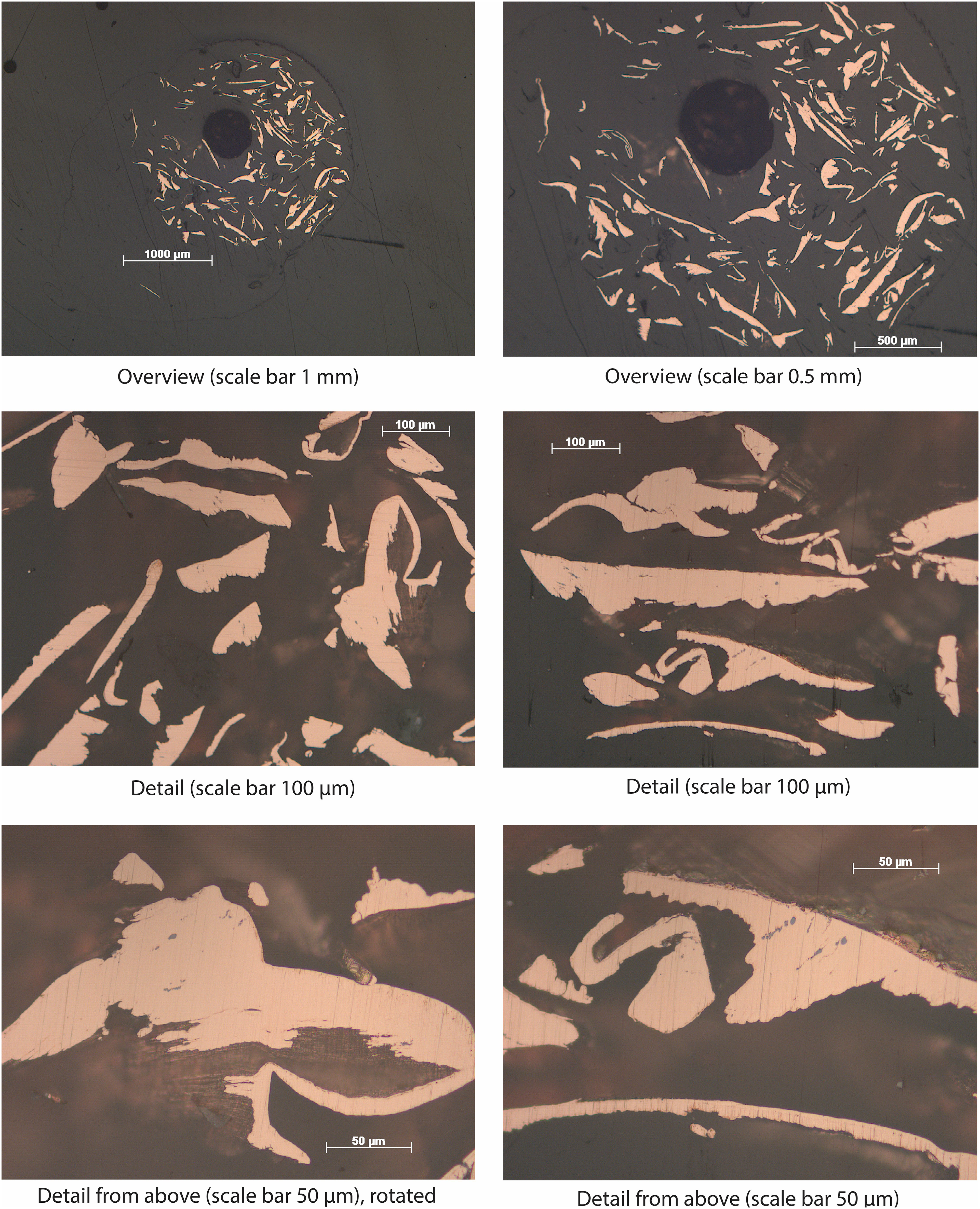
The EPMA analyses showed that the drill shavings consisted of 30-80 µm long flakes of homogenous low impurity copper (Figure 3; Table 2).
Micrographs of the mounted and polished sample (Grandin Reference Grandin2024, 6). Top row: overview of the thin (red) drill shavings in the epoxy matrix. Below: close-ups of various details in the metal (alloy), degree of homogeneity, occurrences of sulphides/oxides (dark grey, black arrows). EPMA (WDS) confirms the grey phases to be copper oxide. No lead droplets are observed.

Mean chemical composition (in wt-%) of the Öja axehead drill-shavings, obtained by EPMA-WDS. Average values are calculated from multiple area scans (n=number of analysed areas)

The full chemical dataset is in the supplementary material (Table S1) and Grandin (Reference Grandin2024), while the elements which are considered the most relevant as geochemical indicators of ore deposits, nickel (Ni), antimony (Sb), arsenic (As), silver (Ag), zinc (Zn), lead (Pb) and gold (Au), along with the copper (Cu) content are reported in Table 2. For most elements, the detection limits are c. 30 to 70 ppm. A few elements have a higher detection level: Ag c. 140 ppm, Au c. 200 ppm and Pb c. 330 ppm (Grandin Reference Grandin2024). According to the EPMA-WDS results (Table 2), the Öja axehead was made of a low impurity copper containing relatively abundant As (0.6%), a composition which was observed in several other EN artefacts analysed in previous studies (eg, Brozio et al. Reference Brozio, Stos-Gale, Müller, Müller-Scheeßel, Schultrich, Fritsch, Jürgens and Skorna2023). The chemical composition of the Öja axehead does not match the so-called Riesebusch copper because the Sb content is very low (20 ppm) and it seems to have quite high gold content. It does not completely correlate with the Mondsee copper either, since Sb and Ni are only present in tens of ppm (see Klassen & Stürup Reference Klassen and Stürup2001). The results from the pXRF analysis, especially those on the drill-shavings, which have been less exposed to corrosion and contamination, are similar to the data obtained by the EPMA-WDS analysis (see Tables 2 and S2).
From a chemical point of view, the Öja axehead is similar to results obtained on recently analysed TRB copper axeheads (Brozio et al. Reference Brozio, Stos-Gale, Müller, Müller-Scheeßel, Schultrich, Fritsch, Jürgens and Skorna2023), particularly regarding Sn, As and Ag content. The elemental compositions of the Sjösvalpet axehead (dated to c. 3750–3300 BCE) found in Scania (cf. Brozio et al. Reference Brozio, Stos-Gale, Müller, Müller-Scheeßel, Schultrich, Fritsch, Jürgens and Skorna2023, S1) is the most similar to the Öja axehead, but its lead isotope composition is quite different.
Lead isotope results
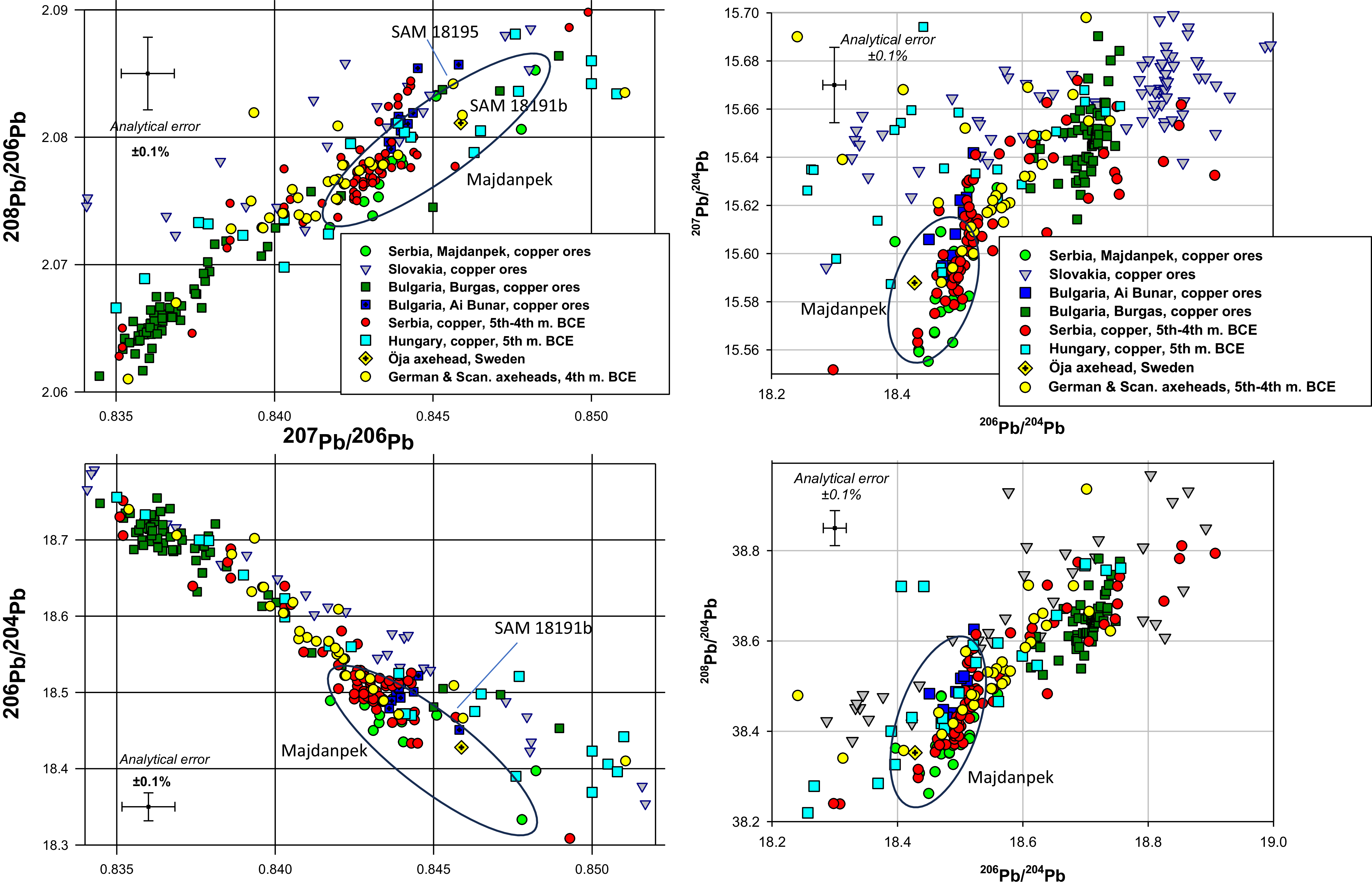
Lead isotope analyses were successfully conducted on drill shavings from the axehead (Table 3). The lead isotope ratios of the Öja axehead were compared with all data for copper ores, as explained above. The Öja axehead has distinctly different lead isotope ratios to the ones expected from Scandinavian ores, belonging to the oldest mineralisations in Europe (Blichert-Toft et al. Reference Blichert-Toft, Delile, Lee, Stos-Gale, Billström, Andersen, Hannu and Albarede2016). Published lead isotope ratios of copper ores from Helgoland are highly radiogenic and completely different to the ratios obtained from the Öja axehead (Frotzcher Reference Frotzscher2012). The TestEuclid calculations indicate that the most probable source for the copper used for the Öja axehead is the Majdanpek mine in Serbia. This is also clear on the graphic comparisons of the lead isotope data (Figure 4), where it is also shown that the lead isotope ratios of the axehead plot close to copper artefacts from the Serbian Early Chalcolithic Vinča culture settlements at Belovode and Pločnik.
Result of the lead isotope analyses of the Öja axehead

Comparison of lead isotope patterns for ores from south-eastern Europe, including ores from Serbia, Slovakia and Bulgaria and Chalcolithic artefacts from Serbia and Hungary, with the Öja axehead (yellow diamond) and other Early Neolithic artefacts analysed in earlier studies, including the copper artefacts from Schleswig-Holstein (Pernicka et al. Reference Pernicka, Begemann, Schmitt-Strecker and Wagner1993; Siklósi et al. Reference Siklósi, Prange, Kalicz, Raczky, Anders, Reingruber, Hansen and Raczky2015; Siklósi & Szilágyi Reference Siklósi and Szilágyi2019; Brozio et al. Reference Brozio, Stos-Gale, Müller, Müller-Scheeßel, Schultrich, Fritsch, Jürgens and Skorna2023).

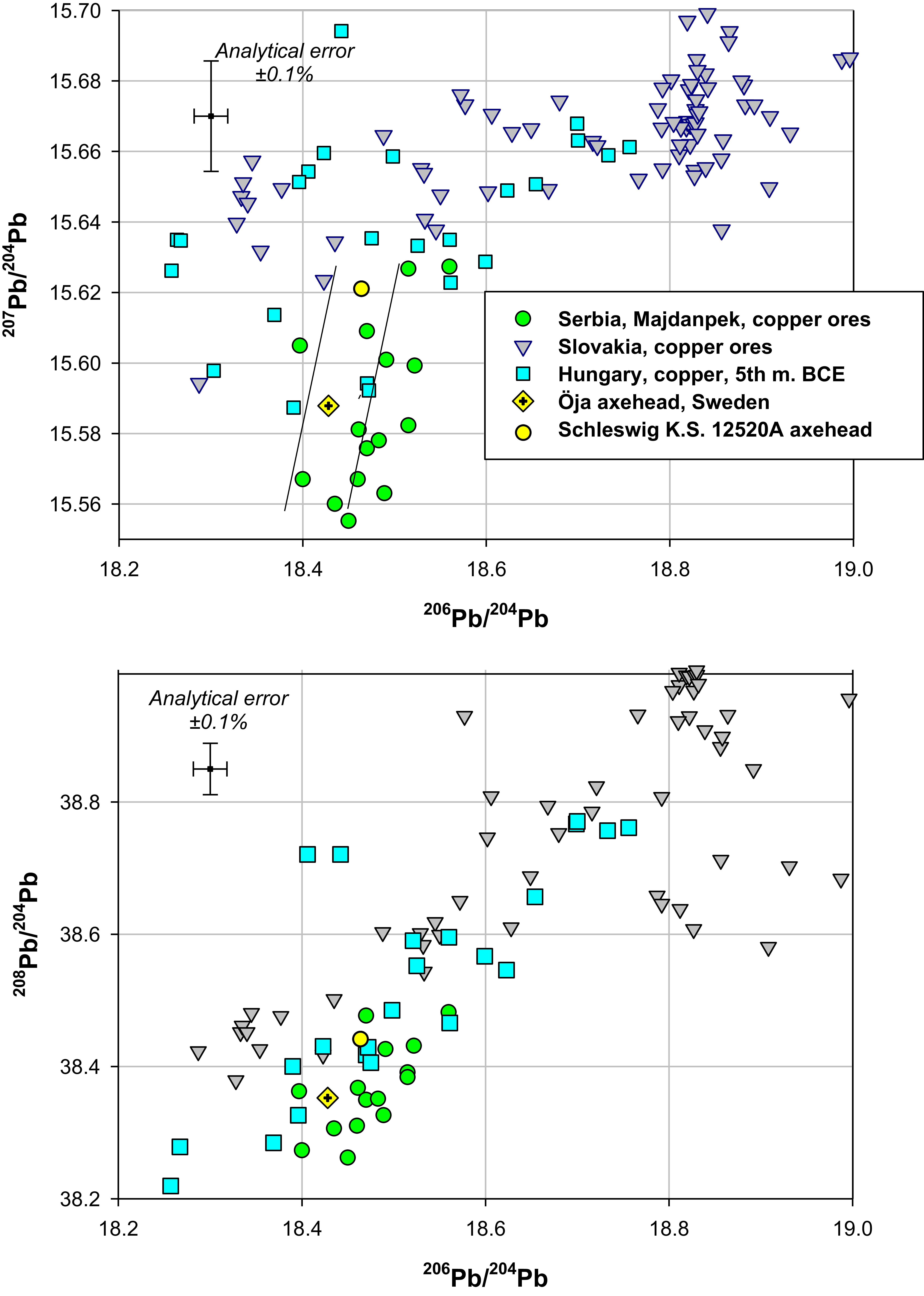
Comparisons were also made with artefacts analysed by Nørgaard et al. (Reference Nørgaard, Pernicka and Vandkilde2019; Reference Nørgaard, Pernicka and Vandkilde2021) but none had comparable lead isotope ratios. The artefacts analysed in that project have chemical compositions indicating copper originating from tetrahedrite ores containing antimony and silver, while the axehead from Öja was made from very pure copper with only a small amount of arsenic. Therefore, it seems that those axeheads were made from copper from a different deposit, most likely located in the Austrian Alps. However, the chemical composition and lead isotope ratios of the Öja axehead are very similar to the compositions of copper artefacts from the Schleswig-Holstein, Riesebusch hoard dated to 3500–3300 BCE, for which ores from Serbia have been suggested as the source of copper (Brozio et al. Reference Brozio, Stos-Gale, Müller, Müller-Scheeßel, Schultrich, Fritsch, Jürgens and Skorna2023: S1). In particular, the flat axehead (Schleswig K.S. 12520A/SAM 1819b) and a spiral (Schleswig K.S. 12520) made of pure copper with some arsenic have lead isotope ratios within the analytical error from the axehead from Öja (Figure 4). Comparisons with the data for the 5th millennium BCE copper artefacts from Hungary (Siklósi et al. Reference Siklósi, Prange, Kalicz, Raczky, Anders, Reingruber, Hansen and Raczky2015; Siklósi & Szilágyi Reference Siklósi and Szilágyi2019) show that two or three of these artefacts could have originated from the same ore source.
In Figure 5, the data for ores from Majdanpek is plotted more clearly and compared with the lead isotope ratios of the Chalcolithic artefacts from Hungary, the Öja axehead and the axehead found in Schleswig. The two axeheads from northern Europe and three of the artefacts from Hungary seem consistent with the geochronological characteristics of the ores from Majdanpek, however the lead isotope ratios of these artefacts are not identical to the samples of ores from Majdanpek analysed so far. The ellipses in Figure 4 mark the range of lead isotope ratios of this mine and it seems that there might be a small difference in lead isotope ratios between different outcrops of copper minerals in this location, indicating that the minerals exploited there were formed at different times. Similar results were obtained when only 39 lead isotope ratios were available for the ores from Cyprus (Gale & Stos-Gale Reference Gale and Stos-Gale1985; Reference Gale and Stos-Gale1986); the pattern of the lead isotope ratios for different mines only became clear when about 500 ore samples from different locations were analysed (Gale et al. Reference Gale, Stos-Gale, Maliotis and Annetts1997; Stos-Gale et al. Reference Stos-Gale, Maliotis, Gale and Annetts1997). The currently available database for Majdanpek consists of only 12 datasets and includes two samples analysed in the Isotrace Laboratory in Oxford provided by geologists, the native copper (TG253 E-1) and the mineral from Lipa (TG 262) analysed in Mainz (Pernicka et al. Reference Pernicka, Begemann, Schmitt-Strecker and Wagner1993) that have lead isotope ratios close to the group of artefacts that include the Öja axehead. These four copper minerals have higher 208Pb/206Pb ratios than that of the remaining eight published samples. Many more analyses of ores from the mines of Majdanpek are necessary to obtain a full picture of the geochronology of this important copper deposit.
Data for the copper ores from Majdanpek, Serbia and the Slovak Ore Mountains compared with Chalcolithic artefacts from Hungary and axeheads from Schleswig-Holstein and Öja. The lines on the upper plot indicate the possible two separate mineralisation events in the mine of Majdanpek.

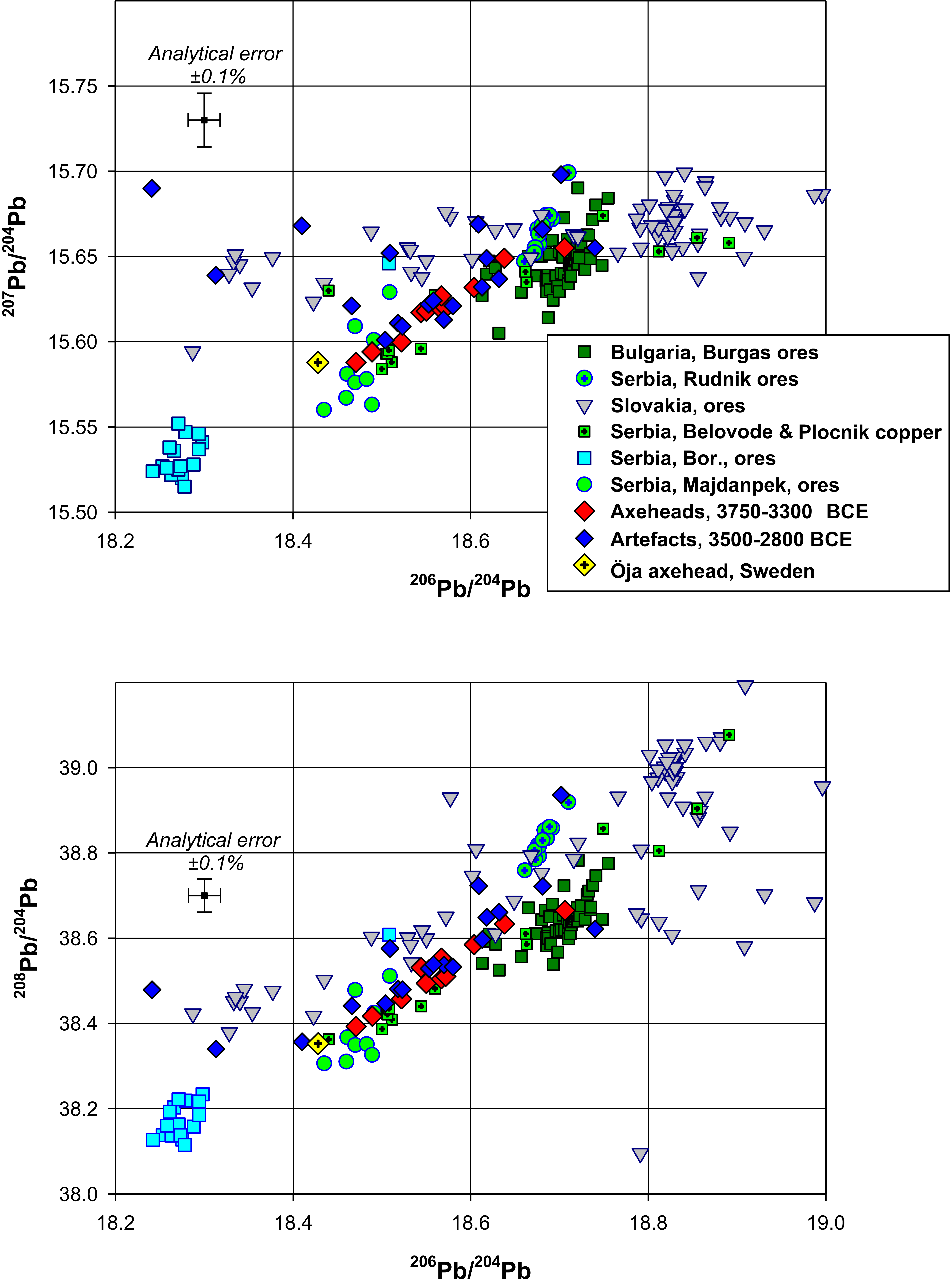
As mentioned above, the publications of analyses of copper artefacts from Poland (Kowalski et al. Reference Kowalski, Stos-Gale, Adamczak, Maas, Woodhead, Garbacz-Klempka, Kozicka, Kofel and Matuszczyk2024; Reference Kowalski, Adamczak, Garbacz-Klempka, Degryse, Stos-Gale, Kozicka, Chudziak, Krzyszowski and Jedynak2019; Wilk et al. Reference Wilk, Stos-Gale, Schwab, Zastawny, Sych, Kiełtyka-Sołtysiak and Momot2024) and Bulgaria (Gale et al. Reference Gale, Stos-Gale, Radouncheva, Ivanov, Lilov, Todorov, Panayotov, Craddock and Lang2003) indicate that in the 5th and 4th millennium BCE copper was smelted in several central European regions. The earliest Polish copper artefacts seem to be made mainly from copper mined in Serbia and Bulgaria, while sometime during the 4th or 3rd millennium BCE there is a shift to use of the copper from the Slovak Ore Mountains and Fahlerz copper containing silver and antimony mined in the Austrian Alps. This shift is also visible in the copper artefacts from northern Europe published by Brozio et al. (Reference Brozio, Stos-Gale, Müller, Müller-Scheeßel, Schultrich, Fritsch, Jürgens and Skorna2023) as presented in Figure 6. The use of copper from the Slovak Ore Mountains is clearly visible amongst the group dated to the end of the 4th millennium and beginning of the 3rd millennium BCE.
Comparison of the lead isotope ratios of EN axeheads from northern Europe (Brozio et al. Reference Brozio, Stos-Gale, Müller, Müller-Scheeßel, Schultrich, Fritsch, Jürgens and Skorna2023) with the ores from the Balkans and the Slovak Ore Mountains.

Discussion
The origin of the Öja axehead in light of isotopic and elemental analyses
The flat triangular copper axehead unearthed at Öja farm in Västergötland in 1918 is one of the most northerly 4th millennium BCE TRB copper finds from Europe. As discussed above, being a single find, it is difficult to provide a precise chronology for it. It is evident that the Öja axehead was a unique and exotic artefact in the local TRB community. The find location underneath a large boulder indicates a ritual deposition in a non-mortuary domain and follows the general pattern for copper flat axeheads observed in south Scandinavia (Karsten Reference Karsten1994; Klassen Reference Klassen2000; Müller Reference Müller, Ling, Chacon and Kristiansen2022).
To enhance our understanding of this artefact and investigate the origin of the copper used to produce it, we performed isotope and elemental analyses on drill shaving from the axehead. The results of the lead isotope analyses revealed similar values to those recently obtained on other Scandinavian TRB copper axeheads (Brozio et al. Reference Brozio, Stos-Gale, Müller, Müller-Scheeßel, Schultrich, Fritsch, Jürgens and Skorna2023), showing consistency with the Majdanpek ore deposits in eastern Serbia, although an unknown source, perhaps from the same region, cannot be ruled out. When and where the axehead was manufactured, as well as the mechanisms through which it reached the inner part of the region of Västergötland in Sweden, remain to be understood.
Debates exist as to the exchange networks of copper ores and artefacts at play during the 5th and the 4th millennium BCE all over the continent (Klassen Reference Klassen2000; Klassen et al. Reference Klassen, Cassen, Pétrequin, Pétrequin, Cassen, Errera, Klassen, Sheridan and Pétrequin2012; Pétrequin et al. Reference Pétrequin, Sheridan, Gauthier, Cassen, Errera, Kerig and Shennan2015). The very presence of this copper axehead in the inland territory of Falbygden provides a striking idea of the vastness of such networks. It also demonstrates that geographically peripheral communities such as those living in inland western Sweden were not socially or culturally isolated. The EN archaeological evidence from Falbygden, including the Öja axehead, numerous flint axeheads as well as the impressive sizes and concentration of megalithic graves, show that a relatively large TRB population with a complex social structure was inhabiting the region, connected to a long-distance exchange network with southern Scandinavia and beyond.
Evidence of early metallurgy is not unproblematic but widespread in TRB-related and EN sites in central and northern Europe. According to Nørgaard et al. (Reference Nørgaard, Pernicka and Vandkilde2021) and Skorna (Reference Skorna2022) metallurgical skills were probably introduced by contacts with the Alpine regions and maybe even the Balkans. The earliest known evidence indicating copper metallurgy in a TRB context was found in Kotowo, Greater Poland (Zurkiewicz et al. Reference Zurkiewicz, Strózyk, Garbacz-Klempa, Szmyt and Silska2023), and Gebauer et al. (Reference Gebauer, Bendtsen, Sørensen, Nørgaard and Reiter2025, 168) suggest that metalworking skills were transferred to TRB communities from the Lengyel-Polgár groups in Poland. In Scandinavia, the crucible and the possible tuyère from Lønt suggest that metallurgy was to some extent known in mid-4th millennium BCE, at least in some parts of Denmark (Gebauer et al. Reference Gebauer, Sørensen, Taube and Wielandt2020). As no traces of metallurgical activity has been found in west Sweden, the most likely assumption is that the Öja axehead was manufactured elsewhere and imported.
Nørgaard et al. (Reference Nørgaard, Pernicka and Vandkilde2021, 29) and Skorna (Reference Skorna2022, 80) proposed that south-eastern European copper reached TRB groups in Germany and southern Scandinavia via the Mondsee group communities in the Austrian Alps. A possible connection between these areas can be seen in the mould found in Mondsee resembling one of the axeheads from the Bygholm hoard (Klassen Reference Klassen2000, 116). Klassen et al. (Reference Klassen, Cassen, Pétrequin, Pétrequin, Cassen, Errera, Klassen, Sheridan and Pétrequin2012) suggested that the Kaka and Belsdorf axeheads, whose shape is partly reminiscent of the Öja artefact (see above), originated in Saxony-Anhalt, Germany, where most of these axeheads have been found. The Öja axehead weighs c. 200 g, which better fits the flat axeheads from the Alpine area (average weight of two groups: 220 g and 151 g) than the axeheads from the TRB contexts (average weight of 381 g; see Klassen Reference Klassen2000, 225).
It has been proposed that the area of Falbygden was part of a well-organised network from which it received flint and amber from Denmark and Scania (Sjögren Reference Sjögren2003; Ramstad et al. Reference Ramstad, Axelsson, Strinnholm, Fowler, Harding and Hofmann2015). Whether the Öja axehead was manufactured in central Europe at places such as Attersee, Austria, where a clay casting mould with a triangular axehead shape impression was recovered (Mayer Reference Mayer1977, table 12), in Saxony-Anhalt, Germany (see above), or in south-eastern Europe close to the ore sources, it is likely that it arrived in Falbygden through the same networks as flint and amber from Denmark and Scania. The absence of copper axeheads from the coastal area of west Sweden north of Scania (Figure 1), strengthens the assumption that different TRB groups participated in different networks and that a more direct connection existed between TRB groups in inland western Sweden, Scania, and south-eastern Denmark (see Sjögren Reference Sjögren2003, 16–18). Likely gathering places for these communities has been proposed in the TRB enclosures, which are mainly found in Funen and on Zealand (Andersen Reference Andersen1997), where concentrations of copper flat axeheads are known. Recently, an EN enclosure site was discovered at Hammar, outside Kristianstad, Scania (Magnus Artursson pers. comm.), in the same area where copper flat axeheads were found (Figure 1: 4–7). The enclosure sites may have served as ritual centres as well as nodes in wider networks through which copper axeheads were distributed.
Copper mining in south-eastern Europe and the Öja axehead: questions and challenges
South-eastern Europe and in particular the history of the exploitation of the mining districts of eastern Serbia and Bulgaria, as discussed above, has been recently reassessed (Radivojević and Grujić Reference Radivojević and Gruyjic2018; Radivojević & Roberts Reference Radivojević, Roberts, Radivojević, Roberts, Marić, Kuzmanović Cvetković and Rehren2021) showing the great vitality of these regions during the local Copper Age (c. 5000–3700 BCE), followed by an apparent period of inactivity during the later so-called Proto-Bronze Age period (c. 3700–3200 BCE). The implications of this historical transformation for the flow of both artefacts and minerals to the rest of the continent, including Scandinavia, have not yet been thoroughly discussed.
We believe that the results of recent provenance studies, including the one presented here, impose the need to carefully re-evaluate existing datasets. Why would metal from the eastern Serbian mines of Majdanpek, which apparently remain inactive during the local Proto-Bronze Age, be used to produce most of the TRB artefacts from Scandinavia, which are generally dated between 3800 and 3300 BCE? Are there other copper ore sources that have not yet been discovered and analysed? Did the production of the EN flat copper axeheads entail a chaîne opératoire that operated according to arrangements and necessities that are not easy to grasp? Can the apparent discrepancy between the chronology of the mining and that of the deposition of the artefacts be explained as the outcome of complex biographies and remelting of older artefacts? The possibility that EN flat axeheads were re-melted to cast them into local forms or into larger axeheads has been considered with interesting arguments by several researchers (eg, Klassen Reference Klassen, Andersen and Nielsen2010, 39; Gebauer et al. Reference Gebauer, Sørensen, Taube and Wielandt2020, 2; Gebauer et al. Reference Gebauer, Bendtsen, Sørensen, Nørgaard and Reiter2025, 170). Could there be a connection between the potential re-melting of EN copper axeheads and the later use of copper axeheads (and rings) as raw materials or ingots during the Late Neolithic and Early Bronze Age (eg, Nørgaard Reference Nørgaard, Risch, Pernicka and Meller2024)? Recasting done without mixing copper from different artefacts, would indeed maintain a stable isotopic signature.
According to Klassen’s (Reference Klassen2000, 235) three-step development of local metallurgy in southern Scandinavia, during the third phase (3500–3000 BCE) local axeheads were produced by TRB communities in northern central Europe and southern Scandinavia. The local types generally consisted of smaller axeheads which were recast into axeheads that were larger and heavier than the original imports. The second and third phase would roughly correspond to south-eastern Europe’s Proto-Bronze Age period, which is the time when local mining seems inactive. In other words, unless future studies show that other ores were mined during this period, one might consider locally produced northern European axeheads as an attempt to cope with shortage of metal from the networks developed during Klassen’s first step.
Conclusions
The results presented in this publication confirm earlier studies indicating that the east Serbian ores played a crucial role for the development of early metallurgy in continental Europe. The challenge now is to understand the underlying production and exchange networks. Whether or not Scandinavian EN TRB communities were aware of the origin of the copper that was used to produce these early metal artefacts, the Serbian copper circulated widely reaching remote regions such as inland south-western Sweden.
Archaeological evidence for amber and flint suggests that Falbygden TRB communities were connected to TRB societies in southern Sweden and Denmark, which were in turn linked to central Europe and maybe also south-eastern Europe. But does a down-the-line model provide a satisfactory explanation for the apparent discrepancies that occur when the chronology of these early finds and that of the exploitation of the eastern Serbian mines are compared? It seems that the end of the local final Chalcolithic marks the beginning of a long period of little or no activity at eastern Serbian ore deposits. In theory, such a period would instead correspond to that in which most of the early copper artefacts in northern Europe are generally dated. We see various possible scenarios: 1) south Scandinavian TRB copper artefacts were produced during the EN I, perhaps in south-eastern Europe, and circulated widely and for a long time afterwards, 2) Serbian copper may have been extracted even if currently the archaeological and isotopic record suggests that local mining activities discontinued or, 3) after the downfall of mining activity in south-eastern Europe, copper of Serbian origin may have continued to circulate, used and recast to produce exclusive objects such as the flat axeheads. Current knowledge does not allow the exclusion of any of these scenarios, but it is clear that the individual biographies of these artefacts and the exchange networks along which they circulated, were complex.
The outcomes of the analyses of the Öja axehead confirm earlier results (Nørgaard et al. Reference Nørgaard, Pernicka and Vandkilde2021; Brozio et al. Reference Brozio, Stos-Gale, Müller, Müller-Scheeßel, Schultrich, Fritsch, Jürgens and Skorna2023). However, the study has also generated new interesting questions. We suggest that the climax and dip of mining activities in south-eastern Europe needs to be taken into further consideration for an in-depth understanding of the production and consumption of early copper artefacts in Europe and Scandinavia.
Supplementary material
To view supplementary material for this article, please visit https://doi.org/10.1017/ppr.2025.10068
Acknowledgements
Research for this paper was funded by the Adlerbertska Stiftelser and Lennart J. Hägglunds Stiftelse. We wish to thank Chris Mark, Melanie Kielman-Schmitt, and Karin Wallner for analytical assistance at NordSIMS-Vegacenter, Natural History Museum, Stockholm. NordSIMS-Vegacenter is funded by the Swedish Research Council as a national research infrastructure (Dnr. 2021-00276). This is Vegacenter publication number 091. We are very grateful to Lena Grandin who performed the elemental analyses (EPMA/WDS). We also thank Thomas Eriksson at the Swedish National Historical Museum, Linn Nordvall, and Karl-Göran Sjögren at the Department of Historical Studies, University of Gothenburg, for support. We are grateful for the helpful comments and suggestions from the reviewers and the editor.




 Open access

