





Introduction
Logwood is the admittedly unimaginative name for the species Haematoxylum campechianum, a tree native to the greater Yucatán Peninsula.Footnote 1 During the sixteenth, seventeenth, and eighteenth centuries, its native range extended from the southern coast of the Bay of Campeche across the Yucatán Peninsula to the Bay of Honduras where swampy terrain and porous limestone bedrock allowed the tree to thrive.Footnote 2 More imaginative than its name was its use: the logwood tree's inner heartwood, when refined and mixed with water and other compounds, yields a natural dyestuff valued by Europe's early modern textile dyers for the range of black and dark blue hues it produced. Following European colonization in its native region, logwood became an item of transatlantic commerce. Demand from the European textile industry fuelled logwood harvesting and the logwood trade became the primary economic activity of this sparsely-settled region of the New World.
Despite its primacy around the Yucatán Peninsula, the logwood trade made up a small facet of overall New World colonial commerce. Other Spanish territories exported precious metals that were more valuable by orders of magnitude. By the time English traders started exporting logwood from the region in the mid-seventeenth century, English colonies in the Caribbean and North American were already exporting sugar, tobacco, and timber. Even comparing logwood just to other dye sources, New Spain produced cochineal and indigo, both of which European dyers used more intensely than logwood. These comparisons notwithstanding, the logwood trade had outsized political ramifications relative to its economic heft. Logwood has proved a fascinating commodity for historians due to its contentious place in diplomatic disagreements between England and Spain, its links to the waning of the golden age of English piracy in the Caribbean, and as the impetus for English settlement on the Meso-American mainland that became the colony of Belize.
Behind the logwood trade's geopolitical importance was a complex economic activity that has been largely neglected. Anglo-Spanish imperial rivalry dominates most treatments of the logwood trade, which also tend to focus specifically on either Campeche or Belize.Footnote 3 They leave out many of the trade's other themes as well as its influence elsewhere around the Caribbean and across the Atlantic. Crucially, they mostly ignore the demand for and use of logwood in Europe. They reference its purpose on the other side of the Atlantic to establish its merit but focus on its supply in the New World. Carlos Marichal has bemoaned what he sees as “economic historians’ neglect of the trade in dyes from the Americas,” especially the demand for these dyes in the markets of Europe. He began to rectify this neglect by examining the Mexican red dyestuff cochineal, but he highlights logwood, brazilwood, and indigo as other New World dye sources whose trades and European demand still suffer from a lack of research.Footnote 4
This study aims to broaden our understanding of the logwood trade in the New World and begin to explore logwood's impact on the economic history of Europe. It approaches the trade holistically as an economic activity that existed across empires and continents. We start on the supply side in the New World by examining how the logwood trade operated and matured as a commercial endeavour. Who were logwood's harvesters? Where and how did they source logwood in the region? How did imperial territorial shifts, the trade's own environmental impact, and other economic opportunities alter harvesting patterns? These questions begin with the political aspect of the logwood trade but quickly expand into the trade's relationship with the environment, slave and indigenous labour sources, and other trades in Caribbean commerce. We then turn to Europe and the demand for logwood. How was logwood refined to create an ingredient fit for dyeing? How did Europe's textile dyers use the dyestuff? How did consumers view logwood dyes and how did officials regulate them? What was the scale of the trade and how lucrative was it? The lack of a comprehensive source of quantitative data hinders our ability to answer this last question but the fragmentary figures that do exist suggest a profitable trade that grew rapidly in the early decades of the eighteenth century.
From this exploration we see a multifaceted economic activity with links to many crucial themes in the history of the early modern Atlantic world. The logwood trade began as a non-plantation activity in the Caribbean that had connections to the transatlantic slave trade, European-indigenous relations, and the environmental history of the Caribbean basin. Later, logwood cultivation became a plantation-based industry, changing its relationship with those themes. A trade that appears primitive and extractive in the New World contributed to an expanding and modernizing textile industry in Europe. Logwood was a versatile dyestuff that spurred early forms of consumer protection and innovation in the midst of European proto-industrialization. The logwood trade is thus a compelling economic activity the influence of which extends beyond its geo-political importance.
The Logwood Trade in the New World
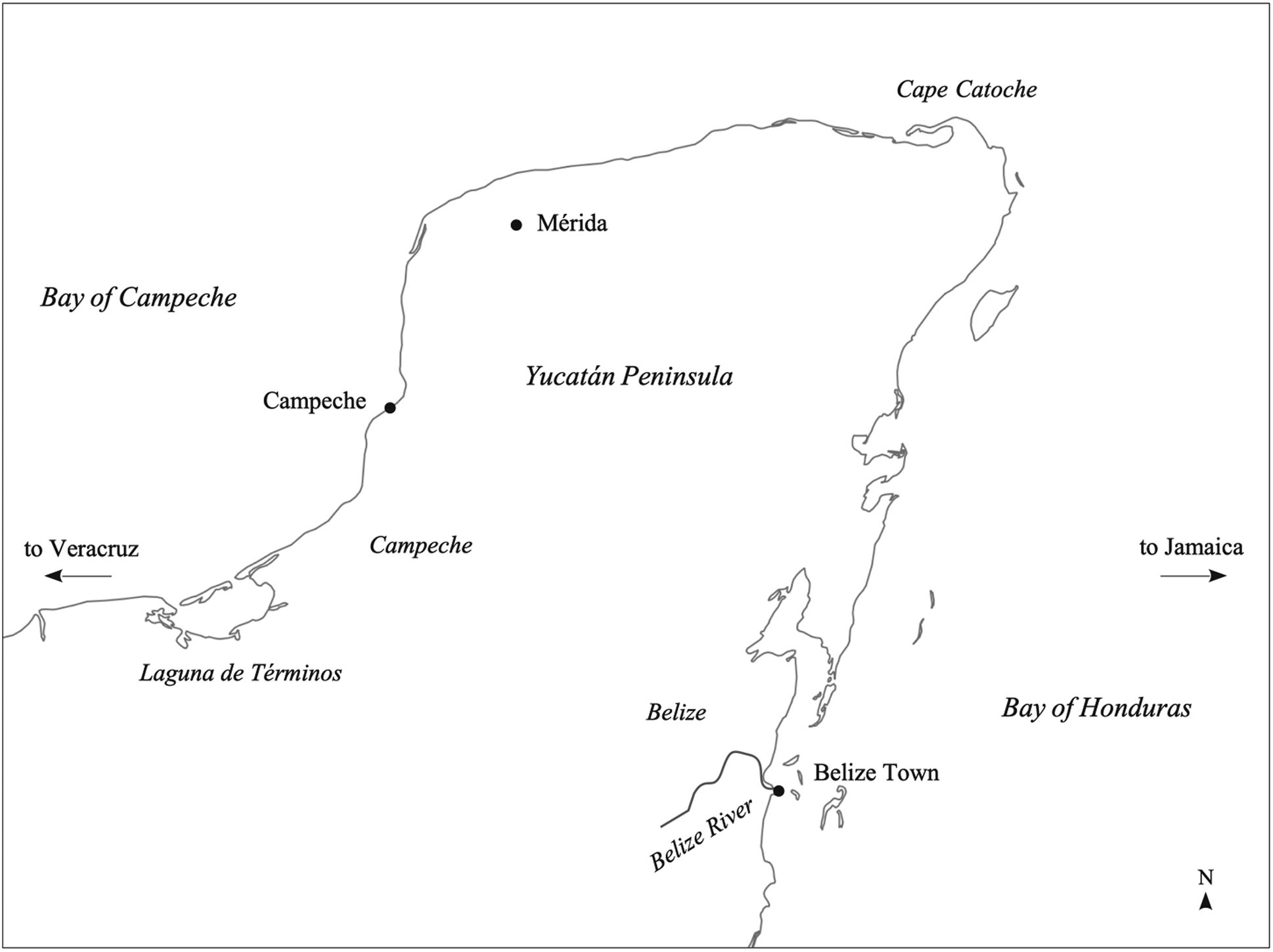
Logwood first entered transatlantic commerce as a Spanish good in the sixteenth century. Early Spanish explorers and traders in the Yucatán Peninsula learned of logwood and its dyeing properties from the area's indigenous peoples. The newcomers began to exploit the resource and, with few other profitable commercial activities in the region, a modest trade developed around the Bay of Campeche and the coast of the Yucatán Peninsula. The primary hub was the port of Campeche itself where Spanish traders employed local indigenous residents to cut and transport logwood from the port's hinterland.Footnote 5 Further east, Mérida was another hub for the trade. An English visitor to Mérida reported in 1572 that logwood was the town's principal export but that generally only small ships came to load wood from the area.Footnote 6 These small vessels would take logwood from Campeche and Mérida to Veracruz for shipment back to Spain with the empire's treasure fleets. Logwood was a supplemental commodity for the fleets’ cargo, however. The commercial focus of the Spanish Empire was on precious metals from Mexico and Peru and the Spanish logwood trade developed only minimally over the sixteenth and early seventeenth centuries.Footnote 7
The earliest English involvement in the logwood trade came as a result of privateering actions against Spain. In 1597, Captain William Parker raided the coastal towns of the Yucatán Peninsula and took some logwood as spoils.Footnote 8 During the first half of the seventeenth century, English privateers operating in the Caribbean regularly raided the small ships that conducted the Spanish logwood trade along the peninsula's coast.Footnote 9 When these privateers brought their plunder back to the ports of Europe, they discovered the value of the commodity there. European dyers had already begun to use logwood in their craft by the late sixteenth century but had to rely on logwood imported via Spain. Captured logwood was thus especially valuable because it circumvented the natural monopoly Spain had on the resource. Realizing a commercial opportunity, English sailors began actively seeking out and procuring logwood themselves.
By the middle of the seventeenth century, English crews had started establishing logwood cutting outposts along the coast of the Yucatán. Captain Peter Wallis founded the first of these fledgling settlements at what is now Belize City near the mouth of the Belize river on the Bay of Honduras around 1640.Footnote 11 Another English settlement emerged around 1660 at Laguna de Términos, a well-protected lagoon off the Bay of Campeche. These small bases began luring more residents in the years immediately following the 1670 Treaty of Madrid, the agreement that ended hostilities between England and Spain. As part of the peace, England promised to curtail its support of privateering against Spanish ships. The English privateers who had formerly roved the western Caribbean found themselves out of work. Keen to avoid such alternatives as settling down in the increasingly rigid plantation society of Jamaica or joining the structured hierarchies of the English Navy, they turned to logwood harvesting on the mainland as a lucrative way to continue their freewheeling lifestyle away from English colonial authorities.Footnote 12 English buccaneers quit cruising the Caribbean islands and swelled the ranks of the logwood cutting camps at Belize and Laguna de Términos. This influx expanded the nascent English logwood trade on the margins of the Spanish Empire.
The Yucatán Peninsula showing the settlements and geography of the logwood trade.Footnote 10
Spain reacted against this unintended consequence of the peace with England. Despite minimally exploiting logwood, maintaining only scattered settlements along the coast of the Yucatán Peninsula, and making virtually no attempt to settle or fortify Belize, Spain decried what it saw as encroachment on its territory. Spain viewed the logwood cutters’ presence as illegal English settlement in the Spanish New World and their harvesting as an illicit activity. In 1672 and 1674, the Spanish crown issued decrees explicitly forbidding foreign logwood harvesting and urging colonial officials to take military action against interloping logwood cutters. Spanish authorities sent naval patrols along the coast to capture English merchantmen carrying logwood and raid what settlements they could. The English view was more ambivalent, holding that the logwood traders were active in areas with no Spanish settlers, only indigenous peoples, and thus their activities were legal. Nevertheless, in an attempt to ease relations with Spain, the English crown issued orders to the governor of Jamaica to forbid the logwood trade in 1679.Footnote 13
While English and Spanish officials attempted to assert authority over Campeche and Belize, the situation on the ground was hardly impacted. Geographic isolation and diplomatic sparring left the loggers in no jurisdiction but their own. They were “sentimentally part of the British nation,” as Eliga Gould described the situation, “but only tenuously subject to the jurisdiction of the British government.”Footnote 14 While the logwood settlements of the Yucatán Peninsula were in some ways outposts of the English empire weakly connected via Jamaica, the logwood cutters, former buccaneers with little regard for colonial authority, hardly saw themselves as such. They displayed little loyalty towards England or Protestantism. They were aware of the inter-imperial rivalry swirling around them insofar as it impacted their economic lives and survival, but they only minimally grasped the political and strategic dynamics at play.Footnote 15
Instead, the logwood main was an inter-imperial periphery where English, Spanish, and indigenous realms melded and local actors exercised their autonomy in between vague political boundaries and distant metropolitan authorities. Their motivations were grounded in their own needs and local conditions rather than in grand imperial designs. Many ignored official designations, creating a zone rife with inter-imperial smuggling and contraband trade. Logwood harvested illicitly in the eyes of Spanish officials was a common commodity of exchange for the necessities of frontier life. Some Spanish and creole settlers and local indigenous groups aided the loggers with information as well as supplies, helping them avoid capture or even strike back against Spanish raids. Others who were threatened by the English presence aided Spanish authorities instead or took up arms against the loggers.Footnote 16 In this regard, the logwood periphery of Campeche and Belize was not unique. Other similar inter-imperial micro-regions emerged throughout the early modern Caribbean: the Leeward Islands were the confluence of a host of competing European powers, creole settlers, and slave societies, while the northern coast of South America saw regular exchange between Dutch, Spanish, enslaved, and indigenous actors.Footnote 17 In all these zones, locals interacted across colonial boundaries, creating their own social and economic realms around the political ones weakly imposed by imperial authorities.
Powerless to curb the activities of the loggers in Campeche and Belize, England's official stance became to ban the logwood trade publicly for diplomatic show but tacitly allow logging and settlement to continue.Footnote 18 After all, Spain was still, despite the peace of 1670, an imperial rival and the logwood trade was an excellent tool with which England could undermine Spanish power in the western Caribbean. Spain responded by exerting what authority it could: continuing to attack English logwood traders and their settlements. The logwood camps of the former pirates around Laguna de Términos were within striking distance of Campeche and along the shipping route between Campeche and Veracruz. They were not simply an affront to Spanish sovereignty—they were a threat to Spanish trade and vulnerable targets. Campeche, however, was a true outpost of the Spanish Empire. Despite the strong desire of the crown and colonial officials to expel the logwood traders, they provided the military and civilian authorities in Campeche with only limited resources. As a result, forces from Campeche struggled to rid the coast of the English presence despite frequent raids.Footnote 19
The events of 1679–80 at Laguna de Términos demonstrate the continual, albeit fleeting, pressure from Spanish forces at Campeche. In December 1679, an initial Spanish naval raid entered the lagoon and captured an English sloop lying at anchor. Spanish ships returned at the end of January in the new year and captured three visiting merchant ships and destroyed a few of the smaller vessels used for transporting logwood across the lagoon before retreating again. Spanish forces made a more sustained assault in the spring. Supported by a flotilla of coastal warships, five hundred or so men landed on Beef Island, one of the islands at the mouth of the lagoon, on 30 April. They besieged the English camped there for three weeks, during which time they also occupied neighbouring Treize Island and skirmished with the handful of merchant ships that had come to Laguna de Términos to acquire logwood. On 20 May, the eighty-odd beleaguered English defenders surrendered under terms of free passage back to Jamaica, although the Spanish reneged and took them as prisoners to Campeche instead. In one last act of disruption before they departed on 24 May, the Spanish forces burned some of the huts and stores of logwood on the eastern side of the lagoon.Footnote 20
This string of attacks stretched across six months, but its results were superficial and ephemeral. The initial naval raids did little more than disrupt logging activity briefly and destroy a tiny fraction of the shipping involved in the trade. The small-scale insular invasion went only somewhat further, lasting three weeks, capturing a few harvesters and traders, and destroying some infrastructure at the lagoon. Other than scouring the northern islands and eastern shore for dwellings and logwood, Spanish forces left the rest of the lagoon and the connected waterways where most of the logwood harvesting occurred unmolested. Furthermore, Spanish officials made no attempt to maintain or consolidate their gains: they left no garrison behind, nor did they construct any sort of fortification from which to ward away future trading. Such repeated half-action allowed English logwood harvesting to thrive out of Laguna de Términos in the second half of the seventeenth century. The situation was even more extreme in Belize. The logwood camps along the Belize River were more isolated and farther from Spanish colonial authorities. As a result, their position left them almost entirely free from Spanish interference.
Contributing to the resilience of the English logwood trade was the entrenchment of the logwood harvesters themselves. In Campeche, they established many small camps both around the lagoon and along the rivers that fed it. Loggers would use these camps as bases from which to trek or canoe in search of logwood stands. They built small huts with palm-thatched roofs that were raised on stilts above the ground to keep them dry during heavy rains and seasonal floods.Footnote 21 Harvesters adopted similar practices in Belize. The loggers maintained a small settlement near the mouth of the Belize River where ships could anchor and numerous smaller clusters of thatched huts upstream closer to logwood stands.Footnote 22 Their dwellings’ placement in waterlogged, low-lying land along shallow waterways made it challenging for Spanish ground or naval expeditions to root them out. Furthermore, the simple nature of their construction meant that camps, while easily destroyed by Spanish attacks, could be rebuilt with similar ease. The dense terrain also presented ample cover for English loggers to wait out Spanish incursions. For all these reasons, the logwood harvesters were difficult to extricate.
The waterways that provided harvesters protection were also critical for the extraction of logwood. In the region's thick forests, water proved a more efficient means of transport than human or animal labour, the latter of which was lacking anyway. In Campeche, merchant ships visiting from Jamaica used the lagoon at Laguna de Términos as an anchorage while smaller boats and canoes used the network of adjoining creeks and basins to bring logwood to the larger vessels. The opening to the lagoon itself was so shallow that ocean-going vessels sometimes had to load part of their cargo in the lagoon and then load the remainder while anchored off the coast so their draught could clear the entrance channel.Footnote 23 The loggers in Belize made similar use of canoes to bring harvested wood downstream and onto awaiting ships but they also experimented with other transportation tactics. They would cut down trees during dry spells and then wait for the arrival of rains and floodwaters to extract the wood more easily. When logs were too large to transport by canoe, Belizean harvesters built rafts using a combination of logwood and lighter woods to float the logs down the river instead.Footnote 24
Riparian transportation networks became more important as the trade developed and logwood stands became less accessible due to overharvesting. The intensity of logging activity, even early in the trade's history, outstripped nature's ability to regenerate. In the middle of the seventeenth century, logwood cutters frequented not only Belize and Campeche but also Cape Catoche on the Yucatán Peninsula's northeastern tip. Within just a few decades, however, harvesters had abandoned Cape Catoche after depleting all the wood close to the shore. By 1675, when William Dampier visited the Yucatán, the stands at Cape Catoche were mostly exhausted. He estimated that cutters could no longer find logwood within fifteen hundred paces of the sea there, whereas the stands in Belize and Campeche were still a mere three hundred paces away.Footnote 25 Not for long, however. Harvesting activity expanded around the turn of the eighteenth century and with Cape Catoche no longer relieving pressure from Campeche and Belize, those three hundred paces lengthened considerably. Nathaniel Uring, a captain and merchant who visited the region four decades later in the 1710s, said that logwood in both Campeche and Belize sometimes came from as many as thirty miles upstream.Footnote 26 He is, of course, giving at once both an estimate and an upper limit but his figure is significantly greater than what Dampier reported just four decades earlier. These accounts suggest that years of regular logging led to the depletion of easily accessible logwood and forced harvesters to extract the wood from greater distances.
The overharvesting of logwood was certainly an environmental tragedy for the species itself, though the broader environmental impact of the trade was less damaging. Logwood harvesting was a selective process: loggers would hunt specifically for logwood trees and fell them with the means available. Some additional clearing occurred around river landings, paths, and camps to facilitate the trade, but logwood extraction did not require clearcutting that destroyed entire tracts of forest. In this regard, the logwood trade was like other early modern logging industries in the New World. The mahogany trade, which supplanted the logwood trade in Belize in the second half of the eighteenth century, and the brazilwood trade in Portuguese Brazil were both similarly selective. They too involved extracting valuable logs from dense forests: harvesters were targeted in their efforts so as not to expend more labour than what was required to obtain and transport the wood. Like logwood, coastal stands of mahogany and brazilwood faced depletion as their trades developed. Over time, scarcity near the ocean pushed harvesters further upriver in search of untapped stands.Footnote 27 The trades in logwood, mahogany, and brazilwood, which ironically preyed directly on forests’ bounty, stand in marked contrast to the Caribbean's and Brazil's primary industry at the time: sugar production. Sugar cultivation required significant clearing to make way for planting and then constant further felling to provide firewood for boiling cane juice as part of the refining process. Swathes of forests in the Caribbean and Brazil were cleared to fuel the energy needs of sugar production.Footnote 28 The logwood trade, yielding no widespread deforestation, brought only minimal environmental destruction compared with sugar's ravenous consumption of New World forests.
Logwood cutters’ targeted methods entailed performing most of the harvesting by hand. Waterways helped with the long-distance extraction but finding logwood stands, which were often some distance from navigable waterways, required bushwhacking through the forest, and hauling logs back to these rivers required labour and preparation. A tree, once felled, would have its branches and worthless outer layers removed and be cut up into more manageable pieces. The harvesters would then “lay [those pieces] in Heaps, cutting away the Under-wood [to make] Paths to each Heap” and drag the wood along these paths to where canoes could pull up.Footnote 29 This task was hard work and made the process of extraction as a whole quite tedious. A man working five days each week would take a month to move a ton of logwood three hundred yards from a harvesting site to a nearby creekside.Footnote 30
The physical nature of logging made the use of slave labour appealing. At various times during the trade's history, English logwood cutters enslaved indigenous Maya and even the occasional Spaniard to harvest logwood for them. In the early decades of the eighteenth century, established logwood cutters who had excess capital began bringing African slaves to Campeche and Belize from Jamaica to augment the logwood labour force and relieve some of their own burden.Footnote 31 When Nathaniel Uring visited Laguna de Términos in 1712, he tallied black harvesters outnumbering white harvesters by a ratio of three to two.Footnote 32 That said, slavery was never the overwhelming source of labour for the logwood trade that it was for other regional industries. The mahogany trade, for instance, encouraged more investment in slave labour. Mahogany harvesting was more labour-intensive owing to the trees’ larger size and the need to cut and transport large, intact pieces that could be used in furniture. While a white logwood cutter might own one or two slaves to help with harvesting, a white mahogany harvester would send a team of a dozen into the forest. By the late eighteenth century when mahogany extraction dominated in Belize, black slaves made up two-thirds or three-quarters of the population of logging settlements on the Bay of Honduras.Footnote 33 An even starker contrast comes when comparing Belizean logwood harvesting to plantation sugar cultivation. Logwood harvesting was by no means egalitarian, but it did take on the communal nature of a dangerous frontier industry. While the cruelties of slavery still existed in Belize, they did so on a smaller scale without the structure of a typical Caribbean plantation slave society. The ratios of the enslaved to the free never approached the extremes of Jamaica and enslaved African and indigenous harvesters often worked side-by-side with their enslavers and other white labourers.
The efforts of the Yucatán's indigenous peoples, both enslaved and free, were also important to the logwood trade throughout its history. It was indigenous Maya who first introduced the Spaniards to logwood and indigenous traders performed harvesting and overland transportation in the trade's earliest days.Footnote 34 After English logwood cutters arrived in the Yucatán, the indigenous peoples of Campeche and Belize were often their supporters against the mutually despised Spanish. They provided the English with knowledge of local topography and tools, such as dugout canoes, that helped the loggers extract logwood. Relations were not always smooth, however, as evidenced by the enslavement of indigenous Maya by English loggers.Footnote 35 Later in the trade's history, a native slave brought the first logwood seeds from the mainland to Jamaica to enable domestic cultivation on Caribbean islands, an action that would significantly alter the landscape of the logwood trade around the Caribbean.Footnote 36
Connections between Jamaica and the logwood main were strong throughout the trade's history. The island served as a convenient stopping place for traders from Europe and North America and a transshipment point for logwood. Jamaica was also the source of whatever English colonial authority extended to Campeche and Belize. Trade between Jamaica and the logwood settlements was regular enough to keep the frontiersmen supplied with the goods they needed from Europe. While the harvesters hunted for food and hides, manufactured goods such as shoes, axes, knives, netting, guns, and gunpowder had to come from the metropole. As such, most ships carried the aforementioned provisions from Europe and picked up some Caribbean rum and sugar, favourites of the loggers, in Jamaica to bring to the Bays of Campeche and Honduras in exchange for logwood.Footnote 37
While the loggers could rely on steady supplies from Jamaica, they could not depend on the larger colony for defence. The governors of Jamaica sought to distance themselves and their colony from the former pirates logging on the mainland. Maintaining the official foreign policy of England and later Great Britain, they tacitly allowed the logwood trade to continue despite Spanish protestations but did not extend overt support to the fledgling settlements.Footnote 38 As such, the Englishmen in Campeche were on their own as Spanish assaults began to mount in the early 1700s. When Captain Uring loaded his frigate with logwood at Laguna de Términos in 1712, he reported that Spanish coastguard patrols had in recent years captured many of the logwood cutters and visiting ships that traded there. A few days after he departed the lagoon, yet another flotilla of Spanish vessels assaulted the anchorage.Footnote 39 The Spanish crown issued Britain a warning regarding the loggers at Laguna de Términos in 1716, threatening to oust the inhabitants if logwood cutting did not cease within eight months. British authorities considered the Spanish position untenable. They cited their agreement in the 1670 Treaty of Madrid that had given England rights to all lands in the New World it had previously settled: according to their own records, Englishmen had been harvesting logwood in Campeche since at least the 1660s.Footnote 40 That said, British diplomats did little to dissuade Spain from following through on the threat nor did the governor of Jamaica take action to defend the mainland settlement. Spain did follow through, beginning what became the final assault later in 1716. Through this action, Spain succeeded in forcing the English loggers out of Laguna de Términos and ending half a century of English logwood cutting in Campeche.Footnote 41
After the fall of Laguna de Términos, British merchants continued to export logwood out of Belize where the trade thrived into the second half of the eighteenth century. Largely as a result of its relative isolation, the Belize logwood colony remained unmolested by Spanish attacks. Spain still considered the British logwood trade illicit, however. Unable and unwilling to maintain a strong colonial presence in Belize, Spain tried to counter the trade on the high seas instead. The crews of Spanish warships in the Caribbean regularly searched British vessels and confiscated their entire cargoes when they discovered any amount of contraband logwood in their holds. Such seizures led to British diplomatic complaints and eventually armed conflict between the two powers after mounting tensions over Spanish searches led to the War of Jenkins’ Ear in 1739.Footnote 42 Britain and Spain eventually resolved the status of the Belizean logwood trade in 1763 as part of the Treaty of Paris that ended the Seven Years’ War. Spain recognized British rights to export logwood from the shores of the Bay of Honduras but forbade British colonists from settling permanently or constructing any fortifications, a condition no doubt ignored by officials and logwood cutters alike.Footnote 43 Ironically, Spanish recognition of British logging rights coincided with the beginning of the trade's decline in Belize. In the 1760s, Belizean loggers began moving away from logwood and towards a new resource: mahogany. They were reacting to two forces. First, logwood prices began to fall as domesticated logwood cultivation spread in the Caribbean. Second, Belize became the most promising source of mahogany after harvesters of that species exhausted their traditional sources on Jamaica and other Caribbean islands.Footnote 44 While the loggers remained in—and even continued to flock to—Belize, their efforts shifted to the more lucrative mahogany.
As mahogany displaced logwood in Belize, logwood harvesting expanded elsewhere in the British Caribbean to places heretofore beyond logwood's natural range. With logwood becoming an important commodity for the British textile industry, British merchants and planters were eager to overcome the two factors contributing to the trade's precarious position: its dependence on harvesting in Spanish territories and the threat of depletion due to overharvesting. They hoped to advance the national interest and perhaps avert future conflicts between Britain and Spain by sustainably cultivating logwood in British territories. Starting in the middle of the eighteenth century, they introduced logwood to plantation groves on Jamaica, the Bahamas, and even in the North American colonies of Georgia and South Carolina. By the 1760s, these efforts had begun to yield results. Low-cost plantation-grown logwood began flowing out of the Caribbean, increasing the resource's supply in Europe. This glut of logwood contributed to the aforementioned fall in logwood prices that sped the decline of wild harvesting in Belize.Footnote 45
The shift to plantation cultivation changed the trade's relationship with slave labour. Slavery had enabled logwood harvesting in Belize but it did so to a smaller extent than on Caribbean plantations. The rigid and brutal structures of a slave society replaced the teams of slaves, their owners, and other white labourers who had roamed the forests of Belize. Logwood production, like sugar, became an industry powered entirely by slave labour rather than by the hybrid labour force of earlier years. Furthermore, the economics of plantation cultivation fuelled a demand for yet more slave labour. Growing logwood trees in orderly, closely spaced farms made harvesting less labour-intensive. Harvesters no longer had to seek out logwood trees deep in forests, trek through and clear thick underbrush, or drag felled logs to waterways. Animal power and plantation infrastructure helped move logwood to ships for export. These labour-saving advantages, rather than reducing the need for slaves, allowed cultivation to expand which in turn required more slave labour overall. Yes, plantation cultivation was more labour efficient but the scale of the trade was now larger. Moreover, the low logwood prices caused by plantation cultivation forced loggers in Belize to turn to the more slave labour-intensive mahogany trade. Thus, the expansion of logwood harvesting to Caribbean plantations caused more African slaves to be taken both to British Caribbean islands and to Belize.Footnote 46
This same geographic expansion of logwood cultivation occurred outside the British Caribbean as well and pulled other merchant powers into the logwood trade. Between deliberate human introduction on plantations and the unintended consequences of regular commercial links—a sort of intra-Caribbean Columbian Exchange—logwood came to be found on many Caribbean islands during the eighteenth century.Footnote 47 French merchants began exporting the dyestuff from the colonies of Saint-Domingue and Martinique. Dutch traders shipped logwood out of St. Eustatius. Even Danish merchants joined the logwood trade with exports from St. Croix.Footnote 48 On the mainland, the Spanish trade found new life in the eighteenth century as well. Spanish logwood traders, who had for decades operated from other Spanish territories around the Yucatán Peninsula,Footnote 49 moved back into Laguna de Términos after Spain ousted the English harvesters there in 1716. For much of the first half of the eighteenth century, however, Spanish merchants were unable to take advantage of the area's bounty due to high freight costs and customs charges within the Spanish Empire that made Spanish logwood significantly more expensive than British logwood in the markets of Europe. Changes to imperial policy in the second half of the eighteenth century, however, lowered prices and made Spanish logwood competitive again. Laguna de Términos reemerged as a base for the Spanish trade and saw renewed investment. Settlers around the lagoon improved coastal infrastructure to facilitate the wood's extraction and established haciendas, domesticating cultivation.Footnote 50 This expansion of logwood's sources around the Caribbean basin served a growing demand for the resource among the textile dyers of Europe.
Logwood in the European Textile Industry
From the shores of the Caribbean, logwood followed a few common routes to European textile centres. British logwood generally began in Campeche and Belize and ended up in London with possible stops in Jamaica or New England. Most of the British logwood fleet was of small to modest size (with ships between fifty and three hundred tons) and based in either London or New England.Footnote 51 The logwood traders of New England saw little demand for their cargo in the North American colonies given the immature state of the colonial textile industry. As such, Boston and other nearby harbours merely served as transshipment ports for logwood and most of the logwood that entered the colonies was re-exported to Britain, arriving through London or Portsmouth.Footnote 52 There were exceptions to this otherwise mercantilist flow of goods, however. Vessels both colonial and metropolitan sometimes disregarded official trade policies and sailed to continental Europe instead of Great Britain. Amsterdam, Hamburg, Lisbon, and Livorno all received visits from British ships sailing from the New World with logwood in their holds.Footnote 53
Spanish logwood, like most other colonial goods from New Spain, generally entered Europe through the Guadalquivir ports of Seville and Cadiz. From these entrepôts merchants redistributed the resource to other European ports near textile productions centres. Spanish merchants brought logwood from Cadiz to London and Hamburg. Traders from the Low Countries carried it to Antwerp. Italian merchants took it to Livorno, Naples, and Venice.Footnote 54 These patterns changed somewhat in the eighteenth century as the Dutch island of Curaçao became a regional entrepôt for trade originating in Spanish America. Dutch merchants carried Spanish logwood across the Atlantic from Curaçao to Amsterdam, as well as carrying logwood harvested on Dutch Caribbean islands.Footnote 55 French merchants, who were also active in the transatlantic logwood trade, brought logwood to the ports of western and northern France.Footnote 56
Some indication of the size of the logwood flows carried on these routes comes from the sparse quantitative data available for the logwood trade. The dearth of figures for the British trade is unsurprising given the clandestine nature of logwood harvesting, lack of official oversight in Campeche and Belize, and periodic bans of the trade in England. That said, the figures and estimates we have show the growth of the trade. English colonial officials estimated that the logwood trade amounted to one thousand or two thousand tons annually in the late seventeenth century.Footnote 57 In 1715, at the peak of British logwood harvesting at Laguna de Términos, logwood imports to Britain amounted to almost six thousand tons, demonstrating rapid growth from a few decades earlier.Footnote 58 The loss of Laguna de Términos, rather than weakening the British logwood trade, may have strengthened it by coalescing harvesting around Belize: by 1750, Belizean logwood exports reached eight thousand tons.Footnote 59
Surviving data on logwood prices likewise reveal a lucrative trade. During the early years when Spain had a monopoly on New World logwood imports, prices in Europe were close to one hundred pounds per ton.Footnote 60 Prices fell during the second half of the seventeenth century as the trade expanded with increased competition from English harvesters and merchants. By the early eighteenth century, prices in England commonly ranged between fifteen and twenty pounds per ton.Footnote 61 In the New World, Nathaniel Uring reported paying four pounds ten shillings per ton of logwood in Campeche in 1712 and a similar five pounds per ton in Belize in 1720.Footnote 62 Taken together, these figures suggest strong gross margins of up to seventy-five percent in the early eighteenth century. Furthermore, logwood shipping rates were competitive vis-à-vis other goods due to the wood's convenient use as ballast in ships’ holds. In the late seventeenth century, the transatlantic rate for logwood shipped from Port Royal, Jamaica was around two pounds five shillings per ton, less than a third or even a quarter of that for sugar in some years.Footnote 63 Far from being relegated to a ballast good, some London-based ships returned home carrying almost exclusively logwood, eschewing the opportunity to load other goods in the Caribbean.Footnote 64 That English merchants were willing to make dedicated transatlantic voyages for logwood demonstrates the resource's commercial power. During the trade's heyday, logwood's profitability alone was enough to convince backers to finance these voyages. We have seen, however, that logwood prices did not stay high forever. The plantation-induced glut of the 1760s caused European prices to drop into the single digit pounds per ton. By the 1770s, some merchants and traditional harvesters reported that prices were below their break-even point and logwood was not worth harvesting or importing to Europe.Footnote 65
For the imported dyestuff to be of any use to European dyers, it had to be refined into a powder suitable for various dye recipes. The initial stages of this processing had already been accomplished by the teams of logwood cutters in the New World. Their labour reduced standing logwood trees to small blocks of the trees’ inner heartwood from which logwood's dyeing compound could be extracted. William Dampier described how a certain division of labour helped teams harvest logwood efficiently: some harvesters “fell the Trees, others saw and cut them into convenient Logs, and one chips off the sap.”Footnote 66 This last step of removing the sap must have been particularly time consuming (although necessary to get to the valuable heart of the tree) since harvesters strove to minimize the effort required. Dampier explained that “We always chuse to cut the old black-rinded trees; for these have less sap, and require but little pains to chip or cut it. The sap is white, and the heart red: The heart is used much for dying; therefore we chip off all the white sap, till we come to the heart; and then it is fit to be transported to Europe.”Footnote 67 Dampier's description of the logwood cutters’ mental and physical process demonstrates that they kept in mind both the wood's eventual end use and its economical transportation to Europe while harvesting.
Once these stripped-down blocks of logwood arrived in Europe, they were refined further. Early modern dyers’ instruction manuals often reference cutting logwood into chips.Footnote 68 These instructions imply that logwood was most commonly purchased in block form and that dyers performed the final stage of processing themselves, shaving off a portion from a larger block as their recipes required it. This practice of dyers manually shaving logwood may have been sufficient for small-batch dyeing but it would have been laborious for larger dyeing operations. As Europe's early modern textile industry developed, larger and more efficient processing methods emerged.
Between the late seventeenth and mid-eighteenth century, mechanically powered mills for processing logwood began to appear in Europe. They used either wind or water power and a variety of mechanisms to refine the dyestuff. One example was the Dutch logwood mill at Zaandijk north of Amsterdam. This wind-powered mill used vertically mounted stamping axes to chop blocks of logwood into smaller pieces. At the same time, the mill's windsails rotated the tub in which these pieces of wood were placed so that the axes gradually reduced the logwood into coarse chips. Labourers occasionally emptied the tub and took the chips to a different mechanism within the mill that ground the chips between large millstones, refining the wood further into a powder. Elsewhere in continental Europe, an eighteenth century mill in Stockholm took a different approach. It used wind power to operate a set of reciprocating saw blades to rasp logwood directly into a powder rather than both chopping and grinding the wood.Footnote 69
Logwood mills began to appear in England shortly after Englishmen began harvesting logwood around the Bays of Campeche and Honduras. One of the earliest English logwood mills was operating by 1660 in Salford on the river Irwell across from Manchester.Footnote 70 English mills operated in a manner similar to those found across the Channel. They often adopted a two-step approach for milling logwood similar to Dutch mills, but given England's abundance of hills and flowing rivers, they favoured water power over wind. An example of a typical English mill was the one constructed in West Ham outside of contemporary London around 1690. It used water wheels that powered one mechanism which rasped logwood into powder with saws and then another which turned two millstones that ground the shavings down further.Footnote 71 The West Ham mill was purpose-built, like many of the logwood mills established in this period. Other mills, however, were converted from prior uses, such as a traditional grain mill in Kinlet, Shropshire which was reconfigured to mill logwood around the turn of the eighteenth century.Footnote 72 Supported by a growing textile industry and sustained logwood imports from the New World, mechanical logwood mills continued to proliferate in the first half of the eighteenth century. In Stockport, southeast of Manchester, a mill for grinding logwood was operating before 1732 and by 1745 a logwood mill was operating in Chester.Footnote 73 Further evidence of the emergence of a dedicated logwood milling industry comes from men listed professionally as “logwood millers” or “logwood grinders” in records from the middle of the eighteenth century.Footnote 74
Refined logwood proved to be a versatile dye source in the hands of Europe's dyers. Early modern dye recipes generally called for several ingredients, including colorants (such as logwood) and mordants (metallic compounds that helped bind colouring agents to textiles). The exact hue that logwood produced varied depending on the mordant used, the other dyestuffs involved, and the fabric on which the dye was applied. Logwood's dark red appearance belied the hues its dyes created: dyers used logwood in recipes that created a range of colours, primarily blacks and blues but also shades of grey, green, and purple, though rarely the red of its heartwood.
While this versatility was logwood's strength, poor colourfastness was its weakness. Early modern critics of logwood called its dyes “false” or “fugitive” due to their tendency to fade over time.Footnote 75 Dyers made gradual advances over the period that improved the fastness of logwood, such as the discovery that adding nutgall prevented it from fading as quickly from direct sunlight, but on the whole logwood remained weak when used alone as a dye's only colorant.Footnote 76 It often needed to be combined with another dyestuff to prevent the colour from easily fading or rinsing out. Logwood was thus an ingredient in many dye recipes but the primary ingredient in very few.
Logwood's most prominent use was in creating black dyes where, given the right mordants, it could stand on its own as a recipe's sole colorant. In many cases, however, logwood needed the support of another dyestuff. For textiles on which logwood would not hold fast by itself, such as linen and cotton, woad helped form the foundation for black dyes. The woad plant's natural indigo compound would not overpower the swarthiness of logwood and woad's colourfastness made the combination significantly more durable.Footnote 77
When creating colours other than black, logwood was a secondary ingredient that provided shading or a deeper richness to compounds centred on another dyestuff. Here again, woad was the most common base. Logwood worked to darken woad's brighter blue tones, turning its lighter “royal blue” into a deeper “Persian blue.” Dyers adjusted the ratio of logwood and woad to make grey- and slate-blue hues and added other ingredients to create various shades of dark green for wool and silk. Sometimes logwood worked in combination with several other dyestuffs to produce more nuanced hues. For shades of red and brown, including colours approximating hazelnut, cinnamon, maroon, and red wine, dyers might combine a handful of plant-based dyes: shavings from the brazilwood tree for red, fustic flowers for yellow, and logwood for a degree of darker shading. Similarly, for violet and purple, brazilwood and leaves from sumac plants provided most of the necessary colour but logwood could be added to darken the final product.Footnote 78
Logwood's tendency to fade and its corresponding reliance on other colorants resulted in the dyestuff's at-times tenuous place in Europe's early modern textile industry. For stretches of the period, government and civic officials placed restrictions, including outright bans, on logwood's trade and use. In Italy, Venetian dyers had begun to use logwood-based dyes by the 1590s. Their initial experiments on woollen textiles yielded blue hues that were not particularly fast. The threat of such fading techniques spurred Venetian officials to defend the quality of the city's products and protect the reputation of its exports. As a result, they banned wool dyers from using or possessing logwood with penalties that included confiscation, fines, and suspension from the dyers’ guild. The city's silk dyers fared better, however, developing faster dyes for their cloth of choice. By the early seventeenth century, they had persuaded the senate to allow them to use logwood as an ingredient in dyes for silks, although logwood continued to be banned for wool.Footnote 79 Regulations with similar ends existed in France even as late as the middle of the eighteenth century, by which time dyeing techniques had advanced to permit a reasonable degree of colourfastness for logwood. These restrictions, instituted by the crown, limited the use of logwood to producing “common colours employed on low-priced goods.”Footnote 80 Examples of restrictions found in Venice and France aimed to ensure that high-quality textiles dyed in rich colours maintained their vibrancy. They prevented dyers from deceiving domestic consumers and undermining the reputation of their industry's exports abroad.
In England, dyers also experienced restrictions placed on logwood. As of 1580, they had not yet learned how to make logwood-based dyes fast, but they viewed logwood with excitement and potential: some hoped that using logwood to create fast blue dyes might reduce English reliance on woad imported from the Continent.Footnote 81 While England's dyers experimented and sought out expertise from abroad, Parliament acted to curtail the nascent dyestuff's use, concerned by its fading tendencies. In 1580, Parliament passed a “Bill against deceitful stuff used in dying of Cloths” that banned the use of logwood in textile dyeing. In 1597, Parliament went a step further, passing a bill “for the abolishing of Logwood alias Blockwood in the dying of Cloth, Wooll or Yarn” that outlawed the trade in logwood within England.Footnote 82 Merchants found dealing in or holding logwood in the kingdom risked fines and having their stocks of the commodity confiscated and publicly burned.Footnote 83 Dyers caught using logwood as an ingredient in their dyes faced legal action. Over subsequent decades, a number of dyers were brought to court on charges of dyeing with logwood in violation of Parliament's proclamation.Footnote 84
The prohibition on imports and the prosecution of dyers had little effect on the use of logwood-based dyes or the flow of the commodity into England, however. Many merchants continued to import logwood and dyers continued to use logwood in their craft. In 1606 and 1607, Parliament debated more severe punishments to prevent the importation of logwood, including making trading logwood a felony. Those who supported the measure argued that the previous laws had proved inadequate and that the subjects of England continued to mistake logwood's “deceitful Dyes for sure Colours.” The House of Commons was not swayed, however. In the end, Parliament declined to enact any new measures and left the old restrictions on logwood in place.Footnote 85 While this debate was underway, a group of dyers petitioned James I for a patent that would give them special dispensation to use logwood. The consortium had developed a logwood-based compound that was “alleged to be good and profitable for dyeing.” In exchange for an annual rent to the crown of five hundred pounds, they sought to be permitted to use this dye in exception to the statute that forbade the use of logwood. The king heard their petition but was hesitant to allow such unproven dyeing methods. His concerns were squarely on protecting those purchasing dyed cloths and maintaining the integrity of England's textile industry. He desired “to prevent all Colour of Vexation to his Subjects … tending to discredit the Making of Cloth (which is one of the greatest and richest Commodities of this Kingdom).” As such, he turned down the dyers’ petition and its potential rent “rather than his Subjects should have any just Cause of Complaint.”Footnote 86
Over the course of the first half of the seventeenth century, financial considerations gradually changed Parliament's position towards logwood. As logwood was officially a banned commodity, there were no duties collected on its trade. Commons began to consider the idea that if England's dyers could create reasonably fast colours with the dyestuff, legalizing its trade and use would prove beneficial to the kingdom's finances. During 1649 and 1650, a committee considered the clandestine trade in logwood and welcomed opinions from the kingdom's merchants and dyers. These groups overwhelmingly reported that various textiles, leather, and hats “cannot be dyed without the Use of Logwood” and “that the said Wood would be of great Use in dying of woollen Cloth, if Provision were made, that the same might not be abused.” Dyeing techniques had clearly advanced since the beginning of the century, fuelled in part by falling logwood prices that made the dyestuff more attractive to dyers and cheaper to experiment with. The committee recommended that the statutes limiting logwood's importation and use be rolled back, citing benefits to both the Commonwealth's coffers and its manufactures.Footnote 87 Thus an economic rationale for allowing logwood imports emerged: with so many merchants importing the commodity and dyers making use of its dye, why not remove the prohibitions and tax the trade?
Legalization came a decade later as a result of this financial motivation and better dyeing techniques. Charles II's parliament passed a statute that repealed the restricting statutes of Elizabeth's reign and fully legalized the importation of logwood and its use in dyeing beginning 1 February 1661. The act laid the foundation for the treasury to profit from the newly legalized trade: it specified that logwood would be subject to the laws governing the realm's customs duties and set logwood's import tariff at five pounds per ton. Furthermore, the language of the statute demonstrates that by this point logwood dyeing techniques in England were producing hues of a satisfactory degree of colourfastness. It proclaimed that “the ingenious Industry of these times hath taught the Dyers of England the Art of fixing the Colours made of Logwood alias Blockwood so as that by experience they are found as lasting and serviceable as the Colours made with any other sort of Dying wood whatsoever.”Footnote 88 With dyeing advancements over the first half of the seventeenth century, logwood, while not among the most colourfast dyestuffs, was at least no longer an outlier.
The timing of legalization coincided with the expansion of the English logwood trade in the New World. By 1660, English logwood harvesters had established settlements at both Laguna de Términos and Belize and had begun their rapid exhaustion of the logwood stands at Cape Catoche. From a trickle of shipments from the Continent and spoils captured from Spanish ships by privateers a century earlier, English merchants now conducted regular, direct logwood commerce with the New World. In some ways, an expanding New World logwood trade increased Parliament's financial motivation to legalize logwood. Burgeoning flows of logwood from the coasts of the Bays of Campeche and Honduras presented an increasingly lucrative opportunity for the treasury if the trade were taxed. Furthermore, the growing number of logwood shipments created a mounting contraband activity that Parliament felt it perhaps could no longer ignore. In other ways, the reverse was true: Parliament's legalization of logwood helped the trade expand. While most of the early logwood harvesters and traders in the New World were ex-buccaneers and had no qualms about engaging in an illicit trade, logwood's legalization made it less risky for merchants in England to deal in the resource. Moreover, legalization bolstered the resource's demand among dyers now that they no longer faced penalties for its use. Reciprocally, the expanding logwood trade of the mid-seventeenth century helped push Parliament to legalize the commodity, while legalizing the commodity allowed the trade to expand further.
With the expansion and legalization of the trade, logwood became part of the landscape of the early modern textile economy of Europe. Black—the hue that logwood dyes produced most reliably—was an important colour for consumers, especially in Protestant Europe. The plain appearance of black and its connotations of piety and respectability led to it being widely worn across social lines and minimally restricted by sumptuary laws.Footnote 89 Supplies of logwood allowed dyers to innovate in creating black dyes to meet this demand and these dyes found their way onto the garments of tradesmen, merchants, and nobles alike. Beyond black, logwood's versatility helped dyers innovate around sumptuary laws. Some consumers looked for opportunities to skirt specific regulations on the combinations of colour, dye quality, and fabric they could wear, and dyers likewise looked for opportunities to meet this demand. One such opportunity was in shading because the period's sartorial restrictions often failed to keep up fully with shading techniques.Footnote 90 As we have seen, logwood was a shading component in a wide range of hues, including blues, greens, and purples. By adding variations to these colours, logwood was an engine of innovation for dyers formulating the nuanced hues that adventurous consumers wanted in addition to helping them fulfil mainstream demand for sartorially safer black dyes.
Logwood also helped bring the New World into globalizing early modern textile networks. For centuries, Europe acquired much of its knowledge of textile dyeing techniques from Asia. Especially for cotton and silk, luxury textiles which originated in Asia, techniques for creating the most vibrant and colourfast hues came to Europe from India, the Middle East, and Turkey, and involved dyestuffs either indigenous to Europe or themselves imported from Asia. Early modern European commercial expansion altered this pattern by introducing European dyers to New World dyestuffs that allowed them to build independent dyeing knowledge.Footnote 91 Logwood was one of these resources that enabled European dyers to innovate beyond their traditional array of Eurasian materials. Together with brazilwood and cochineal, logwood extended early modern textile supply chains to the shores of the New World. In so doing, it followed a pattern of capitalist European mercantile expansion. The logwood trade had the three components that Sven Beckert argues allowed “European capitalists and rulers [to] alter global networks”— “imperial expansion, appropriation, and slavery.”Footnote 92 The expansion of first Spain, then England, and later other European powers into the Caribbean enabled the logwood trade. The trade appropriated indigenous knowledge of logwood and its dyeing properties. Slavery eventually allowed the trade to expand in New World forests and plantations. Together, these factors enabled the integration of logwood into European textile supply chains where it contributed to the finishing process. Furthermore, once in its finished product, logwood continued to globalize textile networks in its re-export and consumption. As British cotton exports expanded across the middle of the eighteenth century, Africa and the Americas became the dominant markets for British cotton textiles.Footnote 93 A consumer in Africa could wear cloth woven in northern England dyed with logwood from Belize. By incorporating the New World into this global network of textile production and consumption, the logwood trade helped place Europe at the centre of increasingly expansive supply chains that merged materials from across oceans and continents.
Conclusions
By the late eighteenth century, the logwood trade had evolved and expanded significantly since the early days of marginal Spanish exchange and incidental collection by English privateers. After the resolution of some imperial conflicts and the introduction of logwood around the Caribbean, the British trade came to be concentrated on Belize and Jamaica and the Spanish on Campeche, with other European powers participating in the trade from their Caribbean island colonies. Traders overcame the challenges of overharvesting first by expanding logistics networks and later by domesticated cultivation. The trade became more organized, with significant fluvial logistics in the Yucatán and plantation infrastructure on Caribbean islands. With these developments, a trade that was once the domain of peripheral former pirates had adopted slave labour and the structure of plantation society typical of many of the Caribbean's major industries.
Over the same period in the Old World, logwood became an important input to Europe's burgeoning textile industry. Early logwood-based dyes suffered from the dyestuff's poor natural colourfastness and spurred regulation that limited logwood's trade and use. After some decades of experimentation, European dyers developed stronger dyes and rendered logwood a versatile dyestuff that could contribute to many hues. As restrictions on the dye eased, logwood came to be found on garments for varying social classes. The growing demand for refined logwood suitable for dyeing led to the establishment of dedicated mechanical mills that enabled logwood processing on a larger scale.
While the logwood trade may appear primitive and extractive at first, the trade's developments link it to important early modern trends in the Atlantic world. We can see mercantilist tendencies in the routes that carried English logwood from the Caribbean to Europe. Belize and Campeche were inter-imperial peripheries like other zones around the Caribbean. The early trade's reliance on indigenous knowledge and loggers’ practice of enslaving local Maya echo broader themes in European-indigenous relations in the New World. The trade also reveals the environmental consequences of colonization: human activity, both intentional and unintentional, spread logwood to Caribbean islands. Logwood extraction brought minimal widespread deforestation but significant species-specific depletion. In this way, the logwood trade was similar to other New World logging industries such as brazilwood and mahogany but starkly different from Caribbean plantation agriculture which clear-cut forests. Similarly, the logwood trade of the seventeenth century stood in contrast to other Caribbean industries in its minimal use of slave labour. As the eighteenth century progressed, however, slave labour became more prominent in wild logwood harvesting and crucial to plantation logwood cultivation.
In Europe, logwood contributed to early modern proto-industrialization. It spurred innovation in the textile industry which drove the continent's industrialization over subsequent centuries. The logwood trade expanded global textile supply chains and allowed European dyers to develop exclusive new knowledge around textile finishing. Logwood's range of uses in shading and the production of black dyes gave dyers options to meet consumer demand within the framework of the period's sumptuary laws. In the statutes passed by Parliament, we see elements of what we would today call consumer protection as both the crown and legislature considered not just the reputation of English textile exports abroad but also the damage to purchasers at home from potentially deceitful dyeing practices. The logwood trade also brought proto-industrial innovation in refining as growing demand for the dyestuff spurred mechanical innovations to improve what was originally a fully manual process. With its origins in the New World, the logwood trade and the innovation it spurred were products of Europe's commercial position in the seventeenth and eighteenth centuries. Far from a primitive economic venture, the logwood trade was a thoroughly early modern commercial activity on both sides of the Atlantic.
Acknowledgements
I wish to thank Greyson Spencer for providing comments on an initial draft and for helping me with the accompanying map. My thanks go also to the two anonymous reviewers who provided suggestions that helped make this article more wide-reaching.


 Open access

