





Introduction
Verbal aggression and hostility in adult romantic relationships have been consistently linked to an array of negative outcomes, ranging from relationship dissolution to significant mental and physical illness (Choi & Marks, Reference Choi and Marks2008; Robles et al., Reference Robles, Slatcher, Trombello and McGinn2014). Identifying the predictors of such verbal aggression is thus critical to guiding prevention efforts (Lee et al., Reference Lee, Wickrama, Futris, Simmons, Mancini and Lorenz2021; Proulx et al., Reference Proulx, Buehler and Helms2009). This study examined the adolescent-era roots of verbal aggression and conflict in two key relationships to which the adolescent is exposed: their parents’ relationship with one another and the adolescent’s relationships with their closest friends. This study utilized a developmental–interactional perspective (Capaldi & Gorman-Smith, Reference Capaldi, Gorman-Smith and Florsheim2003), recognizing that either being directly or indirectly exposed to verbal aggression in relationships, or actively participating in a highly conflictual relationship, has the potential to alter an adolescent’s interpersonal repertoire in ways likely to carry forward to future romantic relationships (Story et al., Reference Story, Karney, Lawrence and Bradbury2004; Whitton et al., Reference Whitton, Waldinger, Schulz, Allen, Crowell and Hauser2008).
Interparental conflict
Verbal aggression and hostile marital conflict in the family of origin have long been identified as predictors of future romantic conflict in studies using rigorous longitudinal methods and multiple reporters (Amato & Booth, Reference Amato and Booth2001; Feng et al., Reference Feng, Giarrusso, Bengtson and Frye1999). This seminal research supports a social learning perspective, in which exposure to hostility in horizontal relationships (i.e., relationships between equals) will have sufficient impact to lead to future hostility in new horizontal relationships with romantic partners (Amato & Booth, Reference Amato and Booth2001; Ha et al., Reference Ha, Van Ryzin and Elam2021). These findings are also consistent with predictions from attachment theory, which suggests that adolescents are likely to learn scripts regarding close relationship behavior in their family of origin that then go on to get applied in new close relationships (Fraley & Davis, Reference Fraley and Davis1997a). This early research largely defined the field, although it was limited by a focus on virtually all-white samples and on consideration solely of parents who were currently married. However, recent short-term research on more diverse samples has also provided at least some support for this perspective, finding that qualities of interparental interactions witnessed during early adolescence predict outcomes at least into late adolescent romantic relationships (Ha, Kim, et al., Reference Ha, Kim and McGill2019; Miga et al., Reference Miga, Gdula and Allen2012).
The majority of recent rigorous studies in this area has focused, however, not on interparental conflict specifically but rather on family conflict more generally – that is, without distinguishing parents’ behavior toward one another from parents’ behavior toward their offspring (Dinero et al., Reference Dinero, Conger, Shaver, Widaman and Larsen-Rife2008; Ha, Kim, et al., Reference Ha, Kim and McGill2019; Ha, Otten, et al., Reference Ha, Otten, McGill and Dishion2019). Although this approach is supported by findings linking the two types of hostility and verbal aggression (Goncy, Reference Goncy2020; Hare et al., Reference Hare, Miga and Allen2009; Sturge-Apple et al., Reference Sturge-Apple, Davies and Cummings2006), it cannot clarify whether interparental conflict is important because of its indirect effect on parenting or whether this construct is directly linked to future difficulties among offspring exposed to it. Unfortunately, the more recent research that does specifically assess interparental conflict has relied almost exclusively upon correlations within single, retrospective self-reports using college student samples, with all of the confounds this entails (Singh & Thomas, Reference Singh and Thomas2022).
The shift toward studying conflict at the family level has also precluded the ability to explore potential differences in effects of verbal aggression on the part of fathers versus mothers. Several lines of research suggest the importance of this distinction. Verbal aggression, and its implied threat of the possibility of physical aggression, is likely to have very different meanings when expressed by men versus women (Caldwell et al., Reference Caldwell, Swan and Woodbrown2012). Men are far more likely to physically injure partners in violent confrontations (Archer, Reference Archer2000), and unsurprisingly women are far more likely to be fearful in the face of potential physical confrontations (Phelan et al., Reference Phelan, Hamberger, Guse, Edwards, Walczak and Zosel2005). In addition, paternal emotional abuse of offspring has been more strongly associated with future victimization of those offspring by peers (Cunningham et al., Reference Cunningham, Goff, Bagby, Stewart, Larocque, Mazurka, Ravindran and Harkness2019). Other research has suggested stronger links from paternal (as opposed to maternal) behavior in childrearing to future child outcomes (Feng et al., Reference Feng, Giarrusso, Bengtson and Frye1999). Yet, whether markers of interparental hostility on the part of fathers are truly more strongly linked to future negative romantic outcomes has yet to be carefully examined.
Conflict in adolescent friendships
Another key horizontal relationship – the adolescent close friendship – is potentially as important as interparental verbal aggression to future romantic verbal aggression but has received far less attention. The adolescent close friendship serves as an arena in which teens develop a host of critical skills that are important to successful romantic adaptation in adulthood (Oudekerk et al., Reference Oudekerk, Allen, Hessel and Molloy2015; Seiffge-Krenke, Reference Seiffge-Krenke2003; Simpson et al., Reference Simpson, Collins and Salvatore2011). Close friendships serve as a training ground for handling issues of autonomy and connection, and for managing conflict in enduring relationships – all of which are critical in future romantic relationships (Oudekerk et al., Reference Oudekerk, Allen, Hessel and Molloy2015). Unlike interparental verbal aggression, which adolescents may directly or indirectly witness, adolescents are direct participants in interactions with friends, likely giving these interactions additional weight.
Several lines of evidence suggest probable links from high levels of conflict in adolescent friendships to adult romantic verbal aggression. Continuity in specific behavioral patterns across these contexts is likely to be rooted in adolescent social learning, which establishes interpersonal processes that are maintained into adult romantic relationships. For instance, coercion in relationships with friends has been found to predict sexual coercion in the early twenties (Ha et al., Reference Ha, Kim, Christopher, Caruthers and Dishion2016). Conversely, observed autonomy with peers has been found to predict autonomy in late adolescent romantic relationships (Kansky et al., Reference Kansky, Ruzek and Allen2017). Indeed, recent evidence suggests that the quality of adolescent friendships may be a better predictor of future romantic relationship qualities than adolescents’ ongoing relationships with their parents (Allen et al., Reference Allen, Costello, Kansky and Loeb2022). In addition, a developmental–interactionist perspective suggests that as developing adolescents gradually transfer core attachment functions from parents to peers, disruptions in peer relationships may create similar levels of dysregulation as does exposure to interparental conflict and thus lead to similar long-term outcomes (Fraley & Davis, Reference Fraley and Davis1997b; Kim et al., Reference Kim, Pears, Capaldi and Owen2009).
Relatedly, emerging evidence suggests that the adolescent close friendship may also serve a moderating role relative to the effects of interactions in the family of origin. New relationships at new periods of development – that is, the increasingly intense, adult-like friendships formed during adolescence – have the potential to modify expectations derived from prior relationship experiences (Carlson et al., Reference Carlson, Sroufe and Egeland2004). Thus, experiencing (or not experiencing) intense conflict in influential new relationships in adolescence may alter adolescents’ expectations regarding future close relationships. Previous research has suggested a process of social compensation, wherein adolescent friendships may at times offset the deleterious effects of problematic family interactions (Lansford et al., Reference Lansford, Criss, Pettit, Dodge and Bates2003; Lyell et al., Reference Lyell, Coyle, Malecki and Santuzzi2020; Schacter & Margolin, Reference Schacter and Margolin2019). The benefits of these compensatory relationships may be particularly strong in the context of close, high-quality friendships, in which adolescents have the autonomy to structure interactions to incorporate meaningful supportive exchanges (Gauze et al., Reference Gauze, Bukowski, Aquan-Assee and Sippola1996; Narr et al., Reference Narr, Allen, Tan and Loeb2019; Schacter & Margolin, Reference Schacter and Margolin2019). This compensation model is also consistent with recent evidence that safe, stable, and nurturing new relationships beyond the family of origin may be key to disrupting the intergenerational transmission of child maltreatment (Merrick et al., Reference Merrick, Leeb and Lee2013). Conversely, negative expectations formed or reinforced in relationships with peers have been found to potentially affect both future romantic partner choice as well as expectations in future relationships in ways that lead to hostility in relationships (Loeb et al., Reference Loeb, Stern, Costello and Allen2020). The presence or absence of high levels of intense conflict in adolescent close friendships thus may significantly alter the context and the implications of exposure to interparental verbal aggression, although this thesis has not been previously explored.
This 20-year study sought to advance our understanding of the roots of adult romantic conflict by examining the intersecting roles of adolescents’ exposure to verbal aggression between their parents and to intense conflict in their relationships with close friends. Using multiple reporters in a multi-ethnic, demographically heterogeneous community sample, including both married and non-married parents, the following hypotheses were addressed:
-
1. Verbal Aggression in the relationship between parents during adolescence will predict future verbal aggression in adult romantic relationships, even after accounting for verbal aggression in the parent–adolescent relationship. Fathers’ verbal aggression toward mothers is more likely than maternal verbal aggression toward fathers to play a primary role in predicting future romantic verbal aggression.
-
2. Intense conflict within the adolescent friendship will add unique variance, over and above interparental verbal aggression, to the prediction of future adult romantic verbal aggression. Effects will be specific to conflict within friendships, as opposed to the overall quality of the friendship.
-
3. Friendships that avoid high levels of intense conflict will attenuate the link between interparental and later romantic verbal aggression.
The potential moderating roles of parental marital status, parental and adolescent residential/cohabiting status, adolescent gender, family income, and adolescent racial/ethnic minority identity will also be examined in relation to each of these hypotheses.
Method
Participants
This report is drawn from a larger longitudinal investigation of adolescent social development in familial and peer contexts. Original participants included 154 seventh and eighth graders (69 male and 85 female) for whom data regarding interparental verbal aggression was available, followed over a 20-year period from ages 13 to 33, along with collateral data collected from mothers, fathers, and close friends of these adolescents. The sample was racially/ethnically and socioeconomically diverse: 93 adolescents (60%) identified as White, 41 (27%) as African American, 13 (8%) as of mixed race/ethnicity, and 7 (5%) as being from other ethnic minority groups. Adolescents’ parents reported a median family income in the $40,000–$59,999 range at the initial assessment.
Adolescents were initially recruited from the seventh and eighth grades of a public middle school drawing from suburban and urban populations in the Southeastern United States. Students and their peers were recruited via an initial mailing to all parents of students in the school along with follow-up contact efforts at school lunches. Families of adolescents who indicated they were interested in the study were contacted by telephone. If a student was identified as a close peer of a participant and agreed to participate in that capacity, they were no longer eligible to participate as primary participants, to reduce redundancies in the data. Of all students eligible for participation, 63% agreed to participate as either target participants or as peers providing extensive collateral information in a 3-hour session. All participants provided informed assent/consent (depending upon whether they were an adolescent or an adult) before each interview session, and parents provided informed consent for adolescents. Initial interviews took place in private offices within a university academic building. Follow-up assessments were conducted in the same setting, or for participants’ living at a distance, were conducted either in local settings (e.g., hotel conference rooms), or via mail.
Participants were first assessed annually with their close friends over a 5-year period across adolescence from ages 13 to 17 (Mean age at first assessment = 13.35 (SD = .64), Mean age at last assessment = 17.32 (SD = .88)). Parents of adolescents were assessed at the adolescent age 13 and age 17 assessments. 63% of parents were currently married (91% of whom were residing together at baseline); 37% of parents were not currently married (10% of these parents were residing together at baseline). In adolescence, participants nominated the person they currently identified as “the peer to whom they were closest” to be included in the study. Close friends came in during a visit along with the target participant. Friends were close in age to participants (i.e., their average age differed by less than a month from target adolescents’ ages). Close friends within adolescence were specified to be same-gender friends, but the same friend need not be specified across different waves. Close friends in adolescence reported that they had known participants for an average of 4.3 to 5.7 years (SD = 3.1 to 3.8) across the various assessment periods. In adulthood, target participants and their current romantic partners (of at least 3 months duration) were assessed repeatedly at ages 23.9 (SD = 1.1), 27.4 (SD = 1.4), 30.3 (SD = 1.2), and 33.76 (SD = 1.30).
Attrition analyses
Adult romantic relationship data were obtained from 79% of the original sample (N = 124) and from romantic partners for 75% of the original sample (N = 119). Given that 98% of the original sample (N = 151) participated in other aspects of the study during the adult period, the attrition with respect to adult romantic relationship data primarily reflects individuals who did not have a sustained romantic relationship during this time frame. Attrition analyses comparing those participants with versus without adult romantic relationship data revealed modest differences only for the two measures of family of origin interparental verbal aggression: Adolescents exposed to more maternal or paternal verbal aggression toward mothers were less likely to have romantic partner data available in adulthood.
Procedure
In the initial introduction and throughout all sessions, confidentiality was assured to all study participants and adolescents were told that their parents and friends would not be informed of any of the answers they provided. Participants’ data were protected by a Confidentiality Certificate issued by the US Department of Health and Human Services, which protected information from subpoena by federal, state, and local courts. Transportation and childcare were provided if necessary. Adolescent/adult participants, their parents, and peers were all paid for participation.
Measures
Interparental verbal aggression (Mother and Father ratings of one another, Family of Origin: Participant Ages 13 & 17)
When adolescents were age 13 and age 17, each parent was asked to rate the other parent in terms of their behaviors during interparental conflicts on the Verbal Aggression scale of the Conflict Tactics Scale (Straus, Reference Straus1979). The questionnaire explored disagreements between spouses over their lifetime at initial interview, and across the preceding period for the follow-up interview; specifically inquiring about the frequency of arguments between partners, how conflicts were handled, and how conflicts were resolved. Using the Verbal Aggression scale, parents responded to 6 items about how often their partner had used verbally aggressive, hostile behaviors toward them during conflict, with responses ranging from 1 (Never) to 4 (Many Times). Items included endorsement of behaviors such as insulting, threatening, and yelling at the other person during an argument. Reports were obtained for both residential and nonresidential parents (provided the adolescent had sufficient contact with the nonresidential parent to allow his or her participation). Scores were aggregated across the two ages of assessment to yield final scores for maternal reports of Paternal Verbal Aggression Toward Mother and paternal reports of Maternal Verbal Aggression Toward Father. These scales had high internal consistency across assessments and reporters (Cronbach’s α’s range from .73 to .81).
Adult romantic verbal aggression (Romantic Partner Ratings, Participant Ages 24–33)
At four different points between the ages of 24 and 33 years, the romantic partners of participants who were in a romantic relationship of at least 3 months duration were invited to complete a measure of the study participant’s romantic conflict tactics using the same Verbal Aggression scale from the Conflict Tactics Scale as described above. Scores were aggregated across the assessment points to yield a single score for participant’s Adult Romantic Verbal Aggression and internal consistencies were high across assessments (Cronbach’s α’s range from .75 to .88).
Close friendship intense conflict (Close Friend Ratings, Ages 13–17)
Close Friendship Intense Conflict was assessed each year from age 13 to age 17 by the named closest friend of each primary participant for that year. The Conflict and Betrayal scale from the Friendship Quality Questionnaire (Parker & Asher, Reference Parker and Asher1993) was administered to the named closest peer of the participant that year. The scale uses seven items to assess the extent to which the two friends, for example, “get mad at each other a lot” “argue a lot” and “fight a lot.” (Cronbach’s α’s range from .65 to .74).
Covariates
Interparental physical aggression (Adolescent Ages 13 & 17)
Using the same approach described for interparental verbal aggression above, each parent rated the other parent’s use of physical aggression during interparental conflicts using the Physical Aggression scale of the Conflict Tactics Scale. This scale contained 11 items, involving behaviors such as hitting, choking, slapping, and kicking during interparental conflicts. Items were weighted to allow for degree of severity using scales developed for the measure (Straus, Reference Straus1979). As above, each parent reported on the other, and scores were aggregated across the two assessment ages. These inventory scales ranged in internal consistency across assessments and reporters but were, with one exception, in the good range (Cronbach’s α’s range from .70 to .87 for maternal reports of father’s physical aggression, and from .36 to .79, median = .74 for paternal reports of mother’s physical aggression).
Parental verbal and physical aggression toward the adolescent (Adolescent Ages 13–17)
Each year from age 13 to 17, adolescents reported the extent to which each parent engaged in either hostile behavior or physical aggression toward them, using the Verbal and Physical Aggression Scales from the Conflict Tactics Scale as described above. Internal consistencies for inventory scales ranged from low to high across measurement occasions but were, with one exception, generally in the good range (Cronbach’s α’s range from .43 to .87, median = .75). Scales for both types of aggression were aggregated to yield total scales for Paternal and Maternal Verbal and Physical Aggression Toward the Adolescent.
Parental co-residence with adolescent (Age 13 to 17)
Adolescents reported each year from age 13 to age 17 whether their two parents were living with each other and with the adolescent to obtain the average percentage of years that the parents were living together in the same household as the adolescent during this period.
Close friendship quality (Friend-rated: Ages 13–17)
Each year from ages 13 to 17, close friends rated participants on their competence at establishing and maintaining a strong close friendship, using a version of the 4-item Friendship Competence Scale from the Adolescent Self-Perception Profile modified to obtain ratings of one’s friend (vs. oneself, as in the original scale) (Harter, Reference Harter1988). Although the scale was originally labeled “close friendship competence,” examination of the items suggests that it is better conceptualized as a measure of the quality and intimacy of the friendship. Items focused, for example, on the extent to which the teen had “a close friend they share secrets with,” “a friend close enough to share really personal thoughts with,” and a “really close friend to share things with.” Results were averaged across the 5 years to produce the final scale. Internal consistency was good (Cronbach’s α’s ranged from .65 to .74 across years).
Results
Preliminary analyses
Means, standard deviations, and intercorrelations for all substantive variables are presented in Table 1. Simple correlations revealed that adult romantic verbal aggression was positively correlated with adolescent friendship conflict, greater family income, and lower percent of time living with both parents. Family income across adolescence, parents’ residential status, and membership in a racial/ethnic minority group were also initially examined and found linked to several of the outcome variables and were thus included as covariates in all analyses. We also examined possible moderating effects of these factors on each of the relationships as described below.
Correlations among primary constructs

Note. S = Participant self-report; RP = Romantic partner report; M = Maternal Report; P = Paternal Report; CF = Close Friend Report; Verb. = verbal; Phys. = Physical. ***p < .001. **p < .01. *p < .05.
Analyses of primary hypotheses
Analytic Plan. For all primary analyses, SAS PROC CALIS (version 9.4, SAS Institute, Cary, NC) was employed. Hierarchical regression models employing full information maximum likelihood methods were used with analyses including all variables that were linked to future missing data (i.e., where data were not missing completely at random). Because these procedures have been found to yield the least biased estimates when all available data are used for longitudinal analyses (vs. listwise deletion of missing data) (Arbuckle, Reference Arbuckle, Marcoulides and Schumacker1996), the entire original sample of 154 was utilized for these analyses. Participant demographic factors were entered in the first step followed by the percentage of years that the adolescent was living with both parents together, followed by substantive variables of interest. Where applicable, moderating effects were assessed by creating interaction terms based on the product of the centered main effect variables. Power estimates based on linear regression models indicate that 80% power would be obtained for standardized estimates equal to or greater than .22 to .26 depending on the specific hypothesis examined.
Hypothesis 1: Predictions from interparental verbal aggression
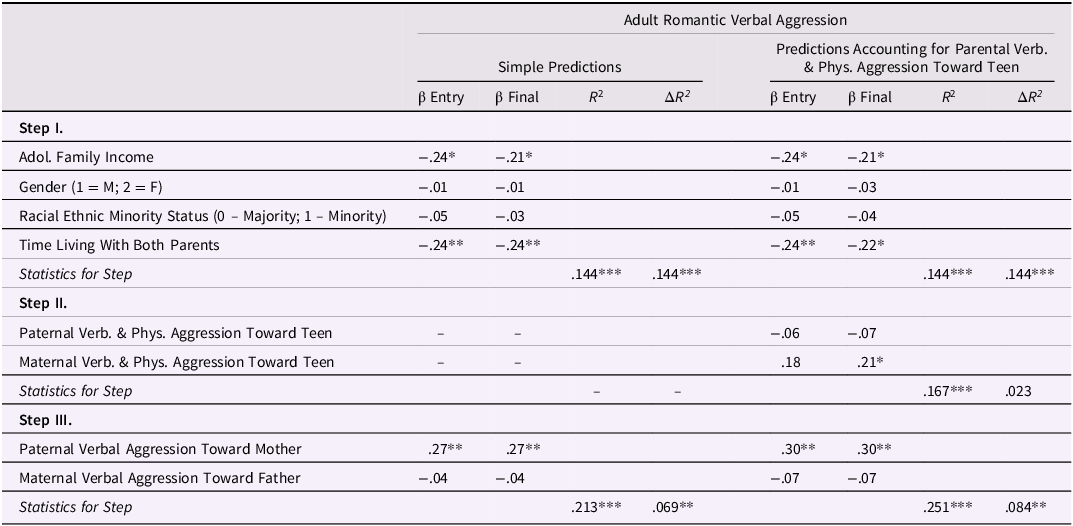
Models first examined predictions from parents’ verbal aggression toward one another in the participant’s family-of-origin. Results are presented in the first four columns in Table 2 and reveal a significant effect of paternal verbal aggression when the participant was an adolescent in predicting future participant romantic verbal aggression in adulthood. Maternal verbal aggression toward fathers was not predictive of future romantic verbal aggression in this analysis, nor was it a significant predictor in zero-order correlations (as seen in Table 1).
Predicting adult romantic verbal aggression from family of origin parental behavior
Note. Verb. = verbal; Phys. = Physical. ***p < .001. **p ≤ .01. *p < .05.
Analyses next examined whether predictions from paternal verbal aggression toward mothers would remain after accounting for both maternal and paternal verbal aggression directed toward the adolescent. Results are presented in the last four columns of Table 2. These indicate that maternal verbal aggression directed toward the adolescent predicted future romantic verbal aggression. Even after accounting for this prediction, however, paternal verbal aggression toward mothers continued to add unique variance to prediction of future adult romantic verbal aggression.
Finally, analyses examined whether results could simply be an artifact of actual paternal physical violence in the interparental relationship. After accounting for violent behavior by each parent toward the other, paternal hostile conflict remained a significant predictor of future romantic verbal aggression (see Supplemental Table 1). This indicated that the predictive effect of paternal verbal aggression toward mothers was not merely an artifact of the presence of violent behavior.
Hypothesis 2: Predictions from close friendship intense conflict
Analyses next examined the role of intense conflict in close friendships as a predictor of future romantic verbal aggression. As shown in Table 3, after accounting for demographic and contextual factors, intense conflict in a teen’s closest friendship added significant variance to the prediction of adult romantic verbal aggression.
Regressions predicting adult romantic verbal aggression from adolescent-close friend conflict

Note. Adol. = Adolescent. ***p < .001. **p < .01. *p < .05.
Follow-up analyses assessed whether results were specific to intense conflict within the close friendship, as opposed to being just a reflection of overall friendship quality. When a marker of overall friendship quality was added to the model, this measure did not significantly add to the prediction of later romantic verbal aggression, nor did it alter the predictions from close friendship verbal aggression to future romantic verbal aggression (see Supplemental Table 2).
Hypothesis 3: Intense conflict in close friendships will moderate effects of interparental verbal aggression
Analyses next examined intense conflict in close friendships in conjunction with interparental verbal aggression, examining both main effects and moderation. Intense conflict in close friendships and paternal verbal aggression toward mothers each contributed unique variance to predicting future romantic verbal aggression in these models as shown in Table 4. In addition, however, a moderation effect was found, such that paternal verbal aggression toward mothers was only predictive of future romantic verbal aggression in the context of moderate to high degrees of co-occurring close friendship intense conflict. Results are presented in Table 4 and Figure 1.
Interaction of paternal verbal aggression toward mother and intense conflict with close friend in predicting adult romantic verbal aggression.
Note. All variables are standardized.

Adolescent close friendship intense conflict moderates relation of paternal verbal aggression toward partner to adult romantic verbal aggression

Note. Adol. = Adolescent. ***p < .001. **p < .01. *p < .05.
Post hoc analyses
Do effects of interparental verbal aggression differ depending on adolescent family income, gender, racial/ethnic minority status, whether parents live together versus apart or were married versus not married? Analyses examined whether measures of interparental verbal aggression or intense conflict with a close friend would differ in their predictive effect depending upon any of the demographic or contextual variables examined in this study. Interaction tests revealed no significant interactions of interparental behavior or friendship conflict with any of these factors, thus indicating that the predictions described above did not differ significantly across these demographic factors.
Do the predictions from paternal verbal aggression and maternal verbal aggression reliably differ from one another? To test whether the apparent difference in predictions from maternal and paternal interparental verbal aggression was statistically reliable, analyses next examined the final model above, but then constrained estimates from maternal and paternal verbal aggression to be equal. Results demonstrated that this constraint led to a significant decrement in model fit (χ2(1) = 5.24, p = .02), thus indicating that the unconstrained model should be retained as the difference between predictions from paternal verbal aggression and maternal verbal aggression was significant.
Do predictions to adult romantic conflict differ depending upon the age of the adult? Supplemental Tables 3–6 present results of analyses parallel to those in Table 4, but instead of aggregating adult romantic conflict across ages, we now disaggregate and present it for each adult age period assessed. Formal tests of the difference in magnitude of effects of paternal aggression and friendship conflict revealed that there was no reliable difference across time periods for friendship conflict, but there was a difference across time in the predictive value of paternal aggression (χ2(3) = 10.91, p = .012). However, inspection of the findings revealed no clear age pattern. Also, because sample size drops substantially at later ages, even estimated effects similar in magnitude to significant effects reported in Table 4 were often not significant given reduced power. Overall, these findings provide little evidence that the main findings above differ reliably depending upon the age of the adults observed.
Discussion
The results of this study highlight the import of adolescents’ exposure to verbal aggression and intense conflict within two key relationships: their parents’ relationship with one another and their own relationship with their closest friends. Both areas of exposure in adolescence contributed unique variance to explaining future adult romantic verbal aggression and also interacted in predicting this verbal aggression. Notably, these findings also suggest that prior seminal findings with more restricted samples do appear to generalize to more racially and ethnically diverse samples.
The findings of this study regarding interparental verbal aggression are consistent with prior research in this area but extend it in key respects. Most importantly, the findings indicate that although interparental verbal aggression on the part of mothers and fathers was correlated, it was fathers’ verbal aggression toward mothers that was predictive of future romantic verbal aggression in adulthood for their offspring, regardless of the teens’ own gender. Prior work had found slight evidence (e.g., only for sons) of paternal satisfaction in marital relationships being more predictive than maternal satisfaction of future offspring satisfaction (Feng et al., Reference Feng, Giarrusso, Bengtson and Frye1999). Yet to our knowledge, longitudinal research utilizing more than a single reporter had not previously addressed paternal versus maternal differences in this regard. Fathers have long been relatively understudied in psychological research (Phares & Compas, Reference Phares and Compas1992), and these findings suggest an important role for them in the intergenerational transmission of relationship styles. Given men’s greater physical strength and greater potential to commit injurious acts of violence (Archer, Reference Archer2000), as well as often greater financial resources, expressions of verbal aggression by fathers are likely to be inherently more threatening and more salient to the observing adolescent, just as they have been shown to be to the adolescent’s mother (Phelan et al., Reference Phelan, Hamberger, Guse, Edwards, Walczak and Zosel2005). Also notable is that these findings were not just a function of adolescent exposure to actual interparental physical violence, which was not predictive of later adult romantic aggression in these analyses. It may be that the implicit possibility of violence that arises with hostile paternal behavior toward the adolescent’s mother is sufficient to make a significant and lasting impression on the adolescent, regardless of whether it is linked to substantial levels of actual physical violence.
The present findings also extend past research in showing that predictions to future romantic conflict appeared over and above predictions from parental verbal aggression directed toward the adolescent. These findings suggest that effects of interparental verbal aggression are not likely to be simply mediated via effects on parenting behavior. Given that interparental verbal aggression and hostile parenting behavior are often correlated (Krishnakumar & Buehler, Reference Krishnakumar and Buehler2000; Low & Stocker, Reference Low and Stocker2005; Sturge-Apple et al., Reference Sturge-Apple, Davies and Cummings2006), the finding that interparental verbal aggression has implications for future development beyond any potential mediation via parenting behavior suggests a need to consider such verbal aggression in its own right. These findings do not, of course, mean that problematic parenting is unimportant, only that in this particular domain, highly problematic and abusive parenting behavior did not appear to be a primary mediator of the predictive effects of what was occurring between an adolescents’ parents. Notably, maternal verbal aggression toward the adolescent was a predictor of future romantic verbal aggression in some models tested. From a social learning perspective, these findings suggest a view of the adolescent as a keen observer of the horizontal interparental dynamic, even when not directly a target of it. These findings are consistent with the notion that the family-of-origin is a powerful model when adolescents are trying to discern which romantic behaviors are and are not acceptable and healthy in their own relationships.
Study findings also appeared robust across income groups, gender, race/ethnicity, and parents’ marital and residential status, thus providing important evidence of contextual generalization that was lacking from otherwise rigorous earlier longitudinal studies. With regard to the finding that predictions from interparental conflict did not differ depending upon whether the parents were living together or apart, it has long been recognized that the conflict prior to divorce in marriages is a larger source of distress to offspring than an actual divorce (Emery, Reference Emery1982). These findings suggest that simply separating parents physically does not eliminate the potential risk stemming from their conflict. It is also noteworthy that even accounting for current levels of interparental verbal aggression, having parents who lived apart was associated with a somewhat greater likelihood of adult romantic verbal aggression.
A second major finding from this study was that even given the large predictive role of paternal verbal aggression toward the adolescent’s mother, intense conflict in the adolescent’s relationship with their closest friend also played a substantial role in predicting adult romantic verbal aggression. Not only did friendship conflict add significant unique variance in explaining adult romantic verbal aggression, but it also moderated the predictive effect of paternal verbal aggression. Paternal verbal aggression was only predictive of future romantic verbal aggression when the adolescent also had close same-gender friendships that were characterized by high levels of intense conflict as reported by the friend. In cases where intense friendship conflict was relatively absent, the relation of paternal verbal aggression to future romantic verbal aggression disappeared, suggesting a buffering or compensatory effect of low-conflict adolescent friendships. Conversely, the predictive effect of such verbal aggression was magnified when also accompanied by intense conflict in the adolescent’s closest friendship. Notably, overall friendship quality was not linked to future romantic aggression, suggesting that the issue in this case is less about whether an adolescent has positive close friendships, but rather, whether they are exposed to significant conflict in their close friendships.
Alternatively, this moderating effect could also be interpreted as suggesting a potential role of relative harmony in the interparental relationship to buffer the negative effects of intense friendship conflict. This interpretation would be consistent with the role of parents as providing a secure base and a consistent model of functional interaction, such that subsequent exposure to intense friendship conflict would be less likely to alter a teen’s scripts for behaving in future romantic relationships (Allen et al., Reference Allen, McElhaney, Land, Kuperminc, Moore, O'Beirne-Kelley and Liebman2003; Dykas et al., Reference Dykas, Woodhouse, Cassidy and Waters2006). It is also quite probable that both interpretations of this moderating effect are true to some degree. Notably, paternal verbal aggression was uncorrelated with adolescent friendship conflict, a finding consistent with the degree to which each phenomenon contributed independently to explaining later adult romantic conflict. Friendship conflict was positively correlated with maternal verbal aggression, however, suggesting that the constructs are not fully independent and that more research on their potential linkage is warranted.
These findings are consistent with an emerging body of research suggesting the potential of the adolescent close friendship to offset the effects of deleterious experiences in the family of origin (Lansford et al., Reference Lansford, Criss, Pettit, Dodge and Bates2003; Lyell et al., Reference Lyell, Coyle, Malecki and Santuzzi2020; Schacter & Margolin, Reference Schacter and Margolin2019). Extensive research is now documenting the fundamental role of the adolescent close friendship in development: Qualities of these friendships have been found to be robust predictors of future romantic interactions, as well as a host of other outcomes into late adolescence and beyond (Allen et al., Reference Allen, Narr, Kansky and Szwedo2020, Reference Allen, Costello, Kansky and Loeb2022). As noted previously, numerous aspects of the adolescent close friendship appear likely to serve as a training ground for handling similar aspects of adult romantic relationships, with the potential for peer socialization influences to override (or reinforce) previous parental socialization. The current findings were not a function of overall friendship quality, however. Rather, there was a high degree of specificity in predictions, such that friendship intense conflict was predictive of future romantic relationship verbal aggression, while overall friendship quality was not. This finding further supports a direct social learning perspective across horizontal relationships, with the implication that adults who are hostile in romantic relationships are not simply victims of a poor general relationship history, but rather have had specific, repeated exposure to hostile and/or intense conflictual close relationships.
In some respects, it may appear surprising that exposure to interparental conflict and intense conflict in close friendships would have lasting implications, given that parents may not be behaving with verbal aggression toward the adolescent and that close friendships are often transient. Together, these findings are consistent with a view of adolescence as a period characterized by unique sensitivity to social interactions. Evidence from neuroimaging studies has suggested that both in terms of neural development and responsiveness to actual interactions, the adolescent brain is uniquely primed to learn from social cues (Blakemore, Reference Blakemore2008). This sensitivity likely prepares the adolescent to ultimately move into the larger social world of adulthood with success, but also makes teens particularly attuned to cues, both functional and dysfunctional, that they observe in key social relationships around them. Findings are also consistent with emerging findings based on attachment theory, suggesting long-term links between parent–child interactions, adolescent friendships, and adult romantic relationships (Loeb et al., Reference Loeb, Stern, Costello and Allen2020; Pascuzzo et al., Reference Pascuzzo, Cyr and Moss2013).
Several limitations of these findings also warrant mention. Most importantly, the findings of longitudinal relations among the data are not sufficient to establish a causal role for either paternal behavior or close friendship conflict in predicting future romantic relationship verbal aggression. Although several potential alternative causal factors (e.g., family income, parents’ residential status, and racial/ethnic minority group membership) were assessed in this study, other unmeasured factors – from parental personality factors and levels of family conflict earlier in development to genetic predispositions (Horwitz et al., Reference Horwitz, Neiderhiser, Ganiban, Spotts, Lichtenstein and Reiss2010, Reference Horwitz, Ganiban, Spotts, Lichtenstein, Reiss and Neiderhiser2011) – may well have played a causal role. However, a primary role of genetic predisposition appears somewhat less likely given the lack of relation between mothers’ verbal aggression toward fathers and their offspring’s later romantic behavior.
This study also did not assess whether adolescents directly observed interparental verbal aggression. Thus, whether these findings reflect effects of direct observation, as opposed to the numerous potential mechanisms of indirect exposure to such conflicts (e.g., parent reports, relatives’ reports, custody hearings, etc.), is an area that warrants further research consideration. To the extent that effects were related to indirect exposure to conflict, efforts to identify the mechanisms by which indirect exposure occurs are also warranted.
The study was also not able to consider adolescents raised by same-sex parents; such consideration could help further clarify the parent gender findings in this study. An additional limitation of the study was that only adult participants who were actually in a romantic relationship of at least 3 months duration were assessed. Attrition analyses suggested that those participants who did not have such a relationship were more likely to have been exposed as adolescents to interparental verbal aggression. If anything, these analyses suggest that effects of exposure to such verbal aggression may have even more profound implications in terms of relationship formation, though these effects could not be readily observed in this study.
Although the current results await further replication, they nevertheless suggest the importance of attending to the ways in which adolescents may be learning from key social experiences regarding appropriate romantic behavior. The specificity of the observed predictors suggests a potential route for preventive interventions by highlighting the possibility of disrupting pathways to romantic verbal aggression by addressing specific conflict behaviors, rather than needing to focus on more global relationship characteristics. Further, the possibility that close friendship qualities may offset effects of interparental verbal aggression suggests a further potential route for intervention. Although these intervention possibilities are speculative and the causal role of the observed predictors remains to be determined, at a minimum these findings indicate that the identified predictors can serve as key early warning signs of future long-term risks and of a need for preventive interventions to set the developing adolescent on a trajectory more likely to lead to satisfying romantic experiences across the life span.
Supplementary material
The supplementary material for this article can be found at https://doi.org/10.1017/S0954579423001670.
Funding statement
This study was supported by grants from the National Institute of Child Health and Human Development and the National Institute of Mental Health (R37HD058305, R01-MH58066, & F32HD102119).
Competing interests
The authors have no conflicts of interest to declare that are relevant to the content of this article.


 Open access

