




Introduction
The temporally extensive and distant nature of prehistory reduces its relatability and accessibility for the general public. In this context, museums are highly influential in shaping how the public perceives prehistory, constituting important educational sites for constructing and communicating knowledge through their displays, and mediating between academics and the public (Hooper-Greenhill Reference Hooper-Greenhill2000; Moser Reference Moser2010; Skeates Reference Skeates2017). Yet the messages that museums convey are not necessarily objective and can be subject to many factors, such as institutional mission, collection history, curatorial preferences and funding pressures, that can unintentionally politicise or even misrepresent the past.
Due to the lack of written sources that might name well-known individuals or events, or facilitate the interpretation of material remains, prehistory is an inherently difficult period to present to the public (Pearce Reference Pearce1990: 161). This situation is exacerbated by the temporal distance of prehistory from the present, which further reduces its relatability for contemporary audiences and subjects material remains to greater taphonomic influences, resulting in a fragmentary and sometimes ambiguous archaeological record. These issues impose numerous interpretative challenges for museums attempting to convey the complex trajectory of prehistory to the public within the restrictions imposed by their collections. With the aim of mapping a path towards more engaging and representative prehistory displays that better cater for visitor familiarity and interests in the period, the present article addresses the following research questions:
1. What preconceptions do members of the public have about prehistory?
2. What are the prevailing trends that shape current museum presentations of humanity's deep past?
3. How do members of the public engage with current prehistory displays?
Evaluating prehistory displays
To evaluate prehistory displays, the narratives they convey and how visitors engage with them, an initial understanding of public preconceptions of prehistory is required. These preconceptions can be defined as the prior understandings and associations that visitors bring with them, and which are shaped by a variety of factors, including individuals’ backgrounds and previous life experiences. It is these preconceptions that dictate the embedded assumptions and expectations that visitors bring to museums, which, in turn, govern their engagements with and understanding of displays.
Wood and Cotton's (Reference Wood, Cotton and Merriman1999) survey of 1836 visitors to the Museum of London in 1992 provides a rare insight into visitor preconceptions of prehistory and highlights that most visitors associate the period with the androcentric concept of ‘cavemen’ equipped with stone weaponry, living contemporaneously with dinosaurs. This lack of public understanding of prehistory has been subsequently documented by studies investigating perceptions of specific prehistoric periods, such as Milner and colleagues’ (Reference Milner, Blinkhorn, Hadley, Hellewell, Ashton and Harris2015) exploration of the Mesolithic.
Research by museum archaeology specialists in particular provides key insights into the representation of humanity's deep past. These include Moser's (Reference Moser1998, Reference Moser and Merriman1999) work on the representation of human origins; Henson's (Reference Henson2016) comprehensive review of the representation of the Mesolithic in a variety of media, including a sample of six museums in Europe and a further eight in England; Wood and Cotton's (Reference Wood, Cotton and Merriman1999) overview of display trends; Ballard's (Reference Ballard, Hamilton, Whitehouse and Wright2007) review of the representation of the Iron Age; and Levy's (Reference Levy2006) study of identity as displayed in Nordic museums. These contributions highlight a reliance on traditional, technology-driven narratives within prehistory displays and elucidate the static nature of many such displays, which continue to recycle the same evolutionary narratives. These important contributions, however, are based largely upon visual observations of small samples of museums, so it is difficult to extrapolate the results: how representative are these trends across multiple museums? And do these trends persist within contemporary museum displays? A specific line of analysis has focused on the representation of gender in prehistory displays (e.g. Gifford-Gonzalez Reference Gifford-Gonzalez1993; Porter Reference Porter and Lumley1995; Cook Reference Cook, Devonshire and Wood1996; Moser Reference Moser and Merriman1999; Sørensen Reference Sørensen and Merriman1999; Ballard Reference Ballard, Hamilton, Whitehouse and Wright2007; Bünz Reference Bünz, Danielsson and Thedéen2012). This extensive body of literature emphasises the persistence of binary gender stereotypes within museum displays, particularly in relation to prehistory due to a lack of written records and therefore greater reliance on how we interpret the fragmentary archaeological record according to our own assumptions and preconceptions.
The trend for museums to present highly stereotyped and restricted narratives of the past is not limited to the representation of prehistory and has been identified more widely in archaeology displays (e.g. Denford Reference Denford1995; Merriman Reference Merriman1999; Tully Reference Tully2010: 131; Skeates Reference Skeates2017). Yet, museums are dynamic, changing with new acquisitions, curators and collection-based research, as well as intermittent injections of funding. These changes might vary from superficial design adjustments to large-scale interventions and re-display of collections. Consequently, most displays should be viewed as palimpsests of different types and scales of interventions through time. This might suggest that, since the research highlighted above was undertaken and published, museums may have adapted and changed their display narratives. To understand how both public understandings of prehistory and the museum representation of the period have changed over time requires a broader evaluation framework that accounts for public preconceptions, display trends and visitor engagements.
Methods
To evaluate contemporary prehistory displays and how they are perceived and engaged with by visitors, the present study uses a dual-scale method to capture both breadth and depth of data. At the broad, ‘macro’ scale, prehistory displays are evaluated using a quantitative method of visual analysis to identify trends. Meanwhile, at the ‘micro’ scale, questionnaires are used to elucidate individuals’ preconceptions of prehistory before visiting a museum display, and in situ tracking surveys to document subsequent engagement with displays. The geographical focus of the study is England and the selected prehistory displays are all permanent installations in museum contexts.
Display evaluation
To identify the prevailing trends affecting museum representations of prehistory, 173 displays across England, from Alnwick to Penzance, were recorded in person and via e-mail between January 2017 and January 2020 (Figure 1). To mitigate against personal subjectivity, a series of standardised variables were defined in order to record each display, using consistent language, and to facilitate an objective comparison of visual categories across diverse contexts.
Map showing the geographical distribution of the 173 museums recorded across England (figure by F. McDowall).

The categories of visual analysis are based on display elements outlined by Moser (Reference Moser2006: 3, Reference Moser2010: 24–30), and later adapted by Tully (Reference Tully2010: 196), to analyse trends in ancient Egyptian museum displays. The 13 variables recorded for each prehistory display for the present study are listed below (further details are provided in the Online Supplementary Materials (OSM)):
1. Name of prehistory gallery/section;
2. Age of displays;
3. Amount on display;
4. Type of material on display;
5. Colour scheme;
6. Type of lighting;
7. Display furniture;
8. Spatial relationships between objects;
9. Text panels;
10. Additional interpretation;
11. Representation of gender;
12. Presentation of human remains; and
13. Overarching display narrative.
Questionnaire and tracking survey
At the micro scale, visitor data were collected at six museums between December 2017 and December 2018 to provide insights into visitor perceptions of and interactions with prehistory displays (Figure 2). Data were collected from 718 visitors in total; 50 tracking surveys and 50 questionnaires were analysed for each of the six museums. The six selected museums are of different sizes and budgets, geographically dispersed, and represent varied approaches to the presentation of prehistory: The British Museum, Stonehenge Visitor Centre, North Lincolnshire Museum, Torquay Museum, Weston Park Museum and the Great North Museum. At each of these museums, tracking survey and questionnaire data were collected in tandem to provide complementary qualitative and quantitative data.
Map illustrating the geographical distribution of the six case studies across England (figure by F. McDowall).

For both the tracking surveys and questionnaires, visitors were selected using a random sampling approach to capture a representative sample for each museum. The partial self-completion questionnaire was split into two sections, with visitors directed to complete the first part, focused on their preconceptions, before viewing a display, and to complete the second part, focused on their opinions about the prehistory displays, either during or after they had viewed one. Most of the questions were open-ended to provide respondents with an opportunity to describe their experiences in their own words, and the resulting qualitative data were thematically coded to quantify the frequency of popular responses.
Covert tracking surveys were used to record visitor movements on schematic maps of the galleries, recording where visitors stopped, for how long they stopped, and how they moved through the gallery spaces. These quantitative observational data indicate the level of visitor engagement in each museum by quantifying the average ‘dwell time’ and the numbers of visitors stopping at each display case. Higher dwell times and visitor frequencies are taken as an indication of more engaging displays.
Visitor preconceptions
To address the first research question, relating to how visitors perceive and understand prehistory, the responses to the first part of the questionnaire were analysed. Across the six case study museums, the qualitative survey responses were analysed to assess the variability of visitor preconceptions (Figure 3). The first open-ended question, ‘What does prehistory mean to you?’ received 285 responses. Thematic content analysis identified nine response themes mentioned by 10 per cent or more of the respondents (Figure 4).
Word cloud produced from the 757 responses collated from the first part of the questionnaire (figure by F. McDowall).

Graph summarising the most popular response themes identified across the 285 responses to the question, “What does prehistory mean to you?” (figure by F. McDowall).

Temporal confusion
Most of the definitions of prehistory provided by respondents reveal temporal misunderstandings of the period, exemplified by respondent 3 at Torquay Museum, who describes prehistory as, “heritage, World War I and II, Kings and Queens, local history, world history—Tsar—Russian revolution, prehistoric man/life/dinosaurs, etc.”. This temporally mixed response, zigzagging across broad swathes of time, is representative of a large proportion of respondents. Although just under 25 per cent of respondents named specific prehistoric periods, understanding of the dates and sequence of these periods varies greatly. References to the Stone Age, Bronze Age or Iron Age, for example, appear in 19 per cent of the respondents’ definitions of prehistory. Yet, often these Ages are referenced in isolation (outside of the tripartite structure) or in association with both earlier and later periods. Consequently, the frequency of respondents referencing each of the so-called Three Ages varies across the sample, with only 9 per cent referencing the Stone Age, 13 per cent referencing the Bronze Age and 11 per cent referencing the Iron Age.
The second most frequent response, at 23 per cent, is a definition of prehistory as the period preceding the written record. Respondents sharing this definition, however, still struggled to situate the period in time; many referenced multiple ‘ancient’ periods within their frame of reference, including later periods with written records, as demonstrated by Respondent 21 at North Lincolnshire Museum, who defines prehistory as, “history of time before formal recording of things, Iron Age, Bronze Age, Romans, Vikings, Saxons, findings of ancient sites such as Herculaneum and Pompeii …”. Despite their own definition that prehistory precedes periods with written records, this respondent also cites later literate periods, illustrating some temporal confusion when articulating the dating and definition of prehistory.
Visitor interests
To identify how museums might better cater for the interests and expectations of their visitors, respondents were asked what they found most and least interesting about prehistory. These responses were then analysed to identify shared visitor interests (Figure 5).
Graph summarising the most popular response themes identified across the responses to the questions, “What do you find most interesting about prehistory?” and “What do you find least interesting about prehistory”? (figure by F. McDowall).

The most popular visitor interests articulated in the 275 responses revolve around learning about the daily lives and skills of people in the past, and human evolution. The 22 per cent of respondents interested in learning about people like themselves reflects the relatability of such content, which enhances the accessibility and relevance of temporally distant prehistoric people and practices. This particular interest has also been identified in previous visitor studies focused on public interest around prehistory and other periods (e.g. Stone Reference Stone, Stone and Molyneaux1994; Wood & Cotton Reference Wood, Cotton and Merriman1999; Tully Reference Tully2010: 148; Pratt Reference Pratt, Hinson and Jawliková2015).
In contrast, respondents were more reticent to articulate what they found least interesting, with only 66 per cent answering this question and 23 per cent of the responses stating that they found ‘nothing’ less interesting. Setting aside the 15 per cent of respondents who referenced ‘Pottery’, the lack of responses makes it difficult to identify specific areas that visitors find least interesting. Yet the lack of interest in pottery reveals an apparent contradiction between how museums often present ‘daily life’ in displays and what visitors want to see.
The prehistory branding issue
The three open-ended questions in the first part of the questionnaire focusing on visitor preconceptions and interests received a total of 757 responses. The results reveal that the respondents are generally unfamiliar with prehistory, with 47 per cent either communicating their unfamiliarity implicitly in the form of responses conflating prehistory with recorded historical periods, or explicitly, specifying their lack of such knowledge. The lack of a shared understanding between respondents is also observed in the frequency of responses referencing specific details about prehistory. Apart from 19 references to Stonehenge and nine references to Neanderthals, all other prehistoric sites, monument types, hominins and named individuals are mentioned by no more than three respondents (out of 757 responses). There are, however, shared references to types of material culture and objects across the responses, with 37 per cent referencing some form of pottery and 24 per cent making broad references to tools (Figure 6).
Graph summarising the types of material culture referenced in the first part of the questionnaire across the 757 responses (figure by F. McDowall).

Beyond a general awareness that prehistory might be defined by a lack of written sources, that it can be split into three technology-based ages, and that it is associated with pottery and tools, the visitor responses demonstrate an absence of a shared language or understanding of prehistory. This variability of responses suggests that, unlike for later time periods, in the public imagination prehistory does not have a strong ‘brand’. In other words, prehistory does not have a commonly understood repertoire of shared associations—such as a suite of stereotypes, associated material culture or popular narratives—that are instantly recalled by the public. Notably, the traditional stereotype of primitive cave dwellers living contemporaneously with dinosaurs is far from pervasive, with only five references to cavemen and 23 mentions of dinosaurs.
Typically, later archaeological periods each have a unique set of associations (Wood & Cotton Reference Wood, Cotton and Merriman1999: 29), constituting a ‘brand identity’ connecting people to the past. Ancient Egypt, for example, is frequently associated with pyramids, religion and hieroglyphs (Tully Reference Tully2010); the Romans are associated with civilisation, military power and imperialist concepts of empire; the Anglo-Saxons with kingdoms and Christianity; and the medieval period with castles, churches and monarchies. These publicly familiar ‘brands’ can shape visitor expectations about museum visits and enhance the accessibility of the narratives conveyed. Yet, prehistory lacks a comparable ‘brand’ that encapsulates the diversity of the material culture and lifestyles across millions of years of human prehistory. Trying to reduce such enormous variability into a singular homogenised ‘brand’ with a widely understood repertoire of associated material culture, named individuals and key events would be a challenging task but is certainly something that requires further investigation.
Representation of prehistory
To address the second research question, concerning the current display trends that characterise museum representations of prehistory, 173 museums displays are visually analysed. The display variables recorded for each of the museums are quantitatively compared and eight of these variables reveal key representational trends influencing the broader representation of prehistory (Figure 7).
Infographic summarising key representational trends identified in the visual analysis of 173 prehistory displays (figure by F. McDowall).

The perpetuation of linear, technology-driven narratives
Analysis of the ages of individual displays—that is, the most recent date at which they were last changed—reveals that just over half have been substantially refurbished and updated in the past 10 years (2010–2020). Despite the relative modernity of the displays analysed, most continue to contextualise displays within the temporal framework of the Three Age system, which, as emphasised by visitor responses discussed above, means little to much of the public. Museums utilising this tripartite framework to structure their displays tend to rely on the dominance of tools in their collections to focus on changes in technology, communicating traditional narratives of progress.
The narrative trend of technological progress through time that is so prevalent in museums across England can be traced back to the origins of both prehistory as a discipline and museum displays (Bennett Reference Bennett2004; Trigger Reference Trigger2008); it has previously been recognised by Wood and Cotton (Reference Wood, Cotton and Merriman1999) in museum displays of the 1990s and, more recently, by Ballard (Reference Ballard, Hamilton, Whitehouse and Wright2007) and Bünz (Reference Bünz, Danielsson and Thedéen2012). The results presented here demonstrate that the narrative of progress is still firmly embedded in the interpretation of prehistory today.
The persistence of older narratives is also illustrated by the representation of gender, with most museums continuing to represent men and women in outdated and unsubstantiated stereotyped gender roles. Of the 75 museums in the sample that represented gender in their visual interpretation, 63 per cent depicted women in exclusive association with the domestic sphere, looking after children, cooking, crafting and textile making, in juxtaposition to men in exclusive association with activities outside of the domestic sphere, such as hunting, tool making, painting and fighting. Twenty-seven per cent of the 75 museums neglected to depict women altogether, perpetuating the invisibility of women in prehistory displays highlighted by scholars over 20 years ago (e.g. Gifford-Gonzalez Reference Gifford-Gonzalez1993; Porter Reference Porter and Lumley1995; Cook Reference Cook, Devonshire and Wood1996; Moser Reference Moser and Merriman1999; Sørensen Reference Sørensen and Merriman1999). Despite the high proportion of displays updated in the past 10 years and the vast body of literature challenging the interpretation of binary gender stereotypes, visual representations of prehistory in most museums continue to emphasise a male-centric narrative of progress.
Invisibility of earlier prehistory
The persistence of technology-focused narratives in contemporary museum displays limits the representation of the Palaeolithic, Mesolithic and Neolithic, defining these periods solely by durable stone technologies, homogenising and primitivising these early periods. In contrast, displays of the Bronze and Iron Ages are associated with a greater diversity of material culture, often imbued with more symbolic capital and utilised to convey higher technological sophistication. This representational imbalance is further reinforced by museum displays in England which provide more physical space and more textual interpretation, and attribute a greater variety of narratives, to later prehistory.
Earlier prehistory is much less visible in museum displays due to the differential preservation and taphonomic factors influencing the survival of objects. Consequently, the composition of most museum collections is often restricted to small quantities of de-contextualised lithics that, in combination with a focus on tool technology dictated by the Three Age system, presents a didactic narrative that homogenises the diversity of Stone Age culture, simultaneously decreasing the visibility and relatability of the deep past.
Decorative or symbolic objects of Palaeolithic or Mesolithic date rarely feature in museum displays. A lack of such objects in collections does not, however, mean that they cannot be featured. The Ashmolean Museum (Oxford) and Natural History Museum (London), for example, utilise casts of Palaeolithic portable art, weaponry and human remains to provide a richer picture of Palaeolithic life. The incorporation of more diverse objects in displays and a greater reliance on casts and copies to complement Palaeolithic tool collections within displays are more common in European museums. Full-sized reconstructions of cave art panels, copies of portable art, hominin skulls and Venus figurines, for example, feature in French, Spanish and Italian museums (e.g Museu d'Arqueologia de Catalunya, Spain; Museo di Storia Naturale del Mediterraneo, Italy; Musée des civilistions de l'Europe et de la Méditerranée, France). These museums often adopt a wider geographical focus, enabling them to incorporate copies and casts of objects discovered in other countries. This approach highlights how a broader geographical focus within museums in England could provide the opportunity to incorporate more diverse social and symbolic narratives of the Palaeolithic and Mesolithic.
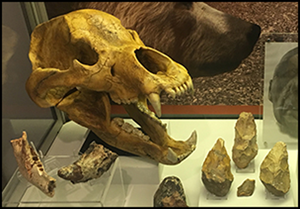
Museums in England rarely include casts or copies to supplement their displays, with only nine per cent of the sample using them to support their interpretations of prehistory. Yet, the analysis of tracking surveys reveals that including casts alongside collections offers great potential for engaging visitors. At Torquay Museum (Devon), cases containing casts of hominin skulls alongside Pleistocene faunal remains and lithics were the most popular areas for visitors to dwell (Figure 8), spending an average of 57 seconds at such display cases—double the average time spent at other cases in the gallery without such material. This engagement trend was also observed at the Great North Museum (Newcastle upon Tyne), where half of tracked visitors stopped to engage with the large, imposing cast of an Irish deer (Megaloceros giganteus) that greets visitors as they enter the gallery.
A case of Palaeolithic hand axes and faunal remains presented alongside a cast of the Atapuerca skull at Torquay Museum (photograph by F. McDowall 2018, with thanks to Torquay Museum).

Visitor engagements
To address the third research question and assess how visitors engage with prehistory displays, the 300 tracking surveys and the responses to the second part of the 300 questionnaires were evaluated. The tracking data reveal how frequently visitors stop to engage with different types of interpretation and for how long (Figure 9). Comparison of visitor frequency and dwell times at different types of interpretation shows that text panels have both the lowest visitor frequency and lowest average dwell time. Such a lack of engagement with text panels makes it difficult for museums to counteract the temporal confusion visitors may bring with them. With an average of only six per cent of tracked visitors stopping to read text panels, there is limited opportunity to convey more detail about, for example, the definitions, dates and sequence of prehistoric periods. There are, however, alternative methods for engaging visitors and influencing their understanding.
Graph summarising visitor dwell times and frequency associated with different types of interpretation at the six case study museums (figure by F. McDowall).

Across the six museums, other display formats include timelines, immersive videos, tactile models and a reconstructed roundhouse; the tracking surveys show that all of these attracted high levels of visitor engagement. Audio-visual and interactive displays attracted average dwell times of 70 and 60 seconds, respectively (Figure 9). These longer dwell times provide more opportunities for visitors to engage with the tactile and visual elements and to absorb information. They can provide physical and emotional connections to the past and effectively anchor visitors to the narrative.
Providing narrative anchors for visitors is essential for engaging them with the temporal context of prehistory, rooting their knowledge within a clear, sequential frame of reference. In addition to the tracking data, the importance that visitors place upon following a clear narrative through displays is further supported by the results of analysis of the second part of the questionnaire. Most of the 178 responses to the question, ‘What did you least like about the displays?’, cite the lack of cohesiveness as their main issue, exemplified by respondent 10 at the British Museum, “layout wasn't very cohesive” and respondent 7 at the Stonehenge Visitor Centre, “it's a bit disorganised in terms of the order. difficult to follow/decide what to look at first …”. Visitors’ preference for a clear chronological narrative route through prehistory displays is apparent across the case studies and is reinforced through the popularity of timelines. At Stonehenge Visitor Centre, for example, a pictorial timeline is used to contextualise the site within a global framework; this timeline represents the second most popular feature, attracting 68 per cent of visitors observed in the tracking survey.
The tracking data also reveal a trend for visitors to engage with more aesthetically intriguing display cases, such as large wall cases and displays of visible skeletal remains and ‘shiny’ metal objects, such as jewellery and weaponry. This pattern was frequently observed across the case studies, with the most-visited display at the British Museum—the Mold Gold Cape—attracting 48 per cent of observed visitors; 82 per cent of visitors engaged with the 360° immersive panoramic video of Stonehenge at the Visitor Centre; and 50 per cent at North Lincolnshire Museum engaged with the large, visually prominent wall case presenting the Appleby log boat. These patterns of engagement are further supported by responses to the visitor questionnaire. Many of the most popular display cases observed during the tracking survey are also explicitly referenced in response to the question, ‘What did you like most about the gallery?’.
The future for displaying the past
The visitor preconceptions, engagements with displays and trends affecting the representation of prehistory in museum displays summarised in this article can inform the creation of prehistory displays that simultaneously engage visitors, fulfil their interests and bring the distant past to life (Figure 10). Here, ‘good’ displays are considered to be synonymous with engaging displays, whether physical, emotional or intellectual, from attracting the visitor's visual attention to provoking haptic interactions or inspiring connections with displays. Building on the visitor data presented above, this article concludes with some recommendations for increasing visitor engagements with prehistory displays.
Summary of the trends outlined in the article (figure by F. McDowall).

The reductive Three Age system continues to haunt prehistory displays and remains prominent in the public imagination. Visitors, however, rarely know how these ‘Ages’ are chronologically arranged. This lack of familiarity offers an opportunity for museums to move away from this framework and to seek alternatives. How, then, can museums move beyond technology-driven narratives, if their collections are primarily composed of prehistoric technology? First, framing the content of displays with compelling titles (free of the reductive Three Age system) requires museums to seek alternative terminology and to establish an accessible and widely recognised ‘brand’. Prehistory could be framed around a diversity of chronologically situated themes such as ‘origins’, ‘what made us human?’, ‘living in a changing environment’ or, more provocatively and humorously framed, ‘Only BC kids will remember this …’ or ‘what did prehistory ever do for us?’. To develop compelling terminology requires the testing of possible alternatives with different segments of the public in front-end evaluations, in order to gauge public associations and familiarity with different terms. Second, to develop narratives beyond technology and technology-focused collections calls for the utilisation of other forms of interpretation, such as casts, copies and interactive and audio-visual content to supplement collections.
It is possible for museums to present richer and more compelling narratives without ‘exoticising’ the past. Principally through a wider focus on daily life, such a focus would be particularly beneficial for diversifying the narratives used to present early prehistory, simultaneously addressing current representational disparities and highlighting the complexity of early humans, catering in particular for visitor interests in the skills of past people (Figure 5). To emphasise these narratives around daily life, comparative interactive content and reconstructed dwellings can be effectively incorporated into displays to enhance the relatability of the prehistory and encourage visitors to view themselves in relation to prehistoric people. The relevance of domestic objects can further be augmented through a person-centric narrative approach focused on key questions to intrigue the visitor, relating collections to recognisable aspects of contemporary life and implicitly encouraging visitors to compare themselves to past people. Such questions can be tailored around a museum's particular collections to invoke locally specific narratives and selected to provoke the innate inquisitive nature of the visitor.
Prehistory is strange and unfamiliar to most, yet it has great potential for engaging the public's curiosity. The lack of written records and ambiguity of interpretation that characterise this period can be used to produce intellectually stimulating displays that encourage the visitor to engage in the dialogue of interpretation. The data and analysis presented here provide a basis on which museums can develop more dynamic and innovative forms of display interpretation, enhancing the relatability and understanding of prehistory for museum audiences in England and beyond.
Data availability statement
The data that supported the findings of this study are available from the author upon reasonable request.
Acknowledgements
Special thanks are due to my PhD supervisory team Benjamin Roberts, Gemma Lewis, Anna Harnden and Sarah-Jane Harknett. For supporting my visitor-based research, my thanks go to: Neil Wilkin, Julia Farley and Stuart Frost, British Museum; Abigail Coppins, Stonehenge Visitor Centre; Rose Nicholson, North Lincolnshire Museum; Barry Chandler, Torquay Museum; Martha Jasko-Lawrence, Weston Park Museum; and Andrew Parkin, Great North Museum.
Funding statement
This research received no specific grant from any funding agency, or from commercial and not-for-profit sectors.
Supplementary material
To view supplementary material for this article, please visit https://dx.doi.org/10.15184/aqy.2023.63.


 Open access

