




1. Introduction
How many sign languages exist in the world? And in what ways are they similar or different? The scientific investigation of sign languages is very sparse compared to spoken languages, since the tradition of sign language research emerged only in the 1960s with William Stokoe’s first work on American Sign Language, which demonstrated that sign languages have syntax and morphology like spoken languages (Stokoe, Reference Stokoe1960). In Germany and many other European countries, research on local sign languages advanced with official or legal recognition of sign languages (De Meulder, Murray & McKee, Reference De Meulder, Murray and McKee2019). For example, German Sign Language and Libras (the sign language used in Brazil) were both officially recognized as languages in 2002, a milestone that resulted in the foundation of many sign language research and teaching institutes. Research on the Uruguayan deaf community and Uruguayan Sign Language, in contrast, was conducted only recently in 2013 (Parks & Williams, Reference Parks and Williams2013). This shows that the sign languages of the world are just beginning to come into view of research, and that there are many sign languages which are not investigated or known at all.
Studies on the vitality of sign languages—i.e. on the languages’ safety and stability—are even scarcer. Institutions such as UNESCO (the United Nations Educational, Scientific and Cultural Organization) have been examining spoken language vitality for over 20 years (UNESCO Ad Hoc Expert Group on Endangered Languages, 2003). However, sign languages were added to this research much more recently. A survey of 15 sign languages which was undertaken with a view to adding them to UNESCO’s Atlas of the World’s Languages in Danger (Moseley, Reference Moseley2010) found that four of them were vulnerable and 11 were endangered, with three of these having the most critical level of endangerment (Safar & Webster, Reference Safar and Webster2014; Webster & Safar, Reference Webster and Safar2019). These results were based on scoring ten factors for each sign language: the proportion of signers in the reference community; generational or age group language use; domains of language use; new domains; materials for language spread and education; governmental and institutional language attitudes and policies; the use of the target sign language in deaf education; the reference community members’ attitudes towards their own sign language; the type and quality of documentation; and the status of language programs.
This paper seeks to expand this research by examining the sociolinguistic data generated by a sign language survey administered as part of the Sign Hub project,Footnote 1 which involved ten partners from seven countries, namely France, Germany, Israel, Italy, Spain, the Netherlands, and Turkey. Led by Jana Hosemann and Markus Steinbach, the subproject Atlas (official name “The atlas of sign language structures”) ran from 2016 and 2020, and was funded—like the whole Sign Hub project—by the European Union’s Horizon 2020 research and innovation program (grant agreement 693349) (Hosemann & Steinbach, Reference Hosemann and Steinbach2023).
The Atlas is a comparative documentation of the linguistic features of the sign languages of the world. Based on a broad survey that collected information about the grammatical structures of sign languages at the levels of phonology, morphology, syntax, semantics, pragmatics, and socio-history, the Atlas is an interactive online tool for deaf, hard-of-hearing, and hearing users, such as linguists, typologists, anthropologists, sign language researchers, interpreters, and sign language teachers. The circulation of the questionnaire that collected the data continued beyond the life of the project, to continue populating this interactive digital Atlas of the world’s sign languages. This is the first known attempt to put data on sign languages into an interactive atlas that permits comparisons of their linguistic structures and grammatical and socio-historical features, allowing users to quickly search for and identify, for example, all sign languages that use the eye squint as a non-manual marker for yes/no questions. However, this pioneering Atlas is only one component of the overall project, which aimed to:
provide the first comprehensive response to the societal and scientific challenge resulting from generalized neglect of the cultural and linguistic identity of signing deaf communities in Europe [and] provide an innovative and inclusive resource hub for the linguistic, historical and cultural documentation of the deaf communities’ heritage. (CORDIS, 2020)
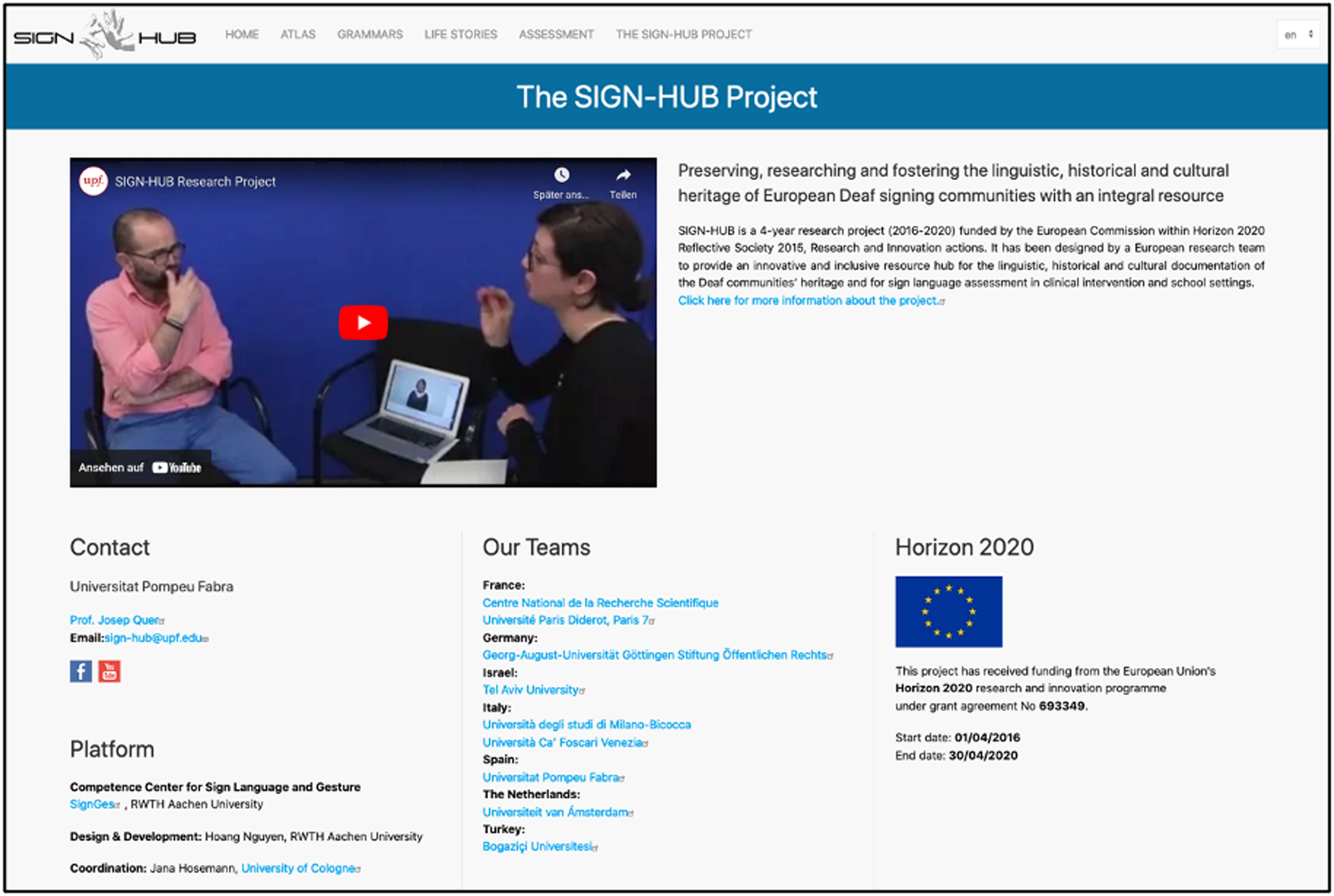
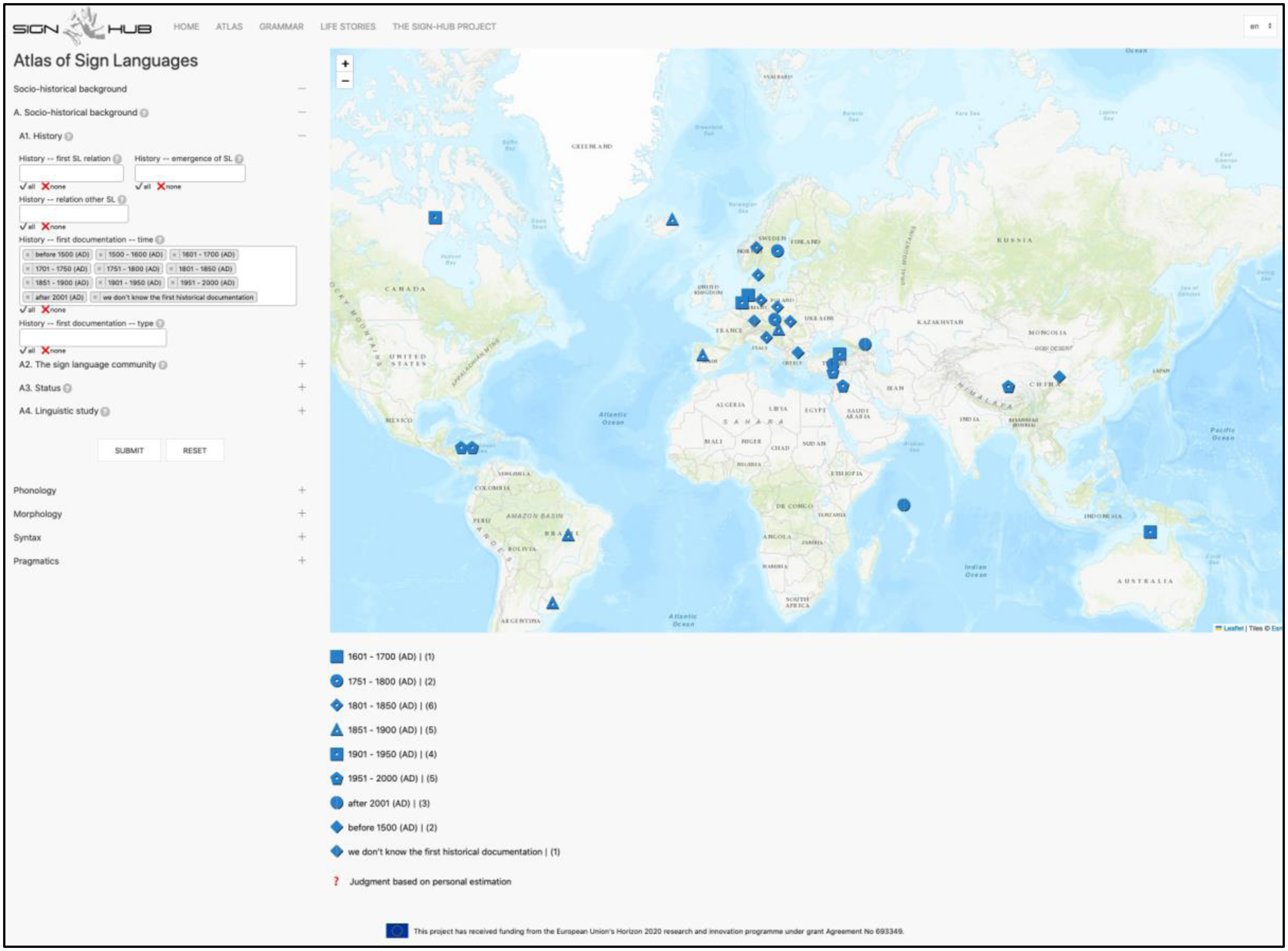
The data considered by this paper are the survey questions and answers used by the research team to complete the sociolinguistic profiles in the Sign Hub Atlas (www.thesignhub.eu/atlas; see Figure 1). The dataset was provided to the first author in June 2022 by project members based at the University of Göttingen, one of the ten project partners, who had gathered it in 2019 and 2020. Today, the Atlas comprises data from 56 different sign languages, 29 of which are included in the socio-historical profile section.Footnote 2 The data analyzed for this paper include a subset of ten different sign languages that were available at the time of analysis. These data already appear in the interactive Atlas, along with data on other sign languages that were collected after this particular set was analyzed. Figure 2 shows an example of how the Atlas looks. It allows the user to select a socio-historical, phonological, lexical, morphological, or syntactic feature and find out which sign languages have that feature (Sign Hub, 2020; Hosemann & Steinbach, Reference Hosemann and Steinbach2023).
The website of the Sign Hub project.
Example of a search in the interactive Sign Hub Atlas for the first historical documentation of all of the sign languages included thus far.
A key priority for the Sign Hub team has been to ensure that the interactive Atlas is visually pleasing and does not display excessive amounts of text. Therefore, its design was based in part on the World Atlas of Language Structures, often referred to as WALS (Dryer & Haspelmath, Reference Dryer and Haspelmath2013). WALS provided the starting point for the team, as it has, for example, explanations of grammatical features indicated with colored dots on a map to show which languages have certain features. However, the published work that had the greatest influence on the Sign Hub Atlas is the SignGram Blueprint (Quer et al., Reference Quer, Cecchetto, Donati, Geraci, Kelepir, Pfau and Steinbach2017). This book provided the structure of the questionnaires as well as the topics and options that appear in the Atlas, which are listed in Section 3 of this paper. Linguistic vitality scores were not a component of the Atlas; the team did not include endangered language experts, and the scope of the Sign Hub project did not encompass producing vitality or endangerment ratings.
The first author, though not a member of the Sign Hub team, has been involved for over a decade with research into sign language vitality led by Ulrike Zeshan at the University of Central Lancashire’s International Institute for Sign Languages and Deaf Studies (Safar & Webster, Reference Safar and Webster2014; Webster & Safar, Reference Webster and Safar2019, Reference Webster and Safar2020; Webster, Reference Webster2022). In 2022, the Sign Hub team generously provided the author with a first look at some of the sociolinguistic data they gathered, after checking the answers for any inconsistencies.
Regarding the structure of this text, a literature review first sets out the existing research into issues around measuring sign language vitality. The data and method are discussed in Section 3, followed by a description of the results from three parts of the survey (Section 4) and a discussion of these findings, focusing on the matters that pertain the most to vitality (Section 5). Finally, a conclusion is presented in Section 6.
2. The vitality of sign languages
This section looks briefly at the literature on factors that have been found to impact on sign language vitality. These include factors which relate more to the decisions made and circumstances faced by users of the sign language, especially generational transmission, and factors that are associated with actions taken by the government and organizations, such as institutional support and language recognition and documentation.
In previous work on assessing levels of sign language vitality (e.g. Webster & Safar, Reference Webster and Safar2019), some of the most significant threats were the decreasing birth of deaf children, changes in marital patterns, the geographic dispersion of sign language users, and language contact with other sign languages (Zeshan & de Vos, Reference Zeshan and de Vos2012; Braithwaite, Reference Braithwaite2019; Safar & Le Guen, Reference Safar, Le Guen, Guen, Safar and Coppola2020), as well as an increasing demand for cochlear implants in deaf children (Wrobel, Reference Wrobel2014; Mauldin, Reference Mauldin2016), a tendency for deaf pupils to attend mainstream schools (Johnston, Reference Johnston2004), and disappearance of sign languages from educational settings (McKee, Reference McKee2017). The last three factors impact national sign languages while the first four have more influence on small-scale “village” sign languages (Webster & Safar, Reference Webster and Safar2019; for further background on the concept of village sign languages, see Zeshan & de Vos, Reference Zeshan and de Vos2012). What these factors all have in common is that they disrupt the transmission of sign languages from one generation to the next, and therefore have a deleterious effect on sign language vitality.
However, sign language use by different generations or age groups can be difficult to define and measure for a variety of reasons (Webster & Safar, Reference Webster and Safar2020). Obtaining an accurate estimate of the number of sign language users in a deaf community can be quite problematic because there is no standard, shared definition of “a fluent/competent sign language user” (Webster & Safar, Reference Webster and Safar2020:118). The notion that sign languages are clearly-bounded entities is increasingly called into question by research into multimodality and translanguaging (Kusters, Spotti, Swanwick & Tapio, Reference Kusters, Spotti, Swanwick and Tapio2017; De Meulder, Kusters, Moriarty & Murray, Reference De Meulder, Kusters, Moriarty and Murray2019; Panda, Reference Panda, Ulrike and Jenny2020). In addition, members of some sign language communities may see their communication practices very differently to how linguistic researchers perceive them, particularly where research has been politicized, making it difficult for the signers to have their views reflected in the research (Webster & Safar, Reference Webster and Safar2020; Webster, Reference Webster2022). Linguists working with sign language users also encounter complexities stemming from the stark sociolinguistic differences between signers and speakers in terms of their bilingual and/or bimodal competence, which is more common in signers than speakers, and language acquisition paths, which for signers do not typically involve acquiring their first language from their parents (Quer & Steinbach, Reference Quer and Steinbach2019). Unlike most spoken language users, sign language users have “a type of bilingualism that is neither territorial nor commonly the result of parent-to-child transmission” (Plaza-Pust, Reference Plaza-Pust2016:448), often due to the prejudice that many parents have against sign language, which is sometimes promoted by medical and educational professionals (Barberà et al., Reference Barberà, Cedillo, Frigola, Gelpí, Quer, Sánchez Amat, Barrieras and Ferrerós2019:81; see also Mauldin, Reference Mauldin2016). This makes transmission “the most idiosyncratic property of this language type within the context of language endangerment” (Barberà et al., Reference Barberà, Cedillo, Frigola, Gelpí, Quer, Sánchez Amat, Barrieras and Ferrerós2019:80). Such issues make it much more challenging for sign language linguists to gather data that will facilitate valid and reliable findings compared to their spoken language counterparts. On the other hand, communication technology has made it easier for geographically dispersed sign language users to collaborate, advocate for their linguistic rights, and engage in empowering activities (Plaza-Pust, Reference Plaza-Pust2016).
Many of the factors noted above are inevitably linked with language shift, which is defined as a group of people steadily increasing their use of an adopted language while decreasing the use of their existing language (Karan, Reference Karan2011). For minority sign languages in particular, this phenomenon tends to be one of the most significant factors in reducing levels of vitality. These include emerging sign languages such as Kafr Qassem Sign Language in Israel (Jaraisy & Stamp, Reference Jaraisy and Stamp2022) and Yucatec Maya sign languages in Mexico (Le Guen, Reference Le Guen2019; Safar & Le Guen, Reference Safar, Le Guen, Guen, Safar and Coppola2020), existing village sign languages such as Adamorobe Sign Language in Ghana (Nyst, Reference Nyst2007; Edward & Akanlig-Pare, Reference Edward and Akanlig-Pare2021), and older deaf community sign languages such as Maritime Sign Language in Canada which dates back to the 1700s (Buchanan, Reference Buchanan2021). Language shift can be prompted by school closures, as was the case when Maritime Sign Language users began using American Sign Language after the Halifax School for the Deaf was closed (Buchanan, Reference Buchanan2021), and geographic dispersal, often due to marriage, as in the village of Nohkop in Mexico whose female inhabitants typically move away to live with their husbands’ families and may switch from Yucatec Maya sign languages to Mexican Sign Language (Le Guen, Reference Le Guen2019). Jaraisy and Stamp (Reference Jaraisy and Stamp2022:17) note that “without language contact, many emerging sign languages may not necessarily be at risk.”
Research into the scoring of sign language vitality has found that these languages in general must cope with “a lack of supportive policies and the often indifferent or negative attitudes of governments and policy makers” (Webster & Safar, Reference Webster and Safar2019:368). Some sign languages are altogether undocumented or under-researched, while others are unacknowledged by governments, or officially recognized in a tokenistic manner with no statutory rights, obligations, or funding to underpin them (Snoddon, Reference Snoddon2009; Lo Bianco, Reference Lo Bianco2020; Webster & Safar, Reference Webster and Safar2020). Governments may recognize the sign language’s name but restrict funding to interpretation and translation, for “disability access” purposes rather than under a framework of linguistic rights, thereby avoiding responsibility for funding sign language education for children and parents, for example (Snoddon, Reference Snoddon2009). This consigning of sign languages to the “disability” realm also often causes them to be disregarded in scholarly work on language endangerment (Barberà et al., Reference Barberà, Cedillo, Frigola, Gelpí, Quer, Sánchez Amat, Barrieras and Ferrerós2019). As a result, we still do not know how many sign languages exist worldwide and to what extent they are expanding or declining (Webster & Safar, Reference Webster and Safar2019).
There is also a lack of agreement in some cases as to what particular sign languages should be called, and when they warrant being named as a language versus a dialect or regional variety. For example, it is unclear whether Yucatec Maya sign languages constitute several different sign languages or a single language with a range of regional varieties (Safar, Reference Safar2019; Webster & Safar, Reference Webster and Safar2020:117). This can then create a vicious circle, as governmental or legal recognition seldom has anything to do with sign language varieties, cultures, or traditions (Lo Bianco, Reference Lo Bianco2020: 90). A related factor that exacerbates governmental indifference is the negative attitudes held in some societies toward deaf signers. Indigenous deaf people, especially those living in villages and rural areas, are often portrayed in public discourse and media as having “no language,” for instance, in Mexico (Safar, Reference Safar2015) and Cambodia (Moriarty Harrelson, Reference Moriarty Harrelson2017).
Writing about spoken languages, Noels, Kil and Fang (Reference Noels, Kil and Fang2014:620) identify sociopolitical status and institutional support as two of the three most important factors for language group survival or “ethnolinguistic vitality.” By this measure, most sign languages are in a precarious position, and this is further magnified by the fact that public bodies have a much more central function in the learning of sign languages than spoken languages (Barberà et al., Reference Barberà, Cedillo, Frigola, Gelpí, Quer, Sánchez Amat, Barrieras and Ferrerós2019). Even in developed countries in the 2020s, deaf people are still having to protest on national television (e.g. in the Netherlands; see Bolier, Reference Bolier2021:104–105) and take the government to court (e.g. in the USA; see Leigh et al., Reference Leigh, Andrews, Miller and Wosley2023:xvii) to get access to essential information in sign language.
To our knowledge, there have not been any attempts at creating sign language atlases. The authors of spoken language atlases have integrated sign languages to some extent. WALS reports on 38 sign languages, but only in regard to two different grammatical features. The Ethnologue (Eberhard, Simons & Fennig, Reference Eberhard, Simons and Fennig2023) and Glottologue (Hammarström, Forkel, Haspelmath & Bank, Reference Hammarström, Forkel, Haspelmath and Bank2022) report respectively on 159 and 215 different sign languages, but not on any grammatical features. Hence, a sign language atlas including grammatical features is unique.
3. Data and method
The sign language data for the Atlas of sign language structures were generated by four extensive questionnaires, each covering a different linguistic topic. Every questionnaire contained many different questions, each of which elicited a different grammatical feature (number of grammatical features displayed in parentheses):
-
• phonology & lexicon (59),
-
• morphology (46),
-
• syntax (91),
-
• pragmatics & socio-historical background (45).
The questions were devised by the two project leaders with reference to Quer et al. (Reference Quer, Cecchetto, Donati, Geraci, Kelepir, Pfau and Steinbach2017). A deaf colleague advised the project leaders on certain questions, for example, how to create the visual material illustrating the possible handshapes of sign languages. However, the overall creation of the survey followed the structure and the topics of Quer et al. (Reference Quer, Cecchetto, Donati, Geraci, Kelepir, Pfau and Steinbach2017), a blueprint “designed to guide language specialists and linguists as they write a reference grammar of a sign language” (p.c.). The SignGram Blueprint uses traditional (spoken language) linguistic concepts, describes them in detail, and provides guidelines for identifying and eliciting these features. Thus, the Atlas also includes many grammatical features that come from traditional linguistics. Unlike other stages of the project, the survey development stage unfortunately did not involve deaf experts, a fact that is open to criticism. This led, for example, to the use of the term “hearing impairment” in the sociolinguistic survey on “the sign language community.” Deaf colleagues would—most likely—have advised us to avoid this term, because it sets a focus on something being deficient. Deaf communities in the USA and Europe typically contend that hearing status has very little to do with the abilities of a person. Additionally, the survey did not address the use of cochlear implants, which is a highly controversial topic. Creating the survey in a team with one or two deaf linguists would have given the project’s leaders more insight into these topics and would have improved the survey (see Orfanidou et al., Reference Orfanidou, Woll and Morgan2015). Presenting the questions in International Sign videos as well as in written English would also have provided a more robust and accessible questionnaire.
After generating the content of each questionnaire, the two project leaders asked for internal feedback within the Sign Hub team. Feedback was given on the selection of linguistic topics, the theoretically neutral description of features, and whether the presented answers actually fit the questions. Before the questionnaires were released, the project leaders ran a pilot questionnaire.
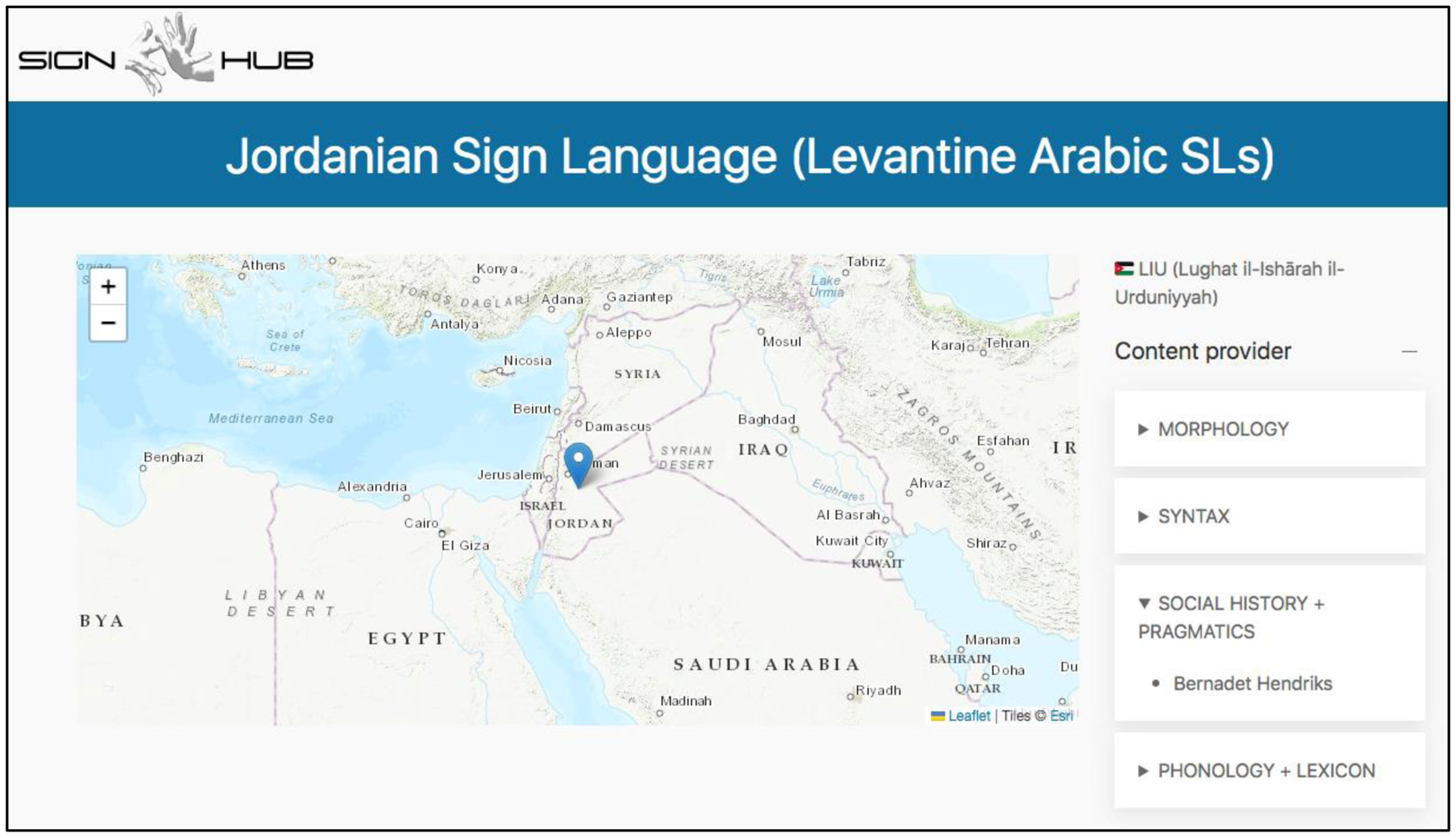
The four questionnaires were distributed among sign language experts who specialized in a specific field, so-called “content providers.” These were deaf and hearing sign language researchers with high expertise in their field and in their sign language, as well as experts on a specific sign language. The project leaders found content providers for each questionnaire via their scientific network and by contacting the authors of sign language publications. Hearing content providers were encouraged to work in a team with at least one deaf person. Their names are shown in the interactive Atlas, under the heading “content provider,” which appears with each sign language (see Figure 3).
Information on Jordanian SL in the Atlas, showing the name of the content provider for social history and pragmatics (questionnaire 4).
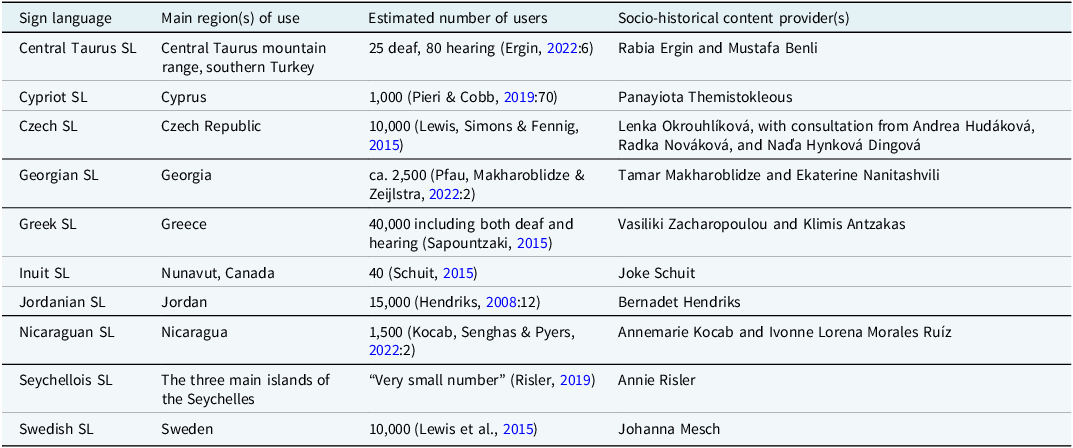
The data analyzed here are the survey questions and answers for ten different sign languages supplied by the respective content providers from 2019 to 2020, which have been used by the Sign Hub team to complete the sociolinguistic profiles in the Atlas (www.thesignhub.eu). These ten sign languages (SLs) are Central Taurus SL, Cypriot SL, Czech SL, Georgian SL, Greek SL, Inuit SL, Jordanian SL, Nicaraguan SL, Seychellois SL, and Swedish SL. Since the analysis in this paper was carried out in 2022, data have since been supplied by further respondents and added to the Atlas, including on Austrian SL, Brazilian SL, Chinese SL, Croatian SL, Danish SL, Dutch SL, Flemish SL, German SL, Hungarian SL, Icelandic SL, Italian SL, Norwegian SL, Portuguese SL, Providence Island SL, Swiss-German SL, Tibetan SL, Turkish SL, Uruguayan SL, and Yolngu SL.
Some of these ten languages are rather obscure, with limited literature and small user populations (see Table 1). For example, Central Taurus SL is a village sign language that emerged spontaneously around 1970 in an isolated location in southern Turkey where there is a high incidence of deafness (Ergin, Reference Ergin2022:6). Seychellois SL also has a small number of users, being used chiefly on the three main islands of the Seychelles, and is influenced by French, Mauritian, and American Sign Languages (Risler, Reference Risler2019). Nicaraguan SL is a very young language that was initially developed by 50 children and youth in the 1970s at a school in the country’s capital, Managua (Kegl, Reference Kegl1994). They used an array of homesigns and gestures in their interactions, which ultimately produced a new sign language (Kocab, Senghas & Pyers, Reference Kocab, Senghas and Pyers2022:2). Georgian SL, another lesser-known sign language, is not yet an official language of Georgia but is mentioned by the government in various documents and used for instruction at three deaf schools in the country (Pfau, Makharoblidze & Zeijlstra, Reference Pfau, Makharoblidze and Zeijlstra2022:2). A grammar sketch and dictionary of Georgian SL were published in 2012 and 2015 respectively. Inuit SL is used by only a few dozen people in the vast Canadian territory of Nunavut (Schuit, Reference Schuit and Julie2015), and has been previously assessed as having the lowest possible level of vitality, termed as “critically endangered” (Webster & Safar, Reference Webster and Safar2019). Cypriot SL has up to 1,000 users, as that is the approximate number of severely or profoundly deaf individuals living in Cyprus, which amounts to a proportionally greater deaf population than most European countries (Pieri & Cobb, Reference Pieri and Valerie Gray Cobb2019:70). The government recognized Cypriot SL in 2006 but has yet to offer any meaningful support for the language (Pieri & Cobb, Reference Pieri and Valerie Gray Cobb2019:71; for more details on this phenomenon of tokenistic recognition, see e.g. McKee & Manning, Reference McKee and Manning2015, and Webster & Safar, Reference Webster and Safar2020). The other four are relatively well-known national sign languages that have larger user populations of about 10,000 or more. This makes for a modest dataset and consequently limited scope in terms of findings that can be drawn, but is nonetheless a very interesting and eclectic mix of languages. As further data have been gathered since this analysis was completed, it will be straightforward to consider the findings for these ten languages against those of the other sign languages now available in the Atlas.
Sign languages covered by the ten content providers who supplied socio-historical data to the Sign Hub survey from 2019 to 2020
The topics in the six parts of the Sign Hub survey are shown in Table 2. The survey items that are examined in this paper appear on a single questionnaire document that contains two of these six main parts: Part A on socio-historical background, and Part F on pragmatics.Footnote 3 Screenshots of the relevant questions from this document are displayed individually in the next section of this paper.
Structure of topics in the Sign Hub survey (with the topics covered in this paper in italics)
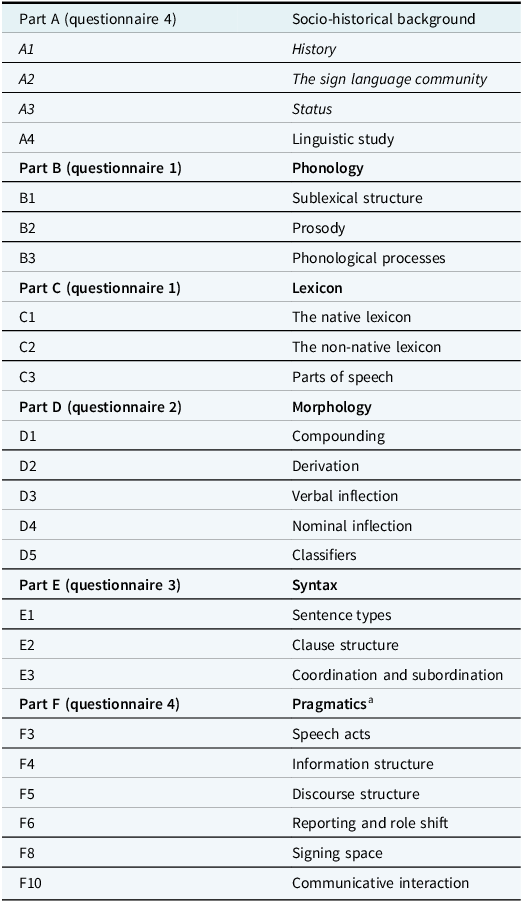
a For the section on pragmatics, not all of the topics from the SignGram Blueprint were used in the Atlas. The topics that were omitted are F1, reference; F2, reference tracking; F7, expressive meaning; and F9, figurative meaning. The team judged that these topics were more difficult to configure in the atlas interface, and less relevant to the aims of the project.
4. Results
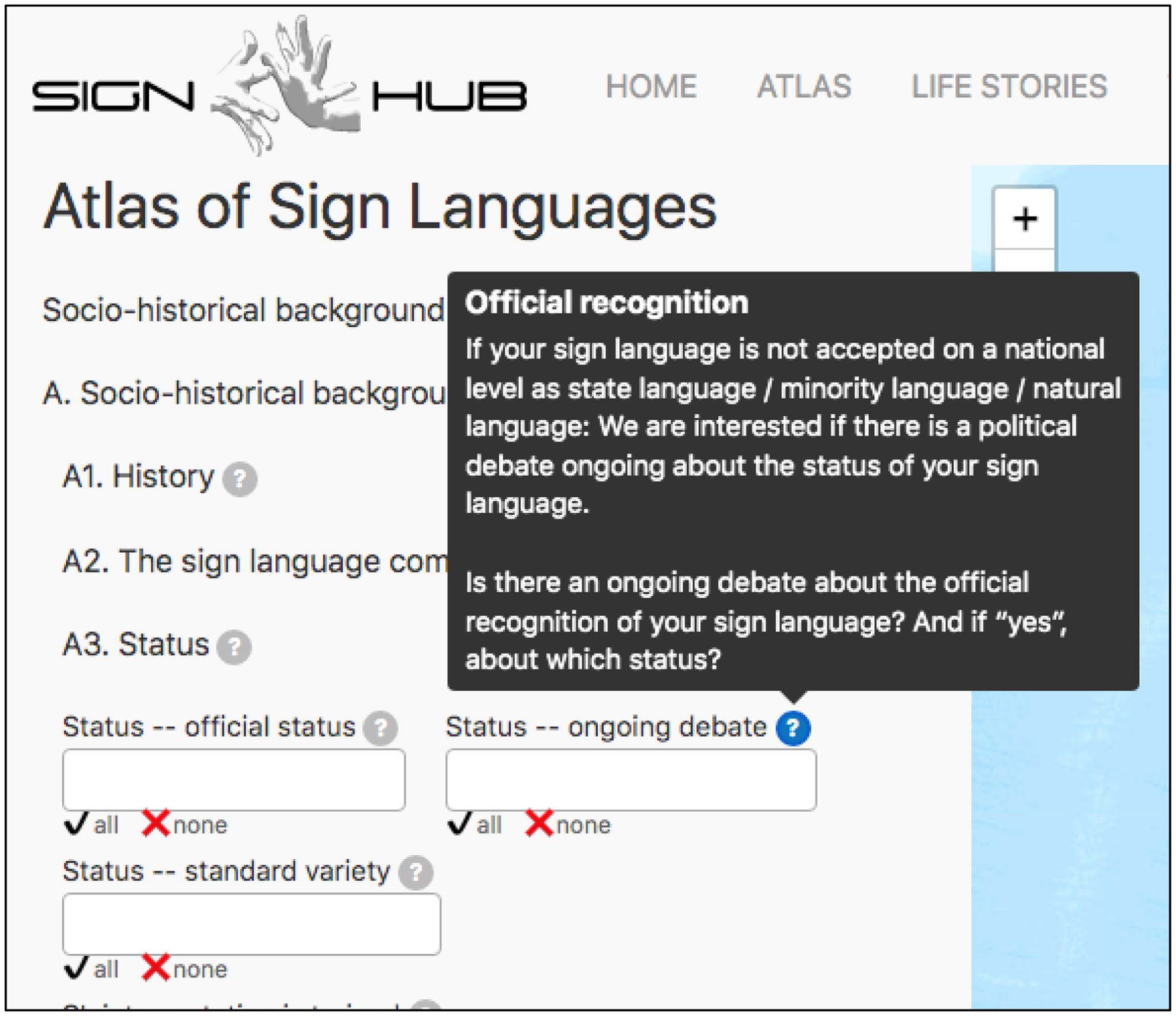
The ten respondents’ answers related to the first three topics in Part A, “socio-historical background,” were reviewed, and the results are described in this section before being discussed in Section 5. These three topics are history, the sign language community, and status. In the Atlas, the user can hover next to each topic and question to see what it means, i.e. what information was sought from the respondents for that item (see Figure 4).
An explanation of the item about “ongoing debate” under the “status” topic in the interactive Atlas.
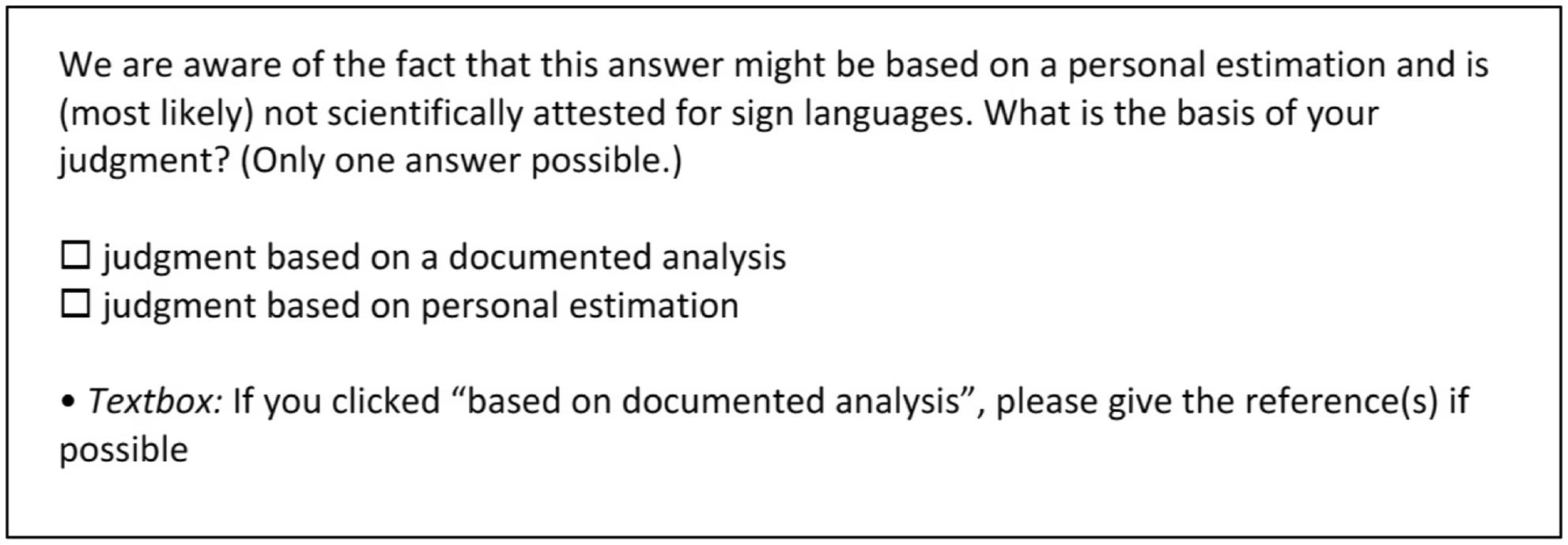
For some of the questions, the respondents were asked to indicate whether they were basing their answer on personal estimation or analysis documented by published material (see Figure 5). Answers based on personal estimation are displayed in the Atlas with a small red question mark (see Figure 6).
Text that appeared below some of the items in the questionnaire asking participants to indicate the basis for their answer.
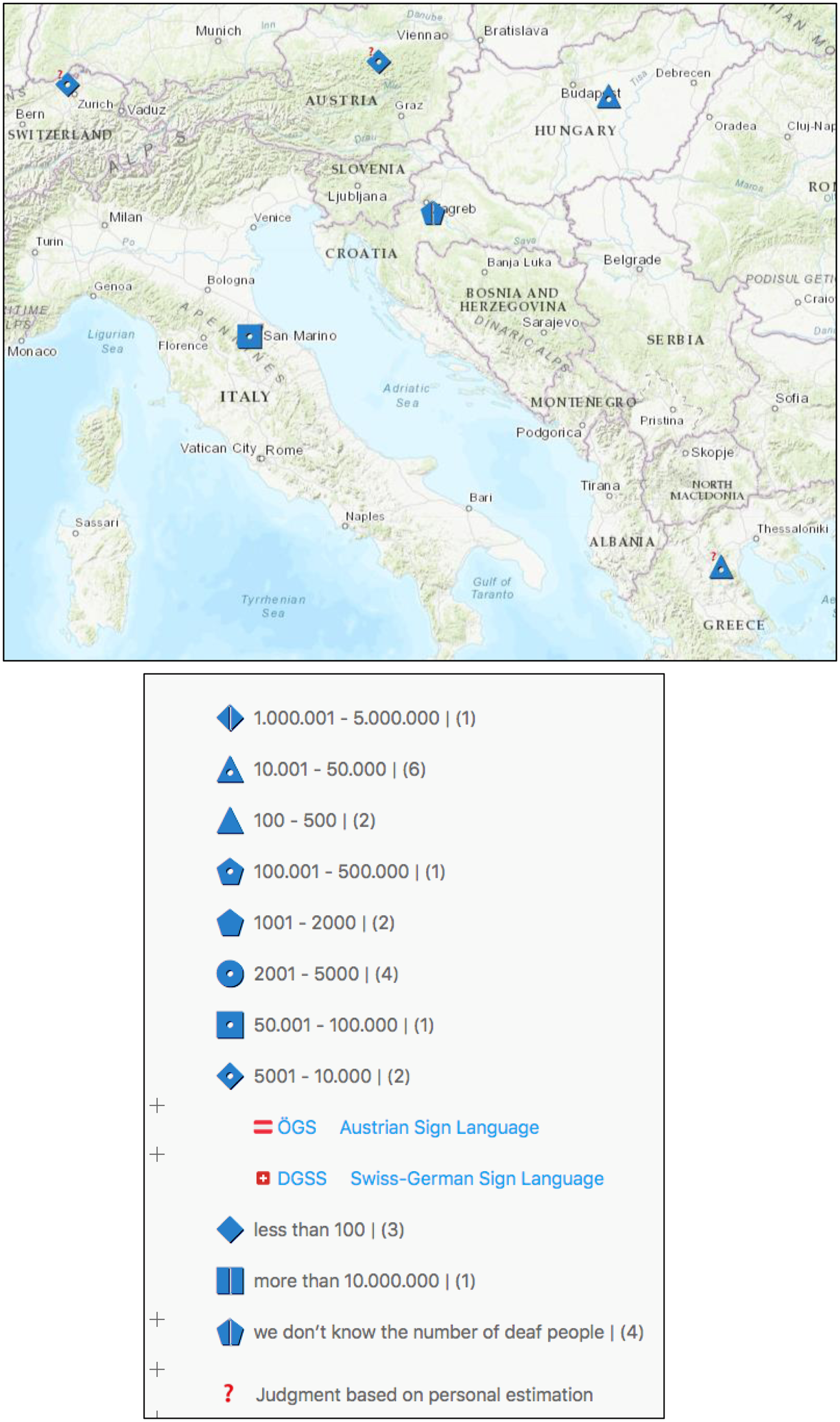
In these screenshots from the interactive Atlas, the user has searched for answers about the number of deaf individuals in each sign language community. The red question marks next to the symbols for Greek SL, Swiss-German SL, and Austrian SL indicate that these answers are judgments based on personal estimation, whereas the others (for Italian SL, Croatian SL, and Hungarian SL) are based on documented analyses. The legend below the map allows the user to see a list of the languages under each answer, as shown here for the range 5,001 to 10,000, which was selected by the respondents for both Austrian SL and Swiss-German SL.
4.1. A1: History
Figures 7–12 show the questions in section A1.
First question in section A1.
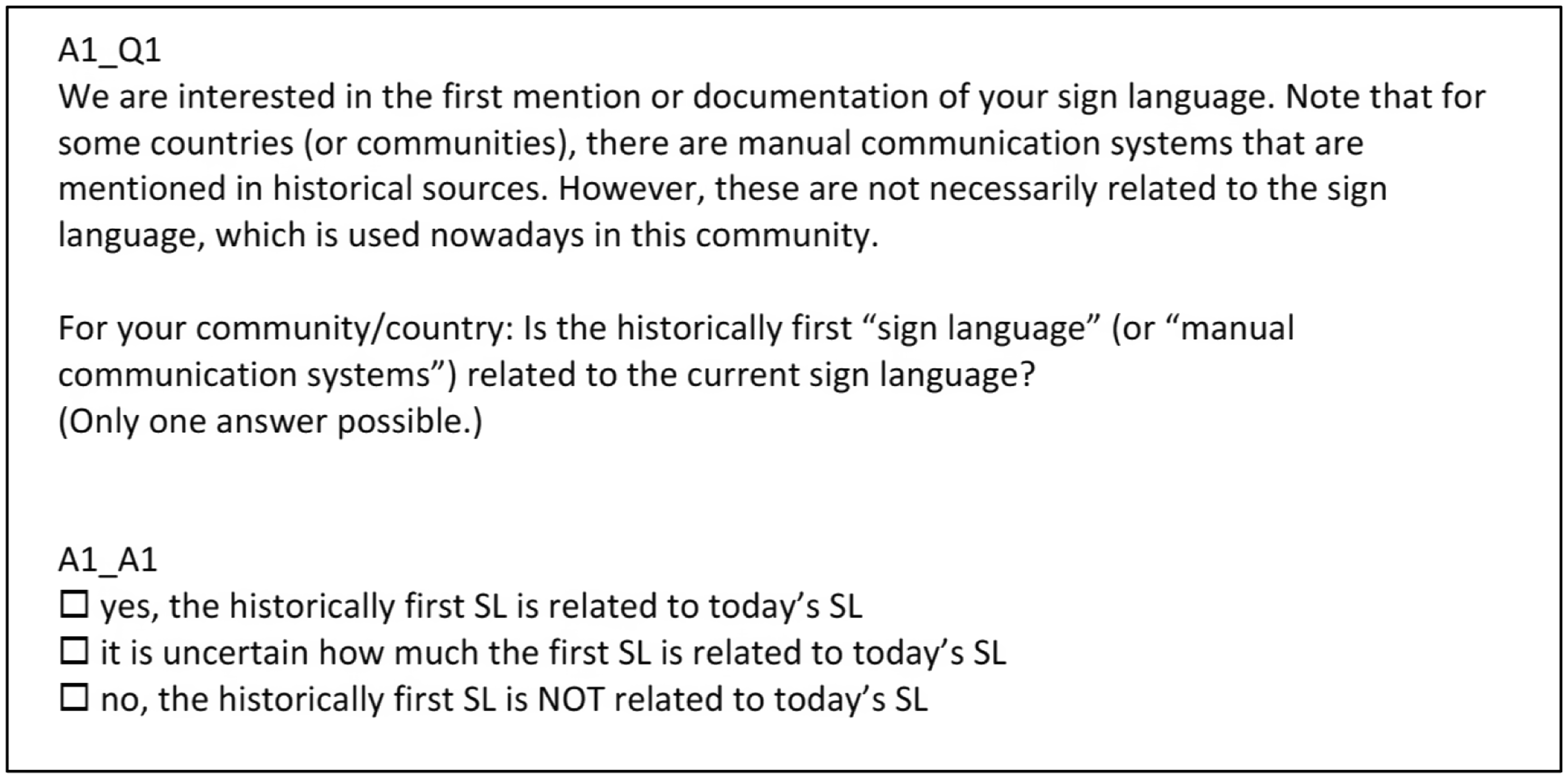
Second question in section A1.

Third question in section A1.
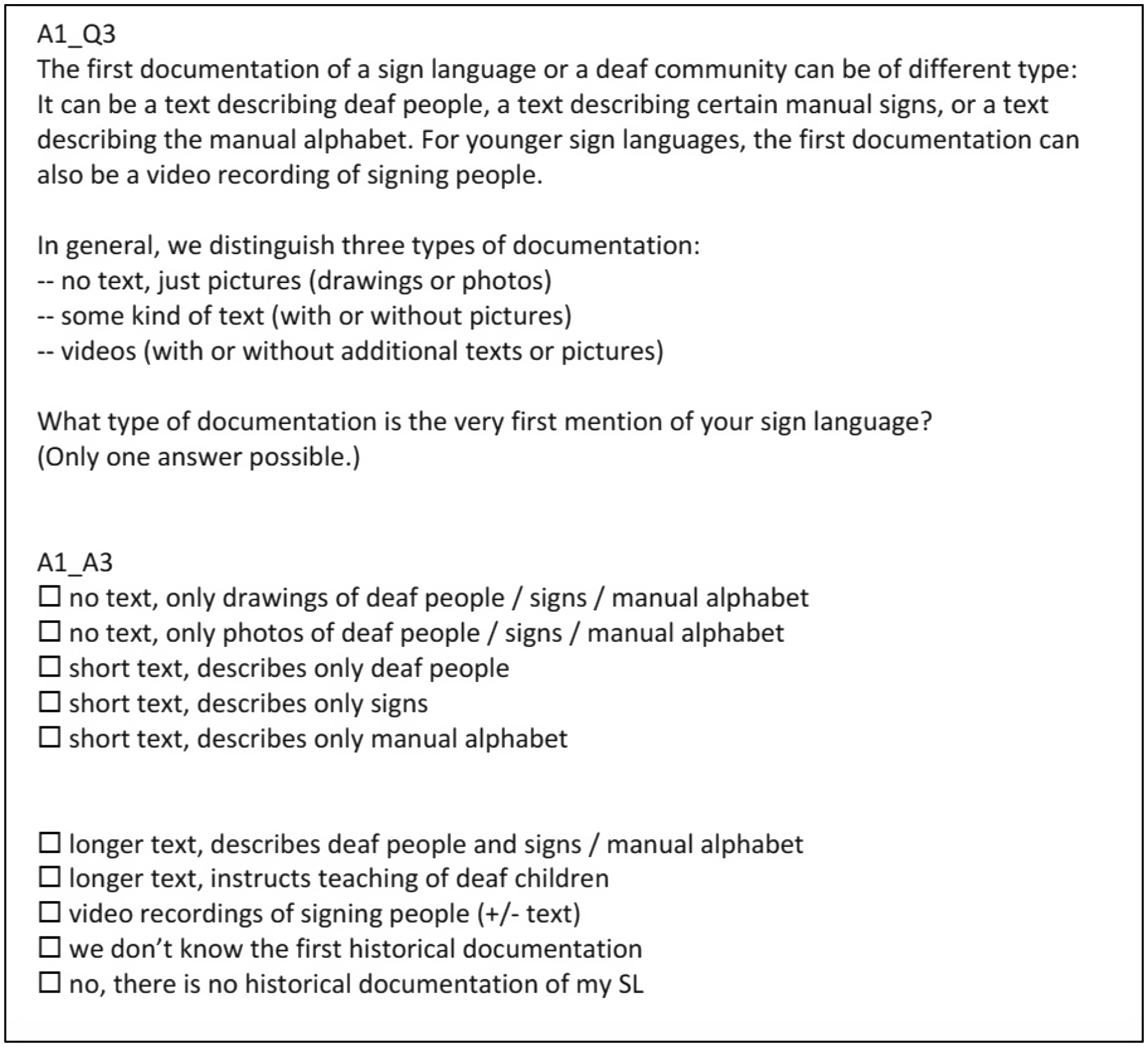
Fourth question in section A1.
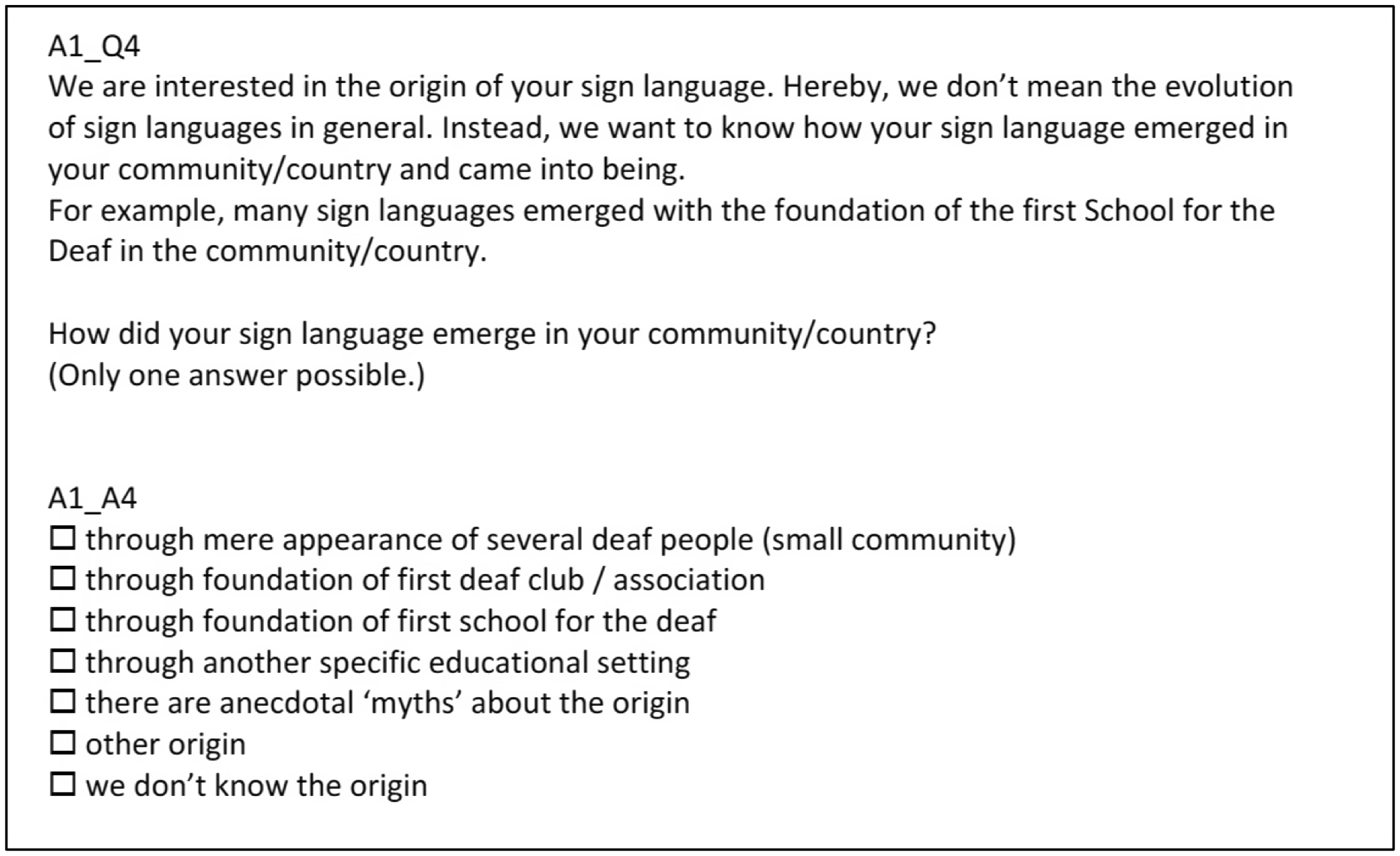
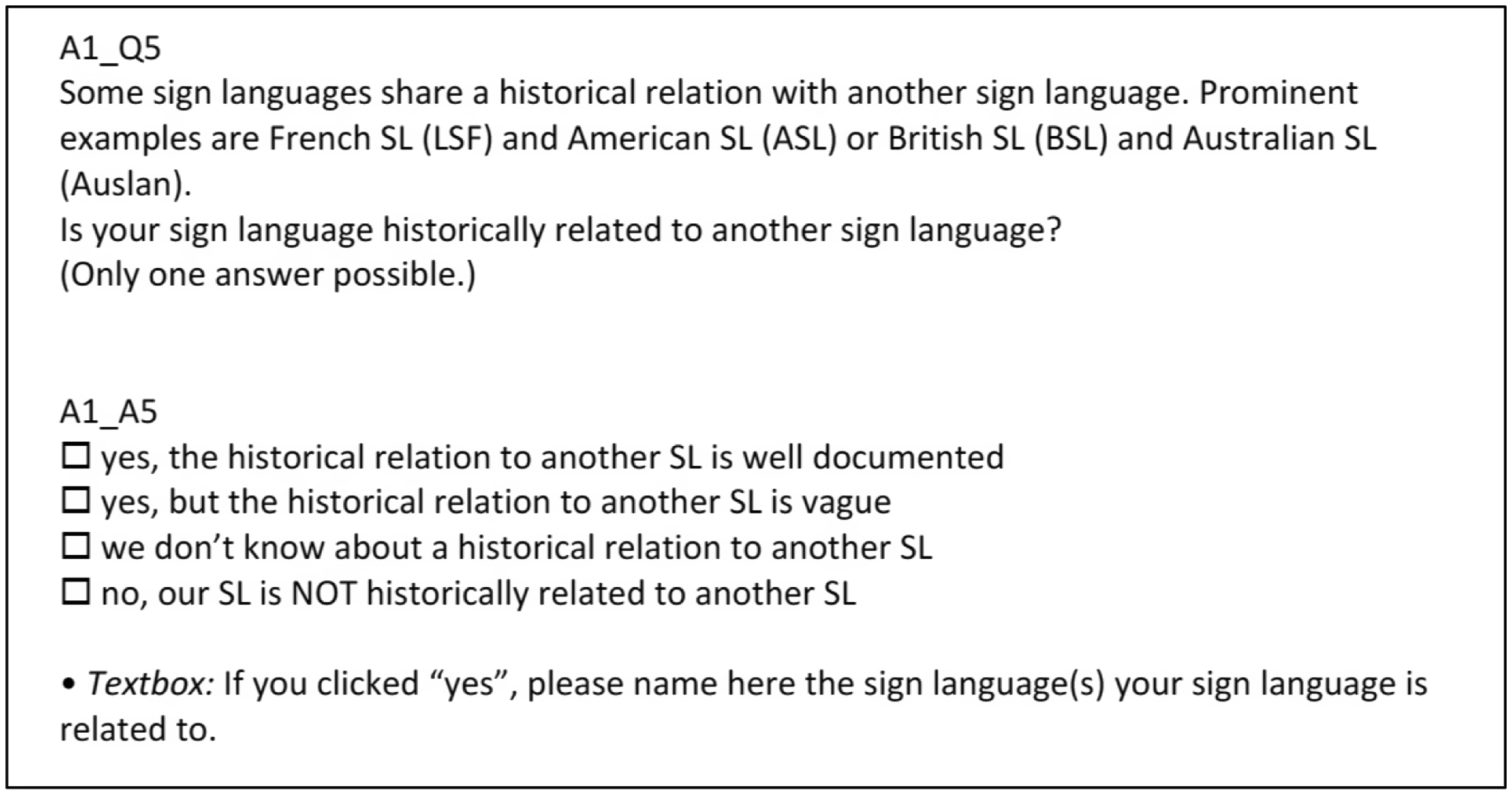
Fifth question in section A1.
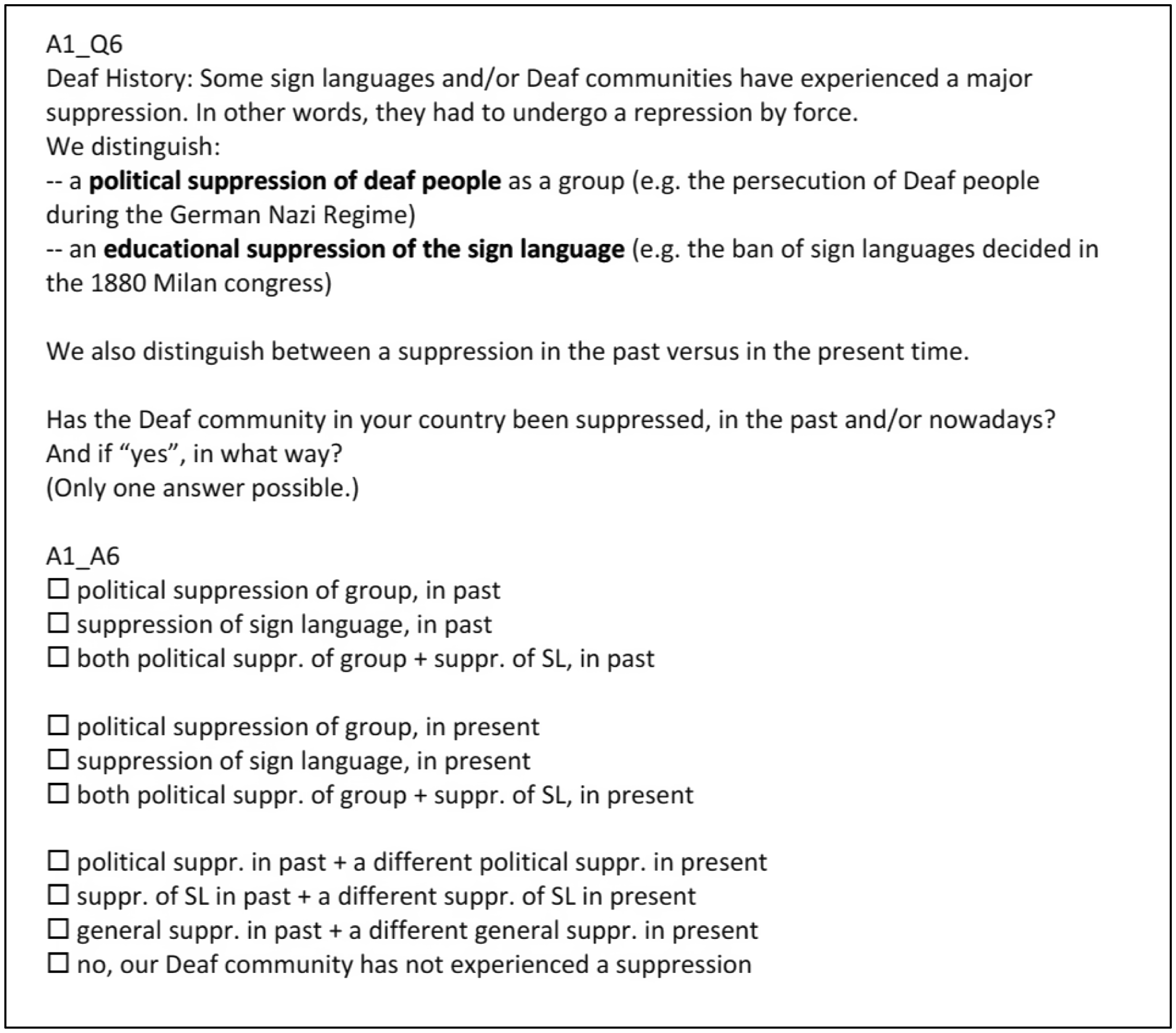
Sixth question in section A1.
A majority of respondents did not know how much the first sign language is related to today’s sign language, and most of them based this judgment on personal estimation; only the respondent for Swedish SL based this on documented analysis (Bergman & Engberg-Pedersen, Reference Bergman, Engberg-Pedersen and Brentari2010). Only two selected the option “yes, the historically first sign language is related to today’s sign language,” and both of them based this on documented analysis. These were the respondents for Nicaraguan SL and Czech SL, the latter of which cited several sources from the nineteenth century, including Mücke (Reference Mücke1834), Jarisch (Reference Jarisch1851), and Kolář (Reference Kolář1897).
With regard to the first historical mention or documentation of the sign language, three respondents chose “after 2001” and two selected “1951–2000.” The four other respondents who answered this question selected earlier times, with one each ticking “1901–1950,” “1801–1850,” “1751–1800,” and “before 1500.”
As for the type of documentation that contained the “very first mention of your sign language,” three respondents said video recordings of signing people (with or without text), three chose “short text [that] describes only deaf people,” and two selected “longer text [that] describes deaf people and signs [or a] manual alphabet.” The respondent for Georgian SL reported that there was no historical document.
For the question that asked how the sign language emerged in the community or country, five of the ten respondents said through the foundation of the first deaf school. Of the other five, two reported that it emerged through the appearance of several deaf people as a small community, two chose “through foundation of first deaf club/association,” and the respondent for Jordanian SL reported that the origin was unknown.
For the question “Is your sign language historically related to another sign language,” five selected “yes, but the historical relation to another sign language is vague.” Two respondents (Georgian SL and Seychellois SL) reported that the relationship with another sign language was well documented, and two (Central Taurus SL and Nicaraguan SL) indicated that their sign language was not historically related to another. The respondent for Inuit SL said they did not know about any historical connections.
Regarding whether there had been suppression of the sign language and/or deaf community, only one (the respondent for Seychellois SL) said there was no suppression, but noted that there had been “an ignorance of the existence of deaf people, who remained isolated and uneducated in families.” A majority (seven) of the ten respondents indicated that there had been suppression in the past. Of these, one (Inuit SL) stated that there was also now a different type of suppression in the present, which included deaf Inuit children having to use ASL interpreters.
4.2. A2: The sign language community
Figures 13–21 show the questions in section A2.
First question in section A2.
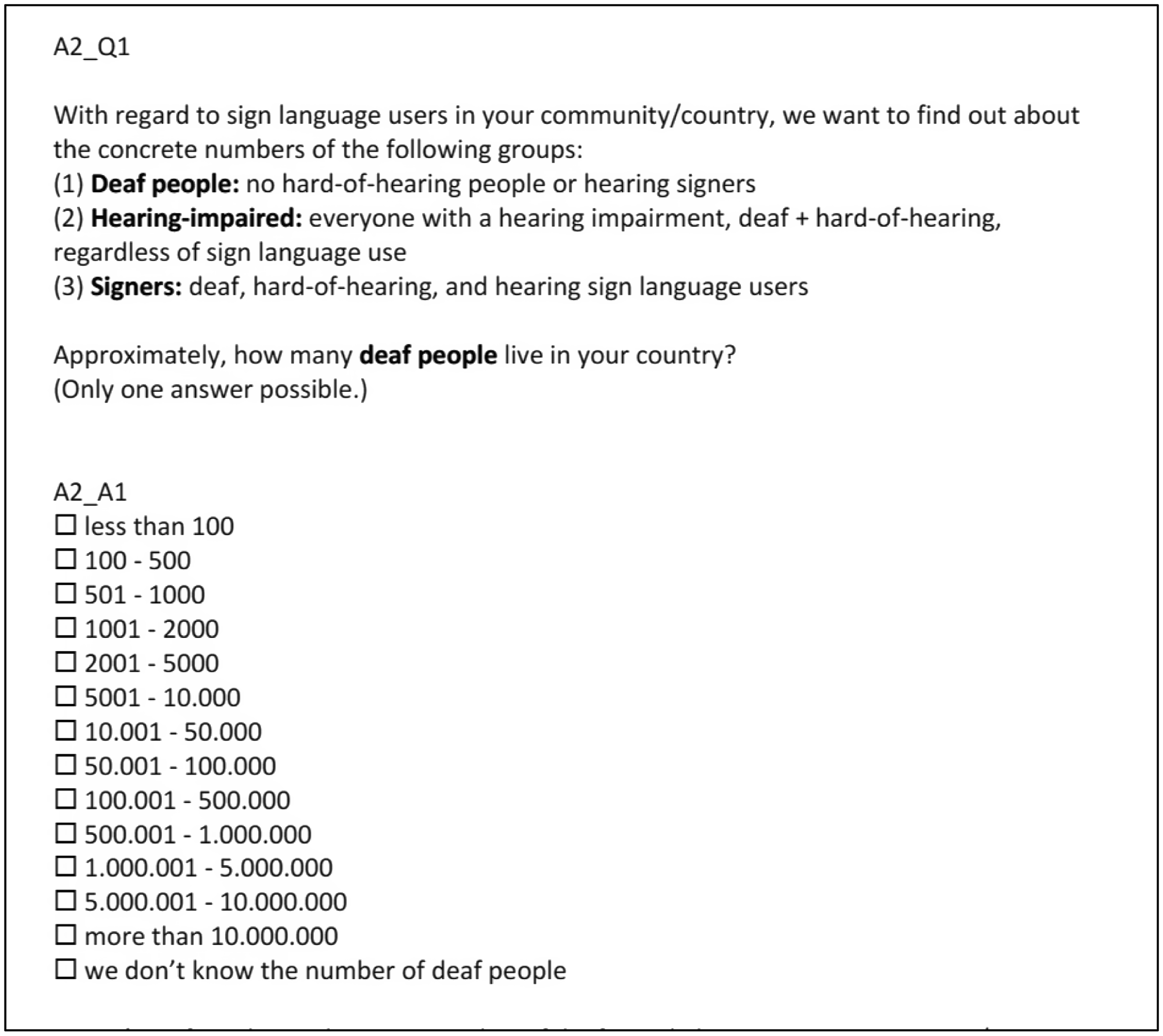
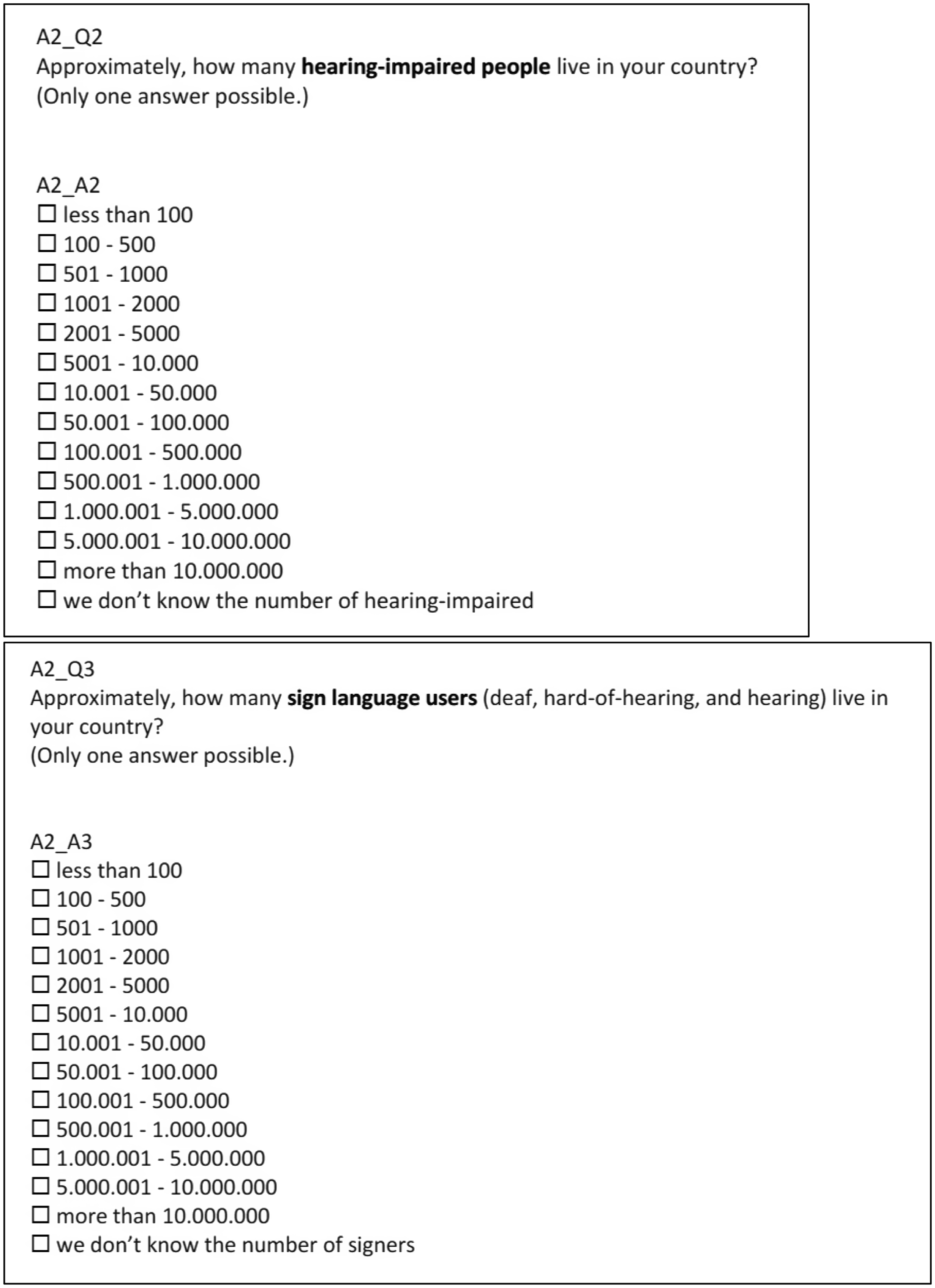
Second and third questions in section A2.
Fourth question in section A2.
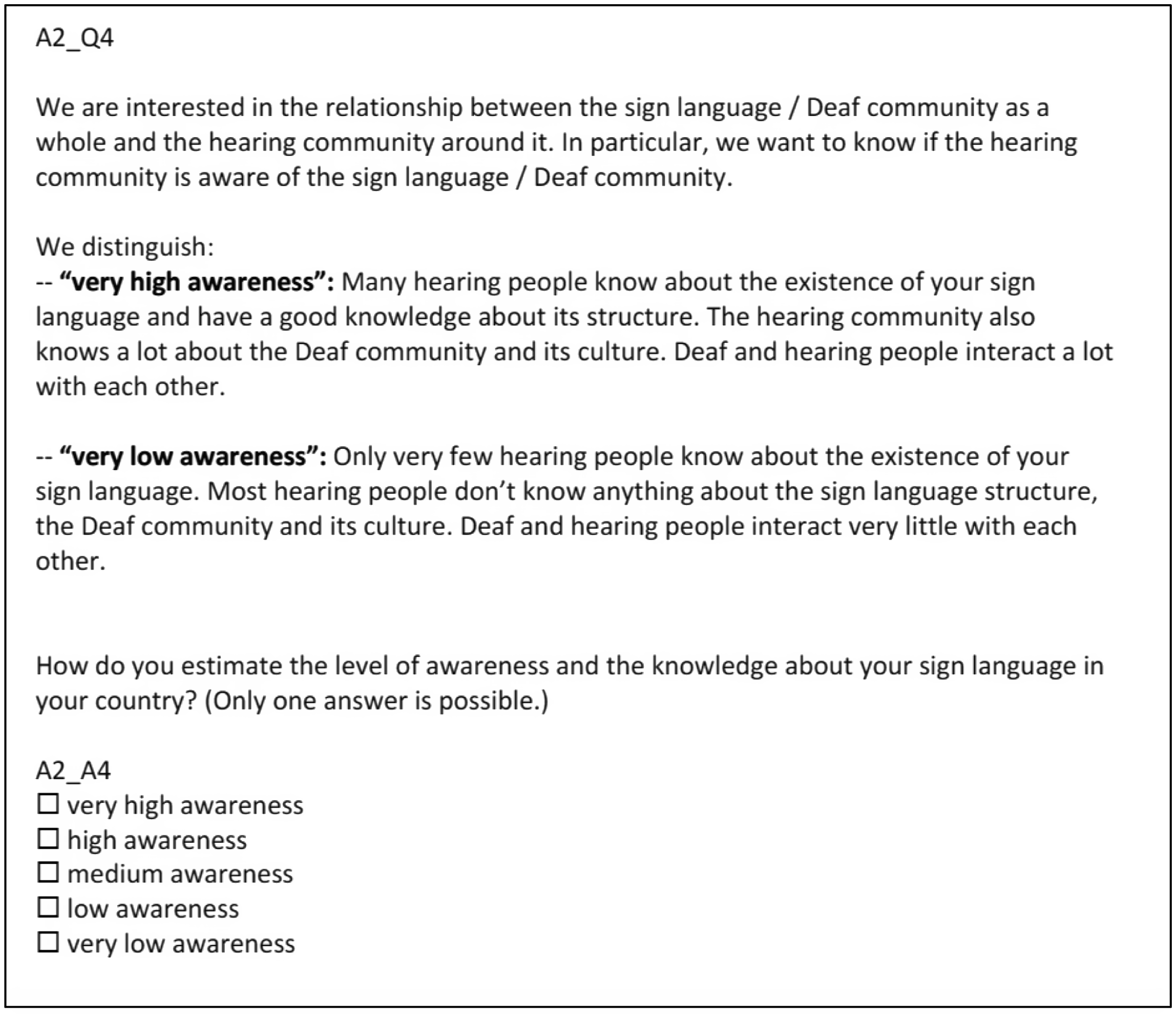
Fifth question in section A2.
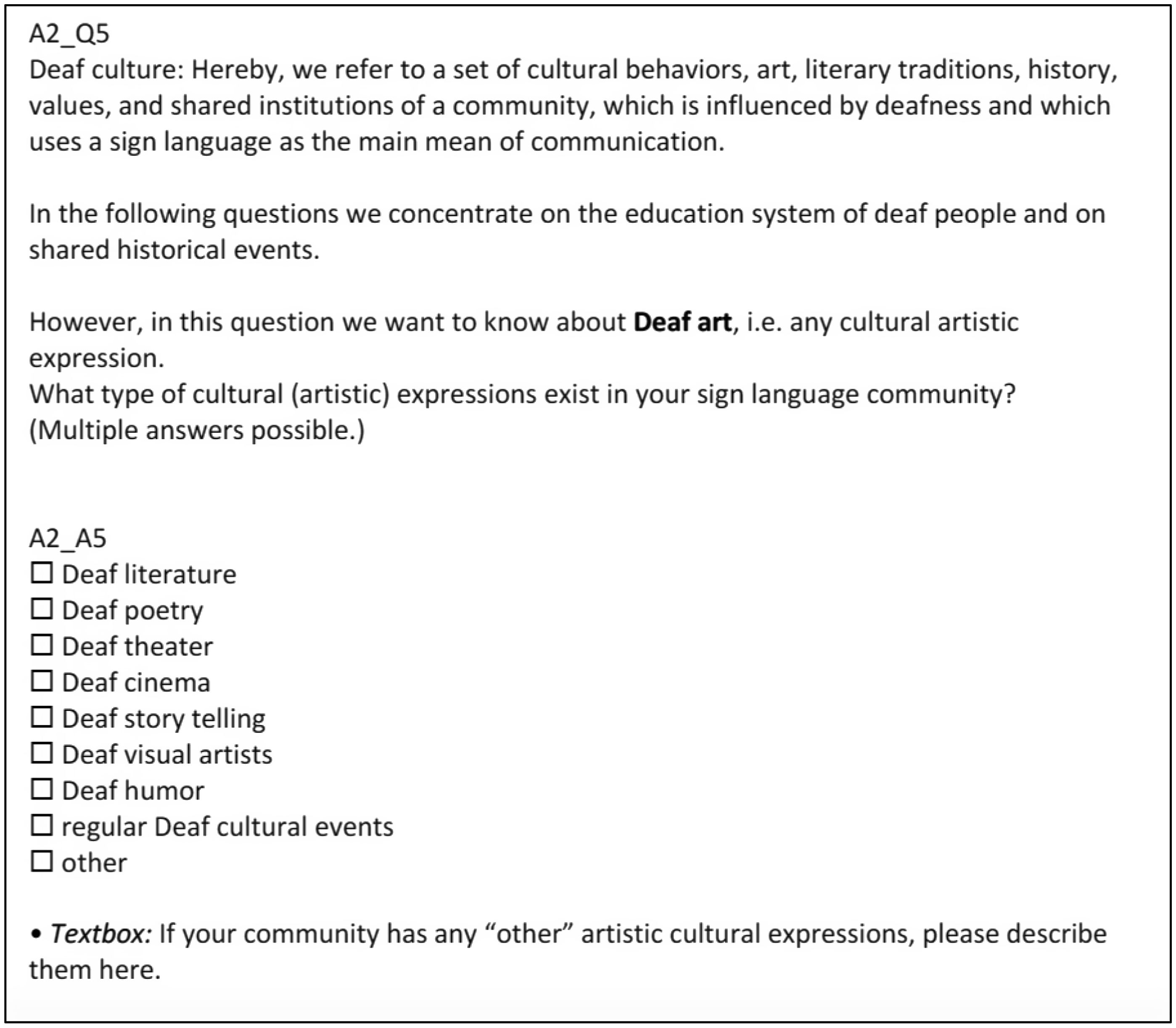
Sixth question in section A2.
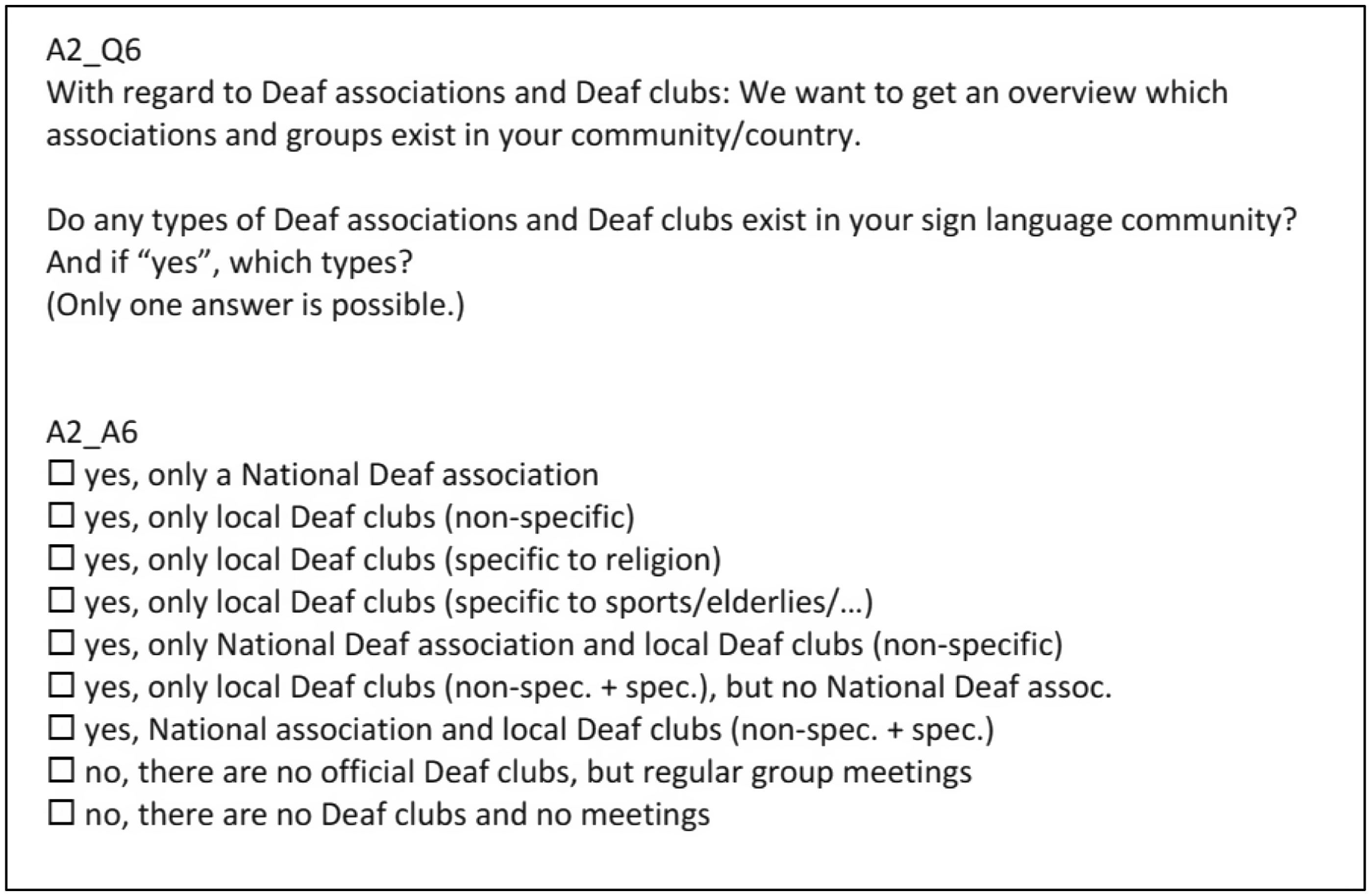
Seventh question in section A2.
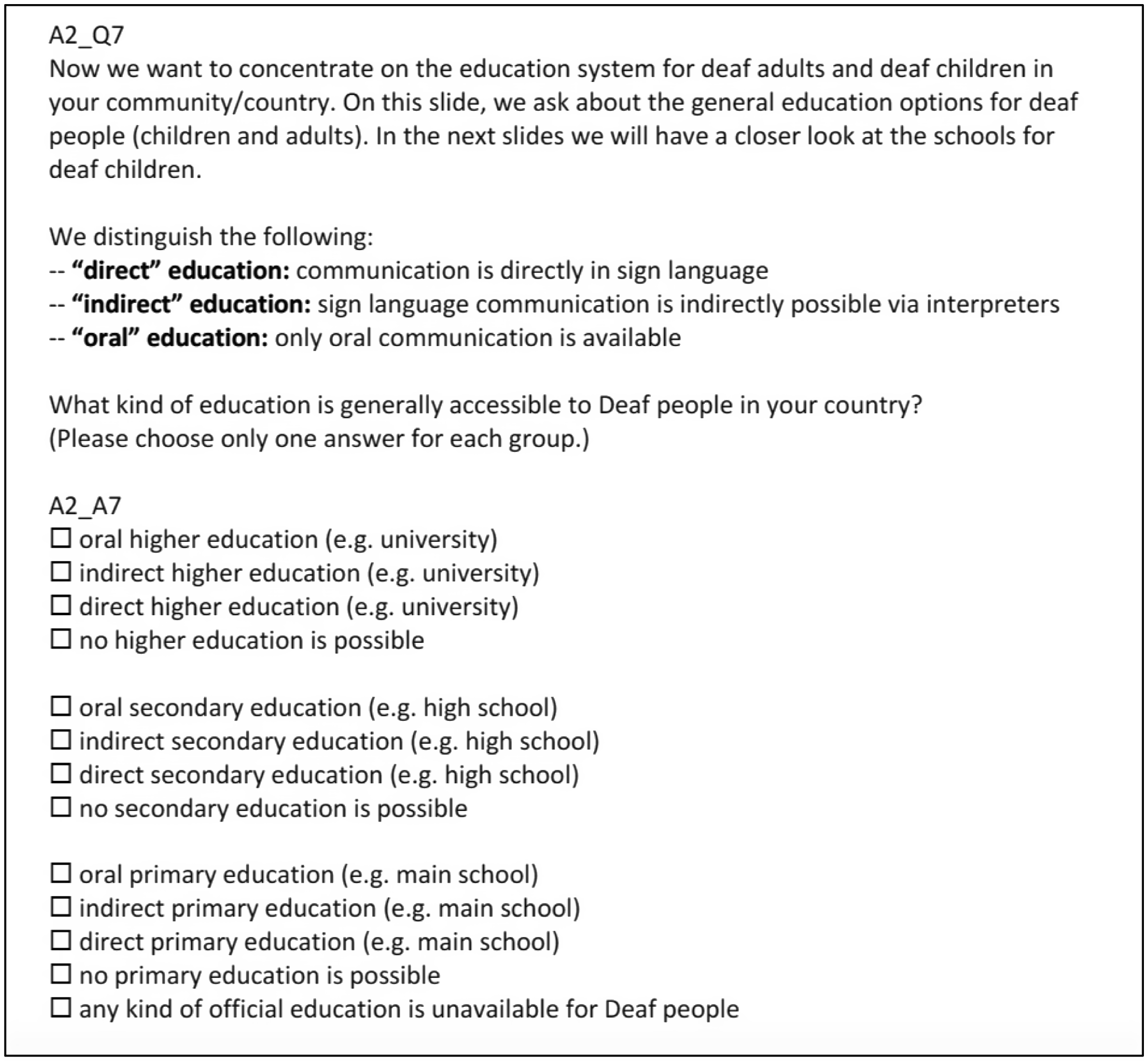
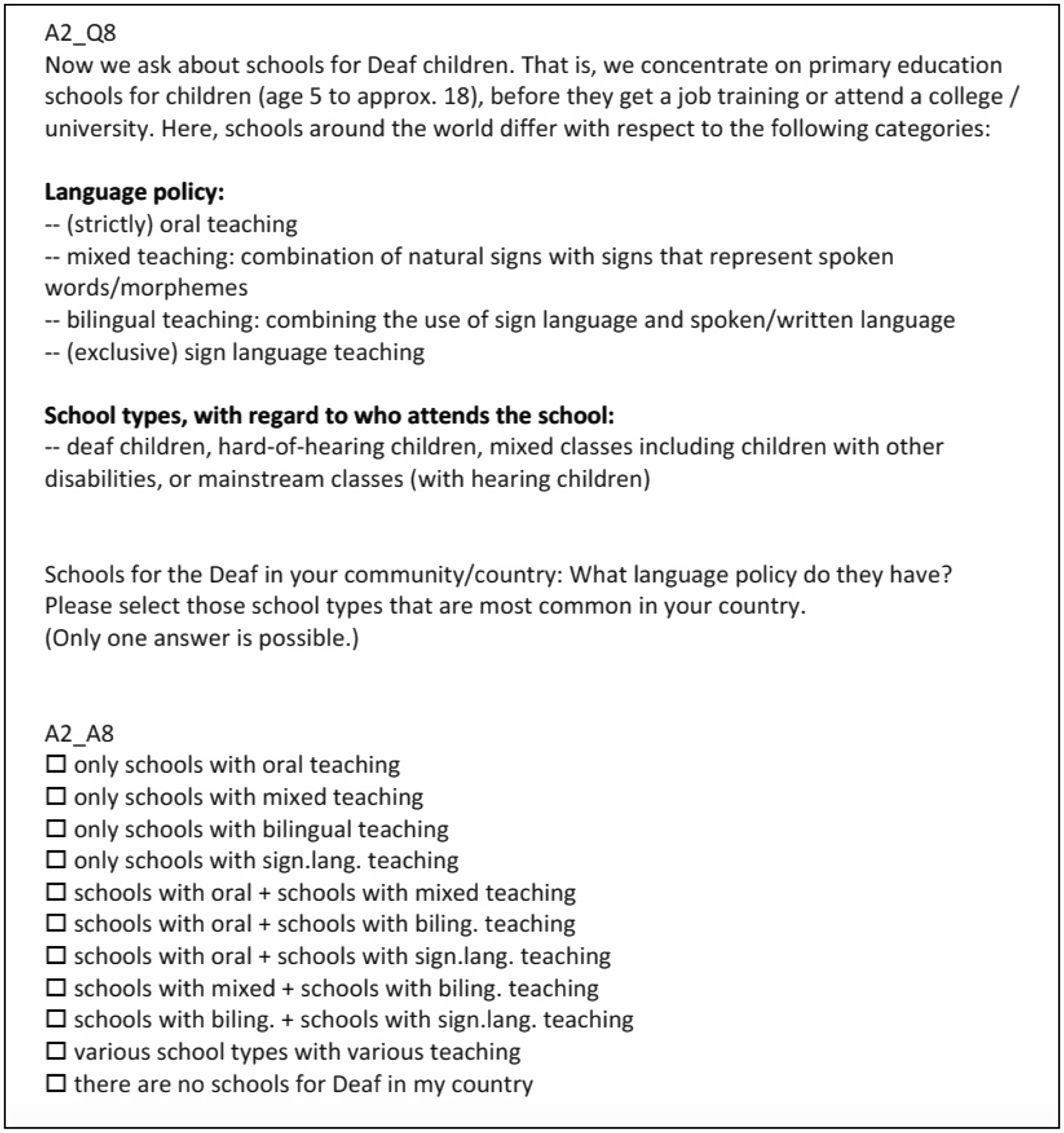
Eighth question in section A2.
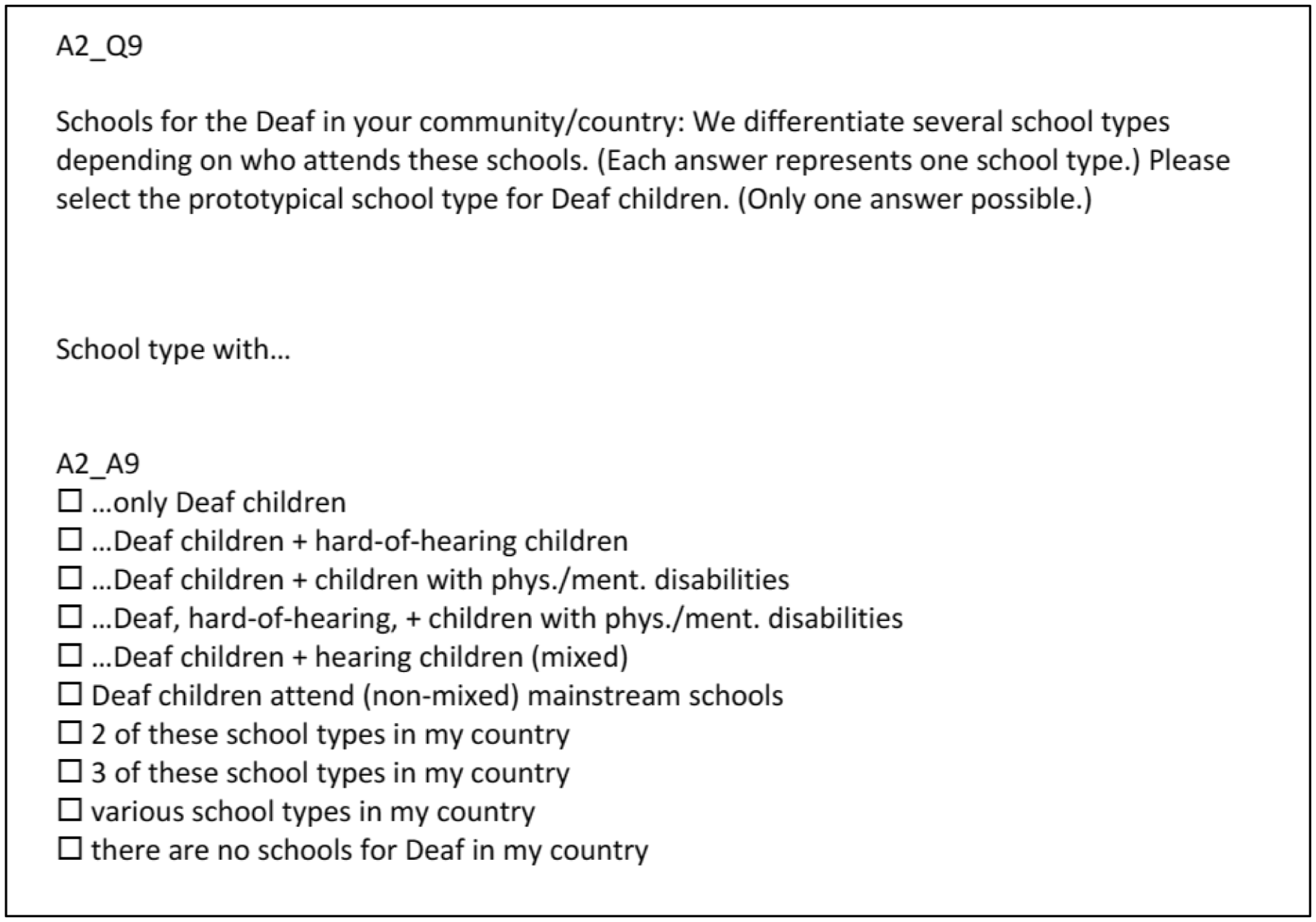
Ninth question in section A2.
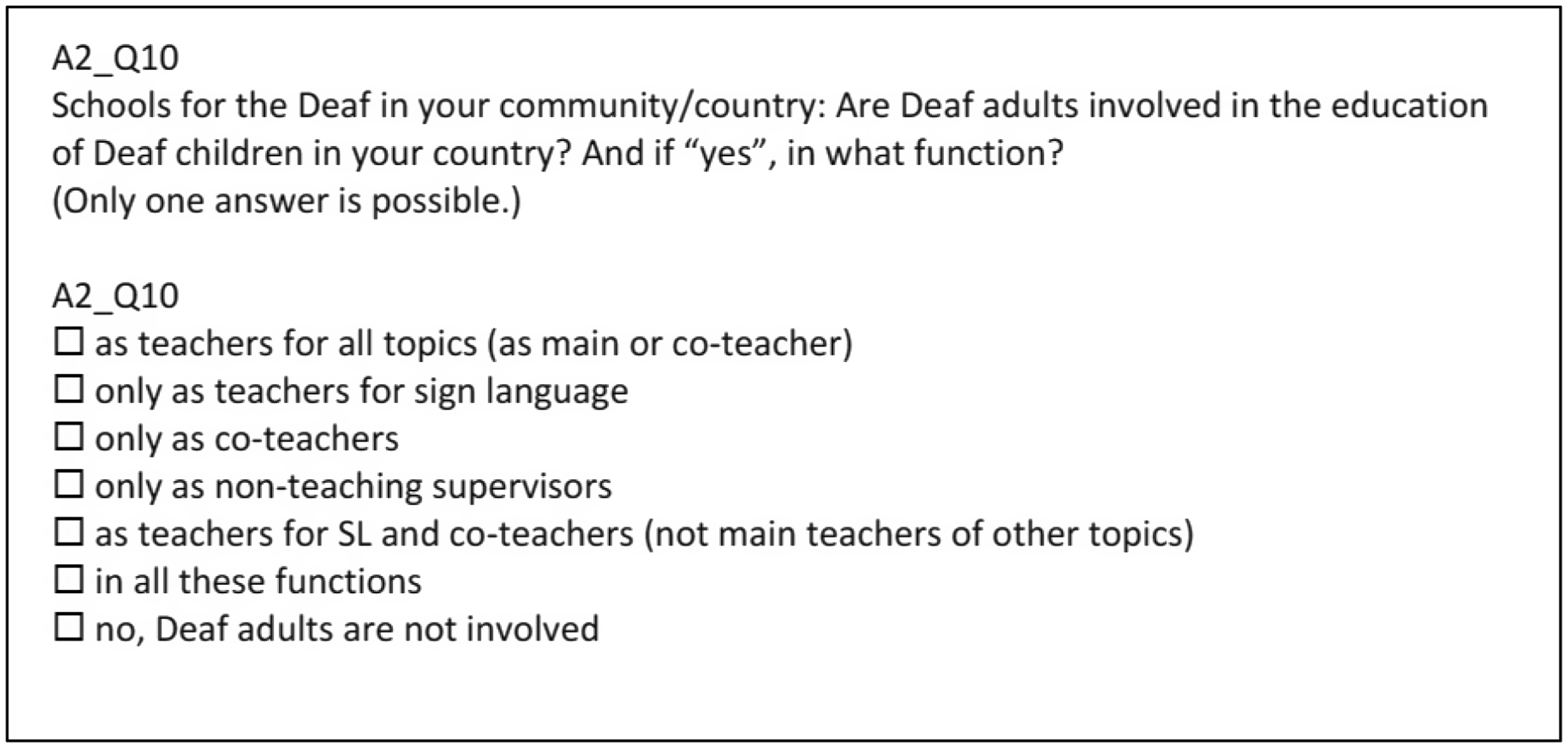
Tenth question in section A2.
Half of the respondents said that there were fewer than 5,000 deaf people living in their country. Four reported that the number was between 10,000 and 50,000. Four indicated that their selection was based on personal estimation, and five said it was based on documented analysis. The numbers of sign language users reported by each respondent were similar to their numbers of deaf people. An exception was the respondent for Greek SL, who reported that there were 10,000 to 50,000 deaf people but did not give an answer regarding the number of sign language users. Only the respondents for Nicaraguan SL and Cypriot SL chose a lower range for sign language users than for deaf people. Among the eight who answered this question, only the Czech SL respondent based it on documented analysis, with everyone else drawing from personal estimation.
With respect to awareness of the sign language among hearing people, five respondents said there was medium awareness, three said high awareness, and two said low awareness (Central Taurus SL and Czech SL). Again, almost all of them based this on personal estimation, with only one indicating that it was based on documented analysis (the Georgian SL respondent, who selected high awareness).
The respondents indicated that a range of deaf cultural activities take place in their countries and communities. The most popular cultural expression was visual art (six respondents), followed by deaf storytelling and humor (five each), theater and regular deaf cultural events (four each), poetry (three), deaf cinema and literature (two each), and finally dance, signed songs, and sport (one each).
For the question that asked for an overview of what deaf associations or clubs existed in the respondents’ countries, only two (Central Taurus SL and Inuit SL) said there were no deaf clubs or meetings. The remaining eight reported that they had both national deaf associations, and local deaf clubs.
Regarding what kind of education is possible for deaf people, five respondents said that their countries had primary education where the teachers use sign language, while two said primary education in sign language was available through interpreters. For secondary level, three respondents said this was possible directly in sign language, three said it was provided through interpreters, and one (Seychellois SL) said no secondary education was possible. The Georgian SL and again the Seychellois SL respondent said that no higher education was possible. Of the remaining six who answered the question, five said that higher education in sign language was possible through interpreters, and one respondent (Swedish SL) indicated that it was available directly in sign language.
Four respondents said that in their community or country, there were only schools with bilingual teaching, i.e. combining sign language and written language; one indicated that there were only schools with mixed teaching, i.e. signs from a deaf community sign language mixed with signs that represent spoken words; and three reported that there were various types of schools with various kinds of teaching.
As for the nature of schools for deaf people in their community or country, three respondents reported that these institutions were only for deaf and hard-of-hearing children; four said that these schools included not only deaf and hard-of-hearing children but also those with physical or learning disabilities; and one (the Czech respondent) said that various types of schools for deaf children exist in their country.
Respondents were also asked about the role of deaf adults in the education of deaf children in their community or country. Four respondents said that deaf instructors were involved in teaching for all topics. The other four who answered this question each gave a different answer: the Seychellois SL respondent said that deaf adults were involved as teachers for sign language, and as co-teachers; the Nicaraguan SL respondent said they were involved only as co-teachers; the Georgian SL informant said they were involved only as teachers for sign language; and the Czech SL respondent said they were involved in all of the functions, i.e. as main teachers, co-teachers, non-teaching supervisors, and teachers for sign language.
4.3. A3: Status
Figures 22–27 show the questions in section A3.
First question in section A3.
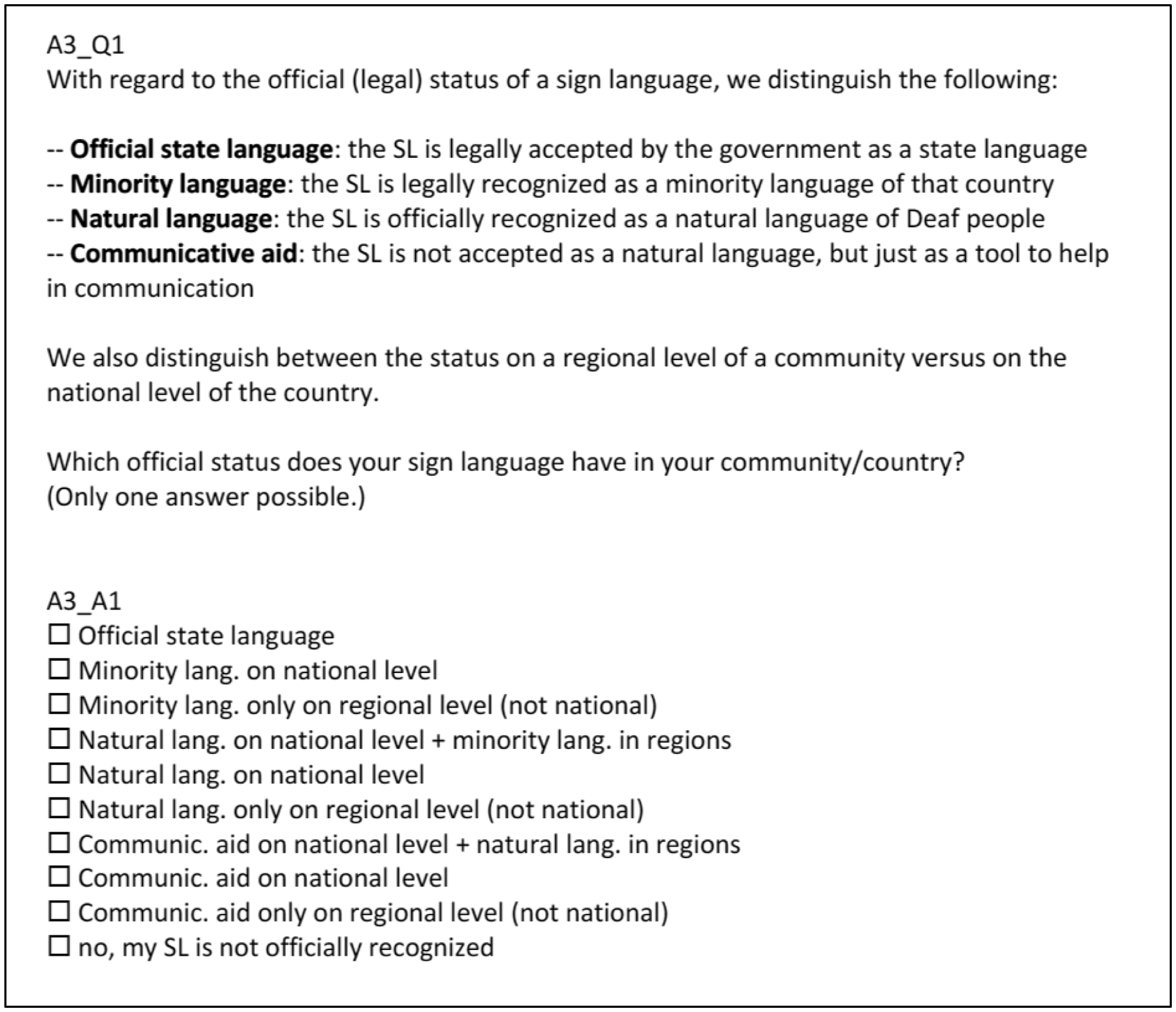
Second question in section A3.

Third question in section A3.

Fourth question in section A3.
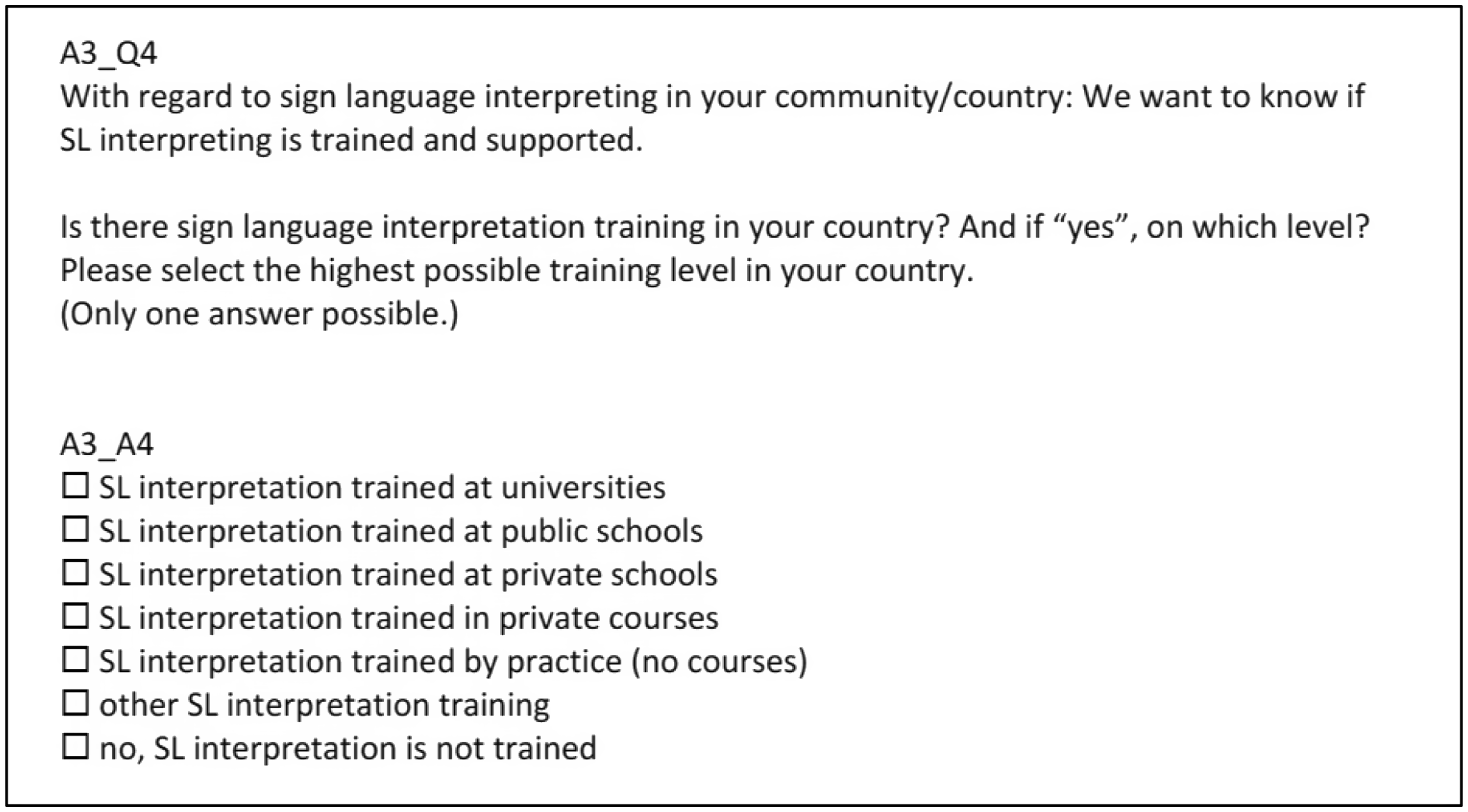
Fifth question in section A3.
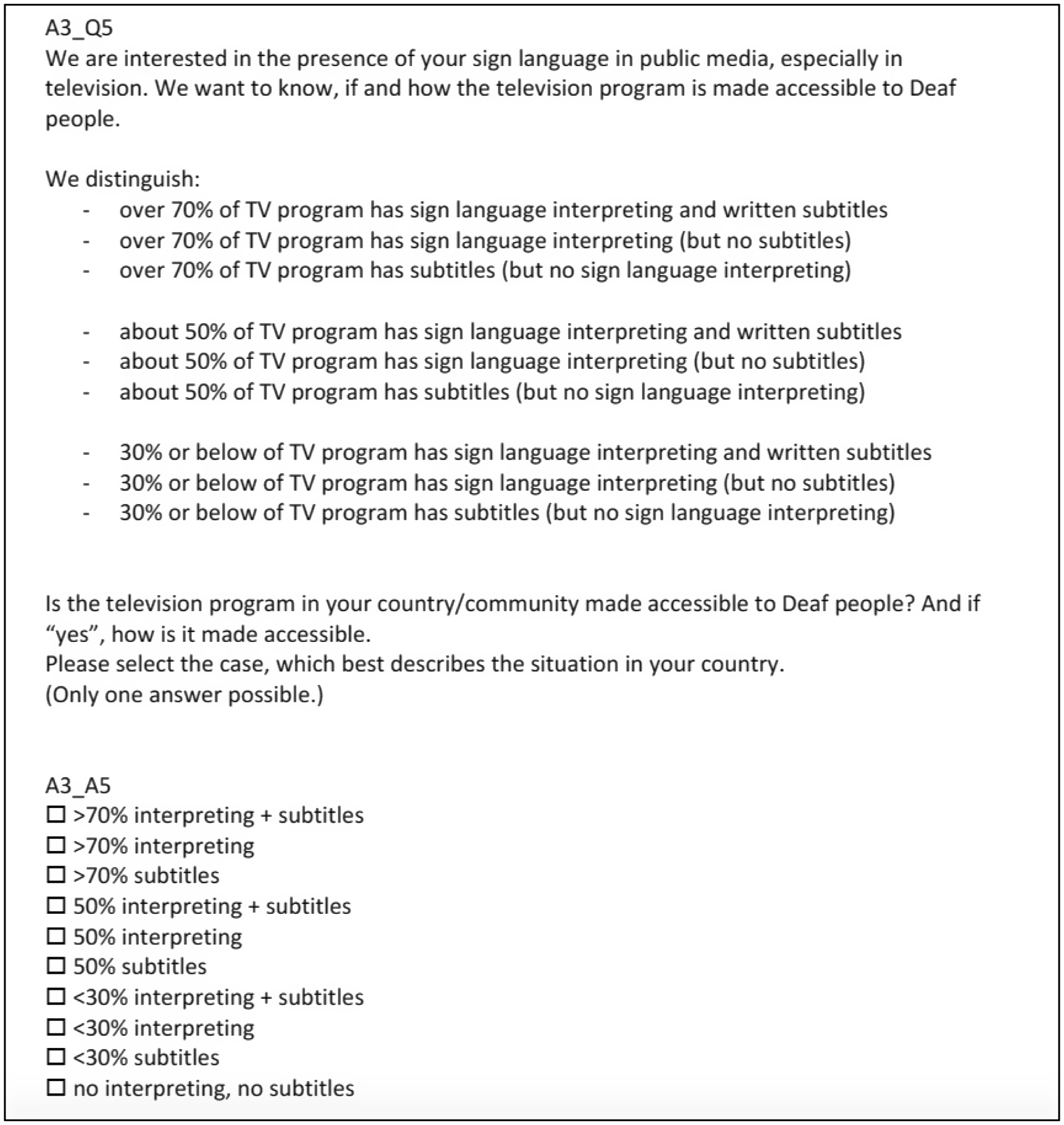
Sixth question in section A3.
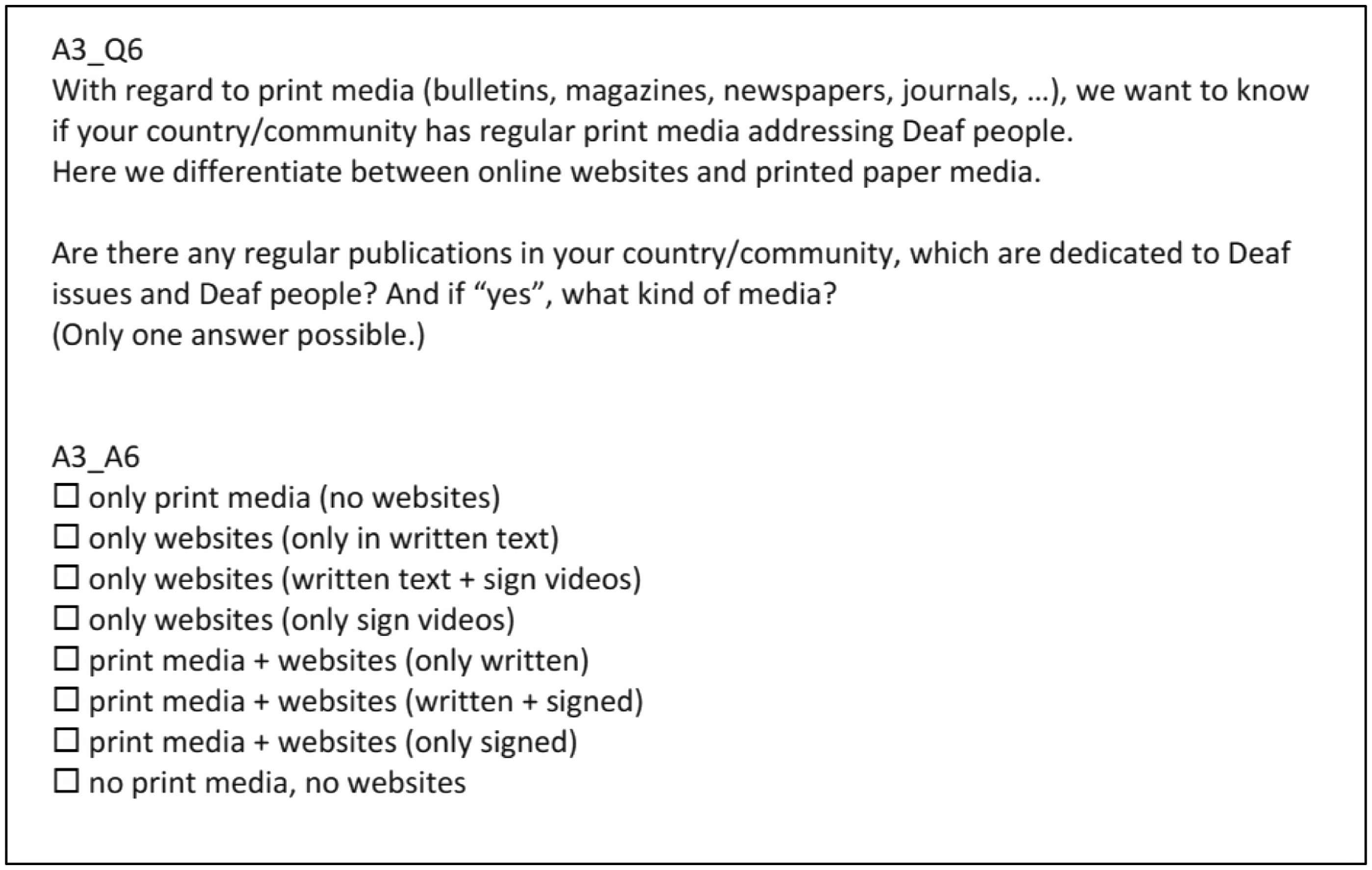
Regarding the legal or official status of their sign languages, five respondents said it was officially recognized as a natural language on a national level. Of the other three people who answered this question, the respondent for Cypriot SL said it was an official state language, the Greek SL informant said it was a minority language on the national level, and the Inuit SL respondent said it was a minority language on the provincial level (recognized in 2008 by the Nunavut Legislative Assembly).
The questionnaire also asked respondents whether there was any political debate on the status of their sign language. Four said there was no official debate on this. The Seychellois SL informant said there was a debate as to whether it would become an official state language, and the Swedish SL respondent said there was a debate on whether it would become a minority language on the national level. The remaining four respondents did not answer the question.
For the question about whether there is a standard variety or regional dialects of their sign language, three respondents said there were several dialects and no standard variety. Another three said there was a standard variety with several dialects, and two reported that there is a language form but they were unsure whether this amounted to a standard variety or multiple dialects. The respondent for Cypriot SL said there was only a standard variety with no dialects.
The next question was about training for sign language interpreters. Four respondents reported that they were trained through private courses, two said they were trained at universities, and one said they were trained via practice only, as there were no courses. The Seychellois SL informant said that their community’s two sign language interpreters had been trained by a French SL interpreter via a development project. One respondent (Inuit SL) said that there was no training for sign language interpreters.
Respondents were also asked what efforts existed in their communities or countries to make television programs accessible to deaf people. Of the five who said that both sign language interpreting and subtitles were used, three said less than 30% of programs were made accessible, one (Swedish SL) said 50% were accessible, and one (Czech SL) said that over 70% were accessible. Of the three who said that only interpreting was used, two said that less than 30% of programs were accessible, and one (Georgian SL) said that 50% of programs were accessible. The Inuit SL respondent indicated that no sign language interpreting or subtitles were available.
With respect to print media addressing deaf people, four respondents said there were no paper-based or web-based publications targeting deaf readers. Only three said their country had both print media and websites; for two of these respondents (Czech SL and Swedish SL), the websites featured written text and sign language videos, while for the other (Nicaraguan SL), the websites only had written text. Three said that their country had websites, but not paper-based media. Of these three, two (Georgian SL and Greek SL) said their websites included both written text and signed videos, while the Seychellois SL informant reported only having signed videos.
5. Discussion
This section discusses the results of all three parts of the survey described above, with particular emphasis on parts A2 (“The sign language community”) and A3 (“Status”) as these are most pertinent to vitality and comparable with previous work such as that described in Webster and Safar (Reference Webster and Safar2019). In addition, the section looks at issues that relate to sign language vitality, which the survey does not cover.
Nearly all of the respondents indicated that there had been suppression of the sign language and/or deaf community. Such oppression is well attested in the literature (e.g. Thoutenhoofd, Reference Thoutenhoofd2000; Bauman, Reference Bauman2004; Ladd & Lane, Reference Ladd and Lane2013) and can be identified as a factor that threatens vitality as it disrupts intergenerational transmission and increases the likelihood of language shift (Bickford, Lewis & Simons, Reference Bickford, Paul Lewis and Simons2015; Webster & Safar, Reference Webster and Safar2019). The first historical mention or documentation of many of these sign languages was no more than about 70 years ago, indicating that the time depth of any recorded knowledge or research on them is quite limited. This is also deleterious to vitality and poses the risk that the language will dwindle or even disappear before researchers and policy-makers have a chance to initiate activities that support vitality. Indeed, half of the respondents felt that historical relationships to other sign languages were vague, underlining that research has been minimal. This kind of scholarly investigation on linguistic relationships and “families” is made more challenging and urgent in the case of sign languages by the fact that these languages change much more quickly than spoken languages, due to their atypical transmission (Reagan, Reference Reagan2021). The resulting lack of evidence for historical relationships may further stymie efforts to advance sign language research and advocacy.
For the majority of respondents, there was a medium or high awareness of their sign language among the hearing community, but only one respondent based this on documented analysis, so it is unclear whether this finding may be due to confirmation bias, the tendency for a person to favor or recall information in a way that validates their existing beliefs (e.g. Nickerson, Reference Nickerson1998). Most of the sign languages are associated with both national deaf associations and local deaf clubs, which likely supports the vitality of these languages. With respect to their use in different levels of schooling, primary education is more likely than other levels to be available directly in sign language, university is more likely to be accessible through interpreters, and secondary education is fairly evenly split between the two types of provision. Schools with bilingual teaching, i.e. instruction that combines sign language with written language, appear to be prevalent, but schools for deaf children also tend to include pupils with physical or learning disabilities. Fortunately, it seems that deaf adults have significant involvement in deaf education, which contributes to language transmission and thus has a positive effect on vitality (cf. Ladd, Reference Ladd, Mathur and Jo Napoli2011; Nankinga, Reference Nankinga, Jenny and Ulrike2021). Most of the sign languages are recognized in some way, and only two respondents indicated that there was political debate on their language’s status. It is unclear whether this is because the issue is beyond question or because there is not sufficient awareness of the need for debate. In the earlier question about awareness among the hearing community, only two respondents said that awareness was low, so it is possible that in most of the respondents’ countries, the status of their sign language is currently perceived as a fairly settled matter.
Most of these sign languages have multiple dialects, which aligns with increasing support in the literature for the validation of different regional varieties (e.g. “Yucatec Maya sign languages,” Safar, Reference Safar2019; Webster & Safar, Reference Webster and Safar2020:117) and skepticism toward claims that a particular variety is one unified sign language. Training for sign language interpreters varied in terms of formality, with only two respondents reporting that university training courses were available in their country. This scant provision of professional interpreter training is quite concerning in the light of the growing awareness of multiple dialects in the SLs represented in the survey. Moreover, most signers in these communities only have access to a minority of television programs, with only Czech SL users enjoying access to a majority of them. Online sign language videos were available for the users of about half of the languages involved. This absence of media may have deleterious effects on linguistic vitality.
Because the survey questions were not aimed at assessing language vitality specifically, but rather at populating an interactive digital atlas of sign languages as part of a resource hub for linguistic and cultural documentation, some factors relating to vitality are not covered in the questionnaire items. For instance, a number of factors impacting the vitality of village languages in particular are absent, such as the extent of increased language contact with other sign languages, changes in marital patterns, geographic dispersal of sign language users, and decreases in the number of deaf children being born. Of the factors that tend to affect national sign languages more, the demand for cochlear implants is also not directly addressed in the survey, but the use of sign languages in deaf education is manifest in several of the questions. The responses to these appear to support the notion of an increasing tendency for deaf pupils to attend mainstream schools and be grouped together with non-deaf peers, which is typically harmful to sign language vitality (e.g. McKee, Reference McKee2017; Webster & Safar, Reference Webster and Safar2019). However, the argument that sign languages are disappearing from educational settings is somewhat refuted by the respondents, who indicate not only that bilingual teaching (Snoddon & Weber, Reference Snoddon and Weber2021) is common in several countries but also that deaf adults play multiple roles in deaf education.
It is noteworthy that, despite most respondents reporting longstanding historical oppression (most notably since 1880, when delegates at the Milan International Congress on Education for the Deaf voted to ban the use of sign languages in schools; see Moores, Reference Moores2010) and a lack of access to most television output, both of which threaten language vitality, their communities generally boast a medium-to-high awareness of the sign languages among hearing people, the provision of education through sign language with the involvement of deaf adults, and the survival of national associations as well as local deaf clubs. This lends further credence to the argument that sign languages have a kind of resilience that other minority languages lack, wherein signers acquire these skills despite not having full access to the ambient spoken language, and also in spite of the overt influence of and constant pressure to use this ambient language (Barberà et al., Reference Barberà, Cedillo, Frigola, Gelpí, Quer, Sánchez Amat, Barrieras and Ferrerós2019). Such resilience is perhaps evidence of sign languages being “the most natural and effortless means of communication for deaf individuals” (Barberà et al., Reference Barberà, Cedillo, Frigola, Gelpí, Quer, Sánchez Amat, Barrieras and Ferrerós2019:81). It may be worthwhile to examine this resilience by adding a diachronic component to the interactive Atlas. This could perhaps be done by asking participants periodically for updates on their previous answers and displaying charts that indicate any changes, which would inform best practices for promoting vitality (Webster & Safar, Reference Webster and Safar2019).
6. Conclusion
This paper has discussed a sign language survey intended to populate an innovative interactive atlas. By considering the survey responses provided by 10 out of the 29 participants who have so far submitted socio-historical data for the Atlas, it has been possible to investigate implications for sign language vitality. Administered by the Sign Hub project, this survey is intended to enable researchers to populate an online Atlas displaying socio-historical and grammatical details about each language. The analysis presented here of the answers in the three sections most relevant to vitality, i.e. history, community, and status, indicates that nearly all of the sign languages and deaf communities represented have experienced oppression, and the recorded knowledge and research on them has quite limited time depth (less than 70 years). Indeed, few of the respondents were able to draw on documented analysis for their answers, and most had to rely on personal estimation for the majority of the questions.
The responses also suggest that, for the majority of the ten investigated sign languages, there is a reasonable level of awareness among the hearing community as well as use within educational institutions, national deaf associations, and local deaf clubs. These factors all support sign language vitality. However, the availability of interpreter training and access to media in sign languages appears to be generally poor, which hinders vitality. The existence of multiple dialects for most sign languages paints a picture of complexity that makes the lack of training for interpreters even more problematic, and raises further questions about the tendency among governments and researchers to treat sign languages as singular, clearly-bounded entities. Efforts to collect and disseminate data about the status of sign languages, such as this detailed survey by the Sign Hub team, are supporting sign language vitality by bolstering engagement and knowledge transfer with and among signing communities, equipping them with the evidence that they need to advocate for their linguistic rights (see Webster & Safar, Reference Webster and Safar2020). This survey in particular, being aimed at placing sign languages in a user-friendly Atlas with the facility of searching for specific socio-historical, phonological, lexical, and grammatical phenomena, constitutes a ground-breaking endeavor, and will provide exciting scholarly and advocacy opportunities for deaf communities and researchers in the fields of sign language linguistics and deaf studies.
Acknowledgments
The authors are grateful to the European Union’s Horizon 2020 research and innovation program for funding, under grant agreement 693349, the project entitled “The Sign Hub: Preserving, researching and fostering the linguistic, historical and cultural heritage of European Deaf signing communities with an integral resource” (https://cordis.europa.eu/project/id/693349). Part of this initiative was the subproject Atlas, which facilitated the interactive online resource and research discussed in our paper. This article also would not have been possible without the generous provision of data by the Atlas survey informants, and the expertise and hard work of the Sign Hub team situated at the University of Göttingen and nine other institutions in Europe. Finally, the authors extend thanks to Professor Ulrike Zeshan at the University of Central Lancashire for establishing the collaboration that resulted in this paper.
Competing interests
The authors declare none.


 Open access

