




Introduction
Canada's Deep-Snow Mountain Caribou (DSC) are among the world's most southerly Rangifer, the genus describing domestic and wild reindeer and caribou. Historically resident as far south as 42°N, this iconic ungulate (Seip & McLellan Reference Seip, McLellan, Hummel and Ray2008) once roamed the mountains of northern Washington, Idaho and Montana (Environment Canada 2014), though today it is restricted to southern inland British Columbia (BC) (Robbins Reference Robbins2018). Even in Canada (Fig. 1), however, DSC have long been in decline (COSEWIC 2002) and were formally designated as endangered in 2014 (COSEWIC 2014). Industrial logging and the accompanying widespread loss and fragmentation of habitat is widely held to be the ultimate agent of their decline, although the proximal agent is predation due to changes in predator-prey relations brought about by these landscape changes (Environment Canada 2014).
Geographical range of southern Deep-Snow Mountain Caribou in British Columbia showing the extent of the interior wetbelt and Caribou (Inland Temperate) Rainforest. Cross-hatched areas show extirpated herds. In colour online.

DSC have long been regarded as an ecotype of the widely distributed Woodland Caribou (Rangifer tarandus caribou) (Environment Canada 2014), although recent molecular findings argue for their recognition as a subspecies of barren-ground Caribou (Rangifer arcticus montanus) (Harding Reference Harding2022). Varying from nearly all other Rangifer, DSC are behaviourally adapted for survival in mountainous regions of deep snow, where ground vegetation is out of reach for several months each year. Instead of pawing for food in winter, DSC walk on top of the snowpack in search of epiphytic hair lichens, their almost exclusive forage during this season (Antifeau Reference Antifeau1987). DSC depend on hair lichens, mostly Alectoria in early winter (Rominger & Oldemeyer Reference Rominger and Oldemeyer1990) and Bryoria in late winter (Rominger et al. Reference Rominger, Robbins and Evans1996), for c. 150–180 days each year (Antifeau Reference Antifeau1987; Rominger & Oldemeyer Reference Rominger and Oldemeyer1990). Rominger et al. (Reference Rominger, Robbins and Evans1996) have shown that adult female caribou in winter must consume 2–3 kg of lichen dry mass daily to maintain body mass, a rate of intake achievable only in forests where hair lichens are widely available at above-average loadings, conditions previously documented by Rominger et al. (Reference Rominger, Robbins and Evans1996) in the south Selkirk and adjacent mountains of the Idaho interior wetbelt (Table 1).
Summary of past studies on arboreal caribou forage lichen loadings within the historic range of Deep-Snow Mountain Caribou in British Columbia and Idaho. Tree abbreviations follow BC Ministry of Forests (https://www2.gov.bc.ca/gov/content/industry/forestry/managing-our-forest-resources/tree-seed/tree-seed-centre/seed-testing/codes): Douglas fir (FDI), Engelmann spruce (SE), subalpine fir (BL), lodgepole pine – interior (LPI), trembling aspen (AT), western red cedar (CW). Stand ages are from forest age-class mapping unless otherwise indicated. Study site elevation above sea level (a.s.l.) is indicated where data is provided by original authors. The Caribou Rainforest area follows Coxson et al. (Reference Coxson, Goward, Werner, Goldstein and DellaSala2020) (wet and very wet interior cedar-hemlock forests) but includes Engelmann spruce-subalpine fir (ESSF) forests where these are immediately adjacent in mountain valleys. The definition of interior wetbelt follows DellaSala et al. (Reference DellaSala, Strittholt, Degagne, Mackey, Werner, Connolly, Coxson, Couturier and Keith2021).

Studies conducted in North America and Europe consistently show that such stand-level loadings, henceforth referred to as hair lichen hyperabundance, are disproportionately associated with forests of advanced age (Edwards et al. Reference Edwards, Soos and Ritcey1960; Esseen et al. Reference Esseen, Renhorn and Pettersson1996; Rominger et al. Reference Rominger, Robbins and Evans1996; Price & Hochachka Reference Price and Hochachka2001; Bartels & Chen Reference Bartels and Chen2015; Boudreault et al. Reference Boudreault, Drapeau, Bouchard, St-Laurent, Imbeau and Bergeron2015). The early work of Edwards et al. (Reference Edwards, Soos and Ritcey1960) was instrumental in calling attention to the potential for high hair lichen loading in old forest canopies, with stand-level lichen biomass estimates of up to 3300 kg ha−1 documented, based on extrapolations from per-tree lichen loading to stand-level tree density (Table 1, Fig. 2). Stevenson (Reference Stevenson1979) subsequently documented lichen loading in the critical lower canopy zone (2–6 m above ground) where caribou typically forage on late winter snowpack, finding an average of 44 to 53 g combined Alectoria and Bryoria per branch (Table 1), values similar to those reported by McLellan & Terry (Reference McLellan and Terry1998) (Table 1). Lewis (Reference Lewis2004) also found canopy lichen loadings of combined Alectoria and Bryoria between 40 to 80 kg ha−1 in intermediate aged forests (50–100 years in age). In one of the most detailed studies of canopy lichen loading, Campbell & Coxson (Reference Campbell and Coxson2001) used canopy climbing approaches to document gradients in canopy lichen loading in subalpine Picea-Abies forests, finding over 200 kg ha−1 combined Alectoria and Bryoria at study sites in the north Cariboo Mountains (Table 1, Fig. 3). Stevenson (Reference Stevenson, Jull and Stevenson2001) likewise found over 400 kg ha−1 canopy lichen loading (Alectoria and Bryoria) in the same area (Table 1). An important qualification to these estimates is provided by Antifeau (Reference Antifeau1987), who notes a ten-fold variability in canopy lichen loading between individual plots within the north Thompson region (Table 1). Factors contributing to within-stand variability are poorly known and are the focus of our discussion below.
Lichen abundance (kg DM tree−1) by stand age in Wells Gray Provincial Park, with biomass expressed as dry mass (DM). Adapted from Edwards et al. (Reference Edwards, Soos and Ritcey1960).

Lichen biomass by tree height class interval on a per branch basis (g DM branch−1; see A & C) and on a per area basis (kg DM ha−1; see B & D), with biomass expressed as dry mass (DM). Measurements were taken at Pinkerton Mountain, British Columbia, for each of Alectoria, Bryoria and foliose lichen functional groups in Abies lasiocarpa (A & B) and Picea engelmannii trees (C & D). Each bar represents the mean ± 1 SE for branches within 2 m height class intervals. Adapted from Campbell & Coxson (Reference Campbell and Coxson2001).

Fortuitously, old-growth forest stands with high canopy lichen loading also buffer DSC against predation by wolves and cougars, their primary predators, which typically avoid old-growth forests (Wittmer et al. Reference Wittmer, Sinclair and McLellan2005a). Apps et al. (Reference Apps, McLellan, Kinley, Serrouya, Seip and Wittmer2013) provide a review of this ‘apparent competition’ phenomenon for endangered DSC in British Columbia. For both reasons (winter forage and predator avoidance), the long-term persistence of these caribou depends on the availability of extensive tracts of old-growth forests (Environment Canada 2014).
While the crucial role played by old-growth conifer forests in providing DSC with winter forage is well established (Environment Canada 2014), the mechanisms involved in the stand-level acquisition of hair lichen hyperabundance remain obscure. At issue is a curious mismatch between, on the one hand, the effective dispersal (Goward Reference Goward2003b) and early entry into regenerating forests by Alectoria and especially Bryoria (Goward & Campbell Reference Goward and Campbell2005; Goward et al. Reference Goward, Gauslaa, Björk, Woods and Wright2022) and, on the other hand, their much-delayed transition into hyperabundance at c. 120–150 years post disturbance (Stevenson et al. Reference Stevenson, Armleder, Jull, King, McLellan and Coxson2001; Boudreau et al. Reference Boudreault, Bergeron and Coxson2009) or even later (Esseen et al. Reference Esseen, Renhorn and Pettersson1996). Such a prolonged delay cannot be attributed to slow lichen growth, as growth rates in Alectoria and Bryoria are comparatively rapid, with annual rates > 10% (Stevenson & Coxson Reference Stevenson and Coxson2003) and up to 1 mg g−1 day−1 (Phinney et al. Reference Phinney, Gauslaa, Palmqvist and Esseen2021). Stevenson & Coxson (Reference Stevenson and Coxson2007) found that stand-level Bryoria loadings tripled over a seven-year period.
Understanding the mechanisms that shape old-growth dependency in Alectoria and Bryoria hyperabundance is of increasing importance at a time when DSC habitat is being severely fragmented by industrial logging. In particular, it seems pertinent to examine the often implicit assumption that the onset of stand-level hair lichen hyperabundance might be accelerated by partial-cut harvesting treatments and related silvicultural protocols (e.g. Stevenson Reference Stevenson1979, Reference Stevenson1990; Rominger & Oldemeyer Reference Rominger and Oldemeyer1989; Stevenson & Enns Reference Stevenson and Enns1992; Terry et al. Reference Terry, McLellan and Watts2000; Serrouya et al. Reference Serrouya, McLellan, Boutin, Seip and Nielsen2011; Boutin & Merrill Reference Boutin and Merrill2016). In an early paper on the distributional ecology of Bryoria within the range of DSC, Goward (Reference Goward1998) hypothesized that the establishment of stand-level hair lichen hyperabundance is necessarily an outcome of certain structural features peculiar to trees in old-growth forests and therefore not amenable to acceleration. Our first of three objectives in this paper is to examine this hypothesis in light of recent quantitative and qualitative insights into Bryoria ecophysiology, while our second objective is to provide a mechanistic explanation of (a descriptive model for) the delayed onset of Bryoria hyperabundance. Finally, our third objective is to draw on both ecophysiological studies and field observation to lay the conceptual foundation for a parallel model pertinent to Alectoria sarmentosa (Ach.) Ach., an exercise with considerable potential importance for efforts at DSC conservation. Our current emphasis on Bryoria derives from both its overall greater importance to DSC as a winter forage source (Rominger et al. Reference Rominger, Robbins and Evans1996; Serrouya et al. Reference Serrouya, McLellan and Flaa2007) and, compared to Alectoria, from its less complex, more readily modelled three-dimensional distribution within the canopies of conifers (Goward Reference Goward1998).
Deep-Snow Caribou Winter Habitat
The current range of DSC largely coincides with the geographical extent in BC of Caribou Rainforest or Inland Temperate Rainforest (Coxson et al. Reference Coxson, Goward, Werner, Goldstein and DellaSala2020), a region where orographic uplift of Pacific storm systems creates a zone of elevated precipitation (DellaSala et al. Reference DellaSala, Strittholt, Degagne, Mackey, Werner, Connolly, Coxson, Couturier and Keith2021). At high elevations this uplift leads to deep winter snowpacks, allowing caribou in late winter to forage on canopy lichens from a 2–3 m settled snowpack (Stevenson et al. Reference Stevenson, Jull and Stevenson2001; Dery et al. Reference Dery, Knudsvig and Coxson2014). The main tree species in these high elevation forests are Picea engelmannii (Engelmann spruce) and Abies lasiocarpa (subalpine fir), which together make up the Engelman spruce-subalpine fir (ESSF) biogeoclimatic zone (Meidinger & Pojar Reference Meidinger and Pojar1991). Mature trees in the ESSF are typically 20–30 m in height with a characteristically narrow, spire-like canopy architecture (Meidinger & Pojar Reference Meidinger and Pojar1991). Downward-leaning branches of mature Picea engelmannii and Abies lasiocarpa, shaped by deep winter snowpacks, can reach 2–3 m in length in the lower canopy, providing an abundant substratum for hair lichens (Campbell & Coxson Reference Campbell and Coxson2001).
Natural range-of-variability estimates suggest that upwards of 80% of the Caribou Rainforest (area: 13 301 km2) was formerly covered by old-growth forests (Delong Reference DeLong2007). Stand-level replacement was accordingly largely a function of single-tree gap dynamics after windthrow or insect outbreaks, leading to multi-aged stands (Benson & Coxson Reference Benson and Coxson2002). At tree scale, Campbell & Coxson (Reference Campbell and Coxson2001) provide structural characteristics for a 300-year-old ESSF stand in which mean branch length (c. 2.5 m) was greatest between 4 and 5 m above ground, branch diameter (3.5–4 cm) was greatest at mid-canopy, and branch density (9–12/m−1) was greatest in the upper third of the canopy.
In recent decades, the Caribou Rainforest has been heavily fragmented by industrial forestry, with a 95% reduction in the area of primary core forests, recently leading to an IUCN ranking of critically endangered for the Caribou Rainforest as a whole (DellaSala et al. Reference DellaSala, Strittholt, Degagne, Mackey, Werner, Connolly, Coxson, Couturier and Keith2021). The corresponding loss of DSC habitat, mostly at lower and middle forested elevations (Palm et al. Reference Palm, Fluker, Nesbitt, Jacob and Hebblewhite2020), has also led to a dramatic decline in DSC populations (COSEWIC 2014), which have dwindled from c. 2500 animals in 18 herds in 1995 (Wittmer et al. Reference Wittmer, McLellan, Seip, Young, Kinley, Watts and Hamilton2005b) to c. 1150 caribou in 12 herds in 2020 (British Columbia Ministry of Environment and Climate Change Strategy 2023). Although a few DSC herds still linger south of the Caribou Rainforest in the Interior Wetbelt (DellaSala et al. Reference DellaSala, Strittholt, Degagne, Mackey, Werner, Connolly, Coxson, Couturier and Keith2021) (Fig. 1), it now seems clear that the Caribou Rainforest will represent their final sanctuary (Apps & McLellan Reference Apps and McLellan2006).
Distributional Ecology of High-Biomass Bryoria spp. Within the Range of DSC
Bryoria is a genus of brownish to blackish hair lichens (sensu Goward et al. Reference Goward, Gauslaa, Björk, Woods and Wright2022) restricted primarily to the branches of trees, especially conifers, at cool temperate and boreal latitudes (Brodo & Hawksworth Reference Brodo and Hawksworth1977). Of the c. 10 species known to occur within the range of DSC (Goward Reference Goward1994), only two (B. fremontii (Tuck.) Brodo & D. Hawks. and B. pseudofuscescens (Gyeln.) Brodo & D. Hawks.) regularly reach stand-level hyperabundance, although Nodobryoria oregana (Tuck.) Common & Brodo sometimes attains moderate abundance (Goward Reference Goward2003a). Goward & Campbell (Reference Goward and Campbell2005) referred to these as the high-biomass Bryoria spp., in contrast to the low-biomass Bryoria spp. including B. fuscescens (Gyelnik) Brodo & D. Hawksw., B. glabra (Motyka) Brodo & D. Hawksw. and B. lanestris (Ach.) Brodo & D. Hawksw.
It is worth noting here that B. fremontii differs markedly from B. pseudofuscescens, both in thallus morphology and in ecological expression. While the first is a rather robust species consisting of pliant branches often somewhat thickened and 20 or even 40 cm long, the second (here including B. inactiva Goward et al. and B. pikei Brodo & D. Hawksw.; see Boluda et al. Reference Boluda, Rico, Divakar, Nadyeina, Myllys, McMullin, Zamora, Scheidegger and Hawksworth2019; Myllys et al. Reference Myllys, Velmala, Holien, Halonen, Wang and Goward2011) is a comparatively delicate lichen with thinner and more brittle branches usually < 15 cm long. Bryoria fremontii occurs in summer-dry regions beyond the ecological tolerance of B. pseudofuscescens (Rambo Reference Rambo2010). In winter, presumably owing to their relatively high protein content (Rominger et al. Reference Rominger, Robbins and Evans1996), both species are preferentially foraged by DSC compared to A. sarmentosa (Rominger et al. Reference Rominger, Robbins, Evans and Pierce2000).
Vertical Zonation of the High-Biomass Bryoria spp. in the Forest Canopy
A marked pattern of vertical zonation can be distinguished in Bryoria abundance in old subalpine forest canopies within the range of DSC (Fig. 3). On both Abies lasiocarpa and Picea engelmannii, Bryoria reaches its greatest abundance between 15 and 20 m above ground, being by far the most abundant lichen morphogroup (compared to Alectoria and foliose lichens) within these forest canopies. These mid- to upper-canopy Bryoria spp. become available to foraging DSC in three contexts: episodically when trees fall (Serrouya et al. Reference Serrouya, McLellan and Flaa2007), periodically as litterfall, and more or less continuously by means of the manna hypothesis described below.
At a finer scale, this vertical gradient in Bryoria abundance is shaped by complex branch-scale three-dimensional responses to changes in moisture exposure and canopy ventilation. Establishing a causal relationship between increasing forest age and stand-level Bryoria hyperabundance requires an understanding of these micro- and mesoscale responses. We therefore highlight three recurring patterns first reported by Goward (Reference Goward1998): 1) Bryoria is absent from conifer branches subject to prolonged burial by snow; 2) Bryoria is largely absent from the outer foliated portions of conifer branches yet can occur in hyperabundance in the inner defoliated portions of the same branches; 3) Bryoria biomass in mid-successional forests tends to be disproportionately higher on stands growing in wind-exposed sites than in more sheltered stands. These and other observations led Goward (Reference Goward1998) to infer that the tree- and stand-level occurrence of the high-biomass Bryoria spp. reflects a complex integration of sensitivity to prolonged wetting on the one hand, and a positive response to rapid drying after wetting on the other hand.
It is now possible to examine this inference in light of recent results on hair lichen ecophysiology. Coxson & Coyle (Reference Coxson and Coyle2003) demonstrated a decline in net photosynthesis in Bryoria after prolonged hydration, while Campbell & Coxson (Reference Campbell and Coxson2001) found that increased exposure to ventilation and light accelerates growth while at the same time reducing thallus die-back (see also Coxson & Coyle Reference Coxson and Coyle2003). Esseen et al. (Reference Esseen, Rönnqvist, Gauslaa and Coxson2017) postulated that Bryoria's sensitivity to prolonged wetting may reflect a pronounced capacity for external water storage. This phenomenon, apparently linked to the water-binding properties of melanic pigments (Beilinson et al. Reference Beilinson, Rassabina, Lunev, Faizullin, Greenbaum, Salnikov, Zuev, Minibayeva and Feldman2022), both extends photosynthetic activity after wetting and reduces photosynthetic efficiency owing to suprasaturation (Lange et al. Reference Lange, Büdel, Heber, Meyer, Zellner and Green1993). In support of this suggestion, growth rates in Bryoria, unlike those of A. sarmentosa, do not increase with increasing rainfall (Phinney et al. Reference Phinney, Gauslaa, Palmqvist and Esseen2021).
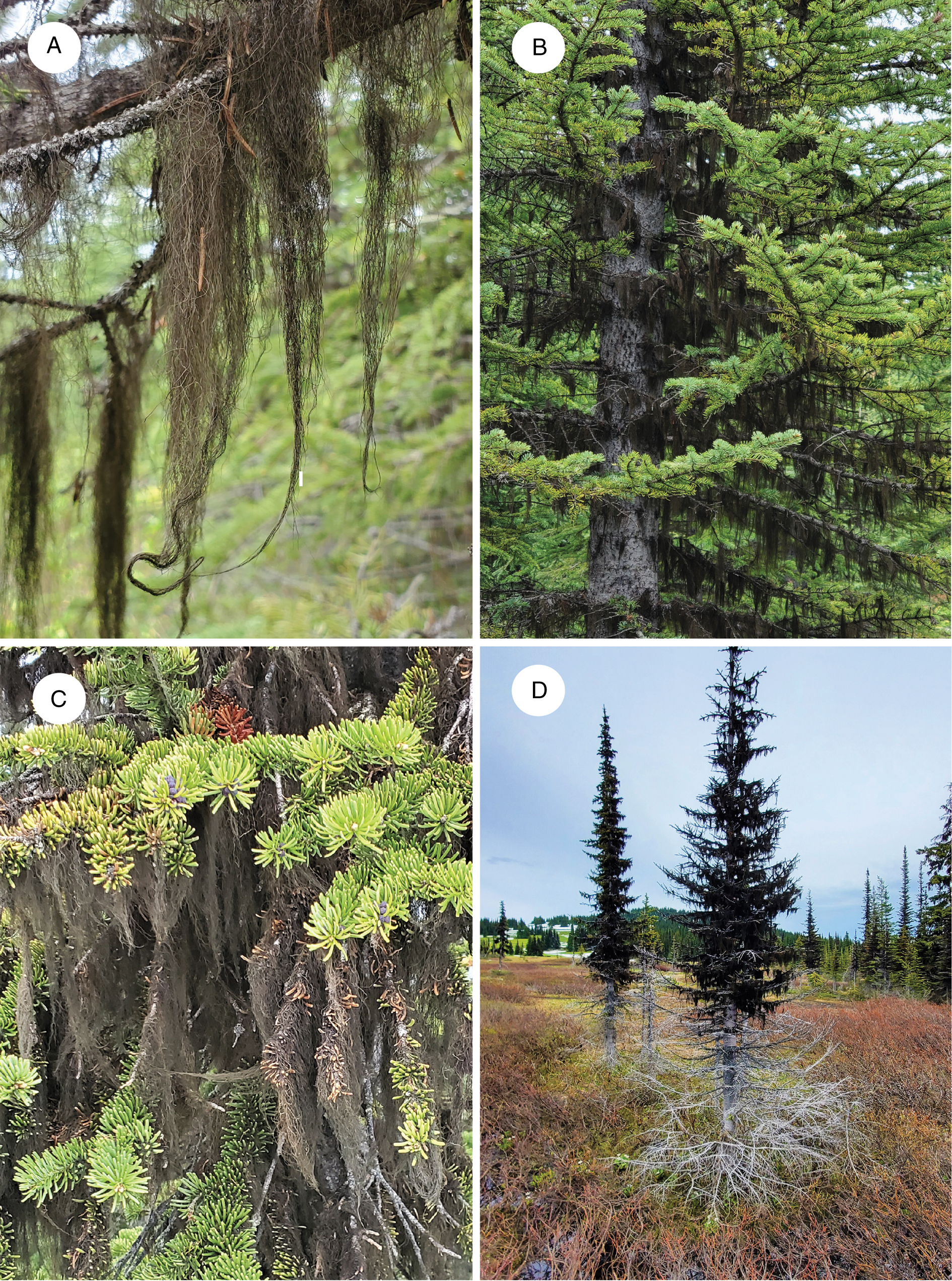
Goward (Reference Goward2003a) identified three vertical canopy zones of Bryoria abundance in high-elevation old-growth forests (Fig. 4). Nearest the ground is Zone A, where prolonged snow cover precludes the growth of hair lichens, and the upper trimline corresponds to the settled depth of the winter snowpack (Zone A in Fig. 4, Fig. 5D). Above Zone A is Zone B, the zone of periodic Bryoria die-back (Fig. 5A), where the high-biomass Bryoria spp. occur in low abundance and/or vigour, presumably a consequence of physiological damage during prolonged wetting (Gauslaa Reference Gauslaa2023). Note that Zone B can be lacking on solitary trees situated in highly wind-exposed localities, where the B/C trimline is replaced by an A/C trimline, as in Fig. 5D. Above Zone B is Zone C, characterized as the region of maximum ventilation, whether in the middle and/or upper canopy (Fig. 5B) or along forest margins (Goward & Campbell Reference Goward and Campbell2005). This is the zone of Bryoria hyperabundance, where thallus die-back is infrequent, thallus growth is accelerated (see below), and the high-biomass Bryoria spp. achieve their heaviest loadings (Fig. 5C & D).
Schematic diagram showing five age-class stages in the development of tree-level hyperabundance in Bryoria fremontii and B. pseudofuscescens (= the high-biomass Bryoria spp.) with increasing stand age within the range of Deep-Snow Mountain Caribou. The inner black canopy represents the defoliated zone where hair lichens establish and thrive above the settled depth of the winter snowpack (the A/B trimline), whereas the outer pale sleeve shows the foliated part of the canopy branches, which decreases geometrically with increasing tree age. The Y axis denotes increasing height above the ground and thus increasing ventilation. Zone A = prolonged snow cover precluding hair lichens; Zone B = zone of periodic Bryoria die-back; Zone C = the region of maximum ventilation and Bryoria hyperabundance. See text for further details on Zones A, B and C. After die-off of old trees occurs, a ‘black flame’ phase can be seen, where Bryoria is abundant throughout the vertical canopy profile. The development of hyperabundance in Alectoria sarmentosa is similar, albeit extending upwards into the upper canopy only in humid forest settings. In colour online.

A, close-up of high-biomass Bryoria spp. showing the narrow, comb-tooth tapering profile associated with Zone B as well as the early stages of die-back at the thallus tips where branches have lost their flexibility and form ± agglutinated ‘moustaches’ (see text). B, high-biomass Bryoria spp. already well established within the defoliated cone of this 40-year-old subalpine fir. These lichens will gradually disappear as upward and outward tree growth in this plantation stand reduces light penetration into the lower canopy while at the same time retarding evaporation after wetting. C, close-up of high-biomass Bryoria hyperabundance on a wind-exposed Abies lasiocarpa, showing the broad, pennant-like tapering profile characteristic of Zone C. D, two recently dead Picea engelmannii have transitioned to black flame trees in a wind-exposed subalpine meadow. Note the copious presence of high-biomass Bryoria spp. above (Zone C) and their absence below (Zone A). The trimline that separates Zones A (branches without hair lichens) and C (branches covered in black Bryoria) marks the settled depth of the winter snowpack. In colour online.
The heavy Bryoria loadings associated with Zone C have been examined by Esseen et al. (Reference Esseen, Rönnqvist, Gauslaa and Coxson2017), who showed that high-biomass Bryoria spp. branch more abundantly in the upper forest canopy (Fig. 4, Zone C) than in the lower canopy (Fig. 4, Zone B). Presumably this reflects their massively interweaving morphology and resulting enhanced capacity for interstitial water storage after rain or fog. In this scenario, the outer parts of the lichen dry rapidly compared with internal sections, causing water to be wicked outward from the less well illuminated thallus interior toward the thallus exterior. Here light is favourable for photosynthesis, whereas prolonged moderate hydration enhances net carbon fixation and thereby promotes increased branching. The likely outcome is a positive feedback loop, according to which enlargement of the interstitial water reservoir with progressive increase in thallus volume tends to accelerate the rate of overall biomass accrual, a phenomenon consistent with, and presumably contributing to, Bryoria hyperabundance in Zone C (Fig. 4, Zone C).
The disparate microclimatic conditions associated with Zone B versus Zone C are also reflected in thallus morphology (Goward Reference Goward2003a). Thus, while the high-biomass Bryoria spp. exhibit a distinctly narrowly tapering (comb tooth-like) profile in the former zone (Fig. 5A), in the latter they are more broadly tapering (pennant-like) (Fig. 5C), a distinction readily observed from 10 or even 20 m. The tapering morphology prevalent in Zone B results from periodic thallus die-back that tends to prevent lateral growth along the surface of the supporting conifer branches; no such die-back occurs in Zone C, so that thalli become laterally more broadly attached and hence pennant-like. This distinction in thallus morphology facilitates recognition of the zone of upward transition from Zone B to Zone C, hereafter referred to as the B/C trimline, which in turn provides a measure of relative stand-level potential for Bryoria hyperabundance: low in cases where the B/C trimline is positioned high in the canopy, and increasingly higher as it approaches the ground (Goward Reference Goward2003a).
The Manna Effect: a Sustained-Yield System for DSC Winter Forage
In common with many other hair lichens, Alectoria and the two high-biomass Bryoria spp. exhibit indeterminate growth, that is, their branches can in principle elongate indefinitely. In practice this means that branch elongation must at some point be offset by fragmentation (Stevenson Reference Stevenson1979, Reference Stevenson1988; Renhorn & Esseen Reference Renhorn and Esseen1995; Goward Reference Goward2003b), resulting in the periodic release of thallus fragments into lower portions of the forest canopy. Consistent with this, Stevenson & Coxson (Reference Stevenson and Coxson2003) found that around half of annual biomass increase in Bryoria is lost to litterfall. While most of the resulting thallus fragments presumably fall to the ground as litterfall (Esseen Reference Esseen1985; Coxson & Curteanu Reference Coxson and Curteanu2002; Goward Reference Goward2003b), some inevitably lodge in the defoliated cone, inoculating and thereby contributing to the ongoing replenishment of Zone B hair lichen biomass following episodic die-back, a process that, once begun, maintains stand-level Bryoria loadings at or near full potential indefinitely.
Stated more formally, this is the ‘Manna Effect’, according to which thallus fragments derived from massive standing crops of high-biomass Bryoria spp. in Zone C and Alectoria in Zone B continuously become available to wintering DSC as 1) litterfall on the snow surface, 2) thalli lodged within foraging reach on the branches of standing trees, and 3) episodically, as recently fallen trees (Antifeau Reference Antifeau1987). From this perspective, DSC can thus be understood as a beneficiary of an old-growth-forest-mediated sustained-yield system of winter forage production; this system, because it operates in the middle and upper canopy beyond their foraging reach, is resistant to degradation from excessive foraging (Edwards & Ritcey Reference Edwards and Ritcey1960).
The Development of Bryoria Hyperabundance with Increasing Forest Age: a Descriptive Model
In this section we propose a mechanistic model for the delayed onset of Bryoria hyperabundance with increasing stand age. We start with the observation (Goward Reference Goward1998) that the (outer) foliated portions of conifer branches do not support Bryoria establishment, while the (inner) defoliated portions of the same branches are the primary habitat of this genus. In this way, progressive annual needle cast is necessarily a key contributor to Bryoria hyperabundance insofar as it results in an inner cone of defoliated branches enveloped by an outer sleeve of foliated branch tips (Fig. 5B). Crucially, and with increasing age of the tree, the proportion of total canopy volume occupied by the defoliated cone increases geometrically relative to the foliated sleeve, a phenomenon briefly described below and schematically illustrated in Fig. 4.
After 20 years, the inner defoliated cone occupies c. 20% of total canopy volume. Depending on the depth of the winter snowpack relative to the height of the tree, the defoliated zone may now either support a few small Bryoria thalli or, at subalpine elevations where hair lichens near the ground are excluded by annual burial in snow (Goward Reference Goward1998), lack Bryoria altogether. In any event, Bryoria growth rates in trees of this age are expected to be low and offset by periodic die-back.
At 60 years, and especially in open stands (Benson & Coxson Reference Benson and Coxson2002; Coxson & Coyle Reference Coxson and Coyle2003; Goward et al. Reference Goward, Gauslaa, Björk, Woods and Wright2022), the defoliated cone now sustains a full complement of Bryoria species, with the occasional exception of B. fremontii, whose pliancy and comparative tensile strength often yield rather coarse thallus fragments resistant to efficient wind dispersal (T. Goward, personal observation). At the same time, and because conditions conducive to Zone C do not yet (within the range of DSC) overlap with well-developed portions of the defoliated cone, the high-biomass Bryoria spp. continue to experience periodic die-back during prolonged wet weather (Goward Reference Goward1998). Alectoria sarmentosa at this stage can also be present in low abundance (Gauslaa & Goward Reference Gauslaa and Goward2023).
By 120 years, stem exclusion (Oliver & Larson Reference Oliver and Larson1996) is underway, and the stand is now more open than before, resulting in increased light in the lower canopy as well as, higher in the canopy, increased exposure to the drying effects of ventilation. The defoliated cone is now well developed into the middle and upper canopies, and the high-biomass Bryoria spp. have begun to establish a permanent and ever-increasing biomass reservoir within Zone C. Meanwhile, diminishing rates of tree growth (Bigler & Veblen Reference Bigler and Veblen2009) create a comparatively stable forest environment favourable to the hair lichens (Esseen et al. Reference Esseen, Ringvall, Harper, Christensen and Svensson2016b).
By 150 years, the defoliated branch zone accounts for c. 95% of canopy volume, providing a fully developed scaffolding for hair lichens into the middle and upper canopies. Meanwhile, the portion of this scaffolding that intersects with Zone C now often sustains B. fremontii and B. pseudofuscescens in hyperabundance, resulting in high rates of thallus fragmentation and litterfall. While much of this litterfall reaches the ground or snow surface (Campbell & Coxson Reference Campbell and Coxson2001), some catches in the lower canopy branches within Zone B where, again, it can accumulate to heavy loadings subject, however, to periodic die-back. The net outcome of this forest maturation is a massive Bryoria reservoir that in suitable localities and/or topographic positions can occur across large expanses of forest.
As the dying tree (200+ years) sheds the needles that constitute its outer foliated sleeve, the newly defoliated branch tips become available for colonization by high-biomass Bryoria spp. At this point, and especially in open stands, increased lichen growth rates rapidly transform the entire tree into a ‘black flame’ of hair lichens (Fig. 5D). Typically, this black flame phase, which persists until sloughed off during bark exfoliation, is still intact when the host tree finally collapses, thereby furnishing DSC with a much sought-after feeding platform (Edwards et al. Reference Edwards, Soos and Ritcey1960; Antifeau Reference Antifeau1987; Terry et al. Reference Terry, McLellan and Watts2000). In this context, it seems reasonable to suggest that the current trend of increasing subalpine tree mortality, a by-product of climate change (e.g. Smith et al. Reference Smith, Paritsis, Veblen and Chapman2015; Andrus et al. Reference Andrus, Chai, Harvey, Rodman and Veblen2021), might translate to a temporary boost in late winter forage availability.
In summary, the available evidence supports the hypothesis (Goward Reference Goward1998) that the century-long delay in stand-level onset of hyperabundance in B. fremontii and B. pseudofuscescens within the range of DSC reflects the late development of certain structural features favourable to their growth and peculiar to old-growth forests. Four such features can be recognized: 1) a fully realized tree-scale (and stand-scale) development of the defoliated cone (Goward Reference Goward2003a); 2) relative environmental stability associated with age-related reduction in tree growth (Bigler & Veblen Reference Bigler and Veblen2009); 3) increased stand spacing (Campbell & Coxson Reference Campbell and Coxson2001; Benson & Coxson Reference Benson and Coxson2002) associated with stem exclusion (Oliver & Larson Reference Oliver and Larson1996); 4) related to this, rapid post-wetting desiccation associated with high ventilation in at least the upper portions of the defoliated cone (Esseen et al. Reference Esseen, Rönnqvist, Gauslaa and Coxson2017). Taken together, these prerequisites of Bryoria hyperabundance challenge the often implicit assumption (Serrouya et al. Reference Serrouya, McLellan, Boutin, Seip and Nielsen2011; Boutin & Merrill Reference Boutin and Merrill2016) that its onset might in principle be appreciably accelerated by selection logging or other silvicultural protocols.
Here it is worth noting that stand-level Bryoria biomass in unmanaged forests may continue to increase into the fourth century post disturbance (Stevenson & Coxson Reference Stevenson and Coxson2003), a finding consistent with the modelling exercise of Dettki & Esseen (Reference Dettki and Esseen2003), who showed that even rotations of 200 years would yield far less Bryoria biomass than uncut stands. From this we infer that our use of 120–150 years as onset for Bryoria hyperabundance should be regarded as a minimum interval after disturbance.
Finally, we stress that the above model describes the behaviour of the high-biomass Bryoria spp. within the range of DSC; there is no reason to believe that B. fremontii or B. pseudofuscescens can achieve hyperabundance throughout their respective distributions, as implicit in the findings of Rambo (Reference Rambo2010). Our field experience suggests that stand-level abundance in these species varies according to degree of overlap in at least eight interacting climatic and edaphic variables, namely: 1) base-poor soils (Gauslaa et al. Reference Gauslaa, Goward and Asplund2021); 2) acidic tree bark (James et al. Reference James, Hawksworth, Rose and Seaward1977); 3) a general absence of within-canopy nutrient enrichment (Goward & Arsenault Reference Goward and Arsenault2003); 4) high atmospheric purity (Häffner et al. Reference Häffner, Lomský, Hynek, Hällgren, Batič and Pfanz2001) including low nitrogen deposition (Esseen et al. Reference Esseen, Ekström, Westerlund, Palmqvist, Jonsson, Grafström and Ståhl2016a); 5) cool climatic regimes combined with moderate continentality (sensu Tuhkanen Reference Tuhkanen1984) (Esseen et al. Reference Esseen, Ekström, Westerlund, Palmqvist, Jonsson, Grafström and Ståhl2016a); 6) moderate precipitation (Esseen et al. Reference Esseen, Ekström, Westerlund, Palmqvist, Jonsson, Grafström and Ståhl2016a; Phinney et al. Reference Phinney, Gauslaa, Palmqvist and Esseen2021); 7) frequent wetting by dew or mist (Gauslaa Reference Gauslaa2014; Bidussi & Gauslaa Reference Bidussi and Gauslaa2015; Strother et al. Reference Strother, Coxson and Goward2021) followed by 8) rapid desiccation (Goward Reference Goward1998; Esseen et al. Reference Esseen, Rönnqvist, Gauslaa and Coxson2017). Even within the range of DSC the divergent hair lichen biomass estimates reported for old-growth subalpine forests, from 300–500 kg ha−1 (Rominger et al. Reference Rominger, Allen-Johnson and Oldemeyer1994; Campbell & Coxson Reference Campbell and Coxson2001) to > 3000 kg ha−1 (Edwards et al. Reference Edwards, Soos and Ritcey1960), might simply reflect differing degrees of overlap in the above variables.
Alectoria sarmentosa Within the Range of Deep-Snow Mountain Caribou
Eight species of Alectoria are currently recognized in North America (Esslinger Reference Esslinger2021), although only A. sarmentosa is of importance to DSC. This pendent hair lichen has rather coarse, pale yellowish green branches (cortical usnic acid) that can sometimes bear apothecia (Brodo & Hawksworth Reference Brodo and Hawksworth1977). Compared with Bryoria, A. sarmentosa, henceforth referred to as Alectoria, has high tensile strength; in favourable habitats, it can measure up to 110 cm long (Goward & Ahti Reference Goward and Ahti1992), although 30–50 cm is more typical (Esseen Reference Esseen2006, Reference Esseen2019). Alectoria provides an important source of forage for DSC in late autumn and early winter, when other food sources are buried out of reach by snow (Rominger et al. Reference Rominger, Robbins, Evans and Pierce2000), and before the winter snowpack lifts them to within foraging reach of Zones B and C. In late winter, however, DSC forage less on Alectoria than on Bryoria (Rominger et al. Reference Rominger, Robbins and Evans1996).
While important insights into the ecophysiology and distributional ecology of Alectoria continue to come to light (Esseen Reference Esseen2019; Phinney et al. Reference Phinney, Gauslaa, Palmqvist and Esseen2021; Gauslaa & Goward Reference Gauslaa and Goward2023), little effort has yet been given to characterizing the main features of its micro- and toposcale occurrence within the range of DSC. Nonetheless, our goal here is to discuss factors responsible for the delayed development of Alectoria hyperabundance into the second century following stand initiation, a discussion that seems merited at this time for three reasons pertinent to DSC conservation: 1) DSC depend on A. sarmentosa as a near-exclusive source of early winter forage (Rominger & Oldemeyer Reference Rominger and Oldemeyer1990); 2) industrial forestry continues to fragment the old-growth forests that sustain its heaviest loadings (Palm et al. Reference Palm, Fluker, Nesbitt, Jacob and Hebblewhite2020); 3) in contrast to the high-biomass Bryoria spp., the onset of hyperabundance in Alectoria appears in some cases to be amenable to acceleration using silvicultural approaches (see below). The following discussion may help to guide future research on the distributional ecology of this wide-ranging hair lichen.
Goward (Reference Goward1998) listed seven micro- and toposcale features pertinent to the distributional ecology of the high-biomass Bryoria spp. within the range of DSC. Four of these features are shared with Alectoria: 1) an inability to colonize branches subject to annual burial in the winter snowpack; 2) a disproportionately higher biomass in the (inner) defoliated cone than in the (outer) foliated sleeve; 3) a disproportionately lower biomass on vigorously growing trees than on trees subject to slower rates of growth; 4) an ability to persist in stands sheltered from frequent exposure to direct sunlight (i.e. in common with B. pseudofuscescens but not with B. fremontii) (T. Goward, personal observation). In addition, Alectoria and the high-biomass Bryoria spp. also tend to achieve maximum biomass in localities adjacent to open water and/or subject to frequent mist or fog. Four points of ecological variance with the high-biomass Bryoria spp. can also be noted. Therefore, Alectoria: 5) tends to be resistant to periodic die-back (T. Goward, personal observation); 6) is generally restricted to lower portions of the forest canopy (Coxson & Coyle Reference Coxson and Coyle2003; Esseen Reference Esseen2019); 7) occurs in greater overall abundance in cold subalpine forests than in warmer forests at valley and especially middle elevations (T. Goward, personal observation; see also Esseen et al. Reference Esseen, Ekström, Westerlund, Palmqvist, Jonsson, Grafström and Ståhl2016a); 8) is more widely distributed in wetter regions and more localized in drier regions (Benson & Coxson Reference Benson and Coxson2002). Taken together, and in contrast to the high-biomass Bryoria spp., these last four patterns support the theory that Alectoria is a rather hygrophytic species (8) in which enhanced tolerance for prolonged wetting (5, 6) operates in tandem with comparative intolerance to rapid desiccation (7, 8).
Recent advances in understanding the ecophysiology of Alectoria suggest that the microscale and toposcale distribution of this species is shaped by at least two constraints. The first constraint concerns a sensitivity to direct sunlight while in the dry condition, a phenomenon attributed by Färber et al. (Reference Färber, Solhaug, Esseen, Bilger and Gauslaa2014) to the poor sun-screening efficiency of its cortical pigment usnic acid, which affords the photobiont limited protection against high light. The second constraint appears to involve an inherent requirement for frequent and/or prolonged wetting (e.g. Phinney et al. Reference Phinney, Gauslaa, Palmqvist and Esseen2021), presumably an adaptation for sustaining metabolic repair mechanisms against light damage (Färber et al. Reference Färber, Solhaug, Esseen, Bilger and Gauslaa2014). Consistent with these constraints, and in contrast to the high-biomass Bryoria spp., Alectoria achieves maximum net carbon uptake in the lower forest canopy (Coxson & Coyle Reference Coxson and Coyle2003), where partial shelter from solar radiation combined with reduced ventilation prolong photosynthetic activity after rain (Stevenson & Coxson Reference Stevenson and Coxson2007).
These factors are reflected in the vertical distribution of Alectoria within forests in DSC habitat (Fig. 3). Alectoria biomass peaks between 5 and 10 m above ground level, diminishing rapidly in abundance at greater heights within the canopy (Fig. 3). In the tree-scale zonal classification developed for the high-biomass Bryoria spp. by Goward (Reference Goward2003a), the vertical amplitude of Alectoria broadly overlaps with Bryoria Zone B (T. Goward, personal observation), that is, the portion of the forest canopy where B. fremontii and B. pseudofuscescens are subject to periodic die-back. Since Zone B is typically confined to the lower canopy (Fig. 4), it follows that the stand-level biomass achieved by Alectoria is generally much lower, certainly in old-growth forests, than that of the high-biomass Bryoria spp., which not only reach their heaviest loadings in Zone C in the middle and upper canopies (Fig. 3), but also continuously inoculate the lower canopy, Zone B, with their thallus fragments.
It is important to note, however, that Zone B can also extend into the middle and upper canopies, especially in perhumid areas of the Caribou Rainforest, where moderate loadings of Alectoria have been shown to occur > 30 m above ground (Edwards et al. Reference Edwards, Soos and Ritcey1960). Such a wide vertical amplitude greatly increases the potential for stand-level hyperabundance, resulting in values that in some cases approximate those of the high-biomass Bryoria spp. (Benson & Coxson Reference Benson and Coxson2002). Crucially, and as with B. fremontii and B. pseudofuscescens, the onset of such heavy tree-scale loadings is necessarily constrained by the late development of the defoliated cone into the middle and upper portions of the forest canopy (Fig. 6A & D).
A, recently defoliated Pseudotsuga menziesii, showing early colonization of Alectoria sarmentosa (Zone B) grading upwards to high-biomass Bryoria spp. in the more wind-exposed upper canopy (Zone C). B, scattered elongated clumps of A. sarmentosa characteristic of the lower canopy of regenerating conifer forests, here aged 90 y. C, close-up of A. sarmentosa hyperabundance derived through litterfall from the upper canopy of low-elevation 120 y P. menziesii. This stand is situated in a hilltop fog belt near a large lake. D, a recently dead P. menziesii situated near a river and bearing copious A. sarmentosa, hence a yellow flame tree. In colour online.

Our understanding of the reproductive ecology of Alectoria is limited owing to uncertainty concerning its capacity for long-distance dispersal via fungal spores versus short-distance dispersal via fragmentation. What is clear, however, is that its tensile strength results in rather coarse thallus fragments (Stevenson Reference Stevenson1988) resistant to efficient wind dispersal (Dettki et al. Reference Dettki, Klintberg and Esseen2000; Goward Reference Goward2003b). A feature of many mid-successional stands is the stand-level occurrence of A. sarmentosa at once robust and intermittently distributed (Fig. 6B), consistent with relatively infrequent thallus fragmentation in wind-sheltered forests.
To summarize, stand-scale Alectoria biomass within the range of DSC is generally negligible during the first century following disturbance (Goward & Campbell Reference Goward and Campbell2005; Goward et al. Reference Goward, Gauslaa, Björk, Woods and Wright2022), an observation that applies even in the lower portions of the forest canopy where fully developed defoliated cones become established early on. Only after c. 100 years, following the onset of stem exclusion (Oliver & Larson Reference Oliver and Larson1996) and consequent increased canopy openness, does A. sarmentosa begin to occur in hyperabundance (Fig. 6C), albeit usually only in the lower portions of the canopy (T. Goward, personal observation). Presumably this pattern in part reflects a corresponding increase in light penetration into the lower canopy (Campbell & Coxson Reference Campbell and Coxson2001).
Implications for Forest Management
We have shown that the late development of heavy Bryoria loadings in forest succession is necessarily associated with structural attributes peculiar to old-growth forests and hence not conducive to acceleration by stand thinning or other silvicultural treatments. In particular, the late development of a defoliated cone into the middle and upper canopies precludes the occurrence in plantation stands of Bryoria loadings relevant to DSC until the second century after disturbance. Furthermore, silvicultural systems designed to mimic the characteristics of old-growth forest ecosystems face three challenges pertinent to DSC winter ecology: 1) partial cutting significantly and permanently reduces stand-level hair lichen loadings compared to unmanaged stands of similar age (Stevenson Reference Stevenson, Jull and Stevenson2001; Stevenson & Coxson Reference Stevenson and Coxson2003; Waterhouse et al. Reference Waterhouse, Armleder and Nemec2007); 2) any temporary increase in hair lichen biomass on residual trees, a function of canopy openness favouring high light and increased ventilation (Campbell & Coxson Reference Campbell and Coxson2001), will be lost once post-logging regeneration begins to close the forest canopy; 3) the comparatively closed stands that result are unlikely ever to be used by caribou (Terry et al. Reference Terry, McLellan and Watts2000; Apps et al. Reference Apps, McLellan, Kinley, Serrouya, Seip and Wittmer2013).
These challenges notwithstanding, the findings summarized here suggest that Alectoria hyperabundance may be more amenable to artificially induced acceleration, at least in stands of sufficient age to support fully developed defoliated cones in the lower and middle canopies: firstly, because Alectoria is well adapted for growth and persistence in the lower forest canopy (Zone B) in conditions unfavourable for the high-biomass Bryoria spp., and secondly, because branch colonization in this species often lags far behind the establishment of a suitable defoliated cone, a consequence of its high tensile strength and resultant inefficient vegetative dispersal (Dettki Reference Dettki1998). Stevenson & Enns (Reference Stevenson and Enns1992) discussed the possibility that stem girdling might be used to generate hair lichen forage for black-tailed deer. Since trees killed by girdling remain standing, a judicious application of this approach in DSC early winter habitat could in principle promote ‘yellow flame’ trees (Fig. 4D) that not only release abundant Alectoria litterfall, but also function as propagule sources for the surrounding forest. Further research is warranted.
Old-Growth Forests and Conservation Strategies for Deep-Snow Mountain Caribou
To date, conservation strategies for DSC have focused on predator control (Serrouya et al. Reference Serrouya, Seip, Hervieux, McLellan, McNay, Steenweg, Heard, Hebblewhite, Gillingham and Boutin2019) and maternity penning (Ford et al. Reference Ford, Noonan, Bollefer, Gill, Legebokow and Serrouya2022), together with partial protection of late winter habitat at subalpine elevations (British Columbia Ministry of Environment 2009). Importantly, none of these initiatives serve to mitigate the adverse effects of ongoing fragmentation of DSC early winter habitat at lower and middle forested elevations. Since DSC avoid mid-seral stands where they do not have ready sightlines to facilitate avoidance of predators (Wittmer et al. Reference Wittmer, McLellan, Serrouya and Apps2007; Blagdon & Johnson Reference Blagdon and Johnson2021), isolated patches of old-growth forest fragmented by mid-seral plantation forests will largely be inaccessible to them. Thus, the avoidance behaviour of these caribou ensures that the progressive loss of old-growth forest habitat necessarily initiates a corresponding loss of winter forage greatly exceeding the areal extent of the clearcuts involved (see Johnson et al. Reference Johnson, Ehlers and Seip2015). Additionally, edge effects in fragmented old-growth forest patches can lead to reduced canopy lichen loading, given the sensitivity of hair lichens to wind scouring (Coxson & Stevenson Reference Coxson and Stevenson2005). The emerging consensus is that long-term survival of DSC requires the continued existence of large, extensively replicated tracts of old-growth forests at all forested elevations, consistent with their dietary requirements during well-documented dual annual migrations (Edwards & Ritcey Reference Edwards and Ritcey1959; Apps et al. Reference Apps, McLellan, Kinley and Flaa2001; Kinley et al. Reference Kinley, Goward, McLellan and Serrouya2007).
Looking ahead, and putting predator relationships aside, it seems inevitable that an ongoing loss of winter forage availability must at some point place DSC at risk of episodic malnutrition: firstly, because the metabolic costs of increased search effort (Stevenson Reference Stevenson1979) will exceed the potential for energy input through foraging (Rominger et al. Reference Rominger, Robbins and Evans1996), and secondly, because winter forage availability is itself subject to considerable interannual variation (Kinley et al. Reference Kinley, Goward, McLellan and Serrouya2007).
Conservation efforts that target predator control and maternity penning at the expense of habitat conservation across the full elevational range of DSC will not save these caribou (Environment Canada 2014; Nagy-Reis et al. Reference Nagy-Reis, Dickie, Calvert, Hebblewhite, Hervieux, Seip, Gilbert, Venter, DeMars and Boutin2021). Even allowing that predation has to date been the primary proximal cause of DSC decline (Johnson et al. Reference Johnson, Ray and St-Laurent2022), it seems unwise to assume that malnutrition will not at some point play a role in their ongoing herd-by-herd extirpation (Government of Canada 2018). In this paper, we have shown that post-logging habitat restoration for DSC is necessarily a long-term commitment requiring more than a century. In such a scenario, it seems reasonable to urge that future efforts at DSC conservation give particular attention to maintaining the sustained-yield system of winter forage production that surely brought this subspecies of barren-ground caribou into existence in the first place.
Author ORCIDs
Trevor Goward, 0000-0003-2655-9956; Darwyn Coxson, 0000-0001-8563-2741; Yngvar Gauslaa, 0000-0003-2630-9682.
Competing Interests
All authors have expressed their willingness to be an author of this article and have declared no conflict of interest.


 Open access

