





Introduction
Weedy rice control is challenging in mid-southern U.S. rice cropping systems because of its highly competitive and resilient nature, its similarity to cultivated rice, and its capacity for readily evolving resistance to commonly applied herbicides. Weedy rice is one of the most detrimental weeds in direct-seeded rice cropping systems (Burgos et al. Reference Burgos, Singh, Tseng, Black, Young, Huang, Hyma, Gealy and Caicedo2014) and can cause up to 80% yield loss and a reduction in grain quality (Shivrain et al. Reference Shivrain, Burgos, Scott, Gbur, Estorninos and McClelland2010b). Weedy rice is genetically similar to commercially cultivated rice, making it particularly difficult to selectively control without also damaging the crop (Burgos et al. Reference Burgos, Singh, Tseng, Black, Young, Huang, Hyma, Gealy and Caicedo2014). Owing to the genetic similarity of weedy rice and cultivated rice, the risk for evolution of herbicide resistance from transgene flow from herbicide-resistant (HR) rice cultivars to weedy rice populations is prevalent (Gressel and Valverde Reference Gressel and Valverde2009). In 2012, a survey of mid-southern U.S. crop consultants (Norsworthy et al. Reference Norsworthy, Bond and Scott2013) was conducted to identify the most problematic weeds of rice, and results from this study conclude that weedy rice and barnyardgrass [Echinochloa crus-galli (L.) P. Beauv.] were the third and first most problematic weeds of rice in the mid-southern United States, respectively.
Cultivated rice comprises two species: Oryza sativa L., which is grown throughout the world, and Oryza glaberrima Steud., which is grown in West Africa (Shivrain et al. Reference Shivrain, Burgos, Agrama, Lu, Sales, Boyett, Gealy and Moldenhauer2010a). In the Oryza genus, which includes cultivated rice, there are 21 wild species, and most of these species can hybridize with each other and produce viable seeds (Shivrain et al. Reference Shivrain, Burgos, Agrama, Lu, Sales, Boyett, Gealy and Moldenhauer2010a). Cultivated rice hybridized with its wild ancestor Oryza rufipogon Griffiths, which ultimately led to the production of weedy red rice (Ellstrand Reference Ellstrand2003; Londo and Schaal Reference Londo and Schaal2007; Shivrain et al. Reference Shivrain, Burgos, Agrama, Lu, Sales, Boyett, Gealy and Moldenhauer2010a). Presence or absence of awns, hull color, and pericarp color are some of the phenotypic traits shared by Oryza species, but these characteristics can vary by ecotype (Burgos et al. Reference Burgos, Singh, Tseng, Black, Young, Huang, Hyma, Gealy and Caicedo2014; Kovach et al. Reference Kovach, Sweeney and McCouch2007). The term weedy rice is used to describe many genetically similar types of rice, all in the Oryza genus, and red rice, specifically, is the product of hybridization that results in a red-colored pericarp on the rice seed. Today, any Oryza plant found in a rice field that was not intentionally planted can be considered weedy rice.
Imidazolinone (IMI)-resistant rice was commercialized by Louisiana State University and became commercially available for use in rice production in 2002 (Sudianto et al. Reference Sudianto, Beng-Kah, Ting-Xiang, Saldain, Scott and Burgos2013; Tan et al. Reference Tan, Evans, Dahmer, Singh and Shaner2005). IMI-resistant rice enables producers to make mid-season postemergence applications of IMI herbicides, such as imazethapyr or imazamox, for the control of problematic rice weeds (Chin et al. Reference Chin, Thien, Bi and Nhiem2007). When IMI-resistant rice technology was first introduced, IMI herbicides were very effective in controlling weedy rice as well as propanil- and quinclorac-resistant barnyardgrass. The ability to selectively control these problematic weeds postemergence was appealing to producers, and the technology was widely adopted. By 2012, upward of 61% of all rice hectares in Arkansas were planted with IMI-resistant cultivars (Wilson et al. Reference Wilson, Moldenhauer, Cartwright and Hardke2013). This widespread adoption ultimately led to the evolution of IMI-resistant weedy rice and barnyardgrass (Burgos et al. Reference Burgos, Norsworthy, Scott and Smith2008, Reference Burgos, Singh, Tseng, Black, Young, Huang, Hyma, Gealy and Caicedo2014; Heap Reference Heap2020). This was primarily caused by overuse of IMI herbicides, which selected for resistant populations, which then outcrossed with susceptible populations, resulting in IMI-resistant populations. Consequently, IMI herbicides are no longer an effective option for controlling weedy rice and barnyardgrass in many fields in the mid-southern United States (Norsworthy et al. Reference Norsworthy, Ward, Shaw, Llewellyn, Nichols, Webster, Bradley, Frisvold, Powles, Burgos, Witt and Barrett2012); thus IMI-resistant rice hectares have declined (Hardke Reference Hardke2018).
The occurrence of widespread IMI-resistant weedy rice as well as multiple-resistant barnyardgrass prompted the development of quizalofop-resistant rice in 2018 (Hines Reference Hines2018). Quizalofop-resistant rice (WSSA Group 1 acetyl CoA carboxylase–inhibiting herbicide) provided mid-southern U.S. rice growers with an additional postemergence herbicide option for selective grass control, including weedy rice. Unlike many other HR crops, quizalofop-resistant rice is nontransgenic (Scott et al. Reference Scott, Norsworthy, Barber and Hardke2018). Because of the risk of antagonism in applications made near flood establishment, it is recommended that broadleaf herbicides only be mixed with quizalofop on the first of two sequential applications (Scott et al. Reference Scott, Norsworthy, Barber and Hardke2018). Quizalofop is an effective postemergence option for controlling weedy rice, but repeated use of this chemistry will increase the likelihood of herbicide resistance development.
Widespread herbicide resistance in common rice weeds poses challenges for mid-southern U.S. rice producers. As a result, strategies have been implemented to mitigate further evolution of herbicide resistance. One of the most effective tactics for combating target-site herbicide resistance evolution is the use of multiple effective sites of action (SOA) for season-long weed control (Norsworthy et al. Reference Norsworthy, Ward, Shaw, Llewellyn, Nichols, Webster, Bradley, Frisvold, Powles, Burgos, Witt and Barrett2012). Using a program approach while implementing multiple effective herbicide SOA will greatly reduce the risk for target-site resistance, thus providing producers with a sustainable and effective weed control program.
Benzobicyclon is a 4-hydroxyphenylpyruvate dioxygenase (HPPD)-inhibiting herbicide that was registered in fall 2021 for postflood weed control in mid-South rice. Benzobicyclon was originally discovered by SDS Biotech in Japan in 2001 (Komatsubara et al. Reference Komatsubara, Sekino, Yamada, Koyanagi and Nakahara2009) and has been used in California as a weed control option in water-seeded paddy rice production since 2017 (Gowan 2017). Although HPPD-inhibiting herbicides, such as mesotrione and tembotrione, are currently registered for use in mid-southern U.S. corn (Zea mays L.) (Barber et al. Reference Barber, Butts, Cunningham, Selden, Norsworthy, Burgos and Bertucci2020), no labeled HPPD-inhibiting herbicides were registered for use in mid-southern U.S. rice prior to benzobicyclon.
Benzobicyclon, as well as other HPPD-inhibiting herbicides, disrupts plastoquinone biosynthesis within the plant, causing bleached symptomology on the new growth, followed by chlorosis, and ultimately leading to plant death (Komatsubara et al. Reference Komatsubara, Sekino, Yamada, Koyanagi and Nakahara2009). Benzobicyclon is a pro-herbicide; therefore it does not directly inhibit HPPD enzymes in plants (Komatsubara et al. Reference Komatsubara, Sekino, Yamada, Koyanagi and Nakahara2009). Rather, benzobicyclon must undergo a nonenzymatic hydrolysis reaction in the presence of water to be converted to the potent and phytotoxic compound benzobicyclon hydrolysate (Williams and Tjeerdema Reference Williams and Tjeerdema2016). For this reaction to occur and for benzobicyclon hydrolysate to be formed, water must be present. Hence it is imperative for rice producers to maintain a continuous flood throughout the growing season for benzobicyclon to perform optimally (Young et al. Reference Young, Norsworthy, Scott, Bond and Heiser2018). Additionally, flood depth has an impact on the efficacy of benzobicyclon. In a recent study, Davis et al. (Reference Davis, Scott, Sandoski, Barber and Norsworthy2013) documented that benzobicyclon performed optimally when the flood depth was at least 10 cm. This is important because a majority of rice hectares in the mid-southern United States are drill-seeded and receive a continuous flood around the 5-leaf growth stage, which is maintained through plant maturity. Benzobicyclon controls a broad spectrum of problematic rice weeds, including aquatics, broadleaves, grasses, and sedges, including those currently resistant to ALS herbicides (Young et al. Reference Young, Norsworthy, Scott and Barber2017).
The addition of benzobicyclon to current rice weed control programs provides a new effective SOA for producers, thus enabling control of a broadened spectrum of weeds as well as providing some protection against weedy rice and other rice weeds evolving resistance to current herbicide options. Furthermore, the addition of benzobicyclon into current mid-southern U.S. rice herbicide programs will provide producers with a nontraited, postflood weedy rice control option on those populations sensitive to the herbicide.
To protect the current traited technologies available in rice for further herbicide resistance development in weedy rice, the objective of this research was to determine if the addition of benzobicyclon to quizalofop- or IMI-resistant rice herbicide programs will provide comparable or improved weedy rice control versus a standard program in these systems.
Materials and Methods
Field experiments were conducted in 2018 and 2019 on a Calloway silt loam (Fine-silty, mixed, active, thermic Aquic Fraglossudalfs) at the Pine Tree Research Station near Colt, AR, and in 2019 on a Dewitt silt loam (Fine, smectitic, thermic Typic Albaqualfs) at the Rice Research and Extension Center near Stuttgart, AR. The experimental design for these experiments was a randomized complete block with four replications.
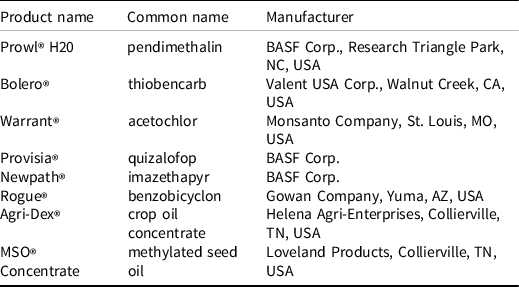
Herbicide trade names, manufacturers, and herbicide common names for the experiments are listed in Table 1. The herbicide treatment combinations evaluated for the quizalofop-resistant rice experiment conducted in 2018 are listed in Table 2, and the herbicide treatment combinations evaluated for the quizalofop-resistant experiments conducted in 2019 are listed in Table 3. The herbicide treatment combinations evaluated for the IMI-resistant rice experiment conducted in 2018 and 2019 are listed in Table 4.
Product name, common name, and manufacturing company of evaluated products for the quizalofop- and imidazolinone-resistant rice experiments in 2018 and 2019.
List of herbicide treatments, application timings, and rates for the quizalofop-resistant rice experiment in 2018. a
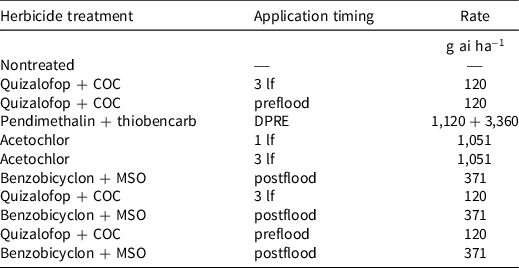
a Abbreviations: 1 lf, 1-leaf crop stage; 3 lf, 3-leaf crop stage; COC, crop oil concentrate at 1% v/v; DPRE, delayed preemergence; MSO, methylated seed oil at 1% v/v.
List of herbicide treatments, application timings, and rates for the quizalofop-resistant rice experiment in 2019. a
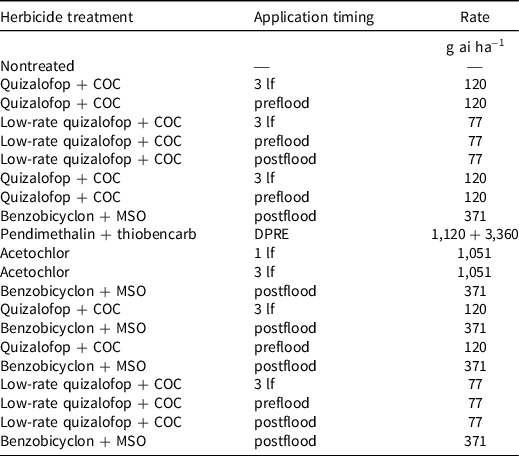
a Abbreviations: 1 lf, 1-leaf crop stage; 3 lf, 3-leaf crop stage; COC, crop oil concentrate at 1% v/v; DPRE, delayed preemergence; MSO, methylated seed oil at 1% v/v.
List of herbicide treatments, application timings, and rates for the imidazolinone-resistant rice experiment in 2018 and 2019. a
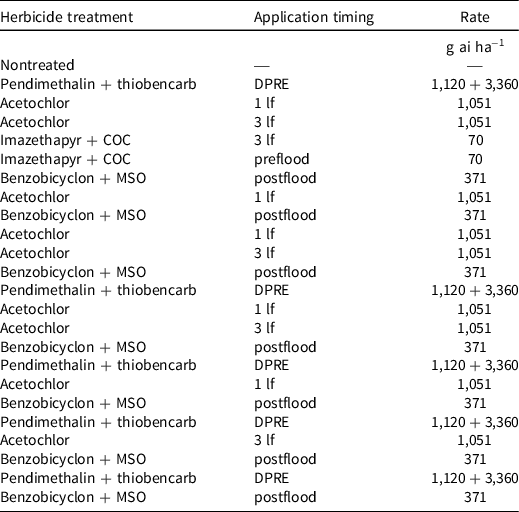
a Abbreviations: 1 lf, 1-leaf crop stage; 3 lf, 3-leaf crop stage; COC, crop oil concentrate at 1% v/v; DPRE, delayed preemergence; MSO, methylated seed oil at 1% v/v.
Individual rice bays were used to prevent movement of benzobicyclon among treatments. Rice bays consisted of a continuous flood being held within man-made levees beginning at the 5-leaf stage of rice. Each non-benzobicyclon-containing plot was placed in a separate bay than benzobicyclon-containing treatments. This setup ensured that non-benzobicyclon-containing plots were not contaminated by benzobicyclon. Plots measured 1.8 × 5.2 m and were planted using a nine-row cone drill on May 14, 2018, at Pine Tree; April 24, 2019, at Stuttgart; and May 17, 2019, at Pine Tree. The quizalofop-resistant (Provisia® Rice System, BASF Corporation, Research Triangle Park, NC, USA) cultivar ‘PVL01’ and the IMI-resistant (Clearfield® rice, BASF Corporation) cultivar ‘CL153’ were drill-seeded at a 2-cm depth at a seeding rate of 73 seeds m−1 of row, and a 1-m alley was established between plots.
A broadcast application of clomazone (Command® herbicide, FMC Corporation, Philadelphia, PA, USA) at 336 g ai ha−1 and halosulfuron + prosulfuron (Gambit® herbicide, Gowan Company, Yuma, AZ, USA) at 53 g ai ha−1 and 31 g ai ha−1, respectively, was made at planting. All experiments were fertilized prior to flooding with nitrogen (N) at 155 kg N ha−1 and were otherwise managed for nonevaluated weeds according to University of Arkansas Extension recommendations (Roberts et al. Reference Roberts, Slaton, Wilson and Norman2018; Scott et al. Reference Scott, Norsworthy, Barber and Hardke2018). All treatments were applied with a CO2-pressurized backpack sprayer utilizing a handheld four-nozzle boom equipped with 110015 AIXR nozzles (TeeJet® Technologies, Springfield, IL, USA) calibrated to deliver 140 L ha−1 at 276 kPa. All postflood applications were made within 3 d following flooding.
Assessments
Herbicide efficacy was visually assessed by means of weedy rice control ratings at 28 d after delayed preemergence (DPRE) applications and at 14 and 28 d after postflood (POST) applications. At the 28 d after DPRE evaluation timing, all DPRE and early postemergence (EPOST) (1-leaf and 3-leaf) applications had been made. At the 14 and 28 d after POST evaluation timings, all applications prior to flooding and postflood benzobicyclon applications had been made. Control ratings were based on a scale of 0% to 100%, with 0% being no control relative to the nontreated check and 100% being complete control of weedy rice within the plots. Additionally, crop injury ratings were taken simultaneously with weedy rice control ratings. Injury was visually evaluated on a scale of 0% to 100%, with 0% being no crop injury relative to the nontreated check and 100% being complete crop death (Frans and Talbert Reference Frans and Talbert1977). For all field experiments, experimental plots were machine-harvested using a small-plot combine to determine rough rice yield at an adjusted moisture of 12%.
Statistical Analyses
All data were analyzed using SAS 9.4 (SAS Institute Inc., Cary, NC, USA). Crop injury and weedy rice control data were subjected to analysis of variance (ANOVA) and analyzed as repeated measures with a beta distribution (values of 0 were adjusted to 0.001 to avoid exclusion) using proc glimmix in SAS (Gbur et al. Reference Gbur, Stroup, McCarter, Durham, Young, Christman, West and Kramer2012). Crop injury and weedy rice control data were analyzed using multiple different covariance structures, then the analysis with the most appropriate covariance structure was chosen for reporting based on the smallest second-order Akaike’s information criterion (AIC) value (Brewer et al. Reference Brewer, Butler and Cooksley2016; Burnham and Anderson Reference Burnham and Anderson2002). When analyzing crop injury and weedy rice control data, block was considered random, and herbicide treatment and time were fixed. Rough rice yield data were subjected to ANOVA using proc glimmix in SAS. When analyzing rough rice yield data, block was considered a random effect and herbicide treatment was fixed. A gamma distribution was used to analyze rough rice yield data. For both the quizalofop- and IMI-resistant rice, each site-year was analyzed separately for each response variable. Each site-year was analyzed separately because combining site-years and analyzing these data using a repeated measures analysis yielded results that were not conducive to reporting. Means were separated using Fisher’s protected least significant difference at α = 0.05. P-values of ANOVAs are displayed in Table 5.
P-values from ANOVA for the quizalofop- and imidazolinone-resistant rice experiments for rough rice yield, crop injury, and weedy rice control at Pine Tree in 2018 and at Pine Tree and Stuttgart in 2019. a

a Abbreviations: imi-res, imidazolinone-resistant rice experiment; quiz-res, quizalofop-resistant rice experiment.
For the quizalofop-resistant rice experiments, analyses containing the variance components (VC) covariance structure were chosen for crop injury data at Pine Tree in 2018 and at Stuttgart in 2019, and the analysis containing the first-order autoregressive (AR [1]) covariance structure was chosen for crop injury data at Pine Tree in 2019. The analyses containing the VC covariance structure were chosen for weedy rice control data at Pine Tree in 2018 and 2019. The analysis containing the AR (1) covariance structure was chosen for weedy rice control data at Stuttgart in 2019.
For the IMI-resistant rice experiments, the analysis containing the VC covariance structure was chosen for crop injury data at Pine Tree in 2018, and the analyses containing the compound symmetry (CS) covariance structure were chosen for crop injury data at Pine Tree and Stuttgart in 2019. The analysis containing the VC covariance structure was chosen for weedy rice control data at Pine Tree in 2018, and the analyses containing the CS covariance structure were chosen for weedy rice control data at Pine Tree and Stuttgart in 2019.
Results and Discussion
Quizalofop-Resistant Rice
Weedy Rice Control
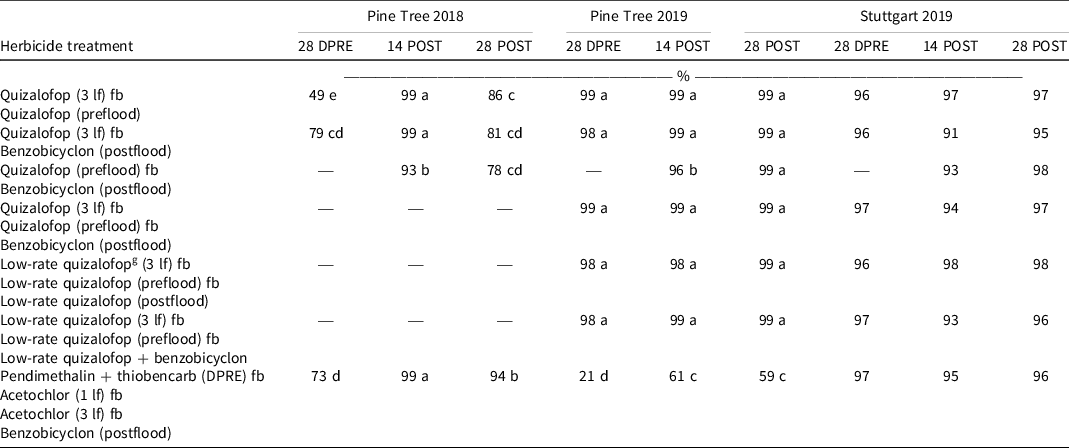
One application of quizalofop, either at the 3-leaf rice stage or at preflood, followed by benzobicyclon applied postflood, provided comparable weedy rice control to two sequential applications of quizalofop across site-years (Table 6). At Pine Tree and Stuttgart in 2019, both treatments containing one application of quizalofop followed by benzobicyclon postflood provided weedy rice control ≥95% at 28 d after the postflood application. With the treatments evaluated, it is not possible to conclude whether a single quizalofop application would be as effective as the current standard, but considering the previously reported activity of benzobicyclon on weedy rice (Mann and Yerkes Reference Mann and Yerkes2018; Young et al. Reference Young, Norsworthy, Scott, Bond and Heiser2018), it is likely that benzobicyclon contributes to the high level of control obtained in this research.
Estimates of weedy rice control relative to the nontreated check 28 d after delayed preemergence applications, 14 d after postflood applications, and 28 d after postflood applications for the quizalofop-resistant rice experiment at Pine Tree in 2018 and at PineTree and Stuttgart in 2019. a , b , c , d , e , f
a Site-years were analyzed separately.
b Abbreviations: DPRE, delayed preemergence; fb, followed by; lf, leaf.
c Quizalofop-containing treatments also included crop oil concentrate at 1% v/v; benzobicyclon-containing treatments also included methylated seed oil at 1% v/v.
d Letters are used to separate means. Means that are significantly different are represented by letter separation by site-year; means without the same letter in each site-year are significantly different according to Fisher’s protected least significant difference (α = 0.05).
e Evaluations were recorded 28 d after delayed preemergence applications, 14 d after postflood applications, and 28 d after postflood applications.
f Cells with a dash indicate evaluations that either were not included in that site-year or had not been evaluated at that timing.
g Low-rate quizalofop treatments received 77 g ai ha−1 instead of the standard rate of 120 g ai ha−1.
The addition of benzobicyclon in quizalofop-resistant rice weed control programs is of value for mid-southern U.S. rice growers for many reasons. For example, using an additional herbicide SOA for weedy rice control, which decreases total quizalofop use, will reduce selection pressure on quizalofop. Additionally, including benzobicyclon broadens the spectrum of control, especially for aquatic species and rice flatsedge (Cyperus iria L.), compared to quizalofop alone (Sandoski et al. Reference Sandoski, Brazzle, Holmes and Takahashi2014; Young et al. Reference Young, Norsworthy, Scott and Barber2017).
Acetochlor, a very-long-chain fatty acid–inhibiting herbicide, is not currently labeled for use in rice; however, if registered, it could be utilized across all rice seed traits due to natural tolerance (Norsworthy et al. Reference Norsworthy, Fogleman, Barber and Gbur2019). If eventually labeled, acetochlor could be used in many rice technology systems because it does not require a specific tolerance trait by the crop. At Pine Tree in 2018 and Stuttgart in 2019, pendimethalin + thiobencarb applied DPRE followed by two sequential EPOST applications of acetochlor followed by benzobicyclon postflood provided comparable weedy rice control to all quizalofop-containing treatments (Table 6). On the basis of these findings, it is suggested that a nontraited herbicide program including acetochlor and benzobicyclon could be a viable option for weedy rice control if acetochlor were labeled for use in rice.
Rice Injury
The recent successful registration of benzobicyclon in rice and its potential use in quizalofop-resistant rice requires every facet of the new chemistry to be understood. To effectively control weeds and potentially maximize yields while using benzobicyclon in conjunction with other herbicides in a system that employs quizalofop, the risk of crop injury must be assessed.
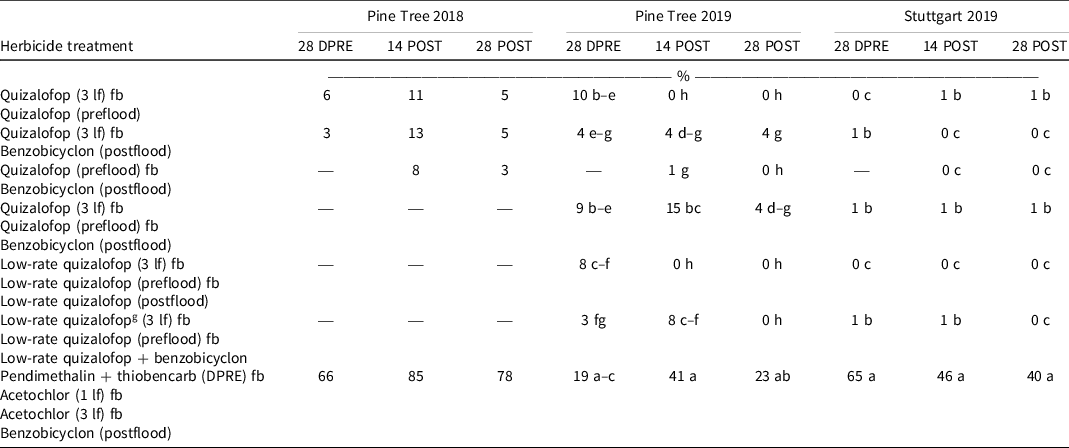
At Pine Tree and Stuttgart in 2019, when compared to all other treatments, the treatment containing pendimethalin + thiobencarb applied DPRE followed by two sequential EPOST applications of acetochlor followed by benzobicyclon postflood was much more injurious (≥41%) to the rice when evaluated at 14 d after the postflood application (Table 7). Previous research indicated that when a single microencapsulated acetochlor application was made EPOST, rice injury was tolerable (Fogleman et al. Reference Fogleman, Norsworthy, Barber and Gbur2019); however, when an emulsifiable concentrate formulation of acetochlor was applied, rice injury was not tolerable. Therefore the microencapsulated formulation of acetochlor was chosen for use in this research. In this experiment, when microencapsulated acetochlor was applied EPOST, rice injury was beyond allowable limits (19% to 65%). Furthermore, when benzobicyclon was subsequently applied, crop injury was exacerbated. These findings suggest that injury to rice caused by acetochlor can be variable from year to year and that sequential applications increase the likelihood for severe injury. Additional research would be needed to better understand the extent to which soil moisture and rainfall differences among site-years contribute to increased risk for injury from microencapsulated acetochlor.
Estimates of crop injury relative to the nontreated check 28 d after delayed preemergence applications, 14 d after postflood applications, and 28 d after postflood applications for the quizalofop-resistant rice experiment at Pine Tree in 2018 and at Pine Tree and Stuttgart in 2019. a , b , c , d , e , f
a Site-years were analyzed separately.
b Abbreviations: DPRE, delayed preemergence; fb, followed by; lf, leaf.
c Quizalofop-containing treatments also included crop oil concentrate at 1% v/v; benzobicyclon-containing treatments also included methylated seed oil at 1% v/v.
d Letters are used to separate means. Means that are significantly different are represented by letter separation by site-year; means without the same letter in each site-year are significantly different according to Fisher’s protected least significant difference (α = 0.05).
e Evaluations were recorded 28 d after delayed preemergence applications, 14 d after postflood applications, and 28 d after postflood applications.
f Cells with a dash indicate evaluations that either were not included in that site-year or had not been evaluated at that timing.
g Low-rate quizalofop treatments received 77 g ai ha−1 instead of the standard rate of 120 g ai ha−1.
Across site-years, treatments containing quizalofop or quizalofop followed by benzobicyclon injured the rice ≤5% at 28 d after the postflood application, regardless of quizalofop rate (Table 7). The addition of benzobicyclon to programs containing up to two sequential quizalofop applications did not increase the likelihood of injury to rice.
Rice Yield
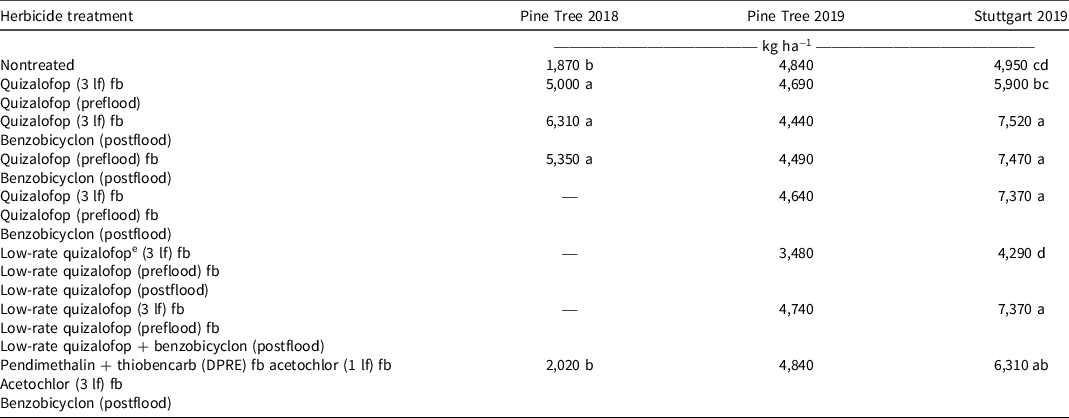
At Pine Tree in 2018, rice yield in both treatments containing a single application of quizalofop followed by benzobicyclon was comparable to treatments containing two sequential applications of quizalofop (Table 8). At Stuttgart in 2019, rice in both treatments containing a single application of quizalofop followed by benzobicyclon yielded 1,595 kg ha−1 greater than that in the treatment containing two sequential applications of quizalofop (Table 8). Although the quizalofop-resistant rice cultivar ‘PVL01’ in 2018 and 2019 yielded >1,000 kg ha−1 less than many of the other rice cultivars commonly planted in Arkansas (Hardke Reference Hardke2019), the addition of benzobicyclon to a herbicide program for quizalofop-resistant rice can provide better or comparable yields than the current standard herbicide program in quizalofop-resistant rice. The ability to maintain cultivar yield potential while also utilizing more than one SOA and providing a broader spectrum of control seems to emphasize that the use of benzobicyclon will be a viable option for rice growers moving forward.
Rough rice yield for the quizalofop-resistant rice experiment at Pine Tree in 2018 and at Pine Tree and Stuttgart in 2019. a , b , c , d
a Site-years were analyzed separately.
b Abbreviations: DPRE, delayed preemergence; fb, followed by; lf, leaf.
c Quizalofop-containing treatments also included crop oil concentrate at 1% v/v; benzobicyclon-containing treatments also included methylated seed oil at 1% v/v.
d Letters are used to separate means. Data within columns containing the same letter are not significantly different according to Fisher’s protected LSD (α = 0.05).
e Low-rate quizalofop treatments received 77 g ai ha−1 instead of the standard rate of 120 g ai ha−1.
Imidazolinone-Resistant Rice
Weedy Rice Control
Widespread weedy rice resistance to IMI herbicides, such as imazethapyr, which is labeled for use in IMI-resistant rice, poses many challenges for mid-southern U.S. rice producers. The overuse and poor stewardship of these IMI herbicides have led to extreme herbicide resistance issues, and as a result, they are no longer an effective option for controlling weedy rice and other weeds, such as barnyardgrass, in the mid-southern United States (Norsworthy et al. Reference Norsworthy, Ward, Shaw, Llewellyn, Nichols, Webster, Bradley, Frisvold, Powles, Burgos, Witt and Barrett2012). Currently, effective postemergence herbicide options for controlling weedy rice are limited. Hence the goal of this experiment was to investigate the viability of the addition of benzobicyclon into a current IMI-resistant rice herbicide program as well as investigating benzobicyclon included in nontraited herbicide programs, relative to a standard IMI-resistant rice herbicide program.
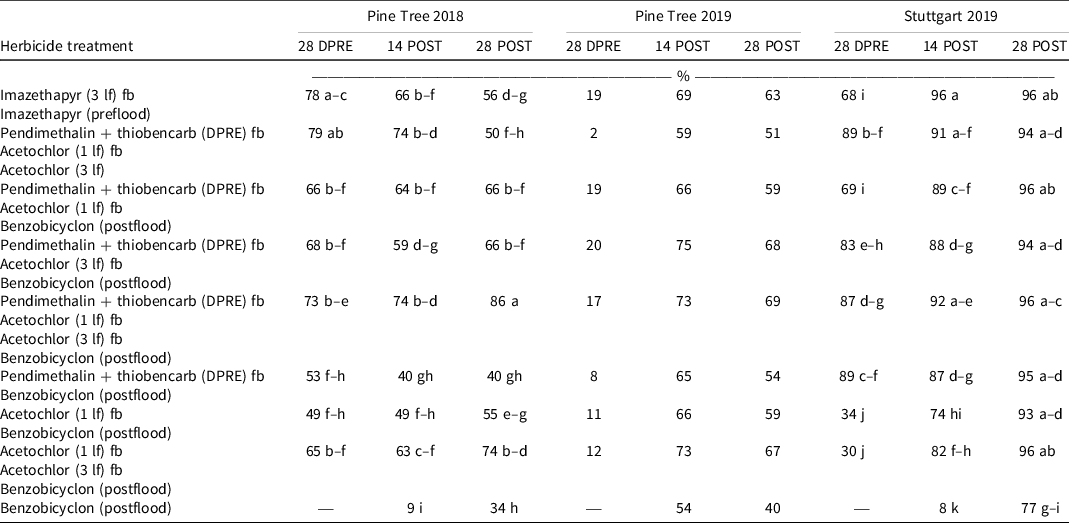
Across all three site-years, at 28 d after the postflood application of benzobicyclon, all treatments containing a full-season herbicide program followed by benzobicyclon postflood provided comparable or improved weedy rice control when compared to two sequential EPOST applications of imazethapyr (Table 9). Many of the treatments contained DPRE-applied pendimethalin + thiobencarb followed by single and/or multiple applications of EPOST-applied acetochlor. These treatments do not contain imazethapyr and can be considered nontraited herbicide programs. However, these programs do include acetochlor, meaning they could be utilized for weedy rice control in different rice technologies in the event that acetochlor were to become labeled for use in rice.
Estimates of weedy rice control relative to the nontreated check 28 d after delayed preemergence applications, 14 d after postflood applications, and 28 d after postflood applications for the imidazolinone-resistant rice experiment at Pine Tree in 2018 and at Pine Tree and Stuttgart in 2019. a , b , c , d , e , f
a Site-years were analyzed separately.
b Abbreviations: DPRE, delayed preemergence; fb, followed by; lf, leaf.
c Imazethapyr-containing treatments also included crop oil concentrate at 1% v/v; benzobicyclon-containing treatments also included methylated seed oil at 1% v/v.
d Letters are used to separate means. Means with the same letter in each site-year are not significantly different according to Fisher’s protected least significant difference (α = 0.05).
e Evaluations were recorded 28 d after delayed preemergence applications, 14 d after postflood applications, and 28 d after postflood applications.
f Cells with a dash indicate evaluations that had not been evaluated at that timing.
At Pine Tree in 2018 and Stuttgart in 2019, the treatment containing postflood-applied benzobicyclon alone was often one of the least effective treatments for weedy rice control. Control increased if benzobicyclon followed a full-season herbicide program (Table 9). These results indicate that benzobicyclon is not effective as a stand-alone herbicide program for weedy rice control. Rather, it should be used in combination with early-season herbicides to make a complete full-season herbicide program to effectively control weedy rice. Size of weedy rice at application of benzobicyclon impacts the likelihood of success with the herbicide (Brabham et al. Reference Brabham, Norsworthy, Sha, Varanasi and Gonzalez-Torralva2022).
Rice Injury
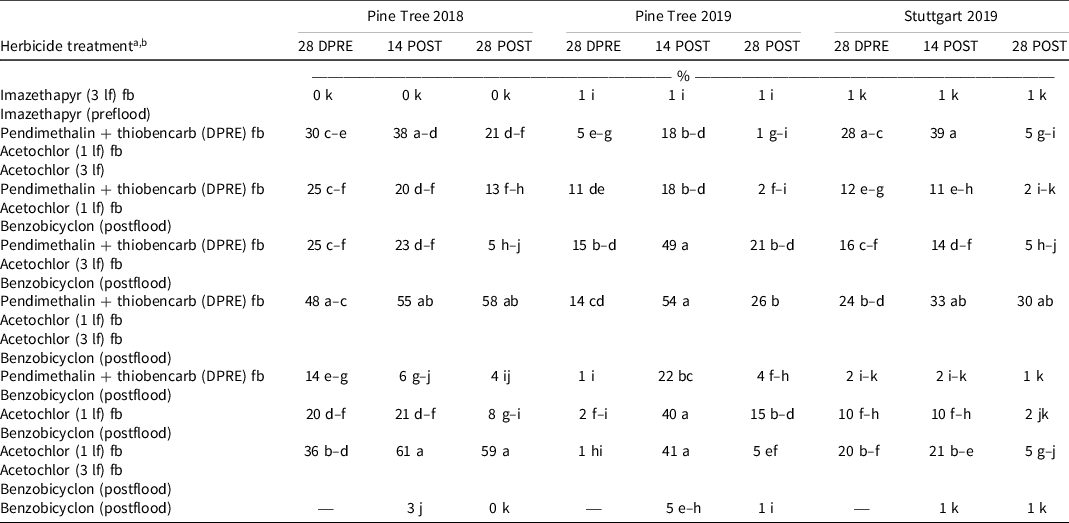
Benzobicyclon was safe for use in IMI-resistant rice when it was not preceded by injury elicited from applications of other herbicides prior to flooding. Across all three site-years, at 28 d after the postflood application of benzobicyclon applied without previous herbicides, rice was injured ≤1% (Table 10). The observed injury on ‘CL153,’ a rice cultivar with japonica background, is consistent with findings reported by Young et al. (Reference Young, Norsworthy, Scott and Barber2017), who found that IMI-resistant rice cultivars and other rice cultivars with japonica backgrounds were injured ≤7%. Conversely, the indica cultivars ‘Rondo’ and ‘Purple Maker’ were severely injured, and high levels of chlorosis were observed when assessed 2 wk after treatment (Young et al. Reference Young, Norsworthy, Scott and Barber2017). Increased tolerance to benzobicyclon in japonica rice cultivars is important because a vast majority of rice cultivars planted in the United States are of japonica origin as opposed to indica origin (Burgos et al. Reference Burgos, Singh, Tseng, Black, Young, Huang, Hyma, Gealy and Caicedo2014). In general, when injury occurred, benzobicyclon tended to exacerbate injury observed from acetochlor-containing applications prior to flood establishment. As expected, the standard IMI-resistant rice herbicide program of two sequential EPOST applications of imazethapyr did not result in injury.
Estimates of crop injury relative to the nontreated check 28 d after delayed preemergence applications, 14 d after postflood applications, and 28 d after postflood applications for the imidazolinone-resistant rice experiment at Pine Tree in 2018 and at Pine Tree and Stuttgart in 2019. a , b , c , d , e , f
a Site-years were analyzed separately.
b Abbreviations: DPRE, delayed preemergence; fb, followed by; lf, leaf.
c Imazethapyr-containing treatments also included crop oil concentrate at 1% v/v; benzobicyclon-containing treatments also included methylated seed oil at 1% v/v.
d Letters are used to separate means. Means with the same letter in each site-year are not significantly different according to Fisher’s protected least significant difference (α = 0.05).
e Evaluations were recorded 28 d after delayed preemergence applications, 14 d after postflood applications, and 28 d after postflood applications.
f Cells with a dash indicate evaluations that had not been evaluated at that timing.
Rough Rice Yield
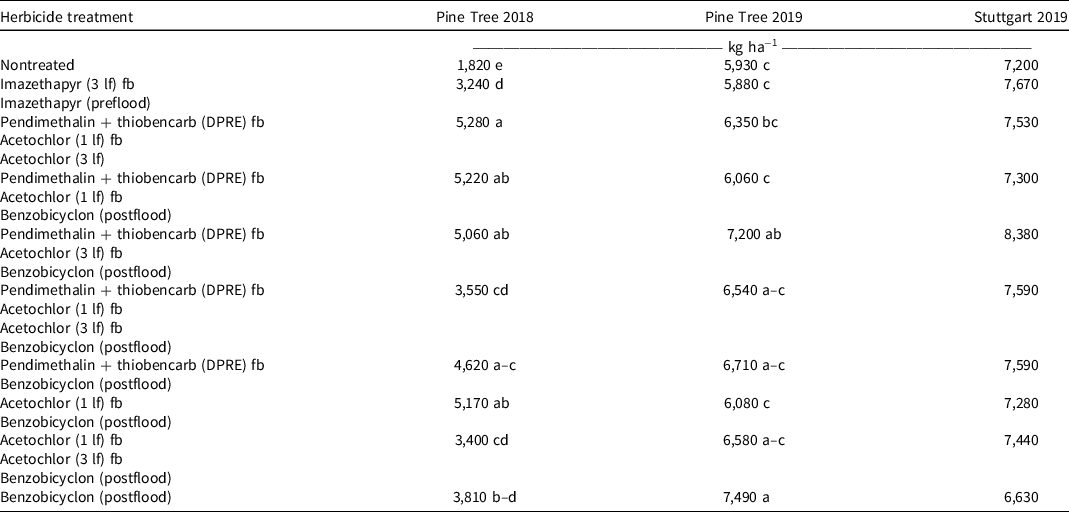
At Pine Tree in 2018, the addition of benzobicyclon to weed control programs, except when following sequential acetochlor applications, resulted in improved rice yields over the standard treatment of two sequential EPOST imazethapyr applications (Table 11). Likewise, rice yields for some, but not all, benzobicyclon-containing treatments at Pine Tree in 2019 had greater yields than were harvested from plots for the standard two-application imazethapyr-alone program (Table 11). In no instance, in any of the three site-years, were rice yields lower for benzobicyclon-treated plots compared to the two-application imazethapyr-alone program.
Rough rice yield for the imidazolinone-resistant rice experiment at Pine Tree in 2018 and at Pine Tree and Stuttgart in 2019. a , b , c , d
a Site-years were analyzed separately.
b Abbreviations: DPRE, delayed preemergence; fb, followed by; lf, leaf.
c Imazethapyr-containing treatments also included crop oil concentrate at 1% v/v; benzobicyclon-containing treatments also included methylated seed oil at 1% v/v.
d Letters are used to separate means. Data within columns containing the same letter are not significantly different according to Fisher’s protected LSD (α = 0.05).
Practical Implications
Findings from this research indicate that the use of benzobicyclon in quizalofop- and IMI-resistant rice herbicide programs provides utility for mid-southern U.S. rice producers. In both production systems, the addition of benzobicyclon to the respective standard herbicide programs resulted in comparable or improved weedy rice control compared to the standard program alone. Additionally, minimal injury was observed from treatments containing the current standard herbicide program followed by the postflood application of benzobicyclon.
Acknowledgments
The authors thank the Arkansas Rice Research and Promotion Board for funding. They declare no conflicts of interest.


 Open access

