





Introduction
Physical and sexual victimization in childhood can produce long-lasting impacts that extend into adulthood, impacting victims’ long-term mental health, their ability to cope with new stressors, and — for a certain proportion of individuals — their parenting practices (Nelson et al., Reference Nelson, Klumparendt, Doebler and Ehring2017; Yu et al., Reference Yu, Zhao and Liu2017). When this occurs, children may become recipients in the intergenerational transmission and impact of maltreatment. One plausible pathway through which this occurs is as follows: caregivers’ experiences of physical and sexual victimization during childhood contribute to increased depressive symptoms in adulthood. Depressive symptoms then put caregivers at increased risk of employing harsh discipline tactics toward their children, which can result in the development of transdiagnostic externalizing behaviors in childhood, culminating in more entrenched behavioral problems in adolescence. Although a large body of work supports the various individual paths mentioned above, few studies have examined this entire intergenerational, cascading process in a single structural equation model while considering how children and their caregivers impact one another transactionally over time — a process emphasized by developmental psychopathology frameworks (Cicchetti, Reference Cicchetti2016; Masten & Cicchetti, Reference Masten and Cicchetti2010) but not always tested empirically. The present study sought to better understand how victimization – and its developmental impact — is transmitted across generations, and how children’s behavior problems, caregivers’ depressive symptoms, and caregivers’ harsh parenting tactics may reinforce one another transactionally across childhood, culminating in disruptive behavior problems in adolescence.
Intergenerational processes from caregiver childhood victimization to child outcomes
The psychological impact of physical and sexual victimization in childhood is immense. Childhood victimization, particularly when chronic, is capable of disrupting multiple different developmental domains and creating long-term maladaptive emotional and behavior responses that extend into parenthood and across generations (Su et al., Reference Su, D’Arcy and Meng2022). Two highly plausible mediators in this intergenerational transmission include caregivers’ mental health and their parenting behaviors. The piecewise paths that comprise this intergenerational process are well supported by meta-analytic evidence. Physical and sexual abuse in childhood are robust predictors of depressive symptoms in adulthood (Nelson et al., Reference Nelson, Klumparendt, Doebler and Ehring2017); caregiver depression can cause reduced tolerance for stress, irritability, and emotion dysregulation, increasing caregivers’ likelihood of using harsh and abusive discipline tactics toward their children (Rueger et al., Reference Rueger, Katz, Risser and Lovejoy2011); caregivers’ harsh parenting, a chronic developmental stressor for children and a model for maladaptive behavior, is strongly associated with children’s development of externalizing problems and more entrenched disruptive behavior problems in adolescence (Pinquart, Reference Pinquart2017).
In the past few decades, studies have employed more sophisticated analytic approaches and rigorous methodologies to test this intergenerational process. Prior work has demonstrated that caregivers’ levels of depression and stress might mediate the association between caregivers’ childhood victimization history and their use of psychologically aggressive and physically assaultive parenting strategies across early and middle childhood (Morelli et al., Reference Morelli, Duong, Evans, Hong, Garcia, Ogbonnaya and Villodas2021). Other studies have extended this work to include children’s mental and behavioral health outcomes. Several studies have identified maternal depression or hostile mother-child interactions as mediators in the association between mothers’ childhood victimization and their children’s psychopathology (Collishaw et al., Reference Collishaw, Dunn, O’Connor and Golding2007; Morrel et al., Reference Morrel, Dubowitz, Kerr and Black2003; Pereira et al., Reference Pereira, Ludmer, Gonzalez and Atkinson2018). Similarly, Russotti et al. (Reference Russotti, Warmingham, Handley, Rogosch and Cicchetti2021) identified a multigenerational developmental cascade whereby maternal history of maltreatment predicted chronic maltreatment for offspring, which in turn predicted greater internalizing and externalizing symptoms in late childhood.
Transactional caregiver-child effects
Considering the findings above, the intergenerational effects of mothers’ experiences of childhood victimization on their children’s behavioral outcomes may be explained by a developmental cascade model. Conceptually, the developmental psychopathology framework theorizes that cascading sequences of effects can account for distal associations, including intergenerational associations. It is possible that these mediational processes are sequential, such that caregiver’s experiences of childhood victimization have cascading effects on their mental health, which in turn compromises parenting, and ultimately increases children’s risk for behavior problems in childhood and mood disorders in adolescence (Masten & Cicchetti, Reference Masten and Cicchetti2010). Yet, the developmental psychopathology framework simultaneously suggests a more complicated story. Although the cascading pathway above is entirely plausible, it is unlikely that children are purely recipients of their caregivers’ influence. Equally important within the developmental psychopathology framework is the transactional nature of children’s development (Cicchetti, Reference Cicchetti2016). From this perspective, children’s outcomes are thought to be the result of countless reciprocal transactions with their environment. When testing developmental cascade models, it is crucial to account for how children and their caregivers may impact one another longitudinally and how these transactional influences might reciprocally exacerbate problems over time.
Evidence for problematic bidirectional cycles between parents and their children has been well supported over the past two decades (Pinquart, Reference Pinquart2017). Particularly useful for demonstrating these effects has been the advent of the cross-lag panel model (CLPM). By accounting for autoregressive effects, CLPMs demonstrate whether two or more variables are associated with increases in one another over time, providing a strong inferential basis for uncovering reciprocal effects and causality. The developmental psychopathology literature has employed CLPMs extensively to explore how children and their proximal environments influence one another bidirectionally (Hentges et al., Reference Hentges, Graham, Plamondon, Tough and Madigan2021; Whelan et al., Reference Whelan, Leibenluft, Stringaris and Barker2015; Wiggins et al., Reference Wiggins, Mitchell, Hyde and Monk2015). Much of this work focuses on transactional escalations in caregivers’ harsh parenting (e.g., spanking) and child externalizing problems. This transactional effect has been shown in both general population samples (Gershoff et al., Reference Gershoff, Lansford, Sexton, Davis-Kean and Sameroff2012) and low-income, racially/ethnically diverse samples (MacKenzie et al., Reference MacKenzie, Nicklas, Brooks-Gunn and Waldfogel2015; Serbin et al., Reference Serbin, Kingdon, Ruttle and Stack2015). Comparable cross-lagged effects have also been identified with respect to caregiver depression and child externalizing problems (Shaw et al., Reference Shaw, Sitnick, Reuben, Dishion and Wilson2016; Wiggins et al., Reference Wiggins, Mitchell, Stringaris and Leibenluft2014). Although studies have not always found hypothesized cross-lagged associations, particularly when time points have been spaced more than one year apart (MacKenzie et al., Reference MacKenzie, Nicklas, Brooks-Gunn and Waldfogel2015; Serbin et al., Reference Serbin, Kingdon, Ruttle and Stack2015; Shaffer et al., Reference Shaffer, Lindhiem, Kolko and Trentacosta2013), CLPMs on the whole have been crucial for supporting the negative reciprocal interplay between caregivers and their children.
The random intercept cross-lag panel model: building upon the traditional CLPM
The traditional CLPM is not without its disadvantages. Hamaker et al. (Reference Hamaker, Kuiper and Grasman2015) pointed out that if the stability of constructs is trait-like in nature, then the autoregressive associations of the traditional CLPM will fail to adequately account for the trait-like, between-person variance, potentially leading to specious conclusions regarding the presence and strength of causal influences. Consider harsh parenting, for example. Caregivers may employ harsher parenting during certain periods, such as when their children are exhibiting more challenging behaviors, and less harsh parenting during other periods, perhaps when they are experiencing less distress. This represents the variance in harsh parenting that exists within caregivers (i.e., the within-person effects). At the same time, there is undoubtedly a trait-like component to harsh parenting; some caregivers are harsher in their parenting style on average than other caregivers, even if they fluctuate from time-to-time. This represents the variance between caregivers (i.e., the between-person effects). One solution to addressing these two types of variances is the random intercept cross-lagged panel model (RI-CLPM). The RI-CLPM extends the traditional CLPM by separating out the stable, trait-like differences between individuals. What is left over is the within-person variance. In this way, the cross-lagged relations in a RI-CLPM represent deviations from an individual’s average or expected level of that construct from one time point to another. Whether this within-person effect provides better interpretability for causal hypotheses compared to the traditional CLPM has been debated (Lüdtke & Robitzsch, Reference Lüdtke and Robitzsch2021). Nevertheless, applications of the RI-CLPM within the parent-child literature have expanded rapidly.
With very little exception (Schütte et al., Reference Schütte, Lohaus, Symanzik, Heinrichs, Konrad and Reindl2022), RI-CLPM studies consistently demonstrate that harsh, aggressive, or psychologically controlling parenting is associated with child externalizing problems at the between-person level (Kullberg et al., Reference Kullberg, Van Schie, Allegrini, Ahmadzadeh, Wechsler, Elzinga and McAdams2023; Pritsker, Reference Pritsker2021; Robillard et al., Reference Robillard, Balakrishnan, Craig and Turner2022; Speyer et al., Reference Speyer, Hang, Hall and Murray2022; Zhang et al., Reference Zhang, Lee, Piehler, Gewirtz and August2020). This provides strong evidence for an underlying trait-level association between caregivers’ parenting and children’s behavior problems, and further justifies separating out this between-person variance before interpreting longitudinal cross-lagged effects. Evidence for within-person cross-lagged effects has been mixed. A handful of studies provide support for a negative transactional cycle at the within-person level, where increases in harsh parenting predict increases in child externalizing problems (Speyer et al., Reference Speyer, Hang, Hall and Murray2022); or the opposite effect, where child externalizing problems exacerbate one another longitudinally through harsh parenting (Schütte et al., Reference Schütte, Lohaus, Symanzik, Heinrichs, Konrad and Reindl2022). Some RI-CLPM studies illustrate mostly unidirectional parent-child effects. Robillard et al. (Reference Robillard, Balakrishnan, Craig and Turner2022) found that increases in harsh parenting were associated with increases in adolescents’ rule-breaking behavior but not vice versa (i.e., parent-to-child effect), whereas Zhang et al. (Reference Zhang, Lee, Piehler, Gewirtz and August2020) found that child externalizing problems were more consistently associated with subsequent harsh parenting (i.e., child-to-parent effect). In other studies, between-person effects were found but within-person cross-lagged associations were largely absent (Kullberg et al., Reference Kullberg, Van Schie, Allegrini, Ahmadzadeh, Wechsler, Elzinga and McAdams2023; Pritsker, Reference Pritsker2021). It is worth noting that Kullberg et al. (Reference Kullberg, Van Schie, Allegrini, Ahmadzadeh, Wechsler, Elzinga and McAdams2023) collected data at child age 9, 12, and 16 years, suggesting that within-person associations may not be detectable across intervals of more than 2–3 years; all of the above studies used time intervals of two years or shorter.
Only two studies to our knowledge have employed a RI-CLPM to investigate reciprocal associations between caregiver depression and child externalizing problems. Both recruited majority-White, middle-upper-class families, and both collected several waves of data: six waves spanning child ages 13–18 years, and eight waves spanning 2–15 years, respectively (Schulz et al., Reference Schulz, Nelemans, Oldehinkel, Meeus and Branje2021; Yan et al., Reference Yan, Liu, Ansari, Li and Li2021). In both studies, significant associations between mothers’ depressive symptoms and their children’s externalizing problems were found at the between-person level but were largely absent at the within-person level.
Gaps in the literature and the present study
In summary, current evidence suggests that (a) the impact of childhood victimization is capable of transmitting across generations, impacting children’s behavior problems (Su et al., Reference Su, D’Arcy and Meng2022) and (b) children and their caregivers are likely to impact one another transactionally across childhood and into adolescence (Pinquart, Reference Pinquart2017). Still, several prominent gaps in the literature remain. First, much of the intergenerational literature is limited by a relatively small number of time points, focusing on a narrow range of child development or on a single mediator. Few studies have tested more complete, cascading intergenerational processes culminating in children’s behavior problems, and those that have did not account for possible transactional associations between caregivers and their children. Second, applications of the RI-CLPM for exploring parent-child transactional effects have only recently begun to appear in the literature, and the findings remain quite mixed. Finally, much of the relevant research in this area has been limited to middle-to-upper class, majority White, or nationally representative families. It is crucial to elucidate problematic intergenerational and transactional family processes within families who are most likely to be impacted by victimization and child behavior problems.
The present study sought to fill these gaps by examining a cascading, intergenerational pathway from caregivers’ childhood victimization to their children’s behavior problems through caregivers’ depressive symptoms and harsh parenting within a socioeconomically disadvantaged, diverse sample of caregiver-child dyads at risk for family violence. Additionally, transactional, cross-lagged associations between caregivers’ depressive symptoms, harsh parenting, and child behavior problems were tested across child ages 4, 6, 8, and 12. Age 14 disruptive behavior problems were included in the model as a final, distal outcome, representing the culmination of dimensional externalizing problems over the 10 preceding years. Cross-lagged associations are presented using both a traditional CLPM and a RI-CLPM, given that each approach offers unique advantages and disadvantages (Hamaker et al., Reference Hamaker, Kuiper and Grasman2015; Lüdtke & Robitzsch, Reference Lüdtke and Robitzsch2021). We hypothesized the following:
-
1. Mothers’ childhood experiences of victimization would be associated with baseline (i.e., child age 4) and trait levels of their depressive symptoms, harsh parenting, and their children’s externalizing problems.
-
2. A cascading, serial mediation process would be identified from maternal childhood victimization to increased maternal depressive symptoms at child age 4, leading to increased harsh parenting at child age 6, leading to increased child externalizing problems at age 8.
-
3. Caregivers’ depressive symptoms, harsh parenting, and children’s externalizing problems would be associated with increases in levels of one another across child ages 4, 6, 8, and 12, as evidenced by significant and positive cross-lagged associations.
-
4. Caregivers’ depressive symptoms, harsh parenting, and children’s externalizing problems at age 12 (and their trait-like components) would be associated with more DSM-5 disruptive behavior problems at age 14 years.
Method
Sample and procedures
The present study utilized data from the Longitudinal Studies of Child Abuse and Neglect (LONGSCAN). LONGSCAN is a multi-site consortium of ongoing prospective studies investigating the causes and consequences of child abuse and neglect (see Runyan et al., [Reference Runyan, Curtis, Hunter, Black, Kotch, Bangdiwala, Dubowitz, English, Everson and Landsverk1998] for a more detailed description). The initial sample included 1,354 child-caregiver dyads and was selected based on prior Child Protective Services (CPS) involvement (Northwest, Midwest, and Southwest sites), identification as high risk for child maltreatment at birth based on a state public health tracking system (South), and involvement with health clinics serving low-income mothers and their children (East). Participants were identified before children were 4 years old. Caregivers and their children were interviewed separately in person biannually by one or two trained interviewers using laptop computers between child ages 4 and 18 years. Interviews lasted between one and three hours and caregivers were compensated with cash for their participation in each interview and children were compensated with gift cards. The time between most interviews was on average two years, except between the age 8 and age 12 interviews, which was four years. All sites utilized uniform assessment measures, data collection, data entry, and data cleaning protocols. Additionally, each of the LONGSCAN sites systematically reviewed and coded narrative CPS records of maltreatment using a modification of the Maltreatment Classification System (MMCS; Barnett et al., Reference Barnett, Manly, Cicchetti, Cicchetti and Toth1993; English & Investigators, Reference English1997). Coders at each site were trained to use the MMCS by experienced coders until they reached 90% agreement with a “gold standard” example. To further ensure reliable coding, coders at all five sites coded a subsample (n = 109) of the CPS narratives that represented cases from each site.
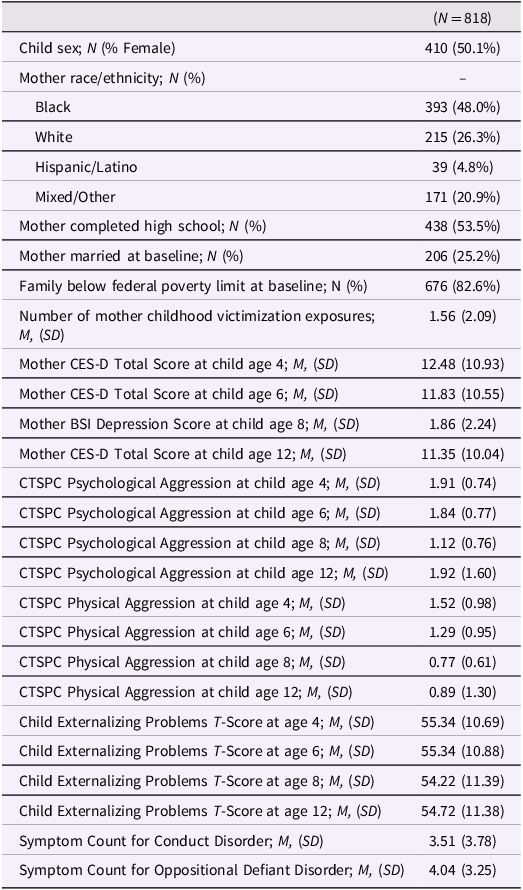
Participants for the present study were (N = 818) biological mother-child dyads who participated in LONGSCAN and provided data at least one study visit between child ages 4 and 14 years. The sample was limited to biological mother-child dyads because only biological mothers were administered the Mother’s History of Loss and Harm questionnaire (see below). Mothers in the sample identified primarily as Black (48%), followed by White (26.3%), multiracial/”other” (20.9%), and Hispanic/Latino (4.8%). Nearly one-half (46.5%) did not have high school diploma and the majority (82.6%) reported incomes that fell below the federal poverty limit at study baseline.
Measures
Family demographics
Mothers’ age, high school completion status, race/ethnicity, and child sex were assessed at the child age 4 interview. Mothers’ marital status (1 = married, 0 = not married), family income, and number of household dependents were assessed at the age 4, 6, 8, and 12 interviews. Annual income and number of dependents were compared to the federal poverty guidelines during the years the data were collected to determine if family annual incomes fell below the poverty line.
Maternal childhood victimization
During the child’s age 4 interviews, maternal childhood history of physical and sexual victimization was assessed using the LONGSCAN-developed Mother’s History of Loss and Harm questionnaire (Hunter & Everson, Reference Hunter and Everson1991). Items were designed based on the methodology of Wyatt and Peters (Reference Wyatt and Peters1986) to assess the experience of specific acts without describing the acts as “abusive” and conforming to the behaviorally based definitions of physical and sexual abuse. Maternal childhood physical victimization was measured using two items in which respondents were specifically asked to exclude spanking by hand (e.g., “When you were a child or teenager, were you ever physically hurt by a parent or someone else…like hit, slapped, beaten, shaken, burned, or anything like that?”). Maternal childhood sexual victimization was measured using six items and defined perpetrators as being at least three years older than the victim (e.g. “Before the age of 13, did anyone older than you ever try to or succeed in touching your breasts or genitals?”). Responses were treated dichotomously (1= ‘yes’, 0= ‘no’) based on whether the participant had any experience of victimization prior to age 18, and a summed total of endorsed items was created. Psychometric data on this measure are not available; however, it demonstrated good reliability in the current sample (α = .82) and has been used by many previous studies to assess caregivers’ history of physical and sexual victimization (Claridge et al., Reference Claridge, Wojciak, Lettenberger-Klein, Pettigrew, McWey and Chaviano2015; Gilbert et al., Reference Gilbert, El-Bassel, Schilling and Friedman1997; Hunter et al., Reference Hunter, Voorhorst, Runyan and Everson1994; Morelli et al., Reference Morelli, Duong, Evans, Hong, Garcia, Ogbonnaya and Villodas2021; Wamser-Nanney & Campbell, Reference Wamser-Nanney and Campbell2022).
Maternal depressive symptoms
Maternal depressive symptoms were self-reported using 20-item Center for Epidemiologic Studies Depression Scale (CES-D; Radloff, Reference Radloff1977) at the age 4, 6, and 12 interview; at the age 8 interview, caregivers completed the Brief Symptom Inventory (BSI; Derogatis, Reference Derogatis1993). The CES-D measures the presence of past-week depressive symptoms on a 4-point scale ranging from 0 (rarely or none of the time) to 3 (most or all of the time). Summed scores indicate overall severity of depressive symptoms. The CES-D demonstrated excellent reliability in the present sample (αs > .90), and previous studies have supported its validity (Radloff, Reference Radloff1977). The BSI is a 53-item measure with nine symptom scales, including a depression scale. Items from this scale assess caregiver’s experiences of depressive symptoms (e.g., “have you felt lonely?”, “have you lost interest in things”) using the same past-week time frame as the CES-D. Differences between the CES-D and the BSI depression subscale include their length (20 items vs. 6 items, respectively) and the scaling (5-point scale vs. 4-point scale, respectively). The BSI demonstrated good reliability in the current sample (α = .81). Both scales measure the same underlying construct and have significant overlap regarding item content; both have been validated in low-income, racially/ethnically diverse populations (Henry et al., Reference Henry, Grant and Cropsey2018; Prelow et al., Reference Prelow, Weaver, Swenson and Bowman2005). Raw scores from the CES-D and the BSI were converted to z-scores to provide a standardized measure of maternal depression across time points.
Mothers’ harsh parenting
The current study used the Conflict Tactics Scale: Parent to Child (CTSPC; Straus, Hamby, Finkelhor, Moore, & Runyan et al., Reference Runyan, Curtis, Hunter, Black, Kotch, Bangdiwala, Dubowitz, English, Everson and Landsverk1998) to assess mothers’ use of harsh parenting practices within the past 12 months at children’s ages 4, 6, 8, and 12 years. The CTSPC consists of three subscales: Nonviolent Discipline (3 items), Psychological Aggression (7 items), and Physical Assault (6 items), which is subdivided into “minor,” “severe,” and “very severe” assault. The present study used items from the Psychological Aggression and Physical Assault subscales. In consultation with the scale developers, LONGSCAN investigators adapted the scale so that items were measured dichotomously (0 = did not occur, 1 = occurred at least once) to represent their prevalence before being summed into their respective scales, as recommended by Straus and Hamby (Reference Straus and Hamby1997). Although these scales have demonstrated good validity, due to the relatively low frequency of each behavior, they tend to show weak evidence of internal consistency (.62 for psychological aggression and .42 for minor physical assault; Straus et al., Reference Straus, Hamby, Finkelhor, Moore and Runyan1998). Importantly, the LONGSCAN study used an adapted version of the CTSPC at the age 4 and 6 interviews that omitted severe and very severe assault items (e.g., hit with closed fist, choked, threatened with knife/gun, beat up) due to concerns about CPS reporting. Additionally, item wording differed slightly across interview periods (e.g., “shouted, yelled, or screamed at him/her” at age 8 vs. “yelled or screamed at him/her” at age 12). To account for these discrepancies, we only included CTSPC items that were nearly identical in wording and meaning across all time points and created latent variables representing the degree of “harsh parenting” at a given time point rather than an exact count of the number of harsh parenting acts. The final latent variables were comprised of two count scores: psychological aggression (sum of three items) and physical aggression (sum of four items). The three psychological aggression items were: (1) [yell/scream/shout], (2) [insult/swear/curse/call names], and (3) threaten to [spank/hit/throw something]. The four physical aggression items were: (1) shake, (2) [push/grab/shove], (3) [spank/hit on bottom with object] and (4) slap [on hand, arm, leg, face, head, or ears]. Because blatantly abusive parenting practices were omitted at the age 4 and 6 time points, these items were not included at any time point; the resultant latent variables represented harsh – but not abusive – parenting. As expected, internal consistency for these items in the current sample was weak (psychological aggression αs = .48 – .61; physical aggression αs = .43 – .64) due to the relatively low frequency of each behavior.
Child externalizing problems
Mothers reported on their children’s dimensional behavior problems using the Child Behavior Checklist (Achenbach & Rescorla, Reference Achenbach and Rescorla2001) at the age 4, 6, 8, and 12 interviews. The CBCL is a widely used, 113-item measure that assesses the frequency (0 = not true, 1 = sometimes true, 2 = often true) of various child behaviors during the previous six months, with greater scores indicating more severe symptoms. The current study used children’s scores from the Externalizing Problems subscale as a primary outcome. This scale is comprised of two syndrome scales, Aggressive Behavior and Delinquent Behavior (20 and 13 items, respectively). Children’s internalizing problems were also assessed via the CBCL at study baseline (i.e., age 4 years) to be used as a covariate. The CBCL has well-established psychometric properties, with strong reliability and validity (Achenbach et al., Reference Achenbach, Dumenci and Rescorla2003). In the current sample, internal consistency for the Externalizing Problems scale ranged from acceptable to excellent (αs = .72 – .93) across time points.
Child disruptive behavior disorder problems
Children’s disruptive behavior problems were assessed using the NIMH Diagnostic Interview Schedule for Children Version IV (DISC-IV; Shaffer et al., Reference Shaffer, Fisher, Lucas, Dulcan and Schwab-Stone2000), administered to both mothers and children at the age 14 interview. The DISC-IV is a well-validated and reliable structured clinical interview designed to assess child and adolescent DSM-IV psychiatric disorders (Derks et al., Reference Derks, Hudziak, Dolan, Ferdinand and Boomsma2006; Shaffer et al., Reference Shaffer, Fisher, Dulcan, Davies, Piacentini, Schwab-Stone, Lahey, Bourdon, Jensen, Bird, Canino and Regier1996, Reference Shaffer, Fisher, Lucas, Dulcan and Schwab-Stone2000). The interview contains a series of initial broad stem questions which, if endorsed, are followed up with contingent questions, which are used to determine if the child’s symptoms meet diagnostic criteria. Trained interviewers administered the DISC-IV to both caregivers and children using laptop computers, including modules for two modules for Conduct Disorder (CD) and Oppositional Defiant Disorder (ODD). Symptoms for each disorder were tabulated using a sensitivity approach, such that symptoms were counted if endorsed by either caregivers or children. A final count variable was created to represent total caregiver- or child-reported disruptive behavior problems at child age 14, which represented the total combined number of children’s CD and ODD symptoms.
Data analysis
Sample descriptive statistics, missing data patterns, and path analyses were calculated using a structural equation modeling (SEM) framework in Mplus version 8.1.5 (Muthén & Muthén, Reference Muthén and Muthén2017). Bivariate correlations among all variables were computed to identify covariates and confirm hypothesized relationships specified in the path model. Two structural equation models — a CLPM and a RI-CLPM — were used to analyze temporal directional associations between mothers’ depressive symptoms and harsh parenting, and children’s externalizing problems across children’s age 4, 6, 8, and 12. Maternal childhood victimization, assessed at child age 4, was included as the primary predictor variable in both models; in the CLPM, maternal childhood victimization was included as a predictor of baseline levels of depressive symptoms, harsh parenting, and children’s externalizing problems; in the RI-CLPM, maternal childhood victimization, which is time-invariant, predicted trait levels of depressive symptoms, harsh parenting, and children’s externalizing problems. In both models, children’s disruptive behavior problems (i.e., a sum of CD and ODD symptoms) at age 14 was included as a final, distal outcome, predicted by mothers’ depressive symptoms, harsh parenting, and children’s externalizing problems at child age 12. Because maternal depression was assessed using a different scale at the age 8 interview (i.e., BSI Depression subscale) than at all other time points (i.e., CES-D), all depression scores were standardized using z-scores prior to inclusion in the models. This conversion was performed in SPSS, which forms z-scores by subtracting the mean from each score and dividing by the standard deviation.
Mplus provides several indicators of overall model fit, including 1) the Comparative Fit Index (CFI; Bentler, Reference Bentler1990); 2) the Tucker-Lewis Index (TLI; Tucker & Lewis, Reference Tucker and Lewis1973); and 3) Root Mean Square Error of Approximation (RMSEA; Steiger, Reference Steiger1990). Based on recommendations (Hu & Bentler, Reference Hu and Bentler1999), values greater than .95 and .90 were used to indicate excellent and acceptable model fit, respectively, for both the CFI and TLI, and values less than .05 were used to indicate acceptable fit for the RMSEA. The fit of individual paths were determined based on their statistical significance. Mediation paths were identified by calculating indirect effects based on the product of the unstandardized path coefficients between the predictor and mediator variables (path a) and the mediator and outcome variables (path b; MacKinnon et al., Reference MacKinnon, Lockwood, Hoffman, West and Sheets2002). The significance of indirect effects were determined using bias-corrected 95% confidence intervals (CIs) based on 1000 bootstrapped samples (Preacher & Hayes, Reference Preacher and Hayes2008). SEM analyses controlled for mothers’ marital status, education level, poverty status, and race/ethnicity, as well as child’s sex and internalizing problems at study baseline (i.e., age 4). Given the potential for marital and poverty status to change over the duration of the study, these variables were included as time-varying covariates at the child age 4, 6, 8, and 12 time points.
Given the complexity of both models, and to maximize model parsimony, all cross-lagged and autoregressive paths were initially constrained to equivalence across time points, as has been recommended previously (Grimm et al., Reference Grimm, Helm, Rodgers and O’Rourke2021). Path constraints were iteratively removed one by one, guided by model modification indices (i.e., Lagrange Multiplier test) and the χ2 difference (Δχ2) test, to determine whether freeing each path resulted in significantly better model fit. Parameter constraints were iteratively removed until the revised model fit did not significantly differ from the previous (more constrained) model (i.e., Δχ2 p > .05). See supplemental material (Figure S1) for conceptual models depicting both hypothesized models.
Results
Missing data
Caregiver-child dyads were included if caregivers (1) identified as biological mothers at study baseline and (2) were interviewed during at least one time point across the child age 4, 6, 8, 12, and 14 interviews. Of the 1,354 original LONGSCAN participants, 819 had caregivers who identified as biological mothers at study baseline. Only one caregiver was not interviewed during any of the included time points, yielding a final sample size of 818. Of these participants, 420 (51.3%) were present for all five interviews, 192 (23.5%) missed one interview, 115 (14.1%) missed two interviews 58 (7.1%) missed three interviews, and 33 (4.0%) missed four interviews. To assess the nature of missing data, Little’s MCAR test was conducted. Results indicated that the data were not missing completely at random (χ2 = 5311.66, df = 5,001, p = .001). Those with missing data did not differ from those with complete data on any of the covariates, including child sex, χ2(1) = 0.85 p > .05, child race/ethnicity, χ2(6) = 7.50 p > .05, caregiver race/ethnicity, χ2(6) = 12.05 p > .05, caregiver marital status at any time point, χ2(1) = 0.02 – 1.05, ps > .05, household poverty status at any time point, χ2(1) = 0.31 – 0.78, ps > .05, caregiver high school graduation status, χ2(1) = 0.09 p > .05, or child internalizing problems at age 4 years, t 827 = 0.24, p > .05. Those with missing data also did not differ from those with complete data on any primary predictor or outcome variable of interest, including number of maternal childhood victimization exposures, t 702 = 0.74, p > .05, caregiver depressive symptoms at any time point, t 557-794 = 0.02 – 1.37, ps > .05, caregiver psychological or physical aggression score at any time point, t 560-710 = 0.12 – 1.42, ps > .05, child externalizing problems at any time point, t 600-827 = 0.30 – 1.84, ps > .05, or disruptive behavior problems at age 14, t 727 = 1.34, p > .05. Whether or not children were recruited due to the presence of a maltreatment report prior to age 4 (see “Sensitivity Analyses” further below) was not related to missingness, χ2(1) = 0.06 p > .05. As a result, these data meet the definition of Missing at Random (Enders, Reference Enders2010). Missing data were handled using Full Information Maximum Likelihood, which allows for unbiased estimation under the assumption that data are missing at random (Enders, Reference Enders2010).
Bivariate associations and descriptive statistics
Descriptive statistics are presented in Table 1. Bivariate correlations between all study variables are presented in the supplementary material (Table S1). Primary variables of interest were generally significantly and modestly-to-moderately associated with one another, with the exception of maternal childhood victimization with baseline physical aggression (r = .03, p > .05). Additionally, children’s age 14 disruptive behavior problems, which was significantly correlated with children’s baseline child externalizing problems (r = .20, p < .01) was not correlated with caregiver depression, physical aggression, or psychological aggression at baseline. Skewness and kurtosis were within the acceptable range for all study variables (<|3| for skewness, <|10| for kurtosis (Kline, Reference Kline2023). No values were greater than two standard deviations above the mean. Approximately one-half (50.6%) of the mothers in the sample reported a history of victimization as children. Children’s externalizing problems in the present sample were slightly elevated compared to normative samples (i.e., T-scores >54 across time points). Similarly, children had an average of 3.51 CD symptoms and 4.04 ODD symptoms at age 14, which is elevated relative to general population samples (Munkvold et al., Reference Munkvold, Lundervold and Manger2011; Murray & Farrington, Reference Murray and Farrington2010).
Sociodemographic information and descriptive statistics

Note. CES-D = Center for Epidemiologic Studies Depression Scale; BSI = Brief Symptom Inventory; CTSPC = Conflict Tactics Scale: Parent to Child.
Structural equation model for the traditional CLPM
The SEM for the initial CLPM, which constrained cross-lagged and auto-regressive paths to equivalence across time points, demonstrated poorer-than-acceptable model fit, χ2 338 = 838.36, p < .001, CFI = 0.93, TLI = 0.91, RMSEA = 0.043, 90% CI [0.04, 0.05]. Guided by modification indices, parameter constraints were iteratively removed until the revised model fit did not significantly differ from the previous (more constrained) model (i.e., Δχ2 p > .05). First, constraints involving covariates were removed (e.g., autoregressive covariate paths constrained to equivalence across times points). Then, constraints involving primary panel variables were removed. In total, three path constraints involving primary panel variables were removed, all of which were autoregressive: (1) the path from age 8 to age 12 harsh parenting, suggesting this path was weaker (but still significant) compared to previous harsh parenting autoregressive paths; (2) the path from age 8 to age 12 maternal depression, suggesting this path was weaker (but still significant) compared to previous depression autoregressive paths; and (3) the path from age 6 to age 8 externalizing problems, suggesting this path was stronger compared to other externalizing autoregressive paths. Removing further constraints did not lead to significantly better model fit, Δχ2 = 3.24, p = .07. At this point, the overall SEM for the revised CLPM fit the data adequately, χ2 272 = 592.24, p < .001, CFI = 0.95, TLI = 0.92, RMSEA = 0.038, 90% CI [0.03, 0.04]. Figure 1 displays all path coefficients and their significance for the traditional CLPM. As described above, harsh parenting at each time point was represented by a latent variable, each comprised of two indicators, psychological aggression and physical aggression. Although fit of the measurement models with only two indicators could not be determined because the model was not identified, their fit was considered in the overall model fit of the SEM. Standardized factor loadings for the harsh parenting latent variables were large and statistically significant at all time points, both for psychological aggression (λs = 0.63 – 0.76, ps < .001) and physical aggression (λs = 0.69 – 0.77, ps < .001).
Significant path coefficients in the traditional cross-lagged panel model. Note. Dep. = depression; par. = parenting; Ext. = externalizing; int. = internalizing; DBP = disruptive behavior problems; symp. = symptom.

Structural equation model for the RI-CLPM
Intraclass correlations
To determine the proportion of variance explained by between- vs. within-person differences, intraclass correlations were calculated for each panel variable: maternal depression, harsh parenting, and child externalizing problems. Random-intercept auto-regressive models were fit for each variable separately and the ICC was computed by dividing the variance of the intercept by the random intercept variance plus the residual variance at time point 1 (i.e., child age 4; K. Grimm, personal communication, April 10th, 2024). Thus, the ICC represents the correlation between the variance of the intercept and the total variance (i.e., the variance of the intercept plus the residual variance). The ICC for maternal depression was 0.32, indicating that 32% of the variance in maternal depression can be attributable to between-person (i.e., trait-like) differences, leaving 68% of the variance attributable to within-person (i.e., state) differences across time. The ICC for harsh parenting was 0.61, leaving 39% of the variance attributable to within-person differences across time. The ICC for child externalizing problems was 0.51, leaving 49% of the variance attributable to within-person differences across time. This indicates that the RI-CLPM is a suitable approach to parse out within- and between-person sources of variance.
Overall model fit
The SEM for the initial RI-CLPM, which constrained cross-lagged and auto-regressive paths to equivalence across time points, demonstrated poorer-than-acceptable model fit, χ2 340 = 800.75, p < .001, CFI = 0.93, TLI = 0.91, RMSEA = 0.041, 90% CI [0.037, 0.044]. Guided by modification indices, parameter constraints were iteratively removed until the revised model fit did not significantly differ from the previous (more constrained) model (i.e., Δχ2 p > .05). First, constraints involving covariates were removed (e.g., autoregressive covariate paths constrained to equivalence across times points). Following this step, modification indices did not suggest the removal of further path constrains. At this point, the overall SEM for the revised RI-CLPM fit the data adequately, χ2 322 = 654.60, p < .001, CFI = 0.95, TLI = 0.93, RMSEA = 0.036, 90% CI [0.032, 0.039]. Figure 2 displays all path coefficients and their significance for the RI-CLPM.
Significant path coefficients in the random intercept cross-lagged panel model. Note. Subscript “i” denotes a random intercept; blue shading indicates between-person components; pink shading indicates within-person components. Dep. = depression; par. = parenting; Ext. = externalizing; int. = internalizing; DBP = disruptive behavior problems; symp. = symptom.

Results for Hypothesis #1: Maternal childhood victimization would be associated with baseline (i.e., child age 4) and trait levels of their depressive symptoms, harsh parenting, and their children’s externalizing problems
Consistent with hypothesis #1, more victimization in mothers’ childhoods was significantly and positively associated with all three panel variables in the CLPM at baseline (i.e., child age 4): depressive symptoms, β = 0.29, p < .001, 95% CI [0.21, 0.38], harsh parenting, β = 0.17, p < .001, 95% CI [0.08, 0.24], and child externalizing problems, β = 0.29, p < .001, 95% CI [0.21, 0.36]. Additionally, maternal childhood victimization was associated with the random intercepts (i.e., trait-like levels) of all three panel variables in the RI-CLPM: depressive symptoms, β = 0.29, p < .001, 95% CI [0.16, 0.42] harsh parenting, β = 0.12, p = .02, 95% CI [0.02, 0.22] and child externalizing problems, β = 0.27, p < .001, 95% CI [0.17, 0.37].
Results for hypothesis #2: a cascading, serial mediation process would be identified from maternal childhood victimization to increased maternal depressive symptoms at child age 4, leading to increased harsh parenting at child age 6, leading to increased child externalizing problems at age 8
As mentioned above, more victimization in mothers’ childhoods was associated with increased depressive symptoms in adulthood in both models. However, whereas the RI-CLPM supported the hypothesized path from higher-than-expected maternal depressive symptoms to higher-than-expected harsh parenting (β = 0.07 p = .04, 95% CI [0.003, 0.15]), the traditional CLPM supported the opposite result, suggesting that more depressive symptoms at child age 4 were associated with decreased harsh parenting at child age 6 (β = −0.08 p = .001, 95% CI [−0.14, −0.03]−0.14, −0.03]). The final path in our hypothesized cascading process (i.e., harsh parenting at child age 6 to increased child age 8 externalizing problems) was significant and positive in the traditional CLPM (β = 0.08 p = .001, 95% CI [0.03, 0.13]), but nonsignificant in the RI-CLPM (β = 0.01 p = .71, 95% CI [−0.06, 0.09]−0.06, 0.09]). No significant indirect paths were identified in either model, indicating that the proposed serial mediation process was not present.
Results for hypothesis #3: caregivers’ depressive symptoms, harsh parenting, and children’s externalizing problems would be associated with increases in levels of one another across child ages 4, 6, 8, and 12, as evidenced by significant and positive cross-lagged associations
Several concurrent and cross-lagged paths were identified in both the traditional CLPM and the RI-CLPM. First, in the traditional CLPM, all three panel variables were significantly and positively associated with one another at concurrent time points. Likewise, in the RI-CLPM, the residuals of all three panel variables (i.e., the within-person components) were significantly and positively associated with one another at concurrent time points. Second, in both models we observed the presence of significant and positive cross-lagged associations between maternal depression and child externalizing problems, which continued reciprocally across time points (βs = 0.05 – 0.14 ps < .04, 95% CIs [0.01, 0.21]). The same bidirectional pattern emerged for the within-person components of maternal depression and harsh parenting in the RI-CLPM (βs = 0.11 – 0.13, ps = .01, 95% CIs [0.001, 0.23]). Finally, and in contrast with our hypotheses, neither model supported a directional association from child externalizing problems to subsequent increases in harsh parenting.
Findings were also notable for several discrepancies between the traditional CLPM and the RI-CLPM. As noted above, whereas the RI-CLPM supported the hypothesized positive association between maternal depression and subsequent harsh parenting across timepoints (βs = 0.07 – 0.08, ps < .05, 95% CIs [0.001, 0.19]), the CLPM suggested a negative association (βs = −0.08 ps = .001, 95% CIs [−0.14, −0.03]−0.14, −0.03]). Also noted above, the traditional CLPM supported our hypothesized path from harsh parenting to increased child externalizing problems across time points (βs = 0.08 – 0.09, ps = .001, 95% CIs [0.03, 0.14]), whereas the RI-CLPM did not (βs = 0.01, ps = .71, 95% CIs [−0.06, 0.09]−0.06, 0.09]). Of note, the random intercepts (i.e., between-person components) for harsh parenting and child externalizing problems were significantly and positively associated with one another in the RI-CLPM (r = 0.37, p < .001, 95% CI [0.23, 0.52]).
Results for hypothesis #4: caregivers’ depressive symptoms, harsh parenting, and children’s externalizing problems at age 12 (and their trait-like components) would be associated with more DSM-5 disruptive behavior problems at age 14 years
In both models, age 12 child externalizing problems were significantly and positively associated with age 14 disruptive behavior problems (βs = 0.39 – 0.54, ps < .001, 95% CIs [0.28, 0.63]). In the RI-CLPM, the random intercept for child externalizing problems was significantly and positively associated with age 14 disruptive behavior problems (β = 0.38, p < .001, 95% CI [0.26, 0.50]). Contrary to our expectations, all other age 12 panel variables and random intercepts were not associated with age 14 disruptive behavior problems. We also did not observe any hypothesized indirect pathways whereby maternal childhood victimization led to increases in their children’s disruptive behavior problems through trait-levels of maternal depression, harsh parenting, or child externalizing problems.
Sensitivity analyses
Participants were recruited for LONGSCAN for several reasons, which often varied systematically across sites. Some children were recruited due to the presence of an official maltreatment report at or before age 4 years (i.e., Northwest, Midwest, and Southwest sites). Other children did not have a maltreatment report at the time of study recruitment but were nonetheless considered “high-risk” based on other sociodemographic information (i.e., South and East sites). In light of the potential for maltreatment to increase risk for externalizing problems (Baldwin et al., Reference Baldwin, Wang, Karwatowska, Schoeler, Tsaligopoulou, Munafò and Pingault2023), we conducted sensitivity analyses to determine whether the SEM models changed notably when controlling for (1) pre-recruitment maltreatment, defined dichotomously (1 = presence of a maltreatment report prior to age 4; 0 = no official maltreatment report prior to age 4); and (2) maltreatment prior to each time point (1 = presence of a maltreatment allegation or substantiation; 0 = no maltreatment allegation or substantiation).
Pre-recruitment maltreatment and maltreatment over the course of the study were associated with several variables of interest. However, only one path from one of the original models (RI-CLPM) changed in significance. Specifically, the path from the random intercept for harsh parenting to age 14 disruptive behavior problems changed from nonsignificant to significant, β = 0.27, p = .02. In the RI-CLPM, pre-recruitment maltreatment was associated with more maternal childhood victimization, β = 0.34, p < .001, lower trait levels of harsh parenting, β = −0.17, p = .001, higher trait levels of child externalizing problems, β = 0.23, p < .001 and more age 14 disruptive behavior problems, β = 0.16, p < .001. Maltreatment prior to each time point was associated with increases in child externalizing problems, βs = 0.06 – 0.07, ps < .001, and decreases in harsh parenting, βs = −0.06 – −0.09, ps < .01. In the traditional CLPM, pre-recruitment maltreatment was associated with less harsh parenting at child age 4, β = −0.20, p < .001, more maternal depression at child age 8, β = 0.09, p = .02, and more child externalizing problems at age 4 and 6, βs = 0.07 −0.10, ps < .02. Maltreatment prior to each time point was associated with increases in maternal depression at age 4, β = 0.19, p < .001, and increases in child externalizing problems at all time points, βs = 0.08 −0.11, ps < .05.
Discussion
The mechanisms underlying the intergenerational impact of child maltreatment are complex. The present study examined a process by which mothers’ early experiences of physical and sexual victimization increase their risk for depressive symptoms and harsh parenting tactics in adulthood, resulting in increased behavior problems among their children. Unique to this study was a focus on reciprocal parent-child interactions, where children were active participants in shaping their family environment. The hypothesized cascading, bidirectional, and reciprocal parent-child pathways were partially supported, particularly when between-person (i.e., trait-like) differences were accounted for. This work has crucial implications for breaking negative cycles of childhood adversity and maladaptive behavior patterns, both across generations and in the context of parent-child interactions during the transition from childhood to adolescence.
Maternal childhood victimization and its association with depression, harsh parenting, and their children’s externalizing problems
Consistent with hypothesis #1, more physical and sexual victimization in childhood was associated with increases in mothers’ depression and harsh parenting in adulthood, as well as more externalizing problems among their children, controlling for mothers’ education level, poverty, marital status, and child internalizing problems. This was observed in the traditional CLPM, where maternal childhood victimization was associated with all three baseline panel variables, and in the RI-CLPM, where maternal childhood victimization was associated with the stable, trait-like components for all three panel variables. This latter finding supports a large body of theory and research suggesting that, for many, the mental and behavioral health consequences of childhood adversity are long-lasting and can become entrenched in adulthood as trait-like characteristics (Russotti, Warmingham, Duprey, et al., 2021). It is crucial that victims of child abuse receive treatment early, ideally before significant mental health symptoms develop (Qi et al., Reference Qi, Gevonden and Shalev2016). While several trauma-informed psychosocial treatments are available, trauma-focused cognitive behavioral therapy (TF-CBT) has emerged as a particularly effective treatment following complex trauma exposure (Morelli et al., Reference Morelli, Straub, Hong, Nguyen, Tabibian and Villodas2025).
Cascading, serial mediation process from maternal childhood victimization to children’s externalizing problems
A major tenet within the developmental psychopathology framework is the potential for cascading sequences of effects, whereby early developmental challenges or disruptions can lead to a series of progressively more complex or severe problems over time, affecting multiple domains of functioning (Cicchetti, Reference Cicchetti2016). Prior research has suggested a potential long-term, intergenerational process in which childhood victimization leads to more depressive symptoms in adulthood, increasing parents’ vulnerability for using harsh discipline tactics, ultimately resulting in more externalizing problems among their children (Nelson et al., Reference Nelson, Klumparendt, Doebler and Ehring2017; Pinquart, Reference Pinquart2017; Rueger et al., Reference Rueger, Katz, Risser and Lovejoy2011). In the present study, this hypothesized intergeneration serial mediation process was only partially supported. More victimization in mothers’ childhoods was indeed associated with more depressive symptoms in adulthood across both models. However, maternal depressive symptoms were associated with more harsh parenting at subsequent time points only in RI-CLPM (not the CLPM), and harsh parenting was associated with more subsequent child externalizing problems only in the CLPM (not the RI-CLPM).
Despite these inconsistent findings, several aspects of the present study still highlight mental health and parenting as key mechanisms in the intergenerational impact of childhood adversity. As stated above, maternal childhood victimization was associated with all three panel variables, both at study baseline and with their trait-like components across the study period. Moreover, all three panel variables were associated with one another at concurrent time points, even after accounting for their between-person, trait-like components via the RI-CLPM. This latter finding suggests that when mothers were experiencing levels of depression that were elevated relative to their long-term average, they were also using harsher-than-typical parenting tactics, and their children were experiencing higher-than-typical levels of externalizing problems. Previous RI-CLPMs almost always identify similar concurrent, within-person associations (e.g., between maladaptive parenting and child behavior problems; spanking and child externalizing problems; Kullberg et al., Reference Kullberg, Van Schie, Allegrini, Ahmadzadeh, Wechsler, Elzinga and McAdams2023; Pritsker, Reference Pritsker2021; Zhang et al., Reference Zhang, Lee, Piehler, Gewirtz and August2020). Other methodological approaches that focus on more immediate family dynamics (e.g., ecological momentary assessment) have documented that increases in parents’ depression or harsh parenting are often followed by proximate increases in child behavior problems (Byrd et al., Reference Byrd, Vine, Frigoletto, Vanwoerden and Stepp2021; Li & Lansford, Reference Li and Lansford2018) It is possible that the path from harsh parenting to child behavior problems is better understood on a smaller timescale (e.g., week-to-week or day-to-day), with effects waning as follow-up time increases. In the present study, even when longitudinal paths were supported, effect sizes were often small (e.g., βs = 0.07 – 0.09) relative to concurrent associations (e.g., βs = 0.16 – 0.41).
The consistent associations among maternal depression, harsh parenting, and child externalizing problems have important clinical implications. First and foremost, child-focused interventions that do not include parent training are unlikely to be sufficient for breaking long-term patterns of externalizing problems (Kaminski & Claussen, Reference Kaminski and Claussen2017). Despite the availability of several evidence-based, front-line interventions that incorporate caregivers (e.g., Parent Management Training [PMT], Child-Parent Psychotherapy [CPP], Modular Approach to Therapy for Children [MATCH] — Conduct Disorder Protocol; Kazdin, Reference Kazdin2005; Lieberman et al., Reference Lieberman, Van Horn and Ippen2005; Weisz et al., Reference Weisz, Chorpita, Palinkas, Schoenwald, Miranda, Bearman, Daleiden, Ugueto, Ho and Martin2012), in practice, many clinicians continue to implement individually-focused interventions with children (e.g., psychoanalysis) to address disruptive behavior problems (Beidas et al., Reference Beidas, Marcus, Aarons, Hoagwood, Schoenwald, Evans, Hurford, Hadley, Barg, Walsh, Adams and Mandell2015). Interventions should not only incorporate both caregivers and children in treatment, but should explicitly address caregiver mental health and parenting behaviors as co-occurring, mutually reinforcing targets of treatment. For example, in treatments like CPP or MATCH, these findings support the integration of modules focused on parental emotion regulation, trauma processing, and parenting self-efficacy, particularly for caregivers with histories of victimization. Tailoring interventions to directly address the interplay between caregiver distress and harsh parenting, rather than viewing them as separate treatment foci, may improve treatment durability and outcomes across generations. In this way, our findings inform the focus of trauma-informed modalities by highlighting the importance of dynamic, transactional processes between caregivers and children, suggesting that interventions may be most effective when they move beyond a trauma history lens to also address ongoing caregiver-child interactions as mechanisms of risk and resilience.
Cross-lagged, bidirectional, and reciprocal associations among maternal depression, harsh parenting, and child externalizing problems
A major focus of the present study was the potential for evocative and bidirectional parent-child effects, an equally important concept within the developmental psychopathology framework (Cicchetti, Reference Cicchetti2016; Masten & Cicchetti, Reference Masten and Cicchetti2010). Evidence for such a process is extensive (Paschall & Mastergeorge, Reference Paschall and Mastergeorge2016), however, fewer studies have attempted to isolate within-person bidirectional effects using the current panel variables in a single, comprehensive model. Consistent across both models was the emergence of cross-lagged, bidirectional associations between maternal depression and child externalizing problems across time points. The directional association from maternal depression to child externalizing problems has been documented extensively (Sutherland et al., Reference Sutherland, Nestor, Pine and Garber2022). Depressed mothers tend to develop less secure parent-child attachments, use fewer and less effective behavior management practices, and provide fewer opportunities for peer socialization compared to non-depressed mothers (Loheide-Niesmann et al., Reference Loheide-Niesmann, Riem and Cima2022). Confounding environmental variables (e.g., poverty, violence exposure) and heritability factors (e.g., conferred genetic risk for general psychopathology) also play a role (Loheide-Niesmann et al., Reference Loheide-Niesmann, Riem and Cima2022).
The reverse process – children’s externalizing problems leading to increased maternal depressive symptoms – has been explored less often; however, existing research has shed light on possible mechanisms. Parents of children with behavioral challenges experience significant day-to-day stress (Kochanova et al., Reference Kochanova, Pittman and Pabis2021; Neece et al., Reference Neece, Green and Baker2012), a strong predictor of depression. Parenting disruptive children has also been shown to decrease parenting self-efficacy (Farmer & Lee, Reference Farmer and Lee2011). Given the context of the present study (i.e., high rates of child maltreatment and loss of custody), mothers’ may have been particularly vulnerable to guilt, loss of confidence, and other negative emotions and cognitions that can emerge in response to child behavior problems. Complicating this picture is the finding that mothers’ harsh parenting was associated with increases in later depressive symptoms, and vice versa, again implicating shame and poor parenting self-efficacy as factors that might maintain long-term cycles of harsh parenting. Interventions that are able to target caregiver mental health, parenting, and child behavior problems simultaneously may be more effective compared to more traditional parent management interventions, particularly when caregivers have significant histories of abuse (Dedousis-Wallace et al., Reference Dedousis-Wallace, Drysdale, McAloon and Ollendick2021).
Several of the hypothesized bidirectional paths did not emerge, or emerged in one model but not the other. One intriguing finding concerned the directional path from maternal depression to harsher parenting at subsequent time points; this path was significant and positive in the RI-CLPM (as hypothesized), but significant and negative in the CLPM. A large body of longitudinal evidence suggests a positive association between maternal depression and harsh parenting (Goodman et al., Reference Goodman, Simon, Shamblaw and Kim2020), making it likely that this finding is the result of the traditional CLPM’s mixture of between- and within-person variance. Hamaker et al. (Reference Hamaker, Kuiper and Grasman2015), in their widely-cited critique of the traditional CLPM, demonstrated this phenomenon using simulated data. Because the traditional CLPM fails to properly separate between-subject differences from within-subject ones, it runs the risk confounding the within-subject relations of interest with between-subject ones, resulting in potentially spurious lagged associations, including associations that differ in sign. Although it is difficult to predict exactly when this will happen, Hamaker et al. (Reference Hamaker, Kuiper and Grasman2015) warned that panel variables with strong trait-like components (e.g., depression) are likely to have a greater distorting effects. It is likely, therefore, that the results regarding maternal depression and harsh parenting are more accurate in the RI-CLPM.
Other inconsistencies and null findings emerged as well. The hypothesized bidirectional association between harsh parenting and child externalizing problems did not emerge, despite substantial support in prior longitudinal studies (for review, see Yan et al., Reference Yan, Ansari and Peng2021). Most of this previous work did not attempt to parse out the between-person, trait-like associations between harsh parenting and child externalizing problems. The present study exemplified the importance of doing so. Caregivers’ interactions with their children, as well as their own mental health, are influenced by myriad factors. An individual caregiver might employ harsher discipline strategies than what is typical for them at certain times because they are temporarily experiencing more stress, more difficulty with their children, or worsening depressive symptoms (Gershoff et al., Reference Gershoff, Lansford, Sexton, Davis-Kean and Sameroff2012; MacKenzie et al., Reference MacKenzie, Nicklas, Brooks-Gunn and Waldfogel2015; Rueger et al., Reference Rueger, Katz, Risser and Lovejoy2011; Serbin et al., Reference Serbin, Kingdon, Ruttle and Stack2015). These temporary fluctuations represent their within-person variance. Simultaneously, some caregivers have a harsher approach to parenting than other caregivers in general, over and above their temporal fluctuations. This variance between caregivers represents the trait-like component to harsh parenting, and may be influenced by their early environment (e.g., exposure to victimization in childhood Morrel and colleagues; Collishaw et al., Reference Collishaw, Dunn, O’Connor and Golding2007; Morrel et al., Reference Morrel, Dubowitz, Kerr and Black2003), or by genetic factors (e.g., predisposition toward emotion dysregulation and impulsivity; Hajal et al., Reference Hajal, Neiderhiser, Moore, Leve, Shaw, Harold, Scaramella, Ganiban and Reiss2015). The same is true for children’s behavior problems, which can fluctuate from time to time within an individual child and vary in severity between children.
When between-person (or trait-like) associations were not accounted for (i.e., in the traditional CLPM), findings suggested a directional association from harsh parenting to increased child externalizing problems at later time points. However, when between-person (trait-like) associations were accounted for (i.e., in the RI-CLPM), two important findings emerged: (1) harsh parenting and child externalizing problems shared a significant amount of between-person (trait-like) variance; this finding is consistent with previous RI-CLPM analyses, which consistently find that harsh, aggressive, or psychologically controlling parenting is associated with child externalizing problems at the between-person level (Kullberg et al., Reference Kullberg, Van Schie, Allegrini, Ahmadzadeh, Wechsler, Elzinga and McAdams2023; Pritsker, Reference Pritsker2021; Robillard et al., Reference Robillard, Balakrishnan, Craig and Turner2022; Speyer et al., Reference Speyer, Hang, Hall and Murray2022; Zhang et al., Reference Zhang, Lee, Piehler, Gewirtz and August2020); and (2) after accounting for this between-person association, harsh parenting no longer predicted externalizing problems at subsequent time points. While some RI-CLPM analyses have identified both between- and within-person effects (Schütte et al., Reference Schütte, Lohaus, Symanzik, Heinrichs, Konrad and Reindl2022; Speyer et al., Reference Speyer, Hang, Hall and Murray2022), other studies have found only between-person effects (Kullberg et al., Reference Kullberg, Van Schie, Allegrini, Ahmadzadeh, Wechsler, Elzinga and McAdams2023; Pritsker, Reference Pritsker2021). Regardless of whether harsh parenting and child externalizing problems causally lead to increases in one another, the present findings provide evidence for an underlying trait-level construct that affects both caregivers’ parenting and children’s behavior problems and justifies separating out this between-person variance before interpreting longitudinal cross-lagged effects.
Panel variables and their association with age 14 DSM-5 disruptive behavior problems
Children’s age 14 disruptive behavior problems were predicted only by prior externalizing problems, both at age 12 and trait levels of externalizing problems across the course of the study. Contrary to hypotheses, neither maternal depression nor harsh parenting were associated with children’s disruptive behavior problems. Furthermore, we did not identify any mediational processes in which trait-like levels of maternal depression, harsh parenting, or child externalizing problems explained the intergenerational impact of maternal childhood victimization on their children’s disruptive behavior problems in adolescence. This finding is in contrast with prior research, including meta-analytic evidence, which has supported the role of caregiver mental health (e.g., depression) and parenting stye (e.g., authoritarian) in exacerbating or maintaining adolescents’ CD and ODD symptoms (Lin et al., Reference Lin, He, Heath, Chi and Hinshaw2022). However, it has also been shown that as children transition into early and middle adolescence, other factors not assessed in the present study (e.g., peer and community influences) begin to compete with the family environment as a major determinant of disruptive behavior and rule-breaking (McGloin & Thomas, Reference McGloin and Thomas2019). Future work would benefit from considering how peer- (e.g., involvement in deviant social groups) and community-level (e.g., community violence/crime) factors might impact adolescents’ disruptive behavior problems bidirectionally in similar cross-lagged models.
Strengths, limitations, and future directions
This study offers many strengths, namely, its use of rich, multi-modal, prospective data spanning two generations and multiple developmental periods. Prior work has rarely had access to this number of time points and length of follow-up, mostly focusing on 2–3 time points during childhood. Previous research investigating negative cycles of parenting and child behavior has also generally focused on White, middle- and upper-class samples. Few studies have included socioeconomically disadvantaged, racially/ethnically diverse families enriched for violence exposure and maltreatment, despite the fact that these families tend to be most impacted by mental illness, maladaptive patterns of behavior, and family dysfunction (Whitten et al., Reference Whitten, Tzoumakis, Green and Dean2024).
The strengths of this study should be considered in context of its limitations. First, most of the assessed variables were mother-reported, with the exception of children’s age 14 disruptive behavior problems, which combined mother and child report. Reliance on a single reporter can inflate the strength of associations (Baribeau et al., Reference Baribeau, Vigod, Brittain, Vaillancourt, Szatmari and Pullenayegum2022). Mothers also reported on their experiences of childhood victimization retrospectively from a limited number of items, which can introduce memory and response bias (Widom, Reference Widom2019). Future studies attempting to model the intergenerational transmission and impact of victimization should, if possible, collect prospective data from multiple sources and seek to include caregivers beyond biological mothers (e.g., fathers, grandparents). We also acknowledge that some constructs in LONGSCAN were measured inconsistently across time points (e.g., harsh parenting, maternal depression), which required adaptation. Further, mother-child dyads were selected because they were at high risk for maltreatment, and children demonstrated elevated levels of externalizing problems and disruptive behavior problems relative to the general population. Although this could limit the generalizability of our findings, our results are of strong relevance for disrupting negative intergenerational cycles in families most impacted by these factors. Finally, some have argued that the RI-CLPM, despite its many advantages, may not be optimal for modeling data separated by long intervals (e.g., > 2 years; Lüdtke & Robitzsch, Reference Lüdtke and Robitzsch2021).
Conclusions
This work fills important gaps in the intergenerational maltreatment literature by examining the possibility of long-term, bidirectional patterns in which parents and children exacerbate each other’s symptoms over time. Findings supported (1) an association between mothers’ victimization in childhood and their levels of depression and harsh parenting in adulthood; (2) multiple bidirectional and reciprocal processes whereby mothers’ depression, harsh parenting, and child externalizing problems exacerbated one another across time; and (3) the methodological advantages of accounting for between-person, trait-like associations when analyzing cross-lagged panel data. This work aligns with developmental psychopathology frameworks, which posit that children are not purely the recipients of their caregivers’ influence, but rather are active participants in shaping their environments. Our findings also highlight the importance of addressing caregiver mental health and trauma history when implementing evidence-based, parent-mediated interventions for child behavior problems. Future research should consider how peer and community influences interact with family processes, particularly during adolescence, and incorporate methodologies such as ecological momentary assessment to better capture dynamic, short-term transactional processes. Expanding this work to include more diverse family structures and caregiver types (e.g., fathers or grandparents) would also provide a more comprehensive understanding of these intergenerational patterns.
Supplementary material
The supplementary material for this article can be found at https://doi.org/10.1017/S0954579425000392
Data availability
Data for the present study can be accessed at https://www.ndacan.acf.hhs.gov/datasets/dataset-details.cfm?ID=158.
Acknowledgments
This research was not preregistered with an analysis plan.
Funding statement
This research was funded by grants from the Office of Child Abuse and Neglect, Administration on Children and Families, and the US DHHS (Grants Nos. 90CA1401, 90CA156901, 90CA1681, and 90CA1749).
Competing interests
The authors declare none.


 Open access

