




1 Introduction
A considerable number of studies have been devoted (partly or wholly) to the different uses of the adverb actually. One thing these studies have in common is that they provide (detailed) discussions of the many functions actually can perform. Apart from this, however, they all focus on different aspects of actually. Some distinguish different types of actually (e.g. adjunct vs. disjunct (Aijmer Reference Aijmer, Tottie and Bäcklund1986); propositional vs. discourse marker (Lenk Reference Lenk1998)), whereas others look at the discourse marker use only (e.g. Smith & Jucker Reference Smith, Jucker, Andersen and Fretheim2000; Clift Reference Clift2001) or do not distinguish any types at all (e.g. Watts Reference Watts1988; Tognini-Bonelli Reference Tognini-Bonelli, Baker, Francis and Tognini-Bonelli1993). Some studies investigate the relation between the type (e.g. Aijmer Reference Aijmer, Tottie and Bäcklund1986; Taglicht Reference Taglicht2001; Oh Reference Oh2000) or function (Clift Reference Clift2001; Aijmer Reference Aijmer2002; Haselow Reference Haselow2012, Reference Haselow2013) of actually and its position in the clause. Occasionally, prosody and its relation to the type/function of actually is taken into consideration (Aijmer Reference Aijmer, Tottie and Bäcklund1986, Reference Aijmer2002; Taglicht Reference Taglicht2001).Footnote 1
Although there is general agreement on the main discourse functions of actually (counterexpectancy, contrast, elaboration, pragmatic softener, topic shift indicator), there is little consensus on how to (sub)classify these functions. Moreover, conclusions concerning the relation between the functions of actually and its position and/or prosodic realization are often contradictory. As a result, the overall picture that emerges from these studies is still confusing and incomplete.
The current article aims to fill some of these gaps by providing a systematic, corpus-based investigation into the function, position and prosody of actually. Use will be made primarily of data from the spoken component of The International Corpus of English – Great Britain (ICE-GB; see Nelson et al. Reference Nelson, Wallis and Aarts2002). The approach taken is both qualitative and quantitative, with all examples being analysed in terms of their discourse-pragmatic, discourse-organizational and/or semantic function, as well as their (clausal or extra-clausal) position and prosodic behaviour. In this way we were able to test some of the previous claims concerning the relation between the functional and formal properties of actually, while, hopefully, also providing new insights in the way these properties interact.
The article is organized as follows. Section 2 provides an overview of previous accounts of the function, position and prosody of actually. Subsequently, section 3 describes our data and methodology. Next, in section 4, we present our findings, looking at three different correlations: between position and prosody (section 4.1), between function and position (section 4.2) and between function and prosody (section 4.3). In section 5 we propose a new classification of actually, linking function to position and, subsequently, to prosodic realization (section 5.1); this is followed by a discussion of the main tendencies (section 5.2). Section 6 concludes the article.
2 Previous accounts of actually
The adverb actually occurs very frequently, especially in spoken language (Aijmer Reference Aijmer, Tottie and Bäcklund1986: 120). As can be seen from example (1), it is also highly multi-functionalFootnote 2 and positionally flexible. In addition, as shown in sections 2.1 and 4 below, actually exhibits a considerable degree of prosodic variation.

However, although the kinds of functions indicated in these examples recur in much of the literature, (sub)classifications of the various uses of actually differ, as do observations concerning the relation between function, position and prosodic realization. In what follows some previous literature on the different aspects of actually is discussed.
2.1 The functions of actually
A distinction is typically made between propositional actually (functioning as an adjunct) and the discourse marker actually (functioning as a disjunct) (e.g. Quirk et al. Reference Quirk, Greenbaum, Leech and Svartvik1985; Aijmer Reference Aijmer, Tottie and Bäcklund1986; Reference Aijmer2002, Reference Aijmer2013; Biber & Finegan Reference Biber and Finegan1988; Hoye Reference Hoye1997; Lenk Reference Lenk1998; Oh Reference Oh2000; Taglicht Reference Taglicht2001). On its propositional use actually is regarded as having a modal function, indicating realis (‘in reality’). This use has also been referred to as truth-insistent (Taglicht Reference Taglicht2001), epistemic (Traugott & Dasher Reference Traugott and Dasher2002: 152), or evidential (Powell Reference Powell1992: 85). In addition, propositional actually has been analysed as an emphasizer or intensifier (e.g. Quirk et al. Reference Quirk, Greenbaum, Leech and Svartvik1985: 583; Aijmer Reference Aijmer, Tottie and Bäcklund1986, Reference Aijmer2002, Reference Aijmer2013; cf. Taglicht’s (Reference Taglicht2001) scalar use). Examples of these two uses can be found in (1a, b), as well as in example (2):

However, when it comes to the functions of actually, most attention has been given to its use as a disjunct, i.e. as a discourse marker. With this use, actually can have a host of functions, the most basic one being that of signalling ‘discrepancy’ (Smith & Jucker Reference Smith, Jucker, Andersen and Fretheim2000: 208) or ‘adversativity’ (Aijmer Reference Aijmer2013: 107), e.g. counterexpectancy, surprise, disagreement, objection, other-correction, change of mind, etc. (see examples in (3)). A related function is that of pragmatic softener, where actually functions to weaken a face-threatening act (Aijmer Reference Aijmer, Tottie and Bäcklund1986, Reference Aijmer2002, Reference Aijmer2013; Tognini-Bonelli Reference Tognini-Bonelli, Baker, Francis and Tognini-Bonelli1993; Traugott & Dasher Reference Traugott and Dasher2002; Oh Reference Oh2000; Haselow Reference Haselow2013) (see examples in (4)).


Other functions include the expression of the speaker’s personal opinion (as in example (5a); see also (1g)) and establishing rapport (establishing and maintaining contact; as in example (5b); see also (1i)), as well as the addition of relevant material (elaboration, e.g. through explanation or justification; see example (1d)) and a phatic use (example (1h)).

Finally, actually may have a discourse-organizational function, indicating a change or shift in topic (Aijmer Reference Aijmer, Tottie and Bäcklund1986, Reference Aijmer2013; Lenk Reference Lenk1998; Oh Reference Oh2000; Smith & Jucker Reference Smith, Jucker, Andersen and Fretheim2000; Clift Reference Clift2001; Taglicht Reference Taglicht2001):

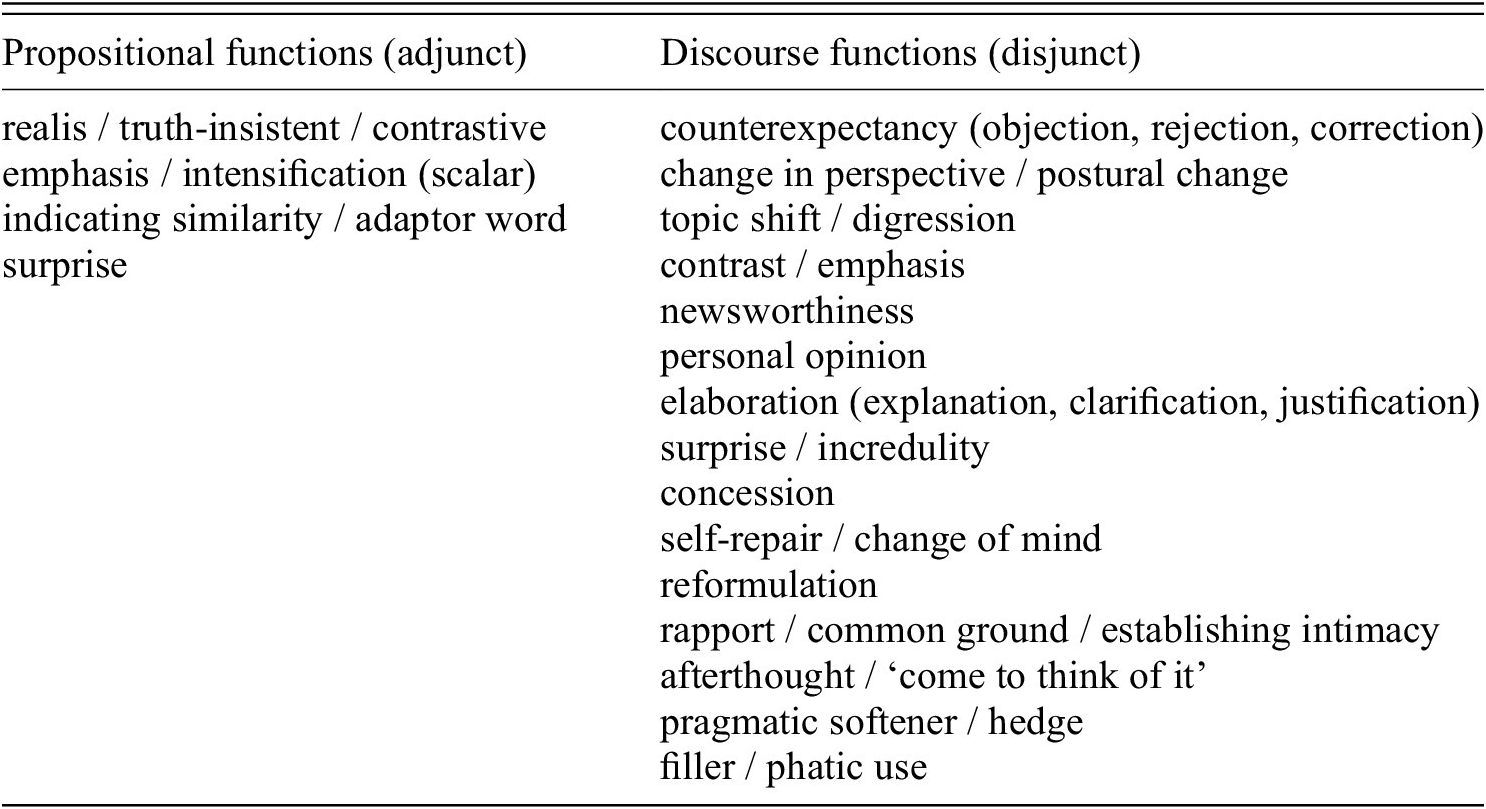
Several other, minor, (sub)functions have been identified, leading to the (non-exhaustive) list of possible functions of propositional actually and actually as a discourse marker in table 1.
Functions of actually

ln many cases assigning one of these functions to actual corpus data is relatively straightforward; nevertheless, the long list provided in table 1 also turns out to be problematic. Firstly, there seems to be considerable overlap between certain functions (Tognini-Bonelli Reference Tognini-Bonelli, Baker, Francis and Tognini-Bonelli1993; Lenk Reference Lenk1998), which makes it difficult to determine which of the functions is the most appropriate (e.g. change in perspective vs. topic shift; concession vs. softening, rapport vs. phatic use). This also applies to some of the examples mentioned above. To give just a few examples: in (2b) actually could just as well be seen as indicating counterexpectancy, surprise or personal opinion; example (5a), classified by Lenk (Reference Lenk1998: 162) as an expression of personal opinion, is analysed by Aijmer (Reference Aijmer, Tottie and Bäcklund1986: 127) as an example of softening; and example (6a), apart from signalling a change in topic, could also be regarded as elaboration or be given a ‘come to think of it’ interpretation. Secondly, the use of actually can fulfil several functions at the same time, as illustrated in example (7) for actually in initial position:

In this example actually introduces a self-interruption, signalling a digression (change of direction within topic). It is used to introduce newsworthy information, which may be assumed to be unexpected, and could even be taken to express (mild) surprise on the part of the speaker (the idea of a pioneer potentially evoking the idea of a bygone era).
It will therefore come as no surprise that in previous studies, different functions have been assigned to the same (or very similar) examples. Aijmer (Reference Aijmer2013: 103) therefore suggests it may be better to regard actually as having ‘a meaning potential organized around several core functions’, such as adversativity. The question that remains is exactly what these core functions are, and how they correlate with formal properties of actually like (extra‑)clausal position and prosodic relation.
2.2 The position of actually
As pointed out by Aijmer (Reference Aijmer, Tottie and Bäcklund1986, Reference Aijmer2002), actually can occur in all clausal positions; the question therefore arises whether there is a correlation between the many functions of actually and the position it takes in the clause: is every use of actually appropriate in all positions, or does the function of actually place constraints on where it can occur in the clause? Aijmer (Reference Aijmer2002: 253) observes that ‘[f]rom the point of view of meaning/function there is also little to distinguish between actually in different positions’; likewise, Oh (Reference Oh2000: 266) concludes that ‘there is no one-to-one correspondence between position and function’ (see also Watts Reference Watts1988: 251, 253–4; Lenk Reference Lenk1998: 166; Smith & Jucker Reference Smith, Jucker, Andersen and Fretheim2000; Simon-Vandenbergen & Willems Reference Simon-Vandenbergen and Willems2011).
However, if we restrict ourselves to the two main uses of actually, some general tendencies on placement have been observed. Thus, propositional (adjunctive) actually appears in medial positions, whereas as a discourse marker (disjunctive) actually prefers initial and final position, although it can also appear in (parenthetical) medial position (Aijmer Reference Aijmer, Tottie and Bäcklund1986, Reference Aijmer2002; Taglicht Reference Taglicht2001). Aijmer (Reference Aijmer, Tottie and Bäcklund1986, Reference Aijmer2002), for instance, states that
when actually is placed medially, it hedges the proposition or a single element. When actually is placed initially or finally it is a discourse particle with textual or interpersonal function. (Aijmer Reference Aijmer2002: 253)
There is, however, no consensus on this point. According to Oh (Reference Oh2000), for instance, actually may have different functions in medial position (see also Lenk Reference Lenk1998): one with a local scope (realis or emphasizing/intensifying; e.g. examples (2a, b)), the other with a global scope (contradicting expectation; e.g. examples (4b) and (5a)). In other words, whereas the propositional use of actually is restricted to a medial position, actually as a discourse marker can appear in any position.
As far as the relation between the position of discourse marker actually and its many functions is concerned, only some broad tendencies have been mentioned. Thus, for Aijmer (Reference Aijmer2002) disjunctive actually in utterance-initial position ‘plays a role for the development of discourse and serves as a discourse particle with cohesive function’ (Aijmer Reference Aijmer2002: 257; e.g. examples in (3)), whereas in utterance-final position it functions as a floor-holder, emphasizing the relationship between speaker and hearer (Aijmer Reference Aijmer2002: 258; e.g. example (5b)). Similarly, in his discussion of utterance-final actually, Haselow (Reference Haselow2012, Reference Haselow2013) identifies a specific effect of this position on the interpretation of actually, namely a stronger illocutionary effect, expressing higher degree of speaker involvement (see also Lenk Reference Lenk1998: 169). Finally, Clift (Reference Clift2001) recognizes clear differences in function between actually at the beginning and at the end of a turn (or turn constructional unit).
2.3 The prosodic realization of actually
Only a few of the studies dedicated to actually provide an account of its prosodic features, either in relation to its function, or in relation to its position. Aijmer (Reference Aijmer, Tottie and Bäcklund1986: 122) mentions that whereas adjunctive actually can be stressed, but does not usually carry a tone, discourse marker actually may (but need not) carry a tone. Taglicht (Reference Taglicht2001: 6), on the other hand, points to a difference in prosody between the two propositional uses of actually. In its modal function, indicating realis (what Taglicht refers to as its truth-insistent use; see example (2a)), actually is typically more prosodically prominent than any element in the rest of the sentence, and may carry a tone. With its emphasizing use (Taglicht’s (Reference Taglicht2001) scalar use; see example (2b)), actually is always less prosodically prominent than what follows (even if actually itself is still stressed). Taglicht (Reference Taglicht2001: 6) provides the following examples (where capitalization indicates prosodic prominence):

In addition, Taglicht (Reference Taglicht2001: 6) observes (in a footnote) that in its scalar use, actually can be completely lacking in prosodic prominence. Unfortunately, there is very little by way of actual prosodic analysis to justify these claims.
As for discourse marker actually, Aijmer (Reference Aijmer2002: 262–5) finds several correlations between discourse function, position and prosody. She distinguishes six possible prosodic patterns, all of which are related to one or more discourse functions (and some to specific positions). These can be summarized as follows:
-
– Pattern A: separate tone unit in initial position (fall rise) – anticipating resistance
-
– Pattern B: separate tone unit in initial position (simple fall) – elaboration, clarification
-
– Pattern C: initially without (nuclear) stress – weak contrast
-
– Pattern D: integrated in final or post-head position; rising tone with a preceding fall tone – available information, establishing common ground
-
– Pattern E: integrated, nuclear tail with a preceding fall tone – actually less important than in Pattern D
-
– Pattern F: inserted as a separate tone group with a rise or fall-rise tone – afterthought
Of these six patterns, three are prosodically integrated and three are prosodically non-integrated; this distinction is, however, not further pursued. Watts (Reference Watts1988: 253–4), on the other hand, explicitly claims that the prosodic (non‑)integration of actually does not affect its function (see also Taglicht Reference Taglicht2001: 4–5). Here again, however, the prosodic analysis is not very precise, and the inventory is far from complete. Moreover, as we will see below, the correlations are not always supported by our data: the difference between patterns A and B was not corroborated by our data, nor was that between patterns D and E (for which we offer a different explanation), while pattern F was hardly attested in our sample.
3 Data and methodology
The data for this study was drawn from the spoken part of the British Component of the International Corpus of English (ICE-GB version 3.0; see Nelson et al. Reference Nelson, Wallis and Aarts2002), which contains approximately 640,000 words from various text types: private conversations, telephone calls, business meetings, classroom lessons, public broadcast discussions and commentaries, court hearings and parliamentary discussions. ICE-GB is particularly convenient for a prosodic analysis because the transcription of the spoken data is accompanied by audio files suitable for an auditory and instrumental prosodic analysis.
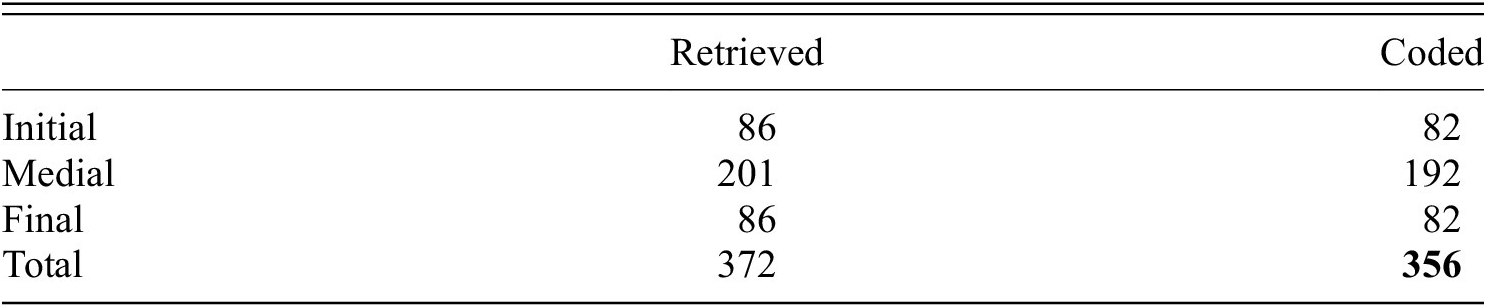
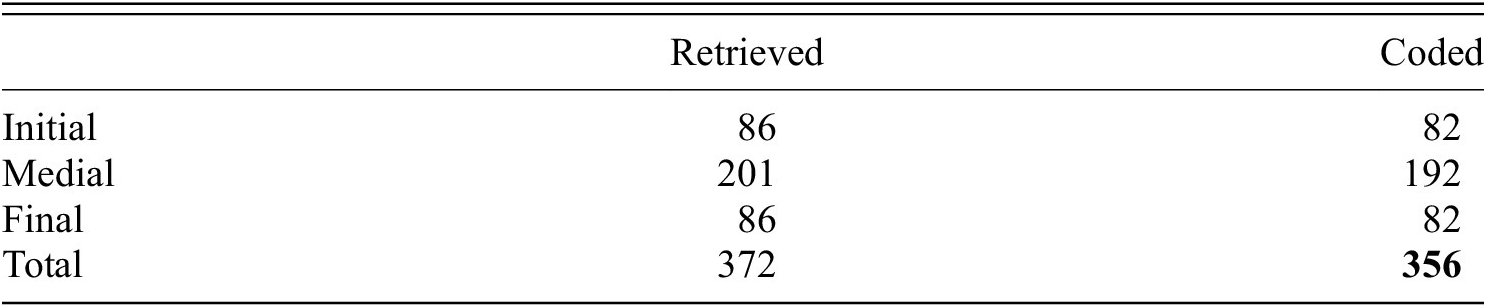
The corpus contained approximately 700 tokens of actually in various positions. All the examples in the initial position (pre-main clause) and in the final position (post-main verb) that were suitable for a prosodic analysis were collected, comprising 82 examples of actually in initial position and 82 in final position. As for the medial position (see below), 201 randomly selected examples were collected, out of which 192 were included in the final analysis (the remaining examples were either mistakes in the corpus or unsuitable for prosodic analysis). In total, 356 examples were analysed (see table 2).
Dataset per position
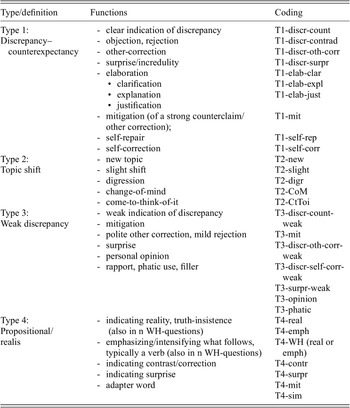
Each example was coded for function, position and prosodic features.Footnote 3 Function was assigned on the basis of context, whereby particular use was made of the various subfunctions of actually proposed in the literature. We soon realized, however, that for the coding of functions we could not just rely on the many functions that had been suggested in the literature, no matter how valid these may be to account for the use of actually in particular examples. Firstly, as we saw in section 2.1, there are simply too many cases where more than one function seems to be appropriate. Secondly, the sheer number of these, sometimes overlapping, functions makes it unlikely that any correlations between specific functions and well-defined prosodic patterns can be detected. We therefore decided, by way of hypothesis, to classify the many subfunctions into four broad types, and to see if any correlations could be found between these types, their positions and their prosodic realization. These four main types were defined as follows.
Type 1: Discrepancy–Counterexpectancy
With this use, actually indicates a change in perspective (e.g. Aijmer Reference Aijmer2002: 252), or a break with what has been said before (Tognini-Bonelli Reference Tognini-Bonelli, Baker, Francis and Tognini-Bonelli1993: 204–5), indicating a discrepancy in propositional attitude with that on the floor (Smith & Jucker Reference Smith, Jucker, Andersen and Fretheim2000: 208). It can be described as ‘a general-purpose signal for a counterclaim’, indicating that what is to come is not shared (Tognini-Bonelli Reference Tognini-Bonelli, Baker, Francis and Tognini-Bonelli1993: 204; Lenk Reference Lenk1998: 160; Smith & Jucker Reference Smith, Jucker, Andersen and Fretheim2000: 222). Finally, it can also be used to indicate surprise/incredulity on the part of the speaker, or to add relevant information (elaboration; Aijmer Reference Aijmer, Tottie and Bäcklund1986, Reference Aijmer2002). Type 1 actually cannot appropriately be replaced by really or in reality, but may be paraphrasable as in fact or as a matter of fact.
Type 2: Topic shift
This function, also mentioned by many authors (e.g. Aijmer Reference Aijmer2013: 113; 2002: 252; cf. Lenk Reference Lenk1998; Oh Reference Oh2000; Smith & Jucker Reference Smith, Jucker, Andersen and Fretheim2000; Clift Reference Clift2001; Taglicht Reference Taglicht2001) can take various guises. It may either disrupt the discourse by introducing a new topical direction, but it may also indicate a smaller shift, or a digression, still relevant to the previous discourse. More specific functions are ‘change of mind’ (e.g. Aijmer Reference Aijmer2013; Clift Reference Clift2001) and ‘come to think of it’ (Aijmer Reference Aijmer, Tottie and Bäcklund1986, Reference Aijmer2002).
Type 3: Weak discrepancy
With this use, actually is used to indicate mild discrepancy or counterexpectancy, There is a break with the preceding discourse (contrast, rejection, correction), but this is indicated in a less confrontational, less face-threatening, manner than in Type 1. Type 3 functions of actually therefore include mitigation (pragmatic softener) and concession. In addition, Type 3 actually can be used to share an opinion and to establish speaker–hearer rapport (Aimer 1986, 2002), and may on occasion even be considered to be phatic.
Type 4: Propositional use
Here actually is used to indicate a discrepancy between reality and what appears to be the case; in other words, it is concerned with the truth value of the proposition of which it is part. It has two main uses: a truth-insistent use (contrastive) and an emphatic use (emphasizing or intensifying what is to come, typically a verb; e.g. Quirk et al. Reference Quirk, Greenbaum, Leech and Svartvik1985: 583; Aijmer Reference Aijmer, Tottie and Bäcklund1986, Reference Aijmer2002, Reference Aijmer2013). With this use, actually functions as an adjunct and can be replaced by really/in reality. Minor uses include indicating surprise and actually as an adaptor word (Aijmer Reference Aijmer, Tottie and Bäcklund1986: 122).
The four types, with the general and more specific functions subsumed under them, and the codes used, are presented in table 3.
Functions of actually: four broad classes

The three positions were defined with respect to the clause expressing the proposition that actually was part of or was used to comment on. The initial and final positions, illustrated in (9) and (10), are relatively straightforward:


The medial position was defined as any of the following:


The prosodic analysis was done in Praat (Boersma & Weenink Reference Boersma and Weenink2019). It included the identification of the tonal contours associated with the target and with the material in its immediate environment. In essence, the goal of the prosodic analysis was to identify the prosodic prominence (in terms of pitch accents) and the prosodic phrasing (in terms of boundary tones) of each example. The analysis made use of the ToBI (Tones and Break Indices) annotation system (Beckman et al. Reference Beckman, Hirschberg, Shattuck-Hufnagel and Jun2006), following the by now widely accepted framework of Pierrehumbert (Reference Pierrehumbert1980), further developed in the Autosegmental-metrical model (AM) (Ladd Reference Ladd2008).Footnote 5 Additionally, the analysis relied on the extensive literature from outside the AM model when it comes to the interpretation of pauses, the identification of breaks and boundaries, and other cues indicating various intonation domains (e.g. Crystal Reference Crystal1969; Bolinger Reference Bolinger1989; Cruttenden Reference Cruttenden1997; Gussenhoven Reference Gussenhoven2004).
We followed Pierrehumbert (Reference Pierrehumbert1980) and Beckman & Pierrehumbert (Reference Beckman and Pierrehumbert1986) in assuming the Intonational Phrase (IP) domain to comprise pitch accent tones (T*), phrase tones (T-) and boundary tones (T%). The IP is thus intonationally defined in terms of a complete tonal contour (tune), modulated by the combination of these different types of tone. Accordingly, the data were coded for each of these tones, and classified according to the tonal contour. Additionally, the analysis of the examples in the medial position was extended to include the coding of two prominence patterns with respect to actually and the following element (in most cases the main verb): the strong–weak pattern versus the weak–strong pattern.
4 Findings
In this section we will present the findings of our analysis, looking at the correlations between position and prosody (section 4.1), function and position (section 4.2), and function and prosody (section 4.3).
4.1 The relation between position and prosody
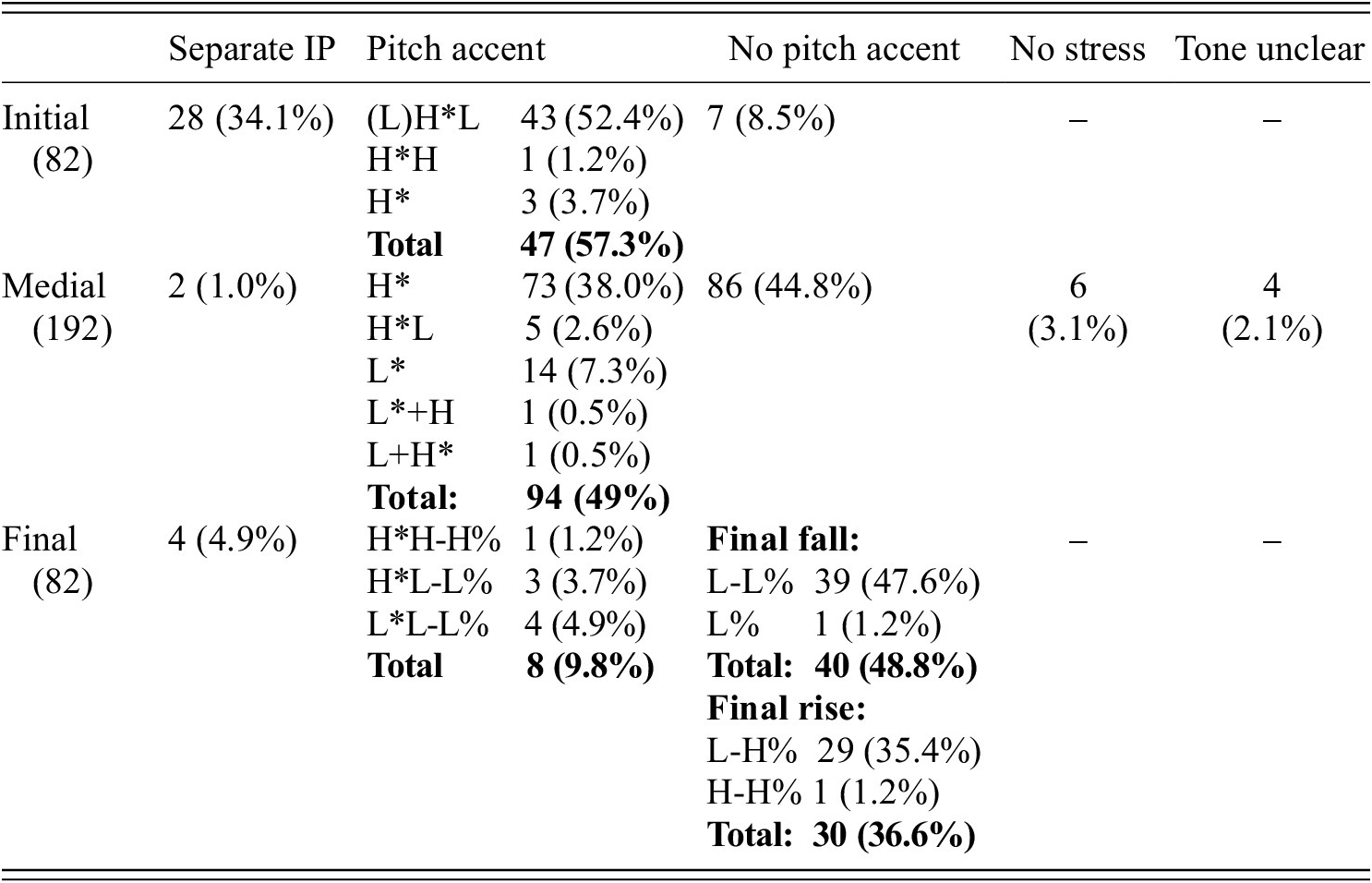
For each position, a variety of prosodic realizations were found, as shown in table 4.
The distribution of prosodic realizations with respect to position

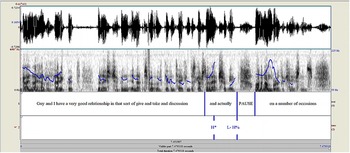
In initial position, actually was almost always pitch accented, with only 8.5 per cent of the examples being realized without a pitch accent (some appearing in the strongly reduced form [kʃi]). Of the pitch-accented initial occurrences, 34.1 per cent were separate Intonational Phrases, with two different contours: falls (H*L-L%; see figure 1),Footnote 6 which formed the large majority (25 instances); and fall-rises (H*L-H%, see figure 2), of which there were only three instances.
actually in the initial position realized as a separate IP with a falling contour (ICE-GB: S1B-064 073)

actually in the initial position realized as a separate IP with a falling–rising contour (ICE-GB: S1B-064 073)

Of the remaining 47 items in initial position, 44 (53.6%) formed the so-called Intermediate Phrase (Beckman & Pierrehumbert Reference Beckman and Pierrehumbert1986), the prosodic domain that consists only of a pitch accent (T*) and a phrase tone (T‑); due to the lack of a boundary tone, these occurrences were interpreted as being integrated in the overall IP domain. By far the most prominent realization was a combination of a high pitch accent H* and a low phrase tone L-, i.e. a falling contour but without an IP boundary (figure 3).
actually in initial position realized as an Intermediate Phrase with a falling contour (ICE-GB: S1B-029 052)

The results for the medial position show an almost even distribution of accented (49.0 %, mostly H*) and unaccented (47.9%) instances of actually; in a few examples actually was realized as completely unstressed (and often strongly reduced; 3.1%). More importantly, however, we found evidence for two distinct prosodic patterns for actually and the immediately following word (usually the main verb) (cf. Taglicht Reference Taglicht2001: 6). The first pattern is what we refer to as the strong–weak pattern (SW) where actually carries a high pitch accent (strong) and the following word is unaccented (weak). The second pattern is the weak–strong pattern (WS), i.e. the word following actually carries the high pitch accent, with actually either being unaccented or having a pitch accent weaker than that of the following word. Figures 4 and 5 illustrate the two realizations in examples from the dataset. The large majority of the examples in the medial position, 71.8 per cent, were realized in the weak–strong (WS) pattern, whereas only 19.8 per cent of the medial instances formed a strong–weak (SW) pattern. Of the remaining examples, two instances formed a separate IP, while in the others the stress pattern could not be established (mostly due to the poor quality of the audio recordings).
actually in the medial position realized in a strong–weak pattern (ICE-GB: S1B-009 125)

actually in the medial position realized in a strong–weak pattern (ICE-GB: S1B-061 159)

In final position, actually was in the majority of cases realized as part of the post-nuclear tune, as a final tail (95.1%); the large majority of these tails were unaccented (85.3%), some even entirely deaccented. The tail realizations were more or less evenly distributed between final falls (57.3%) (figure 6) and final rises (37.8%) (figure 7).
actually in the final position realized as a post-nuclear falling tail (ICE-GB: S1A-064 122)

actually in the final position realized as a post-nuclear rising tail (ICE-GB: S1A-064 122)

The main tendencies when it comes to the relation between position and prosody can thus be summarized as follows:
-
1. In initial position, actually was almost always stressed. In about a third of the cases it formed a separate IP, in the other cases the preferred pitch contour being H*L.
-
2. In medial position, actually was prosodically integrated, with a more or less equal number of accented or unaccented instances. In addition, two stress patterns could be found, one in which the main stress was on actually (SW), the other in which the main stress was on a following element (WS).
-
3. In final position, actually was typically integrated and unaccented, ending either in a fall or in a rise.
4.2 The relation between function and position
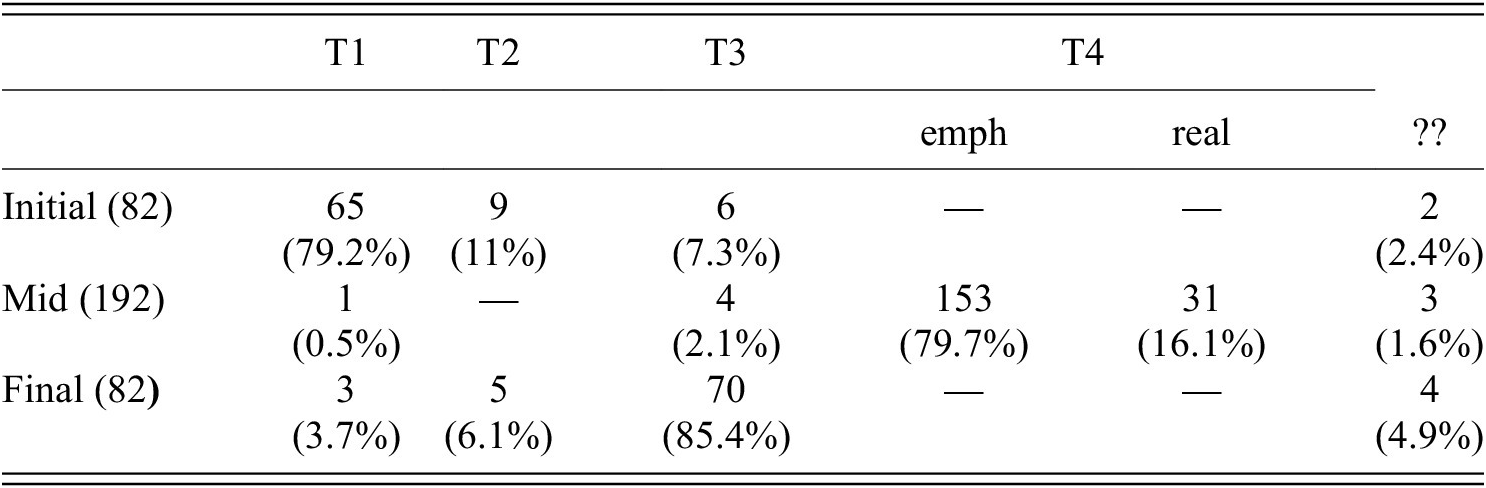
Our findings confirm that there is no one-to-one relation between the many different (sub)functions of actually and its position in the utterance. However, when we restrict ourselves to the four broad classes distinguished in section 3, some patterns do emerge. An overview of the main function of actually in the three positions is given in table 5.
The distribution of main functions with respect to position

As can be observed from table 5, T2, actually as an indicator of topic shift, was by far the least frequent of the four major functions. This can partly be explained by fact that speakers are generally cooperative, and as such do not generally change topic in the middle of a conversation (Grice’s (Reference Grice, Cole and Morgan1975) Maxim of Relation). Partly, however, it has to do with the way we coded the data. As mentioned before, actually can fulfil different functions at the same time. In most of these cases, however, the different functions belonged to the same broad type. In cases of topic shift, however, we found that it often combined with one of the discourse-interpersonal functions included in T1. We therefore decided to only include in T2 those cases where actually quite unequivocally functioned to indicate a change in topical direction, as in (17), where the speaker introduces a new (sub)topic.

As for the initial position, we see that here actually was used predominantly as a strong indicator of discrepancy or counterexpectancy (79.2%), with an additional nine occurrences of topic shift (11%). There were only six examples (7.3%) where actually in initial position served as a weak indicator of discrepancy (T3; see example (27) below). Generally speaking, we can say that actually in this position has backward orientation, typically indicating strong contrast with some element from (or inferrable from) the preceding discourse.
In the medial position, most occurrences of actually (153; 79.7%) were what in the literature have been referred to as propositional uses with an emphasizing/intensifying/scalar function (e.g Quirk et al. Reference Quirk, Greenbaum, Leech and Svartvik1985: 583; Aijmer Reference Aijmer, Tottie and Bäcklund1986, Reference Aijmer2002, Reference Aijmer2013; Taglicht Reference Taglicht2001). In addition, we found 31 cases of realis actually (16.1%). More importantly, however, we found that whereas the realis use was indeed propositional (see also section 5.2), and was restricted to this position, this did not apply to the emphasizing uses. Instead, what has been described in the literature as the emphasizing propositional use was found to indicate discrepancy/counterexpectancy in very much the same way as most (integrated) initial uses of actually. In other words, the discourse marker use of actually could be found not only an initial position, but also in medial position (cf. Lenk Reference Lenk1998; Oh Reference Oh2000). This conclusion was supported by the fact that, since realis actually (expressing epistemic modality) is part of the proposition, it falls within the scope of (predication) negation, with actually following the negator (cf. Taglicht Reference Taglicht2001: 2, 6; see also section 5.2). The discourse marker use of actually is not constrained in the same way (Taglicht Reference Taglicht2001: 2, 4–5). Instead, when the medial actually signals discrepancy, it is not part of the proposition and may therefore also precede the negator with little difference in meaning (compare I actually don’t LIKE her to I don’t actually LIKE her). Since the evidence for this difference between realis and discourse marker actually comes to a large extent from prosody (with the two uses corresponding to different prosodic patterns for actually and the following verb), we will discuss this further in the next section.
As will be clear from table 5, there is a strong correlation between final position and the weak use of discourse marker actually (T3). This might seem surprising, given that the final position of the clause is typically reserved for salient, focal information (principle of End Focus; see Quirk et al. Reference Quirk, Greenbaum, Leech and Svartvik1985: 1357). As noted in section 4.1, however, final actually typically appears as a post-nuclear tail. This particular combination of position and function can be explained by the fact that whichever function actually in final position seems to be associated with has usually already been expressed in, or become clear from, the preceding sentence. It therefore seems wrong to conclude that actually functions to indicate discrepancy, counterexpectancy, surprise, topic shift, etc. in this position; we can only confirm that final actually appears in these contexts. Partly because of this, actually in final position often performs another kind of function, e.g. a mitigating, social or phatic function, as illustrated in example (18), where the speaker agrees with the previous speakers, and where actually seems to have a social, almost phatic function:

Finally, in those cases where actually in final position indicates a shift in topic, we are dealing with a digression, after which the main topic is resumed. An example is given in (19), where a sports commentator interrupts his commentary on the match to provide background information about a player:

Summing up, we found the following correlations between the function and position of actually:
-
1. The discourse marker use of actually was found in all three positions
-
a. in initial position, it was typically used to indicate strong discrepancy (contradiction, rejection, correction), as well as surprise/incredulity;
-
b. in final position, discourse actually was strongly associated with the weaker expression of discrepancy and counterexpectation, was with mitigation, concession, mild surprise. We also found the social and phatic uses here;
-
c. in medial position, the discourse marker use of actually, indicating discrepancy, counterexpectancy, surprise or mitigation, was also the predominant use.
-
-
2. The only propositional use of actually was the realis use; this use was restricted to the medial position.
-
3. When used to indicate topic shift, actually occurred mostly in initial position, where it indicated either a shift (rather than a complete change) in topic, or a minor digression; in final position, this use of actually functioned only to indicate minor digressions.
4.3 The relation between function and prosody
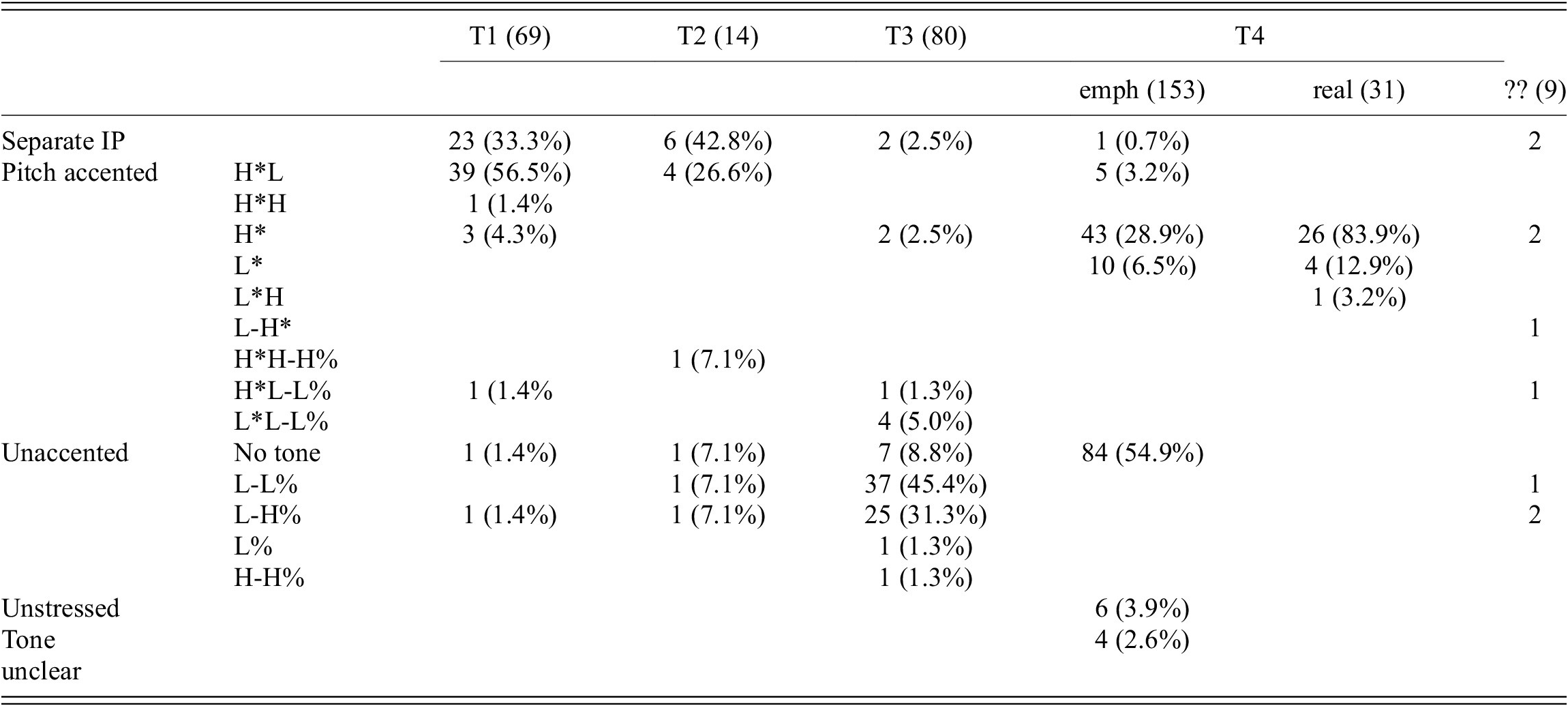
No systematic relations could be found between the many (sub)functions of actually and its position or prosodic realization. As mentioned before, this is largely due to multifunctionality of actually, with many overlapping and co-occurring functions. Nevertheless, the results, shown in table 6, make it possible to identify some general tendencies.
The distribution of main functions with respect to prosody

Given the correlations found in the previous section between position and prosody (section 4.1) and function and position (section 4.2), it is not surprising that we could also identify some tendencies in the relation between function and prosody. Thus, as shown in table 6, separate IPs were used predominantly to code strong discrepancy/counterexpectancy (T1) and topic shift (T2). In those cases where actually was prosodically integrated, both functions were expressed predominantly by a falling tone (H*L). Weak discrepancy, on the other hand, was found to strongly correspond to a lack of accent; in final position, there often was a tone (falling or rising), but this was simply because actually occurred in the post-nuclear tail of a larger IP (for further discussion, see examples (22) and (23) below).
When used as a discourse marker in medial position (T4-emph), actually was often accented, typically as H* (28.9%), sometimes L* (6.5%); in most cases, however, it did not have any accent (58.8%), and in some cases it was even entirely unstressed (3.9%). When used as a realis marker (T4-real), actually was always accented, almost always carrying a high tone (83.9%). In both cases, actually has narrow scope, usually over the following verb. The two uses differ, however, in the accent pattern used: where the realis use always exhibits the SW pattern, i.e. with the main stress on actually, the discourse marker use is characterized by the WS pattern, with the main stress on some following element (usually a main verb). This WS pattern could be found in all unaccented cases of medial actually, as well as in 91.5 per cent of all accented cases.
Some examples are given in (20) and (21). In (20), actually clearly indicates truth insistence, emphasizing the truth of the first part of the preceding sentence (it’s not the people that are covered) and highlighting the contrast with the second part (but the workplaces). In (21), on the other hand, actually signals discrepancy (surprise), but is itself completely unstressed, with the following verb carrying the main accent (see also discussion in section 5.2).


In final position, we can also identify an extra factor determining the exact pronunciation of actually. As shown in table 4 above, actually in this position has two main prosodic realizations: an unaccented fall (L-L%) and an unaccented rise (L-H%), both associated with the expression of weak discrepancy; as mentioned before, this may be due to the fact that any sense of disagreement, objection, correction etc. will have already been expressed in the preceding utterance (the proposition itself). What we found instead was that actually in this position seems to be for additional interactional purposes: it has a forward-looking function, serving to either encourage or discourage the hearer to respond. Examples are given in (22) and (23), respectively.

In (22) final actually is realized with a rising intonation (figure 6), and is used as a means of encouraging a response from the hearer (and as such typically triggering a response). Additionally, our analysis of the corpus data strongly suggests that this particular interactional use of actually expresses specific discourse functions, such as surprise, digression, or self-correction.
The second use of final actually was found to indicate finality, thereby discouraging any response from the hearer (example (23)); here actually is realized with a final fall (figure 7). In these cases, too, there are specific discourse functions accompanying this use of actually, such as (strong) personal opinion, rejection, downtoning/mitigation, or use as pragmatic softener.

In sum, we have been able to identify the following general tendencies when it comes to the relation between function and prosody:
-
1. Type 1 (strong discrepancy) was strongly typically expressed as a separate IP, or, in those cases where actually is prosodically integrated, with an H*L accent.
-
2. Type 2 (topic shift) was also typically expressed as a separate IP, or, when integrated, with an H*L accent. In those cases where actually with this use was unaccented, it indicated a (minor) digression.
-
3. Type 3 (weak discrepancy) was typically expressed without an accent. In final position (i.e. in the majority of cases), it did, however, typically have a falling or a rising tone, indicating finality and encouragement, respectively.
-
4. Type 4 (originally the propositional use) was found to have two different functions corresponding with different stress patterns:
-
a. The realis (propositional use) was always the most prosodically prominent element in the sentence (typically carrying a high tone);
-
b. The ‘emphasizing’ (discourse marker) use was expressed with an accent or without, but never carried the main accent (which typically went to the following verb).
-
5 Classification and discussion
5.1 Classification
From the preceding section, we can conclude that there is indeed no one-to-one relation between the many (sub)functions of actually, its position in the clause and its prosodic realization. Nevertheless, it is possible to observe some (strong) tendencies and patterns if:
-
– we restrict ourselves to three basic functions: one propositional use (realis/truth-insistence), and two discourse-maker uses (discrepancy/counterexpectancy – further divided into a strong and a weak use – and topic shift);
-
– we assume that position is triggered by function, as well as by additional factors such as scope (see sections 2.2, 4.2 and 4.3), strength (sections 3.1, 4.2 and 4.3) and orientation (backward versus forward; sections 4.2 and 4.3);
-
– we assume that prosody is determined by both function and position.
This results in a classification that differs in three important aspects from the previous literature on the functions of actually discussed in section 2.1. Firstly, our findings suggest that there is no evidence for the emphasis/scalar/intensifier use of propositional actually (e.g. Quirk et al. Reference Quirk, Greenbaum, Leech and Svartvik1985: 583; Aijmer Reference Aijmer, Tottie and Bäcklund1986, Reference Aijmer2002, Reference Aijmer2013; Taglicht Reference Taglicht2001). Instead, this (sub)function was reclassified as a discourse use for the simple reason that with this use actually (i) is not truth-insistent, and as such it does not seem to have a propositional function; and (ii) seems to perform the same discourse functions as discrepancy/countexpectancy actually. The only difference seems to be their (local) scope. We therefore analysed these as clause-medial discourse marker occurrences. A second difference with much of the existing literature is that we regard discrepancy/counterexpectancy as a single, broad category that includes many of the various previously proposed subfunctions. Finally, unlike many previous studies (e.g. Lenk Reference Lenk1998: 174, 179; Oh Reference Oh2000: 257; Clift Reference Clift2001; Taglicht Reference Taglicht2001; Aijmer Reference Aijmer2013: 113), the topic shift function was identified as a separate function, i.e. separate from the discrepancy/counterexpectancy use, for those cases where there is no link to the topic of the preceding discourse and thus no indication of discrepancy.
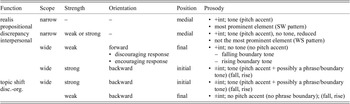
This leads to a final classification based on distinguishing three maximally different functions: realis/truth insistence (propositional), discrepancy/counterexpectancy (interpersonal) and topic shift (discourse-organizational). The differences between these uses are summarized in table 7.
A comprehensive classification of actually

5.2 Discussion
Let us end this article with some comments on the functions distinguished in table 7. In our analysis, only realis actually is regarded as an adjunct (paraphrasable as ‘in reality’), i.e. as part of the main proposition. It will be clear, however, that realis actually is not a prototypical propositional adjunct, as it does not affect the truth value of the proposition: it is truth-insistent rather than truth-conditional. Nevertheless, since it is used to emphasize the truth of an assertion, it has generally been regarded as propositional (e.g. Lenk Reference Lenk1998: 157; Taglicht Reference Taglicht2001: 2; Oh Reference Oh2000: 252–3; Aijmer Reference Aijmer2002: 252–6). This conclusion is supported by the fact that actually belongs to a particular subclass of truth-conditional adverbs, with which it can be coordinated or contrasted, e.g. potentially, virtually, nominally, theoretically, etc., as shown in (24):

Its truth-insistent and (implicitly or explicitly) contrastive nature results in the adverb being the prosodically most prominent part of the proposition, resulting in the use of the SW pattern. Further proof for the propositional nature of adjunct actually can be found in the fact that it falls within the scope of predicational negation, as illustrated by the following examples:

In (25a), the negator scopes over the combination of actually and die, with actually, in turn, scoping over the verb. This leads to an interpretation in which the speaker asserts that what takes place is not quite dying (as expressed by actually), but something similar. In (25a´), on the other hand, actually scopes over the negator, which scopes over the verb; this leads to a different interpretation, with the speaker stressing (insisting) that no dying event took place – a reading incompatible with the context.
The second main use of actually is as a discourse marker indicating (weak or strong) discrepancy. With this use, actually has a pragmatic, interpersonal function, with the speaker indicating that the current proposition deviates in some way from what has been said before. This is confirmed by the fact that, as a discourse marker, actually is generally assumed to be non-truth-conditional and as such outside the scope of negation. This means that the position of actually (clause-initial, medial or clause-final) does not affect the scope of negation (cf. Taglicht Reference Taglicht2001: 4–5); semantically speaking there is therefore no difference between the sentences in example (26):

As shown in table 7, four subclasses of discourse marker actually can be distinguished, depending on two more functional factors: scope, strength and orientation. Starting with the wide-scope uses of discourse marker actually, we find that these typically appear in a peripheral position within the clause. Whether actually will appear in initial or final position is determined by (i) the strength, or urgency, with which the discrepancy is expressed, and (ii) whether it is directed towards the previous discourse (backward looking) or subsequent discourse (forward looking).
Thus, in clause-initial position, actually is backward looking, typically indicating strong contrast with (part of) a proposition in the preceding discourse; its function is to indicate right from the start that what follows will deviate in some way from what has been said before. This use is strongly associated with expression as a separate IP (see figures 1 and 2), or with a falling tone (H*L) tone (see figure 3). Occasionally, however, initial actually appears in unaccented form, as in (27), where it indicates weak backward-looking discrepancy (in this case elaboration; explanation).

In final position, actually is associated with a lack of urgency, resulting in a weak expression of discrepancy, leading to the absence of any accent. As pointed out in section 4.3, however, unaccented final actually is in most cases expressed with a final tone, being in the post-nuclear tail of a larger IP. This results in an additional, forward-looking, discourse-regulating function, in that its tone indicates whether the addressee is invited to respond (rising tone) or not (falling tone) (see examples (22) and (23) above). Occasionally, final actually can also take the form of a separate IP, as in (28).

Although the speaker expresses counterexpectancy or surprise here, this seems to be coded by means of a strong high accent on good, with actually being added more as an afterthought, confirming the sense of surprise.
Actually in medial position has been described in some detail in section 4.3. With this use, actually is not truth-conditional, and does not fall within the scope of negation. Thus, semantically speaking, there is no difference between (26a´) (here repeated as (29a)) and (29b´):

As we have seen, actually with this use can be unaccented (even completely unstressed) or accented, but never carries the most prominent tone (WS pattern).
Finally, discourse marker actually can also have a discourse-organizational function, indicating a shift in topic (without any clear implication of counterexpectancy, correction or rejection). We did not find many cases where the speaker introduced a completely new topic; instead, actually was typically used to signal a shift in, or (minor) digression from, the current direction of the discourse. In this function, actually typically appears in clause-initial position, where it always carries a tone. An example is given in (30), where actually has a distinctive pitch accent, while smoothly transitioning into the rest of the clause (no prosodic boundary), leading to an interpretation along the line of ‘by the way, come to think of it’:

In final position, discourse-organizational actually function is used when the preceding sentence starts a (minor) digression (see example (19)) or resumes a previous discourse topic, as exemplified in (31). In both cases actually may, but need not, be pitch accented.

6 Conclusion
In this article we have used spoken data from the ICE-GB corpus (Nelson et al. Reference Nelson, Wallis and Aarts2002) to come to an in-depth analysis of the function, position and prosody of actually, looking in particular at the way its various functional and formal features interact. In accordance with previous studies, we found that there is no straightforward, one-to-one relation between the many (sub)functions of actually distinguished in the literature, its position in (or vis-à-vis) the clause, and its prosodic realization. Nevertheless, we were able to identify a number of strong tendencies by (i) concentrating on four main functions of actually, (ii) including a number of additional semantic and pragmatic factors, and (iii) assuming that the prosodic features of actually are determined by both function and position.
As for the functions of actually, we made a distinction between a single propositional use (realis/truth-insistence) and two discourse marker uses (one interpersonal use, discrepancy, and one discourse-organizational use, topic shift). In doing so, we redefined what has so far usually been regarded as a propositional use (emphasis) as a discourse marker use in medial position. The additional factors included in the classification were scope (narrow versus wide), strength (or urgency: weak versus strong) and orientation (backward- versus forward-looking). As for the relation between all these functional properties and the formal behaviour of actually, we were able to establish that, on the whole, different combinations of functional features can be correlated with different positions, and that functional properties and position together correlated to different prosodic realizations (defined in terms of tone (pitch accent), pattern (SW versus WS), prosodic integration and boundary tones (falling versus rising)). This resulted in the classification presented in table 7.




 Open access

