

Introduction
International cooperation has never been a certain business, nor has it always been the norm. Nonetheless, in their attempts to govern (parts of) the globe, actors have brought to life enduring organizational designs. For decades, much scholarship has studied these governance arrangements as alive and kicking. Recent debates over the demise of multilateralism and what is often referred to as the Liberal International Order have introduced doubt into the resilience and durability of these organizational initiatives.Footnote 1 This picture has been perpetuated when scholars have focused on formal international governmental organizations (FIGOs), which have attracted contestation both from within their membership and from outside actors.Footnote 2
We want to take a step back from this debate and examine how a particular organizational type can impact international cooperation: ad hoc coalitions (AHCs). AHCs are autonomous global governance arrangements that distinguish themselves from other international organizations (IOs) through a particular configuration of organizational design features that have not received much attention in the international cooperation scholarship.Footnote 3 AHCs are at once short-notice, temporarily bound, and task-specific. This combination of features makes AHCs conceptually distinct from other IOs. So far, most scholarship has focused on questions of membership and degrees of formality.Footnote 4 AHC’s constitutive features around temporality and task-specificity provide us with a new angle from which to understand where and how we can observe a (geo)politicization of international cooperation.
To this end, we look from the twentieth century to today to examine not only whether AHCs are a new phenomenon, but also why and under what conditions they are created and introduced to world politics. We argue that AHCs serve as a testing ground that can bring (geo)political rivals together to address specific governance challenges and issues – and possibly to engage in more costly and long-term cooperation. Like most other IOs, AHCs thereby serve as agenda setters, capacity generators, and decision accelerators. Unlike most other IOs, however, due to their constitutive features, they do not lock participating actors into rules, procedures, and norms with long-term consequences while at the same time at least attempting to solve policy problems. Their temporal and task-specific features make them likely first responders to impending international challenges. Actors can experiment with and address new governance issues and challenges (agenda setter), explore different membership compositions and reshuffle existing organizational memberships (capacity generator), and encourage members to look beyond the broader (geo)political blame games and gridlocks in other IOs (decision accelerator).
While AHCs arguably can bring together political rivals more easily than many other organizational designs, not all issues lend themselves the same way to bridging political divides while addressing pressing policy problems over time. If decision-makers consider an issue to be of relatively low salience, we argue that they are more likely to gloss over political agendas and moderate political rivalries. This finds expression in their choice to delegate the set-up and management of AHCs to experts and bureaucrats, and to include as many members as are willing to join the coalition. This membership composition facilitates discussions about continuing cooperation after the AHC’s raison d’être has been fulfilled. However, if decision-makers deem an issue highly salient, they are more willing to set up AHCs themselves. Given that many AHCs respond to crises, the urgency will often bring rivals to the same table, especially when they are necessary to address the issue. However, creating and maintaining AHCs for high salience issues most likely entices actors to keep the coalition relatively small and controllable. This has implications for the afterlife of such AHCs. In these cases, AHCs fall apart during or after the task has been accomplished.
We examine these developments across AHCs in two issue areas, global health and international security, and in three time periods: the interwar years (1919–1939), the Cold War (1945–1989), and the post-Cold War era (1991–). This research design enables us to capture governance dynamics in both so-called ‘low’ and ‘high’ politics fields, as well as across temporal periods where (geo)political actor constellations and power distributions significantly varied. We focus on six AHCs, with three from each issue area. In the health domain, we study the Epidemic Commission (1920–1924), the International Children’s Emergency Fund (ICEF, 1946–1953), and the African Leaders Malaria Alliance (ALMA, 2009–). In the security domain, we study the Washington Naval Conference (WNC, 1921–1922), the Tripartite Coalition (1956), and the Contact Group for the Balkans (1994–1999). Based on multi-sited archival research and secondary sources, we trace how AHCs have been negotiated over time and across issue areas.
This paper contributes to global governance and international cooperation scholarship. It complements the recent scholarship on diverse organizational designs,Footnote 5 by addressing how the particular design features of AHCs have impacted international cooperation over time. Existing scholarship has emphasized organizational designs that are treaty-centred (degree of formality) and actor-centred (composition of membership), such as FIGOs,Footnote 6 or transnational public–private governance initiatives (TGIs),Footnote 7 as well as informal international governmental organizations (IIGO).Footnote 8 AHCs do not lock actors into any broad mandates and goals, nor do they imply any regularly scheduled meetings or a particular type of membership. AHCs encompass a host of organizations that have so far been discussed under terms such as coalitions of the willing, contact groups, and informal alliances.Footnote 9 Paying attention to their particular design features helps uncover where and when we can expect concrete international cooperation to take place.
Secondly, this paper extends research on AHCs. So far, existing research on AHCs has been presentist, suggesting that AHCs contribute to the de-institutionalization of international cooperation.Footnote 10 By extending the analytical time horizon, we show that AHCs have been a persistent feature of multilateral action and that their impact on international cooperation and global governance varies. By specifying the purposes that drive this form of cooperation over time, we help address the question of whether AHCs have always contributed to destabilizing international cooperation. We show that AHCs have also been the precursor of more long-term, institutionalized cooperation. This provides a better understanding of how and what kind of multilateral cooperation can be created and engineered, even in times of uncertainty and (geo)political crises.
A picture emerges where AHCs have always existed in a diverse organizational ecosystem. While they share some attributes with other IOs, their distinctiveness – their short-notice, temporary, and task-specific features – place them at the intersection of (geo)political tensions. Given their task-specific set-up, they can convince rivals to come to a table and deliberate, sidestepping existing tensions. Furthermore, their institutionalized concern with temporality enables them to incur controllable costs on cooperation. However, they can also be used by political leaders as spearhead organizations to challenge broader organizational frameworks and political rivals.
Why are AHCs created?
AHCs are a particular organizational type. AHCs are autonomous arrangements with a task-specific mandate established at short notice and planned for a finite period of time.Footnote 11 ‘Task-specific’ here means that this IO focuses on narrowly defined or single-purpose goals (e.g., a counterterrorism campaign against a particular group or within a particular region, or a specific vaccination campaign) instead of bundling governance challenges under one organizational umbrella. AHCs are also characterized by their specific temporal features. AHCs emerge at short notice and are intended to have a limited lifespan. Unlike FIGOs, IIGOs, or TGIs, they are not conceived as more permanent forums of debate and deliberation, but are primarily action-oriented.
We want to move research on AHCs forward by asking why actors create AHCs, and how AHCs relate to their organizational and (geo)political environments. We argue that the combination of their distinct organizational features enables an exploratory approach to international cooperation. These features allow members to try out particular and diverse constellations of actors on new and/or challenging issues. This can help moderate political tensions by removing them from entrenched formal structures and bringing rivals to the same table – even if only temporarily. More concretely, AHCs allow actors to test which agenda items and capacities are needed to speed up decision-making and address governance challenges. The combination of temporal and task-specific design features encourages actors to commit to their narrow, time-bound mandate, potentially circumventing political blame games and existing rivalries.
Firstly, their design features enable AHC to be the agenda setter of choice. Since AHCs can be set up on short notice, they afford actors the opportunity to first consider how to address the new policy concern in a new setting, unconstrained by previously established rules and expectations, and potentially overlooking political rivalries. In combination with the task-specific feature, this enables all involved actors to set multilateral agendas by addressing urgent issues of common concern, especially in moments of uncertainty. They facilitate a small(er) circle of members – at least initially – to define the nature of issues and potential policy solutions, serving as tools to set multilateral agendas. In this sense, AHC participants engage in an exploratory exercise of cooperation to test new ideas that could later shape international priorities.
Relatedly, AHCs not only enable the low-cost testing of agenda items at low cost but also help generate resources, including funds, material capabilities, or expertise. Since AHCs centre on specific issues, their main purpose is not only to bring actors around the same table but also to provide a platform from which they can act – on a particular task and within a predetermined timeframe. Importantly, it can mean both limiting or extending the circle of parties involved, in that way pooling available resources – whether material, financial, political, diplomatic, or otherwise – to achieve a specific, time-bound goal. Consequently, when deciding who will contribute to generating capacities to confront any specific governance issue, actors also draw boundaries determining who is in and who is out. This is how AHC membership boundaries can be controlled through a capacity-based logic.
AHCs are also well-positioned to address deadlocks within other IOs that are more permanent and often have a more general purpose, thereby accelerating decision-making. When other IOs experience politicization, deadlock, or gridlock in times of urgency,Footnote 12 the task-specific and temporary features of AHCs can encourage even rivals to address a governance challenge together. AHCs are vehicles through which a group of actors can bypass more long-standing and general-purpose IOs to address new and impending policy concerns. They can do so either by bringing like-minded actors together or bridging rivalries. Emphasizing the specific collective goods that they entail, AHCs may prompt rivals to (temporarily) bracket their political disagreements. Long-standing IOs sometimes reinforce differences rather than accommodate or overcome them, while AHCs can bring rivals to the same table given their issue-specific and temporal design. Arguably, they are the most transactional of all possible multinational policy-making vehicles.
These purposes are not unique to AHCs. Other individual organizational arrangements have also served some of these purposes. However, in their combination, we argue that AHCs are ideally placed to comprehensively serve these purposes. Research on IIGOs has demonstrated that informality can lead to speedy and flexible decisions,Footnote 13 but the regular meeting schedule of organizations such as the Group of Seven (G7) and the Group of Twenty (G20) has demonstrated that decision-making can also be hijacked by (geo)political tensions. The ad hoc format facilitates either engaging or circumventing such tensions. Research on FIGOs has shown that agenda setting is often done elsewhere,Footnote 14 because FIGOs lack appropriate instruments, resources, or expertise,Footnote 15 or because decision-making within them takes time.Footnote 16 A focus on diverse actor composition, such as those found in multistakeholder tripartite organizations, has shown that TGIs are mainly used for capacity building and funding purposes.Footnote 17 It is for these reasons that actors might create and even prefer AHCs, at least in the early stages of addressing new governance challenges or experimenting with multilateral policies. This also places AHCs at the forefront of (geo)political rivalries and tensions.
How do AHCs vary in composition and afterlife?
Not all AHCs bring together and moderate (geo)political tensions the same way over time, which has consequences for how AHCs are managed and whether the cooperative spirit lives on even after the task has been accomplished. Some AHCs only manage to moderate political rivalries over a brief period of time, bound to the task at hand. Others entice their members to continue cooperation in more formal ways after the AHC’s raison d’être has ceased to exist. This distinction is particularly relevant in an environment marked by heightened political rivalries, as is the case today.
Whether AHCs moderate political rivalries only briefly, or encourage future cooperative engagements among their members, depends mainly on the governance challenge’s issue salience to political leadersFootnote 18 at the time of the AHC’s creation.Footnote 19 An AHC’s moderation effect and durability, we argue, depends on the degree of inclusiveness of AHCs and who in the AHC holds issue ownership. Specifically, issue salience can impact membership composition in two ways: firstly, on the international dimension, i.e., whether the AHC is inclusive or only includes powerful and otherwise relevant actors; and secondly, on the internal dimensions, i.e., whether political leaders remain in the driver’s seat or whether experts and bureaucrats will represent states and other actors within the AHC. When political leaders understand the governance challenge to be less salient, governments are likely to allow in more actors and to step back to let bureaucrats and experts take over. However, when governments deem the issue salient, we expect them to keep the AHC small and stay in the lead. This has implications for how AHCs can manage political rivalries and whether their members continue cooperating after the task has been accomplished.
Governments cannot – and often do not want to – give the same attention to all issues. Thus, if political leaders deem a policy issue less salient, it can be more freely addressed among a much broader and more inclusive group of actors and experts.Footnote 20 Without excluding the possibility of tensions and disagreement between different AHC leaders, political leaders generally provide more space for experts because their attention is more urgently needed elsewhere. This not only helps moderate rivalries as governments delegate negotiations to bureaucrats and expertsFootnote 21 but also creates a cooperative foundation that can survive the AHC’s original raison d’être. This is not to say that experts are apolitical, but that they can act under the umbrella of depoliticized actionFootnote 22 – even in times of (geo)political tensions when major IOs experience obstruction. AHCs that are formed under conditions of low issue salience are more likely to extend cooperation from a one-off engagement to more permanent arrangements. Thus, these AHCs more often manage to fix new ‘issue areas’ on the international agenda.
If national governments deem the issue highly salient, however, they are less likely to increase the coalition to more members than absolutely necessary. Potential members are deemed ‘necessary’ or not based on the different capacities they bring to the table or their issue expertise, or else because they are somehow implicated in the governance challenge. In these circumstances, decision-makers are also less likely to delegate to lower-level representatives and experts; they would be more likely to want to stay informed and in control of deliberations. Ideological predisposition and issue ownership are important factors in explaining what national governments find salient.Footnote 23 Generally speaking, we argue that issues are more likely to be deemed salient when they receive significant domestic and international attention and, at the same time, are resource-intensive and threaten to impact an actor’s sovereignty or reputation.Footnote 24 In such instances, while political leaders are willing to engage with political rivals to address urgent issues, less leeway exists to alleviate rivalries between states, and each decision depends on their political will – despite functional pressures to the contrary. National elites are likely to keep experts on a short leash since they want to decide on how resources are managed. While leaders are willing to engage in AHCs despite sidelining existing organizational forums, AHCs are a fragile, cooperative form of organization. They remain exposed to political disagreements and prone to disintegration.
Research design
We turn to multi-sited archival research to investigate AHCs over time, what drove them, and how they fit into their contemporaneous organizational and political ecosystem.Footnote 25 We pursued archival research precisely to move beyond the presentist view of AHCs.Footnote 26 The notion of AHCs is often associated with the Western-led intervention; consider, for instance, the ‘coalitions of the willing’ in Afghanistan, Iraq, and Libya. Starting from the four features of AHCs as being (1) autonomous, (2) single-purpose, (3) short-notice, and (4) temporal arrangements,Footnote 27 we zoomed in on the (digital) archives from the League of Nations Archives, the United Nations Digital Library, the Historical Archives of the European Union, the Archive of the United States Department of the State Secretary, and the African Union (AU)’s Common Repository. The League of Nations and United Nations archives were chosen because these organizations have occupied a central position in the international organizational ecosystem. They are accessible venues for all kinds of actors, where actors raise concerns, seek support and cooperation from prospective partners, and devise strategies for multilateral action. It is therefore very likely that AHCs would be mentioned in these contexts. Moreover, this focus helped to verify their autonomy, membership inclusiveness, and organizational alternatives. In addition to these global archives, we also turned to regional archives (European Union, AU) and substantiated this data with additional research in national archives, in particular the Archive of the United States Department of the State Secretary. While seeking a geographically balanced sample capturing (geo)political rivalries, we were wary that much of the twentieth century was shaped by colonial domination across the globe. Hence, we were careful about imposing an anachronistic dichotomy between ‘Western’ and ‘non-Western’ participation in AHCs and avoided using markers such as ‘European/non-European’, ‘Third World’, and the ‘Global South’ ahistorically.Footnote 28
To capture how and why various AHCs emerged in relation to existing organizations, we devised a research strategy that could capture issue salience variance over time and across issue areas. We decided to cover a period from 1919 to today and focus on AHCs across two issue areas, health and security. This longitudinal focus allows us to tap into times when actors and power constellations varied significantly. These diverse (geo)political contexts and varying organizational densities help us assess whether powerful actors were driving the existence and purpose of AHCs. While we went through the archival material, we paid particular attention to times of crisis (such as the Great Depression, the World Wars, the Oil Crisis, and the Yugoslav Wars) where AHCs arguably would be in greater demand. Furthermore, we decided to focus on two different issue areas to capture any dynamics that may be domain-specific. Security is often understood as ‘high’ politics, while health is seen as ‘low’ politics. Scholars have observed that low politics issue areas, such as health, are organized through multistakeholder approaches, enabling private foundations and other actors to have a say in devising policies.Footnote 29 Security issues, for the most part, are qualified as high politics and are often dominated by formal inter-state alliances and organizations.
Out of the 20 cases we identified as AHCs (see Appendix A), we selected 6 representative ones that capture variance in issue salience across time and policy areas:
• the Epidemic Commission (1920–1923), established to halt the epidemics of cholera and typhus in Eastern Europe;
• the ICEF (1946–1953), a predecessor of the United Nations Children’s Fund (UNICEF);
• the ALMA (2009–p.d.), set up to eliminate malaria in Africa by 2030;
• the WNC (1921–1922), resulting in a series of treaties to regulate naval armament in the Pacific;
• the Tripartite Coalition (1956) between Britain, France, and Israel to invade Egypt and reestablish control over the Suez Canal Zone; and
• the Contact Group for the Balkans (1994–1999), a diplomatic consultation format on the Bosnian and later Kosovo war.
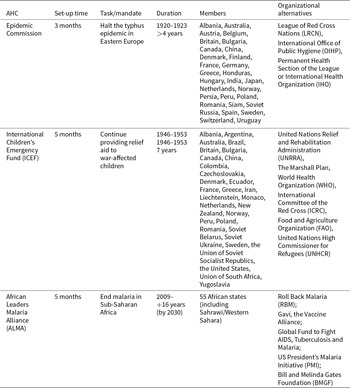
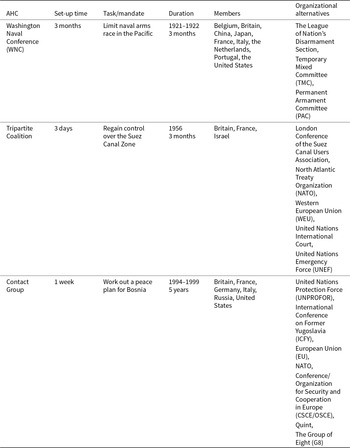
All AHCs in our selection were set up within a year, ranging from three days to five months (see Tables 1 and 2). While their main tasks greatly varied, they often emerged in response to concrete events, such as an epidemic of typhus and cholera in Eastern Europe for the Epidemic Commission, the nationalization of the Suez Canal for the Tripartite Coalition, or an armed conflict in Bosnia for the Contact Group. Moreover, AHCs also tended to focus on a specific geographical area, such as combatting malaria on the African continent or limiting a naval arms race in the Pacific. They were designed to last until the crisis was resolved, which ranged from a few months to over a decade, depending on the mandate’s scope and the coalition’s degree of success.
Health AHCs.

Table 1 Long description
The table compares three health-related ad hoc commissions by set-up time, mandate, operating period, member participation, and suggested organizational alternatives. The Epidemic Commission was created in about three months to halt typhus in Eastern Europe and operated from 1920 to 1923 with a broad, multi-continental membership; alternatives listed include the League of Red Cross Nations and international health bodies. The International Children’s Emergency Fund began in about five months to continue relief for war-affected children and ran from 1946 to 1953 with many member states across Europe and beyond; alternatives include UNRRA, the Marshall Plan, WHO, and other humanitarian agencies. The African Leaders Malaria Alliance also formed in about five months, aims to end malaria in Sub-Saharan Africa, and is shown as running from 2009 through a target horizon of sixteen years by 2030, with membership described as 55 African states including Sahrawi or Western Sahara. Across entries, set-up times are similar, while duration and geographic scope vary widely, from a short postwar epidemic response to a long-term regional disease-elimination effort. Some cells mix narrative notes with time references, so durations and alternatives should be read as descriptive rather than strictly standardized fields.
Security AHCs.
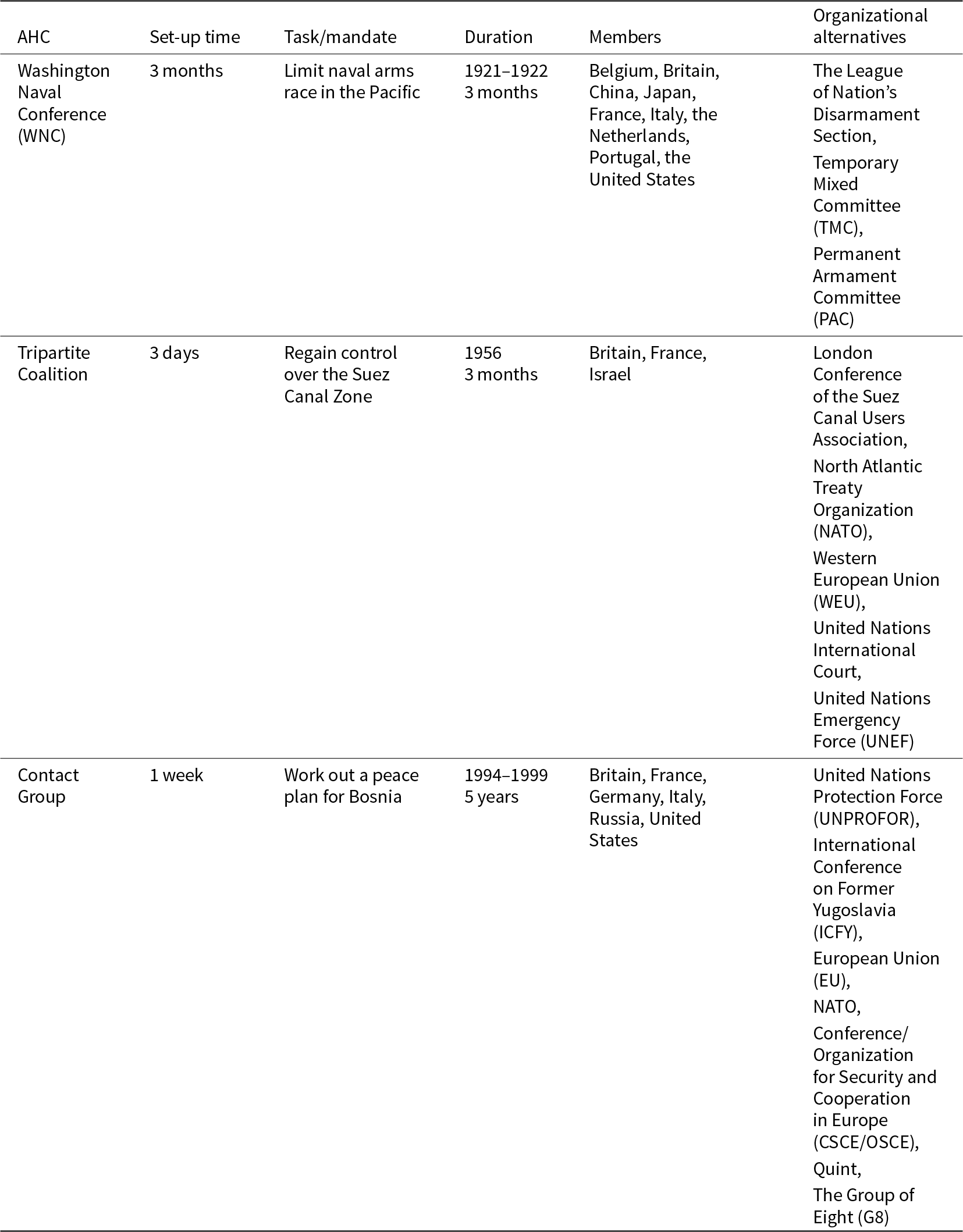
Table 2 Long description
The table compares three ad hoc coalitions by how quickly they formed, what they were tasked to do, how long they operated, who participated, and what other bodies could have handled similar work. The Washington Naval Conference formed in about 3 months to limit a Pacific naval arms race, ran from 1921 to 1922, and included eight states; alternatives listed include League of Nations disarmament bodies. The Tripartite Coalition formed fastest, in about 3 days, to regain control over the Suez Canal Zone in 1956, with three members; alternatives include NATO, the Western European Union, UN legal and peacekeeping mechanisms, and a London users conference. The Contact Group formed in about 1 week to develop a Bosnia peace plan, operated from 1994 to 1999, and had six members; alternatives include UNPROFOR, EU and NATO forums, CSCE or OSCE, the Quint, and the G8. Overall, faster formation does not align with longer duration: the quickest group was short-lived, while the Bosnia group lasted several years. Organizational alternatives range from specialized disarmament committees to broad security alliances and UN institutions, suggesting multiple possible venues for similar mandates.
To establish which organizational options were considered, which pathways were pursued, and which alternatives were discarded, we first considered which already existing organizations could have taken up a new policy problem given their mandate and scope. We then followed each of these options through the archived correspondence, where different actors negotiated an adequate organizational response.
The archival research helps avoid anachronistic interpretations of how AHCs can be identified over time.Footnote 30 The short-notice feature of AHCs prompted us to pause and wonder what it means across time, where technological changes and labour laws have changed significantly. This is so because design features heavily depend on technological innovations in the realm of communication and coordination, as well as labour laws and changing expectations of when people are supposed to be found in their offices.Footnote 31 During the interwar period, information travelled through telegram, mail, and phone, which means that addressing several actors at once was more cumbersome than it has been since the internet became an essential aspect of global governance infrastructure.Footnote 32 Moreover, although today we can assume that international and national staff are readily available throughout the year, this was not always the case. Evidence from the archives shows that, although communications channels between capitals were established, actors strategically used technological limitations to delay answers and prolong deliberations.Footnote 33 Consequently, if we want to uncover and examine AHCs at different points in time, then we need to be open to thinking about ‘short notice’ diachronically.
A persistent and purposeful feature of global governance
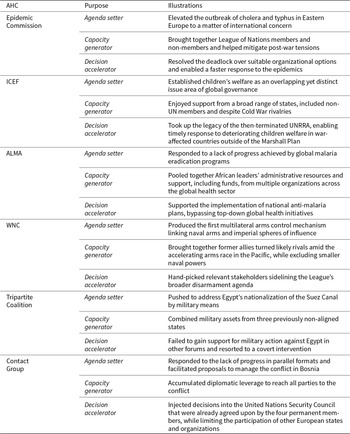
AHCs have been a persistent feature of international cooperation throughout the twentieth and twenty-first centuries, weathering (geo)political shifts, international crises, and changing organizational environments. They enable an exploratory approach to cooperation, being uniquely placed to bring together political rivals and function as task-specific agenda setters, capacity generators, and decision accelerators that could be set up swiftly to operate for a bounded period of time. In this section, we spell out how their three main purposes manifested across time and issue areas. To avoid repetition, we do not go through each AHC in detail but instead illustrate their purposes with one example from each issue area. The full list of our findings is presented in Table 3. Regardless of the time period or issue, AHCs enabled the pursuit of multilateral responses while moving beyond stalemate in other organizations.
Purposes of AHCs and their empirical illustrations.
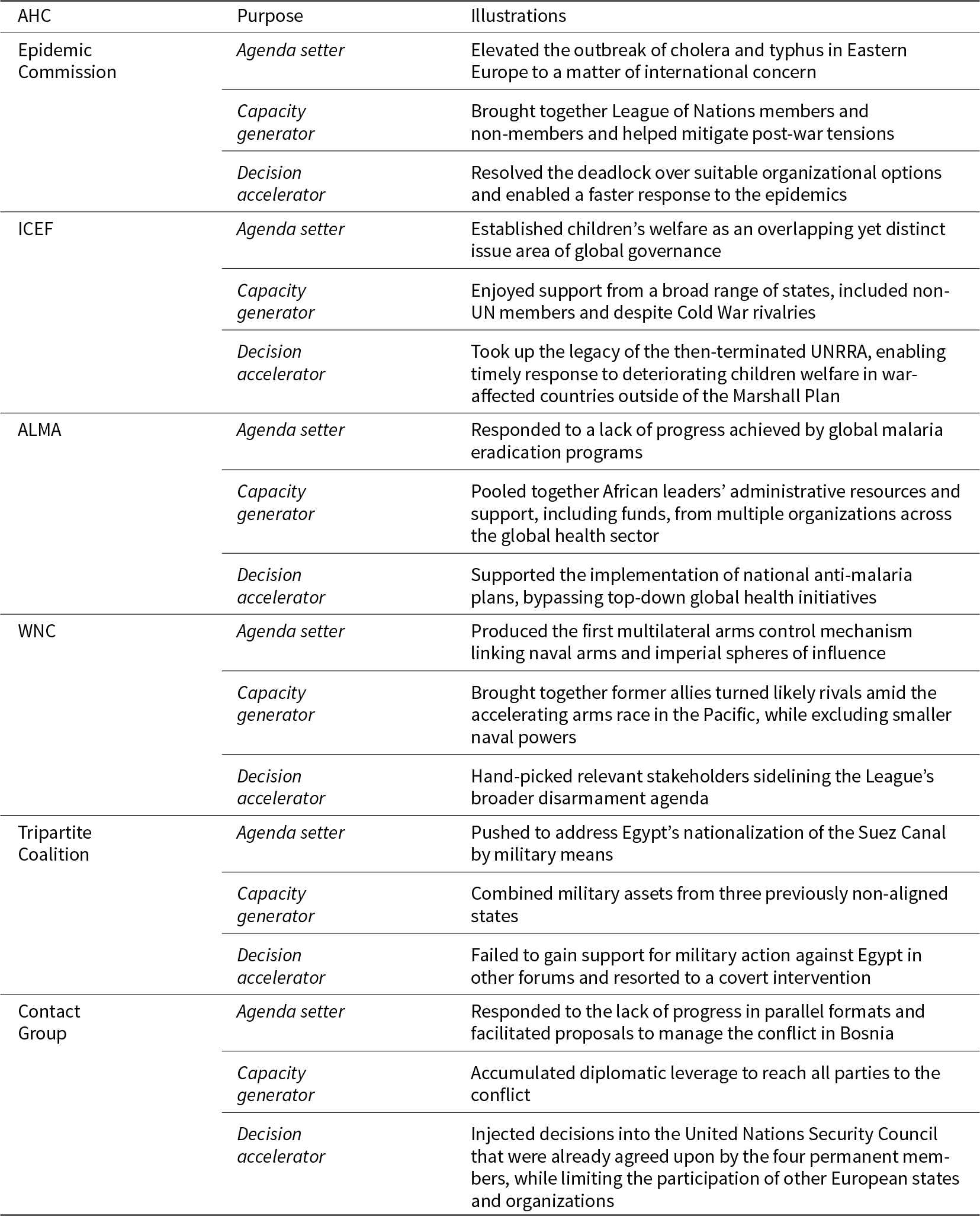
Table 3 Long description
The table lists six ad hoc coalitions (AHCs) and, for each, describes three recurring purposes: agenda setting, capacity generation, and decision acceleration, illustrated with concrete historical examples. The Epidemic Commission is linked to elevating cholera and typhus in Eastern Europe, convening League and non-League members, and breaking organizational deadlock for faster epidemic response. ICEF is tied to defining children’s welfare as a distinct global issue, sustaining broad state backing despite Cold War rivalry, and carrying forward UNRRA’s role to respond quickly in war-affected countries outside the Marshall Plan. ALMA is presented as reacting to stalled malaria eradication, pooling African administrative resources and cross-sector funding, and enabling national anti-malaria plans that bypass top-down initiatives. The WNC example emphasizes naval arms control and imperial influence, convening major powers while excluding smaller navies, and selecting stakeholders outside the League’s wider disarmament agenda. The Tripartite Coalition is framed around the Suez Canal crisis, combining three states’ military assets, and turning to covert intervention after failing to win support elsewhere. The Contact Group is shown addressing Bosnia when other formats stalled, building leverage with all parties, and channeling pre-agreed decisions into the UN Security Council while limiting broader European participation.
Agenda-setters
AHCs are a prime experimental vehicle for setting international agendas; they enable their participants to influence the framing of new policy issues. No matter which historical period or issue area, we observed actors pursuing their agendas through AHCs. The ICEF and WNC illustrate that AHCs, despite their temporary form, can shape not just international agendas but global policy trajectories more generally. For example, issues such as ‘children’s welfare’ and ‘naval disarmament’ have endured until today.
As a health AHC, the ICEF introduced the post-war condition of children in Europe onto the international agenda. In 1946, the United Nations Relief and Rehabilitation Administration (UNRRA) identified ‘the rehabilitation of the children … [as] of paramount importance for the achievement of recovery’ and that ‘such purpose might effectively and appropriately be served by the creation of an International Children’s Fund’.Footnote 34 The approaching end of UNRRA’s activities convinced governments to avoid delaying discussions as ‘any decision taken [later] will leave all too short a time for any International arrangement to come into effect, […] before the procurement of supplies by UNRRA comes to an end’.Footnote 35 Governments across the globe rapidly followed the call of technical experts and international bureaucrats to establish ICEF, pledging voluntary and temporary contributions to address the crisis.Footnote 36 In the words of China’s representative: ‘Of all the sufferers in the war, the ones who have suffered most and most innocently are also the children. If anybody needs and deserves help, they do.’Footnote 37 Thus, the state buy-in resulted in a new temporary configuration ‘for child health purposes generally’ that brought actors associated with the political West and East together to cooperate on this urgent international issue.Footnote 38
ICEF placed children’s emergency relief onto the international governance agenda by initially conceiving it as a broad policy issue that could group diverse state interests and expertise around different types of assistance, including health and food.Footnote 39 The envisioned geographical scope was soon broadened beyond Europe, attracting support from South American and Asian governments that pressed for inclusion.Footnote 40 Moreover, ICEF influenced the children’s healthcare agenda of the existing health organizations, such as the World Health Organization (WHO) and the Red Cross, which relied on ICEF’s implementation functions by providing it with vaccines, supplies, and technical expertise.Footnote 41 In this way, ICEF not only placed ‘children’s welfare’ on the international agenda but also broadened what counted as a global health issue, demonstrating how AHCs can frame new governance problems and build consensus around new issues.
Similarly, security AHCs set the terms of discussion and focused international attention on urgent issues, as seen in the case of the WNC. In this case too, an AHC served to frame an emerging concern as an issue requiring collective deliberation. In the immediate aftermath of the First World War, heads of states of major maritime powers such as the United States (US), Britain, and Japan recognized the urgent need to reduce the threat of a renewed war stemming from the naval arms race.Footnote 42 Spearheading the conference, the US insisted that ‘the problem of limitation of armament relate to Pacific and Far Eastern questions and … that the proposed conference on limitation of armament would be extended to include discussion of all Far Eastern problems by powers interested and that China would be asked to take part in that discussion. The conference should be held in Washington …’.Footnote 43 The US refused the British proposal to discuss the Pacific issues and naval disarmament separately, arguing that ‘[i]t would be quite a different matter to leave subject of limitation of armament to a second conference the holding of which might be entirely dependent upon success of first. Such chance should not be taken’.Footnote 44 Eventually, the US formula, which explicitly linked naval armament with stability in the region, convinced participating states to meet in Washington in a provisional framework.
The WNC produced naval disarmament agreements that shaped international discussions on the subject. Not only did the three great power treaties organize relations among signatory states until the late 1930s, but they also renewed discussions on the subject in the League of Nations. Britain particularly supported such negotiations in the League; in the words of British Commander John Mackey Hodge of the Disarmament Section, doing otherwise would risk ‘deal[ing] a very severe blow at the League of Nations’.Footnote 45 The League started using the WNC as a blueprint for its negotiations by focusing on a system of ratios to pursue maritime disarmament cooperation.Footnote 46 Preparatory work for a disarmament conference started in 1925 to expand WNC arrangements to involve non-participating states and to address non-maritime weapons, too.Footnote 47 The more permanent conference, however, never materialized due to exacerbated inter-state rivalries and the US absence during the negotiations.Footnote 48
Capacity generators
Both health and security AHCs served their members as capacity generators. AHCs can bring together both like-minded actors and rivals. In other words, by pooling capacities, AHCs can influence who is included and who is excluded. ALMA and the Contact Group were instrumental in generating additional capacities for their members across governance challenges, whether in the form of funds or diplomatic leverage, sustaining a joint approach despite divergent positions. Across these cases, AHCs generated capacities for collective action by pooling resources, thereby managing existing political rivalries and tensions.
In the health realm, ALMA brought together African leaders and global health experts to address malaria in Africa. The first ALMA President, Jakaya Mrisho Kikwete, called on all the continent’s leaders to move beyond regional animosities and pool capacities in a renewed campaign against malaria: ‘Malaria can be prevented, cured, controlled and eliminated in Africa. Many countries in the world have done so; why not us in Africa?’Footnote 49 On the one hand, limited to African state leaders, the coalition relied on their political will and administrative capacities. Overcoming intracontinental tensions, ALMA even included African states suspended from the AU, such as Burkina Faso, Mali, and Niger. On the other hand, ALMA drew on the resources of a diverse network of international partners and donors, including United Nations (UN) agencies (e.g., WHO, UNICEF), regional FIGOs (e.g., AU, Regional Economic Communities), private foundations (e.g., Bill and Melinda Gates Foundation, BMGF), and country-led initiatives (e.g., US President’s Malaria Initiative, PMI). Following a capacity-based logic, ALMA boosted the ability of African governments to act collectively on malaria eradication.
In the security domain, AHCs have also helped coordinate efforts among participants with different capabilities and motivations. The Contact Group brought Russia to the table to pressure Serbia’s Milošević government, acquiring an additional asset despite divergent positions between European actors, the Washington, and Moscow.Footnote 50 Intensifying diplomatic pressure from different sides reflected the widespread perception that military involvement should come together with ‘a negotiated settlement … [so that] a lasting peace can be achieved’.Footnote 51 In this context, the Contact Group could steer international leverage by combining diplomatic resources and put pressure on all parties involved in the war in Bosnia to pursue the ‘goal of securing a durable political settlement’, which monitoring and implementation were envisioned to rest upon the shoulders of the United Nations Protection Force (UNPROFOR) or the North Atlantic Treaty Organization (NATO).Footnote 52 The Contact Group for the Balkans bridged opposing views on the conflict. As NATO members, the Western states participating in the Contact Group had common positions on European security and the Balkan wars, while Russia maintained closer ties with Serbia and opposed a Western intervention. By keeping the circle small, Presidents Clinton and Yeltsin agreed that the division of diplomatic activities within the Group would mean that ‘we can bring a successful conclusion to the crisis in Bosnia.’Footnote 53
Decision accelerators
Engaging in ad hoc organized cooperation enables participants to speed up decisions over urgent policy challenges. Where IOs were deadlocked, passive, ineffective, or too generic, both health and security AHCs helped accelerate independent solutions to pressing issues.
In health, the Epidemic Commission eased up political tensions by bringing together states recently at war, namely the Entente powers, as well as Germany, Austria, and Bulgaria. It also smoothed over disagreements about which existing organization should have dealt with the 1919 sanitary crisis in Central and Eastern Europe. The British proposal to address the crisis involved creating a permanent body ‘to advise the League on questions affecting the health of nations.’Footnote 54 However, the proposal faced resistance not only from other states but also from existing IOs. The Red Cross and the International Office of Public Hygiene (OIHP) opposed the formation of new permanent arrangements with overlapping mandates.Footnote 55 The temporary nature of the Commission offered a framework to make rapid decisions about how to address the health crisis and ameliorate previous uncoordinated, inefficient, and costly efforts, bypassing concerns over which existing organization should be prioritized.Footnote 56 As such, governments agreed that ‘at any time that the whole or part of its organisation […] for the purposes here in question should he withdrawn’ once it had solved its tasks.Footnote 57 The League’s Secretary General, in his letter to Balfour, highlighted the salience of the issue: ‘[T]he problem is of such magnitude that nothing short of official action of Governments can meet the case.’Footnote 58 At the third session of the Council of the League of Nations in 1920, state representatives agreed to set up a temporary mechanism given that ‘it is urgently necessary that the question of the spread of typhus in Poland should be taken in hand at the earliest possible moment’.Footnote 59
Similarly to the health domain, time pressures and institutional blockages prompted states to act through AHCs to respond to shared security challenges. The Tripartite Coalition emerged after British and French plans to militarily intervene in Egypt failed to receive broader international support. Initially, France and Britain sought a collectively supported military solution to the Suez Crisis through the two London Conferences,Footnote 60 NATO, and a series of diplomatic consultations with the US.Footnote 61 However, the US maintained that the military option should be ‘relegated to the background’Footnote 62 and advocated for legal or technical settlement of the dispute.Footnote 63 As a result, the Franco-British collusion with Israel was formed outside established formats of cooperation, where it was possible to take rapid decisions about the situation. The Tripartite Coalition enabled Britain, France, and Israel to coordinate their intervention in Egypt in secret, without interference from other countries or organizations. The Tripartite Coalition could take rapid action to address a perceived common challenge, even though speed came as a costly trade-off that sacrificed legality and legitimacy, deepening the (geo)political crisis.
Leadership and the afterlife of AHCs
While AHCs, in general, are a primary vehicle for exploratory governance, serving as agenda setters, capacity generators, and decision accelerators at once, we also can observe how AHCs differ. At the root of these differences lies how salient political leaders deem a governance challenge. The more salient it is for most governments involved, the more likely they wanted to steer the AHC, and this also impacted the AHC’s afterlife. Empirically speaking, we find that while bureaucrats and experts are more likely to steer health AHCs, political leaders remain in charge of security AHCs. However, some health challenges also have become more salient with time, changing AHCs’ composition. This variation has implications for how an AHC can manage political rivalries, and for the afterlife of such temporary arrangements.
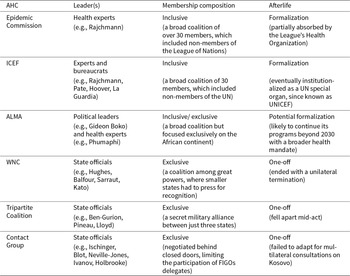
When political leaders deemed the issue salient, they stayed in the lead. They tended to form more exclusive AHCs that would bring rivals together only temporarily. This is particularly evident in security AHCs. In our cases, security AHCs only existed as long as powerful political actors, such as heads of states or cabinet members, deemed them necessary; such alliances quickly fell apart, often exacerbating (geo)political tensions. This made politically driven coalitions more contingent and precarious. When AHCs were led by experts and bureaucrats, they tended to be inclusive with regard to membership – and also cooperation with the existing organizations. In the case of our three health AHCs, this technocratic expertise often expanded their cooperation mandates and membership over time, easing political tensions. The perceived low salience of the issue at stake enabled experts to maintain cooperation among rivals, up to the point where the AHC was likely to become formalized and lose its ad hoc character. Issue salience, however, is not (necessarily) policy-contingent. In fact, the case of ALMA stands out as a mixed AHC jointly governed by heads of state and health experts. The moderate salience of malaria eradication across African countries suggests that political leadership was likely to limit delegation to bureaucratic personnel or experts in setting up AHCs, while still bringing together regional rivals to address urgent policy issues. However, the technical expertise required to address health emergencies provided room for inclusivity and scope expansion. We now turn to show how issue salience influences leadership decisions, which in turn shape membership composition and influence the AHCs’ afterlife. The full list of our findings is presented in Table 4.
Leadership impact in AHCs.
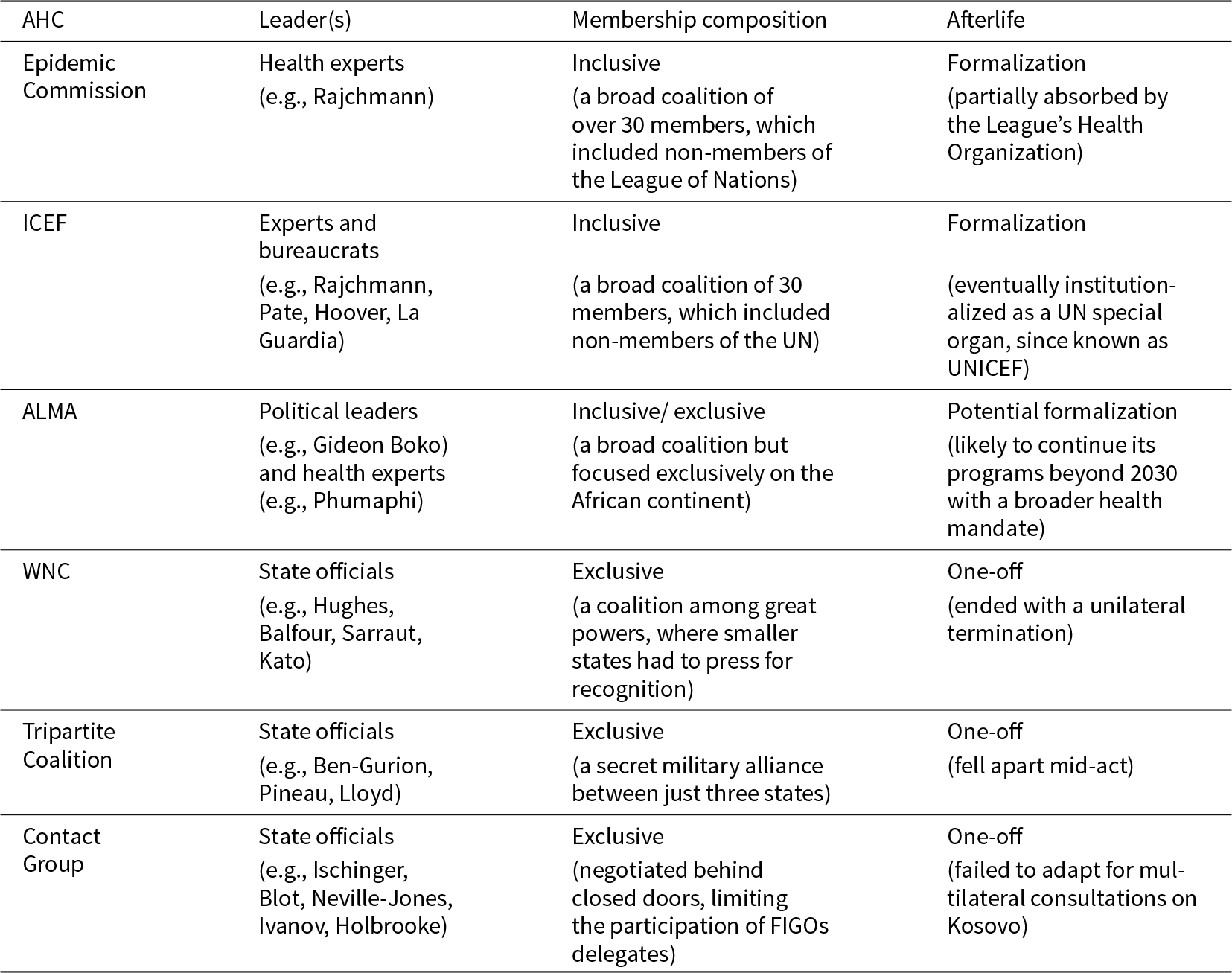
Table 4 Long description
The table compares six ad hoc health-related coalitions by their leaders, who was included in membership, and what happened afterward. Two expert-led bodies, the Epidemic Commission and ICEF, had inclusive coalitions of about 30 or more members and later became formalized within larger international organizations. ALMA combines political leaders and health experts, is broadly inclusive but limited to Africa, and is expected to continue beyond 2030 with a wider health mandate, suggesting possible future formalization. Three state-official-led groups, the WNC, Tripartite Coalition, and Contact Group, are described as exclusive, with membership restricted to great powers or a small set of states and limited participation by other delegates. These exclusive, state-led groups are characterized as one-off efforts that ended through unilateral termination, collapse during implementation, or failure to adapt to broader multilateral consultation. Overall, the pattern links inclusive, expert-driven leadership with institutionalization, and exclusive, state-driven leadership with short-lived outcomes. Membership descriptions are qualitative and include examples of leaders rather than complete rosters.
Issue salience, coalition membership, and moderation of rivalries
Tracing how political leadership or bureaucrats and experts played out in managing low or high salient issues in health and security governance challenges, we show that AHCs have often moved beyond established rivalries – at least temporarily. We thereby observed that health AHCs tend to be generally more inclusive than security AHCs.
In the case of ICEF, health experts and UNRRA bureaucrats assumed a leading role in making the case that children’s health called for a broad coalition. It emerged as a response to the US withdrawal from UNRRA, whose budget was mostly funded by Washington and allocated for post-war relief assistance to communist China.Footnote 64 Facing termination of the organization’s mandate, UNRRA officials pushed to set up a new mechanism that could assume its legacy by releasing field reports pointing to poor living conditions and deteriorating health levels, especially among children, to convey the urgency of the situation.Footnote 65 While the US did not consider this issue salient and ‘even questioned whether it was possible at present to demonstrate that any relief needs requiring external foreign exchange assistance would exist in 1947’, UNRRA bureaucrats mobilized expert reports ‘at least informally with FAO, The [International Monetary] Fund, the [World] Bank, and possibly the Sub-Commission on Devastated Areas, the elements required for such an estimate […] to be made available, directly or indirectly, for these purposes …’.Footnote 66
The technical expertise in public health, administration, post-war rehabilitation, and food programming helped ICEF bridge ideological and (geo)political rivalries. Among the experts who spearheaded the ICEF as a temporary child welfare organization were: Ludwig Rajchmann, the Polish representative in UNRRA, an entrepreneurial figure behind the Epidemic Commission, and a respected health expert in the League of Nations; Fiorello La Guardia, the UNRRA Secretary General and former mayor of New York; Maurice Pate, an UNRRA child health expert who previously led the Commission for Polish Relief and later became the first director of UNICEF; and Herbert Hoover, a former US president also known as the director of the American Relief Administration.Footnote 67 Under the slogan ‘There are no enemy children’, these experts managed to overcome US hesitance, including around sending funds to post-war China, and establish the ICEF.Footnote 68 The primacy of experts was enshrined in the founding resolution stating ‘that at no time should relief supplies be used as a political weapon’.Footnote 69 Eventually, the proposal received support from Brazil, Britain, China, France, and the Soviet Union and was therefore seen as ‘effective in promoting goodwill between the East and the West’.Footnote 70
At the same time, some AHCs can enable lead states to exclude others, keeping the circle small for high-stakes political negotiations and actions, exacerbating (geo)political rivalries. Conceived as flexible frameworks to quickly address security governance problems, security AHCs tend to exclude ‘small’ states and non-governmental actors from discussions when they are driven exclusively by political leaders like heads of state, heads of government, diplomatic and military officials, and other official state representatives. In this sense, US leadership of the WNC; the Tripartite engagement between Britain, France, and Israel; and the few European states convening the Contact Group all operated as exclusionary coalitions.
In the case of the WNC, US leaders exercised their privilege to hand-pick former allies turned likely rivals, namely Britain, Japan, France (the Four-Power Treaty), and Italy (the Five-Power Treaty). In contrast, smaller naval powers had to press for recognition. While Italy eventually had its battleships paired to those granted to France,Footnote 71 and a few ‘small’ European states convinced the US government to be invited to Washington,Footnote 72 Soviet Russia and Germany remained sidelined – not only because they were facing international isolation after the war but also because they had lost most of their ships.Footnote 73
The US Secretary of State, Charles Evans Hughes, led the organization of the conference and assumed a key role in the negotiations. He rejected the British modifications to the proposal to ensure that the conference took place on US terms.Footnote 74 Signalling high issue salience, the British delegation approached the conference as too diplomatically delicate to leave to military officials.Footnote 75 At the conference, Britain was represented by Arthur Balfour, Lord President of the Council and former Prime Minister; France by Albert-Pierre Sarraut, Minister of the Colonies and former Governor-General of Indochina; and Japan by Baron Tomosaburo Kato, Minister for the Navy and war admiral. Baron Kato was prepared to give concessions on disarmament issues in return for assurances regarding Japan’s territories in the Pacific.Footnote 76 The declared focus on the ships’ ratios and tonnage barely masked the (geo)political interest in renegotiating their respective ‘spheres of influence’ in the region.
As high-level political negotiations continued behind closed doors, technical experts and the League’s bureaucrats were kept out. While the Temporary Mixed Committee (TMC) later sought to expand the conference’s blueprint such as the ratio system to more states,Footnote 77 Britain and the US disagreed whether it should be led by the League or Washington.Footnote 78 As Hughes insisted that the expansion of the naval regime was a prerogative of the US administration,Footnote 79 the League’s preparation for a new disarmament conference never came to fruition.Footnote 80
As our empirics demonstrate, issue salience is not intimately connected to the policy domain. Not all health governance challenges are automatically deemed low salience, nor are all security problems always understood as high salience issues. The case of ALMA illustrates how moderate salience attached to a health issue influences the management and afterlife of AHCs. We find that since malaria has been a moderately salient issue, the coalition has relied both on technical expertise and high-level political leadership. ALMA was set up as a broad continental coalition overcoming (geo)political divisions and including a plethora of diverse partners and donors, while still promoting a fixed geographic focus.
Before the Presidents of Tanzania, Uganda, and Zimbabwe officially inaugurated ALMA in September 2009, health experts had to push malaria up the agenda for African leaders. In their reports presented in international fora, experts pointed out ‘moderate progress’ on malaria eradication, which did not enjoy as much political and financial support as other health issues.Footnote 81 They called for increased ‘practical leadership at national, regional, and continental levels’ and more efficient ‘resource mobilization’Footnote 82 – which eventually became ALMA’s raison d’être. Global health experts called on African leaders to renew their political commitment to combatting malaria, as they reported that the ‘countries with higher standards of governance and stronger health systems receive multiple sources of external financing, while those with unstable governments or civil unrest receive very little’.Footnote 83
African state leaders responded to this call, announcing the creation of ALMA. Addressing their counterparts at the UNGA, President Kikwete recognized that malaria remains a ‘number one killer disease in Africa’Footnote 84 and President Mugabe stressed that it is ‘yet another still-formidable challenge’, which requires a strengthened commitment on the part of the international community and national Governments.Footnote 85 Unlike in other health AHCs, political leaders in the case of ALMA did not fully delegate the reins to experts and bureaucrats. Instead, the coalition – currently led by Duma Gideon Boko, the President of Botswana, and Joy Phumaphi, the Executive Secretary of ALMA, a global health leader, a former health minister, and a former WHO officialFootnote 86 – remains a mixed leadership AHC. While the implementation of a malaria eradication initiative still required medical know-how, the increasing political salience of this health emergency resulted in co-leadership of political leaders and health experts.
The afterlife of AHCs
Distinct leaderships not only shape how inclusive or exclusive AHCs can be, but also whether or not the emerging cooperation outlasts its temporary nature. We observe that experts in health AHCs often pursued the formalization of cooperation, persuading state representatives to extend their mandate based on the achieved results. The Epidemic Commission was eventually subsumed by the League’s Health Organization, ICEF was institutionalized into UNICEF, and ALMA expanded its mandate beyond malaria and is likely to continue its activities beyond 2030. In contrast, political leaders’ willingness to carry on with security AHCs was often short-lived. Japan terminated the Washington naval arrangements in 1936, no longer satisfied with the imposed limitations. The Tripartite Coalition fell apart in the middle of the invasion as Britain, France, and Israel faced strong international pushback, including from the US. The Contact Group collapsed once a NATO-led intervention became the primary policy option.Footnote 87 After Russia left the group, its Western members moved onto the Quint format while maintaining contacts with Moscow in the Group of Eight.Footnote 88
These differences stemmed from the imprint of diverse leaderships in AHCs, which depended on perceived issue salience. Technical experts in the Epidemic Commission, for instance, convinced governments to expand cooperation beyond measures in Poland. In 1921, the medical experts managed to shift the focus to Greece, Latvia, and Soviet Russia, where the sanitary conditions were worsening.Footnote 89 Medical experts and even state representatives from Asian and South American states drafted reports affirming the incidence of cholera and plague in Asia to try to convince Western states to address the health crisis there, too.Footnote 90 However, they could do little when the political interest of states in the Commission started to wane, which determined the end of its mandate in 1923. However, it was the bureaucrats in the Health Committee of the League who proposed integrating the Epidemic Commission into the League’s own structures, so that it could finish its activities in Poland and Russia with enough financial means.Footnote 91 This proposal prompted the League to eventually establish the Far Eastern Branch of the Health Organization as a sub-committee of the Health Section. It was charged with working as a monitoring centre, rather than continuing the activities of the Epidemic Commission.Footnote 92
Technical and managerial experts at ICEF also proved creative in expanding their activities and functions. Despite growing US dissatisfaction with ICEF, since it considered the sanitary crisis over, ICEF’s staff maintained its main donor’s interest in its operations by expanding them to South American and Asian states.Footnote 93 This increased support for its mandate from both the US and Global South governments and prompted proposals for integrating ICEF into the UN system as a permanent agency, which was voted on unanimously on 7 October 1953.Footnote 94
Conversely, security AHCs hardly seem to pass the test of time, eventually failing to overcome (geo)political rivalries. The WNC treaties could not be integrated into existing discussions in the League. Moreover, the WNC did not stop Japan from unilaterally withdrawing in the lead-up to the Second World War. The Tripartite Coalition dissolved facing wide international condemnation, making the UN the main arena to deliberate the Suez crisis, which ultimately deployed the multinational Emergency Force (UNEF) in the region.Footnote 95 While the Contact Group became a viable alternative to decision-making and information-sharing in FIGOs, it lost its importance after the Dayton Agreement. The coalition fragmented further once Russia left the Group, as tensions escalated over a NATO intervention in Kosovo.
Once again, coalition dynamics are different in the case of ALMA, which combines both political and technical leadership. This duality is evident in quarterly scorecards for accountability and action in malaria eradication produced by the ALMA Secretariat.Footnote 96 On the one hand, politicians can ‘score points’ showcasing their success with ALMA scorecards, which creates an impetus to keep a narrow focus on malaria.Footnote 97 On the other hand, ALMA experts have already managed to expand their mandate beyond this narrow focus, first to other tropical diseases and later to support the reproductive, maternal, neonatal, child, and adolescent health and nutrition campaigns.Footnote 98 Like other health AHCs, ALMA seems to be on the trajectory towards further integration and formalization. Other contemporary health AHCs, such as the ACT Accelerator, also continue their activities even after the peak of the COVID-19 crisis passed.
Conclusion
AHCs are a persistent feature of international cooperation that address transnational policy and governance challenges, often as first exploratory responders. Yet they are more than that. As we have shown, their organizational features enable actors to forge unlikely issue-specific alliances, bring rivals at least temporarily together, and to respond to the disengagement of major powers such as the US. As such, they are an organizational approach that deserves greater analytical attention in debates about both international cooperation and global political dynamics, often captured with the term ‘international order’.
We have shown that, overall, AHCs have emerged to address and frame new governance issues, generate capacities bridging (geo)political tensions, and accelerate decision-making by bypassing existing multilateral organizations. They are a welcome testing ground for more formal or otherwise cost-intensive forms of international cooperation. At the same time, AHCs can exhibit varied governance models evident across time and issue areas depending on the perceived salience of the problem they were designed to address. Notably, security AHCs are often led directly by political leadership and can manifest exclusionary dynamics, while health AHCs rely more extensively on technocratic expertise. This not only has implications for how they are managed but also their afterlife. We have found that the more AHCs mask underlying political agendas and include additional stakeholders, the more likely that are that they will expand their mandate in time and scope.
Since AHCs have been part of international cooperation for at least a century, they cannot unequivocally be linked to the present transformation and ongoing contestation of the international order. In studying their creation and execution, this paper has started to investigate the implications for the broader field of international cooperation. In the context of current debates about the demise of the ‘liberal international order’ and the ‘return of (geo)politics’,Footnote 99 our focus on AHCs suggests that the degree of disruption to the ‘normal’ has been overemphasized.
While this paper contributes to research on the effects of AHCs, it also raises further questions. Firstly, it puts recent work suggesting that AHCs contribute to further fragmentation and de-institutionalization of global governance into a historical and policy problem perspective.Footnote 100 We examined cases of successful AHCs transitioning into FIGOs (e.g., UNICEF) and cases of failed AHCs, which highlighted the value of existing IOs as more politically transparent forums (e.g., the Tripartite Coalition). Secondly, the co-existence of technocratic and security-based solutions in global health governance, such as seen in the case of ALMA, makes AHCs an increasingly valuable tool for competing coalition leaders to advance through international cooperation. Thirdly, given that AHCs are frameworks with limited accountability,Footnote 101 their existence raises broader questions about the most appropriate and legitimate means of global governance. Thus, future research could further investigate the conditions under which AHCs are more likely to fail or formalize, how AHC leadership might expand or shrink the policy space, and how their prevalent use impacts exclusion and inclusion practices and dynamics in global governance.
Acknowledgements
We are thankful to the archivists of the League of Nations Archives, the United Nations Digital Library, and the Historical Archives of the European Union for their help, and thankful for the generous funding from the ADHOCISM project. We would also like to thank the participants of the ‘Shifting Powers, Shifting Roles’ workshop (European University Institute, Fiesole, 19 May 2025), the ‘Alternative Forms of International Cooperation’ panel (International Studies Association Annual Convention, San Francisco, 3–6 April 2024), and the ‘Global Crisis Governance in Times of Uncertainty’ workshop (European Workshops in International Studies, Amsterdam, 12–14 July 2023) for all their useful comments. We would also like to express our gratitude to Farrah Hawana for her editing assistance.
Appendix A
List of all AHC cases found in the archives:
1. The Epidemic Commission (1920–1923)
2. The Washington Naval Conference (1921–22)
3. The International Children’s Emergency Fund (1946–1953)
4. The Neutral Nations Supervisory Commission (1953–p.d.)
5. The Tripartite Coalition for the Suez Crisis (1956)
6. The Western Contact Group on Namibia (1977–1982)
7. The Multinational Force in Lebanon (1982–1985)
8. Roll Back Malaria (RBM) Partnership (1998–p.d.)
9. GAVI Vaccine Alliance (2000–p.d.)
10. African Leaders Malaria Alliance (ALMA) (2009–p.d.)
11. The Access to COVID-19 Tools (ACT) Accelerator (2020–p.d.)
12. The Contact Group for the Balkans (1994–1999)
13. Operation Allied Force in Kosovo (1999)
14. Operation Enduring Freedom in Afghanistan (2001–2014)
15. Operation Iraqi Freedom (2003–2011)
16. The Six-party Talks on North Korea’s Nuclear Program (2003–2006)
17. The International Military Intervention in Libya (2011)
18. The Iran Deal (2013–2018)
19. The Global Coalition against Daesh (2014–p.d.)
20. The Ceasefire Monitoring Group in Artsakh/Nagorno-Karabakh (2020–2024).

 Open access

