


Wolves Canis lupus are resilient and intelligent predators that have adapted and flourished in a range of habitats, from the Arctic tundra to the Arabian deserts, yet they are locally extinct in parts of their former range (Mech & Boitani, Reference Mech and Boitani2010a). In Asia, wolves are distributed across central Asia from the Trans-Himalayan region of India, Nepal and Tibet to the northern parts of Mongolia and the Korean Peninsula (Pocock, Reference Pocock1941). The species is categorized as Least Concern on the IUCN Red List (Mech & Boitani, Reference Mech and Boitani2010b) but the subspecies Canis lupus lupus (hereafter referred to as the grey wolf) is categorized as Critically Endangered in Nepal and is included on the country's list of protected animals (GoN, 1973; Jnawali et al., Reference Jnawali, Baral, Lee, Acharya, Upadhyay and Pandey2011). Despite its Critically Endangered status, research on wolf biology in Nepal has been limited (Baral & Shaha, Reference Baral and Shaha2008; Jnawali et al., Reference Jnawali, Baral, Lee, Acharya, Upadhyay and Pandey2011), as have conservation efforts for the species in the Nepalese Himalaya. We studied grey wolf distribution in the region and refined the existing distributional map according to IUCN guidelines, on the basis of landscape characteristics and habitat types.
The Himalayan mountain range spans 1,500 km along an east–west axis, with three complexes: eastern, central and western (Fig. 1). The range encompasses 10 protected areas, two of which (Shey Phoksundo National Park and Annapurna Conservation Area) overlap with the Trans-Himalayan region. The altitudinal range of the protected areas is 2,500–8,848 m. The rugged, high mountain peaks are characterized by barren, subalpine and alpine vegetation, whereas the Trans-Himalayan region is a rain-shadow area with undulating alpine steppes, sparse scattered shrub and barren patches (Jackson, Reference Jackson1996). The major carnivores of the Himalaya are the snow leopard Panthera uncia, Eurasian lynx Lynx lynx and common leopard Panthera pardus, and the major prey species are blue sheep Pseudois nayaur, Himalayan tahr Hemitragus jemlahicus, Tibetan antelope Pantholops hodgsonii, Tibetan gazelle Procapra picticaudata, argali Ovis ammon and kiang Equus kiang. The Tibetan community is the dominant ethnic group in the region.
Potential habitat of the grey wolf Canis lupus lupus across the Nepalese Himalaya, modelled using the MaxEnt algorithm (Phillips et al., Reference Phillips, Anderson and Schapire2006).

We employed a multi-pronged approach to gather information on the spatial distribution of the grey wolf in the Nepalese Himalaya. We used camera trap data (Jackson et al., Reference Jackson, Roe, Wangchuk and Hunter2005) from the Nepalese Government's flagship long-term monitoring programme, carried out during 2011–2015 in Kanchenjunga Conservation Area (c. 2,035 km2), genetic sequence data from opportunistic faecal surveys carried out in 2011 and 2014 across seven sites (c. 5,947 km2) in the western complex (Subba, Reference Subba2012; WWF, 2015), and published data on the occurrence (n = 8 occurrences) of the grey wolf in the central complex (Acharya & Ghimirey, Reference Acharya and Ghimirey2011; Jnawali et al., Reference Jnawali, Baral, Lee, Acharya, Upadhyay and Pandey2011; Chetri, Reference Chetri2014). We recorded two direct sightings, of three wolves, while surveying in Shey Phoksundo National Park (Subba, Reference Subba2012). We extracted bioclimatic variables (Hijmans et al., Reference Hijmans, Cameron, Parra, Jones and Jarvis2005; Phillips et al., Reference Phillips, Anderson and Schapire2006) for the spatial data on grey wolf presence to assess potential wolf habitat, and mapped a refined distribution across the Nepalese Himalaya using maximum entropy modelling in MaxEnt v. 3.3.1 (Phillips et al., Reference Phillips, Anderson and Schapire2006).
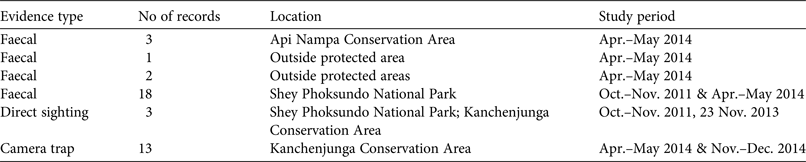
A total effort of 3,300 trap nights (Jackson et al., Reference Jackson, Roe, Wangchuk and Hunter2005; Alexander et al., Reference Alexander, Cusack, Pengju, Kun and Riordan2016) and 154 km of transect surveys yielded 40 records (camera traps, 13; faecal samples, 24; direct sightings, 3) of grey wolves at five sites in the Himalaya (Table 1; Fig. 1; Supplementary Plates S1 & S2). Grey wolves were also recorded along the high plains bordering Tibet in the Upper Mustang of Annapurna Conservation Area (camera trap; Chetri, Reference Chetri2014), Manaslu Conservation Area (direct sighting), and Dhorpatan Hunting Reserve (Jnawali et al., Reference Jnawali, Baral, Lee, Acharya, Upadhyay and Pandey2011; Fig. 1). The altitudinal range of grey wolf presence was 3,616–4,950 m. Wolves were recorded primarily in barren areas (40%), followed by alpine grasslands (38%) and alpine shrublands (22%). Sixty-five percent of occurrences were recorded in the Trans-Himalayan region, with the remainder recorded in the Greater Himalayan region. We estimate there is 28,553 km2 of potential wolf habitat throughout the Nepalese Himalaya (c. 73%), based on the presence data modelled with bioclimatic variables in MaxEnt (Fig. 1). The model output had high discriminative ability (area under curve =0.973), and the most important contributor was the mean temperature of the coldest quarter (41.1%; Table 2).
Records of grey wolf Canis lupus lupus (n = 40) from a survey conducted in the Nepalese Himalaya (Fig. 1) during 2011–2014, based on faecal samples, direct observation, and camera trap records.
Relative contribution of bioclimatic variables (top five) to the MaxEnt model used to map the potential habitat of the grey wolf in the Nepalese Himalaya (Fig. 1).

This was the first extensive study of grey wolves as part of the Nepalese government's snow leopard monitoring programme, and has confirmed their occurrence in the Himalayan and Trans-Himalayan regions. Field observations and previous records indicate a preference for alpine grassland and barren ecosystems, similar to other carnivores such as the snow leopard, Eurasian lynx and common leopard, with distribution across various habitat types. However, wolf distribution in the Churia (Siwalikhs in India) and Lesser Himalaya is unknown.
Wolves were recorded in Kanchenjunga Conservation Area in 2014, whereas they were not recorded by camera-trap surveys there during 2010–2013, indicating that the species may be colonizing this area from Tibet. The subpopulation previously known in Sagarmatha has not been recorded recently (B. Shrestha, pers. comm.). During our preliminary investigation in Kanchenjunga Conservation Area, local people were not supportive of conserving grey wolves as there is no compensation for livestock killed by wolves, as there is for snow leopards (Gurung et al., Reference Gurung, Thapa, Kunkel, Thapa, Kollmair and Műller-Boeker2011). Government guidelines for compensating for depredation of livestock did not originally include the grey wolf as a potential predator (GoN, 2012) but the species was added in the first amendment. However, in practice, compensation has not been provided, and therefore retaliatory killing of wolves as a result of human–wolf conflict is a threat to the long-term conservation of wolves in the Himalaya (WWF, 2014).
Another issue of relevance to wolf conservation is the ambiguous taxonomic status of Canis lupus in the Himalaya (Shrotriya et al., Reference Shrotriya, Lyngdoh and Habib2012). The wolves of Nepal are similar to Himalayan wolves of India, having similar morphological features and preferring similar ecological habitats, as evidenced by photographic records from camera traps (Supplementary Plate S2). Genetic studies in the Indian subcontinent have indicated that the wolf populations there are genetically unique, and a distinct species, the Himalayan wolf Canis himalayensis, has been proposed (Aggarwal et al., Reference Aggarwal, Kivisild, Ramadevi and Singh2007). However, the Himalayan wolf has not been categorized as a distinct species on the IUCN Red List (IUCN, 2015). Further analysis of genetic data (n = 21 samples) has shown evidence of both the Himalayan wolf (n = 8) and the Tibetan wolf Canis lupus chanco (n = 13; WWF, 2015). The taxonomic ambiguity of the Himalayan wolf is a subject for future research but the conservation of this predator should not be delayed until taxonomic issues are resolved using sophisticated techniques (Nowak, Reference Nowak, Wydeven, Van Deelen and Heske2009).
Multiple studies have highlighted conflict between people and snow leopards (Xu et al., Reference Xu, Jiang, Li, Guo, Da and Cui2008; Wegge et al., Reference Wegge, Shrestha and Flagstad2012) yet have failed to examine conflict with the snow leopard's co-predator, the grey wolf (Namgail et al., Reference Namgail, Fox and Bhatnagar2007; Jumabay-Uulu et al., Reference Jumabay-Uulu, Wegge, Mishra and Sharma2014). We have described the grey wolf's distribution across the Nepalese Himalaya, and identified potential retaliatory killing as a threat to the species’ survival. We recommend the establishment of a livestock insurance scheme and the effective implementation of the Government's guidelines for compensation, to discourage retaliatory killing. There is also a need for further investigation of wolf ecology, including its prey species, across the Himalayan landscape to inform action to ensure the long-term survival of this species.
Acknowledgements
We thank the Department of National Parks and Wildlife Conservation for granting permission to conduct this work, and protected area authorities, community institutions and local people for facilitating the research. We thank WWF UK, WWF US and USAID for funding the project. SAS is grateful to Lund University, the Rufford Small Grants Foundation and Lunds Djurskyddsfond for academic and financial support. We thank Dawa Gyangen Lama and Ang Phuri Sherpa for providing information on the grey wolf from Manaslu Conservation Area; Friends of Nature & Green Governance for conducting faecal surveys; Centre of Molecular Dynamics Nepal for the genetic laboratory work; and Marcella J. Kelly, Eric Wikramanayake and Shannon Barber Meyer for their comments on the manuscript.
Contributions
SAS, AKS and KT contributed equally to this article.
Biographical sketches
Samundra Subba is a wildlife researcher with a special interest in the ecology of terrestrial carnivores and their interaction with humans. Anil Shrestha's research focuses on mountain ecology and climate change. Kanchan Thapa is a conservation biologist with an interest in carnivore ecology and population dynamics. Sabita Malla is a wildlife biologist and has led research in Nepal's Terai. She has a special interest in carnivores and mega-herbivores. Gokarna Jung Thapa is a geographical information systems specialist whose research is focused on geospatial modelling. Sujeet Shrestha focuses on community engagement and biodiversity conservation. Shrota Shrestha focuses on community engagement. Naresh Subedi works on biodiversity research and monitoring programmes in Nepal. Gopal Prakash Bhattarai is an ecologist and is interested in biodiversity conservation. Richard Ottvall’s research is focused on carnivore ecology.



