


Introduction
Meat is a highly valued and socio-culturally significant food(Reference Koch, Heuer and Krems1) with valuable ingredients such as protein, vitamins and minerals(2). While it was formerly reserved for certain social groups and occasions, meat has nowadays become part of everyday nutrition for broad sections of the population in many western societies such as in Germany(Reference Koch, Heuer and Krems1,Reference Römer, Koch and Claupein3) .
The German National Nutrition Survey (NVS) II (2005–07) revealed that the mean daily consumption of meat, meat products and sausages in the German population was 116 g. This amount is considerably higher than recommended by the German Nutrition Society (DGE)(Reference Koch, Heuer and Krems1). This considerably higher amount applied particularly to men, young and middle-aged persons and persons with lower formal education. There is a wide range in meat consumption in Europe. The total mean meat intake in European countries range from 75 g/d (Sweden) to 211 g/d (Finland)(Reference Cocking, Walton and Kehoe4). Compared with the daily meat consumption of other European countries, Germany is in the middle range but higher as recommended. Longitudinal analyses from the NEMONIT study (2005/07–2014/15) showed that not much has changed in this situation: Meat consumption in Germany remained stable on a high level during the study period, even among subgroups of the population (groups differing in age, school education and attitudes towards animal welfare)(Reference Römer, Koch and Claupein3).
There are many discussions about different factors like health or environmental factors to reduce the meat consumption. As a consequence, during the last decade, the recommendation to eat ‘less’ meat became more and more common, going up to a transformation of the nutrition towards more plant-based diets. This was shown, for example, in a growing importance of plant-based meals. In 2016, in the German universities, more than 50 % of the meals are vegetarian or vegan(Reference Meyer auf der Heyde5). Also in company canteens, in the last years, more plant-based meals are offered(Reference Bohl AG and Kallsen-Mackenzie6). Current high meat consumption levels are problematic due to animal welfare concerns and public health risks but also due to negative effects on the environment, especially regarding climate change. It is estimated that meat production contributes to about half of the human-induced global greenhouse gas emissions(Reference Goodland and Anhang7) and to about 30 % of the human-induced biodiversity loss(Reference Westhoek, Rood and Van den Berg8). Beside environmental factors, it was well known that meat has not only valuable ingredients(2). A high meat consumption is associated with less favourable health-related characteristics(Reference Aston, Smith and Powles9–Reference Key, Appleby and Rosell11). It is discussed to be responsible for different diseases like coronary heart disease and different types of cancer(2,Reference Aston, Smith and Powles9,Reference Linseisen, Kesse and Slimani10,Reference Bernstein and Walter12,13) .
However, consumers underestimate the benefit of a lower meat consumption(Reference Lea and Worsley14). Additionally, they also show a rather low willingness to reduce meat consumption as compared with other options for action in the field of sustainable nutrition and perceive reducing meat consumption as difficult to implement(Reference Lea and Worsley14–Reference Tobler, Visschers and Siegrist18). For example, a working group in the UK conducted focus groups and interviews to analyse the willingness to reduce meat consumption as part of a sustainable diet. Changing non-food-related behaviours are more acceptable than food-related behaviours, because meat plays an important role in the diet. If healthy, sustainable dietary habits are to be achieved, dietary recommendations must integrate cultural, social and personal values around eating meat(Reference Macdiarmid, Douglas and Campbell16). This confirms, what was also described by others, eating meat is a traditional and dominant eating pattern, with cultural and symbolic meanings(Reference Leroy and Praet19). This suggests that the reduction of meat consumption to a healthy and sustainable level should be addressed also in attitudes, perceptions and behaviours in health promotion programmes. Therefore, the aim of the present study was to expand the knowledge on German consumers’ attitudes, perceptions and behaviours regarding meat consumption to identify barriers for strategies on reduction of meat consumption in societies with high meat consumption. Based on cross-sectional data of the fourth survey year of the NEMONIT study (2012/13), consumption behaviour, willingness to reduce meat consumption, meal structures, motives for meat consumption, social norms regarding meat consumption and general purchasing criteria were analysed.
Methods
Study design and participants
The NEMONIT study (2008–15) is a nationwide longitudinal study designed to provide a continuing examination of nutritional behaviour of German adults. NEMONIT participants were recruited from the German National Nutrition Survey II (NVS II 2005–07), a representative study of the German population providing information on food consumption and nutrient intake. Up to survey year 2012/13, 9232 participants of the NVS II aged 18–80 years were invited to participate in NEMONIT, because they had completed at least one 24-h recall and were willing to participate in further studies. In total, 2749 participants were recruited for annual assessments of food consumption and nutritional behaviour. In the following survey years, about 2000 participants took part in the annual assessments. Information was obtained on food consumption, energy and nutrient intake, use of dietary supplements, socio-demographics as well as lifestyle and health characteristics using two 24-h telephone recall interviews and an additional computer-assisted telephone interview (CATI). A detailed description of NEMONIT has been published previously(Reference Gose, Krems and Heuer20). The NEMONIT surveys were approved by the German Federal Data Protection Office. Respondents were informed in detail about the study objectives, interview and examination procedures as well as the handling of data records and analyses under pseudonymous conditions. It was made clear that participation was on a voluntary basis and could be terminated at any time. Participants provided informed written or verbal consent.
Besides repetitive assessments on food consumption, one-time topics were included in the single NEMONIT survey years. The present study is based on cross-sectional analyses of data collected in 2012/13. In the present study year, a focus was laid on sustainable handling of foods and meat consumption. 1807 participants 20 to 80 years of age completed all interviews in this year and were included in the study sample.
Socio-demographic characteristics, attitudes and perceptions
Information on socio-demographic characteristics and attitudes and perceptions with regard to meat consumption was obtained in the CATI. Socio-demographic characteristics include sex, age, school education (highest school-leaving qualification, recoded to years spent in school (≤9 years, 10 years and 12/13 years)) and household size (the number of people living in the household including children, recoded into single, two-person and multi-person households).
Questions regarding meat consumption behaviour focused on the consumption of particular types of meat (meat, meat products and sausages), the hypothetically ‘desired’ meat consumption of participants and their social environment, the value of meat in an ideal meal and the motives for meat consumption as well as the self-definition as vegetarian (including vegan, lacto-vegetarian, ovo-vegetarian, ovo-lacto-vegetarian and pesco-ovo-lacto-vegetarian), whereby the questions on individual meat consumption were only posed to meat consumers.
Information on general purchasing criteria was collected in a complementary telephone interview in the same survey year.
Meat consumption
To assess food consumption, two non-consecutive 24-h recalls were conducted by phone using the software EPIC-SOFT(Reference Slimani, Deharveng and Charrondiere21) (renamed GloboDiet in 2014). The daily consumed amount of ‘meat, meat products and sausages’ (unprocessed meats, meats processed for conservation and/or refinement and mixtures of chopped meat, fat tissue and flavouring ingredients) was calculated as the average intake of these foods on both recall days.
In addition, a food-frequency questionnaire (FFQ), which asked for the consumption frequency of 30 main food and beverage groups in the last year, was applied. Answer categories included ‘never’, ‘rarely’, ‘1 d/month’, ‘2–3 d/month’ (recoded to less than 1 d/week), ‘1–2 d/week’, ‘3–4 d/week’, ‘5–6 d/week’ and ‘daily’. The questionnaire was sent to participants and after a few days, the answers were recorded during the complementary telephone interview. The FFQ also covered the consumption frequency of the food group ‘meat, meat products and sausages’.
The amount of meat consumed as reported in the 24-h recalls was compared with the recommendation of the German Nutrition Society to eat no more than 300 to 600 g meat per week(22). According to their meat consumption behaviour, participants were categorised as (pesco-)vegetarians, low meat consumers and high meat consumers. Those not exceeding a daily meat consumption of 86 g/d (= 600 g per week) were coded as ‘low meat consumers’, those consuming more than 86 g/d were coded as ‘high meat consumers’. Among the self-defined vegetarians, consistency-checks were performed with food consumption data. Of fifty-four self-defined (pesco-)vegetarians, five consumed meat according to the 24-h recalls and/or the FFQ and were recoded as meat consumers.
Analysis
Descriptive analyses were performed on attitudes regarding meat consumption. Differences in these attitudes and meat consumption level were compared using χ 2 statistics. All statistics were performed using SAS 9.3 (SAS Institute, Inc.) and two-sided P-values below 0⋅05 were considered statistically significant.
Results
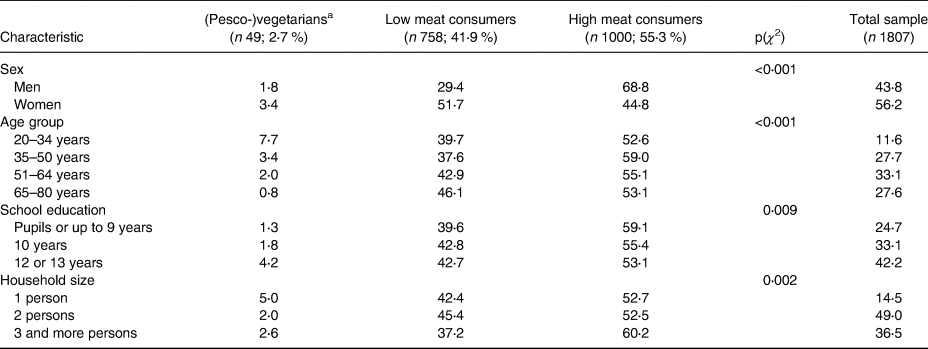
The characteristics of the study sample are presented in Table 1. The sample includes a higher proportion of females (56 %) than males. Participants’ mean age was 54 years and 42 % attained higher school education (12/13 years). Since NEMONIT participants were recruited from participants of the NVS II who were willing to take part in further surveys, there is a selection bias towards female, older and higher socioeconomic status participants(Reference Linseisen, Kesse and Slimani10), which needs to be considered when interpreting the data.
Characteristics of the study sample; NEMONIT 2012/13 (%)
NEMONIT study, survey year 2012/13.
a (Pesco-)vegetarians: vegan, lacto-vegetarian, ovo-vegetarian, ovo-lacto-vegetarian or pesco-ovo-lacto-vegetarian; low meat consumers: total meat consumption <86 g/d (as recommended); high meat consumers: total meat consumption ≥86 g/d.
Three percent of the participants were vegetarians (including pesco-vegetarians), 42 % low meat consumers and 55 % high meat consumers exceeding the maximum meat consumption recommended by the German Nutrition Society. The prevalence of (pesco-)vegetarians is higher among women, younger adults, individuals with higher school education and individuals living in single households, while the proportion of high meat consumers is higher among men, middle-aged adults, individuals with lower school education and individuals living in multi-person households.
Consumption of different types of meat among non-vegetarians
When asked for their consumption of particular types of meat in the CATI, 100 % of the non-vegetarians answered they eat meat, 98 % eat meat products and 97 % eat sausages. That means, that only a very small proportion declared to consume only meat and omit the higher processed meat products and/or sausages. This was slightly more common in low meat consumers. Of the low meat consumers, 4 % stated that they do not eat meat products and 6 % do not eat sausages, but only 1 % of high meat consumers stated that they do not eat meat products and 2 % do not eat sausages.
Weekly meat consumption
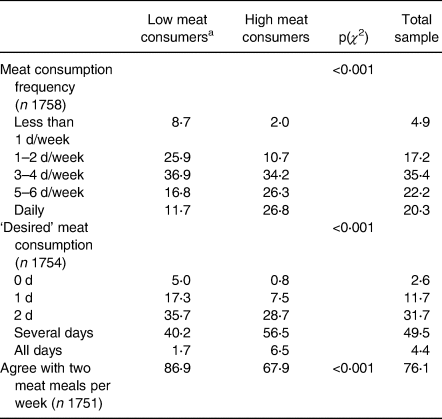
According to the FFQ, 5 % of the non-vegetarian participants consumed meat, meat products and sausages less than 1 d/week. With 35 %, the majority of participants consumed these foods about every second day. For the other categories, the consumption frequencies were between 17 and 22 % (Table 2). High meat consumers showed a considerably higher consumption frequency compared with low meat consumers: 26 % consumed meat, meat products and sausages on 5–6 d/week (low meat consumers: 17 %) and 27 % daily (low meat consumers: 12 %) (Table 2).
Meat consumption frequency (FFQ), ‘desired’ meat consumption, agreement with two meat meals per week among non-vegetarians, by meat consumption level; NEMONIT 2012/13 (%)
NEMONIT study, survey year 2012/13.
a Low meat consumers: total meat consumption <86 g/d (as recommended); high meat consumers: total meat consumption ≥86 g/d.
Hypothetically ‘desired’ meat consumption and willingness to reduce meat consumption
Non-vegetarian participants were also asked on how many days per week they want to eat meat with answering options ranging from no day to all days of a week (Table 2). The proportion of non-vegetarians who wanted to eat meat less than once a week was very low (‘desired’ meat consumption: 3 % and stated meat consumption frequency (FFQ): 5 %), but 12 % stated that they would like to eat meat on 1 d/week and 32 % stated that they would like to eat meat on 2 d/week (FFQ, 1–2 d/week: 17 %). About half of the participants wanted to eat meat on several days (3–6 d) a week (FFQ, 3–4 d and 5–6 d/week: 58 %) and only 4 % wanted to eat meat daily (FFQ: 20 %). Similar to the stated consumption frequency, the ‘desired’ consumption frequency was higher among high meat consumers.
Regarding the question whether they would agree with a maximum of two meat meals per week in the long run, 76 % of the non-vegetarian participants answered yes. This proportion was considerably larger than the proportion of participants who claimed that they want to eat meat on a maximum of 2 d/week (‘desired’ meat consumption: 46 %) and the proportion of participants who stated to eat meat on 1–2 d/week (FFQ: 17 %). The willingness to accept a lower number of meat meals differed significantly among groups. High meat consumers compared with low meat consumers were less willing to accept a maximum of two meat meals per week.
Perception of an ideal meal
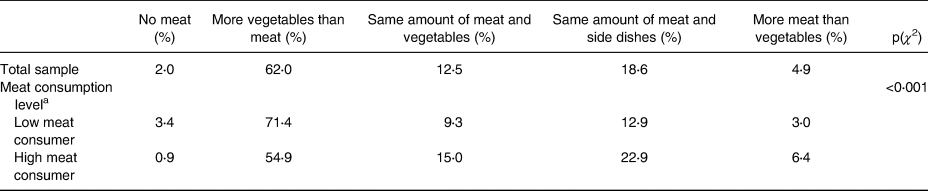
Being asked for their perception of an ideal meal, only 2 % of the non-vegetarian participants chose the option of a meal without meat. Sixty-two percent stated that the proportion of meat in an ideal meal should be lower than the proportion of vegetables. Thirteen percent preferred the same amount of meat and vegetables, 19 % the same amount of meat and side dishes and only 5 % preferred more meat than vegetables (Table 3). Meals with a larger proportion of meat tented to be more popular among high meat consumers.
Perception of an ideal meal among non-vegetarians, by meat consumption level; NEMONIT 2012/13 (n 1731)
NEMONIT study, survey year 2012/13.
a Low meat consumer: total meat consumption <86 g/d (as recommended); high meat consumer: total meat consumption ≥86 g/d.
Motives for meat consumption
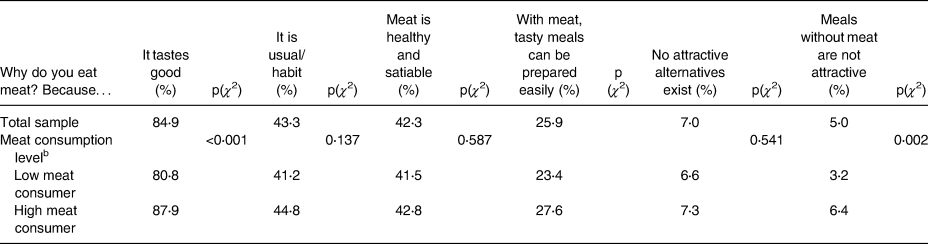
Eighty-five percent of the non-vegetarian participants stated to eat meat ‘because it tastes good’ (Table 4). Taste as a motive to eat meat was more often named among high meat consumers.
Motivesa for meat consumption among non-vegetarians, by meat consumption level; NEMONIT 2012/13 (n 1725)
NEMONIT study, survey year 2012/13.
a Multiple answers.
b Low meat consumer: total meat consumption <86 g/d (as recommended); high meat consumer: total meat consumption ≥86 g/d.
Forty-three percent of the non-vegetarian participants stated to eat meat ‘because it is customary in the family and because it is a habit’. Forty-two percent of the participants agreed to eat meat ‘because it is healthy and satiable’. Practical reasons to eat meat were less frequently mentioned in this survey but also matter: 26 % of the participants stated to eat meat, ‘because tasty meals can be prepared easily and without great considerations when using meat’. Only 7 % stated to eat meat ‘because no attractive alternatives exist’ and only 5 % stated to eat meat ‘because meals without meat were not attractive’.
Perceived social acceptance
The participants were not only asked about their own acceptance of a maximum of two meat meals per week but also to assess their social environment in this regard (Table 5). These assessments were also obtained from (pesco-)vegetarians. In general, the participants rated their own willingness to limit the number of meat meals relatively high compared with their assessment of other groups like their relatives, friends or the general population. Additionally, it was assumed that women (best female friend, mother) would rather accept limiting the number of meat meals per week than men (best male friend, father).
Perceived social acceptance of a maximum of two meat meals per week among (pesco-)vegetarians, low meat consumers and high meat consumers; NEMONIT 2012/13

NEMONIT study, survey year 2012/13.
a (Pesco-)vegetarian: vegan, lacto-vegetarian, ovo-vegetarian, ovo-lacto-vegetarian or pesco-ovo-lacto-vegetarian; low meat consumer: total meat consumption <86 g/d (as recommended); high meat consumer: total meat consumption ≥86 g/d.
The comparison of vegetarians, low and high meat consumers shows that the assessment of the immediate social environment (spouse, best male friend, best female friend) tends to comply with the own consumption behaviour: (Pesco-)vegetarians assumed a higher willingness to accept a maximum of two meat meals per week in their environment than low meat consumers who, in turn, assumed a higher acceptance in their environment than high meat consumers.
The assessment for the German population was clearly more negative than the self-assessment and the assessment of the immediate social environment: Only 17 % assumed that the German population would agree with a maximum of two meat meals per week.
Purchasing criteria
The information, which aspects are considered important when buying food, might shed further light on different underlying attitudes among vegetarians, low and high meat consumers. Altogether, aspects of freshness, health and sustainability were rated as important aspects when buying food while aspects of convenience were considered less important (Fig. 1).
Importance of purchasing criteria among (pesco-)vegetarians, low meat consumers and high meat consumers (χ 2 statistics). NEMONIT study, survey year 2012/13 (n 1807).

Although this tendency can be found among all groups, some remarkable differences were observed between (pesco-)vegetarians and low and high meat consumers. (Pesco-)vegetarians and low meat consumers tended to rate aspects of sustainability (seasonality, animal welfare, no genetically modified foods, few additives, ecological packaging, fair trade products and organically grown products) more important than high meat consumers. In return, (pesco-)vegetarians rated aspects of convenience (easy preparation, preparation instruction on packaging, easy to open packaging, easy to reach in the shop) less important than low and high meat consumers who rated these aspects relatively similar. Low meat consumers, however, rated health and the indication of ingredients and nutrients slightly more important than high meat consumers.
Discussion
In the present study, 42 % of the participants were categorised as low meat and 55 % as high meat consumers, according to the recommendations of meat consumption per day in Germany. Additionally, 3 % of the participants are non-meat consumers. An overall characterisation of non-meat, low meat and high meat consumers were already addressed in a previous paper based on NVS II data(Reference Koch, Heuer and Krems1). In this previous paper, it was also shown that especially men are less likely to abstain from meat and more likely to consume meat in exaggerated amounts. A higher meat consumption among men has been comprehensively reported in other studies(Reference Cocking, Walton and Kehoe4,Reference Aston, Smith and Powles9,Reference Linseisen, Kesse and Slimani10) . In addition to the overall characterisation, in the present study, it was shown that most of the participants stated to consume all types of meat like meat, meat products and sausages. This suggests that various forms of meat are commonly consumed and should also be considered in campaigns aiming to reduce meat consumption to the recommended level.
Usually, socio-demographic factors like sex, age and socioeconomic factors are used to describe differences in meat consumption(Reference Bedford and Barr23,Reference Hoek, Luning and Stafleu24) . However, in the present study, it could also be shown that differences in meat consumption might also be described by different attitudes and perceptions which will be discussed here. When participants were asked about their ‘desired’ or intended meat consumption frequency, it could be shown that this was lower than the stated meat consumption frequency assessed by the FFQ. This could be explained by the differences between asking about the desired consumption (wanting to do sth.) that surely provokes stronger socially desirable response behaviour than reporting the concrete consumption (doing sth.). But the discrepancy between both aspects might also indicate that the framework conditions to some extent do not motivate or enable people to turn their intentions into actions. This may also be explained by the fact that eating meat is a traditional and dominant eating pattern, with cultural and symbolic meanings(Reference Leroy and Praet19). The strong fixation on meat in parts of society can still make it difficult to abstain from it, for example, in family meals, in canteens and restaurants or in takeaway meals. Even though information on meatless alternatives and offers of vegetarian snacks and dishes in Germany generally increased during the last years(Reference Meyer auf der Heyde5,Reference Bohl AG and Kallsen-Mackenzie6) , this might not be applied and accepted equally to all regions and social environments.
The willingness to reduce meat consumption was rather high in the participants (76 %). Additionally, this proportion was larger compared with the proportion of participants who stated that they would like to eat meat on a maximum of 2 d/week or even ate meat on 1–2 d/week. Although effects of social desirability are likely to have influenced the answers to the question about willingness to reduce meat consumption, it must be acknowledged that a part of the participants seems to be open to the idea to limit meat consumption beyond current and desired consumption levels. The literature also provides promising results that parts of the European population have already reduced their meat consumption or are principally open to a behavioural change(Reference Austgulen, Skuland and Schjøll15,Reference Tobler, Visschers and Siegrist18,Reference de Boer, Schösler and Boersema25–28) . Especially consumers who already eat less meat were willing to (further) reduce their consumption(Reference de Boer, de Witt and Aiking29). Therefore, it is crucial to exploit the existing potential through supporting environments and corresponding options for action. For example, the conditions in the out-of-home eating sector could be adapted so that it is an accessible, common and tasty option to eat meat-reduced or meat-free meals. As it was described by Bohl(Reference Bohl AG and Kallsen-Mackenzie6), there are different possible actions to reduce the portion of animal products in meals like reducing the portion of meat and increase the portion of plant-based foods or to replace meat by meat substitutes. When changing the meals in canteens, it is important not to patronise the guests, but to present the positive aspects of the new vegetarian/vegan meals or meals with less meat to increase the acceptance. This underlines the importance to understand the attitudes and values of high meat consumers as less motivated but extremely important target group to be able to address them explicitly and appropriately.
Only 2 % of the non-vegetarian participants chose the option of a meal without meat when being asked about their perception of an ideal meal. This reflects the high status of meat in society: For the majority of the German population, a good and complete meal must contain meat, albeit in different proportions. For many consumers, meat is the necessary centre piece of a ‘proper meal’(Reference Austgulen, Skuland and Schjøll15) and the favourite part of their meal(Reference Dibb and Fitzpatrick27). The traditional western meal structure of meat accompanied by potatoes or other starchy side dishes, vegetables and gravy seems to be particularly popular among persons with high meat consumption(Reference Koch, Heuer and Krems1,Reference Schösler, Boer and Boersema30 ) and this traditional concept of an ideal meal does not leave a lot of room for flexibility and creativity for a meat-reduced or meat-free alternative. Accordingly, it is regarded as a barrier for the adaption of more plant-based diets(Reference Dibb and Fitzpatrick27). To reduce meat consumption to a healthy and sustainable level, a change of attitudes is needed in such a way that these traditional, ideal meals are reserved for special days, e.g. Sundays and holidays, as it was formerly the case and that other tasty meals without or with less meat gain a higher priority.
The results of the present investigation confirm that taste is one of the main motives for meat consumption in Germany(31). Taste followed by habit are often named as the main motives for (high) meat consumption in western countries(Reference de Boer, de Witt and Aiking29,Reference Schösler, Boer and Boersema30,Reference Mullee, Vermeire and Vanaelst32) . That it is healthy to eat (a lot of) meat is also a frequently reported motive by consumers(Reference de Boer, de Witt and Aiking29,Reference Schösler, Boer and Boersema30,Reference Mullee, Vermeire and Vanaelst32) . In the UK and the Netherlands, key barriers for non-users of meat substitutes were analysed. The unfamiliarity and the lower sensory attractiveness compared with meat and the tendency to avoid new foods are detected as key barriers in the group of non-users of meat substitutes(Reference Hoek AC, Weijzen and Engels33). Also, others described, that, meat substitutes are not accepted by everyone(Reference Bohl AG and Kallsen-Mackenzie6). Therefore, it is important that consumers are informed about the nutritional adequacy and the benefits of meat-reduced diets(Reference Dibb and Fitzpatrick27). Practical reasons to eat meat were less frequently mentioned in this survey but also matter. In recent expert interviews, it was also emphasised that a strength of meat is its tastiness without complicated preparation and that the attractiveness of meat alternatives is important for the reduction of meat consumption(Reference Clausen and Mathes34).
According to a survey on environmental consciousness in Germany, consumers seem to be more willing to reduce their meat consumption if the family agrees upon changing their habits(31). Impulses stimulating such discussions in families might be beneficial. To support these, objective information on the nutritional adequacy and the health and environmental benefits of meat-reduced diets is necessary.
The results of the present investigation show that the assessment for the German population with regard to accept two meat meals per week was clearly more negative than the self-assessment. This makes also clear that there is a large discrepancy between the self-assessment and the perception of the public mood. While the self-assessment might be positively influenced by social desirability, the public mood might be assessed too negatively due to the very emotional reactions of society on attempts to reduce meat consumption, which are often perceived as restraints.
According to Rothgerber(Reference Rothgerber35), an overestimation of the consumption behaviour of others may lead to a false perception of social norms as a reference for one's own behaviour. Therefore, a much more open and objective discussion of the topic is needed and less restraints (or initiatives that are perceived as such) which seem to have rather counterproductive effects. Instead options for action which consumers can implement in their daily routines are needed. Role models can also provide reasonable reference values and positively influence consumer behaviour.
The results on the purchasing criteria may indicate that (pesco-)vegetarians choose their food with particular regard to sustainability concerns, while low meat consumers balance their choices between sustainability, health and convenience aspects. For high meat consumers, taste might be particularly relevant when choosing foods, but this was not directly asked for here.
The group differences in attitudes are largely in line with consumption behaviour. Consumers eating more meat than recommended to a higher percentage stated to eat meat with different processing grades, they stated to eat meat more frequently, wanted to eat meat more often, were less willing to accept a lower number of meat meals per week, preferred meals with a larger proportion of meat, and more often stated to like the taste of meat and to find meals without meat unattractive. This consistency indicates that it might be very challenging to persuade consumers with high consumption levels to reconsider and change their behaviour.
Strengths and limitations
The study strengths include the relatively large nationwide sample and the detailed assessment of consumption behaviour complemented with varied information about attitudes and perceptions regarding meat consumption. A limitation is the selection bias towards female, older and more educated persons. Since women and older persons consumed less meat, the overall results might be slightly too optimistic in favour of the reduction of meat consumption. Socially desirable response behaviour might have biased the results towards the same direction. Additionally, the present analysis is based on cross-sectional data, which does not allow interpretations about causality.
Conclusion
The present study aimed to expand the knowledge on German consumers’ attitudes, perceptions and behaviours regarding meat consumption. The results showed that gender-specific patterns still shape behaviour, preferences and attitudes with regard to meat. They also underlined the social significance of meat and support previous results in this regard: Meat is a part of everyday diet among Germans, and among the majority, an ideal meal should contain meat because it tastes good and is perceived healthy and satiable. Besides, it is a – perhaps in everyday life largely unreflected – habit to eat meat. In families and other social environments, meat eating is, in most cases, the norm and high meat consumption is accepted as common in the German society. The large number of consumers declaring that they would agree with less meat, however, shows that there is a potential for change.
To our knowledge, the present study is the first asking for the individual willingness as well as the perceived willingness of the population to reduce meat consumption and it revealed a large gap between these two assessments. Even though social desirability is very likely to have influenced response behaviour, this factor alone cannot explain the large discrepancy. Thus, while – on the individual level – there is a willingness to reduce meat consumption at least in parts of the society, the (perceived) normality of higher meat consumption seems to be an obstacle to the realisation of this intention. This could be changed by establishing moderate consumption of meat as the social norm in the public space. In this development, the out-of-home eating sector could be accorded an essential role also and especially for children. Providers could set trends and establish new standards by their offers of attractive meat-free or meat-reduced meals.
Furthermore, the present study showed that high meat consumers as an important target group for meat reduction are particularly tied to their habitually high consumption and that this group's purchasing and maybe also eating behaviour is less guided by sustainability and health aspects. Insofar, this group will be particularly difficult to address and to be convinced directly by health and ecological arguments to change their behaviour. A transformation of social norms, however, might also be relevant for this group and could encourage behavioural changes in the long run.
Altogether, the study could provide some new aspects for strategies to reduce meat consumption, especially by suggesting to establish a moderate meat consumption as social norm in the public space. This revealed potential for behavioural changes and the complementary structural changes must be made transparent and exploited urgently to reduce meat consumption in Germany to a healthy and sustainable level.
Acknowledgements
The authors thank Dr. Friederike Wittig (Max Rubner-Institut, Department of Nutritional Behaviour, Karlsruhe) for the critical review of the paper.
NEMONIT was funded by the German Federal Ministry of Food and Agriculture. The ministry had no role in the design, analysis or writing of this article.
F. K. analysed and interpreted the data and drafted the manuscript. C. K. and T. H. were involved in the study design and data interpretation and critically reviewed the manuscript. E. C. initiated and designed the research, contributed to data interpretation and manuscript preparation, critically reviewed the manuscript and had primary responsibility for the final content. All authors read and approved the final version of the manuscript.
The authors declared that they have no conflict of interest.


 Open access

