





1. Introduction
The year 2025 was another successful one for Language, and a momentous one in many ways. Submissions were substantially higher than last year’s high numbers, with continued diversity in the areas of submission. All four issues were published on time, for a total number of pages and articles comparable to the previous year. We saw several transitions off the editorial team over the year, while also welcoming new members. This volume is also Language’s 101st, the first of its second century and also marking the second year of our Language Centennial Celebration program, which largely consisted of reprinting at least one classic article per issue alongside new commentary pieces on the article. Finally, this volume marked the very last for Language as a self-published journal of the Linguistic Society of America. Starting on January 1st, 2026, publication operations were taken over by Cambridge University Press, and much time was spent this past year setting the journal up on Cambridge’s publication platform and developing procedures for operating the journal in the new system, all while weaning operations from the older system, in preparation for this transition. Among other changes this engendered, it meant volume 101 was the last ever print volume of Language. All future issues of the journal will appear online only.
2. Changes in the editorial team
We welcomed several new associate editors to the editorial team at the beginning of 2025 who handle general research article and research report submissions. These include Michael Diercks (Pomona College), Maria Gouskova (New York University), Gaurav Mathur (Gallaudet University), and Tatiana Nikitina (Centre national de la recherche scientifique). We also had associate editors from among this group step down at the end of 2025, including Lisa Green (University of Massachussets, Amherst), Jesse Harris (University of California, Los Angeles), Maziar Toosarvandani (University of California, Santa Cruz), and Graeme Trousdale (University of Edinburgh), all of whom served three or more years in their roles as associate editor. They were replaced by Ailís Cournane (New York University), Thomas Grano (University of Indiana, Bloomington), Ethan Poole (University of California, Los Angeles), Freek Van de Velde (Katholieke Universiteit Leuven), and Ming Xiang (University of Chicago), who all began at the start of this year. We further saw transitions among our associate editors in charge of special sections, with Ann Bunger (Indiana University, Bloomington) joining as joint associate editor for Teaching Linguistics, replacing Michal Temkin Martinez (Boise State University), who stepped down at the end of 2024. We thank all of these new and departing editors for their service to the journal. We also thank former Editor Andries Coetzee (University of Michigan) and former associate editors Ezra Keshet (University of Michigan) and David Willis (Oxford University) for serving as guest editors during 2025. We are as always grateful to Dr. Hope Dawson and Dr. Robert Maslen for their exceptionally thorough copyediting and proofreading work, which help us to produce a top-quality publication. We also thank long-term editorial assistant Venus Shirazy, whose two-and-a-half-year term ended at the end of 2025, for her dedication to the journal, and Erika Arredondo and Emmeline Wilson, two new editorial assistants who joined us in the latter part of 2025.
Finally, this volume represents John Beavers’s last as Editor. He served as an associate editor for four years (2016–2019), and then as Co-Editor (2020–2022) and Editor (2023–2025) for a total of six years, in total making his service in leading the journal longer than most other editors in Language’s history. John expresses his gratitude to all of his colleagues on the editorial team who he served alongside for their dedication and support during his time at Language, to the Society for placing their trust in him to lead the journal for six years, and of course to all of the reviewers and authors for all of the hard work they put into their contributions to the journal. Starting on January 1st of 2026, current Co-Editor Shelome Gooden will serve as Editor for three years. This past year a nomination process solicited applications for a new Co-Editor, with applications reviewed by a committee consisting of John Beavers, Andries Coetzee, Shelome Gooden, and former associate editor Kristen Syrett (Rutgers University). Current associate editor Michael Putnam (Penn State University) was ultimately selected as the finalist for the position by the Executive Committee in May 2025, and he was elected to the position by the Society in November 2025. His term began on January 1st, 2026.
3. Volume 101
Volume 101 of Language consisted of four issues across 797 pages in the printed section, comprising sixteen general research articles, six book reviews, one recent publication notice, and one editors’ report. The online section of the volume had 368 pages, consisting of two articles in Language and Public Policy, three in Language Revitalization and Documentation, two in Teaching Linguistics, and one in Research Reports. We also published one piece in Perspectives, with eight associated replies and one rejoinder from the original authors. This Perspectives piece was recently honored with the Society’s 2026 Best Paper in Language award.
In addition, this volume also marked the first full year of Language’s new century. To acknowledge the Language centenary the Society established a committee of current and former Editors to oversee the celebration of this momentous occasion in the history of the journal. The committee consisted of John Beavers (Editor), Shelome Gooden (Co-Editor), Andries Coetzee (Editor, 2017–2022), Brian Joseph (The Ohio State University, Editor, 2002–2008), and Sarah Thomason (University of Michigan, Editor, 1988–1994). The celebratory program spearheaded by the committee was to reprint roughly one article per decade from Language’s first 100 years, accompanied by commentary pieces authored by colleagues in the field that touched on topics such as the article’s overall importance, historical significance, and connection to current trends in the field. Six reprints, with associated commentary, were printed in volume 100, and an additional three were published in volume 101:
-
• Sacks, Harvey; Emanuel A. Schegloff; and Gail Jefferson. 1974. A simplest systematics for the organization of turn-taking for conversation. Language 50(4).696–735, republished in issue 101(1), with commentary by Richard Fitzgerald (University of Macau).
-
• Hopper, Paul J., and Sandra A. Thompson. 1980. Transitivity in language and discourse. Language 56(2).251–99, republished in issue 101(2), with commentary by Marianne Mithun (University of California, Santa Barbara).
-
• Hale, Ken; Michael Krauss; Lucille J. Watahomigie; Akira Y. Yamamoto; Colette Craig; LaVerne Masayesva Jeanne; and Nora C. England. 1992. Endangered languages. Language 68(1).1–42, republished in issue 101(3), with commentary by Leanne Hinton (University of California, Berkeley).
The original goal was to also publish two further reprints in volume 101, representing the 2000s and 2010s, over the course of this project. But in the end the centennial committee opted to stop after the 1990s, since the recency of the last two decades made it hard to determine yet the kind of long-lasting impact that drove the choices for the preceding decades. Instead, in issue 101(4), John Beavers penned his own note, ‘An Editor’s farewell’, in which he reflected on, among other things, the various significant changes 2025 brought to Language, the trajectory of the journal as it enters its new century, the choices made for the Centennial reprints, and his own personal journey with the journal. This served as the final Centennial Celebration piece, and as the final paper to appear in the printed version of Language. We thank all of the contributors to this program for their commentaries, and the commmittee for their hard work in making it happen.
4. The transition to Cambridge University Press
Beginning in early summer of 2025 the Language Editors, as well as incoming Co-Editor Michael Putnam, met on a biweekly basis with the team from Cambridge University Press to begin the process of transition. A website for Language on Cambridge’s journal management system, ScholarOne, was launched. Much of its content was ported over from Language’s previous website, which was operated via Open Journal System (OJS), and the internal working parameters of the new ScholarOne site were defined to match standard Language editorial processes. Submissions to the OJS site were shut down in early September of 2025, with all new submissions from that point directed over to ScholarOne. Several submissions that were sent to OJS just prior to the transition were ported over and instead handled through ScholarOne, and authors with outstanding revisions that were originally meant to go back to OJS—or who were invited for revisions through OJS after it was closed to new submission—were instructed to submit their revisions instead to ScholarOne, where they would be treated as legacy submissions. OJS will continue to operate as a legacy site until there are no further papers on it under further consideration at Language.
Meanwhile, the journal’s stylesheet has been revamped in order to conform with Cambridge University Press’s standard style. This was a part of the agreement with Cambridge that the Society entered into, and will involve many changes to the overall look and feel of the journal, though certain classic aspects of the traditional Language stylesheet will be retained. Finally, a new cover for the journal was chosen that maintained several of its most iconic features (including its banner title and cream color), while also introducing new design elements that will tie it in better with other branding on the Society’s own website. Gone from the cover, though, will be the table of contents that previously adorned each issue of Language. As an all-online journal there will be no print document representing one issue of Language. Rather, an issue will instead be represented as a single webpage with a series of articles, and as such the cover needed to be something more static across issues.
5. Submission statistics for 2025
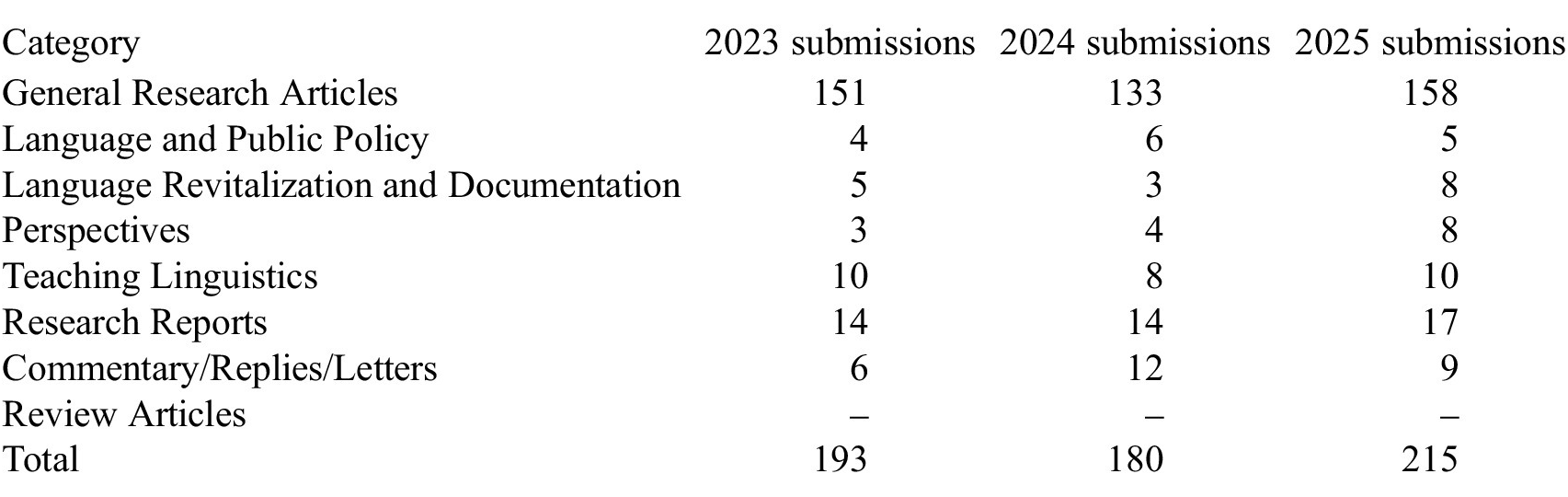
In 2025 we received a total of 215 submissions. The breakdown of submissions by section is given in Table 1. The numbers from 2023 and 2024 are included for comparison.
Submissions by journal section for 2023, 2024, and 2025.

Table 1. Long description
The table consists of four columns: Category, 2023 submissions, 2024 submissions, and 2025 submissions.
* General Research Articles: 151 in 2023, 133 in 2024, 158 in 2025.
* Language and Public Policy: 4 in 2023, 6 in 2024, 5 in 2025.
* Language Revitalization and Documentation: 5 in 2023, 3 in 2024, 8 in 2025.
* Perspectives: 3 in 2023, 4 in 2024, 8 in 2025.
* Teaching Linguistics: 10 in 2023, 8 in 2024, 10 in 2025.
* Research Reports: 14 in 2023, 14 in 2024, 17 in 2025.
* Commentary/Replies/Letters: 6 in 2023, 12 in 2024, 9 in 2025.
* Review Articles: No data recorded for any year.
* Total: 193 in 2023, 180 in 2024, 215 in 2025.
The number of submissions in 2025 well exceeded those of 2023 and 2024.
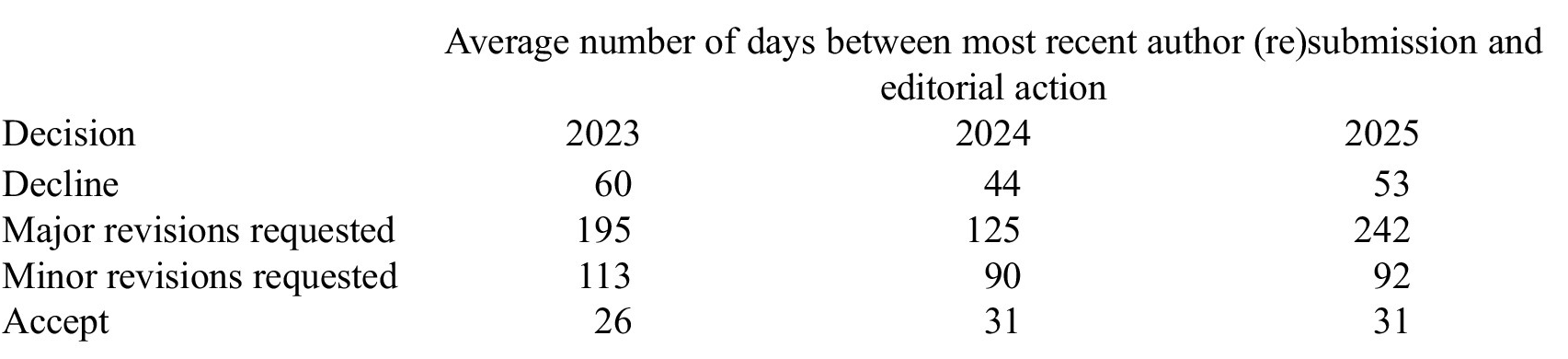
For manuscripts submitted during 2025, the average time between submission and the various kinds of editorial decisions are given in Table 2 (with 2023 and 2024 times included for comparison).
Average number of days for various editorial decisions during 2023, 2024, and 2025.

Table 2. Long description
The table consists of four columns and five rows. The first column lists the type of editorial decision, while the subsequent three columns represent the years 2023, 2024, and 2025 under the header Average number of days between most recent author resubmission and editorial action.
* Decline: 60 days in 2023, 44 days in 2024, and 53 days in 2025.
* Major revisions requested: 195 days in 2023, 125 days in 2024, and 242 days in 2025.
* Minor revisions requested: 113 days in 2023, 90 days in 2024, and 92 days in 2025.
* Accept: 26 days in 2023, 31 days in 2024, and 31 days in 2025.
While the average number of days for several decisions are comparable to previous years, the time to decision for major revisions has clearly gone up this year. To some degree, the transition to Cambridge factored into this, and it is something the editorial team will work to reduce in the year ahead.
Starting in January 2019, authors are asked to voluntarily indicate the primary field of their submission, using the same categories as those used for abstract submission to the annual meeting. Table 3 shows the number of submissions by author-reported primary field for 2023, 2024, and 2025. Authors may also indicate secondary and tertiary fields of study, but this information is not included below. On OJS this information was technically collected separately from the submission itself, and sometimes authors did not enter it, meaning those articles are not represented in the numbers below. Furthermore, the ScholarOne website originally did not collect fields-of-study information, and once that question was subsequently added to the submission process it did not differentiate between primary, secondary, and tertiary fields, meaning that many articles submitted to ScholarOne in the latter part of 2025 did not have a clear primary field of study. These papers were also not included below. Thus, overall the numbers reported here do not fully reflect the set of fields represented by the articles submitted to Language, especially for 2025. Nonetheless, the subfields with the most submissions as recorded in the data available are generally comparable to previous two years (syntax, historical linguistics, sociolinguistics, and applied linguistics, albeit with a drop in semantics), and we also saw a three-fold increase in second language acquisition submissions over last year.
Author-selected primary area of linguistics submissions for submissions received in 2023, 2024, and 2025.

Table 3. Long description
The table contains 38 rows of linguistic subfields with submission counts for three years.
* Syntax: 29 in 2023, 26 in 2024, 23 in 2025.
* Historical linguistics: 15 in 2023, 8 in 2024, 12 in 2025.
* Applied linguistics: 9 in 2023, 9 in 2024, 11 in 2025.
* Second language acquisition: 1 in 2023, 4 in 2024, 11 in 2025.
* Sociolinguistics: 17 in 2023, 16 in 2024, 11 in 2025.
* Phonology: 5 in 2023, 10 in 2024, 10 in 2025.
* Language acquisition: 6 in 2023, 1 in 2024, 8 in 2025.
* Semantics: 19 in 2023, 15 in 2024, 8 in 2025.
* Typology: 8 in 2023, 1 in 2024, 7 in 2025.
* Cognitive Linguistics: 5 in 2023, 8 in 2024, 5 in 2025.
* Language documentation: 7 in 2023, 4 in 2024, 5 in 2025.
* Sign linguistics: 4 in 2023, 2 in 2024, 5 in 2025.
* Phonetics: 6 in 2023, 5 in 2024, 4 in 2025.
* Anthropological linguistics: 2 in 2023, 2 in 2024, 3 in 2025.
* Creolistics: 0 in 2023, 0 in 2024, 3 in 2025.
* Discourse analysis: 6 in 2023, 4 in 2024, 3 in 2025.
* Morphology: 5 in 2023, 3 in 2024, 3 in 2025.
* Psycholinguistics: 6 in 2023, 7 in 2024, 3 in 2025.
* Scholarly teaching: 3 in 2023, 6 in 2024, 3 in 2025.
* Bilingualism: 3 in 2023, 1 in 2024, 2 in 2025.
* Grammaticalization/Grammatical variation: 1 in 2023, 3 in 2024, 2 in 2025.
* Language revitalization: 0 in 2023, 1 in 2024, 2 in 2025.
* Pragmatics: 2 in 2023, 4 in 2024, 2 in 2025.
* Computational linguistics: 7 in 2023, 5 in 2024, 1 in 2025.
* Language evolution: 4 in 2023, 5 in 2024, 1 in 2025.
* Linguistics and literature: 3 in 2023, 1 in 2024, 1 in 2025.
* Prosody: 0 in 2023, 0 in 2024, 1 in 2025.
* Text/Corpus linguistics: 7 in 2023, 3 in 2024, 1 in 2025.
* Translation: 1 in 2023, 7 in 2024, 1 in 2025.
* Writing studies: 0 in 2023, 3 in 2024, 1 in 2025.
* Forensic linguistics: 1 in 2023, 0 in 2024, 0 in 2025.
* History of linguistics: 2 in 2023, 1 in 2024, 0 in 2025.
* Lexicography: 3 in 2023, 1 in 2024, 0 in 2025.
* Philosophy of language: 1 in 2023, 1 in 2024, 0 in 2025.
* Raciolinguistics: 1 in 2023, 0 in 2024, 0 in 2025.
* Sociology of linguistics: 0 in 2023, 2 in 2024, 0 in 2025.
* Teaching linguistics: 1 in 2023, 0 in 2024, 0 in 2025.
* Other: 1 in 2023, 3 in 2024, 2 in 2025.
6. Special thanks
We owe much gratitude to the community of linguists who continue to support the journal through choosing to submit to Language and through their willingness to serve as reviewers. We also acknowledge the continued support of past and current Linguistic Society of America staff: Jourdian Godley and Vy Le, who worked with us through March 2025; Margaret Vitullo, who worked with us throughout the year; and, from June 2025, Association Management Services staff Justin Dodge, Kelsey Kirsch, and Catherine Pauley. We also thank the Society’s Executive Committee for their ongoing support. Language continues to maintain very high standards in copyediting in no small part due to the dedication of our copyeditors and proofreaders, Dr. Hope Dawson and Dr. Robert Maslen. We thank them for their exceptionally thorough work.
The Language editorial team is composed of a group of dedicated individuals whose contributions ensure the continued success of the journal. Special thanks go to every member of the editorial team for 2025, including editorial assistants Venus Shirazy, Erika Arredondo, and Emmeline Wilson, review editor Jessi Grieser, and associate editors Catherine Anderson, Ann Bunger, Patricia Cukor-Avila, Michael Diercks, Maria Gouskova, Lisa Green, Jesse Harris, Caroline Heycock, Ruth Kramer, Wesley Leonard, Erez Levon, Gaurav Mathur, Paul McPherron, Tatiana Nikitina, Michael Putnam, Morgan Sonderegger, Maziar Toosarvandani, Graeme Trousdale, and Suzanne Evans Wagner. We also thank former associate editors Diane Brentari, Lisa Cheng, Ezra Keshet, and Kristen Syrett, who left the team in prior years but continued their service into 2025. We extend our appreciation to all of these associate editors for their invaluable service to Language, the Society, and to the wider linguistics community. We also thank former Editor Andries Coetzee, former associate editor David Willis, and current associate editors Catherine Anderson and Ann Bunger for serving as guest editors during 2025. Lastly, the editorial team wishes to thank the following individuals who generously contributed their time and effort to the essential task of refereeing submissions in 2025. Individuals whose names bear an asterisk provided more than one review for us during the calendar year.
Peter Ackema
Luke James Adamson
Samuel Akinbo
Jalal Al-Tamimi
Alex Alsina
Mark Baker
Michael Barrie
Clay Beckner
Balthasar Bickel
Christina Bjorndahl
Frances Blanchette
Reed Blaylock
Olivier Bonami
Holly Branigan
Canaan Breiss
Benjamin Bruening
Mary Bucholtz
Phillip Buech
Wednesday Bushong
Fausto Carcassi
Eleanor Chodroff
Cynthia Clopper
Uriel Cohen Priva
Anne Coleman-Webre*
Mayer Connor
Elizabeth Coppock
Alexandre Cremers
Antje Dammel
Veneeta Dayal
Bart de Boer
Derek Denis
Shelece Easterday
Gorka Elordieta
Michael Everdell
Charlie Farrington
Sebastian Fedden
Roman Feiman
Hana Filip
Sara Finley
Edward Flemming
Naomi Francis
Susanne Fuchs
Richard Futrell
Lauren Gawne
Ted Gibson
Nikolas Gisborne
Jason Grafmiller
Simon Greenhill
Jennifer Guzman
Matías Guzmán Naranjo
Nancy Hedberg
Brent Henderson
Kasia Hitczenko
Valentin Hofmann
Kaden Holladay
Bart Jacobs
Brian Joseph
Vsevolod Kapatsinski
Jonah Katz*
Henri Kauhanen
Andrew Kehler
Stefan Keine
Bob Kennedy
Yuni Kim
Agnieszka Konopka
Hadas Kotek*
Dave Kush
Ethan Kutlu
Myriam Lapierre
Laurie Lawyer
Diane Lillo-Martin
Hannah Little
Jiayi Lu
Beth MacLeod
Glenn Martínez
Gaurav Mathur
Jeff Mielke
Shota Momma
Nikita Muravyev
Neil Myler
Ad Neeleman
Rachel Nordlinger
Jason Overfelt
Lefteris Paparounas
Mary Paster
Doris Payne
Lisa Pearl*
Nicolai Pharao
Stephen Politzer-Ahles
Ciyang Qing
Malte Rosemeyer
Erich Round
Carmen Saldana*
Joe Salmons
Tory Sampson
Nathan Sanders
Wendy Sandler
Chelsea Sanker
Cristina Schmitt
Lane Schwartz
Jason A. Shaw
Rachel Showstack
Nandi Sims
Kenny Smith
Ryan Walter Smith
Jon Sprouse
Laura Stigliano
Richard Stockwell
Yenan Sun
Balàzs Surànyi
Guy Tabachnick
Meredith Tamminga
Ai Taniguchi
David Tézil
Harold Torrence
Robert Truswell
Martha Tyrone
Cherlon Ussery
Freek Van de Velde
Bob van Tiel
Coppe van Urk
Charlotte Vaughn
Laura Wagner
Natalie Weber
Andrew Weir
Tracey Weldon
James Whang
Søren Wichmann*
Paul Widmer
Ming Xiang
Himanshu Yadav
Raffaella Zanuttini
Hedde Zeijlstra
Sarah Zobel
Kie Ross Zuraw


 Open access

