


Introduction
This special section in the pages of Urban History revisits a classic topic of post-war urban history, that is, the so-called ‘trend towards oligarchy’ in pre-modern towns. Discussing various case-studies from all over Europe, many historians have argued that in the course of the late Middle Ages and the early modern era, access to political power in urban society became more restricted. Presumably, a process took shape in which urban political elites closed ranks, and as they came to exclude more and more outsiders, urban government became the privilege of an ever-smaller group with a distinctly aristocratic cachet. The result of this closure of the political community was an increase in the social distance between rulers and subjects.Footnote 1
In the twenty-first century, historians continue to build on this paradigm in that urban oligarchy figures largely in arguments about discrimination and the construction of social hierarchies. Research reveals that in the fourteenth, fifteenth and sixteenth centuries, a wide range of groups became the subject of progressive stigmatization, ranging from women to gypsies and migrants to the poor and the elderly. To explain these trends, historians partly refer to the development through which city councils were increasingly dominated by exclusive interest groups that used urban government to assert their hegemony over lower-ranking groups, a process that is closely linked to the increasing authority of emerging states over urban government. The best example in this respect is Frank Rexroth's study of London: in the course of the late Middle Ages, the aldermen aligned their interests more closely with the English crown, which in turn endowed the aldermen with additional authority. Strikingly, this authority was geared towards the progressive discrimination against a wide range of city dwellers.Footnote 2 London, for all its unique features, is likely to be typical for many towns, at least in England and France. For both English and French towns, historians have revealed that the crown increasingly monitored urban governments as components of the state administration.Footnote 3 In sum, the rise of oligarchy in towns is thought to have had momentous consequences for many different social groups, as it was a key factor in the birth of the ancien régime, a shorthand for the fine-grained social and political hierarchies that took shape somewhere in the late Middle Ages and then persisted until the revolutions of the eighteenth and nineteenth centuries.Footnote 4
What is surprising, at least to the authors of this article, is that the empirical basis of this urban trend towards oligarchy and aristocracy is quite limited. Even the best available discussion of the subject, that is, Christopher Friedrichs’ incisive and wide-ranging article on urban politics in early modern Europe, proceeds from a handful of case-studies, and even for these case-studies, precise estimates are rare. This begs the question whether the well-documented towns that do show a trend towards oligarchy are as representative as is commonly thought.
In the contributions that constitute this special section, we probe this historiographical problem with a discussion of the Low Countries. The historiography on urban elites in the Low Countries is typical in that the state of the art is quite unbalanced: many studies are available on the urban government of towns in the Northern Low Countries (especially Holland), but data are surprisingly scarce for the Southern Low Countries. To give but one extreme example: no fewer than five monographs are available on elite formation in the town of Leiden between 1300 and 1800.Footnote 5 In contrast, next to nothing has been published on the urban government of southern towns such as Leuven or Brussels. Medieval Ghent has received close scrutiny, alongside a series of more limited case-studies, but no coherent interpretive framework has as yet emerged.Footnote 6
This uneven development of historiographical research on Netherlandish urban elites is largely rooted in the distinct trajectories of the Northern and Southern Low Countries in the seventeenth and eighteenth centuries. The Dutch Revolt of the late sixteenth century had caused the Low Countries to split into two distinct polities. On the one hand, the northern provinces became independent from the Habsburg empire and organized themselves in the famous Dutch Republic, a confederacy that was basically ruled by urban elites. Little wonder then, that Dutch historians prioritized the study of the elites who not only managed the towns of Holland but also one of the first European republics. On the other hand, the southern provinces remained subject to the Habsburgs, and here, urban elites remained subservient to state elites so that Belgian historians saw little reason to focus on the elites of the Flemish and Brabantine towns. This state of affairs is a telling illustration of how the concept of ancien régime – however useful it is as a shorthand to indicate the progressive articulation of social rank in pre-modern Europe – introduces a teleological bias in the research agenda of historians.
We counter this bias with articles on the elites of three towns in the Southern Low Countries. The first is an article on sixteenth-century Ghent that complements existing research on Ghent's fourteenth- and fifteenth-century ruling classes. The second and the third articles focus on the elites of Mechelen and Antwerp between c. 1400 and c. 1550. Together with recent research on late medieval Bruges,Footnote 7 the three case-studies allow a comparative approach to trends in the configuration and reconfiguration of four urban political elites up to c. 1550.Footnote 8
What the four selected towns have in common is that they were all among the largest towns that had developed in the Low Countries. Yet, these towns were also different in ways that allow historians to determine whether trends towards oligarchy and aristocracy – if they did take shape – were tied to different economic, social or political configurations. This is important, because even if historians assume that towns became more oligarchic after the twelfth and thirteenth centuries, no convincing model is available as to the causal mechanisms behind such a process. Economically speaking, Ghent and Mechelen had much in common (see Table 1). Both towns came to prominence as producers of high-quality textiles, but in the late Middle Ages, both urban economies became more diversified.Footnote 9 As both towns were old industrial centres, they also shared their social profile: in the course of the thirteenth and fourteenth centuries, the urban economies of Ghent and Mechelen became increasingly organized through craft guilds, which eventually managed to stake a claim in the urban government in the early fourteenth century. This was pronounced in Ghent, where three-quarters of all available seats in the city council were reserved for a coalition of the 50-odd craft guilds in the town, many of which pertained to cloth production.Footnote 10 In Mechelen, the craft guilds were somewhat less powerful, and only claimed about one third of all available positions in the city council.
The four towns and the key parameters for comparative analysis

Bruges had a somewhat different profile. Just as Ghent, the town had prospered in the high Middle Ages as a centre for textile production, and just as in Ghent, craft guilds managed to claim about two-thirds of the seats in the city council in the fourteenth century. Yet, Bruges came to differ from Ghent in that this town became the Low Countries’ hub for international trade. In tandem with this process, the Bruges craft guilds increasingly specialized in the production of a wide range of luxury goods, a trajectory that was similar to that of Mechelen.Footnote 11
Antwerp's trajectory, then, is different again because this town was a late-bloomer in the Flemish and Brabantine urban network. The town only became prominent in the course of the fourteenth century. Because the urban efflorescence of Antwerp took place well after the revolts around 1300, the craft guilds failed to secure political power. Apart from a brief intermezzo between 1477 and 1486, the Antwerp craft guilds had no stake in the city council. In the late fifteenth century, Antwerp replaced Bruges as the gateway city for international trade in the Low Countries, and the sixteenth-century boom of Atlantic trade ensured that Antwerp was the first town in the Low Countries to pass the threshold of 100,000 inhabitants. As a corollary, Antwerp also lured more and more artisanal industries away from smaller towns in its hinterland.Footnote 12
The four towns also had a different relationship with the Burgundian–Habsburg dynasty, which came to rule over the Low Countries in the course of the fifteenth century. The Ghent craft guilds had a strong tradition of urban independence, with a string of revolts against the increasing fiscal pressure imposed by the Burgundian–Habsburg state. Bruges and Mechelen, however, had a more ambivalent relationship with the prince. Just as in Ghent, the Bruges craft guilds often rebelled against the Burgundian–Habsburg dynasty, but Bruges was also one of the favourite sites of residence of Duke Philip the Good (r. 1419–67) and the rulers of the Low Countries were very much aware that the Bruges milieu of opulent merchants and financiers was an important source of credit. In a similar vein, Mechelen developed a close bond with the state: while this town was also occasionally the stage of unrest among the craft guilds, Mechelen became the first capital of the Low Countries between the 1470s and the 1530s, after which Brussels became the capital. Antwerp, then, was hand in glove with the princely administration: the Habsburg dynasty relied on the increasingly important capital market of Antwerp to obtain massive loans, whereas Antwerp relied on the Habsburg state to secure commercial privileges. A comparison of these different relationships between city and state is useful because historians often point at the rise of the state and its growing aspiration to dominate the towns to explain the urban trend towards oligarchy.
A trend towards oligarchy?
Considering four very different towns between the mid-fourteenth and mid-sixteenth centuries, the first question is of course if there was a trend towards a closure of the political community with the passage of time, and if so, why. Proceeding from the common-sense definition of oligarchy as ‘the rule of the few’, the first conclusion must be that the four case-studies reveal no consistent trend towards oligarchy. Measuring the degree of oligarchy by simply counting the number of families that provided aldermen, urban government certainly became more oligarchic in Ghent, but not in Mechelen, Antwerp, or Bruges.
First the city of Ghent, where a stable division of power existed since the 1360s, in which the urban bourgeoisie – the poorterij (a discussion of this concept follows) – and the craft guilds claimed one quarter and three-quarters of all available seats in the city council respectively. Ghent presents us with an example of a stable and open political system that became suddenly much more restricted through an external shock (see Table 2): up to 1540, the city council was constantly dominated by approximately 130 families. Yet, in 1540, Emperor Charles V dismantled the official position of the craft guilds in Ghent in response to a failed revolt. Since the 1360s, the corporations had an official claim to 20 of the 26 available seats in the two benches of aldermen, but this arrangement was abolished. In the decades that followed the political reform of 1540, the urban political elite changed in substance and shape: the corporate milieu of craftsmen continued to provide aldermen, but now only in an unofficial capacity, and on a much more modest scale than was the case before 1540. The Ghent bourgeoisie now dominated urban government. As a corollary of this, the number of families that provided one or more aldermen shrank from c. 130 to c. 100 by the 1560s. In sum, Ghent conforms to the classic idea of a closure in urban government, as increased state intervention destroyed arrangements that had been put in place in the wake of the fourteenth-century revolutions.
The composition of the Ghent City Council, 1500–60
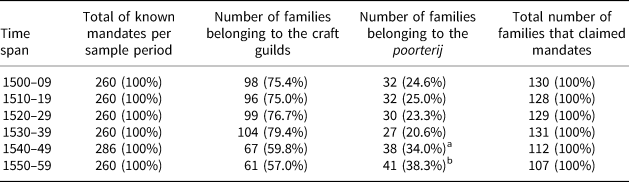
a For seven families in this time span, we could not assess whether they belonged to the craft guilds or the poorterij.
b For five families in this time span, we could not assess whether they belonged to the craft guilds or the poorterij.
Source: see Jelten Baguet's article in this special section.
If Ghent conforms to the widely held idea that urban oligarchy and state formation were interconnected, then Bruges and Mechelen complicate this interpretation. In the third quarter of the fourteenth century, the Bruges aldermen and councillors were recruited from 138 families, but as a rule, more families had access to the city council in the fifteenth century (see Table 3). Most important of all is that Bruges reveals that the repression of urban revolts did not automatically imply an increase of oligarchy. After Duke Philip the Good had crushed the Bruges revolt of 1436–38, more families became involved in urban government (in 1401–25, the city council was recruited among 115 families, but this increased to 158 and 164 families in 1426–50 and 1451–75 respectively). Presumably, the dukes would have made sure that the aldermen were no longer recruited from milieus that were hostile to the prince, but urban government was not entrusted to a small clique.Footnote 13 The scenario repeated itself after the revolt of the large Flemish towns against the Burgundian–Habsburg dynasty in the 1480s. After Bruges had conceded defeat in 1490, the Bruges craft guilds permanently lost their formal representation in the city council, but repression did not imply the installation of a small clique. Because of the many regime changes in the 1480s, in which aldermen had often been deposed before their term of office had ended, an unprecedented number of 237 families had provided an alderman, but in the first quarter of the sixteenth century, about 190 families still had at least one representative in urban politics. In the second quarter of the sixteenth century, this had declined somewhat to 174 families, but this number is still considerably larger than the number of families that constituted the Bruges political elite in the late fourteenth and early fifteenth centuries.
The composition of the Bruges City Council, 1351–1550

Source: the database WetsmagSAB, accessible in the Bruges City Archives, provides a full overview of all the burgomasters, aldermen and councillors of Bruges.
In Mechelen, a trend towards oligarchy becomes apparent in the early sixteenth century, but this development was not tied to state intervention (see Table 4). Just as in Ghent, the Burgundian–Habsburg state intervened in Mechelen's political affairs. This took place in 1468, when Duke Charles the Bold reduced the share of the craft guilds in the city council from one third of all seats to one fifth of all seats. Yet, this did not imply a decline in the number of families that participated in urban government if we use the 1370s as our benchmark for the period before the repression of the guilds. Here too, state intervention did not provoke a closure of the political elite. In Mechelen, such a closure of the political elite only took shape in the first half of the sixteenth century. In 1477, with the death of Duke Charles the Bold, Mechelen returned to its traditional fourteenth-century arrangement in which the craft guilds staffed one third of the city council, and this restoration again increased the number of families. Yet, this increased openness of the political system did not last, as the number of political families plummeted from 60 around 1480 to 37 around 1560. This is striking, because the Habsburg administration by and large refrained from interference in Mechelen in the first half of the sixteenth century. In this case, a trend towards oligarchy was not rooted in an external shock, but in an intra-urban development. Also, and perhaps more importantly for our current line of enquiry, the result of this trend towards oligarchy was not more exclusive than had been the case in the late fourteenth century.
The composition of the Mechelen City Council, 1370–1563

Source: see Frederik Buylaert's article in this special section.
Antwerp also presents us with a reminder that a trend towards oligarchy is not self-evident. In this town, the craft guilds had no official representatives in the city council, so the question is whether access to political power remained equally open to all of the wealthy bourgeois families that constituted the Antwerp poorterij. Between 1400 and 1550, the urban political elite was extremely stable, always recruiting its members from among 50-plus families (see Table 5). The only exception is the time span of 1460–90, which includes the short-lived experiment of 1477–86, in which the Antwerp craft guilds did manage to break into the city council. In the first half of the sixteenth century, however, the city rapidly returned to pre-established patterns, showing no trend towards oligarchy.
The composition of the Antwerp City Council, 1400–1549

a The city council of Antwerp consisted of 2 mayors and 12 aldermen up to 1490, when the number of aldermen was increased to 16. Hence the increase in the number of mandates after this date.
Source: see Janna Everaert's article in this special section.
The only way in which Antwerp saw a trend towards oligarchy was that the political community remained stable in size, whereas the urban population grew rapidly. Around 1400, the 50-odd families ruled over a town of c. 10,000 inhabitants, whereas the 50-odd families that ruled the town around 1550 ruled over a true metropolis with c. 100,000 inhabitants. Antwerp did see the establishment in 1435 of the so-called Monday Council, in which 12 craftsmen were allowed to participate, but this body was slow to develop, and apparently only had an advisory function. From a relative perspective, the balance between rulers and ruled had thus changed dramatically. Mechelen presents a similar, albeit less extreme, development: while the political community fluctuated between c. 40 and 60 families, the urban population had grown from c. 12,000–15,000 inhabitants in 1400 to c. 28,000 inhabitants in the 1530s. The changing ratio between the size of the urban population and that of the urban political community provides a reminder that oligarchy was also a matter of social distance: even if a political elite remained stable in size, then it may have been perceived by contemporaries as an increasingly exclusive institution because that elite ruled over an ever-larger urban community.
Yet Antwerp and Mechelen were more the exception than the rule. Ghent had seen a slight decline in its population from c. 64,000 inhabitants in the fourteenth century to c. 50,000 inhabitants in the sixteenth century, and Bruges saw its population decline gradually from c. 60,000 inhabitants around 1300 to c. 35,000 inhabitants in the 1520s.Footnote 14 With the demographic slump that hit Europe in the post-plague era and the stagnating levels of urbanization in the sixteenth and seventeenth centuries, Ghent is probably the most typical of the four case-studies in this respect.Footnote 15
All things considered, the thesis of a seemingly uninterrupted rise of oligarchy only holds up if the concept of ‘oligarchy’ is defined in two different ways. According to the perspective that favours the evolution in the absolute numbers of families involved in urban government, only Ghent saw a distinct trend towards oligarchy. According to the perspective that focuses on the relative balance between the rulers and the ruled in urban society, this also holds for Antwerp and Mechelen. A first conclusion must thus be that the narrative around urban oligarchy needs to be revised, as it throws together different trends that each had very different causes. Ghent conforms to the idea that the rise of the state often implied a reconfiguration of urban government, a development that can also be noted in, for example, Utrecht or Augsburg, where the Habsburg government also removed the craft guilds from urban government. Mechelen and Antwerp, then, reveal that other trends towards oligarchy were rooted in institutional sclerosis. Apparently, urban institutions did not readily adapt, even if the towns themselves changed beyond recognition. Last but not least, the case-study of Bruges serves as a reminder that not every town saw a trend towards oligarchy, however this process is defined.
A social perspective (1): from patriciate to poorterij
A second point that we would like to make is that historians would do well to disentangle oligarchy – however it is defined – from social stability. As discussed in the introduction of this article, historians often assume that the rise of urban oligarchy between c. 1300 and c. 1600 contributed to the birth of ancien régime societies, in which the hierarchical ordering of social groups had become much more pronounced than it had been in the pre-1300 era. These urban elites are consequently imagined as restricted cliques, composed of powerful families that frequently intermarried, that were extremely stable in their composition.
Netherlandish historiography provides a telling illustration of this association of oligarchy with social stasis. From the late nineteenth century to this day, scholars tend to conceptualize urban elites as ‘patriciates’, even if the latter term was never used by contemporaries.Footnote 16 While acknowledging that urban political elites in the Low Countries never enjoyed the legal prerogatives of the original patriciate of the Roman Republic, historians use the term to stress the longevity, social cohesion and collective identity of the cluster of families that provided aldermen to the city council on behalf of the poorterij of well-to-do merchants, rentiers and property owners, as distinct from the aldermen who represented the craft guilds.Footnote 17
To test this perspective, we quantified the political commitment of all families that provided aldermen to Ghent, Bruges, Mechelen and Antwerp. We used the patrilineal ‘family’ – the aggregate of individuals who shared a surname and who were presumed to have a common male ancestor was called a geslachte (lineage) by contemporaries – as a crude measure for the openness of urban government. Because one family could provide a single alderman whereas another family could provide a great number of office-holders (in all four towns, aldermen were only in office for one year), we quantified the number of offices held by each family.
This approach reveals that all four towns did have true political dynasties: some families rotated a seat in the city council among fathers and sons, brothers and cousins, and so on. In each of the four towns, the political elite constituted a cluster of prominent dynasties that was embedded in a larger group of families that claimed only a handful of positions, often through one family member who was the first and only one of his lineage to be active as an alderman. In fact, the distribution of power over families was surprisingly similar in Bruges, Ghent, Mechelen and Antwerp, and it was surprisingly constant in that no significant change in this distribution took place in the course of the fourteenth, fifteenth and sixteenth centuries. A Lorenz curve analysis of the Bruges City Council for the six consecutive time spans of 25 years between 1351 and 1500 provides a good illustration (see Figure 1).
Lorenz curve of the distributions of mandates in the Bruges City Council, 1350–1550 (per 25 years)

The balance of power between the ‘core’ of political dynasties and the ‘periphery’ of less powerful families and isolated individuals in Bruges closely resembles the situation in Ghent, Antwerp and Mechelen.Footnote 18 The top 20 per cent families of Bruges claimed c. 50–60 per cent of all available offices, a figure that is matched by their counterparts in Antwerp. Mechelen and Ghent were not far behind: in Ghent, the top 20 per cent of families claimed c. 40 per cent, and in Mechelen c. 40–50 per cent. Inversely, in all four towns, the bottom 20 per cent of the families claimed less than 10 per cent of the seats in the city council. In the three towns where power was shared between the poorterij and the craft guilds, the top families were usually, but not always, representatives of the poorterij. The social basis of government was thus basically the same in the four towns.
If this analysis confirms that the large towns of the Southern Low Countries included true political dynasties, it also casts doubt on the interpretation of the aggregate of these dynasties as a coherent and self-conscious elite – a ‘patriciate’. The data remind us that urban politics was not the privilege of powerful families. These families shared power with a wide range of individual politicians as well as with families that only occasionally provided an alderman. If the great dynasties had the advantage of experience and contacts that could be handed from one family member to the next, aldermen who did not belong to such families may have weighed just as heavily on the decision-making process on the basis of the individual merits that had earned them a seat in the city council.
What casts further doubt on the viability of the concept of a patriciate is the observation that even among the most powerful families, the social turnover was very high. Many families died out in the male line, whereas others were removed from power or willingly abandoned urban politics in search of other pursuits. The late medieval ‘patriciates’ are often imagined as the continuation of the ruling class that governed the towns alone before the rise of the craft guilds around 1300, but socially speaking, only very few families from the fourteenth, fifteenth and sixteenth centuries could really claim to have belonged to that milieu. Barring spectacular exceptions such as the Borluut family, which participated in Ghent politics from the thirteenth until the nineteenth century, most families disappeared from the political stage after one, two or three generations. In Mechelen, only 3 of the 37 lineages that dominated the city council in the 1550s had belonged to the 38 lineages that had ruled the town in the 1370s (8 per cent). In nearby Antwerp, the turnover was quite similar: of the 59 lineages that dominated the town in the early fifteenth century, only 10 still belonged to the 57 political dynasties that are attested for the second quarter of the sixteenth century (17 per cent). For reasons that are as yet unclear, the turnover was somewhat lower in Ghent: of the 31 families that had represented the town's poorterij in the city council in 1530–40, about 6 or 7 belonged to the 22 families that had provided aldermen in 1400–10 (27–32 per cent). As long ago as 1994, Denis Menjot pointed out that urban elites were in constant flux, but the data for the large towns of the Southern Low Countries suggest that, so far, scholars have underestimated the intensity of this process.Footnote 19
A comparison with rural elites is helpful to appreciate how volatile the composition of urban political elites was. As with most European elites, the nobility of the county of Flanders lost about half of its constituent lineages per century, so that of the c. 228 families attested in 1351–75, c. 106 families still belonged to the Flemish nobility in 1476–1500 (46.5 per cent).Footnote 20 For a comparable time span, the political families of Ghent, Mechelen and Antwerp lost between c. 70 and 90 per cent of their members. Like rural elites, urban political elites saw the constant disappearance of dynasties because of impoverishment, biological extinction or emigration, but on top of that, an urban alderman also had to weather the dangers of urban politics, in which a wrong move during a revolt or its aftermath could see him and his family members ostracized from urban government.
Even if some families did manage to attain an enduring presence in the city council for over a century, then this longevity did not imply that they consistently belonged to the powerful nucleus of families. In Bruges, for example, the Van Themseke lineage was constantly active in urban politics between 1351 and 1500, but its political weight – as measured in the number of offices held by family members – was limited before 1400. Inversely, the Van Vaernewijck lineage in Ghent had been powerful in the fourteenth and fifteenth centuries (its members then often held six or seven mandates per decade), but the family lost much of its power after 1500: its members now belonged to the periphery rather than the core of urban politics. So, even if the balance of power between the powerful and the not-so-powerful families was stable over time, this balance was clearly the result of continuity through change: oligarchy did not imply social stability, and it is an open question whether the social networks at the top of urban government were sufficiently stable to give birth to a coherent collective identity.
At the end of the day, the continued use of the concept of patriciate is a matter of debate, depending on how strictly the term is defined. Bearing in mind the caveats outlined above, the concept does capture the existence of a handful of powerful families that frequently intermarried. Yet, we would do well to realize that the continued use of the concept comes at a price, namely that we may misconstrue the social identities of the families engaged in urban government. The assumption that families at the top had a well-defined collective identity may hide more than it reveals, in that it shields the issue of how political elites were embedded in the social fabric. For the Low Countries, the issue largely revolves around the enigmatic concept of poorterij. Generally speaking, the poorterij can be translated as ‘the citizenry’, in that it was the contemporary judicial designation of all the burghers of a town (as opposed to city dwellers without burghership). Yet, the term also had a second, more elusive meaning, namely a segment of urban society that existed next to the corporate milieu of the craft guilds. Barring Antwerp, where the city council was dominated by the poorterij, the aldermen of the towns under discussion either represented the craft guilds or the poorterij. In this definition, the poorterij was clearly the political emanation of what historians tend to call the ‘urban bourgeoisie’, that is, the aggregate of citizens who derived their income from trade, house rents, land leases, some professions that were not regulated by craft guilds, and the like.
Very little is known about the poorterij as a pendant to the corporate milieu but it concerned a significant part of urban society. The only reliable estimate of its demographic weight comes from Bruges, where the poorterij claimed 4 out of 13 seats in both the bench of aldermen and the bench of councillors, leaving the other seats to representatives of the craft guilds. Evidence from the early fifteenth century shows that when the Bruges militia was under arms, roughly 20 per cent of the monthly expenses went to the poorterij.Footnote 21 Even if we concede that a member of the poorterij may have received a higher monthly stipend than a fellow combatant from the craft guilds – at least some wealthy merchants are known to have fought as fully armoured horsemen, which undoubtedly came with higher expenditures for fodder and so on – the social body of the poorterij was clearly much larger than the number of poorterij families that held offices in the city council.
The observation that the handful of political dynasties of poorterij profile represented a much broader milieu again raises the question whether the aggregate of these powerful families constituted a separate social group. Rather than a patriciate, they may have imagined themselves to be the most prominent segment among urban bourgeois. Antwerp provides precious evidence in this respect, as the contribution of Janna Everaert reveals that the recruitment of new political families was largely tied to the marital alliances of established political dynasties with fellow poorterij families without any political experience. At the end of the day, the families at the top may have aligned their interests and affinities not so much in a horizontal manner – i.e. the solidarity among powerful families at the top – but in a vertical manner, perhaps all the way down the lower fringes of the poorterij. If the upper fringes of this milieu belonged to exceptionally wealthy merchants, then the lower fringes included individuals who were not so wealthy, such as schoolmasters, lower-ranking legal professionals or those who practised a ‘burgher trade’ (i.e. one of the professions that were not organized in formal guilds, such as landlords of taverns or bonnet makers). If correct, then this perspective not only puts pressure on the long-standing tendency to imagine political elites as coherent social elites, but perhaps also on experiments with identifying ‘middle classes’ in medieval towns.Footnote 22
A social perspective (2): a trend to aristocracy?
If we turn from oligarchy to aristocracy, another factor complicates the traditional view of urban political elites as well-delineated social groups: if urban political elites were perhaps not closed at the bottom from the poorterij, they were also open at the top. An increasingly large segment of the urban political elites may not have defined themselves first and foremost as members of the patriciate of this or that town, but as members of the regional nobility.
The proponents of the thesis that European towns were increasingly dominated by oligarchies have often argued that the trend towards oligarchy went hand in hand with a trend towards aristocracy, in that differences in social status between rulers and subjects became more pronounced. Nobility is the most important proxy in this respect, as contemporaries usually, but not always, accepted noblemen to be a superior social standing than commoners, even if the latter surpassed the former in wealth and power.Footnote 23 Christopher Friedrichs, for example, speculated in 1995 that nobility contributed to the progressive articulation of social hierarchy in towns:
the pull of noble rank was in many ways the ‘primum mobile’ of the urban status system, for it indirectly shaped the ambitions and aspirations of people much further down the ladder. The desire for noble status formed the apex of a much broader pattern of social aspiration. For the very same ‘ambition or avidity for honour’ that made goldsmiths aspire to become merchants, or merchants to become rentiers, also inspired rentiers and others at the top of the urban hierarchy with the hope of acquiring – for themselves or, failing that, for their sons and grandsons – the honour and prestige of a noble rank and title.Footnote 24
This perspective is anything but dead. As recently reasserted by David Crouch, the emergence of the concept of nobility in the high Middle Ages not only gave coherence to a socially inchoate elite, but also provoked a cascade effect, in which other groups were henceforth imagined as different rungs on an increasingly complex ladder of status positions with the nobility at the top. Esquires were positioned below knights, gentlemen were positioned below esquires, peasants below gentlemen and so on.Footnote 25 Because oligarchy was coupled with aristocracy – in the contemporary definition of nobles having ‘better blood’ than others – the changes in the government of late medieval towns are thus imagined as a factor in the birth of the ancien régime as a society of orders.
The basic assumption that underpins this claim is of course a growing presence of the nobility in the towns. This assumption can be tested effectively for the Low Countries because nobility was a relatively stable concept until the seventeenth century.Footnote 26 This provides a strong contrast with, for example, England, where the concept of nobility was broadened to include new groups. Around 1300, England had 3,000 noble families, but in 1500, this polity had no fewer than 10,000 families with ‘gentry status’ (a watered-down concept of nobility), whereas the size of the English population had declined from four to two million people between 1300 and 1500.Footnote 27 No such trends are visible in the Netherlandish principalities: the Flemish nobility, for example, always oscillated around 250 families in the period under discussion.
Even if the concept of nobility was not stretched out to include new groups, as was the case with the concept of ‘gentry’ in England, noble status was not an impossible dream for city dwellers. Between the fourteenth and the sixteenth century, the number of aldermen with noble status in the large towns in the Southern principalities of Brabant and Flanders gradually increased. This rapprochement was rooted in the growing overlap in the economic and social profile of noblemen and prominent city dwellers. On the one hand, wealthy urbanites increasingly often acquired large rural estates, and on the other hand, established noble lords from the countryside adjusted to the rise of large towns by infiltrating those towns, not only to enjoy urban life, but also to take up positions of power. In this context, marriages between noble families and urban political dynasties occurred increasingly often, and increasingly often, an urban politician inherited or purchased a seigneurie, that is, a source of nobility.Footnote 28 For at least some of the families involved, noble lordship counted for more than urban politics. The Bau lineage from Mechelen and the Braderic family from Bruges, for example, ceased to provide aldermen to their hometowns to focus on their seigneurial estates.Footnote 29
The question at this point is whether the timing and intensity of this growing overlap between urban and rural elites differed from town to town or not. To measure the share of the nobility in the urban political elites of Ghent, Bruges, Antwerp and Mechelen, we quantified the explicit designation of this or that alderman as edele ende weerde heere (noble and honourable lord), as a noble homme, or as a member of a noble family, as well as titles of address that were uncontested markers of nobility (knighthood or squirearchy or a seigneurial title) in the available sources (lists of aldermen, tombstones and so on).
The results suggest a growing overlap of the nobility and the urban political elites in the Southern Low Countries between the fourteenth and the sixteenth century. We start the comparative analysis with Bruges (see Table 6). Around 1350, the social composition of the Bruges City Council conformed to the traditional dichotomy between ‘rural nobility’ and ‘urban elites’, as the participation of noble lineages in urban government was close to non-existent. From the late fourteenth century onwards, the share of noble lineages increased gradually, as some established noble lineages became involved in Bruges politics as aldermen, and some political dynasties became noble. The number of noble families remained quite limited, but these families were often exceptionally influential: by the second quarter of the sixteenth century, 25 per cent of all available positions in the city council were held by nobles. In sum, Bruges reveals an increasing overlap between nobility and the urban political elite.
The progressive ennoblement of the Bruges City Council

Source: the data listed for Table 3 have been cross-checked with the primary sources edited in F. Buylaert, Repertorium van de Vlaamse adel (ca. 1350 – ca. 1500) (Ghent, 2011), and F. Buylaert (ed.), ‘Sociale hiërarchisering en informatiebeheer tussen vorst en kasselrij. De productie van “adelslijsten” in het graafschap Vlaanderen (14e–16e eeuw)’, Handelingen van de Koninklijke Commissie voor Geschiedenis, 178 (2012), 65–128, as well as with all explicit references in the original lists of aldermen to individuals with noble titles.
Similar quantitative assessments for Ghent, Antwerp and Mechelen confirm that the ennoblement of the urban elite had deep roots, and that this process progressed only slowly.Footnote 30 In fourteenth-century Ghent, the presence of noblemen in the Ghent City Council was negligible, as it was only in the fifteenth century that Flemish noblemen turned towards the towns, at which point some of the greatest political dynasties of Ghent became noble as well. In the last quarter of the fifteenth century, more than 40 noble lineages provided the town with at least one noble alderman.Footnote 31 In fact, Ghent attracted more noble lineages than any other Flemish town, probably because this city was also the seat of the Council of Flanders, the highest princely court of justice and administration in the county. Yet, the impact of this growing appeal of Ghent to the landed nobility on the composition of the city council was at first rather limited. Until the 1540s, noblemen only claimed c. 10–20 per cent of all available positions. After the abolition of craft guild participation in 1540, however, noble dynasties had more space to spread out, and their share increased to c. 40–50 per cent of all available mandates at the eve of the Dutch Revolt (1568–1648).
Mechelen presents us with a similar development: here too, the role of noblemen in urban government was close to non-existent in the fourteenth century (only 4 per cent in the 1370s), and this changed slowly in the course of the fifteenth century. In the 1470s and 1480s, we see that the share of the nobility in the urban elite had increased to 8 per cent and 12 per cent respectively, two figures that are comparable to those for Bruges and Ghent. If we move on in time to the 1550s and 1560s, the share of the nobility had increased to about half of all available positions (48 per cent), a situation that was very similar to the one in Ghent.
The difference between Ghent and Mechelen concerns the precise timing of this process. In Ghent, the progressive ennoblement of the city council only truly took off quite late in the sixteenth century. The game changer was apparently the abolition of official craft guild participation in 1540 and the increased prominence of bourgeois families in the city's benches of aldermen: with the increasing dominance of the poorterij, the nobility apparently had more room to spread out. In Mechelen, however, the increased presence of the nobility in the city council stretched back to the first quarter of the sixteenth century. This tallies well with the observation that, in Mechelen, the share of the craft guilds in the city council was traditionally much more limited than in Ghent (about half and three-quarters of all available positions, respectively). Detailed analysis also reveals that many noblemen settled in Mechelen when the town functioned as the informal capital of the Low Countries between the 1470s and the 1530s, and this helped urban dynasties to become noble themselves. The special bond of Mechelen with the nobility of the Habsburg court thus helps to explain the progressive ennoblement of its ruling class, even if this town did not see the abolition of craft guild participation.
The town of Antwerp provides us with a cross-check for whether the presence of the princely court or the princely administration was necessary for an exceptionally strong trend towards ennoblement. Unlike Mechelen, this town never was a capital, and unlike Ghent, it never hosted an important princely administrative body such as the Council of Flanders. The Antwerp trajectory reveals that other factors could also contribute to an increasing noble presence: as an increasingly important commercial centre, the town did attract its fair share of noble interest. Strikingly, Antwerp saw an early and strong increase in the number of noblemen in the city council in the first two decades after 1406, when c. 15–25 per cent of the aldermen belonged to the nobility. The timing is not a coincidence, as 1406 is an important dynastic caesura: up to that moment, the town was under de facto control of the count of Flanders, but henceforth, Antwerp was again ruled by the duke of Brabant. There is much evidence to suggest that Anthony of Burgundy, duke of Brabant and the new ruler of Antwerp, wanted to establish a strong bond with the ruling elite of Antwerp by granting knighthoods to some local families, and by positioning some trusted noblemen in the city council. As a result, the share of the nobility was quite substantial in the first two decades of the fifteenth century. The data are inconclusive for the next decades, but when we are on firm empirical footing again in the 1460s, Antwerp still had a sizeable contingent of noblemen in the bench of aldermen. When Antwerp gradually claimed the position of the central trade hub of the Low Countries in the late fifteenth century, noblemen consistently claimed about one third of all available positions, and this situation persisted until c. 1530. After 1530, the share of the nobility increased even further to perhaps about half of the urban political elite.
This development first reveals that a noble presence in Antwerp had developed somewhat earlier than in Ghent and Mechelen. Apparently, the absence in Antwerp of political craft guilds as they existed in Ghent and Mechelen allowed noblemen to profile themselves in urban politics quite early on. Yet, at the end of the day, the outcome was strikingly similar in Ghent, Mechelen and Antwerp. At the eve of the Dutch Revolt, close to half of the aldermen and councillors in all three towns were noblemen, a situation that was completely unthinkable in the fourteenth and fifteenth centuries.
Bruges, then, trailed somewhat behind, as only a quarter of the aldermen belonged to the nobility by the mid-sixteenth century. This city did not host princely institutions, even if the ageing Duke Philip the Good had spent some time in Bruges in the 1450s and the 1460s.Footnote 32 Bruges also lost its position as the Netherlandish gateway town to Antwerp: after the fifteenth-century efflorescence of Bruges, demographic decline set in. Apparently, this trend also diminished the appeal of Bruges to established noblemen intent on urban careers, and, in consequence, the opportunities for ambitious city dwellers to marry a noble heiress to a seigneurie.Footnote 33
The growing overlap between noble elites and urban elites was thus apparently typical for large towns in the Southern Low Countries, but the intensity and timing of this process was influenced by the distinct economic, social, and political profile of each town.
Conclusion
Comparing urban biographies is a difficult affair, even if we only focus on a handful of variables that have to do with the openness of the city council and the social profile of its members. Each town is unique, and a town's history is to a large extent shaped by the cumulative impact of contingent factors that are particular to that town. Yet, scholars such as Tom Scott show that comparative analysis of pre-modern towns can and must be done.Footnote 34
A joint study of Ghent, Bruges, Mechelen and Antwerp in c. 1350 – c. 1550 to test assumptions about urban political elites yields mixed results. The comparison of these four towns in the Southern Low Countries suggests that the classic thesis about the inexorable trend towards oligarchy requires reconsideration. While being a convenient blanket term for the reshaping of the upper strata of urban society between 1300 and 1600, this concept amalgamates different processes that deserve to be treated separately. If urban governance was a more exclusive affair in 1550 than in 1400 in three of the four cities discussed, then this development was different in nature in Ghent (where the ruling class did become more oligarchic) than in Antwerp and Mechelen (where the demographic ratio between rulers and ruled had changed). Also, fifteenth-century Bruges, with its increasingly open political community in the wake of a repressed revolt, and Mechelen, where the Habsburg state was willing to condone the continued participation of craft guilds even as the town came to function as an informal capital, provide a warning against the assumption that state formation always provoked trends towards oligarchy. Perhaps oligarchy is simply not the best proxy for historians of urban politics, for the simple reason that a small clique could pursue inclusive policies that benefit the many, not in the least because of the pressure that could be brought to bear by non-elites on urban governments.Footnote 35 Inversely, a large, open ruling class could pursue an agenda of stigmatization and discrimination.
Similar assumptions about the impact of economic change also deserve critical scrutiny. Historians often surmise that merchants first infiltrated, and then dominated the urban government in those towns that came to function as a hub for international trade, but as discussed in the contribution by Janna Everaert below, Antwerp escaped this trend when it replaced Bruges as the gateway for international trade in the Low Countries. This is not to say that urban political elites were immune to economic change. In their articles in this special section, Jelten Baguet and Frederik Buylaert argue that economic trends contributed to the weakening position of craft guilds in Ghent and Mechelen respectively. Yet Antwerp is a forceful reminder that the composition of social groups was not just a linear reflection of economic trends. In fact, the challenge is often to understand how the impact of larger political and economic trends on urban political elites was blunted, mediated or redirected: the comparative approach adopted in this article reveals that the different outcomes for the four towns cannot be reduced to the differences we outlined in the introduction in respect to the economic profile of the town, the political strength of the craft guilds and the relationship with the state.
If comparative analysis of a cluster of towns reveals that some entrenched historiographical assumptions on the common characteristics of pre-modern European towns deserve closer scrutiny, then it also reveals some patterns that are so surprisingly consistent that future research is necessary to explain them in full. The social basis of urban politics was the same in each of the four towns under consideration, combining a nucleus of powerful families that held about half of all available offices with an extensive periphery of individuals and families whose position in the city council was less well entrenched. What suffused these stable configurations was not the emergence of hereditary elites, but high levels of social mobility, up to the point that the existence of stable social groups – patriciates – is an open question.
Similarly, if the trend of oligarchy touched some cities while leaving others untouched, a trend towards aristocracy is revealed for all four cities: by the 1550s, about half of the urban politicians in Mechelen, Antwerp and Ghent belonged to the nobility, and Bruges trailed not so far behind. If the outcome was similar, the timing of the process was not, and these differences in timing can be explained from the relative strength of the craft guilds, the town's economic fortunes and the town's proximity to the princely administration.
In twentieth-century historiography, trends towards aristocracy were often imagined as a corollary to trends towards oligarchy, in that a more restricted and exclusive ruling class would automatically acquire a more elitist social cachet, but the case-studies under consideration make clear that this assumption does not withstand close scrutiny. In the article on Mechelen, Frederik Buylaert even argues that the pursuit of nobility can help to explain why access to urban government sometimes became more exclusive. The increasing social prominence of urban politicians is best considered as an independent variable.
This comparative project for Netherlandish towns thus suggests that the established concept of the ‘Birth of the ancien régime’ does capture a fundamental change that historians need to address: urban elites were something very different by the late sixteenth century than they were in the early fourteenth century. Yet, this transformation was much more complex than a mere trend towards oligarchy. Urban elites were shaped and reshaped by various transformations that were decidedly more social in nature than is often assumed. The articles on Ghent, Mechelen and Antwerp show that these transformations were not random, but tied to specific changes in the urban economy and urban society, as well as in the larger political and religious developments of fifteenth- and sixteenth-century Europe. In that sense, urban political elites deserve to be ranked high on the research agenda, as this theme allows historians to investigate both the impact of larger trends on specific communities, as well as the ways in which the characteristics and history of specific communities gave shape to larger patterns in European history.
In the survey article that follows this special section, Christian Liddy provides an assessment of the historiographical stakes and potential benefits of concerted research on urban elites in western Europe with a discussion of the available scholarship for England, the German empire, the Low Countries, France and the Italian peninsula. As a specialist of English urban society, Liddy points out that earlier reflections on ‘elite’, ‘family’ and so on are not neutral, but tied to the priorities of various historiographical traditions that are still largely shaped by the framework of modern states. As discussed in the introduction of this article, the different ‘origin stories’ about present-day Belgium and the Netherlands have provoked a decidedly unequal interest in urban political elites among twentieth-century historians, and similar processes are at work in other parts of Europe.Footnote 36 Like the urban historians in the Benelux, specialists of French, Italian and German towns often speak of ‘patriciates’ because it functions as a shorthand for deep-rooted assumptions about the stability and cohesion of urban ruling classes. By contrast, historians of English urban society have stressed the dynamic nature of urban elites as they proceeded from a perspective that presumes exceptionally intense social mobility and social change in English society.
While probing the functionality of specific assumptions and statements about urban elites for some of the grand narratives, Liddy also brings into focus the surviving evidence on contemporary perceptions of urban elites with a critical discussion of the testimony of William Caxton, the first English printer. Having spent much of the 1460s and 1470s in Cologne, Bruges and Ghent before returning to London, Caxton saw a great contrast between the urban dynasties on the continent, which endured for hundreds of years, and those of London, which usually disappeared after two or three generations. The evidence presented in this special section reveals that historians would do well to be careful with such statements, as age-old dynasties were in fact extremely rare in the Netherlandish towns where Caxton had lived. Yet, factually inaccurate as they may be, contemporary musings such as Caxton's also hint at an important variable for elite transformations, that is, the social and cultural categories that shaped the perceptions of elites and those of their subjects. Here too, historians cannot restrict themselves to the observation that patriciate is a humanist construct that developed a life of its own in the hands of nineteenth- and twentieth-century scholars. Unearthing the discursive assumptions about family, power and social cohesion that circulated among fourteenth-, fifteenth- and sixteenth-century city dwellers is an important prerequisite to placing the history of urban elites on a new, improved footing.



