

THE EUROPEAN BRONZE AGE AS A COMMUNICATION NETWORK: HISTORICAL & THEORETICAL FRAMEWORK
Among the characteristics that might compel archaeologists to label the Bronze Age a ‘formative epoch’ in European history, the density and extent of the era’s exchange and communication networks should perhaps be regarded as the most significant. During the Bronze Age, cultural, social, and political formations of a new kind and magnitude came into existence and transformed Europe into a connected economic zone, where intense and dynamic relations between local, regional, and ‘global’ processes of change coincided with increased social connectivity and mobility. New and larger regional cultural zones, such as Nordic or Atlantic, emerged as a result of the distribution of metal and the regularity of social interaction, while at the same time inter-regional trade crosscut and linked such regional configurations together, often characterised by international weapon types. At the same time, an increasing diversity of local cultural and political configurations or chiefdoms can be detected by small variations in ornaments and weapons (Reference KristiansenKristiansen Reference Kristiansen2014).
Initially driven by the necessity to gain access to remote resources and technological skills, Bronze Age societies established communication links that ranged from the Baltic to the Mediterranean and from the Atlantic to the Black Sea (cf. Sherratt Reference Sherratt1993; Reference KristiansenKristiansen & Larsson Reference Kristiansen and Larsson2005; Suchowska Reference Suchowska2009). They incorporated natural pathways such as coastal sea routes, rivers, and mountain passes, as well as trails and built roads, to form a ‘network of networks’ that facilitated a great diversity of physical modes and motivations for transport and travelling. Indeed, one must take care to differentiate between the material components of the network, such as roads and river transport links, and the immaterial or social ones. The latter must have been embedded in the former, but are exceedingly hard to reconstruct in the absence of written sources, as is the case for large parts of the European Bronze Age. Alternatively, one might think of physical networks as the conductors of past social behaviour. Thus, the gradual introduction of bronze and bronze-working technologies into all spheres of life – from weapons and ornaments to working tools such as axes, and agrarian tools such as sickles – had social and political implications. As all communities became dependent upon regular supplies of bronze, new social institutions were established that secured such regular supplies on a year to year basis, perhaps even on a month to month basis. New forms of organised transport had to be developed, both at sea and on land, as well as political alliances and confederations that guaranteed the safety of traders and their companies. A stop in supplies would mean severe long-term economic and political consequences, and therefore had to be avoided. Consequently we see the emergence of new forms of stable long-distance alliances and confederacies.
Chiefly confederacies were recently subject to a comparative study by Blair Gibson (Reference Gibson2011), who used evidence from Celtic Iron Age Ireland, Archaic Greece, Korea, and Iran, and from ethnographic cases in the Pacific. Confederacies could be employed in the formation of a larger composite chiefdom, geographically coherent, as in Ireland, or they could be employed to link chiefdoms together in linear geographical space, as with nomadic or maritime confederacies, in order to secure trade. Bronze Age and Viking Age confederacies belong rather in the latter category (Gibson Reference Gibson2011). Gibson (Reference Gibson2011, 217) defined confederacies as follows: ‘A Chiefdom confederacy consists of a number of genealogically related and unrelated chiefdoms which were unified through coercion or common agreement’. Once established, networks became catalysts of cultural exchange that led to profound social change throughout the Mediterranean Basin and temperate Europe. In the Bronze Age, routes for the supply of raw materials, and later more refined trading goods, created the basis for individuals to move across the continent, taking on many different roles such as travelling craftsmen, warriors/mercenaries, diplomats, and perhaps explorers. It is at this point that we can truly speak of ‘travelling cultures’ and an interconnected ‘globalised’ world (Clifford Reference Clifford1992; Reference KristiansenKristiansen in press). A major motivating force in the maintaining of interregional networks was linked to the competitive advances that certain regions possessed (Earle et al. Reference Earle, Ling, Uhnér, Stos-Gale and Melheim2015). Baltic amber was craved in the eastern Mediterranean, and once South Scandinavia was able to take advantage of this situation, its wealth increased to unprecedented levels. Likewise, Cornwall possessed tin, the Carpathian region salt mines, the steppes supplied good horses, etc. In short, no region was able to maintain their social system without being part of the larger inter-regional networks that supplied the goods everyone needed.
For a holistic perspective on the connected world of the Bronze Age, it is important to keep in mind that physical networks are largely self-organising and self-replicating structures once their institutional framework is in place. However, they are also highly dynamic and unstable. Competition must have arisen between different regions in Europe, or even between different local communities, to secure a better place in the network. Warriors were thus increasingly important for their role in protecting trade missions, while at the same time they were potentially disruptive.
In this article, we wish to shed some light on these opposing forces of ‘trade monopolies/peacekeeping alliances’ versus ‘competition/disruption’ in the distribution and operation of trade networks/political alliances. We are thus only in partial agreement with Knappett (Reference Knappett2011) as we contend that self-organisation can only be understood within a specific historical framework of operating institutions. They provide the necessary social and political framework, in short the political economy (Earle Reference Earle2002). To illuminate this we have chosen the period 1500–1100 bc as our case study, as this period saw the formation of a stable international trade network that connected the Nordic amber-rich zone with southern Germany and further to the western Mediterranean. However, during the 13th century this trade network was disrupted and collapsed, and only after some time was it replaced by a new network that connected the Nordic zone to eastern Central Europe, and further on to the Aegean. We will trace this changeover through an analysis of use on full-hilted swords and flange-hilted swords, as well as through an analysis of the distribution of Naue II swords, which became the dominant warrior sword after 1300 bc.
THE FORMATION OF INTER-CONNECTED ECONOMIES AND VALUES IN EUROPE & BEYOND
The 15th–13th centuries bc were a period of intensive socio-political development, connectivity, and long-distance mobility. How complex these cross-cultural relations were is particularly visible in the eastern Mediterranean, where communication and trade flourished despite a growing tension between Egypt and the Hittite cities over the Levant (Astour Reference Astour1981). In the Aegean, this was the period in which the Mycenaeans took over long-distance trade routes from the Minoans and underwent a period of great cultural and economic expansion characterised by excessive consumption (Cline Reference Cline2009; Burns Reference Burns2010; Steel Reference Steel2013). According to the written sources, merchants, sailors, craftsmen, and diplomats, as well as warriors/mercenaries providing security, were meeting in many ports-of-trade located on the Near Eastern coast. For instance, in Ugarit in the Levant, foreigners from Cyprus, the Aegean, Egypt, Anatolia, Canaan, and Assyria resided temporarily or permanently to conduct their trades (Astour Reference Astour1981).
A good impression of the scale of the exchange is provided by written sources that give the quantities and sizes of merchant ships. In Ugaritic texts we find references to vessels carrying 450–500 tons of cargo and fleets composed of several such ships (Casson Reference Casson1995, 36). The cargo of the Late Bronze Age shipwrecks of Uluburun, Cape Gelidonya, and Point Iria represent various types of trade. Uluburun indicates a ceremonial and commercial exchange on an official royal trip (Pulak Reference Pulak2001), whereas Cape Gelidonya shows evidence of a private enterprise undertaken by merchants engaged in freelance metal trade (Bass Reference Bass1991). The cargo of Point Iria, on the other hand, consisting of Cypriot and Aegean storage vessels, is most likely that of a trader in local produce (Lolos Reference Lolos1999).
Such commercial trade endeavours, whether local or international, were facilitated by political negotiations, as is evidenced in the Armana diplomacy between the Great Powers of the time (Astour Reference Astour1981; Moran Reference Moran1992; Cohen & Westbrook Reference Cohen and Westbrook2000). Most crucially from a European perspective, the rising Mycenaean kingdom (or kingdoms) was part of this high-level political network that secured trade, whether in the form of monopolies in certain goods or access to harbours and markets. The so-called ‘Aegean List’ found near the Valley of the Kings, frescoes from the Cult Centre at Mycenae, and archaeological finds with pharaoh’s cartouches support a likely scenario that an official Egyptian embassy was sent to the Aegean during the reign of Amenhotep III, possibly directed specifically towards Mycenae (Wachsmann Reference Wachsmann1987; Marinatos Reference Marinatos1988; Cline Reference Cline2014, 44 ff). However, there is also substantial textual evidence for the establishment of economic embargoes and other forms of political control over the activity of merchants and diplomats operating within the Mediterranean Basin (Cline Reference Cline1991; Moran Reference Moran1992). All this confirms the complexity of the trading network, which connected the Mediterranean world during the second half of the 2nd millennium bc.
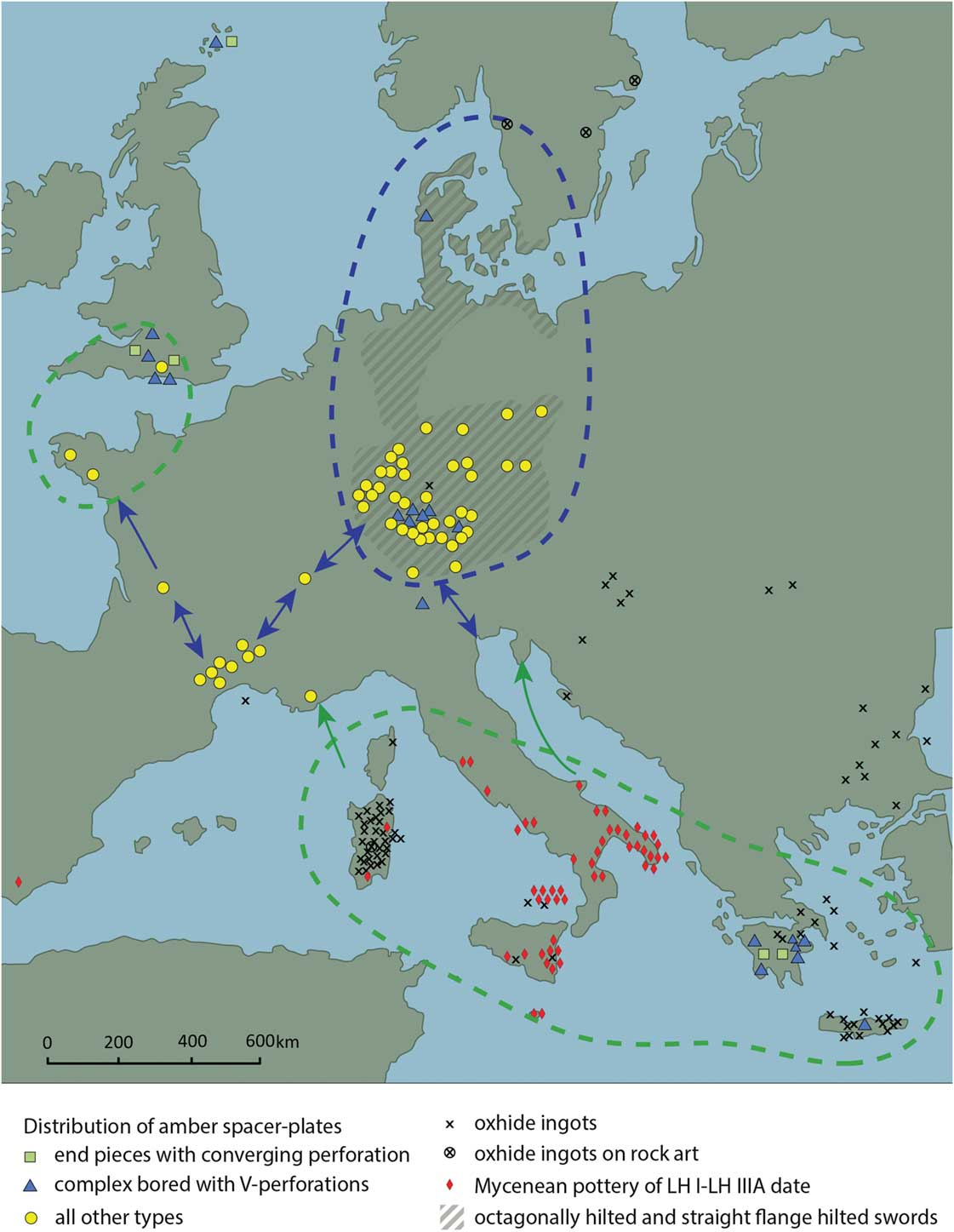
Although it seems that the socio-political situation in temperate Europe was less complex than in the Mediterranean Basin, there is no doubt that it, too, saw a period of consolidation and greater regularity of cross-cultural communication and long-distance exchange, particularly in the 15th and into the 13th century bc (Sherratt Reference Sherratt1993; Reference KristiansenKristiansen & Larsson Reference Kristiansen and Larsson2005). At this time the western Mediterranean became the focus of new direct trade with the expanding Tumulus Culture of western Central Europe, which secured direct connections to Jutland and its sources of amber. The archaeological evidence shows that the Tumulus societies were in contact with the Aegean city-states through the exchange of amber and metal items, and also perhaps of perishable goods (Fig. 1). It created new wealth in the Nordic Bronze Age and led to the formation of a specific Nordic style based on Mycenaean templates. New habits from shaving to sitting on campstools were adopted (Kaul Reference Kaul2013).
Trade networks during the 16th–14th centuries bc, when a Nordic/Tumulus Culture network was connected to a Mycenean/western Mediterranean network. Amber was the most valuable trade item from the Nordic zone. Mycenaean pottery is present in northern Italy in the Terramare settlements from LH IIIB onwards. Digital drawing by Richard Potter
In the 13th century bc, long-distance communication between temperate Europe and the Mediterranean intensified and became more direct, as the Mycenaeans grew more interested in their northern frontier. The Balkans, on the periphery of the Aegean world, became the destination of the political and economic expansion of the Mycenaeans, as is visible for instance in the Assiros and Kastanas settlements (Wardle Reference Wardle1993; Lichardus et al. Reference Lichardus, Echt, Iliev and Christov2002; Aslaksen Reference Aslaksen2013). Contacts with societies of Italy were also maintained and extended as far as the highly developed Terramare Culture of the Po Valley (Vianello Reference Vianello2005; Reference Vianello2009). The Circum-Alpine region was strongly connected with the important centres of the Carpathian Basin (Palincaş Reference Palincaş2007; Dietrich Reference Dietrich2010), and it was this hub of innovation and resources that allowed the communications to extend further north, all the way into Scandinavia (Reference KristiansenKristiansen Reference Kristiansen1987). For now, this trade was dominated by eastern Central Europe, and we shall later analyse the consequences this had for the former western Central European tumulus trade network.
In the Mediterranean, this period of prosperity ended unexpectedly in the 12th century bc, when significant political, social, and economic changes occurred (Sandars Reference Sandars1983; Drews Reference Drews1993; Cline Reference Cline2009; Reference Cline2014; Wachsmann Reference Wachsmann2013). This caused a partial collapse of exchange and communication networks and a decline of political and economic entities such as the Mycenaean Culture, the Hittite Empire, and the cities of the Levant (eg, Ugarit), and weakened Egypt and Mesopotamia. On the other hand, this situation apparently created new opportunities for territories lying in the so-called ‘marginal zone’ (for instance in Central Europe) and for some enclaves like Cyprus, where new bronze-working centres developed (Muhly Reference Muhly1992; Vianello Reference Vianello2005). This process was partly enabled by a collapse of centralised administrative centres that freed technological development and freelance commercial trade from political ties (Sherratt & Sherratt Reference Sherratt and Sherratt1991).
Agents of the international Bronze Age networks
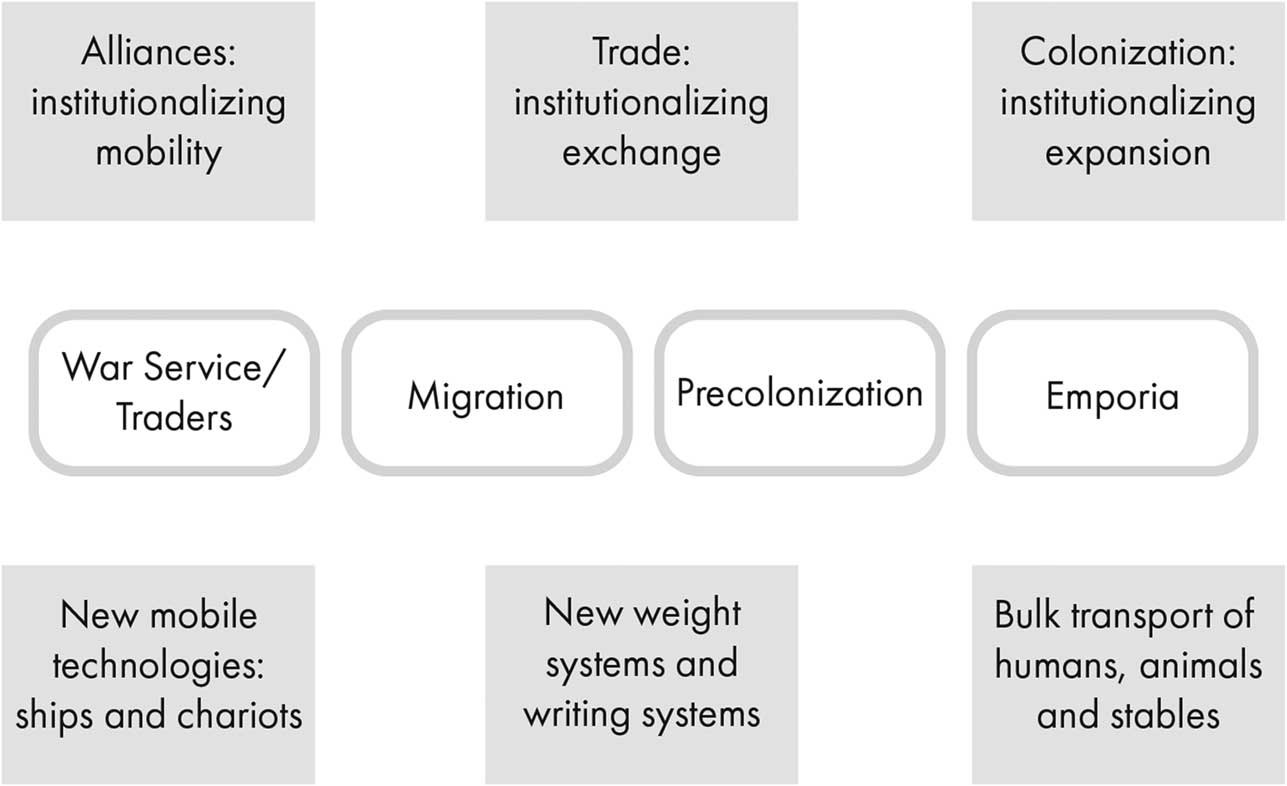
During the Bronze Age, vast networks of communication thus connected the European continent with the eastern and western Mediterranean, transforming physical geography into social geographies. Social networks consisted of interpersonal relations and diplomatic alliances, established and maintained through the exchange of extraordinary objects. Increased connectivity fostered the emergence of political alliances, treaties, and the rule of guest-friendship, allowing the agents of social interaction to travel to distant places and acquire knowledge, both geographical and technological (Reference KristiansenKristiansen & Larsson Reference Kristiansen and Larsson2005, particularly chap. 2). Based on archaeological and written sources it can be assumed that the main categories of people who travelled during the Bronze Age were traders/merchants and smiths/craftsmen, warriors and mercenaries, migrants, and diplomats (see Fig. 2 for a model of these agents of mobility and their institutions). Traders, smiths, and warriors in particular were at the heart of the economic system, as they fulfilled the most basic need of connected societies for access to non-local resources and skills. Through these long-distance journeys and irreversibly linked societies, knowledge, skills, and technologies (such as metal-working, architecture, and shipbuilding) were distributed (and locally adapted) across Europe and the eastern Mediterranean.
Model of the most common agents of mobility and their institutions during the Bronze Age. Digital drawing by Richard Potter
Ancient texts from the eastern Mediterranean present a very complex organisation of trade and exchange in the region, ranging from state-sponsored trading expeditions to private ventures conducted by stateless middlemen and wealthy merchants such as Sinaranu tamkaru of Ugarit (Astour Reference Astour1972; Heltzer Reference Heltzer1988; Monroe Reference Monroe2011). A most illustrative example of mercantile travel in the ‘globalised’ Bronze Age world is the Uluburun shipwreck (Bass Reference Bass1991; Pulak Reference Pulak2001). The ship’s cargo contained raw materials and finished goods from most parts of the known world, and its crew was fairly ‘international’, as indicated by their personal possessions and also by the tools they used (ie the sets of weights that possibly belonged to four merchants and tools used by smiths working on board, as well as weaponry that belonged to possibly three warriors). In the Late Bronze Age, traders were also diplomats that served as emissaries and messengers, as a letter sent to the Pharaoh confirms, in which the king of Alasiya asks: ‘My brother, let my messengers go promptly and safely so that I may hear my brother’s greetings. These men are my merchants. My brother, let them go safely and promptly’ (Moran Reference Moran1992, 112). There is no doubt that, in spite of constant competition, hostility, and military conflicts, all city-states were linked to each other within wide-ranging trading networks. Moreover, traders accompanied armies. Frequently, they even arrived in advance of armies and could be an important source of information. Caesar most famously acknowledges this important role of traders when he said that ‘no one, except traders, goes there [to Britain] without good reason’ (Gallic Wars, 4.20).
An interesting example of inter-regional integration and long-distance mobility is given by the Old Assyrian trading colonies that belonged to the city of Ashur and were located about 1200 km away from the latter, in central Anatolia (cf. Bryce Reference Bryce2002; Barjamovic et al. Reference Barjamovic, Hertel and Larsen2013). The most important of them was the karum at Kanesh (modern Kültepe), where more than 15,000 tablets have been found. It needs to be emphasised that it is only thanks to these written sources that it was possible to identify the merchant quarter as Assyrian, as all the houses and material culture recorded on the site were entirely Anatolian. Based on tablets from Kanesh and the royal inscription, Ashur’s society can be depicted as complex in composition, and largely run by a powerful group of merchants who sent some of their male relatives to settle in one of the Anatolian colonies to direct and promote the family business. Kanesh’s position in the centre of the important communication network allowed Ashur to benefit from the tin and textile trade.
Mercantile travels in the Mediterranean and Near East were hazardous. The Amarna letters refer to a number of incidents of traders being attacked and murdered (Bryce Reference Bryce2002, 89–90; Barjamovic et al. Reference Barjamovic, Hertel and Larsen2013). In one letter, the king of Babylon Burna-Buriyash II complains to Akhenaten that his merchants were murdered in Canaan by subjects of the pharaoh, and demands that the perpetrators be punished. The Hittite kings also tried to encourage the authorities of the districts located on the trading routes to put greater efforts into protecting travelling merchants against crime and to assume responsibility for the merchants’ safety. When they failed, they were forced to pay substantial compensation to the traders themselves or to their families and business associates. A merchant could claim compensation for damage to his cargo or equipment as well, whether caused accidentally or through negligence. These efforts to create a legal framework for trade and to protect merchants, even if often unsuccessful, highlight the importance attached to their role in the network of international communication during the Late Bronze Age.
Trade in the Bronze Age Mediterranean Basin and Near East was ever expanding in scale, especially during the 15th–13th centuries bc, most notably in the many settlements with Mycenaean pottery. The intense cross-cultural contacts in the region are attested to by the discovery of Aegean-made items in foreign contexts and eastern Mediterranean-style objects in the Aegean (Cline Reference Cline2009; Hitchkock & Maeir Reference Hitchkock and Maeir2014; Suchowska-Reference Suchowska-DuckeDucke in press). The regular connectivity between Bronze Age communities meant that knowledge could be obtained about faraway places on a regular basis (Tartaron Reference Tartaron2013). Traders were the new specialists who provided such knowledge and the organisational skills to connect distant places and their goods (Van Wijngaarden Reference Van Wijngaarden2012). But warriors also became widely sought after as mercenaries in the eastern Mediterranean during the Late Bronze Age from the 15th century onwards, as is well attested in texts and on stelae, not least in Egypt (Morkot Reference Morkot2007). It explains how new sword types could spread rapidly from the Mediterranean to Scandinavia probably within a few years. Thus the combination of trade in metal and possibly in arms, as well as travelling warrior groups and their attached specialists, created an interconnected ‘globalised’ world without historical precedent.
THE EMERGENCE OF MEDITERRANEAN/EUROPEAN TRADE NETWORKS 1600–1200 bc
Taking into consideration the cited evidence for eastern Mediterranean colonisation and the organisation of trade and exchange in the region, it seems justified to ask whether Mycenaean items and settlements found in Sicily and southern Italy, and now also northern Italy, are indications of similar mercantile activity (see discussion by Blake Reference Blake2008; Cazzella & Recchia Reference Cazzella and Recchia2009; Vianello Reference Vianello2009 versus Jung Reference Jung2005). A Mycenaean presence is most evident in the Thapsos settlement, already beginning during the 16th century bc (Militello Reference Militello2004), and Mycenaean influence on the region increased in scale during the 13th and 12th centuries bc, when Aegean pottery and Aegean (as well as Cypriot) types of metalwork were being produced in the central Mediterranean (Jones & Vagnetti Reference Jones and Vagnetti1991). For instance, the archaeological finds from Scoglio del Tonno in southern Italy and Frattesina in the Po Valley are mixtures of local and Mycenaean pottery and figurines and Aegean, Italian, and Central European metal forms (such as violin-bow fibulae, Peschiera daggers, and winged axes), representing cultural diversity comparable to the port-of-trade of Ugarit. These sites can be seen as emporia that played an important role in the extensive trade network and places where Mycenaean traders and craftsmen were present. In addition, the casting mould of a so-called ‘winged axe’, a type common in temperate Europe that was found in the House of the Oil Merchant at Mycenae, is considered an indicator of the existence of itinerant craftsmen (Bietti Sestieri Reference Bietti Sestieri1988). Sardinia was likely another important hub in this western Mediterranean trade network, although it’s precise role is debated (Giardino Reference Giardino1992). According to recent results from lead isotope analyses of Nordic bronzes from Period II and III (1500–1150 bc) most copper came from Sardinia and/or the Iberian Peninsula during this period (Ling et al. Reference Ling, Stos-Gale, Grandin, Billström, Hjärthner-Holdar and Persson2014).
Mediterranean trade was well organised and diversified, allowing producers and distributors to cater for a wide range of consumer needs. It was also standardised on the level of commodities exchange, such as the trade in pottery, wine, and olive oil. For the transportation of large quantities of metal a distinctive type of Mediterranean oxhide ingot was used (cf. Reference SabatiniSabatini in press). The wide circulation of these ingots, from the coast of the Mediterranean Sea all the way to the Black Sea and Central Europe clearly points out how strongly interconnected Bronze Age societies were. Commercial communication between the two regions is well illustrated by an oxhide ingot found in Tscherkovo in the Burgas district, which bears traces of an inscription in Cypriot-Minoan linear writing (Buchholz Reference Buchholz1983; Suchowska Reference Suchowska2009, with more examples). It is possible that temperate Europe was also directly linked to this international network of trade and exchange, as the four fragments of oxhide ingots found in Oberwilflingen in Baden-Wüttenberg in Germany, made of Cypriot copper and dated to the 14th/13th century bc, may indicate (Primas & Pernicka Reference Primas and Pernicka1998). Representations of various types of oxhide ingots have recently been identified in Scandinavian rock art (Ling & Stos-Gale Reference Ling and Stos-Gale2015), and are also found symbolically represented in European metalwork (Popa Reference Popa2014).
In Figure 1 we have summarised the evidence of regional trade networks and their interactions during the 16th–14th centuries bc. The connecting valuable was Baltic amber, which was exported from Jutland and the Baltic to southern Germany and the Aegean, where it was made into complex necklaces. Each region in this inter-regional network thus possessed something the other regions craved or needed. Wessex and southern England possessed tin (one of the few areas in Europe where it is found) which is needed for the production of bronze. South Scandinavia possessed amber – the tears of the Gods – which was regarded as divine and was especially sought after by the Mycenaeans, though we find it also in Syria and Egypt. From these locations Mesopotamian and Egyptian blue glass was exported via Mycenaean traders back to Denmark (Walton et al. Reference Walton, Shortland, Kirk and Degryse2009; Varberg et al. Reference Varberg, Gratuze and Kaul2015). Copper was found in several regions, but it is characteristic that large-scale mining only took place in a few areas at any given time (O’Brien Reference O’Brien2015). The Alps possessed rich sources, as did Sardinia and Cyprus. Sardinia/the Iberian Peninsula was perhaps the main deliverer of copper to Northern Europe during this period, and it explains the direct route taken by traders to southern Germany and further north to Denmark after 1500 bc, when southern England and Wessex lost some of their importance. Southern Germany was the new hub and the direct connection to Jutland and the amber route, as indicated on Figure 1. It lasted for 200 years, after which it was taken over by an eastern Central European/Balkan route.
During the Middle Bronze Age, 16th–13th centuries bc, the entire European continent was thus integrated into a full Bronze Age economy. We shall therefore consider next how these European trade networks were organised and what the roles of warfare and warriors were in this context. But first a few words about the pan-European flange-hilted sword.
A NEW WEAPONS TECHNOLOGY & ASSOCIATED SOCIAL CHANGE
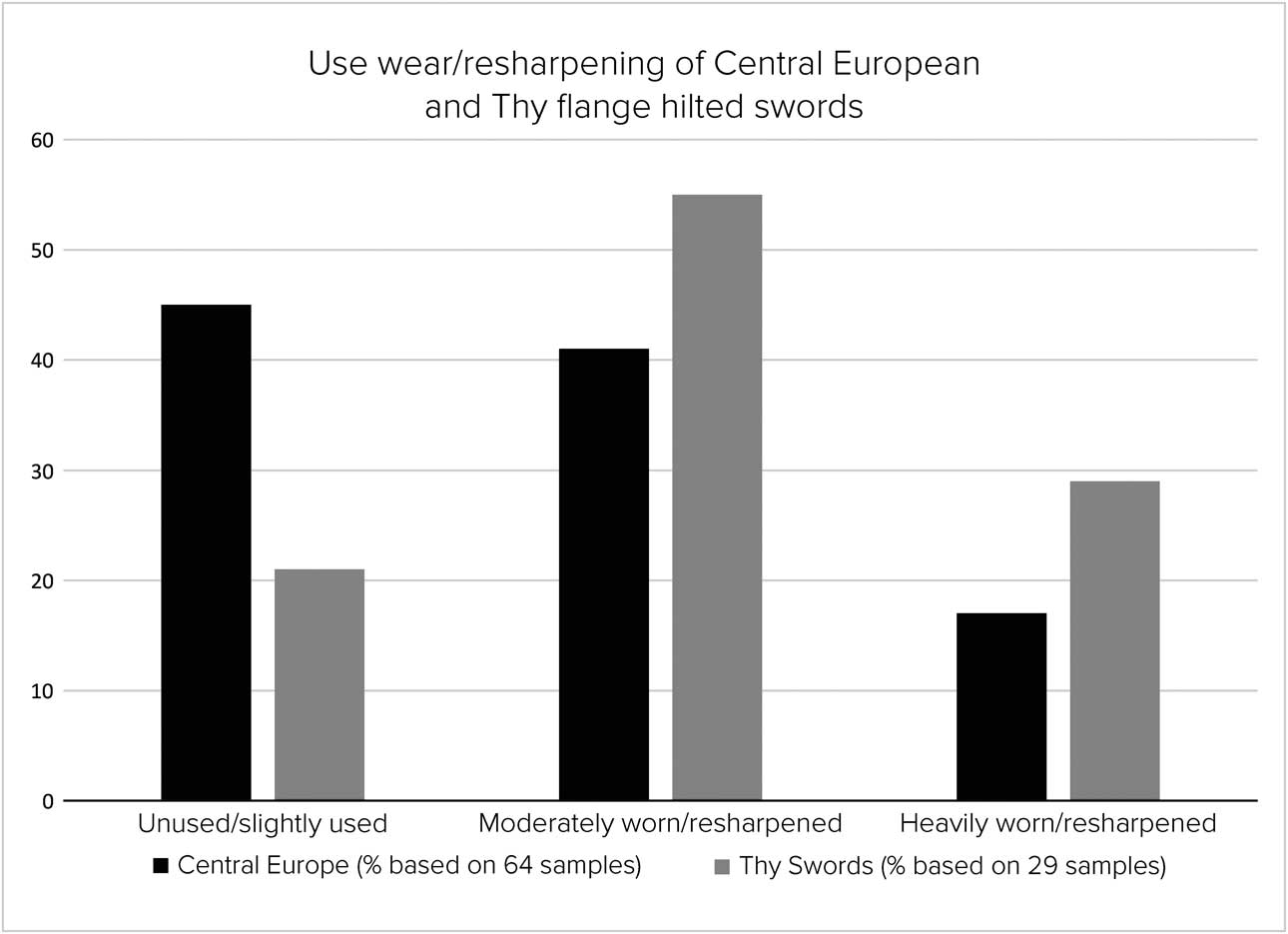
Flange-hilted swords can be characterised as relatively long and heavy weapons with distinctive parallel-sided cutting edges and a thick cross section.Footnote 1 Flange-hilted swords are functional warrior swords, and from their emergence around 1500 bc onwards they often display traces of use and damage from actual combat (Foltiny Reference Foltiny1964; Reference KristiansenKristiansen Reference Kristiansen1984; Uckelmann & Mödlinger Reference Uckelmann and Mödlinger2011). On Figure 3 we compare the degree of re-sharpening of the blade due to combat in Central Europe and north-western Jutland during the period 1500–1150 bc. We merge the early and late types Naue I and II to achieve a representative sample, as previous studies showed no significant difference between them (Reference KristiansenKristiansen Reference Kristiansen1984, figs 6 & 7). The analysis shows that they were used in combat, as they always have razor sharp blades, even the unused pieces. It also shows that they were apparently more heavily re-sharpened in Jutland than in Central Europe. Sometimes they have small notches on the blade from combat that sharpening could not eliminate.
A study of re-sharpening of a group of Central European Swords of Type I and II (1500–1150 bc) (mainly from the National Museum in Budapest and some provincial museums in Hungary) compared to a small sample from north-west Jutland in Denmark of the same period, but with more Type II swords. It shows that swords were used in combat, and that they were in use slightly longer in Denmark/Thy than in Central Europe. Importantly, the swords had the same function as a combat weapon in both regions. Digital drawing by Richard Potter
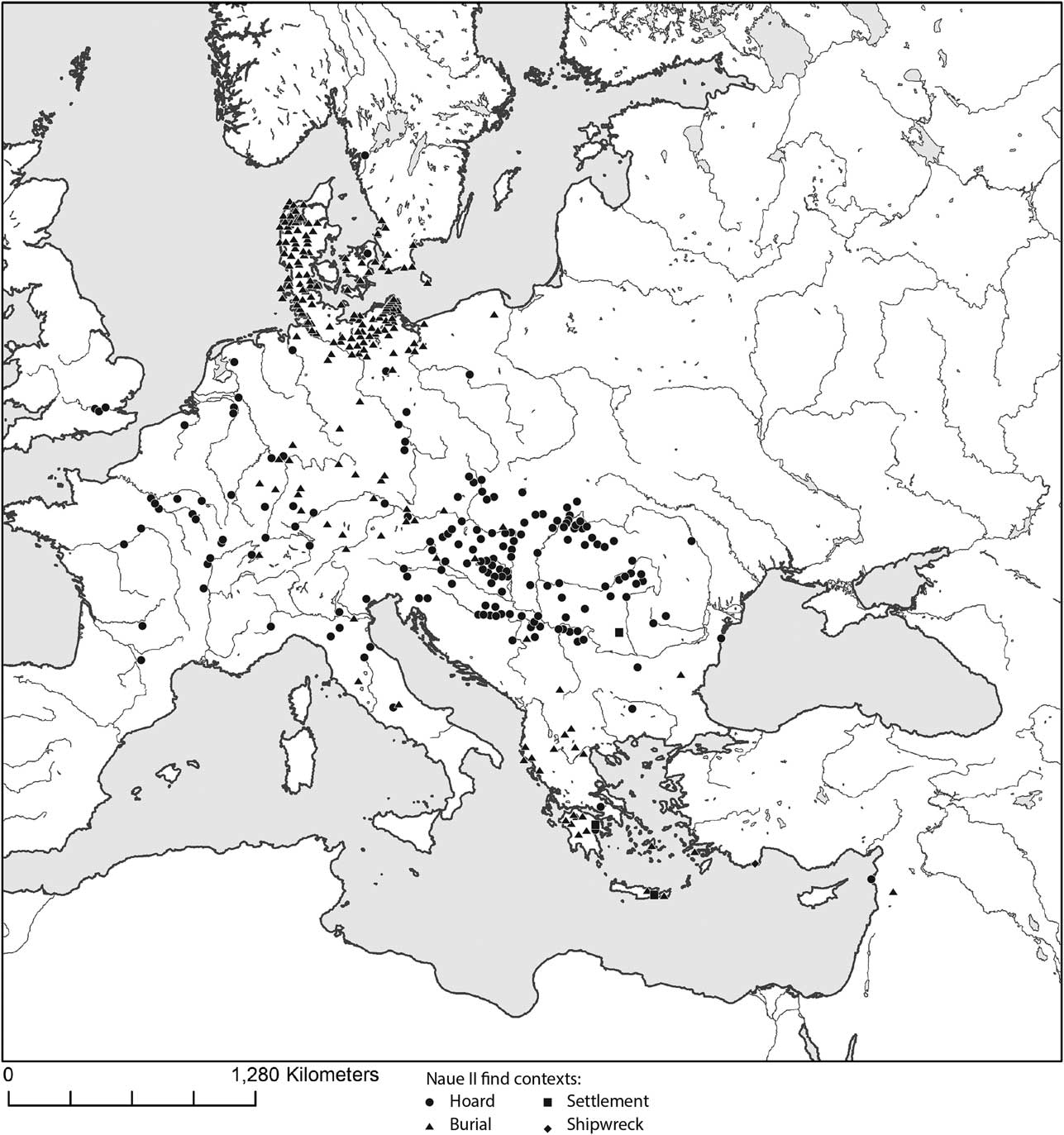
Contexts of Naue II finds. Digital drawing by Richard Potter
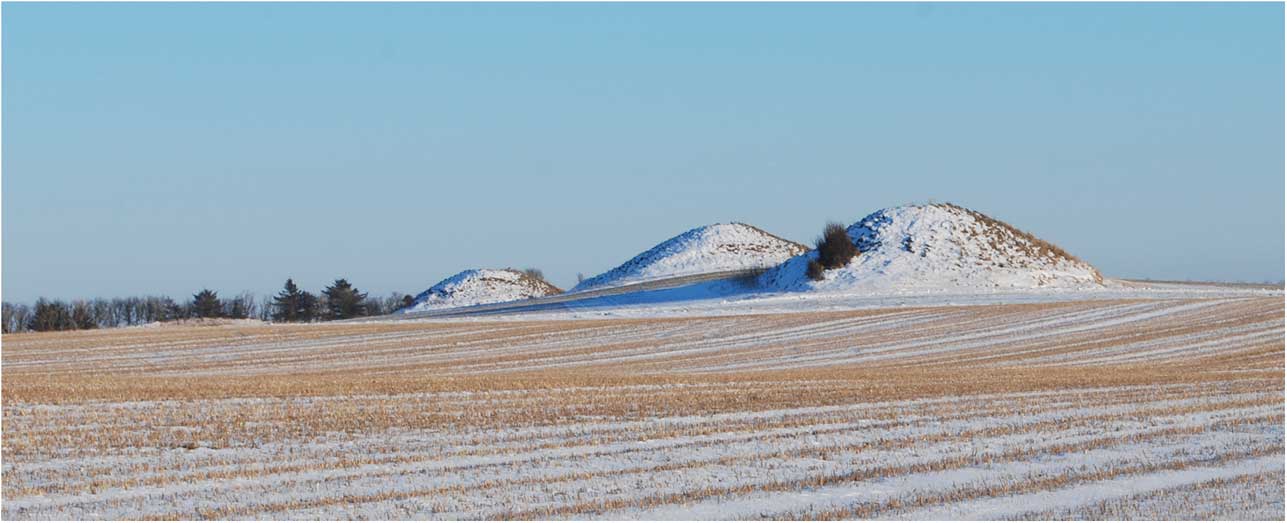
Burial mounds from Eldsted in Thy, Denmark. Photo by Jens Henrik Bech, Thisted Museum
Broken rivet holes and broken hilts also testify to their use in heavy fighting. The pattern of re-sharpening the majority of moderately used blades demonstrates their use over longer periods of time, and expectedly there were more unused or slightly used swords in Central Europe closer to metal supplies. When blades become heavily worn they lose much of their functionality, as the blade becomes thinner and sometimes much shorter due to the breaking of the tip. But such swords also indicate that metal was not available to warriors at all times or simply could not always be afforded. The solid construction of flange-hilted swords makes them robust and resistant against bending. They were also longer and heavier than other swords of their era (around 60 cm blade length), and their balance points were located significantly further away from the hilt allowing more kinetic energy to be transferred to the tip of the blade and thus providing better armour penetrating power (Reference KristiansenKristiansen Reference Kristiansen2002; Jung & Mehofer Reference Jung and Mehofer2009). For these reasons, it has been argued that the appearance of flange-hilted swords, equally suitable for thrusting and cutting and for close hand-to-hand combat, marks a significant change in the fighting techniques among Late Bronze Age societies (Drews Reference Drews1993). However, another significant change took place around 1350/1300 bc when the blade became wider and heavier, therefore more suitable for slashing than thrusting. This is exemplified by the Naue II sword, which became the preferred warrior sword in the coming centuries.
As mentioned, flange-hilted swords were highly functional weapons, versatile and efficient in combat but also relatively easy to manufacture. Therefore, they quickly became the weapon of choice for a class of professional warriors that likely sought profit as raiders and mercenaries (Kristiansen & Larsson Reference Kristiansen and Larsson2007). These highly mobile warriors can be assumed to have been a driving force behind the rapid spread of this weapons technology, and there is no doubt that its international distribution from Northern Europe to the Aegean is truly remarkable. Most significantly, these professional warriors must have been at least partially responsible for many profound cultural transformations of their societies of origin by bringing back from their voyages new impressions, ideas, innovations, and material wealth. These assumptions are supported by many finds of Greek armour such as greaves, corslets, and helmets, as well as Mycenaean swords and rapiers, which have been found in the Balkans and in Central Europe during the Late Bronze Age (cf. Harding Reference Harding1984; Bouzek Reference Bouzek1985; Suchowska-Reference Suchowska-DuckeDucke in press). These finds may be interpreted as evidence of warriors returning home. This warrior heritage is perhaps most impressively preserved in the numerous graves in Denmark and northern Germany, many of which contained flange-hilted swords with signs of use-wear that clearly indicate that they were used in real combat (Fig. 3), but also with full-hilted swords that were symbols of social status (Reference KristiansenKristiansen Reference Kristiansen1984; Reference Kristiansen2002).
We shall now look more closely at the role of flange-hilted warrior swords versus other types of full-hilted swords during the period 1500–1100 bc.
WARRIORS AND TRADERS OF THE FLANGE-HILTED SWORD 1500–1300 bc
Two distinct sword types connect southern Central Europe and South Scandinavia during the 15th–14th centuries bc: the full-hilted sword with octagonal hilt, and the flange-hilted sword. These were supposedly linked to two different types of travel: trade and mercenary, but with obvious overlaps and modes of collaboration between them (Fig. 4).
Distribution of foreign swords, flange-hilted and octagonal-hilted, connecting southern Germany and Denmark, versus the distribution of Nordic full-hilted swords. Digital drawing by Richard Potter

We shall now explore how new European trade networks were established that were able to connect the European hinterlands, which provided such essential goods as amber, tin, warriors, and perhaps slaves (see Briggs Nash Reference Briggs-Nash2006 for the earliest Etruscan evidence on depictions of blonde northerners) to the Bronze Age palace economies in the Near East and the eastern Mediterranean. This trade was supported by central meeting places such as Monkedonja in Istria (Krause 2006/Reference Krause7; Hänsel Reference Hänsel2007), the Terramare Culture in the Po valley (Vianello Reference Vianello2005), and the large fortified settlement at Bernstorf in southern Germany (Bähr et al. Reference Bähr, Krause and Gebhard2012). They reflect the opening of a direct trade link to South Scandinavia to obtain amber directly from the source rather than via Wessex or the Carpathian tell cultures, which had previously been the case. This commercial shortcut directly to the source marks the start of a most remarkable flourishing of a Nordic Bronze Age culture, which suddenly became incredibly rich in copper, tin, and even gold. During the next centuries South Scandinavia produced and deposited more elaborate bronzes in graves and hoards than any other region in Europe. Baltic amber likewise ended up in rich graves in southern Central Europe, Italy, and in Mycenaean graves (Czebreszuk Reference Czebreszuk2011; Reference Czebreszuk2013), as well as in the Levant and Syria (Mukherjee et al. Reference Mukherjee, Roßberger, James, Pfälzner, Higgitt, White, Peggie, Azar and Evershed2008). If we consider the rate of exchange between amber, gold, and copper, the economic gain for South Scandinavia by taking charge of this trade becomes easier to understand. According to textual evidence (Morkot Reference Morkot2007):
-
∙ gold, silver, and copper in the New Kingdom was calculated as 1:2:200; and
-
∙ in Ugarit around 1200 bc as 1:2:400.
If we, as a conservative estimate, replace gold with amber as in Roman times, we can calculate its value in the Mediterranean: 2 kg amber=400 kg copper. An experienced amber collector can, after the days following a storm, collect up to 2 kg amber on the west coast of Jutland with a bit of luck (Reference BechBech in press). Huge quantities of amber were thus in all probability exported south every year from Jutland. This explains the incredible wealth after 1500 bc in bronze and gold in South Scandinavia, even if we subtract profits for middlemen on the way. Copper imported to South Scandinavia had its origin in the western Mediterranean according to lead isotope analysis (Ling et al. Reference Ling, Stos-Gale, Grandin, Billström, Hjärthner-Holdar and Persson2014), and mostly consisted of one dominant copper type (Liversage & Northover Reference Liversage and Northover1998). It suggests some form of trade monopoly, or at least the dominance of one or a few mining areas.
It is therefore not surprising that Europe and the Aegean during the 15th–14th centuries bc shared the use of similar efficient warrior swords of the flange-hilted type, as well as select elements of shared lifestyle, such as campstools. Linked to this are also tools for body care, such as razors and tweezers. This whole Mycenaean package, including spiral decoration, was most directly adopted in South Scandinavia after 1500 bc, creating a specific and selective Nordic variety of Mycenaean high culture that was not adopted in the intermediate region (Kaul Reference Kaul2013). This could hardly have come about without intense communication and practice by travelling warriors or mercenaries. Swords come in different types and have different fighting styles (Reference KristiansenKristiansen Reference Kristiansen2002; Molloy Reference Molloy2010). Therefore they are not easily adapted: they are part of a system of warfare and skills that demand long-term training. Furthermore they demand changes in social organisation in order to sustain the new role of warriors. It therefore seems likely that warriors were at the same time also traders, or they accompanied traders to protect them. We may therefore accept that the shared use of sword types among Scandinavia, Central Europe, and the Aegean during this period would also lead to similarities in the social institutions linked to warriors. This seems indeed to be the case: the dual organisation of leadership between a Wanax and a Lawagetas in the Mycenaean realm is replicated in the Nordic realm, which also copied Mycenaean material culture closely (Reference KristiansenKristiansen & Larsson Reference Kristiansen and Larsson2005, chaps 5.4 & 6.5). However, we should also be open to the possibility that this dual organization was part of a shared Indo-European Bronze Age tradition (Reference KristiansenKristiansen Reference Kristiansen2013b).
A case in point in the Nordic Early Bronze Age is the constitution of Wanax type ritual chiefs characterised by a certain recurring set of ritual objects and symbols, and Lawagetas type warrior chiefs characterised by a different set of recurring objects without ritual references. The ritual chief is distinguished by a special package of objects, linked to shared aesthetics and lifestyle elements from the Aegean to Scandinavia (Kaul Reference Kaul2013; Ruiz-Galvez Priego & Galán Reference Ruiz-Galvez Priego and Galán2013), such as campstools and drinking vessels with sun symbols at the bottom – the sun would rise when lifting the cup that contained mead. Razors and tweezers are also often linked to this group of ritual chiefs, which share the exclusive use of spiral decoration, the symbol of the sun cult and of Nordic identity. The sword would often be full-hilted and used for parade rather than warfare, rarely sharp and rarely damaged (see Reference KristiansenKristiansen Reference Kristiansen1984 for an empirical documentation of the use of different sword types).
The warrior chief, on the contrary, would have a highly functional, undecorated flange-hilted sword of an international type distributed from southern Central Europe and the Aegean to Scandinavia. It was the sword of the professional warrior, always sharp edged and often re-sharpened from damage in combat (Reference KristiansenKristiansen Reference Kristiansen1984). The warrior chiefs would rarely have any of the ritualised symbolic objects of ritual chiefs, which suggest that they were denied access to this office. They shared with ritual chiefs burials in an oak coffin under a barrow, and a chiefly dress consisting of cape and round cap, both costly and socially distinctive of the free man of chiefly lineage. They also shared burials in barrows, which correspond ritually to ‘free men’ who owned cattle and farms, in opposition to those who had smaller houses without stalling for cattle (Reference KristiansenKristiansen Reference Kristiansen2013a; also Bunnefeld Reference Bunnefeld2014).
Finally, we have a third group with octagonal-hilted swords of southern German origin, but also produced in Denmark by migrant smiths, as they employed a specific casting method different from that of the Nordic smiths (von Quillfeldt Reference von Quillfeldt1995; Bunnefeld & Schwenzer Reference Bunnefeld and Schwenzer2011). Like the warriors they do not have any of the paraphernalia of the ritual chiefs, and they share the same international distribution as the flange-hilted sword. They represent a group of people who might be linked to trade and smithing (Reference KristiansenKristiansen & Larsson Reference Kristiansen and Larsson2005, fig. 107). These three groups are represented by several hundred burials, and they serve as a prime example of Ian Hodder’s dictum that material culture is meaningfully constituted. In a rather straightforward way they demonstrate that different sword types in the Bronze Age were meaningfully linked to different social and ritual institutions and social identities.
Thus, the two institutions of ritual chiefs and warrior chiefs/traders have radically different distributions, and this informs us about their different roles in the reproduction of a complex set of regional and inter-regional identities, some of which formed a collective ethnicity and some of which formed a political identity. The ritual chiefs maintained the ritual and cosmological order of society, defined by a symbolic package of objects and the spiral decoration. The spiral signalled Nordic identity, a shared religious cosmology, and probably also a shared cosmological origin, in this case Mycenaean. These chiefs were in charge of rituals, and controlled the huge corpus of religious and legal texts vital to the correct performance of rituals and the maintenance of order. Therefore Nordic ritual chiefs never, or rarely, moved outside the cultural boundaries of this ‘ethnic’ identity – defined as a shared symbolic world of cosmological origin (Jones Reference Jones1997). However, the Nordic identity displayed in the spiral style of chiefly objects refers back to a distant Mycenaean template of high culture that was not shared with other Central European Bronze Age groups.
The warrior chiefs, on the contrary, were culturally defined as ‘foreign,’ which allowed them to travel and maintain political connections outside the symbolically defined ethnic world of Nordic Culture. Therefore they maintained and carried the inter-regional networks that constituted the flow of bronze and of foreign relations, supported by confederacies. They were part of a Central European/Northern European international network, with a shared material culture of Central European origin. We should thus envisage regular and direct long-distance trade expeditions between southern Germany and Jutland/Denmark during this period. Denmark and southern Germany were also the wealthiest regions in terms of grave goods, perhaps as a result of trade (Endrighkeit Reference Endrighkeit2014; Müller Reference Müller2015).
Ethno-historical evidence of warrior cultures supports such an interpretation of warriors and traders on the move. Warriors often formed special group identities (sodalities) that linked them in a spatial network defined by rules of special behaviour and etiquette. This could be employed both for recruiting war bands and for travelling to more distant chiefs to earn fame and foreign prestige goods, as evidenced in Africa among the Maasai, among the Japanese Samurai, and is a recurring feature in the literature on warriors and warfare in Indo-European literature (Otto et al. Reference Otto, Thrane and Vandkilde2006; Vandkilde Reference Vandkilde2006; Reference KristiansenKristiansen Reference Kristiansen2014). However, we must assume that other groups of people could travel or were even being traded as labour/slaves. Daphne Briggs-Nash’s (Reference Briggs-Nash2007) essay on travellers of the Early Iron Age also has bearing upon the Bronze Age.
We have demonstrated that institutions existed that took care of separate needs that were vital to Bronze Age societies: the internal maintenance of a shared cultural and cosmological world, and the external maintenance of political and commercial relations. Women achieved new social and economic status by being central to forging marriage alliances, and thus keeping the system open (Reference KristiansenKristiansen & Larsson Reference Kristiansen and Larsson2005, chapter 5). This is evidenced by the recent analysis of the Egtved burial of an 18 year old woman (Frei et al. Reference Frei, Mannering, Kristiansen, Allentoft, Wilson, Skals, Tridico, Nosch, Willerslev, Clarke and Frei2015). She travelled twice during her last two years between southern Germany and Jutland, and the additional little 5 year old child in the coffin, cremated, also came from southern Germany. It indicates the highly organised, directed nature of trade and travels between the southern German and Danish chiefly centres (Müller Reference Müller2015).
Returning to the question of personhood and social identity, the sheer number of sword burials and the regularity they display in burial rituals and burial goods suggest that we are dealing with well defined, bounded institutions and social identities. In southern Germany these networks were joined by a western Mediterranean commercial network originating in the Mycenaean world as evidenced in Figure 1.
The archaeological finds fit nicely with numerous examples of both direct imports and indirect imitations of Minoan/Mycenaean objects and styles in the Nordic realm during the period 1450–1300 bc such as campstools and specific forms of spiral decoration that emulated Mycenaean prototypes (Reference KristiansenKristiansen & Larsson Reference Kristiansen and Larsson2005; Krause 2006/Reference Krause7). Baltic/Danish amber was the highly valued, mythical material behind these enterprises, which began during the Shaft Grave period (Maran Reference Maran2004; Hughes-Brock Reference Hughes-Brock2005; Vandkilde Reference Vandkilde2013b) but became more regular and systematic with the opening of the direct trade link to Denmark via southern Germany; this is when amber became a regular feature in Mycenaean graves (Czebreszuk Reference Czebreszuk2011; Reference Czebreszuk2013). Warriors and traders moved on a regular basis between South Scandinavia, southern Germany, and probably even further. The Terramare settlement of northern Italy provided one such bridgehead or hub. Here we find both amber beads and also other evidence of northern connections in sword types and pottery (Cupito Reference Cupito2006, figs 37–8 & 65; Aner et al. Reference Aner, Kersten and Willroth2011, no. 9852, a Boiu sword in northern Germany, plus other southern items, nos 9853 and 9855A). Figure 1 illustrates the extent, and some of the content, of these networks/confederacies, which were kept together by treaties/political alliances between the chiefdoms, or rather kingdoms along the route, which in turn provided logistics and support for the traders. Dynastic marriages between chiefdoms/kingdoms along the route have long been demonstrated archaeologically (Jockenhövel Reference Jockenhövel1991; Reference KristiansenKristiansen & Larsson Reference Kristiansen and Larsson2005, fig. 107; Mordant et al. Reference Mordant, Rottier and Saligny2007). Such marriages provided political security for travelling warriors and traders, and although local warfare always contained a risk to the system, the benefits of maintaining stable alliances prevailed.
WARRIORS & TRADERS OF THE FLANGE-HILTED SWORD 1300–1150 bc
This well-oiled network collapsed during the transition to the 13th century bc and was replaced by an East–Central European network of the Sprockhoff type II/Naue II flange-hilted sword (see Figs 5–6 for chronology and find contexts). The earlier Sprockhoff type I/Naue I sword had a narrower blade and could be used for both slashing and thrusting. The Naue II is a warrior sword more suitable for man-to-man combat where slashing dominates. Though it could also be used for thrusting, its wider and heavier blade made it more efficient for combat dominated by slashing, which eventually took place on horseback, as indicated by the cemetery of Neckarsulm. Emerging strontium isotope analysis, for example from Neckarsulm in southern Germany around 1300 bc, provides evidence that warriors could be hired by foreign chiefdoms. It is a male cemetery of 51 individuals, where one third were non-locals. However, before they died they shared the same healthy diet and were above average height. They were therefore most likely part of a chiefly retinue, and three sword graves distinguished the chiefly commanders. The skeletons also showed signs of riding, which may have been introduced by the Urnfield period (Wahl & Price Reference Wahl and Price2013).
Given the efficient design of the flange-hilted swords and the sheer intensity of warfare as a form of social interaction, it is hardly surprising that this type of weapon spread fast and over vast areas during the Late Bronze Age (cf. Suchowska-Reference Suchowska-DuckeDucke Reference Suchowska-Ducke2015). Hundreds of these swords have been found in Central and Northern Europe and in the Balkans, dozens in Southern and Western Europe and in the Aegean; several examples of Naue II swords are also known from Cyprus and eastern parts of Europe (Figs 5 and 6). The majority of flange-hilted swords have been found in graves (Scandinavia, northern Germany, and Greece) and in hoards (Carpathian Basin and Western Europe). Many Naue II swords were accompanied by a special package of objects that characterizes travelling warriors or mercenaries, such as other types of weaponry and tools, drinking vessels, and toiletries (razors, tweezers, combs, and mirrors), and also by such unique items as parts of armour and campstools (Deger-Jalkotzy Reference Deger-Jalkotzy2006). The following are some examples of the often strikingly rich assemblages in which Naue II swords were embedded.
Approximate chronological classifications of Naue II finds. Digital drawing by Richard Potter

Particularly rich in finds are the hoards from Central Europe and the Balkans (Fig. 6). For instance, the hoard from Şpălnaca in Romania (dated to Br D/HaA1) yielded 23 examples of flange-hilted swords, along with 24 other types of swords and fragments, parts of helmet, daggers, spearheads, axes, chisels, awls, fragments of a saw and hammer, sickles, a knife, a razor, fish hooks, belt fragments, pins, fibulae, an armlet, a neck collar, a necklace, several discs, beads of different materials, parts of horse harness, a metal vessel, as well as a tin scrap (Bader Reference Bader1991, 89–90, 92, 95, 98). The Romanian hoard from Uioara de Sus (dated to Br D/HaA1) consisted of 15 Naue II swords, all items mentioned above, and additionally fragments of a diadem and a corselet, spirals, rings, and parts of a wheel (Bader Reference Bader1991, 88–90, 96). In the Central European grave of Čaka in Slovakia (dated to Br D/HaA1) two flange hilted swords, the fragment of a corselet, two spearheads, a razor, an axe, two chisels, a pin, and fibulae have been found (Novák Reference Novák1975, 20). In the Hungarian burials in Csabrendek and Mosonszolnok (both dated to Br C2/D), Naue II swords were accompanied by, respectively: two spearheads, a decorated belt fragment, and a pin and armlet; in the other burial was a dagger, spearhead, armlet, pin, as well as two violin fibulae (Kemenczei Reference Kemenczei1988, 59).
Similar warrior-like packages of objects can be seen in graves from the northern and southern parts of the European continent. For example, in a grave dated to Period III from Elsted in Thy, northwestern Jutland (Fig. 7 shows the barrows), a flange-hilted sword was found along with a knife, a razor, tweezers, and two buttons (Aner et al. Reference Aner, Kersten and Willroth2001, no. 5002). Several uniquely equipped burials are also known from Germany. In Goldenbow (Period III) a flange-hilted sword was accompanied by a knife, spiral fibulae, a pin, an armlet, two rings, and a campstool (Wüstemann Reference Wüstemann2004, 36), for which Mediterranean links are postulated (Werner Reference Werner1987). The burial from Weitgendorf (also from Period III) contained a Naue II sword, knives, a spearhead, a razor with a horse handle, and an amber bead (Wüstemann Reference Wüstemann2004, 39–40). In a grave from Wollmesheim (dated to HaA1/A2), along with a Naue II sword, shield fragments (74 rivets), pins, fibulae, rings, a knife, an axe, a bracelet, spiral ornaments, hematite and nephrite beads, and a metal vessel have been found (Schauer Reference Schauer1971, 168–9). In Mycenaean Greece, in a tomb from Portes-Kephalovryso (dated to LH III C), a Naue II sword was found along with greaves, a spear, a knife, and a tiara-like helmet (Eder Reference Eder2003, 40).
The evidence of such rich graves with Naue II swords stand in some contrast to the type I swords, which were rarely so well equipped. In Denmark it was the Nordic full-hilted sword that had the privilege of being accompanied by rich equipment, and this tradition continued during Period III. By Period III graves with flange-hilted swords also boasted similar equipment, as demonstrated above. It suggests that Period III was a turbulent time where traditional warriors and mercenaries could rise to the highest chiefly positions, perhaps as part of social upheaval, or perhaps because warfare and warriors now allowed war leaders to take over chiefly leadership. We see this new trend from Achaea in Greece to the Nordic realm. Suddenly flange-hilted warrior swords of Naue II type appear in rich graves with local prestige goods. All evidence linked to the expansion of the Naue II sword thus points to disruption and violence along the way. How can this be substantiated archaeologically, and what was the scale of the violent events accompanying Naue II swords?
Already during Period III from 1350/1300 to 1150/1100 bc we see that full-hilted swords are more often used in combat, just as some warrior burials in this period may contain the symbolic paraphernalia of ritual chiefs: razors and tweezers. The warriors are making claims to positions previously not open to them. The stable conditions of the ‘golden’ Period II had come to an end after 150–200 years of wealth expansion and consolidation of power for the ruling chiefly elites. However, during Period III, 1300–1150 bc, a dramatic change took place in the supplies of bronze, probably during the 13th century bc (HaA1). The old network with southern Germany, which had secured a steady flow of metal for amber during most of the 15th and 14th centuries bc and provided opportunities for warriors and traders to travel both ways (Fig. 4), was cut off due to warfare linked to social and religious reformation throughout eastern Central Europe. The archaeological evidence for this is twofold: the successor of the octagonal-hilted swords, the Riegsee full-hilted sword, never reached Denmark, but we suddenly find a group of Riegsee swords in Slovakia, the new hub for contacts to the north (Fig. 8). We may interpret this as an attempt to forge new political alliances, but perhaps it is also a result of new east/west hostilities on a regional scale. At the same time we see a geographical expansion of hoarding (Fig. 8), which was an old ritual tradition in the Carpathians, but now also occurs in central Germany and former Yugoslavia, suggesting either the intrusion of new people from the Carpathian Basin and/or new hostilities. In the Nordic zone, and in the area of the former Tumulus Culture as well as in the Aegean, warrior burials continued and suggest the continuation of old social and ritual traditions (Sperber Reference Sperber1999). In southern Germany one of the central hubs of trade, Bernstorff, was heavily fortified around 1340 bc and shortly after burned down and deserted. Bernstorff is the largest fortified settlement in southern Germany/western Central Europe with a size of 14 ha. Its huge fortifications were constructed in the Middle Bronze Age (middle of the 14th century bc), when the power balance between eastern and western Central Europe was changing, and shortly after it was devastated and burned down along 1.6 km of its length (Bähr et al. Reference Bähr, Krause and Gebhard2012). We will probably never know who the enemies were, but we might suspect them to be outsiders, because at the same time we find evidence of major upheavals in eastern Central Europe.
The distribution of the Riegsee type full-hilted sword, which replaced the octagonal-hilted sword, plus the distribution of areas (hatched) dominated by hoard depositions (based on von Quillfeldt Reference von Quillfeldt1995, Tafel 118; Hansen Reference Hansen1991; Reference Hansen1994, Beilage 1). The trade link to the Nordic zone has collapsed. Digital drawing by Richard Potter

In the Carpathians and Transylvania huge metal hoards containing up to a ton of objects are deposited, testifying to the collapse of the traditional metal distribution system, and in the west in southern Germany, full-hilted swords of ‘Riegsee’ and ‘Dreiwulstschwerter’ type are becoming more and more worn on the hilt, as they had to be kept in circulation longer (Figs 9 and 10). From Riegsee to Dreiwulstschwerter the number of heavily worn swords increases to nearly 50%, which, however, corresponds to similar figures in DenmarkFootnote 2 (Reference KristiansenKristiansen Reference Kristiansen1978, fig. 3). This figure should be compared to the previous period when there was a balance of unused, moderately and heavily worn swords (Fig. 11; Reference KristiansenKristiansen Reference Kristiansen1978, fig. 2). This increase in circulation time is a sure sign of declining metal supplies due to a rather long-lasting breakdown of regular trade. In addition these later types of full-hilted Central European swords rarely came to Northern Europe. They testify to a new east–west Central European network, with a high degree of stylistic and formal homogeneity among swords, suggesting that either few workshops existed, or imitation was common (Stockhammer Reference Stockhammer2004, chap. 6). It was in the Nordic realm, however, that the unstable supply of metal during the 13th century bc was felt most strongly: here a whole generation of full-hilted Nordic swords had to be kept in circulation for a prolonged period of time. As a result their hilts were completely worn down, and furthermore the bronze was worn away in several places laying bare the inner clay core of the casting. This phenomenon can be observed throughout South Scandinavia and northern Germany during Montelius Period III, and it is well-documented in the Aner and Kersten volumes I–XX in drawings (eg, Aner & Kersten 2001; 2011). In Figure 12 we show a photo of such a sword from Thy. Full-hilted Nordic swords were finally deposited in burials towards the end of Period III during the 12th century bc when supplies were becoming stable again, now through political alliances with the Carpathian region.
Use-wear of Riegsee swords showing an increasing number of heavily worn swords, indicating decreasing supplies of metal. Digital drawing by Richard Potter

Use-wear of ‘Dreiwulstschwerter’ now showing half of the swords are heavily worn. Fig. 12 corresponds to similar figures for Nordic full-hilted swords during Period III. Digital drawing by Richard Potter

Use-wear on Period II octagonal-hilted swords, which shows an even distribution between swords with no use-wear on the hilt, with moderate use-wear, and with heavy use-wear. It corresponds quite well to the Danish situation during Period II, even if some regions had more unused swords (Reference KristiansenKristiansen Reference Kristiansen1978, fig. 2). Digital drawing by Richard Potter
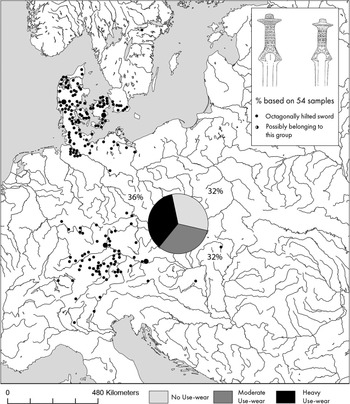
Photo of a full-hilted Period III sword from Thy in Denmark, with a hilt completely worn down to the clay core. Photo by Klaus Madsen, Thisted museum

These dramatic historical events tended to undermine the authority of ritual chiefs in the Nordic zone, which was linked to control over rituals and metal that was now becoming sparse, whereas warriors might benefit from taking part in raids and returning with riches from booty. In this way they could mobilise alternative wealth from raid and plunder, whether at home or as mercenaries in Central Europe or the Aegean where the flange-hilted sword testifies to the appearance of warriors from the north, mainly from Italy but also from Central Europe (Clausing Reference Clausing2003, Abb. 2; Jung & Mehofer Reference Jung and Mehofer2013). As return payment and booty they would bring new body armour to Central Europe (Goetze Reference Goetze1984; Clausing Reference Clausing2003, Abb. 4). Thus, after the deposition of the last generation of full-hilted Nordic swords towards the end of Period III, we see a major reorganisation of burial rituals. From this point urn burials become the norm, and large objects such as swords are no longer deposited, except in rare circumstances. The construction of thousands of barrows made of grass turf also came to an end, except for a few elite burials (Holst et al. Reference Holst, Rasmussen, Bech and Kristiansen2013). A new political and ritual regime with less boasting of power had taken over, probably due to a centralisation of power in fewer hands, but also due to influence from the Lausitz/Lusatian culture. This new regime corresponds to similar changes in Central Europe (Clausing Reference Clausing2005), and the elites now shared international prestige goods of drinking and feasting (Metzner-Nebelsick Reference Metzner-Nebelsick2003).
Once this new trading network was established it flourished and continued during Period IV of the Nordic Bronze Age (Reference KristiansenKristiansen Reference Kristiansen1998, figs 42 & 45). During Period III it exhibited the same characteristics as the former Period II network: there is a concentration of swords and Aegean imports/imitations in Slovakia/the Carpathian Basin, and then there is another heavy concentration in Denmark and Mecklenburg, with an empty stretch of several hundred kilometres in between. Again it suggests directional and regular trade connections between these two rich and powerful regions. Hammered bronze vessels of various types produced in the Carpathian zone reached the Nordic zone in quite large numbers, and testify to the elite level of trade (Metzner-Nebelsick Reference Metzner-Nebelsick2003). In the Nordic zone Mecklenburg rose to dominance during Period III, and it is therefore not surprising that hostilities would occur especially in this region, as witnessed in Tollense (cf. Jantzen et al. Reference Jantzen, Brinker, Orschiedt, Heinemeier, Piek, Hauenstein, Krüger, Lidke, Lübke, Lampe, Lorenz, Schult and Terberger2011). In the following we shall therefore discuss in more detail the possible historical processes leading up to this major change in trade routes (and religious beliefs), accompanied by social disruption, warfare, and migrations, during the 13th–12th centuries bc.
CENTRAL EUROPE & THE EASTERN MEDITERRANEAN DURING THE 13TH–12TH CENTURIES bc: THE HISTORICAL PROCESSES AT WORK
The rise of the Late Bronze Age warrior aristocracy in temperate Europe and its expansion especially after 1300 bc must be explained with respect to the region’s position on the periphery of the more advanced and richer centres of the Mediterranean Basin (Reference KristiansenKristiansen & Larsson Reference Kristiansen and Larsson2005). It coincides with the emergence of the Urnfield Culture, characterised by intensive development and great mobility. The most important historical question, then, is how these processes in the European peripheries were related to the contemporaneous developments in the palatial centres of the Mediterranean Basin. Indeed, what makes this epoch in European history most remarkable are the dramatic events associated with the influx of the ‘Sea Peoples’ and the eventual destruction of the palatial centres of the South after 1200 bc. However, we can only understand the background to the Sea Peoples, and contemporary overland migrations through the Balkans, by probing more deeply into those large-scale changes that took place in temperate Europe from the beginning of the Urnfield period between 1350 and 1250 bc as they form a necessary prelude to what happened after 1200 bc.
While the full-hilted sword of Riegsee type and its successors never left the Central European mainland, the flange-hilted sword, also known as Naue II, is an international warrior’s weapon that was in use from the Aegean to Scandinavia (see Fig. 1). This begets the question of what exactly it was that made these swords so much more globally popular, and what made them one of the most important sources of evidence for the role of travelling mercenaries and their impact on Late Bronze Age societies across Europe?
New forms of warfare and new forms of more centralised government go hand-in-hand. Traditionally Bronze Age warfare was mostly local, and linked to raids and oppression using small war bands of typically 15–20 lance carrying infantries, with one or two sword carrying commanders. From Period III they might have been on horseback. This pattern of small war bands can be traced from the early Middle Bronze Age and down to the Late Bronze Age (Harding Reference Harding2007; Vandkilde Reference Vandkilde2013a). What we see in the Urnfield period is the beginning of more organised battles with hundreds or even thousands of warriors. It only makes sense if you were able to control your enemy’s territory after a conquest, and to do that there had to be centralised settlements housing all major institutions and functions needed to govern and control a larger territory, eventually supported by smaller local forts. This form of government started on a smaller scale in the Carpathian Basin with the tell cultures during the Middle Bronze Age (Earle & Reference KristiansenKristiansen Reference Earle and Kristiansen2010; Uhner Reference Uhner2012), and by the 14th century reached a new momentum in the very same region, which led to new settlements and increased population.
New forms of settlement & increasing population densities
Cornesti-Iarcuri in Transylvania represents a new form of proto-urban settlement of a size never seen before or after, that is until the historical period. This settlement, nearly 6 km across (1733 ha/17 km2), had four fortification lines and an inner settlement with a diameter of c. 2 km (Szentmiklosi et al. Reference Szentmiklosi, Heeb, Heeb, Harding, Krause and Becker2011). Magnetic mapping and preliminary excavations suggest a dense and well-organised settlement of urban character. For the fortification walls alone an estimated 824,000 tonnes of earth had to be moved. Archaeological material and a few radiocarbon dates suggest the construction took place during the earlier Urnfield Culture (there are only three radiocarbon dates of the later burning phase, made on wood from burnt oak beams whose inbuilt age should be considered). Some time after, probably during HaA1, the settlement was burned down in a heavy fire and apparently abandoned. There is still a long way to go before we fully understand this mega-site; archaeological work so far is preliminary, but it suggests that something completely new was taking place in terms of the organisation of large populations. There is also evidence of two smaller fortified sites, 1 km across, that might have been part of this new political structure as well. We must envisage these mega-sites as being part of a political centralisation process, a complex chiefdom, or archaic state that perhaps failed. In the vicinity we also find corresponding rich graves from the same period, which are contemporary with the Bernstorf fortification and its later devastation. Furthermore, such population surplus would be a natural primary instigator for later migrations, especially if the settlement was abandoned, in part or entirely, during the 12th century bc.
Such migrations correspond with evidence from Tollense in fertile Mecklenburg (Jantzen et al. Reference Jantzen, Brinker, Orschiedt, Heinemeier, Piek, Hauenstein, Krüger, Lidke, Lübke, Lampe, Lorenz, Schult and Terberger2011). Here a huge army of several hundred, perhaps several thousand, warriors met with a defending army, and a battle raged along the small river over several kilometres (Jantzen et al. Reference Jantzen, Brinker, Orschiedt, Heinemeier, Piek, Hauenstein, Krüger, Lidke, Lübke, Lampe, Lorenz, Schult and Terberger2011; Reference Jantzen, Orschiedt, Piek and Terberger2014). The attackers apparently came from the south; Price (Reference Price2014) shows that c. 50% was non-local, but this figure could be higher. They used bronze arrowheads and also horses for the officers – in short, they were an organised army. Dating of the battle by radiocarbon so far places it in the middle of the 13th century bc. Such a migration to the Nordic cultural zone could be the kind of event that broke the old exchange network to southern Germany and established a new connection to the south towards Slovakia and the Carpathians. It suggests that Bronze Age societies were highly organised, but also that overpopulation and new forms of political authority might lead to migrations out, first to the north, later to the south. Such migrations further provided part of an explanation for a temporary collapse of the metal trade in the 13th century bc, as evidenced by the dominance of heavily worn swords in the Nordic realm (Fig. 12).
New forms of agrarian intensification: the creation of larger food supplies & a new political economy
New crops and more intensive agrarian regimes are introduced during the Urnfield period, and they transformed landscapes on a large scale (Bartelheim & Stäuble Reference Bartelheim and Stäuble2009); for example, cutting down forest along river valleys to create fields made them prone to erosion (French Reference French2010). Some of these new agrarian strategies could well have been inspired from the south, but more importantly they allowed more people to be fed than during the predominantly herding economies of the Tumulus culture.
We may thus conclude that during the 13th century bc societies in Central Europe underwent not only a religious reform with the onset of the Urnfield culture, but they also underwent economic and political reforms – in short a new political economy with a higher degree of centralisation was established, and consequently many later settlements were now fortified (Harding Reference Harding2000, 296). The more extreme centralisation processes may have succeeded only in the heartland of Central Europe, as is evidenced by the mega-site Cornesti-Iarcuri in Transylvania. Such centralisation processes of large populations might have spurred new migrations to the north, the west, and later to the south when the mega settlements were abandoned. A similar development of a more hierarchical settlement structure followed by more violence is evidenced also in the Terramare Culture in northern Italy (Cansi et al. Reference Cansi, Gaspari and Maino2009). Here a large population concentration reached a tipping point around 1200 bc, and more than 100,000 people abandoned their homes; some of them settled elsewhere in Italy, while others evidently became part of the Sea Peoples (Cardarelli Reference Cardarelli2009; Reference KristiansenKristiansen in press). Such build up of populations in northern Italy and Central Europe provides a necessary background for understanding how Bronze Age societies in Europe could provide the population surplus for the huge migrations at land and sea that came to characterise the 12th century bc, and led to the onset of a Dark Age in Anatolia, Greece, and in the eastern Mediterranean.
Centre–periphery dynamics
The archaeological evidence clearly indicates that what happened in the Aegean world during the 13th and 12th centuries bc was not just a local chain of temporary economic and social disruptions, but also a catastrophic sequence of events that eventually affected most of the continent. The stability and growth that initially characterised the Aegean Late Bronze Age vanished, giving way to the decline of the palatial societies. Most intriguingly, it seems that the appearance of temperate European mercenaries and settlers coincided with, promoted, or even caused these significant political, social, and economic changes in the Mediterranean Basin, resulting in a partial collapse of exchange and communication networks that ultimately brought about not only the decline of the once mighty Mycenaean culture, but also the city-states of the eastern Mediterranean (Muhly Reference Muhly1992; Drews Reference Drews1993; Bachhüber & Roberts Reference Bachhüber and Roberts2009).
There is little indication that an indigenous aristocracy survived in the south that would have been able to re-manifest its social position and wealth during that time. There are, however, some exceptions. These are the so-called ‘warrior graves’, most of them recorded in Achaea during the LH III C (1200–1100 bc; Deger-Jalkotzy Reference Deger-Jalkotzy2006; Giannopoulos Reference Giannopoulos2008). They contained swords of Naue II type along with Mycenaean swords and other weaponry such as daggers, knives, spears, greaves, helmets, and shields. They also contained metal vessels, dress fasteners, and jewellery, as well as tweezers, combs, and razors. These graves testify to attempts at establishing a new hierarchical social organisation in post-palatial society as well as the rise of a distinct class of warriors whose function had changed in line with the changing circumstances (Deger-Jalkotzy Reference Deger-Jalkotzy2006). These were the warriors who, through their military prowess, were able to grasp the opportunities that came with shifting social status and political power. It may be speculated that some of these new ‘warrior princes’ were indeed mercenaries of northern origin that stayed in Greece to become local rulers (Giannopoulos Reference Giannopoulos2008). This view is supported by the fact that most of the weapons (usually a sword accompanied by one or more spears) found in these graves were European types (Jung & Mehofer Reference Jung and Mehofer2013), but swords of the Aegean types F and G have been found as well. However, as Eder (Reference Eder1999) points out, Mycenaean types of weapons were found mostly in peripheral regions (such as Thessaly), while Naue II swords were mainly found in the warrior tombs of the Peloponnese and on the Aegean Islands. Thus, the phenomenon of the ‘warrior graves’ reflects a deeply rooted change in the social and economic spheres of Mycenaean Greece that originated in the collapse of the palatial system (Deger-Jalkotzy Reference Deger-Jalkotzy2006).
In a broader view, the involvement of the European warriors in a ‘globalised’ network of power and wealth can be demonstrated by the diverse archaeological finds from Naue II contexts, such as Baltic amber, dress fasteners, toiletries, and weapons of so-called ‘northern origin’ that have been found in the Aegean and eastern Mediterranean (cf. Harding Reference Harding1984; Bouzek Reference Bouzek1985; Czebreszuk Reference Czebreszuk2011; Suchowska-Reference Suchowska-DuckeDucke in press). Furthermore, the cargoes of the aforementioned shipwrecks of Uluburun and Cape Gelidonya indicate that warriors from the North were present on board. Such a presence among the crew of the Uluburun is attested to by an Italian sword of Pertosa type, six European-type spearheads, a globular bronze pin, a mace with closest parallels in the northern Balkans, and 41 beads of Baltic amber (Pulak Reference Pulak2001). On board the Cape Gelidonya vessel a genuine flange-hilted sword of Naue II type was found (Bass Reference Bass1991). It is very likely that such items belonged to a foreign warrior whose hired role might have been to protect the traders on their mercantile mission.
During the 13th century the peripheries closer to the Mycenaean and Cypriot palaces were thus increasingly drawn into their realm through a mix of trade, war service by mercenaries, and eventually also some dispositions of people as slaves (Reference KristiansenKristiansen Reference Kristiansen1998, fig. 211; Mederos Martin Reference Mederos Martin2009; Bouzek Reference Bouzek2011). In the Terramare this is testified by the appearance of Mycenaean pottery during the 13th century (Radina & Recchia Reference Radina and Recchia2010), just as we find Italian type flange-hilted swords from travelling warriors in several places in the eastern Mediterranean (Jung Reference Jung2009; Jung & Mehofer Reference Jung and Mehofer2009; Reference Jung and Mehofer2013). One such sword was found on the Uluburun ship, which led Susan Sherratt (Reference Sherratt2003) to see this movement as the onset of a more dynamic historical situation, where the palaces had less control and private enterprises flourished. However, others have criticised this view and pointed out that palaces were in reality also private enterprises, just on a larger scale (Routledge & McGeough Reference Routledge and McGeough2009). Be that as it may, during the 13th century we see an increased interaction between the eastern Mediterranean civilizations and the European hinterlands, from the Balkans (Falkenstein 2012/Reference Falkenstein13; Aslaksen Reference Aslaksen2013) further on to the Carpathians, and via sea routes to northern Italy. Northern Italian Peschiera daggers and early violin bow fibulae used on dress accompanied these movements and show that people rather than goods were travelling (Terzan Reference Terzan2007, table xxxiv). This is also supported by Italian impasto pottery in LH III B contexts at Tiryns, Midea, and Mycenae (Jung & Mehofer Reference Jung and Mehofer2013, 184). After 1200 bc these very same peripheries for reasons yet unknown started to migrate towards the centres of civilisation, at land and at sea. We should probably envisage these historical processes much in the same way as later Celtic and Viking migrations, which channelled surplus populations into seasonal trading and raiding alternating with war service leading to conquest and migration when conditions were ripe.
CONCLUSION
During the Bronze Age, especially from the 16th century bc onward, vast networks of communication existed, transforming physical geography into social geographies. Economic and technological innovations diffused rapidly, flattening ‘cultural gradients’ and removing borders to trade, exchange, and travel (Harding Reference Harding1984; Bouzek Reference Bouzek1985; Reference KristiansenKristiansen & Larsson Reference Kristiansen and Larsson2005; Vandkilde Reference Vandkilde2013b). The starting point for this investigation was formed by the premises that:
-
a. pan-European economic and political interdependence can be traced back at least to the Bronze Age;
-
b. there exists a strong correlation between traders and warriors, which can be used as proxy evidence for cross-cultural communication in the archaeological record; and
-
c. long-distance mobility influenced central and peripheral regions alike.
We were able to verify all of these premises with two case studies of shifting interregional trading and warrior networks, backed by political alliances. We could further demonstrate that interactions of connected societies are never one-directional: European societies increasingly adopted features from the palatial centres in the eastern Mediterranean, which in turn adopted both warriors and valuable products from the European hinterlands. The final collapse of the centres in the eastern Mediterranean undoubtedly stands testimony to this type of connected fate.



