




Fire was a persistent feature of village life in the Philippines, a society that remained rural well into the twentieth century. Although undisturbed tropical forests rarely burn under normal climatic conditions, the barrios located within or next to them were highly combustible.Footnote 1 Stephen Pyne describes these settlements as ‘rebuilt wildlands’, assembled from the same materials as their surroundings and burning to a seasonal rhythm as they dried and aged in the sun.Footnote 2 When the Spanish arrived in 1565, they encountered a dispersed rural population and soon concentrated it through a process of reducción to facilitate evangelisation, taxation, and control – thereby intensifying the fire risk.Footnote 3 The bahay-kubo, constructed from abundant but highly flammable materials, remained the dominant form of housing, while seasonal grass fires posed a constant external threat.Footnote 4 Fire thus persisted as a structural hazard into the mid-twentieth century, only gradually receding as concrete replaced organic building materials in many parts of the archipelago.Footnote 5
Hazard is never far from Filipinos who live in a semi-constant state of threat. Typhoons, floods, earthquakes, and volcanic eruptions, among other hazards, occur with such regularity that they have become woven into the country’s social and economic fabric.Footnote 6 Communities have adapted to the risk. The annual cycle of typhoons and floods, which causes more loss of life and property than any other hazard, has entrenched practices of preparedness and mutual support. The frequency of earthquakes has reshaped both urban centres and rural towns, repeatedly threatening the material heritage of the nation. Volcanic eruptions have punctuated the archipelago’s history, producing dramatic population movements and long-term ecological and economic disruption.Footnote 7
Yet, among the wide array of hazards that regularly afflict the islands’ population, fire remains curiously understudied. It is chiefly acknowledged as a tool of indigenous agriculture – the burn central to swidden (kaingin) cultivation – and as a cause of colonial-era deforestation.Footnote 8 But fire constitutes a widespread and distinctive hazard in its own right. While large, climate-driven wildfires were less common in the Philippines than elsewhere in Southeast Asia, specific forest types – notably the ‘fire climax’ pine forests of Northern Luzon – remained highly fire-prone, particularly during ENSO-related droughts, and are likely to become more so with climate change.Footnote 9 Grasslands, plantations, and agricultural zones also burned frequently and threatened adjacent forest ecosystems.Footnote 10
Far more common were the urban and residential fires that devastated dense shanty towns and informal settlements in major cities. Historical accounts highlight the persistently destructive nature of fire in Manila and provincial towns. Spanish urban planning, with its compact grid centred on plazas and churches, intensified fire risk by concentrating flammable structures. Manila suffered repeated conflagrations that reshaped the city centre, while provincial towns experienced similar devastation.Footnote 11 Urban fire continued to plague cities and towns during the American colonial period.Footnote 12
Absent from the historical record is almost any sustained reference to village fires. This silence is striking given the material conditions of the traditional Filipino house: well-adapted to its environment, yet highly combustible. Clustered densely into barrios, such dwellings created settlements intrinsically vulnerable to rapid fire spread. Ignitions were often accidental, but fire was also used deliberately. Unlike in Europe and North America, however, there is little evidence of incendiarism directed against landowners during periods of social unrest.Footnote 13 Whether this reflects a genuine absence of such acts or the biases of a source base that relies almost exclusively on subaltern voices remains unclear. What is certain is that fire was systematically deployed as a weapon of war; hundreds of barrios were destroyed during the Spanish and Philippine-American Wars and again in World War II. This article reconstructs this Filipino ‘village fire regime’ – its characteristic patterns, uses, and consequences – and situates it both within the recent history of the archipelago and within the broader field of fire studies.
Why study village fires?
In a country shaped by relentless environmental pressures like the Philippines, fire as a hazard remains both ubiquitous and curiously overlooked. This neglect is even more striking in a society where the barrio has long been the fundamental unit of everyday life. According to the 1939 Census, the population was overwhelmingly rural, with 76.5 percent of people living in barrios or poblaciónes with less than 5,000 inhabitants.Footnote 14 Even as recently as 2020, 46 percent of Filipinos still lived in rural settlements.Footnote 15 Yet, fire in these communities has attracted remarkably little scholarly attention.Footnote 16 Historical data nonetheless reveal that fire was a recurrent hazard in the barrio, woven into the rhythms of rural existence.
In the Philippines, the barrio was/is a site of dense and continuous human activity, and this everyday presence shaped both ignition risk and the response to fire. Open flames used for cooking, heating, and agricultural work combined with highly combustible, locally sourced building materials to produce an environment where the probability of ignition was structurally high. Once a fire began, its impacts were immediate and devastating. A village fire was not a wildland blaze largely left to burn itself out nor a contained incident within a potentially insured urban system. A village fire was a direct assault on shelter, food stores, and livelihoods within a largely self-sufficient rural setting. Its consequences were therefore disproportionately catastrophic to its inhabitants.Footnote 17
Even though the frequency and impact of rural fires have often been overlooked, these fires played a crucial role in shaping the vulnerability and resilience of rural communities. Rural communities traditionally confronted fire collectively, knowing how quickly flames could spread from one house to the next. Most villages were close-knit, with residents often addressing each other as cousin, auntie, or grandfather – a sense of fictive kinship that fostered strong communal bonds. Village solidarity was most evident during major communal events such as fiestas, weddings, burials, and house relocations – and especially in times of fire.Footnote 18 Neighbours responded quickly to extinguish small flare-ups, but once a blaze had taken hold, they were reluctant to risk lives attempting to save property. Instead, households hurried to remove their belongings before the flames consumed their homes, after which, however, the community came together to rebuild in the fire’s aftermath.
Understanding village fires offers insight into the everyday risks faced by ordinary people and the ways communities adapted to, and recovered from, such hazards in a uniquely Filipino setting. Although the nature of rural fires changed in the early twentieth century with the introduction of new technologies, fuels, and building materials, their frequency did not decline as it sometimes did in urban centres. On the contrary, village fires became more frequent, more destructive, and increasingly deliberate as Filipino communities were drawn into the expanding sphere of twentieth-century techno-warfare. Tracing this trajectory highlights an alternative, more popular history of the Philippines centred on the barrio – one that foregrounds the experiences of the common person, or tao. In an overwhelmingly rural society, village history is the history of the many rather than the few.
Studying village fires also deepens our understanding of disaster adaptation and environmental history in the Philippines. It highlights the environmental dimensions of warfare, showing how military strategy, material culture, and landscape interacted to produce patterns of destruction that conventional military or fire-science frameworks often overlook. It also sheds light on twentieth-century counterinsurgency, in which the burning of villages – whether punitive, pre-emptive, or opportunistic – became a recurrent tactic for reshaping populations and controlling territory. Footnote 19 In this sense, the history of village fire provides an important lens through which to interpret the environmental history of conflict in the Philippines and the wider region.Footnote 20
The source
Barrio fire was among the most frequent hazards historically faced by Filipinos, yet their history has largely vanished from the written record and survives mainly in local memory. One of the few sources through which this lost history can be reconstructed is the Historical Data Papers (HDP), a nationwide survey of municipal histories commissioned in 1951 by President Elpidio Quirino. The survey was intended to preserve local histories threatened by the widespread destruction of archives during World War II.Footnote 21 Compiled largely by local schoolteachers who interviewed elderly residents, the HDP recorded the origins, notable events, customs, and traditions of municipalities and their barrios.Footnote 22
For the study of village fires, the HDP are an indispensable source, some dating back to the eighteenth century. Their geographically extensive coverage captures incidents and practices that rarely appear in extant records, revealing a persistent and often structurally embedded fire regime in early twentieth-century rural communities. The documents depict highly combustible settlement environments, the use of fire as a weapon during periods of conflict, and the growing role of new technological sources of ignition and their consequences. Taken together, these accounts show that village fires were not isolated events but part of a recurring pattern that shaped rural life and, at times, even served as a force of destruction and renewal.
But the HDP are not without limitations. Their quality varies depending on the interests and abilities of those who compiled them, and critics have noted inconsistencies in format, chronology, and completeness.Footnote 23 For a start, the apparent absence of class-directed incendiarism may conceal activities villagers were unwilling to reveal as much as it reflects their actual non-occurrence. The schoolteachers who compiled these accounts were also untrained researchers. Although members of the communities they described, they were seldom native to the barrio itself. Educated, literate in English, and occupying a position of relative social prestige, they stood apart from most other residents. To what extent did this ambiguous insider-outsider status shape what they observed, what they were told, and what they chose to record? Yet such shortcomings matter less when the aim is to understand everyday practices and collective experiences rather than establish precise timelines. In this respect, the HDP offer unparalleled insight into settlement patterns, social organisation, community interactions, and local events across a wide geographical range.
To address their unevenness, the archive was examined systematically across all provinces rather than selective sampling.Footnote 24 This approach resembles a form of prosopography, emphasising the commonplace experiences of many rural communities rather than exceptional events or elite narratives. By allowing the sources to speak largely in their own words, the HDP recover the ‘little tradition’ of the barrio – its routines, hazards, and collective responses.Footnote 25 Now that the files have been almost completely digitised by the National Library of the Philippines, it has finally become possible to reconstruct the historical dynamics of village fire and, more broadly, the environmental and social history of the everyday life of Filipinos in rural areas.
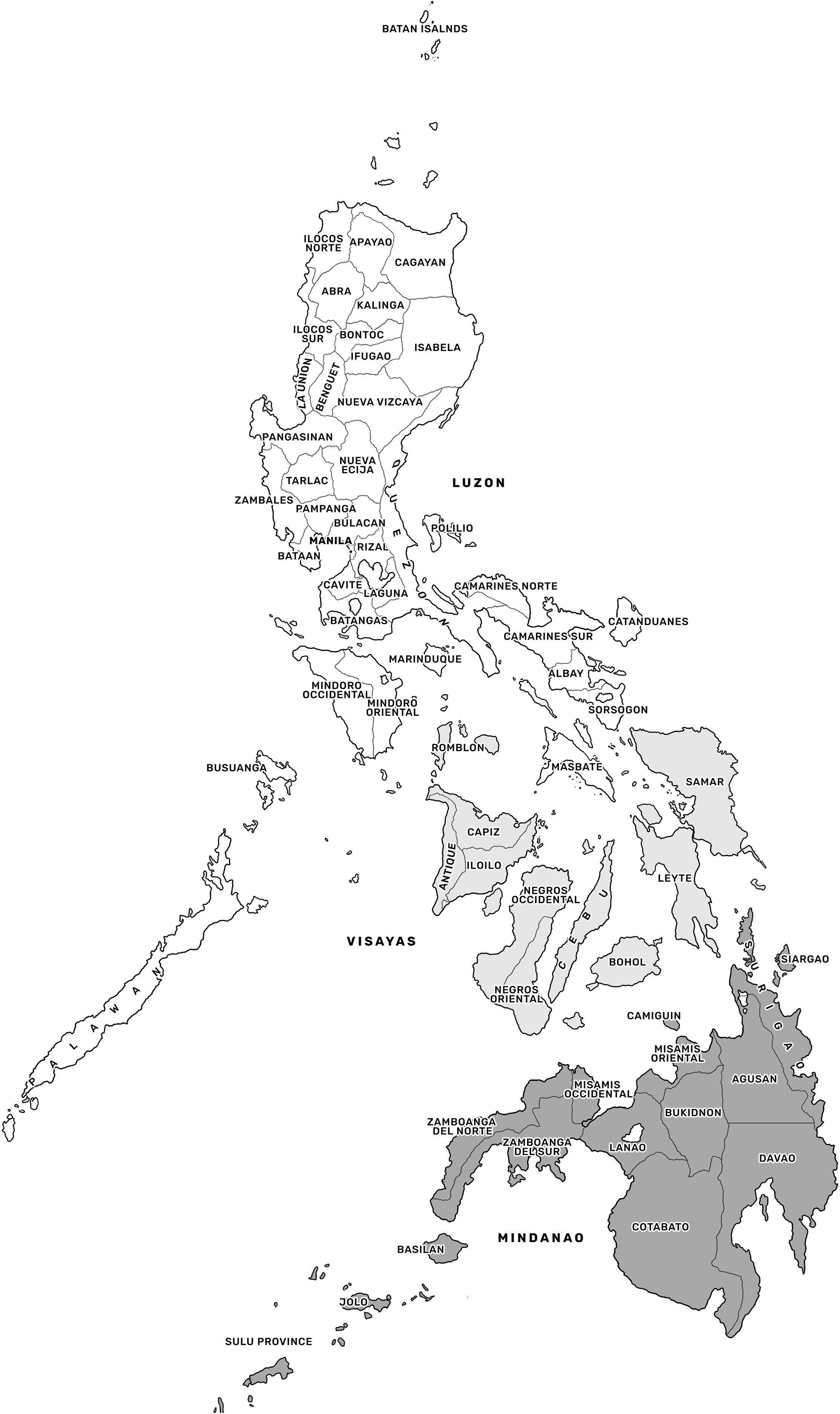
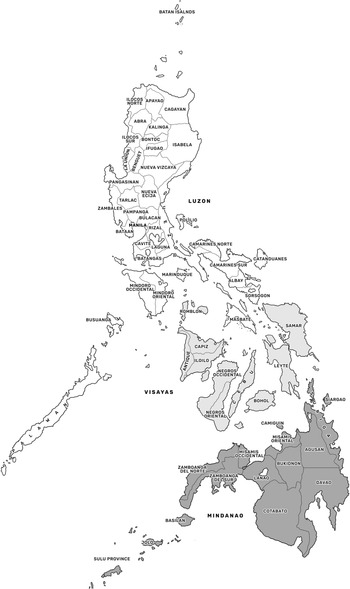
Map of the Philippines showing the provinces in 1950 (drawn by Maiden Mirabueno).
The vulnerability of the bahay-kubo
The barrio has been the primary unit of administrative, social, and economic activity for people in the islands since pre-colonial times, organised around reciprocity though with distinct social hierarchies.Footnote 26 It was often a small and sometimes geographically dispersed settlement inhabited by a few hundred inhabitants.Footnote 27 In one sense, the term simply equated with a village, but it could also encompass a variety of other settlements, including outlying hamlets or sitios (now known as puroks) as well as the outer areas of poblaciónes or small country towns.Footnote 28 The barrios of these poblaciónes were made from similar materials as their village counterparts apart from the principal buildings in the plaza and so are treated in the same manner.
The barrio comprised a number of small, single-room houses raised on wooden stilts and constructed from organic materials such as bamboo, wood, and thatch. This was the archetypal rural dwelling of the lowland Philippines and was known as the bahay-kubo or nipa hut, a name derived from the palm (Nypa fruticans), whose leaves were commonly used as thatch. Its steeply pitched roof and wide eaves were designed to shed heavy tropical rains, while the elevated floor protected the interior from flooding, pests, and ground moisture and allowed the air to circulate beneath the house. Walls and floors were made from woven bamboo, giving the structure a light, flexible quality well suited to a humid climate and earthquake-prone environment.Footnote 29 Barrios contained not only nipa houses but also granaries stocked with substantial quantities of grain, particularly palay (unhusked rice). The husk of rice is rich in cellulose and lignin, making it highly combustible and capable of intensifying a blaze once ignited. As they aged, the combustibility of these structures increased as the materials from which they were made dried, especially during the dry season.Footnote 30 The barrio’s layout only heightened the danger with clusters of highly flammable dwellings standing close together. While the architecture of the bahay-kubo has since become iconic, inspiring elements of modern design, its light and combustible construction made it highly vulnerable to fire.Footnote 31 Entire barrios – and at times even provincial poblaciónes – were reduced to ashes by the smallest accident.
Fires were all too common in the barrio. Autogenic fires caused by lightning were rare, but more common were fires that followed the many typhoons that struck Luzon and the Visayas, as occurred in Peñaranda on 8 November 1902.Footnote 32 The flammability of local building materials meant that ordinary farming or everyday household activities could spark fires.Footnote 33 Fire was integral to swidden agriculture and could easily spread on windy days. As one observer in Mindoro noted, the most common cause of barrio fires was ‘the customary burnings of the Kaingin’.Footnote 34 In this semi-built/semi-vegetated environment, accidents were common, and their consequences potentially catastrophic. Within the barrio, fires were most often the product of irresponsible behaviour. In 1870, a blaze attributed to a ‘careless neighbor’ left Barrio Gigmato entirely destroyed, not a single house remaining.Footnote 35 Such incidents were typical: an overturned lamp, a guttering candle, or a discarded cigarette could ignite catastrophe in an environment where dwellings were effectively dry tinder. In March 1891, the sister of the Tayum parish priest died after waking to find her room ‘all in flames’, the fire traced to an ever-burning lamp that had tipped over during the night.Footnote 36 In August 1915, a smouldering cigarette left on a windowsill in Goa sparked a conflagration that consumed more than 200 houses.Footnote 37
The need for fire in daily life meant that the risk of one escaping from human control was ever-present. Cooking was a common cause of fire. On 13 April 1912, a kitchen fire burned down several granaries and half the houses in Tayum, the blaze starting when an elderly woman left boiling camotes unattended ‘as is often the custom’. The house was soon engulfed in flames, and, with dry weather and a strong southerly breeze, the flames spread quickly to nearby buildings until ‘the whole area west of the church was like hell’.Footnote 38 In 1935, the fire that destroyed several houses in Barrio Taliptip in Bulacan was blamed on carelessness when a small girl left the stove unattended to go and play.Footnote 39 The risk of cooking fires was the reason why village kitchens were often free-standing structures apart from the main house.
Outside the home, local customs created frequent ignition points in an environment that was neither urban nor wildland. Funerary rites required a fire to burn through the night to ward off spirits; fiestas, weddings, and harvest celebrations featured fireworks amid sun-dried thatch that served as ready tinder.Footnote 40 In Barrio Mapulang Bato, the harvest brought nine nights of revelry with ‘much fireworks and things to eat’.Footnote 41 Such festivities could all too easily turn catastrophic: in Pangil, fireworks during a procession sparked a conflagration that left only nineteen houses standing.Footnote 42
Not all fires were accidental; arson, too, marked rural life. The record is too thin to establish patterns of the kind Cathy Frierson identifies for pre-revolutionary Russia, so it is difficult to determine whether such acts were forms of social protest or expressions of local tensions.Footnote 43 Yet, the evidence makes clear that incendiarism was a recurring presence. In 1853, the ‘notorious’ Fernando was seen fleeing a blaze that destroyed seven houses in Barrio Dagatan, Laguna.Footnote 44 In 1876, Paciano Omana pleaded guilty to incendiarism after more than half the población of Gumaca was razed.Footnote 45 An Aglipayan sacristan was later suspected – though not proven – to have set fire to the Catholic church in Pura in April 1905.Footnote 46 Contemporary newspaper reports also suggest that arson was not uncommon, though they seldom bothered to report incidents in rural areas. One such case of arson, however, occurred at Paniki (Tarlac) on 25 February 1903, when a deliberately set blaze swept through a village of nipa houses, destroying more than forty dwellings along with the market and a finca. Material losses were estimated at ₱45,000.Footnote 47
The detailed records for Batac in Ilocos Norte for 1882 suggest how frequent such incidents could be. In January, the house of Don Hermogenes Arizabal was burned, with two suspects named. In February, the houses of Damaso Tagatac and Fedel Libed were destroyed on successive nights – one just after curfew, the next at three in the morning. Later that same Friday, shortly before noon, the house of Ines Lopez across the river was set alight, triggering a conflagration that swept through the población to the southern hills and consumed, among many others, the house of the gobernadorcillo, the town mayor. Footnote 48 In such contexts, ‘mysterious fires’ often invited scapegoating: after the great fire of Bocaue in 1898, which began in a Chinese-owned store and levelled most of the town, residents turned violently on the Chinese community, killing those they could find.Footnote 49
Village fires and their frequency
The HDP contain numerous accounts of village fires. Typically, only ‘frightful calamities’ persisted ‘in the memory of the old folks’, fires such as the Good Friday blaze in Ilaya, Rizal, that ‘razed almost the whole barrio to the ground’.Footnote 50 Mostly, these fires are described as ‘big’, as having destroyed large parts of settlements, while smaller, more frequent blazes went unrecorded unless some prominent structure caught fire. Many early entries are also vague – ‘a big conflagration in Tayabas in 1732’ – or imprecise, like the fire that consumed much of Barrio Manuyo ‘during the Spanish occupation’.Footnote 51
Even for the early nineteenth century, descriptions remain relatively thin. One account describes a fire on 31 August 1809 in Barrio De La Paz that burned a third of the houses and allegedly claimed the lives of over half the inhabitants, though such a death toll is unlikely.Footnote 52 In 1837, a ‘great fire’ in Sitio Baligang in Albay compelled residents to abandon the site altogether.Footnote 53 After 1850, reports of fires become more frequent and detailed. On 15 January 1887, a ‘great conflagration’ in Looc originating in the home of a laundry woman swept over the whole town, wiping it out entirely.Footnote 54 Similarly large fires, leaving ‘thousands homeless’, occurred in Sta. Ana (1870), Polangui (1876), Aliaga (1881), Buhi (1884/1885), Pililla (1887), Patucannay (1893), and Gatbuca (1894).Footnote 55
By the twentieth century, fires appear less as lore than as lived experience. A major blaze on Romblon, for example, razed Barrio Libertad in 1921. It broke out while the men were in the fields, spread rapidly under a strong northeasterly wind, and was intensified by houses standing ‘very near each other’. By the time the men returned, much of the barrio had been destroyed; even thirty years later, only ten houses had been rebuilt on the original site.Footnote 56 Wind frequently drove fires ‘out of control’, as in Barrio San Roque in 1934, where flames raged for an hour before consuming almost half the settlement.Footnote 57 The costs were equally severe. The largest fire ‘ever known’ in Baum in 1919 destroyed nearly all its houses and caused losses of several hundred thousand pesos; recovery took years.Footnote 58 In March 1939, a man named Aurelio Estacio reportedly went insane and set fire to his house in Barrio Tipas. The resulting blaze consumed a hundred houses and was said to have caused damages of up to a million pesos.Footnote 59
In the tinder-dry environment of the barrio, even a small fire could quickly escape control and cause widespread destruction. The true frequency of such incidents is difficult to determine, however, as the surviving evidence is largely anecdotal and too irregular to sustain firm statistical analysis. Most records note only the more conspicuous fires – those that destroyed multiple houses or important buildings – while smaller, routine fires likely went unreported. In a few localities, however, fires are mentioned repeatedly in the sources. Fragmentary though they are, these recurring references offer at least a tentative basis for gauging the relative incidence of fire during this period.
Fires in Sariaya, Quezon, for example, destroyed numerous homes in 1831, caused even greater damage in 1847, and burned down forty-three houses on Christmas Day in 1867.Footnote 60 The neighbouring población of Pagbilao suffered devastating fires in 1881, 1882, and 1884 that consumed most of the settlement’s houses, including the church and school.Footnote 61 In Camarines Sur, a conflagration razed Baao to the ground in 1902 and was followed by two further major fires in 1906 and 1919 that set back the town’s development for years.Footnote 62 Fires were so frequent in Peñaranda during the first decade of the twentieth century that scarcely a year passed without one. In 1902 alone, major fires broke out in March and again in November, destroying numerous homes and a large warehouse. Another blaze in January 1905 gutted a hundred houses, leaving many families homeless, while in 1909, two large fires burned more than a hundred houses.Footnote 63
Based on such reports, it appears that major fires occurred at least once a decade in many places, and often more frequently. To the residents of Barrio Ambil on Mindoro, fire was simply ‘one of the calamities of the place’.Footnote 64 The barrio itself was a highly combustible environment – distinct from urban centres and different again from the surrounding forests or fields – and one that burned repeatedly, whether through accident or intent.
The flames of war
‘Institutionalised’ arson was very much a feature of the rural landscape in the Philippines. Organised groups of all persuasion – soldiers, militias, revolutionaries, rebels, and raiders – singled out the barrio and used fire to intimidate, punish, repress, or deny. Long before modern warfare, villages were already targets. For centuries, Moro raiders had sacked and burned coastal settlements, mountain peoples had torched missions and foothill towns, and Spanish authorities had put entire rancherías (traditional villages) to the torch.Footnote 65 One Spanish officer reputedly burned down 180 houses in a single raid in 1829.Footnote 66 By the late nineteenth century, burning had become integral to colonial policing; the Guardia Civil routinely set villages alight.Footnote 67 Across every major conflict from the late nineteenth century to the mid-twentieth century – the Philippine Revolution and the Philippine-American War (1896–1902), the Moro Wars (1902–1913), the Pacific War (1941–1945), and then the Huk Rebellion (1946–1954) – it was the barrio and población that repeatedly burned. Footnote 68 Yet, historical attention remains overwhelmingly fixed on the city.Footnote 69
Between 1896 and 1902, all sides weaponised fire. Spanish forces burned houses suspected of sheltering ‘insurgents’ and torched barrios thought to sympathise with them, especially near sites of fighting. Footnote 70 Residents who failed ‘to answer in a convincing manner’ risked seeing their homes destroyed. Footnote 71 Reprisals could be extreme: after a Guardia Civil sergeant was ambushed in 1896, an entire barrio was burned, and forty inhabitants were massacred.Footnote 72 Troops also set abandoned villages alight, whether out of suspicion or during withdrawal.Footnote 73 Filipino Republican forces likewise used fire to deny the enemy shelter, leaving opposing troops without lodgings.Footnote 74 They targeted symbolic colonial structures – municipal buildings and churches – and burned towns such as Guinobatan to prevent their use as American bases.Footnote 75 Elsewhere, scorched-earth tactics were employed to discourage prolonged occupation.Footnote 76 Villages were also burned for tactical reasons, such as clearing defensive positions, though typically only after women and children had been evacuated.Footnote 77
American forces followed similar patterns, destroying villages thought to be aiding insurgents,Footnote 78 burning crops and granaries,Footnote 79 and levelling abandoned settlements.Footnote 80 Suspected enemy hideouts were torched to flush out enemy combatants.Footnote 81 In 1900, for example, ‘not a single house escaped’ in Barrio Kinibiti.Footnote 82 Fire was also used in reprisals.Footnote 83 In La Union, an entire village was destroyed after a soldier was killed, and in Abra, the surrounding barrios were burned following an ambush in 1900.Footnote 84 In Samar and Batangas, retaliations reached new levels. After a company was ‘massacre[d]’ on Samar in September 1901, whole swathes of countryside were burned to make the island ‘a howling wilderness’.Footnote 85 In Batangas, enforced reconcentration was implemented by torching homes so ‘nobody would benefit from anything left’.Footnote 86 Fires lit by Americans were so widespread that one account claimed houses and granaries were burned at night ‘simply to give them light’.Footnote 87
World War II magnified this pattern to an unprecedented scale. Footnote 88 Accounts from across the archipelago describe the near-daily burning of homes, crops, boats, and public buildings.Footnote 89 Japanese forces, often acting under explicit orders, razed entire communities. In October 1943, for example, troops burned four barrios while crossing the mountain trail between Abra and Ilocos Sur and left poblaciónes such as Camalig in Albay ‘a ghost town with practically every building burned or damaged beyond repair’.Footnote 90 Settlements suspected of aiding guerrillas were routinely targeted. After learning that guerrillas had bivouacked in Barrio Toboan, Camarines Sur, Japanese forces ‘lost no time in raiding the place, burning all the houses’. Footnote 91 Retaliatory burnings followed ambushes: when a soldier was shot near Barrio Masili, Laguna, the village was torched; similar reprisals followed the killing of a courier in Camarines Sur and a spy in Negros Oriental.Footnote 92 Punitive destruction also accompanied troop withdrawals.Footnote 93 Nearly 600 houses were burned in San Matias, Pampanga, and only five remained standing in Bauan, Batangas.Footnote 94 By war’s end, many poblaciónes had effectively been erased.Footnote 95
Guerrillas and the US Army Forces in the Far East (USAFFE) used fire more selectively but still destroyed whole barrios when deemed necessary, a policy bitterly resented by locals.Footnote 96 In Capiz, for instance, all the houses in Barrio Rizal were torched by ‘the Guerrilla men’.Footnote 97 They singled out strategic buildings and the homes of collaborators, especially those belonging to pro-Japanese paramilitary groups.Footnote 98 In the first months of the war, the USAFFE destroyed assets that might aid the enemy.Footnote 99 Some communities even burned their own homes to prevent the Japanese from using them.Footnote 100 During liberation battles in 1944–1945, American forces again set structures alight to dislodge snipers, leaving towns like Pililla in Rizal in ruins.Footnote 101
The tinder-dry materials from which most rural structures were built made barrios easy – and attractive – targets for armed groups intent on coercion. Villages were burned repeatedly. Barrio Dororian, for instance, was set alight in succession by Spaniards, Republicans, and Americans.Footnote 102 This pattern intensified during World War II. In Barrio Lipayo, Negros Oriental, roadside houses were first burned by guerrillas and then by Japanese troops.Footnote 103 In Garchitorena, Japanese forces burned part of a barrio and looted the rest; after they withdrew, guerrillas returned to destroy what remained, including the school, leaving the place ‘as it was fifty years before, a desolate jungle’.Footnote 104
Fire was both an incidental product of combat and a deliberate instrument of punishment against communities suspected of aiding the enemy. Although scorched-earth tactics have long figured in both offensive and defensive operations, what stands out in the Philippine case is the routine, almost systematic resort to burning villages as a tactical measure.Footnote 105 This pervasive, institutionalised use marks village fire as a distinct category – one in which the destruction of a built rural environment, so closely mirroring the surrounding vegetation, becomes integral to the conduct of war itself.
Fire and village transformation
Neither the causes nor the consequences of village fire remained static throughout the early twentieth century. New sources of ignition and the proliferation of highly combustible materials created novel ‘firescapes’ (the dynamic interaction between the combustible elements of an area of land) in rural areas, even as fire itself acted as a transformative force on occasions, prompting barrio regeneration and improvements to the traditional rural house, the bahay-kubo. Villages thus became more vulnerable and, paradoxically, more open to change. The nature of village fire in the Philippines was shifting.
One notable development was the growing incidence of fires linked to new modes of transport and to the storage of volatile substances in traditional houses whose materials and construction had changed little over time. At first, such incidents were associated with sparks from wood-burning locomotives on the new railway lines running north and south of Manila, as well as on the shorter company lines used to transport bulk goods.Footnote 106 The large fire that consumed much of Peñaranda in 1909, for instance, began when a railroad engine hauling gravel set adjacent structures alight.Footnote 107 The Manila Railway Company, likewise, had to compensate homeowners in the población of Baao after locomotive sparks caused damaging fires in 1906 and again in 1919.Footnote 108
These incidents, however, were largely confined to areas close to railway lines. As the century advanced, a more ubiquitous hazard emerged with the increasing presence of motorcars. Even in rural districts, gasoline introduced a significant new agent of ignition and acceleration. Improper storage of fuel intensified the fires that devastated Barrio Sapangbato, Pampanga, in December 1941 and Barrio San Roque, Rizal, in April 1942.Footnote 109 The blaze that destroyed, ‘with such unbelievable quickness’, the southern section of Mayantoc within an hour on 27 February 1947 was likewise attributed to gasoline stored inside a ‘bamboo’ house.Footnote 110
Inside the home, too, the introduction and widespread adoption of new lighting technologies such as the kerosene lamp created an additional source of fire. As a petroleum derivative, kerosene produces volatile vapours that can form highly explosive mixtures with air at ordinary temperatures. Lamps that were defective or accidentally overturned easily ignited nearby materials, particularly in houses constructed from such light, combustible materials. Kerosene was also increasingly used in heaters, which exploded if poorly maintained or damaged. In the city of Manila – the only place at the time for which systematic statistics exist – kerosene lamps accounted for a significant proportion of urban fires. Between 1901 and 1913, nearly 22 percent of all recorded fires were attributed to lamps that had either been overturned or had exploded.Footnote 111 Although comparable records do not exist for rural areas, and the spread of such lamps was undoubtedly slower than in the capital, kerosene nevertheless introduced new dangers into the village environment.
Wartime developments further heightened these risks. The changing character of warfare, especially the advent of air power, introduced a devastating new threat to rural communities. Strafing runs might ignite flammable buildings, as in Nasugbu, when aircraft gunfire set the sugar mill’s powerhouse ablaze in January 1945.Footnote 112 Incendiary bombs, designed expressly to start fires, magnified the danger, though even high-explosive ordnance triggered fires.Footnote 113 The resulting destruction was immense: nearly 70 percent of homes in Barrio Batchelor, Pangasinan, were burned, as were half the houses in one district of Mauban, Quezon.Footnote 114 Barrio Binagbag was left a ‘veritable ghost town’ after more than one hundred houses were burned during a bombing raid.Footnote 115 Worst affected was the población of Bagued, Abra, where American bombs ignited a firestorm that left only three houses standing and reportedly killed 300 people.Footnote 116
The inherent flammability of rural housing – constructed from the same materials as the surrounding wildland yet distinct in form, ventilation, and interior fuels – meant that barrios could ignite and spread fire with extraordinary speed. Yet, as in wildland regimes, fire also functioned as a catalyst for renewal, opening opportunities to replace older structures with more ‘modern’ dwellings. When fire destroyed two-thirds of La Paz opposite Iloilo City in 1923, it was described as a ‘blessing in disguise’: slum areas were cleared and ‘more presentable’ houses erected.Footnote 117 Similar judgements recurred after the war. In Toledo, Cebu, rebuilt homes were deemed ‘much better and stronger’ than those lost; in Barrio Castro, La Union, and nearby General Terrero, reconstruction produced not only improved housing but also larger dwellings.Footnote 118 In barrios such as Boguibog, Ilocos Sur, more durable materials were adopted, while in Angat, Bulacan, recovery brought both a revitalised community and new ‘model’ homes.Footnote 119 Much of this transformation was enabled by the Philippine War Damage Commission, whose compensation allowed many rural and small-town residents ‘to rebuild their houses in more decent ways’.Footnote 120
Yet unlike urban areas, rural barrios lacked the institutional capacity and support services necessary for systematic rebuilding, and not every burned house or village re-emerged. Footnote 121 Fires could just as easily precipitate abandonment or depopulation. After Republican forces razed Barrio Zaragoza, Antique, in 1900, the community relocated; following a major blaze in 1921, Barrio Libertad, Romblon, was left largely deserted, its site judged unsuitable because its lack of water made fires ‘very difficult to put out’.Footnote 122 Some fires, too, spurred migration. After the devastating 1877 fire in the población of Molo, Panay, many residents moved to Negros, prospered in the sugar economy, founded towns, and became leading landowners.Footnote 123 Others ventured farther afield. After a postwar blaze left people living in ‘little huts’ in Barrio Saccuya, Ilocos Sur, recruiters signed up many labourers to work in Hawaii and Guam, where ‘now many people live better and enjoy a happy living’.Footnote 124 Fires triggered significant demographic and social changes, reshaping rural settlement patterns and economic activities.
Managing village fire
Faced with the constant and growing risk of fire from technological innovations, as well as the frequency of warfare during these years, people in the barrio had to rely mainly on themselves and their own resources. The ceaseless struggle to feed and shelter a family, while also contending with recurring hazards such as fire, fostered patterns of collective action. In the absence of effective state institutions – particularly emergency services in rural areas until after the Second World War – cooperation between neighbours was essential.Footnote 125 Such cooperation rested on self-interest and mutual benefit and formed a web of dyadic and community relationships that can be described as a ‘reciprocity of misfortune’.Footnote 126
Within this system, help offered freely to a neighbour in times of trouble carried the expectation that it would be repaid when the need arose and that dangers threatening the community would be faced collectively. In the context of rural life, it often functioned as the only practical form of insurance against the frequent hardships that might otherwise overwhelm a family or even an entire barrio, being ‘not so much a product of altruism as of necessity’.Footnote 127 This long-standing tradition of mutual aid in the case of fire was widely evident. In Rizal province, for example, a spirit of neighbourliness was said to be palpable ‘in every nook and corner of the place’.Footnote 128 When fire broke out, the entire community mobilised: church bells rang continuously in alarm, while the bandillo, or village crier, went through the settlement announcing the location of the blaze and calling for assistance.Footnote 129
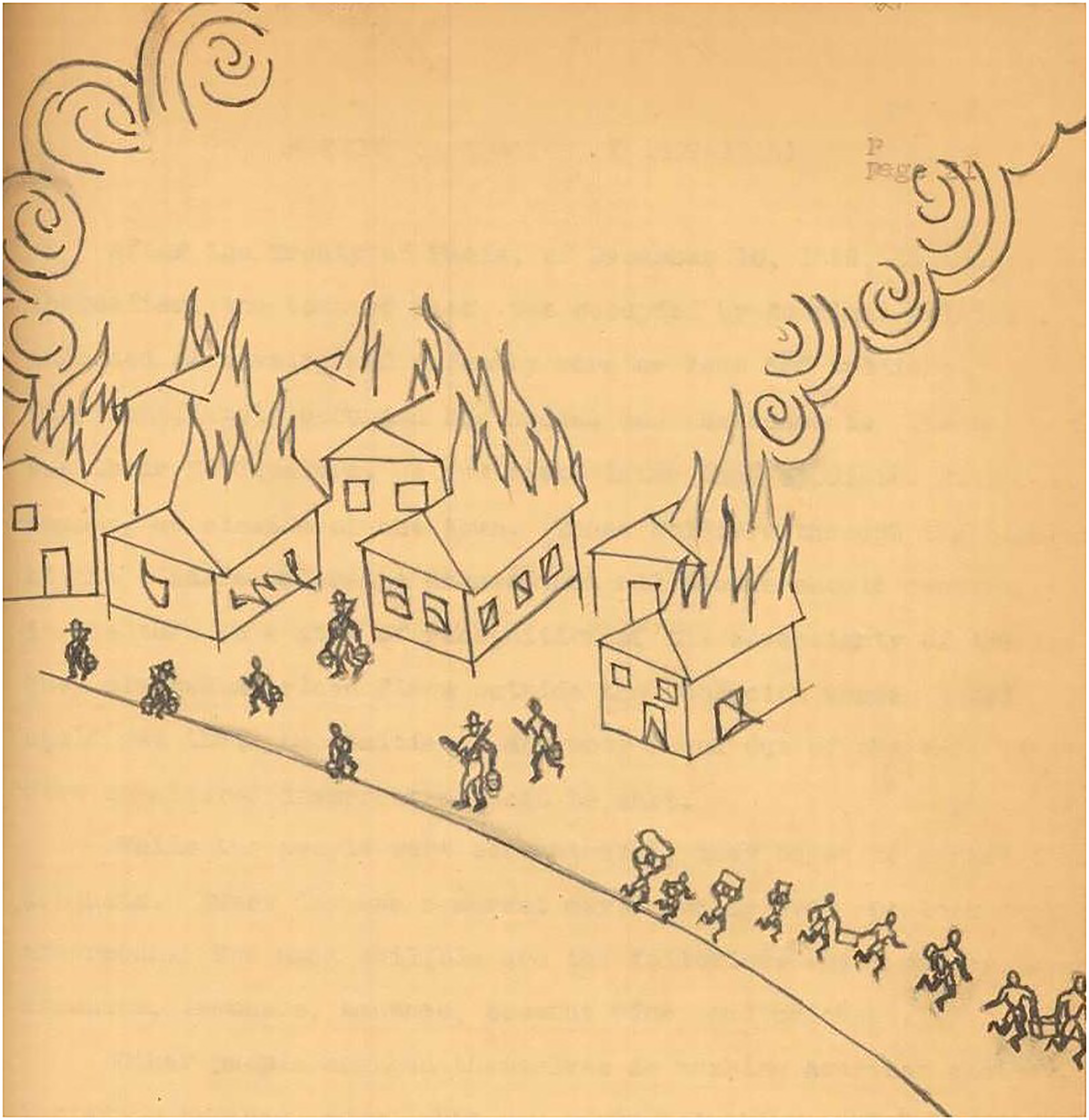
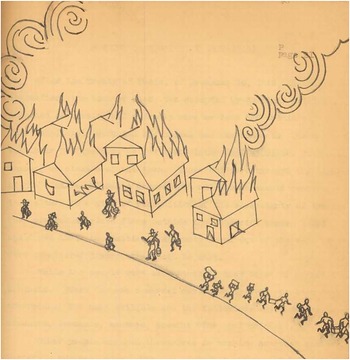
People’s priorities, however, were not primarily directed toward saving buildings. If a fire was small or contained, neighbours hurried to extinguish it; once it took hold, there was often little to be done. Moreover, the materials of the bahay-kubo were readily available and could be replaced through collective labour, so efforts quickly shifted to salvaging portable property. Figure 2, depicting the ‘Great Fire of Sagrada’ in 1902 and drawn by a barrio schoolteacher, captures this response: residents flee with their belongings, while only a few figures – mainly American soldiers – attempt to fight the blaze with buckets of water.Footnote 130 Although limiting a fire’s spread had obvious advantages, there was little incentive to risk injury or lose one’s possessions once the flames were fully established. Attempts to suppress small outbreaks could be vigorous – one reported remedy was to douse flames with vinegar – but were usually abandoned once the fire intensified.Footnote 131 Spanish observers sometimes interpreted this as reluctance, remarking on an apparent failure to act ‘despite the grave consequences to commerce and property’ and noting instead how many seemed ‘occupied only with saving their own personal effects’.Footnote 132
The ‘Great Fire of Sagrada’ in 1902.
Villages also took more proactive measures to reduce the threat from fire. Planting banana groves around homes served the dual purpose of providing a ready household source of food as well as constituting an effective barrier to impede the spread of flames.Footnote 133 More formal fire management systems in the barrio included the ronda, an association of residents responsible for fire safety who served either as volunteers or by rotation. In addition to firefighting, they maintained local order and were often based in purpose-built structures equipped with water buckets, sand, a ladder, and other basic tools.Footnote 134 In places where there was no such structure, like Barrio Las Salinas Sur in Bohol, operations were run out of the home of the team leader.Footnote 135
To mitigate the persistent threat of fire in rural areas, the U.S. colonial government enacted Law No. 1733 in 1907, which required municipalities without formal fire departments to adopt firefighting provisions – an exemption that applied only to Manila (established in 1901) and, later, to Cebu (1937). Under this arrangement, the local police force effectively doubled as firemen operating under the municipal president’s direction. Officers were obliged to drill weekly and to familiarise themselves with firefighting equipment. Each municipality was required to maintain a range of essential tools – buckets, ladders, hooks, bolos, axes, and saws – in good condition and store them in a designated location. In addition, local officials were instructed to organise a volunteer firefighting force drawn from the community.Footnote 136 Yet, the absence of any mention of these units in the HDP makes it difficult to assess how consistently they functioned, how effective they were, or whether they existed at all.
More significant were the municipal planning reforms introduced by progressive local leaders in some of the larger poblaciónes, which enhanced firefighting capacity through the regularisation of street layouts and modest infrastructure improvements. In 1920, for example, the municipal president of Malibay in Rizal oversaw the installation of fire hydrants, a piped water system, a fire brigade, and a telegraph service – amenities that materially improved emergency response.Footnote 137 Similarly, Governor Turentique of Rizal introduced a grid plan in Morong, aligning streets and alleys so as to facilitate quicker access to river water in the event of fire. Yet, as one contemporary observer remarked, this remained ‘a system not found in many towns’, making it difficult to determine how widely such innovations spread, particularly to the barrios.Footnote 138
One noticeable change in the post-World War II years was the growing dependence on external assistance in the aftermath of fires. From the mid-twentieth century, the American – later Philippine – Red Cross assumed an expanding role in relief and reconstruction.Footnote 139 When much of Barrio Pantad in Zamboanga del Sur was destroyed by fire in March 1946, the local Red Cross supplied each affected household with fifty pieces of nipa to begin rebuilding.Footnote 140 In the years that followed, such appeals became increasingly routine. After a third of Bagong Sikat in Occidental Mindoro was destroyed in 1949, for instance, the barrio lieutenant promptly sought its assistance.Footnote 141 Nor was the Red Cross the only source of aid. When a major fire swept through the commercial district of Barrio Poblacion in Bohol on 16 August 1952, leaving some 500 people homeless, civic organisations from nearby Tagbilaran – including the Lions, Jaycees, and the Knights of Columbus – mobilised rapidly to provide material, financial, and moral support.Footnote 142 Together, such responses reflected the gradual incorporation of barrio communities into wider networks of institutional and civic relief.
Village fire: another category?
In the scholarly literature, fire is largely conceptualised within the domain of the ‘wildlands’ – an etymology that carries clear colonial overtones. Such fires are understood as uncontrolled, fast-moving events in natural vegetation – forests, grasslands, and brush.Footnote 143 Where they encroach upon and destroy large numbers of homes, particularly on the fringes of settler cities or in parts of southern Europe, they are classified as wildland–urban interface (WUI) fires.Footnote 144 Increasingly, these events penetrate deeper into built environments, effectively becoming urban conflagrations.Footnote 145 Urban fire, however, remains comparatively under-theorised. Its apparent retreat as a major public concern in Western Europe and North America during the nineteenth century has often been explained by the so-called ‘fire gap’: the divergence between rising urban densities and declining fire losses, attributed to fire-resistant construction, lower site coverage, and the professionalisation of firefighting services.Footnote 146
This interpretive model, however, is built almost entirely on European or Neo-European cases.Footnote 147 Theoretical generalisations about urban fire are therefore derived from a narrow empirical base and reproduce a long-standing epistemic bias that privileges the Western experience. Where documentation exists outside this sphere, it is often too sparse or uneven to support large comparative claims, reinforcing the illusion that the Western trajectory is universal.Footnote 148 Yet, the limits of this framework become clear when considering a fourth form of fire – village fire – one that defies easy placement within conventional fire typologies.
As the case of the Philippines suggests, village fires arose from a distinctive convergence of structural, environmental, and socio-economic conditions that set them apart from wildland, urban, and even WUI fires. Although they ignited in vegetated landscapes, they did not behave like wildland fires. The internal division of the bahay-kubo into one or more rooms introduced forms of compartmentalisation that altered ventilation, heat transfer, and the movement of fire gases – dynamics largely absent in natural settings. Rates of spread depended not only on wind and fuel, as in wildland fires, but also on structural adjacency, shared walls, rooflines, and the clustered arrangement of buildings. Crucially, unlike wildland fires, village fires unfolded amid dense human intervention. Residents attempted to extinguish small outbreaks, adopted mitigation measures such as planting banana trees, organised improvised firefighting systems like the ronda, or prioritised the evacuation of portable property. In this way, people actively reshaped fire conditions in real time.
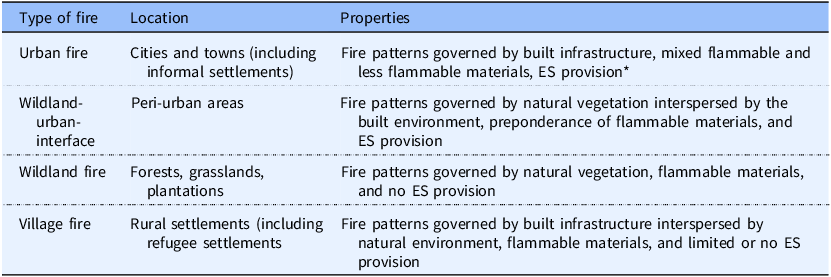
Nor can village or barrio fires be reduced to small or simplified versions of urban fires. Their spatial configuration, building density, and accessibility diverged sharply from those of larger towns (cabeceras) and cities. Vegetation remained closely interwoven with dwellings, while roads were often narrow, discontinuous, or impassable to fire apparatus – even if such equipment had existed. Reticulated water supplies, organised fire brigades, and enforceable building codes were limited or entirely absent. These conditions produced patterns of fire behaviour that did not conform to urban fire models, which typically assume reliable infrastructure, mapped streets, and some degree of regulated construction (See Table 1).Footnote 149
Four-fold typology of fire and its properties in the Philippines
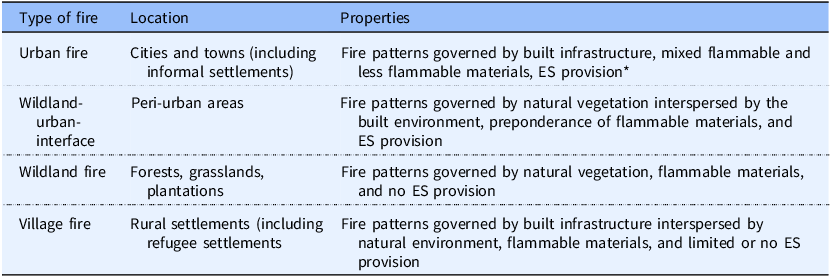
Table 1. Long description
A table categorizing types of fires by location and properties. The table has four rows and three columns. The columns are labeled ‘Type of fire’, ‘Location’, and ‘Properties’. Row 1: Type of fire, Urban fire; Location, Cities and towns (including informal settlements); Properties, Fire patterns governed by built infrastructure, mixed flammable and less flammable materials, ES provision. Row 2: Type of fire, Wildland-urban-interface; Location, Peri-urban areas; Properties, Fire patterns governed by natural vegetation interspersed by the built environment, preponderance of flammable materials, and ES provision. Row 3: Type of fire, Wildland fire; Location, Forests, grasslands, plantations; Properties, Fire patterns governed by natural vegetation, flammable materials, and no ES provision. Row 4: Type of fire, Village fire; Location, Rural settlements (including refugee settlements); Properties, Fire patterns governed by built infrastructure interspersed by natural environment, flammable materials, and limited or no ES provision. ES: Emergency Services.
* ES: Emergency Services.
Village fires also possessed a distinct rural profile that set them apart from their urban counterparts. Contemporary reports frequently noted the destruction of both dwellings and granaries. In the municipality of Badoc in Ilocos Norte, for example, a fire on 9 March 1908 burned four houses and three granaries filled with palay, causing losses estimated at about ₱600. A week later, on 17 March, a fire in Barrio Catablan in Pangasinan destroyed seven nipa houses and three granaries of palay, with losses exceeding ₱1,000. Finally, on 20 March, a blaze in Barrio Mulauin in Bataan consumed five nipa houses and fifty cavans of palay, valued at ₱250. These incidents highlight how the rural economy itself, through the storage of combustible harvests within the settlement, magnified the impact of village fires.Footnote 150
Village fires bore a superficial resemblance to the modern WUI in that settlements intermingled with surrounding vegetation and were constructed from similarly combustible materials – wood, bamboo, and nipa. But this similarity is largely material rather than structural. Barrios lacked the institutional, infrastructural, and technological frameworks that define WUI fire regimes in industrialised settings. There were no enforceable building codes, hazard-reduction strategies, professional fire services, hydrants, all-weather access roads, or reliable communications. Fire response depended instead on collective action, improvised techniques, and locally embedded knowledge.
As a result, village fire risk was organised along fundamentally different lines: less a problem of managing the interface between built and wild fuels than of coping with a continuous, highly flammable social and material environment. This distinction is underscored by the prevalence of deliberate burning. In peasant societies, arson was a recurrent feature of rural life. Evidence from Imperial Russia suggests that 10–15 percent of fires were officially attributed to arson, with higher estimates in rural areas. While comparable statistics for the Philippines are lacking, contemporary accounts likewise indicate that incendiarism was not uncommon. Taken together, these features point to a fire regime in which vulnerability derived not simply from exposure to surrounding vegetation, as in the WUI, but from the absence of formal mitigation systems and the embeddedness of fire within the social relations of village life.
Two further factors sharpened the distinctiveness of village fire: its close association with warfare and its marked seasonality. Burning the barrio was a simple and effective tactic for forces of all persuasions seeking to intimidate or punish rural populations, deny shelter, or flush out opponents. War thus amplified a hazard already embedded in everyday village life. During the Second World War, for example, some 500 structures were destroyed in Talisay (Cebu), leaving families to sleep ‘under the bare cold house frameworks’, with many, especially children, subsequently falling ill.Footnote 151 Climate compounded this vulnerability. The long dry months from January to May in the more densely populated western regions rendered villages – built largely from cured organic materials – highly combustible. As a Pampanga newspaper observed in February 1904: ‘The dry season has begun, and with it, the spate of fires’.Footnote 152 Writing in the mid-nineteenth century, the German naturalist Fedor Jagor similarly noted how houses of bamboo and wood became ‘perfectly parched in the hot season, dried into so much touchwood by the heat of the sun’, such that on a windy day a single blaze could consume an entire settlement.Footnote 153
Evidence from the Philippines, therefore, suggests that the barrio may represent a historically significant but largely neglected category of fire. Villages have generally been overlooked by a Western-derived fire science that focuses on environments where fire hazards are tightly regulated or largely eliminated. In the industrialised world, the danger of village fire largely receded during the latter half of the nineteenth century with the spread of modern infrastructure, professional fire services, and building codes, rendering such events increasingly invisible. Yet, for most people in the past – and for many Filipinos today – the village remains the primary setting in which fire is experienced.
Village fires do not fit neatly within existing categories. They are not wildland fires, since they occur within human-made and socially organised landscapes; nor are they urban fires, whose infrastructure, construction materials, and institutional protections they lack. While they share certain features with the WUI, they cannot be reduced to it. Rather, they constitute a distinct socio-ecological fire regime shaped by combustible building materials, dense settlement patterns, limited firefighting capacity, seasonal climate, and social conflict. Precisely because they do not conform to developmental narratives derived from Western urban experience, such fires have received little scholarly attention.Footnote 154 Recognising village fire as a coherent category helps broaden our understanding of fire regimes and challenges assumptions about how fire risk evolves across different social and environmental contexts.
Conclusion: village fire in the Philippines
Fire was a constant in village life – ever-present in peace and magnified in war. Yet, it rarely conformed to the patterns familiar from Europe or North America. Rural fire in the Philippines was not typically a weapon of class protest, nor, as in parts of Russia, a means of peasant retribution. Even so, the countryside burned. Houses built from highly combustible materials were easily ignited, and destruction was often total, though directed primarily at property rather than lives. In Barrio Ambil, major fires in 1905 and 1920 reportedly left not a single house standing, while a blaze in Lian, Batangas, in 1939 rendered thousands homeless and destitute.Footnote 155 Despite its frequency and impact, village fire has remained largely invisible – underreported in official statistics, neglected in policy, and marginalised in scholarship – even though most people historically lived, and many still live, in rural communities outside urban centres.
This neglect obscures a fire regime that is analytically distinct. In the Philippines, village fires formed a social, spatial, and infrastructural configuration unlike those of wildlands, cities, or the wildland–urban interface. Although barrios shared with the WUI a landscape of intermixed vegetation and settlement, they lacked the institutional and material buffers that mitigate fire risk in industrialised contexts: enforceable building codes, organised fire services, reliable transport, and increasingly fire-resistant construction. Even where fire stations existed, they were distant and difficult to access; prevention and response depended largely on communal effort and improvisation. Fire risk, therefore, was embedded in the ordinary fabric of village life rather than managed at its margins.
Nor do Philippine village fires align with European rural patterns. There is little evidence that incendiarism functioned as a systematic form of agrarian protest or local score-settling. Arson occurred, but more episodically and unevenly – though the evidence for this is somewhat tentative. Instead, fire was most consistently mobilised in warfare, where the burning of villages served as a blunt instrument of coercion, intimidation, and control. Combined with the extreme combustibility of rural building materials and the seasonally desiccated environment, this produced a fire regime in which ignition was easy, spread was rapid, and containment was minimal. Unlike the urban trajectory, moreover, there was no clear ‘fire gap’: rather than receding with modernisation, village fires appear to have persisted or even intensified into the twentieth century.
Treating village fire as a distinct analytical category is therefore not simply a matter of classification. It restores to view the experiences of the majority of past populations and challenges a historiographical bias that privileges the urban over the rural experience. It also opens onto wider comparative terrain. The conditions that shaped village fire – material precarity, limited infrastructure, and reliance on collective response – persist in many contemporary settings, from informal settlements to refugee camps. Attention to village fire thus not only reframes the historical record but also sharpens our understanding of vulnerability, inequality, and everyday risk in the present.
Acknowledgements
Research for this article was funded by an Ateneo de Manila University Research Council Essential Scholarly Work Grant dated 12 April 2024.

 Open access

