




Introduction
As soon as polls closed in Indonesia’s February 2024 presidential election, it became clear that that the incumbent Defence Minister Prabowo Subianto owed a special debt of thanks to young voters for their help in generating his landslide victory. While Prabowo won 58.6 percent of the vote overall, exit polls showed him winning 71 percent of support from “Gen Z” voters – voters born after 1997 —his best performance among all key demographic groups (Muhtadi and Muslim Reference Muhtadi and Muslim2024).
Young voters’ preference for Prabowo has provoked understandable concerns about their role in either opposing or facilitating the democratic regression that Indonesia has been experiencing since the mid-2010s (Power and Warburton Reference Power and Warburton2020; Mujani and Liddle Reference Mujani and Liddle2021). Prabowo was a leading figure in the New Order regime at the time of its collapse in 1998, and he was distinctive in the extent to which he made a populist critique of the post-reformasi system part of his political appeal as a party leader and serial presidential candidate (Aspinall Reference Aspinall2015). Prabowo’s election raised concerns of an outright authoritarian reversal in the coming years (Slater Reference Slater2024; Jaffrey and Warburton Reference Jaffrey and Warburton2024, Nord et al. Reference Nord, Altman, Angiolillo, Fernandes, God and Lindberg2025: 13–15, 27)—concerns that have been lent some vindication, with new attacks on the achievements of the post-1998 reform period sparking alarm during the first year of his presidency (Hermawan Reference Hermawan2025, Nugroho and Supriatma Reference Nugroho and Supriatma2025). If such a scenario comes to pass it will have been predicated in part on the overwhelming electoral support for Prabowo in 2024 of those whose political socialization occurred entirely under a democratic regime.
The special importance of young people within Prabowo’s electoral support base suggests the need for revisiting the issue of youth agency in the evolution of Indonesia’s politics. The prominent role that young activists have played in pro-democratic contentious politics since Indonesia’s democratization in 1998 has led much journalistic and scholarly commentary to reflexively assign young people with pro-democratic tendencies. Student activism in particular remains a key force of opposition against undemocratic elites, with scholars noting resonances between the anti-Suharto movement of the late 1990s, and high-profile protests since 2019 against regressive actions and laws tabled during the administration of former president Joko Widodo (Aspinall Reference Aspinall2020; Jaffrey Reference Jaffrey2019; Nuraniyah Reference Nuraniyah2024).
Yet Prabowo’s ascent to the presidency has revealed a more complicated picture than might be gained from observation of a small but vocal minority of young people who engage in overt advocacy for progressive causes—as scholars have already begun to highlight. Survey data collected and analyzed by Kuipers, Toha, and Sumaktoyo (Reference Kuipers, Toha and Sumaktoyo2024) during the 2024 campaign revealed that fading memories of the New Order among young people may have opened the way for economic concerns and personality politics to drive their voting choices, in ways that have parallels with the election of Ferdinand Marcos Jr in the Philippine presidential election in 2022 (Dulay et al. Reference Dulay, Hicken, Menon and Holmes2023).
Yet the 2024 presidential election results and their aftermath are just one of a number of factors that highlight the need for subjecting young Indonesians’ political values to more systematic scrutiny. One is the emergence of an electoral majority whose political socialization has occurred mostly or entirely under a democratic regime. Does membership of the post-reformasi generation have an independent effect on individuals’ attitudes towards democracy, and if so in what direction? By asking this question we connect with other comparative work on the political-generational effects of democratic transitions (Mattes Reference Mattes2012; Chu et al. Reference Chu, Diamond, Nathan and Shin2008; Rose, Mishler, and Munro Reference Rose, Mishler and Munro2006). Importantly, the entry of Gen Z voters as a significant voter bloc in Indonesia has coincided with a sustained period of democratic regression that under Jokowi (Power and Warburton Reference Power and Warburton2020; Mujani and Liddle Reference Mujani and Liddle2021). Existing research that examines the effects of age on democratic attitudes found no significant generational gaps in democratic attitudes—yet these findings are based on survey data collected between 1999 and 2014, before Indonesia’s democratic backsliding gained momentum (Mujani, Liddle, and Ambardi Reference Mujani, Liddle and Ambardi2018; Mujani and Prasetyo Reference Mujani and Prasetyo2012). Existing studies are therefore limited in what they can tell us about how different generations of Indonesian voters—especially the post-reformasi generations now entering the electorate—differ in their perceptions of democracy.
In this article we address thsese analytical gaps with the use of a newly constructed dataset that pools dozens of nationally representative surveys of voting-age Indonesians taken between 2003 and 2023. We disaggregate responses to questions about preference for democracy as a regime type and assessment of the performance of Indonesian democracy by generational cohort, controlling for a number of key demographic variables to isolate age effects. By tracking the evolution of inter-generational differences in these key democratic attitudes across this 20-year period, spanning three presidencies, we are also able to see how different generational cohorts’ attitudes have changed over time—and especially how different generations of Indonesians have perceived a more than decade-long period of democratic backsliding. Finally, we also link our historical data to a unique pre-election survey to investigate whether broad attitudes to democracy have an influence on how younger Indonesians voted in the 2024 election campaign.
Our analysis reveals, first, that Indonesians all become more satisfied with democracy as they age, suggesting a cohort effect so far unidentified in the literature. Second, we show that Indonesia’s youngest cohort of voters exhibit similar levels of support for democracy as other generations; but their satisfaction with democracy is notably higher than previous generations, and increases more quickly over the two Jokowi terms compared to older generations, even when controlling for a range of demographic and political factors. We conclude on the basis of this analysis that Indonesia’s Gen Zs, when compared to other generational cohorts, exhibit a high degree of democratic complacency .
This article proceeds as follows. We begin by locating Indonesia within the global literature on generational effects on democratic attitudes in post-authoritarian societies, and problematize assumptions about the role of youth agency in Indonesia’s democratic (de)consolidation. A third section introduces the dataset of voter surveys and explains the statistical methods we use. We then map the results of the pooled data in the fourth section. The article then provides additional insight into Gen Z democratic preferences by introducing a pre-election survey, revealing how and why the youngest cohort voted for Prabowo in such large numbers, testing theories about this cohort’s openness to authoritarian ideas. In our concluding section, we summarize our findings about democratic complacency, emphasizing the value of future research into youth agency in democratic backsliding and the factors that might be important to prevent their complacency about democracy from lapsing into flirtation with authoritarianism.
Theorizing youth as a democratic cohort
Scholars have long been preoccupied with interpreting the causes of young people’s prominence in contentious politics and varied forms of progressive or otherwise radical activism across diverse historical, national, and socioeconomic contexts. The classic “life-cycle” theory purports that younger citizens will tend to hold more progressive values because they are free of the kind of career, family and financial obligations that make older people more conservative and risk-averse; students, in particular, are also exposed to a range of new ideas and information that make them more critical and reformist (Dalton Reference Dalton1977). But such effects are, according to the life-cycle theory, temporary, and people’s values evolve as they age and begin to prioritize economic and other policy concerns.
By contrast, “cohort” theories of inter-generational value change argue that citizens grow up in historically specific political, cultural and economic settings that in turn give rise to a set of political values that are distinctive of their age cohort. Seminal studies by Inglehart (Reference Inglehart2000, Reference Inglehart1990) and Abramson and Inglehart (Reference Abramson and Inglehart1986; Inglehart and Abramson Reference Inglehart and Abramson1994), for instance, argue that the affluence and stability of postwar Europe and North America produced a “postmaterialist” generation of voters for whom economic (in)security was no longer a primary political concern, and who instead prioritized the expansion of liberal freedoms and individual self-expression in their activism and choice of political parties and candidates. Research working within the cohort paradigm sees young people’s distinct political preferences not just as a reflection of transient, life-cycle effects, but instead as reflective of the unique sociopolitical contexts in which they become politically aware. Inglehart’s (Reference Inglehart2000) “socialisation” hypothesis assumes that by the time a person has reached their adult years, their personality has been formed through a process of engagement with their cultural and political environment; over time, this generational effect can exert a major influence on attitudes of a society in aggregate, as exemplified by the “baby boomer” generation’s importance in driving a range of emancipative political causes.
While Inglehart’s pioneering research focused at least initially on the effects of the postwar economic boom on value changes in consolidated Western liberal democracies, since the post-Cold War acceleration of the third wave of democratization a major goal of scholarship has been to examine the role of regime shifts in creating inter-generational differences in values. A key research agenda has been to use surveys to test how transparent and responsive political institutions, the expansion of media freedoms, and reform of education systems that accompany democratization might imbue younger cohorts of citizens with democratic values and political behaviours that are distinct from older cohorts, whose political socialization took place in authoritarian political contexts (Dalton Reference Dalton1994; Chu et al. Reference Chu, Diamond, Nathan and Shin2008; Mattes Reference Mattes2012; Resnick and Casale Reference Resnick and Casale2011). The conclusions of this body of literature are varied, however. In their instructive study of South Africa’s “Born Frees”—those born after the country’s democratization and end of Apartheid in 1994—Mattes (Reference Mattes2012) finds younger citizens’ attitudes are less democratic on a range of measures than their parents’ or grandparents’, which is a function of young people’s particular frustrations with political corruption and economic insecurity. In fact, as Mattes points out, these findings echo the results of surveys in other young democracies, which also find limited evidence of a generational effect in favour of democratic preferences among younger citizens (Chu et al. Reference Chu, Diamond, Nathan and Shin2008; Rose, Mishler, and Munro Reference Rose, Mishler and Munro2006).
The further expansion of this research agenda to non-Western contexts also revealed evidence of distinctive regional patterns in inter-generational differences in democratic attitudes. Building on tentative evidence of a weakening of young people’s preference for and satisfaction with democratic regimes in many consolidated Western democracies (Foa and Mounk 2016, Reference Foa and Mounk2017), more recent research has demonstrated that concentration of falloffs in democratic support and satisfaction among youth may be a phenomenon particular to the West: in the relatively younger consolidated liberal democracies of Northeast Asia—Taiwan, South Korea and Japan—surveys reveal a distinctive pattern whereby democratic satisfaction has improved overall from generation to generation, and rises as voters from all democratic cohorts grow older (Foa et al. Reference Foa, Klassen, Slade, Rand and Collins2020, 13).
“Pemuda” politics in Indonesia
Within this research agenda on the nature and causes of inter-generational differences in democratic attitudes, Southeast Asian cases, including Indonesia, have been relatively marginal. Qualitative accounts of Southeast Asian youth politics often cast young people as a force for democratic reform or renewal. Young people are the face of popular protests movements against regressive or ineffective government. In the digital age, it is also the youngest generation leading new forms of innovative online activism (Sinpeng Reference Sinpeng2021; Smith Reference Smith2013). In Asia specifically, university students have again and again been at the forefront of reformist movements that seek to change or topple illiberal incumbents (Weiss, Aspinall, and Thompson Reference Weiss, Aspinall, Thompson, Weiss and Aspinall2012).
Indonesia has been no exception to the habitual ascription of anti-authoritarian attitudes to youth constituencies. Activism on the part of youth has had such a prominent place in Indonesia’s political history that the term for youth, pemuda, is evocative of righteous political struggles past and present. From the earliest expressions of nationalism at the start of the twentieth century, to the revolution against the Dutch, the popular movement against President Sukarno in 1966, to the protests that brought down President Suharto in 1998, pemuda organizations and leaders have been critical actors in major moments of political change, and are most often at the forefront of popular pressure for democratic reform and social justice (Aspinall Reference Aspinall2005; Lee Reference Lee2016; Sastramidjaja Reference Sastramidjaja, Dibley and Ford2019; Aspinall Reference Aspinall, Weiss, Aspinall and Thompson2012). For these reasons, Indonesian citizens are taught from a young age that pemuda have always mobilized during times of crisis or in the face of threats to the popular and national interest.
This narrative was given sustenance by the relationship of youth-based political movements to Jokowi—both during his rise to national prominence, when he was seen as a technocratic reformist, as well as in opposition to him as he emerged surprisingly as an agent of democratic backsliding during his two terms as president (2014–2024). As he had done during his career in subnational politics, when he ran for president for the first time in 2014 Jokowi “embraced new forms of media that encouraged a grassroots campaign that mobilized many volunteers … and youth groups” (Tapsell Reference Tapsell2015, 36). As Jokowi’s authoritarian tendencies became clear in the years following his victory in 2014, young people were at the forefront of progressive opposition to his administration’s rollbacks of civil liberties protections and reformasi-era institutional reforms. In late 2019 and early 2020, university student organizations led protests that saw hundreds of thousands of protestors march in Jakarta and other cities against revisions to legislation that would weaken a key anti-corruption agency, as against a package laws for economic deregulation that compromised labour and environmental protection (Hamid and Hermawan Reference Hamid and Hermawan2020). As Jaffrey (Reference Jaffrey2019) observed, “politicians’ brazen disregard for public opinion … mobilized a younger generation of Indonesian that has often been regarded as lacking political awareness or interest.” The mobilization in defence of democracy was on a scale unprecedented in the post-Suharto era, and appeared to transgress identity-based and partisan divides that had come to characterize Indonesian politics over the preceding five years (Warburton Reference Warburton2019). In both the 2019 and 2020 waves of protests, the protests were met with state violence and intimidation, and were quickly supressed (Setijadi Reference Setijadi2021).
The special prominence of young people in contentious politics from the colonial era to the present day has led to popular narratives about young people’s politics implicitly embracing a kind of life-cycle explanation. As Aspinall (Reference Aspinall, Weiss, Aspinall and Thompson2012, 153) observes: “youth and, more specifically, university students occupy [a central position] in official accounts of Indonesia’s national narrative”; in such accounts, and in the thinking and behaviour of activists themselves, students are often conceived as a moral force that sits outside of the tainted, corrupt world of Indonesia’s political institutions (Aspinall Reference Aspinall, Weiss, Aspinall and Thompson2012; Ridha Reference Ridha2020). In colloquial discussions students are often expected to be more radical in their political views than average citizens, and after they grow up, they pass the task of fighting for justice and reform on to the next generation.
While the life-cycle theory can help to explain the historically grounded nature of activism among university students in the Indonesian context, it would also seem plausible that the last two decades of democratic rule have had a unique impact on the democratic preferences and attitudes of the country’s youngest citizens more broadly. Existing studies offer weak evidence for this assumption. Mujani and Prasetyo (Reference Mujani and Prasetyo2012), for example, draw on the results of Asian Barometer surveys to investigate the democratic orientation of Asia’s younger generations, including Indonesia. They found few significant differences between older and younger citizens (those of voting age under 30) across the region, both in terms of their preference for democracy as a system of government and their support for liberal norms and ideas. The authors also test whether increased internet usage among Asia’s youth might lead them to have more globalized, and therefore more liberal, preferences. But in Indonesia, they found internet use has no significant effect on citizens’ political attitudes. To the extent that they do find inter-generational divergence, the young emerge as less democratic than those in the middle and older age groups in several countries, including Indonesia.
In their wide-ranging study of public opinion in Indonesia since the end of the New Order, Mujani, Liddle, and Ambardi (Reference Mujani, Liddle and Ambardi2018) also find that age differences have little effect on a whole range of political attitudes and behaviours, including how Indonesians assess the quality of their democracy, and whether they prefer democracy over other regime types. Their only significant finding is that, over the course of almost two decades of elections, young people have become less interested in participating in politics, with fewer and fewer citizens under 40 choosing to vote or to become involved in campaigns (Mujani, Liddle, and Ambardi Reference Mujani, Liddle and Ambardi2018, 125–30). These studies, however, draw on survey data collected during a time before Indonesian democracy had entered a sustained period of backsliding. How have these trends changed, if at all, over the course of the Jokowi-era democratic regression?
Measuring generational differences in a backsliding democracy
Against this backdrop, our primary objective is to examine how young Indonesians’ support for democratic principles, and their assessment of the state of Indonesian democracy, differs from older cohorts of voters. We are especially interested in the views of citizens who have been socialized almost entirely in a democratic society with free and fair elections, and a relatively open civic space. We focus in particular on Gen Z—those born between 1997 and 2012—who have grown up with what has until recently been a relatively free and open civic space, especially online. This cohort only recently entered the electorate, and are thus only now receiving attention in the scholarship on young Indonesians’ political attitudes and behaviour.
We test the assumptions that this youngest cohort will have a distinct set of values and preferences because of their early socialization to democratic norms. To do so, we use survey data and compare the attitudes of Indonesia’s youngest voters who have grown up under democracy with those of older generations. We use pooled time series data to try to disentangle cohort versus life-cycle effects. Ideally such data would reach back thirty to forty years to capture longer horizons of change in each generations’ political views. We are naturally limited by the fact that polling only emerged as an industry in Indonesia in the early 2000s, after the transition to democracy began.
Still, despite the lack of pre-transition polling data that would enable us to directly compare temporal shifts in democratic attitudes across that regime change, we nonetheless aim to examine the effects of political socialization under different regime conditions by looking at generational effects. To do so, we disaggregate our two decades’ worth of survey results by generational cohort, and then compare the average responses of voters who became politically aware during the New Order on the one hand, and those whose political socialization has occurred after the success of reformasi on the other.
In measuring these attitudes, we are mindful of some of the ambiguities of interpreting survey data on individuals’ support for democracy as a concept, assessments of democratic outcomes, and the interrelationship between these two metrics. As Norris (Reference Norris1999, 2) has observed, “citizens draw a clear distinction between which type of government they would choose as their ideal and the performance of current regimes.” By this logic, dissatisfaction with democratic outcomes, amid a generally strong commitment to democratic values in the abstract, might signal a critical attitude to objective shortcomings in the quality of democratic institutions. These nuances are highly germane to the Indonesian case because many Indonesians, as shown by Mujani, Liddle and Ambardi (Reference Mujani, Liddle and Ambardi2018), have mixed views on whether Indonesian democracy is performing well, and on how specific institutions perform too, despite their strong overall commitment to democratic principles. With this in mind, we set out to test the notion that Indonesia’s youngest voters, who have been raised in the post-Suharto period—Gen Z (born after 1997) and a large portion of Millennials (born 1981–1996)—might on average exhibit especially strong commitments to democratic principles and be especially concerned about the trajectory of democracy, because of the general effects of having been educated and politically socialized under a democratic regime. The youngest voters have grown up in a context where democratic elections and protection of civil liberties are ‘normal’—and, until very recently, relatively uncontested. Young voters today may therefore be unlikely to share in the nostalgia that some older generations might feel toward the stability or other aspects of the previous authoritarian regime.
The alternative hypothesis is that the youngest voters, who have never experienced life under authoritarian government, take their democratic rights for granted—and are thus less alert to threats posed by anti-democratic and illiberal state policies relative to older generations who remember the quotidian repression and censorship that pervaded the New Order era. Instead, the older age cohorts that experienced the New Order at its height, and felt first-hand the arrival of the freedoms that reformasi brought, will express more concern about recent illiberal threats. In this scenario, the consistently strong level of youth support for the presidential candidacies of Prabowo Subianto could be read as testament to the fact that Prabowo does not appear to be an especially problematic figure for the youngest cohort of voters, who have no memory of Prabowo’s role in the old authoritarian regime and the human rights abuses he was responsible for.
In short, there are sound empirical and theoretical reasons to expect young voters to hold distinct values and concerns when it comes to the state of their country’s democracy—but also that these distinct generational effects could lead them to be more or less sensitive to processes of democratic regression currently underway in Indonesia.
We divide our respondents up into discrete political generations. We adopt the generational categories widely used in public and political analysis (see for example, Foa et al. Reference Foa, Klassen, Slade, Rand and Collins2020). We categorize respondents as either Gen Z (born after 1997), Millennial (born between 1981 and 1996), Gen X (born between 1965 and 1980), Baby Boomer (born between 1944–1964) or Inter-War (born between 1918 and 1943). These categories are relevant to Indonesia’s political history too, with Gen Z babies almost all born after the end of the authoritarian New Order, and many Millennials socialized in the final years of authoritarianism or in the democratic era. While there will always be clusters of people whose birth date falls so close to the generational divide so as to make the distinction seemingly arbitrary, as general generational categories we believe these cut-offs serve our analytical purpose and provide for ready comparison with existing studies that draw on similar definitions of political generations.
As described above, we are specifically interested in the cohort of citizens who have little to no lived experience of the New Order regime, and instead were born and raised primarily under democracy. These are our post-reformasi cohort, and include all of Gen Z. They were born after the fall of Suharto, and have grown up experiencing relative political freedom and regular elections, but have come into adulthood during a moment of democratic backsliding under the Jokowi presidency. Because a large portion of the Millennials were also socialized under primarily democratic conditions, we expect that the differences between these two generations may be small. We compare Gen Z and Millennials to two older generations: Gen X, and a combined category comprising Baby Boomers and the Inter-War generation. The latter generation represents a very small proportion of the electorate, so we combine these respondents with Baby Boomers. We feel this is not problematic for our analysis given both the size of the Inter-War sample, and because both generations’ formative years were spent under authoritarianism and are hence likely to have the strongest memories of the New Order.
Mapping generational differences in democratic preferences
In measuring inter-generational differences on a range of questions of democratic attitudes across time, we draw upon pooled data from 68 nationally representative surveys conducted between 2003 and 2023, giving us a total of 149,034 respondents. All of these surveys were administered via in-person interviews. We disaggregate responses by generational cohorts and compare how each generations’ attitudes towards democracy change over time. The challenge, however, is that among these 68 surveys, not all asked exactly the same questions about democracy. We present a series of results for two questions that were asked with a degree of consistency during this time period—however, as we shall see, some questions were asked more often than others. Still, taken together, this is a remarkably large sample that stretches back almost two decades, providing unique insight into the development of inter-generational differences in responses across two decades.
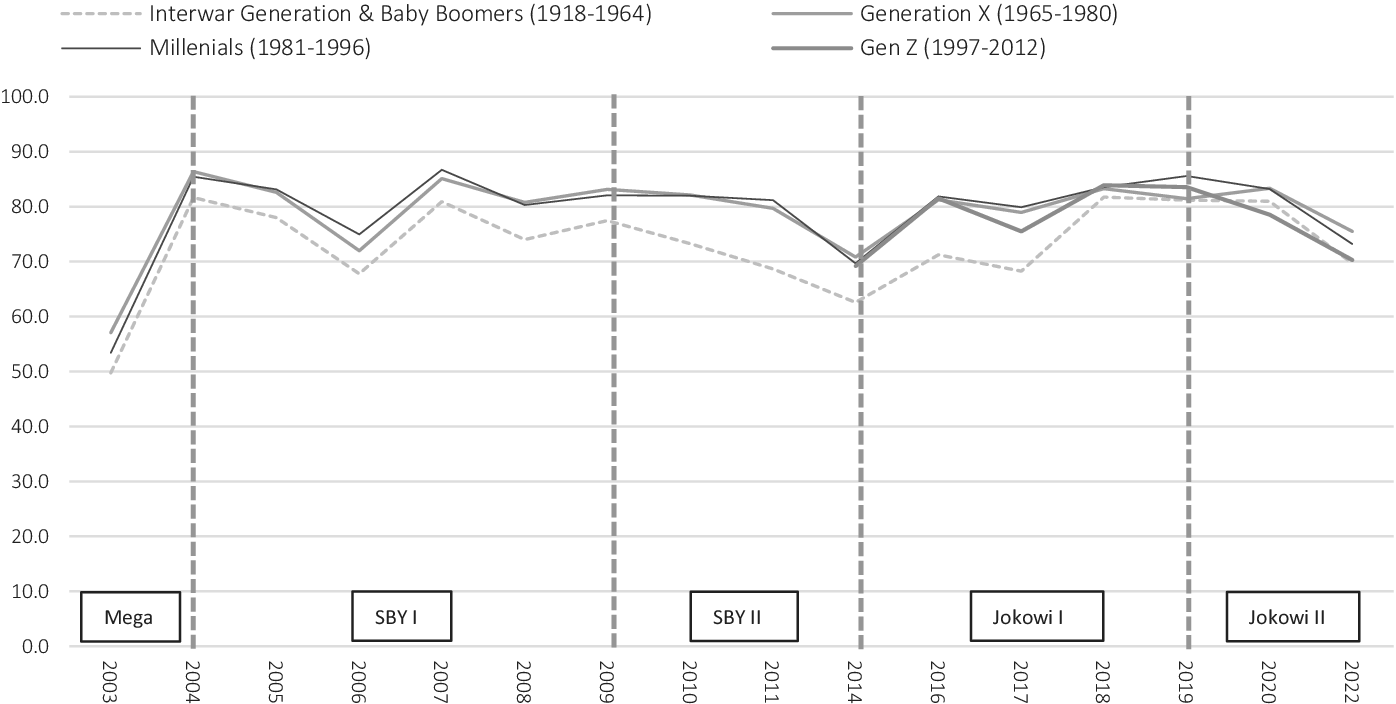
At first view the results paint a picture of convergence between generations—both in terms of their views on the abstract question of democracy as a broad regime category, and with their satisfaction with how democracy is actually being practised in Indonesia—since 2003. Figure 1 depicts the results of a survey question fielded from 2003–2022 that asked respondents about the extent to which they supported democracy as as system of government. Specifically, respondents were read a statement that “democracy, though imperfect, is the best form of government for Indonesia,” and were asked to respond to a five-point Likert-type scale with responses being “strongly disagree, somewhat disagree, neutral, somewhat agree, strongly agree.” Figure 1 displays the proportion of “somewhat agree” or “strongly agree” responses to this statement.
Preference for democracy over other forms of government 2003–2022 (agree/strongly agree).

We can see that from a low starting point in the latter period of President Megawati Soekarnoputri’s administration, affirmative responses peaked around the time of the first direct presidential election in 2004, before beginning a slow overall decline among all age groups, reaching a post-2004 nadir around the time of national legislative elections in 2014. Throughout the presidency of Susilo Bambang Yudhoyono (SBY) (2004–2014) there is a relatively consistent gap between the youngest generation and eldest on this question of support for democracy, with the youngest more supportive of democracy as a regime type. During the first term of Joko Widodo (Jokowi) as Indonesia’s president in 2014, however, Indonesia saw a gradual convergence across age groups on this question, with increasing support for democracy during his first term, and a decline during his second term.
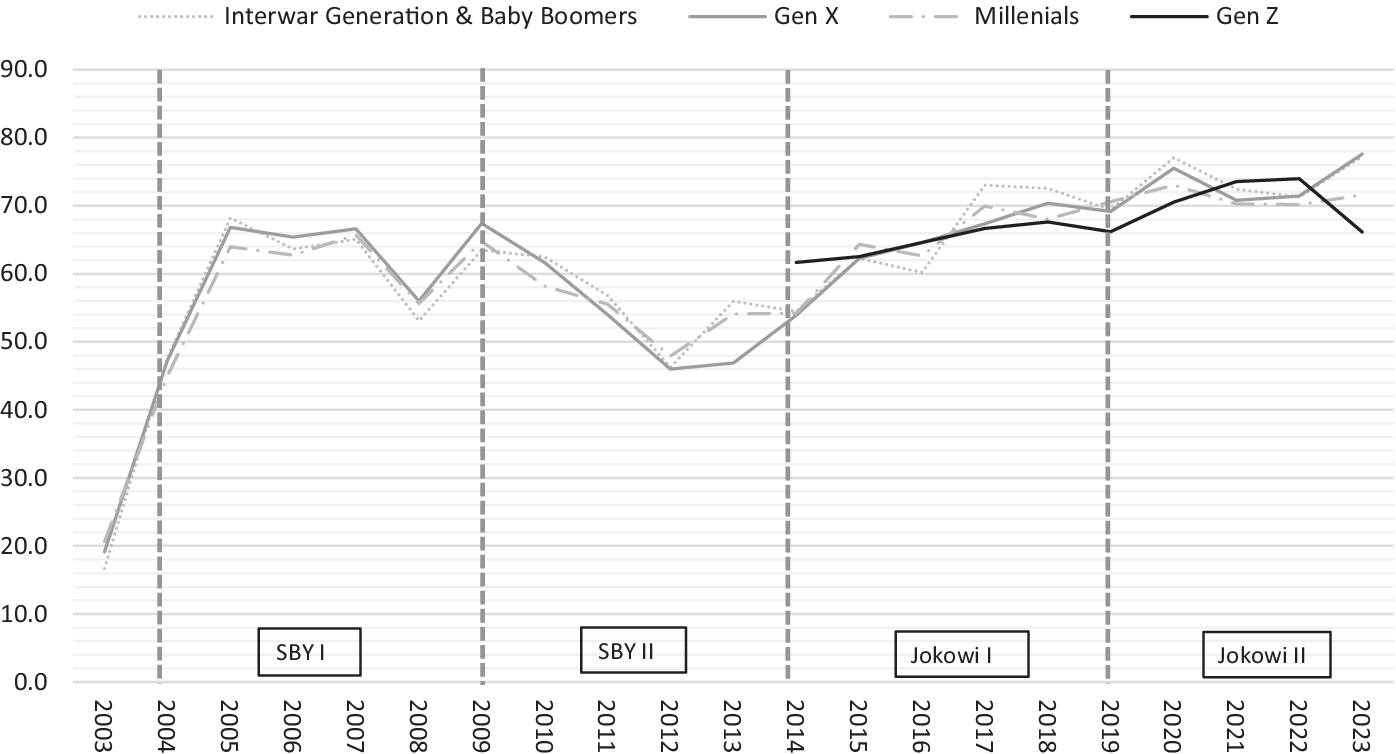
Alongside these questions about preference for a democratic regime in the abstract, we can also observe an increase in overall satisfaction with the actual practice of Indonesian democracy, while exhibiting relatively smaller gaps in average responses between different age groups. We use the question, “How satisfied are you with the way democracy is practiced in this country?.” The answers likewise range on a five-point Likert-type scale from “very satisfied” to “very dissatisfied,” and Figure 2 displays results based on a recoding of responses using a dummy variable where 1 represents feeling “somewhat satisfied” or “very satisfied” and 0 represents all other responses.
Trends in satisfaction with democracy 2003–2023 by age group (Satisfied/ Very Satisfied)

As Figure 2 shows, after climbing to a peak among all age groups around the time of the 2009 presidential elections, satisfaction with “how democracy is working in our country” dropped significantly during the second term of President Yudhoyono, before beginning a steady upward trend across both Jokowi terms. Gen Z is particularly satisfied, entering the dataset in 2014 with the strongest levels of satisfaction, and increasing in a mostly linear fashion, expressing the most satisfaction in 2021 and 2022—apart from in 2023. Overall, these patterns suggest that over time there are modest, but certainly not striking, generational differences on questions of democratic support and satisfaction.
We now turn to observe changes within each generation in order to reveal the relative importance of cohort versus life-cycle effects. The most comprehensive long-term data we have is for the question on satisfaction with democracy; questions about a preference for a democratic regime were asked much less frequently over this period.
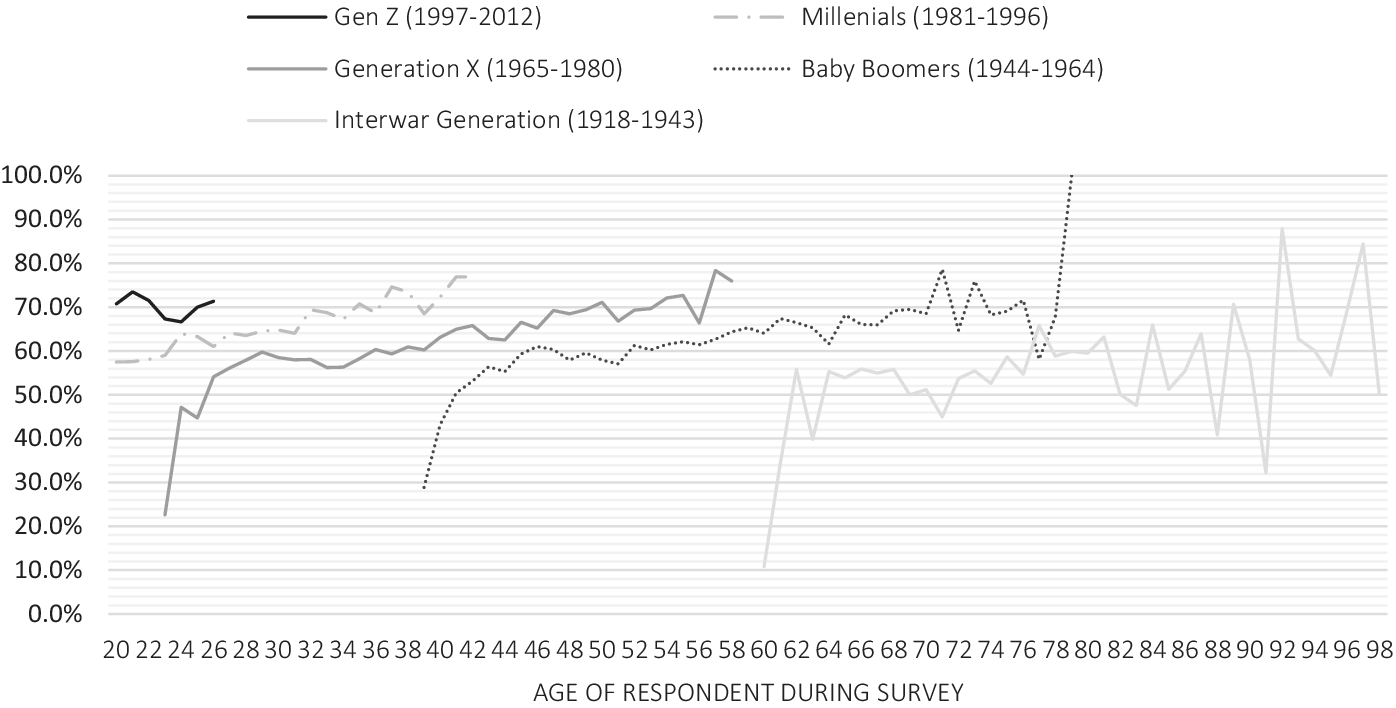
Figure 3 displays pooled data from 2003–2023 on the question of satisfaction with democracy. When visualised in this way, the data appear to suggest the presence of life-cycle effects: we can see that within each generation, voters grow more optimistic about the state of their country’s democracy as they age. In this sense Indonesia conforms to a pattern visible in the high-income democracies of East Asia such as Taiwan, South Korea and Japan (Foa et al. Reference Foa, Klassen, Slade, Rand and Collins2020, 13). Strikingly, insofar as there is a cohort effect visible in this data, it appears to be making younger generations more satisfied than older ones with the state of Indonesian democracy. We can see, for instance, that members of Gen Z are on average entering the electorate holding a substantially more positive evaluation of the state of Indonesian democracy than millennials, Gen X or Boomers did when they began to be polled. Indeed, members of each generation seem to enter the electorate more satisfied with the state of democracy overall than those in the previous generation to them. Moreover, a consistent trend throughout—or at least, for generations for which there is enough data to draw conclusions—is that members of each generation grow more satisfied with the state of democracy as they grow older. It should be emphasized, however, that the trend is less conclusive for Gen Z, because they only been included in polling samples since around 2014.
Average levels of satisfaction by age and generation

Explaining inter-generational divergences
Are the differences we find in these descriptive data a result of generational effects on their own, or some other demographic qualities of our respondents, such as religion or gender, or other factors that correlate with age among Indonesians? And could it also be that generational differences vary depending on political periods, with people from particular age cohorts responding to political shifts under each president in different ways ? To answer these questions, we use a logistic regression model to test whether the generational differences are we seeing are in fact statistically significant.
We create an interactive model, where the outcome of interest is satisfaction with democracy. We interact two key independent variables: dummies for our generational cohorts, and dummies for specific ‘survey periods’—which we define as the average survey response over the course of each distinct presidential period.Footnote 1 The models give us the predicted level of democratic satisfaction for each generational cohort at each survey period, controlling for other potential causal factors.
We prioritize a number of demographic and cultural-political factors as control variables in these models. The first is gender, to test whether gendered patterns of political attitudes among Indonesians may be particularly strong among some demographic cohorts in ways that impact the aggregate results illustrated in Figures 1 and 2. Gender is coded 1 if the respondent is a male and 0 if the respondent is a female. A second crucial control is religion, given the wealth of qualitative research that has examined how younger Indonesians are becoming attracted to conservative forms of Islam that may have a bearing on how they perceive the performance of Indonesian democracy (Nisa Reference Nisa2018; Noorhaidi Reference Noorhaidi2009). We therefore included a dummy variable dividing Muslims (coded 1) from non-Muslims (coded 0). We also included a control variable for geography with a dummy variable sorting those who live in urban areas (coded 1) from those who live in rural areas (coded 0). This is because not only are those voters in rural areas likely to be less educated and earn lower incomes than those in cities, their political views may be more closely tied to traditional authority figures and clientelistic relationships that, in turn, may impact perceptions of democracy.
We introduce education as another key control variable using an ordinal scale whereby 1 denotes “never went to school” and 10 is “graduated university.” Education is widely assumed to have an important impact on individuals’ political values, and there are significant inter-generational differences in educational attainment in Indonesia as younger people benefit from improved rates of school completion and the expansion of the Indonesian higher education system. It is therefore important that control for education’s effect on democratic attitudes. Finally, we include ethnicity as a control variable. Indonesia, despite the absence of overt ethnic politics at the national level since the fall of Suharto, still exhibits socioeconomic, and to an extent cultural, divides between the outer islands and the island of Java, a majority of whose population belong to the Javanese ethnic group—Indonesia’s biggest ethnic group with approximately 42 percent of the population. With the New Order having operated in the view of some outer islanders as Javanese neo-empire, there are pockets of Indonesia where the legacies of the New Order include a resentment of Java’s dominance in the national economy and politics (Soderborg and Muhtadi Reference Soderborg and Muhtadi2023). Given that resentment of Java for historical reasons is likely to be concentrated among older Indonesians who remember the New Order, we want to account for these differences in the model as well. We therefore include as a control variable a dummy variable that sorts Javanese (coded 1) from non-Javanese ethnic groups (coded 0).
Pinpointing generational effects
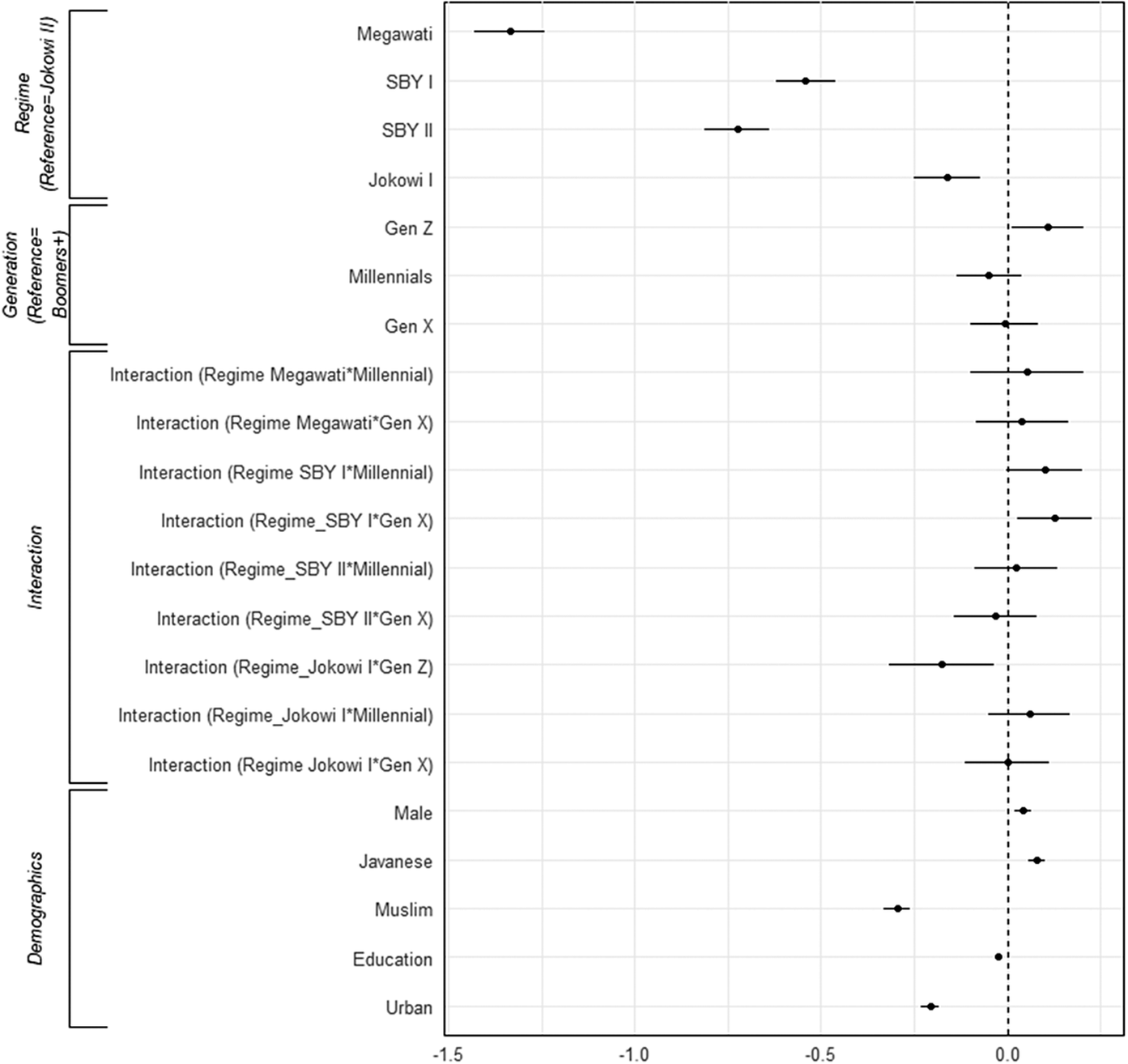
First, to test if younger citizens are less critical of the state of democracy, and how inter-generational differences have evolved across different presidents, we present a logit regression analysis. We test for group-by-period interaction effects, in order to test whether generational differences depend in some way on these political periods. We thus includes an interaction term for “presidential regime” and “generation.” The reference category is the period of Jokowi’s second term. We illustrate the point estimates (coefficients) and 95 percent confidence intervals for each predictor in the specified regression model (Figure 4). The summary statistics are included in Appendix 1.
Coefficient plot of factors associated with democratic satisfaction 2003–2023 and interaction terms between survey period per presidential regime and generation

The negative and significant coefficients for Megawati’s term, Yudhoyono’s first and second terms, and Jokowi’s first term, indicate that voter satisfaction with democracy was signficantly higher during Jokowi’s second term than during all other presidential periods, including his own first term.
Overall, there are few differences between generations—except when Gen Z enters the dataset. Figure 4 shows that respondents polled during the Jokowi’s second term administration were consistently happier with democracy than in the preceding survey periods. The data also reveal that, compared to the oldest generation, Gen Z significantly more satisfied with how democracy is working.
When the survey periods per presidential regime are interacted with generation, we find the majority of them are insignificant—with one important exception. The results show a significant difference between average levels of Gen Z satisfaction with democracy during Jokowi’s first term when compared to his second, essentially flipping from being dissatisfied to satified. In short, Gen Z attitudes to democracy seems to change remarkably between these two time periods. Still, the generational effects revealed by this model are modest, with our controls having larger effects: being Muslim, being more educated, and living in urban areas, are all significantly associated with being less satisfied with democracy in this pooled dataset.
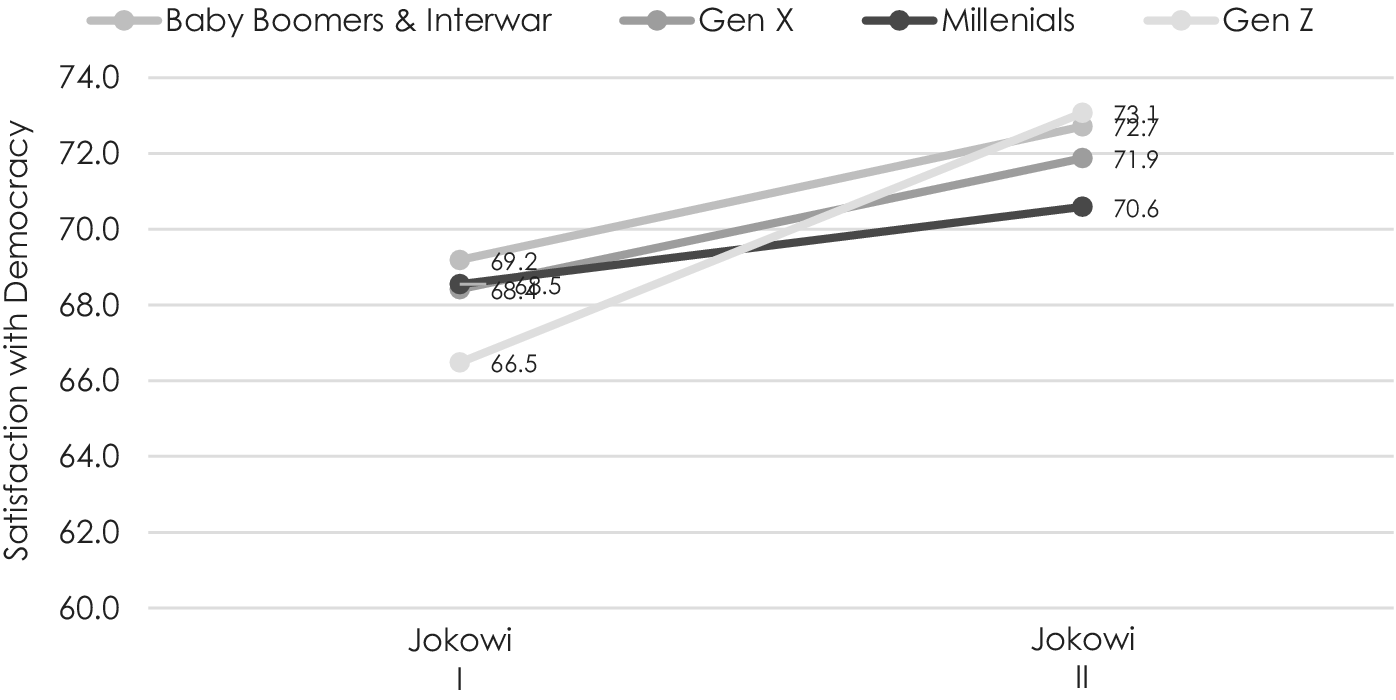
We dig deeper into the average change between these two time periods, when Indonesia’s democracy began to deteroriate along a number of measures. Figure 5 depicts the trend in levels of satisfaction with democracy by generation, but only from 2014 to 2023, when eligible Gen Z voters entered the population (i.e. enrolled voters) being sampled in the survey. We can observe how the increase in satisfaction levels varies by generation. Gen Z respondents’ satisfaction with democracy grows between poll periods to a greater extent than other generations. The proportion of Gen Z who were satisfied with democracy rose from 66.5 percent in Jokowi’s first term survey to 73.1 percent in his second term.
The trend of democratic satisfaction by generation (2014–2023) (percent of strongly/quite satisfied)

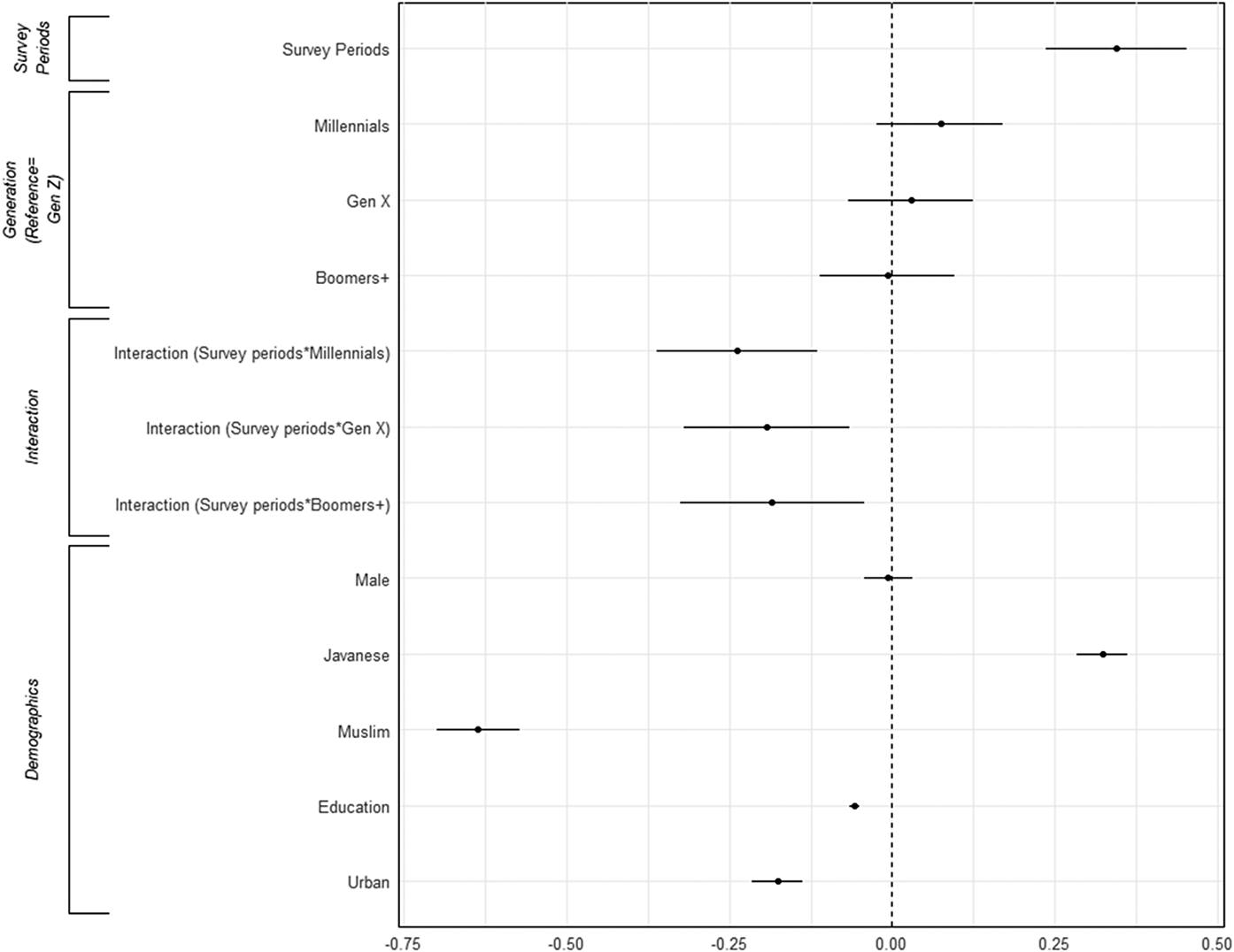
We test the significance of these patterns again using a logit model (Figure 6). Again, summary statistics are in Appendix 1. The variable “survey periods” is a dummy variable coded 0 if the surveys were administered during Jokowi’s first term in office, and 1 if they were conducted during his second term. The results confirm that, first, everyone is more satisfied with democracy during Jokowi’s second term, and there are indeed generational differences—but the differences are contingent on survey periods. Regardless of demographic variables, the interaction effect of political generation and survey period is statistically significant: Gen Z became on average more satisfied with democracy compared to other generations over the course of Jokowi’s decade.
Democratic satisfaction 2014–2023 and interaction terms between survey period and generation

In other words, to the extent that our pooled data reveal a potential cohort effect, this effect only appears for Gen Z. Contrary to stereotypes about the more pro-democratic and aptitudes of young people, today we find Indonesia’s youngest cohort to be the least concerned about the country’s democratic trajectory—at a time during the Jokowi presidency when NGOs, media and scholars in Indonesia were pointing urgently to a precipitous decline in the quality of democratic institutions and protections over the past decade. In this sense we suggest that Gen Z exhibit democratic complacency to a greater degree than other generations.
Gen Z’s democratic outlooks and voting behaviour
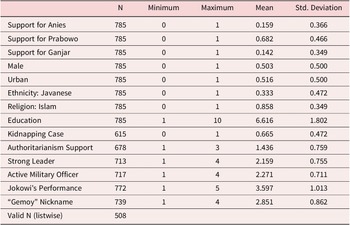
How does Gen Z’s democratic complacency manifest when it comes to their choice of political candidates? To answer this question, we turn now to examine the role that Gen Z played in delivering victory to Prabowo Subianto in the 2024 presidential elections. Using a national pre-election survey of the presidential voting intentions of 7,940 respondents, we dig into how Gen Z perceived Prabowo and why they voted for him at much higher rates than they did for Prabowo’s opponents, former governor of Jakarta Anies Baswedan and former governor of Central Java province Ganjar Pranowo.Footnote 2 The survey asked participants their voting intentions, alongside key attitudinal questions that allow us to capture the relationship between supporting Prabowo and preferences for strongman leadership, memory of New Order human rights violations, preference for democracy as a regime, and knowledge of Prabowo’s 2024 campaign messaging.We use these data and conduct a logistic regression analysis where three outcome variables are voting for one of the three candidate pairs (Table 1). Summary statistics are again in Appendix 1.
Sources of Gen Z support for Prabowo, Anies, and Ganjar

*p<0.05; **p<0.01; ***p<0.001.
One of the central themes of the 2024 election was the strategic alliance between Widodo and Prabowo, cemented by Prabowo’s appointment of Widodo’s eldest son, Gibran Rakabuming Raka, as his running mate. With a sizeable support base of his own and historically high approval ratings for an outgoing president, Jokowi’s support helped attract voters to Prabowo–Gibran (Mietzner Reference Mietzner2024). Many other surveys showed that support for Prabowo was tied closely to voters’ broader approval of Widodo, and saw Prabowo–Gibran as the “continuity” ticket associated with the outgoing president.
The results of our pre-election survey confirmed that voters’ choices were markedly associated with the support for outgoing President Joko Widodo (Jokowi). However, Gen Z voters were unique among generational cohorts in our survey in that that their opinions of Widodo had no clear influence on their vote choice in 2024. Unlike the rest of the population, this generation’s preference for Prabowo was unaffected by Widodo’s performance.Footnote 3
Instead, our data suggest that Gen Z’s special affinity with Prabowo is best explained in terms of intrinsic elements of his political persona, rather than the transference of Widodo’s popularity to him over the course of the 2024 campaign. We focus our analysis of the pre-election survey, therefore, on locating the possible roots of Prabowo’s special appeal to Gen Z both in his embodying broad political values of that generation, as well as in the resonance of Prabowo’s 2024 campaign gimmicks and imagery with young voters.
First, in order to capture whether preference for “strongman democracy” is shaping voters’ support for Prabowo, we asked respondents about the extent to which they agreed with the statements that “active soldiers should lead our government,” and that “we should abolish the [national legislature] and general elections, and leave it to a strongman leader to make decisions.” Initially respondents were asked to respond on a four-point Likert-type scale ranging from strongly agree to strongly disagree; for easier interpretation of the results, both are coded in reverse in the analysis to follow.
Second, we sought to probe respondents’ knowledge of New Order-era human rights abuses in which Prabowo was implicated. Prabowo, a senior army officer and pro-regime hardliner at the time of the reformasi movement, was found by a military tribunal to have been responsible for the kidnapping and disappearances of a number of anti-regime activists during the final months of Suharto’s presidency. Prabowo’s role in this and other alleged human rights abuses has made him a notorious figure among progressive civil society. But to gauge whether these allegations still colour Indonesians’ views of him, we asked respondents in our pre-election survey whether they “believe that Prabowo Subianto was involved in the kidnapping of pro-democracy student activists in 1998.”
Third, we asked respondents’ preferences regarding democratic versus other political regimes more broadly. We adopted questions from the Asian Barometer and World Values surveys to construct a three-point scale of openness to authoritarian rule, with respondents asked to identify which of the following statements most closely aligned with their views: “Democracy is always superior to other forms of government” (1 point); “For people like me, it does not matter whether it is a democratic system or an authoritarian system” (2 points); and “In some situations, an authoritarian government is superior to a democratic government” (3 points).
Finally, we asked respondents how fond they were of the campaign gimmick that used an Indonesian slang term for “cute” or “cuddly” (gemoy) to paint Prabowo in a soft and cute light: “How much do you like Prabowo Subianto’s gemoy moniker?” The question is constructed in a five-point scale, with possible answers ranging from “do not like it at all” to “really like.”
Using the logistic regression model presented in Table 1, we predict the probability of a participant’s support for each candidate, as determined by these four factors. We focus here just on the Gen Z respondents. The results indicate that, in terms of key demographic characteristics, Gen Z Prabowo supporters are more likely than those in other age categories to be Muslim and highly educated (both of which are statistically significant at the 95 percent level). Full regression results can be viewed in the Appendix (2–5).
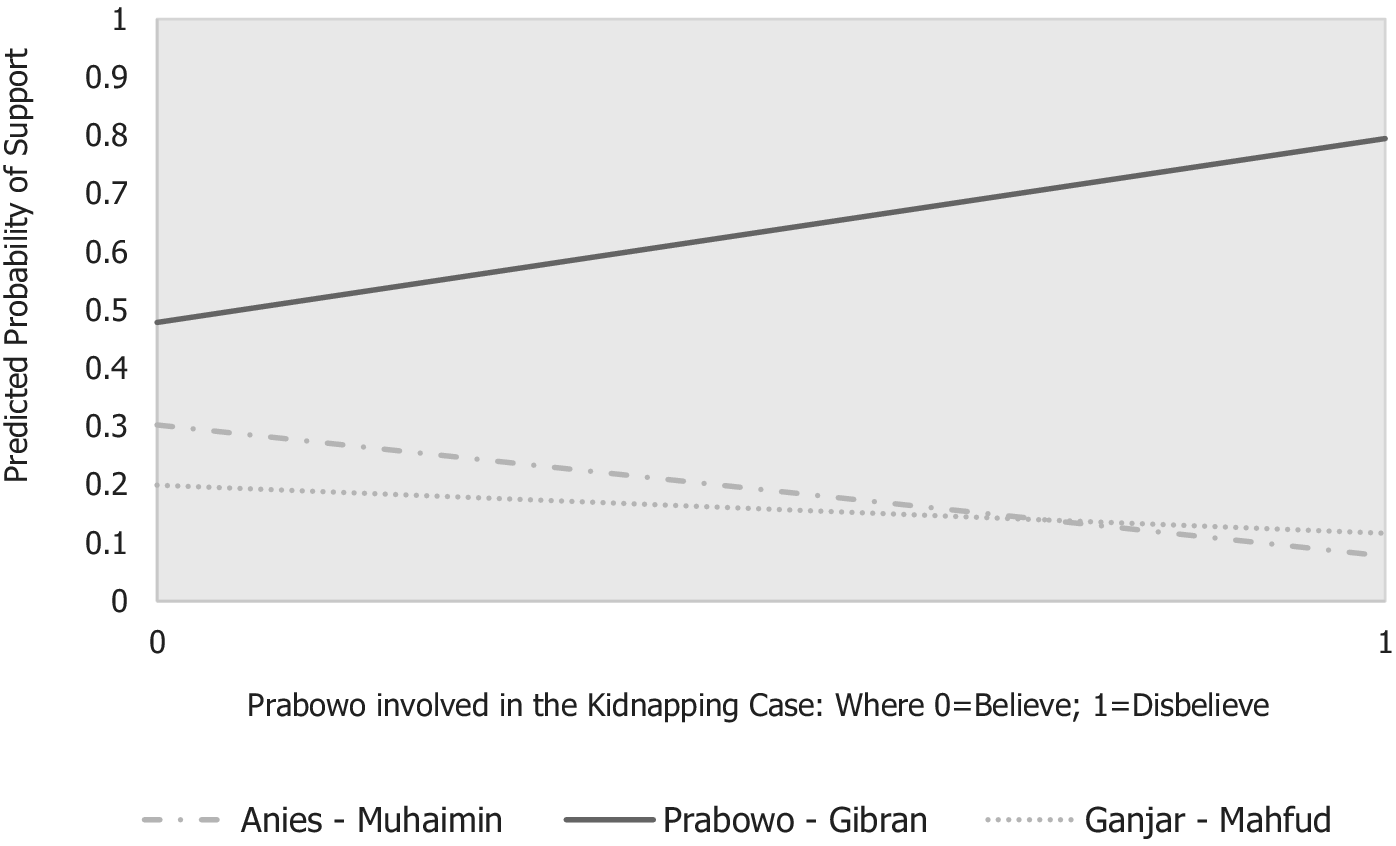
We also find that Prabowo’s Gen Z supporters typically do not believe Prabowo was involved in the kidnapping of activists in 1997–1998. At the same time, even among those who do believe this history, the predicted probability of their voting for Prabowo in 2024 was almost 0.5, as Figure 7 shows. Of course, we cannot make definitive statements about the direction of causality in the relationship between denial of Prabowo’s involvement in the kidnappings and young voters’ support for him; disbelief of the allegations a priori may open the way for them to support him, or, equally as plausible, their choice to support him may precede their denial or rationalization of his involvement in human rights violations. Be that as it may, we can conclude on the evidence here that voters do not see those allegations as disqualifying.
Predicted probability of voting for Prabowo, Anies and Ganjar by belief of kidnapping case—Gen Z only

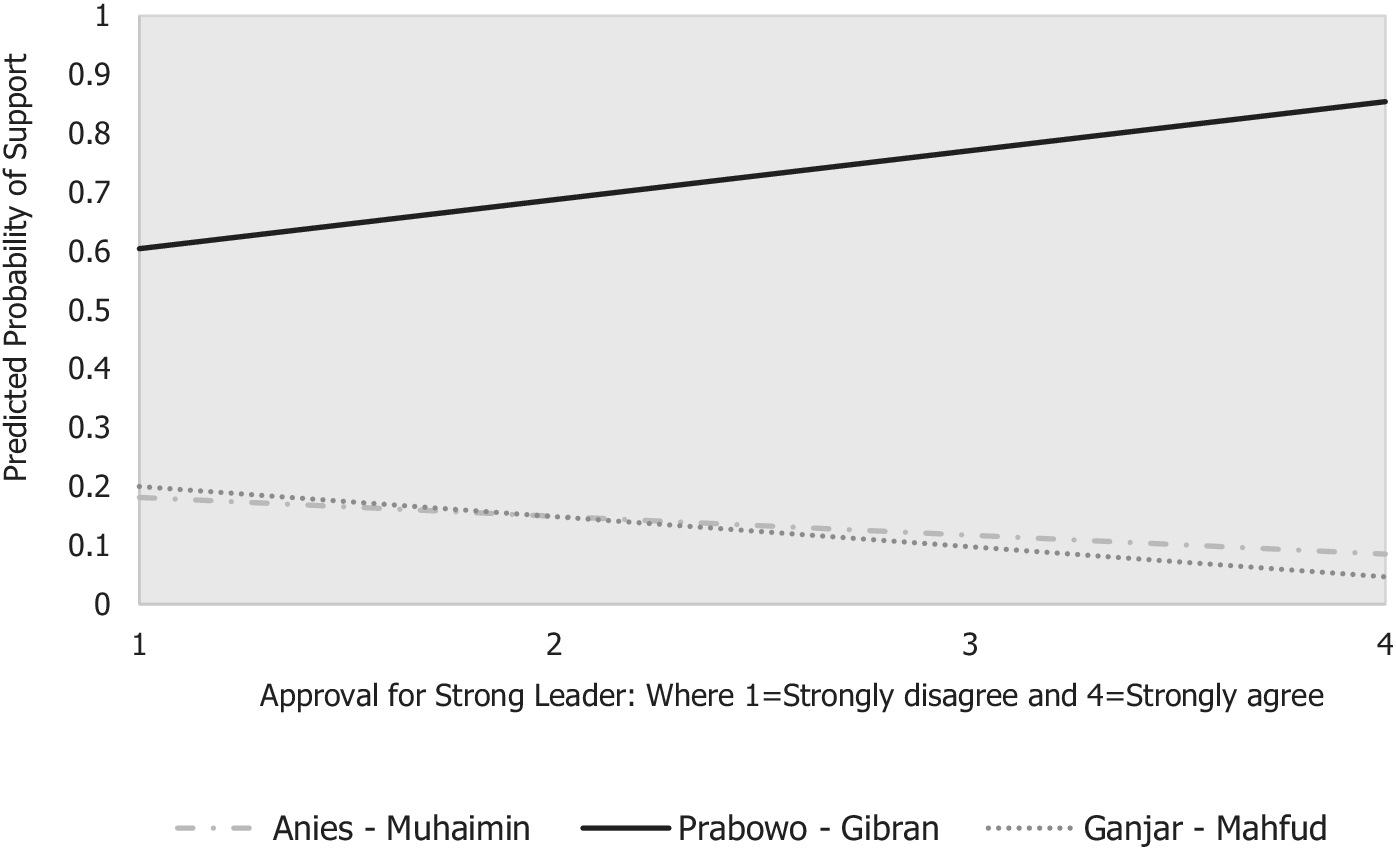
We also find that Prabowo’s Gen Z supporters tend to express their attraction to the idea of strongman leadership. Predicted support for Prabowo reaches almost 0.8 among those who “strongly agree” with the idea of a leader who is willing to suspend parliament to get things done, as Figure 8 shows. By contrast, there is a negative, though comparatively weaker, correlation between rejection of such authoritarian attitudes among those voters who supported Anies Baswedan and Ganjar Pranowo’s candidacies. In an echo of the results on the question about Prabowo’s human rights record, however, we still find a high predicted probability of supporting him even among those Gen Z voters who relatively lack a penchant for an illiberal style of leadership. We find a similar trend of increasing support for Prabowo as illiberal attitudes increase in the general sample (Appendix 2) and Millennials (Appendix 3), but the substantive effect is much larger among Gen Z.
Predicted probability of voting for Prabowo, Anies and Ganjar by strong leader support—Gen Z only

We then test the appeal of an attempt by Prabowo’s campaign to rebrand the former special forces general as a cute grandfatherly figure that came to be known as the gemoy phenomenon. Prabowo and his running mate, the president’s son Gibran Rakabuming Raka, appeared in campaign posters as baby-faced cartoon figures reminiscent of the AI-aided selfie filters popular among young social media users; local and international media were quick to highlight the gemoy tactic as one element in Prabowo’s appeal to youth (Ratcliffe and Mulyanto Reference Ratcliffe and Mulyanto2024).
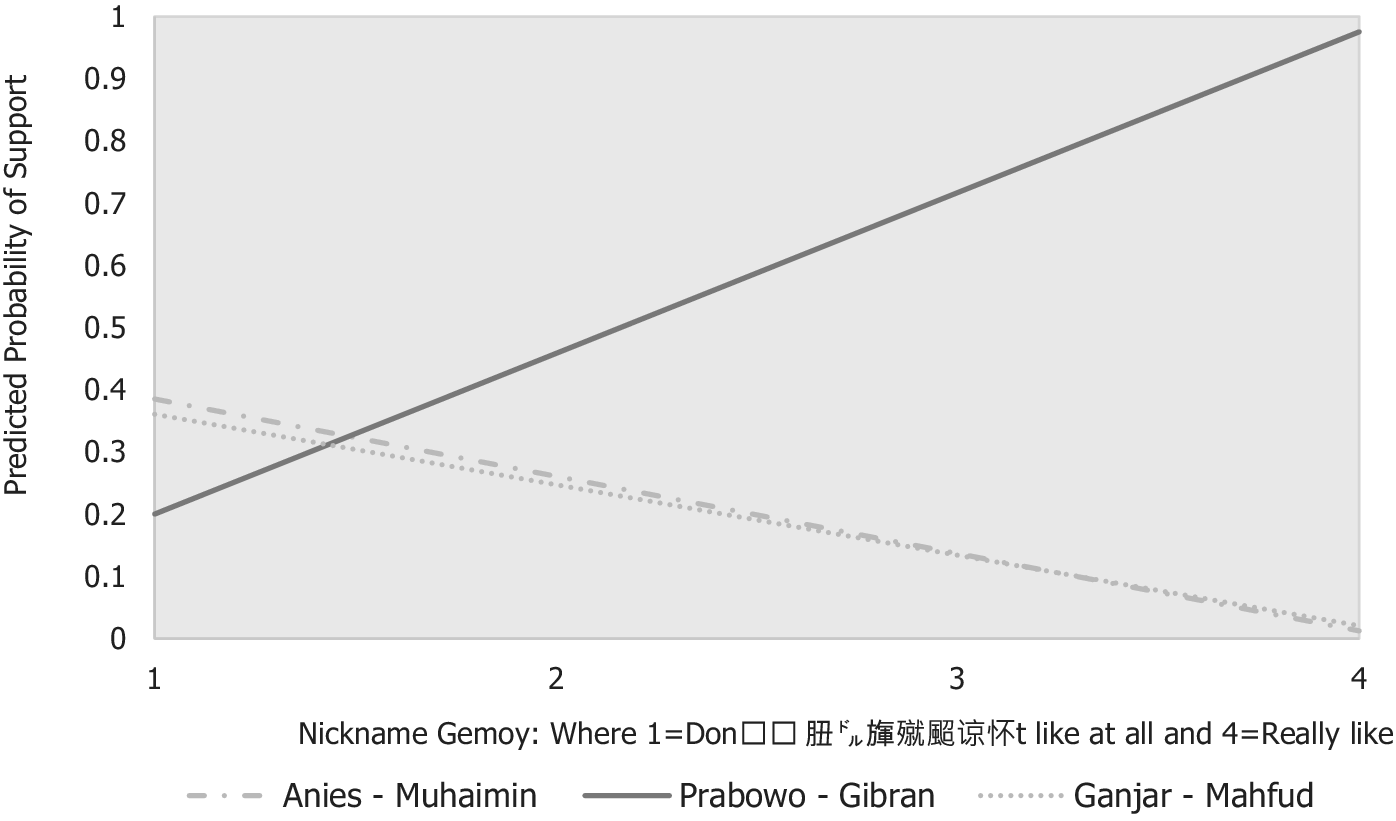
We asked respondents whether they were aware of the gemoy branding and whether they had positive sentiments towards it. The results, as displayed in Figure 9, show that there is a very strong correlation between positive sentiment towards the gemoy phenomenon and the likelihood of Gen Z voters supporting Prabowo, and a weaker but nonetheless noticeable correlation in the opposite direction for the comparatively small proportion of Gen Z voters who supported Prabowo’s opponents. While this is suggestive of the salience of the gemoy gimmick in the Prabowo campaign among Gen Z, we are not in a position to make any conclusions about causation in terms of voter support. It may be the case that voters who were attracted to Prabowo for diverse ideological or personality-based reasons may express appreciation of the gemoy gimmick as an effect, rather than a cause, of their support for him.
Predicted probability of voting for Prabowo, Anies and Ganjar by Gemoy appeal—Gen Z only

In summary, our analysis of the foundations of Prabowo Subianto’s overwhelming youth support shows that support for Prabowo among Gen Z is correlated with preference for illiberal or strongman rule. Yet it is important to emphasize that even those who reject such alternatives to democracy were also likely to vote for the former New Order general. This generation also showed overall strong skepticism about Prabowo’s involvement in human rights abuses—but even among those who did believe this information there was a relatively strong probability of supporting him.
Linking these data back to our historical analysis that measured democratic attitudes dating back to 2003, the surveys paint a picture of a post-reformasi generation whose preference for democracy as a regime type is not being accompanied by alarm on their part about the declining quality of Indonesian democracy. Nor is it leading them to shun political candidates with links to the old regime—and whose commitment to the post-reformasi political system is uncertain. Our analysis shows that the idea that democracy as the appropriate political regime in Indonesia maintains widespread support across all age groups regardless of whether they have experienced authoritarian rule; democratic satisfaction is likewise high and overall increasing, with Gen Z’s democratic satisfaction slightly higher, and increasing slightly faster, than that of other age groups. Our analysis also shows evidence that life-cycle and cohort effects are combining to overall produce higher levels of democratic satisfaction among Gen Zs at any given age compared with previous generations’ experience. In short, our surveys reveal that many Indonesians are complacent democrats, but Gen Z is distinctively so. While Indonesia’s post-reformasi generation share democratic values, they appear unalert to present and potential threats to that democracy.
Conclusion
The research presented here set out to provide a more robust empirical basis for discussing the role that Indonesia’s post-reformasi generation are playing in the evolution of the country’s democracy, while bringing the Indonesian case into more direct dialogue with the international literature on young people’s role in democratic (de)consolidation. With regards to the Indonesian case, our results reinforce the need for more caution in ascribing pro-democratic agency to young voters—or indeed, about generalizing in any way about the role that young people have in enabling or resisting democratic backsliding. We do not want to downplay the important role that youth-led civil society and protest movements that have played in moderating, and in some cases defeating, the Widodo administration’s efforts to weaken the institutional achievements of the reformasi movement. But protest and advocacy are only one form of political agency available to Indonesians—and the laudable vigilance that youth-led movements have shown about the creeping return of New Order-style governance during the Widodo years are only one part of a diverse set of outlooks on Indonesia’s political past, present and future held by members of the generation that knows only the politics that reformasi created.
Our results show that there is a silent majority of Gen Z Indonesians who retain a normative commitment to democracy as the best political regime for Indonesia, but remain satisfied with the performance of its democracy even as it experiences a prolonged period of backsliding. We interpret this widespread democratic complacency as being a critical precondition for Prabowo Subianto’s landslide victory among the youngest cohort of voters: while there is a section of the young Indonesian electorate that holds more illiberal views are especially attracted to the idea of illiberal or strongman democracy, but that these voters are neither typical of their generational cohort nor even of the Prabowo Subianto support base.
For Indonesian civil society, this suggests a more thoroughgoing effort is needed to raise awareness on the emerging generation of voters about the dark realities of the New Order, about the key elements of successful democracies, and about the dangers to democratic regimes posed by the gradual, often subtle erosion of the institutions of democracy that is characteristic of democratic backsliding in the contemporary world (Bermeo Reference Bermeo2016).
The apparent importance of life-cycle effects in affecting long-term trends in satisfaction with democracy should prompt caution about what observations we can make about the potential emergence of a cohort of “critical democrats” per Norris (Reference Norris1999, Reference Norris2011) as Indonesia’s post-reformasi generations emerge as a major voter bloc in the Widodo era. Our results suggest further lines of enquiry that, while outside the scope of this paper, will be important in understanding how the political maturation of Indonesia’s post-reformasi generationwill affect the country’s political evolution in the coming years and decades. While our analysis suggests that educational attainment has only a modest impact on Indonesians’ assessment of the state of civic freedoms, polling suggests that among younger voters, male and blue-collar voters of low educational attainment were particularly attracted to the candidacy of Prabowo Subianto in the 2024 presidential election (Kuipers, Toha and Sumatokoyo 2024). As Indonesia’s millennials and Gen Z voters emerge as an electoral majority, keeping a close eye on the attitudinal and behavioural differences between the economically and culturally advantaged segments of these generations and those “left behind,” or of the emergence an over-educated, frustrated group of urban youth, could be crucial leading indicators with regards to the legitimacy and stability of the existing democratic system in coming years.
Beyond this contribution to the Indonesia-focused literature, our study also contributes to the international literature, particular when it comes to the insights of our analysis of long-term survey data to tease out the relative prominence of life-cycle and cohort effects in shaping inter-generational attitudinal differences. Indonesia has not experienced the pattern of declining democratic satisfaction and greater openness to illiberal or non-democratic regimes among Millennial and Gen Z voters seen in many consolidated Western democracies identified by Foa et al. (Reference Foa, Klassen, Slade, Rand and Collins2020). Instead, Indonesia broadly mirrors similar patterns seen in consolidated high-income democracies of Northeast Asia—both the post-authoritarian cases of Taiwan and South Korea, as well as the longstanding democracy of Japan.
The prima facie evidence for a distinctive East Asian pattern of inter-generational differences in democratic satisfaction in particular that appears to hold across the consolidated, stable democracies of developed Northeast Asia and, in a backsliding middle-income democracy in the Indonesian case, suggests that there is analytical value in exploring the possible causes of this East Asian convergence: the influence of distinctively East Asia structures of inter-generational economic inequality, economic growth per se, particular cultural values, or the role of educational curricula may be have a role to play in producing distinct geographical patterns. Beyond the region, and indeed beyond just our thematic focus on youth here, we also see analytical utility in focusing on the causes and consequences of democratic complacency—or, to adapt Norris (Reference Norris2011), uncritical democratic attitudes—in backsliding democracies more broadly. We need to look at the idea that democratic complacency could be a crucial enabling factor in the democratic backsliding that is being driven by popular leaders all across Asia and beyond.
Acknowledgments
The authors wish to thank the Indonesian Survey Institute (LSI)—especially Saiful Mujani and Djayadi Hanan—for granting permission to use LSI data from 2003–2012. The authors are also grateful to Rizki Rahmadian and Adam Kamil for their research assistance.
Competing interests
The authors declare none.
APPENDIX
Appendix 1: Descriptive Statistics: Democratic Satisfaction 2003–2023

Appendix 1. Descriptive Statistics: Democratic Satisfaction 2014–2023

Appendix 1. Descriptive Statistics: Sources of Gen Z Support for Prabowo, Anies, and Ganjar

Appendix 2. Determinant of support for Prabowo, Anies and Ganjar (whole sample)

*p<0.05; **p<0.01; ***p<0.001; standard error in parentheses.
Appendix 3. Determinant of support for Prabowo, Anies and Ganjar (Millennials only)

*p<0.05; **p<0.01; ***p<0.001; standard error in parentheses.
Appendix 4. Determinant of support for Prabowo, Anies and Ganjar (Gen X only)

*p<0.05; **p<0.01; ***p<0.001; standard error in parentheses.
Appendix 5. Determinant of support for Prabowo, Anies and Ganjar (Boomers only)

*p<0.05; **p<0.01; ***p<0.001; standard error in parentheses.


 Open access

