


The dietary factor associated with cognitive function has been well-established(Reference Chen, Maguire and Brodaty1). Epidemiological studies have shown an association between the diet and cognitive function in children(Reference Kim and Kang2), adults(Reference Fortune, Harville and Guralnik3) and the elderly(Reference Sala-Vila, Valls-Pedret and Rajaram4).
In recent years, egg consumption is on an upward trend in Asian countries(Reference Yang, Rose and Yang5,Reference Iddamalgoda, Hayashi and Goto6) , especially in China(Reference Yang, Rose and Yang5,Reference Zhai, Du and Wang7) . Eggs contribute to around 6 % of the total protein in the diets of Chinese individuals(Reference Yang, Rose and Yang5). More than 40 % of eggs in the world are produced in China, making it the largest producer globally(Reference Nys, Bain and Van Immerseel8). Although eggs contain high-quality protein, unsaturated fats and all essential vitamins and minerals, with the exception of vitamin C, their role in health benefits has long been debated over many years, particularly concerning their association with CVD. This dispute has recently been clarified, with increasing evidence supporting the benefits of egg consumption over cardiovascular risk. Nevertheless, the debate is ongoing, with some studies continuing to show a significant association with CVD(Reference Zhong, Van Horn and Cornelis9) and others claiming no association(Reference Qin, Lv and Guo10) or inconclusive evidence(Reference Drouin-Chartier, Chen and Li11–Reference Xu, Lam and Jiang13).
Although most studies on egg consumption have focused on cardiovascular health, research is beginning to implicate eggs in their relationship to cognitive health(Reference Kucab, Boateng and Brett14–Reference Bishop and Zuniga17), yet evidence on the benefit of whole egg consumption is lacking. A case–control study of elderly individuals in China revealed that healthy controls had higher egg intake compared with those with mild cognitive impairment, suggesting that sufficient egg intake may play a role in preventing the development of mild cognitive impairment(Reference Zhao, Yuan and Feng15). This may be due to particular nutrients available in eggs such as choline and lutein that have been previously shown to have a beneficial effect on cognitive function(Reference Renzi-Hammond, Bovier and Fletcher18,Reference Poly, Massaro and Seshadri19) . Also, a study on adults aged 65 years or older from Madrid showed that dietary patterns that involve egg consumption are associated with enhanced cognitive capacity(Reference Aparicio Vizuete, Robles and Rodriguez-Rodriguez16). On the other hand, a multi-domain study of representative samples of older adults in the USA revealed inconclusive evidence on egg consumption and cognitive health, suggesting that egg intake is not beneficial nor detrimental to cognitive function(Reference Bishop and Zuniga17).
Furthermore, eggs are an important source of protein. Protein intake and cognitive health have also been investigated. Evidence suggests that higher protein intake may decrease the risk of cognitive impairment or dementia(Reference Roberts, Roberts and Geda20,Reference La Rue, Koehler and Wayne21) . This may be due to the presence of particular amino acids that are important for cognitive function, such as leucine, isoleucine, valine, phenylalanine and tryptophan(Reference Suzuki, Yamashiro and Ogawa22). It is worth to mention that increased egg consumption has been shown to be associated with an increased diabetes risk in several countries(Reference Djousse, Gaziano and Buring23–Reference Djousse, Khawaja and Gaziano26), including China(Reference Shi, Yuan and Zhang25). Moreover, diabetes has been shown to be associated with cognitive impairment(Reference Ding, Fang and Li27,Reference Teixeira, Passos and Barreto28) , dementia(Reference Chatterjee, Peters and Woodward29,Reference Gudala, Bansal and Schifano30) , Alzheimer’s disease(Reference Gudala, Bansal and Schifano30,Reference Arvanitakis, Wilson and Bienias31) and vascular dementia(Reference Gudala, Bansal and Schifano30). It is unknown whether this association between egg consumption and diabetes can be translated into cognitive impairment.
While many factors may contribute to the development of cognitive decline in adults and elderly, dietary factors have been increasingly recognised as having one of the key roles which are amenable to change. In particular, eggs are a common food staple which are generally inexpensive and accessible to all populations, yet their role in cognition is not well-studied. Another important question which has not been answered concerning the impact of egg consumption on cognition lies in whether additional nutrients function as a modifier variable in relation to egg cognition. We have previously described that higher Fe intake has an inverse association with cognitive function in Chinese adults(Reference Shi, Li and Wang32). Putting these together, the aim of this study was 2-fold. Firstly, we aimed to assess the longitudinal association between egg consumption and cognitive function among Chinese adults using data obtained over 15 years from the China Health and Nutrition Survey (CHNS). In addition, our aim was to assess the interaction between egg intake and Fe in relation to cognition.
Methods
Study design and sample
This was a longitudinal study based on repeated measurements of dietary intake and cognitive function over 15 years from the CHNS. The CHNS study is an ongoing open prospective household-based cohort study conducted in thirteen provinces in China between 1989 and 2015(Reference Zhai, Du and Wang7,Reference Popkin, Du and Zhai33) . Samples are selected from both urban and rural areas through a multistage random-cluster sampling process. Ten waves of data collection have been conducted between 1989 and 2015. In the surveys of 1997, 2000, 2004 and 2006, cognitive screen tests were conducted among those above 55 years. As the dietary data in 2015 survey were not released and the 1989 survey only collected dietary data in a subgroup, we only used data between 1991 and 2006. Between 1997 and 2006, a total of 4852 participants (2309 men and 2543 women) attended the cognitive screen tests. Of these participants, 3302 participants attended the screen test in at least two surveys. Participants who did at least one cognitive screen test were included in the analysis (Fig. 1).
Sample flow chart of participants attending China Health and Nutrition Survey. Number of participants included in the analyses in each wave were 2109, 2209, 2947 and 3339 in 1997, 2000, 2004 and 2006, respectively.

The survey was approved by the institutional review committees of the University of North Carolina (USA) and the National Institute of Nutrition and Food Safety (China). Informed consent was obtained from all participants. The response rate based on those who participated in 1989 and remained in the 2006 survey was > 60 %.
Outcome variable: cognitive function
The cognitive function was assessed by both objective measures for global cognitive function and self-report for memory.
Total global cognitive score
The cognitive screening items used in CHNS were face-to-face and included a subset of items from the Telephone Interview for Cognitive Status–Modified(Reference Plassman, Welsh and Helms34). The tool has been used to assess cognitive function in other population studies in China(Reference Lei, Hu and McArdle35). The global cognitive score was calculated using composite scores of memory, counting back and subtraction scores. The cognitive screening contained three tasks, an immediate (score 10) and delayed (score 10) recall of a 10-word list, counting backward from 20 to 1 (score 2), and serial 7 subtractions (score 5). The total global cognitive score ranged from 0 to 27, with a higher cognitive score representing better cognition. For the first task, scores were 1 through 20, in which a score of 1 is given to each correctly recalled word. A total verbal memory score was constructed as the sum of the immediate and delayed 10-word recall. For the second task, those who counted backward correctly in the first try were given a score of 2. For those who counted backward correctly in the second try, they received a score of 1. For the last task, the participants were asked to do five consecutive subtractions of 7 from 100. For each of the correct 5 serial 7 subtractions a score of 1 was given. An orientation was assessed only in 1997, 2000 and 2004; therefore, we did not include it in the analysis.
Self-reported memory
Participants were also asked ‘How is your memory? (1) Very good, (2) good, (3) OK, (4) bad, (5) very bad, (9) unknown’. Participants who reported ‘bad’ or ‘very bad’ were considered as having a poor memory. Memory change was assessed by the question ‘In the past twelve months, how has your memory changed? (1) Improved, (2) stayed the same, (3) declined, (9) unknown’. Participants who reported ‘declined’ were considered as having memory decline.
Exposure variable: cumulative mean egg intake and iron intake
Egg and Fe intake data were collected in multiple waves. At each wave, individual dietary intake data were gathered by a trained investigator conducting a 24-h dietary recall on each of 3 consecutive days. Food and condiments in the home inventory, food bought from markets or brought from gardens and food waste were weighed and recorded by interviewers at the start and end of the 3-d survey period. Detailed description of the dietary measurement has been discussed elsewhere(Reference Zhai, Du and Wang7). Food consumption data were converted to nutrient intakes using the Chinese Food Composition Table(Reference Yang36). The dietary assessment method has been validated for energy intake(Reference Yao, McCrory and Ma37).
Covariates
Demographic characteristics included age and sex. Measures of socio-economic status included education (low: illiterate/primary school, medium: junior middle school and high: high middle school or higher), annual family income per capita (recoded into tertiles: low, medium and high), urbanisation levels(Reference Zhai, Du and Wang7) (recoded into tertiles: low, medium and high). In addition, other covariates including physical activity level (metabolic equivalent of task) estimated on the basis of self-reported activities (including occupational, domestic, transportation and leisure-time physical activity), smoking (non-smokers, ex-smokers and current smokers), alcohol drinking (yes/no), BMI, self-reported diabetes and stroke (yes/no) and hypertension (systolic blood pressure > 140 mmHg or diastolic blood pressure > 90 mmHg or self-reported hypertension).
Two dietary patterns were constructed based on thirty-five food groups, including alcohol which was aggregated from 24-h dietary recalls of 3 consecutive days with the use of factor analysis(Reference Shi, Taylor and Riley38). The first pattern (traditional south pattern) is characterised by a high intake of pork, vegetables and rice, and low intake of wheat. The second pattern (modern dietary pattern) is characterised by a high intake of milk, soya milk, eggs, fruits, deep fried food and beer.
Statistical analysis
Cumulative mean egg intake across survey waves was calculated and recoded into quartiles. To compare differences between groups for categorical variables, the χ 2 test was used, and for continuous variables the ANOVA test was used. To assess the association between egg intake and cognitive function, a mixed-effects model using mixed command in Stata (StataCorp) was used. A negative regression coefficient represents cognitive function decline. A set of models were used: model 1 adjusted for age, sex and energy intake. Model 2 further adjusted for intake of fat, smoking, alcohol drinking, income, urbanisation, education and physical activity. Model 3 further adjusted for overall dietary patterns, and model 4 further adjusted for BMI and hypertension. Model 5 further excluded those who only participated in one wave of the cognitive function tests. All the adjusted variables were treated as time-varying covariates (except sex). In sensitivity analyses, we further adjusted for total protein intake (and without eggs) in order to separate the effect between egg intake and total protein intake. To assess the association between cumulative mean egg intake and the risk of poor cognitive function, mixed-effects logistic regression was used while adjusting for the same covariates as in model 4 mentioned above. Furthermore, we used the mean egg intake between 1991 and 1993 as the exposure variable to assess the association. To test the interaction between egg intake and a set of variables including BMI, hypertension, sex and Fe intake, a product term of each pair of variables was put in the regression model. The command marginsplot was used in Stata 17 to visually present the interaction. All of the analyses were conducted using STATA 17 (Stata Corporation). Significance was considered when P < 0·05 (two-sided).
Results
Descriptive results
The sample characteristics of participants who attended the first cognitive function test based on quartiles of cumulative egg intake are presented in Table 1. Across egg intake quartiles, the intake of protein, fat and Fe increased. Modern dietary pattern was also positively associated with egg intake. However, carbohydrate intake was negatively associated with egg intake. There was no difference in energy intake and traditional dietary patterns across quartiles of egg intake. Those with higher egg consumption had a higher BMI, income and education level and were less physically active compared with those with lower egg consumption. The prevalence of self-reported poor memory and self-reported memory decline declined with the increase in egg consumption.
Sample characteristics of Chinese adults aged ≥ 55 years old attending the first cognitive function test by quartiles of cumulative egg intake (n 4661)
(Numbers and percentages; mean values and standard deviations)

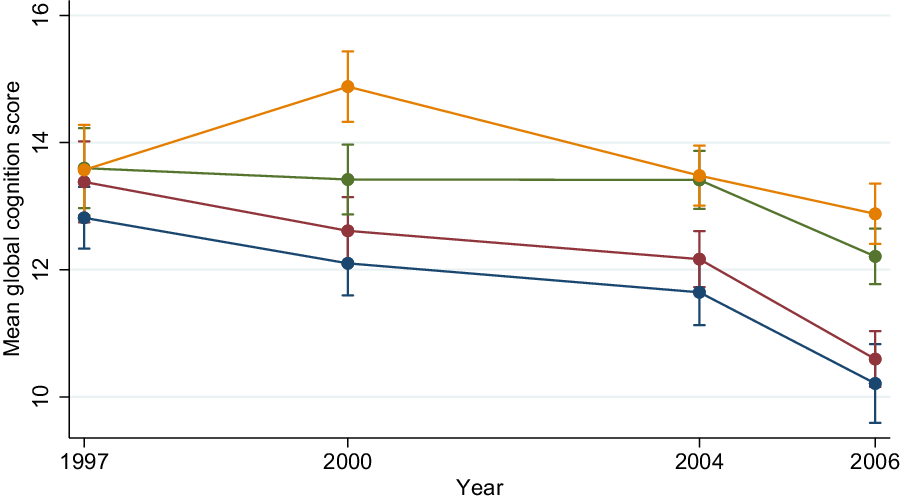
Overall, the mean global cognitive score had a downward trend between 1997 and 2006 (Fig. 2). The mean global cognition score was 12·1 (sd 6·8) in 1997. The decline in the annual cognitive function score was 0·10 (95 % CI 0·07, 0·13).
Mean global cognitive score (95 % CI) by year and quartiles of egg intake among Chinese adults aged >= 55 years and who attended at least two waves of cognition tests, China Health and Nutrition Survey. Quartiles of egg intake:  , Q1;
, Q1;  , Q2;
, Q2;  , Q3;
, Q3;  , Q4.
, Q4.
Association between egg intake and cognitive function
Egg intake was positively associated with cognitive function on a global cognitive scale (Table 2). Compared with non-consumers (Q1), those in the fourth quartile of egg consumption had a higher global cognitive score. In the fully adjusted model (model 5), regression coefficients for the global cognitive score for the first, second, third and fourth quartiles of egg intake were 0, 0·11 (95 % CI –0·28, 0·51), 0·79 (95 % CI 0·36, 1·22) and 0·92 (95 % CI 0·43, 1·41), respectively. The association still remained when we adjusted for total protein intake (without eggs).
Regression coefficients (95 % CI) for cognitive function by quartiles of egg intake among Chinese adults aged 55 years and above attending China Health and Nutrition Survey (n 4852)
(95 % confidence intervals)

* Model 1 adjusted for age, sex and energy intake.
† Model 2 further adjusted for intake of fat, smoking, alcohol drinking, income (low, medium and high), urbanicity (low, medium and high), education (low, medium and high) and physical activity level (continuous).
‡ Model 3 further adjusted for overall dietary patterns.
§ Model 4 further adjusted for BMI and hypertension.
|| Model 5 further excluded those who only participated in one wave of the cognitive function tests.
¶ Model 6 adjusted for the same variables as model 5 but excluded intake of fat. This model also adjusted for total protein intake (without eggs).
All the adjusted variables are treated as time-varying covariates (except sex).
High egg intake was inversely associated with both self-reported poor memory and memory decline after adjusting for age, sex and energy intake. The associations were attenuated with further adjustment of covariates. There was a dose–response inverse relationship between egg consumption and self-reported memory decline in the fully adjusted model (Table 3). There was no interaction between egg consumption and hypertension and overweight/obesity in relation to cognition (data not shown).
Odds ratios (95 % CI) for self-reported poor memory and self-reported memory decline by levels of egg intake among Chinese adults aged ≥ 55 years old by characteristics, China Health and Nutrition Survey (n 4852)
(95 % confidence intervals)

* Model 1 adjusted for age, sex and energy intake.
† Model 2 further adjusted for intake of fat, smoking, alcohol drinking, income, urbanicity, education and physical activity.
‡ Model 3 further adjusted for overall dietary patterns.
§ Model 4 further adjusted for BMI and hypertension.
|| Model 5 further excluded those who only participated in one wave of the cognitive function tests.
¶ Model 6 adjusted for the same variables as model 5 but excluded intake of fat. This model also adjusted for total protein intake (without eggs).
All the adjusted variables are treated as time-varying covariates (except sex).
In sensitivity analyses using the mean egg intake between 1991 and 1993 as the exposure variable, most of the above associations remained (online Supplementary Tables S1 and S2). However, the association between egg intake and self-reported memory decline became statistically not significant in the multivariable models.
Iron intake modifies the association between egg consumption and cognitive function
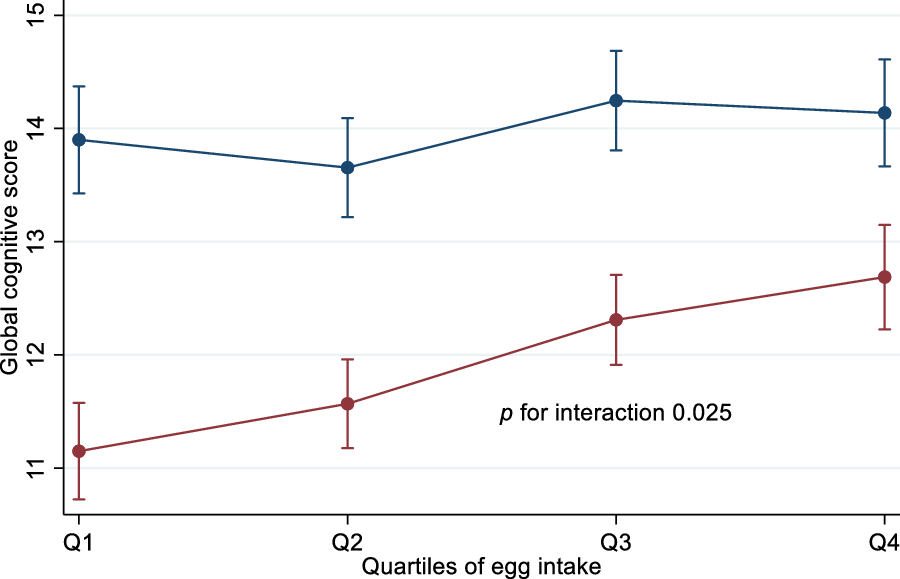
A significant interaction (P = 0·011) between egg consumption and Fe intake in relation to cognition function on a global cognitive scale was observed (Fig. 3). The positive association between egg intake and global cognitive function was stronger among those with low Fe intake compared with those with high Fe intake. The interaction was mainly seen for counting back and subtraction but not for memory (online Supplementary Fig. S1). There was a significant interaction between egg consumption and sex. The positive association between egg consumption and global cognition score was mainly observed in women but not men (Fig. 4). However, there was no three-way interaction between egg consumption, Fe intake and sex (data not shown).
Interaction between egg intake and Fe intake in relation to global cognitive function. The mixed linear regression model adjusted for age, sex, intake of energy and fat, smoking, BMI, alcohol drinking, income, residence, education, and physical activity, overall dietary patterns and hypertension. All participants participated at least two waves of survey. Values represent regression coefficients and 95 % CI. P for interaction between Fe intake and egg intake was 0·011. An ordinal value (1, 2, 3, 4) was assigned to reflect the quartiles of egg intake level and treated as a continuous variable while testing for interactions. Quartiles of egg intake: , Q1; , Q2; , Q3; , Q4.

Interaction between egg intake and sex in relation to global cognitive function. The mixed linear regression model adjusted for age, intake of energy and fat, smoking, alcohol, BMI, drinking, income, urbanicity, education, and physical activity, overall dietary patterns and hypertension. All participants participated at least two waves of survey. Values represent regression coefficients and 95 % CI. , men; , women.
Discussion
In this population-based longitudinal study in China, higher egg intake was positively associated with cognitive function as measured by global cognitive scores. Higher egg intake was inversely associated with self-reported poor memory and self-reported memory decline. Additionally, there was a significant interaction between egg intake and Fe intake in relation to cognitive function. The positive association between egg intake and cognitive function was stronger among those with lower Fe intake.
Association between egg intake and cognitive function
To our knowledge, this is the first population-based longitudinal study to investigate the interaction between egg consumption and Fe intake in relation to cognitive function. Importantly, we found a dose–response relationship between egg consumption and cognition. Our findings are supported by a study on the elderly population from Madrid region, which found that individuals with higher intake of eggs had less errors in the Short Portable Mental Status Questionnaire, which was used to assess cognitive capacity(Reference Aparicio Vizuete, Robles and Rodriguez-Rodriguez16). Moreover, a case–control study conducted by Zhao(Reference Zhao, Yuan and Feng15) and his colleges in old Chinese individuals aged 60 years and above found that higher egg intake may play a role in preventing mild cognitive impairment(Reference Zhao, Yuan and Feng15). Additionally, a ∼22-year follow-up study on 2497 Finnish males showed that moderate egg intake was associated with greater performance on certain measures of cognitive function(Reference Ylilauri, Voutilainen and Lonnroos39). However, a multi-domain study of older adults in the USA revealed inconclusive evidence on egg consumption and cognitive health, suggesting that egg intake is neither beneficial nor detrimental to cognitive health(Reference Bishop and Zuniga17). This discrepancy in the findings may be due to different study designs and measurements of the exposure variable. The study considered egg intake as a categorical variable, and it was measured by a FFQ. Moreover, the authors of this study failed to adjust for important covariates including dietary patterns, which may have contributed to their inconclusive results.
The potential mechanisms of the effect of egg intake on cognitive health have yet to be understood. Eggs are a main source of dietary cholesterol, with one egg containing around 200 mg of cholesterol. Given that dietary cholesterol has been shown to have a minor effect on plasma cholesterol concentration in most people(Reference Howell, McNamara and Tosca40), previous studies have revealed no association between dietary cholesterol and cognitive performance or risk of incident dementia(Reference Ylilauri, Voutilainen and Lonnroos39), or Alzheimer’s disease(Reference Morris, Evans and Bienias41). Furthermore, it is worth to mention that the effect of eggs on cognitive health is not only to be determined by their cholesterol content, as eggs are a source of many other nutrients and bioactive compounds that have a beneficial effect on cognitive function, notably, lutein, zeaxanthin and choline(Reference Renzi-Hammond, Bovier and Fletcher18,Reference Poly, Massaro and Seshadri19,Reference Hammond, Miller and Bello42) . A randomised, double-masked, placebo-controlled trial conducted by Hammond(Reference Hammond, Miller and Bello42) and his colleagues examined the effect of lutein and zeaxanthin supplementation on cognitive function in older adults. Cognition was measured using the Central Nervous System Vital Signs computerised test platform. It was found that supplementation of lutein and zeaxanthin improved macular pigment optical density, complex attention and cognitive flexibility domains(Reference Hammond, Miller and Bello42). A study similar in design was conducted on young healthy adults, which revealed improved cognitive function and central nervous system xanthophyll levels(Reference Renzi-Hammond, Bovier and Fletcher18). High intake of choline has also been shown to be associated with improved cognitive capacity(Reference Aparicio Vizuete, Robles and Rodriguez-Rodriguez16).
Furthermore, eggs are a rich source of dietary protein. Previous evidence demonstrated the beneficial effect of protein on cognitive health(Reference Roberts, Roberts and Geda20,Reference La Rue, Koehler and Wayne21,Reference Li, Li and Wang43,Reference Shang, Hill and Li44) . This may be due to the protective effect of high dietary protein intake on the amyloid-β burden in the brain(Reference Fernando, Rainey-Smith and Gardener45). Cognitive decline is accelerated by a high amyloid-β burden(Reference Baker, Lim and Pietrzak46). In addition, eggs contain essential amino acids including leucine, isoleucine, valine and tryptophan, which have been shown to be associated with improved cognition(Reference Suzuki, Yamashiro and Ogawa22,Reference Strasser, Gostner and Fuchs47) . However, it is worth mentioning that evidence on dietary protein and cognitive health is inconclusive. A previous study on adults (age ≥ 60 years) found a positive association between dietary protein intake from total animal, total meat, legumes, and eggs and cognitive function, whereas protein intake from milk and milk products had a negative association(Reference Li, Li and Wang43). Also, a study in China found that a dietary pattern with a high percentage of energy intake from protein may be linked with cognitive decline(Reference Ding, Xiao and Ma48). In addition, a Spanish study on elderly showed no significant association between dietary protein intake and cognitive function(Reference Ortega, Requejo and Andres49). In the present study, adjusting for total protein intake did not change the association between egg intake and cognitive function. This suggests that the association between egg intake and cognition is independent of protein intake. Although the exact benefits on eggs v. total protein intake on cognition are not yet clear, it is possible that the combined interactions of particular micronutrients, such as n-3 fatty acids and minerals, with protein and their particular composition in eggs could play a significant role.
Iron intake modifies the association between egg consumption and cognitive function
Interestingly, we found that high egg consumption is beneficial for cognitive function only among those with a relatively low intake of Fe. In our previous study, increased Fe intake was found to be adversely associated with cognitive function(Reference Shi, Li and Wang32). In addition, it was previously shown in Western populations that Fe intake is positively associated with disorders that induce cognitive decline, such as Parkinson disease(Reference Logroscino, Gao and Chen50,Reference Powers, Smith-Weller and Franklin51) . However, in a Japanese case–control study, an inverse association between Fe intake and Parkinson disease was found(Reference Miyake, Tanaka and Fukushima52). This discrepancy in the findings may be attributed to differences in study designs and exposure classification.
The mechanisms linking Fe intake and cognitive function have been studied. It was hypothesised that free non-heme Fe plays an important role in neural and cognitive ageing(Reference Harman53). A number of reviews revealed a crucial role of Fe in neurodegenerative diseases as a redox-active ion that can contribute to oxidative stress in cells(Reference Agrawal, Berggren and Marks54,Reference Li and Reichmann55) . Furthermore, high Fe status has been shown to be positively associated with a higher risk of hyperuricaemia in CHNS participants(Reference Li, He and Yu56). Moreover, hyperuricaemia is associated with poor cognition in the Chinese population(Reference Liu, Wang and Zeng57).
Although eggs are a known source of Fe, it was previously shown to inhibit Fe absorption(Reference Callender, Marney and Warner58,Reference Peters, Apt and Ross59) . However, it was suggested by Kobayashi(Reference Kobayashi, Wakasugi and Yasui60) and his colleagues that egg white protein component ovalbumin may increase the absorption of Fe. Higher egg intake may not be beneficial if Fe intake is high. Future research should assess whether Fe supplements may modify the association between egg consumption and cognition.
Strengths and limitations
Our study includes several strengths including the longitudinal study design and the multiple measurements of dietary intake such as Fe intake. This study has a relatively large sample size and a wide variation of egg intake. To provide a strong estimate of long-term egg consumption, cumulative egg intake based on repeated measures of a 3-d dietary intake was used. Our findings can be generalised in the Chinese population. On the other hand, we were not able to explore potential mechanisms due to a lack of related biomarkers. In spite of adjusting for potential confounding variables, residual confounding may still impact our findings. The information on Fe supplement use was not available. Considering the low cognitive status of the study cohort, the use of a 24-h dietary recall may be biased due to its reliance on memory recall. However, the prevalence of energy misreporting was low among participants attending CHNS (7·9 %)(Reference Wang, Li and Shi61). Moreover, cognitive function is multifaceted, and this study measured cognition only as a global measure that relied on auditory processing skills. We did not have other cognition measures such as verbal, visual or speed of processing. Our egg consummation data were derived from both 1991 and 2006; the latter one could raise a concern about reversal causation. On the other hand, we used mixed effort model approach to cooperate the change of exposure and changes of outcome simultaneously. Such approach can offset this potential concern(Reference Krueger and Tian62). In sensitivity analyses using the mean egg intake between 1991 and 1993 as the exposure, the sample size was reduced substantially. It may partly explain why the association with self-reported memory decline was no longer significant. Future randomised control trials may aid in elucidating mechanisms and support the association between egg intake and cognitive function.
Implications
The implications of egg consumption and cognition in the elderly are important to public health. There is a significant global burden of dementia. It is estimated that 35·6 million people worldwide experienced dementia in 2010, with this number being expected to double every 20 years(Reference Prince, Bryce and Albanese63). Only in China, around 9·5 million adults aged 60 years and older experienced dementia in 2017(Reference Wu, Ali and Guerchet64). Given the detrimental outcomes of dementia for individuals and their families, people are increasingly aware about prevention strategies, including lifestyle changes and dietary nutrition to reduce the risk of developing dementia. Our findings may also shed light for people who doubt the health benefits of eggs. With eggs being a common palatable food staple in many countries, purchased at a low cost and being easily accessible, it may be a potential implication that eggs act as a nutrition factor in preventing cognitive decline.
In conclusion, our study found that higher egg intake is positively associated with better cognition among Chinese adults, independent of lifestyle and socio-demographic factors. There was a significant interaction between egg consumption and Fe intake, showing improved cognitive function in those with higher egg consumption and low Fe intake. We also observed that higher egg intake is associated with a lower risk of self-reported poor memory and self-reported memory decline. Further research is needed to elucidate the relationship between egg intake and Fe intake in relation to cognitive function.
Acknowledgements
This research uses data from the China Health and Nutrition Survey (CHNS). The authors thank the National Institute for Nutrition and Health, China Center for Disease Control and Prevention, Carolina Population Center (P2C HD050924, T32 HD007168), the University of North Carolina at Chapel Hill, the NIH (R01-HD30880, DK056350, R24 HD050924 and R01-HD38700) and the NIH Fogarty International Center (D43 TW009077, D43 TW007709) for financial support for the CHNS data collection and analysis files from 1989 to 2015 and future surveys, and the China-Japan Friendship Hospital, Ministry of Health for support for CHNS 2009, Chinese National Human Genome Center at Shanghai since 2009, and Beijing Municipal Center for Disease Prevention and Control since 2011.
None.
L. S. drafted, reviewed and revised the manuscript. Z. S. conceived the study, analysed the data, interpreted the results and critically revised the manuscript. J. L. critically reviewed and revised the manuscript. Z. S. was responsible for the work and had access to the data. All authors approved the final manuscript as submitted and agree to be accountable for all aspects of the work.
There are no conflicts of interest.
Supplementary material
For supplementary material referred to in this article, please visit https://doi.org/10.1017/S0007114521004402



