


Introduction
The tiger Panthera tigris is an apex predator that is subject to a range of threats. As for other threatened carnivore species, habitat fragmentation and prey depletion are the primary contributors to the tiger's threatened status (Sanderson et al., Reference Sanderson, Moy, Rose, Fisher, Jones and Balk2019). The spatial overlap of tigers and human-dominated landscapes results in human–tiger conflict, often leading to livestock depredation, human injury and retaliatory killing of tigers (Letro & Fischer, Reference Letro and Fischer2020). Poaching, a significant threat, is fuelled by an increasing demand for tiger body parts and derivatives in South-east Asia and elsewhere (Wong & Krishnasamy, Reference Wong and Krishnasamy2019). Conservation efforts aim to mitigate these threats and increase the species’ resilience and population size.
Recent tiger conservation efforts have been attributed to the St. Petersburg Declaration in 2010, which allied the 13 tiger range countries under a common goal of global species recovery (Harihar et al., Reference Harihar, Chanchani, Borah, Crouthers, Darman and Gray2018). The Declaration resulted in a commitment to double the wild tiger population by 2022, commonly referred to as the Tx2 goal (Pasha et al., Reference Pasha, Dudley, Stolton, Baltzer, Long and Roy2018). Attention to tiger conservation has increased significantly since 2010, resulting in stable tiger populations in eastern Russia, Bhutan, India and Nepal (Jhala et al., Reference Jhala, Gopal, Mathur, Ghosh, Negi and Narain2021). However, tiger recovery in the wild varies across countries. For example, the tiger population in India grew from 1,411 in 2006 to 2,967 in 2018 (Jhala et al., Reference Jhala, Gopal, Mathur, Ghosh, Negi and Narain2021), yet tigers are now functionally extinct in Cambodia, Laos and Viet Nam (Rasphone et al., Reference Rasphone, Kéry, Kamler and Macdonald2019; Gray et al., Reference Gray, Grainger and Grosu2020). India harbours more than 70% of the global wild tiger population (Jhala et al., Reference Jhala, Qureshi and Nayak2020). In the neighbouring Himalayan countries of Bhutan and Nepal, tiger numbers have also increased (Dhakal et al., Reference Dhakal, Karki, Jnawali, Subedi, Pradhan and Malla2018; NCD, 2019).
Because the Terai Arc Landscape and the Himalayan region, particularly areas above 2000 m, have not generally been considered primary tiger habitat, research in this region has been limited, with empirical findings scattered among various document types, including journals, reports and newspapers. Without an adequate summary of the state of tiger research in the Terai Arc Landscape and the Himalayan region, it is challenging to analyse or change conservation policies, develop adaptation strategies, prioritize research programmes or allocate resources for conservation.
We conducted a systematic scoping review for tiger conservation in the Terai Arc Landscape and the Himalayas, guided by two research questions: (1) what are the nature, extent and trends of the published research, and (2) what are the research gaps? We designed the systematic scoping review to identify focal research areas, the spatial and temporal distribution of study sites, general publication trends, the extent of empirical studies, and gaps in tiger conservation research in the Terai Arc Landscape and Himalayan region (spanning Bhutan, India and Nepal). We also make recommendations to help scientists, policymakers and managers prioritize research and conservation initiatives for the region's tiger population.
Study area
The Terai Arc Landscape includes the Shivalik hills in the outer Himalayan range and the Terai regions of north-western India and southern Nepal. This 5 million ha area stretches from the Bagmati River in Nepal to the Yamuna River in India, and includes 14 protected areas, including the well-known tiger reserves of Corbett and Rajaji. In addition to the tiger, this landscape harbours other flagship species, such as the one-horned rhinoceros Rhinoceros unicornis and Asian elephant Elephas maximus (Umariya et al., Reference Umariya, Sylvia, Chanchani, Lachenpa, Lachungpa and Shrestha2021). This area is a mega-biodiversity hotspot and a geo-ecological asset that provides ecosystem services (water, food and energy) to 240 million people (Sharma et al., Reference Sharma, Molden, Rahman, Khatiwada, Zhang and Singh2019).
Human population growth and poverty throughout this region result in unsustainable natural resource extraction and consequent biodiversity loss (Sanderson et al., Reference Sanderson, Moy, Rose, Fisher, Jones and Balk2019). Effective governance of natural resources and sustainable practices are limited, adding to conservation challenges (Yadav et al., Reference Yadav, Saha, Mishra, Kapoor, Kaneria and Kaneria2019). In addition, climate change is affecting the fragile ecosystems that dominate the area, resulting in receding glaciers, damage to permafrost, and perturbations in ecosystem function and structure (Pandey et al., Reference Pandey, Kumar De, Dubey, Kumar, Dobhal and Adhiguru2020). Biodiversity loss is exacerbated by the heavy dependence of local human communities on natural resources, unabated and unplanned infrastructure development, overexploitation of medicinal and aromatic plants, and poaching and illegal wildlife trafficking (Sandhu & Sandhu, Reference Sandhu and Sandhu2015). Such threats do not occur in isolation, and tigers, together with other species, are impacted.
Methods
Systematic scoping review
We conducted a systematic scoping review to address the two primary research questions: (1) what are the nature, extent and trends of the published research on tiger conservation in the Terai Arc Landscape and Himalayas, and (2) what research gaps need to be addressed? Although several literature review strategies exist (see Grant & Booth, Reference Grant and Booth2009, for a comparison of approaches), the systematic scoping review is a form of knowledge synthesis that incorporates a range of study designs to summarize and synthesize evidence comprehensively to inform practice, programmes and policy for providing direction to set future research priorities (Tricco et al., Reference Tricco, Lillie, Zarin, O'Brien, Colquhoun and Kastner2016; Turner et al., Reference Turner, Kalamatianou, Drewnowski, Kulkarni, Kinra and Kadiyala2020). The systematic scoping review has been used widely in the medical sciences, and increasingly in biodiversity conservation and natural resource management (e.g. Robinne et al., Reference Robinne, Hallema, Bladon and Buttle2020; Rana et al., Reference Rana, Rawal, Dangwal, Bhatt and Price2021).
We used the PRISMA-ScR (Preferred Reporting Items for Systematic reviews and Meta-Analyses for Scoping Reviews) guidelines to ensure a robust and replicable process. These guidelines are designed to improve the completeness of systematic reviews (for a review, see Tricco et al., Reference Tricco, Lillie, Zarin, O'Brien, Colquhoun and Levac2018) and are helpful for mapping evidence to produce a visual representation of results (e.g. Verbos et al., Reference Verbos, Altschuler and Brownlee2018; Zajchowski et al., Reference Zajchowski, Brownlee and Rose2019). Additionally, PRISMA-ScR outlines a minimum set of items intended to improve methodological transparency and review outcomes (Stander et al., Reference Stander, Grimmer and Brink2019). Combining approaches outlined by PRISMA-ScR, Grant & Booth (Reference Grant and Booth2009) and other scoping reviews (e.g. Zajchowski et al., Reference Zajchowski, Brownlee and Rose2019), we used the following process to collect, analyse and collate the data.
Preliminary search and keyword development
Initially, we used two databases (Google Scholar and Web of Science) and the search terms ‘tiger conservation,’ ‘human–tiger conflicts,’ ‘tiger habitat,’ ‘human–tiger co-occurrence,’ ‘tiger presence,’ ‘livestock depredation by tigers,’ and ‘tiger population’ to identify additional keywords contained in article abstracts, keyword lists and titles. These initial articles and reports helped refine our search strategies and keywords. We developed final search keywords using the results from this preliminary search.
Search strategy and inclusion/exclusion criteria
In the preliminary search, we identified that Google Scholar and Web of Science provided adequate and comprehensive coverage of the literature, evidenced by duplicate occurrences of sources across specialized databases (e.g. Zoological Records). We conducted a scoping exercise to assess alternative search terms by testing them against 20 relevant publications. We then modified and amended keywords based on expert suggestions from subject area experts from the Global Tiger Forum, Tigers United University Consortium, and a university research librarian trained in systematic search methods. The final list of search terms was: anthropogenic disturbance, attack, attitude, behaviour, Bhutan, big cats, camera trap, coexistence, common-pool resources, communities, community development, community-based conservation, compensation, conflicts, conservation policy, community conservation, co-occurrence, corridor connectivity, crop raiding, ecosystem service, forest managers, governance, habitat loss, high-altitude, Himalayas, human fatalities and injuries, hunting, India, interactions, landscape fragmentation, large apex predators, large carnivores, law and enforcement, livelihoods, livestock depredation, livestock loss, local people, management, national park, Nepal, occupancy, Panthera tigris, perception, poaching, predators, prey depletion, protected areas, retaliation, Shivalik hills, social capital, stakeholders, sustainability, Terai Arc Landscape, tiger reserve, tigers, tourism, trade, ungulates, and village relocation.
Following the identification of search terms, we developed Boolean search strings, for example ‘tiger* conservation*', ‘coexist* AND conflict*', ‘livestock* AND human* depredation*' and ‘poaching* OR killing*'. These Boolean search strings were used to optimize the likelihood of finding relevant publications focused on tiger conservation in the Himalayan region and Terai Arc Landscape.
During the construction of our final search strategy, we specified temporal, geographical and source type inclusion and exclusion criteria. We included peer-reviewed journal articles and technical reports published in English by governmental and non-governmental agencies during 2000–2020 (10 years before and after the 2010 St. Petersburg Declaration). Geographically, we only included research focused on the Terai Arc Landscape and the Himalayan region of tiger range countries (Bhutan, India and Nepal; Fig. 1).
Locations of 216 studies published during 2000–2020 on tiger Panthera tigris conservation in the Terai Arc Landscape and Himalayas of Bhutan, India and Nepal.

We excluded publications that reviewed general issues, provided perspectives or were opinion papers (e.g. Yeh, Reference Yeh2012; Gour & Reddy, Reference Gour and Reddy2015). Similarly, we did not include news articles, press releases, conference proceedings or general books about tiger conservation. Academic theses and dissertations were excluded because they are not peer-reviewed. Additionally, we also excluded reports and articles that contained only a tangential focus on tiger conservation (e.g. Heinen & Shrivastava, Reference Heinen and Shrivastava2009). We acknowledge that some important tiger conservation research may not be published in peer-reviewed journals or scientific reports and therefore was not captured in this scoping review.
Data collection and screening
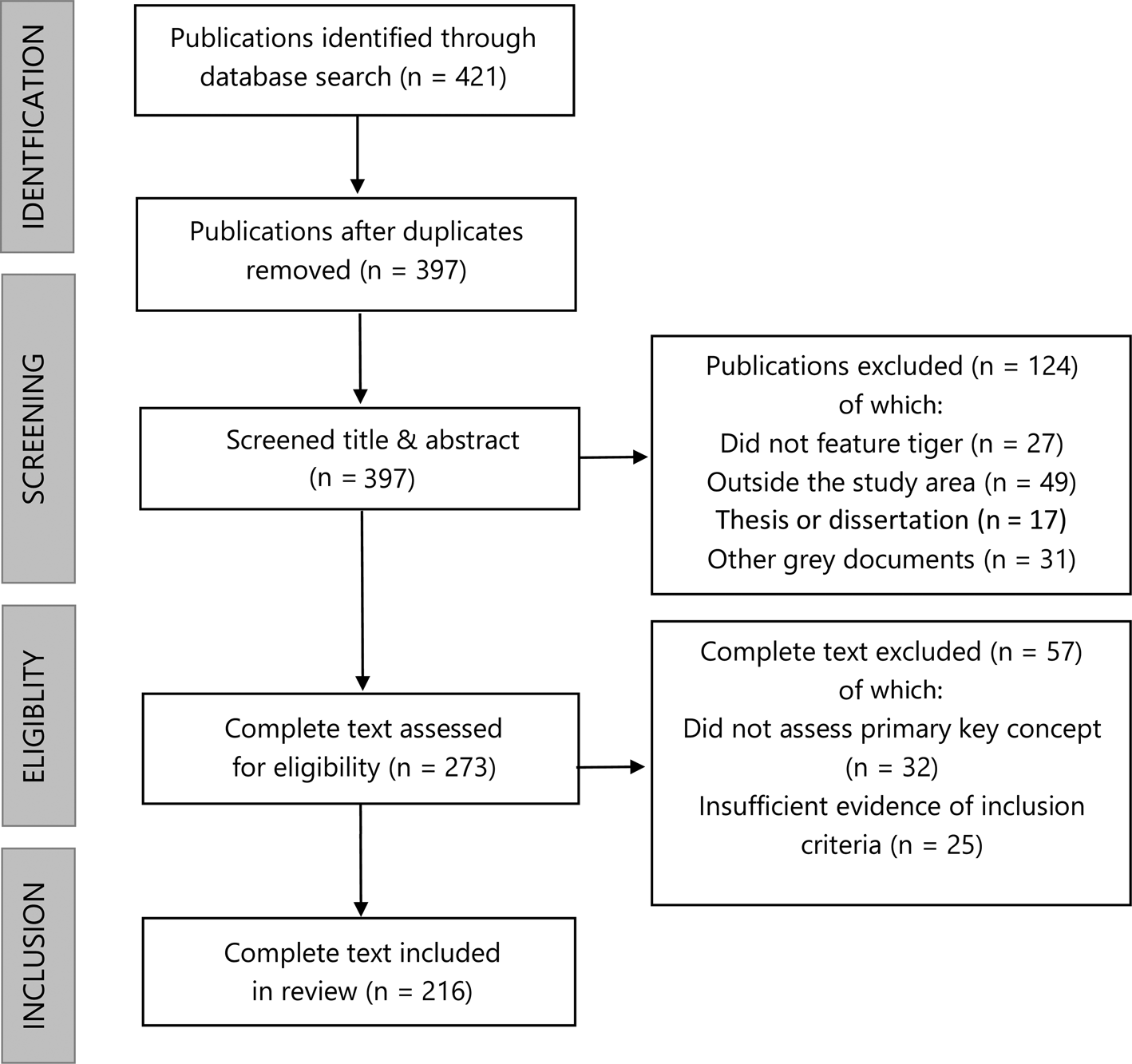
For data collection, we followed a protocol used in similar literature review studies (e.g. Holland et al., Reference Holland, Larson and Powell2018; Turner et al., Reference Turner, Kalamatianou, Drewnowski, Kulkarni, Kinra and Kadiyala2020) to ensure transparency, minimize subjectivity and ensure a robust and replicable process (see screening process outlined in Fig. 2). Initially, we identified 421 potentially relevant publications; after removing duplicates, we retained 397 for further screening. Two researchers independently screened the publications using the inclusion and exclusion criteria, initially focusing on abstracts and titles, yielding 273 publications. Finally, we screened the contents of each article for alignment with our purpose and adherence to the inclusion and exclusion criteria, which resulted in a final total of 216 publications (Supplementary Material 1).
Search path used to identify publications eligible for conducting the systematic scoping review.
Data charting
We recorded the complete reference, general themes and geographical locations of the 216 publications, including the country of the study and the geographical coordinates where available. We categorized studies that shared two or more nations in the same biophysical landscape as transboundary research. If research was conducted in two or more countries in different biophysical landscapes, it was categorized as a global study. Protected areas, including tiger reserves, national parks and wildlife sanctuaries, have legal protection and resources for protecting tigers and their habitats, and therefore we also categorized studies according to whether they occurred within or outside a protected area.
We charted the data across two elevation profiles (above and below 2,000 m), for several reasons. Firstly, extreme variation in bioclimatic and physiographic zones occurs over short distances in the Himalayas, with the most distinct change at c. 2,000 m, where subtropical and temperate zones change to subalpine, alpine and nival zones (Paudel et al., Reference Paudel, Sipos and Brodie2018). Secondly, species richness (particularly of threatened mammal species) monotonically decreases with elevation, but the relationship flattens above 2,000 m (Paudel et al., Reference Paudel, Sipos and Brodie2018). Thirdly, changes in human density during the 21st century will impact tiger range, population health and behaviour, all of which are expected to shift as human populations in Asia migrate from rural to metropolitan areas (Sanderson et al., Reference Sanderson, Moy, Rose, Fisher, Jones and Balk2019). The implication for tigers is that areas of low or decreasing human density and greater range size availability (i.e. above 2,000 m) may harbour an increasing number of tigers (Cardillo et al., Reference Cardillo, Purvis, Sechrest, Gittleman, Bielby and Mace2004; Sanderson et al., Reference Sanderson, Moy, Rose, Fisher, Jones and Balk2019). Because of their remoteness and inaccessibility, areas above 2,000 m may serve as corridors for tigers roaming between areas of suitable habitat (Thinley et al., Reference Thinley, Dendup, Rajaratnam, Vernes, Tempa, Chophel and Norbu2020).
Synthesis and interpretation
The systematic scoping review allowed us to examine the trends, extent, topics and outcomes of research focused on tiger conservation in the Terai Arc Landscape and Himalayas. During 2000–2020, an increasing amount of research was published over time. We identified 62 publications on various tiger conservation issues in Chitwan National Park, indicating this is a primary research area in the region. Corbett Tiger Reserve (38 publications) and Bardiya National Park (26 publications) were the second and third most frequently researched protected areas, and Namdapha and Buxa Tiger Reserves in north-east India the least (Fig. 1). The majority of research has been conducted in protected areas in India and Nepal below 2,000 m altitude, but in Bhutan, more research has been conducted above 2,000 m and within protected areas (Fig. 3).
Number of publications identified on tiger conservation above and below 2,000 m and in non-protected and protected areas of the Terai Arc Landscape and Himalayas of Bhutan, India, Nepal and transboundary areas (two or more nations in the same biophysical landscape), and globally (two or more countries in different biophysical landscapes).

We identified five themes in the 216 studies: (1) tiger habitat and ecology, (2) human–tiger conflict, (3) human–tiger coexistence, (4) community-based tiger conservation, and (5) tiger killing and trade (Fig. 4). We identified these thematic groups by reading the articles and reports, iterative meetings among the research team, and referencing known tiger conservation issues. We categorized studies that evaluated prey availability, habitat, ecology and travel corridors into the theme tiger habitat and ecology. Publications dealing with conflicts, mainly focused on human and livestock depredation, were categorized under the human–tiger conflict theme. All studies documenting stakeholders' perceptions of and attitudes towards tigers were categorized in the theme human–tiger coexistence. We categorized studies related to compensation and alternative livelihoods in the community-based tiger conservation theme. Studies focused on the retaliatory killing and poaching of tigers for their trade were categorized in the targeted tiger killing and trade theme. The categories were mutually exclusive; no publication was categorized under more than one theme.
Number of publications identified in each of five themes (see text for details) in the Terai Arc Landscape and Himalayas of Bhutan, India, Nepal and transboundary areas (two or more nations in the same biophysical landscape), and globally (two or more countries in different biophysical landscapes).

Approximately 60% of the published studies covered the tiger habitat and ecology theme. The human–tiger conflict theme included 20% of the published studies. The human–tiger coexistence and community-based tiger conservation themes contained 9 and 7% of the publications, respectively. Only 4% of the studies focused on tiger killing and trade. Studies published during 2000–2010 covered 1–4 of the five themes, but after 2010, thematic diversity increased (Fig. 5).
Number of publications identified in each of five themes (see text for details) in the Terai Arc Landscape and Himalayas of Bhutan, India, Nepal and transboundary areas (two or more nations in the same biophysical landscape), and globally (two or more countries in different biophysical landscapes), by year of publication (2000–2020).

Tiger habitat and ecology
The Terai Arc Landscape and the Himalayan region are home to many species and offer south–north transboundary connectivity between tiger habitats of Bhutan, India and Nepal via the Shivalik Hills and plains. Several studies (e.g. Anwar & Borah, Reference Anwar and Borah2020; Thinley et al., Reference Thinley, Dendup, Rajaratnam, Vernes, Tempa, Chophel and Norbu2020) have examined wildlife corridors and tiger movement, providing recommendations to maintain corridor functionality. In the lower Himalayas, researchers have reported a stable tiger population with high reproductivity and turnover between successive years (e.g. Thapa & Kelly, Reference Thapa and Kelly2017; Thapa et al., Reference Thapa, Wikramanayake, Malla, Acharya, Lamichhane and Subedi2017; Bisht et al., Reference Bisht, Banerjee, Qureshi and Jhala2019; Tempa et al., Reference Tempa, Hebblewhite, Goldberg, Norbu, Wangchuk, Xiao and Mills2019; Anwar & Borah, Reference Anwar and Borah2020), and concluded that such source populations could sustain low-level poaching and, with well-managed habitat connectivity, aid the recovery of tiger populations across the region.
Thapa et al. (Reference Thapa, Manandhar, Bista, Shakya, Sah and Dhakal2018) estimated population growth rates in Nepal and found numbers higher than expected as a result of in situ reproduction, and also concluded that tigers from India are using corridors to recolonize Nepal's protected areas. There have been a number of studies of foraging behaviour and available prey for tigers in the Terai Arc Landscape, with recommendations to restore prey populations in the region (e.g. Basak et al., Reference Basak, Dibyendu, Sanjay, Rahul, Ashraf, Singh and Krishnendu2018; Carter et al., Reference Carter, Levin and Grimm2019; Dorji et al., Reference Dorji, Rajaratnam and Vernes2019).
Anecdotal evidence and records indicate the presence of tigers above 2,000 m in the region, and empirical evidence has identified habitat linkages between higher and lower elevations (e.g. Bhattacharya & Habib, Reference Bhattacharya and Habib2016; Adhikarimayum & Gopi, Reference Adhikarimayum and Gopi2018; GTF, 2019). It is unclear whether the increase in evidence of tigers above 2,000 m is a result of dispersal from highly disturbed and fragmented regions such as the Terai Arc Landscape or a result of more focused studies above 2,000 m. Nevertheless, there is relatively less human pressure and more intact habitat in this region.
Following the St. Petersburg Declaration in 2010, there has been an increase in the number of studies of habitat fragmentation and prey depletion in the Terai Arc Landscape and Himalayan region (e.g. Aryal et al., Reference Aryal, Brunton, Pandit, Shrestha, Lord and Koirala2012; Karki et al., Reference Karki, Barber–Meyer, Jhala, Pandav, Jnawali and Shrestha2015; Kafley et al., Reference Kafley, Gompper, Sharma, Lamichane and Maharjan2016; Lahkar et al., Reference Lahkar, Ahmed, Begum, Das, Lahkar, Sarma and Harihar2018; Tempa et al., Reference Tempa, Hebblewhite, Goldberg, Norbu, Wangchuk, Xiao and Mills2019; Anwar & Borah, Reference Anwar and Borah2020). Monitoring the tiger population is an important management tool for ensuring a healthy ecosystem. Recent research has emphasized the protection of tiger landscapes with the best chance of restoring or stabilizing tiger populations (e.g. Jhala et al., Reference Jhala, Qureshi and Gopal2015; Thapa et al., Reference Thapa, Wikramanayake, Malla, Acharya, Lamichhane and Subedi2017; Bisht et al., Reference Bisht, Banerjee, Qureshi and Jhala2019; Jhala et al., Reference Jhala, Qureshi and Nayak2020, Thinley et al., Reference Thinley, Dendup, Rajaratnam, Vernes, Tempa, Chophel and Norbu2020). Monitoring of tigers, co-predators and prey has been recommended in the upper Himalayan region (e.g. Bhattacharya & Habib, Reference Bhattacharya and Habib2016; Adhikarimayum & Gopi, Reference Adhikarimayum and Gopi2018; GTF, 2019; Chatterjee et al., Reference Chatterjee, Mondal, Tripathy and Chandra2020). Several studies have reported that tigers move across country borders in the Terai Arc Landscape and Himalayas (e.g. Kanagaraj et al., Reference Kanagaraj, Wiegand, Kramer-schadt and Goyal2013; Lahkar et al., Reference Lahkar, Ahmed, Begum, Das, Lahkar, Sarma and Harihar2018).
Human–tiger conflict
Increasing human–tiger interactions pose concerns and challenges for tiger conservation in the Terai Arc Landscape and Himalayan region (Ruda et al., Reference Ruda, Kolejka and Silwal2020). Conflicts involving tigers have become a delicate issue around protected areas in this region (e.g., Bargali & Ahmed, Reference Bargali and Ahmed2018; Bhattarai et al., Reference Bhattarai, Wright, Morgan, Cook and Baral2019). These conflicts often result in mortality through retaliatory killing, or removal of tigers in distress or those causing distress (e.g. Borah et al., Reference Borah, Bora, Sharma, Dey, Sarmah, Vasu and Sidhu2018; Lamichhane et al., Reference Lamichhane, Persoon, Leirs, Poudel, Subedi and Pokheral2018). Conflict between people and tigers is one of the significant challenges threatening tiger conservation, the success of which depends on an abundance of prey and the absence of human disturbance (Letro & Fischer, Reference Letro and Fischer2020).
Most studies on human-tiger interactions have focused on livestock depredation by tigers, the degree of conflict and how this is influenced by cattle availability, or site-specific problems. For instance, Bhattarai et al. (Reference Bhattarai, Wright, Morgan, Cook and Baral2019) reported that since 1994, 12 and 99 fatal tiger attacks on people were registered in and around Bardya and Chitwan National Parks, respectively. Since 1979, 34 tigers from these protected areas have been killed as a result of human–tiger conflicts. Bargali & Ahmed (Reference Bargali and Ahmed2018) examined 5,733 livestock depredation incidents by tigers during 2006–2015 in and around Corbett Tiger Reserve. Lamichhane et al. (Reference Lamichhane, Persoon, Leirs, Poudel, Subedi and Pokheral2018) recorded killing of tigers for various reasons, including the loss of livestock, property and human lives. Many studies (e.g. Lahkar et al., Reference Lahkar, Ahmed, Begum, Das and Harihar2020; Ruda et al., Reference Ruda, Kolejka and Silwal2020) recommended mitigation of human–tiger conflict by restoring prey populations and reducing the level of human disturbance around protected areas.
Human–tiger coexistence
Because implementation and effectiveness of conservation interventions rely on participation from the local community, investigating attitudes towards human–wildlife coexistence is important (Gaodirelwe et al., Reference Gaodirelwe, Motsholapheko and Masunga2020). Rastogi et al. (Reference Rastogi, Thapliyal and Hickey2014), Aiyadurai (Reference Aiyadurai2016) and Allendorf et al. (Reference Allendorf, Gurung, Poudel, Dahal and Thapa2020) used social science approaches to understand the challenges of human–tiger coexistence. Their research concluded that human–tiger conflicts and lack of livelihood opportunities would encourage people to partner with conservation agencies in pro-conservation initiatives. Several studies (e.g. Harihar et al., Reference Harihar, Veríssimo and MacMillan2015; Lamichhane et al., Reference Lamichhane, Leirs, Persoon, Subedi, Dhakal and Oli2019; Sanderson et al., Reference Sanderson, Moy, Rose, Fisher, Jones and Balk2019; Letro & Fischer, Reference Letro and Fischer2020) have recommended implementation of preventive measures, addressing depredation issues, encouraging sustainable livelihoods and conducting education awareness programmes to increase positive attitudes towards tiger conservation. Carter et al. (Reference Carter, Levin and Grimm2019) conducted research about human–tiger coexistence at fine spatial scales, and concluded that tiger conservation could probably be enhanced by abundant tiger prey and low levels of tiger poaching. Researchers have also recommended long-term monitoring to understand the interaction between people and tigers, specifically in local communities living near tiger habitats and corridors (e.g. Lamichhane et al., Reference Lamichhane, Leirs, Persoon, Subedi, Dhakal and Oli2019; Sanderson et al., Reference Sanderson, Moy, Rose, Fisher, Jones and Balk2019; Letro & Fischer, Reference Letro and Fischer2020).
Community-based tiger conservation
We identified fewer studies on community-based tiger conservation than on other themes. However, the literature indicates that successful tiger conservation at the landscape level requires provision of sustainable livelihood opportunities and appropriate compensation for livestock and human depredation. Some studies (e.g. Lyngdoh et al., Reference Lyngdoh, Mathur and Sinha2017; Lamichhane et al., Reference Lamichhane, Persoon, Leirs, Poudel, Subedi and Pokheral2018; Lele & Sharma, Reference Lele and Sharma2019) have recommended financial instruments such as eco-tourism and insurance to reduce human–tiger conflict. Lele & Sharma (Reference Lele and Sharma2019) suggested that finance through carbon-related projects could be an essential solution for addressing economic loss as a result of conflicts with tigers.
Thapa et al. (Reference Thapa, Wikramanayake, Malla, Acharya, Lamichhane and Subedi2017) reported that wildlife tourism provided economic benefits and financial security to local communities. These employment opportunities also motivated local communities to participate in conservation activities, ultimately helping tiger conservation in Nepal. Thinley et al. (Reference Thinley, Rajaratnam, Lassoie, Morreale, Curtis and Vernes2018) described how tiger conservation can provide ecological benefits to farmers by reducing crop and livestock losses in Bhutan. One of the most significant challenges in biodiversity conservation is to facilitate protection for species that are highly valued globally but have little or negative value at a local level (Khan et al., Reference Khan, Lovari, Ali Shah and Ferretti2018). Imperiled species, such as tigers, can impose high economic costs locally (e.g. livestock losses), which often occur in rural and low-income communities where households are not able to tolerate additional expenses (Pooley et al., Reference Pooley, Barua, Beinart, Dickman, Holmes and Lorimer2017).
Tiger killing and trade
Targeted killing and trade endanger tigers across their entire range. In the Himalayan region, Karmacharya et al. (Reference Karmacharya, Sherchan, Dulal, Manandhar, Manandhar and Joshi2018) noted that western Nepal, notably Bardya National Park, is a poaching hotspot. Considered the flagship species in human-populated landscapes, tigers face many threats, including illegal poaching for the illicit trade of tiger body parts (Campbell et al., Reference Campbell, Martyr, Risdianto and Clemente2019; Wong & Krishnasamy, Reference Wong and Krishnasamy2019). Retaliatory killings in response to livestock predation and human fatalities are other threats to tigers in the Terai Arc Landscape and the Himalayas (Lamichhane et al., Reference Lamichhane, Persoon, Leirs, Musters, Subedi and Gairhe2017).
TRAFFIC reported an increase in illegal tiger trade over 19 years across the tiger range countries, including those in the Himalayan region, and, consequently, transboundary cooperation and capacity building to combat the tiger trade have often been recommended (Wong & Krishnasamy, Reference Wong and Krishnasamy2019). Paudel et al. (Reference Paudel, Potter and Phelps2020) concluded that enforcement alone is not the best tool for tiger conservation. For example, despite strict wildlife protection laws, the illegal trade of tiger body parts from Bhutan, India and Nepal is increasing (Karmacharya et al., Reference Karmacharya, Sherchan, Dulal, Manandhar, Manandhar and Joshi2018). Seizure data of illicit tiger trade for 2000–2018 indicate that most transit routes originate in Bhutan, India or Nepal, with destinations in China and South-east Asian countries (Wong & Krishnasamy, Reference Wong and Krishnasamy2019). Paudel et al. (Reference Paudel, Potter and Phelps2020) identified substantial research gaps regarding enforcement rates, prison sentences, conviction information, species targeted, behavioural drivers and deterrents, and the social impacts of enforcement.
Conclusions and recommendations
This systematic scoping review has identified focal research areas, the spatial and temporal distribution of study sites, general publication trends, the extent of empirical studies, and gaps in tiger conservation research in the Terai Arc Landscape and Himalayas. This information can be used to design conservation policies, develop adaptation strategies, prioritize research programmes, and help decision makers allocate resources based on empirical evidence. The principal themes of the 216 studies we identified, published during 2000–2020, were tiger habitat and ecology, and human–tiger conflict in protected areas.
Identifying gaps in research is important because human and tiger populations are both projected to increase, which will result in additional research needs, particularly associated with the human dimensions of wildlife management and in high-altitude landscapes of the Himalayas. Tiger conservation remains a globally relevant concern and a transnational issue, particularly in relation to the illicit trade of tiger body parts. Habitat degradation and human encroachment into healthy ecosystems may continue to threaten tiger populations, contributing to the need for landscape-scale conservation research that involves both tigers and people as research subjects. As human behaviour, values and populations change, tigers will adapt and shift as well, which will lead to new research gaps and needs.
Summaries, such as this scoping review, are necessary to ensure that the relevant literature is periodically characterized and catalogued so that decision makers, policy officials, researchers, managers and other stakeholders can understand the trends and extent of empirical findings. With such information, tiger conservation initiatives and policies can be more fully informed and implemented.
Acknowledgments
We thank the Tigers United University Consortium and the Department of Parks, Recreation, and Tourism Management at Clemson University for their administrative support in conducting this research; Savannah Dopkins, Carissa Wheeler, Shuai Yuan and Amar Nath Choudhary for their assistance; and Rajesh Gopal, S.P. Yadav, Lori Dickes and Brett Wright for providing feedback that improved this article.
Author contributions
Data collection: PKY; design and analysis: PKY, MTJB; writing and revision: all authors.
Conflicts of interest
None.
Ethical standards
This research abided by the Oryx guidelines on ethical standards. Because human or animal subjects were not used in this study, institutional review by Clemson University was not required. However, this research project was approved by the Director of Park Solutions Lab at Clemson University and met all ethical standards for institutional research that does not involve human or animal subjects.


 Open access

