


Introduction
Weed control is a major obstacle to rice production in Arkansas, one of the most important crops grown in the state. In a 2011 survey, 63% of Arkansas crop consultants listed barnyardgrass [Echinochloa crus-galli (L.) Beauv.] as the most problematic weed of rice, with red rice (Oryza sativa L.) ranking second (Norsworthy et al. Reference Norsworthy, Bond and Scott2013). Red rice and barnyardgrass can potentially cause yield losses as high as 82% and 70%, respectively (Smith Reference Smith1988).
Barnyardgrass has evolved resistance to multiple herbicides used in Arkansas rice, the first of which was propanil in the early 1990s (Carey et al. Reference Carey, Hoagland and Talbert1995). Poor stewardship of alternative herbicides led to evolution of resistance by barnyardgrass to quinclorac, clomazone, and several acetolactate synthase (ALS)-inhibiting herbicides (Talbert and Burgos Reference Talbert and Burgos2007; Norsworthy et al. Reference Norsworthy, Bond and Scott2013). With the evolution of weeds that have resistance to multiple herbicide mechanisms of action, weed control has increasingly become more challenging. A new technology is needed to control many of these troublesome weeds. A new herbicide-resistant rice technology that will allow for topical applications of quizalofop, an acetyl coenzyme A carboxylase (ACCase)-inhibiting herbicide, is expected to be adopted by rice growers throughout the midsouthern United States (Guice et al. Reference Guice, Youman, Rhodes, Schultz, Bowe, Armel and Harden2015).
Quizalofop is a systemic herbicide historically used to control annual and perennial grass weeds in soybean [Glycine max (L.) Merr.], potato (Solanum tuberosum L.), cotton (Gossypium hirsutum L.), vegetables, as well as in noncrop areas. Growth ceases soon after application of quizalofop, with young and actively growing tissues being first affected. Chlorosis and eventual necrosis develop 1 to 3 wks after application (Ahrens Reference Ahrens1994). Research has shown that quizalofop is effective in controlling both barnyardgrass (Noldin et al. Reference Noldin, Chandler, McCauley and Sij1998) and red rice (Salzman et al. Reference Salzman, Smith and Talbert1988). In soybean, quizalofop is applied at from 35 to 84 g ai ha–1 (Shaner Reference Shaner2014), but labeled use rates in quizalofop-resistant rice could be as high as 138 g ha–1 for single application (Anonymous 2017). This higher application rate of quizalofop could lead to greater risk for injury to neighboring crops, especially crops such as corn, grain sorghum, or conventional rice.
Off-target movement of herbicides can be problematic, especially when environmental conditions favor re-deposition combined with improper application (Wall Reference Wall1994; Wauchope et al. Reference Wauchope, Richard and Hurst1982). Many factors influence the severity of herbicide drift. Primary contributors to physical drift are wind speed, application height, and nozzle selection (Hanks Reference Hanks1995). Physical drift in close proximity to the actual application often occurs at herbicide use rates ranging from 1/10 to 1/100× (Al-Khatib et al. Reference Al-Khatib, Claassen, Stahlman, Geier, Regehr, Duncan and Heer2003). Even at lower rates, drift events can still result in significant injury to susceptible plants, depending upon the herbicide and sensitivity of the plants evaluated (Al-Khatib et al. Reference Al-Khatib, Claassen, Stahlman, Geier, Regehr, Duncan and Heer2003).
Although ACCase-inhibiting herbicides have no activity on broadleaf plant species (Konishi and Sasaki Reference Konishi and Sasaki1994), there is risk for damage to monocot plant species due to off-target movement. Sethoxydim, an ACCase-inhibiting herbicide, was found to reduce grain sorghum yield at 1/3× and 1/10× a rate of 168 g ai ha–1 (Al-Khatib et al. Reference Al-Khatib, Claassen, Stahlman, Geier, Regehr, Duncan and Heer2003). Likewise, drift rates of multiple ACCase-inhibiting herbicides were determined to affect vegetative buffer strips by producing chlorosis and reducing biomass production (Rankins et al. Reference Rankins, Shaw and Douglas2005). With the addition of quizalofop-resistant rice to current production systems, it is expected that quizalofop use in the midsouthern United States will increase in the coming years. This increase in quizalofop use could lead to a higher risk for off-target movement onto other monocot crops. Little research has been published on the risk for quizalofop to injure corn, grain sorghum, or rice not resistant to quizalofop, and with the anticipated launch of quizalofop-resistant rice in 2018, research is needed to evaluate such risk in the aforementioned crops. The objective of this research was to evaluate the sensitivity of corn, grain sorghum, and conventional rice to low rates of quizalofop.
Materials and Methods
Experiments were conducted in 2014 and 2015 to evaluate the response of corn, grain sorghum, and conventional rice to sublethal concentrations of quizalofop. For all experiments, the experimental design was a two-factor factorial, randomized complete block with four replications. Factors consisted of simulated drift rate of quizalofop and growth stage at time of application. Simulated drift rates of quizalofop were 1/10×, 1/25×, 1/50×, 1/75×, 1/100×, and 1/200× of 160 g ai ha–1 (anticipated maximum use rate of quizalofop in quizalofop-resistant rice at the time of experiment initiation). Growth stage at time of application varied by crop and will be discussed in detail below. A nontreated control plot was included for comparison. Herbicide treatments were applied with a CO2-pressurized backpack sprayer calibrated to deliver 140 L ha–1 at 276 kPa. Visual injury ratings based on a scale of 0 to 100%, with 0 representing no injury and 100% representing complete plant death, were taken at 14 and 28 d after application (DAA). Plant height was measured on five plants per plot at 14 and 28 DAA and again approximately 2 wks before harvest. Although research is limited between the relationship of plant height and overall plant health for drift rates of ACCase-inhibiting herbicides, studies on multiple other postemergence herbicides have shown a relationship between the two parameters for grass crops (Brown et al. Reference Brown, Robinson, Young, Loux, Johnson, Nurse, Swanton and Sikkema2009; Ellis et al. Reference Ellis, Griffin, Linscombe and Webster2003; Roider et al. Reference Roider, Griffin, Harrison and Jones2007). There was no intent to compare quizalofop sensitivity across crops, thus crops were grown in separate trials.
Corn Field Experiment
Experiments were conducted on a Sharkey clay loam (very-fine, smectitic, thermic Chromic Epiaquerts) at the Northeast Research and Extension Center in Keiser, AR (35.40° N, 90.5° W) in 2014 and 2015. A Smartstax™ (glyphosate/glufosinate-resistant) corn variety ‘Croplan 6274SS’ was planted on May 22, 2014 and on April 30, 2015 at a seeding rate of 74,000 seeds ha–1. In both years, the fields were tilled and beds were formed on 96-cm wide centers before planting. Experimental plots were maintained weed-free by a PRE application of a premix of thiencarbazone methyl plus tembotrione (Capreno™ herbicide, Bayer CropScience, Research Triangle Park, NC) at 15 + 75 g ai ha–1 in 2014 and a tank-mix of S-metolachlor (Dual II Magnum™ herbicide, Syngenta Crop Protection, Greensboro, NC) at 1,068 g ai ha–1 plus atrazine (Aatrex 4L™ herbicide, Syngenta Crop Protection, Greensboro, NC) at 1,680 g ai ha–1 in 2015 and a POST application of glufosinate (Liberty™ herbicide, Bayer CropScience, Research Triangle Park, NC) at 450 g ai ha–1 at the V4 growth stage for both years. Corn experiments were fertilized according to University of Arkansas Extension recommendations.
Plots consisted of four rows, 7.6 m long. Growth stages evaluated for corn were two- to three-leaf, tassel, and silk stages. The applications of quizalofop were made on the following dates: two- to three-leaf stage applied June 6, 2014 and May 21, 2015; tassel stage applied July 21, 2014 and July 1, 2015; and silk stage applied July 31, 2014 and July 15, 2015. Corn was harvested from the center two rows of each plot September 17, 2014, and September 21, 2015 using a small-plot combine. Yields were adjusted to 15.5% moisture.
Grain Sorghum Experiment
Grain sorghum experiments were conducted at the same location as the corn experiments. A DeKalb™ conventional variety (DKS53-67) was planted on May 20, 2014, and the variety DK554-00 was planted on June 11, 2015 at a seeding rate of 200,000 seeds ha–1. In both years, fields were tilled and beds were formed on 96-cm wide centers before planting. Plots were maintained weed-free by a PRE application of S-metolachlor (Dual II Magnum™ herbicide, Syngenta Crop Protection) at 1,068 g ha–1, and atrazine (Aatrex 4L™ herbicide, Syngenta Crop Protection) at 1,680 g ha–1, and a POST application of quinclorac (Facet L™ herbicide, BASF Corp., Florham Park, NJ) at 421 g ha–1 at the V3 growth stage for both years. Experiments were fertilized according to University of Arkansas Extension recommendations.
Plots consisted of four rows, 7.6 m long. Growth stages evaluated for grain sorghum were two- to three-leaf, boot, and panicle exertion stages. Quizalofop applications were made on the following dates: two- to three-leaf stage applied May 20, 2014 and June 25, 2015; boot stage applied July 8, 2014 and July 30, 2015; and panicle exertion stage applied July 12, 2014 and August 5, 2015. Grain sorghum was harvested on August 10, 2014 and August 20, 2015. Yields were adjusted to 13% moisture.
Rice Experiment
A rice experiment was conducted in 2014 on a Sharkey clay loam (very-fine, smectitic, thermic Chromic Epiaquerts) at the Northeast Research and Extension Center in Keiser, AR (NEREC). Environmental and soil conditions hindered harvest of rice in 2014, resulting in no yield data; therefore, two alternate locations were chosen for the conventional rice experiment in 2015. The experiment in 2015 was conducted on a Calloway silt loam (fine-silty, mixed, active, thermic Aquic Fraglossudalfs) at the Pine Tree Research Station near Colt, AR (PTRS) (35.7° N, 90.48° W) and on an Immanuel silt loam (fine-silty, mixed, active, thermic Oxyaquic Glossudalfs) at the University of Arkansas at Pine Bluff Farm near Lonoke, AR (UAPB) (34.47°N, 91.54°W). The imidazolinone-resistant variety ‘CL152’ was planted at the NEREC on May 7, 2014, with the imidazolinone-resistant variety ‘CL111’ planted at the PTRS on April 31, 2015 and at the UAPB on June 8, 2015. An imidazolinone-resistant variety was chosen in both years to aid in keeping the plots weed-free. All locations were planted at a seeding rate of 65 seeds m–1 row in 18-cm wide rows. Plots were maintained weed-free with a PRE application of clomazone (Command™ herbicide, FMC Corp., Philadelphia, PA) at 547 g ai ha–1 and quinclorac (Facet L™ herbicide, BASF Corp., Florham Park, NJ) at 280 g ai ha–1 followed by a POST application of imazethapyr (Newpath™ herbicide, BASF Corp.) at 105 g ai ha–1 for all locations. Experimental plots were fertilized according to University of Arkansas Extension recommendations.
Plots consisted of nine drilled rows, 7.6 m long. Growth stages evaluated for rice were two- to three-leaf stage and 1.3-cm internode elongation stage. Herbicide applications were made on the following dates: two- to three-leaf growth stage on May 20, 2014, at the NEREC; on May 12, 2015, at the PTRS; and on June 22, 2015, at the UAPB; 1.3-cm internode elongation stage on June 8, 2014, at the NEREC; on June 7, 2015, at the PTRS; and on July 14, 2015, at the UAPB. Rice was harvested at the PTRS on September 4, 2015 and at the UAPB on October 3, 2015.
Statistical Analysis
All data for corn, grain sorghum, and conventional rice experiments were analyzed with JMP Pro 12.1 (SAS Institute Inc., Cary, NC) using the Fit Model function. Year and replication nested within years were considered random effects. For data that met the assumptions for ANOVA, means were separated using Fisher’s protected LSD test (α = 0.05). If assumptions for ANOVA were not met, then treatments means alone are presented.
Results and Discussion
Corn Experiment
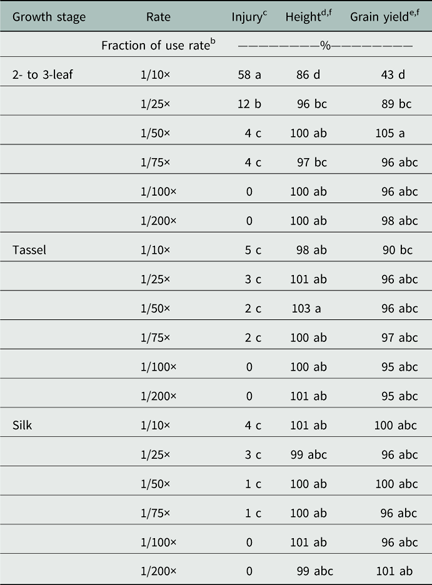
In general, injury from simulated drift rates of quizalofop on corn was most severe with the 1/10× rate (Table 1), the highest rate applied. Injury from the 1/10× rate was greatest following application at the two- to three-leaf growth stage (58%) compared to both tassel (5%) and silk growth stages (4%). The only other quizalofop rate that caused greater injury was the 1/25× rate at the two- to three-leaf application timing (12%) compared to the two later timings. The increased injury at the two- to three-leaf application timing can be attributed to the inability of corn to recover from the quizalofop application, which resulted in complete plant death of several plants within the plot, and an overall stand reduction. Injury at later growth stages mainly consisted of leaf chlorosis but also resulted in a dark ring in the center of the stalk, especially at the two highest rates evaluated.
Injury (2 wks after herbicide application), height (2 wks before harvest), and grain yield of corn following low rates of quizalofop at three different application timings averaged over years in Keiser, AR.Footnote a
a Means within a column followed by the same lowercase letter are not different based on Fisher’s protected LSD (0.05).
b Quizalofop rate with 1× equal to 160 g ai ha–1.
c Treatments 1/100× and 1/200× quizalofop rate were removed from analysis for corn injury due to violating the assumptions of ANOVA (homogeneity of variance).
d Data expressed as percent relative height compared with nontreated control. Height for nontreated control was 241 cm averaged over site years.
e Data expressed as percent relative grain yield compared with nontreated control. Grain yield for nontreated control was 11,000 kg ha–1 averaged over site years.
f LSD (0.05) is 6 for percent relative height and 12 for grain yield to compare to the nontreated control (100%).
The greatest plant height reduction resulted from the 1/10× rate applied at the two- to three-leaf growth stage (P=0.0004), which resulted in 86% relative in height compared to the nontreated control (Table 1). The height for the nontreated control was 241 cm averaged over both years. The 1/10× treatment resulted in greater height reduction, compared to the same quizalofop rate at the tassel and silk growth stages.
Corn grain yield followed the same trends as injury and plant height. The treatment with the greatest reduction in yield was the 1/10× quizalofop rate applied at the two- to three-leaf growth stage (P≤0.0001) with 57% yield loss compared to the nontreated check (Table 1). However, the 1/25× rate at the two- to three-leaf stage and the 1/10× rate at the tassel stage resulted in lower relative grain yields at 89% and 90% compared to the nontreated control, respectively. The yield of the nontreated check was 11,000 kg ha–1 averaged over both years.
Grain Sorghum Experiment
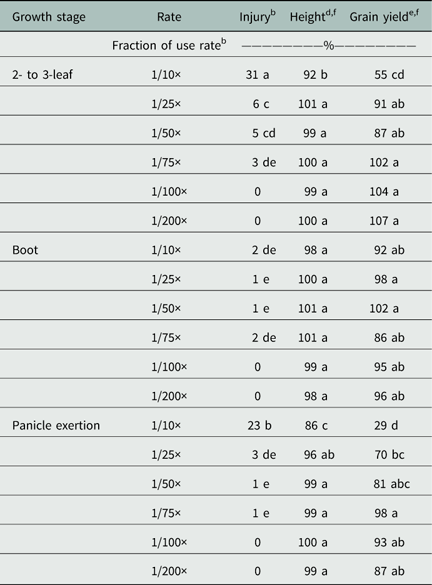
Grain sorghum injury varied with growth stage at the time of herbicide application but was generally the greatest from the 1/10× quizalofop rate (Table 2). The 1/10× rate applied at the two- to three-leaf growth stage resulted in the 31% injury (P≤0.0001), whereas the same rate applied at the panicle exertion stage resulted in 23% injury. These results were similar to those of Al-Khatib et al. (Reference Al-Khatib, Claassen, Stahlman, Geier, Regehr, Duncan and Heer2003), who reported an average of 20% injury on grain sorghum from the 1/10× rate of sethoxydim applied at the two- to four-leaf growth stage. The boot growth stage was more tolerant to quizalofop application, with the 1/10× rate resulting in only 2% injury. Generally, grain sorghum injury symptoms consisted of leaf chlorosis and some necrosis at the two- to three-leaf stage; however, at the panicle exertion stage, head and grain malformation was observed at the 1/10× quizalofop rate.
Injury (2 wks after herbicide application), height (2 wks before harvest), and grain yield of grain sorghum following sublethal rates of quizalofop at three different application timings averaged over years in Keiser, AR.Footnote a
a Means within a column followed by the same uppercase letter are not different based on Fisher’s protected LSD (0.05).
b Quizalofop rate with 1× equal to 160 g ai ha–1.
c Treatments 1/100× and 1/200× quizalofop rate were removed from analysis for corn injury due to violating the assumptions of ANOVA (homogeneity of variance). In particular, there was no variability among the repetitions for these rates.
d Data expressed as percent relative height compared with nontreated control. Height for nontreated control was 141 cm averaged over site years.
e Data expressed as percent relative grain yield compared with nontreated control. Grain yield for nontreated control was 5,080 kg ha–1 averaged over site years.
f LSD (0.05) is 6 and 27 for percent relative height and grain yield, respectively, to compare to the nontreated control (100%).
The greatest grain sorghum height reduction was from the 1/10× quizalofop rate at the panicle exertion stage (86% relative height) (Table 2). The 1/10× rate at the two- to three-leaf growth stage resulted in lower heights (92% relative height) than the nontreated control. The height of the nontreated control was 141 cm averaged over both years.
Grain sorghum relative yield followed similar trends as injury and relative height. The greatest reduction in yield occurred following the 1/10× quizalofop rate applied at the panicle exertion growth stage (P = 0.0152) with 29% relative yield, with the nontreated control yielding 5,080 kg ha–1 (Table 2). However, the 1/10× rate applied at the two- to three-leaf growth stage (55% yield) and the 1/25× rate applied at the panicle exertion stage (70% yield) resulted in lower relative yield than the highest yielding treatments. The greater yield loss at the panicle exertion growth stage can be attributed to the malformed grain heads, which reduced overall grain production.
Rice Experiment
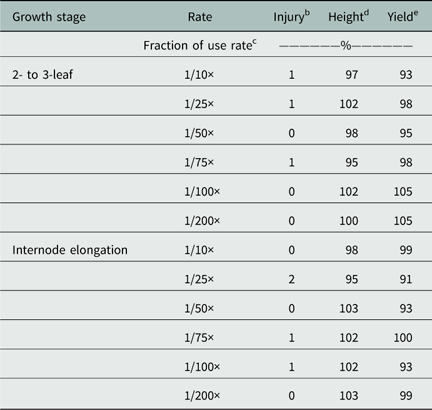
Rice showed no significant interaction or main effects of quizalofop rate or growth stage for any parameter evaluated. Overall, rice displayed no biologically significant injury from any rate of quizalofop applied (Table 3). Because of the high degree of rice tolerance to drift rates of quizalofop, growth stage during a drift event will probably not influence the sensitivity of the crop to this herbicide. Similarly, no differences were observed among treatments for plant height prior to harvest, and rice yields across experimental treatments did not differ.
Injury (2 wks after treatment), height (2 wks before harvest), and yield of rice following simulated drift of quizalofop at two different application timings averaged over site years in Keiser, Colt, and Lonoke, AR.Footnote a
a All parameters evaluated for rice resulted in no significant interaction or main effects.
b Due to low overall injury observed and no variance between repetitions for multiple treatments, no official analyses were conducted for injury.
c Quizalofop rate with the 1× rate equal to 160 g ai ha–1.
d Data expressed as percent relative height compared with nontreated control. Height for nontreated control was 81 cm.
e Data expressed as percent relative yield compared with nontreated control. Yield for nontreated control was 11,048 kg ha–1.
Practical Implications
Overall, the risk for damage from off-target movement of quizalofop onto corn, grain sorghum, and rice is low. Conventional rice (nonresistant to quizalofop), the crop most likely to be planted adjacent to quizalofop-resistant rice, shows no effects from low rates of quizalofop. Corn displays a higher degree of sensitivity to quizalofop; even then, however, almost all the negative effects of quizalofop drift occurred from the high drift rate, which would be rare in actual field conditions. However, the most sensitive growth stage for corn is the two- to three-leaf growth stage, and with overlapping planting timing in Arkansas for both corn (April 1 through 26) and rice (April 14 through May 19) (USDA-NASS 2010), the risk of an off-target application of quizalofop from quizalofop-resistant rice is great. Likewise, grain sorghum displays the greatest risk for injury and yield reduction from off-target movement of quizalofop at the two- to three-leaf stage due to typical applications of quizalofop in quizalofop-resistant rice coinciding with two- to three-leaf grain sorghum.


 Open access

