


1. Introduction
Sign language researchers have long intuited, albeit with caution, that sign languages tend to be more similar to each other than spoken languages are known to be (Newport & Supalla, Reference Newport, Supalla, Emmorey and Lane2000; Pizzuto & Volterra, Reference Pizzuto, Volterra, Emmorey and Lane2000; Meier, Reference Meier, Meier, Cormier and Quinto-Pozos2002; Woll, Reference Woll, Baker, van den Bogaerde and Crasborn2003; Perniss, Pfau, & Steinbach, Reference Perniss, Pfau, Steinbach, Perniss, Pfau and Steinbach2007). While recognizing the need for extensive cross-linguistic research to explore where differences across sign languages lie, researchers have pointed to several possible factors underlying this perceived similarity. One of the most widely assumed and mentioned factors concerns the affordances of the body and the hands for iconic representation in sign languages and in the gestural systems from which sign languages historically emerge.
In one of the earliest investigations of the role of iconicity in sign language structure, Klima and Bellugi (Reference Klima and Bellugi1979, p. 21) compared the signs for ‘tree’ produced by users of American, Chinese, and Danish Sign Languages. Using what has now become a frequently cited set of examples, they show that while the shape and movement of the hands in each of these signs bears an imagistic resemblance to their referent concept, they each comprise quite different formational features, to be described below. Klima and Bellugi use these examples to argue that though the formational features of a sign seem motivated by aspects of its referent, the specific values of those features are unpredictable, resulting in a rich variety of signs across sign languages.
In this paper, we revisit their argument about the unpredictability of signs across different sign languages. We propose an alternate view, that many signs exhibit what we call patterned iconicity, even as they individually vary in imagistic form. We propose that it is possible to identify patterns on the basis of which iconic strategies or which combination of strategies are favored for different classes of related entities. We argue that these patterns result from humans using the body and the hands to create and organize a lexicon.
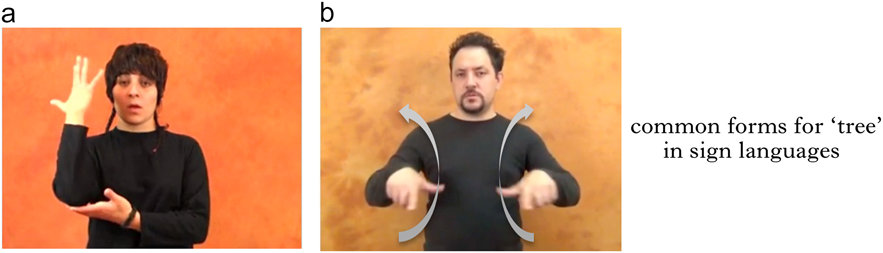
To illustrate patterned iconicity, we return to Klima and Bellugi’s (Reference Klima and Bellugi1979) discussion of the signs for ‘tree’ across different sign languages. In Figure 1a, ‘tree’ is represented by vertically holding up the dominant hand with spread fingers and placing the elbow on the other hand, which is positioned horizontally. In addition to American Sign Language, other languages that have forms similar to this include Brazilian, British, French, German, Greek, Icelandic, Lithuanian, Portuguese, Russian, Turkish, and Spanish Sign Languages. All examples are drawn from an online dictionary <www.spreadthesign.com>. Engberg-Pedersen (Reference Engberg-Pedersen and Taub2004) corrects the record and reports that the Danish Sign Language sign for ‘tree’ is also represented in this way (see <www.tegnsprog.dk>), unlike what Klima and Bellugi (Reference Klima and Bellugi1979) describe. In Figure 1b, ‘tree’ is represented with a two-handed symmetric upward motion of the hands. Languages that use a variant of this form include Chinese (Klima & Bellugi, Reference Klima and Bellugi1979) as well as Indian and Italian Sign Languages. While the formational features of the signs in Figure 1a and 1b differ, they both use the hands and arms away from the body (that is, away from the head and torso) to represent a static aspect of the shape of the referent, either the trunk and the branches, or only the shape of the trunk. Both examples exemplify the strategy we call object.
The above signs for ‘tree’ are similar to the iconic forms described by Klima and Bellugi (Reference Klima and Bellugi1979). Both images are from <www.spreadthesign.com>, with (a) from Greek Sign Language and (b) from Italian Sign Language.
In contrast, two common forms for ‘bird’ in the same online dictionary coordinate the body with the hands to represent aspects of the referent. In Figure 2a, ‘bird’ is represented by contacting the dominant hand with the front of the mouth, and with the index and thumb opening and closing like a beak. Languages that use a variant of this form include American, Austrian, Brazilian, British, Czech, French, Icelandic, Italian, Japanese, Latvian, Lithuanian, and Swedish Sign Languages. In Figure 2b, ‘bird’ is represented by flapping the hands and arms at the sides of the body. Languages that use a variant of this form include Turkish, German, Estonian, and Polish Sign Languages. Several sign languages also use the two forms together in sequence: Russian, Portuguese, Spanish, Bulgarian, Ukrainian, Indian, and Ugandan Sign Languages.
The signs represent ‘bird’ with a shared iconic strategy in which the human body maps to the body of a non-human entity. Both images are from <www.spreadthesign.com>, with (a) from American Sign Language and (b) from German Sign Language.
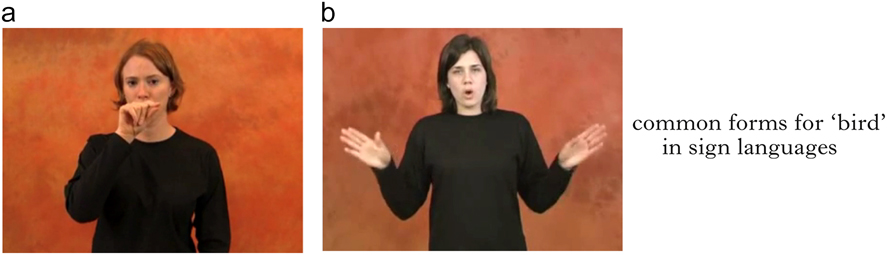
The forms in Figures 2a and 2b have different hand configurations, locations, and movements, but in this paper we view them as instances of the same iconic strategy, which we call personification, mapping the body of a non-human entity onto the human body, using the human head to represent parallel locations on a non-human head, the human body to represent a non-human body, and human appendages to represent non-human appendages. These signs for ‘bird’ differ from the earlier examples of signs for ‘tree’ because, in both signs for ‘bird’, the bird’s body is superimposed or mapped onto the body of the signer – its mouth is the signer’s mouth; its wings are the signer’s arms – while in no sign language that we know of does a person’s body become the body of a tree in a lexical sign (except when purposely creating an anthropomorphic tree in artistic performance, for instance).
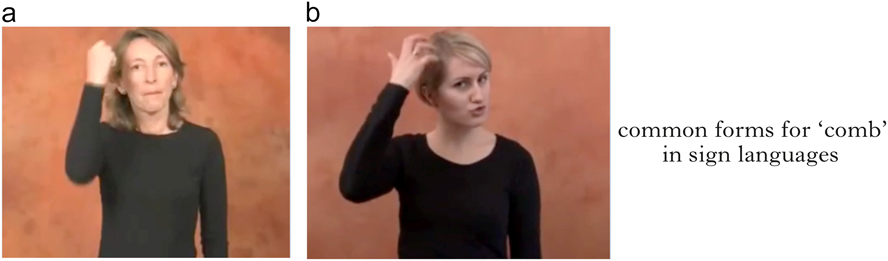
Two common forms for ‘comb’ in the same online dictionary exemplify another strategy for encoding meaning that recruits the body for iconic representation. Padden and colleagues (2013) noted that for hand-held, man-made tools like ‘comb’, sign languages typically use one of two iconic strategies, referred to together here as manipulation. In Figure 3a, the hand is configured like the human hand holding a comb, moving near the head and simulating the action of combing one’s hair; in this sign, the signer’s head, arm, and body represent a human head, arm, and body. Languages that use a variant of this form include Austrian, British, Czech, French, German, Indian, Italian, Japanese, Norwegian, Spanish, and Turkish Sign Languages. In Figure 3b, the hand is configured to resemble the teeth of a comb, also moving near the head simulating a combing motion. Languages that use a variant of this form include American, Estonian, Latvian, Lithuanian, Polish, Portuguese, Russian, Swedish, and Ukrainian Sign Languages. Again, unlike the signs for ‘tree’, in the signs for ‘comb’, the signer’s body plays an iconic role of representing the body of an agent manipulating the referent in both variants. Unlike tree and bird, which are natural entities, a comb is a man-made artifact to be used for a specific function. The manipulation forms in Figure 3 both reflect humans’ cultured interactions with these objects. As might be expected, we find that across different sign languages and cultures, the way the body and the hands are used reflect common practices, but they are consistently manipulation forms.
The signs represent ‘comb’ with a shared iconic strategy in which the human body maps to the body of a human agent. Both images are from <www.spreadthesign.com>, with (a) from Spanish Sign Language and (b) from Polish Sign Language.
We regard the body as more than just a place of articulation for the hands, but critically involved in making meaning. The body can be used to explicitly represent agency and animacy, and purposely de-emphasized or excluded to represent non-agency and non-animacy (cf. Meir, Padden, Aronoff, & Sandler, Reference Meir, Padden, Aronoff and Sandler2007). To review, the key iconic strategies we discuss here are: manipulation, which further divides into two: (i) “instrument”, in which the hands depict the size and shape of an object, and (ii) “handling”, in which the hands show how an object is held by human hands. We make a distinction between the instrument strategy and a similar one which we term object, where the configuration and movement of the hands depict the size and shape of an object and the role of the body is purposely de-emphasized. As we discuss below, this distinction is crucial for marking humanness. And finally, we further distinguish instrument and object strategies from personification, where the hands depict the size and shape of specific parts of non-human animate entities whose bodies are represented by signers’ or gesturers’ bodies.
We describe patterned iconicity as made up of iconic strategies grouped together to form distinct patterns that are consistently used by gesturers and signers. Our work echoes Kendon’s (1980, p. 97) earlier insight about the nature of iconicity in gesture, that “certain kinds of referents tend to favor certain kinds of realization devices”. Others have discussed referent–realization device pairings in gesture and sign languages under a variety of terms, focusing on the representational role of the hands, in particular whether the hands are shaped to represent human hands or to represent the referent (Goodglass & Kaplan, Reference Goodglass and Kaplan1963; Supalla, Reference Supalla1982; Brentari, Coppola, Mazzoni, & Goldin-Meadow, Reference Brentari, Coppola, Mazzoni and Goldin-Meadow2012; Müller, Bressem, & Ladewig, Reference Müller, Bressem, Ladewig, Müller, Cienki, Fricke, Ladewig and McNeill2013). Padden, Hwang, Lepic, and Seegers (Reference Padden, Hwang, Lepic and Seegers2015) and others (Goldin-Meadow, So, Özyürek, & Mylander, Reference Goldin-Meadow, So, Özyürek and Mylander2008; Brentari, Renzo, Keane, & Volterra, Reference Brentari, Renzo, Keane and Volterra2015; Strickland, Geraci, Chemla, Schlenker, Kelepir, & Pfau, Reference Strickland, Geraci, Chemla, Schlenker, Kelepir and Pfau2015) use the different responses of non-signing gesturers compared to signers as indicative of emergent properties of spontaneous gesture and sign languages. The comparison across groups provides an opportunity to examine possible pathways for grammaticization and conventionalization from emergent to established sign language lexicons and grammars.
Here we seek to sharpen our earlier observations (Padden et al., Reference Padden, Hwang, Lepic and Seegers2015) by examining in detail the ways in which gesturers and signers use iconic patterning to distinguish between entities having different properties of instrumentality, animacy, and humanness. As in our earlier work, we view these iconic strategies as being grounded in the body, as both the seat of sense and proprioceptive knowledge, and a readily available and portable medium of cultured interaction and communicative expression.
We propose that, when asked to identify and name pictures of entities, gesturers and signers consistently draw from the same set of strategies to form distinct iconic patterns marking different semantic categories: (i) tools are man-made artifacts, (ii) animals are natural entities that are non-human and animate, and (iii) fruits & vegetables are natural, inanimate entities. To test this, we code gesture and sign forms produced by gesturers and signers involving each of the body’s four partitionable zones (Dudis, Reference Dudis2004) – the head, the torso, and each of the arms. We evaluate, first, whether the forms produced by gesturers and signers reliably use each of the iconic strategies we have named here, then second, whether our coding of their strategies can reveal important differences between gesturers and signers of different sign languages. We next examine what these results suggest about pathways to grammaticization and conventionalization in a sign language.
2. Overview of the studies
We examine lexical signs produced by deaf signers of eight different languages, as well as the gestures without speech produced by hearing American non-signers during a picture task. All participants were shown photographs of thirty tools, thirty animals, and thirty fruits and vegetables. Signers were asked to name the pictured object in their language, and non-signers were asked to identify the pictured object using their hands and body instead of their voice. As we explain below, some of the languages that we report on are recently identified and young, and dictionaries are not yet available for them.
For the main study, the group elicitation study, we collected responses from eight individuals in four groups: (i) hearing undergraduate students in the US who reported no experience using a sign language; (ii) adult signers of a village sign language that was recently identified in the Central Taurus Mountains of Turkey, called Central Taurus Sign Language (CTSL). It is estimated to be less than 100 years old and is currently the primary means of communication for sixteen deaf signers living in nearby villages and their hearing family members (Ergin, Reference Ergin2015); (iii) signers of American Sign Language (ASL); and (iv) Japanese Sign Language (JSL, also known as Nihon Syuwa). The latter two sign languages are unrelated and each are 200 or more years old.
In a follow-up study, the single elicitation study, we confirm the results from the group elicitation study for a single signer from each of the additional unrelated sign languages: Al-Sayyid Bedouin Sign Language in the Negev area of Israel (ABSL), Israeli Sign Language (ISL), and German Sign Language (DGS, Deutsche Gebärdensprache). ABSL and ISL, like CTSL, are emerging languages and reported to be less than 100 years old (see Meir, Sandler, Padden, & Aronoff, Reference Meir, Sandler, Padden, Aronoff, Marschark and Spencer2010, for a comparison of ISL, which is described as a deaf community sign language, and ABSL, as a village sign language). DGS, like ASL and JSL, is an established sign language and approximately at least 200 years old. Our goal is to confirm or disconfirm whether the same strategies can be found in individual signers of three more sign languages that are each unrelated to one another.
In a third study, the corpus study, we extend our analysis to include different entities for each of the three semantic categories, and more culturally specific referents than those from our elicitation task. We drew from a lexical corpus of Kenyan Sign Language (KSL), compiled by one of the co-authors (H. Morgan) based on fieldwork, and a dictionary of Ha Noi Sign Language (HNSL). KSL is an indigenous sign language of Kenya that emerged from two deaf schools established in western Kenya in the early 1960s. HNSL is a regional sign language of Vietnam belongs to the same language family as Ho Chi Minh City (Saigon) Sign Language and Hai Phong Sign Language (Woodward, Reference Woodward, Emmorey and Lane2000). Before the partition of Vietnam in 1945, deaf people from all over Vietnam attended the deaf school near Ho Chi Minh City that was founded in 1886 (Woodward, Nguyen, & Tien Nguyen, Reference Woodward, Nguyen and Tien Nguyen2004). The first deaf school in north Vietnam was established in Hanoi in 1976. Based on what is known about the histories of deaf schools in each of these languages, KSL and HNSL are likely younger than ASL and JSL.
In the following sections, we describe the experimental materials in more detail, the coding system for identifying iconic strategies, and the rates at which these strategies were found for each group and semantic category. The results are presented in three parts, consisting, first, of the group elicitation (American gesturers, CTSL, ASL, and JSL), then the single elicitation (ABSL, ISL, and DGS), and finally, the corpus study (KSL and HNSL). We show that, despite individual variation in the specific forms of the elicited signs and gestures, there nevertheless are reliably identifiable patterns that signers and gesturers use for entities drawn from each of the three semantic categories we identify here.
2.1. participants
Thirty-two participants from four groups of subjects (8 participants each) participated in the group elicitation study. Eight hearing non-signers were recruited and tested at the University of California, San Diego. These non-signers are referred to here as the Gesture group. The participants in the Gesture group are undergraduate students at a diverse university, and are native speakers of a comparably diverse range of languages; however, as students at an American university, they use English on an everyday basis. All participants in the Gesture group were tested in a monolingual spoken English setting and reported that they had no knowledge of a sign language. We acknowledge that testing groups of homogeneous speakers of different languages, as reported in Padden et al. (Reference Padden, Meir, Hwang, Lepic, Seegers and Sampson2013) and Brentari et al. (Reference Brentari, Renzo, Keane and Volterra2015), could be a future extension for more in-depth understanding of cross-cultural variation in gesture patterns. However, such a goal is beyond the scope of the present study. Our primary criteria for selecting Gesture participants were lack of signing experience and willingness to create silent gestures to name or identify objects shown in pictures.
The remaining twenty-four participants self-identify as deaf or hard-of-hearing and use a sign language in their everyday life. Eight signers of ASL were tested in the US. Eight deaf signers of JSL were tested: seven in Japan and one in the US. Eight deaf signers of CTSL were tested in Turkey in the village where they live. All signing participants were tested in their respective sign languages, by a mixture of deaf and hearing experimenters. Due to the heterogeneous nature of each of these signing communities, and because ontogenetic sources of variation was not the focus of our study, we did not explicitly control for factors such as age of acquisition here. All participants were able to complete our vocabulary elicitation task on the basis of their sign experience.
In the single elicitation study, we tested one deaf signer each of ABSL, ISL, and DGS using the elicitation materials described below. In the corpus study, the data of KSL and HNSL were obtained from lexical datasets that had been independently compiled prior to our study.
2.2. materials and procedure for group and single elicitation studies
For the group and single elicitation studies, all participants were tested using the same materials and following the same procedure. Participants were informed that they would see several photographs, and that they should name or identify the item in each picture. All signers were instructed to sign in their own languages. The gesturers were instructed to complete the task using their hands and body instead of speaking, and to remain seated throughout the task.
Each participant had a 2-item practice session followed immediately by the 90-item picture naming task. All items were represented digitally as individual photographs of a single item against a white background. Participants directed their responses to an experimenter and were allowed to proceed at a natural and comfortable pace. Each session with a participant was recorded as continuous digital video.
The practice items were cup and eggs. After the practice items, participants were given feedback such as to only name or identify the object, and not to describe it in detail or to develop a narrative around the object. The test items were presented to each participant in a single, randomized block, comprising of three conditions with thirty entities each: tools, animals, and fruits & vegetables. Tools consisted of: broom, cellphone, cleaver, comb, fork, hairbrush, hairdryer, hammer, handsaw, key, knife, lipstick, mascara, mop, nail polish, paintbrush, paper fan, pencil, plug, rake, screwdriver, shovel, spoon, staple remover, thermometer, toothbrush, turner (spatula), umbrella, vacuum, wrench. Animals consisted of: alligator, ant, bear, bee, bird, bunny, butterfly, cat, chicken, cow, dog, dolphin, duck, elephant, fish, frog, giraffe, goat, horse, lion, monkey, mouse, owl, scorpion, shark, sheep, snake, spider, turtle, whale. Finally, fruits & vegetables consisted of: apple, avocado, banana, bean sprouts, cabbage, carrot, cashew, cauliflower, cherry, chili, corn, eggplant, garlic, ginger, grape, grapefruit, green beans, green onion, mango, onion, orange, peach, pear, pineapple, potato, snap pea, strawberry, sweet potato, tomato, watermelon.
2.3. coding and analysis
All participants’ videotaped responses from the group and single elicitation analyses were coded using the ELAN annotation software developed at the Max Planck Institute for Psycholinguistics in Nijmegen (Brugman & Russel, Reference Brugman and Russel2004). Their responses were first segmented in time if there was more than one sign or gesture in the response. Each segmented response was analyzed in terms of the participant’s reference to the body, the head, the right arm and hand, and the left arm and hand. The body was coded for whether it represented (i) the body of a human agent acting upon the referent, (ii) the body of the referent, or (iii) neither an agent nor the referent. The head was coded for whether it represented (i) the head of a human agent acting upon the referent, (ii) the head of the referent itself, (iii) to represent something other than a human head, or (iv) none of the above. Each arm was coded for whether it represented (i) the arm of a human agent acting upon the referent, (ii) a part of the referent, or (iii) the referent itself without a simulated human action.
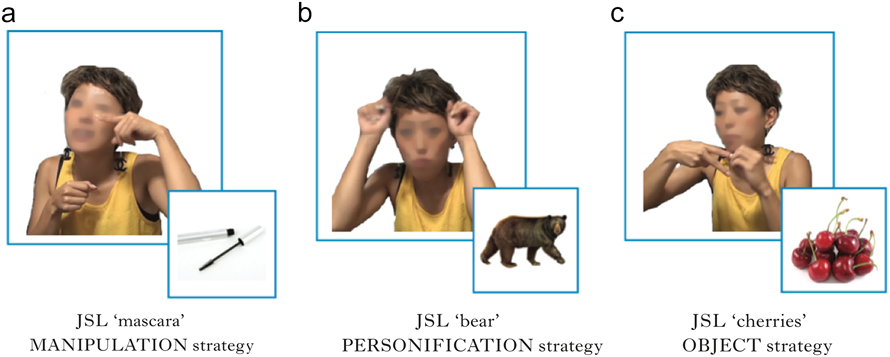
The three principal iconic strategies that emerged from compiling the data together were manipulation, personification, and object, as previously discussed. The manipulation strategy involves the body representing the body of a human agent and an arm representing the arm of a human agent as it acts upon the referent, as in Figure 4a. Previously, we distinguished between the handling strategy (as in Figure 3a), where the signer’s hand represents a human hand in action, and instrument strategy (as in Figure 3b), where the signer’s hand additionally profiles the shape of the referent tool (Padden et al., Reference Padden, Meir, Hwang, Lepic, Seegers and Sampson2013, Reference Padden, Hwang, Lepic and Seegers2015). Our distinction between the two iconic strategies can also be found in work by others (Goodglass & Kaplan, Reference Goodglass and Kaplan1963; Overton & Jackson, Reference Overton and Jackson1973; Boyatzis & Watson, Reference Boyatzis and Watson1993; O’Reilly, Reference O’Reilly1995; Brentari et al., Reference Brentari, Coppola, Mazzoni and Goldin-Meadow2012, Reference Brentari, Renzo, Keane and Volterra2015). Here, we collapse the two strategies together as manipulation to highlight their common property, that the signer’s body represents the body of a human agent using the referent, and that the form includes motion of the signer’s arm representing human action. The personification strategy involves the body representing the body of the referent and an arm representing a part of the referent, as in Figure 4b. The object strategy involves an arm representing the referent itself without simulated human action, as in Figure 4c. Within the general object strategy we include forms where the configuration of the hand represents the shape of an object (a “manual sculpture”, Müller et al., Reference Müller, Bressem, Ladewig, Müller, Cienki, Fricke, Ladewig and McNeill2013), and a tracing strategy where the movement of the fingers or the hand(s) outline the shape of an object (Padden et al., Reference Padden, Meir, Hwang, Lepic, Seegers and Sampson2013). In both cases, as in the example of ‘tree’, the body parts do not map to a human agent. In other words, our classification of iconic strategies uses a relatively broad stroke in order to identify common properties behind groups of signs and gestures, focusing principally on the role of the body in iconic representation. In individual responses, the forms are coded based on whole sign/gesture form–meaning mappings that include both movement and handshape (not just handshape, as in Brentari et al., Reference Brentari, Coppola, Mazzoni and Goldin-Meadow2012, Reference Brentari, Renzo, Keane and Volterra2015) and the relationship of the hands to the rest of the body.
Signs from Japanese Sign Language, coded for strategy.
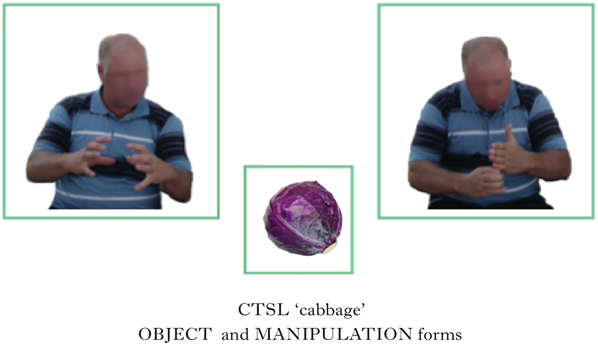
Some responses consisted of multiple sequential parts. Multiple responses to a single entity were each coded. For example, in response to the test item ‘horse’, one gesturer first moved her hands to both sides of her head to represent an animal’s ears (body as body of referent, arms as parts of the referent), then moved her hands to the front of her body to act out grasping the reins of an imagined horse (body as body of human agent acting on the referent, arms as arms of a human agent acting on the referent). These two segments were analyzed first as personification then manipulation. In the case of a response for ‘cabbage’, as shown in Figure 5, a CTSL signer first showed the round shape of a cabbage (arms as referent itself without simulated human action), followed by a chopping motion (body as body of human agent acting on the referent, arms as arms of human agent acting on the referent). These two segments were analyzed as object and manipulation.
Example from a signer of Central Taurus Sign Language using two different strategies for ‘cabbage’, object and manipulation.
The coding decisions for different parts of the body sometimes were congruous; for example, if the participant’s body is representing the body of a human agent manipulating the referent, then it is often the case that the participant’s head is also representing the head of a human agent. However, our coding system also allowed us to capture responses in which different parts of the body played different representational roles. For example, some responses used each of the arms differently. In the ASL sign for ‘sheep’, the non-dominant arm represents the sheep’s body (arm as a part of the referent), while the dominant arm maps to the human action of using shears to remove wool (arm as arm of human agent acting on the referent). In this instance, a single segment of a response was coded for two iconic strategies used simultaneously, manipulation and personification. In such cases, as described below, the form was counted once for each iconic strategy.
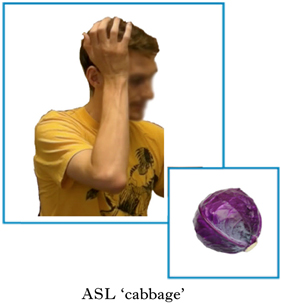
Our coding system also accommodates examples of signs or gestures where parts of the head and face, including the nose, lips, and eyes, are associated with inanimate objects, but are not counted as examples of any of the three iconic strategies we identify. For example, in the ASL sign for ‘cabbage’ (Figure 6), the head resembles a spherical object and the hand resembles a leaf (head as something other than a head, arm as part of the referent) (Shaw & Delaporte, Reference Shaw and Delaporte2015). In other examples, parts of the head or face were used to represent sensations (the mouth used to represent a pained human mouth in JSL ‘chili pepper’) or shapes (the nose used to represent a triangular shape in JSL ‘strawberry’) or textures (the cheek used to represent fuzzy skin in ASL ‘peach’). The use of these additional strategies suggests to us that there are many more that we have yet to identify and classify, and that, in a more detailed analysis of the head and face, we may find a rich environment for describing specific cross-linguistic distinctions across sign languages. Here we limit our discussion to the major strategies of manipulation, personification, and object.
Example from American Sign Language, where the head does not represent a head as a body part but rather a round object.
Finally, in ASL, JSL, and ISL, some responses for referents involved fingerspelling the name of the object in the dominant spoken language. Because fingerspelling does not draw from the same iconic resources as signs, we put aside all fingerspelled segments and did not include them in any category.
Reliability of the coding was assessed on data from four randomly chosen participants, one from gesture, CTSL, ASL, and JSL groups. There was agreement on the coding for 96% of the test stimuli.
In our discussion of the results, for each group, we report the mean average percent of use of an iconic strategy for items in a semantic category. Because the response to a referent could involve more than one strategy (e.g., gesture for ‘horse’, ASL sign for ‘sheep’ as described above), the percentages do not necessarily sum to 100%.
3. Results and discussion
3.1. group elicitation study
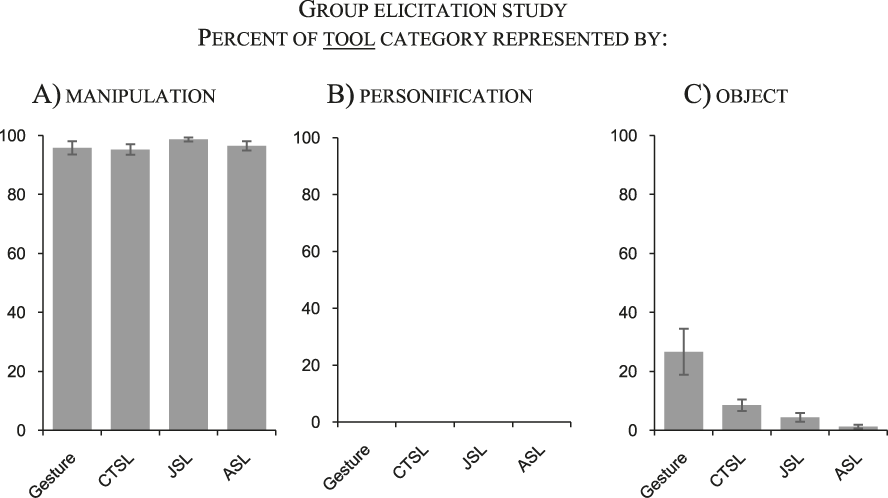
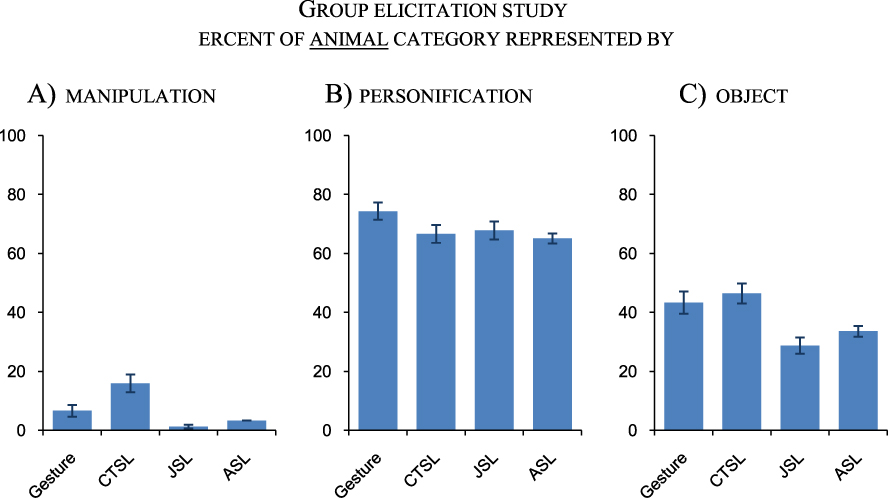
Here, we focus on the results from Gesture, CTSL, ASL, and JSL, with data from eight individuals in each group. The results for tools are shown in Figure 7, for animals in Figure 8, and for fruits and vegetables in Figure 9. We examined whether the semantic category of referents are predictive of the iconic strategy that is preferentially used to represent them. To test this claim, we examined whether or not there was a dominant, or highly preferred, strategy for representing each semantic category.
Graphs demonstrate that all four groups show a preference for manipulation forms over other forms for representing tools. (The values reflect mean averages across eight participants in each group with standard error bars.)
Graphs demonstrate that all four groups show the highest preference for personification forms for representing animals, with lower preferences for object and manipulation forms. (The values reflect mean averages across eight participants in each group with standard error bars.)
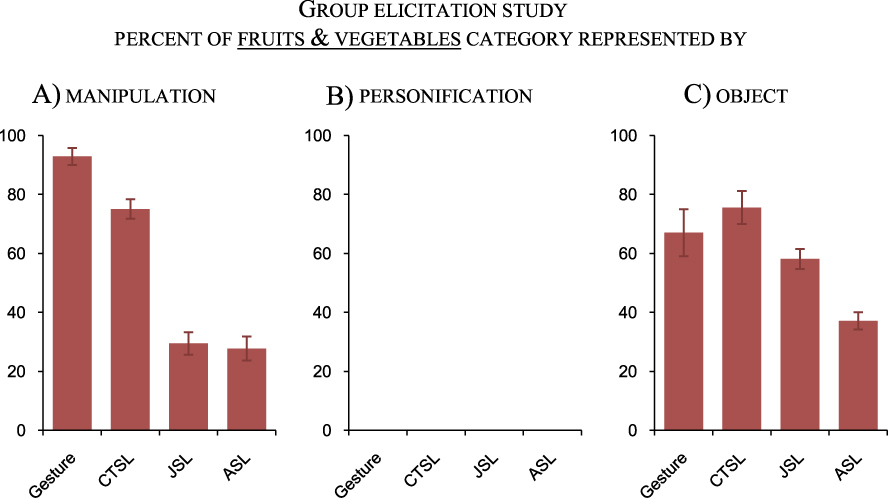
For the fruits & vegetables category, two strategies were preferred: object and manipulation. We found high rates of manipulation forms in gesture and Central Taurus Sign Language for representing fruits & vegetables, as compared to Japanese and American Sign Languages. (The values reflect mean averages across eight participants in each group with standard error bars.)
Based on our previous findings (Padden et al., Reference Padden, Meir, Hwang, Lepic, Seegers and Sampson2013, Reference Padden, Hwang, Lepic and Seegers2015), we expected that the manipulation strategy would be the dominant way to represent tools in our test items. The majority of our total of thirty tools were the same entities used in our earlier study (Padden et al., Reference Padden, Meir, Hwang, Lepic, Seegers and Sampson2013). Indeed, in this study most tools were represented using manipulation forms: 96% in Gesture, 95% in CTSL, 97% in ASL, and 99% in JSL (Figure 7a). We did not find any cases where tools were represented using personification (Figure 7b), though hypothetically, an entity like ‘hammer’ could be shown by bending the torso in a downward swinging motion. Anthropomorphic forms like these are found in poetry and storytelling in sign languages to attribute animacy and emotion to inanimate entities, but not as vocabulary signs (Sutton-Spence & Napoli, Reference Sutton-Spence and Napoli2010). We did find cases where tools were represented with object forms, either alone or in sequence with manipulation forms: 27% in Gesture, 9% in CTSL, 1% in ASL, and 4% in JSL (Figure 7c).
We predicted that the personification strategy would be the dominant way to represent animals, as shown in the sign language examples for ‘bird’ across different sign languages. In fact, personification forms were used for entities in the animal category at the following rates: 74% in Gesture, 67% in CTSL, 65% in ASL, and 68% in JSL (Figure 8b), and were never used to refer to fruits & vegetables or tools (Figures 7b and 9b). Our results show that the use of the personification strategy with animals is attested cross-linguistically as a preferential pattern, but it is not as exclusive as the robust use of manipulation strategy with tools. For animals, gesturers and signers used object forms as well (Figure 8c), either alone or in combination with personification.
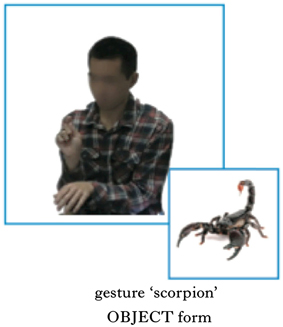
The variation in representing animals with personification and object forms may have been due to the thirty photographs of animals selected for the elicitation, which included mammalian vs. non-mammalian, terrestrial vs. aquatic, large vs. small, and wild vs. domesticated entities. Many-legged insects, for example, may be more likely to recruit the object strategy because of their smaller size and the difficulty of mapping onto the human body, as in an observed gesture for ‘scorpion’ (Figure 10), which we coded as an object form. We observed that such object forms occurred for animals at the following rates: 43% in Gesture, 46% in CTSL, 34% in ASL, and 29% in JSL (Figure 8c). Manipulation rates were low for animals: 7% in Gesture, 16% in CTSL, 3% in ASL, and 1% in ASL (Figure 8a).
Example of an object form for an animal entity from the gesture of a non-signer.
We predicted that the object strategy would be a common way to represent fruits & vegetables. The rates for object forms were: 67% in Gesture, 76% in CTSL, 37% in ASL, and 58% in JSL (Figure 9c). Although the rate of object forms were the highest for fruits & vegetables compared to the other categories, the use of the object strategy for fruits & vegetables was not as robust as the use of manipulation for tools and personification for animals. Manipulation forms were observed at higher rates than object forms for fruits & vegetables in Gesture (93%) and CTSL (75%) (Figure 9a). None of the three principal iconic strategies discussed here emerged as a dominant pattern for fruits & vegetables in ASL.
Statistical differences in the rate of observed instances of the iconic strategies for each of the semantic categories as described above were captured through the Wald test on binomial logistic regressions, with strategy as the independent variable and the status of whether or not the strategy was observed in a trial as the dependent variable, using R (R Core Team, 2012). Across all language groups, we found differences in the rate of strategies for tools (X 2 = 10799.6, df = 2, p < .001), animals (X 2 = 1041.9, df = 2, p < .001), and fruits & vegetables (X 2 = 1149.9, df = 2, p < .001). For each of these semantic categories, we ran Tukey pairwise comparisons between the predicted dominant strategy and the other two. Within the semantic category of tools, the manipulation strategy was statistically higher (p < .001) than the strategies of personification or object. Within the semantic category of animals, the personification strategy was statistically higher (p < .001) than the strategies of manipulation or object. Within the semantic category of fruits & vegetables, manipulation rates and object rates were higher than personification rates (p < .001), but not statistically different from each other (p = .29).
We conducted Tukey pairwise comparisons in order to determine whether each group exhibited a preferential pairing of either the manipulation or the object strategy with the category of fruits and vegetables. Manipulation rates were higher than object rates for Gesture (p < .001), and manipulation rates were not statistically different from object rates for CTSL (p = .99). In contrast, object rates were higher than manipulation rates for JSL (p < .001) and ASL (p = .02).
Consistent with our results regarding the preferential use of manipulation with tool and personification with animals, we found no statistical differences among the four groups in the rate of manipulation forms for tools (X 2 = 4.1, df = 3, p = .25) and the rate of personification forms for animals (X 2 = 5.4, df = 3, p = .14). These results suggest that iconic strategies are patterned robustly across languages for categories like tools and animals, but that a greater degree of variation in use of strategy can be found for categories like fruits & vegetables.
We further tested the generalizability of these patterns by examining responses in other sign languages to the same test materials, as described in the two following studies, the single elicitation study and the corpus study.
3.2. single elicitation study
Here, we ask whether our earlier results predict the forms used by a single signer of additional different sign languages, ABSL, ISL, and DGS. We predict that, as young languages, ABSL and ISL should show patterns similar to CTSL, and as an established language, that DGS should show patterns similar to ASL and JSL.
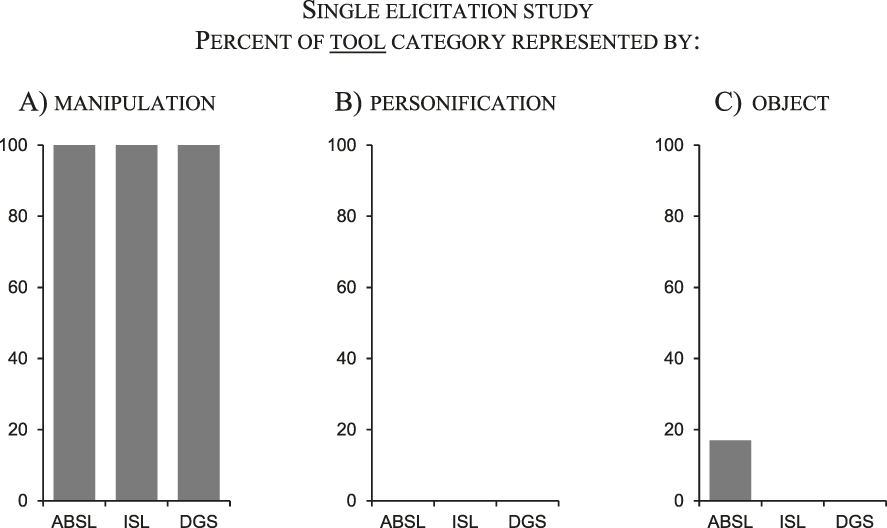
Padden et al. (Reference Padden, Meir, Hwang, Lepic, Seegers and Sampson2013) reported that ABSL uses manipulation strategies for representing tools, with a stronger preference for instrument forms over handling forms. In the single elicitation study, we found that 100% of our thirty tool items were represented with manipulation strategies by the ABSL, ISL, and DGS signers (Figure 11a). The ABSL signer used object forms in sequence with manipulation forms for 17% of her responses to tools, primarily to indicate size, whereas the ISL and DGS signers did not (Figure 11c).
Graphs demonstrate that the three languages show a preference for manipulation forms over other forms for representing tools.
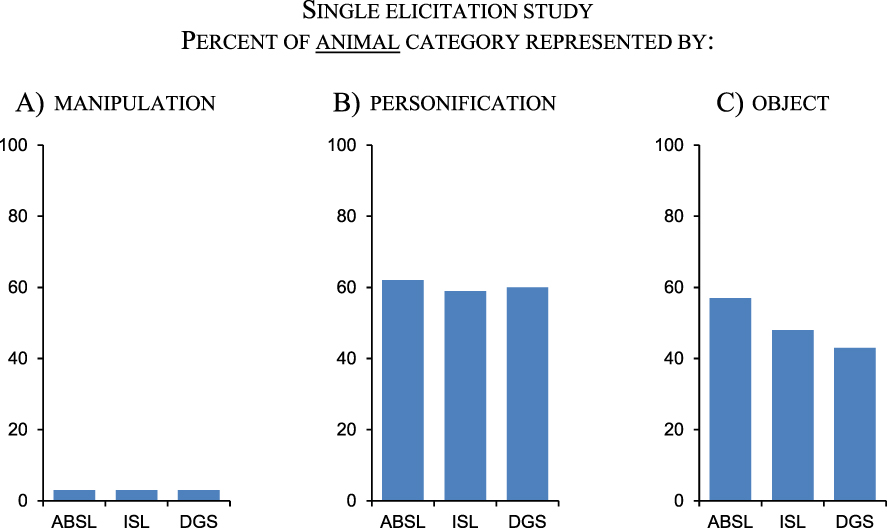
We next examined the rates of strategies for animals (Figure 12). As with our group elicitation study, personification forms among single signers across sign languages were found only for animals and at the following rates: 62% in ABSL, 59% in ISL, and 60% in DGS. Animals were also represented with object forms: 57% in ABSL, 48% in ISL, and 43% in DGS. Manipulation forms were used for representing only 3% of animals in all three signers.
Graphs demonstrate that the three languages show the highest preference for personification forms for representing animals, with lower preferences for object and manipulation forms.
Finally, we examined the rates of strategies for fruits & vegetables (Figure 13). Object forms were found at the following rates: 60% in ABSL, 54% in ISL, and 57% in DGS. Manipulation forms were found at the following rates: 87% in ABSL, 79% in ISL, and 50% in DGS.
For the fruits & vegetables category, two strategies were preferred: object and manipulation. We found high rates of manipulation forms in ABSL and ISL for representing fruits & vegetables, as compared to DGS.
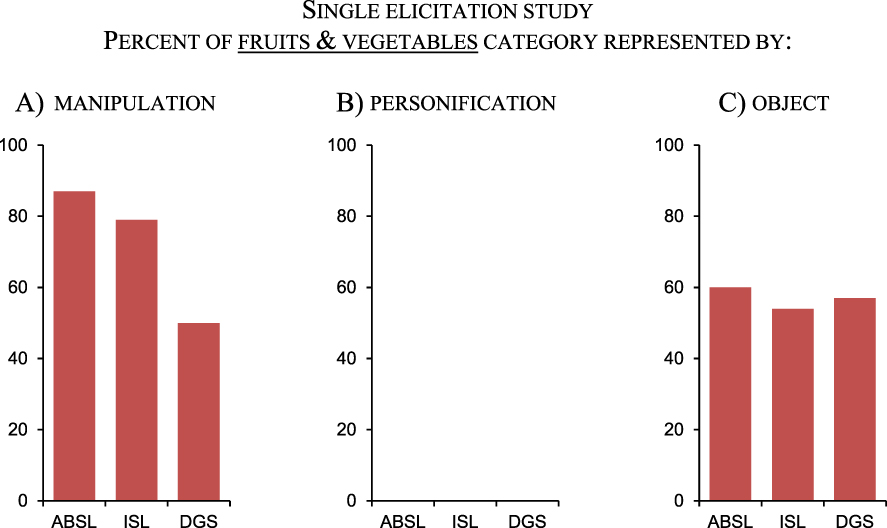
In the group elicitation study, we compared two established sign languages (ASL and JSL) with a young sign language (CTSL) and the gestures of non-signers. The single-elicitation study allows us to compare another established sign language (DGS) with two other young sign languages (ABSL and ISL). Comparing across studies, we find that, in established and young sign languages alike, manipulation forms are used at a high rate for tools, and similarly that personification and object forms are used at high rates for animals. Manipulation forms are also used at higher rates for fruits & vegetables in young sign languages (CTSL, ABSL, ISL) than in established sign languages (ASL, JSL, DGS).
These results confirm the two types of patterns that were found in the group elicitation study, (i) those that are shared across manual systems (i.e., the preference of using the body to represent an agent using a tool, the preference of using the body to represent the body of an animal), as well as (ii) those that differ across languages, perhaps as a function of language age (i.e., the preference for representing fruits & vegetables by referencing how they are prepared and eaten, in addition to referencing what they look like).
3.3. corpus analysis of Kenyan Sign Language and Ha Noi Sign Language
To confirm that our elicitation results are not contingent on the set of ninety items we selected, we examined corpora data from two additional languages, KSL and HNSL, for signs naming culturally specific entities drawn from the same semantic categories of animals, tools, and fruits & vegetables. We coded all signs from the corpora data that could be identified as falling into one of these three categories.
The KSL data analyzed here are 152 signs drawn from a larger corpus, with accompanying videos, used to analyze the phonological and morphological structure of KSL (Morgan, Reference Morgan2015). Signs were collected in a rural town in southwestern Kenya that has two deaf schools and an active community of deaf adults. In total, twelve deaf KSL signers participated in the development of the corpus, with three signers (two female) contributing the majority of signs in the database. Only signs that were observed to be used in this region were included, and were elicited in a variety of ways – photographs, illustrations, English translation, and in conversation. Nearly all of these signs analyzed here were elicited from photographs found online that were taken in East Africa. The photographs were presented on a laptop, with a black background and the English word for the target sign visible below the photograph.
The 152 signs consisted of the following numbers for each category: 22 signs for tools (e.g., spoon, plough, shovel, machete, hoe), 83 for animals (e.g., bat, pig, porcupine, tilapia, hyena), and 47 for fruits & vegetables (e.g., kale, beans, lemon, maize, sweet-potato).
The HNSL data come from a dictionary created by the Ha Noi Association for the Deaf. The data analyzed here consist of all 156 signs in the dictionary that are relevant to our study: 19 tools, 58 animals, and 79 fruits & vegetables. The dictionary entries include pictures of the entities, pictures of signers modeling the HNSL sign, with arrows and numbering showing movement sequences, the Vietnamese term for the entity, and an English term for the entity.
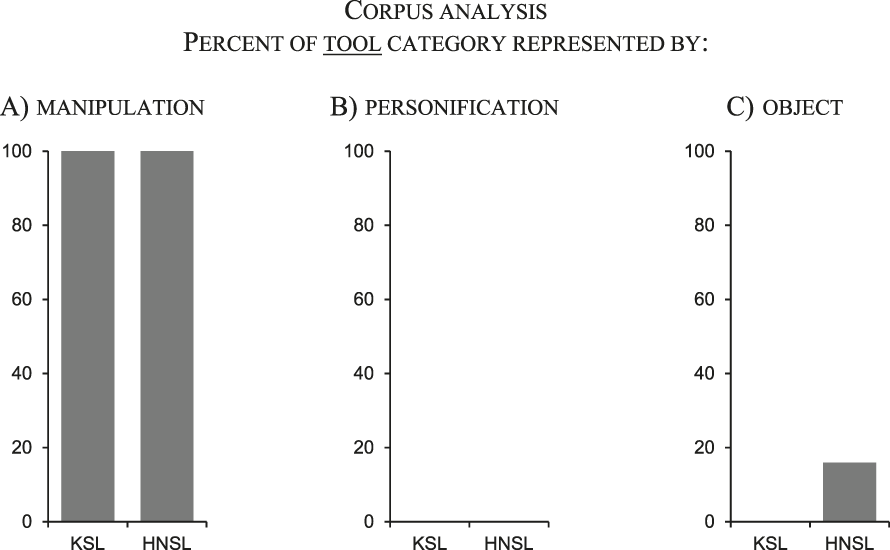
Again, the dominant strategy for representing tools was manipulation: 100% of signs for tools in KSL and HNSL depict human action (Figure 14a). We did not find any cases where an object form was used to represent a tool in KSL, but we found three such cases (16%) in HNSL where an object form was used with a manipulation form (saucepan, mortar & pestle, bucket) (Figure 14c).
Graphs demonstrate that both languages show a preference for manipulation forms over other forms for representing tools.
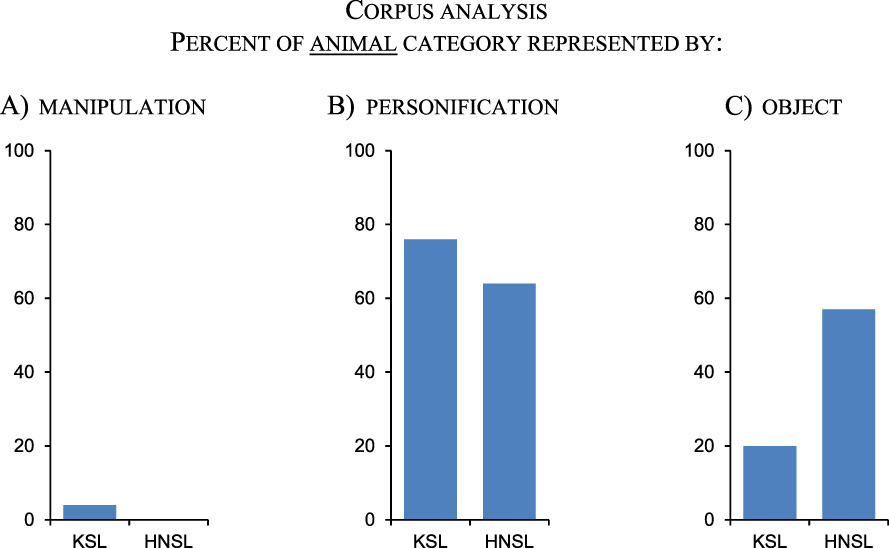
Again, animals were the only semantic group represented with personification forms: 76% in KSL and 64% in HNSL (Figure 15b). Animals were also represented with object forms: 20% in KSL and 57% in HNSL (Figure 15c). Manipulation forms were used to represent only 4% of animals in KSL, with no examples found in HNSL (Figure 15a). We suspect the lower rate of personification forms and higher rate of object forms in HNSL in comparison with KSL may be attributed to the higher number of non-mammalian entities in the HNSL set, which included several different species of fish and birds.
Graphs demonstrate that both languages show the highest preference for personification forms for representing animals, with lower preferences for object and manipulation forms.
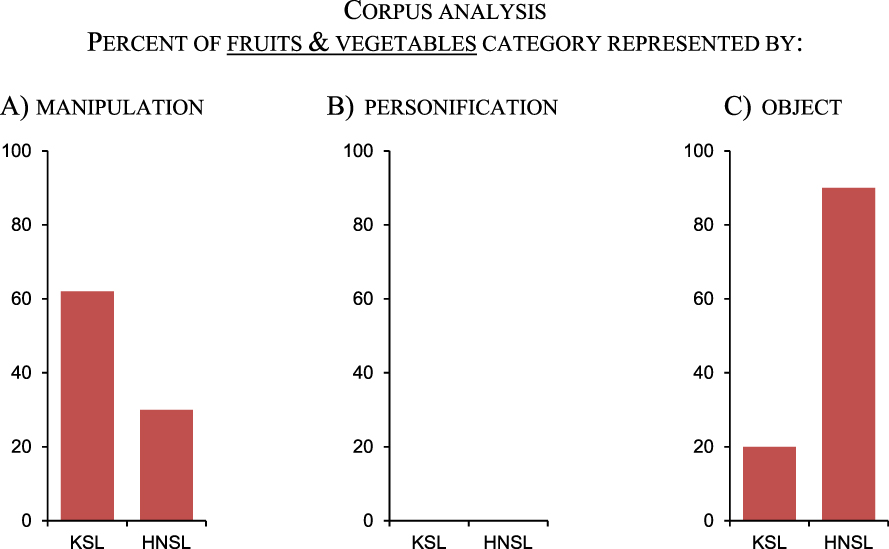
Finally, we analyzed strategies used to represent fruits & vegetables (Figure 16). We found manipulation forms at the following rates: 62% in KSL and 30% in HNSL. We found object forms at the following rates: 20% in KSL and 90% in HNSL. As we found in the results from the elicitation studies, the category of fruits & vegetables is not reliably represented with a preferred or dominant pattern across languages, unlike the cross-linguistic association of tools with manipulation forms or animals with personification forms.
For the fruits & vegetables category, two strategies were preferred: object and manipulation.
3.4. recognizing the body
The results from the above three studies point to two main findings: (i) the typical use of the body to represent a human agent when identifying and naming tools and fruits & vegetables, and (ii) the dual role of the body in representing humanness as well as non-human animates, as in gestures and signs for animals.
Representing a human agent through patterned use of the body is seen principally with conventions for naming tools, objects that humans have created and that typically have a small number of intended uses. However, as Gibson (Reference Gibson1979) noted, human beings act upon not only the artifacts that they themselves have created, but also the natural environment. manipulation forms reflect cultured ways of interacting with a diverse set of entities that can be found in the physical environment. manipulation forms are also used to describe human cultivation and consumption of fruits and vegetables. Gesturers and signers of young sign languages used manipulation forms at high rates (near 90%) for this class of objects. However, in many cases, manipulation forms that simply show cutting or eating do not help distinguish between objects that are prepared in similar ways. In established sign languages, successful manipulation forms are more distinctive: peeling for ‘banana’, smashing for ‘garlic’, and thumping for ‘watermelon’.
We have also seen a number of cases where manipulation forms are used for animals, as in the controlling of the reins of a ‘horse’ or the stroking of the (imagined) fur of a ‘cat’. Colleagues conducting fieldwork on other sign languages have given us other culturally specific examples: in the “Z” signing community in Mexico, ‘chicken’ is represented by depicting the motion of snapping the neck of a chicken in preparation for eating (Haviland, Reference Haviland2013), and in the Chatino signing community, also found in Mexico, ‘chicken’ is represented by depicting the motion of a machete sawing back and forth on the signer’s head, also in preparation for eating (personal correspondence, Lynn Hou and Kate Mesh). Thus, manipulation forms are used in forms where referent objects are associated with canonical actions and reflect cultural practices.
These examples show that many animals can be considered to have “distinctive uses” that set them apart from other referents and so can be represented with a manipulation form. However, for other animals, particularly undomesticated or wild ones, there may not be a characteristic human action. Instead, we find that the body is extended to represent other kinds of bodies. Bodies of land mammals like ‘giraffe’ and ‘elephant’ draw on correspondences between an animal body and a human one, using the human hands on the body in order to map the location of an animal’s characteristically long neck or long trunk. Smaller animals like fish and spiders, and other, less mammalian animals are often, but not always, represented using object forms, where animacy is conveyed through a wiggling or scooting movement of the hands and fingers.
Other examples where iconic representations reflect extension of the body are signs for certain fruits & vegetables in ASL and JSL. These established languages demonstrate an expanded repertoire of body-based iconic strategies, using specific attributes on the head and face without extending the iconic mapping to rest of the body. These mappings involve fewer structural correspondences; rather than using the head to represent a head, complete with two eyes, a nose, and mouth, the head may simply represent a spherical object, as in the JSL sign for ‘onion’, which involves an upward movement from the top of the head to show the stalk emerging from the top of an onion.
4. General discussion
While recognizing the broad diversity of sign language lexicons, we argue that it is also possible to detect similarities among sign languages through the lens of patterned iconicity. Our investigation of the iconic properties of signs and their similarities to gesture would appear to play into a common myth about sign languages, that they are fundamentally alike. Those without knowledge about sign languages are often surprised to find that there is not a universal sign language (Battison & Jordan, Reference Battison and Jordan1976) or that ASL and British Sign Language (BSL) developed independently of each other, even though their societies share a spoken language. The myth of a universal sign language is rooted in a common belief that communicating with the hands and body is transparent and universal. It is not an unreasonable belief, given the popularity of games like charades, or in events where there is no shared spoken language, as in a foreign market place, where tourists can rely on gesture to carry out basic communication.
Moreover, signers of different sign languages seem to be able to negotiate shared vocabulary in more than a rudimentary fashion (Moody, Reference Moody and Van Cleve1987; Supalla & Webb, Reference Supalla, Webb, Emmorey and Reilly1995). Owing to an increase in the number of international conferences, associations, sporting events, and other social opportunities to bring together signers of mutually unintelligible sign languages, a system called “International Sign” has emerged for use in one-on-one communication and in large audience presentations at conferences and symposia (McKee & Napier, Reference McKee and Napier2002). McKee and Napier describe International Sign as allowing for communication among signers who “share common contextual experiences and knowledge of grammatical structures in sign languages, but not a common lexicon” (p. 28).
We argue here that the impression of similarity or “universality” across sign languages and between sign language and gesture is rooted in the powerful ways that the body can be used as a medium of communication. When individual signs across sign languages are compared with one another, they may be quite different: in one sign language, ‘dog’ may be represented with the hands moving as in a barking mouth; in another, the sign shows the human snapping fingers as if to draw the attention of a dog. But when groups of signs of related semantic concepts, say animals, within and across different languages, are compared, there are systematic iconic patterns within the category. Our studies here show that these patterns can be reliably identified. We propose that this impression of similarity across signs and gestures comes from a ubiquity of patterned iconicity. Here we describe three examples, but we believe there are many more. Recently, Lepic, Börstell, Belsitzman, and Sandler Reference Lepic, Börstell, Belsitzman and Sandler(2016) have compared two-handed signs across different sign language lexicons to show that signs for certain concepts, e.g., plurality and atmospheric events, are more likely than chance to be two-handed.
Sign languages exhibit linguistic structure at all levels of organization; there is ample evidence of phonological, morphological, and syntactic structure. Furthermore, sign languages convey complex and abstract meanings as spoken languages do (Emmorey, Reference Emmorey2002; Sandler & Lillo-Martin, Reference Sandler and Lillo-Martin2006). Nevertheless, even when acknowledging that sign languages are not pantomime, it is not hard to notice correspondences between spontaneous gesture and conventionalized signs. Ongoing work with emerging and young sign languages, including homesign, has demonstrated in detail the possible origins of vocabulary in established sign languages (Haviland, Reference Haviland2013; Hunsicker & Goldin-Meadow, Reference Hunsicker and Goldin-Meadow2013; Padden et al., Reference Padden, Meir, Hwang, Lepic, Seegers and Sampson2013; Tkachman & Sandler, Reference Tkachman and Sandler2013). There is evidence that iconicity persists in established sign languages as well, despite the presence of complex grammatical structure and natural language processing pressures (Klima & Bellugi, Reference Klima and Bellugi1979; Perniss, Thompson, & Vigliocco, Reference Perniss, Thompson and Vigliocco2010; Meir, Padden, Aronoff, & Sandler, Reference Meir, Padden, Aronoff and Sandler2013; Emmorey, Reference Emmorey2014). Though here we have focused on lexical signs whose function is to name referent objects, our findings are also broadly compatible with discussions of iconic, spatial predicates in sign languages, commonly referred to as classifier constructions, in which the shape and movement of the hands conveys grammatical information (e.g., Benedicto & Brentari, Reference Benedicto and Brentari2004; Brentari et al., Reference Brentari, Renzo, Keane and Volterra2015). To complement these descriptions of grammatical patterns accounting for the configuration and movement of the hands through signing space, our findings here show that it is also necessary to consider the representational role of the body as well as the hands in discussions of iconicity in sign language structure (cf. Taub, Reference Taub2001; Wilcox, Reference Wilcox2004; Emmorey, Reference Emmorey2014).
In this paper, we have shown that there are identifiable iconic strategies that can be compared among referential signs across unrelated sign languages. Other investigators have asked to what degree signs across different sign languages are similar or identical to each other (McKee & Kennedy, Reference McKee, Kennedy, Emmorey and Lane2000; Guerra Currie, Meir, & Walters, Reference Guerra Currie, Meier, Walters, Meier, Cormier and Quinto-Pozos2002; Al-Fityani & Padden, Reference Al-Fityani, Padden and Brentari2010), following methods that have been used to study spoken languages (Greenberg, Reference Greenberg1957). Using a modified Swadesh list of 100 core concepts, McKee and Kennedy (Reference McKee, Kennedy, Emmorey and Lane2000) report that 64 signs are identical in the historically linked British, Australian, and New Zealand Sign Languages. In contrast, only 19 of the signs (19%) in this group are identical to ASL. Guerra Currie et al. (Reference Guerra Currie, Meier, Walters, Meier, Cormier and Quinto-Pozos2002) compare signs in French, Spanish, Mexican, and Japanese Sign Languages, using a list of terms for “foods, flora and fauna, modes of transportation, household objects, articles of clothing, calendrical expressions, professions, kinship terms, wh-words and phrases, and simple emotions” (p. 226). They calculated the percent overlap in the languages based on whether signs shared at least two of the three major parameters of sign formation. They report that 23% of signs in the dataset are similarly articulated in Mexican and Japanese Sign Languages, the two least related languages in their set, with higher rates of similarity for pairwise comparisons between related languages.
Guerra Currie et al. (Reference Guerra Currie, Meier, Walters, Meier, Cormier and Quinto-Pozos2002) note that similar rates of overlap are reported in other studies (Woodward, Reference Woodward and Siple1978; Woll, Reference Woll, Loncke, Boyes-Braem and Lebrun1983; Kyle & Woll, Reference Kyle and Woll1985; Woll, Reference Woll and Kyle1987; Smith Stark, Reference Smith Stark1990). Their observed rates of 20–40% similarity are relatively high compared to spoken languages. They attribute the degree of similarity to the visual–gestural modality and its iconic affordances, or “shared symbolism”.
Focusing on iconic properties of signs, rather than their formational features, Richie et al. (Reference Richie, Yang and Coppola2014) examined the conventionalization of signs in developing lexicons of homesigners in Nicaragua. They coded signs for item-specific iconic properties, which they call “conceptual components”. The examples they provide are for ‘cow’, where the representation of a human agent milking a cow was coded as “milking” and the representation of a cow’s horns was coded as “horns”. When comparing their coding system to ours, “milking” would be subsumed under our category of manipulation. “Horns” would be subsumed under personification if the horns were represented with hands brought to the side of the head, or as object if the horns were represented away from the body with a single hand, such as with the index finger and pinky extended and the hand itself corresponds to the head of the animal. The item-specific method of coding iconic properties used by Richie and colleagues is useful for their study because they were tracking the degree to which homesigners and their communication partners showed consistency for twenty-two signs, which were not further grouped into semantic categories.
Beyond the domain of lexical patterns, other research groups have reported robust and consistent mappings across sign languages like those reported here. Strickland et al. (Reference Strickland, Geraci, Chemla, Schlenker, Kelepir and Pfau2015) found that telicity of verbs is encoded through movement, which involves repetition in atelic verbs and no repetition plus clear event boundaries for telic verbs. The seemingly universal nature of this pattern is attributed to mapping biases that can be found even among non-signers. Brentari et al. (Reference Brentari, Renzo, Keane and Volterra2015) found that handling handshapes are aligned with the description of events involving human agents, and that “object handshapes – those that represent the class, size, or shape of objects” are aligned with events of object motion that do not involve human agents. The directionality of these preferences can be found among non-signing gesturers as well.
We have demonstrated here the value of analyzing iconic strategies at the level of lexical semantic categories in sign languages, and of recognizing the representational role of the body in this example of patterned iconicity. From this perspective, the interesting finding is not that signs for ‘bird’ look similar or different in any two sign languages, but that (i) signs for ‘bird’ are likely to share an iconic strategy with other signs for animals, and (ii) broadly, sign languages use similar strategies to organize their lexicons.
As an initial step toward documenting these strategies, the iconic patterns we have examined in this paper are as follows: tools are overwhelmingly represented through manipulation forms, where the body depicts the body of a human agent. Animals are represented through personification forms, where the body depicts the body of the animate referent, as well as through object forms, where the hands but not the body depict aspects of the animate referent. We have speculated that these two strategies may serve more fine-grained representational functions, such as to distinguish animals that live on land vs. those that live in water, but leave this question for a future investigation. Fruits and vegetables are represented with object forms where the hands depict static aspects of the referent, as well as manipulation forms that evoke how agents prepare these entities for human consumption. We have speculated that the use of iconic strategies for fruits & vegetables may change as a function of language age and conventionalization as established sign languages further differentiate between similar items within a set or category.
Applying a similar methodology of identifying iconic strategies in other parts of lexicons and grammars could lead to the discovery of additional typological tendencies across sign languages. Such investigations promise to contribute to a better understanding of the role of iconicity in language structure. As a result, we hope that discussions on iconicity will go beyond the focus on imagistic properties, or the closeness of form–meaning mappings, to broader aspects of cognitive organization (cf. Gentner, Reference Gentner1983) and the impact of cultured ways of interacting with and relating to entities found in the world.


 Open access

