




Introduction
In the popular mind, the rise of ancient Rome from clusters of prehistoric hilltop huts to imperial metropole is presented as a quintessential success story. Correlating urban expansion with the influence and power of the ‘Roman state’, this notion positions Rome as the apogee of an imagined Western civilisation (see Terrenato Reference Terrenato and Yoffee2015). Linear conceptions of progress as a moral imperative became prominent during the Enlightenment (Hume Reference Hume1739) and were integral to cultural evolutionary models of a natural trajectory towards ‘civilisation’ (Morgan Reference Morgan1877; Service Reference Service1962). Despite their widespread rejection by archaeologists (e.g. Yoffee Reference Yoffee2005), these ideas connecting success to continuous growth persist within wider discourse (e.g. Pinker Reference Pinker2018) and remain embedded within the study of Roman history and archaeology. While some recent works promote more nuanced understandings of Rome's trajectory as expressed through its built environment (e.g. Davies Reference Davies2017; Bernard Reference Bernard2018), these studies continue to reinforce the logic that growth or contraction of a physical urban area reflects a city's success.
Gabii, a central Italian polity that emerged chronologically and geographically alongside Rome (Figure 1), is presented in ancient literary sources as a canonical example of urban decline, and both implicitly and explicitly portrayed as a failure when compared with Rome (Becker et al. Reference Becker, Mogetta and Terrenato2009). Intentionally stepping outside of this model, we use a ‘rhythmic’ approach (Lefebvre Reference Lefebvre2004) to interpret the material record uncovered by a decade of archaeological excavations at Gabii (Mogetta & Becker Reference Mogetta and Becker2014; Fabbri & Musco Reference Fabbri, Musco, Fontaine and Helas2016; Samuels et al. Reference Samuels2021; for preliminary data from the Gabii Project, see https://gabii.cast.uark.edu/data). In this, we problematise linear models that assume a connection between growth in settlement extent and urban success, and between reduction in size and urban failure. A rhythmic framework, centred on the actions of individuals and groups within ever-evolving temporal cycles, allows us to focus on the maintenance, transformation and abandonment of different urban components as evidence for shifting values and priorities (Harris Reference Harris2017). Attending to what was cherished, adapted and maintained at ancient Gabii shifts our emphasis from moments of disjunction, where change implies either progress or decline, to rhythms of adaptation and resilience, and, further, accounts for the immaterial and material value of things in their socially embedded contexts. Through this, we can see how the Gabine community reconfigured itself repeatedly within its changing regional context, and how these changes were influenced by the expansion of Rome and the development of the Roman state. Advancing adaptation and resilience as successful strategies is common in archaeological interpretations of rural communities, and can be equally applied to the adaptation of urban communities to shifts in their local and regional contexts (e.g. Lewit Reference Lewit2020). Drawing from Gabii's nearly 2000-year trajectory, we argue for a model of Gabine urbanism that encapsulates diverse, successful iterations of a single urban community.
A) Location of Gabii in central Italy; B–C) plans of the Gabii Project's excavations (figure by M. Naglak).

Reimagining ‘proto’-urbanism (ninth to sixth centuries BC)
The excavation of a ninth- to sixth-century habitation cluster at Gabii has uncovered evidence for diverse activities over 400 years, including the transition from a wattle-and-daub hut compound to a stone-socled house (Figure 2) (Evans et al. Reference Evans2019). This transition from ‘huts to houses’, along with other canonical metrics of urbanity in an Italic context (e.g. orthogonality, fortification walls and temple construction), is often used to indicate substantial progress along an imagined continuum from ‘pre/proto-’ to ‘complete’ urbanism (e.g. see Fulminante Reference Fulminante2014: tab. 25). At Gabii, rather than marking a disjuncture between embryonic and mature urbanism, the change from huts to houses appears to be an isolated architectural and technological shift, as continuity amongst other elements of contemporaneous material culture—produced by the rhythmic patterns of daily life—suggests the persistence of many social practices. By attending to these diverse materials rather than privileging building techniques, we can conceptualise archaic Gabii as a successful and enduring, dispersed urban community sustained by rhythms of architectural maintenance, funerary practice, resource procurement and craft production.
Reconstruction of Gabii as an Early Iron Age (eighth to sixth century BC) poly-nuclear settlement (reconstruction by E. Stewart).

Area C/D is one of two distinct habitation clusters excavated by our project; excavations of the so-called ‘Regia of Gabii’ by an Italian team may have identified a third (Fabbri Reference Fabbri, Lulof and Smith2017). Concentrations of broadly contemporaneous ceramics identified in Guaitoli's (Reference Guaitoli1981) survey of the intramural area of Gabii strongly suggest the presence of over a dozen further clusters. At Gabii, our excavations suggest that these nuclei comprised clusters of structures sometimes delimited by small walls and separated by tracts of non-residential land (Evans et al. Reference Evans2019). The spatial organisation of burials and their grave assemblages suggests that each cluster was inhabited by a distinct kinship group that retained a degree of autonomy (Cohen & Naglak Reference Cohen, Naglak and Mogetta2020). Simultaneously, communal projects, such as the construction of fortification walls, the placement of extramural cemeteries and communal cultic activity, indicate some integration between different groups occupying Gabii from the eighth century BC onwards. This type of ‘leopard spot’ poly-nuclear settlement pattern is hypothesised at several contemporaneous central Italian settlements, on the basis of field survey data (Terrenato Reference Terrenato2019: 34–43), and is usually interpreted in Italian contexts as an interim step in urban development. This dispersed settlement pattern, however, is broadly consistent with an urban model that finds comparanda in Central Europe, Mesoamerica and Southeast Asia (e.g. Moore Reference Moore2017; Fletcher Reference Fletcher2019). As such, we can understand Gabii's poly-nuclear settlement structure as representing a distinctive form of dispersed urbanism in its own right, rather than simply as a stepping-stone towards its development into a ‘proper’ city.
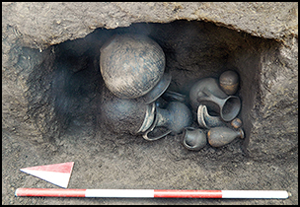
Communal investment and maintenance of structures reveal the continuous and punctuated activity that served to create and strengthen ties between these kinship groups. These rhythms of ongoing maintenance, however, are often obscured by the archaeological practice of identifying occupation phases as distinct temporal moments based on architectural changes. The Area C/D hut complex has yielded evidence for such practices, including resurfacing beaten-earth floors, maintaining wattle-and-daub walls, re-plastering walls and floors, and the periodic reorganisation of space. In contrast to larger construction events that may have disrupted the occupation of the huts or houses, these repeated actions—evidenced through micromorphological analysis conducted by Cristiano Nicosia (unpublished data)—may have connected with wider rhythms and rituals that supported community-binding over generations (e.g. Boivin Reference Boivin2000; Naglak & Terrenato Reference Naglak, Terrenato, di Fazio and Paltineri2019). These repeated actions were enhanced by punctuated moments of communal investment and display, which are best represented by elaborate infant burials immediately surrounding the domestic structures (i.e. not located in the extramural cemeteries), physically tying the legacy of a family to their land (Figure 3). This practice is well attested at Gabii and across Latium (west-central Italy) more widely (Cohen & Naglak Reference Cohen, Naglak and Mogetta2020). Irrespective of the architectural change from huts to houses, these repeated, spatially embedded activities and events, such as hut maintenance and infant burial, materialised and sustained networks within and between dispersed kinship groups, reinforcing communal ties.
Rich infant burials from the Area C/D complex show significant investment in luxury materials: A) grave assemblage in Tomb 51; B) in-situ offerings in Tomb 52 (figure by the Gabii Project).

The rhythms of food procurement, processing and consumption also served to reproduce social and economic networks across generations. Faunal and archaeobotanical remains at Gabii suggest local continuity in foodways across any supposed urbanising transition. Contrary to the expectation that urban populations in Italy increased their consumption of pigs from the eighth century BC (De Grossi Mazzorin & Minniti Reference De Grossi Mazzorin, Minniti and Albarella2017), meat production at Gabii remained focused on ovicaprines through at least the early fifth century BC (Figure 4). Similarly, preferences in staple crops at Gabii remained consistent over time, showing the selection of barley over the regionally predominant emmer wheat (Motta & Beydler Reference Motta, Beydler, Hollander and Howe2020). Gabii's inhabitants appear to have had a remarkably resilient micro-local diet that included millet and bitter vetch, which are often considered fodder crops in later Roman contexts (Motta et al. Reference Motta, Cullen, Ross, Banducci and Gallone2020). Consistency in diet and consumption patterns at Gabii is further supported by persistence in the different forms of cooking wares and both fine and utilitarian dining wares excavated across these periods.
The proportions of faunal remains and textile tools stay substantively consistent before and after the introduction of stone architecture (based on chi-square test values), showing continuity in meat consumption and textile production at Gabii (figure by V. Moses).

Household production activities within the community—specifically textile production, which is well attested at Gabii—not only indicate continuity in techniques (i.e. tool forms), but also in social organisation and economic networks (Figure 4). Tablet weaving was a technique used to produce the elaborate belts and borders incorporated into Italian elite dress as, for example, at the nearby cemetery of Osteria dell'Osa (Gleba Reference Gleba2017). This is the principal method of textile-making activity attested at archaic Gabii, and is evidenced by the presence of two bone tablets and a large number of so-called ‘spools’. Based on evidence from elsewhere in central Italy, Gleba (Reference Gleba2017) argues that ‘spool’ is a misnomer, and that these were instead weights used for tablet weaving. This technique is reliant on loom-woven textiles as a base; tools for weaving (specifically loom weights), however, are so far largely absent from archaic Gabii, despite ample evidence for spinning (i.e. spindle whorls). This speaks to a complex network of production, in which textile products moved between and within social strata throughout the chaînes opératoires (Samuels Reference Samuels2020). These economic networks could reify social hierarchies, crafting visual markers of elite status, while also linking different communities.
All these instances suggest that value and desirability were not fixed attributes of particular objects or practices, but were context-dependent and socially constructed as the community prioritised certain materials and activities (Harris Reference Harris2017). While the architecture may have changed, the processes of construction, consumption, production and the underlying social behaviours persisted.
Reimagining the success of dense urbanism (fifth to first centuries BC)
Between the fifth and first centuries BC, the rhythms of life at Gabii changed and the city moved away from its earlier dispersed character. Following the development of a street grid, Gabii's city centre slowly developed—for a time—a densely built character, full of houses, monumental buildings and public infrastructure (Mogetta et al. Reference Mogetta, Johnston, Naglak and D'Acri2019; Samuels et al. Reference Samuels2021). This period saw shifting activities at various scales, from the regional to the local; yet these changes were gradual and ultimately not sustained. This densest materialisation of urban life at Gabii—itself less dense then we might expect in comparison to modern cities—represents, at most, 200 years of the site's nearly 2000-year occupation. Rather than the apogee of urban life at Gabii, this phase represents only one, short-lived manifestation of urban ‘success’.
The emergence of a quasi-orthogonal street grid and the property reorganisation that followed are the most notable changes visible in the urban landscape. This street grid, confirmed by magnetometry survey and excavation, consists of elongated city blocks radiating from a central road, which itself follows the curve of the volcanic slope (see Figure 1). Excavations date the initial construction of the main thoroughfare and its cross-streets to the late fifth century BC (Mogetta et al. Reference Mogetta, Johnston, Naglak and D'Acri2019; see Figure 1). While it remains uncertain whether the entire grid-plan was constructed simultaneously—only five roads have so far been excavated—the eventual extension of the street-grid across the entire intramural area could suggest an emergent and enduring shared vision of how the settlement should be organised, possibly resulting from increased coordination between different groups. This could also be interpreted as an imposition by a few actors in a segment of the city, followed by wider communal adoption, or as a new colonial foundation by Roman elites (Johnston & Mogetta Reference Johnston and Mogetta2020). Despite this new feature, the persistence of a dispersed urban model and its uneven development is supported by the temporally and spatially irregular infill of the new blocks, none of which have produced architecture that pre-dates the third century BC. Despite this lack of pre-third-century structures, however, the abundance of residual ceramics—specifically opaque red ware, a regional fineware—found in the floor-levelling deposits of two third-century BC houses suggests continued activity through the late fifth to third centuries BC. The dispersed nature of the urban environment present in earlier centuries persisted slowly, reorienting along new spatial axes and towards a new urban norm.
The extensive construction of early modern and contemporary urban environments, along with the popular presentation of some ancient Roman cities, have predisposed urban archaeologists—especially in Italy—to expect densely occupied and built-up urban centres. It is difficult to validate this assumption at Gabii. Our excavation around the primary intersection of the city, where we would expect to see the densest occupation, shows that mixed use was more common than a uniformly built-up environment. City blocks, or portions of them, appear to have been reserved as open spaces that may have been used as gardens, for animal grazing, or purposefully left undeveloped (i.e. as ‘empty’ spaces, e.g. Smith Reference Smith2008; in central Italy, see Fentress Reference Fentress and Fentress2003: 138–41). The Gabine habit of levelling the sloping topography to create flat spaces for construction, and the continual problems of down-slope erosion, have limited previous interpretation of these ‘empty’ areas. As important as the rhythms dictated by built features and the emerging orthogonality would have been for those inhabiting and visiting Gabii, these empty spaces probably also enabled ephemeral activities (e.g. temporary storage, informal gatherings, loading/unloading, sorting and drying materials) that sustained a close relationship between the residential and productive spheres.
Local variations in public and private architecture and decorative trends highlight a wider dialogue and value system predicated on experimentation and innovation, possibly facilitated by the sharing of techniques, materials and labour (for a similar discussion at Cosa, a contemporaneous central Italian site, see Mogetta Reference Mogetta, Buccellati, Hageneuer, van der Heyden and Levenson2019). While certain structures at Gabii lack direct comparanda, many of their constituent elements can be situated in a developing regional elite architectural tradition, but with a particular Gabine flair. The Area C house, for example, incorporates an open courtyard (atrium) seen in other elite Italian domiciles, yet forgoes the strict axial symmetry visible in the idealised atrium-house in order to fit within the irregularly shaped Gabine city block. For the Area F building, external influences can be seen in its scenic architecture (e.g. monumental entranceways and open courtyards), and possible bathing, feasting and ritual spaces (Johnston et al. Reference Johnston2018) (Figure 5). Its idiosyncratic Gabine character is amplified by the use in monumental and visible components of the building of Lapis Gabinus (a local tuff quarried at the site), and decorative, painted plaster that mimics courses of masonry construction (Figure 6). This type of painting, showing clean drafting lines against a solid white background, appears in many different contexts and chronological periods beyond Gabii (e.g. Gee Reference Gee, Clarke and Muntasser2019: 1174). Although less iconographically complicated and colourful than other painting fragments found at Gabii, they evoke the ashlar construction of the building, and thus its value may stem from its visual resonance with the complex's locally sourced architectural core.
The monumental Area F complex sits at the intersection of three important roads and incorporates regional and local architectural elements, such as a monumental wall constructed of local tuff (figure by T. Johnson).

Painted plaster on the interior of the Area F complex mimics the worked local stone used to construct the building (figure by the Gabii Project).

This architectural focus represents a shift in the rhythms of elite display, replacing the earlier emphasis on the punctuated moments of funerary ritual with enduring built forms as an effective means of expression. Public buildings, including the new (second century BC) Temple of Juno Gabina, and continued investment in the fortification walls, communicated the wealth of the city and importance of its patrons, while houses advertised private wealth. These shifts in modes of expression reveal an elite who were renegotiating their values and priorities amidst shifts in local and regional pressures—namely the expansion of Roman hegemony, increased urbanism in Italy and growing interconnectivity across the Mediterranean basin.
This dense monumental phase, during which built spaces came to the fore (preservation biases aside) as desirable material entities, was short-lived, as the different residential complexes (Areas A, B and C) were abandoned in first century BC. The following centuries saw the transformation and repurposing of these areas as burial grounds (Area B), industrial spaces associated with quarries (Area A) and dumps for construction material (the upper terraces of Area F) (see Banducci & Gallone Reference Banducci and Gallone2021). As with the infill of the street grid, the transformation of these blocks was not uniform and does not reflect wholesale abandonment of this zone, let alone the entire city (Figure 7). Instead, we see a transition to a new urban model, which would maintain its mixed character going forward.
The diachronic shift in foci of activity within the excavation area, as represented by the accumulation of representative ceramic classes and newly constructed or in-use architecture. While the different formation processes, overall ceramic abundances and types of activities dominant in each period vary, these distributions represent broader trends in changing urban land use at Gabii (figure by R. Opitz).

Reimagining urban decline (first to fourth centuries AD)
From the first to third centuries AD, as Rome expanded and extended its (sub)urban sphere far out into Latium (Emmerson Reference Emmerson2020), the occupied area of Gabii contracted and became concentrated along its main thoroughfare. This type of reduction in the overall extent of a city, either through contraction or the abandonment of individual neighbourhoods, has often been interpreted as an unambiguous sign of decline (see the concept of ‘shrinking cities’ in, for example, Oswalt Reference Oswalt2005). Spatial contraction at Gabii, however, occurred together with new investments in commercial and private buildings, thereby challenging a vision of urban crisis. Additionally, the periodic abandonment and restructuring of specific blocks occurred throughout the city's lifespan. Thus, Gabii's contraction over time is temporally and topographically uneven, and bears no linear correlation with a strict process of decline. We argue that the gradual reduction of Gabii's urban core, starting in the first century AD, represents an intentional shift in the types and locations of activities and the value of disparate civic investments. These shifts were a response to changing regional circumstances, such as the continued expansion of Rome as a centre of economic and political gravity in the area. The result was a new spatial, economic and social logic that developed in accordance with new rhythms and a vision of urban success, wherein Gabii functioned as a part of a regionally dispersed Roman (sub)urban network.
Excavations and intramural survey at Gabii provide a view of the slow transformation and consolidation along the main road (Guaitoli Reference Guaitoli1981; Samuels et al. Reference Samuels2021). Structures along this thoroughfare assumed a clear commercial character. In the first century AD, the lower terrace of the Area F building, along with the adjacent Areas G and H, were reorganised to include latrines, storage areas and shops. Open areas fronting the road, suggestive of shops, are visible in Area I from the late second century AD (see Figure 1). Meanwhile, a large and finely decorated public bath house was installed to the west of Area F, and remained in use for around 400 years (d’Agostini & Musco Reference d'Agostini, Musco, Angelelli, Massara and Sposito2016). These developments represent a qualitative shift towards public amenities, catering to the valuable economic commerce provided by travellers moving along the main road to and from Rome, into whose suburban network Gabii was increasingly drawn.
Alongside the emergence of a new, spatially contracted suburban character at Gabii, investment in symbolic and prestige civic projects continued in new forms, funded by a new cohort of imperial benefactors (Figure 8). A portico of massive tuff pillars along the facade of the Area F building was restored, suggesting a programme of investment in, and maintenance of, this central, monumental thoroughfare. In the absence of epigraphic evidence, we cannot determine the agents behind this activity, whether the local community or imperial authorities; elsewhere at Gabii, however, we know that imperial investment in local renovations and infrastructure was wide-ranging. It included the re-monumentalisation of the sanctuary of Juno Gabina, as well as the second-century AD construction of a local council building and aqueduct (Becker et al. Reference Becker, Mogetta and Terrenato2009: 632). A shrine was also built for Domitia Augusta Longina, wife of the Roman emperor Domitian, in the mid-second century AD, and subsequently transformed into a temple dedicated to the imperial cult. Numerous marble sculptures and inscriptions (now at the Louvre Museum in Paris) were recovered from a portico along the main road (the so-called ‘Hamilton's Forum’) during eighteenth-century excavations. These depict the imperial family, imperial aristocracy and local elites, illustrating Gabii's ongoing status as a locus of prestigious display and investment (Becker et al. Reference Becker, Mogetta and Terrenato2009: 632). In short, despite its spatial contraction and incorporation into Rome's suburban network, aspects of conventionally recognisable urbanism, including private investment and civic monumentalisation, continued to be prioritised at Gabii well into the second century AD.
Examples of civic investment at Gabii from the first century AD onwards: A) the ‘Diana of Gabii’, excavated in 1792—one of the many sculptures recovered from a public building (the so-called ‘Hamilton's forum’); B) Tomb 29, built in a cappuccina style, from the Area B necropolis near the main thoroughfare; C) pilaster of the monumental portico erected along the main thoroughfare and restored after the first century AD (figure by T. Johnson; photographs by the Gabii Project).

Alongside these forms of monumentalisation, the prominent installation of a non-elite intramural necropolis in Area B demonstrates that diverse groups continued to reside at Gabii and invest resources into the symbolic marking of their presence (Figure 8) (see Banducci & Gallone Reference Banducci and Gallone2021). The non-elite character of the necropolis is attested by skeletal evidence for injuries and biomechanical stress, potentially associated with repetitive labour or violence, and a poor, carbohydrate-heavy diet (Killgrove Reference Killgrove, Banducci and Gallone2021). Excavations elsewhere in the city have recovered more than a dozen roughly contemporaneous tombs (Majerini & Musco Reference Majerini, Musco and Filippi2001: 493; Glisoni et al. Reference Glisoni, Hasselin and Roger2017). While intramural burial is often cited as a violation of Roman religious and legal norms, the practice is well attested within both urban and suburban environments in Italy (Emmerson Reference Emmerson2020), as cities extend beyond their walls and their formal limits blur. We can see an inverse yet complementary process at Gabii. As their own urban core was shrinking, Gabines may have begun to conceive of their city as a component of Rome's suburban network, rather than as an independent polity.
This suggestion is supported by other activities that highlight Gabii's integration into regional economic networks. Intensive quarrying and the export of worked stone attested in Areas A and B (directly adjacent to the necropolis and new commercial spaces off the main thoroughfare) and confirmed by geochemical analyses of large public monuments in Rome, suggest that Gabii successfully responded to the changing regional economic context by pursuing an economic activity usually reserved for the countryside (Farr et al. Reference Farr, Marra and Terrenato2015). Nearby, a mixed-use residential and production complex, built between the late second and early third centuries AD (Area I), demonstrates how wealthy inhabitants prioritised more luxury concerns, such as regional fashions of social display in their living spaces, while adapting and perpetuating rural economic strategies (Figure 9). This complex broadcasts the private wealth of its residents through its architecture and decoration, which included various water features, an open-air hall, apses and fine mosaic floors—features indicating a continued emphasis on the markers of elite lifestyle.
Examples of luxury and productive investment in the Area I house: A) the remains of a decorative mosaic floor in the residential courtyard; B) plan of the house; C) a vat fitted with hydraulic concrete and a spout, which carries water from a drain located in the neighbouring room (figure by T. Johnson; photographs by the Gabii Project).

The layout of the complex shows both strong continuities with preceding elite domestic architecture at Gabii, as well as engagement with regional architectural fashions, such as the inclusion of apsidal elements. Beyond architecture, large dumps of imported African cooking wares recovered from within the structure suggest the persistence of connections to regional and Mediterranean-wide commerce, probably mediated through Rome. Contemporaneously, the consumption of imported goods occurred alongside a new production strategy, as evidenced by the construction of a press (likely for wine) connected to several large tanks (Samuels et al. Reference Samuels2021). The introduction of agricultural facilities into the domestic environment echoes the configuration of a villa—the quintessential, upper-class residential unit of rural and suburban Roman contexts. The location of such a structure along the main road, in a highly visible location, suggests that its residents began to embrace the values of labour and agricultural production—and advertised these shifting values—as they successfully navigated the increasingly blurred lines between Gabii and Rome's extended suburbium.
Although the density of settlement in rural Latium gradually decreased following its peak in the second century AD (Costambeys Reference Costambeys2009: 103), the evidence at Gabii suggests that, at least in its immediate hinterland, the economic pull of Rome continued to permit even shrinking communities to sustain themselves. Through a re-orientation of urban infrastructure and specialised production activities, Gabii became a waypoint that served new rhythms of movement and activity in a regional economic network, where the gravity of Rome still dominated. The changing situation at Gabii exemplifies the relationship between physical urban reduction and integration within regional urban systems (perhaps fruitfully compared to ‘megalopoli’; see Fletcher Reference Fletcher2019). These changes probably resulted from both a combination of proactive and reactive choices made by the local inhabitants in order to adapt to new circumstances and demographic shifts that were influenced by internal and external pressures, notably those driven by Rome. The new system profoundly altered the dynamics of Gabii's community, which nonetheless adapted successfully and found expression within the region's new form. This cycle of transformation and reorientation continued until at least the tenth century AD, when the remnants of Gabii's urban past were converted to agricultural use (Samuels et al. Reference Samuels2021).
Conclusion
In the context of archaeological scholarship, it is difficult to discuss urbanisation and cities without talking about state formation; and it is difficult to discuss state formation without addressing the levers of power—political, social and economic—which are often divorced from the value systems and choices that drive lived experiences. This issue remains embedded in classical archaeology, despite growing research to the contrary. Western scholarship continues to disentangle itself from its real and imagined inheritance from Rome—as an urban ideal and as a source of political institutions and power structures that shape contemporary nation states. Using the archaeological evidence from Gabii, we have attempted to construct a biography of a Roman urban community that seeks explicitly to avoid models of ‘progress’ as a moral good and closely allied frameworks of value that prize growth and elaboration. Instead, we focus on actors and their shifting values and priorities, and their rhythmic engagements with diverse domestic, civic, religious, social and economic systems.
At Gabii, these engagements played out through periods of dispersed and dense urbanism, and the blurring of distinctions between urban, suburban and rural activities at different moments. In this light, growth and contraction of the urban footprint and built environment cannot be considered as direct proxies for success and failure: value, desirability and success are not static and universal concepts, but rather, are reliant on social, economic and political systems. An approach that examines quotidian rhythms and patterns of adaptation and resilience reveals a simultaneously locally focused and regionally embedded Gabine urban community that was built on negotiation and adaptation within complex, mutable systems of value. The evidence emerging from Gabii highlights the varied modes of urban life embedded under the skin of a superficially conformant Roman city. Gabii's divergences, both subtle and significant, from received ideas of Roman cities remind us that we should continue to probe our preconceptions of all urban places and communities.
Acknowledgements
The excavations are conducted under permits (concessione MIBACT, Prot. nos. DG4254/2012, DG3151/2013, DG3930/2014, DG6156/2015, DGAR4980/2016, DG-ABAP15682/2017 and DG-ABAP0015053/2018) from the Ministero per i beni e le attività culturali e per il turismo, in collaboration with the Soprintendenza Speciale Archeologia Belle Arti e Paesaggio di Roma and with the help of R. Bochicchio, Arch. C. Andreotti and the late S. Musco. The American Academy in Rome provided logistical support. All these parties are gratefully thanked here.
Funding statement
The Gabii Project is supported by generous grants from the University of Michigan, the Kelsey Museum of Archaeology, the National Endowment for the Humanities, Fiat Chrysler Automobiles, the National Geographic Society, the Loeb Classical Library Foundation and several private donors.


 Open access

