

I THE INVISIBLE FORESTS OF ROMAN AFRICA
In the second or third century c.e., C. Annaenus Felix dedicated a stele to Saturnus Augustus in a sanctuary just outside the town of Thignica, set in the highlands of Africa Proconsularis, the modern Tunisian Tell (Fig. 1).Footnote 1 Nothing is known of Annaenus himself, besides what can be reconstructed from his dedication: he was a Roman citizen with the tria nomina, wealthy enough to commission a substantial carved-stone monument, a sacerdos of Saturn (a term whose significance is debated, but does imply a heightened status at least within the temple community), but probably not a member of the civic elite of the town; no other mentions of him survive in the rich epigraphic record of Thignica.
Votive stele to Saturn, dedicated by Caius Annaenus Felix. Thignica, mid second or early third century c.e. (Musée de Carthage). (Photo: author)

At the top of the stele, a pine cone appears, flanked by two billhooks: all-purpose tools used for cutting branches, chopping wood, or engaging in a host of other productive activities. Commentators have seen these falces as attributes of Saturn — the god almost always carries one — and the pine cone as a stand-in for the deity himself, long seen as a thinly veiled iteration of the pre-Roman Baal Hammon, a ‘dieu suprême et universel’ in North Africa, who is cast as playing a special role in agricultural endeavours. The pine cone certainly did not, according to Marcel Le Glay, have anything to do with local economies and daily life, because it appears in regions where, based on a 1941 French colonial vegetation map, the pine did not exist.Footnote 2 Instead (says Le Glay), the pine cone on dedications like this must be interpreted symbolically, as a generic marker of fertility and immortality within the conventions of a generic Graeco-Roman iconographic system.
In neighbouring Thugga, during the reign of Commodus, a pair of local elites paid for a new temple to Mercury, set on a small piazza opposite a new market building that they funded.Footnote 3 In one of the temple's two cellae stood a statue of the god; it does not survive, but its inscribed base records that it was sacrum to a god named as Mercury Silvius.Footnote 4 The dedication has been set alongside a number of other instances of dedications to ‘Mercury Silvanus’ from the Maghreb. The seeming strangeness of a god of commerce being linked to forests in North Africa has led most scholars to see this compound deity as the product of a cumulative syncretism, with fossilised conceptions of a god worshipped in an earlier period by a different cultural group embedded in this imperial-period statue.Footnote 5 Likewise, even ‘plain’ Mercury in North Africa has been identified as a god of olive groves, with a Roman veneer overlaid on an earlier deity, now masquerading as a semi-Roman Mercury.
Interpretations of both dedications are marked by two assumptions that shape nearly every modern account of Roman Africa. The first is that North Africa was largely environmentally and culturally homogenous, with the religious life of individuals shaped and constrained by broad regional pantheons that developed in the pre-Roman period — a view that has recently been challenged and rejected.Footnote 6 The second is that forests and a forest economy played only a minor role in the lives of province and people: that they were marginal spaces and resources and not a locus of labour, imagination and livelihood. This latter notion is almost universally echoed in works on the intersection of societies, economies and practices in Roman Africa. In Pierre Bonniard's historical survey of land and labour in northern Tunisia, the pine forests contribute only firewood and perhaps the raw materials for Roman siege engines during the Third Punic War.Footnote 7 In R. M. Haywood's economic history of Roman Africa, forest resources are mentioned only in the context of providing luxury wood products like the thuya tabletops described by Pliny or other citrus-wood furniture, mostly coming from the Atlas Mountains of Mauretania.Footnote 8 It is primarily luxury consumption in Rome that shapes modern attention to African woodlands, our perspectives aligning with senatorial consumers who sought such goods.Footnote 9 In surveying forests and wood resources across the Roman Empire, Russell Meiggs writes of Africa, ‘We hear of massive plantings of olive trees but never of forests’.Footnote 10 Woodlands play no role in Dennis Kehoe's account of labour and economies on imperial saltus in Africa, save as an empty space waiting to be turned to agricultural use.Footnote 11 The same is true in recent French synthetic accounts of Roman Africa; woodlands and their exploitation are silently passed over.Footnote 12 Other examples abound,Footnote 13 and can be found well beyond classical studies: the Canadian forest historian J. V. Thirgood could similarly cast the forests of Roman North Africa as largely empty spaces.Footnote 14 When forests do figure in contemporary scholarship, it is generally not their exploitation, but their role in narratives of environmental change which is highlighted — especially those changes long (and problematically) attributed to post-Roman ‘Arab’ misuse of the land. Even here, these forests tend to be imagined as empty of labour and production.Footnote 15 Woodland resources, the labour to harvest them and the labourers who performed such work are ignored and rendered invisible. Both of these assumptions are quickly falsified by even a cursory look at ancient materials, as we shall see.
I therefore start from two basic questions, one historical, the other historiographic. What role did the forests of Africa Proconsularis play in the economies and productive imaginaries of the region's imperial-period inhabitants? And why have the products, labour and labourers of woodland industries been largely written out of modern histories and archaeologies of Roman Africa, in ways that have forced tortured interpretations of cultural practices like those reflected in the monuments of Annaenus and the Thuggan couple?
The first question is easily answered, even from the scant archaeological and textual remains available. Woodlands — even the dry pine forests of central Tunisia — were clearly loci of significant labour and exploitation in Roman Africa, even if much of that productive activity must be supposed on the basis of proxy evidence. The key role that forests played for the inhabitants of the region is also visible in a host of worship and dedicatory practices, including the two monuments with which we began. And the ways that African forests have been written out of modern accounts of land, labour and culture in the region are the products not only of the fragmentary evidentiary record, but also of colonial imaginations and ideas about what constituted meaningful productive endeavours. Taking a first step towards recognising the significance of forests in the ancient Maghreb, and the reasons they have been ignored, opens a host of new avenues for research on the archaeology, social history and economy of marginalised peoples, practices and resources.
II FORESTS IN THE LANDSCAPE: LITERARY, EPIGRAPHIC AND PALYNOLOGICAL INDICATORS
The ancient literary, epigraphic and archaeological evidence for the forests of Africa Proconsularis is plentiful, even if it tells us little about the precise ways that forest resources were worked, exploited and integrated into the lives of the region's inhabitants. Despite environmental evidence for deforestation — perhaps especially marked during the Roman imperial and modern periods — forests were (and are) important and productive features of the landscape of many micro-regions of North Africa. Given this abundance of evidence, it is all the more striking that forests have rarely figured in modern scholarship on the region and have been written out of interpretations of votive monuments like those discussed above.
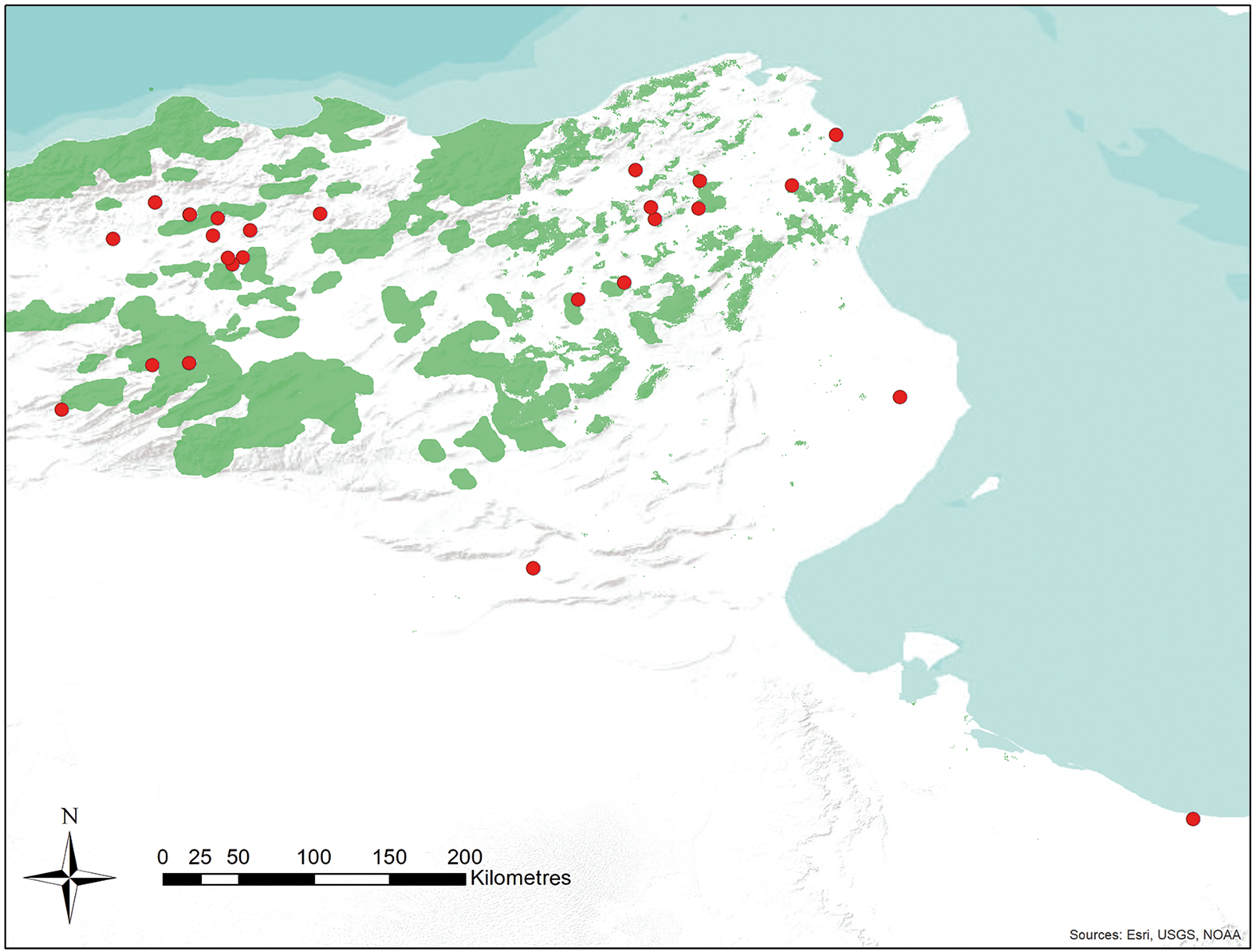
Like many parts of the Mediterranean, Africa Proconsularis was a tessellated landscape.Footnote 16 Today, the region can be divided into at least nine distinctive bioclimatic zones, ranging from humid and sub-humid in the north to Saharan desert in the south (Fig. 2).Footnote 17 Behind the Mediterranean coast rises the easternmost spur of the Atlas Mountains, creating the Tunisian Dorsal, which separates a steppe zone to the south from the more humid Tell to the north. The northern zone is characterised by its diversity, with permanent rivers, seasonal streams (oueds), broad plains used for cerealiculture and pasturage from at least the Iron Age, and hills. Both Thignica and Thugga sit in the Tell, and it is on this region that I will focus.
Map of bioclimatic zones in Tunisia, with sites discussed in text. (Map: author, after Division des ressources en eau et en sol, Ministère de l'agriculture 1976)

Forests are a significant feature in the modern landscape of this region. While both climate shifts and human impacts have had significant effects on North African forestlands, the picture in modern times points to these spaces as both productive and important (if often overlooked). In 2010, the Dorsal, Tell and far north of modern Tunisia contained over 1 million hectares of forest land. Around two-thirds of the modern forest zones are made up of Aleppo pine (Pinus halepensis), capable of withstanding drought and growing in the mountainous zones of the Tell and Dorsal; much of the rest is oak (especially the cork oak, Quercus suber, and zean oak, Quercus faginea) and cypress, especially in the more humid northern zone.Footnote 18 Of course, this contemporary snapshot is very much the product of historical processes. Roughly 60 per cent of this modern forest is the product of policies to re-plant forests in the post-colonial period, but is also an indicator of the minimum forestland that modern environmental conditions might support.Footnote 19 The French colonial period — and especially the first half of the twentieth century — was a documented period of vast deforestation that helped to create the landscape visible today, and which was present in the minds of many twentieth-century scholars of North Africa. In the case of the Aleppo pines in the Tell and Dorsal, much of this deforestation was directly linked to the harvesting of timber to support mining during the two World Wars.Footnote 20
As for the use of these modern forests, roughly 10 per cent of Tunisia's population today lives in forested land, or 23 per cent of the rural population of the country; in 1942, it was estimated that around 6.5 per cent of Tunisia's population, and over 12 per cent of the population of neighbouring Algeria, relied primarily on forest resources for their livelihood.Footnote 21 These forest-users were explicitly identified as ‘indigènes’ — that is, not European colonists — in Pierre Boudy's account of North African forests under French rule.Footnote 22 The forest is an important feature of the landscape and lifeways in modern times: not an insignificant, meaningless, or empty space.
Nineteenth-century travellers also commented on the forests in this region. In 1877, the Scottish traveller Lambert Playfair noted the lushness and abundance of trees in the area around Testour: ‘Even the lentisk, which in the shape of tufts of scrub, covers the whole country, seemed to have changed its nature, and grew here to the size of forest trees, shading the road with its dense evergreen foliage’.Footnote 23 Further south, in the Dorsal and the region around Kasserine, Playfair describes the landscape as ‘covered with wood, chiefly pines and cedars, stocked with game’.Footnote 24 This mountain zone impressed nineteenth-century foreigners with its lush vegetation and liveliness.
The same appears to have been true in antiquity; indeed, contemporary and pre-colonial conditions may offer a rough-and-ready point of comparison for what could have existed under the early empire. A host of ancient literary accounts mention the forests of eastern Algeria and Tunisia. Herodotus describes the lands west of the Syrtes as ‘mountainous and wooded and full of wild beasts’.Footnote 25 Juvenal can use the monkeys populating the shady forests of the saltus Thabraca (modern Tabraca) in a simile; the forest fauna were well-known to Rome.Footnote 26 Other authors describe battles in forests, whether during the Punic Wars, the war against Jugurtha, or the Byzantine reconquest.Footnote 27 The Byzantine general Solomon is said to have fallen in battle in the forests (silvis) near Cillium, close to the find-spots of some of the Roman-period dedications in question.Footnote 28 Set on the edge of the Tunisian Dorsal, the mountain range around Cillium which separates the steppe to the south from the Tell to the north, with its mountain slopes and semi-arid conditions, is today prime land for the growth of oak and pine forests.Footnote 29 Corippus also names a number of enemy tribes who lived in forested zones, although locating these groups geographically remains a subject of debate.Footnote 30 The landscapes of the mountainous interior of Africa were clearly imagined by Roman authors as woodland landscapes.
Of course, literary accounts may be bound up with imagination and trope, or reflect perceptions of landscape and resources alien to the inhabitants of the region. But both place-names and pollen sequences also point to the importance of forest lands in parts of the Tunisian Tell and Dorsal.
We know of a number of pieces of land — mostly in Africa Nova and, by the middle of the first century c.e., owned by emperors — designated as saltus. This title was probably applied to them in the first century b.c.e., as the landscape was being surveyed, divided and exploited for the benefit of elite estate-owners.Footnote 31 Modern scholarship tends to translate saltus simply as ‘estate’, and to treat the term as a synonym for villa or praedia. Footnote 32 There are certainly good reasons to think the term may have acquired such a general meaning by the time agrimensores were writing their handbooks under the high empire.Footnote 33 Yet in the late Republic, as these African tracts of land were being named, the jurist Aelius Gallus offers a much more restricted definition of saltus: ‘a place where there are woods and pastures’.Footnote 34 On this definition, a saltus was not cultivated land, but land given over to non-agricultural forms of exploitation, due to its physical characteristics and vegetation. Elsewhere in the late republican period, saltus were used to support grazing, and — through the imperial period — might be overseen by saltuarii, a position that seems largely to have been akin to a forest ranger.Footnote 35 The woodland connotations of the term are central, and perhaps, in this part of North Africa, almost synonymous with pasture; in post-antique ethnographic accounts, the main use for the pine-covered lands of the Tell and Dorsal is as grazing land.Footnote 36
This formal division between terms for ‘estate’ and saltus seems to have been a key part of how landscape was conceptualised in Africa. At Hippo, we hear of a procurator ad praedia saltus Hipponiensis et Thevestinus.Footnote 37 The estate (praedia) is clearly distinct from the forestal descriptor: ‘procurator at the estate of the Hippo and Theveste Forest’. Likewise, another inscription from Aïn el-Djemala makes a distinction between the saltus Neronianus and the fundus Neronianus.Footnote 38 The saltus seems to be a portion of the fundus, and shares the name of the estate on which it sits. The term saltus may well have had its own semantic range, indicating how land might differ in its vegetation cover (forests) and functionally (used for things other than agriculture) from cultivated fields.
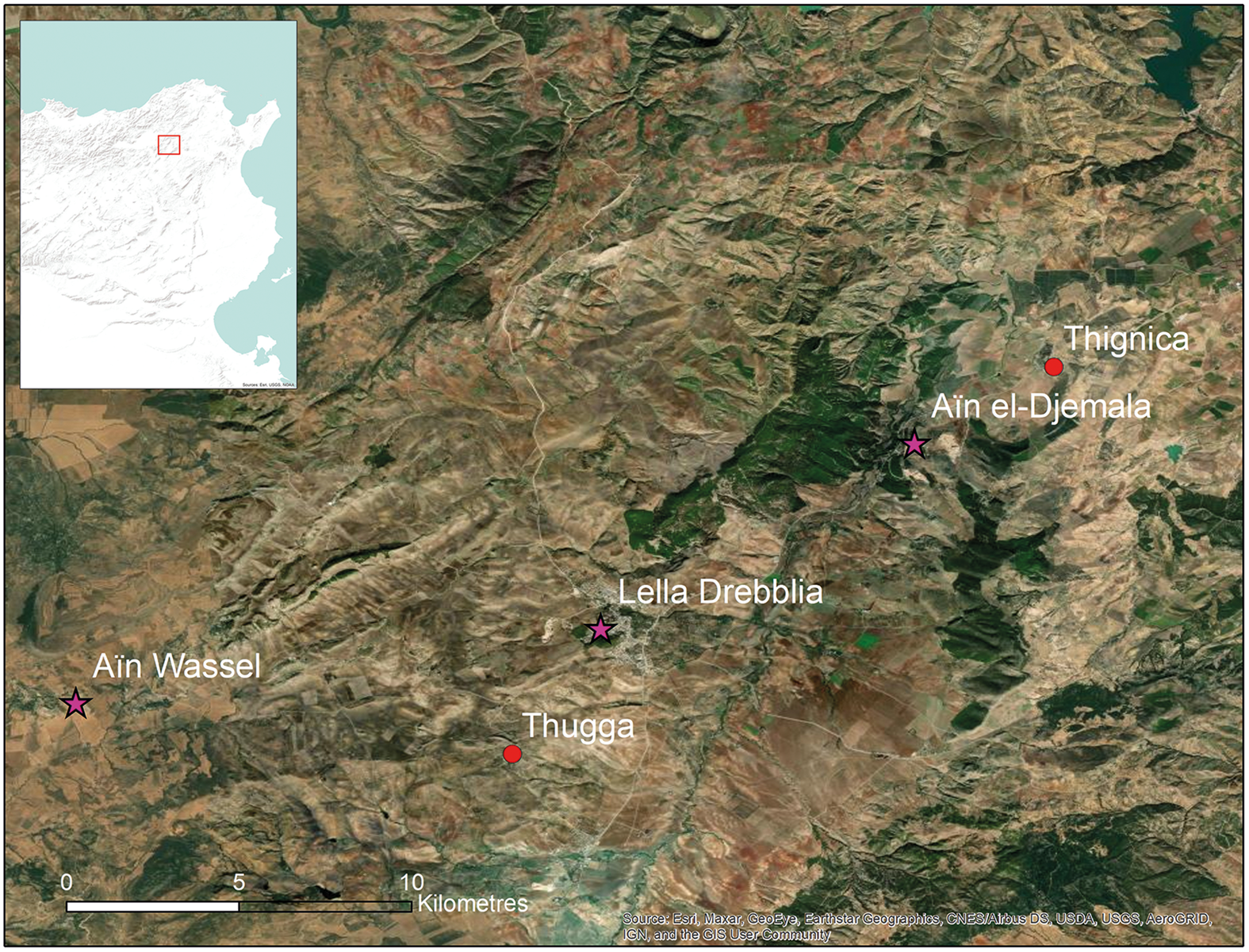
It is noteworthy that of the African inscriptions that refer to saltus, almost all come from hilly and mountainous zones that are close to, or within, modern forest-zones. Three of these inscriptions come from the particular area with which we are concerned, and suggest woodlands (and pastures) nearby (Fig. 3). All three seem to deal with related circumstances; at least, all three quote the same pronouncement of the procurators of those (forested?) estates, even if their immediate contexts are more localised disputes. All revolve around requests to cultivate these saltus under the terms of the lex Manciana by converting lands that are deemed ‘swamp and forest’ (in paludibus et in silvestribus) into agricultural plots. Although at least some of the lands on the saltus had been centuriated and leased out, it seems that significant portions of them were not being used for olives, vines, or cereals (the crops whose cultivation the emperor sought to encourage).Footnote 39 In the immediate hinterland of Thignica, a Hadrianic inscription from Aïn el-Djemala (about 6 km to the southwest of the town) refers to the Saltus Blandianus, the Saltus Udensis and the Saltus Tuzritianus (which includes the formerly independent Saltus Lamianus and Domitianus).Footnote 40 These same saltus are mentioned again in another Hadrianic inscription from near the marabout of Lella Drebblia, roughly 10 km to the southwest.Footnote 41 They appear a third time at Aïn Wassel, near a wooded, hilly plateau, this time a bit further (22 km) to the southwest of Thignica.Footnote 42 Triangulating these texts, it stands to reason that these saltus can be localised in the immediate area to the southwest of Thignica, and presumably stretched for a considerable distance. This makes geographic sense; even today, the land around Aïn el-Djemala and west of Thignica includes the Testour Forest. This hilly zone was well suited for the growth of Aleppo pine and related tree species; the parcel-names and inscriptions describing a push to convert land-use to agriculture strongly suggest the presence of forests here in antiquity.
Saltus inscriptions discussed in text. (Map: author; basemap: Esri, Maxar, Earthstar Geographics, USDA FSA, USGS, Aerogrid, IGN, IGP, and the GIS User Community)
Other African saltus similarly appear in zones that are currently defined by forests, and probably were in antiquity too. The saltus Massipianus probably covered Dorsal forests near Thala.Footnote 43 An inscription related to the saltus Beguensis, named for the tribe occupying the territory rather than an elite landowner (although by 138 c.e. it was part of an estate owned by the senator Lucilius Africanus), comes from Hr. el-Begar, at the base of a now forested ridge in the Tunisian Dorsal.Footnote 44 There may also have been a saltus Thibaritanus near Thibaris.Footnote 45 The saltus Hipponiensus et Thevestini must have been a significant patch of woodland, stretching from the coast inland to Theveste; it is worth noting that nineteenth-century travellers also flagged the dense forests in this region.Footnote 46 The saltus Sorothensis is mentioned on a dedication to Saturn as genius of the saltus; this inscription was found reused in the Byzantine fort at Ksar el-Ahmar, cupped between two ridges in a forested zone of western Proconsularis. The same pattern — of saltus set close to hills and to forest lands — holds in Numidia as well.Footnote 47
The evidence strongly suggests that these African saltus were not simply ‘estates’: they were tracts of land that were named and defined by virtue of their appearance and non-agricultural function. In the first centuries b.c.e./c.e., as these spaces were defined, bounded and recognised as discrete parcels of land, they were named in a way that seems to have recognised their wooded and non-agricultural character. Much of this territory may have continued to be forested at least down to the Hadrianic period, when imperial policy embraced the re-purposing of such lands for particular forms of agricultural exploitation.
Beyond literary imaginations and place-names, analysis of pollen preserved in the sediment of lagoons and offshore areas offers more direct evidence for ancient vegetation in the region (Fig. 4). However, because pollen caught in sediments often derives from the immediate vicinity of the wetlands in which it is preserved, it offers an extremely localised picture of ancient conditions within very broad chronological bands, and there is no direct evidence from the Tell/Dorsal regions.Footnote 48 Overall, though, the picture from pollen sequences reflects the tessellation of Africa into distinct bioclimatic zones, and indicates a general stability in the kinds of vegetation growing in each zone from around 2000 b.c.e. down to the modern period. Of course, there is also evidence for the intensification of agriculture — including through the introduction of new crops — and for a substantial level of deforestation. There can be no doubt that forest land was cleared during the imperial period for many reasons; but there can also be little doubt that forests continued to be a significant and heavily utilised feature of the landscape in the imperial period.
Sites with pollen samples. (Map: author; basemap: Esri, USGS, NOAA)
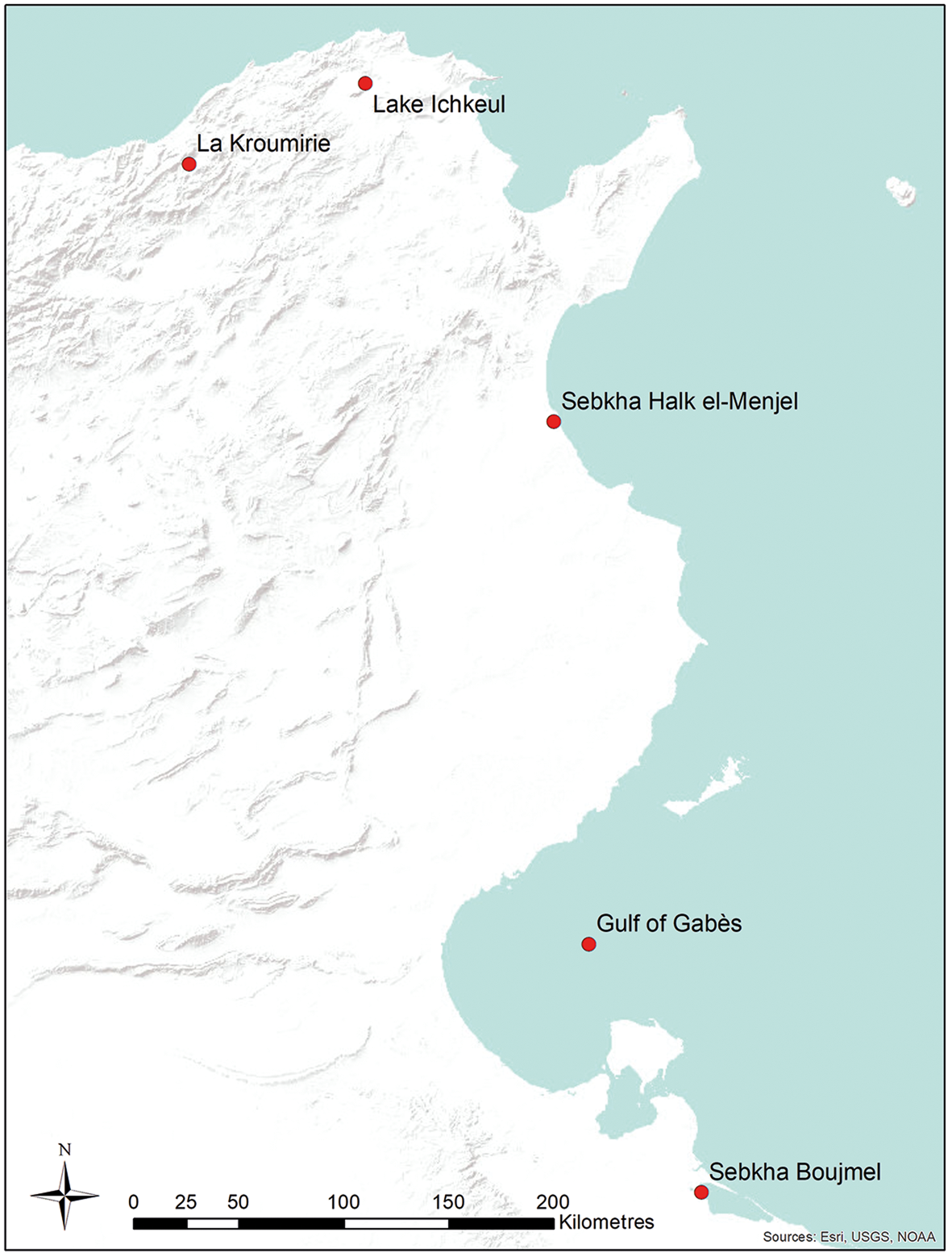
One of the closest pollen sequences to the Tell comes from Sebkha Halk el-Menjel, a lagoon in the Sahel just north of Sousse. While the sequence reflects the rapid spread of wild olives in the Late Holocene, it also indicates another important shift. Between c. 1696 cal. b.c.e. and the modern period, the pine pollen rate — attributed to pollen rains from the Dorsal — drops from around 20 per cent to around 5 per cent.Footnote 49 There seems to have been, in other words, a massive deforestation between the second millennium b.c.e. and 1969, when a flood deposited a heavy layer of sediment on the bottom of the lagoon. Unfortunately, the exact period of this transition is unclear, although one likely candidate is the documented clear-cutting of Tunisian forests to support iron production during the World Wars.
A palynological study based on a series of cores taken in northwestern Tunisia, in the region of La Kroumirie, also suggests heavy forestation during the last two millennia b.c.e. and through much of the post-antique period, although the authors also suggest there is evidence for deforestation in the increase in scrub (especially tree heather, Erica arborea).Footnote 50 The zean oak (Quercus canariensis) dominates the pollen record here, complemented by the cork oak (Quercus suber); in several cores, there appears to be a drop in the pollen from both species at some time in the first millennium b.c.e. The authors connect this with increased exploitation of wood resources and clearing land for agriculture, starting in the period of Phoenician colonisation.Footnote 51 This picture is largely confirmed by another core from Bourdim, which shows some oak (Quercus suber and some ilex), but mostly scrub (tree heather), albeit with a sharp decline that corresponds with an increase in olive pollen.Footnote 52 Under Roman rule, forests were being cleared at a rapid rate to turn land to agricultural use. The northern zone of Africa Proconsularis was, in other words, a semi-forested zone dominated by oak in the Iron Age and Roman imperial period, but one that may have been heavily cut in the historic period.
Nearby, a core in Lake Ichkeul — also in north-central Tunisia — paints a slightly different picture. An increase in cork oak (Q. suber) pollen from around 1900–1500 b.p. points to a period of forest recovery in the early imperial period, although with a marked period of forest disturbance and rise in juniper and pine pollen in the middle of the period.Footnote 53 This was followed by a period of intense deforestation, which intensified from around 1200 b.p. The proposed chronology for this pollen sequence, though, is much less precise than others, and based primarily on linear extrapolation from very few 14C dates. Still, these data indicate significant forested land in antiquity, as well as suggesting how differently the land was utilised across micro-regions.
Pollen from further south also hints at both diachronic stability and regional diversity. We have a fragmentary series of pollen sequences from the Gulf of Gabès, off the coast of the southern Tunisian Sahel. This series, unfortunately with a significant gap in the Roman period, reflects the steppe-like conditions of the region throughout the historical period: some Pinus (the dominant tree), a prevalence of Artemisia species, and a marked uptick in Olea some time between around 3000 cal. b.c.e. and 980 cal. c.e. The region seems to have been consistently steppe-like, but with more semi-arid lands brought under olive cultivation in the historical period.Footnote 54 Pollen analysis at the Sebkha Boujmel, in south-eastern Tunisia (near Djerba), suggests that the historical period was dominated by steppic species — grasses (Poaceae) and scrub — with very little arboreal pollen; this zone was a grassy steppe (with perhaps increasing pastoralism from the first millennium onwards), akin to what is visible today.Footnote 55
In other words, the pollen suggests general bioclimatic stability through the Late Holocene. Early modern travellers therefore may well have encountered essentially the same range of vegetation as existed in antiquity, rendering their observations useful. In the Iron Age and Roman periods, this was a tessellated landscape of very distinctive bioclimatic zones: oak forests in the north, pine forests in the Tell and Dorsal, and steppes further to the south and in the Sahel. Indeed, even when changes in climate have been suggested, such shifts may suggest an even greater extension to the potentially forested zones as compared to their modern distribution.Footnote 56 And despite the diachronic variability of climate (due both to long-term fluctuation and to the yearly shifts that have long impacted life in North Africa), the vegetation of the region has remained largely stable.Footnote 57 There does, though, seem to have been one or more periods of deforestation between the Bronze Age and modern times. This suggests that different strategies of exploiting available resources were possible: what worked in the north, with its declining oak forests, may not have shaped practices in the semi-arid steppes of the southern Sahel, and neither may have resembled practices in the pine-forested lands of the Tell or Dorsal.
Further environmental proxies may hint at even more prominent forest-cover in the Tell and Dorsal in antiquity — or at least conditions that favoured such coverage. Botanical macro-remains from the bottom of the mid first-millennium b.c.e. channel of the Medjerda River suggest slightly more humid conditions in the region during the late Iron Age/Roman periods.Footnote 58 An increase in the salinity of Lake Ichkeul also suggests drier conditions in the Late Roman period than existed previously or in more recent times.Footnote 59 Studies of soil sequences in the Medjerda floodplain suggest that large-scale soil erosion from slopes (attributed to removal of vegetal cover) did not occur before the fourth century c.e., hinting that forests or cultivated groves on the hillsides flanking the valley may have remained intact through much of the Roman period.Footnote 60 Taken together, these data suggest that environmental conditions in antiquity were conducive to forest cover, and increase the likelihood of vegetation along slopes in the Tell.Footnote 61
This is not to downplay what must have been a significant pattern of land clearance in the later first millennium b.c.e. and early first millennium c.e. High-quality archaeological surveys in every region — northern Tunisia, northeastern Algeria, the hinterland of Thugga and the hinterland of Cillium — all show a marked increase in the number of archaeologically visible rural sites in the imperial period, many with evidence for agricultural processing.Footnote 62 The inscriptions discussed above, indicating the conversion of saltus to agricultural land, also point to shifts in land-use and probable deforestation. Similarly, much further west, in the Rif and Middle Atlas of Morocco, pollen samples point to large-scale deforestation beginning around the turn of the millennium, and linked to intensified mining and smelting under Roman rule.Footnote 63 Still, forests certainly continued to be an important — if shrinking — part of the landscape of Roman Africa; the rhythms and ramifications of this deforestation matter less for my purposes than the broader recognition of the existence of these significant tracts of wooded landscape.
III FOREST PRODUCTION
The presence of forest land, probably mostly of Aleppo pine and related dry Mediterranean species, in the Tell and Dorsal regions — evident in ancient and modern descriptions as well as suggested by the palynological record — does not in itself mean that these forested zones were exploited or significant to ancient inhabitants.Footnote 64 Indeed, many modern accounts assume that two archaeologically attested practices — the use of ceramic tubes to provide frames for vaulted architecture, and the use of olive-pressing waste as kiln fuel — are evidence for the lack of forests and their exploitation in Roman Africa; surely (the argument goes) wood would have been used for both if it had been available and harvestable. But this assumption is grounded on the notion that the wood-consuming practices of Europe were the technological default everywhere in the empire. There are better ways to explain technological choices that are not dependent on privileging European practice and that have nothing to do with the availability of wood. Rather, there is ample positive archaeological and literary evidence (both direct and indirect) that these forest spaces were in fact vitally significant economic resources for the inhabitants of Iron Age and Roman Africa.
The use of terracotta vaulting tubes as centring for arches — a technique popular mostly in the Maghreb — has often been attributed to the lack of available construction timber.Footnote 65 After all, in other parts of the empire, wooden frames were used for building stone and concrete arches. But there is in fact plenty of evidence for timber centrings in Africa. The Baths of Memmia at Bulla Regia, a site in the northern Tunisian Tell, seem to have used wooden centring for some arches, while others may have used terracotta tubes.Footnote 66 The excavators note that there may have been reasons to prefer one medium over the other (cost, time, complexity of vault) beyond resource availability.Footnote 67 Lynn Lancaster — without denying possible deforestation in the Roman period — comes to a similar conclusion, suggesting that a combination of readily available, cheap ceramic production, relationships between builders and (clay) materials suppliers, and the particular labourers involved in a project might have driven the particular popularity of vaulting tubes in Africa.Footnote 68 Here as elsewhere, technologies and practices were not solely — or even primarily — contingent upon the dearth of a particular resource.
The other ‘evidence’ for limited wood supply comes from the use of olive pomace (the waste left over from pressing olives into oil: skins, flesh, stones) in kilns at a number of sites. At Oudhna, charred olive waste was found in a late antique pottery kiln;Footnote 69 at Leptiminus, in the Sahel, large quantities of charred olive pips were found among other kiln waste;Footnote 70 the same is true of recently excavated kilns at Utica.Footnote 71 The major sites for the production of African Red-Slip pottery (ARS) seem to have been located near major olive-producing regions, and it has become a ‘fact’ that this reflects the use of pressing waste as fuel for the kilns.Footnote 72 Lime kilns at Carthage seem to have been powered by pomace as well: charred olive stones were found incorporated in the mortar of the House of the Greek Charioteers, presumably during the cooking of the lime.Footnote 73 Similarly, at the Baths of Memmia, significant quantities of carbonised olive stones were found in the furnace, implying that olive waste was used to heat the complex.Footnote 74 In addition to olive-pressing waste, the furnace did in fact also contain some carbonised wood: mostly olive (presumably also waste from oleoculture), but also some mastic.Footnote 75 This use of olive pomace as a fuel source has long been used to argue for the lack of available wood resources across North Africa, or deforestation caused by clearing land for agriculture.Footnote 76
But here, too, the evidence is less than clear. The published and excavated kilns tend to be far from the forested zones of the Tell/Dorsal, and may simply represent different strategies of resource use. Wood may not have been the default or even the preferred fuel source; to select wood or wood that had undergone processing into charcoal as fuel was also a choice. The production sites for ARS may well have had access to both kinds of fuel: the olive-producing zones where ARS production centres were located were also close to potentially forested regions of the Tell and Dorsal. Until more kilns are excavated and charcoal reports published, it is impossible to assert that the industry was structurally dependent on one fuel over another. At coastal sites like Carthage, Utica and Leptiminus, wood may indeed have been harder to source and more costly. But pomace also had a host of potential advantages over wood where it was available: it offered a cheap, high-potency fuel that doubled as a waste-management system for the major agricultural producers in the region. Processing the leftovers from oil production required less labour (and cost) than cutting fresh wood (used in the north-west provinces, zones without olive industries) for fuel. Olive waste might well have been chosen for high-demand industrial applications even if wood was available as an alternative fuel source.Footnote 77 To assume that wood was the ‘default’ fuel for pyrotechnical activities is to set northern European regimes of practice as a standard.
Distinctive regional habits of wood use can also be seen in non-industrial uses of charcoal at multiple sites, which underline the importance of wood resources in the Tell and Dorsal. Excavations at Althiburos offer the most detailed charcoal analysis for the region, capturing a broad chronological span.Footnote 78 Although the charcoal data come from a series of small trenches around the centre of the Roman-period urban core, it seems to reflect generalised usage across the site, especially from Iron Age domestic waste. In all periods up through the high Empire, Aleppo pine dominates the charcoal assemblages, making up between 75 and 92 per cent of all of the charcoal in each phase. Aleppo pine also provided the fuel for metallurgical production in the eighth century b.c.e., although this was before intensive oleoculture began in the region. There is little evidence for environmental change over the period studied; instead, the same forest resources and species provided charcoal fuel and building material in each phase, although there is some evidence for the expansion of the intensity and range of wood collection to include more cultivated species, more brush (like Pistacia sp.) and hydrophilic species which flourished closer to oueds (Ulmus, Salix).Footnote 79 Even so, the importance of dry Mediterranean forest zones for supplying the site throughout antiquity is clear; these forests were a key part of local economies and consumption practices.
Similarly, excavations of a sixth- to eighth-century c.e. farm at Aïn Wassel produced a range of carbonised remains, including wood that probably came from local sources: mostly olive wood from the groves that dominated this region, but also pine, juniper, cypress, and ash.Footnote 80 The assemblage also included a significant quantity of Pinus pinea (stone pine); the excavators suggest that the stone pine may have been cultivated in the region for its pine nuts. At both Carthage and Leptiminus, there is evidence for the consumption of pine nuts.Footnote 81 Arboriculture (or forested land) in antiquity stretched beyond the zones and forms recognisable in the contemporary landscape.
Further afield, charcoal sequences reflect different resource-management strategies. At Utica, sitting in a rather different bioclimatic zone, mastic (Pistacia lentiscus) in the early first millennium b.c.e. gives way almost entirely to olive wood in the imperial period; pine species are rare, and it has been suggested they represent waste from construction using imported materials (either from the mountains nearby or from Sardinia).Footnote 82 That agricultural waste (olive branches) served as the primary fuel only suggests that forests were not exploited for firewood here; it does not mean they were not present or used for other purposes. It is also worth noting that along the north coast of Tunisia, oak species predominated in earlier periods, and the palynological data suggests that they may have been more extensively cut down in earlier periods. Again, greater attention to regional variation and resources is necessary.
Wood was also, of course, an essential primary material in its own right, with a number of uses (construction, furniture- and tool-making among others).Footnote 83 Augustine describes women coming to Hippo from nearby Mount Giddaba to sell wood in the city; this was seemingly a regular occurrence, and a central economic endeavour for the inhabitants of the mountain landscape.Footnote 84 Of course, the lack of wood in the archaeological record has led to its importance being downplayed. Still, there is ample evidence at nearly every site for wooden construction.Footnote 85 From hand tools like the falces on Annaenus’ stele, with an iron blade attached to a wooden handle by a tang, to the levers that drove the region's omnipresent oil/wine presses, the tools that fuelled North Africa's economic boom demanded wood in their production and (no doubt frequent) repair.Footnote 86 In the colonial period, Aleppo pine was widely used for making everything from shovels to ploughs to threshing equipment.Footnote 87
Aside from wood itself, other forest resources played a key role in the economic life of the province. Hunted forest species appear in many of the faunal assemblages from archaeological sites across Africa, although admittedly never in large numbers and presumably not serving as a major source of sustenance.Footnote 88 Nonetheless, most of the attested faunal assemblages derive from urban, coastal centres and elite contexts, rather than the rural and forested zones where game might have been a more important contributor to diet. At Althiburos, only the domesticated animal remains from excavations around the Capitolium have been published; the presence and importance of the (still unpublished) wild game species is only hinted at in the report.Footnote 89 The excavators report that bones from deer (Cervidae) and other wild species were present at all levels, and made up between 3.5 and 6.1 per cent of the NISP during the imperial period (an increase from the pre-Roman levels at the site).Footnote 90 At Thugga, by contrast, wild species were rare in the material collected during excavations in 2001–2002, and included only hare (Lepus europaeus) and perhaps the Barbary sheep (Ammotragus lervia), each representing around 1 per cent of the total assemblage.Footnote 91 The only excavated rural settlement with a published faunal report is the late antique (sixth- to eighth-century c.e.) farm at Aïn Wassel; there, hunted species were also rare, although the inhabitants enjoyed a rather urbane diet that included coastal products like conch and saltwater fish.Footnote 92
Even if game played a limited dietary role at those sites with published faunal assemblages, woodland hunts were certainly among the most popular mosaic motifs in third-century Proconsularis.Footnote 93 Such images, bound up in the self-representation and status construction of elite homeowners, suggest that if animal forest resources offered little in the way of direct economic capital, they did play a key role in amassing social capital. Furthermore, wild animals were also one of the region's luxury exports, especially as fodder for spectacles; venationes in Rome advertised African animals (regardless of actual origin) for the cachet of the ‘brand's’ fierceness and exoticism.Footnote 94 The real origin of such animals is often placed further west, in the High Atlas, or in far-flung places like Ethiopia and Saharan/sub-Saharan Africa.Footnote 95 Outside Africa itself, tracing the exact source of ‘African’ animals that appear in literature, images and faunal assemblages is nearly impossible.Footnote 96 Still, even in the Tunisian Tell and Dorsal, wild animals certainly existed. Juvenal's Thabracan monkeys, in the more humid oak forests of the north, have already been flagged.Footnote 97 The Barbary lion — driven extinct in the French colonial period — prowled the forested mountain zones of the Tunisian Tell as well as arenas and private ‘zoos’ throughout the empire.Footnote 98 Lions appear regularly on stelae dedicated to Saturn in North Africa, especially on the fringes of the mountain forests.Footnote 99 Indeed, it has even been suggested that the popularity of animal hunts rather than gladiatorial games on mosaics in Proconsularis might speak to the importance of ‘local’ animals in spectacles.Footnote 100 The business of provisioning wild animals was certainly an important one for individuals and groups in the region; whether this included employing inland hunters and trappers in the Tunisian mountains is less evident, but certainly possible.
Leather and leatherworking also seem to have played a role in Roman Africa. Woodlands offered not only pasturage for animals, but the raw materials (vegetal tannins) required for the tanning of leather. In the nineteenth century, the bark of Aleppo pines and oak fuelled this industry in rural Tunisia.Footnote 101 There is, it is true, little in the way of direct archaeological evidence for tanneries and their consumption of forest resources in Roman Africa. Still, there is indirect evidence. Carcass-processing in the wider Roman world was an efficient endeavour: where there was animal raising, there was butchery, leather-working and bone-working, leaving little of an animal unused.Footnote 102 These latter industries are well attested in Africa Proconsularis.Footnote 103 Further afield, in Numidia, the 202 c.e. Zaraï tariff presumes that the products of pastoral economies would pass through the town: it has entries for ‘finished leathers’ (corium perfectum) as well as semi-worked and unworked animal hides, presumably destined for tanneries and manufactories within Numidia (and perhaps ultimately supplying the heavy army demand for leather goods in this militarised zone).Footnote 104 The demand for bark and/or wood to support tanning industries may have been substantial.
Pine forests provided other foodstuffs and products as well. The Aleppo pines that were widespread in the Tell and Dorsal produce pine cones with nuts; less famous and widely used in modernity than those of Pinus pinea (the stone pine), Aleppo pine cones were regularly harvested in Neolithic Tunisia, and their nuts may have been a staple in the Capsian diet.Footnote 105 In contemporary Tunisia, these are still a common snack called zgougou; in 2012, Tunisian households consumed an average of 1.5 kg of Aleppo pine nuts per year.Footnote 106 And there may be evidence from the Roman period for a similar use of Aleppo pine nuts, whose harvesting and consumption would leave little archaeological trace. In two surveys of the Dorsal — one around Ammaedara, the other around Cillium — several undated kilns were found that seem to have been used (perhaps among other things) for the warming of pine cones so that they would open to render the seeds harvestable.Footnote 107
Yet one of the most essential forest products that must have undergirded the ‘North African boom’ and the export of commodities like oil, wine and fish sauce has been utterly ignored in modern scholarship: pitch. These economic staples of Africa Proconsularis were all packaged in pitch-lined amphorae. Pine resin must have been one of the most important and largest-scale products derived from forested zones.
Olive-oil production has long been seen as the main driver of North Africa's ‘economic boom’ from the second century c.e. onwards, thanks both to archaeological evidence for production (olive milling stones; press parts) and export (amphorae) and the retrojection of French colonial economic models.Footnote 108 The importance of wine as an export from Proconsularis was long downplayed, but its role has more recently been recognised.Footnote 109 The importance of fish products is attested not only from significant groups of fish-salting ‘factories’ along the coast, but also from the diffusion of amphorae that may have carried North African fish products across the Mediterranean.Footnote 110 All three products contributed substantially to the export economy of the region.
Without delving into which amphora types carried which products, suffice it to say that all three products were exported in amphorae produced in great quantities at coastal sites throughout Proconsularis.Footnote 111 Although both oil and wine seem to have been brought from inland production zones to ports in skins or barrels (another use for wood which is often ignored),Footnote 112 they were repackaged for export in ceramic amphorae for maritime transport.Footnote 113 Most of these amphorae would have been lined with a cooked tree-resin product (in generic terms, pitch) to seal them.Footnote 114 It has long been thought that only wine and salt-fish amphorae were pitched; indeed, the visible presence of pitch has been used as a way to identify an amphora's use as a container for shipping wine rather than oil. But more recent analyses of amphora contents demonstrate that both wine and oil amphorae were pitched; oil simply degraded the pitch lining, rendering it invisible to the eye, but still detectable through chemical residue analysis.Footnote 115 It is now clear that sealing the inside surfaces of amphorae with pitch was the norm for all contents. In other words, tree resin and its more processed forms were necessary to support the major African export industries.
The demand for pitch must have been significant; but where was this resin produced? A number of heavily forested regions in the Roman Mediterranean — especially the Pyrenees — may have specialised in the production of pitch for export markets.Footnote 116 Places like Egypt almost certainly imported pitch, probably from the Levant.Footnote 117 But evidence for pitch in shipwreck cargoes seems to suggest that it largely circulated within Europe (Gaul/Spain/Britain);Footnote 118 despite the dearth of excavated wrecks with cargoes destined for Africa Proconsularis, it seems less probable that resin and pitch were imported from Gaul, given the limited amount of direct trade between these two regions. Similarly, pitch produced in southern Italy seems to have been used primarily within southern Italy;Footnote 119 where pitch could be produced locally, it was. Indeed, the Zaraï tariff includes entries for both resina and pix, demonstrating the production and exchange of pitch within North Africa along the edge of a mountainous (and forested) zone.Footnote 120 The harvesting of resin from Aleppo pines in Proconsularis itself seems likely. Indeed, James Bruce notes a thriving pine-pitch industry in the late eighteenth-century Tunisian Dorsal;Footnote 121 the demands for such a product must have been even greater in the Roman period.
The lack of direct evidence for pitch production in Roman Africa is not decisive; after all, the focus on monumental, urban sites and stone-work in North African excavation and survey would be unlikely to identify rural pitch furnaces. Indeed, beyond monumental remains, extra-urban industrial sites are identified primarily from surface pottery or durable material scatters, patterns which privilege the visibility of pottery and lime kilns. Other furnaces, when found, are rarely explored to determine their use when surface scatters do not readily reveal their function. There are also many archaeologically invisible ways to extract resin and produce processed resin products, especially when large quantities of charcoal are not necessary to support other local industries and alternative fuel sources (such as pomace) are available. Resinous trees like the Aleppo pine can simply be tapped to collect their resin: this was traditionally done by creating a wound in the surface of the tree (with an axe or the point of a billhook, like the one pictured on Annaenus’ stele) and collecting the resin that drips out.Footnote 122 This method was recognised by Theophrastus, especially for what was probably the Aleppo pine.Footnote 123 The resin can then be cooked with additives (in examples of Spanish amphorae, these included oil and lime)Footnote 124 to create pitch; this does not require unusually high temperatures or exotic materials, and could have been done over non-monumental fire-pits. Such fire pits — which would be nearly archaeologically invisible — are still used for large-scale pitch-production operations in parts of the Moroccan High Atlas.Footnote 125 In short, this whole process could require no kilns and leave no significant archaeological traces.
That said, where archaeological evidence for pitch production in the Iron Age and Roman worlds has been found, it suggests that a different, and more destructive, form of pitch-making was practised. The evidence is confined to the wood-rich zones of temperate Europe and takes the form of pitch kilns, sometimes with charcoal pine logs inside.Footnote 126 In the Pyrenees, for example, there is evidence for dedicated resin-extracting furnaces, used according to methods described by Theophrastus and Pliny.Footnote 127 Pine trees would be chopped and the logs slowly cooked in an oven to extract resin.Footnote 128 The pine logs would, in the process, create charcoal that served as another important product of this process and supported other industries. Of course, even beyond the Pyrenees and temperate Europe, pitch might be produced by cooking wood. Studies of the chemical composition of pitch used to line amphorae from Italy show that they contained methyl-dehydroabietate, a compound created when gaseous methanol is produced from burning wood during the extraction of resin.Footnote 129 The implication is that the pitches used in Italy were produced in the manner seen in temperate Europe.
The difference in extraction techniques — tapping, which leaves a tree alive (but has an impact on growth and can, through successive tappings, kill the tree),Footnote 130 and cooking logs, which is destructive — is an important one not only for understanding the potential for the process to leave archaeological remains, but also for modelling the effects of pitch production on woodland ecosystems in North Africa. The destructive model seems to have been preferred for amphora linings in other parts of the Roman world. It can probably be assumed for the Maghreb as well, although with the caveat that there were many regionally specific technological practices in various parts of the economy (vaulting tubes, pomace fuel: see above). But definitive answers to the nature and scale of pitch production in the region require greater archaeological attention to non-agricultural productive practices and more chromatographic analysis of African amphora linings.
Even a rough estimate of the scale of pitch-production necessary to line the amphorae exported from Africa suggests that this was a substantial industry. Papyrological evidence related to pottery-making in Roman Egypt offers some clues to the quantity of pitch needed for a vessel.Footnote 131 One of the major oil-carrying amphora-types exported from eastern Tunisia, the Africana I, had a capacity of around 42 l; assuming a roughly cylindrical interior, this would need around 0.144 kg to cover its interior surface. This suggests that, per litre of olive oil exported in an Africana I amphora, 3.4 g of pine-pitch would be needed. Based on the number of presses found in the area around Cillium, a town in the Dorsal whose growth owed much to intensive olive-oil production from the late first century c.e., Matthew Hobson has estimated that the city's hinterland might produce around 364,300 l of oil in a single year.Footnote 132 Of course, not all of the oil produced in Cillium was destined for export in amphorae. But even if only half made its way to the coast to be packaged in Africana I amphorae, a single year's oil from the Cillium region might require 26,230 kg of pitch. Even with this very rough approximation, we can begin to see the scale of pitch production necessary to support other export industries in Africa, with a large number of towns and their territories producing amphora-packaged exports beyond oil. This was no minor industry: it involved significant material and labour.
Even this brief survey of direct and proxy evidence suggests that forested lands played vital economic roles in Africa Proconsularis (and, presumably, Numidia). They were not empty and unproductive spaces, but full of labourers harvesting a plethora of resources that provided not only wood, but sustenance, raw materials and the materials needed to support the more visible agricultural production in the province. Recognising this allows us to return to the dedications with which we began, and to re-interpret them in light of these woodland economies.
IV LIFEWAYS AND WOODLAND WORSHIP
The labour and industries that relied on, and animated, forest landscapes in Roman Africa also shaped a range of other cultural practices for those involved in such activities, especially worship patterns. Patterns of worship were parts of ‘lived religion’, bound up in every activity in which a person might engage: the separation of economy and religion as separate spheres of practice is a modern phenomenon.Footnote 133 Both of the dedications with which we began, and a host of others made to gods like Saturn and (Mercury) Silvanus, must be read in light of the centrality of woodland economies and labour in this part of Roman Africa. Such dedications point not to the continuity of a pre-existing African pantheon, but to a koine of worship patterns within the wider empire, and to the life and labour of those who may have been involved in the exploitation of the forests.
At Thignica, set on the edge of several forested saltus, the stele of C. Annaenus fits within a much larger series of dedications to Saturn at the site. Over 300 Latin-inscribed dedications to Saturn (Annaenus’ among them) were excavated on the south-western periphery of the city — that is, in the direction of the attested saltus — seemingly buried in a favissa. Fifty-six of these stelae show pine cones at the summit. Sanctuaries to Saturn were, throughout Africa, often set outside urban centres: this implies that the god and his worshippers may have been especially concerned with countryside activities rather than affairs of the city.Footnote 134
While most accounts of pine cones on Saturn stelae assume that these are aniconic stand-ins for the god, it seems more likely that these objects represent forms of offerings.Footnote 135 When pine cones appear on votive stelae from other sites (Fig. 5), it is often in a context which suggests that offerings are intended. At Thigibba Bure, close to Thignica, a pine cone appears alongside other objects that seem to be offerings or related to the act of offering: cakes, a pitcher, an incense box and a bucranium, all set above an altar.Footnote 136 The pine cone is clearly shown as an object offered to the god. But the stele also indicates a setting for these activities, via a pair of trees that flank the offerings to create a woodland environment (whether a sacred grove or a natural forest is unclear). At Hr. es-Srira, pine cones appear at the top of stelae, but the rest of the images largely concern offerings or the furnishing of a sanctuary (Fig. 6).Footnote 137 The same is true of stelae from other sites.Footnote 138 At these sites, as at Thignica, the woodland context and the offerings it produces are central to the act of worship as it is constructed iconographically.

Stele dedicated to Saturn, with pine cone amid other offerings including loaves, a full basket, cakes and animal offerings. Thala, second–third century c.e. (Musée du Bardo). (Photo: author)

With the possible exception of Oued Laya, in the scrubland of the Sahel, all of these stelae come from sites adjacent to what were probably forested zones in antiquity. In light of the frequent use of pine cones as offerings — both indicated as such iconographically within Africa, and attested across the Roman Empire as burnt sacrifices in sanctuariesFootnote 139 — it seems most probable that the pine cone on Annaenus’ stele was not a generic stand-in for the god, but evoked potential offerings. The other images on the stele also look like things that might be offered to Saturn: a bull at the bottom (on other Thignica stelae, the bull is shown dressed for sacrifice) and a garland festooned across the top. (Although the types of things offered to a god might of course also serve to characterise and define that deity.)Footnote 140
The two falces are harder to read in this light, since the billhook is often an attribute of Saturn. But the doubling of the falx is telling: generally, when attributes take the place of a deity in iconography, they are rendered singularly. After all, the objects shown have a single referent, a single god whom they metonymously evoke. Jupiter is not indicated by two thunderbolts; Mercury is not indicated by two caducei.Footnote 141 So it is less likely that the falces operate in this manner. Flanking the closed pine cone, its stem still attached, these pruning knives may also evoke the labour that cut that stem and harvested pine cones from saltus in Thignica's hinterland. Gifts given to a god are things that come at a cost, that are derived from human labour.
These billhooks are first and foremost tools: instruments of woodland labour. And they are tools so deeply integrated into the experience of local communities that the shape they take on stelae differs from region to region, reflecting local traditions of tool-making and design in ways that echo the regional diversity of modern billhooks.Footnote 142 While falces were also a key part of arboriculture — they are often seen by modern scholars as tools used in oleoculture or viticulture, under the assumption that olive- and grape-growing was the main economic practice of Africa — the association with the pine cone on Annaeus’ stele suggests a stronger association with woodland work. Olives never appear on stelae dedicated to Saturn; at Thignica, bunches of grapes are rare.Footnote 143 The carved falces and harvested pine cone make forest labour visible.
This is, of course, not to say that Annaenus was necessarily directly involved in the exploitation of forests around Thignica, or that any of the dedicants were. None of the dedicants at Thignica (or any of the city's inhabitants known through epigraphy) mention professions that speak directly to their role exploiting forest resources. But this is not surprising. Rada Varga has shown that forest-resource harvesting and related pursuits are nearly absent from the epigraphy of professions, even in regions of temperate Europe where forestry must have been a significant industry.Footnote 144 Only merchants selling wood products enter the epigraphic record. Those who laboured in the forest either lacked the capital to produce monuments, or did not make that labour part of their inscribed biographies. Still, such labour existed and underpinned a host of other economic activities — including those merchants who do appear in epitaphs.
The forests and their resources mattered within the ritual economy of the town and the community of Saturn-worshippers. At the very least, pine products were central to cult, at least as imagined and depicted. But perhaps more than that, the worship of Saturn — recipient of woodland offerings, equipped with tools for working in forest lands, and set in a temple close to the forested countryside — speaks to the centrality of these woodland resources to the lives of his worshippers.
This is perhaps even more clear when we turn to the statue of Mercury Silvius at Thugga and to the host of dedications that equate Mercury with Silvanus in Africa. The distribution of Silvanus dedications across Africa Proconsularis and Numidia largely follows the mountain slopes (Fig. 7); the dedications that are explicitly made to Mercurius Silvanus — and it should be noted that these may sometimes be dedications to two deities in a list, rather than a ‘compound god’ — also come from hilly, forested regions, especially those where Aleppo pine forests dominate. They are particularly concentrated further west, in central Numidia.Footnote 145
The paired, or compounded, Mercury–Silvanus need have nothing to do with papering over or ‘interpreting’ an indigenous deity or set of deities.Footnote 146 It has seemed strange to modern commentators to link a god of commerce with a god of woodlands. But this is hardly necessary as soon as we acknowledge that woodland resources did play a key role in commerce and the economic vibrancy of the region, especially in the zones where dedications to Silvanus and Mercury–Silvanus appear. The architectural and dedicatory context of the Thuggan Mercury Silvius statue makes this clear.
The temple of Mercury was a pendant to the market built just across a piazza (Fig. 8).Footnote 147 The columnar porticoes of each structure were symmetrical, creating a visual and spatial linkage. Both buildings were paid for by Q. Pacuvius Saturus, his wife Nahania Victoria and their son M. Pacuvius Felix Victorianus.Footnote 148 As the dedication makes clear, they were wealthy local grandees. The temple itself, alongside an endowment for sportulae and theater performances, cost the family 145,000 HS: not an insignificant sum. The family owned significant parcels of land in the area,Footnote 149 and were involved in commerce. In the market itself, at around the same time, another pair of local grandees dedicated a new statue to Mercury as genius macelli.Footnote 150
Temple of Mercury and market, Thugga. (Plan: author, after Aounallah and Golvin Reference Aounallah and Golvin2016, fig. 94)

This entire complex — sanctuary with multiple statues of the god to receive worship, market with apse and at least one more statue of the god — was an enormous temple of commerce at the heart of the ancient city. It was a space not only for trade, but for worshipping and seeking the aid of a commercial deity. Private worshippers frequented the temple of Mercury, resulting in a number of private dedications erected in fulfillment of vows.Footnote 151
The layout of the temple has been argued to take a ‘non-Roman’ form, and thus to be directed towards a non- (or pre-)Roman deity. The three cellae are not raised up on a podium — just the same three steps that encircle the entire piazza — and the multiple cellae have been seen as similarly part of an Afro-Punic tradition of triple-cella ‘courtyard temples’.Footnote 152 But recent work has questioned the association between particular temple forms and the cultural backgrounds of deities (if such backgrounds were even operative in how worshippers identified their gods), and has suggested that the entire notion of the ‘Semitic Temple’ is a modern Orientalist myth.Footnote 153 Instead, it makes more sense to see this temple of Mercury — and Mercury Silvius — as directly tied to commerce and the town's market in a way that would hardly seem out of place anywhere else in the empire.
In this context, it is difficult to see Mercury Silvius as anything other than a god of commerce related to forest affairs, worshipped in a city set on the edge of several significant saltus. That this woodland Mercury received cult in one of the temple cellae suggests his wider importance to the community. The god is certainly related to local concerns — commerce around forest resources. But being local does not automatically mean being marked as ‘indigenous’ or pre-Roman. Forest exploitation must have been big business and a significant source of income for some of the landholders around Thugga; it is no wonder that the god is worshipped here in a commercial context.
Further afield, in other areas where Mercury–Silvanus appear, the connection between cult and forest economies is also evident. Silvanus does not receive cult in the less forested steppes of southern Proconsularis, or the scrubland of the Sahel.Footnote 154 But roughly 50 km to the southwest of Thignica, in the hilly forests outside of el-Kef, a damaged metrical inscription sings the worship of Silvanus in a sacred grove, celebrating his role in making the forests lush.Footnote 155 The dedication is often held up as a rare invocation of a more ‘Italian’ (or cosmopolitan) Silvanus, in contrast to his ‘African’ counterpart worshipped elsewhere in the region.Footnote 156 Instead, in light of the distribution of other dedications to the deity, it may be preferable to see them all as indicative of concerns related to woodlands, and of a Silvanus that would have been entirely recognisable across the wider empire.
These dedicatory patterns and iconographies indicate the importance of woodland economies in the Roman period. Cults explicitly tied to woodland commerce stood at the very heart of towns like Thugga; forest economies were important enough to shape dedications, how worshippers identified and created the gods they worshipped, and the kinds of worship offered. It has taken significant special pleading to remove these cultural practices from their ancient forest context, and to appeal instead to indigenous deities or iconographies.
This, of course, brings us back to the second question with which we began: why have forest economies in Roman Africa been rendered invisible in modern scholarship?
V ERASING FOREST LABOUR
It would be easy to attribute the lack of modern interest in North African forests to the wider conception of forestlands as marginal spaces in studies of the Mediterranean and European past.Footnote 157 This is no doubt part of the picture. But a range of works on the exploitation of and lifeways linked to forestlands suggest that this alone does not explain the invisibility of woodlands in modern accounts of Africa.Footnote 158 Indeed, such studies cover not only the dense forests of Italy and temperate Europe, but even the dry pine forests of regions like Asia Minor.Footnote 159
For the invisibility of forests and woodland labour in Africa more particularly, it might be possible to blame French colonial imaginations of North Africa, its environment and its resources. Indeed, this is a significant part of the story, but only a partial one. Diana Davis has demonstrated the way a declensionist narrative of the North African environment shaped a host of colonial-era practices (as well as those in post-independence Algeria and Tunisia).Footnote 160 According to such narratives, a once lush, forested Africa was ground down to a semi-arid, less productive wasteland through ‘Arab’ over-grazing and slash-and-burn land-clearing practices. Indigenous populations were seen as ruining, misusing and destroying forest resources, rather than harvesting them productively.
But more than general imaginations and narratives, the confluence of colonial practices, policies and conceptualisations of what constituted legitimate productive labour also played a major role in erasing woodland economies from African histories. In such official discourses and politics, there was a clear division between a narrow (European) notion of what counted as legitimate productive activity (agriculture and manufacture of goods for export) and the range of other uses of forested lands. Whatever indigenous productive labour took place in the forests, because it was not seen as an exportable benefit to the world beyond the Maghreb, it did not count.
This is certainly true of the first visitors who observed landscape exploitation in the Maghreb. Prior to the major French colonial occupation, when travellers like Thomas Shaw, James Bruce and Lambert Playfair did remark on economic activities in Tunisia, it is in terms of materials that get exported (like grain); such lists never include the types of woodland products and labour discussed above.Footnote 161 It is not because such exploitation did not happen, or was not seen. Bruce recorded significant pitch-making activities near Sufetula in his notebooks; but these were considered too workaday, not meaningful enough, to make the transition to his published travelogue. Similarly, when French colonial-era commentators discussed the economies of the Tell and Dorsal, they ignored forests: Bonniard dubs pine forests in the Tell ‘terres mortes’, even while describing tanning industries that relied on pasturage and tannins from those forests.Footnote 162 Products and labour were only notable in European eyes when they were directly beneficial to Europe. The same, of course, has been true in accounts of Roman Africa that mythologise the province's role as the ‘granary of Rome’.Footnote 163
The division between resources and labour beneficial to Europe(ans) and those used locally was perpetuated through official policies, including the creation of colonial forest services across the Maghreb that oversaw and regulated forest use. In both Tunisia and Algeria, reforestation efforts were largely driven not by a desire to exploit the forests, but to support other agricultural endeavours aimed at export markets.Footnote 164 One of the prevailing views from the mid nineteenth century on was that forests prevented desiccation of landscapes and could thus support agriculture by increasing the land's humidity.Footnote 165 In 1867, for example, François Trottier called for planting the arid zones of Algeria with eucalyptus as a means to provide wood (for timber and fuel) and to assist agriculture by enhancing the humidity of the land.Footnote 166 Ultimately, though, the eucalyptus was judged as offering no real economic value on its own — it was simply a means of creating more wooded spaces and increasing available moisture.Footnote 167 In imagination, policy and practice, forests were seen as existing primarily to support an agricultural, export economy.
Other official policies regulated alternative — and indigenous — ways of exploiting woodland resources. Forest lands were officially made property of the state in the French territories, and most forms of indigenous exploitation of forest resources were banned through a series of laws.Footnote 168 Many were based on France's own 1827 Forest Code, but Caroline Ford has drawn attention to the ways this law was interpreted, seen to function and built upon in mainland France as opposed to its overseas territories.Footnote 169 In the former, the forest laws were seen as protecting historicised socio-economic spaces and preserving authentic national rustic practices; in the latter, they were seen as conservationist and intended to protect an unpeopled, natural environment — or rather, to de-people forest zones.
In Tunisia, development of forest regulation in the era of the protectorate was a gradual process that drew a sharp line between European ideals and economic values and those of indigenous populations. The first forest laws were passed in 1890 and continued through a series of edicts that sought to define the boundaries of state forest property and limit its use with increasing severity (including communal punishment for violators).Footnote 170 A law of 1934 banned all private use or exploitation of forest land and resources. People could not use forests for pasture (with a few exceptions, especially for the pasturing of pigs, a species not consumed by Muslim inhabitants), clear brush, harvest wood for fuel, or take other resources.Footnote 171 They could not live in designated forest zones, or make charcoal. The goal of such legislation was ostensibly to protect the forests from exploitation and prevent further deforestation; the impact was to alienate the inhabitants of these lands from their livelihoods. After independence, Tunisia continued to claim forests as property of the state, turned them over to the (now independent) Forest Service, and largely limited access to these lands for any exploitation.Footnote 172 Colonial-period laws and policies — alongside their successors — minimised any economic exploitation of forestlands, rendering such practices largely illicit and invisible.
There was one notable exception, which throws into relief the clear distinction in how different types of forest resources were imagined, treated and valued. Despite the strict regulation of exploitation of forest resources by indigenous peoples in the name of conservation, the state heavily exploited the cork-oak forests of north-western Tunisia.Footnote 173 One of the first official publications of Tunisia's colonial Forest Service explicitly privileges the cork-oak both for its aesthetic appeal (to European sensibilities) in making up ‘les plus belles forêts de la Tunisie’ and its economic potential.Footnote 174 The Forest Service report states as its main goal that of understanding how those forests might benefit European industry.Footnote 175 Cork production was chief among these, having already enjoyed great success in neighbouring Algeria.Footnote 176 The Aleppo pine, the tree comprising much of the forest of the Tell and Dorsal, was largely ignored; such forests were too far from the coast, in poor condition, on land without value, and capable only of providing subsistence to local communities.Footnote 177 Their only value to European settlers was to provide the wooden crossbeams on railroad tracks. Any other uses of this prevalent tree, and the lands on which it grew, were systematically devalued.
With woodlands — especially those pine forests of the Tell and Dorsal — being cast as unproductive, unpopulated, unimportant ‘terres mortes’ to European consumers; with forms of indigenous exploitation being limited through official policy; and with imaginations of a ‘desertified’ and deforested landscape running through modern colonial imaginations and practices, it is perhaps not surprising that woodlands in the ancient Maghreb and the livelihoods that depended upon them would be ignored, just as they were devalued in modern times.
But it is equally striking how much narratives of ancient economies and livelihoods in the Maghreb have recursively reproduced the same focus on productive practices that served European consumers and export markets. Grain, oil, wine, fish-sauce, and ceramics that piled up on European tables; the rarified thuya tabletops upon which those foodstuffs may have sat for the most elite consumers at Rome; exotic animals for spectacles and zoos — these have been the near-exclusive focus of modern archaeologists and historians. The excessive modern focus on oleoculture in Roman Africa, to the detriment of other products and productive lifeways, has similarly been recognised as the result of colonial-era experience and expectations coupled with colonially tinged developmental economics.Footnote 178 The non-agricultural labour, livelihoods and even large-scale industries like pitch-making of many inhabitants of the saltus that covered much of Africa are utterly ignored.
VI CONCLUSION
In privileging the agricultural productivity of land and labour in the Maghreb, European travellers and colonial administrators — abetted by modern scholars — have largely written out of their histories other ecological niches, industries, ways of life and modes of practice. The archaeological correlates of forest use have been ignored or, in the case of worship patterns, misinterpreted.
Forests were an important feature of the landscape of ancient Africa; arguments to the contrary have depended upon modern imagination and the prioritisation of European modes of practice as the standard against which other technologies might be judged. A host of archaeological proxies, direct literary testimonia and evidence for worship patterns point to the ways that forest exploitation was central to the lifeways and economies of many inhabitants of the ancient Maghreb. Acknowledging the place of forests and woodland labour may encourage a re-evaluation of the interconnections of regional economies in Africa: agricultural goods for export and coastal production sites of fish products and amphorae depended on pitch from the forested mountains. It may also be necessary to reconsider the ‘agricultural inscriptions’ from the Medjerda valley that deal with land-use on imperial estates: not just as evidence for economic development policy, but as part of ongoing conflicts between different lifeways and priorities. The forests and swamps being converted to agricultural use were not empty spaces, but zones where rather different forms of production and labour operated.
More work, of course, is necessary to flesh out this picture, and to appreciate better the intersections of land, labour, cultural practice and economy in the forested zones of the Tunisian Tell and Dorsal. This is one area where new archaeological work is necessary: high-resolution excavations in the woodland regions of Tunisia and Algeria could offer robust data. Surveys and excavations of furnaces — beyond those used for pottery production — might allow for better understanding of pitch production and its role in regional and Mediterranean economies, or for recognition of the role of pine nuts in local diets. Similarly, more detailed chemical analysis of the pitch linings of amphorae from Africa could offer perspectives on how pitch was produced. Analysis of charcoal at sites across the region is a desideratum, as is the identification of wild animal bones at inland sites — something that would be facilitated by having access to better reference collections in the field.
Simply recognising the presence of these forested lands and their users — reforesting and repopulating these zones in contemporary imaginations — is a necessary first step in this endeavour. We only find what we look for; so long as we ignore, devalue and marginalise those modes of woodland exploitation that were significant for a substantial number of ancient North Africans, we will not generate richer, more complete accounts of North Africa and its inhabitants under the Roman Empire.


 Open access

