


Introduction
The salient role of knowledge and ideas as key drivers in economic growth theories (Romer, Reference Romer1986, Reference Romer2019) and coordination economics (Hayek, Reference Hayek1945; Potts, Reference Potts2019) has sparked renewed interest concerning the properties of knowledge and their effects in economic systems (Hess and Ostrom, Reference Hess and Ostrom2007; Heller, Reference Heller2008).Footnote 1 While most of the focus since Hayek’s (Reference Hayek1945) article on knowledge has been added on informational efficiency, the rise of the economics of governance (Ostrom, Reference Ostrom1990), alongside the challenges of social dilemmas surrounding knowledge (re)production and dissemination (Boldrin and Levine, Reference Boldrin and Levine2008; Goodman and Lehto, Reference Goodman and Lehto2024), has led to new questions concerning the various regimes of knowledge property and the associated mechanisms designed to govern and enforce them (Antonelli, Reference Antonelli2005; Frischmann et al., Reference Frischmann, Madison and Strandburg2014; Hess and Ostrom, Reference Hess and Ostrom2007).
Once we consider these different strands of research, two valuable insights arise. First, following Romer (Reference Romer1986, Reference Romer2019), we can grasp that knowledge is not always rivalrous or subtractable in Elinor Ostrom’s (1990) terms. This means that one person, group, or organisation ‘consuming’ a particular portion of knowledge does not reduce others’ benefits and possibilities from using that same idea, helping us escape the constraints imposed by the scarcity of rival and tangible goods. Think, for example, of the Pythagorean theorem: the fact that company A can use the theorem to build windows does not diminish company B’s ability to benefit from using the same idea to make doors.Footnote 2 Ultimately, the non-rivalry of ideas allows societies to achieve increasing returns to scale even though capital, land, and labour have decreasing returns to scale, thus promoting sustained economic growth. Ideas and their non-rivalry seem to be a key factor behind the wealth explosion that the world has experienced in the last 200 years (Romer, Reference Romer2019). Moreover, knowledge is not always excludable, or it might be challenging to exclude others from accessing or using it, either in a technical or institutional sense. For instance, some industries, such as the mining and construction industries, are characterised by intensive tacit knowledgeFootnote 3 and specialist skills, making it challenging to set barriers to access that knowledge through IP protections (Lin et al., Reference Lin, Wang and Yuan2023; Pathirage et al., Reference Pathirage, Amaratunga and Haigh2007).Footnote 4 Likewise, when the realisation of innovative ideas requires the combination of diverse yet complementary pieces of knowledge, setting boundaries on these pieces can hinder knowledge collaboration and, consequently, its (re)production.
Second, in realising the complex nature of knowledge and its governance, scholars have explored alternative property regimes that extend beyond private property (i.e. IP). Kealey and Ricketts (Reference Kealey and Ricketts2014, 2022) model scientific knowledge as ‘contribution goods’, which can also be seen as club goods. Meanwhile, Gächter et al. (Reference Gächter, Von Krogh and Haefliger2010) apply the coordination game to examine the private-collective innovation prevailing in open-source software development. More notably, drawing from E. Ostrom’s work on common-pool resources, a growing body of work has shed light on knowledge commons (Frischmann et al., Reference Frischmann, Madison and Strandburg2014), which acknowledges that the (re)production and use of knowledge are often featured with open and collective innovation, necessitating high degrees of cooperation and coordination.
However, scholars’ understanding of knowledge commons is not identical. Ostrom and Hess (2007: 7) categorise knowledge as a public good, while Potts (Reference Potts2019: 25) mainly views innovation commons as a type of common-pool resource. On the other hand, Madison et al. (Reference Madison, Frischmann and Strandburg2010a, Reference Madison, Frischmann and Strandburg2010b) and Frischmann et al. (Reference Frischmann, Madison and Strandburg2014) shed light on the governance arrangements to address various social dilemmas, referring to knowledge commons as the institutionalised community governance of the sharing and production of intellectual resources. As Madison et al. (Reference Madison, Frischmann and Strandburg2009: 841) note, ‘the basic characteristic that distinguishes commons from non-commons is institutionalized sharing of resources among members of a community’. Nevertheless, despite their differences, their arguments are coherent with Antonelli’s (Reference Antonelli2005) emphasis on analysing governance mechanisms of the broad array of knowledge interactions among agents. Simply put, if knowledge as an intangible resource is essential to sustaining long-term economic growth and the underlying cultural underpinnings that facilitate cooperation and exchange, then a crucial aspect of knowledge lies in its governance structures. This raises the importance of crafting institutions and rules that best govern the (re)production and dissemination of knowledge (and other intangible resources) under different contexts (Paniagua, Reference Paniagua2020; Frischmann et al., Reference Frischmann, Madison and Strandburg2014).
This literature has deepened our understanding of the complex and multi-faceted nature of knowledge and its alternative property regimes, as well as the importance of appropriate governance mechanisms to promote cooperation and, therefore, knowledge (re)production and dissemination. However, some key gaps in conceptualising knowledge governance remain. This article contributes to the literature on knowledge by proposing a novel framework for conceptualising knowledge property regimes. It studies various governance mechanisms of knowledge that might be adopted under different contexts. We show how knowledge governance is achieved through diverse and adaptive institutions and polycentric systems. This underscores the significance of understanding the local nuances, bottom-up institutions, and culture in the broader discourse on governing intangible assets and ecological resources (Lin et al., Reference Lin, Wang and Yuan2023; Paniagua, Reference Paniagua2020; Paniagua and Rayamajhee, Reference Paniagua and Rayamajhee2024a).
This article addresses some of the gaps in the literature through two theoretical and conceptual contributions. First, we identified that scholars have conceptualised knowledge as fitting into four different property regimes (i.e. private goods, contribution/club goods, public goods, and common-pool resources); however, these regimes have not been systematically examined or classified under a coherent framework of analysis – this will be our first contribution. Moreover, the specific elements that determine which category or form of property regime knowledge falls into have yet to be fully explored. The literature has not thoroughly examined why institutions for managing knowledge production and sharing vary across industries, according to the different properties and scope of knowledge in various economic sectors and their different possibilities for enforcing property rights. Exploring these mechanisms will be a key contribution of this article. By drawing from Vincent and Elinor Ostroms’ taxonomy of goods based on the (non-)excludability and (non-)rivalry criteria (see Ostrom and Ostrom, Reference Ostrom, Ostrom and Michael D2002), along with Cristiano Antonelli’s (2019, 2022) work on the characteristics of knowledge, we present the first taxonomy of knowledge governance based on alternative property regimes.
Second, based on E. Ostrom’s (2010) Institutional Analysis and Development (IAD) framework, we further explore how three elements shape the property regimes of certain intellectual assets and structure actors’ interactions in the knowledge (re)production and dissemination. The three elements are (1) attributes of the physical and cognitive world (e.g. the tacitness, exhaustibility, appropriability, and transferability of knowledge), (2) attributes of the organisations (e.g. firm size, network, or norms of industrial communities), and (3) the rules-in-use (e.g. the enforcement of patent law). This second contribution shows the existence of multiple and complex knowledge property regimes underscoring the need for pluralistic – yet appropriate – governance mechanisms to foster intellectual cooperation and address (intangible) social dilemmas, such as free-riding and coordination problems present in the (re)production and dissemination of knowledge (Goodman and Lehto, Reference Goodman and Lehto2024).
A growing body of research indicates that IP is not a one-size-fits-all solution for enforcing all knowledge property regimes and incentivising innovation (Boldrin and Levine, Reference Boldrin and Levine2008). Various governance institutions have emerged over time and within specific contexts, such as ‘open-source innovation’ used to develop software (O’Mahony and Ferraro, Reference O’Mahony and Ferraro2007), the historical evolution of ‘user innovation’ among physicians (Strandburg, Reference Strandburg2017: 63), a norms-based IP system developed by French chefs (Fauchart and Von Hippel, Reference Fauchart and Von Hippel2008), and ‘collective invention’ in the 19th-century British and American steel industry (Allen, Reference Allen1983). Such work suggests that institutional diversity within knowledge governance has been recognised. However, as Frischmann et al. (Reference Frischmann, Madison and Strandburg2014: 10) remind us, ‘comparative institutional analysis is limited in this area’. For instance, Potts (Reference Potts2019) presents a framework of comparative institutions for innovation contracting, given the levels of uncertainty of innovation activities and contracting costs. Similarly, Antonelli (Reference Antonelli2005) compares governance mechanisms when knowledge is viewed as a public good, a proprietary good, and a localised and collective activity. Building on these previous attempts, we contribute to the literature by engaging in applied exercises in comparative analysis by focusing on different industrial sectors and how they have managed knowledge governance.
The remainder of this paper is organised as follows. Section 2 presents a conceptual taxonomy of different knowledge property regimes based on knowledge’s degree of excludability and rivalry, while synthesising other relevant features such as tacitness, exhaustibility, appropriability, and transferability. Section 3 explores three crucial factors determining the categorisation of knowledge property regimes and provides some empirical evidence highlighting the institutional mechanisms and incentives that undergird knowledge governance across industrial sectors. Section 4 concludes.
A taxonomy of knowledge property regimes
Drawing from their empirical work on common-pool resources, Elinor and Vincent Ostroms developed the typology of goods based on the degrees of excludability and subtractability (or rivalry) (see Rayamajhee and Paniagua, Reference Rayamajhee and Paniagua2021). As illustrated in the 2×2 matrix in Figure 1, goods (and knowledge) can be categorised into four types: private goods, public goods, club goods, and common-pool resources. Aligning with this tradition, we argue that this taxonomy helps evaluate and map different knowledge property regimes for several reasons. First, such criteria not only classify the property structure of intellectual assets but also capture the dynamics concerning the incentive structures and the interaction of actors involved in their production and consumption.
Dynamic classification of goods.
Source: Authors’ elaboration based on Rayamajhee and Paniagua (Reference Rayamajhee and Paniagua2021: 76).

The criterion of excludability of knowledge property can be indicated by the difficulty (or costs) of defining and enforcing property rights and preventing the unauthorised use or appropriation of such knowledge. When it is challenging to protect a specific piece of knowledge, such as when constructing barriers is impractical, such knowledge often resides in the public domain, aligning with the regime of public goods or common-pool resources. By contrast, if the bundle of its property rights can be well defined and enforced, and hence, mechanisms for excludability can be established, then knowledge typically falls into the private or club goods category (see also Paniagua and Rayamajhee, Reference Paniagua and Rayamajhee2024b). Furthermore, the specific property regime to which knowledge belongs depends on its level of rivalry or subtractability. Subtractability here implies the use (or misuse) of an intellectual asset by one party (e.g. A) that can reduce the potential future revenue streams (i.e. expected benefits) of another party (e.g. B) from using it (Paniagua, Reference Paniagua2020). However, unlike physical goods, knowledge is not diminished or ‘consumed’ through sharing or dissemination since knowledge generally has the intrinsic characteristics of non-rivalry (Romer, Reference Romer2019).
Nevertheless, some forms of knowledge can be ‘contained’ or ‘bounded’ through property rights systems to erect barriers that impede the utilisation and consumption of that knowledge from other parties (Boldrin and Levine, Reference Boldrin and Levine2008; Goodman and Lehto, Reference Goodman and Lehto2024). Moreover, Potts (Reference Potts2019), following Schumpeter, highlights that the rivalry of knowledge is more about the potential reduction of benefits (i.e. the reduction of future revenue streams) to the initial founder or inventor – such as entrepreneurial profits or transitory monopolistic advantage – when others gain access to it. For instance, once knowledge is exposed or publicised, the original creator cannot retract it, and others may take a ‘slice of the pie’ by leveraging that knowledge for their gain. The potential subtractability or rivalry of knowledge – concerning its expected benefits – is an additional incentive for epistemic creators to seek to establish governance structures and institutions that can increase the degree of excludability to protect their future revenue streams (Boldrin and Levine, Reference Boldrin and Levine2002).
Second, the dual criteria of excludability and subtractability are conceptually helpful since they can also incorporate other related knowledge features. For instance, as Antonelli (Reference Antonelli2019) highlights, knowledge’s non-exhaustibility allows it to be shared while remaining available for use. According to Antonelli (Reference Antonelli2019, Reference Antonelli2022), knowledge does not ‘wear and tear’; consequently, its use is characterised by ‘cumulability’, meaning that different ‘pieces’ of knowledge accumulate and keep adding to the system, with consequences for competition and scale among firms. This limited exhaustibility reflects the cumulative nature of knowledge production – knowledge serves as both an input for technological innovation and an output of knowledge generation activities, often arising from recombining and re-arranging existing ideas (Romer, Reference Romer2019). The limited exhaustibility of knowledge underpins its intrinsic non-rivalrous nature in use, as noted by Antonelli (Reference Antonelli2019).
However, limited exhaustibility does not guarantee low subtractability levels, as Potts (Reference Potts2019) suggests. On the contrary, when repeated use of knowledge diminishes the inventor’s benefits, it becomes subtractable (regarding future revenue streams). Furthermore, if knowledge with limited exhaustibility is exclusively stored and accumulated within a private entity, such as a firm, thus increasing its degree of excludability, then it can reduce the firm’s marginal learning cost. This triggers intra-firm ‘cumulability’, for which the more extensive the firm, the lower the knowledge generation costs from using a larger stock of existing knowledge and the lower its exploitation costs. This reduction could lead to absorptive capacity and a competitive advantage in the market, thus increasing the size of some firms (Antonelli et al., Reference Antonelli, Orsatti and Pialli2023). Consequently, concerning knowledge ‘cumulability’ within industries (Antonelli, Reference Antonelli2019), the degree of rivalry is extremely important, thus suggesting different governance regimes akin to the ones seen in Figure 1 (Paniagua, Reference Paniagua2020; Potts, Reference Potts2019).
Another key feature suggested by the work of Antonelli (Reference Antonelli2019) is the degree of ‘appropriability’ of knowledge. Appropriability is closely tied to its excludability in our proposed framework. Appropriability refers to the extent to which ownership of knowledge rests with its inventors, namely, the ability to prevent others (e.g. potential imitators or other users) from accessing or utilising it. Knowledge with high appropriability allows inventors to create barriers and exclude others’ access, provided suitable institutional mechanisms are in place. Conversely, excluding others becomes more challenging and costly when knowledge exhibits low appropriability. As Antonelli (Reference Antonelli2019) clarifies, low appropriability often leads to the spillover of proprietary knowledge, where inventors cannot capture the full benefits of their innovations. This spillover effect facilitates imitation, which, in turn, can lower barriers to entry and enable new competitors to emerge.
As illustrated in the lower right quadrant of Figure 1, intellectual assets characterised by high excludability and high rivalry often fall into the category of private goods. This classification suggests that privatisation – typically achieved through formal legal mechanisms – becomes the dominant approach to governing such intangible resources. In these cases, investors are granted and retain a bundle of (transitory or permanent) monopolistic rights over the use and transfer of knowledge. They can rely on legal frameworks and judicial systems to safeguard their innovative ideas and resolve disputes arising from potential or actual infringement of their rights. The intellectual property (IP) system, including patents, copyrights, and trademarks, serves as the prototypical governance mechanism for managing these types of resources (Boldrin and Levine, Reference Boldrin and Levine2002).
Think, for instance, of the Pythagorean theorem, which has a very low degree of appropriability, and, as such, anyone can use it without the possibility of preventing others from utilising it simultaneously. In contrast, consider pharmaceutical and biological knowledge concerning vaccines and other medical treatments with high appropriability degrees. Pharmaceutical patents exemplify how the IP system operates as the primary legal mechanism for privatising knowledge by increasing its excludability by granting enforceable rights over innovation and other epistemic resources. Strict private property and patent-related cases within the medical industry and scientific research could follow this logic, akin to ‘private’ knowledge (Boldrin and Levine, Reference Boldrin and Levine2008). In the United States, applying for patents for new drugs is a commonly used approach to safeguard the newly developed formula and deter infringement. According to the US Patent and Trademark Office, there were over 28,000 active pharmaceutical patents in 2022, each granting 20 years of market exclusivity to recover R&D investments and block competitors (Jahav and Peden, Reference Jahav and Peden2024). Yet exclusivity also drives up pharmaceutical prices.
Generic drugs represent the competitive alternative that emerges once patent monopolies expire. Generic drugs are lower‑cost equivalents of brand‑name drugs that have demonstrated therapeutic equivalence through FDA‑approved bioequivalence studies rather than full clinical trials. The Hatch‑Waxman Act altered the system of patents by allowing generic firms to file an Abbreviated New Drug Application (ANDA). Under this pathway, generics rely on the original innovator’s clinical data to demonstrate bioequivalence rather than repeating costly trials. Gupta et al. (Reference Gupta, Shah and Ross2019) show that brand‑name manufacturers frequently delay generic competition through tactics such as patent ‘evergreening’, litigation challenges, and reformulations. Nevertheless, generic competition could be the mechanism that ultimately dismantles the temporary monopoly power granted by patents, restoring competitive pricing once exclusivity ends.
As the level of the rivalry of intellectual resources declines, they begin to be treated more like club goods (i.e. a leftward shift from knowledge as a private good towards a club good in Figure 1). This means its dissemination does not significantly diminish the contributors’ benefits once the knowledge is produced and shared (i.e. the benefits are still contained within a circumscribed community). Scientific communities and universities could be considered part of a broader governance system that treats specific forms of knowledge as a ‘club good’ (Hess and Ostrom, Reference Hess and Ostrom2007: 9). Kealey and Ricketts (Reference Kealey and Ricketts2014) argue that scientists can form an implicit ‘college’, which might begin as a formally organised community that might develop and grow as a group in response to private interests. The ‘tacitness’ inherent in scientific work – a critical condition for interpreting and utilising codified research papers and results – plays a key role in maintaining its high degree of excludability despite the lower rivalry. Such ‘tacit dimension’, on the one hand, indicates that the costs of copying research and commercialising it could be substantial, and these costs are typically higher for ‘outsiders’ than for ‘insiders’ (Polanyi, Reference Polanyi1958; Kealey and Ricketts, Reference Kealey and Ricketts2014).
As Antonelli (Reference Antonelli2022) explains, there is a limited transferability of knowledge. This means that knowledge possesses an irreducible tacit component that varies across types of knowledge and industries, yet it cannot be reduced to nil. Hence, using and imitating knowledge requires some dedicated effort, implying that frictions in knowledge transferability vary across industries. In some economic contexts, transferability is high and, therefore, appropriability is low (Antonelli, Reference Antonelli2022).
Scientific knowledge, for instance, is characterised by high levels of tacitness whose transferability highly depends on the user’s competence and might indicate substantial absorption costs. On the other hand, club members face an innovation dilemma: they must balance motivating members to generate and contribute knowledge with ensuring effective coordination among themselves. To address this challenge, governance mechanisms such as collaborative research programmes, science parks, and cluster developments have been designed to mitigate these difficulties. Kealey and Ricketts (Reference Kealey and Ricketts2014) argue that scientific knowledge should be conceptualised as a ‘contribution good’ rather than a public good since scientists establish institutions such as clubs or ‘visible colleges’ to sustain a community in which knowledge spillovers can primarily benefit the contributors within the network. Thus, scientists establish mechanisms to promote ‘a contribution game in which spillovers differentially benefit contributors over non-contributors’; this transforms knowledge from a public good into a club or contribution good (Kealey and Ricketts, Reference Kealey and Ricketts2014: 1014).
Mediaeval guilds could also be interpreted as structures that enable the production, maintenance, and management of knowledge and know-how as ‘club goods’ (De Moor, Reference De Moor2011). A key purpose of guilds was to keep knowledge about a certain production process confined within the group of guild members. Guilds shared their knowledge and know-how only among the members of their occupation who paid their fees and contributed to the community. Hence, the excludability of knowledge often stems from establishing barriers to entry, such as mandatory apprenticeship programmes and other social customs, circulation mechanisms, and privileged rights over standards and instrument-making processes.
The point of these examples is to show how knowledge could become either a ‘private’ good or a ‘club’ good through the technological, legal, and institutional structures employed to govern them, which can alter the contested nature and properties of knowledge (Rayamajhee and Paniagua, Reference Rayamajhee and Paniagua2021). As De Moor (Reference De Moor2011: 429) acknowledges: ‘Although the literature usually views knowledge as a single type of good, there are different types of knowledge’, thus, we can adopt different governance structures to deal with the different types of knowledge reviewed here, and some forms of knowledge could move through time across the other quadrants. As Cowen (Reference Cowen1985) has argued, the nature of a good is institutionally and contextually contingent, and knowledge seems to present similar dynamics as discussed here. While ‘private’ and ‘club-like’ arrangements might mitigate the free-rider problem in knowledge production by restricting information spillovers, they could simultaneously hinder the capacity of knowledge sharing, thus potentially creating wider impediments for positive knowledge spillovers, which are fundamental drivers of economic growth and technological advancements (Heller and Salzman, Reference Heller and Salzman2021).
At worst, private solutions and the extreme fragmentation of the use and production of knowledge could generate the tragedy of the anticommons (Heller, Reference Heller1998; Buchanan and Yoon, Reference Buchanan and Yoon2000). In other words, ‘the tragedy of the anticommons in the knowledge arena lies in the potential underuse of scarce scientific resources caused by excessive intellectual property rights and over-patenting in biomedical research’ (Hess and Ostrom, Reference Hess and Ostrom2007: 11). Likewise, ‘knowledge clubs’, such as guilds, could oppose innovations that threaten guild members’ ability to control market access or maintain restrictive entry barriers (Ogilvie, Reference Ogilvie2019).Footnote 5
As illustrated in Figure 1, with the excludability of intellectual assets declining (i.e. upward shift in the figure), their governance regime might shift into the categories of public goods or common-pool resources, depending on their level of rivalry (or subtractability). When these epistemic assets are less rivalrous (i.e. non-rival regarding future financial benefits), they are often regarded as public goods. Fundamental scientific and abstract knowledge, particularly mathematical and physical theorems, exemplifies intellectual public goods. A classic example is the Pythagorean theorem, as discussed earlier. Another example is the Schrödinger equation from quantum mechanics: this fundamental scientific principle underpins advances across physics and chemistry, yet remains freely accessible and usable by researchers worldwide without depletion (Stiglitz, Reference Stiglitz, Kaul, Grunberg and Stern1999).Footnote 6
One example of a public good beyond scientific theory is Wikipedia: like foundational scientific knowledge, it is non‑rival and non‑excludable, freely accessible to anyone worldwide. Its governance relies almost entirely on voluntary contributions and community self‑regulation rather than formal property rights, demonstrating how commons‑based institutions can sustain shared knowledge without exclusive control (Safner, Reference Safner2016). In contrast, more specialised or application‑oriented scientific knowledge, such as a patented drug formulation or a proprietary algorithm, exhibits non‑rivalry within a restricted group but is deliberately excluded from broader use, making it a ‘club good’ type.
Finally, when intellectual assets with low excludability are highly subtractable, they can be categorised as common-pool resources. Drawing on the definitions by Potts (Reference Potts2019: 19) and Lin et al. (Reference Lin, Wang and Yuan2023: 2), such epistemic assets can also be described as knowledge commons.Footnote 7 The combination of low excludability and high rivalry necessitates collective action and governance institutions to maintain innovators’ incentives for knowledge (re)production and dissemination, as those are called for the knowledge regimes of club goods and public goods (Ostrom, Reference Ostrom1990). A key challenge then is to solve the problem of incentive incompatibility: to mitigate or prevent others’ opportunistic or dishonest behaviours, such as usurping innovators’ benefits (e.g. market profits, reputational propriety, and status in the hierarchy) in competitive environments, and, in the meanwhile, facilitate knowledge sharing and dissemination (Kealey and Ricketts, Reference Kealey and Ricketts2014).
Institutional mechanisms, particularly informal and social ones, have been shown to play a role in certain industrial communities. For example, the ‘collective invention’ system emerged during the 19th-century American and British industrial revolutions, facilitating shared innovation (Allen, Reference Allen1983). Similarly, China’s mining sectors have adopted hybrid relational-contractual institutions; these include mechanisms such as outsourced contracts and mentor-mentee agreements, which regulate mining activities while promoting the advancement and sharing of tacit, localised, contextual, and technical mining skills and technologies across companies and miners (Lin et al., Reference Lin, Wang and Yuan2023).
Similarly, social norms governing the attribution of authorship, the exposure and use of new ideas, and decentralised sanctions (e.g. ostracism) have been established and applied to foster innovation and creativity in communities such as French chefs (Fauchart and Von Hippel, Reference Fauchart and Von Hippel2008) and the 18th-century Republic of Letters (Mokyr, Reference Mokyr2018). Similarly, the mechanism of copyleft (i.e. open licencing) has been widely adopted to support open-source software development. Copyleft leverages copyright law to allow free use, modification, and redistribution of source code while simultaneously regulating user inclusion (including developers) (O’Mahony, Reference O’Mahony2003). In essence, governing knowledge commons requires a collective, legitimate, and trusted institutional structure that incentivises intellectual resource sharing, dissemination, co-production, and peer-to-peer monitoring. These structures encourage both the production and the appropriate use of such resources, as well as the potential ‘knowledge spillovers’ (Sanfilippo et al., Reference Sanfilippo, Frischmann and Strandburg2021; Harris, Reference Harris2018). Such governance frameworks enable knowledge to be intentionally shared and disseminated, whether by design, circumstance, or a combination of both, despite the presence of high degrees of rivalry, thereby fostering the development of comprehensive networks of collaborators or communities (Asvanund et al., Reference Asvanund, Clay, Krishnan and Smith2004; Mokyr, Reference Mokyr2018) that resemble the governance dynamics of communities that manage tangible common-pool resources (Ostrom, Reference Ostrom1990).
To conclude, establishing and enforcing knowledge regimes of these types can be seen as alternatives to privatisation approaches. Unlike privatisation, which may impede access to socially beneficial knowledge, such regimes promote open use and dissemination, addressing potential societal needs more effectively, thus helping us to avoid the tragedy of the anticommons (Boldrin and Levine, Reference Boldrin and Levine2002; Goodman and Lehto, Reference Goodman and Lehto2024). Nonetheless, various factors can shape and affect the knowledge property regimes. Exploring them will enable us to decode the complexity of knowledge governance and provide insights into institutional design and diversity that could best address the cooperation dilemmas inherent in knowledge production and sharing. This will be the task of the following section.
Factors determining knowledge property regimes
Exploring the factors determining the different knowledge property regimes underpins our decoding and understanding of knowledge and innovation governance. Drawing from Ostrom’s insights on institutional analysis, particularly the IAD framework (see Figure 2 and McGinnis, Reference McGinnis2011), we categorise and highlight three structural factors, or the ‘exogenous variables’ that structure an action (governance) situation (see Ostrom, Reference Ostrom2010, Reference Ostrom1990): (1) the characteristics of knowledge itself, (2) the attributes of the organisations, and (3) the rules-in-use. According to McGinnis (Reference McGinnis2011: 172), these exogenous variables are ‘the contextual factors (attributes of the community, nature of the good/biophysical conditions, and rules-in-use) that encompass all aspects of the social, cultural, institutional, and physical environment that set the context within which an action situation is situated’. Hence, the outcomes that result from a given governance situation are ‘shaped by both the outputs of the action situation and by [the] exogenous factors’ (McGinnis, Reference McGinnis2011). Before examining the roles of these three elements, some caveats must be noted in our framework of analysis.
Knowledge-based IAD framework.
Source: Authors’ elaboration based on E. Ostrom (Reference Ostrom2010: 646).
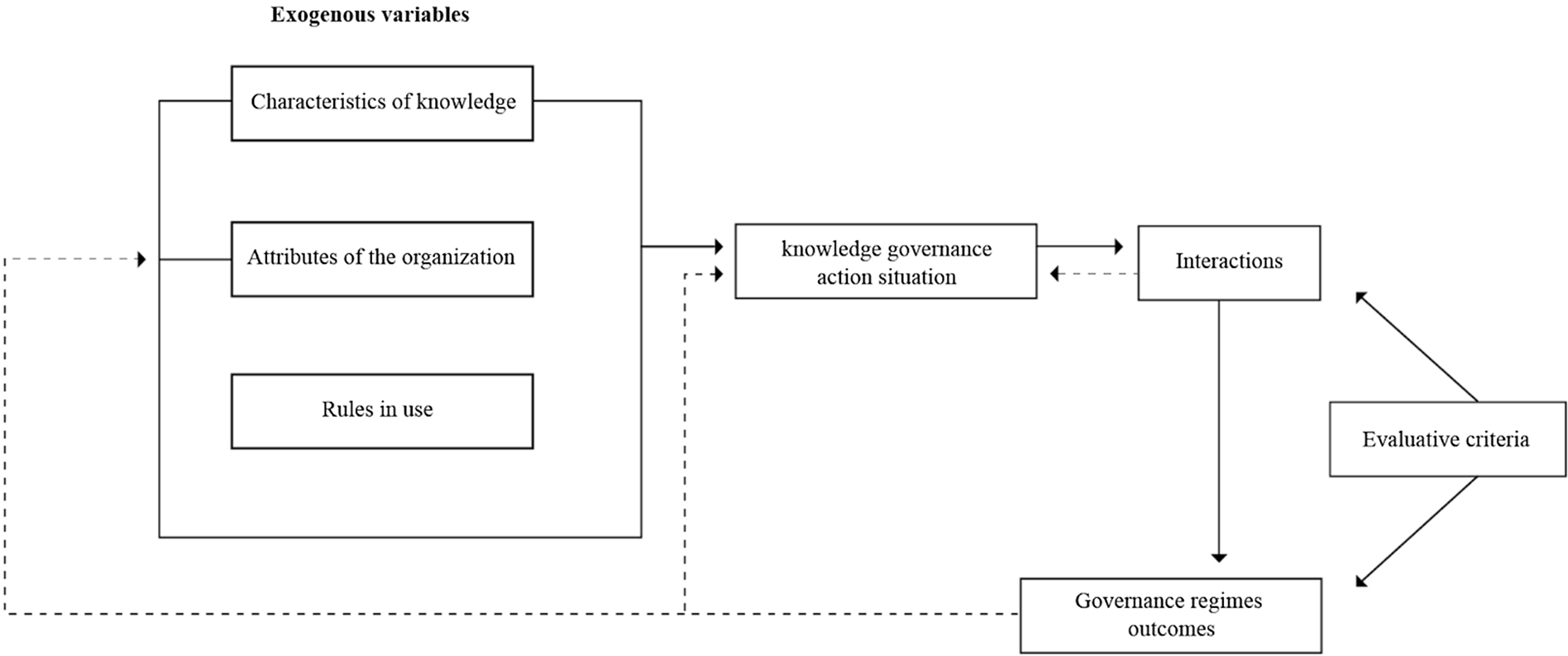
First, knowledge property regimes define the nature and forms of intellectual asset ownership and shape the action and interaction arena of involved actors, mechanisms, and institutions they develop to govern and balance the (re)production and dissemination of intellectual assets within specific industries. Second, these elements are not mutually exclusive; they can complement and reinforce one another. Thus, analysing a specific knowledge property regime is an empirical matter, and institutional, geographical, or physical details on the ground matter considerably in any analyses about the directions and forms that governance structures may take (Lin et al., Reference Lin, Wang and Yuan2023; Ostrom, Reference Ostrom1990).
Third, like other goods and services (see Rayamajhee and Paniagua, Reference Rayamajhee and Paniagua2021), knowledge property regimes can change due to technical, technological, and legal changes. Knowledge is highly excludable when confined to a few individuals, such as an author withholding an unpublished article. In this case, the knowledge remains within the private domain. However, once published, it transitions from a ‘private good’ to a ‘club good’, accessible to the scientific community, or even a ‘public good’ (De Moor, Reference De Moor2011: 429), as its excludability and/or subtractability decrease. Moreover, legal changes in property rights and technological changes that might improve excludability techniques could further contribute to changes in the governance structures utilised to manage the production and use of knowledge (i.e. dynamic movements along the different quadrants in Figure 1). Like tangible goods and services, knowledge regimes are also institutionally and (technologically) contextually contingent (Cowen, Reference Cowen1985).
The characteristics of knowledge
The characteristics of knowledge itself, such as tacitness, exhaustibility, appropriability, and transferability, underlie the physical structure of governance regarding the assignment, organisation, and enforcement of IP. Let us further examine the tacitness of knowledge, as it has been considered crucial in managing epistemic resources (Antonelli, Reference Antonelli2022). Tacitness here means that certain portions of knowledge are difficult to extract or articulate – in opposition to conceptualised, codified, or explicit knowledge – and is therefore difficult to convey and transmit such knowledge to others through codifying procedures, texts, or manuals (Reber, Reference Reber1989; Polanyi, Reference Polanyi1958). Tacitness implies that explicit methods for codifying and transferring knowledge are limited, necessitating shared understanding and local procedures or actions within a group or community to facilitate its (re)production and dissemination. Therefore, the effective transfer of tacit knowledge requires repetitive personal contact, regular interaction, and social trust among agents (Goffin and Koners, Reference Goffin and Koners2011).
By its less explicit and codifiable nature, this kind of knowledge can usually be produced or transmitted through practice in a particular context and communicated through social networks (Lin et al., Reference Lin, Wang and Yuan2023). Such knowledge is managed in its dissemination and use when the knowledge holders and other potential users join a network or a community of practice (Toso, Reference Toso2006). This, for example, becomes particularly evident in scientific academia, where knowledge is often abstract or difficult to articulate – successful academics possess a combination of wisdom, experience, and intuition – which are difficult to teach or to convey explicitly in ‘academic manuals’ (Polanyi, Reference Polanyi1958). When such tacitness is reflected in technical and practical skills, its effective transfer or dissemination requires personal contact, regular interactions at the local level, and a certain level of trust between individuals (Goffin and Koners, Reference Goffin and Koners2011). Industrial sectors that rely on tacit knowledge tend to be communities that depend on strong social norms and tight community networks to deal better with the tacitness of such knowledge as a form of commons (Mokyr, Reference Mokyr2018; Lin et al., Reference Lin, Wang and Yuan2023; Filippaz, Reference Filippaz2022).
Take knowledge in the mining industry as an example. Mining sites vary in geological structure, as well as in the size, grade, and composition of ore deposits. Consequently, mining depends on local conditions, requiring intensive skills, complex calculations, and practice-based innovations. Despite frequent equipment upgrades, engineers and miners must rely on their expertise, intuition, and experience to adapt machinery to specific local conditions. This process often demands continuous experimentation and adaptation (Lin et al., Reference Lin, Wang and Yuan2023). Likewise, consider the art of glassmaking in Murano, Italy (Toso, Reference Toso2006). Since at least 1291, Murano’s glassmakers have refined and innovated key techniques, pioneering advancements such as transparent glass (cristallo), enamelled glass (smalto), multi-coloured glass (millefiori), milk glass (lattimo), and glass-based imitation gemstones (Amato, Reference Amato1997; Segre and Russo, Reference Segre and Russo2005). However, much of this craftsmanship was initially preserved as tacit knowledge, passed down through hands-on practice with the canna da soffio (blowpipe) and sustained by local social ties, particularly the apprentice-master tradition in Murano (Leszczyńska and Khachlouf, Reference Leszczyńska and Khachlouf2018; Toso, Reference Toso2006), rather than being codified in manuals or textbooks.
While codified and abstract knowledge can be transferred through information and communication technologies across long distances, thus avoiding the need for close and personal interactions, this usually does not apply to tacit and contextual knowledge, which is generally prevalent in craftsmanship-based and manual-based industries (Filippaz, Reference Filippaz2022; Leszczyńska and Khachlouf, Reference Leszczyńska and Khachlouf2018). For instance, the complexity of glassmaking and its technicalities make it impossible to transmit this knowledge without face-to-face learning and on-the-job experience, much like mining activities. In other words, ‘it is difficult to rely on IP to stop people accessing certain types of knowledge, especially tacit knowledge’ (Lin et al., Reference Lin, Wang and Yuan2023: 2). Consequently, tacit knowledge – crucial for some industrial sectors to thrive – might be more suitably shared within industrial clusters as a form of commons since they rely heavily on local knowledge and geographical proximity, a common language, and shared culture and values that might facilitate the production and dissemination of informal or contextual knowledge (Filippaz, Reference Filippaz2022; Lin et al., Reference Lin, Wang and Yuan2023).
Nonetheless, despite its tacit nature, technical and skill-based knowledge may be less excludable than scientific and other knowledge, as it can often be acquired through observation and imitation, making barriers to entry more costly to enforce. Transferring the former might require less absorption costs but necessitates efficient interaction between knowledge producers (owners) and users. As suggested, tacit knowledge can be conveyed primarily through observation and imitation (see Polanyi, Reference Polanyi1958). Therefore, it is highly susceptible to being used, appropriated, or copied by others, especially non-contributors. For illustrative purposes, think about the bicycle example by Michael Polanyi (Reference Polanyi1958). Riding a bicycle has a significant component of tacit knowledge: we can do it but without quite knowing how, yet others can easily copy the knowledge on how to ride a bicycle through mere imitation and observation (the same occurs with how to make a fire or how to make cheese and so on). This makes tacit knowledge susceptible to being used and appropriated by others, making it challenging for knowledge creators to exclude others from its use and dissemination. In other words, excludability tends to be challenging in economic sectors where tacit knowledge is preeminent. Therefore, additional social-based governance structures are warranted to appropriately manage knowledge use and dissemination and protect future revenue streams within a confined population. This helps explain, for instance, the prevalence of community-based mechanisms and tight social networks in China’s mining industry (Lin et al., Reference Lin, Wang and Yuan2023) and Italy’s glassmaking sectors (Toso, Reference Toso2006).
Naturally, it can be found that a particular characteristic of knowledge, such as tacitness, is often insufficient to determine the excludability and/or subtractability of an intellectual resource. As reviewed earlier, knowledge’s limited exhaustibility supports its non-rivalrous nature (Antonelli, Reference Antonelli2019), but this does not always mean low subtractability of future revenue streams. Take the characteristic of transferability as another instance: although intellectual resources such as source codes in the software sector and synthetic molecules, chemical formulas, and manufacturing techniques in the pharmaceutical industry are all relatively codifiable and transferable (since they have lower degrees of tacitness), their level of excludability differs – due to different physical, legal, and technological reasons. Software source codes tend to be far less excludable than pharmaceutical innovations. Developing software also requires investment; however, its iteration costs and research investments are relatively low compared to pharmaceuticals. Its trial-and-error cycle is shorter and can be gradually optimised, making the losses from failure significantly smaller than those associated with a failed new drug. In other words, although code developers can verify instances of infringement, the high opportunity costs often make enforcement impractical. As a result, building protective barriers may not be worthwhile. In contrast, the pharmaceutical sector has successfully relied on patent fencing to sustain innovation and prevent exploitation due to the verifiability of infringement, the substantial investment required, and the prolonged timelines involved (Hall et al., Reference Hall, Helmers, Rogers and Sena2014). Hence, despite having similar degrees of transferability, they, de facto, present different degrees of excludability.
The attributes of the organisation
As McGinnis (Reference McGinnis2011) suggests, a second element affecting the structure of an action (governance) situation is the ‘attributes of the n’ or the ‘attributes of the community’ under analysis (see also Ostrom, Reference Ostrom2010). The attributes of the organisations where knowledge is produced and disseminated play a significant role in shaping knowledge property regimes and influencing the interaction structures that regulate knowledge producers and users (Lin et al., Reference Lin, Wang and Yuan2023). These organisations should be understood in a general sense; they are highly contextual and can take various forms, including firms, associations, and communities. Moreover, they do not necessarily have clear or rigid boundaries. As Ostrom (Reference Ostrom1990) suggests in her analysis of local governance, three influential elements determining the organisation’s attributes are the incentive structures of involved actors, the scale and network of the organisations, and the norms and culture prevailing in it.
(1) Sharing values and non-pecuniary benefits: First, though knowledge producers and users are rational actors seeking to improve their welfare, their benefits of producing knowledge could be pecuniary or non-pecuniary. Privatising and monopolising IP through legal mechanisms are typical channels to capture their pecuniary benefits, such as royalty fees. For instance, non-pecuniary motivations are also relevant in some fields, such as science and mathematics. Reputation, fame, and peer recognition are typical mechanisms to reap non-pecuniary benefits. As Goodman and Lehto (Reference Goodman and Lehto2024) argue, reputation often serves as a sufficient reward, as many individuals derive satisfaction from social status and recognition. The motivation to build an individual reputation and international recognition incentivised the emergence, during the 17th and 18th centuries, of an international community of scientists (the ‘Republic of Letters’) that contributed inputs and intellectual efforts into a vast ‘knowledge commons’ contributing to the industrial revolution (Mokyr, Reference Mokyr2018). Yet, within that commons, there were still strong non-pecuniary incentives such as high status or ‘immortality’, by which scientists rushed and quarrelled to make scientific discoveries before others to reach fame by having a theorem named after them (i.e. a form of non-pecuniary and subtractable benefit in our framework in Section 2) (Mokyr, Reference Mokyr2018: 166). Nowadays, the ‘tenure system’ ensures that scholars do not need to worry about their survival and income, thus making a knowledge-based reputation their primary goal, which, in turn, encourages collaboration and the sharing of new ideas through journals and the public (Raymond, Reference Raymond2001).
The pursuit of reputation and other non-pecuniary benefits is also prevalent among developers and hackers in the software development sector. As an oft-cited dictum illustrates, you do not become a hacker by calling yourself a hacker; you become a hacker when other hackers call you a hacker (Raymond, Reference Raymond2001: 94). Reputation enables them to attract attention and collaboration from others while also signalling their skills for potential employment opportunities (Schweik and English, Reference Schweik and English2012). To conclude, the motivation to seek non-pecuniary interests enhances the compatibility of openness and knowledge sharing with the correct incentives, suggesting that a more open and collective governance structure – such as clubs or commons – will develop to govern the production and dissemination of knowledge in such sectors marked by non-pecuniary benefits (Mokyr, Reference Mokyr2018). In other words, such motivations encourage actors to contribute to the (re)production of intellectual assets that fall within the property regimes of club goods, knowledge commons, and public goods, as seen previously.
(2) Scale and network structures: Second, the organisation’s scale and the involved actors’ network structures also significantly affect how the governance regime will develop. Empirical evidence suggests that small and close-knit networks are often helpful in facilitating the governance of knowledge regimes in the form of knowledge commons and club goods. For instance, tacit and technical glassmaking knowledge remained confined and well-managed within a close-knit community throughout the 15th and 18th centuries in Venice, fostering innovation and success within that community (Amato, Reference Amato1997; Leszczyńska and Khachlouf, Reference Leszczyńska and Khachlouf2018). Most of the glassmaking knowledge and techniques were not encoded initially in private ‘manuals’ or ‘glassmaking textbooks’, but instead, they were a sort of tacit knowledge that could only be transmitted through the practice with the blowpipe and the local social ties such as apprentice-and-master-glassmaker relationships in Murano (Leszczyńska and Khachlouf, Reference Leszczyńska and Khachlouf2018; Toso, Reference Toso2006). The knowledge of glassmaking was thus passed from generation to subsequent generations through practice and learning by doing within a close-knit community under a form of knowledge commons, in which they could collectively govern and better preserve the quality of such ideas and techniques. Similarly, mining activities in China are often outsourced to specialised teams, typically led by experienced engineers who contract with mine owners. These teams frequently comprise ‘bonded miners’ who develop strong ties and share mining techniques and employment information (Lin et al., Reference Lin, Wang and Yuan2023).
Tight or well-connected networks facilitate knowledge production and dissemination through non-proprietary approaches in several ways. First, such networks enable involved actors to circulate and disclose information about individuals’ capacities and behaviour (i.e. intellectual achievements as knowledge producers), which helps build reputations of collaboration and respect. Repetitive dealings and interactions among a strong network enable the emergence of governance mechanisms such as monitoring, mutual respect, and other informal rules, such as giving credit for each other’s achievements concerning knowledge production (Mokyr, Reference Mokyr2018). For example, scholars and hackers can efficiently share their innovative ideas via platforms such as arXiv, ResearchGate, online forums, and mechanisms like copyleft. Moreover, such networks can also transmit information about cheating or opportunistic behaviour in the (re)production and misuse of knowledge – for example, stealing a knowledge producer’s idea or using it without proper acknowledgment is punished by these communities. Misconduct of this kind may result in social punishments, particularly ostracism, public denunciation, and potential losses of future collaborations.
Nonetheless, we do not claim that knowledge can only be governed through small-scale organisations and tightly connected networks. Privatisation and conventional approaches – usually sustained by IP systems, trade secrecy mechanisms, and hierarchical firm structures – are also widely employed to manage and incentivise innovation, particularly when industrial participants are embedded in large, abstract, and loosely connected networks. This is exemplified by the extensive use of patents in the pharmaceutical sector (Heller, Reference Heller2008). Moreover, concerning firm scale and given the limited exhaustibility of knowledge, there is a contemporary trend in which larger firms are increasingly inclined towards knowledge-intensive technological change, as they can more efficiently generate, accumulate, and exploit knowledge, benefiting from economies of scale in both knowledge production and use (Antonelli et al., Reference Antonelli, Orsatti and Pialli2023). Consequently, in those industrial sectors with large-scale economies dominated by loosely connected and highly abstract networks, the emergence of private regimes and the privatisation of knowledge will be more likely.
(3) Internalised norms and mediating normative beliefs: Third, by mediating normative and behavioural beliefs, as well as payoffs of involved actors within specific sectors, norms emerging and prevailing in those places also shape the game structure and the governance regime utilised (Ostrom, Reference Ostrom2010). Norms can be understood as shared understandings among actors about what constitutes legitimate behaviour or what ought to happen in a given context (Ostrom, Reference Ostrom1990). The norms of reciprocity and fairness prevail in open-source communities, sustained by gift culture instead of exchange culture (Raymond, Reference Raymond2001). For instance, developers report that they like ‘helping others’ or ‘giving something back’ to ‘like-minded people’ (Markus et al., 2000). Similarly, empirical evidence suggests that professional communities – such as academics, magicians, and French chefs, for example – uphold strong norms regarding the attribution of authorship and the appropriate use and dissemination of proprietary knowledge, such as theorems invented, magic tricks, or innovative recipes (Mokyr, Reference Mokyr2018; Loshin, Reference Loshin and Corcosed2008; Fauchart and von Hippel, Reference Fauchart and Von Hippel2008).
These norms are frequently internalised and become endogenised in actors’ decision-making processes. Individuals who violate such norms to misuse knowledge by appropriating it in ways inconsistent with the shared understandings of the community often experience costs and social punishments, such as guilt or shame, or even ostracism, which reflect a loss of social approval. Notably, the incentives to comply with internalised norms differ from pursuing non-pecuniary interests. In Bicchieri’s (Reference Bicchieri2006) framework, internalised norms are understood as conditional preferences: people conform to norms based on expectations about others’ behaviours and beliefs. Individuals expect others to follow the norm and simultaneously believe they are expected to do the same. When the social norm (or culture) of knowledge co-production and sharing is prevalent in a particular industry, knowledge tends to be less excludable; thus, it is often characterised by knowledge commons, which require informal rules and sanctioning procedures to prevent free-riding (Mokyr, Reference Mokyr2018).
As analysed in subsections 3.1 and 3.2, the transformation of knowledge governance and the property regimes utilised could change from private knowledge into a knowledge commons to reap positive externalities and ‘knowledge spillovers’ from clustering specific industrial sectors that rely heavily upon tacit knowledge, strong communication networks, and close-knit communities (Carbonara, Reference Carbonara2018; Leszczyńska and Khachlouf, Reference Leszczyńska and Khachlouf2018). The cases of the ‘Republic of Letters’ (Mokyr, Reference Mokyr2018), the Venetian glassmaking community (Filippaz, Reference Filippaz2022; Leszczyńska and Khachlouf, Reference Leszczyńska and Khachlouf2018), and recent mining communities in China (Li and Gao, Reference Li and Gao2021; Lin et al., Reference Lin, Wang and Yuan2023) suggest that sectors characterised by intensive use of tacit knowledge, craftsmanship, and specialist onsite skills, concomitant with a tight-knit community network, will possess both the ‘resource characteristics’ and the ‘attributes of the community’ conducive to rely on knowledge commons as the more suitable governance structure for the management of valuable epistemic resources.
The rules-in-use
Following the Bloomington school (see McGinnis, Reference McGinnis2011; Hess and Ostrom, Reference Hess and Ostrom2007), we can establish that the rules-in-use are the third set of elements that shape the property and governance regimes of intellectual resources, particularly through structuring the involved actors’ incentives, and the enforcement and monitoring mechanisms. The rules-in-use in our case of knowledge governance often consist of norms regarding knowledge sharing, the use and punishment as informal rules, and the laws on IP and the use of contracts as formal rules (see Frischmann et al., Reference Frischmann, Madison and Strandburg2014).
(1) Norms regulating behavioural belief: Besides shaping actors’ normative beliefs, norms can also regulate their behavioural beliefs by imposing punishments on those who violate internalised norms. Behavioural belief refers to an actor’s expectations about others’ behaviours or strategic responses (Bicchieri, Reference Bicchieri2006). If a knowledge user expects to be punished – either formally or informally – for reaping or inappropriately using others’ intellectual achievements, they are more likely to refrain from free-riding behaviour, and they will tend to abide by those behavioural beliefs, contributing to better management of the proper use and dissemination of knowledge (Mokyr, Reference Mokyr2018).
Ostracism from others within the community, such as refusing to interact or collaborate with rule violators in the future, is a typical form of punishment that regulates behavioural beliefs in using and appropriating knowledge (Mokyr, Reference Mokyr2018). For instance, Loshin (Reference Loshin and Corcosed2008) shows that a magician who violates community norms – regarding the attribution of authorship, use of new ideas, and exposure of magic secrets – risks losing the respect of their peers, along with valuable opportunities to lecture or perform at events in the future, thus incentivising compliance with the norms. Similar informal and social enforcement mechanisms are prevalent in other creative professions that rely heavily on the production and proper use of knowledge, such as comedy and fine-dining cooking, where peer-sanctioned norms and other behavioural beliefs deter plagiarism and protect originality despite not having de jure property rights (Oliar and Sprigman, Reference Oliar and Sprigman2008; Fauchart and Von Hippel, Reference Fauchart and Von Hippel2008).
In addition, some industrial communities have also developed coercive power and enforcement mechanisms to deter opportunistic behaviour, leveraging platform effects. A prominent example is the GNU Project, one of the pioneering open-source software initiatives. The GNU General Public License (GPL) empowers copyright holders to enforce compliance by terminating the rights of violators to copy, modify, sublicense, or distribute the software. This enforcement capability serves as a deterrent against misuse and ensures adherence to the licence terms (O’Mahony, Reference O’Mahony2003). When an industrial or economic sector is capable of providing norms for monitoring and sanctioning opportunistic behaviour from the bottom-up, it often demonstrates a high capacity for self-governance in the use and management of knowledge – and, as a result, open innovation, particularly in the form of knowledge commons, is likely to emerge and persist over strictly fragmented property rights’ solutions (Hess and Ostrom, Reference Hess and Ostrom2007; Lin and Lin, Reference Lin and Lin2023).
(2) Legal and formal institutions: Legal institutions – especially formal legal IP systems and contract law, and their related court judgments, monitoring, and enforcement rules – are also key factors that affect the knowledge governance employed (Heller, Reference Heller2008). In a country or region that highly values IP rights (from a perspective of legal individual rights) and possesses a relatively stable and efficient legal system that defends private property, then the cost of defining and protecting IP is relatively low, thus also diminishing the potential costs of conflict resolution mechanisms to determining the excludability of knowledge. Put differently, relatively efficient legal systems that define and enforce property rights on knowledge help reduce the transaction costs to govern knowledge as a ‘private’ asset (Paniagua and Rayamajhee, Reference Paniagua and Rayamajhee2024b). This makes it relatively easier to exclude others – via legal mechanisms – from using the knowledge being produced, thus incentivising the use of IP regimes over commons (Lin et al., Reference Lin, Wang and Yuan2023).
In systems in which high levels of uncertainty characterise the legal protection of property rights, using standard IP legal mechanisms to create and protect property rights over knowledge might not be the most practical (cost-effective) and stable solution. This suggests that similar forms of knowledge and technologies may possess different levels of excludability under different legal contexts, affecting the final governance structure employed in different sectors. Thus, we should expect that in legal contexts with stable, transparent, and predictable protection of property rights concerning intellectual resources, economic sectors will tend to rely more heavily on private and highly fragmented governance structures over collective governance regimes (Goodman and Lehto, Reference Goodman and Lehto2024).
Consider how knowledge is governed in China’s mining industry (Lin et al., Reference Lin, Wang and Yuan2023). Legal protections for IP rights in China are improving, but remain highly ambiguous and volatile. A relatively ineffective IP regime and an unpredictable legal system incentivise individuals to seek informal and relational governance mechanisms that rely more on social norms, reputation, and trust among the participants (Fauchart and Von Hippel, Reference Fauchart and Von Hippel2008). A hybrid combination of informal-relational and formal-contractual governance structure, which consists of outsourced contracts, mentor-mentee agreements, and favouritism-based information-sharing mechanisms, has been crafted in China to secure the production and sharing of mining skills and knowledge (Lin et al., Reference Lin, Wang and Yuan2023). This makes technical knowledge in China’s mining industry to be treated as a collective asset (commons), which, in turn, reinforces the culture of cooperation, trust, and sharing among miners and the mining community (Lin et al., Reference Lin, Wang and Yuan2023). Preliminary evidence suggests that specific commercial sectors would lean towards knowledge commons-like arrangements to create pools of knowledge, thus protecting themselves from the outside world whenever the formal legal system and governments are unable to provide crucial (formal) governing tools at lower costs and at higher degrees of predictability (Fauchart and Von Hippel, Reference Fauchart and Von Hippel2008).
Concluding remarks
This paper contributes to the knowledge governance literature by proposing a novel theoretical framework for conceptualising and taxonomising different structures and institutional alternatives that could govern knowledge properties under different contexts. Our contribution has been twofold: first, by building on Ostrom’s (Reference Ostrom2010) work, we have examined why governance structures for managing knowledge production and sharing vary across industries, thus presenting a taxonomising framework inspired by Ostrom and Ostrom (Reference Ostrom, Ostrom and Michael D2002). Second, building on the IAD framework, we developed a conceptual framework for knowledge governance heterogeneity based on three different factors: (1) the characteristics of knowledge itself, (2) the attributes of the organisations, and (3) the rules-in-use. This paper helps differentiate how industrial sectors can choose different governance regimes to deal with knowledge and their distinctive solutions concerning governance.
These contributions illuminate the relevant mechanisms and incentives that undergird the choice of groups and industrial sectors concerning how to govern the (re)production and dissemination of knowledge, thus helping also to understand why institutions for governing knowledge vary across industries, according to both the different properties and scope that knowledge possess, and their possibilities for using property rights. Finally, we have provided some evidence highlighting the mechanisms and incentives that undergird knowledge governance in different sectors. The proposed conceptualisation, followed by the examples, helps delineate a fruitful research agenda at the intersection of applied institutional analysis and the political economy of knowledge by providing better conceptual clarity about the different regimes available and the core mechanisms that structure or affect their formation. Our conceptual contribution could become a building block for future empirical research to better understand the knowledge regimes utilised in different contexts. As such, this work would be pivotal in undertaking new research on the complex governance of knowledge in our modern knowledge-based economies by providing a framework for empirical research on how different knowledge regimes that promote sharing and prosperity could thrive.


 Open access

