




During the last three decades and more, beginning in 1991, a large number of Bactrian documents have come to light. Almost all of them first appeared on the international art market, with the unfortunate result that we have little reliable information about their provenance. From their contents, however, the great majority appear to derive from various regions in what is now Northern Afghanistan, in particular from the principality of Rōb (modern Rui) in the northern Hindukush, from Kadagstān to the north-east of Rōb, and from Gōzgān to the north-west. Much more recently, a number of Bactrian documents which seem to have been written in areas to the south of the Hindukush have become known. Unlike the documents from Northern Afghanistan, most of which are written on leather or parchment, those from Southern Afghanistan are mostly written on birchbark (see BD4 = Sims-Williams Reference Sims-Williams2025).
Most of the documents from Northern Afghanistan were published in the three volumes of Bactrian Documents from Northern Afghanistan (BD11/BD12, BD2, BD3 = Sims-Williams 2001/2012b, Reference Sims-Williams2007a, Reference Sims-Williams2012a), but a few came to my notice too late to be included there. Amongst these late arrivals are the two parchment documents to be published here, which belong to the al-Sabah Collection in Kuwait, where they were recognized as Bactrian by Dr Judith A. Lerner. I am extremely grateful to Dr Lerner for bringing them to my attention and to the authorities of the al-Sabah Collection, Dar al-Athar al-Islamiyyah, Kuwait, for permission to publish them. The inventory/accession numbers of the two documents in the al-Sabah Collection are LNS 305 and LNS 320. However, in order to integrate them into the system of signatures used in BD1–3, I shall refer to them as ao (= LNS 320) and cs (= LNS 305).
It may be useful to give a brief explanation of this system of signatures here. Signatures consisting of a capital letter (A–Y) are dated legal documents, arranged in chronological order, while a signature such as “Aa” indicates a document later than A but earlier than B. Signatures consisting of two lower-case letters aa–an are further legal documents of uncertain date, together with economic documents such as lists and accounts. As an undated receipt, LNS 320 has been added to this group and given the signature ao.
In principle, all the legal documents, lists and accounts were included in the second edition of BD1 (Sims-Williams Reference Sims-Williams2012b), with the exception of those which came to light after its publication, namely Dd (Sims-Williams Reference Sims-Williams2017), Uv (Sims-Williams Reference Sims-Williams2015, a contract from Khēsh in the southern Hindukush), and of course ao.
BD2 (Sims-Williams Reference Sims-Williams2007a) contains letters, together with a few Buddhist texts (za–zc) and fragments of uncertain character (ya–ye). The letters are mostly undated but are arranged in the edition, in part hypothetically, in chronological groups: ba–bh; ca–cr; da–dg; ea–eh; ja–ji), those whose chronological position is quite uncertain being placed at the end (xa–xt). Additional texts noticed too late to be included in BD2 are bi (the under-text of the palimpsest letter co, partially read in BD3: 21 n. 6), jj (Sims-Williams Reference Sims-Williams and Alram2010b: 205–9) and zd (ibid., 203–5, a Buddhist text on birchbark, said to be from Bāmiyān). Twenty-six recently discovered birchbark letters from Southern Afghanistan have now been published in BD4 under the signatures ka–kz.
The identification of the letters ca–cr as a single chronological group was largely based on the occurrence in several of them of the name Nawaz (see BD2: 19). However, a systematic study of the chronology of the Bactrian documents has led to the recognition that two or more persons named Nawaz are involved. According to the adjusted chronology presented in Sims-Williams and de Blois Reference Sims-Williams and de Blois2018, these letters must be divided into at least two groups. The earlier group includes ca–ci and cp, which probably date from around 370 ce and are thus approximately contemporary with the dated letter cr (380 ce), while a later group, including cj–cm and cq, may rather date from the middle of the following century. LNS 305, to which I have assigned the signature cs, belongs to the earlier group, being addressed to a certain Khwasraw Khahran, almost certainly the same person who is named as the addressee of letter cb.
The standard formats used in Bactrian documents and letters were most recently described in BD3: 9–12. That description also contains diagrams (fig. 1–2 on p. 11) showing the orientation of the various elements of the text of a letter and how they are laid out on the two sides of the parchment. The letters A–L, which are used below in the description of cs, indicate specific areas of the parchment as shown in these diagrams.
ao (LNS 320, Figure 1)
Complete document written on leather or parchment, authenticated by two clay sealings attached to the bottom margin, where the leather is folded over, each sealing being secured by a string threaded through a pair of holes in the leather (format 2a according to the definition given in BD3: 10).
Document ao (LNS 320) © The al-Sabah Collection, Dar al-Athar al-Islamiyyah, Kuwait.

The document is an undated receipt for a sum of ten dirhams, apparently the repayment of a loan. The closest parallel among the documents previously published is an (BD12: 152–3), a receipt for a sum of 25 dirhams. As noted in the commentary to line 5 below, the present text contains some late Bactrian forms, including the Chinese loanword σακο “document, receipt” (otherwise attested only in an), which suggest a date not much earlier than 700 ce.
Text
ao1 μ̣ισιδο ασταδο τα̣ο̣ κ̣α̣ν̣α̣γ̣ο̣
ao2 πα̣σ̣α̣νοa ασ̣ομαγο βοιοb δ̣δ̣ρ̣α̣χ̣μο
ao3 α̣γιτιγο ιʹ ταδο μανο βοιοb σ̣αφ-c
ao4 αγο καν̣αγο π̣αρσο δδραχμο αγγι-
ao5 τινδο οδομο λαδδηιο σακο οδο-
ao6 μο μισ̣ο̣ π̣ιδ̣ο πωστιγο αχασο νισ-
ao7 το
a Or χα̣σ̣α̣νο? bOr βα̣ιο? cApparently not α̣σ̣αφ-.
Translation
Now: you, Kanag Pasan, had 10 dirhams held (= on loan) from me, Buy. Then I, Buy, received back the dirhams from you, Kanag, 5and I have given you (this) receipt, and moreover I have no dispute regarding the document.
Commentary
ao1f. The personal name καναγο (clearer in line 4) is well-attested and corresponds to the Sogdian name kʾnʾkk, kʾnk (Sims-Williams Reference Sims-Williams2010a: 75, #201; Lurje Reference Lurje2011: 202, #516). The patronymic or family name πασανο or χασανο is otherwise unknown. It does not seem possible to read χαρανο, i.e. Khahran “belonging to the family of the ruler”, as in cs below.
ao2, 3. If correctly read, βοιο is an otherwise unattested personal name, perhaps to be identified as the Middle Persian name Bōy (Gignoux Reference Gignoux1986: 59, #212). However, although the ι seems to be widely separated from the preceding letter, which of course suggests that the latter is ο rather than α, it is hard to exclude the possibility that the attested name βαιο (Sims-Williams Reference Sims-Williams2010a: 44, #67) may be intended.
ao3. αγιτιγο is the past participle of the verb αγισ- “to take, hold, get hold of”. Here “held” probably means “on loan”.
ao3f. σαφαγο seems to be a unique shortened form for ασαφαγο “from you”. For the loss of the initial vowel one may compare the late form σασκο (= Manichaean cʾsq) for ασασκο “over, upon, through”. A different shortening of ασαφαγο to ασοφαγο or ασφαγο (cf. also ασομαγο for ασαμαγο in line 2 above) is comparatively well-attested.
ao5. οδομο λαδδηιο “and I have given (to) you” is an example of the so-called “indirect affectee” construction, in which a transitive past tense agrees with the indirect rather than the direct object (see BD2: 46). The non-traditional attachment of the enclitic pronoun -μο to οδο rather than οτο is a feature of late Bactrian, not attested in datable texts before 662 ce (see Sims-Williams and de Blois Reference Sims-Williams and de Blois2018: 63, Criterion 20).
σακο “document, receipt”, a loanword from Chinese ce/chai 冊, is otherwise attested only in the similar receipt an, which was probably written in Gozgan around 700 ce (see Sims-Williams and de Blois Reference Sims-Williams and de Blois2018: 52).
cs (LNS 305, Figures 2, 3, and 4)
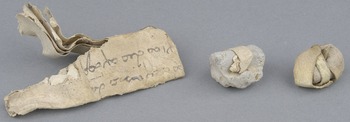
Letter, originally folded several times horizontally and vertically and sealed by cutting a thin strip along the bottom edge from the right edge almost to the left edge, winding this around the letter and attaching to it a clay sealing (format 3 as defined in BD3: 11–12). The letter was still folded when it was received in the al-Sabah Collection, though both left and right ends of the parchment are lost, including almost all of the first continuation, which would have been written in the left margin of the recto. Two clay sealings with thongs embedded in the clay, one or other of which may belong to this letter, were apparently acquired with it.
Document cs (LNS 305), before opening, with two accompanying clay sealings © The al-Sabah Collection, Dar al-Athar al-Islamiyyah, Kuwait.

Document cs (LNS 305), recto © The al-Sabah Collection, Dar al-Athar al-Islamiyyah, Kuwait.

Document cs (LNS 305), verso © The al-Sabah Collection, Dar al-Athar al-Islamiyyah, Kuwait.

The writer of the letter is Farak, an otherwise unknown ruler (khahr or khar) of Rōb. The addressee Khwasraw Khahran, whose surname suggests that he is also a member of the royal family of Rōb, is probably to be identified with a person of the same name who is already known from letter cb, c. 370 ce. On what would have been the outside of the sealed letter, it bears not only the usual details of the addressee but also an annotation indicating the subject matter. Such annotations are quite frequently attested on letters which were still sealed when they were found, which suggests that they were “office copies” kept in the archive of the sender rather than the letters actually sent. In a number of cases sealed letters bearing such annotations (e.g. bg, bh, cb) were written by members of the royal family of Rōb. It seems likely that such letters formed part of the royal archive of Rōb.
Text
Recto, primary text, areas E–L
cs1 ασο φαρακο ι ρωβο ι χα̅ρ̅ο̅ αβο χοασραο̣[ ι ]χ̣[α]ρ̣[ανο]
cs2 ι φριιο β̣ρ̣αδο λρ̅ο̅δ̅ο̅ οτανο οαλο ϸα̣τ̣αρανο καλ̣[δα]-
cs3 ν̣[ο ]χ̣[οα]δ̣ο λρ̅ο̅γ̅ο̅ οινανο μισιδο βαγορηοιιαμϸο̣ αβα̣[]-
cs4 [μαγο πιδοοα]υ̣αδο κοαδ̣α̣νο ι ταοι …[ ]-
cs5 [•]γ̣οασο ιασταχσαγγο π[οσ]ο ζιδηιο τακαλδαν[ο ]-
cs6 [•γο]α̣σ̣ο α̣βο ι̣ τ̣οποa αγαδινδηιο τα[δο]ιην̣[ο ]αβ[ο βα]-
cs7 γ̣ο̣ρηοιιαμϸοb απισ̣ο̣ αγγαδηιο ταδοιηνο ζα̣[ ]
In the left margin, first continuation, areas A[–D]
cs8 [ ]…ηι̣ο̣[
Several lines missing
Verso, second continuation, areas I–L
cs9 ο̣[ ταλ]δο̣[ ιθαιν]δο ταδο ν̣[αϸι]-
cs10 ζγιστο ο̣[το ] τοοι σαχ[οαν]-
cs11 ο π[α]ρογα[σο τακ]αλδο ιθ̅αα[σαγ]-
cs12 ωνδο βαγ̣[ο]ρ̣ηοιιαμϸο αβ[α]-
cs13 μαγο πιδο[ο]α̣υαδο τ̣αδασο ι
cs14 μαρηγανο φαρο βαγο-
cs15 ρηοιιαμϸο λαδο οδο οιζαρο̣
Third continuation, area Hii
cs16 κιρο
Address, area G
cs17 Αβο χοασραο ι χ-
cs18 α̅ρ̅α̅νο λρ̣οδο
Annotation, area F
cs19 πιδο βαγο-
cs20 ρ̣ηοι̣ι̣αμ̣ϸ̣ο̣
a Less likely ποπο. b The ρ seems to have been altered.
Translation
From Farak, the ruler of Rōb, to Khwasraw [Khahran], (my) dear brother, greeting. And then I would be more happy when I [myself] might see (you) healthy. Now: Bagrew-yamsh has [complained] to [me], (saying): Your [subordinate](?) 5…guas(?) has taken the sheep of (the village)(?) Astakh. Then if …guas(?) should have brought them to Tup(?), then you should *fetch them to Bagrew-yamsh. Then their … If (these things) are so, then 10it is not good, and … you should take notice of the statement. [So] if it was as Bagrew-yamsh has complained to me, then make a judgement and decision against (your) servants (and) for Bagrew-yamsh.
To Khwasraw Khahran, greeting.
Concerning Bagrew-yamsh.
Commentary
cs1. The fact that the letter begins with ασο “from” rather than αβο “to” indicates that the sender is superior in rank to the addressee (see Sims-Williams Reference Sims-Williams, Panaino and Piras2007b: 703, §1.6). The sender’s name φαρακο “Farak” is otherwise unattested in Bactrian but is clearly a hypocoristic in -ak(k) from the noun φαρο, older φαρρο “glory”, corresponding to Sogdian prnʾkk (Lurje Reference Lurje2011: 297, #898) and parallel forms in other Iranian languages. His title “kha(h)r (= ruler) of Rōb” is frequently attested. In BD1–2 I took ρωβοχαρο as a compound, but the writing ι ρωβο ι χα̅ρ̅ο̅ suggests that it should rather be understood as two words, here separated by the article ι.
As noted above, the addressee χοασραο ι χα̅ρ̅α̅νο “Khwasraw Khahran” (whose name is better preserved in the address on the outside of the letter), is already known from the published letter cb (BD2: 70–71).
cs3. The previously unattested personal name βαγορηοιιαμϸο is a compound of two divine names: βαγορηοι° “the Rich God” (see Sims-Williams Reference Sims-Williams2010a: 41, #54) and °ιαμϸο “(God) Yamsh” (ibid., 67–9, #167–72). For the spelling of the first component with -οι for final [u] or [w], see BD2: 40 and Sims-Williams and de Blois Reference Sims-Williams and de Blois2018: 61 (Criterion 7). Further instances in this document are ταοι “your” in line 4, τοοι “you” in line 10.
cs4. κοαδανο. The hypothetical particle -ανο, together with the following verb in the past optative, indicates the status of the statement as hearsay (see BD2: 49).
cs4–6. The same name, that of some servant or subordinate of the addressee, seems to occur twice in these lines, both times unfortunately incomplete at the beginning.
cs5. ιασταχσαγγο π[οσ]ο “the sheep of (the village) Astakh”(?). The form ιασταχσαγγο can be analysed in several ways. The initial ι- may be a prefixed article or part of the word itself, and the adjectival suffix may be either -αγγο or -σαγγο. Since both suffixes typically form adjectives from nouns referring to persons or places, it is likely that the underlying noun is a place name Astakh, Astakhs, Yastakh or Yastakhs. If the correct form is Astakh, this may well be a variant of a place name already attested via the derivatives ασταχιρσο, αστιιαχιρσιγο and ισταχιρσιγο in documents af, C, and ee. In BD2: 197 I took the name of this place to be ασταχιρσο, but it now seems more likely that all the attested forms are adjectives bearing the suffixes -σο, -σιγο, -σαγγο, the underlying place name being *ασταχιρο/*ισταχιρο, a form equivalent to (and possibly borrowed from) the name of the well-known city of Iṣṭaxr near Persepolis in Fars. This makes possible a better interpretation of the opening words of af (BD12: 156–7): ασο ασταχιρσο τητοκο “from Tetuk, (inhabitant) of Astakhir”.
The restoration π[οσ]ο “sheep” is of course uncertain but fits the context well. Since it is a collective noun, it can be treated either as singular (here agreeing with the verb of which it is the object, 3 sg. past opt. ζιδηιο “has taken it [= the sheep]”) or as plural (as indicated by the ending of αγαδινδηιο in the next line).
cs6. τοπο (or possibly ποπο) is unknown, perhaps a place name.
cs6–7. τα[δο]ιην[ο ]αβ[ο βα]γορηοιιαμϸο απισο αγγαδηιο “then you should *fetch them to Bagrew-yamsh”. The form απισο is a variant of πισο “in the presence of, before, to, etc.”, already indirectly attested by the derivative απισοδαρο, απισταρο “previously, formerly, before”. It is not obvious why (α)πισο < *patīčā (Sogdian pt’yc, Parthian pdyc) should have developed a prothetic vowel, but a similar case is (α)παρσο “back” < *paršti-čī-. The circumposition αβο … (α)πισο is also attested in the late document U (see BD2: 257 s.v. 1πισο).
The verb αγγαδηιο is problematic. Although αγγαδ- looks like a past stem, the construction requires a transitive present with -ιην[ο] “them” in line 6 as its object. Possibly αγγαδ- is a denominative present stem “to collect, gather, fetch” derived from *hangata- “collected, gathered”; cf. the personal name αγγαδοσπαλο (Sims-Williams Reference Sims-Williams2010a: 30, #7), which may mean “he who assembles the army”. The cognate Parthian ʾngd “arrived” is also used with pdyc “before, in the presence of” (see Sundermann Reference Sundermann1981: 59, lines 710–11, and 151).
cs9–10. The cliché can be restored on the basis of cl6 and cm5.
cs11. The restored form π[α]ρογα[σο] is 2 sg. impv. of παρογασ-/παρογατο, a verb already attested in ba13 and 14 with the postulated meaning “to take notice”. There, as here, its object is σαχοανο “statement”. A slightly different sense of the verb seems to be required in the Surkh Kotal inscription SK4, where πορογατο has been translated “surveyed”. Both senses derive from an underlying *pari-kasa- “to look around”.
cs11–12. For the sequence [τακ]αλδο ιθ̅αα[σαγ]ωνδο, lit. “if it was just as …”, cf. ιθασαγωνδο “just as” in A14 and 17 (= ιθα “thus” + σαγωνδο “as”). The double -αα- may be compared with οτο ιθααυασιδο “and it so happened that” in R7–8, where it seems necessary to interpret -αυ- or -αυα- as a form of the verb “to be”, possibly an enclitic 3 sg. perfect (see BD2: 44, where ιαδαυηιο ασιδο “it so happens that” in Tt7 is also discussed).
cs13–16. ταδασο ι μαρηγανο φαρο βαγορηοιιαμϸο λαδο οδο οιζαρο κιρο “then make a judgement and decision against (your) servants (and) for Bagrew-yamsh”. The letter ba, already cited above, which deals with a dispute of much the same kind, uses very similar wording, including the prepositions ασο “against” and φαρο “for”: ταδο ασο ι χοβανανο φαρο ι μαρηγο λαδο ωστιιο “then you should impose a judgement against the shepherds (and) for (my) servants” (ba17–18). Here the wording mentions not only a “judgement” (λαδο) but also a “decision” (οιζαρο). Similar expressions are found in other letters, e.g. jc8, xk6 and 8, but these use the normal Bactrian form οισαρο rather than οιζαρο. The latter must represent the cognate Middle Persian form wizār, whose occurrence here results from Sasanian influence.



 Open access

