




Policy Significance Statement
In recent years, corruption risk assessments have become an important methodology for preventing corruption in different areas. In business, it has helped identify potential areas that lack regulation against corruption. In public procurement, it has helped to identify sectors that lack competition and are more prone to corruption and implement solutions. Based on the risk assessment methodology, this article contributes to understanding corruption risks in political parties. This article proposes a novel index of de jure corruption risk in political parties that analyzes national laws, affecting party competition and internal party rules that modify politicians’ behavior. The risk of corruption (ROC) index has important policy implications. First, it helps identify weak areas of the national regulation that should be addressed to control corruption in political parties. Second, the index allows understanding of what laws are needed to have more transparent parties, such as clear rules for selecting leaders and candidates and anti-corruption policies. Third, the ROC benefits political parties that would like to improve their practices and fight against corruption. Finally, this index also gives information to voters to make better decisions.
1. Introduction
Measuring corruption is not straightforward because it involves illegal activities that are not directly observable. Scholars have thus deployed a variety of tactics to capture corruption indirectly. The first studies that examined corruption used expert’ and citizen’ perceptions (Treisman, Reference Treisman2000; Gerring and Thacker, Reference Gerring and Thacker2004, Reference Gerring and Thacker2005; Kunicová and Rose-Ackerman, Reference Kunicová and Rose-Ackerman2005; Chang and Golden, Reference Chang and Golden2007; Schleiter and Voznaya, Reference Schleiter and Voznaya2014; Schleiter and Voznaya, Reference Schleiter and Voznaya2018; Gnaldi et al., Reference Gnaldi, del Sarto, Falcone, Troìa, Carloni and Gnaldi2021). However, how people perceive corruption could be affected by different factors unrelated to corruption, such as economic performance, quality of information, media bias, and ideological factors (Golden and Picci, Reference Golden and Picci2005; van de Walle, Reference van de Walle, Huberts, Jurkiewicz and Maesschalck2008; Melgar et al., Reference Melgar, Rossi and Smith2010). Corruption perceptions could also persist over time, even if actual corruption has changed (Standaert, Reference Standaert2015).
Given these potential drawbacks, researchers have looked for additional and novel ways to capture corruption. Surveys of corruption experience, judicial records, and corruption scandals were deployed to contribute to analyzing the causes of corruption (Manzetti and Wilson, Reference Manzetti and Wilson2007; Fan et al., Reference Fan, Lin and Treisman2009; Kaufmann and Vicente, Reference Kaufmann and Vicente2011; Chang and Kerr, Reference Chang and Kerr2016; Charron and Bågenholm, Reference Charron and Bågenholm2016; Ecker et al., Reference Ecker, Glinitzer and Meyer2016). These indexes have been helpful for testing arguments about the causes of corruption in countries and individual factors that affect accountability and corruption tolerance. Nevertheless, they do not allow cross-country comparisons or test specific arguments across government branches and actors.
Scholars have recently conducted corruption risk assessments to capture the likelihood of engaging in corrupt activities (Fazekas et al., Reference Fazekas, Tóth and King2016). The main idea behind risk indicators is that control of corruption (CC) aims not only to punish but also to prevent corruption. Thus, corruption risk indexes help examine areas where corruption is possible and advise recommendations for minimizing it (Gnaldi et al., Reference Gnaldi, del Sarto, Falcone, Troìa, Carloni and Gnaldi2021). In addition, calculating risks do not require information about perceptions, corruption scandals, or prosecutions but the assessment of rules and regulations. This article contributes to the literature by setting out an index of the risk of political party corruption.
Currently, no indexes try to measure corruption in political parties. Political parties and their members face diverse and different incentives to engage in corruption than other political actors. For that reason, measuring corruption in parties is the first step to understanding the exact effect of political institutions on political parties and politicians’ behavior. This new index tries to address this gap by identifying the risk factors and giving recommendations to political parties to improve their practices and reduce corruption risks.
By conducting a de jure analysis in 18 Latin American countries, I propose a risk of corruption (ROC) index for political parties. This novel index has two levels. At the country or system level, I evaluate the strength and implementation of national laws and regulations that affect political parties and party members. At the political party or individual level, I assess the strength of party statutes and anti-corruption tools. One limitation of the index is that it does not consider de facto implementation. However, this index is the first step in determining corruption risks in political parties and party systems.
The ROC index also has two advantages over other measures used before to capture corruption. First, it does not depend on subjective perceptions. This index is a measure based on objective parameters that identify when a situation is prone to corruption. Second, identifying corruption risks is not an attempt to point out that an organization is corrupt. Corruption risk indexes try to identify the areas where political parties are more prone to corruption and give recommendations to decrease those risks. Moreover, although the index focuses on Latin American countries, it could be used to measure corruption risks in other contexts because the ROC index allows comparability among countries and parties.
In the following sections, I first review the literature about corruption measures in terms of their advantages and usefulness. After that, I define the ROC in political parties and identify the risk factors. Then, I show sources of information and the methodology for deriving the index for 18 Latin American countries and 85 political parties. The next sections show the results, compare the new index with others and conduct the uncertainty analysis. The final section concludes.
2. Measures of Political Corruption
The extensive literature about political corruption can be divided into two categories: the drivers of corruption and the determinants of behavior related to corruption. These categories have specific needs regarding data and measures. On the one hand, drivers of corruption research need cross-country data and corruption measures that allow scholars to understand individual and institutional causes of political corruption. On the other hand, behavior relating to corruption—such as corruption tolerance, accountability or voting behavior, and CC—uses data in specific contexts. However, no matter the suitability of each category, the different corruption measures have advantages and disadvantages.
Research about the causes of corruption relies on the aggregated perception of corruption indexes and surveys of corruption experiences. Perception indexes are aggregated opinions of citizens, public servants, entrepreneurs, and experts, compiled by different surveys and combined in one index (Gingerich, Reference Gingerich2013). The most used indexes are the Corruption Perception Index (CPI) and the CC (Gnaldi et al., Reference Gnaldi, del Sarto, Falcone, Troìa, Carloni and Gnaldi2021). Surveys of corruption experiences have also become popular in corruption comparative research. These surveys ask citizens about experiences (own or related) with corruption in public and private sectors (Treisman, Reference Treisman2007; Goel et al., Reference Goel, Mazhar and Nelson2016; Gnaldi et al., Reference Gnaldi, del Sarto, Falcone, Troìa, Carloni and Gnaldi2021). They are a way to capture individual characteristics—gender, age, socioeconomic status, ideas—that affect people’s incentives to engage in corrupt activities. The global Corruption Barometer released by Transparency International is a noteworthy example.Footnote 1
Even though aggregated and citizen’ perception indexes have advantages over other corruption measures, researchers have argued they could be biased and not show the truth about corruption (Treisman, Reference Treisman2007; Gingerich, Reference Gingerich2013; Feres and Penha Cysne, Reference Feres and Penha Cysne2016). For example, the use of aggregated measures does not have any potential harm to subjects since the surveys are anonymous (Gingerich, Reference Gingerich2013). Also, statistical procedures that make public opinion surveys comparable across different countries and times allow increasing indexes’ coverage. Despite these advantages, they face a bias problem. Scholars question whether the respondents could differentiate between corruption, pork-barreling, lobbying, and clientelism. These are different phenomena from corruption but relate to it (Gerring and Thacker, Reference Gerring and Thacker2004; Schleiter and Voznaya, Reference Schleiter and Voznaya2014). Moreover, we could expect that the citizen’ opinions are based on cultural differences that affect their perceptions of corruption, such as the levels of cynicism, social injustice, economic inequality, social trust, government acceptance, and media reporting (Seligson, Reference Seligson2002; Treisman, Reference Treisman2007).
Like corruption perception, experience surveys also have more extensive coverage, but few citizens respond honestly about their experiences due to selective memory or fear of authorities (Treisman, Reference Treisman2007; Gnaldi et al., Reference Gnaldi, del Sarto, Falcone, Troìa, Carloni and Gnaldi2021). Also, experience surveys only measure bribery and no other corrupt behavior—like embezzlement or traffic of influence—so they underestimate the frequency and impact of corrupt activities.
On the other hand, research about other behavior related to corruption tends to use more objective measures of corruption, such as news scandals, judicial records, and experiments (Fisman and Gatti, Reference Fisman and Gatti2002; Golden, Reference Golden2003; Olken, Reference Olken2007; Chang et al., Reference Chang, Golden and Hill2010; Balán, Reference Balán2011; Yadav, Reference Yadav2011; Bågenholm, Reference Bågenholm2013; Charron and Bågenholm, Reference Charron and Bågenholm2016). This category of studies aims to understand citizen’ motivations to punish corrupt politicians for engaging in corruption and citizen’ incentives to engage in corrupt behavior. While news scandals report the number of corruption scandals for a specific actor or government, judicial records report the number of persons prosecuted within a particular time and space. In addition, experiments in the laboratory or the field focus on individual characteristics that motivate or incentivize people’s corrupt behavior like gender, age, and education. Together, these indexes have contributed to our understanding of individual characteristics that promote corruption, corruption tolerance, and voting behavior (Olken, Reference Olken2007; Peisakhin, Reference Peisakhin2012).
However, the indexes above tend to suffer from low coverage and are difficult to compare across countries. For example, news scandals depend on the objectivity of the press because they could be a product of the media’s motivations to increase circulation or weaken a candidate (Seligson, Reference Seligson2002). Similarly, judicial records depend on the judicial system’s effectiveness in prosecuting corrupt politicians. As such effectiveness varies between countries, it is impossible to compare the results because the observed changes in the levels of corrupt reports could depend on the levels of corruption or effectiveness (Gnaldi et al., Reference Gnaldi, del Sarto, Falcone, Troìa, Carloni and Gnaldi2021). Consequently, studies that use scandals could overestimate corruption, while measures that use judicial records could underestimate it. Unlike scandals and judicial records, experiments do not depend on the effectiveness of institutions, but they are expensive and could have ethical problems besides the external validation problem (Olken, Reference Olken2007, Reference Olken2009).
Most recently, literature has turned on the corruption risk indexes which aims to conduct corruption assessments in public procurement (Fazekas et al., Reference Fazekas, Tóth and King2016; Charron et al., Reference Charron, Dahlström, Fazekas and Lapuente2017; Gnaldi et al., Reference Gnaldi, del Sarto, Falcone, Troìa, Carloni and Gnaldi2021). Corruption risks do not seek to understand the causes of corruption directly or the causes of corruption-related behavior, but they seek to understand what situation is most likely to be corrupted and give recommendations to minimize the risks (Gnaldi et al., Reference Gnaldi, del Sarto, Falcone, Troìa, Carloni and Gnaldi2021). As CC aims to punish and prevent corrupt behavior, corruption assessments are a good tool for identifying problematic transactions that could lead to corruption (Fazekas et al., Reference Fazekas, Tóth and King2016; Fazekas et al., Reference Fazekas, Cingolani and Tóth2017; Fazekas and Kocsis, Reference Fazekas and Kocsis2020; Gnaldi et al., Reference Gnaldi, del Sarto, Falcone, Troìa, Carloni and Gnaldi2021). Evaluations of corruption risk are widely used in private organizations and public procurement contracts (Petkov, Reference Petkov2018). While corruption risk assessments have been used in private organizations to detect bribery (Kenyon, Reference Kenyon and Barrington2013), in public procurement contracts have been used to identify what makes a contract more susceptible to corruption (Fazekas et al., Reference Fazekas, Tóth and King2016). This evaluation is based on the type of awarded contract, the particularistic tie, the winning bidder, and the awarding body (Fazekas et al., Reference Fazekas, Cingolani and Tóth2017).
While corruption risks in public procurement have been calculated for many countries and sectors, no indexes assess corruption risks across political actors. As political power is held by various political actors—political party leaders, legislators, public servants, and judges—each actor has different incentives to engage in corrupt activities. This article joins the risk assessment literature by calculating political parties’ corruption risks. Political parties are the central unity of analysis in politics: they help organize elections, group preferences, and propose policies. Moreover, political actors are grouped into political parties and respond to party incentives in different government branches. For that reason, understanding corruption risks in parties will contribute to developing better policies against undue influence, improve anti-corruption strategies, and test arguments about the effect of political institutions on politicians’ corrupt behavior. The next section shows a new framework to assess political parties’ corruption risks.
3. Measuring Corruption Risks in Political Parties
Assessing corruption risks in political parties should use a broader definition of corruption. The traditional definition of political corruption refers to the abuse of political power for private gain (Nye, Reference Nye1967). Yadav (Reference Yadav2011) amplifies this definition by adding that political corruption can include money as well as trading influences or granting favors. Thus, political party members engage in corrupt activities to gain more money and political power, including illegal campaign financing, passing legislation, nepotism, bribery, and embezzlement for the leaders (dos Santos and da Costa, Reference dos Santos and da Costa2014).
Another key characteristic of political parties is that corrupt activities arise during and after elections. Any evaluation that involves political parties should include information about the two moments. During election campaigns, political party members could become involved in corrupt activities like illegal campaign financing, receiving funding by supporting citizens’ policies, or offering jobs for votes. Once elections are held, political parties’ labels are less prominent, and their members in the government are more important than the party. They could engage in corrupt activities by receiving money in exchange for influence in policy or giving public contracts.
Additionally, internal party rules and national legislation also affect political parties’ behavior. On the one hand, party rules—statutes and codes of ethics—shape how political parties address issues related to their internal organization. These issues include financing, selecting leaders, selecting candidates, and legislative organization, but also, rules for punishing unethical behavior. On the other hand, national legislations, such as integrity laws, open government policies, and party financing laws, also modify internal party organization and politicians’ behavior. So, evaluating corruption risk should consider both levels. While one level captures the robustness of country legislations for controlling corruption—country level—another level captures the robustness of the party rules—party level.
In this section, I integrate these three characteristics of political parties to explain the framework of analysis for setting out the ROC. I describe the risk factors that compose each level—country and party—including the different ways to engage in corrupt activities during and after election campaigns.
3.1. ROC at the country level
National laws set the legal framework that defines what is allowed and how to implement different actions and sanctions that affect political parties. For example, freedom of information (FOI) laws that increase transparency in political parties helps reduce the risk of engaging in corrupt activities. However, when we talk about political parties, we should also consider those norms regulating political parties’ day-to-day lives, such as party laws and financial laws. I propose a de jure country-level indicator that captures the strength of national legislation to reduce corruption risks in political parties. At this level, I identify five areas of risk: funding risk, misconduct risk, lack of transparency risk, lobbying risk, and lack of independence of the Electoral Management Body (EMB) risk. A country with strong regulation in these areas will have more transparent political parties and fewer opportunities (risks) to engage in corruption. I explain each risk below.
Funding risk refers to how political parties fund their activities during and after electoral campaigns. International organizations like Transparency International and the Institute for Democracy and Electoral Assistance (IDEA) have found that the lack of public funding increases corruption risks (Bosso et al., Reference Bosso, Martini and Albisu2014; OECD, 2016). Without public funding, private interests use private financing to influence party ideology, policy agenda legislation, or get public contracts (Andía and Hamada, Reference Andía and Hamada2019; Hummel et al., Reference Hummel, Gerring and Burt2019; Tomashevskiy, Reference Tomashevskiy2022). For example, Hummel et al. (Reference Hummel, Gerring and Burt2019) found that public funding reduces the importance of private money and increases sanctions for corruption, reducing it. In another study, Tomashevskiy (Reference Tomashevskiy2022) found that private money influences party ideology, making parties’ ideology more extreme. For that reason, international organizations recognize that the electoral campaigns and the day-to-day functioning of the political party should be funded with public resources to reduce the risk of capture and corruption. Additional to public funding, Ohman (Reference Ohman2012) points out that bans and limits during the campaign period are other critical factors in preventing corruption. Particularly, norms that ban and limit spending and donations during campaigns decrease the influence of private interest.
The ROC also depends on punishment. According to Yadav (Reference Yadav2011) and Bosso et al. (Reference Bosso, Martini and Albisu2014), political corruption involves different activities like electoral fraud, voter coercion, embezzlement, and bribes. Corruption risks will be higher when a country does not have an anti-corruption law, but also when the government does not have regulations to punish electoral misconduct associated with political corruption. Laws that prevent and punish vote-buying, electoral fraud, voter coercion, and voter registration are necessary to control corruption. Otherwise, political parties could use those activities to gain money or political power. Most of these activities happen during campaign elections, but anti-corruption laws are necessary during and after campaigns.
International organizations and scholars argue that more transparency increases the likelihood of discovering and punishing corrupt politicians (Bac, Reference Bac2001; Peschard, Reference Peschard2005; Kolstad and Wiig, Reference Kolstad and Wiig2009). So, lack of transparency is another variable that affects risk. Nowadays, more and more countries have implemented FOI laws to make governments more open to the public. FOI laws regulate how citizens get public information from different political actors such as political parties. These laws have facilitated information about actions, performance, and contracts in political parties and their members (Berliner, Reference Berliner2014). In this way, countries with access to information laws are more transparent and have more information about party members’ behavior, increasing accountability.
However, regarding political parties, transparency not only has to do with information about the political party itself but about how they affect policies. For that reason, lobbying and conflict of interest regulations play a crucial role in understanding external influences. After elections, political parties have members in the legislative and executive tied to political parties’ platforms. Those platforms should represent the interest of the political parties’ members and not only one part of the electorate. The lack of lobbying regulation and conflict of interest can lead politicians to use their political power for personal financial gain (OECD, 2009; dos Santos and da Costa, Reference dos Santos and da Costa2014). Then, countries with laws that regulate lobbying and conflict of interest decrease corruption risks, making political parties less prone to undue influences (Chari et al., Reference Chari, Hogan, Murphy and Crepaz2020).
Finally, the role of the EMB is vital to curbing corruption. EMB is responsible for organizing elections and controlling electoral misconduct (Catt et al., Reference Catt, Ellis, Maley, Wall and Wolf2014). The independence of the EMB helps determine when a candidate, politician, or political party engages in corrupt activities and punishes them, reducing corruption risks (OECD, 2016). When the EMB is not independent, it could be captured by particular interests that mislead their objectives, allowing for fraud, bribery, and coercion.
3.2. ROC at the party level
Some political parties are more transparent and develop mechanisms to prevent their members from corrupt activities. So, evaluating the strength of political parties’ internal rules will show the potential opportunities/risks of involving in corruption. At the party level, I have identified four areas of risk: lack of transparency risk, selection of party leaders’ risk, selection of candidates’ risk, and lack of commitment risk. Political parties that address these risks will have less probability of having members involved in corrupt behavior. Moreover, these political parties will detect corrupt behavior in party members easily. I explain each area below.
As noted above, transparency helps to reduce corruption because it increases the likelihood of discovering corrupt activities (Bac, Reference Bac2001; Peschard, Reference Peschard2005; Kolstad and Wiig, Reference Kolstad and Wiig2009; Cordis and Warren, Reference Cordis and Warren2014). If citizens have access to information about finances and internal party organization, they could better judge the performance of each political party. Also, transparency increases responsiveness and accountability, making it more difficult to hide illegal activities such as corruption (Peschard, Reference Peschard2005; Ackerman and Sandoval-Ballesteros, Reference Ackerman and Sandoval-Ballesteros2006). Thus, political parties that highlight the importance of disclosing information, even if it is no mandatory, will decrease the likelihood of engaging in corrupt activities.
Another source of risk is the selection of party leaders. Selecting party leaders is one of the essential characteristics of the internal party organization (Scarrow, Reference Scarrow2005; Kenig, Reference Kenig2009). Analyzing the selection process shows the degree of democracy and transparency inside a political party (Kenig, Reference Kenig2009). Most political parties in Latin America are organized on three levels—local, regional, and national. Each level has two central bodies: party assembly and executive committee. While the party assembly is organized by delegates elected at regional levels and decides the most important characteristics of the party, the executive committee takes the day-to-day decisions. It means that the most important decisions inside a political party go through the executive committee, which the party president leads. Then, selecting the executive committee and the president determines if external forces could influence the political party. To reduce this risk, political parties must have transparent and democratic procedures for choosing their leaders (Martini, Reference Martini2012). If all the members vote for the party leaders and the selection process is transparent, the likelihood of being influenced by external forces will be reduced. In addition, the code of good practices in political parties highlights the importance of having democratic procedures for choosing party leaders to diminish external influences (European Commission for Democracy Through Law, 2009).
Similar to choosing leaders, selecting candidates is another key feature of the internal party organization (Lundell, Reference Lundell2004; Scarrow, Reference Scarrow2005). However, for selecting candidates, internal democracy is not the most important aspect but the control over representatives in the government—legislative and executive branches—(Hazan and Rahat, Reference Hazan and Rahat2010). This control will reduce corruption by decreasing opportunities for outside and undue influences. The control over representatives should be reflected in the mechanism of choosing candidates as well as the transparency and democratization aspect to guarantee fewer corruption risks.
Finally, some political parties argue that they are committed to anti-corruption problems but do not develop platforms to mitigate corruption. Political parties with anti-corruption commitments have tools to punish corruption inside them, independent and external watchdogs to control their finances, and agendas for developing policies to reduce corruption. Thus, political parties with an anti-corruption commitment should have statutes and codes of ethics that include these aspects.
4. Methodology and derivation of the ROC Index
Based on the main framework above, it is possible to set out a de jure composite index for the two levels of regulations. This section shows the coding process and the methodology for rescaling, weighting, and aggregating the ROC index. The online appendix shows more details about the variables and the coding process.
4.1. Coverage and scope
I coded 18 Latin American countries—Argentina, Bolivia, Brazil, Chile, Colombia, Costa Rica, Dominican Republic, Ecuador, El Salvador, Guatemala, Honduras, Mexico, Nicaragua, Panama, Paraguay, Peru, Uruguay, and Venezuela—and 85 political parties within these countries. I do not include information at the party level for Nicaragua and Venezuela. Nicaragua does not have a current EMB web page to know the political parties or laws that regulate the competition. In addition, Venezuela does not have clarity about the political parties that compose its congress. I have complete information about their political parties for the rest of the countries.Footnote 2
At the party level, I examine between 11 and 2 political parties per country that have at least one seat in the lower chamber of Congress. I do not include political parties that run elections but do not win seats. Even if a political party runs in the last elections, it could lose its position as a political party, and information could not be trustworthy. Also, for this iteration, I include the political parties with the biggest and the fewest number of seats. I differentiate the political parties between big and small parties because some differences in the ROC could have to do with differences in the number of seats.
In addition, as political parties have different cycles in each election, it is usual that they change their manifestos, platforms, and statutes for each electoral period. Also, the regulations about their members in the government are only valid for each electoral period. So, I capture each country and each party once per legislative period. Since I observe the political parties in the first semester of 2020, I take as reference the last electoral period.
Finally, the ROC is mainly a de jure index. It captures the existence and strength of three types of rules: rules that deter corruption, rules that punish corruption and set the severity of punishment, and rules that set the implementation of the rules. Even though the index mainly focuses on the formal existence of rules, one component looks at de facto rules: transparency. Transparency at both levels considers if countries and political parties effectively release information.
4.2. Variables, measurement, and coding
I coded three types of variables for each level: binary, categorical, and numerical. Binary variables are categorical variables with only two categories, coded as 0 or 1. Categorical variables received more than two categories, and each category is coded in a range between 0 and 1. Numerical variables correspond to variables that count the number of times one characteristic repeats. The online appendix details the type of variables, their categories, and their scores.
Table 1 summarizes the variables for country-level analysis as well as the sources for each component. The risk-country assessment comprises three integrity policies: Anti-Corruption, Lobbying, and FOI laws. In addition, I also include information about funding laws, electoral misconduct regulations, and EMB legislation. To get the information, I first checked the primary sources mentioned in the table, and then checked countries’ web pages, such as the EMB and lower chamber web pages. When I found a specific law or decree affecting the risk evaluation, I included this regulation in the analysis. The online appendix also shows the laws and rules used to evaluate risks.
ROC variables at the country level

I followed a similar process to get the information for the risk-party assessment. First, I revised the EMB and the lower chamber web pages to get information about political parties. Once I had identified the parties, I reviewed the web page of each political party to get the most updated statutes, manifestos, and code of ethics/conduct. When I did not find any information on the party’s web page, I looked for this on the EMB web page. If I did not find information on the countries’ web pages, I used the database compiled by the Project of Policy Reforms in Latin America. Finally, I conducted a web scrapping to ensure I had the most updated information. Table 2 summarizes the variables, the measurement, and coding for the ROC at the party level.
ROC variables at the party level

4.3. Rescaling, weighting, and aggregation
The ROC index is a de jure composite index of different risk areas for each level. This section explains the rescaling, weighting, and aggregation methods to composite the index. These steps affect index results and should be selected carefully (Saisana et al., Reference Saisana, Saltelli and Tarantola2005; Nardo et al., Reference Nardo, Saisana, Saltelli, Tarantola, Hoffmann and Giovannini2008).
Rescaling refers to making each risk-component comparable (Nardo et al., Reference Nardo, Saisana, Saltelli, Tarantola, Hoffmann and Giovannini2008). As noted above, all the risks have different scales. They need to have the same measurement scale to aggregate the risks in one index. I choose a normalization method as follows:
 $$ {I}_{i,c}^t\hskip0.35em =\hskip0.35em \frac{x_{i,c}-\underset{c}{\min }{x}_i^t}{\underset{c}{\max }{x}_i^t-\underset{c}{\min }{x}_i^t}, $$
where $ \underset{c}{\min }{x}_i^t $
and
$ \underset{c}{\min }{x}_i^t $
and $ \underset{c}{\max }{x}_i^t $
are the minimum and maximum value of the party’s score (x) across all countries (c) and times (t). This method rescales the components between 1 and 0. I prefer this method over standardization because I could fix the maximum and minimum values for each risk-component.
$ \underset{c}{\max }{x}_i^t $
are the minimum and maximum value of the party’s score (x) across all countries (c) and times (t). This method rescales the components between 1 and 0. I prefer this method over standardization because I could fix the maximum and minimum values for each risk-component.
Weighting refers to the importance of each component (Nardo et al., Reference Nardo, Saisana, Saltelli, Tarantola, Hoffmann and Giovannini2008). I use equal weights for each risk-component because I do not have any evidence that one risk affects more (or less) political corruption. Thus, for the risk of corruption at the country (ROC CTR) level, each risk is weighted by 20%, and for the risk of corruption at the party (ROC PP) level each risk is weighted by 25%.
Aggregation refers to the compensability among indicators (Nardo et al., Reference Nardo, Saisana, Saltelli, Tarantola, Hoffmann and Giovannini2008). An arithmetic aggregation implies full compensability among components. It means that when a component scores a low number, the total index is compensated by another component that scores a greater number. A geometric aggregation implies partial compensability. It means that indicators compensate partially among them, and when a component scores 0, others could not compensate. I choose an arithmetic method because some countries and political parties score 0 in some risk-component, but it does not mean they have the highest ROC. Thus, the formula for aggregating and weighting the components is as follows:
 $$ ROC\hskip0.35em =\hskip0.35em \sum \limits_{r=1}^R{w}_L\hskip0.35em \ast \hskip0.35em {I}_{i,c}^t, $$
where r means the risk-components—five risk-components for ROC CTR and four risk-components for ROC PP—and $ {w}_L $
represents the weights for each level—0.2 for ROC CTR and 0.25 for ROC PP.
$ {w}_L $
represents the weights for each level—0.2 for ROC CTR and 0.25 for ROC PP.
In summary, I follow the next steps to composite the aggregate index of risk. First, I normalize each risk-component between 0 and 1. Second, I weight each component with equal weights for each level. Third, I sum each weighted value. The next section shows the results for both levels.
5. ROC Index Results
Figure 1 shows the ROC CTR for Latin American countries. Venezuela is the riskiest country in the region, followed by the Dominican Republic and Costa Rica. Mexico, Chile, and Peru are the countries with less ROC. However, there is a difference between ROC CTR and ROC PP. Figure 2 shows the ROC PP by political party and country. This graph shows a high variation within countries regarding the ROC PP. In all the countries, political parties with high and low levels of risk exist. These results indicate that even though party laws shape the competition among political parties, each political party has internal rules that help them prevent corruption.
Risk of corruption by country (ROC CTR).

Risk of corruption by country (ROC CTR) and political parties (ROC PP).

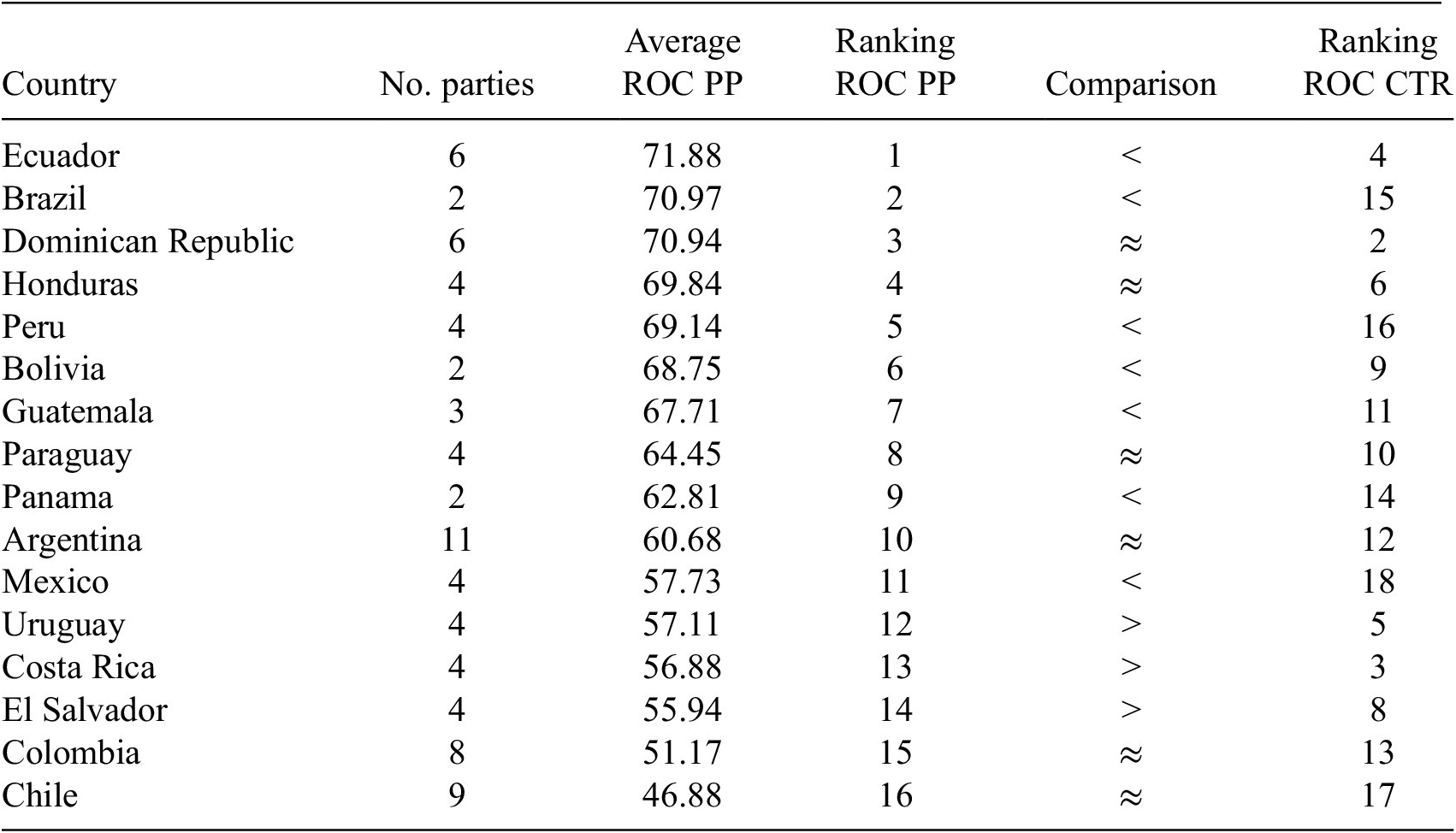
Table 3 shows the descriptive statistics by country. On average, the countries with higher ROC PP are Ecuador, Brazil, and Dominican Republic, and the countries with lower ROC PP are El Salvador, Colombia, and Chile. The table also shows that countries with a high ROC CTR level do not necessarily have a high average of ROC PP—for example, Uruguay and Costa Rica. Similarly, countries with low ROC CTR could have, on average, a higher ROC PP—for example, Mexico, Peru, and Brazil.
ROC PP and ROC CTR a
Abbreviations: ROC CTR, risk of corruption index at the country level; ROC PP, risk of corruption index at the party level.
a When the difference in rankings is less than 2 points, the values are about the same (≈).
6. Comparisons with Other Measures
I compare the different measures of political corruption with the ROC CTR and the ROC PP. I use the most common indexes of corruption: the CPI by Transparency International, the CC by the World Bank, the Political Corruption Index (PCI) by V-Dem, and the Rate of Bribery from Transparency International. While the ROC index measures the likelihood of corruption by evaluating laws and regulations, other measures try to determine the spread of corruption. Thus, we do not expect the indexes have a perfect match.
Comparing corruption measures is hard because they cover different countries and years and do not use the same scale. As the ROC is measured by legislative period, I aggregate the measures by legislative periods and standardize the values to have the same variance. I also change the polarity of CPI and CC, which measures corruption’s absence instead of corruption. These changes allow better comparisons among the indexes. In addition, these comparisons focus on the means because I only have one observation for the ROC and, in some countries, one observation for the bribery rate.
Figure 3 shows the variation of five different measures of corruption and the ROC CTR from 1980 to 2019.Footnote 3 This figure shows that corruption indexes vary between countries because they measure other characteristics of political corruption. For example, Argentina shows that bribery rates and ROC are lower while country expert’ and citizen’ perceptions are slightly higher. Like Argentina, Mexico has medium CPI, CC, and PCI levels, but it has a higher bribery rate and a lower ROC. Mexican case is particular. In recent years, the Mexican government has implemented different regulations to control corruption, making the ROC the lowest in the region. However, people still experience high levels of corruption, and experts’ views have not changed. Costa Rica and Uruguay are other special cases. According to experts, they are two of the cleanest countries in the region. But, the rate of bribery is high compared to the expert’ views, and the risk of engaging in corruption is among the highest in Latin America. I explain these cases below.
Measures of corruption by Country from 1980 to 2019. ROC = Risk of Corruption at the Country Level. CPI = Corruption Perception Index. PCI = Political Corruption Index. CC = Control of Corruption. BRI = Bribery Rate.

Costa Rica and Uruguay score high levels of risk due to the risk of funding and conflict of interest. In the case of Costa Rica, the risk of funding has to do with the absence of regulation for access to media advertising and rules for in-kind donations. Moreover, Costa Rica does not have a law limiting spending during campaigns. Furthermore, even though the anti-corruption law and the decree that regulates the law establish the need to declare conflicts of interest, there is no law regulating lobby. Like Costa Rica, Uruguay does not limit spending during electoral campaigns or in-kind donations. Moreover, there is no information about how the country regulates donations from corporates and foreign interests. Also, lobbying is not regulated in Uruguay, but the party law and chamber of deputies’ regulations establish that candidates and incumbents should declare any conflict of interest. These characteristics make Uruguay a higher-risk country than other countries with the same perception in the region and make it more prone to corrupt activities, particularly the traffic of influences.
Figure 4 compares CPI and PCI with the ROC CTR for the last legislative period. I separate the graph into four quadrants. Quadrants II and III show the expected relationship between the indexes: countries with high corruption perception levels have high levels of ROC CTR and vice versa. However, it is interesting to observe countries in quadrants I and IV. On the one hand, countries with high levels of perception and low levels of risk (IV) could have more regulations to reduce the risk because they have corruption problems and want to reduce them. The Mexican case is an example of implementing many regulations to minimize corruption but still maintaining the same perception levels. On the other hand, countries with lower corruption perception and high levels of risk (I) could be less worried about controlling corruption and have less robust regulations. Costa Rica and Uruguay are good examples.
On the left, corruption perception index (CPI) vs. risk of corruption country-level (RCO CTR). Political corruption index vs. risk of corruption country-level (RCO CTR) is on the right.

Finally, Table 4 shows the correlation between traditional measures and the ROC—country and party levels—for the last legislative period. While ROC CTR does not significantly correlate with any indexes, ROC PP has a significant correlation with CPI, PCI, and CC but not with Bribery. This variation could be due to compliance. Even though some countries implement more anti-corruption measures, law enforcement is difficult to achieve among political parties in Latin America. Moreover, strong regulations against corruption could diminish the risk but do not change perceptions because government performance, economic cycles, and individual democratic attitudes could keep perceptions unchangeable (Morris, Reference Morris2008; Melgar et al., Reference Melgar, Rossi and Smith2010).
Correlation between corruption measures a

Abbreviations: CC, control of corruption; CPI, corruption perception index; PCI, political corruption index; ROC CTR, risk of corruption at the country level; ROC PP, risk of corruption at the party level.
a The correlation indexes are calculated using Pearson’s formula.
7. Uncertainty Analysis
As composite indexes have many resources of uncertainty (Saisana et al., Reference Saisana, Saltelli and Tarantola2005), this section shows the input factors that contribute to ROC’s uncertainty: rescaling, weighting, and aggregation.Footnote 4 Table 5 shows the original ROC (Index 0), which uses a normalization rescaling method, equal weights, and an arithmetic aggregation. Below, I assess the change in the standard ROC (Index 0) by modifying the input factors.
Combinations of uncertainty inputs

To conduct the uncertainty analysis, I first identify different options for each input factor and then assess the changes in the ROC. As shown in Table 5, each input factor has two options. Rescaling uses normalization and standardization. Weighting uses equal weights and Principal Component Analysis (PCA) weights. Aggregation uses arithmetic and geometric method.Footnote 5 Combining the different categories in each input, I estimate eight different indexes at both levels (see Table 5). Some of these combinations show null results and are not included in the analysis. For example, because standardization produces negative values, it is impossible to make a geometric aggregation with odd weights, and Index 7 displays null results. Additionally, to compare the different indexes, I rescale them from 0 to 100.
Figure 5 shows the uncertainty analysis. The figure shows the mean (stars), the original ROC (black points), and the maximum and the minimum (lines). For political parties (top), the variation is low when they have high levels of ROC—more than 75 points—but the variation increases when they have low levels of ROC—less than 40 points. For countries (bottom), there is more uncertainty at all levels. However, the standard ROC is close to the average for all the countries except Mexico. Most of the indexes give Mexico a low-risk value except Index 5. Index 5 uses standardization, equal weights, and a geometric aggregation method, making Mexico a highly risky country. It happens because, in this specific case, four of the five components—funding, misconduct, transparency, and conflict of interest—are far below the mean of all countries, and one component—EMB independence—is very close to the mean. Thus, using a standardization formula makes this component more salience. Also, using equal weights gives this component the same ponderation as the others. Lastly, the geometric aggregation makes the component less compensable than other aggregation formulas. So that, using Index 5 makes Mexico riskier than using different combinations. This example shows how rescaling, weighting, and aggregation affect the values of the indexes.
Uncertainty analysis results show indexes according to the original ROC (black points), the mean (stars), and the minimum and maximum values (vertical lines). Political parties (top) are ordered according to the original ROC PP. Countries (bottom) are ranked according to the original ROC CTR.

Figure 6 shows uncertainty analysis using the rankings instead of values. Shadows show how often each country achieves each ranking. In general, countries keep the same ranking across the different indexes. Mexico, Chile, Peru, Colombia, Argentina, Guatemala, Paraguay, and Venezuela seem unchangeable. Bolivia, El Salvador, Nicaragua, and Ecuador have the most variability. Using rankings allows for evaluating the index no matter the values. We cannot forget that, unlike the ROC PP, ROC CTR has fewer observations, and the variability could be because of a small sample. As noticed from the ROC PP, the index could yield more precise results with more observations and less corrupted countries.
Countries are ordered according to descending ranking. Uncertainty analysis results show the countries’ ranking for each alternative index.

8. Conclusion
This article shows a novel de jure index to measure corruption risks in political parties at two levels: country and political party. Using regulations about party funding, misconduct, transparency, lobbying, and electoral management bodies, I propose an index to measure the risk of corrupt activities at the country level. The index is valid for the last legislative period in Latin American countries. Similarly, I developed an index of the ROC for 85 political parties in these countries. Using the political party manifestos, statutes, and web pages, I obtain information about transparency, party leaders’ selection, candidate selection process, and anti-corruption commitment to assessing corruption risk at the political party level.
I find that countries could have a low risk of perception at the party system level but a high ROC PP level. Thus, even though specific laws and regulations in each country affect political parties, some of them have more measures for controlling corruption. This finding suggests a line of research about political parties’ compliance. I also found that countries could have a high perception of corruption and low risk. While both indexes should not match perfectly because they measure different things, the results show that the ROC CTR is low for most medium-high corrupt perceived countries. Moreover, the ROC CTR is high for the less corrupt perceived countries. Although I do not have enough information—only one legislative period—to make inferences, these results could be due to the countries with a low perception of corruption not worrying about control of the corruption risks. However, a higher perception of corruption leads to more regulations to control the ROC. Future research should focus on what makes a country takes more robust measures to prevent corruption.
Additionally, these findings have two broad policy implications. First, integrity legislation is only reflected in national laws and regulations, but political parties have not developed internal measures for controlling corruption. National governments should consider asking political parties to establish internal anti-corruption or integrity policies that help prevent corruption. Second, even though open government policies should apply to all political actors, there is necessary a better agency or institution that controls the enforcement of these national laws.
Finally, these results have two potential limitations that could be addressed in future research. First, they are only valid for Latin American countries and political parties. The index should include countries and political parties from other continents such as Europe and Asia. The internal party organization in parliamentary systems could be different and affect the ROC in other ways. Second, these results only consider de jure analysis. A de facto analysis of law implementation could complement the results found here. This analysis will show more differences between countries and political parties within countries.
Acknowledgments
I would like to thank the reviewers for their time and feedback.
Funding Statement
This research was supported by the Mexican National Council on Science and Technology (CONACYT) doctoral fellowship.
Author Contributions
G.R.-G. is the sole author responsible for this study, including the data collection, analysis and interpretation of results, and manuscript preparation.
Data Availability Statement
The replication code and datasets used in the paper are openly available in Dataverse at https://doi.org/10.7910/DVN/VXTC6H.


 Open access


Comments
No Comments have been published for this article.