





Scat for conservation biologists and wine for sommeliers have much in common: Both invite us to use our bodies as synesthetic tools for appropriate probing—fracturing a piece of scat with our hands or touching the wine with our tongues, in addition to intensive seeing and smelling. Both could be difficult to describe for untrained subjects, but appear infinitely describable. Both involve a social delegation of knowledge, through which lay subjects frequently rely on experts’ judgments—judgments that are by no means arbitrated by the individual, but are instead predicated upon a scientific or expert community (Fleck Reference Fleck, Trenn and Merton1981; Boyer Reference Boyer2008; Carr Reference Carr2010; Kuhn Reference Kuhn2012; Eyal Reference Eyal2013). In this paper, I ask: What if linguistic anthropological scholarship examining language use and sensory evaluation did not start with wine connoisseurship (Manning Reference Manning2012; Harkness Reference Harkness2013; Silverstein Reference Silverstein, Carr and Lempert2016) but with scat identification?
Scat identification does more than merely expand linguistic anthropological studies of fine-tuned sensory calibration. Rather, it constitutes a crucial example for examining cross-event multisensory calibration along a social-material spectrum that such calibration affords. While aesthetic connoisseurship regularly links taste to stereotypical personae along axes of social class, the material end of the spectrum refuses to prioritize signs about humans over those of nonhumans (Latour Reference Latour2007; Schneider and Heyd Reference Schneider and Heyd2024). Instead, it attunes us to intersubjectively verifiable features of “things” themselves. Like oinoglossia, the repertoire of scatoglossia is similarly rich in adjectives and adjectival phrases. When we focus on both things and humans, the process of scat identification encourages us to see these adjectival predicates not merely as once-and-for-all “quality words” or indexical icons (“qualia”) but as composite, multifunctional operators in real-time interactions—a phenomenon I call “adjectival deixis.”
Linguistic anthropological scholarship on materiality and sensory experience reveals that repertoires of sensation speech are often rich in adjectives. Analyzing wine-tasting in English, Michael Silverstein demonstrates how “wine aroma terminology” deploys adjectives with fine-grained denotations: “floral,” “spicy,” “fruity,” “pungent,” “earthy,” “woody,” “nutty,” and so on (Silverstein Reference Silverstein, Carr and Lempert2016, 200, Reference Silverstein2003, 222–27). Nicholas Harkness (Reference Harkness2013) examines a kind of taste talk surrounding cross-modal sensations of “softness” in Korean soju consumption of the early 2000s. In a convergent investigation, Chumley and Harkness (Reference Harkness2013) draw on Nancy Munn’s model of the interconnected values in rural Gawan communities, in which Munn analyzes paradigmatically aligned lexical stems of, and the perceived relations among, being “heavy/mwaw,” “slow/mwaw-utu,” and “sad/kara-mwaw” (Munn Reference Munn1986, 74–104).Footnote 1 Chumley and Harkness further propose foregrounding the denotata of such adjectives,Footnote 2 or “sensations of qualities, [like] softness, lightness, clarity, pain, stink, etc.,” as intersubjective semiotic processes (Harkness Reference Harkness2013, 4, 7).
Through a case study of wildlife scat identification, this paper explores the precise mechanisms of adjectives and adjectival phrases within the social semiosis of sensory evaluation and materialization. If evaluative repertoires are inherently adjectival, two questions arise: First, how do these adjectives coordinate and mediate evaluative acts? Second, given that “adjectives” are not cross-linguistic universals (Dixon Reference Dixon1982; Kennedy Reference Kennedy1999b), what are adjectival predicates, and how do they contribute to discursive semiotic processes? Drawing on multilingual interactions in community-science collaboration, this paper addresses these questions and argues that adjectives and adjectival phrases function as multifunctional operators in evaluative acts, and that these operations are better captured as what I call “adjectival deixis.” To demonstrate this, I suggest analyzing sensation talk as a specialized kind of referential practice.
Situated at the nexus of sensory calibration and materiality, this paper focuses on wildlife scat on the Tibetan Plateau, a valuable indicator through which Tibetan community experts and Han-Chinese conservation biologists infer wildlife movement. My data includes an English-language “instructional manual” and a Mandarin Chinese-Amdo Tibetan bilingual interactional transcript. Like oinoglossia, both involve a scatoglossic register rich in adjectives and adjectival phrases. While the scatological encounters inevitably unfold against a densely encoded political backdrop of ethnoracialization, geopolitics, and Indigenous sovereignty, scatoglossia helps to sustain a specific scientific chronotope. Within this chronotope, the identities and authorities of speech participants are reconfigured, reassembling a new form of “rapport” (Stengers Reference Stengers2011; Goebel Reference Goebel2019; Carruthers Reference Carruthers2023) between Tibetan community experts, Han-Chinese scientists, wildlife, and the forests.
By analyzing forms of talk that simultaneously describe the perception of scat (“sensation”) and judge its species origin (“ontology”), I explore how language and materiality co-constitute one another. In what follows, I locate adjectival deixis along the social-material spectrum by synthesizing three genealogies: the oinoglossia and qualia literature (Silverstein Reference Silverstein2003, Reference Silverstein2004, Reference Silverstein, Carr and Lempert2016; Chumley and Harkness Reference Chumley and Harkness2013; Chumley Reference Chumley2017), adjective semantics (Kennedy Reference Kennedy1999b; Kockelman Reference Kockelman2016a), as well as situated cognition and skilled vision (Goodwin Reference Goodwin1994, Reference Goodwin, Resnick, Säljö, Pontecorvo and Burge1997, Reference Goodwin2017; Grasseni Reference Grasseni2009). To ground these theoretical discussions, I examine a multilingual transcript from the Tibetan Plateau, alongside an early attempt to formalize scat analysis through published English-language descriptors. In doing so, I detail two indexicalities of adjectival deixis: invoking chronotope and referent configuration.
Limit of the connoisseurship genre
There are good reasons why studies of sensation talk gravitate toward empirical examples of connoisseurship—such as wine tasting (Harkness Reference Harkness2013), cocktail evaluation (Manning Reference Manning2012), upmarket coffee consumption (Silverstein Reference Silverstein, Carr and Lempert2016, 203–8), tea appraisal (Besky Reference Besky2021), sound adjustment of classical music instruments (Glazer Reference Glazer2026), and patented color branding (Nakassis Reference Nakassis, Carr and Lempert2016). In a capitalist society, mass-produced goods are in dialectical tension with sensory calibration: On the one hand, commodity fetishism often obscures the socio-historically accrued labor relations and the sign vehicles through which these relations are sedimented (Kockelman Reference Kockelman2006; Manning Reference Manning2010; Agha Reference Agha2011). On the other hand, sensation talk yields an effect of singularity and uniqueness, which corresponds to the limited-edition nature of high-end luxury crafts and collectibles. Consequently, scholars of linguistic anthropology have frequently selected genres of connoisseurship as primary samples of sensation talk.
A broader body of literature that has influenced this scholarship is sociologist Pierre Bourdieu’s (Reference Bourdieu1984, Reference Bourdieu1991) classic studies of taste, distinction, and symbolic power. Bourdieu conceptualizes the socially conditioned disposition of “taste” primarily as a technique of distance-making in social class. Crucially, to prove that “taste” is neither innate nor objective, Bourdieu goes so far as to treat the object of taste—and its physical materiality—as almost entirely irrelevant. To be sure, linguistic anthropologists are hardly followers of Bourdieu; Practitioners in the discipline have criticized the absence of interactional dynamics in Bourdieu’s macroanalysis (Agha Reference Agha2007, 167; Carr and Lempert Reference Carr and Lempert2016; Silverstein Reference Silverstein, Carr and Lempert2016, 188) and his blanket mystification of an agency-less habitus (Agha Reference Agha2007, 228–32). Recent studies of the evaluative repertoire have also called for moving beyond the Bourdieusian distinction by examining the value and materiality of evaluative “words” themselves (Cavanaugh and Shankar Reference Cavanaugh and Shankar2017; Besky Reference Besky2021). Yet subsequent connoisseurship literature—continuing to stress words and their speakers—has largely inherited Bourdieu’s original insight about the linkage between aesthetic practices and social personae, despite the former’s commitment to micro-analysis. In doing so, this literature has similarly ignored material referents and the semiotic co-evolution of words/speech and “things.”
To adequately inquire into sensation talk, the genre of connoisseurship provides neither the only examples nor the best ones. In connoisseurship practices, the sociological differentiation of social domains—among experts, amateurs, and complete outsiders, who have different degrees of competence in the sensation register (which are also mapped onto social classes)—overshadows how sensation talk is actually utilized to configure, and make sense of, materiality. In other words, analysts too often over-emphasize the human-centric group-making threshold of sensation talk, while neglecting the “thing”-centric process of how in-group members enact expertise and coordinate material realities through sensation talk.
Data on sensation talk in these cases can be studied not only through the lens of connoisseurship and its associated personae, as if the evaluation of social classes must be prioritized. A thorough investigation of sensation talk must encompass both human sociality and nonhuman materiality. Here, I propose to also focus on the speech-mediated materiality of “things” themselves, without losing sight of the social. Furthermore, such materiality and materialization—between sensation talk and the configuration of “things”—should not be dismissed as merely an ideological process (see Keane Reference Keane2003, Reference Keane2018), as if it were somehow less “real” (Agha Reference Agha2007, 396). Rather, it operates as a socially available metasemiotic model and habitual pathway through which materiality is experienced and valued. Such models, shared by communities much like scientific references within a normative public (Wolfgram Reference Wolfgram2016), should be recognized as an achievement through which one of many realities is attained.
Despite these material omissions, the wine-tasting connoisseurship framework remains highly useful for demonstrating one of the functions of adjectival deixis. Silverstein’s study of oinoglossia makes it clear that the refined, adjective-rich terminology of wine-tasting notes indexes “an abstract envelope” in which wine transforms from “an agricultural product” into a prestigious “comestible” (Silverstein Reference Silverstein, Carr and Lempert2016, 198). As Silverstein argues, these adjectives do not emerge randomly. Rather, they are sedimented through institutional practices, ranging from the applied sciences of chemistry, botany, and gastronomy to institutions of connoisseurship and lifestyle marketing (Silverstein Reference Silverstein, Carr and Lempert2016, 198–203). As Silverstein notes, “[t]hese [scientific and aesthetic] institutions … intersected with distinctive shaping influences” converge to deliver to the wine consumer a sense of prestige (Silverstein Reference Silverstein, Carr and Lempert2016, 203). In other words, the institutional credentials, the anticipated labor, and time of the experts and their craft, together with the neatly arranged, accurate-looking, and finely contrasted terminology beyond ordinary English, yield an enregistered effect of prestige for its target wine consumers. This analysis successfully illustrates how the use of adjectives achieves intensive effects of comparison, discernment, and refined selection. And such intensity is not achieved by a single indexical process but is augmented by several processes in combination.
Yet this analysis and its generalizable method are also limited by its analytic standpoint. It situates the analyst at the border between the enchanted world/chronotope of wine-tasting and the presumably naturalistic background where wine is merely an agricultural liquid. But what if we immerse the analysts within the chronotope and ask about the wine talk’s referent itself: is the wine tinkered with in any way by the adjectives that define it? What about wine-brewing experts and sommeliers who rely on these mutable human-wine tinkerings to deliver a more interesting tasting experience? What about avid hobbyists or cross-cultural learners who, regardless of social class, rely on this vocabulary, its denotata, and various wines themselves to explore a novel sensual universe?
To attend to these questions, in the following sections, I align scat identification with wine connoisseurship to reveal what the latter elides. After tracing early attempts to standardize scatoglossia, I examine its usage on the Tibetan Plateau to demonstrate that adjectives within sensation talk are not passive descriptors. Instead, they perform two active interactional functions: first, they index a scientific chronotope; second, they achieve referent configuration, providing the foundational mechanism for subsequent token-type sorting.
Standardizing scatoglossia
For conservation biologists and Indigenous communities coexisting with large-scale nature areas, wildlife tracks and scat are vital evidence of animal behavior (Murie Reference Murie1975; Mumma et al. Reference Mumma, Adams, Zieminski, Fuller, Mahoney and Waits2016). Anthropologists working with Indigenous communities have noted how rare, and occasionally life-threatening, it is to encounter apex predators and herbivores head-on (Kohn Reference Kohn2005, 179; Rahder Reference Rahder2020, 10–11; Kockelman Reference Kockelman2016b). Given this visual scarcity, reading excrement left in the landscape is a crucial skill for wildlife experts. During an early expedition to the southern edge of the Tibetan Plateau, naturalists George Schaller and Peter Matthiessen wrote extensively about their meticulous tracking of elusive predators like wolves, foxes, and the rare snow leopard, treating these droppings as vital sensory clues to plateau biodiversity (Matthiessen Reference Matthiessen1978; Schaller Reference Schaller1980).
To contextualize the scatological encounters on the Tibetan Plateau, it is useful to first examine an early scientific attempt to standardize the identification of fecal pellets into a learnable methodology. In 1940, American biologist John Webb (Reference Webb1940a) proposed a four-way contrast for describing rodent and rabbit scat on the Kansas plains: size, shape, texture, and color. Drawing on his training in botany and agricultural science (Webb Reference Webb1940b), Webb collected fresh pellets from live traps near Hays, Kansas, confirmed the species—including the cottontail rabbit (Sylvilagus), squirrel (Sciurus), prairie dog (Cynomys), and hare (Lepus)—and subsequently dried, measured, and photographed the specimens. While contemporary fecal analysis involves drying methods, chemical analysis, and DNA analysis to detect epithelial cells shed from the intestines (Casper et al. Reference Casper, Jarman, Gales and Hindell2007), scat morphology remains essential in the field. Although Webb’s exact taxonomic vocabulary is not directly invoked by contemporary Tibetan community experts or Chinese conservation biologists, these actors nonetheless participate in the transnational legacy of this standardized scatology—disseminated globally through zoological literature, classrooms, and community workshops.
Nature produces variation. There are no two identical scat pellets, just like there are no two identical leaves. Yet trained eyes can confidently sort among varied scat pellets, assigning their origin to squirrels or prairie dogs. Webb’s attempt to describe scat does not aim at providing accurate denotational descriptive substitutions for each type of pellet. Instead, he is engaged in token sorting and type making. He uses a wide range of adjectives and numerals, together with a hand-drawn image, to design a set of tools that ensure consistent token-type sorting. How is such consistency achieved? We must examine the repertoire, including adjectives and numerals, as well as their relations.
For the cottontail rabbit, for instance, Webb writes, “pellets even textured; completely composed of coarse plant matter, easily crumbled into chaff, light tan colored; spherical oval symmetrical, somewhat flattened; average width, 8-9 mm” (1940a, 480). For the squirrel, he notes, their pellets are “oval shaped, very hard and compact, shiny black color, 7-8 mm. in diameter” (ibid). At the end of the paper, Webb made a list of pellet descriptions, together with a hand-drawn picture of the different shapes and sizes of the fecal pellets (Figure 1).
Pellets descriptors in Webb (Reference Webb1940a, 481), image appears courtesy of Transactions of the Kansas Academy of Science (my annotation color code: yellow: shape; blue: texture; green: length; pink: color).

Figure 1 Long description
Key to the Fecal Pellets of Certain Common Rodents and Rabbits. A single-page textual illustration with a large title at the top, followed by a numbered identification key in two columns. The key uses dotted leader lines that end with animal names. Several phrases in the key are underlined. A block of pellet silhouettes appears below the key, arranged in rows, with a handwritten-style animal name under each group. Text on the page is in English. Title: Key to the Fecal Pellets of Certain Common Rodents and Rabbits Subtitle line: Based on the characteristics of feces collected from a limited area and over a limited period Numbered key text: 1. Pellets spherical to slightly oval, somewhat flattened. 2. Tan color, even texture, easily crumbled. Width, 8-10 mm. Sylvilagus 3. Width, 9-10 mm. Lepus 4. Pellets oval, very hard, compact, shiny black. Width, 7-8 mm. Sciurus 5. Pellets irregular-shaped, wide, elongate. Cynomys 6. Narrow, long-shaped, 10 mm. Neotoma 7. Not more than 3 mm. Mus 8. Very slender, dark brown, 1.5 mm wide, 5-8 mm long. Dipodomys 9. Elliptical, more than 3 mm in diameter. 10. Least 10 mm long. 11. Length, 14-20 mm. Neotoma 12. Length, 10-13 mm. Cynomys 13. Less than 10 mm long. 14. Width, 4-5 mm, very compact, smooth. Neotoma 15. Width, 6-8 mm, wide, rough, lumpy. Rattus 16. Length, 10-13 mm. Citellus 17. Less than 5 mm long. 18. Short, elongated, rough, varied in size, irregular construction. Mus 19. Short, elongated, rough, varied in size. Onychomys 20. At least 3 mm long. 21. Less than 7 mm long. Peromyscus 22. Pellets very connected, light brown. 23. Pellets usually connected by a thin thread, very small, dark. Reithrodontomys Pellet silhouette labels under the drawings: Lepus Sylvilagus Citellus Sciurus Neotoma Rattus Cynomys Onychomys Mus Dipodomys Peromyscus Microtus Reithrodontomys.
Here, each adjective is not isolated and used only once for a specific species’ pellets. These adjectives form a recyclable repertoire in which certain adjectives work together—in gradient, complementary, or polar relations—to establish a matrix of morphological description. The relations between these adjectives are more important than any singular adjectives themselves.Footnote 3 For instance, “spherical” and “elongated” are mutually exclusive, while the “slightly oval” pellet sits in the middle. By contrast, “smooth” and “coarse” are a polar pair at two ends of a spectrum. “Noticeably longer than wide” and “slightly oval” use adverbs to further modify finer-grained degrees. For color words, “tan,” “brown,” and “black” are further specified into “dark brown,” “shining black,” “light brown,” and so on.
In analyzing the relationships among these descriptors, I arranged Webb’s four-way descriptors in a wheel-like chart (Figure 2). Adjectives in the second and third levels are sorted by asking whether a third-layer adjective is also true for a second-layer adjective, but not the other way round. Here, the third-layer is more fine-grained than the more “basic” adjectives in the second-layer. Outside of the wheel, degree adverbs are used to further refine scatological descriptions.
A wheel chart for fecal descriptors.

Figure 2 Long description
A radial wheel chart for fecal descriptors. The chart is organized into four main categories, each forming a section of the wheel. The four central category labels are shape, color, size and texture. Each category contains inner-ring terms and outer-ring refinement terms. Category: shape. Inner-ring terms include round, elongated, curved and flattened. Outer-ring refinement terms include slightly oval, sausage-shaped, longer than wide, slender, elliptical and somewhat deformed. Category: color. Inner-ring terms include light-brown, brown, dark-brown and black. Outer-ring refinement terms include light to dark tan, different shades of brown and among black. Category: size. Inner-ring terms include small and big. Outer-ring refinement terms include numerical metrics noted along the outer edge. Category: texture. Inner-ring terms include coarse, smooth, soft and hard. Outer-ring refinement terms include lumpy, rough, irregular, loose, compact, very compact and extremely compact. The outer ring of the chart contains degree adverbs that further refine each descriptor grouping. The overall structure moves from broad category labels at the center outward to increasingly specific descriptive terms.
The relative orderliness of such descriptors is crucial in enregistering a scientific style. Without this style and the scientific chronotope it indexes, the pellets remain indistinguishable lumps of dirt. Yet, shifting our focus from sociality to materiality—from human-obsessed to “thing”-aware—reveals a second function of these adjective descriptors: these adjectives offer the readers a better understanding of the otherwise random shapes of the fecal pellets presented in the image. At the same time, decontextualized “coarseness” means little to someone who has never touched rabbit scat—they serve as textual anchors. Here, adjectives, as co-texts to the image representation, key our attention to specific dimensional axes, assisting semiotic agents in configuring the referent through a double process of object formulation and deictic anchoring. This allows tokens to be sorted, based on each token’s relation to one another in relation to the dimension in question (or, “relation between relations,” see Kockelman Reference Kockelman2005). How do language-specific adjectives facilitate our configuration and sorting? In the next section, I will illustrate this point in a transcript of a multilingual interaction.
Scatological encounters on the Tibetan Plateau
It was the fourth day of Fang Laoshi’s visit to Tashi’s hometown.Footnote 4 Tibetan environmentalist Tashi had carefully planned her week-long schedule and suggested, on this day, that Fang Laoshi would already be acclimated to the 3,000-m elevation and that now we were safe to trek the 4,000-m-plus mountains together. Trained as the first generation of conservation biologists in China, Fang Laoshi serves as a consultant for a domestic conservation NGO.
Tashi planned the trip for the conservation biologist to look at the biodiversity of his home forest. We were going to start from a valley called “Dzikha,” following a path that connects a dirt road to their sacred mountain and their summer pasture, which lies further east of their settlement. Tashi’s friend Yeshe also accompanied us. Being an active pastoralist, Yeshe frequently trekked through the forests for daily pastoralist work; at the same time, he also had plenty of free time to observe and gather information from animals that interested him.
During the trip, we stopped at a few points to look at traces and excrement of musk deer, ungulates, wolves, and other possible species. As it is unlikely for humans to encounter these wild animals face to face, identifying them from their footprints and excrement was all we could do—in fact, Yeshe is an expert in this kind of identification.
Fang Laoshi attached her phone to a tripod and intended to make our field trip a live show for a popular science audience. Given the lack of cellular service up in the mountainous forest, she recorded a few short excerpts. Only after going through the videos that Fang Laoshi shared with us later, did I start to understand the participation frameworks of these fieldtrips and many grassroots wildlife surveys—as well as the individual and collective expertise of Yeshe, Tashi, and Fang Laoshi. The following sceneFootnote 5 was recorded when we encountered piles of wildlife excrement along the elevation (Figure 3).
Transcript of the interaction in original languages (left) and English glossing (right) (italic: Amdo Tibetan; non-italic Mandarin).

Figure 3 Long description
The image shows a line-numbered transcript table with two columns. The left column contains dialogue in Amdo Tibetan and the right column provides the English gloss/translation. The conversation discusses shapes and sizes, with corrections made between terms like short-long and big-small. The transcript includes bracketed notes and translation conventions. The format is structured with numbered lines, facilitating reference to specific parts of the dialogue.
In Tashi’s home forest, as with forests elsewhere, an isolated piece of wildlife excrement usually invites no more attention than soil or stones. In this case, after Tashi exclaimed “this is [what we are looking for],” he picked up a few scat pellets (རྟུག་པ། tukka), examining them in his hands.
Although Fang Laoshi had never been to this forest before, her professional experience as a conservation scientist had prepared her to examine the scat of typical wildlife species found throughout Asia. Tashi smoothly followed her inquiries, describing the pellets while smelling them, demonstrating his skill. In terms of participation framework, Yeshe, as an active pastoralist, was more of an expert on wildlife than Tashi. Knowing this, Tashi translated selected information that Yeshe relayed to him in Amdo Tibetan to Fang Laoshi in Chinese, sometimes eliminating the reporting structure, translating Yeshe’s judgment as their collective conclusion; sometimes keeping the reporting structure, telling Fang Laoshi in Chinese that “he [Yeshe] thinks it is a tufted deer’s” (L32), and that “he [Yeshe] thinks [they] are not long enough” (L37). Fang Laoshi, then, reframed what Tashi had told her for her intended audience in the recording.
If we analyze the Amdo Tibetan and Chinese language that these participants use at sentence-level, we will find more processes unfolding. First, regarding the deer excrement, Yeshe, Tashi, and Fang Laoshi all used improvised adjectives—from their respective linguistic and cultural repertoires—so as to direct their respective addressee’s attention and to dimensionalize the referent in a particular way. Tashi commented that the second pile of excrement they found was “tiny” (zhikka, ཞིག་ག), which can be parsed as “tiny” in English, but the adjective in Tibetan also encodes the feeling of being fragile and fractured. Yeshe told Tashi that the musk deer’s excrement he knew was “long” (ringnga རིང་ང་།) and “narrow” (trapu ཕྲ་བུ།). Here, a trapu thing is not only narrow in size but also needs to be thin, long, and round, like fingers.
Fang Laoshi’s descriptions, too, were saturated with her language-specific adjectives, like the duplicated “round” suggesting very round (yuan-yuan-de [round-DUP-NZR]), and the classifier suggesting a grain-like shape (yi-li yi-li de [one-CL (grain-like) one-CL (grain-like) NZR])Footnote 6 (Figure 4). In the process of relay and translation, Fang Laoshi mistook what Tashi reported in the dimension of short-long (L37) as a matter of big-small in size (L38, L46). But Tashi quickly corrected her in the next turn of speech (L48). Here, fine descriptions of shapes, textures, and comparative structures in Amdo Tibetan are turned into relatively coarse Chinese shape descriptions through translation. Yet when a mistake emerges, it can be corrected. In short, Tashi’s and any other Tibetan speakers’ relative expertise—compared to Fang Laoshi’s or other non-Tibetan speakers’—lies in that a Tibetan speaker could produce, understand, and relay these fine-grained descriptors, while also being able to link the qualified referents when they encounter real-world entities. This is exactly what Yeshe did.
One to six screenshots from the recorded interaction (Copyright: Marrong Dongge Conservation Group).

Figure 4 Long description
Six photographs depict a field survey in a forest setting. The first photo shows hands holding small dark pellets, with another person nearby. The second photo is a close-up of pellets scattered on the forest floor among twigs and leaves. The third photo captures a person kneeling, holding pellets in their palm, with a camera positioned nearby. The fourth photo shows a person sitting, closely examining pellets in their hand. The fifth photo again shows hands holding pellets. The sixth photo provides a wide view of the forest, showing trees and greenery from an elevated perspective. The sequence illustrates the process of collecting and documenting pellets during a forest field survey.
These improvised, language-specific adjectives function as the default linguistic tools for local experts who frequently encounter scat in their daily conservation work. While a more standardized scatoglossia—similar to Webb’s taxonomic proposal—often appears in formal field-trip diaries, real-time interactive identification relies on a slightly different repertoire. As this excerpt demonstrates, participants coordinating in the field deploy a set of improvised adjectives that only partially overlap with formal standardized terminology.
Despite the asymmetrical linguistic access, collaborative science gets done despite translation gaps. Because Fang Laoshi lacks Tibetan linguistic competence, her access to localized expertise inherently differs from that of Yeshe and Tashi. For the local experts, Tibetan adjectives are the most immediate communicative tools for calibrating the present scat against their historical, experiential encounters. However, exact denotational equivalence across languages is not strictly necessary for successful collaborative calibration. Fang Laoshi’s lack of Tibetan is mitigated by her repeated probing questions (Lines 30, 38, 46) and Tashi’s subsequent corrections (Line 48). Crucially, Tashi does not pause to single out and translate specific Tibetan adjectives, such as trapu, into Mandarin for Fang Laoshi; doing so would be neither essential nor efficient for the immediate material task of scatological calibration.
Second, sources of knowledge are encoded in deictic categories (evidential marker; pronoun). But these deictic categories are eliminated through reporting and reframing. Despite being the one—among all the participants—with the most expertise on wildlife around Smar, Yeshe also had never seen a musk deer close-up. Generally, only (former) hunters or scientists who specialized in musk deer have such first-hand knowledge or encounters. This kind of knowledge became “sayings” (ཤོད་སྲོལ། shösol) among Tibetan communities like Smar. Yeshe quoted the local saying in Line 22:

The Tibetan quotation marker zer (ཟེར) conveniently suggests that what comes before it is second-hand knowledge. Yeshe further used complex auxiliary verb structures to hedge a very delicate sense of certainty. When Tashi was relaying Yeshe’s information (L23–24, 31) to Fang Laoshi (L32, 37), even though he preserved the reporting structure, the source of information and Yeshe’s degree of certainty were conveniently erased:

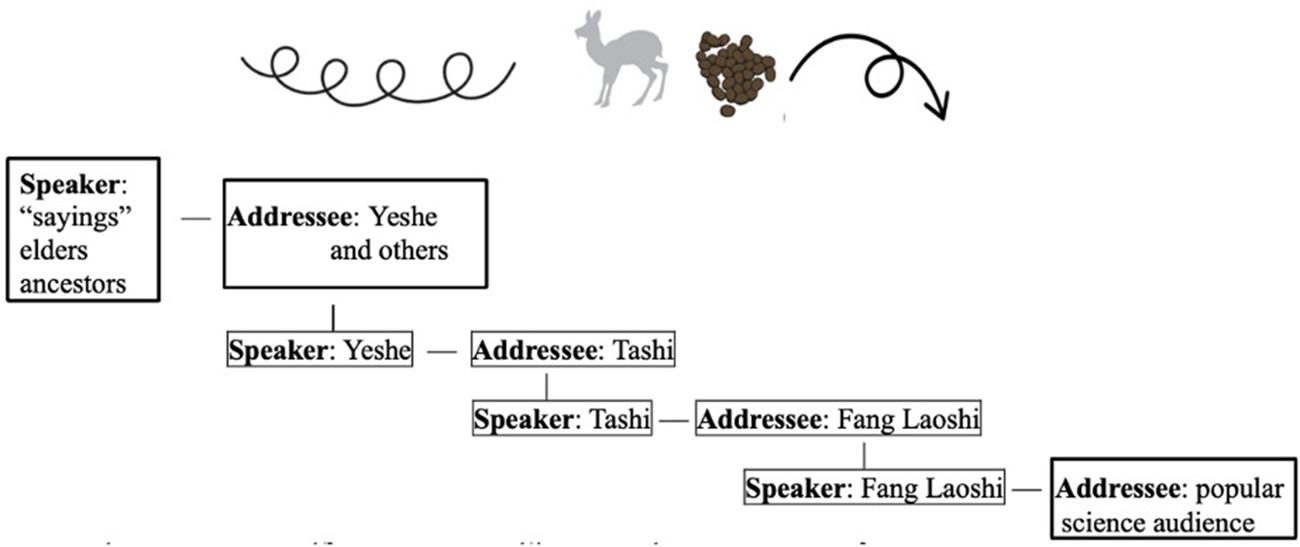
Figure 5 diagrams this speech chain as it unfolds across Yeshe’s analysis, Tashi’s report, and Fang Laoshi’s on-camera presentation. Here, Yeshe and Tashi mobilize local knowledge, drawing on previous encounters in their home region that extend well beyond the immediate speech event to make sense of the pellets in their hands. Within this participation framework, Tashi acts as the Goffmanian delegate (Reference Goffman1979) for Yeshe in Mandarin, just as Yeshe channels local elders in Tibetan. Meanwhile, Fang Laoshi alone breaks the immediate frame to address an external popular-science audience. Code-switching in such conservation contexts is inherently political (Edmonds Reference Edmonds2020), particularly given state policies that undermine linguistic justice across Tibet and China (Zhang Reference Zhang2018; Blum Reference Blum, Huang, Jing-Schmidt and Meisterernst2019; Roche Reference Roche2024). Yet, this specific interaction inverts macro-level power dynamics. Using Amdo Tibetan as their default working language, Tashi and Yeshe accommodate the monolingual Fang Laoshi only minimally.Footnote 7 Here, Amdo Tibetan does not operate as a minoritized language struggling against Mandarin (Ward Reference Ward2024). Rather, its epistemic dominance forces Fang Laoshi to repeatedly probe in the nationally dominant language just to access their localized analysis.
This collaborative scat identification relies on the indispensable interplay of fragmented speech and improvised adjectives, which are tightly coordinated with co-occurring kinesic actions like pointing, mutual gaze, and tactile handling. Together, these multimodal practices accomplish three things: (1) coordinating the participants’ joint attention to the pellets on the ground; (2) physically probing the multidimensional features of the scat, including its size, shape, smell, and freshness; and (3) comparing these immediate material signs against other pellets encountered in the past.
Scientific chronotope among many possible scatological chronotopes
Tibetans and Han-Chinese cannot agree on shit. This structural friction is crucial for analyzing the preceding interaction. Tracing the cultural and historical baggage of Sino-Tibetan encounters over excrement clarifies a key function of adjectival deixis: indexing chronotopes. The many possible historical chronotopes around excrement reveal that the scientific chronotope between Fang Laoshi and Tashi bounds a rare ritualistic effect—produced and maintained by the scientific scat talk they collaborate on. I will introduce a broader (post)colonial semiotics of waste to understand this local backdrop.
While anthropocentric views frequently consider bodily waste as “matter out of place,” a biosemiotic perspective recasts it as “a sign of the form of life to which it once belonged, [and] a remnant” (Reno Reference Reno2014, 9). Globally, excrement features in many Indigenous stories as an allegorical companion for reciprocity, relations, or humanity at large. In Western Apache landscape stories, the undesired accumulation of excrement in a clan’s settlement corresponds to a lack of reciprocity exchange (Basso Reference Basso1996, 23–28). In Kaguru sexuality allegories, anus-less or excrement-less people remain enticing but had better not be trusted (Beidelman Reference Beidelman1972). Excrement also mediates the tension between decontextualized colonial theories of hygiene (Bashford Reference Bashford2003; Rogaski Reference Rogaski2004) and Indigenous technologies that are optimized for specific places and climates. Feces and urine are further used in carnivalesque protests to demarcate symbols of power—from court-justice unrest in southern China (Chu Reference Chu2014) to the “Rhodes Must Fall” student movement in South Africa (Ahmed Reference Ahmed2017).
These fraught (post)colonial relations are also refracted in contemporary Sino-Tibetan encounters against the backdrop of state-led developmentalism (Yeh Reference Yeh2013; Bauer and Gyal Reference Bauer and Gyal2015; Makley Reference Makley2018). On the Tibetan plateau, Han-Chinese tourists are routinely repelled by livestock dung on the streets, lamenting a lack of “hygiene.” Conversely, Tibetan (agro)pastoralists, who rely on yak and sheep dung as everyday fuel, are often affronted by this hygienic anxiety (Schutte Ke Reference Schutte Ke2024, 128). Simultaneously, since the Cultural Revolution, Tibetan communities are frequently appalled by the Han-Chinese settler-farmers who casually collect human feces for fertilizer (Alai Reference Alai2021, 32–34). In short, these clashing metasemiotic frameworks produce deeply divergent stances toward fecal practices along ethnonational boundaries.
Yet the scatological encounter between Fang Laoshi, Tashi, and Yeshe suspends these historically scripted ethnonational relations. By handling animal scat pellets from one hand to the other—feeling the pellets by hand and arranging them in size—Yeshe, Tashi, and Fang Laoshi bond over what Reno (Reference Reno2014) calls a “cross-species” paradigm shift on waste. Their asymmetrical but complementary knowledge of animal scat forms a “rapport” (Stengers Reference Stengers2011; Carruthers Reference Carruthers2023) grounded in a shared object of analysis. This effect of rapport is achieved not only through their joint attention to wildlife scat pellets but, crucially, through the distinct discursive repertoires each brings to the interaction.
Drawing on “relationality” theorists (Stengers Reference Stengers2011; Strathern Reference Strathern2020), Carruthers (Reference Carruthers2023, 11) proposes that rapport is not merely an “ethnometapragmatic chronotope” in which co-present participants assume relational roles within a speech event; rather, it actively “incites attention to affinities, associations, comparisons, and relational coming-together.” This relational coming-together is particularly significant given the broader socio-political realities of Tashi and Yeshe’s home forest. Historically, Han-Chinese actors—ranging from government officials and tourists to migrant laborers and illicit poachers (roles that frequently overlap)—are considered by the local community as agents within a broader pattern of extraction or intrusion upon the Indigenous community’s territory. Yet, the material task of scat identification suspends these macro-level frictions. It generates coordinated attention, mutually respected expertise, and a minimally shared scientific goal. The rapport among Tashi, Yeshe, and Fang Laoshi lies not only in their participation framework in the speech event but also in a rare cross-cultural affinity, or a mutual stance, toward wildlife in this forest.Footnote 8
Just as oinoglossia transforms quotidian wine drinking into a ritual of class membership via adjectives like “bouquet” or “waxy” (Silverstein Reference Silverstein2003, Reference Silverstein2004, Reference Silverstein, Carr and Lempert2016), the subtle linguistic calibration of scat morphology anchors the Sino-Tibetan interaction within a scientific chronotope. Here, scat pellets are simultaneously everyday feces, contested dirt, and scientific specimens. Keying, speaking, and discussing scat is not simply a matter of a repertoire that can be learned from an instructional manual like Webb’s list of pellet descriptors. The adoption of this repertoire is embedded in the long-term biographical trajectories of trained conservation biologists and Indigenous experts. Their expertise lies not in a repertoire of pellet descriptors, but in their interactional capacity to use adjectives to help addressees calibrate their perspectives, aligning them with the speaker’s own sensory vision and tactility.
Scalar deixis and referent configuration
How, then, should we study adjectives and adjectival phrases within sensation talk? To operationalize this inquiry, I synthesize formal semantics—specifically how adjectives encode dimensions (Kennedy Reference Kennedy1999b)—with ethnomethodological approaches to their interactional deployment (Goodwin Reference Goodwin, Resnick, Säljö, Pontecorvo and Burge1997). These two traditions converge on the concept of deixis: a social process through which denotational and interactional text operate inextricably (Levinson Reference Levinson1983, 54–96; Agha Reference Agha2007, 37–48).
Following Paul Kockelman’s (Reference Kockelman2016a, 391) anthropological application of Christopher Kennedy’s (Reference Kennedy1999a) semantic framework, gradable adjectives (e.g., “tall,” “red”)Footnote 9 encode both a dimension (a scalar such as length or redness) and a threshold (the standard admitting an entity as being “tall” or “red”). Where do the “scalar” and “threshold” come from? Taking color as an example, we might assume that all color words correspond to simple, explicit dimensions. Yet John Lucy (Reference Lucy, Hardin and Maffi1997) critiques “color linguists” who use decontextualized color swatches in experiments to understand the correspondence between native color words and color “perception.” Here, in field linguistics, the dimension of many adjectives, like certain color words, only makes sense in the local environment (even though such dimensions can be infinitely described as “luminance,” “vitality,” and so on). Yet, simply acknowledging that the dimension of an adjective is language-specific is insufficient.
Among gradable adjectives, linguists have found a set of adjectives that challenge the idea that a scalar lies within the semantic field shared by normative speakers of a language. For adjectival predicates such as “fun,” “tasty,” and “spicy,” the dimension of these adjectives is uncontroversial, but the standard appears to vary and depends entirely on the individual speaker.Footnote 10 For instance, the proposition that “Rollercoasters are fun,” in everyday speech, might suggest a speaker-centered “subjective” evaluation. However, it is the utterance context that determines the projected point of reference rather than the adjectives themselves. Here, the same sentence, used in a theme park design meeting, would suggest that the zero point of reference is the park’s potential audience rather than the speaker themselves. Similarly, gastronomists’ descriptors of “tasty” or “light” are also different from those of a lay consumer (Kennedy Reference Kennedy2013, 268). In other words, such a scalar must not be assumed to exist in any default way, like a dictionary reference or a color swatch. Rather, it is co-formulated within a situated speech event and the social histories surrounding it.
This suggests that an adjective works together with co-textual variables—in utterance as well as immediate or social contextFootnote 11—in indexing an important variable in adjective semantics: the scalar. Even ordinary adjectives shift contextually: a tall child is measured against a completely different array of potential entities than a tall adult or a tall table.Footnote 12 The scalar itself is a process of relation-making that projects what William Hanks (Reference Hanks, Duranti and Goodwin1992) terms the “indexical ground”—which corresponds to a non-present set of children, adults, or tables when “tall” is uttered with different co-texts. Hanks (Reference Hanks, Duranti and Goodwin1992) has adopted a denotatum–relationality–indexicality framework to analyze deictic forms in speech. For instance, in English, “here” denotes a region or place, encoding an immediate or proximal relation, while indexing the location of the speaker. Hanks defines the indexical ground as the context being created or projected by the deictic form. The indexical ground need not point to a specific entity. Instead, it consists of an array of potential figures that share affinities with the actual figure: the denotatum and the indexical ground are “in a foreground-background relation” (Hanks Reference Hanks, Duranti and Goodwin1992, 57).
Adjectival deixis configures referents by performing scalar measurements against a historically accrued indexical ground. Charles Goodwin’s (Reference Goodwin, Resnick, Säljö, Pontecorvo and Burge1997) study of professional interactions reveals that such a “scalar” is embedded in social history. The study features an expert chemist guiding an apprentice through the situated practice of determining the precise moment to stop a chemical reaction by collaboratively judging exactly when an acrylic fiber turns a diagnostic shade known as “jet black.” Goodwin reveals that the “jet black” does not come from “a preformulated, context-free universal color category” (Goodwin Reference Goodwin, Resnick, Säljö, Pontecorvo and Burge1997, 111). Instead, the dimension and measurement are part of a formulated effect projected by such an adjective. To achieve this task in real-time apprenticeship, the chemists recruit improvised adjectival metaphors (“like gorilla fur,” “lumpy”) alongside embodied, kinesic actions (“fingers feeling fibers gesture”) to substantiate the calibration of “jet black” (Goodwin Reference Goodwin, Resnick, Säljö, Pontecorvo and Burge1997, 123, 128).
If we treat the referential field—acrylic fibers for Goodwin, scat pellets in this paper—as the indexical ground, the adjective operates as a scalar deixis that selects a figure from this projected field, or the referent from its “same but different” others. In L20–22 of my transcript (Figure 5), adjectives work together with deictic expressions di/zhe (“this”) and Tashi’s pointing and picking up in the interaction to select the referent. Here, participants in the speech events use adjectives to highlight certain comparative attributes of the referent in its referential field—its being “tiny,” “very round,” and “very grainy”—aligning other speech participants’ perspectives to these selective principles along the dimensions these adjectives offer. Here, in L20, 25, 27, and 29, Tashi, Yeshe, and Fang Laoshi use adjectives to key other speech participants’ attention to the referent they selected, calibrating their vision alignment with one another.
Speech chain between elders/ancestors, Yeshe, Tashi, Fang Laoshi, and the popular science audience.

Figure 5 Long description
The diagram illustrates a speech chain. At the top left, a box labeled 'Speaker: “sayings” elders ancestors' connects to 'Addressee: Yeshe and others.' Below, 'Speaker: Yeshe' links to 'Addressee: Tashi.' Further down, 'Speaker: Tashi' connects to 'Addressee: Fang Laoshi.' Finally, 'Speaker: Fang Laoshi' links to 'Addressee: popular science audience.' Above the boxes, there are images of a spiral, a deer, scat pellets and an arrow pointing right. These elements visually represent the flow of communication from elders to the popular science audience.
The process of adjectival deixis can also select non-present referents from a narrated event. In L23–24, the pastoralist expert Yeshe told Tashi that, as he heard from other credible sources, the scat pellets from musk deer are “long” (ringnga) and “narrow” (trapu). Here, the indexical ground could be similar scat pellets in the forest, or the scat pellets under their eyes. Either way, it forms comparative relations between the unknown species’ pellets and those of a musk deer as Fang Laoshi and Tashi take up this morphological discrepancy and frame their own comparative structures in L37 and L46. The following table summarizes the dimensional configuration of the selected scat pellet in the interaction (Figure 6).
Dimensional configuration assisted by adjectival predicates.

Figure 6 Long description
The table has four columns: Adjectival Predicate, Referent, Indexical Ground, Dimensional Configuration. It includes 8 rows. The first four rows share the referent 'entities e' and indexical ground 'speech event (scat pellets of X)', pointing to 'similar scat pellets in the forest'. These predicates describe characteristics like 'tiny', 'very round', 'very grainy' and 'like pearl'. The next two rows shift to 'narrated event (scat pellets of musk deer)' with predicates 'long' and 'narrow', indicating a different comparison. The final two rows have unspecified referents and indexical grounds, with predicates '(not) long (enough)' and '(too) small'. The dimensional configuration diagram illustrates 'long' and 'narrow' aspects, with 'discreteness' suggesting variability in pellet shapes.
Here, “referent configuration” is achieved through a dialectical process: (1) the deictic anchoring of the immediate referent in relation to social histories beyond the speech event and (2) “object-formulation” around the referent over linear sociohistorical time (Kockelman Reference Kockelman2005, 242–45; Agha Reference Agha2011). Deictic anchoring enables spiral spatiotemporal recalibration along comparative scalars. While object-formulation cumulatively materializes the referent, naturalizing its newly ascribed “properties.” At the micro-level, adjectives, and the comparative frames they introduce, yield the effect of “highlighting” the referent against its immediate background. In studies of skilled vision, Cristina Grasseni (Reference Grasseni2022, 2) terms this effect “perspicuity”: “the resulting, learned capacity to recognize at a glance what is relevant or merits further attention in a field of vision, and which course of action this realization should lead to.” This seemingly automated “recognition at a glance” is not innate; it is the interactional achievement of referent configuration, successfully aligning the selected material referent with the relevant entities in one’s experiential histories.
Conclusion
In his essay “The Law of Mind,” Charles Sanders Peirce observed that “facts that stand before our face and eyes and stare us in the face are far from being, in all cases, the ones most easily discerned” (Peirce Reference Peirce, Cohen and Dewey1998, 237). In this paper, I demonstrated that, for a highly tangible entity like scat—much like discerning a refined taste or delicate hue—we are also required to invoke complex comparative frameworks and past communicative chains in order to know a bit more about it. Furthermore, discerning these facts is never merely an internal cognitive exercise. As responsible speakers and addressees, we are compelled to calibrate our shared grounds to fulfill social roles: as scientists and Indigenous experts; as apprentices and masters; as external researchers and community scientists.
The pluralistic dimensions of each scat pellet exceed measurable scale at every attempt of decontextualized captioning—just like wine to the tongue, timbre to the ear, and color to the eye. Yet, the process of identifying apparently discrete scat pellets and their associated namable species reveals how adjectival deixis and referential practice are immanent to sensory calibration. Scat identification in Sino-Tibetan Indigenous-Science collaboration provides a case in which two effects of adjectival deixis can be readily delineated: (1) the scientific chronotope and (2) referent configuration.
By bridging the fields of aesthetics and science-making, this paper also emphasizes the dialectical mutuality of sociality and materiality. The capacity to compare, discern, and identify scat is socially valued. Such expert knowledge generates an indispensable form of social capital—albeit one that remains transient, non-accumulative, and defeasible in light of broader structures of ethnonational or professional identity. This social capital may carry high stakes, sometimes amounting to Indigenous expertise and community sovereignty.
Acknowledgements
I am deeply grateful to Drakpa Sherab, Rabzang, Yingyi, Lobsang, and Drolma for their guidance and support during my fieldwork in Tibet. I also extend my thanks to Aliyah Dewar, Juliet Glazer, Randy Burson, and Tayeba Batool for their generous feedback on earlier drafts of this article. Portions of this research were presented at the Society for Linguistic Anthropology (SLA) Biennial Conference, the Penn EnviroLab, and the Penn Semiotic Lab. I thank the attendees for their constructive engagement.
Funding statement
This research was supported by funding from the Chiang Ching-Kuo Foundation (CCKF) and the International Dissertation Research Fellowship from the Social Science Research Council (SSRC-IDRF).




 Open access

