





Introduction
The relation between screen media use behaviors and mental health/well-being in children and adolescents (referred to here as youth) is often debated (e.g., Eirich et al., 2022; Przybylski et al., Reference Przybylski, Orben and Weinstein2020; Vuorre et al., Reference Vuorre, Orben and Przybylski2021) and presents concern for researchers, clinicians, and the public. As an example, a Google search of “screen use child mental health” in December 2023 yielded over 500 million results. Select studies have led to multiple popular press articles claiming a strong relationship between more screen time and worse mental health among youth (Twenge & Campbell, Reference Twenge and Campbell2018), while others have strongly refuted that claim (Orben & Przybylski, Reference Orben and Przybylski2019). Because this research garners widespread press and guides clinical recommendations for youth and their parents, a better understanding of the relation between screens and youth mental health is needed. Screen media use can be critically important in the transition from childhood to adolescence, during which time children have more autonomy with screen use and social media use is not as prevalent (Madigan & Reich, Reference Madigan and Reich2023). This study aims to assess the relation between screen time, problematic media use behaviors, and clinical mental health concerns in the epidemiologically informed Adolescent Brain Cognitive Development (ABCD) Study to better understand this relationship during the transition from childhood to adolescence.
Screen time and problematic media use
There are multiple ways to measure and conceptualize child media use, including screen time, behaviors surrounding screen media, and “addiction-like” screen media behaviors (Domoff et al., Reference Domoff, Borgen and Radesky2020; Kaye et al., Reference Kaye, Orben, Ellis, Hunter and Houghton2020). Screen time (or screen media use) refers to simple time spent on screens (e.g., tablets, smartphones, televisions, and gaming consoles), whereas problematic media use refers to media use that interferes with at least one domain of a child’s functioning (Domoff et al., Reference Domoff, Borgen and Radesky2020). The last few years have seen a greater recognition that screen media use is poorly measured and questionably meaningful (Kaye et al., Reference Kaye, Orben, Ellis, Hunter and Houghton2020), with a “lack of harmony” between informants and type of measurement in the screen time literature (Eirich et al., 2022). While many scholars are harnessing more intensive quantitative methodologies to better analyze simple screen time (e.g., Song et al., Reference Song, Zhang, Zhou, Fu, Zou, Xu, Wang, Li, Zhao, Potenza, Fang and Zhang2023), understanding behaviors around screens (i.e., problematic media use), rather than focusing on screen time per se, will be useful in guiding clinical recommendations and future directions in this field.
Indicators of problematic media use include a child begging for screens, a child becoming dysregulated when they cannot use a screen, and a child’s screen media use causing problems for the family or interfering with family activities (Domoff et al., Reference Domoff, Harrison, Gearhardt, Gentile, Lumeng and Miller2019). Domoff and colleagues’ (2020) Interactional Theory of Childhood Problematic Media Use (IT-CPU) posits that distal factors (e.g., parent’s own use of media, SES), proximal factors (e.g., parent’s beliefs about their child’s media use, child emotional dysregulation) and maintaining factors (e.g., use media to regulate, positive reinforcement for child to use media) play a role in the development of problematic media use. Problematic media use is linked to parenting behaviors around media (Coyne et al., Reference Coyne, Shawcroft, Gale, Gentile, Etherington, Holmgren and Stockdale2021), higher behavioral problems and executive functioning difficulties (Oh et al., Reference Oh, Kim and Joung2021), and children bypassing their parents’ device limits (Hadlington et al., Reference Hadlington, White and Curtis2019).
Additionally, problematic media use has consequences for both externalizing (e.g., problematic behaviors) and internalizing (e.g., depressive symptoms) in children (Rega et al., Reference Rega, Gioia and Boursier2023). In previous studies, problematic media use predicts child difficulties and functioning over and above screen time (Domoff et al., Reference Domoff, Harrison, Gearhardt, Gentile, Lumeng and Miller2019), and there is a wide range of studies examining problematic media use in early childhood (e.g., Coyne et al., Reference Coyne, Shawcroft, Holmgren, Christensen-Duerden, Ashby, Rogers, Reschke, Barr, Domoff, Van Alfen, Meldrum and Porter2024); few studies have specifically examined it in relation to clinical concerns in a racially diverse sample of preadolescents. Both screen media use and problematic media use can displace health-promoting activities relevant in the development of psychopathology, including sleep (Lund et al., Reference Lund, Sølvhøj, Danielsen and Andersen2021) and physical activity (Iannotti et al., Reference Iannotti, Kogan, Janssen and Boyce2009). Given the large focus on screen time in the extant literature, this study examines both screen media use and problematic media use in the context of child mental health development.
While problematic social media use is also a focal concern for many researchers and parents, that is not the focus of this study due to the sample’s developmental stage (most children under the age of 12 do not use social media; Rideout & Robb, Reference Rideout and Robb2019). In this paper, problematic media use refers to the behaviors surrounding all media, and was specifically theorized for children 12 and under (e.g., Domoff et al., Reference Domoff, Borgen and Radesky2020); social media use could be part of these problematic behaviors, but adolescence allows for more social need and unsupervised peer connection present with social media use (Bányai et al., Reference Bányai, Zsila, Király, Maraz, Elekes, Griffiths, Andreassen and Demetrovics2017). While many of these children could still be using social media, better understanding problematic non-social media use can still be useful for these families, as problematic media use can interact with other domains of mental health concerns in childhood (Domoff et al., Reference Domoff, Borgen and Radesky2020). Notably, it can be also difficult to disentangle parent-reported problematic media use behaviors from externalizing behaviors as reported by parents, as many problematic media use domains are encompassed by externalizing behaviors (e.g., becoming dysregulated when cannot use a screen) and the two symptoms may bidirectionally influence the other (Rega et al., Reference Rega, Gioia and Boursier2023).
Potential sex differences in screen media behaviors
Scholars have posited that screen use and behaviors around screens should be conceptualized as part of the child’s larger ecological system, which includes sex and race/ethnicity (Paulus et al., Reference Paulus, Zhao, Potenza, Aupperle, Bagot and Tapert2023). Indeed, research indicates that screen media use differs by sex within the context of this particular developmental window. In a 2019 nationally-representative sample of 8–12-year-old children, males spent over an hour more on screens than females (Rideout & Robb, Reference Rideout and Robb2019). This could be due to the large amount of time males start spending on video gaming once they enter preadolescence compared to females (Rideout & Robb, Reference Rideout and Robb2019). While the relation between screen media behaviors and clinical concerns has been analyzed by sex, findings indicate that the effect of screen media use on clinical outcomes does not vary by sex (e.g., higher screen media use is associated with worse clinical outcomes to similar degrees across sex; Paulich et al., Reference Paulich, Ross, Lessem, Hewitt and Kabir2021). However, a separate analysis found that females spending over seven hours a day (vs. 1 hour) on screens were four times as likely to meet criteria for a depressive disorder, whereas males were only twice as likely. Both males and females with that level of screen use were twice as likely to report suicidal ideation or attempts and engage in self-harm (Roberston et al., Reference Roberston, Twenge, Joiner and Cummins2022). Thus, the literature on the relation between sex and screen media use is mixed. Unlike the literature on screen media use, there is much less research on how problematic media use differs by sex (though there is a wealth of research on problematic social media use). To date, the limited research has found that males are overrepresented as compared to females in groups with severe problematic media use around age 9 (Oh et al., Reference Oh, Kim and Joung2021), and a systematic review found that males are more likely to exhibit problematic media use before the age of 10 years (Rega et al., Reference Rega, Gioia and Boursier2023).
Considerations for screen media behaviors pertaining to race/ethnicity
Research to date investigating effects related to screen media behaviors have also found differing patterns according to race and ethnicity. Notably, when we discuss race in this paper, we are not alluding to the presence of biological or genetic differences (Smedley & Smedley, Reference Smedley and Smedley2005) as the root cause for group differences in screen media use or problematic media use; instead, we are examining associations of interest in within-group analyses stratified by race/ethnicity as there are still social connotations related to race in the United States (Quintana et al., Reference Quintana, Aboud, Chao, Contreras‐Grau, Cross, Hudley, Hughes, Liben, Nelson‐Le Gall and Vietze2006). Moreover, examining within-group patterns allows us to highlight that these groups are not monolithic and bring focus to many racial groups that are considerably underrepresented in research on screen media behaviors. Existing studies analyzing screen media behaviors and their association with mental health concerns in large datasets have often positioned race as a confounder (i.e., a source of variance to be covary out) rather than a focal variable of interest (e.g., Chu et al., Reference Chu, Ganson, Baker, Testa, Jackson, Murray and Nagata2023; Keyes et al., Reference Keyes, Hamilton, Finsaas and Kreski2024; Paulich et al., Reference Paulich, Ross, Lessem, Hewitt and Kabir2021; Roberston et al., Reference Roberston, Twenge, Joiner and Cummins2022).
There are some noteworthy examples of research on media use that consider race. Existing research has found that, on average, Black and Hispanic/Latine parents have a more positive view of media than parents of White children from an early age (Rideout & Robb, Reference Rideout and Robb2020). Therefore, based on the IT-CPU model, differences in parent beliefs across race may contribute to both higher screen media use and potentially higher problematic media use. Additionally, one study reported that White children spend less time on screens than Black and Hispanic/Latine youth (Rideout & Robb, Reference Rideout and Robb2019); this large, nationally-representative study recruited “Other” races other than the ones in this analysis, but did not report their data. Further, race may play a moderating role both in the development of screen media use and problematic media use, as well as how they are related to clinical concerns. Given the well-established inequities in income (Patten, Reference Patten2016) and stress (Nam et al., Reference Nam, Wikoff and Sherraden2015) – well-established predictors and correlates of child media use (e.g., Rideout & Robb, Reference Rideout and Robb2020, Warren & Aloia, Reference Warren and Aloia2019) – between some White parents and some parents of color (including Black, American Indian or Alaska Native, Hispanic/Latine, and Asian, with some differences within each comparison), race should be considered when examining media use behaviors and relations to child mental health. To date, we are not aware of any studies that assess race/ethnicity and problematic media use in late childhood/early adolescence directly, rather than framing it as a confounder.
Clinical problem presentation during the adolescent transition
Mental health concerns frequently emerge during the adolescent transition, and how screen media use and problematic media use are linked with these concerns requires further study. Understanding the factors associated with increases in emotional problems is critical, as they place youth at higher risk for self-directed harm (Cha et al., Reference Cha, Franz, Guzmán, Glenn, C., Kleiman and Nock2018). Indeed, suicide is the second leading cause of death during this developmental window (e.g., ages 10–24; Heron, Reference Heron2021; Kochanek et al., Reference Kochanek, Murphy, Xu and Arias2023). Similarly, self-injurious thoughts and behaviors, such as suicide ideation (SI) and non-suicidal self-injury (NSSI), occur but are rarer in childhood (e.g., Janiri et al., Reference Janiri, Doucet, Pompili, Sani, Luna, Brent and Frangou2020) and become increasingly common in adolescence. SI, which includes passive thoughts of death or suicide (e.g., “I wish I could go to sleep and never wake up”) and active thoughts of suicide (e.g., “I want to kill myself”), is estimated to be experienced by 20–24% of youth internationally (Nock et al., Reference Nock, Borges, Bromet, Cha, Kessler and Lee2008). NSSI, which is the act of injuring oneself intentionally without the intent to die, has an international lifetime prevalence of approximately 17% in adolescence (Brown & Plener, Reference Brown and Plener2017). Emotional problems, such as internalizing and externalizing symptoms, increase precipitously across adolescence (Bitsko et al., Reference Bitsko, Holbrook, Ghandour, Blumberg, Visser, Perou and Walkup2018) and externalizing syndromes may be more strongly related to thoughts of and death by suicide among children, whereas internalizing syndromes may be more strongly linked among adolescents.
As is true for screen media use and problematic media use, clinical problems need to be considered within the greater context of the child’s demographics, including sex and race/ethnicity. Patterns of emotional problems, SI, and NSSI do not seem to differ robustly between male and female preadolescent youth (Rescorla et al., Reference Rescorla, Achenbach, Ivanova, Dumenci, Almqvist, Bilenberg, Bird, Chen, Dobrean, Döpfner, Erol, Fombonne, Fonseca, Frigerio, Grietens, Hannesdottir, Kanbayashi, Lambert, Larsson and Verhulst2007; Wiglesworth et al., Reference Wiglesworth, Fiecas, Xu, Neher, Padilla, Carosella, Roediger, Mueller, Luciana, Klimes-Dougan and Cullen2023), though recent evidence suggests higher rates of NSSI for males versus females in this age group (Burke et al., Reference Burke, Bettis, Walsh, Levin, Lawrence, Sheehan, Turnamian and Liu2023). In adolescence, however, these patterns diverge, and female youth become more likely than male youth to experience internalizing symptoms, NSSI, and SI (Cha et al., Reference Cha, Franz, Guzmán, Glenn, C., Kleiman and Nock2018; Hayward & Sanborn, Reference Hayward and Sanborn2002; Nivard et al., Reference Nivard, Lubke, Dolan, Evans, St. Pourcain, Munafò and Middeldorp2017). These differences may be partly driven by pubertal development and associated neurobiological changes, which onset earlier on average for female youth (Ho et al., Reference Ho, Gifuni and Gotlib2021; López-Ojeda & Hurley, Reference López-Ojeda and Hurley2021; McNeilly et al., Reference McNeilly, Saragosa-Harris, Mills, Dahl and Magis-Weinberg2022). Somewhat paradoxically, in adolescence, male youth show an increased risk for death by suicide relative to their female agemates (Kochanek et al., Reference Kochanek, Murphy, Xu and Arias2023). This elevated risk burden may be associated with increases in externalizing symptoms and behaviors such as substance use among male youth (Hicks et al., Reference Hicks, Blonigen, Kramer, Krueger, Patrick, Iacono and McGue2007; McGirr et al., Reference McGirr, Renaud, Bureau, Seguin, Lesage and Turecki2008; Nivard et al., Reference Nivard, Lubke, Dolan, Evans, St. Pourcain, Munafò and Middeldorp2017).
Clinical concerns also vary by race and ethnicity in childhood and adolescence. Racial/ethnic differences in youth internalizing and externalizing problems have primarily been examined between Black/African American, Hispanic/Latine, and White/ European American youth, with very little research including youth from other racial/ethnic backgrounds. Generally, this work has found higher internalizing symptoms among Black/African American youth and Hispanic/Latine youth as compared to non-Hispanic-White/European American youth, as well as differences within race/ethnicity based on sociodemographic characteristics (Brown et al., Reference Brown, Meadows and Elder2007; McLaughlin et al., Reference McLaughlin, Hilt and Nolen-Hoeksema2007). While some research has found lower prevalences of externalizing disorders among racial/ethnic minoritized youth as compared to White/European American youth (i.e., Kessler et al., Reference Kessler, Avenevoli, Costello, Georgiades, Green, Gruber and Merikangas2012), these findings are mixed (i.e., McLaughlin et al., Reference McLaughlin, Hilt and Nolen-Hoeksema2007). When considering SI and suicide attempts, we also find racial/ethnic prevalence differences. In a national sample of adolescents, Native American, Native Hawaiian/ Pacific Islander, and Multiracial youth reported the highest rates of SI (19.7%–22.8%) and suicide attempts (10.9%–14.0%), followed by White/European American, Asian/Asian American, Black/African American, and Hispanic/Latinx youth (13.7%– 16.4% SI; 6.4%–8.8% attempts; Wiglesworth et al., Reference Wiglesworth, Klimes-Dougan and Prinstein2023). Since mental health problems and suicide risk are known to vary across different populations of youth based on demographic characteristics such as age, race/ethnicity, and sex, there may also be variation in how screen media use and problematic media use relate to these outcomes.
Screen behaviors and clinical concerns in youth in the ABCD study
The ABCD StudySM is a large, prospective, population-based, and longitudinal study assessing multiple developmental outcomes in youth from multiple sites in the United States that can offer a critical opportunity for research to begin to address the most pressing questions pertaining to the intersection of child and adolescent development, screen media use and problematic media use, mental health, and suicide risk. Important strides have been made to use the ABCD StudySM. To date, several studies using this dataset have reported significant but small relations between screen media use and clinical concerns (Nagata et al., Reference Nagata, Chu, Zamora, Ganson, Testa, Jackson, Costello, Murray and Baker2023; Paulich et al., Reference Paulich, Ross, Lessem, Hewitt and Kabir2021; Roberston et al., Reference Roberston, Twenge, Joiner and Cummins2022), with greater youth-reported screen media each day (i.e., more than 2 hours) being related to a higher likelihood of meeting criteria for depressive disorders, SI, and NSSI (Roberston et al., Reference Roberston, Twenge, Joiner and Cummins2022). Additionally, males displayed more video game addiction symptoms, while females displayed more social media addiction (Bagot et al., Reference Bagot, Tomko, Marshall, Hermann, Cummins, Ksinan, Kakalis, Breslin, Lisdahl, Mason, Redhead, Squeglia, Thompson, Wade, Tapert, Fuemmeler and Baker2022). Black youth also displayed more video game and social media addiction than youth of all other races (Bagot et al., Reference Bagot, Tomko, Marshall, Hermann, Cummins, Ksinan, Kakalis, Breslin, Lisdahl, Mason, Redhead, Squeglia, Thompson, Wade, Tapert, Fuemmeler and Baker2022); it should be noted, however, that the majority of youth in this study at the first three time points used none or very little social media (less than an hour). One study that considered longitudinal data from the ABCD Study reported that each additional hour of total screen media use at baseline was associated with a 0.09 additional odds of suicidal thoughts or behaviors two years later (Chu et al., Reference Chu, Ganson, Baker, Testa, Jackson, Murray and Nagata2023). Notably, because of the ABCD Study’s large sample size, very small effects can be significant, meaning it is even more critical to look beyond statistical significance to understand the clinical significance of these findings. Though a measure of parent-reported problematic media use is included in the ABCD Study beginning at Year 2 (Domoff et al., Reference Domoff, Harrison, Gearhardt, Gentile, Lumeng and Miller2019), to date, we are not aware of any published papers have used it in their examinations of child screen use and mental health, nor examined it by both sex and race/ethnicity (though there are other studies utilizing the video game, social media, and mobile phone addiction measures in the ABCD Study in mid-adolescence; e.g., Grund & Luciana, Reference Grund and Luciana2025; Raney et al., Reference Raney, Al-shoaibi, Ganson, Testa, Jackson, Singh, Sajjad and Nagata2023). Given the relevance of problematic media use to clinical concerns, an important next step is to understand association of both screen media use and problematic media use with an array of clinical outcomes (Eales et al., Reference Eales, Wiglesworth, Klimes-Dougan and Cullen2023.)
The current study
The current study aims to examine the relations between problematic media use, screen media use, and clinical concerns in children in the ABCD Study. We have two research questions. First, how well do parent-reported problematic media use and screen media use differentially predict concurrent internalizing and externalizing problems, suicidal ideation, and NSSI? We hypothesize that in our whole sample, the relation between problematic media use and clinical concerns will be stronger than the relation between screen media use and clinical concerns as measured by standardized effect sizes. Second, how do the relations between parent-reported problematic media use, screen media use, internalizing and externalizing problems, SI, and NSSI differ by race/ethnicity and sex? This aim does not compare results across demographic groups, as recommended by APA Guidelines on Race and Ethnicity (APA, 2019); instead, we are examining how problematic media use and screen media use operate within each demographic group. In keeping with better capturing the demographic nuances within each racial/ethnic group, moderations between problematic media use/screen media use and ethnicity and Multiracial status will be assessed. We hypothesize that problematic media use will continue to be a better predictor of clinical concerns across race/ethnicity and sex.
Method
Sample
Data are drawn from the 4.0 data release from the Adolescent Brain and Cognitive Development Study (ABCD Study®), a multisite, epidemiologically informed study of brain development in youth in the United States (Jernigan & Brown, Reference Jernigan and Brown2018). Youth were enrolled in the study at ages 9–10 years with a goal to match national proportions of age, gender, race, ethnicity, SES, and urbanicity (Garavan et al., Reference Garavan, Bartsch, Conway, Decastro, Goldstein, Heeringa, Jernigan, Potter, Thompson and Zahs2018). Our sample includes up to 10,052 youth from the Year 2 ABCD Study time point (the “11–12 year” wave, with actual age range for the youth being 10 to 13 years), the first study wave at which problematic media use is measured; our sample is slightly smaller than the total ABCD Study sample at Year 2 because we excluded youth who any missing problematic media use data. Youth were excluded from our study sample if they were missing problematic media use data; the maximum number of cases available with relevant data were used for each analysis. Demographic characteristics of our sample (including sample sizes for each variable) can be found in Table 1; a breakdown of each variable by race/ethnicity and sex can be found in Supplement A (Tables A1 through A9).
Descriptive statistics for each study variable
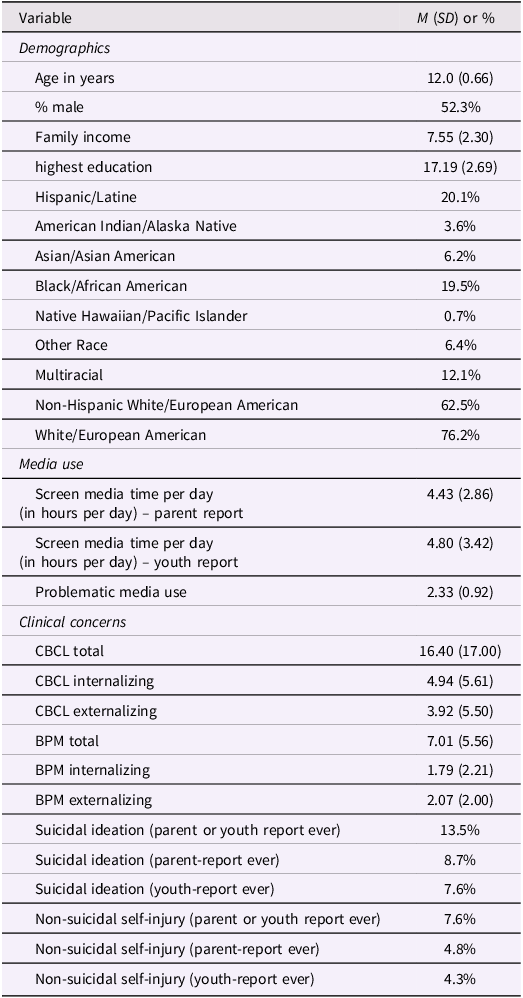
Note: CBCL = Child Behavior Checklist; BPM = Brief Problem Monitor. Family income: 1 = Less than $5,000; 2 = $5,000 through $11,999; 3 = $12,000 through $15,999; 4 = $16,000 through $24,999; 5 = $25,000 through $34,999; 6 = $35,000 through $49,999; 7 = $50,000 through $74,999; 8 = $75,000 through $99,999; 9 = $100,000 through $199,999; 10 = $200,000 and greater. Parent highest education: 0 = Never attended/Kindergarten only; 1 = 1st grade; 2 = 2nd grade; 3 = 3rd grade;4 = 4th grade; 5 = 5th grade; 6 = 6th grade; 7 = 7th grade; 8 = 8th grade; 9 = 9th grade; 10 = 10th grade; 11 = 11th grade; 12 = 12th grade, no diploma; 13 = High school graduate; 14 = GED or equivalent Diploma; 22 = Less than 1 year of college credit/postsecondary education (or less than 10 classes); 23 = One year or more of college credit; 16 = Associate degree: Occupational, Technical, or Vocational; 17 = Associate degree: Academic Program; 18 = Bachelor’s degree; 19 = Master’s degree; 20 = Professional School degree; 21 = Doctoral. Problematic Media Use: 1= Never; 2 = Rarely; 3 = Sometimes; 4 = Very often; 5 = Always. Of the 10,052 in the analytic sample, the N for each variable is as follows: Age N = 10,052; Sex N = 10,052, 2 are intersex male; Family Income N = 9249; Highest parent education N = 10,052; Ethnicity N = 9932; All races N = 10,052; Parent SMU N = 10,050; Youth SMU N = 10,027; CBCL total, internalizing, and externalizing N = 7857; BPM Total N = 8906; BPM Internalizing N = 9635; BPM externalizing N = 9541; SI reported by youth or parent N = 9842; SI reported by parent N = 9905; SI reported by youth N = 9962; NSSI reported by youth or parent N = 9842; NSSI reported by parent N = 9905; NSSI reported by youth N = 9962; One hundred and twenty participants either said they refused to answer, didn’t know, or did not respond to the question on Hispanic/Latine heritage. Their data was excluded from models including that variable.
Measures
Sociodemographic characteristics
Parents reported on participant sociodemographic data at baseline and at follow-up time points. Participant sex assigned at birth (referred to subsequently as sex) and race/ethnicity were reported at baseline (see Table 1 for details). Most participants were identified as male or female, however, two intersex participants were identified and were not included in Aim 2 analyses. Sociodemographic data from Year 2, which was collected approximately two years post-baseline, included family income, parent highest education, and age. Race was coded into seven non-mutually exclusive categories (i.e., Multiracial participants were represented across multiple groups), as presented in Table 1. Parents reported separately on race (e.g., Asian/Asian American, Black/African American) and ethnicity (e.g., Hispanic/Latine). Youth whose parents/caregivers selected “Refuse to answer” or “Don’t know” and did not select any other race or ethnicity category were excluded from all analyses that included race/ethnicity.
Screen media activity
Parents and youth reported on youth screen media activity, reporting how much time youth engage in screen media activity during the weekdays and weekends (Bagot et al., Reference Bagot, Tomko, Marshall, Hermann, Cummins, Ksinan, Kakalis, Breslin, Lisdahl, Mason, Redhead, Squeglia, Thompson, Wade, Tapert, Fuemmeler and Baker2022). Both parents and youth were instructed not to include time spent on media during school. Parents were asked how much time youth spend per typical weekend or weekday in total on a computer, cell phone, tablet, iPod, or other electronic device and are asked to respond with a drop-down menu indicating number of hours (0–23) and mins (in 15-min intervals) per day. Youth reported on their total weekday and weekend media use disaggregated based on device, media platform, or activity. Activities included: a) watching or streaming TV shows or movies, b) watching or streaming videos or live streaming (such as YouTube, Twitch), c) playing video games on a computer, console, phone or other device (Xbox, PlayStation, iPad) which was broken down into single player and multiplayer gaming, d) texting on a cell phone, tablet, or computer (e.g., GChat, WhatsApp, etc.), e) visiting social networking sites like Facebook, Twitter, Instagram, etc., f) editing social media photos, g) browsing the internet, or h) video chatting (Skype, FaceTime, etc.). Response options included “none,” “<30 min,” “30 min,” “1 h,” “2 h,” “3 h,” or “4 + hours.” Reported screen media time was summed over the course of a week (e.g., weekday screen time multiplied by seven plus weekend screen time multiplied by two). Because we wanted to have consistent reporters between problematic and screen media use (and youth-report problematic media use is not included in the ABCD Study), parent-reported screen media use is used in these analyses. Youth screen media use is reported in the descriptive table, and is used in the predictive models in the supplement. Finally, screen media use was winsorized within 2 SDs over the mean per previous research (e.g., Eales et al., Reference Eales, Gillespie, Alstat, Ferguson and Carlson2021) – any values above that cutoff were restricted to the highest limit (for parent-report, 461 participants were limited to 84.4 hours/week; for youth report, 459 participants were limited to 92.3 hours/week). To further simplify, the models included hours
per day (simply dividing the hours per week by seven).
Problematic media use
Problematic media use is assessed through nine parent-reported items based on the Problematic Media Use Measure – Short Form (Domoff et al., Reference Domoff, Harrison, Gearhardt, Gentile, Lumeng and Miller2019): “My child sneaks using screen media,” “Screen media is all that my child seems to think about,” “It is hard for my child to stop using screen media,” “When my child has a bad day, screen media seems to be the only thing that helps him/her feel better,” and “My child’s screen media use causes problems for the family.” Parents respond on a five-point scale that ranges from never (1) to always (5) (Cronbach’s α = 0.93).
Clinical concerns
The Child Behavior Checklist (CBCL), which measures specific problems experienced by youth within the past six months, was completed by the parent/guardian (Achenbach & Ruffle, Reference Achenbach and Ruffle2000; Barch et al., Reference Barch, Albaugh, Avenevoli, Chang, Clark, Glantz, Hudziak, Jernigan, Tapert, Yurgelun-Todd, Alia-Klein, Potter, Paulus, Prouty, Zucker and Sher2018). Responses were recorded on a 4-point Likert scale, ranging from not true (0) to very true (3). We examined raw scores from three CBCL subscales: Total Problems (α = 0.95), Internalizing Problems (α = 0.88), and Externalizing Problems (α = 0.90). The use of raw scores is recommended by the instrument authors to preserve the full range of variation (Achenbach & Rescorla, Reference Achenbach and Rescorla2001; Thurber & Sheehan, Reference Thurber and Sheehan2012).
The Brief Problem Monitor (BPM), which measures specific problems experienced by youth over the past week, was completed by the youth (Achenbach et al., Reference Achenbach, McConaughy, Ivanova and Rescorla2011). Responses were recorded on a 3-point Likert scale, ranging from not true (0) to very true (2). We examined raw scores from the 6-item internalizing (α = 0.66) and 7-item externalizing (α = 0.58) subscales and total (α = 0.79) to mirror the approach used with the CBCL.
The computerized Kiddie Schedule for Affective Disorders and Schizophrenia for DSM-5 (KSADS-COMP), which measures symptoms for assessing clinical symptom profiles, was completed by both youth and the parent/guardian (Barch et al., Reference Barch, Albaugh, Avenevoli, Chang, Clark, Glantz, Hudziak, Jernigan, Tapert, Yurgelun-Todd, Alia-Klein, Potter, Paulus, Prouty, Zucker and Sher2018; Kaufman et al., Reference Kaufman, Birmaher, Brent, Rao, Flynn, Moreci, Williamson and Ryan1997, Reference Kaufman, Kobak, Birmaher and De Lacy2021). SI is measured across five domains: passive, active but nonspecific, active with a specific method in mind, active with intent, and active with a plan. NSSI was measured by an item that asked about behaviors such as scratching, cutting, or burning oneself. Lifetime suicidal ideation and non-suicidal self-injury were each coded according to both parent and youth endorsement, where 1 = either parent or child indicated that the child had a lifetime experience of SI or NSSI (coded separately), 0 = neither parent nor child indicated this lifetime experience. We also coded both SI and NSSI according to parent and youth report separately for exploratory follow-up analyses, as previous research suggests that youth reports may be more reliable than parent reports, particularly at younger ages (e.g., DeVille et al., Reference DeVille, Whalen, Breslin, Morris, Khalsa, Paulus and Barch2020; Jones et al., Reference Jones, Boyd, Calkins, Ahmed, Moore, Barzilay, Benton and Gur2019; Moretti et al., Reference Moretti, Fine, Haley and Marriage1985).
Data analysis
For Aim 1, multilevel regression models were conducted using the lme4 R package (Bates et al., Reference Bates, Mächler, Bolker and Walker2015) with family (1620 families with 2+ children in the study; 6761 families with just one child) and site (21 sites) as random effects. Models predicted the clinical concerns (CBCL, BPM, SI, and NSSI) separately. Problematic media use and screen media use were both included together in the models. The comparison of problematic media use to screen media use was assessed via standardized beta weights, which indicate change in the dependent variable in SDs based on SD change in the independent variables. Child age, family income, and parent education were included as covariates (in addition to sex and race and ethnicity). Models with random effects failed to converge for our dichotomous outcome variables using binomial models (SI and NSSI), even after changing the optimizers and removing random effects one at a time. This is likely due to the relatively small incidence of SI and NSSI for this age group. Because of this, simple logistic regressions were conducted. The mixed effects models used standardized betas to assess effect sizes; the logistic regressions used odds ratios, and problematic media use and screen media use were standardized to create a standardized odds ratio.
For Aim 2, multilevel regressions were again conducted with family and site as random effects, however analyses were conducted separately for both each sex and each race/ethnicity. To allow for a more nuanced interpretation of race/ethnicity, interaction terms were also included between screen media use/problematic media use and Multiracial and Hispanic/Latine (this allowed for us to understand the ways in which screen media use/problematic media use might interact with those demographic statuses in relation to clinical concerns vs. simply controlling for them). As with the overall regressions, models with random effects failed to converge for the dichotomous outcome variables, even after changing the optimizers and removing random effects one at a time; thus, simple logistic regressions were conducted.
Results
Aim 1
Externalizing and internalizing problems
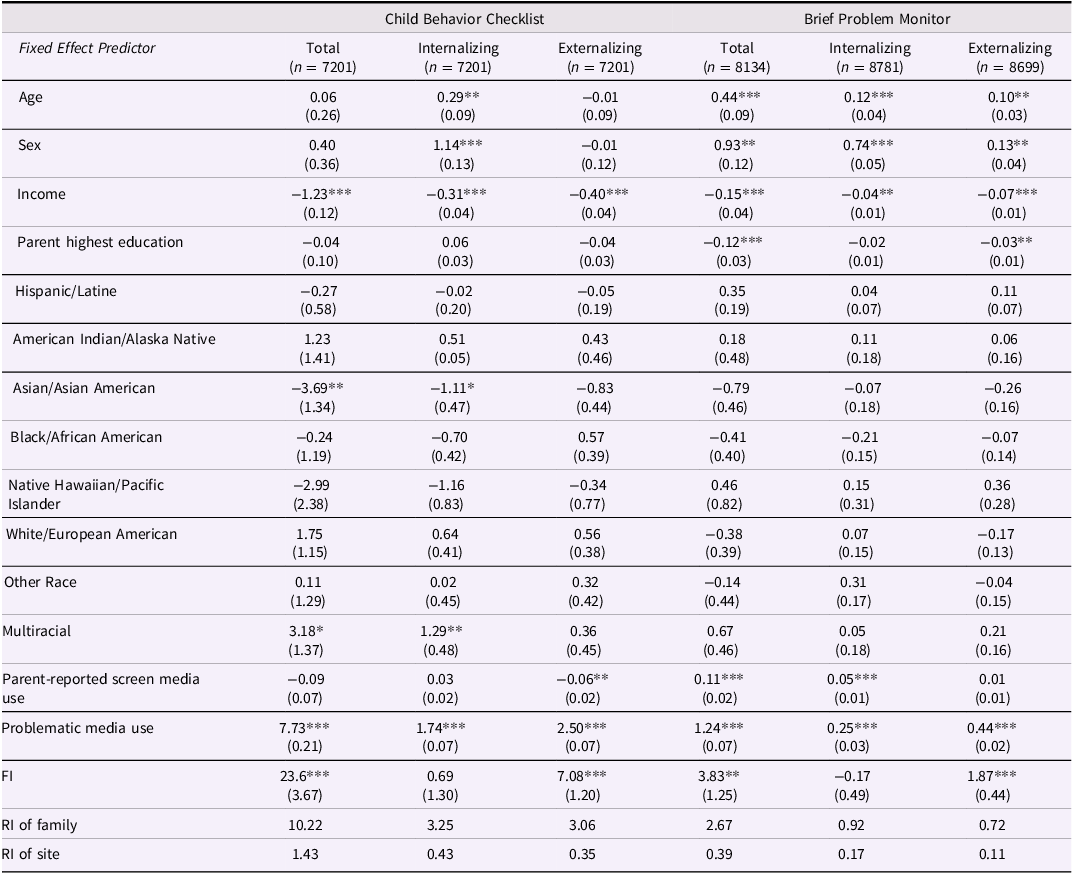
Table 2 indicates the unstandardized coefficients and SEs for each variable in each model. Problematic media use was significantly related to higher total, internalizing, and externalizing problems in both the CBCL and BPM (ps < .001). Screen media use was also significantly associated with BPM total, BPM internalizing problems, and CBCL externalizing problems (ps < .01). Standardized coefficients also indicate that the relation between problematic media use and all CBCL/BPM outcomes had a greater effect size than that between screen media use and CBCL/BPM outcomes, and the results for problematic media use often had the highest effect size of all variables in the model.
Multilevel model predicting internalizing and externalizing problems using unstandardized coefficients and standard errors
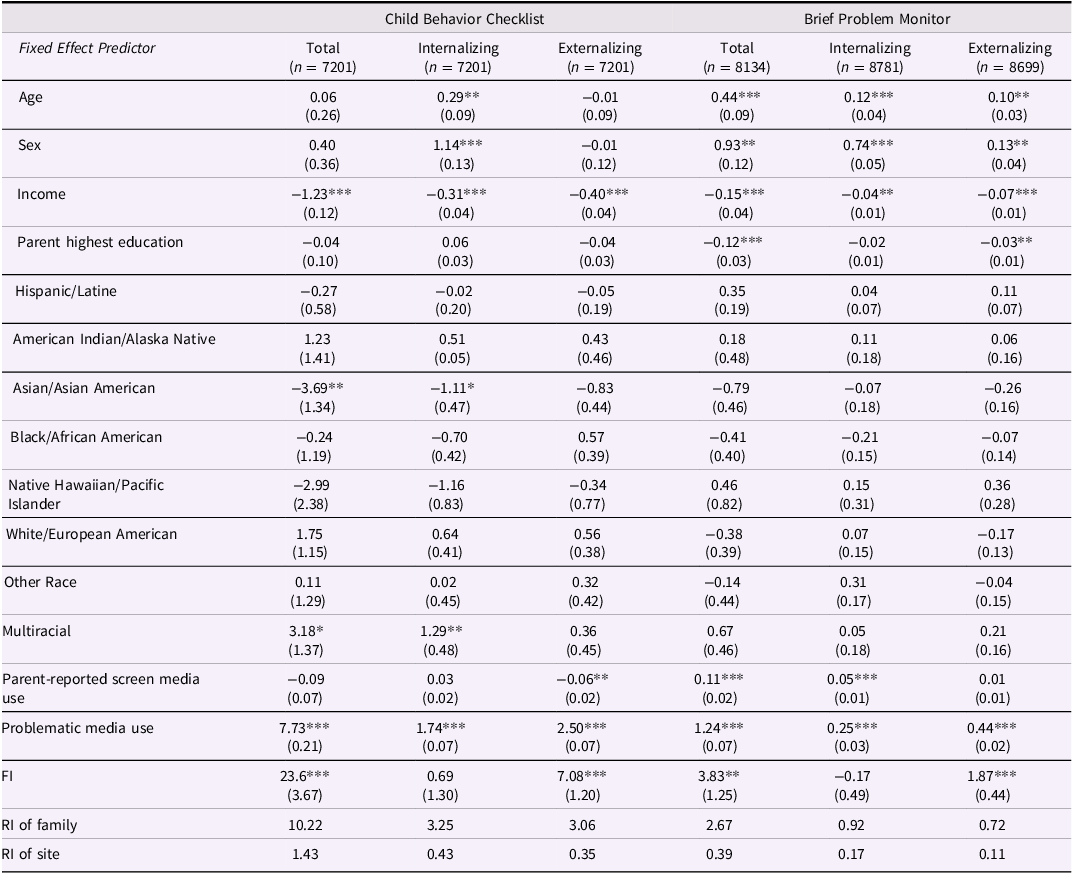
*p < .05; **p < .01; ***p < .001. Screen media use is average hours in a day. FI = Fixed intercept; RI = random intercept.
When predicting CBCL total problems, problematic media use (standardized B = 0.42) demonstrated the greatest effect size of all variables in the model (e.g., Income B = −0.17, screen media use B = −0.01). Problematic media use also had the greatest effect size of all variables in the model predicting CBCL internalizing (problematic media use B = 0.29, screen media use B = 0.01) and CBCL externalizing (problematic media use B = 0.43, screen media use B = −0.03).
When predicting BPM total problems, problematic media use had the highest effect size (B = 0.20 vs. B = .06 for screen media use). Problematic media use also had a higher effect size than screen media use in relation to BPM internalizing (problematic media use B = 0.10, screen media use B = 0.07) and BPM externalizing (problematic media use B = 0.20, screen media use B = 0.01).
Supplement B (Table B1) indicates the same analysis with youth-report screen media use, which indicated similar results with more variation in the effect sizes of problematic media use and screen media use as predictors.
Suicidal ideation and non-suicidal self-injury
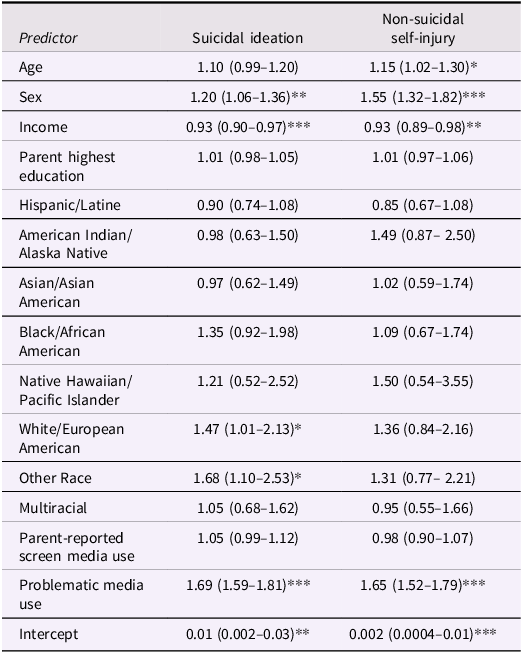
Table 3 presents the odds ratios and confidence intervals for logistic regressions predicting SI and NSSI (ever reported by parent and/or child). Screen media use and problematic media use were both standardized by dividing the variable by the SD. Screen media use was not associated with SI or NSSI. A one-SD increase in problematic media use was associated with a 69% increase in the odds of a parent or child ever reporting child SI (OR = 1.69, CI 1.59–1.81). For NSSI, a one-SD increase in problematic media use was associated with a 65% increase in the odds of the parent or child ever reporting NSSI (OR = 1.65, CI 1.52–1.79).
Logistic regression odds ratios and confidence intervals predicting non-suicidal self-injury and suicidal ideation (N = 8965)
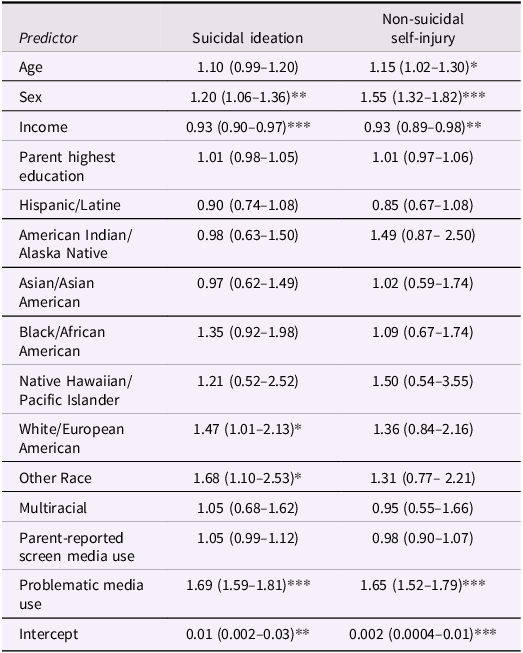
*p < .05; **p < .01; ***p < .001. Screen and problematic media use are both standardized (divided by their standard deviation).
This analysis was also conducted with parent-report and youth-report SI and NSSI separately. For parent-report SI, problematic media use was still significant (OR = 1.88, CI 1.74–2.03), and screen media use was not. For youth-report SI, problematic media use is also significant (OR = 1.47, CI 1.36–1.60), and screen media use was not. The same patterns emerge for both parent-report NSSI (problematic media use significant: OR = 1.84, CI 1.66–2.03, screen media use not significant) and youth-report NSSI (problematic media use significant: OR = 1.50, CI 1.35–1.67, screen media use not significant).
Supplement B (Table B2) indicates the same analysis with youth-report screen media use, which indicated similar results with more variation in the effect sizes versus parent-reported problematic media use and screen media use predictors. The main difference in results is that youth-reported screen media use significantly predicts both SI and NSSI.
Aim 2
Predicting clinical concerns by race/Ethnicity
Hispanic/Latine participant models
For Hispanic/Latine participants (Supplement C, Tables C1 and C2), higher problematic media use predicted higher CBCL and BPM total, internalizing, and externalizing symptoms (ps < .001). Higher screen media use predicted lower CBCL total and externalizing symptoms (ps < .05). Problematic media use, not screen media use, predicted increased likelihoods of both SI (OR = 1.76, CI 1.50–2.06, p < .001) and NSSI (OR = 1.78, CI 1.46–2.48, p < .001).
American Indian/Alaska native participant models
For American Indian/Alaska Native participants (Supplement C, Tables C3 and C4), higher problematic media use only predicted higher CBCL externalizing symptoms (β = 3.46, p < .05). Higher screen media use predicted both higher BPM total (β = 0.90, p < .05) and BPM externalizing symptoms (β = 0.36, p < .01). Two interactions were significant: American Indian/Alaska Native youth who were also Hispanic/Latine with higher screen media use had lower CBCL internalizing symptoms (β = −0.86, p < .05) than non-Hispanic/Latine participants within this group, and American Indian/Alaska Native youth who were also Multiracial with higher screen media use had lower BPM externalizing symptoms (β = −0.37, p < .001) than non-Multiracial individuals within this group. Neither screen media use nor problematic media use significantly predicted SI. Problematic media use, not screen media use, as associated with higher odds of NSSI (OR = 4.39, CI 1.27–25.70, p < .05).
Asian/Asian American participant models
For Asian/Asian American participants (Supplement C, Tables C5 and C6), higher problematic media use significantly predicted higher CBCL total, internalizing, and externalizing symptoms, as well as BPM total and externalizing symptoms (ps < .01). Problematic media use did not significantly predict BPM internalizing symptoms. Screen media use did not predict any CBCL or BPM scores. Higher problematic media use was associated with higher odds of experiencing SI (OR = 1.64, CI 1.06–2.59, p < .05). Neither screen media use nor problematic media use significantly predicted NSSI.
Black/African American participant models
For Black/African American participants (Supplement C, Tables C7 and C8), higher problematic media use predicted higher CBCL and BPM total, internalizing, and externalizing symptoms (ps < .05). Screen media use did not predict any CBCL or BPM symptoms. Problematic media use, not screen media use, significantly predicted higher odds of experiencing both SI (OR = 1.47, CI 1.23–1.75, p < .001) and NSSI (OR = 1.47, CI 1.16 = 1.86, p < .01).
Native Hawaiian/Pacific Islander participant models
For Native Hawaiian/Pacific Islander participants (Supplement C, Tables C9 and C10), higher problematic media use predicted higher CBCL total, internalizing, and externalizing symptoms (ps < .05). Problematic media use did not predict any BPM scores. Screen media use did not predict any CBCL or BPM symptoms. Higher problematic media use, not screen media use, significantly predicted greater odds of experiencing SI (OR = 2.95, CI 1.08–9.30, p < .05). We found several interactions between Hispanic/Latine, Multiracial, problematic media use, and screen media use in the predictions models (see Supplement C, Table C9). However, given the small sample size (ns = 50–59) in this population, we have low confidence in the robustness of these results. The NSSI model was unreliable, as probabilities of 0 or 1 occurred (likely due to the small sample size).
White/European American participant models
For White/European American participants (Supplement C, Tables C11 and C12), higher problematic media use predicted higher CBCL and BPM total, internalizing, and externalizing symptoms (ps < .001). Screen media use only predicted higher BPM total and internalizing symptoms (ps < .001). For White/European participants who were also Multiracial, higher screen media use was associated with higher CBCL total, internalizing, and externalizing symptoms (ps < .05) than non-Multiracial participants in this group. These participants also had lower BPM total scores with higher problematic media use (p < .05). White participants who were also Hispanic/Latine had, on average, lower CBCL total and BPM total scores with higher screen media use (ps < .05) than non-Hispanic/Latine individuals in this group. Problematic media use, not screen media use, significantly predicted higher odds of experiencing both SI (OR = 1.70, CI 1.56–1.86, p < .001) and NSSI (OR = 1.64, CI 1.48 = 1.83, p < .001). White/European participants who were also Hispanic/Latine had lower chances of experiencing SI with high screen media use than non-Hispanic/Latine participants in this group.
Other race participant models
For Other Race participants (Supplement C, Tables C13 and C14), higher problematic media use predicted higher CBCL total, internalizing, and externalizing symptoms (ps < .01). Problematic media use did not predict any BPM symptoms. Screen media use did not predict any CBCL or BPM symptoms. For Other Race participants who were also Hispanic/Latine, high problematic media use was associated with less CBCL externalizing symptoms than non-Hispanic/Latine participants in this group (p < .05). Problematic media use, not screen media use, significantly predicted higher odds of experiencing SI (OR = 3.27, CI 1.56–7.58, p < .01). Neither screen media use nor problematic media use predicted NSSI. For Other Race participants who were also Hispanic/Latine, higher screen media use was associated with even higher odds of SI than non-Hispanic/Latine participants in this group.
Predicting clinical concerns by sex
In the regression models predicting internalizing and externalizing problems separately for males and females, higher problematic media use consistently significantly predicted higher CBCL and BPM total, internalizing, and externalizing problems (p < .001 for both males and females in every model; see Supplement C, Tables C15 and C17 for the full regression models). Screen media use only predicted higher BPM internalizing problems for males (β = 0.03, p < .05); for females, higher screen media use predicted lower CBCL externalizing problems (β = −0.08, p < .05), higher BPM total problems (β = 0.18, p < .001), and higher BPM internalizing problems (β = 0.08, p < .001). For males, the interaction between being Multiracial and screen media use was significant, such that increases in screen media use for Multiracial males were associated with higher total BPM problems (β = 0.20, p < .05). There were more significant interactions in the female models. Multiracial females with higher problematic media use also had higher CBCL total, internalizing, and externalizing symptoms (β = 1.78, 0.67, and 0.57, respectively; ps < .05). Multiracial females with higher screen media use also had higher CBCL total scores (β = 0.70, p < .05).
In the logistic regression models predicting SI and NSSI, screen media use was not a significant predictor for either sex (see Supplement C, tables C16 and C18). Problematic media use was significantly associated with higher odds of both SI and NSSI for males (SI OR = 1.71, CI 1.53–1.92; NSSI OR = 1.66, CI 1.43–1.94; ps < .001) and females (SI OR = 1.81, CI 1.60–2.04; NSSI OR = 1.73, CI 1.50–2.00; ps < .001). For males, being Multiracial with higher screen media use was associated with a greater likelihood of experiencing SI (OR = 1.11, CI 1.01–1.19, p < .05).
Discussion
Given the relative novelty of screen media use, which allows youth to be on their screens and interact with others much more than before mobile technology was available, more research is needed to better assess how screen media is related to youth mental health, and for whom. The current study aimed to not only assess how screen media use (screen time) and problematic media use differentially relate to mental health concerns in youth, but also which is more strongly related to mental health problems, and how their relation varies by sex and race/ethnicity. Overall, this study indicated overwhelming support that, while screen media use and problematic media use were both related to clinical concerns to some degree, problematic media use was substantively more strongly and consistently related to clinical concerns than screen media use, even across sexes and most race/ethnicities. Taken together, this study provides further evidence that, as researchers, clinicians, parents, and individuals otherwise invested in youth development, it is more important to focus on how screens impact youth’s daily lives, rather than how much time they engage with the screen. Moreover, our results refute the idea that screen media use/problematic media use are linked to mental health to a similar degree for all youth regardless of youth characteristics (e.g., sex, race/ethnicity), further emphasizing the importance of understanding the contextual factors around media use that may influence these associations.
Caring about screen media behaviors, not time
Multiple scholars have already outlined the poor utility of screen media time for understanding the relation between screens and mental health (e.g., Odgers & Jensen, Reference Odgers and Jensen2020; Orben & Przybylski, Reference Orben and Przybylski2019). This study included screen media use to both examine it in the ABCD Study and replicate previous studies on its poor predictive ability for mental health. Utilizing the ABCD Study to answer this question is useful for its large, epidemiologically informed sample, and unique (i.e., young/preadolescent) age range in this data wave. Much previous work has elucidated the need to use individual trajectories of media use and understand for whom screen media use relates to mental health, as simply examining total screen time is not adequate (Paulus et al., Reference Paulus, Zhao, Potenza, Aupperle, Bagot and Tapert2023; Song et al., Reference Song, Zhang, Zhou, Fu, Zou, Xu, Wang, Li, Zhao, Potenza, Fang and Zhang2023). Though screen media use was related to multiple clinical concerns in the current study, the effect sizes were always smaller and less consistent than those of problematic media use. This expectedly differed when incorporating youth-reported screen media use (Supplement B); though problematic media use still was a stronger predictor overall in each model. Thus, while there were significant relationships between screen media use and various mental health outcomes in this study, they are small and, again, of questionable clinical significance.
This study intentionally compared screen media use and problematic media use as simultaneous predictors to see how screen time vs. behaviors around screens related to mental health concerns. As expected, problematic media use significantly predicted internalizing, externalizing, and total problems as measured by the CBCL (parent-report), though these links may be inflated due to shared reporter bias (all parent reports). Importantly, the relations between parent-reported problematic media use and youth-reported clinical concerns as measured by the BPM were also significant, showing this association was not attributable to respondent bias. Additionally, many problematic media use symptoms (e.g., begging for screens, becoming dysregulated without screens) can be conceptualized as externalizing symptoms; therefore, it is notable that problematic media use predicted not only externalizing, but also internalizing symptoms across parent- and youth-report. Externalizing and internalizing symptoms develop together across childhood and early adolescence (Papachristou & Flouri, Reference Papachristou and Flouri2020); problematic media use symptoms could be distinct from externalizing symptoms. However, they could also be a proxy for externalizing symptoms in a particular area of a youth’s life, or they could also uniquely contribute to other internalizing symptoms common in youth with problematic media behaviors (Rega et al., Reference Rega, Gioia and Boursier2023).
The starkest differences between problematic media use and screen media use were found when predicting SI and NSSI. A one-SD increase in problematic media use was related to a 69%-odds increase in reporting lifetime SI and a 65%-odds increase in reporting lifetime NSSI. A one-SD increase in parent-reported screen media use was not related to any differences; when using youth-reported screen media use, the significant increases associated with screen media use were notably smaller (youth-reported screen media use ORs are 25 and 23% respectively for SI and NSSI vs. problematic media use ORs of 66 and 58%, respectively, for SI and NSSI). Notably, the significance of problematic media use persisted over screen media use even when separating out parent- and youth- report SI and NSSI. Thus, problematic media use poses a larger statistical and clinical significance across all emotional measures assessed in this study as demonstrated by effect sizes in Aims 1 and 2.
When considering the clinical relevance of media use, these results indicate that we should pay attention much more to behaviors around screens, rather than screen time. Instead of providing blanket statements to parents about time on screens, clinicians could teach parents about signs of problematic media use. For example, is their child begging for screens? Are their behaviors causing problems for the family? Notably, more work needs to be done to understand the development and prevention of problematic media use. While that was not within the scope of this current study, other research with infants has indicated that many early life buffers against mental health concerns (e.g., attachment security, parent–child relationships) are also protective against early problematic media use (Shawcroft et al., Reference Shawcroft, Coyne, Linder, Clifford and McDaniel2024; Swit et al., Reference Swit, Coyne, Shawcroft, Gath, Barr, Holmgren and Stockdale2023). Given the strong relation between problematic media use and clinical concerns in the current study, future work can further disentangle whether problematic media use is fully separate from other mental health concerns, or if they develop in an interrelated bi-directional manner via developmental cascades (Masten & Cicchetti, Reference Masten and Cicchetti2010).
Sex, screen use behaviors, and clinical concerns
A unique contribution of this study is the assessment of the relations between screen media use, problematic media use, and clinical concerns for both sex and race. Sex and race are both important features of the ecological systems in which youth develop, and both are related to the development of screen media use and problematic media use (Domoff et al., Reference Domoff, Borgen and Radesky2020; Paulus et al., Reference Paulus, Zhao, Potenza, Aupperle, Bagot and Tapert2023). While the effect sizes were not directly compared for females versus males in this study, the overall patterns indicated that problematic media use, not screen media use, was significantly related to higher SI and NSSI for both males and females, with slightly larger effect sizes for females (ORs for SI and NSSI = 1.81, 1.73) than males (ORs = 1.71, 1.66). Interestingly, screen media use was related to more youth-reported clinical concerns (Total and Internalizing) as measured by the BPM for females, not males. These patterns mirror previous evidence indicating that screen time and screen behaviors differ between males and females (e.g., Bagot et al., Reference Bagot, Tomko, Marshall, Hermann, Cummins, Ksinan, Kakalis, Breslin, Lisdahl, Mason, Redhead, Squeglia, Thompson, Wade, Tapert, Fuemmeler and Baker2022), with a stronger relationship between screen behaviors (including social media addiction and general screen time) and internalizing disorders for females versus males (Roberston et al., Reference Roberston, Twenge, Joiner and Cummins2022). Females and males are similar in their internalizing symptoms and SI in childhood, and this begins to change in adolescence, right around the age of the sample used in this study (Cha et al., Reference Cha, Franz, Guzmán, Glenn, C., Kleiman and Nock2018; Hayward & Sanborn, Reference Hayward and Sanborn2002; Nivard et al., Reference Nivard, Lubke, Dolan, Evans, St. Pourcain, Munafò and Middeldorp2017). It is possible that these links reflect a transactional process by which greater use of screen time leads to more social isolation, and more social isolation leads both to clinical concerns such as depression, and to more screen media use, which has been found in older adolescents (Al-Kandari & Al-Sejari, Reference Al-Kandari and Al-Sejari2021) Given that females tend to use media in more social ways than males (Bagot et al., Reference Bagot, Tomko, Marshall, Hermann, Cummins, Ksinan, Kakalis, Breslin, Lisdahl, Mason, Redhead, Squeglia, Thompson, Wade, Tapert, Fuemmeler and Baker2022), an empirical question for future research is whether increased use of social media in particular can heighten feelings of social isolation and clinical concerns for females in a way that is less prevalent among males.
Though previous work has found a stronger relationship between externalizing behaviors and screen media use for males vs. females (Eirich et al., Reference Eirich, McArthur, Anhorn, McGuinness, Christakis and Madigan2022), the current study found no relations between parent-reported screen media use and externalizing behaviors for males (and a negative association for females) when accounting for the variance from problematic media use. This divergence may be due to developmental differences in the samples, as the Eirich and colleagues (2023) meta-analysis included studies with a mean age of 6 or 7 years and our study sample included youth who were 11 to 12 years old. Given that males tend to exhibit externalizing behaviors at an earlier age than females, particularly for aggression and opposition (Bongers et al., Reference Bongers, Koot, Van Der Ende and Verhulst2004), the link between problematic media use and externalizing behaviors may follow different trajectories based on sex and future research that maps these trajectories across childhood and adolescence is warranted. Additionally, the stronger link for problematic media use and externalizing for both males and females could be due to many problematic media use symptoms appearing as externalizing behaviors.
Race/ethnicity, screen use behaviors, and clinical concerns
Previous research has also demonstrated that patterns of media use may also differ as a function of race/ethnicity. Our study demonstrated that while problematic media use was almost always associated with all clinical concerns across all races, there were differences between how screen media use and problematic media use related to clinical concerns by race and ethnicity. Race interacts with other socioecological systems, all of which can be considered part of Domoff and colleagues’ (2020) IT-CPU. Racially marginalized individuals face stressors related to systemic racism (Trent et al., Reference Trent, Dooley, Dougé, Cavanaugh, Lacroix, Fanburg, Rahmandar, Hornberger, Schneider, Yen, Chilton, Green, Dilley, Gutierrez, Duffee, Keane, Krugman, McKelvey and Wallace2019) and lower SES (Williams et al., Reference Williams, Mohammed, Leavell and Collins2010) and worse physical health (Paradies et al., Reference Paradies, Ben, Denson, Elias, Priest, Pieterse, Gupta, Kelaher, Gee and Hills2015). These are due to systems of oppression that overlap, rather than the fault of the individual or any supposed biological predeterminism. By examining differences in the associations between screen media use/problematic media use and clinical concerns by race/ethnicity, we can begin to understand how these overlapping systems change the role of screen behaviors in the development of clinical concerns.
In the current study, problematic media use was consistently a better predictor of clinical concerns than screen media use for most race/ethnicities. Problematic media use, not screen media use, predicted increased likelihoods of experiencing both SI and NSSI for Hispanic/Latine, Black/African American and White/European American youth. Problematic media use, not screen media use, was associated with higher odds of experiencing only NSSI (not SI) for American Indian/Alaska Native youth, and was associated with higher odds of experiencing only SI (not NSSI) for Asian/Asian American, Native Hawaiian/Pacific Islander, and Other Race participants. Problematic media use also acted as a strong predictor over screen media use for other clinical concerns in the Hispanic/Latine, Asian/Asian American, Black/African American, Native Hawaiian/Pacific Islander, White/European American, and Other Race samples.
While this study purposefully did not directly compare the predictive power of problematic media use for clinical concerns across races/ethnicities, future work will need to parse out exactly why problematic media use was such a universal predictor for clinical concerns. Measurement equivalence analyses for problematic media use would be useful to conduct in a large sample such as the ABCD Study, as the original measure was developed with a primarily White, much smaller (N = 632) sample (Domoff et al., Reference Domoff, Harrison, Gearhardt, Gentile, Lumeng and Miller2019). The research on problematic media use in children is nascent relative to most other studies of developmental and psychological constructs; thus, continued research on its nuances and how it operates within different cultural and demographic groups is needed. These results indicate that there is something at the core of problematic media use that is related to clinical concerns for most children in this study. However, the factors that underlie and proliferate this risk may still be culturally and contextually dependent, pointing toward the need for additional research highlighting such factors.
There were some varying results in the association between screen media use and clinical concerns. Hispanic/Latine youth with higher parent-reported screen media use had lower CBCL total and externalizing symptoms, contrary to the results of the overall sample. Higher screen media use predicted higher clinical concerns only for American Indian/Alaska Native and White youth. These results were also borne out in the moderation analyses; for American Indian/Alaska Native and White/European American youth, also being Hispanic/Latine buffered the relation between screen media use and some clinical concerns. Research has shown that Hispanic/Latine parents have a more positive view of media versus White parents from an early age (Rideout & Robb, Reference Rideout and Robb2020), and Hispanic/Latine youth spend significantly more time with screen media use than White youth (Rideout & Robb, Reference Rideout and Robb2019; research is lacking in this domain for American Indian/Alaska Native youth). Research has also indicated that in childhood, more positive parent beliefs about media are related to higher child screen media use (Lauricella et al., Reference Lauricella, Wartella and Rideout2015). This indicates that screen media use might be more normative in Hispanic/Latine families – and therefore, higher screen media use might be less indicative of underlying clinical concerns for these youth. Screen media use might simply be a better proxy for atypical behaviors and concerns for White youth, relative to Hispanic/Latine youth, due to a more negative perception of media by their parents. Parents who have more negative attitudes about their child’s media might employ more media rules and guidelines for their children out of worry for potential consequences of media behaviors; however, these parenting strategies likely become less effective as youth transition into adolescence (Sanders et al., Reference Sanders, Parent, Forehand, Sullivan and Jones2016). Thus, for these White/European American (and possibly American Indian/Alaska Native) parents, employing more rules but having their child skirt them or still have high screen media use could be considered more problematic and a proxy for other behaviors. However, even in these cases, measuring problematic media use directly seems to be substantially more indicative of these problems, again reinforcing the need for measuring problematic behaviors rather than or in addition to screen time. For Hispanic/Latine parents, who have a more positive view of technology, the associations between screen media use and clinical concerns could be in the opposite direction due to a more positive view of screen media use in general.
Notably, being Multiracial indicated lower risk in the relation between screen media use and some clinical concerns for American Indian/Alaska Native youth, but was indicative of higher risk in this relation for White/European American youth. There are countless ways to interpret this finding given the multifaceted ways in which being Multiracial may be related to unique cultural ideals or values that impact family dynamics (e.g., Wilt, Reference Wilt2011) around screen media use, as well as psychological distress (e.g., Fisher et al., Reference Fisher, Reynolds, Hsu, Barnes and Tyler2014) driven by forms of minority stress. For example, Multiracial individuals are subject to various forms of racial discrimination (e.g., Franco et al., Reference Franco, Durkee and McElroy-Heltzel2021) and racial misclassification and identity invalidation (Campbell & Troyer, Reference Campbell and Troyer2007; Franco & O’Brien, Reference Franco and O’Brien2018). However, there is relatively little research in this area, particularly for American Indian/ Alaska Native youth, given the underrepresentation of these populations in psychological research broadly. Future research with the ABCD Study can specifically assess clinical challenges for Multiracial youth and thoughtfully detail how these experiences are related to screen media use.
Limitations and future directions
Though this study has many strengths, including its large sample, careful attention to race/ethnicity (including the interactions between race and ethnicity), and use of both problematic media use and screen media use, it is not without limitations. First, all media use measures were youth- and parent-report, meaning we do not have any objective measures of screen media use or problematic media use. While we considered problematic media use and screen media use in our study, future research could aim to include more objective (e.g., phone-based apps, battery tracking) measures of screen media use, though these would be difficult to gather in a large sample that also has available clinical data. Our primary screen media use measure was parent-report, though child-report was included in the supplementary analyses and results were fairly similar. Unfortunately, both parent- and youth-report of screen media use can be biased, as it is very challenging to provide accurate estimates of these behaviors. The parent-report element of the problematic media use measure also indicates that these parents were noticing these behaviors and found them distressing, and more objective observational measures could be utilized in future studies. Other studies utilizing ABCD Study data have been primarily using child-report symptoms of video game, mobile phone, and social media addiction in mid-adolescence (e.g., Grund & Luciana, Reference Grund and Luciana2025; Raney et al., Reference Raney, Al-shoaibi, Ganson, Testa, Jackson, Singh, Sajjad and Nagata2023). Our study acts as a precursor to these studies, examining earlier problematic media use symptoms.
Additionally, the cross-sectional approach used in this study limits inference regarding directionality between screen media use, problematic media use, and clinical concerns. Notably, even in the absence of causal inference, understanding the relations among screen media use, problematic media use, and clinical concerns can still be useful for parents and clinicians when considering early adolescent development. However, future research should leverage the longitudinal dataset of the ABCD Study to better uncover how these associations change over developmental stage. It is possible that there are other underlying facets that link problematic media use to clinical concerns that change across developmental stages, which could be captured in longitudinal studies. Additionally, the internal consistency of the BPM measure was relatively low in this study (α = 0.58–0.79), meaning this result should be interpreted with caution. Finally, alongside these longitudinal future directions, individual trajectories can be helpful to better understand who is at risk for problematic media use and clinical concerns, and why. While this is not an individual trajectories analysis, other research utilizing the ABCD Study have successfully leveraged this opportunity (Song et al., Reference Song, Zhang, Zhou, Fu, Zou, Xu, Wang, Li, Zhao, Potenza, Fang and Zhang2023).
Future research could employ mixed methods research to both understand sex and race/ethnicity differences in time and behaviors around media use, as well as what youth are doing on screens to understand what is more normative and adaptive for different families. To better understand the relationship between engagement with media and mental health, assessing the best measures of media engagement will be important. Additionally, examining what exact cultural or structural factors are related to screen media behaviors, like acculturation, family environment, and/or neighborhood conditions, could be assessed. Other historically underrepresented demographics could be studied in this manner as well, including lesbian, gay, bisexual, transgender, queer, and expansive (LGBTQ+) youth. LGBTQ+ youth are disproportionately burdened by internalizing and externalizing problems, SI, suicide attempts, and NSSI as compared to heterosexual, cisgender youth (Blashill et al., Reference Blashill, Fox, Feinstein, Albright and Calzo2021; Mink et al., Reference Mink, Lindley and Weinstein2014). Better understanding how media is adaptive or a risk factor for this population is needed as media may both foster community and increase the likelihood of experiencing harassment online. Additionally, community-based participatory research (CBPR) should be implemented in future studies that continue to assess underrepresented racial groups in the ABCD Study (i.e., American Indian/Alaska Native and Native Hawaiian/Pacific Islander; see White et al., Reference White, Demuth, Wiglesworth, Coser, Garrett, Kominsky, Jernigan, Thompson, Paulus and Aupperle2023). Working with communities that identify with these groups when using large-scale data would likely lead to a better and more nuanced understanding of relevant factors for youth’s mental health and screen behaviors– especially considering the heterogeneity present within Indigenous populations and the notable lack of screen behavior research that is inclusive of these populations. This research also has implications for future interventions. Practitioners, including mental health professionals and primary care physicians, should not focus solely on screen media time when assessing risk for mental health. Practitioners should incorporate questions and assessments of behaviors surrounding media use, including behavioral dysregulation. Both screen and problematic behaviors can displace health-promoting behaviors (e.g., Lund et al., Reference Lund, Sølvhøj, Danielsen and Andersen2021), and both should be addressed clinically. Highlighting for both youth and parents that there are coping and regulation skills other than media use is important, as emerging adolescents need a plethora of tools in their toolbelt for managing emerging psychopathology.
Supplementary material
The supplementary material for this article can be found at https://doi.org/10.1017/S0954579425100655.
Data availability statement
Data used in the preparation of this article were obtained from the Adolescent Brain Cognitive Development (ABCD) Study (https://abcdstudy.org), held in the NIMH Data Archive (NDA). This is a multisite, longitudinal study designed to recruit more than 10,000 children aged 9-10 and follow them over 10 years into early adulthood. The ABCD Study® is supported by the NIH and additional federal-partners under award numbers U01DA041048, U01DA050989, U01DA051016, U01DA041022, U01DA051018, U01DA051037, U01DA050987, U01DA041174, U01DA041106, U01DA041117, U01DA041028, U01DA041134, U01DA050988, U01DA051039, U01DA041156, U01DA041025, U01DA041120, U01DA051038, U01DA041148, U01DA041093, U01DA041089, U24DA041123, U24DA041147. A full list of supporters is available at https://abcdstudy.org/federal-partners.html. A listing of participating sites and a complete listing of the study investigators can be found at https://abcdstudy.org/consortium_members/. ABCD consortium investigators designed and implemented the study and/or provided data but did not necessarily participate in the analysis or writing of this report. This manuscript reflects the views of the authors and may not reflect the opinions or views of the NIH or ABCD consortium investigators. The ABCD data repository grows and changes over time. The ABCD data used in this report came from Data Release Version 4.0. DOIs can be found at http://doi.org/10.15154/1523041. These analyses were not preregistered. Code necessary to reproduce the analyses can be provided by LE by request.
Funding statement
This study was supported in part by the National Institute for Mental Health (5R01MH122473). Author LE is supported by the National Institute for Mental Health (MH073517-17) and is now at UCLA Semel Institute for Neuroscience and Human Behavior. Author AW was supported by the National Science Foundation Graduate Research Fellowship Program and is now at the Laureate Institute for Brain Research.
Competing interests
None.
Other statement
We honor the Očhéthi Šakówiŋ and Anishinabewaki  , the Original Peoples of the land on which we live and work. This acknowledgement is a small piece of the larger goal to disrupt colonialism and Indigenous erasure and restore Indigenous Peoples to their lands.


 Open access

