




In the summer of 1962, George Reed, a member of the National Catholic Welfare Conference (NCWC) Legal Department, wrote to his colleague William Consedine about questions of “federal aid to education … which might confront us during the next session of Congress.” After decades of legal advocacy on behalf of the American Catholic bishops’ official episcopal organization, Reed expressed the urgency with which he thought the NCWC should continue to attempt to obtain government aid for parochial schools. “I am not endeavoring to cover in this short memo all the possible legislative programs which may develop,” Reed wrote, but “it is probabl[e] that the Congress will not be favorably disposed towards giving [parochial schools] the same consideration which it gives to public schools.” Despite these challenges, Reed was resolute in his insistence that the NCWC support parochial school students by ensuring that they were not excluded from federal aid proposals on account of their being Catholic. “The basic question is this,” he asked: “Shall we settle for anything less than complete equality?”Footnote 1
Only two years after the nation’s first Catholic president, John F. Kennedy, garnered praise for his opposition to “government support of parochial schools and the appointment of a United States Ambassador to the Vatican,” the political efficacy of Reed’s legislative advocacy plan was doubtful.Footnote 2 Notwithstanding that fact, Reed was reassured that the NCWC’s efforts to support money-strapped parochial schools would pass constitutional muster before the US Supreme Court should a federal aid plan ever be enacted. “We have developed the constitutional argument to such an extent,” he concluded, “that we are now in a position to meet the constitutional arguments against full and equal treatment.”Footnote 3
The cautious optimism expressed in Reed’s 1962 memorandum was predicated on the publication, only one year earlier, of the NCWC’s near-sixty-page study of “The Constitutionality of the Inclusion of Church-Related Schools in Federal Aid to Education.”Footnote 4 Published in the Georgetown Law Journal and the product of nearly two decades of research by Catholic and non-Catholic legal scholars affiliated with the NCWC, this report served as the foundation for the NCWC’s “education of sympathetic attorneys in the basic Church–State problems” and was printed more than 7,500 times for distribution to “every professor of constitutional law and every dean of a law school in the United States.”Footnote 5
Its reach aside, the historical significance of the NCWC’s report is perhaps most clear in its closing exhortation that the constitutionality of government aid to parochial schools is fundamentally a question of the rights of American families. As the report observed, “Practicalities, not slogans, should govern the determinations to be made [about aid]—determinations which give clear recognition to the rights of parents, the rights of children, the enlargement of freedom, and the preservation of the nation.”Footnote 6 In the NCWC’s view, such appeals to the constitutional rights of American families seemed most likely to undercut the primary source of mid-century opposition to parochial school aid: what the leading anti-Catholic manifesto of the period infamously dubbed the threat of “Catholic Power.”Footnote 7
Anti-Catholicism had been a feature of American law and politics for nearly three centuries before the publication of the NCWC’s report.Footnote 8 It was principally in the fifteen years after the US Supreme Court upheld the constitutionality of government-funded transportation to parochial schools in Everson v. Board of Education (1947), however, that lawyers in the NCWC developed behind-the-scenes litigation strategies for Catholics across the nation that self-consciously took account of anti-Catholic prejudice.Footnote 9 Indeed, in the fifteen years that elapsed between Everson and Reed’s 1962 memorandum, the NCWC’s Legal Department began, for the first time in the history of the American Catholic Church, to craft a national approach to parochial school litigation. As has been suggested, this approach was decisively shaped by Catholic lawyers’ recognition that anti-Catholicism posed a significant barrier to vindicating the rights of Catholic parents to direct the religious upbringing of their children by sending them to parochial schools.
One of the principal litigation strategies that the NCWC developed after Everson required Catholics to frame government aid to parochial schools as a means of securing the constitutional rights of American families, rather than as a means of supporting the institutional Church in the way that some states had used tax revenues to support religious institutions during the eighteenth and nineteenth centuries.Footnote 10 As the Catholic priest and one-time NCWC executive William McManus candidly observed in 1950, “Frequently our position [on government aid to parochial schools] is represented as some kind of a sinister plot to shift the whole cost of parochial education to the public treasury, a grab of the Catholic Hierarchy for power.” So as to avoid inflaming such fears of Catholic Power, McManus suggested that the NCWC establish a commission to author a definitive report on “the Catholic position with regard to aid,” staffed by at least one Catholic lawyer who had particular experience with the “Parental Right theory.”Footnote 11
Although historians have studied how interconfessional hostilities shaped legislative developments in Congress and legal developments before the Supreme Court in the years following (and immediately leading up to) Everson, they have largely failed to consider their influence on the Catholic Church’s behind-the-scenes litigation strategy after Everson initiated the first national fight for parental rights in education.Footnote 12 Consequently, this article reveals how fears of Catholic Power shaped the development of the Church’s post-Everson parochial school litigation strategy.
After Everson, the American Catholic Church’s public spokesmen sought to undercut claims that government aid to parochial schools would perniciously enrich the (Roman) Catholic hierarchy. Thus, they increasingly framed debates about parochial school aid as implicating the constitutional rights of American parents to direct the religious upbringing of their children, eschewing arguments made in the eighteenth and nineteenth centuries that state governments have a legal obligation to fund institutional religion. Around the same time, lawyers associated with the NCWC refrained from publicly involving themselves in some local litigation to prevent anti-Catholic prejudice from impacting the disposition of discrete church–state disputes in which the Church had an interest. Despite this lack of public involvement, the NCWC’s lawyers worked privately to persuade sympathetic litigants that providing government aid to parents who sent their children to parochial schools did not violate the Establishment Clause when the aid merely provided for students’ health, welfare, or safety. Such an emphasis on limited and non-preferential aid to all parents who sent their children to nonpublic schools, it was thought, would not heighten popular fears of Catholic Power.
This article concludes by suggesting that the American Catholic Church’s approach to the first national fight for parental rights in education was marked by strategic continuity. As reflected in previously overlooked archival material from the fifteen-year period following Everson, the Church’s approach to defending the constitutionality of parochial school aid was motivated by a consistent conviction that parents who sent their children to Catholic parochial schools ought to be treated in the same manner as parents who sent their children to other nonpublic (but non-Catholic) schools. When the scope of proposed government aid to nonpublic schools grew in later years, so too, therefore, could the Church reasonably argue that students in parochial schools should similarly benefit from more robust aid programs. As debates over the public funding of private religious education continue today, recovering this forgotten history indicates that more recent advocates for educational pluralism have successfully refashioned the arguments of their mid-century predecessors to meet contemporary challenges.
Episcopal Conditions for Courtroom Possibilities
The family-focused litigation strategy that the NCWC developed in the fifteen years following Everson was presaged by Pierce v. Society of Sisters (1925).Footnote 13 In Pierce, the US Supreme Court held that Oregon’s Compulsory Education Act—which required children to attend public school until age sixteen—violated the Constitution. As one legal scholar has recently observed, the court’s decision in Pierce “made clear that the Constitution places hard limits on the reach of forced homogenization through education by establishing that parents have the right to choose where—and to some extent how—their kids are educated.”Footnote 14 To do so, Justice James McReynolds emphasized parents’ rights to direct the (religious) upbringing of their children.Footnote 15 “The child is not the mere creature of the state,” he wrote for a unanimous court. “Those who nurture [the child] and direct his destiny have the right, coupled with the high duty, to recognize and prepare him for additional obligations.”Footnote 16
Although the NCWC had helped to advise the plaintiffs in Pierce, its Legal Department was not established as a full-fledged unit of the NCWC capable of providing nationwide litigation guidance under the leadership of William Montavon until several months after Pierce was decided.Footnote 17 Lacking an organized and seemingly episcopally authoritative means of directing local litigation, the NCWC’s involvement in Pierce became rife with confusion and prompted such serious internal disputes that Catholic bishops “worried” that intra-NCWC tensions over Pierce would “erupt into scandal.”Footnote 18
The litigation strategy that the plaintiffs in Pierce eventually employed was not principally informed by the recognition, most evident in the NCWC’s post-Everson legal advocacy, that anti-Catholic prejudice threatened to stymie the constitutionalization of government aid to parochial schools. In part, this was a result of the fact that the plaintiffs in Pierce did not seek monetary aid from the government, but rather a declaration that parents—not the state—have the legal authority to determine the course of their children’s education. Moreover, at the time that Pierce was being litigated, members of the NCWC’s Washington-based leadership team did not view the events preceding Pierce as “evidence of a nationwide rise in anti-Catholic sentiment.” Instead, they attributed Oregonians’ concerns about “a Catholic conspiracy to control public education” to the imprudent public relations decisions of Oregon’s Catholic bishops.Footnote 19 As the legal scholar Paula Abrams has illustrated in her standard-bearing account of the Pierce litigation, the turn to “parental rights” as a form of constitutional argument in Pierce can thus be explained by the innovative advocacy of the plaintiffs’ lawyer, William Guthrie.Footnote 20
In light of the US Supreme Court’s 1923 decision in Meyer v. Nebraska—which affirmed parents’ rights to enroll their children in foreign-language instruction classes—Guthrie believed that the court would be most likely to invalidate Oregon’s compulsory public school attendance law on the basis of the parental right to “direct the upbringing and education of children.”Footnote 21 As Abrams has observed, “Guthrie believed that the Court stood poised to constitutionalize parental rights” after Meyer, meaning that a “decision [from the court] based on parental rights would destroy the movement for compulsory public education.”Footnote 22 To be sure, Guthrie had been cognizant of anti-Catholicism for at least a decade preceding the court’s decision in Pierce and publicly “blamed anti-Catholicism for the success” of Oregon’s compulsory public school attendance law, but his court filings did not specifically mention “anti-Catholic sentiment.”Footnote 23 For these reasons, the extant evidence suggests that Guthrie’s adept reading of Meyer and associated concerns about “state power run amuck,” not his contemporaneous recognition of anti-Catholicism, prompted him to organize his advocacy in Pierce around parental rights in education.Footnote 24
When the NCWC appointed William Montavon to the directorship of the Legal Department in the months following Pierce, it began to create constructive episcopal conditions for future courtroom possibilities. As the NCWC’s Bulletin once observed, before Montavon’s appointment in 1925, the Legal Department was “groping for its proper place in the plan of things.” After his appointment, however, there was “a clear vision for the future, and great talent for administration.”Footnote 25 A graduate of St. Edward’s College (Ontario), St. Charles College (Maryland), the University of Notre Dame, and the Institute de Ste. Croix (Paris), Montavon began to advise Catholic bishops and attorneys around the country about legal issues facing the Church during the latter half of the 1920s.Footnote 26 His desire, the Bulletin remarked on the occasion of his planned retirement in 1952, “was to develop the Legal Department not merely as a bulwark to protect the Church, but equally as a vehicle to promulgate a positive philosophy in the field of Catholic legal relations.”Footnote 27
Under Montavon’s leadership, the Legal Department began to serve as an indispensable resource for Catholics attempting to obtain government aid for parochial schools in the 1930s. In 1937, in fact, the NCWC noted that an informational pamphlet prepared by the Legal Department concerning “the rights of the parochial school child” had “enjoyed an unusual popularity and correspondence from all parts of the country.” This positive reception of the Legal Department’s counsel, the NCWC claimed, was illustrative of the department’s usefulness to “Diocesan School superintendents and lay organizations.”Footnote 28 By 1950, the department could confidently be characterized as having made “knowledge and materials [about church–state relations] … available to Diocesan Attorneys throughout the Country wherever the Department’s help has been sought.”Footnote 29
As the Legal Department began to establish itself as the intellectual force behind the Church’s national litigation efforts in the 1930s, it became increasingly aware that safeguarding Catholics’ interests would require closely tracking state-level developments in church–state relations. By tracking these developments and making information about them available to interested parties, it was thought that the department could more effectively advise local bishops and attorneys about pending legal challenges, and more effectively develop a nationwide approach to advancing the Church’s interests vis-à-vis parochial school aid. In light of these considerations, William Montavon entered into an agreement with the president of the University of Notre Dame, John F. O’Hara, to seek the bishops’ imprimatur for a new initiative to “compil[e], through [the Notre Dame] Law Review … statutes and decisions referring to religious bodies.”Footnote 30
As O’Hara’s draft proposal to the bishops observed, “To ascertain the exact status of the Church and schools in the United States the University of Notre Dame proposes to survey the law pertaining thereto and publish the results of its research.” According to this letter, such an effort would be particularly helpful when legal challenges to the Church in one part of the country were novel. “It is quite possible that we may be able to find [the] solution [to current problems in local courts],” the letter noted, “in a study of cases involving analogous problems, or perhaps we may find its solution in our examination of the law of other jurisdictions.”Footnote 31
In October 1939, the NCWC’s News Service announced the establishment of the Notre Dame Bureau of Research in Civil Church Law, and the first “Digest of Church Law Decisions” was published the following year.Footnote 32 With this and other similar research initiatives underway, the Legal Department became increasingly well equipped in the 1940s to ensure that state-level efforts to obtain government aid for parochial schools were effectuating (or, at the least, not stymieing) the American Catholic Church’s national interest in vindicating the rights of Catholic parents to direct the religious upbringing of their children.
The Threat of Catholic Power from Everson to Zorach
By the time that Everson was decided in 1947, the Legal Department had developed a national reputation for its counsel to local dioceses and had assumed a distinctive aura of authority by virtue of its association with the American Catholic bishops’ official episcopal organization in Washington. Unlike in the years preceding Pierce, therefore, there were fewer concerns after Everson about “the potential for … turf battle[s] between local and national leadership” over the litigation strategies that Catholics should employ in discrete church–state disputes.Footnote 33 Indeed, organizational centralization in the Legal Department in the years that elapsed between Pierce and Everson positioned Montavon and his colleagues to develop a nationwide Catholic litigation strategy when the first genuinely national fight for parental rights in education emerged in Everson’s wake.
Between its decisions in Pierce and Everson, the US Supreme Court decided only one case about the constitutionality of government aid to parochial schools, Cochran v. Louisiana State Board of Education (1930).Footnote 34 Given the court’s limited engagement with the constitutionality of parochial school aid in the two decades preceding Everson, and the fact that the Free Exercise Clause was not incorporated against the states until the court’s 1940 decision in Cantwell v. Connecticut, pre-Everson concerns about a “grab of the Catholic Hierarchy” were largely diffused between the states and generally vocalized by disconnected anti-Catholic organizations.Footnote 35 Before Everson, in other words, there was no nationwide sense that the Catholic Church in the United States was actually poised to effectuate “a sinister plot to shift the whole cost of parochial education to the public treasury,” even if anti-Catholic organizations in individual states acted on such suspicions to enact Oregon-like compulsory public school attendance laws. This landscape markedly changed, however, with the court’s 1947 decision in Everson—a decision that incorporated the Establishment Clause against the states and prompted the court, for the first time in American history, to find “itself in the position of final arbiter of First Amendment controversies with an ever-increasing docket of cases.”Footnote 36
On February 10, 1947, a closely divided Supreme Court held in Everson that New Jersey did not violate the Establishment Clause by reimbursing parents for bus transportation to nonpublic schools, including Catholic parochial schools.Footnote 37 As the NCWC’s Bulletin observed shortly after Everson, the majority’s holding was a “momentous decision” that “[took] a long step forward towards a reasonable application of the First Amendment to concrete present-day conditions in American life.”Footnote 38 Though Catholic leaders’ public reactions to Everson were largely laudatory, they expressed private concern that the dissenting justices’ more expansive views of the Establishment Clause could imperil the Church’s long-term efforts to obtain limited forms of government aid for parochial schools.Footnote 39 Only one week after Everson was decided, in fact, the Legal Department was urged to “immediately … ask two or three competent historians to make a careful historical analysis of the First Amendment” to ensure that the NCWC would be prepared to respond to future invocations of Justice Wiley Rutledge’s Everson dissent.Footnote 40 One month later, the NCWC’s Administrative Board held an emergency meeting at which $5,000 was appropriated for the authorship of such a study.Footnote 41
While the Legal Department was preparing for future litigation, the NCWC was beginning to respond to the explosion in anti-Catholic sentiment that followed Everson’s permitting of government aid to parochial schools. In the fall of 1947, this anti-Catholic sentiment seemed to manifest itself most inimically in the establishment of Protestants and Other Americans United for Separation of Church and State (POAU).Footnote 42 As the NCWC’s News Service observed, “Persons long known for their persistent talking and writing against the Catholic Church and things Catholic are prominent in a group which has announced the formation here of a nationwide organization ‘to insure [sic] the separation of Church and state.’” The leader of this new organization, according to the NCWC’s release, was the Methodist bishop G. Bromley Oxnam, someone “widely known for his anti-Catholic outbursts.” To be sure, the POAU rejected suggestions of its being anti-Catholic, but Oxnam was said to believe that “tensions exist between Protestant churches and the Roman Catholic Church” on account of “an attempt on the part of the Catholic Church to be both a church and a state.”Footnote 43
As the historian Gregg Ivers has observed, the POAU was not founded as an explicitly anti-Catholic organization. Rather, after the leaders of several mainline Protestant churches became concerned that Everson had “established an unfavorable precedent for future … cases involving the transfer of public funds to religious institutions,” the POAU was organized to develop “legislative and litigation strategies” that could “discourage state legislatures from enacting additional programs” that provided monetary assistance to parochial schools. In the two decades following its establishment, however, the POAU often “tried … to appeal to anti-Catholic sentiment” to pursue its aims. Thus, in 1964, the POAU “dropped the ‘Protestants and Other’ from its name to quell … legitimate criticism from other religious and civil liberties organizations” that the POAU, if not anti-Catholic itself, was too often sympathetic to virulent anti-Catholic prejudice.Footnote 44
In the 1940s, Catholic leaders perceived the POAU to be the most formidable anti-Catholic opponent of parochial schools. This perception arose from the fact that the POAU was “well-ordered,” “skillfully directed,” national in scope, and sought to particularly oppose “efforts to get public money for sectarian purposes, such as free textbooks for parochial schools.”Footnote 45 As the POAU’s own founding “manifesto” observed, three of the organization’s eight “immediate objectives” involved opposition to parochial education.Footnote 46 In later years, the POAU appeared to be so effective in identifying potential Catholic litigation targets that the NCWC’s Administrative Board confidentially directed the Legal Department to provide diocesan attorneys with an eight-part plan to thwart the POAU’s research agenda. Among other things, this plan required diocesan attorneys to omit “the names of the public schools in which Nuns teach” from the Official Catholic Directory so that the POAU could not easily pinpoint local school boards that cooperated with the Church.Footnote 47 As a member of the Legal Department observed one year after this directive was issued, “Each local chapter of the POAU [has become] an additional source of information; in short, this anti-Catholic organization has now become well informed of legal developments … and initiating litigation and fostering legislation.”Footnote 48
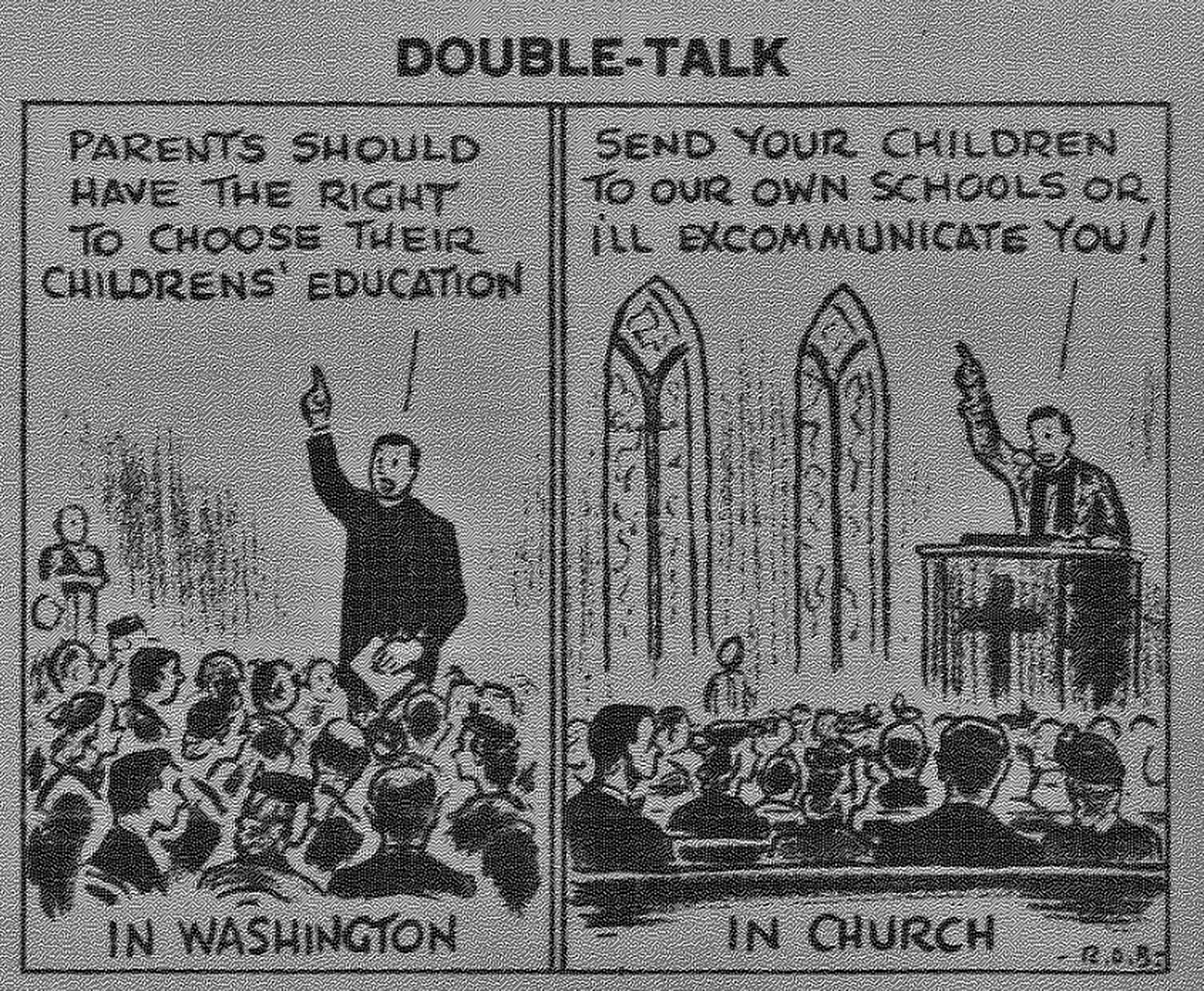
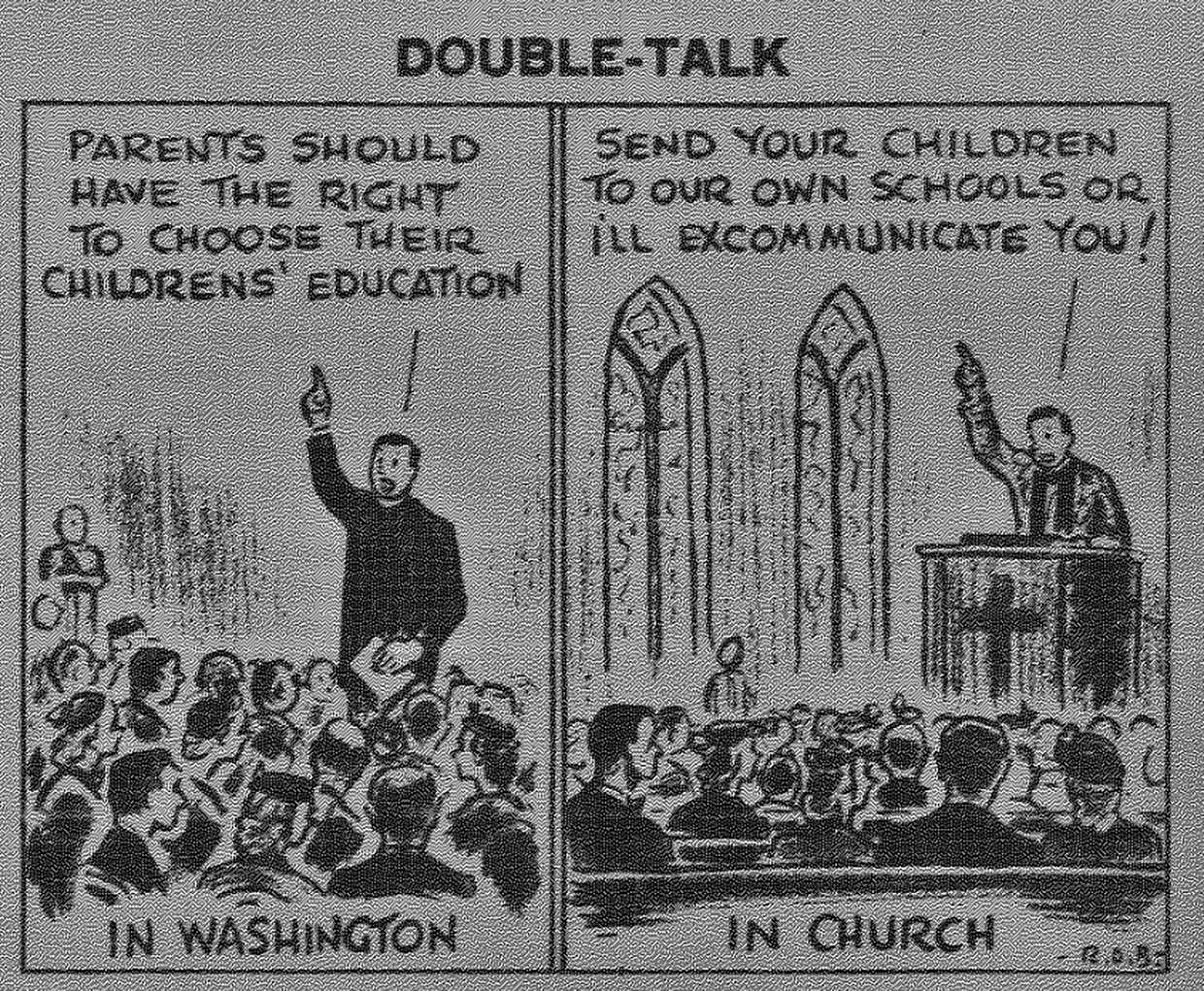
One of the principal strategies that the POAU employed to oppose parochial education was to claim that the Catholic Church’s defense of parental rights was actually a ruse, contrived by the Church’s hierarchy, to lead Americans to believe that Catholic parents could meaningfully exercise choice in education. As a POAU cartoon once asserted (Figure 1), the Church was engaged in “double-talk” whereby Catholic parents who exercised their rights to “choose their children’s education” would be excommunicated unless they chose to send their children to parochial schools.Footnote 49 This claim, of course, evoked popular images of Catholics who could not “think on their own” because of the Church’s hierarchical (and seemingly authoritarian) ecclesial structure.Footnote 50
POAU cartoon, 1956, suggesting that Catholic parents would be threatened with excommunication if they sent their children to non-Catholic schools. This cartoon sought to frame the American Catholic Church’s position on parental rights in education as hypocritical—on the one hand, the Church claimed to support parental rights; on the other, it seemed to prohibit Catholic parents from exercising that right. Church and State: A Monthly Review 9, no. 4 (April 1956), in box 20, folder 7, GC/LD Records.
While not all opponents of parochial school aid may have in fact been motivated by anti-Catholic prejudice, volumes of anti-Catholic literature were published immediately after Everson. This literature seemed to confirm that opposition to parochial school aid went hand-in-hand with anti-Catholicism. In 1947, for instance, the International Convention of the Disciples of Christ published 50,000 copies of a pamphlet on The Separation of Church and State in America which claimed that the “Roman hierarchy” was deceiving the American public into believing that “free textbooks and bus transportation for pupils of parochial schools” were “humane and kindly provisions for the welfare of the children.”Footnote 51 In reality, the convention argued, the Catholic Church sought to “shift the total support” for a “church controlled educational system” from “the Roman church” to “the public treasury.” On this view, the provisioning of free textbooks and bus transportation was “but the initial [step] in a long range strategy” to “completely [shatter]” the “principle of separation of church and state.”Footnote 52
In March 1948, the hostile national response to Everson that the POAU and other organizations fomented appeared to lead the US Supreme Court to adopt a newly expansive reading of the Establishment Clause. In McCollum v. Board of Education, the court overwhelmingly found that the use of government property for religious instruction violated the Establishment Clause.Footnote 53 Unsurprisingly, Catholics widely rebuked the court for this decision. As the influential Jesuit political philosopher John Courtney Murray remarked shortly after McCollum was handed down, the decision created a First Amendment with “about the same status in our constitutional law as the original method of electing a president; it is [a] historical relic to which some academic interest attaches.”Footnote 54 “Now there has been substituted for it,” Murray sarcastically continued, “the ‘great American principle of the eternal separation of Church and State.’”Footnote 55 Murray’s Jesuit contemporary, Robert Drinan, likewise found McCollum to be so objectionable that he devoted his master’s thesis at the Georgetown University Law Center to studying the “novel ‘liberty’” purportedly created by the court’s decision.Footnote 56 As Drinan argued in the Jesuit magazine America, McCollum failed to respect the Pierce-era conviction that parents have the constitutional right to direct the religious upbringing of their children. “If the rights of parents to choose a school for their children is guaranteed by the Constitution,” Drinan asked, “then should not the lesser right to guide the education of one’s children in a public school be as guaranteed?”Footnote 57 After the publication of this article, an attorney donated $100 to Drinan to “combat the principles set forth in the McCollum decision.”Footnote 58
Although McCollum was viewed as a victory for POAU-aligned organizations, the fears of Catholic Power that emerged with national seriousness after Everson continued to motivate public opposition to parochial education after McCollum. In December 1948, for example, The New York Times reported that anti-Catholic organizations were depicting the Church as “working hand-in-glove [with the House Committee on Un-American Activities] for the destruction of Protestantism, the abolition of free public schools, and the breakdown of the principle of the separation of church and state.”Footnote 59 Likewise, Paul Blanshard’s infamous anti-Catholic New York Times bestseller, American Freedom and Catholic Power, was published the following year, inflaming nativist skepticism of the Church in the public square.Footnote 60 As John McCormack, the Irish-Catholic majority leader of the House of Representatives, wrote to the Legal Department in November 1949 about Blanshard, “This chap is engaged in a campaign of bigotry against the Catholic Church.”Footnote 61
Popular reception aside, Blanshard’s withering critique of the Church even reached the upper echelons of the legal profession. In the fall of 1949, for instance, the Harvard Law School Forum—a student-run initiative to present outside speakers to the Harvard Law School community—“respond[ed] to an overwhelming number of requests from [its] audience” and set out to host a program on “American Freedom and Catholic Power” with Blanshard.Footnote 62 While Congress debated legislation around the same time that would have provided federal aid exclusively to state public schools, “vicious rumors and innuendos circulated by opponents” of parochial schools prompted thousands of Catholics in Rhode Island to write to their congressman in support of his efforts to ensure that “nonreligious textbooks, bus rides, and health aids [would be available] for children in both public and nonpublic schools.”Footnote 63
As the historian Mark Massa has noted, American Freedom and Catholic Power began as a series of articles in The Nation magazine and “set the stage for increasingly neuralgic exchanges between Catholics and Protestants during a decade in which sociologist Will Herberg announced that the ‘American Way of Life’ was now acceptably packaged in Protestant, Catholic, and Jewish forms.” Contra Herberg, however, Blanshard “understood himself to be issuing a timely call to protect the First Amendment of the Constitution against the encroachments of a Catholic hierarchy living within the very fortress of the free world.”Footnote 64 A few years after his essays began to appear in The Nation, Blanshard therefore published a second book-length critique of American Catholicism that continued to frame the Church as a foreign threat to the United States seeking to displace American democracy with Roman authoritarianism.Footnote 65
To respond to the national skepticism of the American Catholic Church engendered by Blanshard’s accusations, Catholic leaders publicly rejected suggestions that the Church was attempting to establish itself as an official state religion. As a visiting professor at Yale University in 1952, for example, John Courtney Murray remarked in a series of lectures that the Church “neither needs nor wants the status of a state church in modern society” and that there “is no ‘clash in principle’ between the Roman Catholic Church and … constitutional democracy.”Footnote 66 As Massa has noted, “Already widely perceived as the most thoughtful Catholic voice in the public conversation over … church–state issues,” Murray—in insisting that Catholics did not seek to replicate what John Adams once described as a “mild and equitable establishment of religion”—was especially characteristic of the mid-twentieth-century American Catholics who articulated public rejoinders to Blanshard.Footnote 67
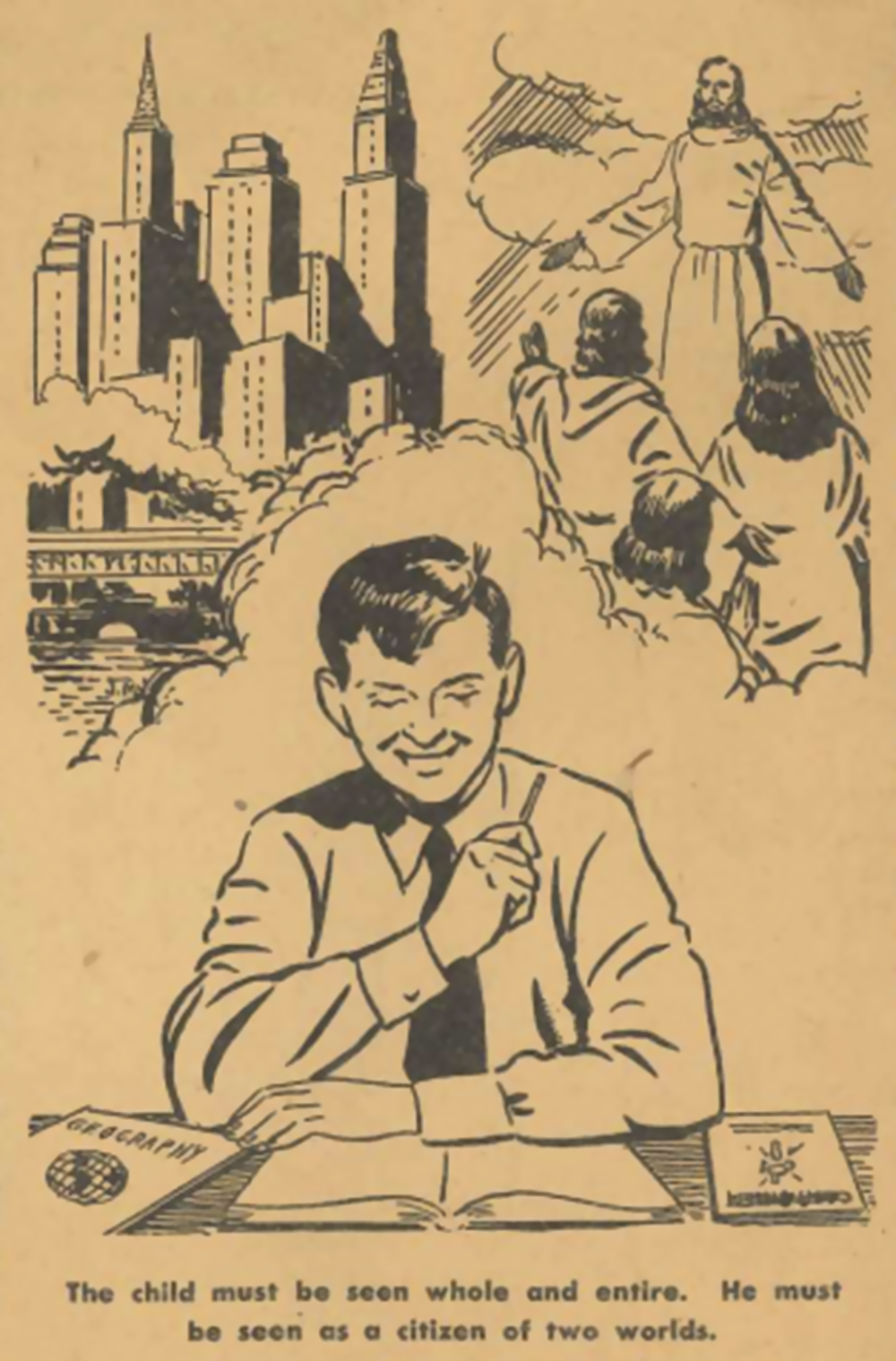
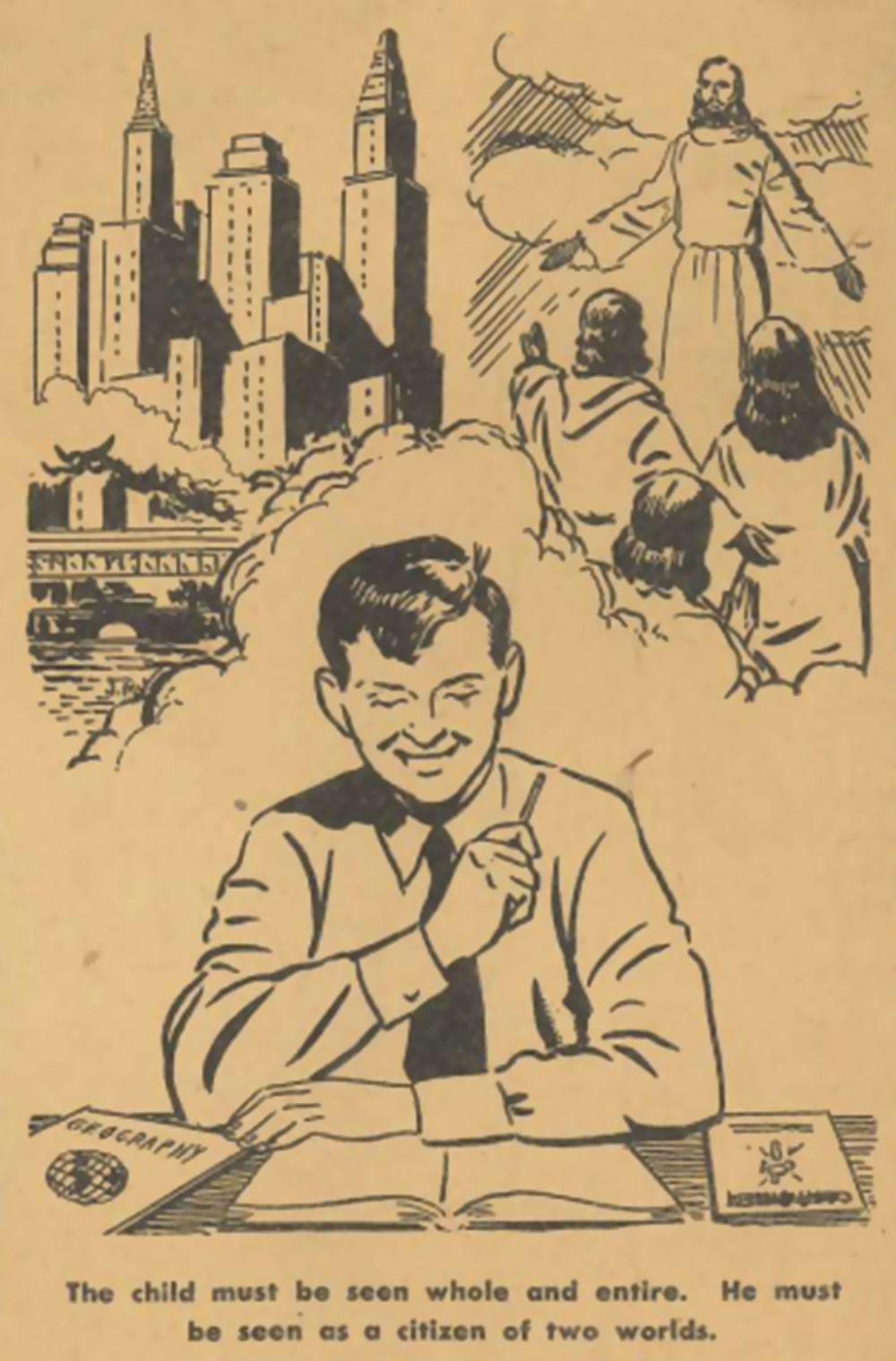
Amid this mid-century moment of interconfessional hostility, the US Supreme Court again returned to the relationship between religion and education in Zorach v. Clauson (1952).Footnote 68 Only two years after the NCWC had released a statement on The Child: Citizen of Two Worlds (Figure 2)—in which the bishops depicted Catholic children as having a “first and highest allegiance to the kingdom of God” with which the government could not interfere—the court was asked to consider whether New York could dismiss children from public schools for off-site religious instruction at the direction of their parents.Footnote 69 In a six–three decision, the court held in Zorach that New York did not violate the Establishment Clause because there was no coercion of religious belief required by the state’s program.
Image included in NCWC, The Child: Citizens of Two Worlds, 1950, depicting a Catholic schoolboy situated between heaven and an unidentified industrial city. Box 4, folder 6, GC/LD Records.
From the Legal Department’s perspective, Zorach had the potential to correct the chief error of McCollum—namely, the court’s failure to respect parental rights in education. As George Reed wrote shortly after Zorach, “No reference [in McCollum] was made to the rights of the parents, whose children were attending the [religious] classes.” As a result of this failure to appreciate parents’ constitutional rights, Reed read McCollum to reject the proposition that “impartial aid might be given to all religions” at the request of parents. Zorach, however, established a “new norm” of “cooperation of Church and State, and, implicitly, cooperation of parents with the State.”Footnote 70 As the NCWC’s News Service likewise observed in a press release upon the publication of Reed’s article, “the rights of the parents are paramount. Such being the case, it cannot validly be argued that the state power [in released-time arrangements] is being used to ‘aid religion’ or to ‘coerce children.’”Footnote 71
Outside of the NCWC, Catholic commentators similarly framed Zorach in the context of parental rights in education. As the Jesuit editor-in-chief of America magazine, Robert Hartnett, wrote in May 1952, “Catholics feel that Mr. [Justice] Douglas [in Zorach] should have resorted explicitly to parental rights to justify the majority ruling. This observation is largely valid … Even without such resort, however, the Douglas opinion is monumental.”Footnote 72 Perhaps recognizing the potential efficacy of appeals to parental rights after Zorach, Leo Pfeffer—a prominent Jewish attorney and opponent of parochial school aid whom the Legal Department once labeled as its “personal protagonist”—argued that “the holding of the Pierce case is not completely applicable to [Zorach]” and sought to illustrate that the claims to parental rights in Pierce were actually not claims to “religious liberty at all.”Footnote 73
Despite the fact that, like McCollum, Zorach did not specifically deal with government aid to parochial schools, the Church’s mid-century opponents viewed Zorach as a boon to the Church’s “long range strategy [to] completely [shatter the] principle of separation of church and state.” (This was a “strategy,” of course, that would have direct implications for the constitutionality of government aid to parochial schools if successfully executed.) Following Zorach, the POAU and other similar organizations therefore continued to raise the specter of Catholic Power in the public square to stymie the Church’s perceived legal success. Less than a year after Zorach, for example, a mailing campaign was initiated to urge Congress to investigate the “subversive activities of the Vatican.” According to the campaign’s model letter to Congress, “the moment is propitious for the initiation of action against an international political organization masquerading as a religious organization, which constitutes an immediate, urgent, and dire threat against our Republic.” Characteristically, this campaign connected fears of Catholic Power in general to Catholic schools in particular, claiming that the Church “is able to infiltrate its representatives in the best Communist manner, into key positions: into government at all levels, into education, into the national economy, into our armed forces.” “In its parochial schools,” the letter continued, “the Church has been teaching religious intolerance at the expense of non-Catholic American taxpayers, in violation of the Constitution of the United States.”Footnote 74
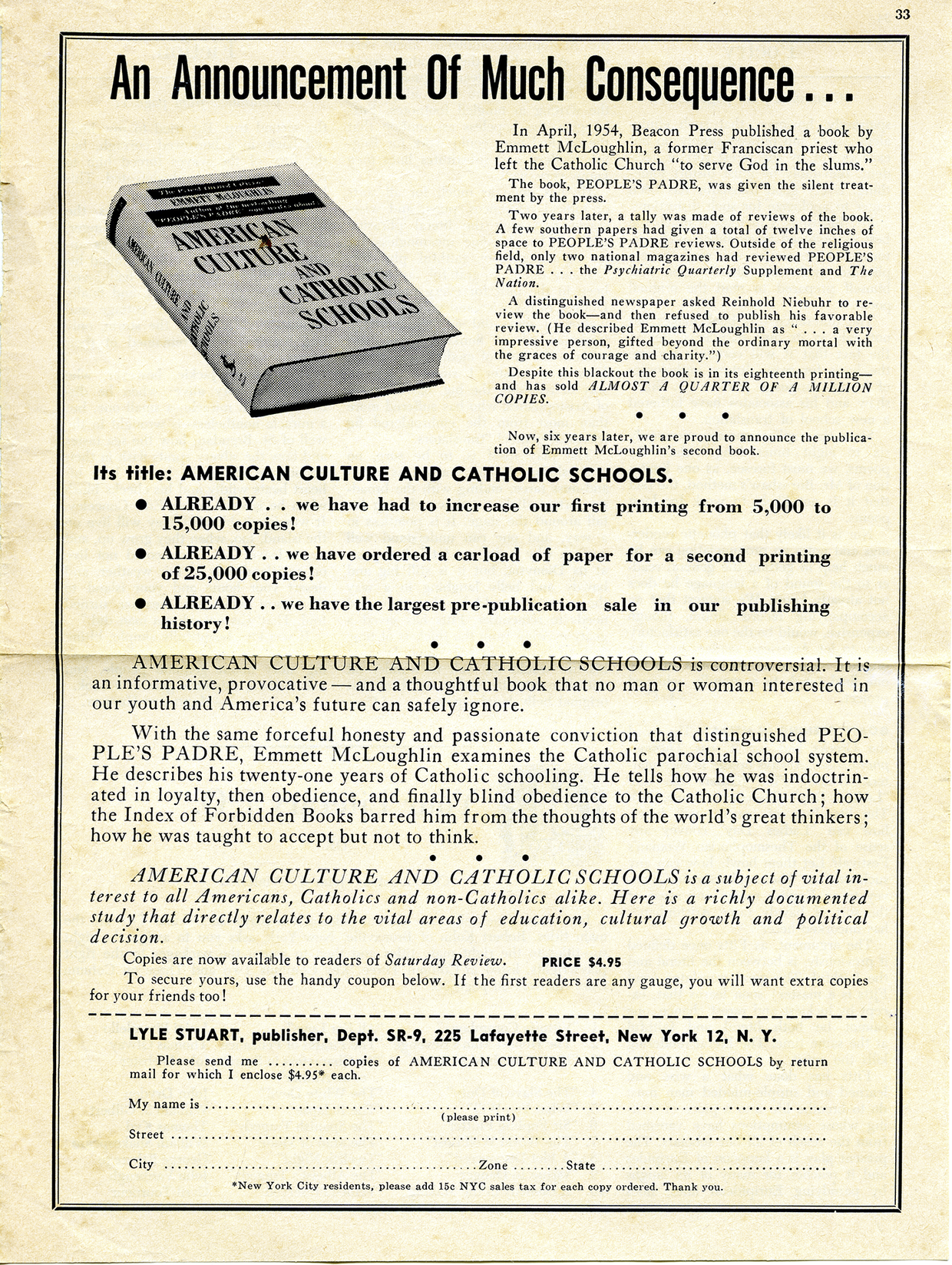
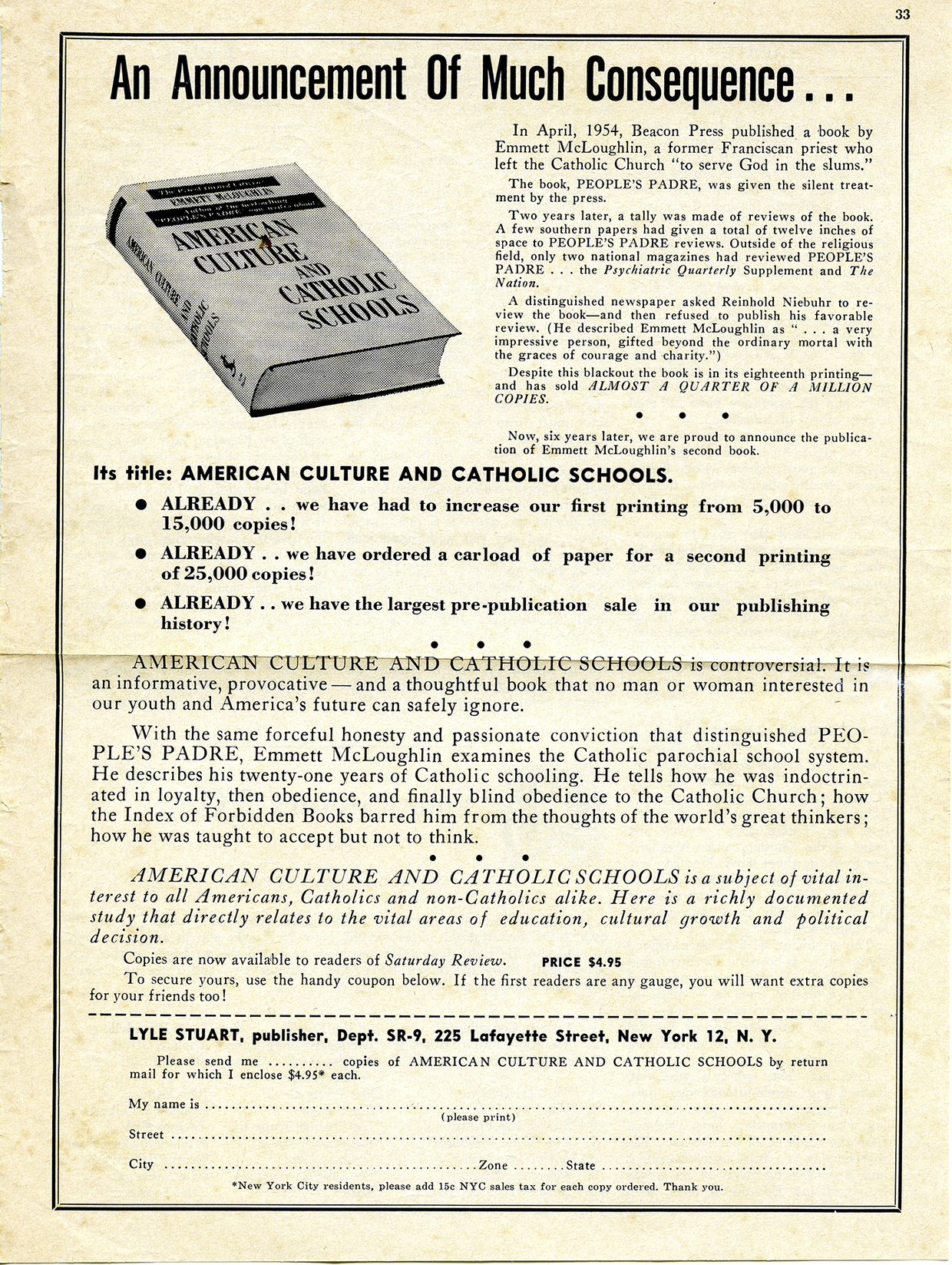
As the nation approached the 1960 presidential election, resurgent fears of Catholic Power in the post-Zorach parochial school context were well reflected in the publication of American Culture and Catholic Schools by Beacon Press, the same imprint that had carried Blanshard’s American Freedom and Catholic Power a decade earlier.Footnote 75 As a magazine advertisement (Figure 3) for the book proudly claimed, American Culture and Catholic Schools promised to tell the story of a former priest who had left the Catholic Church and who, over twenty-one years of Catholic schooling, “was indoctrinated in loyalty, then obedience, and finally blind obedience to the Catholic Church.” According to the advertisement, this “controversial” book had generated “the largest pre-publication sale” in Beacon’s history.Footnote 76
Beacon Press advertisement, 1960, for American Culture and Catholic Schools, which had sold “almost a quarter of a million copies” in the six years after its initial publication. Box 6, folder 8, Francis B. Biddle Papers, Booth Family Center for Special Collections, Georgetown University Library, Washington, DC.
Although Catholic lawyers in the NCWC and legal scholars in their mid-century milieu recognized the influence of popular anti-Catholicism on post-Everson debates about parochial school aid, skepticism of Catholic Power did not always come in the form of grand claims about the Vatican’s secret plot to Romanize the republic. Indeed, the network of Catholic lawyers and legal scholars most responsible for developing the Church’s national parochial school litigation strategy after Everson appreciated the fact that some of their non-Catholic interlocutors were concerned about Catholic Power for reasons other than blind nativism. Throughout the 1950s and 1960s, for example, Boston College and Harvard University sponsored a joint seminar on church–state relations in which leading Catholic and non-Catholic legal scholars discussed the constitutionality of government aid to parochial schools and other similar topics.Footnote 77 Two of the participants in this seminar—William Kenealy, the Jesuit dean of the Boston College Law School, and Mark De Wolfe Howe, a prolific non-Catholic legal historian at Harvard—developed a close friendship, all while maintaining serious scholarly disagreements about the constitutionality of parochial school aid.Footnote 78
As Kenealy wrote in 1962, Everson had created a “constitutional difficulty” for those who sought, through parochial school aid, to promote “the general welfare of the nation, the equal treatment of school children, and the practical freedom of parental choice in education.”Footnote 79 Given his conviction that non-preferential government aid to all religions (at the direction of parents) was clearly constitutional, Kenealy attempted to explain post-Everson opposition to parochial school aid on the basis of misguided “emotional concerns” about the power of “organized religion.” Although he did so anonymously in his 1962 article, Kenealy found comments that De Wolfe Howe had made at an earlier convening of the Boston College–Harvard seminar revelatory of how otherwise thoughtful scholarly contemporaries could become infected by fears of Catholic Power. According to Kenealy, De Wolfe Howe confessed at one of these convenings that his opposition to parochial school aid “is based upon emotion. The emotion is fear. The fear is of organized religion. The history of organized religion is the history of kicking other people around. Tax aid would strengthen religious schools. Strengthened religious schools would increase the power of organized religion. Organized religion would then use its increased power exuberantly. This exuberance would post a threat to the civil liberties of others.”Footnote 80
However perniciously prejudiced or sincerely misguided opponents of parochial school aid were in fact, it was clear to Catholic lawyers in the NCWC and the Catholic legal scholars with whom they were in dialogue that post-Everson fears of Catholic Power posed a serious challenge to the Church’s efforts to obtain government aid for parochial schools. As evidenced by their popular and scholarly writings after Everson, McCollum, and Zorach, the Church’s public spokesmen therefore frequently attempted to reframe debates over parochial school aid by focusing on the constitutional rights of parents, first established in Pierce, to direct the religious upbringing of their children. In doing so, these Catholic leaders eschewed arguments made in the eighteenth and nineteenth centuries that state governments have a legal obligation to fund institutional religion. And it was thought that, by further emphasizing the limited nature of the aid that Catholic parents sought, the Church would avoid inflaming fears that it sought to “shift the total support” for a “church controlled educational system” to “the public treasury.”Footnote 81 In nonpublic forums, this means of responding to mid-century fears of Catholic Power exerted a similarly decisive influence on the development of Catholic litigation strategy after Everson.
The Courtroom Response to Fears of Catholic Power
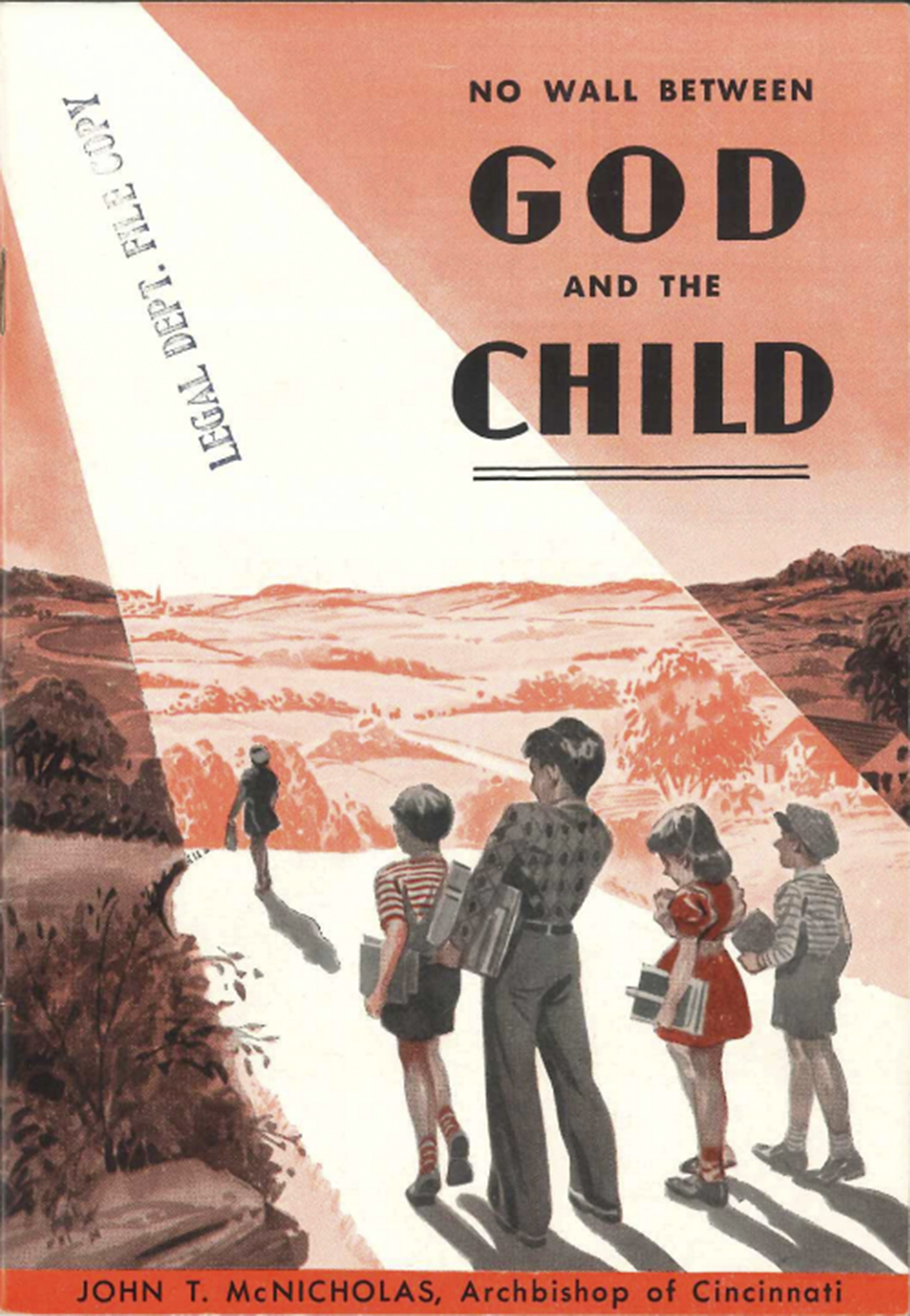
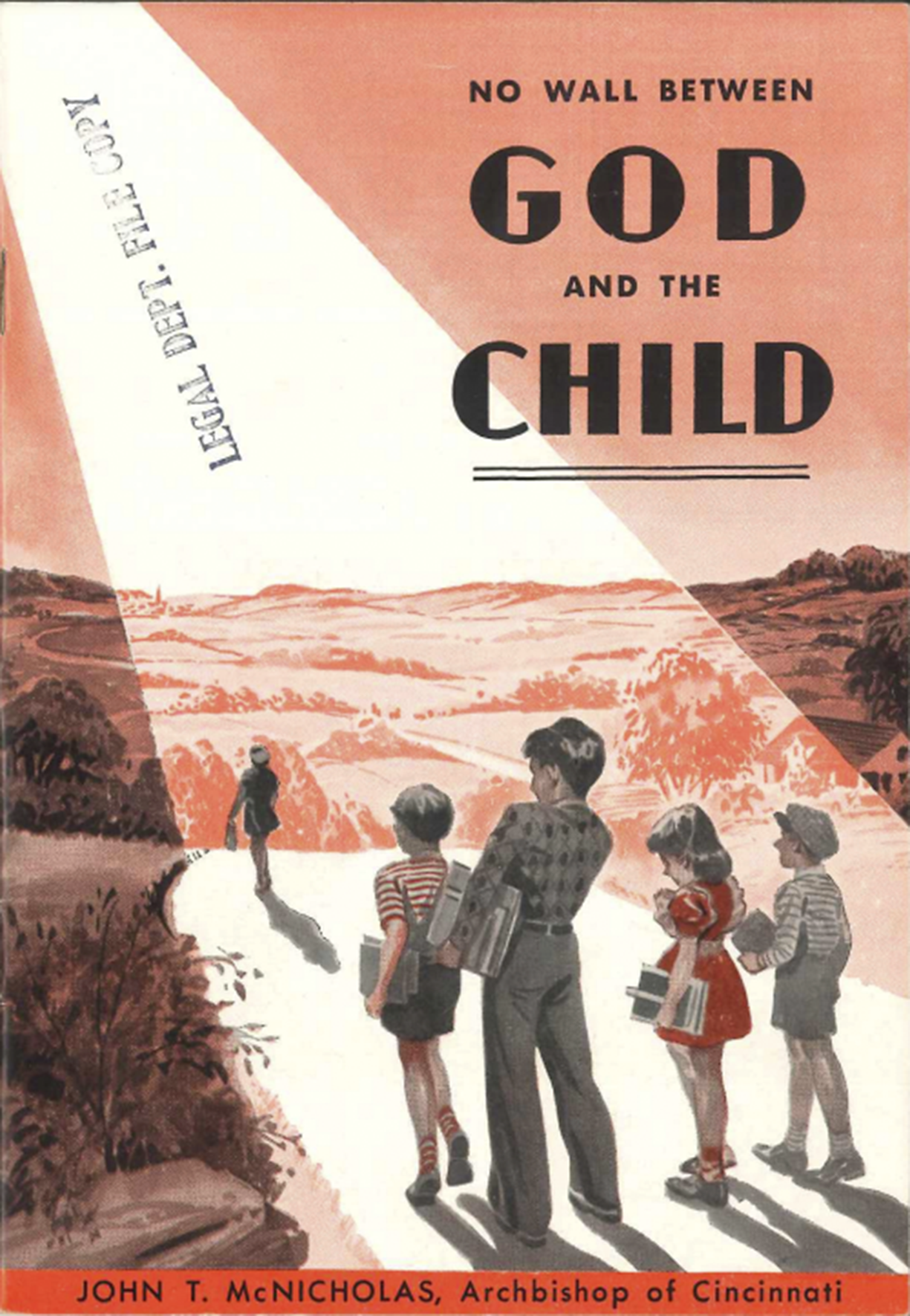
When William Guthrie advanced parental rights arguments in the Pierce litigation, he was informed by a long tradition in the Catholic Church of believing that a “child is not something owed to one, but is a gift … [because the] ‘supreme gift of marriage’ is a human person.”Footnote 82 As the archbishop of Cincinnati, John McNicholas, observed in a statement on the fact of their being “no wall between God and the child” in 1947 (Figure 4), “The child … belongs to its parents, who have been called into a partnership with God as [the child’s] co-creators. The parents are the founders, under God, of the divine institution of the family, which is the fundamental unit of society, having natural, primary, fundamental, inalienable, and imprescriptible rights, which are antecedent and superior to all positive human laws.”Footnote 83
John T. McNicholas, No Wall Between God and the Child (Washington, DC: National Catholic Welfare Conference Education Department, 1947). The image depicts (presumably Catholic) children being illuminated by light from heaven. Box 20, folder 12, GC/LD Records.
The Supreme Court’s constitutionalization of parental rights in the 1920s provided Catholic lawyers in the NCWC with a latent precedential resource on which they could draw in future litigation to vindicate these background philosophical and theological convictions. Because neither the Constitution nor the Bill of Rights “explicitly declares that … parents have the right to manage the education of their children,” however, it was far from certain that the Legal Department would organize the Church’s parochial school litigation strategy around parental rights in Everson’s wake.Footnote 84 But as the extant archival evidence demonstrates, Catholic lawyers’ post-Everson recognition of ascendant fears of Catholic Power led the Legal Department to emphasize that providing limited forms of government aid to Catholic parents did not violate the Establishment Clause, but rather vindicated their constitutional rights to direct the religious upbringing of their children on the same basis as their non-Catholic contemporaries. By framing questions of parochial school aid in the context of parental rights and placing outsized attention on parochial school litigation specifically involving parental rights, the department believed that it could most effectively avoid bringing fears of Catholic Power into state courtrooms around the country.
Given that the US Supreme Court had completed its incorporation of the Religion Clauses against the states by the spring of 1947, the Legal Department knew well that post-Everson state litigation involving primary and secondary schools could eventually reach One First Street and thereby precipitate nationwide changes in church–state relations. By providing local attorneys with NCWC-sanctioned interpretations of the Religion Clauses, even when Catholics were not themselves directly involved in pending litigation, the Legal Department believed that it could best safeguard the Church’s national interest in obtaining government aid for parochial schools.
One of the first post-Everson cases in which the Legal Department sought to influence pending litigation was McCollum. However, because the school board defending the released-time program there was public, not parochial, the extent of the NCWC’s involvement in the litigation was dictated by the attorneys representing the school board. Tellingly, as William Montavon wrote in the fall of 1947, the NCWC had “been asked by the attorneys in [McCollum] to refrain from publicly proclaiming [the Church’s] position with reference to the proper interpretation of the First Amendment and the related problems until the Supreme Court has rendered [its] decision.”Footnote 85 While not stated explicitly, this request that the NCWC refrain from publicly involving itself in McCollum was undoubtedly a product of the school board’s fear that such prominent Catholic involvement might agitate popular fears of Catholic Power and thereby obfuscate the substantive legal issues at stake in the case.
Having been barred from publicly intervening in McCollum, the Legal Department and the Catholic attorneys with whom the department consulted outside of the NCWC provided private guidance to the school board about how it should approach litigating before the US Supreme Court. In a memorandum to the Legal Department two months before McCollum was scheduled for oral argument at the court, one of the NCWC’s consulting attorneys unsurprisingly proposed that the most congenial approach to McCollum would be to return to Pierce-era parental rights arguments:
[Pierce] stated in effect that parents wishing their children to have education in religion as well as education in secular subjects, could patronize private schools offering such form of education. This in substance meant that the religious schools could exist as a matter of right, but it is of course self-evident that such schools are mere instrumentalities available for fulfillment of the basic parental liberty. It is the parental liberty which is to be guarded. That liberty in turn is constitutionally sacred as the means for fulfilling the parental duty in respect of the child. Parental duty gives rise to parental right. Parental right created the legitimacy of religious education.Footnote 86
This strategy for vindicating parental rights in education was unsuccessful in McCollum. As the editor of the Declan X. McMullen Company wrote to the Jesuit political scientist Wilfrid Parsons only two days after the decision was rendered, a “present emergency” was created by the Supreme Court’s outlawing of the school board’s released-time program.Footnote 87 To ensure that Parsons’s in-progress manuscript on church–state relations would, upon publication, offer an effective scholarly response to McCollum, the Legal Department sent Parsons “a complete set of the briefs filed in the McCollum case, together with a copy of the decision of the United States Supreme Court.”Footnote 88 In his 1948 book, First Freedom, Parsons characteristically framed McCollum as a dispute over parental rights: “[McCollum] dealt with the released-time program set up by the Champaign, Illinois, Council of Religious Education to enable those parents who wished it to have religious education for their children on the public-school premises in the denomination of their choice.”Footnote 89
Recognizing the potential threat that McCollum posed to future efforts to obtain government aid for parochial schools, Catholic leaders publicly responded to the decision by asserting that McCollum “did not outlaw cooperation between government and religion.”Footnote 90 In private, so too did the Legal Department attempt to ensure that McCollum would not undo the progress made in Everson toward providing limited forms of government aid to parents who sent their children to parochial schools. In the summer of 1948, in fact, George Reed noted in a memorandum to the NCWC that the Legal Department was becoming involved in post-McCollum litigation in various states, including New Mexico, New York, Illinois, Missouri, and Washington.Footnote 91
Although the Legal Department had been “in close contact with all of the attorneys” involved in these cases and had “provided [them with] voluminous material from [the department’s] files,” the “most important case” pending after McCollum, according to Reed, was Visser v. Nooksack Valley School District. Footnote 92 As Reed observed, “In 1945 a [school bus transportation] statute was enacted providing that free transportation be accorded every student attending school … [The Nooksack Valley School District] refused to comply, and, accordingly, parents of children attending a [Protestant school] brought a mandamus action.” Despite the fact that Protestant parents were the principal plaintiffs in Visser, an attorney for the Catholic Diocese of Seattle “handl[ed] the case for the parents.” As a result, the Legal Department could, behind closed doors, “materially [assist] in the preparation of the [plaintiffs’] brief.” To effectively defend the statute, Reed was of the opinion that the department would need to respond to “oblique attack[s] upon [Pierce]” and the school district’s claim that Everson “ha[d] been entirely dissipated by [McCollum].”Footnote 93
As scholars have observed, the limited government aid to private religious education made possible by Washington’s statute was ultimately invalidated by the Washington Supreme Court in Visser because of Washington’s Blaine Amendment—an infamously anti-Catholic state constitutional provision that, in the words of Visser, “provides that no public money or property shall be used in support of institutions wherein the tenets of a particular religion are taught.”Footnote 94 Unable to surmount the challenge posed to the constitutionality of this limited aid because of Washington’s Blaine Amendment, the Legal Department continued to privately work to bring parental rights to the forefront of the Church’s litigation strategy. As George Reed wrote to one Catholic bishop in January 1949, “we should demonstrate the fact that the released time controversy as well as the questions involving [bus] transportation and health services are primarily a question of aid to parents and not aid to religion. In short, a unity of effort on the part of parents and the State is not synonymous with union of church and state despite the fact that parents may have a religious motivation for their action.”Footnote 95
In the aftermath of Everson, the American Catholic Church unsuccessfully framed government aid to parochial schools as an issue of parental rights. But the courtroom setbacks that the Church and its non-Catholic allies faced in McCollum, Visser, and other such cases—few of which addressed Pierce in particular or parental rights in general—suggested that appeals to parental rights could still be efficacious in the future. Thus, it should come as little surprise that the Legal Department advised the plaintiffs in Visser to not appeal their case to the US Supreme Court, all while advising Catholic bishops and other interested laypeople to study the Supreme Court of Illinois’s 1950 decision in People v. Levisen. Footnote 96 In Levinsen, the Illinois Supreme Court held that parents enjoyed the right to educate their children at home, rather than send them to public school as a state law otherwise required. As a member of the Legal Department’s staff remarked in April 1950, the “reaffirmation of the parental right [in Levinsen] is particularly significant for it underscores the proposition that children attend school in pursuance of the parental right.”Footnote 97 The year following, the NCWC’s annual meeting characteristically featured a discussion of how, in the Catholic bishops’ public relations efforts, “aid for children should be insisted on, rather than for schools.”Footnote 98 Though more implicit than explicit in these private communications, the Church’s desired focus on aid to parents, rather than aid to the institutional Church, evidently sought to avoid inflaming fears of Catholic Power—that, in other words, the Church “want[ed] the status of a state church in modern society.”Footnote 99
After the US Supreme Court’s 1952 decision in Zorach, the Legal Department was encouraged to intervene in litigation where invocations of parental rights could be most efficacious. At the NCWC’s 1954 meeting, for example, the Administrative Board adopted a resolution directing the Legal Department to file a supplemental brief in a case involving “the question of the parental right.”Footnote 100 According to the resolution, “should intervention be deemed necessary or advisable, the Legal Department [is] authorized to arrange for the submission of a brief amicus curiae in the Turner v. State of California case in order to present clearly the Catholic view on the parental right in education.”Footnote 101
Like Pierce and Levinsen, Turner dealt with a compulsory public school attendance law, but this was not the only area in which the Legal Department sought to exercise influence over pending litigation through the lens of parental rights. Indeed, around the same time that the department was engaged in the Turner litigation, it also expressed interest in Tudor v. School Board of Rutherford, a dispute over the constitutionality of a New Jersey school board’s distribution of Gideon Bibles to public school students “whose parents indicate[d] that they desire to have their children receive such a Bible.”Footnote 102 According to an analysis of Tudor prepared by the Legal Department, the New Jersey Supreme Court’s holding the program unconstitutional could, in part, be explained by anti-Catholicism: Leo Pfeffer “made much of Catholic participation in his oral argument,” the document observed, even despite the fact that there were no Catholics among the parties to the case. Because Pfeffer seemed poised to use the case to attempt to “secure a ruling that a school board may not in any way cooperate with religion or a particular religion even at parental request,” the NCWC advised the Rutherford School Board to not appeal the case to the US Supreme Court.Footnote 103
To be sure, the influence of anti-Catholicism on the development of the American Catholic Church’s post-Everson parochial school litigation strategy was often more implicit in private communications than it was in many public statements. Nevertheless, the Legal Department’s consistent turning to parental rights after Everson nationalized parochial school litigation was decisively shaped by Catholic lawyers’ recognition that fears of Catholic Power could prejudice state courts against litigants sympathetic to the Church’s interests. As George Reed observed almost a decade after Everson, in fact, it was “highly probable” that local attorneys involved in parochial school litigation would continue to “not wish to have any brief amicus curiae filed by a representative of the Catholic Church unless many Protestant organizations file briefs amicus.”Footnote 104 Such public affiliation with the Church, it was thought, might further disadvantage litigants who were advancing the Church’s substantive legal positions. “It is my opinion,” Reed therefore wrote, “that we could be of much more assistance by establishing a working relationship with counsel charged to defend the constitutionality of the payment of tuition to children attending non-public … schools.”Footnote 105
Perhaps the most revealing demonstration that the Legal Department’s post-Everson litigation strategy was shaped by ascendant fears of Catholic Power can be located in a 1957 dispute in Maine over a city ordinance that authorized public bus transportation to parochial schools. After local counsel requested the Legal Department’s assistance in defending the ordinance, it was decided that the “most expeditious” means of supporting the local litigation efforts would be to schedule a meeting between the Legal Department’s staff and counsel for the city.Footnote 106 Concerned that public knowledge of its involvement might agitate fears of Catholic Power, however, the department decided that this meeting could not occur in the state. As William Consedine noted in a memorandum to the NCWC, “We met the [local counsel] in Boston because we were reluctant to make a personal visit to Augusta. Such a visit certainly would have directed attention to [the NCWC’s] association with the controversy.”Footnote 107 Notably, such aversion to the institutional Catholic Church’s involvement in local litigation continued in later decades. In 1968, for example, the successor organization to the NCWC agreed not to file amicus briefs in Flast v. Gardner and Board of Education v. Allen because filing briefs on behalf of the Church “would inject issues [into the litigation] much broader than the narrow educational ones.” So, it was determined that “the Catholic expression [of views] be made by the National Catholic Educational Association as a professional educational organization.” This move to emphasize the Church’s “education[al] interests,” an internal research memorandum noted, “hopefully will avoid the opportunity for the [opposing party] to impart undue emphasis to their assertion that the Church, not education, is the direct beneficiary of the [aid program at issue].”Footnote 108
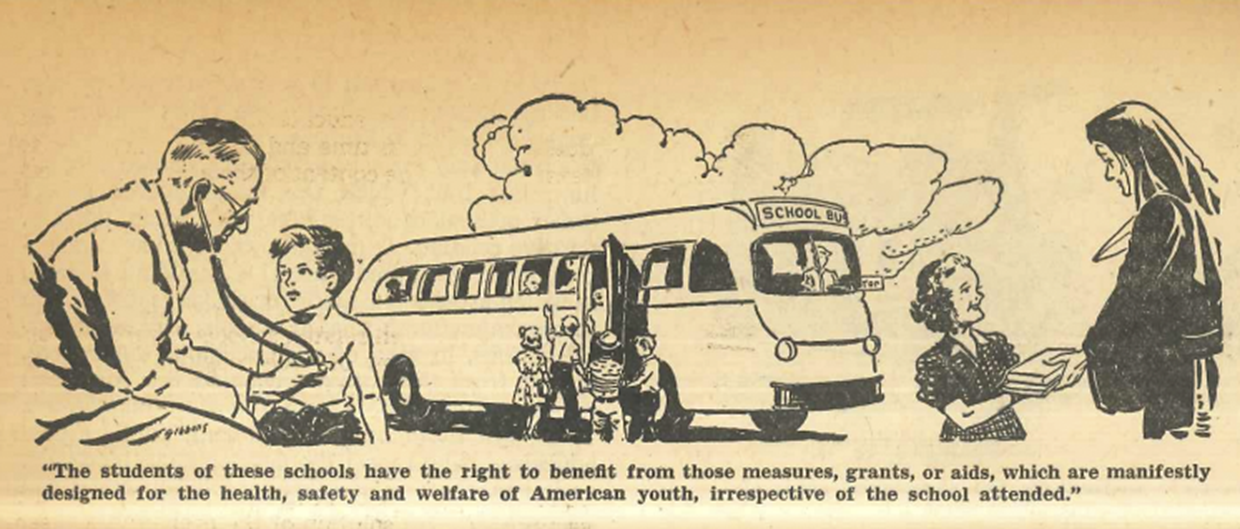
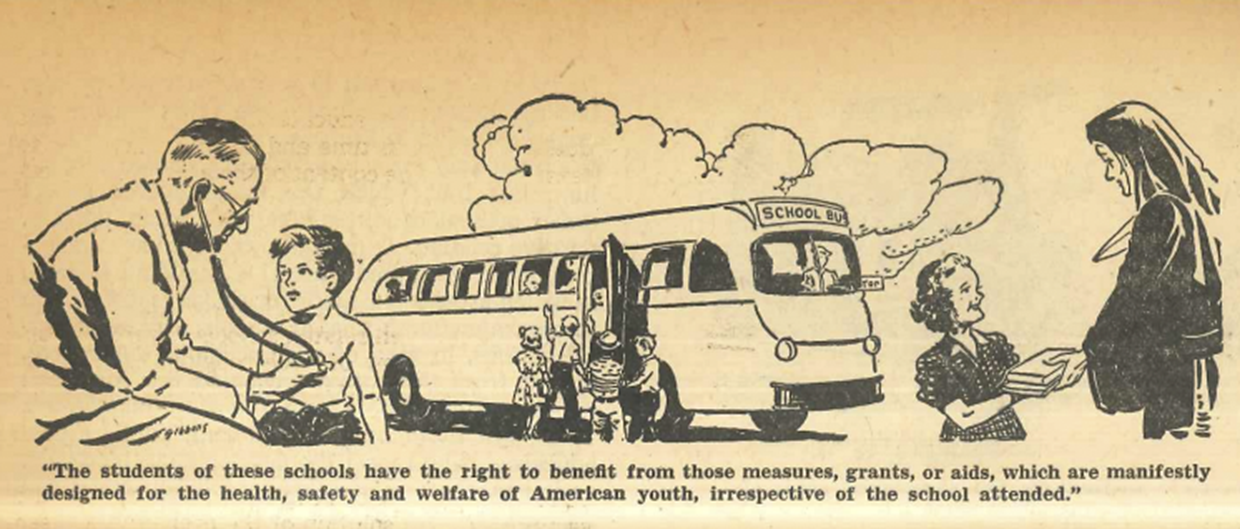
As the Legal Department observed in the same year as the Maine controversy, “Briefs submitted to courts and arguments advanced before legislatures [by the NCWC] have [been] carefully limited … in order to offset the charge that the Church is seeking full support of its educational system.” Although the department consistently believed that parents enjoyed a “basic natural law right to control the education of their children which is recognized by the [federal] Constitution,” it also understood that advancing its legal arguments too aggressively could contribute to fears that the Church was advancing a “sinister plot to shift the whole cost of parochial education to the public treasury, a grab of the Catholic Hierarchy for power.”Footnote 109 Following a 1955 statement from the NCWC’s Administrative Board, the department consequently argued in state courts that students attending parochial schools at the direction of their parents enjoyed rights to merely “those measures, grants, or aids, which are manifestly designed for the health, safety, and welfare of American youth, irrespective of the school attended” (see Figure 5).Footnote 110
Image included in NCWC, The Place of the Private and Church-Related Schools in American Education, 1955, depicting Catholic beneficiaries of publicly subsidized bus transportation, medical treatment, and textbooks. Box 2, folder 9, GC/LD Records.
The “cautious approach” that the NCWC took in Everson’s wake—to emphasize the rights of Catholic parents to relatively limited forms of government assistance on the same basis as non-Catholic parents—seemed to “[enable] the Church to make substantial progress” toward obtaining government aid for parochial schools as the nation approached the 1960 presidential election. While, again, the lawyers associated with the NCWC certainly believed as a matter of first principles that Catholic parents should be entitled to more than subsidized bus transportation or secular textbooks, legal arguments seeking equal funding for public and parochial schools, for example, were thought to “envision [a] concept of social justice not yet accepted by a sufficient number of our fellow citizens.”Footnote 111 This recognition of the imprudence of making more ambitious legal and political arguments was, of course, a product of the fears of Catholic Power through which Catholic lawyers’ “fellow citizens” seemed to view questions of parochial school aid.
Given its conviction that there was “no short cut to the problem of securing in law the equitable rights of parents,” the Legal Department was quite careful in how it advanced its parental rights arguments after Everson. Not only did the department refrain from publicly involving itself in some local litigation, but it also placed outsized attention on litigation involving bus transportation and other similar welfare services. And the department simultaneously urged Catholics to abandon litigation efforts that implicated more wide-ranging claims of financial entitlement.Footnote 112 In response to the 1957 Maine transportation controversy, in fact, the NCWC’s Department of Education, acting on the advice of the Legal Department, encouraged Catholic leaders not to support further litigation efforts because the claims of financial entitlement there seemed too expansive. As the Education Department noted,
In states which do not have laws authorizing nonpublic school bus service, litigation to compel the state to furnish this service for non-public school pupils probably will not succeed. Prevalent law is that a state is free to give or deny this service. If a state desires to transport nonpublic school pupils, it must enact a law for this purpose. The argument of equal rights for all children as it pertains to bus service simply will not stand up in state courts.Footnote 113
As this memorandum indicates, the Legal Department’s post-Everson advocacy in support of parochial school aid was premised on a belief in equal treatment. When parents exercised their constitutional rights to direct the (religious) upbringing of their children by sending them to parochial schools, the argument went, they ought to be eligible for the same financial assistance as parents who sent their children to other nonpublic (but non-Catholic) schools. Thus, unless Catholic parents who sent their children to parochial schools were treated less favorably than parents who sent their children to other nonpublic (but non-Catholic) schools, Catholic parents, according to the Legal Department, would not prevail.
Conclusion: Catholic Power and Parental Rights in Education
In 1962, two months after George Reed suggested to William Consedine that the NCWC was finally “in a position to meet the constitutional arguments against full and equal treatment,” the US Supreme Court declined to review Carlson v. Dickman. Footnote 114 As Consedine noted in preparation for an upcoming NCWC meeting in Rome, the Oregon Supreme Court in Carlson “held that a law providing free textbooks for children attending certain parochial schools violated the State Constitution[’s Blaine Amendment].” The issue in Carlson, according to Consedine, however, was not actually aid to parochial schools. Rather, “[s]imply it was this: May a state consistently with the Fourteenth Amendment deliberately withdraw from parents and their children benefits bestowed [to all educationally qualifying nonpublic schools] by law, precisely for the reason that the schools attended have a religious orientation?”Footnote 115
The US Supreme Court’s failure to review Carlson led Consedine to extend his “deep sympathies” to Catholics in the Diocese of Portland who were adversely affected by the decision. But this decision also confirmed in Consedine’s mind the approach that the NCWC would need to embrace going forward if it was to successfully vindicate the rights of Catholic parents and their children to be treated equally before the law. “The question of the validity under the Federal Constitution of state classification by local constitutional provisions or statutes on religious grounds as a disqualification for state benefits must … be faced and overcome.”Footnote 116
Despite the anti-Catholic pressures that had appeared to undermine the Church’s family-focused litigation strategy in Carlson and other similar cases, both Reed’s and Consedine’s 1962 memoranda were resolute and cautiously optimistic, in part because of their focus on the potential passage of federal (not state) aid-to-education legislation. Absent a federal Blaine Amendment, and after fifteen years of legal advocacy emphasizing the constitutionality of providing limited government aid to parents who sent their children to Catholic parochial schools on the same basis as other nonpublic schools, the Legal Department believed that the NCWC would be on firm constitutional footing in lobbying Congress to include parochial schools in potentially expansive aid-to-education legislation. Even Mark De Wolfe Howe, once a skeptic of parochial school aid, had by 1962 become sympathetic to the Church’s position. As the Harvard Law School’s student newspaper reported in February 1962, “Federal aid may be constitutionally given to church-supported private schools if it is used for non-religious instruction, Professor Mark De Wolfe Howe told a Law School audience last week.”Footnote 117
The US Supreme Court’s 1962 decision in Engel v. Vitale and 1963 decision in Abington Township v. Schempp engendered further developments in the American Catholic Church’s approach to church–state litigation.Footnote 118 As this article has illustrated, however, it was in the fifteen years after Everson that the Church developed its first nationwide strategy for vindicating the rights of Catholic parents to direct the religious upbringing of their children. This nationwide strategy may have manifested itself differently in individual states and cities as a result of unique state and local legal environments, but it is nevertheless true that popular fears of Catholic Power after Everson led the NCWC to develop a national approach to parochial school litigation. Indeed, given the explosion of fears of Catholic Power in Everson’s wake, the Church’s public spokesmen increasingly framed debates about parochial school aid as implicating the constitutional rights of American parents to direct the religious upbringing of their children. This emphasis on parents, rather than the institutional Church, it was thought, would undercut claims that government aid to parochial schools would perniciously enrich the (Roman) Catholic hierarchy.
At the same time as the Church’s spokesmen were publicly emphasizing parental rights in education, lawyers associated with the NCWC refrained from publicly involving themselves in some local litigation to prevent anti-Catholic prejudice from impacting the disposition of concrete church–state disputes in which the Church had an interest. Despite this lack of public involvement, the NCWC’s lawyers nevertheless worked privately to persuade litigants that providing government aid to parents who sent their children to parochial schools did not violate the Establishment Clause when the aid merely provided for students’ health, welfare, or safety. This particular emphasis on limited and non-preferential aid to all parents who sent their children to nonpublic schools seemed poised to avoid inflaming popular fears that the Church was pursuing “some kind of a sinister plot to shift the whole cost of parochial education to the public treasury, a grab of the Catholic Hierarchy for power.”
As reflected in previously overlooked archival material from the fifteen-year period following Everson, the NCWC’s approach to defending the constitutionality of parochial school aid was motivated by a consistent belief in equal treatment for Catholic and non-Catholic families. Thus, by the time that Congress reconsidered expansive federal aid-to-education legislation in the 1960s, the NCWC was prepared to invoke its parental rights arguments before the federal courts and the court of public opinion to defend the full inclusion of parochial schools in this legislation.
In concluding, it bears noting that many of the parental rights arguments developed by American Catholics in the fifteen years after Everson laid the foundation for the now more successful movement for educational pluralism in the United States—a movement, notably, that is less associated with bus transportation and secular textbooks than with full-tuition educational vouchers and so-called “publicly funded religious charter schools.”Footnote 119 By way of example, consider the singular influence of William Bentley Ball, a Catholic layman who argued, among other landmark First Amendment cases, Wisconsin v. Yoder (1972).Footnote 120 In Yoder and several other cases before the US Supreme Court in which he served as counsel-of-record for religious claimants, Ball successfully enlarged the scope of parental rights in education.Footnote 121 And, importantly, he did so by invoking the parental rights arguments that his co-religionists had brought to courtrooms and school boards across the country for decades. As Ball acknowledged in a 1995 interview about educational vouchers, “public funds, in these initiatives, would be going to the individual parents. The money would not be given directly to the private religious schools. The parents would have a completely free choice as to what to do with the voucher; the public aid would be directed toward them, and their decisions would control the disposition of the funds.”Footnote 122 To be sure, as early as the 1930s Ball had begun to argue that government aid to parochial schools “would not be … supporting of the Catholic Church as such,” but it is equally true that the post-Everson efforts of Catholic lawyers, public intellectuals, and episcopal leaders affiliated with the NCWC helped to bring such understandings of parental rights into the national mainstream by the time that Ball began to appear at One First Street during the last three decades of the twentieth century.Footnote 123 After all, the question seemed clear: “Shall we settle for anything less than complete equality?”

 Open access

