


1. Introduction
There is a lot of conversation these days about the need for system transformation (e.g., Chapin et al., Reference Chapin, Pickett, Power, Jackson, Carter and Duke2011; Fazey et al., Reference Fazey, Schäpke, Caniglia, Patterson, Hultman, Van Mierlo and Waer2018; Olsson et al., Reference Olsson, Moore, Westley and McCarthy2017; Rockström, Reference Rockström2015; Rockström et al., Reference Rockström, Steffen, Noone, Persson, Chapin and Lambin2009; Sharpe et al., Reference Sharpe, Hodgson, Leicester, Lyon and Fazey2016). Businesses and the economic systems that support them, in particular, are implicated in the need to come into much better harmony with the realities of nature and in support of better human dignity, wellbeing and, generally, societies (e.g., Ehrenfeld & Hoffman, Reference Ehrenfeld and Hoffman2013; Jackson, 2011; Lovins et al., Reference Lovins, Wallis, Wijkman and Fullerton2018). Businesses, which are responsible for much of the negative ecological impact of industrialization, will clearly need to work collaboratively with governments and citizens movements to avoid ecological disasters arising from climate change (IPCC, 2019) and species extinction (Diaz et al., Reference Diaz, Settele and Brondizio2019; Ripple et al., Reference Ripple, Wolf, Newsom, Barnard and Moomaw2020), among other civilizational risks (see Diamond, Reference Diamond2005).
While it is occasionally possible for leaders of powerful single companies to transform in the direction of flourishing for all (used here as shorthand for dignity, wellbeing, sustainability and flourishing), it is unlikely that enough businesses can transform sufficiently by relying on individual company actions to achieve needed reductions in CO2 and ecological destruction or create societal wellbeing. Transformation agents – most likely politicians and legislators, activists, non-governmental organizations (NGOs) and other social change agents, each operating from their own perspectives and with the resources at their disposal – need to dramatically transform the context or ecosystem in which businesses operate. Only when new ‘rules of the game’ or socio-political expectations shift markedly to demand significantly greater sustainability overall will businesses collectively be enabled to move towards a flourishing world for all. The business context, including socio-political norms (including public policy) and operating rules, along with ecological constraints, provides the ground rules and enabling/restricting environment for what is and is not acceptable and expected. The remarkable innovative capacities of businesses can and are likely to be triggered when the expectations of the socio-political context demand change.
2. Background
If you search in Google Scholar for the words ‘transform business’, what immediately becomes clear is how little the idea of system transformation is understood. Transforming business, in the Google Scholar context, seems to mean doing more, better or somehow different things than currently as a means of making more profits and continuing to grow endlessly. It also seems to mean changing without actually having the business undergo the type of radical transformation implied by the need to move to a flourishing world for all. A transformative shift implies a fundamental reorientation of business purposes and practices (cf., Donaldson & Walsh, Reference Donaldson and Walsh2015), not just tweaking around the edges. The current reality is that most so-called transformative impulses leave today's growth-orientated, linear production standards and exploitation of the living Earth (e.g., Korten, Reference Korten2007; Lovins et al., Reference Lovins, Wallis, Wijkman and Fullerton2018) firmly in place. Such impulses simply offer to help businesses grow more quickly, dominate more markets and make more profits without regard to the socio-ecological consequences of doing so.
Crucially important, individual companies and their leaders, even very visionary leaders, working independently are hard pressed to make the scope of changes in the direction of sustainability and flourishing needed. Fears of being placed at a competitive disadvantage or stepping too far into the lead on ecological or system change issues, along with the very real potential costs of doing so and the reality that many current practices are deeply embedded norms or the result of legislation and regulation, make individual company transformation virtually impossible. That barrier remains in place despite the fact that companies might experience possible gains from innovative products, new markets and better reputation. Yet in the face of these unrelenting pressures for profits, growth and throughput of products and services, businesses are increasingly called upon to transform their impacts on the socio-ecological system, reducing their impacts and working more generatively with respect to nature (e.g., Lovins et al., Reference Lovins, Wallis, Wijkman and Fullerton2018). Those pressures pose a systemic conundrum for business leaders who want to contribute to a flourishing world for all.
To deal with this reality, it is vital to recognize that the real need for change is at the system level, in this case the big picture socioeconomic–political–ecological system or ecosystem in which businesses operate. Changing the system means changing the ‘rules of the game’ (i.e., the expectations and demands around (for simplicity's sake) business (or any system's) purposes, perspectives, practices, power relations and performance) so that the field is ‘levelled’ for all. In the current system, individual companies are subject to unrelenting systemic pressures for growth, performance, profitability and productivity, among others. Those pressures arguably need to be transformed, through political, citizen activist, and democratic processes, to something more life-giving (Lovins, Reference Lovins2016) if businesses as a whole are to contend honestly with the realities imposed by nature and the need to develop a future in which all can flourish.
3. Business ‘transformation’
The most relevant stream of related literature focuses on sustainable business models, which Evans and colleagues define as “the logic of how a firm does business, [which explains] how the firm creates, delivers and captures value” (Evans et al., Reference Evans, Vladimirova, Holgado, Van Fossen, Yang, Silva and Barlow2017; Magretta, Reference Magretta2002; Teece, Reference Teece2010). In a pioneering 2008 paper on the transformation of business models towards sustainability, Stubbs and Cocklin (Reference Stubbs and Cocklin2008) emphasize the importance of creating wholly new business models that bring sustainability – or flourishing for all – into their core so that they actually drive firm decision-making processes. Later authors, however, note that such transformative business models are not currently developed to the point where significant numbers of case studies on them can be undertaken. In other words, few businesses recognize the need for transformation – or are actually undertaking it. Yet climate, sustainability and inequality studies suggest that such transformation needs to happen sooner rather than later (Evans et al., Reference Evans, Vladimirova, Holgado, Van Fossen, Yang, Silva and Barlow2017). As Aldelkafi and Täuscher (Reference Abdelkafi and Täuscher2016) point out, true transformation needs to engage the whole business model in ways that either do less harm to nature's ecosystems or actually contribute positively to human flourishing.
Real transformation of businesses so that they actually work in harmony to restore, renew and regenerate the living Earth while still remaining profitable is far from most people's minds. Towards that end, business needs, as stakeholder theorist Ed Freeman is fond of saying, a new story. It is a story that needs to go well beyond simply co-creating value with stakeholders (Freeman, Reference Freeman2017) towards transformation of the whole systemic context in which businesses are embedded. Today's dominant business ‘story’ rests on neoliberalism's tenets of constant growth, supposedly free markets, self-interested individualism, limited government and free trade, without regard for societal or ecological considerations (Lovins, Reference Lovins2016; Monbiot, Reference Monbiot2016; Waddock, Reference Waddock2016). Indeed, transformation is needed in the socioeconomic context that enables or inhibits businesses from bringing about more regenerative, circular and ecologically sustainable practices. Businesses, after all, are part of a broader system linked to multiple networks (Evans et al., Reference Evans, Vladimirova, Holgado, Van Fossen, Yang, Silva and Barlow2017) that form their own business ecosystem (Moore, Reference Moore2016). Add to the business ecosystem the reality that businesses exist in a societal ecosystem, which is itself integrally linked to natural ecosystems (many of which are failing today). Businesses belong to a nested array of ecosystems. Each exerts pressures and dynamics that create the contexts in which businesses operate.
One important initiative that attempts to provide a different context is the United Nation's (UN) 17 Sustainable Development Goals (SDGs) initiative, otherwise known as the Global Goals to transform our world (United Nations, 2015). While not perfect, the SDGs aspire to a world of peace and prosperity for all, including other living beings and the Earth's natural systems. Because of their great power, scope and clout, businesses have a vital role to play in the transformation needed to achieve the Global Goals. Even in the SDG context, however, academic articles that take seriously the issue of transformative change for businesses – change that fundamentally alters business models to bring them into alignment and balance with nature's realities – are few (albeit see Schaltegger et al., Reference Schaltegger, Hansen and Lüdeke-Freund2016; Stubbs & Cocklin, Reference Stubbs and Cocklin2008). For example, it has been argued that businesses can ‘transform’ themselves by incorporating various digital technologies (Kane et al., Reference Kane, Palmer, Nguyen and Kiron2015), including blockchain (though that, apparently, will take years) (Iansiti & Kakhani, Reference Iansiti and Lakhani2017), artificial intelligence and application programming interfaces, among other innovative technologies (Kavadias et al., Reference Kavadias, Ladas and Loch2016). Alternatively, companies can ‘transform’ their approach to managing to get more productivity or efficiency out of employees through product, technological and process innovations (Abdelkafi & Täuscher, Reference Abdelkafi and Täuscher2016), and hence make more money or grow faster. None of these approaches, however, changes the fundamentals of doing business (i.e., the growth-at-all-costs orientation or the basic rationale of maximizing profits that drive businesses operating under the banner of neoliberalism; Monbiot, Reference Monbiot2016).
4. Epimimetics: thinking systemic change
Except in rare circumstances and usually driven by visionary leaders of relatively powerful firms, individual businesses find it incredibly difficult to accomplish transformation. Here is the fundamental issue: only when the rules of the game, including the governance system (Evans et al., Reference Evans, Vladimirova, Holgado, Van Fossen, Yang, Silva and Barlow2017), change is it likely that a critical mass of businesses will really transform in sufficient depth and at scale. Absent changes in relevant business ecosystems, including the expectations placed on businesses by the general public, business norms and by governments, transformation is unlikely.
Viewed this way, transformation is aligned with what biologists call epigenetics in living organisms (Lipton & Bhaerman, Reference Lipton and Bhaerman2009). Epigenetic processes are a combination of ‘nature’, or genetic make-up, and ‘nurture’, or environmental stimuli that influence the organism. The popular belief is that nature – DNA or how the genes of an organism are constructed – is determinative. Epigenetics, however, recognizes that the environment in which the organism lives (what it eats, how exposed it is to chemicals and so on) also influences how that organism will turn out. Epigenetics is why identical twins, who have the same genetic make-up, begin to look and act somewhat differently as they mature. Despite their genetic similarities, they will inevitably have different experiences that make them – sometimes subtly, sometimes more dramatically – different from each other. The differences are like different interpretations of the same song – the similarity in words and melody (like genetic make-up) is recognizable, but each artist (like the context for companies) gives the song a flavour that makes it unique to that artistic expression.
Indeed, biologist Richard Dawkins seems to have recognized this cultural analogue in inventing the word ‘meme’ (short for mimene, which means ‘something imitated’ in Greek) to represent how different cultural expressions of various kinds are transferred from person to person or group to group (Dawkins, Reference Dawkins1976). Businesses are known to follow fads and fashions (Dale et al., Reference Dale, Elkjaer, Van der Wiele and Williams2001; Williams, Reference Williams2004), which come about because the dynamics of their contexts and the expectations of actors in some ways have been changed. Thus, businesses tend to imitate, to some extent, what others are doing. Innovative and visionary leaders like Unilever's Paul Polman (Freudenreich et al., Reference Freudenreich, Lüdeke-Freund and Schaltegger2019) and Interface's Ray Anderson (Stubbs & Cocklin, Reference Stubbs and Cocklin2008) recognized the need for transformation to sustainability significantly before others in their industries did. They were willing to take risks to transform their businesses (e.g., to deal with issues of sustainability when others did not (yet) see the need to do so). In doing so, they also (somewhat) changed the ecosystem. But because of current system pressures for profitability and growth, most other business leaders have not actually mimed – imitated – these transformative efforts.
Furthermore, not all businesses are led by visionary leaders willing to take such risks and make transformational changes. That noted, most businesses do change over time – largely in response to pressures that shift their ecosystem (i.e., the competitive, political, technological and cultural dynamics the firm faces). As the ecosystem changes, companies create internal changes to meet new demands. That process, here called epimimetics, means that system changes alter the contexts in which businesses (or other institutions) operate, just as much as internal innovations change companies from the inside. Contextual changes ultimately are reflected in changes in the businesses themselves. So epimimetics suggests that when a major company (e.g., a Walmart or Unilever) does change, it can influence what other companies are doing, in part because companies’ leaders do tend to copy what their competitors are doing (see Johnson & Hoopes, Reference Johnson and Hoopes2003) or respond (e.g., to pressures posed by relevant supply chains).
Transformation can result from internal dynamics and forces like the ones exerted by visionary leaders who see a different path forwards. More frequently, however, transformation is likely to result from the dynamic shifting of the ecosystem (i.e., competitive, technological, cultural or political changes) in which businesses operate in this epimimetic process. While each business is unique in the way that it specifically responds to changing external dynamics and pressures, there will tend to be transformations in similar directions responding to similar contextual dynamics. That is, as an industrial, social or ecological context changes, the businesses in it will also change epimimetically to reflect the new conditions. More wholesale shifts (e.g., towards sustainability) will more likely come about when the system's expectations and requirements shift in that direction.
5. Systems and business transformation
System transformation is itself complex and takes place in a context characterized by complexity and so-called wicked problems (e.g., Sharpe et al., Reference Sharpe, Hodgson, Leicester, Lyon and Fazey2016; Waddock et al., Reference Waddock, Dentoni, Meszoely and Waddell2015). In complexity and wickedness, change agents can come from just about anywhere in the system (Waddock et al., Reference Waddock, Dentoni, Meszoely and Waddell2015). Most likely, given the types of changes that are needed, those change agents will be opinion/thought leaders (including visionary business leaders), activists and NGO representatives attempting to shape public policy-makers’ views, as well as visionary business leaders.
5.1. Understanding system transformation
Considerable work has emerged that describes the design principles and processes involved in system transformations (e.g., Colvin & McDonagh, Reference Colvin and McDonagh2017), as well as some of the characteristics of transformative innovation and change (e.g., holistic, adaptive, emergent, uncertain; Colvin et al., Reference Colvin, Blackmore, Chimbuya, Collins, Dent, Goss and Seddaiu2014). Other research focuses on the skills needed by change agents for transformation practice (e.g., future orientation, pattern recognition, systems thinking, integrative approaches, transformative dialogues and participative, collaborative, diverse and inclusive approaches; e.g., Sharpe et al., Reference Sharpe, Hodgson, Leicester, Lyon and Fazey2016).
Schot and Steinmueller (Reference Schot and Steinmueller2018) argue for framing processes in transformative innovation that take holistic and experimental inclusive approaches, engage multiple actors, recognize emergent processes, are open-ended in their coordination and work through collaborative, inclusive, participative and reflexive processes. Similarly, Moore et al. (Reference Moore, Olsson, Nilsson, Rose and Westley2018) argue that there are two key capacities important to transformation in the context of complexity: the ability to navigate emergence and cross-scale reflexivity (see also Olsson et al., Reference Olsson, Moore, Westley and McCarthy2017). Also focusing on the processes of change, Gorddard et al. (Reference Gorddard, Colloff, Wise, Ware and Dunlop2016) emphasize the importance of understanding the working values, rules and knowledge in a system's decision-making context. In a comprehensive overview of earlier work, Westley et al. (Reference Westley, Tjornbo, Schultz, Olsson, Folke, Crona and Bodin2013) synthesize the key skills (or managerial mind-set) needed to ‘steward’ (and, arguably, transform) ecosystems. These skills include facilitating knowledge building and use, vision building, developing social networks, building trust, legitimacy and social capital, facilitating innovations, preparing and mobilizing for change, creating/seizing windows of opportunity, identifying and communicating ‘small wins’ and facilitating conflict resolution.
Furthermore, Bennett and colleagues (Reference Bennett, Solan, Biggs, McPhearson, Norström, Olsson and Carpenter2016, p. 441) outline the elements or components that constitute ‘plausible pathways of development’ for dealing with the exigencies of the Anthropocene. Elements include inspirational visions, altering the basic relationship between humans and nature, using an approach known in entrepreneurship as bricolage (using elements already present in new ways) and finding and growing ‘seeds’ of innovation that are already growing, among others. In seminal work on transitions, Geels (Reference Geels2004) and colleagues emphasize the importance of socio-technical systems, rules and institutions, human actors/groups coordinated by cognitive, normative and regulative rules in multilevel systems that include niches where innovations grow, landscapes and whole regimes (Geels & Schot, Reference Geels and Schot2007).
While the processes, skills needed and the characteristics and arenas of complex systems in which transformations occur have been addressed, relatively little attention in this emerging literature has been paid to the content of what in the system has to change if transformation is to occur. To understand the ‘what’, it is important to begin with a definition of what a system is, so that we can apply that definition at two levels – the system as a whole and the business enterprise – to see what characteristics they share.
5.2. What is a system?
According to Ackoff and Gharajedaghi (Reference Ackoff and Gharajedaghi1996, p. 13), “[A] system is a functioning whole that cannot be divided into independent parts.” Backlund (Reference Backlund2000) further elaborates systems as needing to satisfy three conditions: each element's behaviour affects the behaviour of the whole; elements and their behaviour are interdependent; and “the elements of a system are so connected that independent subgroups of them cannot be formed” (p. 447). Identifying a particular system, however, is a matter of the lens or perspective that is used and which relationships are considered (Backlund, Reference Backlund2000, p. 449). Thus, a ‘system’ in social sciences might be a group, a community, an organization or a society, depending on the perspective. This paper is concerned with two levels of system: the ecosystem of business and businesses, which interact epimimetically.
Complex systems, such as human communities, organizations, societies and socio-ecological systems, are defined by Ladyman et al. (Reference Ladyman, Lambert and Wiesner2013, p. 57) as “an ensemble of many elements which are interacting in a disordered way, resulting in robust organization and memory.” Ackoff and Gharajedaghi (Reference Ackoff and Gharajedaghi1996, p. 13) classify systems by their purpose, and argue that “the ability to make choices is necessary for purposefulness, but it is not sufficient.” In this telling, organic (living) systems of all sorts (animated, social, ecological), but not deterministic (mechanical) systems, have either purposeful parts or wholes or, in the case of social systems, both. Furthermore, choice is a necessary concomitant of purposefulness (Ackoff & Gharajedaghi, Reference Ackoff and Gharajedaghi1996). Business systems, as human/social systems and societies as a whole, are thus purposeful in both their parts and their wholes, while socio-ecological systems can be composed of purposeful elements or parts, but the ‘whole’ might not appear to be purposeful (at least in most modern conceptions).
Systems are also highly interconnected and interactive, with what happens in one place in the system potentially affecting many other aspects (i.e., parts of epimimetic processes). Importantly, “A system's performance is the product of the interactions of its parts or aspects” (Ackoff & Gharajedaghi, Reference Ackoff and Gharajedaghi1996, p. 19, emphasis in original), which means that changing what is happening in various parts of the system can change the overall performance – something that is a key to understanding system transformation and, in the case of this review, how businesses might be transform. The fundamental question now becomes what are the ‘parts’ or elements – the ‘what’ of systems – that need to (or can be) changed?
6. Core aspects of human systems subject to transformation
This section asks: what is the what of system transformation? What needs to be transformed or changed to bring about significant change? To date, little has been written on this ‘what’, with most of the emerging work on system transformation focused on processes, change agent skills and system characteristics. Drawing from Meadows (Reference Meadows1999), Waddock and Waddell (Reference Waddock and Waddell2019) and others who allude in various ways to the ‘what’, this section argues that change agents attempting to transform human systems (businesses) can ‘simplify’ a complex task by focusing on five integrated, interconnected system ‘whats’. These ‘whats’ are purpose, perspectives, power relations, practices and performance (see Waddock & Waddell Reference Waddock and Waddell2019) (see Figure 1 for a synthesis) that interact in epimimetic fashion with the broader ecosystem of a given system.
An epimimetic approach to system transformation. Five core aspects of any socioeconomic system are illustrated, including businesses and their surrounding ecosystems, both of which shift as transformation takes place. Double-sided arrows and permeable system boundaries illustrate how external influences can penetrate the system and how the system itself might influence the external context in what is here called an epimimetic way.
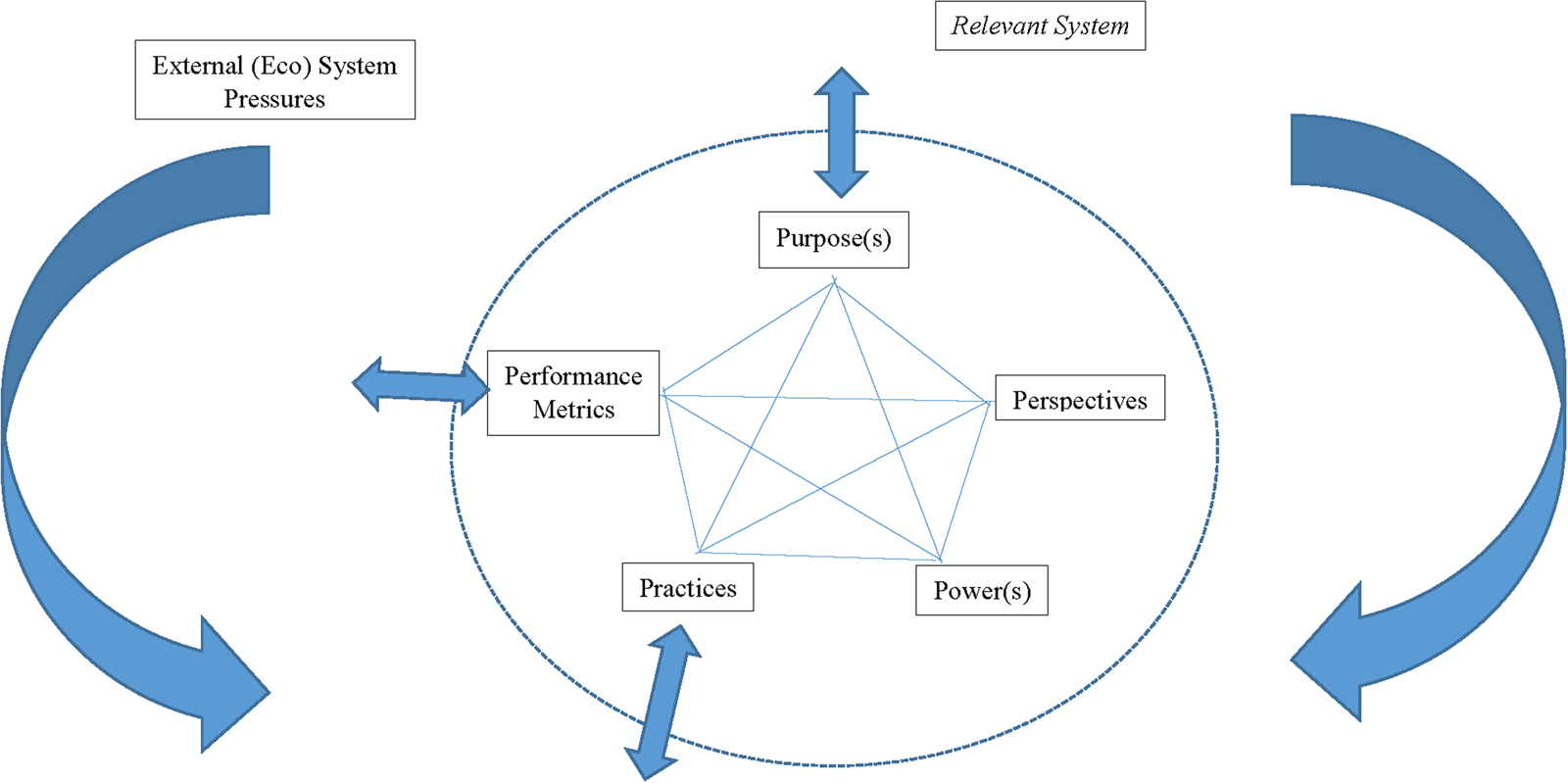
This paper goes back to its original proposition: that transforming businesses requires transforming the (socioeconomic) ecosystem that surrounds businesses so that businesses can act in an epimimetic fashion and adapt to the system's new demands. Doing that means paying attention to the purposes, perspectives, power relations, practices and performance metrics embedded in the larger ecosystems – societies and economies – and these same aspects of businesses themselves. Thus, system transformation for businesses needs to take place on two levels: the whole system level and in individual businesses responding epimimetically to shifts in their ecosystem. Only as the broader system changes, however, are the vast majority of businesses themselves likely to transform. Below, the paper explores each of these aspects of system change.
6.1. Purpose(s)
Purpose defines the goals, mission or raison d’être of particular systems, which could be an industry, nation, state province or community, an organization like a business or a natural system. Such systems are typically embedded within other systems (e.g., a business is embedded in an industry that is in an economy that is part of a society and so on). System purposes provide a framework for action, guiding the narrative that shapes perspectives or mind-sets (see Section 6.2), as well as understandings of what it means to be in this particular system and how ‘things are done here’ (i.e., the power relationships, practices and even performance metrics). Stated purpose theoretically provides overall guidance for the system. Today, the purpose of business is broadly defined as maximization of profits or continual growth. If the narrative of economic growth overall in society supports that sense of purpose, then businesses will focus epimimetically on profitability or growth. If purpose emphasizes something broader or more life-enhancing, then businesses will emphasize those things.
Human systems, like businesses and the societies/economies in which they are embedded, are purposeful in both their parts and as wholes (Ackoff & Gharajedaghi, Reference Ackoff and Gharajedaghi1996). In creating the potential for a ‘good Anthropocene’, Bennett et al. (Reference Bennett, Solan, Biggs, McPhearson, Norström, Olsson and Carpenter2016, p. 442) argue that a key component of such transformation is providing inspirational visions, which can help shape new purposes and provide important directionality for change efforts (see also Westley et al., Reference Westley, Tjornbo, Schultz, Olsson, Folke, Crona and Bodin2013). Transforming such systems means rethinking core purposes, goals, visions and the like, which provide directionality and guidance for actions in the form of goals, aspirations and the like (see Meadows, Reference Meadows1999).
Transformation towards sustainability and wellbeing, however, demands a different orientation or guiding narrative. Changing that sense of purpose – such as to collective value absent dignity violations, to use Donaldson & Walsh's (Reference Donaldson and Walsh2015) framing – emphasizes the shift in purpose – but will have knock-on (epimimetic) effects on all of the other major aspects of the system as well because of their systemic interconnectedness. Arguably, core to achieving system transformation for businesses, then, is shifting business purposes away from today's emphasis on maximizing shareholder wealth (i.e., financial benefits for one stakeholder group) towards broader goals that place the wellbeing of the whole system and its inhabitants (whether human or not) at their core.
There is already some hope in changing social norms and expectations for businesses that shape innovative business models and purposes. Some businesses, for example, have already adopted new social purpose, hybrid or social enterprise-orientated business models that bring them along this path. The global accounting firm Deloitte in a 2018 report on the ‘Rise of Social Enterprise’ defines such a social enterprise as “an organization whose mission combines revenue growth and profit-making with the need to respect and support its environment and stakeholder network” (Deloitte Insights, 2018, p. 2).
There are numerous types of social enterprises. For example, companies established as or that become B Corporations attempt to explicitly balance purpose and profit and are required to consider how their decisions affect a range of stakeholders, including workers, customers, suppliers, their communities and the natural environment (e.g., Clark & Babson, Reference Clark and Babson2012). Other companies have historically had (or sometimes adopted) structures that allow for more democratic operations, such as cooperatives (Mazzarol et al., Reference Mazzarol, Clark, Reboud and Limnios2018) and employee share ownership plans (ESOPs) (Betit, Reference Betit, Andriof, Waddock, Husted and Rahman2017). A few others pursue open-book policies (Stack & Burlingham, Reference Stack and Burlingham2013), in which employees and other key stakeholders are exposed to the company's books so that they understand where and how resources flow. Furthermore, in recent years, social enterprise and various forms of hybrid organizations that blend business and social and/or ecological purpose (Defourny & Nyssens, Reference Defourny and Nyssens2010) have emerged.
While social enterprises, broadly defined, are growing in numbers and popularity, there are significant systemic obstacles to their capacity to live out both their financial and socio-ecological purposes. The Financial Times reported in 2018 that Britain had nearly 100,000 social enterprises (representing about 5% of total employment), but that finding sufficient capital resources to support these enterprises on an ongoing basis is difficult, in part because the ‘social impact’ of such companies is hard to determine (Groom, Reference Groom2018). Similarly, the World Economic Forum (WEF) identified ‘six of many obstacles hindering progress’ of such enterprises. The sector, according to the WEF, does not promote innovation, has little consistent access to capital and has non-transparent reporting. Furthermore, social enterprises’ business agendas are complex, there is a bias towards non-profits in the media and social entrepreneurs can suffer from burnout (Zimmer & Pearson, Reference Zimmer and Pearson2018).
Social enterprises with broadened or multiple bottom-line purposes have made inroads into system change, but such enterprises still represent a relatively small proportion of total businesses because the current ecosystem does not really support them. More transformative changes demand that the broader socioeconomic system shift its purposes as well so that many more businesses can epimimetically make new choices about purpose. Towards that end, ‘collective value (wellbeing) absent dignity violations’ (Donaldson & Walsh, Reference Donaldson and Walsh2015) could serve as a general purpose approach at both the business and economy/society level. For example:
• Collective value and businesses: Scholars Donaldson and Walsh (Reference Donaldson and Walsh2015) have offered a new definition of business purposes as ‘collective value absent dignity violations’. Enlarging collective value to include the wellbeing of non-human entities would go a long way towards pushing businesses to be more life-affirming, ecologically and socially conscious in their strategies – more sustainable – and stewards of the Earth (Chapin et al., Reference Chapin, Carpenter, Kofinas, Folke, Abel, Clark and Swanson2010, Reference Chapin, Pickett, Power, Jackson, Carter and Duke2011). Such a redefinition recognizes that businesses operate in societies that exist in ecological contexts. Such broadened purpose could also help recognize and support social enterprise in new ways.
• Collective value/wellbeing for societies and economies: Today, much attention focuses on economic growth (gross domestic/national product; GDP/GNP) as a signifier of how well a society is doing. Shifting towards a collective value/wellbeing purpose for the broader societies in which economies are embedded, along with recognition of the societies’ embeddedness in nature, would help align humanity's activities with the limits of the natural environment. It would foster the development of wellbeing for all humans and all of life. Sometimes called a ‘wellbeing economy’,Footnote i a shift would help orientate companies, along with governments and NGOs, towards the achievement of goals such as the SDGs and the Paris Accord on Climate Change. It could bring economies and companies into alignment along the lines of the Organisation for Economic Co-operation and Development's (OECD) ‘better life index’ (Durand, Reference Durand2015; Mizobuchi, Reference Mizobuchi2014) or the Genuine Progress Indicator (Lawn, Reference Lawn2003), both of which could underpin a broader sense of socioeconomic purpose (see Section 6.5).
6.2. Perspectives
Meadows (Reference Meadows1999) argued that the most powerful lever of change was changing the perspectives or mind-sets of people in a system, which Colvin et al. (Reference Colvin, Blackmore, Chimbuya, Collins, Dent, Goss and Seddaiu2014) call changes in understanding and Westley et al. (Reference Westley, Tjornbo, Schultz, Olsson, Folke, Crona and Bodin2013) characterize as changing beliefs. Meadows amended her ideas to suggest that the ability to transcend mind-sets was even more powerful a change lever than the mind-set/perspective itself.
Mind-sets or perspectives that dominate in a human system, culture or society derive from values, rules and knowledge, according to Gorddard et al. (Reference Gorddard, Colloff, Wise, Ware and Dunlop2016). Mind-sets or perspectives are evidenced by stories and paradigms that frame understanding of the world. Purposes, paradigms, mind-sets and perspectives set directionality for change (cf., Schot & Steinmuller, Reference Schot and Steinmueller2018). They build on core norms, values and beliefs that then shape action (Moore et al., Reference Moore, Olsson, Nilsson, Rose and Westley2018; Olsson, Reference Olsson, Westley and McGowan2017), which can come from internal or external sources. Towards that end, core mythologies, stories and dominant narratives play important roles in shaping mind-sets and values around system transformations (e.g., Harari, Reference Harari2014; Ingram et al., Reference Ingram, Ingram and Lejano2019; Moezzi et al., Reference Moezzi, Janda and Rotmann2017; Paschen & Ison, Reference Paschen and Ison2014). At a more basic level, narratives and stories are at the core of how we humans understand who we are, our place in the world and what the world is about (Cron, Reference Cron2012; Gottschall, Reference Gottschall2012). Dominant narratives (cf., Bennett et al., Reference Bennett, Solan, Biggs, McPhearson, Norström, Olsson and Carpenter2016) can either speak to possibilities for change or hold the current system in place, depending on the understandings and perspectives that they shape.
In the business context, today's dominant narrative is clearly that of neoliberalism (Lovins, Reference Lovins2016; Monbiot, Reference Monbiot2016). Neoliberalism has core memes emphasizing self-interested individual responsibility, free markets, free trade, constant growth and maximized shareholder wealth. Observers believe that this economic approach has created many of the problems that now demand systemic transformation (Lovins et al., Reference Lovins, Wallis, Wijkman and Fullerton2018). Meadows (Reference Meadows1999) argued that changing mind-sets or paradigms such as neoliberalism (and transcending them) was the most powerful leverage point for system change. Changing managerial mind-sets – or cognition – is a vital aspect of needed system transformation. Empirical research indicates that managerial cognition can be limited by the history or legacy of an industry. It can be limited by firms’ managers having similar beliefs as their close competitors in highly competitive contexts (Johnson & Hoopes, Reference Johnson and Hoopes2003) in what was above called the epimimetic process, and thereby reduce the potential for innovative thinking. As globalization has increased, managerial cognition research has also emphasized the need for a global mind-set (Levy et al., Reference Levy, Beechler, Taylor and Boyacigiller2007), because Maitland and Sammartino (Reference Maitland and Sammartino2015) find that managerial mind-sets can differ depending on the international breadth, depth, diversity and prior experience of strategic decision-making of the leaders.
The depth of the climate and other sustainability crises has further led some observers to argue that business managers (and also policy-makers, activists and citizens more generally) need to be educated to understand sustainability issues. Hermes and Rimanoczy (Reference Hermes and Rimanoczy2018) argue for developing a ‘sustainability mind-set’ that would open up managers’ and others’ sustainability issues. Part of the process of shifting perspectives is changing the underlying ‘story’ that is told, whether that story is about the business itself and its place in the system or about the broader purposes of the system as a whole (Lovins, Reference Lovins2016; Monbiot, Reference Monbiot2016). As Freeman (Reference Freeman2017) has argued, a ‘new story’ is needed for businesses.
A new story that helps foster systemic change arguably needs to be one in which managers, leaders and policy-makers in all realms understand human beings’ deep interconnectedness with each other and the natural environment. Part of the transformation process is to create new, compelling stories and narratives that articulate the desired future in new ways and shape new perspectives. Here, the focus is on shifting perspectives to a world where all of life flourishes, where everyone (and every being) has dignity and worth (e.g., Lovins et al., Reference Lovins, Wallis, Wijkman and Fullerton2018; Pirson, Reference Pirson2017). Consistent with the shifting purpose of businesses and socioeconomic systems described above, the mind-set for a transformed system needs to affirm life and dignity for all.
• A life-centric, dignity-for-all mind-set: Korten (Reference Korten2007, Reference Korten2018) argues that we humans are living beings born of a living Earth. We humans need to better recognize our inherent interconnectedness with nature. Making that (type of) understanding a core narrative or story is key to shifting perspectives. New narratives and stories are an important basis for developing mind-sets, cultural norms, expectations and understandings that foster life-affirming qualities of shared responsibility, community, flourishing, dignity (Pirson, Reference Pirson2017) and wellbeing for all (e.g., Korten, Reference Korten2007, Reference Korten2018; Pirson, Reference Pirson2017). Such mind-sets would align with the collective value/wellbeing orientation of business/societal purpose and allow very different approaches to doing business than are currently done. These ideas are also consistent with ideas of stakeholder relationships (Freeman, Reference Freeman2017), regenerative economies (Fullerton, Reference Fullerton2015) and conscious capitalism (Mackey et al., Reference Mackey, Sisodia and George2013), among other recent attempts to change capitalism. A life-affirming approach would also emphasize circularity and cyclicality (Geissdoerfer et al., Reference Geissdoerfer, Savaget, Bocken and Hultink2017; Stahel, Reference Stahel2016), living systems and the organic nature of the Earth conceived as Gaia (Lovelock, Reference Lovelock2009) as opposed to the linear, take–make–waste production and business models common today (McDonough & Braungart, Reference McDonough and Braungart2010).
6.3. Power relationships
The third area of system change is that of power dynamics and relationships in the system, which involves how stakeholders relate or connect with others, who has power and authority (and who does not) and what the resource flows and structures in the system are. Power relationships, structures and ‘authority’ (Moore et al., Reference Moore, Olsson, Nilsson, Rose and Westley2018; Olsson, Reference Olsson, Westley and McGowan2017; Westley et al., Reference Westley, Tjornbo, Schultz, Olsson, Folke, Crona and Bodin2013) determine resource flows in systems (Olsson, Reference Olsson, Westley and McGowan2017). Organizational structures and flows establish who has access to knowledge, resources, information and clout; that is, who influences behaviours, actions, practices and even perspectives/mind-sets.
Such relationships form path dependencies (Olsson et al., Reference Olsson, Moore, Westley and McCarthy2017) that strongly influence what is and is not possible in any given system. Path dependencies can influence whose voice is heard, who is seen and who is invisible, including in businesses how enterprises or systems are structured and who has what function, as well as how changes are likely to evolve. Structures can also shape technological transitions and innovations (Markard & Truffer, Reference Markard and Truffer2008). Shifting these relationships breaks down or changes the existing dominant system, altering the dynamic interactions within the system and eliminating undesirable pathways in the system (Olsson, Reference Olsson, Westley and McGowan2017, p. 59). It can also shift operating rules, including technical and legal frameworks that structure power relations as well as operating practices (see below) (Westley et al., Reference Westley, Tjornbo, Schultz, Olsson, Folke, Crona and Bodin2013, p. 30).
Transformative processes inevitably have a significant impact on the structure, nature, type and extent of power(s) held by different players in an organization as well as in the context of societies. To achieve transformation means understanding where power is held, how it can be/is being used and what its implications are for the success of the transformation – and shifting power and structures according to desired ends. Who has power at the ecosystem level is important, as well as internally (e.g., today the financial community controls a huge proportion of most economies, exerting inordinate influence on companies around solely financial performance). Ecosystem changes that favour certain structural forms can be important levers for changing power dynamics in businesses.
Bringing a collective value/wellbeing orientation to businesses means ensuring that the broader system recognizes and values power relationships and dynamics in new ways, valuing each participant wholly. Wellbeing for many people inside and outside of companies potentially involves many more stakeholders finding and having ‘voice’ (Sen, Reference Sen and Hausman1993) and likely requires structural, decision-making and resource flow changes both societally (more democracy) and in businesses (more ‘voice’ through, for example, governance reform to structures such as cooperatives, ESOPs and the like). At the system level, reducing the power of financial institutions, which has grown dramatically since the 1980s (Davis, Reference Davis2009, Reference Davis2013) so that other considerations than financial wealth are taken into account by businesses, is an important step. Because power relationships are complex and interrelated, only a few of the more obvious and important arenas of possible action can be highlighted here: structural redesign of the corporation; reduce the power of the financial community; and shifting governance to allow more ‘voice’.
• Structural redesign of the corporation: In an initiative called Corporation 2020, Tellus Institute's Allen White (Reference White2006) called for a massive redesign of the corporation to cope with the exigencies of the 21st century. Recognizing that corporations were originally permitted only when they served a social purpose/public interest, White argued for a redesign of today's corporations to once again “harness private interests to serve the public interest” (White, Reference White2006, p. 12). White's redesign included fair returns for shareholders while considering the legitimate interests of other stakeholders, sustainability, equitable distribution of wealth, participatory governance and upholding of human rights. Calls by thought leaders such as White continue today and can be used to influence thinking about the future of the corporation (e.g., Kelly, Reference Kelly2020; Lovins et al., Reference Lovins, Wallis, Wijkman and Fullerton2018) so that policy-makers and regulators can begin to deal with the realities of a world in climate change (as one example). Kelly (Reference Kelly2020), for example, calls for ‘ownership design’ of companies that encompasses five key elements: purpose, membership (not simply employment), internal governance (not shareholder governance), capital and networks. Such innovative thinking can begin to push towards transforming the design of corporations, which is itself part of the problem (Lovins et al., Reference Lovins, Wallis, Wijkman and Fullerton2018; White, Reference White2006).
• Reduce the power of the financial community: One important step towards system transformation is reducing financial institutions’ power to dictate a financial results-only set of norms for businesses. Fullerton (Reference Fullerton2015) has suggested along these lines a shift towards what he calls a regenerative economy that would be developed around principles that foster life and wellbeing. Davis (Reference Davis2013) encourages the growth of small, innovative businesses that he claims are already beginning to replace today's behemoths and that are more connected to their communities, another aspect that fosters ‘life’.
• Shift governance to allow more ‘voice’ at all levels: Today, many people in companies and around the world feel like they have little ‘voice’ or authority, because the power resides in individuals at the ‘top’ of the hierarchy (see Kelly, Reference Kelly2020). As organizations become more networked, however, there is a chance that power becomes more distributed and people at local levels will need to have both decision-making capacity (voice) and authority to act in new ways – and in ways that foster a life-affirming, inclusive and participative set of approaches. New governance structures in societies could foster democratic institutions and give those institutions a new and more powerful voice (e.g., Sen, Reference Sen and Hausman1993) in societies. Amplifying and supporting organizational structures that favour worker social enterprise in general could enhance employee/worker ownership, democracy and voice. Different governance forms include ESOPs, cooperatives, foundation-owned enterprises, benefit corporations, B corporations and hybrid enterprises. Such governance can foster new ways for owners, workers, leaders and companies themselves to relate to each other – and to the world around them. Public policies emphasizing transparency approaches such as open-book accounting (Stack & Burlingham, 2013) supported by major accounting and regulatory entities would also be a step in the direction of transformation.
6.4. Practices (policies, processes and practices)
There are numerous practices (shorthand for policies, processes and practices) that characterize any human or socio-ecological system. Such operating practices are evidenced in roles and routines that indicate who does what (Olsson, Reference Olsson, Westley and McGowan2017) and how work gets done (and, as indicated above, relevant power relationships and structures). As Westley et al. (Reference Westley, Tjornbo, Schultz, Olsson, Folke, Crona and Bodin2013, p. 30) note, technical and legal frameworks can encourage (or inhibit) the integration of new knowledge, experiments and other learning depending on their nature. As the purposes of a system change, so do these practices, and, as Meadows (Reference Meadows1999) notes, changing practices too can be a lever of transformation. One way of recognizing that transformation has taken place is to witness considerable shifts in the practices of a system. Colvin et al. (Reference Colvin, Blackmore, Chimbuya, Collins, Dent, Goss and Seddaiu2014) identify critical shifts that are important in complexly wicked contexts: identifying key stakeholders and creating joint responsibilities; developing new policies and institutions; facilitating as needed; and identifying what constitutes an improvement (see Section 6.5).
At the whole-system level, there are many possible new operating practices, policies and processes that might result in systemic transformations towards flourishing for all participants in a system. Below are just a few of the domains in which operating practices would change if a collective value/wellbeing set of purposes were broadly implemented. For the sake of simplicity and because practices, processes and policies are many and complex, the discussion here focuses on only a few arenas: compensation; reporting and stakeholder engagement; governmental policy on sustainability; citizen action; and technological advances.
• Compensation: Reasonable and equitable compensation schemes that ensure that everyone has dignity, foster some degree of equity and ensure that all participants in a system can live a reasonable and dignified life (e.g., living wage policies, raised minimum wages, even income for all) could be mandated. Simultaneously, it is important to address inequitable compensation schemes, which in some parts of the world today are wildly out of balance and ‘reasonableness’, with CEOs being paid many hundreds of times what average workers are paid.
• Reporting and stakeholder engagement: Regulatory and legislative policies around stakeholder engagement, transparency and the integration of environmental, social and governance (ESG) issues into company reporting can be important levers of transformation. Indeed, some nations already require stock exchange-listed companies to use such reporting. ESG reporting approaches such as the Global Reporting Initiative and the emerging integrated reporting initiative (https://integratedreporting.org/the-iirc-2), which integrates financial and social reporting into one report, can be important ways for companies to gain holistic perspectives on their activities and impacts – and are likely to need to be regulated/mandated for wholesale adoption to occur (see Section 6.5).
• Governmental policy on sustainability: Governmental policies that foster a circular economy, regeneration, renewability, restoration and renewal and punish linear production methods and waste to foster different types of company behaviours, practices and actions would force companies to adopt different sustainability practices. Combined with the peer/normative pressure of industry associations, standard-setting bodies and bodies such as the UN Global Compact, Global Reporting Initiative and actors in the emerging infrastructure, such innovations can potentially hold companies accountable for their impacts (Gilbert et al., Reference Gilbert, Rasche and Waddock2011). Implementing requirements for companies to live up to higher sustainability standards could reset norms, expectations and even stakeholder demands that push companies towards new, more sustainable, life-giving and wellbeing-orientated practices. Governments could also ban the use or production of toxic substances (and things such as single-use plastics), support renewable energy sources, redesign housing to foster energy efficiency, promote walking and cycling not driving and establish green urban designs including growing vegetables and plants on rooftops in cities. Some of these things are happening already on a local scale, but broader adoption may take governmental/legislative action across whole nations. Such actions produce norm-shifting and may incidentally open up numerous new business opportunities. Governments could foster product/service durability (as opposed to what ecologists call take–make–waste approaches) by providing tax incentives and disincentives appropriately (e.g., by implementing ‘take back’ laws that require companies to take back products at the end of their useful life and recycle them, which Germany already has). Government policy could foster what is known as ‘servicizing’ (White et al., Reference White, Stoughton and Feng1999), a system in which companies continue to own products while leasing them to customers for whatever useful functionality they provide. Tax or incentive policies could nudge customers and companies towards keeping their old products instead of the constant product churn now in place.
• Citizen action: Efforts by citizen and consumer groups (along with governments) to work on changing norms and standards for product durability, design and usefulness could be enhanced, thereby rewarding companies that produce such goods. Citizens are also adopting things such as sharing platforms for different resources (e.g., Airbnb, Uber and Lyft, among many others), which use existing assets in what is called a zero-marginal-cost economy (Rifkin, Reference Rifkin2014). Clothes exchanges, car sharing, transition cities and other transformative efforts could ensure that business as usual tomorrow will look quite different from business as usual today.
• Technological advances: Technology also has the potential to reduce material throughput (e.g., electronic devices instead of physical books, journals and newspapers are already dramatically affecting the publishing industry). Coming from companies, such technologies act epimimetically by changing the context for consumers and businesses alike, fostering the adoption of new approaches, some of which have significant potential to reduce the consumption of material goods, while still retaining the potential for company profitability. Technological developments that reduce material goods, such as using an e-reader instead of books, could emphasize software development and enhancement while discouraging replacement of the physical device itself.
6.5. Performance criteria
There is a saying in accounting that ‘you get what you measure’. It is well known in management theory that you get the behaviours that you reward, so establishing metrics that provide the desired orientation for the relevant system is an important step. As noted earlier, today's corporations, especially large ‘public’ corporations, emphasize ‘maximizing shareholder wealth’, generating constant growth and enhancing profitability, following the tenets of today's dominant narrative, neoliberalism (Lovins et al., Reference Lovins, Wallis, Wijkman and Fullerton2018; Monbiot, Reference Monbiot2016). Economies, in turn, orientate towards constant GDP/GNP growth (on a finite planet) despite its known flaws. Today's business and economic ecosystem thus emphasizes financial profitability and economic ‘growth’ at all costs, with corresponding metrics associated with GDP/GNP growth and bottom-line financial profitability and share price growth. Establishing powerful new metrics that emphasize goals that favour wellbeing and flourishing for all (including non-humans) may well be necessary to achieving transformed human and socio-ecological systems, because of the power that metrics have to influence perspectives/mind-sets and practices.
Establishing and taking seriously new performance metrics orientated towards transformational goals such as wellbeing for all and emphasizing broader human and ecological values are vital parts of shifting the business ecosystem. Such new performance criteria need to be in place at the firm level as well as more holistically in societies and globally. Simon Kuznitz, originator of the idea of GDP/GNP, for example, acknowledged that GDP/GNP were flawed metrics when they were originally introduced (see Kuznets, Reference Kuznets1973) because both measure only economic activity, whether for good or ill. Yet today GDP/GNP are the most widely used measures to indicate wellbeing (despite the fact that they measure no such thing). In 1968, then Senator Bobby Kennedy (Reference Kennedy1968) pointed out in a speech that GDP “measures everything except that which is worthwhile.” No new indicator dominates world perspectives the way that GDP does today. There are, however, a number of broad-based indicators that, if implemented at the national and global scales, could foster new mind-sets and ultimately practices. Such indicators explicitly aim to measure collective value/wellbeing.
• Economy/society (ecosystem) indicators: Moving beyond GDP/GNP is important because of the problems associated with these metrics (Berick, Reference Berick2018; Costanza et al., Reference Costanza, Hart, Posner and Talberth2009, Reference Costanza, Fioramonti and Kubiszewski2016; Stiglitz et al., Reference Stiglitz, Fitoussi and Durand2018). In contrast, the Genuine Progress Indicator (GPI; https://sustainable-economy.org/genuine-progress) represents a significant attempt to supplement GDP by adding economic activities that contribute to overall wellbeing and subtracting ones that harm wellbeing. It is meant to be a more holistic and accurate assessment of the state of a nation's (city or region) economy, spurring equitable growth and reducing negative impacts on nature. Other wellbeing-orientated indicators include Bhutan's Gross National Happiness Index (www.grossnationalhappiness.com) and the UN Development Programme's Human Development Index (HDI; http://hdr.undp.org/en/content/human-development-index-hdi). Using something such as the OECD's ‘Better Life Index’ (www.oecdbetterlifeindex.org), which asks ‘How's life?’ to assess wellbeing at the country/nation-state level, is another possibility. The Better Life Index draws from the path-breaking work of Amartya Sen on human capabilities (Sen, Reference Sen and Hausman1993) and Martha Nussbaum's (Reference Nussbaum1997a, Reference Nussbaum1997b) elaboration of specific capabilities vital to human wellbeing. The Better Life Index includes assessments of housing, income, jobs, community, education, environment, civic engagement, health, life satisfaction, safety and work–life balance, mixing both objective and subjective facets of wellbeing. If this type of index were taken seriously as an indicator of economic and social wellbeing, countries would have reasons to attempt to improve these indicators.
• Business-level indicators: Business metrics that assess collective value/wellbeing sorely need broad agreement and implementation at national and global levels to change the business ecosystem. Donaldson and Walsh's (Reference Donaldson and Walsh2015) theory of business argues for collective value (wellbeing) absent dignity violations as the core purpose of business. Implementing a collective value metric for businesses clearly would demand optimization of collective value and accountability for all business participants/stakeholders (Donaldson & Walsh, Reference Donaldson and Walsh2015). A shift towards collective value as core metric is already part of the way that so-called social or impact investors look at businesses. Social investing attempts to assess companies’ financial performance and also their ESG performance. Widespread adoption of this approach, as is already happening with the world's largest financial institution BlackRock adopting ESG metrics for its entire investment practice as of early 2020, will begin to ensure that that all companies pay attention to such issues (Fink, Reference Fink2020). While BlackRock cannot mandate change in the companies it invests in, this type of pressure from the world's largest investor creates a radically different ecosystem and set of expectations for many businesses – and is quite likely to change how they view their practices and their own performance. Furthermore, the world's largest accounting firms, providers of financial capital, regulators, policy-makers and businesses themselves are behind a major initiative to eventually have all companies listed on public stock exchanges or that have reached a certain size adopt what is known as integrated reporting. Again, as large companies begin to produce such reports, the ecosystem will shift and other companies, especially in related supply and distribution chains, will feel pressure to similarly and epimimetically also adopt such reporting. Other initiatives that are part of the growing corporate responsibility infrastructure similarly change the ecosystem and put both competitive, peer, normative and societal pressures on companies to behave in different ways. Governmental moves to have accounting standards incorporate or ‘internalize’ what are now known as ‘externalities’ into accounting statements or have companies adopt full-cost accounting approaches would similarly change the landscape – and subsequent corporate behaviours and practices.
7. Conclusion
Clearly, there are many other changes that might be made as leverage for inducing systemic transformation – and changing the context in which businesses operate so that they inherently focus more on issues of wellbeing, dignity and even care (Eisler, Reference Eisler2008, Reference Eisler2012). What this article attempts to make clear is that because of epimimetic processes businesses cannot transform towards sustainability or flourishing for all unless the system in which they operate also, perhaps first, transforms. What is also clear is that a good deal of what needs to happen is already known. Much of what could be done by companies has been outlined in depth in a variety of places, including Hawken et al.'s (Reference Hawken, Lovins and Lovins2013) Natural Capitalism, McDonough and Braungart's (Reference McDonough and Braungart2010) Cradle to Cradle, Lovins et al.'s (Reference Lovins, Wallis, Wijkman and Fullerton2018) A Finer Future and, around product innovation, Benyus's (Reference Benyus1997) Biomimicry, to name a few.
The problem in system transformation is the system. If the system demands that businesses act in short-term, narrowly focused, financial/economic-only terms in the interests of an elite set of stakeholders (i.e., the shareholders), then that is exactly what businesses will do. To transform businesses towards true sustainability – not, as Ehrenfeld and Hoffman (Reference Ehrenfeld and Hoffman2013) put it, simply less unsustainability – and wellbeing for all, the system itself needs to change.
Transforming the context in which businesses operate is possible, but it is hard – requiring political and citizen activist will and action. That is, we know something about ‘what’ might transform the ecosystem in which businesses operate, as the above illustrates. The problem is finding the political wherewithal and will to make it happen. The ‘how’ then becomes the really hard part. Because of the need to change minds/perspectives, because power will be shifted and sometimes displaced, because practices will need to change along with performance metrics and because the very purpose(s) of and perspectives (mind-sets) about business will be questioned, transformation is difficult. Still, despite the difficulties involved, the imperatives of climate change, species extinction, political and social unrest, topsoil erosion and many other current threats make it clear that finding the will to change is among the most important projects of our time.
Acknowledgements
The author would like to thank the SDG Transformations Forum for encouragement of these ideas.
Author contributions
The manuscript is sole authored.
Financial support
None.
Conflicts of interest
None.
Research transparency and reproducibility
There are no data in this paper. All references are publicly available.


 Open access

