




Introduction
The centennial of the Turkish Republic in 2023 – and its commemorative aftermath in 2024 – marked a key moment for Turkish political elites and cultural institutions to shape the memory of the Republic. Among the many celebrations – military parades, anniversary marches, concerts, and political rallies – two major exhibitions in İstanbul stood out for their scope, aesthetic ambition, and symbolic charge: “From Bygone Times to Destiny: Turkey’s Century” (Maziden Atiye: Türkiye Yüzyılı), commissioned by the Presidency’s Directorate of Communications, and “The Republic at Hundred: Impressions from the Cultural Revolution” (Cumhuriyetin Yüzü: Kültür Devriminden İzler),Footnote 1 curated by the Borusan Kocabıyık Foundation. They represented not only two contrasting readings of Republican history, but also two rival projects for imagining Turkey’s present and future.
This article offers a comparative analysis of these exhibitions. By directing attention to both institutional practices and the broader nationalist ideologies that structure them (Posocco Reference Posocco2022), it explores how opposing political actors – the authoritarian–Islamist regime of the Justice and Development Party (Adalet ve Kalkınma Partisi; AKP) and the liberal–Kemalist oppositionFootnote 2 – mobilize exhibitions to produce, perform, and discipline public memory, and how they create diverging contexts for the enactment and production of citizenship.Footnote 3
Despite their aesthetic, affective, and ideological differences, both exhibitions converge in their reliance on state-centric and exclusionary narratives that delineate the boundaries of belonging and prescribe what versions of the past deserve commemoration. In doing so, they reveal how the deepening of authoritarianism constrains the cultural imagination, narrowing the space for critical or pluralist engagements with history – even within institutions aligned with the opposition Republican People’s Party (Cumhuriyet Halk Partisi; CHP). In this sense, the centennial exhibitions reveal not just a struggle over national memory, but a deeper transformation: the autocratization of memory itself.
The fact that such a contestation and dissenting readings of national identity remain possible is characteristic of the still competitive authoritarian nature of the current political regime, which has “exited” what used to be a secular, if defective, democracy with a poor human rights record (Öktem and Akkoyunlu Reference Öktem and Akkoyunlu2018) and crossed over into the territory of authoritarian governance and personalized rule (Castaldo Reference Castaldo2018; Esen and Gumuscu Reference Esen and Gumuscu2016). As in other cases of autocratizing countries in Europe and beyond, political competition continues despite the autocratic frame with a real impact on people’s lives, including the survival of pockets of opposition power. In the Turkish case, the progressive transfer of power to the opposition on the sub-national level in the local elections of 2019 and 2023 is noteworthy because it created spaces beyond direct government control also in the cultural life of cities (Esen and Gumuscu Reference Esen and Gumuscu2019; Öktem Reference Öktem2021).
The empirical evidence on which this paper rests is derived from a political ethnography (Schatz Reference Schatz2009) conducted during several research stays in İstanbul and Ankara between November 2023 and March 2025. These included: repeated visits to both exhibitions under study, as well as to other centennial-related exhibitions in İstanbul and Ankara; conversations and interactions with visitors; interviews with curators and organizers; and a discourse-analytical engagement with exhibition artifacts, display panels, promotional videos, and visitors’ books (Macdonald Reference Macdonald2005).
Both exhibitions are examined through an analytical lens inspired by Sharon Macdonald’s emphasis on the importance of attending to both the production (financing institutions, curatorial strategies) and the consumption (visitor reactions, public and media debates) of exhibitions. As Macdonald notes, exhibitions are typically presented as finished and authoritative statements, while the assumptions, compromises, and contingencies that shape them remain hidden from view (Macdonald Reference Macdonald and Watson2007, 177). As far as possible, I therefore seek to elucidate the production processes of each exhibition, with particular attention to the consequences of specific representational choices for the distribution of power (Macdonald Reference Macdonald and Watson2007, 179). Each case is analyzed in terms of its location and function within İstanbul’s urban fabric, exhibition layout, aesthetics, and master narratives. Considerations of funding, production processes, and curatorial intent provide the backdrop for questions of reception, with media coverage and visitors’ books offering insight into variations in audience interpretation.
Exhibitions and the construction of national master narratives
Museums, and by extension large-scale exhibitions, provide fertile ground for studying the construction, dissemination, and contestation of national master narratives. They have been described as “disciplinary spaces” where modernity, civility, and citizenship are exhibited, defined, and performed, as well as primary agencies of “heritage-making” and “making citizens” (Bennett Reference Bennett2018, 2; see also Bennett Reference Bennett2005). These disciplinary spaces frequently extend beyond the venue and become part of the production of national space. Extrapolating on Henri Lefebvre (Reference Lefebvre1991), Janson and Kınıkoğlu (Reference Janson and Kınıkoğlu2021, 233) suggest that “nationalist memory culture not only (re)collects ‘things in space’ – it produces ‘national space’ itself.”
Macdonald (Reference Macdonald2003, 5) posits that from their beginnings, public museums were engaged in “identity work” and “embroiled in the attempt to culture a public and encourage people to imagine and experience themselves as members of an ordered but nevertheless sentimentalized nation-state.” Archives, libraries, and museums “help to store and create modern ‘imagined communities’” (Brown and Davis-Brown Reference Brown and Davis-Brown1998, 20; see also Anderson Reference Anderson1983). These master narratives create illusions of homogeneity and “too often … use the remnants of the past – museum artefacts – to construct national identity or heritage that silences diverse heritages or cultures, that ignores competing views of the past” (Lleras Reference Lleras, Hamilton and Gardner2017, 1).
The view of museums as performative spaces is also a core idea of Carol Duncan’s work on art museums as “ritual structures” that prompt “visitors to enact a performance of some kind” (Duncan Reference Duncan1995, 2). The two defining ritual features of museums, she argues are:
[a] marked-off, “liminal” zone of time and space in which visitors, removed from the concerns of their daily practical lives, open themselves to a different quality of experience; and second, the organization of the museum setting as a kind of script or scenario which visitors perform (Duncan Reference Duncan1995, 20).
In this ritual context then, visitors are not invited to engage critically with the exhibited artifacts and their stories, but to partake in an exalting ritual that allows them to feel part of a larger story. This story can be the superior aesthetics of Western civilization in European art galleries, the achievements of the secular Republic in Turkey’s Republican museums, or the supremacy of Turkishness and Islam in Turkey’s history museums. Closely related to this ritualization of museum visits is the aestheticization of objects that affirms “the uncomplicated and reverential mythology of a single great civilisation” (Knell Reference Knell, Knell, Aronsson, Amundsen, Barnes, Burch, Carter, Gosselin, Hughes and Kirwan2010) and allows for these objects to be transformed into relics of devotion and self-affirmation. Lleras (Reference Lleras, Hamilton and Gardner2017, 11), however, posits that “[m]useums should not be about making fetishes of patrimonial objects.”
The building of new museums in the Global South and more specifically in the Middle East – often in non-democratic contexts such as Abu Dhabi, Qatar, Azerbaijan, or Singapore – as part of processes of nation-building and nation-branding and their positions in the neoliberal transnational art world is another avenue of investigation (Levitt Reference Levitt2015). Yet, neither approach resounds strongly with the current Turkish case: As part of the country’s deepening autocratization at least since the coup attempt of 2016, attempts at a de-colonial engagement with Turkey’s history – that acknowledges the history and achievements of non-Turkish people and recognizes the colonial logic of interactions particularly with the country’s Kurds – have been relegated to the extreme margins of public debate. The lens of nation-branding and “art-washing” appears to be of limited use also, as the AKP regime has largely disengaged from Western audiences as a source of legitimacy, the primary target of most current nation-branding projects.
Populism and post-secular nationalism in AKP-era museums
Most current studies of Turkey’s museums are concerned with the nationalism, militarism, and religious revisionism, or, in short, the “neo-Ottomanist” nostalgia of a new wave of museums emerging under successive AKP governments since the early 2000s. At the heart of these studies are the Museum of the Conquest of İstanbul (Panorama 1453), the Museum of the History of Science and Technology in Islam, the Sacred Trusts section of the Topkapı Palace, and the Gallipoli museums, along with the ostensibly less politicized miniature park Miniatürk (Hassan and Posocco Reference Hassan and Posocco2023; Janson and Kınıkoğlu Reference Janson and Kınıkoğlu2021; Posocco Reference Posocco2022; see also Bozoğlu Reference Bozoğlu2020; Karakaya Reference Karakaya2020; Reference Karakaya2022; Türeli Reference Türeli2006).
Despite their differences in disciplinary approaches, the authors agree that these museums present clearly defined master narratives that preclude a critical engagement with the past. Instead, museums like Panorama 1453, which celebrate Sunni Turkish–Muslimness, are “populist spectacles,” spaces exuberant with “affective atmosphere” that transfigure the conquest of Constantinople into a religiously coded spectacle (Karakaya Reference Karakaya2022, 133). Many visitors experience these museums as sacred spaces and places of emotional pilgrimage.
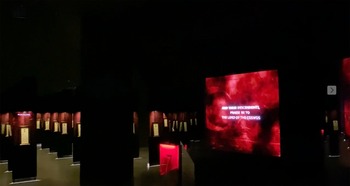
Nowhere is this spectacle more palpable, nor the current master narrative more expressive, than in a lesser-known 15 July Democracy Museum (15 Temmuz Demokrasi Müzesi), situated within Ankara’s vast presidential complex. It presents the military coup attempt through an immersive multi-media experience. The exhibition opens with an explanatory section presenting the Gülen movement as a terrorist organization and as main culprit while outlining a global history of Western imperialism and US-instigated military coups. In the following section, visitors are plunged into a high-tech, multisensory experience of the coup attempt. Here, digitalized images and epic-scale videos flash in rapid succession, accompanied by a dystopic soundscape of blaring fighter jets, rumbling tanks, and the crack of machine gun fire. Next comes a large “hall of witnesses,” which is the museum’s only evidence-based section. Here, the visitor encounters screens showing interviews with eyewitnesses and veterans, who recount their recollections of the event. The tone shifts in the final section, which features a symbolic graveyard for the “Martyrs of 15 July.” The space is filled with solemn recitations of the Quran superimposed with the distant howling of fighter jets.Footnote 4 The only possibility for an interactive engagement is in this graveyard section, where visitors are expected to make a brief prayer and many do (Figures 1 and 2).
Video installation at the 15 July Democracy Museum, located within the Presidential Complex in Ankara. The scene features a group of digitally rendered soldiers marching beneath a stylized, glowing map of Turkey, accompanied by the ambient sound of tank engines and fighter jets.
Source: Photograph by the author, July 20, 2024

The symbolic graveyard of the 15 July Museum, featuring a darkened hall lined with plaques bearing the names and engraved portraits of those designated as martyrs of the 2016 coup attempt. At the far end, a large screen displays a paraphrased line loosely inspired by Surah Al-Fatiha in Turkish, Arabic, and English. Referencing the Quran’s opening chapter – which praises God as “the Lord of all worlds” and invokes guidance – it reads: “And their descendants, praise be to the Lord of the cosmos.”
Source: Photograph by the author, July 20, 2024

Comparable narrative frames celebrating Islam and Turkishness, combined with a deep sense of distrust and dismay towards the West in general, also appear in provincial ethnographic and archaeology museums that mostly predate the AKP era but share the notion of “a conscious project of forgetting – a negligence of the diversity of memories in the creation of official histories” as well as in the museums of local history, established by AKP municipalities throughout the 2010s (Mete Reference Mete2015; see also Levin Reference Levin2019). These new (or re-curated) collections project a vision of Turkey’s history through emotively and religiously charged episodes like the Gallipoli Campaign and local resistance against Western powers during the War of Independence which are then used to elicit anti-European responses (Gezgin Reference Gezgin2019). They actively seek to develop an alternative frame to Kemalist historiography, yet they reproduce early Kemalist notions of propagating a monolithic reading of Turkey’s history and of museums as places where identity narratives and foundational myths are celebrated rather than questioned, and where the dividing lines between objects and simulation becomes blurred.Footnote 5
The 15 July Democracy Museum constitutes a major departure from conventional museums and sets a benchmark for the new state museums and exhibitions of the 2020s, as it does not display any artifacts, but only simulacra, here of tanks, fighter jets, and armored vehicles. Instead of large-scale photographs or videos from the event itself, we find effigies of protestors. With very few exceptions, even the video installations are based on vicarious representations rather than visual evidence. This uncoupling of representation and evidence/artifacts also constitutes the key framing of the official centennial exhibition “Turkey’s Century.”
From bygone times to destiny: “Turkey’s Century”
A tent-like structure on Taksim Square. At its center, a concave video wall encompassing a reflecting pool with two handling robots holding moveable screens. The wall displays a contemporary photograph of Mustafa Kemal in company of a young woman and several young men. Drones, fighter jets, and military vessels take to the screen. Women with mobile phones record the scene. The video wall now projects the fortress of Şuşi in Karabakh – recently conquered by Azerbaijani and Turkish forces from its Armenian defenders – as a choir intones the lyrics of the Centennial March: “This land, this sea, this flag we bear, our legends reach beyond compare. The fate of Turkishness in its fold we find, this homeland is ours in heart and mind.” Outside the structure, another video wall in the shape of a medallion casts portraits of Mustafa Kemal. Drones, jets, high speed trains, and the Turkish flag follow in quick succession. The external video walls teem with the faces of young men and women supporting a large Turkish flag, while passersby look on, some filming the display. The central screen now projects the portraits of Atatürk and Erdoğan, while the smaller screens project the logos of the centennial celebrations. The video reaches its climax as the choir crescendos through the last two stanzas: “Should foes unite and rain down from the sky/Should seas surge and mountains rise high/We’ve never bowed, nor shall we yield/For Turks were made as heroes, divinely sealed.”Footnote 6
The exhibition “Turkey’s Century” was organized by the Directorate of Information, an agency tracing its origins to the late Ottoman and early Republican eras, reconstituted and granted expanded powers in 2018 under President Recep Tayyip Erdoğan. Since then, it has become a key instrument in structuring public debate and consolidating the government’s control over strategic communication. The curators remain unnamed in the exhibition; also the videos shown at the exhibition and available on the presidency’s website do not disclose names or companies involved in the production. The Directorate appears as the sole organizer, suggesting that the exhibition and videos represent the official view of the Republic. In the absence of curators, however, we can discern several “digital content creators”: advertising agencies like Arter Medya have been devising the AKP’s election strategies and campaign videos since the early 2000s. The exhibition’s multi-media content indeed shares the narrative templates and militaristic aesthetics of the party’s election videos. Part of the exhibition material was also used during the 2024 local elections that took place a few months after the centennial celebrations.Footnote 7 It is not the content’s originality, however, that makes it so pervasive but its integration into a seamless flow of images, videos, and slogans that have been circulating in the public space and on social media for at least the last decade.
The exhibition tent was conveniently located on Taksim Square between the newly built Taksim Mosque and the reconstructed Atatürk Cultural Centre, two buildings which emphasize the inherently political choice of location. Taksim Square has been a lieu de memoire (Nora Reference Nora1984), a place of memory of paramount importance in contemporary Turkey’s history, serving as a central site for the labor struggles and socialist mobilizations of the 1960s and 1970s all the way to the Gezi protests of 2013. Following the military coup attempt of 2016, the regime organized so-called Democracy Watches to mobilize members of Turkey’s Islamist movement to claim the city’s central squares and thereby symbolically reconquer public space (Konya Reference Konya2021) that had come to be associated with the opposition and the Gezi protests. During the two years of emergency rule after 2016, construction on the Taksim Mosque began, and the Atatürk Cultural Centre was rebuilt. In the AKP’s universe of symbolic politics, the confluence of these interventions sealed the conquest, co-optation and rebranding of this space of dissent into a space of domination (Figures 3 and 4).
Taksim Square with the Monument of the Republic in the foreground and the newly built Taksim Mosque, one of the “grand projects” of President Erdoğan. The exhibition space was located right across from the mosque.
Source: Photograph by the author, November 6, 2023

Still from the promotional video of the Directorate of Communications screened at the Taksim exhibition space. The frame captures a visitor recording footage of a domestically produced Turkish combat helicopter.
Source: İletişim Başkanlığı (Reference Başkanlığı2024)

Hence, the show was easy to access, with no security barriers or entry controls, as Taksim Square is now the most heavily securitized public square in Turkey with a continuous presence of police units and armored vehicles. Passers-by and tourists would be drawn in by the music blaring out of the tent and then stay on to watch the videos. Importantly, the show was not limited to the square. Virtually identical spaces were established in three other locations in İstanbul as well as in several other cities. Some had different titles, with Üsküdar’s main square dedicated to the “Recep Tayyip Erdoğan Special Exhibition,” yet roughly the same videos were projected. The exhibition space in Taksim hosted one central screen, where a multimedia show praised the achievements of the Erdoğan era in a wide range of categories from agriculture and industrialization to transport, infrastructure, and public services. References to the Kemalist past were frequent, with photographs of airplanes, trains, and hospitals built during the early Republic juxtaposed with the corresponding photographs of the Erdoğan era. Particular emphasis and visual prominence were given to the defense industry and Turkey-built drones, fighter jets, and warships as symbols of national pride and power (Figures 5 and 6).
Still from a promotional video of the Directorate of Communications. The image depicts visitors looking at a lone horseman galloping past the Shusha Fortress – retaken from Armenian forces by Azerbaijani and Turkish troops in September 2023. Preceding frames featured the slogan “Ancestral Land, Turkey is by your side” (Ata Yurdu, Türkiye Yanında).
Source: İletişim Başkanlığı (Reference Başkanlığı2024)

Video installation at the Taksim exhibition space showcasing domestically produced military aircraft from the early Republican era, presented as historical forerunners of Turkey’s rapidly expanding military aviation industry.
Source: Photograph by the author, November 6, 2023

Yet alongside the military imagery, the videos also conveyed a seemingly more inclusive narrative of Turkish society. In one clip, a cheerful group of men and women – some in vaguely traditional attire, some wearing headscarves, others not – dance the horon in a lush, hilly landscape evocative of the eastern Black Sea region. This scene serves as a commentary on gender representation in both the early Republic and contemporary Turkey. It contrasts the early Republican imagery of unveiled women in European dress dancing or engaging in public sports with a more diverse and collective portrayal: women with and without headscarves dancing alongside men in a shared folk tradition. At the same time, it reflects the AKP’s vision of acceptable femininity – one that selectively embraces sartorial difference and presents women as visible, if not equal, participants in public cultural life. The show, as the video, ends with images of Erdoğan alongside Atatürk and the slogan “From the Past to the Future” (Mazi’den Ati’ye) (Figures 7 and 8).
Still from the video installation at the Taksim exhibition space showing a group of men and women dancing together in a celebratory performance. Flanking the scene, two smaller screens display the official logos of the “Century of Turkey” campaign.
Source: Photograph by the author, November 6, 2023

Screen display in front of the Üsküdar exhibition space juxtaposing two leaders: Mustafa Kemal Atatürk appears surrounded by a group of young people – unusually, composed mostly of men – while Recep Tayyip Erdoğan is shown among a similarly youthful group, which includes a woman wearing a headscarf and others without.
Source: Ensonhaber (2023)

With its dispersed structure – content spread across multiple exhibition sites and webpages – and the Directorate’s opaqueness, “Turkey’s Century” resists a cohesive interpretation, making it nearly impossible to assess its broader reception.Footnote 8 Yet, at least some details can be reconstructed. During my visits to the Taksim site, I witnessed the exact scenes shown in the exhibition trailer discussed earlier: The visitors – a cross-section of İstanbul’s population, along with domestic and international tourists – would walk through the space with their mobile phone cameras on, recording the multi-media content, often with their friends and family in the foreground. The space, open from morning to midnight, was always teeming with visitors. The atmosphere was casual, with children running around and visitors moving freely. In two weeks, probably around 50,000 visited the Taksim venue alone, and probably up to a quarter million patronized the exhibitions spaces in different neighborhoods of İstanbul.Footnote 9 Considering that much of the content was also visible on the external screens and online, however, the images and videos reached a significantly larger secondary audience.
Few visitors stayed longer than ten minutes, but throughout their visit, most engaged very actively with their surroundings. Especially, younger patrons used their mobile phones to record footage and take photographs in front of the waterworks, which they then posted on social media. Many visitors were electrified by the vitality, dynamism, and technologically savvy exhibition design as well as by the uplifting narrative. Some welcomed the visual presence of Atatürk with a sense of positive surprise. While the atmosphere echoed the “populist spectacle” characteristic of other AKP-era museums, it lacked the deeply emotional engagement seen elsewhere – there were no elderly visitors moved to tears before the displays, nor did the exhibition foster an ambiance of emotional pilgrimage akin to that of the Panorama 1453 Museum, the Sacred Trusts section at Topkapı, or, for that matter, “The Republic at Hundred” exhibition.
Like the 15 July Democracy Museum, “Turkey’s Century” featured no objects or artifacts. Instead, its aesthetic and narrative structure unfolded through immersive installations and projected audiovisual content. The resulting environment was paradoxical: at once militaristic and laid-back, cacophonous yet carefully staged, chaotic but visually impressive. The jingoistic lyrics and martial tone of the Centennial March – composed specifically for the occasion – merged with the everyday sounds of children playing and mobile phones chiming. Hovering over this sensory spectacle were the omnipresent images of both President Erdoğan and the founder of the Republic Mustafa Kemal Atatürk, only seemingly equal in asserting their symbolic dominance.
The exhibition’s master narrative was clearly coded: Atatürk and the early Republic laid the foundations for Turkey’s independence and initial industrialization, serving as an unavoidable point of origin. Yet it is only under President Erdoğan’s leadership that these beginnings have come to full fruition. In this narrative, Erdoğan is positioned not as Atatürk’s equal, but as the one who has moved the country beyond the promise of the Republic – Westernization, modernization – by reconciling tradition and modernity, connecting Islam and progress, and healing the long-standing rift between the secular state and its citizens. Contemporary Turkey is thus presented as a rising military power and a beacon of (Islamic) modernity, thanks to these transformative achievements.
“The Republic at Hundred”: a vision to shape the future
A blonde girl at the gate of the exhibition venue breaks away from her mother’s hand when she sees a glowing tunnel. At its end, the black-and-white silhouette of a man is barely discernible. Entranced, she steps into the elevator. On the ride down, a reproduced print from a 1930s magazine catches her eye – a striking woman with a bob cut. On arrival in the exhibition hall, she is suddenly transformed, wearing a white dress with red stars, reminiscent of the Turkish flag’s star and crescent. Around her, busts, photographs, newspaper front pages, and paintings of Atatürk fill the space. Her initial surprise gives way to a serene smile, her blue eyes flashing with wonder. Accompanied by the frenzied rhythms of Ulvi Cemal Erkin’s Köçekçe Dance Suite, she poses in front of an installation – a family photograph with Atatürk. Skipping along, she twirls past a life-sized reproduction of Atatürk’s iconic photograph capturing him mid-dance with a young woman in his embrace. She gazes at classical musical instruments and listens to the state-commissioned classical works of the 1930s. She freezes in awe at the projection of a steam locomotive thundering through the landscape. Finally exhausted, she comes to rest in front of a selection of oversized caricature prints, while a female narrator invites the prospective visitor to “[s]ee, listen, feel, and understand the Republic” (Figures 9 and 10).Footnote 10
Still from the trailer of “The Republic at Hundred,” showing the young protagonist swinging joyfully in front of an iconic photograph of Mustafa Kemal Atatürk dancing with a woman, evoking the ideal of the unveiled, Westernized Republican woman – a highly symbolic representation of early Republican modernity and gender conventions.
Source: Borusan Kocabıyık Vakfı (2024a)

“The Republic at Hundred” was staged in a basement-level space within the Galataport shopping complex. Although entry was free of charge, access was limited by two layers of security screening. In the background, a docked cruise ship.
Source: Photograph by the author, April 13, 2024

This exhibition trailer of “The Republic at Hundred” was widely circulated on social media and YouTube and gives astute insights into the exhibition’s master narrative, its organizational logic, its aesthetic choices, as well as its politics of representation. The focus on a young girl creates an emotive frame of the early Republic as a childhood dream that is remembered fondly and with nostalgia. The girl’s blonde hair and blue eyes evoke the complex politics of race and chromatism prevalent in the secular Turkish nationalist tradition (Ergin Reference Ergin2016). In fact, her blue eyes mirror those of Mustafa Kemal, who is omnipresent both in the short film and in the exhibition, depicted as commander, statesman, modernizer, and teacher of the nation, always surrounded by women and men clad in the striking modernist attire of the time.
“The Republic at Hundred” was conceived and realized by curator İzzeddin Çalışlar, a political scientist, former advertiser and collector of early Republican items, and advised by the mathematician and public speaker Haluk Oral, another known collector. Some historians and experts were contacted in the lead-up, yet the exhibition’s narrative framework was created by Çalışlar alone, supported by an architectural firm specialized in exhibition design.Footnote 11 Çalışlar explains how he approached the exhibition:
The transformation in the 1930s is somewhat unique. But we’re not here to question it or conduct sociological analyses. Our aim here is for everyone who visits the exhibition to say, “Wow, those were the days.” It’s as simple as that.
His curatorial partner wanted the visitors “to take a journey though time, go back a century” and “feel the anxieties experienced by those who founded this Republic, and the peace they felt after establishing it.”Footnote 12 A celebratory rather than critical point of departure, a focus on progress rather than contestation, and a state-centric rather than a society-focused perspective was their deliberate choice. The Borusan Foundation endorsed this approach and funded the exhibition. Its general secretary emphasizes that “our company founder was from a small village and whatever he achieved was thanks to the Republic …, he had a strong ethos of giving back to the country, and this is what we tried to do with this exhibition.”Footnote 13
The exhibition was open to the public from November 2023 to June 2024 in the basement of a commercial structure on the Karaköy waterfront, in one of İstanbul’s most far-reaching neoliberal gentrification projects, Galataport (Genç Reference Genç2024). The complex opened in 2021, after years of contestation by the Chamber of Architects and civil society organizations defending the “right to the city.”Footnote 14 It combines an international cruise ship terminal with a shopping center of around 230 retail units and restaurants. Cordoned off from the public by an electronic security perimeter, Galataport also holds a Peninsula hotel, the İstanbul Modern Art Museum, and other cultural and entertainment facilities. It is owned by Doğuş Group, one of Turkey’s major business groups which predates the AKP regime but has developed close relations with it. While entry was free, visitors had to clear two security gates and then take a lift down to the basement before they could finally enter the exhibition.
Clearing these hurdles, visitors found themselves in a tunnel with a succession of panels explaining the hardships of the War of Independence and the state of destruction, which the Republican nation builders inherited after decades of war in the early twentieth century. The tunnel opened to a large open space with panels providing a systematic review of the achievements of the Republic in the fields of literature, fine arts, performing arts, urbanism, and education, and displaying more than 500 artifacts. Ankara’s construction as capital in the 1930s was a particular focal point. The exhibits were a mixture of original objects – books, documents, paintings, newspapers, photographs, ephemera – and contemporary documentary films as well as enlarged reproductions of photographs, documents, and city maps. The different sections were connected by an aesthetic language that evoked the design and architecture of the early Republic as well as its much-celebrated national exhibitions, both widely documented in the photographs of Othmar Pferschy (Batuman Reference Batuman2008) and journals like La Turquie Kemaliste (İşler Reference İşler2017; Kezer Reference Kezer2015; Suda Reference Suda, Suda, Uslu and Korkmaz2020). A complex soundscape accompanied the visitor, with Turkish orchestral music of the 1930s, the voice of Atatürk, Nazım Hikmet reciting a poem, and the roaring sound of factories and locomotives. The exhibition concluded suddenly with Atatürk’s death, transitioning seamlessly into a second, embedded display featuring late Ottoman and early Republican paintings of the Borusan collection (Figures 11 and 12).
Photograph of painter Nazmi Ziya Güran posing in front of a large canvas titled Kemal Paşa ve Harf Devrimi (Kemal Paşa and the Alphabet Revolution), depicting a scene based on an iconic photograph of Mustafa Kemal teaching the Latin alphabet to villagers during the 1928 script reform. The little-known painting, previously unpublished, is part of the Suna and İnan Kıraç Foundation Photograph Collection (Çalışlar Reference Çalışlar2024, 433).
Source: Photograph by the author, April 13, 2024

A visitor examines a wall of illuminated photographs depicting the early construction of Ankara as the capital of the new Republic in the 1920s. By magnifying and isolating original archival images, the display underscores their documentary authority.
Source: Photograph by the author, April 13, 2024

The exhibition’s master narrative is most clearly spelled out in an introductory panel with the title “From Deprivation to Existence: 1919–1922” on the developments leading to the foundation of the Republic. After summarizing the loss of territory, population, and economic assets of the Ottoman Empire due to World War I, the curator argues that Anatolia after the War of Independence had suffered great damage, with the “social structure fragmented, and the economy in tatters.” They then suggest that with the Lausanne Treaty, the conditions for a new state project emerged:
With a parliament that provided political stability, a government freed from economic chains, and a people ready to follow the victorious commander, a new chapter in history began on October 29, 1923. … When the new regime was declared, no one had a clear understanding of the changes that would come. Except for one person. He knew that he was in the right place and time to realize the truths he had identified and the ideal he had envisioned throughout his life. On October 29, one hundred years ago, as everyone celebrated lasting peace, he began working to establish his greatest work, which he believed would endure forever.Footnote 15
The text strongly evokes the official narrative of the early Republic and its reiteration that began to circulate after the 1980 military coup and was diffused to the following generations of school children. It is based on the story of great devastation, from which the victorious commander Mustafa Kemal emerged to build, single-handedly, the culture and the citizens of the modern Turkish nation. Interestingly, the curator avoids the characteristic Kemalist dialectic of “Kemalist Progress” versus “Ottoman Reaction,” and sidesteps the self-Orientalizing framing of a backward, Islam-inflected Orient opposed to an enlightened and progressive Occident (Szurek Reference Szurek, Pouillon and Vatin2015, 115) – an omission to pre-empt criticism from AKP-aligned audiences.
While this civilizational dialectic is left out, the curator firmly retains another foundational element of Kemalist historiography: the widely internalized narrative of the Republic as an ethno-racial state for (Sunni Muslim) Turks, founded on the clean slate of total devastation.
I was interested in the great social transformation that was set in motion. … Greeks, Armenians, Jews, yes, they are not represented. They could not be. This was not the story we wanted to tell. This is the project of a Turkish nation, the creation of a new concept. This is a state project … Of course, in Turkey, you always need the state to do something.Footnote 16
Despite this insistence on the ethno-racial logic of the Republic, however, the exhibition also included a letter from the estate of the Armenian goldsmith Levon Mazlumyan that refers to an “alphabet plaque” crafted for the celebration of the “alphabet revolution,” i.e. the abolition of the Ottoman–Arabic script and the introduction of a Turkish–Latin alphabet, and gifted to the Turkish Grand National Assembly in 1930.Footnote 17 This letter sits uneasily among the exhibits of “The Republic at Hundred,” as neither before nor after this point, Armenians, or any other ethnic or religious groups apart from Turks, are acknowledged. This sole reference to an artifact that belongs to a non-Muslim, non-Turkish person is surprising, as it calls into question the otherwise narrowly defined ethno-racial limits of the early Republic and serves as an unexpected reminder of the imperial and post-imperial “uncanny,” which is otherwise suppressed effectively (Walton Reference Walton, Hartmuth and Dilsiz Hartmuth2024) (Figures 13 and 14).
View of an exhibition section showcasing the fashion and social life of the early Republic. Archival footage is projected onto suspended screens above, depicting scenes of public events and elite gatherings – including Atatürk’s dance – while display cases below feature period clothing, including formal gowns and evening wear.
Source: Photograph by the author, April 13, 2024

An elderly visitor rests at the end of “The Republic at Hundred” exhibition tour. Behind him, a large black-and-white photograph – projected through a rounded archway – shows a Republican-era woman striding confidently ahead of a group of young girls, possibly en route to or from school.
Source: Photograph by the author, January 14, 2023

During my visits over three months, the vast exhibition space was usually very calm and patronized by only a few people. The majority were visitors whose sartorial choices indicated a secular middle-class background while there was also a more limited presence of families with Islamic-leaning attire and some international tourists from the nearby cruise-ship terminal. The atmosphere was subdued, and visitors were mostly silent, whispering to each other, taking photographs discreetly, and all in all behaving reverentially, taking in the artifacts and reflecting on their messages. The mood livened up during the visits of school children. About 50,000 visitors and around 10,000 school children made it to the venue in the ten months between November 2023 and June 2024.Footnote 18
The show’s organizers also provided visitors’ books. Reflecting the relatively limited accessibility of the exhibition venue, many visitors attended in organized groups. Most of these groups were affiliated with secular and Kemalist institutions, such as Sabancı University, the Alumni Association of the Middle East Technical University, the Association for the Support of Contemporary Life (Çağdaş Yaşamı Destekleme Derneği), and the Association for Kemalist Thought (Atatürkçü Düşünce Derneği). A second cluster of organizations represented in the visitors’ books consisted of foundations and educational institutions associated with the Borusan Group, including primary schools, high schools, and vocational colleges. As a result, many of the entries were group entries, signed by members of the respective visiting delegation.
Almost all entries were solemn and contemplative. Many thank the organizers for “creating such an important event at a time of political crisis” while they cite aphorisms mentioned in the exhibition material and attributed to Atatürk. Some simply reproduce aphorisms like “Happy, who calls himself a Turk,” “A nation that does not know its history is bound to disappear,” or “Let’s not stop, or we will fall.” Some do this in a more individualized fashion, by addressing Atatürk personally: “As a Turkish engineer, I am walking on the path (of contemporary civilization), which you have laid open before us.” A category of entries stands out: many young women write about the importance of values they associate with the Republic: “As a modern woman and a young doctor, I feel admiration and gratitude for Atatürk.” Another entry, also from a woman, reads: “In this hopeless environment we find ourselves in, our greatest hope is that our country will become modern again.” This “nostalgia for the modern” and the anxiety caused by the AKP regime’s Islamist policies continues to be a widely shared sentiment among the Kemalist-leaning middle classes (Ozyurek Reference Ozyurek2008).Footnote 19
“The Republic at Hundred” adopts a conventional exhibition format, relying on artifacts, documents, and photographic evidence to persuade visitors that the early Republic was a near-miraculous achievement – realized almost single-handedly by Atatürk in the face of overwhelming adversity. The exhibition catalogues and celebrates the revolutionary transformations in education, cultural life, social norms, and architecture that aimed to make Turkey more “like Europe.”Footnote 20 At the same time, it carefully avoids anything that might cast a less flattering light on the early Republic. The regime’s authoritarian character, its repressive policies toward non-Muslims and Kurds, and the ultimately limited reach of the Republican project in rural Anatolia and Kurdistan remain absent from the narrative it constructs.
Comparative discussion
“The Republic at Hundred” and “Turkey’s Century” represent strongly contrasting readings of Turkey’s past and equally divergent projects for its future. The former is framed in secular Kemalist terms, steeped in nostalgia for the early Republic; the latter articulates an Islamist authoritarian vision that is modernist, tech-savvy, and militarist, or “techno-nationalist” in Yohanan Benhaïm’s (Reference Benhaïm2025) words while concurrently signaling a family-friendly position that appears inclusive in terms of religious and secular lifestyles. It seeks to shape public consciousness through the relentless reiteration of its message, positioning exhibition visitors as active participants in its performative script.
The master narrative of “The Republic at Hundred” presents Atatürk as the sole architect of modern Turkey, overcoming the devastation of war to build a unified nation. Atatürk here emerges as a meta-paternal figure, whose legacy is rendered transhistorical and beyond reproach. By contrast, “Turkey’s Century” reframes Republican history as a prelude to Erdoğan’s “New Turkey,” positioning him as the rightful heir to Atatürk’s legacy. In this narrative move, Mustafa Kemal’s role as the Republic’s “founding father” is effectively displaced by Erdoğan’s self-presentation as the father of a “new” nation – Muslim, modern, and Turkish.
Ontologically and epistemologically, the two exhibitions stand at opposite poles. “The Republic at Hundred” insists on artifacts and documentary evidence in a positivist effort to prove the uniqueness of the early Republic. “Turkey’s Century,” by contrast, embraces a post-truth framework in which narrative and affect are decoupled from material evidence, privileging repetition, spectacle, and symbolic projection.
The spatial and experiential dimensions of the exhibitions reinforce these distinctions. “The Republic at Hundred” was housed in the securitized setting of Galataport, accessible only after passing through multiple security checkpoints. With its somber atmosphere, its life-size photographs of Atatürk and the austere aesthetics of the early Republic, the exhibition space was very clearly marked off from the world outside, in this case, the consumer landscape of Galataport. Visitors inadvertently recognized the scripts of Republican citizenship upon entry and embodied and enacted them through solemn and reverent behavior and awareness of the importance of the civilizing mission of the Republic (Bennett Reference Bennett1995; Duncan Reference Duncan1995).
In contrast, the tents and external screens of “Turkey’s Century” on Taksim Square and other public locations deliberately blurred the boundaries between the exhibition and everyday life, equalizing the inside and the outside, as well as the offline and online worlds. Audience behavior reflected these differences: In Galataport, predominantly secular middle-class visitors moved through the space in solemn reverence, hushed tones and small groups, treating the exhibition as a site of quiet contemplation on the Republican past and the affective co-construction of modern secular citizenship as expressed in the visitors’ books consulted earlier. On Taksim Square, the mood was extroverted and exuberant, with large crowds, often families or passersby, engaging actively with the displays in a celebratory spirit marked by nationalist pride and belief in the power of technology and infrastructure.
The visual and sonic aesthetics further underscored this divide. At Galataport, the design echoed the bold geometry of 1930s modernism, framed by the rhythm of Turkish orchestral works from the same period. In contrast, “Turkey’s Century” relied on flashy video content reminiscent of AKP campaign ads, blending quasi-fascistic imagery with feel-good montages of folk dancing, Islamic symbolism, and displays of military prowess – all set to the eerily familiar tones of the Centennial March, a composition unexpectedly reminiscent of the state-reverent musical aesthetics of the 1930s. While “The Republic at Hundred” concluded abruptly with Atatürk’s death and offered no coherent vision of the future, “Turkey’s Century” projected the achievements of the AKP era triumphantly forward.
Finally, crammed into the cordoned-off consumer complex of Galataport, “The Republic at Hundred” was effectively excluded from public space and left with little resonance beyond its venue, its securitized spatial organization limiting both access and public spill-over. By contrast, “Turkey’s Century” expanded across spatial and cognitive registers, multiplying itself through several exhibition venues, through screens projecting its images into public space, and through the content visitors circulated on social media. Drawing on Janson and Kınıkoğlu (Reference Janson and Kınıkoğlu2021) and Lefebvre’s (Reference Lefebvre1991) understanding of the production of space – while resonating with Massey’s (Reference Massey2005) emphasis on space as relational and extended – “Turkey’s Century” thus unfolded across space and time, actively constituting its own national space, adding a further layer of domination to Taksim Square.
Yet, for all their apparent opposition and different mechanics, the two exhibitions reveal a deeper, shared logic. Both are ultimately concerned with crafting master narratives that police the symbolic boundaries of citizenship and define whose heritage merits recognition. Alternative perspectives – whether critical, subaltern, or non-Turkish – are systematically excluded. In both, history is reduced to a celebratory, pedagogical script in which only Sunni Muslim Turks are cast as legitimate historical agents. Within this homogenized national memory, a single artifact in “The Republic at Hundred” – a commemorative plaque gifted by the Armenian goldsmith Levon Mazlumyan – stands out as a ghostly trace of the suppressed imperial and post-imperial past. It disrupts the otherwise seamless narrative of ethno-national continuity and serves as a fleeting reminder of the multi-ethnic realities that both exhibitions, in different ways, work to erase.
Conclusion
The centennial of the Republic in 2023 and 2024 provided a revealing lens into how rival political blocs mobilize history, spectacle, and space to assert their competing visions of Turkey’s past and future. As this paper has shown, “Turkey’s Century” and “The Republic at Hundred” differ sharply in aesthetic, messaging, and target audience – yet converge in their deeper logic. Both stage state-centric, exclusionary narratives in which citizens are not invited to critically engage with the past but are instead asked to perform and absorb it as a source of pride, legitimacy, and emotional identification. That this convergence emerges not only from the state-sponsored centennial initiative but also from a privately funded exhibition backed by liberal–Kemalist elites is especially telling. From the latter, a more critical, historically grounded, and less infantilizing account of the early Republic could have been reasonably expected, especially since the blueprint for such an approach had already been successfully articulated with the 75th anniversary celebrations in 1998.Footnote 21
The retreat into hagiography in “The Republic at Hundred” reflects not only nostalgia, or a sense of ontological insecurity, but also the deepening autocratization of Turkey’s cultural and political field. Critical curators, intellectuals, and independent voices have been silenced – sometimes through imprisonment, more often by marginalization (Maessen Reference Maessen2014; Oren Reference Oren2008; Reference Oren2019) – leaving behind a cultural space increasingly filled by compliant, neoliberal actors with little inclination towards critical thought.Footnote 22 While claiming to offer a counter-narrative to the AKP regime, these new cultural entrepreneurs avoid political risk and instead instrumentalize history to celebrate ethnic dominance, fetishize the symbols of Kemalist state power, and uncritically reproduce authoritarian narratives from the 1930s.
Even recent initiatives by the opposition, such as the İstanbul Metropolitan Municipality’s Republic Museum opened in June 2024, suggest the limits of resistance in the cultural field. Located on Taksim Square under the symbolic shadow of the eponymous mosque, the museum largely mirrors the aesthetic and narrative choices of “The Republic at Hundred” and its state-centric gaze rather than offering an alternative storyline. This convergence reflects not simply the pressure of authoritarianism but also the failure of Turkey’s oppositional mainstream – from CHP municipalities to corporate-backed cultural institutions – to articulate a pluralist, self-critical, and inclusive history of the Republic that exceeds the confines of neoliberal authoritarianism.Footnote 23
These dynamics are not unique to Turkey. Yet Turkey’s case offers a particularly instructive example of how the autocratization of politics eventually leads to the autocratization of the cultural imaginary. Though located at opposite political poles, the two exhibitions are shaped by comparable disciplinary logics – revealing not only how the autocratization of memory forecloses critical engagement with the early Republic’s more troubling legacies, but also how, under conditions of deepening autocratization, educated middle classes and seemingly democratic opposition movements take refuge in time-honored, if long-devalued, narratives of the self. In doing so, they preclude any conception of the past that would allow for a shared, inclusive, and mutually enriching engagement in the sense proposed by Michael Rothberg’s notion of “multidirectional memory” (Rothberg Reference Rothberg2009; Reference Rothberg2014), which now appears increasingly untenable not only in Turkey but in a much wider global context.
Acknowledgments
I am grateful to the Museum Lab at the Orient-Institut İstanbul and its director, Christoph Neumann; to İpek K. Yosmaoğlu, director of the Keyman Modern Turkish Studies Program at Northwestern University; and to my colleagues at the Consortium of European Symposia on Turkey for sustaining a space of critical intellectual exchange on Turkey’s politics and society, and for the opportunity to present and discuss parts of this work at Consortium symposia and summer schools, as well as at the Keyman Program’s annual conferences on Turkish Studies. I also thank the two anonymous reviewers for their concise and constructive comments, as well as the individuals involved in the realization and presentation of the exhibitions examined here for generously sharing their time, experience, and insights.
Competing interests
The author reports there are no competing interests to declare.



 Open access

