


Commercial bell pepper production is reliant on a variety of cultural and chemical methods to prevent yield loss caused by competition with weeds. Plastic mulches, site selection, and cultivation are common cultural practices, while fumigation and herbicides are common chemical weed control tactics used in bell pepper production. Until 2005, the fumigant methyl bromide (MBr) was the standard for broad-spectrum pest control in bell pepper. However, the Montreal Protocol and Clean Air Act classified MBr as a Class I ozone-depleting substance and called for its gradual phaseout (USEPA 1993; Watson et al. Reference Watson, Albritton, Anderson and Lee-Bapty1992). The phaseout of MBr was complete in 2005, with critical use exemptions allowed in crops where no technically and economically feasible alternatives to MBr are available (USEPA 2008). Alternative weed management systems are needed in bell pepper, not only to prevent weed competition with bell pepper but also to reduce disease and insect habitat (Frank et al. Reference Frank, Schwartz and Potts1991).
Numerous attempts have been made to discover a single broad-spectrum fumigant to replace MBr. Previous research has found fumigants that control soil-borne diseases and insects but fail to adequately control troublesome weeds such as Cyperus and Amaranthus species (Gilreath et al. Reference Gilreath, Jones and Overman1994; Gilreath et al. Reference Gilreath, Santos, Motis, Noling and Mirusso2005; Webster et al. Reference Webster, Csinos, Johnson, Dowler, Sumner and Fery2001; Webster Reference Webster2006). Holes in plastic mulch created by the penetration of nutsedge (Cyperus sp.) reduce the lifespan of plasticulture and allow for other weeds, such as pigweed species, to emerge (Chase et al. Reference Chase, Sinclair, Schilling, Gilreath and Locascio1998). Previous studies have shown that fewer than 5 yellow nutsedge (Cyperus esculentus L.) plants m−2 can reduce bell pepper fruit yield 10%, and densities up to 30 plants m−2 can reduce bell pepper yield 54% to 74% (Motis et al. Reference Motis, Salvadore, Gilreath and Stall2003). Fu and Ashley (Reference Fu and Ashley2006) reported that two redroot pigweed (Amaranthus retroflexus L.) per meter of row can reduce bell pepper yield up to 68%. Low densities of annual grass species such as, large crabgrass [Digitaria sanguinalis (L.) Scop.] have also been reported to reduce bell pepper yield (Fu and Ashley Reference Fu and Ashley2006).
The fumigant combination 1,3-dichloropropene (1,3-D) plus chloropicrin (Pic) has shown potential to control nematodes and disease in the place of MBr (Gilreath et al. Reference Gilreath, Santos, Motis, Noling and Mirusso2005). However, erratic nutsedge control has been reported when using 1,3-D plus Pic (Gilreath et al. Reference Gilreath, Jones and Overman1994; Gilreath et al. Reference Gilreath, Santos, Motis, Noling and Mirusso2005). When comparing MBr, methyl iodide, and 1,3-D plus Pic, MBr was the only treatment in which less purple nutsedge (Cyperus rotundus L.) emerged through the polyethylene mulch than did in the nontreated control (Webster et al. Reference Webster, Csinos, Johnson, Dowler, Sumner and Fery2001). One fumigant combination that has been proposed as an MBr alternative is dimethyl disulfide plus Pic (DMDS+Pic). DMDS+Pic (79:21 w/w) has been documented to effectively control vegetable diseases and nematodes while maintaining crop safety (Heller et al. Reference Heller, Sunder, Charles, Pommier and Fritsch2008; Locascio et al. Reference Locascio, Dickson, Mitchell, Olson, Gilreath, Noling, Chase, Sinclair and Rosskopf1999; Lopez-Aranda et al. Reference Lopez-Aranda, Santos, Gilreath, Miranda, Soria and Medina2005; Robinson et al. Reference Robinson, Estes, Whitson and Perdue2006; Santos et al. Reference Santos, Gilreath, Lopez-Aranda, Miranda, Soria and Medina2007). In bell pepper, dimethyl disulfide has been shown to provide excellent control of purple nutsedge and marginal control of annual grasses and small-seeded broadleaf weeds (Culpepper and Sumner Reference Culpepper and Sumner2011).
Inadequate weed control with fumigants other than MBr has increased dependency on herbicides in vegetable production (Culpepper et al. Reference Culpepper, Grey and Webster2009). Using only herbicides in bell pepper production results in a limited weed control spectrum, and crop tolerance is commonly an issue. Paraquat and glyphosate are labeled for preplant applications in bell pepper production on plastic mulch, however, these herbicides do not provide residual activity in the crop and have been shown to cause significant vegetable injury when not properly rinsed from plastic mulch prior to transplant (Culpepper et al. Reference Culpepper, Grey and Webster2009). Napropamide, trifluralin, and clomazone are available for use in bell pepper preplant or PRE. Napropamide and trifluralin control annual grasses and pigweed species early in the season, but do not provide season-long control. Clomazone controls annual grasses and some small-seeded broadleaf weeds, but fails to control pigweed species and has numerous rotational restrictions for crops commonly rotated with bell pepper. Additionally, S-metolachlor may be applied preplant or POST in bell pepper to residually control annual grasses and pigweed species. Robinson et al. (Reference Robinson, McNaughton and Soltani2008) reported 80% redroot pigweed control 56 days after bell pepper transplant using S-metolachlor pretransplant. In transplant bell pepper, late-season control of common lambsquarters (Chenopodium album L.) and jimsonweed (Datura stramonium L.) was 77% to 95% when using S-metolachlor preplant incorporated (Ackley et al. Reference Ackley, Wilson and Hines1998). Yellow nutsedge control 4 to 6 weeks after using S-metolachlor or metolachlor has been documented to be 60% to 80%, while purple nutsedge control was found to be considerably significantly lower (Bangarwa et al. Reference Bangarwa, Norsworthy and Gbur2009; Grichar et al. Reference Grichar, Colburn and Baughman1996; Grichar et al. Reference Grichar, Dotray and Baughman2008; Obrigawitch et al. Reference Obrigawitch, Abernathy and Gipson1980).
It is evident that no single active ingredient can adequately control weeds in bell pepper. Rather, a weed management system comprising two or more active ingredients will be needed to replace the broad-spectrum control of MBr. In situations where yellow and purple nutsedge are present, a combination of fumigants and herbicides will be needed (Culpepper et al. Reference Culpepper, Sosnoskie, Rucker, Tankersley, Langston, Webster and Upchurch2008; Santos and Gilreath Reference Santos and Gilreath2006). Combinations of 1,3-D plus Pic and the herbicides napropamide or trifluralin failed to improve season-long weed control in bell pepper (Gilreath et al. Reference Gilreath, Santos, Motis, Noling and Mirusso2005). Weed control using dimethyl disulfide in bell pepper production will give excellent control of nutsedge; however, the addition of herbicides is needed for season-long control of Palmer amaranth and large crabgrass (Culpepper et al. Reference Culpepper, Sosnoskie, Rucker, Tankersley, Langston, Webster and Upchurch2008). Therefore, field trials were performed to determine bell pepper and weed response to DMDS+Pic alone or in combination with napropamide beneath the plastic mulch followed by S-metolachlor POST.
Materials and Methods
Field experiments were conducted during 2010 and 2011 near Ty Ty, Georgia on a Tifton loamy sand (fine-loamy, kaolinitic, thermic Plinthic Kandiudults) with 90% sand, 7% silt, 3% clay, 1% organic matter, and a pH of 6.4. The factorial study design was arranged in the field as a randomized complete block with four replications. Fumigant treatments in these studies included DMDS+Pic with a 79:21 product ratio. The factorial arrangement included three DMDS+Pic rates (374, 468, and 560 L ha−1), three napropamide rates (0, 1,120, and 2,240 g ha−1), and two S-metolachlor rates (0 and 800 g ha−1). Also included in each experiment was a nontreated control to compare against the weed management programs. Production and pest management practices other than specific treatments followed University of Georgia Extension Service recommendations and were held constant over the entire experiment.
Soil within the experimental area was tilled in January of each year. On February 18, 2010, and February 15, 2011, raised seed beds (0.9 m wide, 9.1 m long, and 15 cm tall) were formed using a combination bedder shaper and plastic mulch layer (Kennco Manufacturing, Inc., 1105 3rd Street NE, Ruskin, FL 33570). As beds were being formed, treatments that included DMDS+Pic were injected 20 cm below the bed top using three shanks evenly spaced across the bed. Immediately following fumigant injection, drip tape was laid in the center of the bed 2.5 cm below the bed surface. When included in treatments, napropamide was applied to the bed surface immediately prior to laying plastic mulch using a CO2 pressurized sprayer calibrated to deliver 187 L ha−1 at 172 kPa. After application of DMDS+Pic and/or napropamide polyethylene, mulch was used to cover the bed.
Transplant holes were mechanically made in the plastic mulch using a transplant hole punch wheel (Kennco Manufacturing) on March 30, 2010, and March 21, 2011, and bell pepper seedlings were transplanted by hand. The bell pepper cultivars ‘2815’ and ‘Vanguard’ were transplanted during 2010 and 2011, respectively. Plants were transplanted on twin rows with a spacing of 31 cm between rows on the bed and 36 cm between plants on the row. When bell pepper plants had five leaves, treatments that included S-metolachlor were applied topically with a CO2-pressurized backpack sprayer calibrated to deliver 140 L ha−1 at 275 kPa.
Visual estimates of bell pepper injury were recorded 1, 2, and 4 weeks after transplant (WAT) on a scale from 0% (no injury) to 100% (death). Heights of 20 bell pepper plants per plot were recorded 4 WAT. Visual estimates of yellow nutsedge, Palmer amaranth, and large crabgrass control were recorded 2 and 6 WAT using the same scale described previously. Additionally, a count of yellow nutsedge, large crabgrass, and Palmer amaranth in each plot was recorded 4 WAT. Jumbo grade peppers (≥7.6 cm in diameter) were harvested once per week for three weeks beginning June 2, 2010, and June 1, 2011.
Data for all parameters were subjected to ANOVA using the PROC MIXED procedure in SAS (SAS Institute Inc., Cary, NC 27513) with years and replications as random effects. Although nontreated controls were included in each experiment, they were not included in the statistical analysis to allow consideration of the factorial treatment arrangement in the experiment. Yield data for the nontreated control are provided as a reflection of weed pressure in the absence of weed control. Means of significant main effects and interactions were separated using Fisher’s protected LSD test at P≤0.05.
Results and Discussion
Bell pepper were not significantly injured by DMDS+Pic or napropamide regardless of rate. When S-metolachlor was used, bell pepper injury 1 and 2 WAT was 3% and 2%, respectively (data not shown). Full recovery by bell pepper from S-metolachlor injury was observed 4 WAT. Robinson et al. (Reference Robinson, McNaughton and Soltani2008) observed similar injury and recovery when S-metolachlor was applied 1 day prior to bell pepper transplant into bare ground. Bell pepper height 4 WAT was not influenced by the rates of DMDS+Pic, napropamide, or S-metolachlor (data not shown).
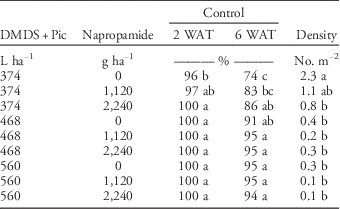
The combination of DMDS+Pic followed by S-metolachlor POST did not influence yellow nutsedge control; however, DMDS+Pic and napropamide rates did influence control. Yellow nutsedge control 2 WAT using DMDS+Pic at 374 L ha−1 without napropamide was 96%, while the addition of napropamide at 2,240 g ha−1 increased control to 100% (Table 1). Increasing the DMDS+Pic rate to 468 or 560 L ha−1 provided 100% yellow nutsedge control regardless of the napropamide rate. By 6 WAT, yellow nutsedge control when DMDS+Pic was applied at 374 L ha−1 with and without 2,240 g ha−1 napropamide was 86% and 74%, respectively. DMDS+Pic applied at 468 or 560 L ha−1 controlled yellow nutsedge 91% to 95% at 6 WAT, irrespective of napropamide rate. At 4 WAT, yellow nutsedge density was 2.3 plants m−2 when DMDS+Pic was applied at 374 L ha−1 without napropamide (Table 1). The addition of napropamide at 2,240 g ha−1 to DMDS+Pic at 374 L ha−1 reduced yellow nutsedge density to 0.8 m−2. When DMDS+Pic was applied at 468 L ha−1 or 560 L ha−1, 0.1 to 0.4 yellow nutsedge m−2 were observed, regardless of napropamide rate.
Influence of dimethyl disulfide plus chloropicrin (DMDS+Pic) and napropamide rate on yellow nutsedge control 2 and 6 weeks after bell pepper is transplanted (WAT), and yellow nutsedge density 4 WAT.Footnote a , Footnote b
a Means within a column followed by a different letter are significantly different at P≤0.05.
b Data pooled over S-metolachlor rates.
Large crabgrass and Palmer amaranth control 2 and 6 WAT were influenced by DMDS+Pic rate, S-metolachlor rate, and napropamide rate (Table 2). Large crabgrass control 2 WAT using DMDS+Pic at 375, 468, and 560 L ha−1 was 42%, 73%, and 80%, respectively. The addition of S-metolachlor and/or napropamide resulted in 85% to 100% control. At 6 WAT, DMDS+Pic at 374 L ha−1 controlled large crabgrass 69%. Large crabgrass control 6 WAT with DMDS+Pic at 375 L ha−1 and napropamide at 1,120 gha−1 was 70%, while napropamide at 2,240 gha−1 increased control to 85%. At 6 WAT, DMDS+Pic at 468 or 560 L ha−1 with or without S-metolachlor or napropamide controlled large crabgrass 92% to 100%. Large crabgrass density 4 WAT was lower when napropamide and/or S-metolachlor were with DMDS+Pic (Table 3). When DMDS+Pic was used without herbicide, 2.5 large crabgrass plants m−2 were observed. DMDS+Pic followed by S-metolachlor POST resulted in 0.7 large crabgrass m−2. Systems that included DMDS+Pic and napropamide at 1,120, and 2,240 g ha−1 resulted in 0.6 and 0.3 large crabgrass plants m−2, respectively. DMDS+Pic and napropamide followed by S-metolachlor POST resulted in 0.1 large crabgrass plant m−2.
Effect of weed management systems including dimethyl disulfide plus chloropicrin (DMDS+Pic), S-metolachlor, and/or napropamide on large crabgrass and Palmer amaranth control 2 and 6 weeks after bell pepper is transplanted (WAT).Footnote a

a Means within a column followed by a different letter are significantly different at P≤0.05.
Influence of S-metolachlor and napropamide on large crabgrass density 4 weeks after bell pepper is transplanted.Footnote a , Footnote b

a Means within a column followed by a different letter are significantly different at P≤0.05.
b Data pooled over fumigant (DMDS+Pic) rates.
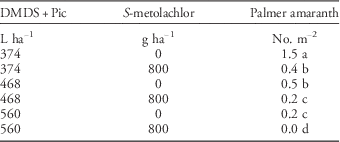
Control of Palmer amaranth 2 WAT using DMDS+Pic at 374 L ha−1 provided 31% control, while the addition of napropamide increased control to 65% to 78% (Table 2). The addition of napropamide to DMDS+Pic at 468 or 560 L ha−1 controlled Palmer amaranth 87% to 96% at 2 WAT. Regardless of DMDS+Pic or napropamide rate, Palmer amaranth control was 90% to 100% at 2 WAT when S-metolachlor was applied. Palmer amaranth control 6 WAT using DMDS+Pic at 374, 468, and 560 L ha−1 was 21%, 64%, and 85%, respectively. The addition of napropamide to DMDS+Pic at 374 L ha−1 provided 57% to 74% Palmer amaranth control 6 WAT. DMDS+Pic applied at 468 or 560 L ha−1 with napropamide (either rate) provided 83% to 94% control of Palmer amaranth 6 WAT. When S-metolachlor was applied POST following DMDS+Pic at 374 L ha−1, Palmer amaranth control 6 WAT was 88%. Palmer amaranth control 6 WAT with DMDS+Pic and napropamide followed by S-metolachlor POST was 91% to 100%. Palmer amaranth density was influenced by DMDS+Pic and S-metolachlor rate (Table 4). Application of S-metolachlor POST following DMDS+Pic systems reduced Palmer amaranth density. Palmer amaranth density was 1.5 plants per m−2 when S-metolachlor did not follow DMDS+Pic applied at 374 L ha−1. The addition of S-metolachlor to DMDS+Pic applied at 374 L ha−1 reduced Palmer amaranth density to 0.4 plants per m−2. Palmer amaranth density was reduced to 0.0 plants per m−2 when DMDS+Pic at 560 L ha−1 was follow by S-metolachlor POST.
Influence of dimethyl disulfide plus chloropicrin (DMDS+Pic) and S-metolachlor on Palmer amaranth density 4 weeks after bell pepper is transplanted.Footnote a , Footnote b
a Means within a column followed by a different letter are significantly different at P≤0.05.
b Data pooled over napropamide rates.
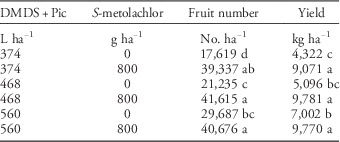
DMDS+Pic and S-metolachlor rate influenced bell pepper number and yield (Table 5). Regardless of fumigant rate, the number of bell peppers harvested per acre was greater when S-metolachlor was present in the weed management system than when it was absent. When DMDS+Pic was used at 374 L ha−1, 17,619 fruits ha−1 were harvested. Higher rates of DMDS+Pic resulted in 21,235 to 29,687 fruits ha−1. When S-metolachlor was added to DMDS+Pic fumigant systems, 40,676 to 41,615 fruits ha−1 were harvested. Bell pepper yield using DMDS+Pic at 374 or 468 L ha−1 was 4,322 to 5,096 kg ha−1. Increasing DMDS+Pic rates to 560 L ha−1 increased yield to 7,002 kg ha−1. When S-metolachlor was added to DMDS+Pic systems, yield was 9,071 to 9,781 kg ha−1.
Influence of dimethyl disulfide plus chloropicrin (DMDS+Pic) and S-metolachlor on bell pepper number and yield.Footnote a , Footnote b
a Means within a column followed by a different letter are significantly different at P≤0.05.
b Data pooled over napropamide rates.
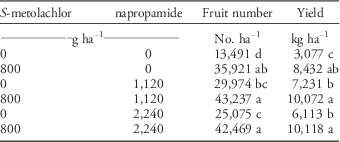
Bell pepper number and yield were influenced by the interaction of S-metolachlor and napropamide rate (Table 6). Fruit number using DMDS+Pic was 13,491 ha−1. The addition of napropamide increased fruits per hectare to 25,075 to 29,974. DMDS+Pic at 374 L ha−1 followed by S-metolachlor applied POST resulted in 35,921 fruits ha−1. Adding S-metolachlor and napropamide to DMDS+Pic fumigant systems increased fruit count from 13,491 fruits ha−1 to 42,469 to 43,237 fruits ha−1. Bell pepper yield using DMDS+Pic was 3,077 kg ha−1. The addition of napropamide increased yield to 6,113 to 7,231 kg ha−1. Bell pepper yield when S-metolachlor was added to DMDS+Pic systems was 8,432 to 10,118 kg ha−1. In systems where DMDS+Pic and napropamide were followed by S-metolachlor POST, bell pepper yield was 10,072 to 10,118 kg ha−1.
Influence of S-metolachlor and napropamide on bell pepper yield.Footnote a , Footnote b
a Means within a column followed by a different letter are significantly different at P≤0.05.
b Data pooled over fumigant (DMDS+Pic) rates.
These results show excellent bell pepper tolerance of weed management systems that include DMDS+Pic and napropamide prior to transplanting followed by S-metolachlor POST. Transient crop injury did occur with S-metolachlor, but yield was not negatively impacted. DMDS+Pic at 468 or 560 L ha−1 and napropamide beneath the plastic mulch followed by S-metolachlor POST may offer season-long weed control, ultimately preventing yield loss.



