





Introduction
The impact of mothers’ emotional distress, including depressive symptoms and parenting stress, on child outcomes has long been a topic of interest among researchers (Masarik & Conger, Reference Masarik and Conger2017). Parenting during early childhood is a particularly vulnerable developmental stage, as parents of young children are at higher risk of experiencing parenting stress and depressive symptoms (Liu & Wang, Reference Liu and Wang2015). Approximately 11 percent of parents in the US often or always experience parenting stress (USDHHS, 2014). Similarly, about 15 million children in the US reside with parents who have had one or more instances of major depressive disorder (England et al., Reference England and Sim2009). Prior research suggests that mothers in low-income families are at a higher risk of experiencing parenting stress or depressive symptoms. Indeed, roughly 1 in 11 mothers in low-income households experience major depression (McDaniel & Lowenstein, Reference McDaniel and Lowenstein2013), and 19 percent of parents in low-income families experience parenting stress (USDHHS, 2014). Given that approximately 40 percent of young children in the United States live in low-income households, it is essential to understand the consequences of parenting stress and depressive symptoms on parenting behaviors and subsequently on child outcomes and the protective factors that may buffer these family stress processes (Koball et al., Reference Koball, Moore and Hernandez2021).
Both depressive symptoms and parenting stress are shown to have detrimental impacts on parenting behaviors (Dix & Moed, Reference Dix, Moed and Bornstein2019; Ward & Lee, Reference Ward and Lee2020). These maladaptive parenting behaviors, in turn, have been consistently shown as significant predictors of child outcomes such as behavior outcomes, poor cognitive abilities, and worse socioemotional development (Morris et al., Reference Morris, Robinson, Hays-Grudo, Claussen, Hartwig and Treat2017). There are various protective factors that can buffer these associations and social support has persistently emerged as a crucial protective factor that mitigates the negative impact of economic and emotional risk factors on parenting behaviors and child outcomes (Hashima & Amato, Reference Hashima and Amato1994). Hence, the current study examines the associations of emotional distress with adaptive and maladaptive parenting and subsequent child social, emotional, and behavior outcomes among low-income families. Moreover, we investigated the direct and moderating effects of social support on parenting behaviors as well as child outcomes.
Family stress model
The current study is guided by the Family Stress Model and the model theorizes that parents in low-income households experience heightened distress, undermining their parenting quality and thereby leading to poorer child outcomes (Conger et al., Reference Conger, Wallace, Sun, Simons, McLoyd and Brody2002). The model also posits that there are various factors including biological, psychological, and social resources that can buffer the family stress processes. This model has garnered substantial empirical support from decades of studies across various populations and family structures (Masarik & Conger, Reference Masarik and Conger2017). However, there is an existing gap in the Family Stress Model literature regarding testing protective and promotive factors that may buffer different risk exposures. There have been only a handful of studies that have tested the moderating role of social support in the Family Stress Model however these studies have mixed findings. For example, McConnell and colleagues (2011) did not find main effects of social support on parenting quality but found significant buffering effects of social support on the association between parenting stress and parenting quality. Moreover, social support had a significant main effect on child outcomes but did not buffer the association between parenting quality and child outcome. In another study, social support had significant main effects on parental depression and positive parenting, but the moderating effect was not significant (Lee et al., Reference Lee, Anderson, Horowitz and August2009). Therefore, Conger and colleagues have warranted the need to examine the resilience processes in the Family Stress Model to identify the factors that can buffer the adverse effects of stressors in vulnerable families (Conger et al., Reference Conger, Conger and Martin2010; Masarik & Conger, Reference Masarik and Conger2017; Masarik et al., Reference Masarik, Fritz and Lazarevic2022).
Another major gap in the Family Stress Model literature is that most of the existing studies are cross-sectional in nature and have tested the model on adolescents rather than young children (Barnett, Reference Barnett2008; Neppl et al., Reference Neppl, Senia and Donnellan2016). Although a few recent studies have used the longitudinal design to test the Family Stress Model, these studies have examined the child outcomes during the middle childhood (Gard et al., Reference Gard, McLoyd, Mitchell and Hyde2020; Neppl et al., Reference Neppl, Senia and Donnellan2016; Saasa et al., Reference Saasa, Ward, Sandberg and Jacobson2021). However, it is important to examine the model among young children during the early childhood period because they may be particularly vulnerable to the adverse effects of family processes, such as maternal emotional distress and parenting behaviors, in the face of economic adversity (Linver et al., Reference Linver, Brooks-Gunn and Kohen2002). In turn, these adverse experiences during the early years of life can lead to maladaptive socioemotional, behavioral, and cognitive outcomes (Barnett, Reference Barnett2008). Thus, we extend the previous work on the Family Stress Model by 1) testing a longitudinal application on families with young children; 2) including both depressive symptoms and parenting stress as predictors of both adaptive and maladaptive parenting practices; 3) examining children’s social, behavior, and language outcomes concurrently; and 4) testing the main and moderating effects of social support on parenting behaviors and child outcomes. Given that the Family Stress Model focuses on the effect of economic hardship on the family stress processes, we limited our sample to low-income mothers. Although Conger et al. (Reference Conger, Wallace, Sun, Simons, McLoyd and Brody2002) broadly defined emotional distress as depressive symptoms, anxiety, anger, and alienation, we also included parenting stress besides maternal depressive symptoms as an indicator of maternal emotional distress because previous research using the FSM have used parenting stress as a unique indicator of emotional distress (Gard et al., Reference Gard, McLoyd, Mitchell and Hyde2020; Gershoff et al., Reference Gershoff, Aber, Raver and Lennon2007; McConnell et al., Reference McConnell, Breitkreuz and Savage2011; Warren & Font, Reference Warren and Font2015; Wu et al., Reference Wu, Radey, McWey and Millender2025). Moreover, negative affect has been demonstrated as the common underlying phenotype for both depressive symptoms and parenting stress and hence both were included in the model in the current study (Gard et al., Reference Gard, McLoyd, Mitchell and Hyde2020).
Parent’s emotional distress and parenting behavior
Parents’ emotional distress can be characterized by many indicators, but the current study focuses on depressive symptoms and parenting stress. Depressive symptoms are considered sadness, loss of energy, irritability, insomnia, diminished ability to focus, and loss of interest in usual activities (American Psychiatric Association, 2013). The link between depressive symptoms and unresponsive parenting can be understood by emotion-related theories regarding depression and parenting. Depressive symptoms are likely to evoke more negative emotions and fewer positive and empathetic emotions in parents, which promotes harsh and unresponsive parenting practices (Dix & Moed, Reference Dix, Moed and Bornstein2019). Research studies based on both self-reported and observational methods have well established the role of maternal depressive symptoms in undermining parenting quality and behaviors (Lovejoy et al., Reference Lovejoy, Graczyk, O’Hare and Neuman2000). Indeed, mothers with depression tend to have fewer positive interactions with their children and exhibit less sensitivity and responsiveness towards their children (Cohn & Campbell, Reference Cohn, Campbell, Cicchetti and Toth1992). For example, Campbell and colleagues (2007) reported that mothers with high levels of depressive symptoms had lower levels of maternal sensitivity as compared to mothers with low levels of depressive symptoms. Maternal depressive symptoms also predict more hostility, negative control, and anger expression toward their children (Leung & Slep, Reference Leung and Slep2006). For example, a meta-analysis by Lovejoy et al. (Reference Lovejoy, Graczyk, O’Hare and Neuman2000) based on 46 observational studies of mother–child interactions reported that depressed mothers tend to exhibit more negative interactions and hostile behaviors towards their children.
In addition to depressive symptoms, parents commonly experience parenting stress, which is defined as the specific stress related to the demands of being a parent (Deater-Deckard, Reference Deater-Deckard1998). Previous research has well-documented the negative impact of parenting stress on parenting behavior. Based on Abidin’s theory on parenting stress, parents experience higher stress levels due to the demands of parenting demands and, therefore, engage in less optimal interactions with their children (Abidin, Reference Abidin1990). Parents of young children are more likely to experience parenting stress, especially with a higher likelihood among low-income parents (Liu & Wang, Reference Liu and Wang2015; Raphael et al., Reference Raphael, Zhang, Liu and Giardino2010). Parents of young children may experience higher levels of parenting stress because the first five years are particularly taxing (Östberg & Hagekull, Reference Östberg and Hagekull2000). Families with lower income may be more likely to experience higher levels of parenting stress because they still need to meet the demands of parenting but are simultaneously experiencing constraints on their time and resources (Leigh & Milgrom, Reference Leigh and Milgrom2008). Empirical evidence suggests that parents with higher levels of parenting stress are more likely to demonstrate harsh parenting and show less responsiveness towards their children. For example, Crnic and colleagues (2005) found that higher parenting stress among mothers was associated with harsh parenting practices, including yelling and physical expressions of anger toward their young children. Further, Ward & Lee (Reference Ward and Lee2020) found that higher parenting stress was related to lower responsiveness towards their toddlers. Taken together, depressive symptoms and parenting stress can negatively impact parent–child interactions and undermine sensitive parenting behaviors. Given that parenting behavior is a significant predictor of child outcomes, it is important to identify the predictors of parenting behavior during this critical time period to inform early prevention and intervention programs with families. Previous research demonstrates that early delays in children’s socioemotional, behavioral, and cognitive outcomes have long-reach on outcomes later in life and are related to maladaptive outcomes in adulthood (Whittaker et al., Reference Whittaker, Harden, See, Meisch and T’Pring2011). Therefore, early years are probably the best window of opportunity to alter the trajectories of maladaptive child outcomes (Heckman, Reference Heckman2006).
Parenting behavior on child outcomes
Responsive and harsh parenting are mechanisms through which maternal depressive symptoms and parenting stress are related to child outcomes, such that depressive symptoms and high parenting stress impede parenting quality leading to negative child outcomes. Responsive parenting is contingent on children’s cues and is characterized by sensitive and warm responses of caregivers to children’s cues (Bowlby, Reference Bowlby1973). In contrast, harsh parenting involves controlling, aggressive behaviors, such as spanking or shoving the child and verbal aggression towards the child (Straus et al., Reference Straus, Hamby, Finkelhor, Moore and Runyan1998). Parenting behaviors, including responsive parenting and harsh parenting, particularly during early childhood play an instrumental role in predicting children’s behavioral, socioemotional, and cognitive outcomes in a way that responsive parenting fosters these outcomes, whereas harsh parenting undermines them.
Responsive parenting has been related to fewer behavior problems, better cognitive skills particularly their language development, and more adaptive social behavior (Ward & Lee, Reference Ward and Lee2020). Parenting plays a salient role in children’s language development as responsive parents foster stimulating and supportive environments for their children during their daily interactions and encourage their efforts of using language (Eshel et al., Reference Eshel, Daelmans, Mello and Martines2006). Responsive parents, characterized by consistent and contingent response to their child cues, engage in verbal reciprocity, take turns while communicating with their young children, and builds the conversation based on child’s cues which fosters children’s language development (Cates et al., Reference Cates, Dreyer, Berkule, White, Arevalo and Mendelsohn2012). Responsive parents also incorporate teaching behaviors with their young children during daily routine activities such as labeling the objects that the child pays attention to and book reading and shows positive affect towards the child which predict positive language development (Pace et al., Reference Pace, Luo, Hirsh-Pasek and Golinkoff2017). For example, a recent meta-analysis based on 37 studies found that parent sensitive responsiveness was positively associated with children language development (Madigan et al., Reference Madigan, Prime, Graham, Rodrigues, Anderson, Khoury and Jenkins2019). Responsive caregiving also plays a foundational role on young children’s socioemotional development. Children receiving consistent and contingent responses from their responsive parents develop adaptive internal working models that help children understand that they are worthy of love and care from their caregivers, resulting in adaptive socioemotional outcomes (Bowlby, Reference Bowlby1973). Moreover, young children heavily rely on their caregivers to facilitate them in regulating their emotions and responsive parents help the children to successfully regulate their negative emotions (Tronick, Reference Tronick2007). Children learn adaptive emotion regulation skills from their caregivers in a warm and sensitive environment and employ these skills to effectively regulate their negative emotions such as frustration and sadness and learn to express their emotions in socially appropriate manner while interacting with other adults and peers (Bordeleau et al., Reference Bordeleau, Bernier and Carrier2012; Tronick, Reference Tronick2007).
Conversely, harsh parenting practices put children at risk of negative outcomes such as externalizing and internalizing behavior problems and poorer social and cognitive skills (Akcinar & Shaw, Reference Akcinar and Shaw2018; Berlin et al., Reference Berlin, Ispa, Fine, Malone, Brooks-Gunn, Brady-Smith, Ayoub and Bai2009; Callahan et al., Reference Callahan, Scaramella, Laird and Sohr-Preston2011; Gershoff, Reference Gershoff2002). Parents who engage in harsh parenting practices are less likely to teach their children the ability to have emotional and behavioral control, leading to externalizing behavior problems in their children (Dix, Reference Dix1991). One potential explanation is the social learning perspective where children model parents’ aggressive behaviors during coercive interactions and generalize these maladaptive interactions to other interpersonal contexts (Bandura, Reference Bandura1977). Moreover, since harsh parenting is distressing for children, these experiences may result in children feeling anxious, wary, and uneasy, resulting in more internalizing problems (Gilliom & Shaw, Reference Gilliom and Shaw2004). Parents’ use of harsh parenting can also be detrimental to children’s social skills as it can reinforce defiant responses in children and lead them to struggle to understand the rules regarding emotional expressiveness (Laible et al., Reference Laible, Carlo, Torquati and Ontai2004; Smith et al., Reference Smith, Dishion, Shaw, Wilson, Winter and Patterson2014). Furthermore, harsh parenting characterized by negative parent–child interactions has also been linked with compromised cognitive outcomes, notably children’s language development including receptive language ability (Berthelon et al., Reference Berthelon, Contreras, Kruger and Palma2020). Receptive language is the ability of children to understand words or sentences and is one of the major developmental milestones during the early childhood period (Frazier, Reference Frazier, Goldstein and Naglieri2011). The optimal receptive language development during early childhood predicts adaptive language and reading skills development across middle childhood and adolescence (McGuinness, Reference McGuinness2005). Children need conducive caregiving environment to facilitate their receptive language development (Madigan et al., Reference Madigan, Prime, Graham, Rodrigues, Anderson, Khoury and Jenkins2019), however, the parents who use harsh parenting practices tend to have fewer verbal exchanges with their children such as limited general conversations and book-readings thereby providing limited opportunities to enrich children’s language development (Dede Yildirim & Roopnarine, Reference Dede Yildirim and Roopnarine2019). In addition, harsh parenting creates hostile environment that could put the child under a cognitive load which could hinder their abilities to internalize key information during their interactions with parents (Rothbart & Putnam, Reference Rothbart, Putnam, Pulkkinen and Caspi2002). Previous research has found that negative parenting practices are associated with slower rate of growth in young children’s receptive language abilities. Thus, harsh parenting is consistently linked with worse developmental outcomes for children.
Although the links from emotional distress to parenting behaviors and parenting behaviors to child outcomes have been established in the literature, few studies have employed a longitudinal design to examine the mechanism linking maternal emotional distress to various child outcomes via parenting behaviors. Furthermore, there is limited research exploring the longitudinal associations between emotional distress, parenting behaviors, and children’s social, behavioral, and language outcomes in a high-risk sample of low-income families. This is a major shortcoming given that extensive literature has demonstrated that parents’ emotional distress and parenting behavior are robust predictors of child outcomes. Therefore, in the present study, we tested both responsive and harsh parenting practices in the same model to disentangle their differential effect on various child outcomes in the context of socioeconomic and emotional risk.
Effect of social support on parenting behavior and child outcomes
Given that parenting young children can be stressful for parents, especially for parents living in low-income families, social support can play a crucial role in assisting parents with caregiving responsibilities. Social support can be defined as the support that an individual receives from their social networks, including family and friends. For example, it could be either financial (e.g., giving loans or help with the mortgage), or instrumental (e.g., helping in childcare) (Thompson, Reference Thompson1995). Financial and instrumental support could be particularly important for mothers experiencing economic hardship because it can help them to meet critical basic needs of their family such as food, shelter, and childcare and to better cope with daily hardships. Social support is one of the most commonly cited protective and promotive factors (Masten et al., Reference Masten, Lucke, Nelson and Stallworthy2021). A promotive factor exhibits a direct effect, in which promotive factors are positively associated with adaptive outcomes regardless of risk exposure. A protective factor exhibits a moderating effect, in which the protective factor buffers the association between risk exposure and the outcome. According to Differential Impact Theory (Ungar, Reference Ungar2018), the protective role of a moderator depends on the individual’s exposure to the risk. The impact of a protective factor also depends on the outcome assessed (Ungar, Reference Ungar2019). As such, the conditions under which social support is protective or promotive likely vary based on the risk and the outcome assessed.
Prior research has demonstrated that social support is a promotive factor for later parenting behaviors. In other words, evidence has shown that social support has a direct effect on parenting behavior, and more exposure to social support enhances parenting quality irrespective of risk exposure. For example, Ceballo & McLoyd (Reference Ceballo and McLoyd2002) examined the association between instrumental social support and parenting among a sample of mothers experiencing economic disadvantage. They assessed mothers’ instrumental social support by asking them questions on the degree of instrumental support (for example, counting on someone to run errands if your family is sick) they can get from the social network during the times of need and found that parents’ perception of a higher level of instrumental social support predicted lesser punitive parenting practices. Similarly, Choi & Pyun (Reference Choi and Pyun2014) used the same data set and found that higher levels of perceived instrumental support from their social network in the form of money, time, or in-kind assistance predicted better parenting quality among a sample of low-income mothers. Although social support could be helpful for all the parents, it can also have buffering effects on parenting behavior in the context of risk exposure and can mitigate the impact of risk on parenting behavior. In other words, social support can interact with risk exposure to predict parenting behavior. Low-income mothers often rely on their social network to provide them instrumental support, especially while experiencing difficulties of raising a young child. Social network could help mothers alleviate the financial burden of expensive childcare, housing, and transportation by providing free emergency childcare support, free housing, or access to transportation which may alleviate mothers’ emotional distress and promote adaptive parenting practices (Kalil & Ryan, Reference Kalil and Ryan2010; Taraban et al., Reference Taraban, Shaw, Leve, Natsuaki, Ganiban, Reiss and Neiderhiser2019). Prior evidence suggests that social support improves parenting behaviors among parents experiencing high levels of emotional distress in the context of economic hardship (Crnic et al., Reference Crnic, Greenberg, Robinson and Ragozin1984). For example, a systematic review on informal support in which many studies used the FFCWS data found that instrumental support reduces neglectful and harsh parenting by decreasing mothers’ emotional distress among low-income families (Radey, Reference Radey2018). Furthermore, Sattler (Reference Sattler2022) using FFCWS data and Leinonen et al. (Reference Leinonen, Solantaus and Punamäki2003) found that instrumental support including help from social network in childcare, household chores, and loaning small amount of money buffered against punitive parenting practices in the context of economic risk exposure. Thus, there is preliminary evidence that social support might buffer parents’ emotional distress on parenting behaviors, even in the context of economic disadvantage.
In addition to parenting behavior, social support can also be directly or indirectly associated with child outcomes. Despite facing adversity, the developmental trajectories of children may be improved through social support from social networks in two ways. First, the extended social network can assist parents in caregiving, which in turn can lead to positive child outcomes. Mothers living in low-income families particularly rely on their social network for assistance due to their inability to purchase services such as childcare. For example, Gordon et al. (Reference Gordon, Lindsay Chase-Lansdale and Brooks-Gunn2004) found more adaptive child outcomes with mothers living in multigenerational households who got support and assistance from other family members in child-rearing. Alternatively, social support can have a direct effect on child outcomes as children can receive support from social support figures extending beyond their primary caregivers. The support from the social network could also provide frequent positive experiences to the child and may promote a sense of wellbeing leading to more adaptive child outcomes (Cohen, Reference Cohen2004). For example, Appleyard et al. (Reference Appleyard, Egeland and Sroufe2007) found that children with supportive social support outside their parents had lesser externalizing and internalizing problem behaviors.
Despite the evidence for the protective and promotive effect of social support, it has not been explored much in the Family Stress Model literature in the first five years of children’s life. Moreover, very few population-based studies exist that have explored the protective and promotive effects of social support on the association between emotional distress and children’s social, behavior, and language outcomes via parenting behaviors. It is crucial to examine these resilience processes in a longitudinal study given the deleterious effect of emotional distress and maladaptive parenting on child outcomes (Manuel et al., Reference Manuel, Martinson, Bledsoe-Mansori and Bellamy2012). Therefore, the current study examines whether social support (financial and instrumental) has direct and moderating effects on multiple parenting and child outcomes across multiple risk exposures.
The current study
Using three waves of data from Future of Families and Child Wellbeing Study (FFCWS), the current study focused on two research questions. First, do responsive and harsh parenting mediate the association between parenting stress and depressive symptoms and children’s internalizing and externalizing behavior problems, adaptive social behavior, and receptive language skills in low-income households? We hypothesized that parenting behaviors will mediate the association between maternal emotional distress and child outcomes such that higher levels of parenting stress and maternal depressive symptoms will lead to less responsive and more harsh parenting which in turn will predict higher externalizing and internalizing behavior problems and lower adaptive social behavior and receptive language skills. Second, whether social support is a protective factor that moderates the association between maternal emotional distress and parenting behaviors or promotive factor that fosters adaptive parenting behaviors? We hypothesize that social support will have negative and significant main effect on harsh parenting and positive significant effect on responsive parenting however we do not propose any formal hypotheses for the moderating role of social support. Third, whether social support is a protective factor that moderates the association between parenting behaviors on child outcomes or promotive factor that fosters adaptive child outcomes? We hypothesize that social support will have negative and significant main effect on internalizing and externalizing behavior problems and positive significant effect on adaptive social behavior and receptive language skills however we do not propose any formal hypotheses for the moderating role of social support.
Method
The current study used the data from the Future of Families and Child Wellbeing Study (FFCWS), a nationally-representative, longitudinal birth cohort study of children living in 20 cities across the U.S. recruited from 1998 to 2000. This study oversampled for children born to unmarried parents, and the participating families were disproportionately more likely to experience economic disadvantage. The data is publicly available at the Princeton University Office of Population Research data archive. There were approximately 5,000 children included in the study at the baseline but for the current study, data was used from year 1 (wave 2, 89% completion rate), year 3 (wave 3, 86% completion rate), and year 5 (wave 4, 85% completion rate). The sample was limited to the mothers who participated in the fourth wave of data collection as this is when our outcomes of interest were assessed. Families living below 100% of the federal poverty thresholds are considered poor and families living between 100 to 200% of the federal poverty thresholds are considered near poor families (Jiang et al., Reference Jiang, Granja and Koball2017) and our sample was limited to low-income mothers (both poor and near poor) living below 200% of the federal poverty line resulting in a sample of 1968 mothers. Our sample was racially/ethnically diverse (48 % Black, 28% Hispanic, 21% White, and 4% other race) and included 1,968 mothers. The majority of mothers were either single (40%) or cohabitating (36%), and 24% of mothers were married. The average age of children at wave 2 (year 1) was 1.26 years (range = 9 months to 2.5 years), at wave 3 (year 3) was 2.94 years (range = 2.67 to 3.9 years), and at wave 4 (year 5) was 5.11 years (range = 4.75 to 6 years). Of the total sample, approximately 52% of the children were male.
Measures
Parenting stress (year [Y] 1)
Parenting Stress was measured using four items adapted from the Parent Stress Inventory (Abidin, Reference Abidin1995). Mothers indicated their perceived stress due to childrearing (e.g., “I feel trapped by my responsibilities as a parent”) on a 4-point scale, with responses ranging from 1 (strongly agree) to 4 (strongly disagree) at 1 year. The items were reverse coded and averaged, such that a higher score indicated higher levels of parenting stress (α = .61, Mean = 2.17, SD = .71, Range = 1 to 4).
Depressive symptoms (year [Y] 1)
Depressive symptoms were assessed using the Composite International Diagnostic Interview- Short Form (CIDI-SF) (Kessler et al., Reference Kessler, Andrews, Mroczek, Ustun and Wittchen1998). At 1 year survey, mothers answered a screening question if they had a feeling of depression (dysphoria) or were unable to enjoy normally pleasurable things during the past year (anhedonia). After an affirmative response to either of the two questions, mothers were asked 7 follow-up questions about their feelings of worthlessness, feelings of tiredness, difficulty in sleeping, difficulty in concentrating, loss of interest in things, change in weight by 10 or more pounds without trying, and thoughts about death. The mothers who responded ‘no’ to both the screening questions were given a score 0. The items were summed to create a score for depressive symptoms such that a higher score reflected more depressive symptoms (α = .91, Mean = 1.18, SD = 2.26, Range = 0 to 8).
Responsive parenting (year [Y] 3)
Responsive parenting was assessed using the Home Observation for Measurement of the Environment (HOME) Inventory (Caldwell & Bradley, Reference Caldwell and Bradley2001). To assess responsive parenting at year 3, 9 items from the responsivity subscale (e.g., “Parent responds verbally to child’s vocalizations or verbalizations”) and 2 items from the involvement subscale (e.g., “Parent keeps child in visual range, look at often”) were used. During the home visits, trained observers completed these 11 items using dichotomous scoring 0 (not present), 1 (present) based on mothers’ responses during the mother–child interactions. These 11 items were summed to create a composite score for responsive parenting such that higher scores indicated more responsive parenting (α = .78, Mean = .83, SD = .20, Range = 0 to 1).
Harsh parenting (year [Y]3)
Harsh parenting was assessed using the Home Observation for Measurement of the Environment (HOME) Inventory (Caldwell & Bradley, Reference Caldwell and Bradley2001). To assess harsh parenting at year 3, 5 items from the acceptance scale were used (e.g., “Parent does not express overt annoyance with or hostility to the child”). During the home visits, trained observers completed these 11 items using dichotomous scoring 0 (not present), 1 (present) based on mothers’ responses during the mother–child interactions. All the items were reverse-scored and summed to create a composite score for harsh parenting such that higher scores indicated harsher parenting (α = .76, Mean = .11, SD = .22, Range = 0 to 1).
Receptive language skills (Y3 & Y5)
Children’s receptive language skills were measured using the standardized scores from the Peabody Picture Vocabulary Test (PPVT; Dunn & Dunn, Reference Dunn and Dunn1997) at year 3 and year 5. The test was administered to the child during the in-home visit where the interviewer measured their receptive vocabulary. During administration, the interviewer read aloud words and asked the child to point to the picture that corresponds the word from a given set of four pictures. The PPVT score used in the current study was a constructed variable in the FFCWS data set (Mean = 83.51, SD = 15.51, Range = 40 to 130 for Y3 and Mean = 90.19, SD = 15.46, Range = 40 to 131 for Y5).
Social skills (Y3 & Y5)
Children’s social skills were measured using the Adaptive Social Behavior Inventory (ASBI) at year 3 and year 5. The ASBI was used to assess social competence and prosocial skills of children based on mothers’ report on each item using a 3-point scale ranging from 0 (not true) to 2 (very true or often true). The scale consisted of 9 items (e.g., “child is sympathetic toward other children’s distress”) at 3 year (α = .73, Mean = 1.68, SD = .30, Range = 0 to 2) and 13 items (e.g., “child understands others’ feelings, like when they are happy, sad, or mad”) at 5 year (α = .80, Mean = 1.58, SD = .26, Range = .08 to 2.0) and the items were averaged at each year to create overall social skills score such that higher scores reflected higher social skills.
Behavior problems (Y3 & Y5)
Children’s behavior problems were assessed using the Child Behavior Checklist (CBCL; Achenbach, Reference Achenbach1991). Mothers reported on their children’s externalizing and internalizing problems on a 3-point scale ranging from 0 (not true) to 2 (very true or often true) at year 3 and year 5. The internalizing behavior included two subscales – anxious/depressed (8-items at year 3 and 14-items at year 5; e.g., “Child is nervous, high strung, or tense”) and withdrawn (8-items at year 3 and 9-items at year 5; e.g., “child is withdrawn, he/she doesn’t get involved with others”). The externalizing behavior included two subscales- aggressive (15-items at year 3 and 18-items at year 5; e.g., “Child is defiant”), destructive (7-items at year 3; e.g., “Child can’t concentrate, can’t pay attention for long”) and delinquent (10-items at year 5; e.g., “Child doesn’t seem to feel guilty after misbehaving”). These subscales were combined within domain to create internalizing behavior problems (α = .80, Mean = .43, SD = .24, Range = 0 to 1.5 at Y3 and α = .73, Mean = .26, SD = .20, Range = 0 to 1.4 at Y5) and externalizing behavior problems (α = .88, Mean = .64, SD = .36, Range = 0 to 1.9 at Y3 and α = .85, Mean = .45, SD = .24, Range = 0 to 1.5 at Y5) scales, with higher scores indicating higher levels of behavior problems.
Social support (Y1 & Y3)
To assess perceived social support, mothers were asked 6-items focused on financial support (4-items, e.g., “Could you count on someone to loan $200 in the next year?”) and instrumental support (2-items, e.g., “Could you count on someone to provide a place to live in the next year?”). Mothers responded 1 (yes) and 0 (no) to each item at year 1 (α = .69, Mean = .68, SD = .28, Range = 0 to 1) and year 3 (α = .70, Mean = .67, SD = .28, Range = 0 to 1). A mean score was created using all the 6 items such that a higher score indicated more social support.
Covariates
We controlled for several child-related, mother-related, and family-level covariates. These included child’s age (continuous variable), gender (0 = female, 1 = male, male as reference group), low-birth weight (0 = not low birthweight, 1 = low birthweight; low birthweight as reference group), child disability status (0 = no physical disability, 1 = physical disability; physical disability as reference group), mother’s age (continuous variable), education (continuous variable), marital status (1 = Married, 2 = Cohabitating, 3 = Single; Single as the reference group ), nativity status (0 = Not U.S. born, 1 = U.S. born; U.S. born as the reference group), race/ethnicity (1 = White, 2 = Black, 3 = Hispanic/Other race; Hispanic/ other race as reference group), number of family members (continuous variable), and spanking at year 1 (1= yes, 0 = no; yes as reference group). Spanking at year 1 was included as a covariate in the model because the measures for parenting behaviors at year 1 was not available in the data set and previous studies have found spanking as a significant predictor of child outcomes (Gershoff & Grogan-Kaylor, Reference Gershoff and Grogan-Kaylor2016). The hypotheses and design of the current study were not pre-registered. Data may be accessed by applying to Princeton’s University’s Office of Population Research (OPR) data archive.
Analytic approach
The conceptual model is displayed in Figure 1. Structural equation modeling (SEM) framework was employed using Mplus (Muthen & Muthen, Reference Muthén and Muthén2017). To handle the missing data, Full Information Maximum Likelihood (FIML) was used. We tested three sets of models. First, we used SEM linear regressions to estimate the mediation effect of parenting behaviors (including harsh parenting and responsive parenting) on the association between emotional distress (including depressive symptoms and parenting stress) and child outcomes (including receptive language skills, social skills, and behavior problems). We also tested the indirect effects of maternal emotional distress on child outcomes via parenting behaviors using the indirect effects estimator in Mplus with 1000 bootstrap samples with p-value less than .05 as significant. In the second set of models, we included the main effects of social support in the base model. Specifically, we estimated the main effects of social support at year 1 on harsh parenting and responsive parenting at year 3 and the main effects of social support at year 3 on child outcomes at year 5. Finally, in the third set of models, moderated mediation effect was tested where social support moderated the pathway from maternal emotional distress to child outcomes via parenting behaviors. These models were estimated separately from the second set of models because we cannot interpret the main effects in the presence of the interaction term. Specifically, we estimated the moderating effect of social support at year 1 on the association between emotional distress at year 1 and parenting behaviors at year 3. In other words, the moderating role of social support at year 1 on the association between depressive symptoms at year 1 and responsive and harsh parenting at year 3 and the association between parenting stress at year 1 and responsive and harsh parenting at year 3 were assessed. We also tested the moderating effect of social support at year 3 on the pathway between harsh parenting and child outcomes at year 5 and responsive parenting and child outcomes at year 5. In all the models, we specified covariates on parenting behaviors (responsive and harsh parenting) and child outcomes (internalizing and externalizing behavior problems, adaptive social skills, and receptive language skills). The model fit was assessed using four fit indices, including the chi-square index (a nonsignificant value indicates good fit), the root mean square error of approximation (RMSEA; value below or equal to .08 indicates good fit), standardized root mean square root (SRMR; value below or equal to .08 demonstrates good fit), and comparative fit index (CFI; value above or equal to .90 indicates good fit) (Hu & Bentler, Reference Hu and Bentler1999).
Conceptual framework.

Results
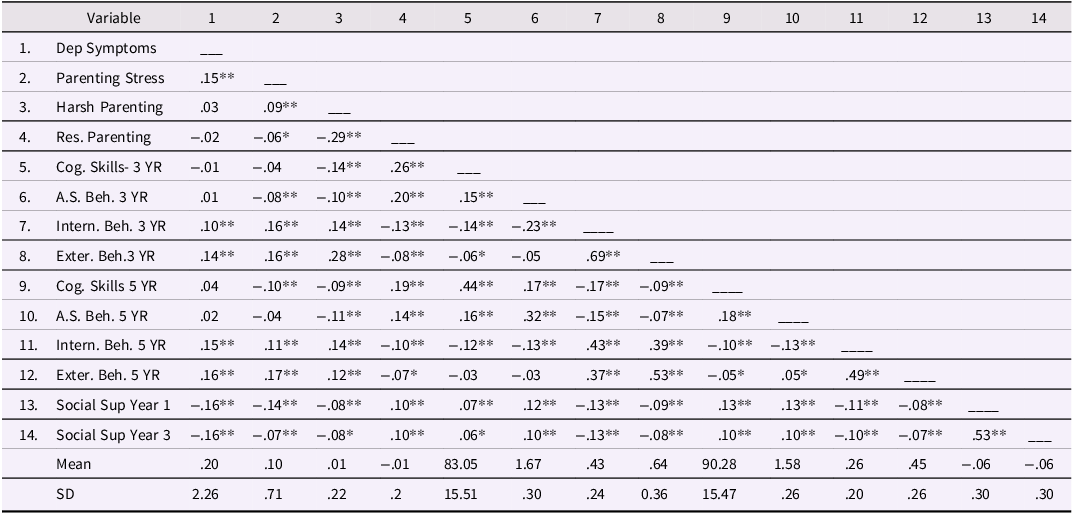
Descriptive statistics and intercorrelations among the study variables are displayed in Table 1 and the results are displayed in Figure 2. The association of covariates with child outcomes and parenting behaviors are shown in supplemental table 1 and 2 respectively. Regarding the covariates, child sex, race, maternal education, and marital status was significantly associated with children receptive language skills; maternal age, race, and marital status was significantly associated with children internalizing and externalizing behavior problems, and child age, child sex, maternal age, education, and marital status was significantly associated with adaptive social behavior. The results of the Little’s test using the Stata command (mcartest) showed that the data was missing at random, χ2 (5920) = 3903.80, p = 1.00. In our first set of analyses, we tested the hypothesized mediating role of parenting behaviors (i.e., harsh parenting and responsive parenting) on the association between mothers’ emotional distress (i.e., depressive symptoms and parenting stress) on child outcomes (Model 1). This model demonstrated a good fit (χ 2 (24) = 130.10, p = 0.00; RMSEA = .05, 90% CI [.04, .06]; CFI = .95; SRMR = .01. In model 1, harsh parenting was positively associated with internalizing behavior problems (β = .06, p = .04) and was negatively associated with adaptive social behavior (β = −.07, p = .02). However, the responsive parenting was not associated with any of the child outcomes. Furthermore, parenting stress was positively associated with harsh parenting (β = .07, p = .03) but not responsive parenting. In other words, results indicated that mothers who experienced higher parenting stress reported more harsh parenting. Depressive symptoms were neither associated with harsh parenting nor responsive parenting. Harsh parenting, in turn, was negatively associated with adaptive social behaviors (β = −.07, p = .02) and was positively associated with internalizing behaviors (β = .07, p = .02). However, harsh parenting was not associated with receptive language skills and externalizing behaviors problems. Responsive parenting was negatively associated with internalizing behavior problems (β = −.06, p = .04) but was not significantly associated with receptive language skills, adaptive social behaviors, and externalizing behavior problems. We also estimated indirect effects from emotional distress to child outcomes via parenting behaviors using Mplus model indirect estimation with 1,000 bootstrap samples and none of the indirect effects were significant.
Standardized coefficients are presented. *p < .05, **p < .01. Child’s age, gender, low-birth weight, child disability status, mother’s age, education, marital status, nativity status, race/ethnicity, number of family members, and spanking at year 1 were specified as covariates on parenting behaviors and child outcomes in the model, but associations are not illustrated.

Correlations and descriptive statistics

In model 2, we estimated the hypothesized main effect of social support at year 1 on harsh parenting, responsive parenting at year 3, and the main effect of social support at year 3 on child outcomes. The model demonstrated a good fit (χ 2 (30) = 136.80, p = 0.00; RMSEA = .04, 90% CI [.03, .05]; CFI = .95; SRMR = .01). The main effect of social support at year 1 on harsh parenting at year 3 was significant (β = −.07, p = .02) such that higher social support at year 1 predicted less harsh parenting behaviors at year 3. In addition, higher social support at year 1 also predicted more responsive parenting at year 3 (β = .06, p = .03). Regarding child outcomes, social support at year 3 was positively associated with receptive language skills (β = 0.05, p = .04) and adaptive social behavior (β = .05, p = .03) and was negatively associated with internalizing behavior at year 3 (β = −.04, p = .04). There was no main effect of social support at year 3 on externalizing behavior problems at year 5.
In model 3, moderated mediation effect was estimated for social support. This model included four interaction terms: the interaction term between depressive symptoms at year 1 and social support at year 1 predicting parenting behaviors at year 3, the interaction term between parenting stress at year 1 and social support at year 1 predicting parenting behaviors at year 3, the interaction term between social support at year 3 and harsh parenting at year 3 predicting child outcomes at year 5, and the interaction term between social support at year 3 and responsive parenting at year 3 predicting child outcomes at year 5. None of the interaction effects of social support were significant in the model and are displayed in Table 2.
Moderating effects of social support on maternal emotional distress and child outcomes
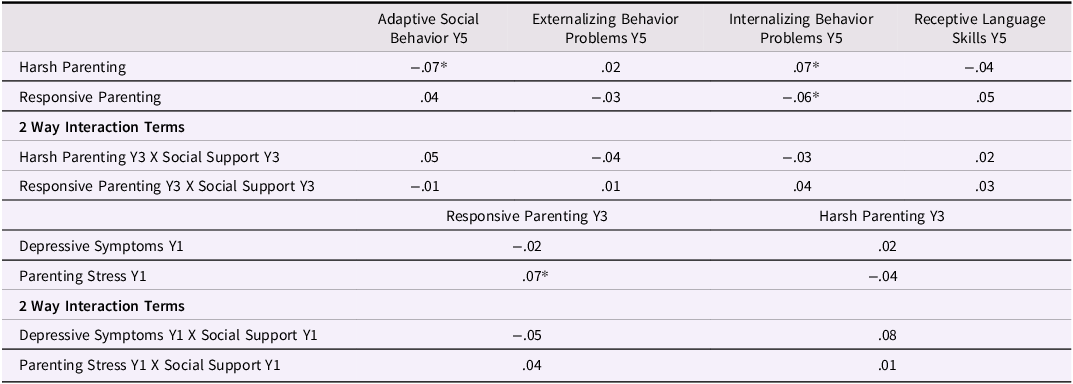
Note. Y1 = Year 1; Y3 = Year 3; Y5 = Year 5. * p < .05, ** p < .01.
Discussion
Guided by the Family Stress Model, the present study investigated the mediating role of predicted responsive and harsh parenting on the association between maternal emotional distress (maternal depressive symptoms and parenting stress) and child outcomes (including receptive language skills, adaptive social behavior, and externalizing and internalizing behavior problems). Moreover, we also examined the main and buffering effects of social support on parenting behaviors and child outcomes. In the current study, we did not find evidence for the mediating role of parenting behaviors on the association between maternal emotional distress and child outcomes on all the specified pathways in the model. The results showed that parenting stress predicted harsh parenting, which in turn predicted adaptive social behavior and internalizing behavior problems. Emotional distress was not associated with responsive parenting however, responsive parenting was associated with internalizing behavior problems. We also found significant main effects of social support on responsive parenting, harsh parenting, receptive language skills, and adaptive social behavior however, none of the moderating effects were significant.
In the present study, we found partial support for the hypothesis that parents’ emotional distress undermines their parenting behaviors in the context of economic disadvantage. Consistent with the prior work, our findings highlighted the significant role of parenting stress in predicting disrupted parenting behavior such that parents with higher parenting stress used more harsh parenting practices. It is well documented that heightened levels of stress experienced in the context of parenting are associated with negative parenting behaviors. For example, Jackson and Choi (Reference Jackson and Choi2018) and Mortensen and Barnett (Reference Mortensen and Barnett2015) found that higher parenting stress was associated with more harsh parenting practices during early childhood. Surprisingly, parenting stress was not related to responsive parenting and does not align with the previous literature that have demonstrated that parents with higher levels of parenting stress are less responsive and involved and show lower warmth towards their children (Deater-Deckard, Reference Deater-Deckard1998). For example, Ward & Lee (Reference Ward and Lee2020) tested the Family Stress Model among a sample of parents of young children and found significant negative associations between parenting stress and their responsiveness. In their study, Ward & Lee (Reference Ward and Lee2020) included various important dimensions of parenting, such as maternal sensitivity, positive regard, and detachment using videotaped laboratory observations of mother–child interactions during the Two-Bags Task. However, in our study, we relied only on interviewer observations of maternal responsiveness using the HOME scale, which only includes dichotomous indicators of whether a behavior occurred or not. Therefore, our measure of responsive parenting may not have captured as wide of a range of parenting behaviors.
Furthermore, contrary to the expectations, findings of the study indicated that depressive symptoms were neither associated with responsive parenting nor with harsh parenting. Our findings differ from Shelleby et al. (Reference Shelleby, Votruba-Drzal, Shaw, Dishion, Wilson and Gardner2014), who found that heightened maternal depression predicted higher levels of harsh parenting practices among mothers of young children. Similarly, Lee et al. (Reference Lee, Lee, Yoon, Kirsch, Pace and Schoppe-Sullivan2023) also tested the Family Stress Model in a low-income context and found that maternal depression was associated with lower levels of maternal warmth towards their young children. However, our findings are consistent with a few prior studies that have used the Future of Families and Child Wellbeing study data to examine the association between depressive symptoms and parenting behaviors. For example, Saasa et al. (Reference Saasa, Ward, Sandberg and Jacobson2021) tested the Family Stress Model on immigrant mothers and did not find significant associations between depression at age 3 and harsh parenting at age 5. Likewise, Kuckertz and colleagues (2018) did not find significant association between maternal depressive symptoms and their use of physical assault including spanking and shooking the child during early childhood. The nonsignificant association between emotional distress and parenting behaviors could possibly be due to a ceiling effect because limiting the sample only to the families living below 200 percent of the federal poverty level could reduce the variability in the scores. The null findings may also be due to large time gap between the measurement of depressive symptoms and parenting behaviors where depressive symptoms were assessed at year 1, however, parenting behaviors were assessed at year 3. Although there was evidence of stability in depressive symptoms as the correlation between depressive symptoms was significant across the two timepoints, future research should replicate the current study with shorter time intervals. Shorter time gaps between waves of assessment would allow researchers to examine whether significant events, such as change in relationship status or other extraneous events, impact the association between depressive symptoms and parenting behaviors on a more proximal basis. Moreover, there could also be rapid changes in the experiences of parents and young children as children transition from infancy to toddlerhood.
Another finding of the study unveiled that parenting behaviors predicted some but not all of the child outcomes. Harsh parenting predicted lower adaptive social behavior among children. Parents’ disciplining techniques characterized by harsh practices have significant implications for children’s social competence, such that these negative parent–child interactions undermine children’s capacities to get involved in socially appropriate interactions (Scaramella & Leve, Reference Scaramella and Leve2004). For example, Brotman et al. (Reference Brotman, Gouley, Chesir-Teran, Dennis, Klein and Shrout2005) found that a training intervention program during early childhood aimed at decreasing harsh parenting practices subsequently led to more social competence among children as compared to their counterparts whose parents were in the control group. Furthermore, parenting behaviors, including harsh and responsive parenting, predicted lesser internalizing behavior problems but did not predict externalizing behavior problems. Research studies have shown the benefits of positive parent–child interactions and the detrimental effects of harsh parenting practices on children’s internalizing behavior outcomes. For example, Shaw et al. (Reference Shaw, Gilliom, Ingoldsby and Nagin2003) and Wadsworth and colleagues (2013) demonstrated that the young children of parents with harsh parenting practices were more likely to have internalizing behavior problems. The nonsignificant associations between parenting behaviors and externalizing problems align with the findings of the metanalysis conducted by Rothbaum & Weisz (Reference Rothbaum and Weisz1994) with mean age of children as 5.3 years, who displayed minor role of parenting in predicting children’s externalizing problems. They found that parenting explained less than 6% of the variance in children’s externalizing behavior problems. The finding is also consistent with the previous literature which exhibited that the effect of parenting behaviors on children’s externalizing problems becomes more salient as the children get more older (Pearl et al., Reference Pearl, French, Dumas, Moreland and Prinz2014; Verhoeven et al., Reference Verhoeven, Junger, van Aken, Deković and van Aken2010). It may be that during the early years of life, externalizing problems may be more dependent on the individual child’s characteristics, such as temperament, and parenting behavior might be more influential on externalizing behavior during school years. We also did not find any associations of parenting behaviors with receptive language skills. It could be that parenting behaviors combined with availability of leaning materials at home such as picture books and children’s participation in learning activities such as book reading (also known as home learning environment) could be a robust predictor of children language development. Previous research support this proposition and has shown that home learning environment significantly predict children language development, particularly during the early childhood period (Raikes et al., Reference Raikes, Alexander Pan, Luze, Tamis-LeMonda, Brooks-Gunn, Constantine, Constantine, Tarullo and Rodriguez2006), however testing the home learning environment as a mediator is beyond the scope of this study.
Another key finding of the study was that social support had significant main effects on harsh and responsive parenting, such that it predicted more responsive and less harsh parenting. Indeed, parenting in low-income families can be challenging due to the presence of multiple stressors and lack of resources and hence social support can be a critical resource for parents experiencing economic hardship (Brody & Flor, Reference Brody and Flor1998; Green et al., Reference Green, Furrer and McAllister2007; McLoyd, Reference McLoyd1998). Higher levels of social support can foster positive parent–child interactions, more involved parenting, and could enhance parents’ confidence in their parenting abilities, resulting in more responsive and less harsh parenting practices (Green et al., Reference Green, Furrer and McAllister2007; Lee et al., Reference Lee, Edwards and Hans2020). This finding is consistent with the previous studies that have examined the association between emotional distress and parenting using the same data set. For instance, Choi & Pyun (Reference Choi and Pyun2014), Sattler (Reference Sattler2022), and Kang (Reference Kang2013) found that higher levels of instrumental support available to mothers of young children promotes responsive parenting and reduces the risk of neglectful parenting practices.
Social support also directly predicted child outcomes such that higher levels of social support, better receptive language skills, more adaptive social behavior, and lesser externalizing behavior problems among the children. Social support can directly facilitate positive child outcomes because, due to high social support, the child may have positive and nurturing relationships with the adults from the parents’ social network beyond their interactions with their primary caregiver (Barnett, Reference Barnett2008). Social support from family members, partners, and friends has been shown to predict children’s better cognitive, socioemotional, and behavior outcomes during toddlerhood (Huang et al., Reference Huang, Costeines, Kaufman and Ayala2014; Logsdon et al., Reference Logsdon, Birkimer, Ratterman, Cahill and Cahill2002). Existing studies that have used FFCWS data to examine the association between instrumental social support and child outcomes and the findings of those studies are consistent with the results in the current study. For example, Choi and Pyun (Reference Choi and Pyun2014) found that children living in the families receiving instrumental support show better receptive language skills at age 5. Similarly, Ryan et al. (Reference Ryan, Kalil and Leininger2009) found that young children of mothers receiving higher financial and instrumental support had lower internalizing and externalizing behavior problems and higher adaptive social behavior.
Hence, it suggests that social support is beneficial for parenting practices and child outcomes in all families experiencing variable risk circumstances. However, we did not find evidence of the stress-buffering role of social support. One possible reason for this could be that social support networks are not just a byproduct of social ties, rather, individuals form ties with the social networks based on the assistance they can seek from their network. Likewise, they are included in the social networks of others based on what they can contribute to the network. Since mothers experiencing economic hardship usually have limited resources, it might become difficult for them to reciprocate the support that they receive from the members of their social network leading to their alienation from their social networks or only limited help from their social network (Offer, Reference Offer2012). It could also be that the people in mothers’ social network might have limited resources, and these might not be enough to demonstrate stress buffering effects. Another reason for the lack of buffering effects of social support could be because we only assessed mothers’ instrumental and financial support from her social network and were not able to examine emotional support. Future studies should examine mothers’ emotional support to see if it is protective in the context of emotional distress.
There are several major strengths of the present study. First, it contributes to the literature on the longitudinal application of the Family Stress Model among families with young children. Second, the data of the study was collected using multiple methods and included multiple reporters, such as the use of parents’ reports for emotional distress and children’s behavior outcomes, the use of observational data assessed by the experimenters to examine the parenting behaviors, and the use of children’s score on Peabody Vocabulary Test to examine children’s receptive language skills. The data drawn from multiple reporters has less biased estimates in comparison to the data drawn from the sole use of a single reporter. Third, the study included a range of child outcomes, including social competence, receptive language skills, and behavior outcomes. Despite these strengths, the findings from the present study should be considered in light of certain limitations. First, the study oversampled for low-income unmarried mothers; hence it limits the generalizability of results to all the U.S. families. Second, we included only those families who were 200 percent below federal poverty level. However, exposure to various levels of poverty may predict different parenting behaviors and child outcomes. Future research should examine parenting and child outcomes at varying poverty levels. Finally, all the variables used in the present study were manifest variables containing measurement error. Future studies should consider latent variables with various indicators to test this model. Lastly, this study cannot establish causality, which would be unethical given the research questions of interest.
Our findings may inform interventions targeted on mothers with young children. First, our results suggest the adverse influence of parenting stress on parent–child interactions. Parents living in low-income families are at disproportionately at higher risk of experiencing parenting stress and targeted intervention programs could help parents to effectively cope with parenting stress in the context of economic adversity. Evidence from previous studies has shown the significant impact of interventions targeted at reducing parenting stress among low-income parents by incorporating cognitive and behavioral skills training to promote effective stress-coping skills among parents (Cates et al., Reference Cates, Weisleder, Dreyer, Berkule Johnson, Vlahovicova, Ledesma and Mendelsohn2016). Second, the significant association between parenting behaviors and children’s outcomes suggests that parenting intervention programs could be helpful for low-income parents to foster positive parenting behaviors. Parenting interventions have been shown to be feasible and effective strategies to promote positive parent–child interactions (Knerr et al., Reference Knerr, Gardner and Cluver2013). Third, efforts to provide social support to mothers could be effective in promoting adaptive parenting behaviors and child outcomes among low-income families. Various group programs that aim at strengthening low-income mothers’ social networks can be helpful to support them. For example, low-income women participants in a community-based social network program showed that the program improved their social networks (Freeman & Dodson, Reference Freeman and Dodson2014).
In summary, our study shows that parenting stress predicts harsh parenting. Further, harsh and responsive parenting are associated with children’s adaptive social behavior and internalizing behavior problems. We also found the significant main effects of social support on parenting behaviors and child outcomes. Taken together, the results suggest that the stress associated with parenting can impede parenting behavior and child outcomes and also underscores the importance of social support to promote positive mother and child outcomes. However, we did not find support for the key proposition of the Family Stress Model regarding the mediating role of responsive parenting on the association between maternal emotional distress and child outcomes and hence the future studies should further explore the other dimensions of parenting behaviors to test the model.
Supplementary material
The supplementary material for this article can be found at https://doi.org/10.1017/S0954579425000173.
Data availability statement
Data may be accessed by applying to Princeton’s University’s Office of Population Research (OPR) data archive. This study was not preregistered.
Acknowledgements
This study includes data from the Future of Families and Child Wellbeing Study conducted by Princeton University’s Bendheim-Thoman Center for Research on Child and Family Wellbeing (CRCFW) and the Columbia Population Research Center (CPRC).
Funding statement
This research received no specific grant from any funding agency, commercial, or not-for-profit sectors.
Competing interests
None.




 Open access

