

Introduction
Globally, the proportion of older persons is projected to more than double over the next three decades, reaching 16% in 2050 (United-Nations-Department-of-Economic-and-Social-Affairs, Population-Division, 2020). Research indicates that loneliness may follow a u-shaped trajectory across the lifespan, with the highest prevalence being in younger adulthood, lower rates during midlife, and another peak in late life (Beam & Kim, Reference Beam and Kim2020). Further, rates of social isolation increase in later life (Cornwell & Waite, Reference Cornwell and Waite2009), and socially isolated people are more likely to experience depression (Heikkinen & Kauppinen, Reference Heikkinen and Kauppinen2004), loneliness (Wigfield et al., Reference Wigfield, Turner, Alden, Green and Karania2022), dementia (Livingston et al., Reference Livingston, Huntley, Sommerlad, Ames, Ballard, Banerjee, Brayne, Burns, Cohen-Mansfield, Cooper, Costafreda, Dias, Fox, Gitlin, Howard, Kales, Kivimäki, Larson, Ogunniyi, Orgeta, Ritchie, Rockwood, Sampson, Samus, Schneider, Selbæk, Teri and Mukadam2020), poor health, reduced wellbeing, and higher mortality (e.g. Patterson & Veenstra, Reference Patterson and Veenstra2010; Steptoe et al., Reference Steptoe, Shankar, Demakakos and Wardle2013), highlighting the need to find strategies to mitigate social isolation in older adults. Reasons for the increased social isolation in older adults are varied but include: (1) the impact of declining physical health in later life which reduces older people’s ability to attend social activities, and (2) the reduced availability of social networks due to friends and family moving away or dying (Coyle & Dugan, Reference Coyle and Dugan2012).
According to the Selective Optimization with Compensation (SOC) model (Baltes & Baltes, Reference Baltes, Baltes, Baltes and Baltes1990), individuals adapt to aging-related challenges by selectively optimizing their resources and compensating for limitations. A compensatory strategy for older adults to overcome physical limitations that limit social connections is to socialize using Information and Communication Technologies (ICTs). Social media, also known as Social Networking Sites (SNSs), is an evolvement of ICT thanks to the emergence and rapid diffusion of Web 2.0 functionalities and falling costs for online data storage, with Facebook, Twitter, and Instagram being some well-known examples (Obar & Wildman, Reference Obar and Wildman2015). Although social media sites first became available in the early 2000’s, it was not until around 2007 that social media use started to increase with the introduction of Facebook, Twitter, and YouTube (2004–2006), and the release of the first smartphone in 2007, which made social media sites easily accessible. Since then, social media use has exploded with over half the world’s population using it (Ortiz-Ospina, Reference Ortiz-Ospina2019).
Although older adults interact with social media platforms less than younger adults, the frequency of internet and social media use in older adults has been rising in recent years (e.g. Anderson et al., Reference Anderson, Perrin, Jiang and Kumar2019; Silver et al., Reference Silver, Johnson, Jiang, Anderson and Rainie2019) making SNSs a promising option for increasing social interactions in this population. Studies have shown that using social media is associated with some benefits for older adults, including cognitive health (Quinn, Reference Quinn2018), feeling less loneliness and depression (Chopik, Reference Chopik2016), better social connectivity (Hage et al., Reference Hage, Wortmann, van Offenbeek and Boonstra2016), and quality of life (Nam, Reference Nam2021).
Most of our current understanding of the interaction between social media use and psychosocial outcomes comes from research in younger people who make up the largest cohort of active social media users around the world (Erfani & Abedin, Reference Erfani and Abedin2018). These studies have typically focused on either adolescent samples or general samples (primarily composed of young adults). Reviews exploring the effects of social media use on adolescents predominantly highlight negative psychosocial outcomes, particularly when usage patterns exhibit addictive or problematic tendencies (e.g. Webster et al., Reference Webster, Dunne and Hunter2021). In contrast, reviews employing young adult samples yielded more mixed findings, with both positive and negative outcomes being reported (e.g. Huang, Reference Huang2017). Multiple factors such as personality, social anxiety, self-esteem, and need to belong have been shown to influence how social media affects psychosocial outcomes in these populations (Smith et al., Reference Smith, Leonis and Anandavalli2021). Some of the mediators underlying the association between social media use and negative psychosocial outcomes in young individuals are insomnia and other sleep-related factors, perceived social support, rumination, social comparison, body image concerns, and social media ostracism (Keles et al., Reference Keles, McCrae and Grealish2020; Nesi, Reference Nesi2020; Webster et al., Reference Webster, Dunne and Hunter2021). There is also some evidence that the relationship between social media use and psychosocial outcomes is bidirectional, with some studies finding that socially anxious and lonely young adults use social media more frequently, more intensely, and more addictively and thus may result in negative outcomes (O’Day & Heimberg, Reference O’Day and Heimberg2021). However, findings predominantly describe associations drawn from cross-sectional study designs, and thus causal conclusions cannot be drawn.
The impact of social media use on psychosocial outcomes may differ for older adults compared to younger users due to variations in the size and quality of older adults’ social network and ways in which older adults use social media. Older adults tend to maintain smaller but higher-quality social networks, primarily comprising family and close friends (Rylands & Van Belle, Reference Rylands and Van Belle2017; Sims et al., Reference Sims, Reed and Carr2017). They prioritize direct communication activities that foster emotional connections, while younger adults often engage in broadcasting activities to larger networks, potentially leading to social comparison and exposure to diverse content (Kim & Shen, Reference Kim and Shen2020). These age-related distinctions could potentially result in age-related differences in the impact of social media use on psychosocial outcomes. That is, social media use in older adults may be more likely to result in increased engagement with higher-quality social networks and therefore more likely to be associated with positive outcomes.
Several review papers have explored the effects of ICT interventions, social media use, and video calls on social isolation and/or social participation in older adults (Baker et al., Reference Baker, Warburton, Waycott, Batchelor, Hoang, Dow, Ozanne and Vetere2018; Chen & Schulz, Reference Chen and Schulz2016; Khosravi et al., Reference Khosravi, Rezvani and Wiewiora2016; Noone et al., Reference Noone, McSharry, Smalle, Burns, Dwan, Devane and Morrissey2020), with some reviews focusing only on cross-sectional or experimental studies (Casanova et al., Reference Casanova, Zaccaria, Rolandi and Guaita2021), and others only on participants with specific living arrangements (e.g. living in communities or in assisted living facilities; Fuss et al., Reference Fuss, Dorstyn and Ward2019). Overall, these reviews found ICTs or social media use have the potential to improve older adults’ social participation and psychosocial wellbeing. However, no causal conclusions can be drawn because most of the studies were cross-sectional. Authors of those reviews suggested more well-designed studies examining the impact of social media use on older adults’ psychosocial outcomes in-depth.
Recently, Wiwatkunupakarn et al. (Reference Wiwatkunupakarn, Pateekhum, Aramrat, Jirapornchaoren, Pinyopornpanish and Angkurawaranon2022) systematically examined the relationship between social media use and social isolation, loneliness, and depression among older adults specifically and found a few observational and experimental studies supporting an association between social media use and lower depression and loneliness, while the relationship between social media use and social isolation remains unclear. However, their review was limited by combining general internet use and social media use outcomes together as well as excluding the impacts of social media use on anxiety and other aspects of psychosocial wellbeing. Given findings in younger samples that social media use is specifically associated with anxiety and other psychosocial wellbeing outcomes (Keles et al., Reference Keles, McCrae and Grealish2020; Smith et al., Reference Smith, Leonis and Anandavalli2021), it is important to examine the impact of social media on these outcomes also in older samples. Given the overlapping nature of various psychosocial outcomes, it is important to examine broad outcomes of social media use in older adults to try to tease apart whether social media use might be associated with some factors more than others. For instance, social media use may be less associated with loneliness in older adults if their social media use is primarily focused on interactions with close family and friends, as some evidence has shown that compared to individual relationships with family and friends, social groups that older adults strongly identified with were more important in providing a basis for receiving social support (Haslam et al., Reference Haslam, Cruwys, Milne, Kan and Haslam2016). It is also important to further examine the literature to try to isolate key potential causal mechanisms associated with positive or negative effects of social media use. This information is important for guiding future social media interventions that promote positive outcomes and mitigate negative ones.
Since 2007, social media’s popularity has skyrocketed due to widespread internet access and smart mobile devices (Sajithra & Patil, Reference Sajithra and Patil2013). Therefore, the current systematic review aimed to explore the most recent literature (from 2007 to the current date) to examine the impact of older adults’ social media use on a broad range of psychosocial outcomes. It included not only SNSs but also other ICT programs (e.g. discussion forums and Skype) and customized older adult-friendly social networking interventions (e.g. customized iPad-based application [Judges et al., Reference Judges, Laanemets, Stern and Baecker2017]) that share similar online socializing functions of social media. Additionally, the current review aimed to synthesize the effects of social media use on older adults’ psychosocial outcomes across loneliness, depression, anxiety, social connectedness, social isolation, life satisfaction, quality of life, and wellbeing without restriction on participants’ living arrangements or study design. Finally, the current review also aimed to synthesize the findings regarding the mediators of the relationship between social medial use and older adults’ psychosocial outcomes so that the important components of social media use could be better understood.
Method
Search strategy, inclusion criteria, and study selection
A systematic search strategy was designed to address the key aims of the review as outlined above. In this review, social media formats encompassing a wide range of sites, platforms, and apps enable communication through varied formats including sending and receiving text messages, photos, voices, videos, making voice/video calls, video conferencing and creating, sharing and responding to posts through smartphones, tablets, or computers. This review was prospectively registered on the PROSPERO database for systematic reviews (CRD42022289949) and was conducted according to PRISMA guidelines. Search terms were developed against the PICO statement (Population, Intervention, Comparison, Outcome). The population was defined as older adults who were aged 65 years or older. The intervention was defined as the use of social media (as defined above). The comparison was between less frequent social media users and frequent users or between users and nonusers. Outcomes were defined as measures of psychosocial outcomes including emotional (i.e. loneliness, depression, anxiety, and suicidality), social (i.e. social isolation, social connectedness, and relatedness), and overall wellbeing (including life satisfaction and quality of life) outcomes. The inclusion criteria were: (1) peer-reviewed articles reporting original results; (2) published in English between January 2007 and October 2023; (3) participants’ mean age (or median or minimum age if the mean age was not reported) was 65 years or older; and (4) examined the impact of social media use (see definition) on psychosocial outcomes. A full list of search terms can be seen in the Appendix.
Electronic searches for this systematic review were conducted in November 2021 (first updated search in December 2022 and second updated search in October 2023) using three databases PsycINFO, PubMed, and CINAHL (Cumulative Index of Nursing and Allied Health Literature). The following filters were used in the database search: year: 2007 to current; language: English; age group: older adults 65 + years; article type: journal articles. The search of databases yielded 3745 publications (CINAHL: 807, PubMed: 2587, and PsycINFO: 339), of which 581 duplicates were removed. An additional 12 papers were identified in review papers. A total of 3164 studies were screened by two researchers independently (XL and DM for the initial search, XL and AV for the first updated search, and XL and W-YL for the second updated search) to determine study inclusion/exclusion, first by title and abstract, and then by full text. Conflicts were resolved through discussion between the two researchers, with the option to consult the third researcher (author VW) if the conflict was not resolved. A total of 64 articles met the inclusion criteria and were retained for this systematic review. See the PRISMA flow diagram in Supplementary Figure S1.
Data extraction and synthesis
Data from the 64 studies were extracted and synthesized which included study population, study location, publication type, social media used, study intervention (if applicable), study methods, study length, control variables, study outcome measures, and key findings. Data extraction was performed by the first author and checked for accuracy by another author (DM for the initial search, AV for the first updated search, and W-YL for the second updated search).
Quality review
Longitudinal and cross-sectional studies were evaluated with the National Institute of Health (NIH) study quality assessment tools for observational cohort and cross-sectional studies. Interventional studies were assessed with the NIH study quality assessment tools for before-after (pre-post) studies. The Critical Appraisal Skills Program (CASP) qualitative research checklist was used to assess qualitative and mixed-methods studies. Two researchers independently performed the quality assessment (XL and W-YL). In case of any discrepancy, a consensus was reached after discussion and reevaluation between two researchers and if necessary, the opinion of a third member of the review team was requested.
Results
Quality of the included studies
Quantitative studies were assessed against several quality criteria in the NIH study quality assessment tools, such as research questions, study population, participation rate, inclusion criteria, sample size, exposure prior to outcome, etc., specific to study designs (see details in Tables 1 and 2). According to rating standards adopted by previous studies (Akiboye et al., Reference Akiboye, Sihre, Al Mulhem, Rayman, Nirantharakumar and Adderley2021; Bagias et al., Reference Bagias, Sukumar, Weldeselassie, Oyebode and Saravanan2021), four of the six longitudinal studies were rated as “good” and 2 were rated as “fair” in quality. All 38 cross-sectional studies were rated as “fair” in quality. For the nine interventional studies, four were rated as “good” and five were rated as “fair” in quality.
Studies (cross-sectional and longitudinal) assessed using the NIH quality assessment tool for observational cohort and cross-sectional studies
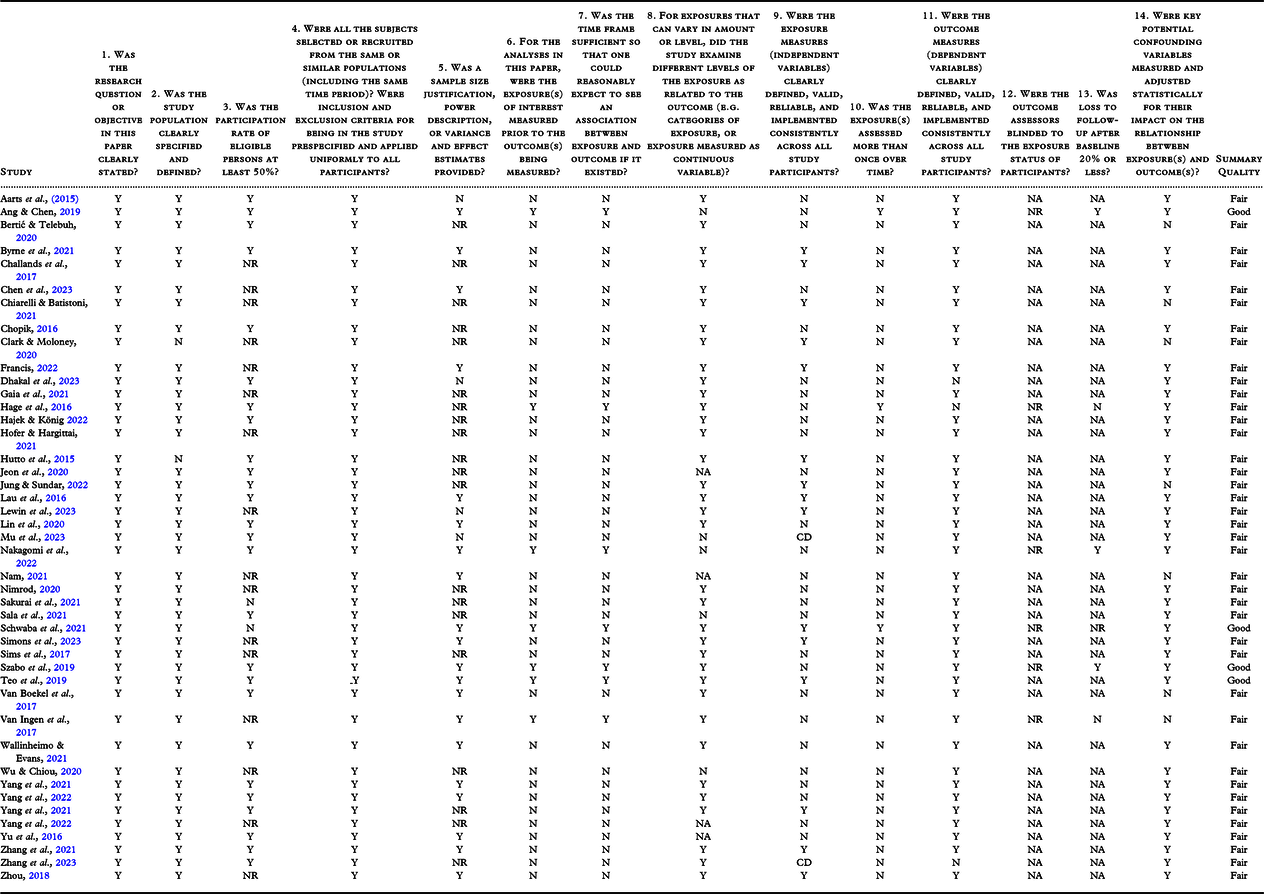
*CD, cannot determine; NA, not applicable; NR, not reported.
Studies (interventional) were assessed using the NIH quality assessment tool for before-after (pre-post) studies

*CD, cannot determine; NA, not applicable; NR, not reported.
The quality of qualitative (n = 7) and mixed-methods (n = 4) studies was assessed against the CASP qualitative research checklist. For all studies, there was a clear aim, the qualitative methodology was deemed appropriate and used appropriate recruitment methods, and they were deemed to have collected data in a way that address the research issue, analyzed data rigorously, and stated their findings and the value of their research. Six out of 11 studies justified the choice of the research design and 5 out of 11 studies provided information regarding ethics approval. Only one study reported on consideration of the relationship between the researcher and participants. Details of the quality assessment for each study can be seen in Tables 1–3.
Studies (qualitative) assessed using the CASP qualitative research checklist

Study and participant characteristics
The 64 studies retained were conducted in 20 different countries with the highest number coming from the United States (n = 17). One multi-site study (Yachin & Nimrod, Reference Yachin and Nimrod2021) was conducted across seven countries. Across the studies, the number of participants included ranged from 6 to 16,925, the percentages of females ranged from 42% to 100%, and 56 studies recruited community-dwelling samples, six studies used participants from aged care facilities, and two studies recruited both community-dwelling older adults and aged care residents. Included studies employed various methods: 53 were quantitative studies, 7 were qualitative, and 4 were used mixed-methods. Of the 53 quantitative studies, 38 were cross-sectional, 6 were observational longitudinal, and 9 were interventional.
Quantitative studies
In the cross-sectional and longitudinal studies, social media use was measured in various forms, including social media user status (i.e. user vs. nonuser, n = 15), frequency of social media use (n = 18), duration of use (n = 5), frequency of using specific social media functions (e.g. checking vs. posting, n = 4), the number of online applications used (n = 2), changes in social media use (i.e. increase of social media use during the COVID-19 pandemic and loss of social resources on social media, n = 2), and Facebook network size (n = 1). The interventions used in the interventional studies included online video conferencing apps (n = 3) and training in using social media apps (n = 5) or a customized online social networking platform (n = 1). Eight of the nine interventional studies compared the intervention groups to the control groups.
Loneliness
Twenty-six quantitative studies investigated the relationship between social media use and loneliness, including cross-sectional studies (n = 17), longitudinal studies (n = 2), and interventional studies (n = 7). Most studies measured loneliness with various forms of the De Jong-Gierveld Loneliness Scale (De Jong Gierveld & Van Tilburg, Reference de Jong Gierveld and van Tilburg2006; n = 10) and the UCLA Loneliness Scale (Russell, Reference Russell1996; n = 13). The Social and Emotional Loneliness Scale for Adults (DiTommaso & Spinner, Reference DiTommaso and Spinner1993; n = 1) and a single question (n = 2) were also used to measure loneliness. In general, the cross-sectional studies found that greater social media use was associated with lower rates of loneliness (n = 13). This was replicated across a wide range of social media use measures such as user status, frequency of use, number of online applications used, and duration of use. Results of longitudinal studies were mixed, with one of the two studies reporting that more frequent social media use predicted reduced loneliness over time (Szabo et al., Reference Szabo, Allen, Stephens and Alpass2019), while the other found no association between time spent on social media and loneliness over time (Schwaba et al., Reference Schwaba, Bleidorn and Donnellan2021). Similarly, the interventional studies reported mixed results. While some interventions that attempted to increase older persons’ use of social media were associated with improvements in loneliness (n = 4; e.g. Tsai et al., Reference Tsai, Tsai, Wang, Chang and Chu2010), some were not (n = 3; e.g. Quinn, Reference Quinn2021).
Depression
Twenty-two quantitative studies investigated the relationship between social media use and depressive symptoms, including cross-sectional studies (n = 12), longitudinal studies (n = 4), and interventional studies (n = 6). Most studies measured depressive symptoms with various forms of the Geriatric Depression Scale (Yesavage & Sheikh, Reference Yesavage and Sheikh1986; n = 7) and the Center for Epidemiologic Studies Depression Scale (Radloff, Reference Radloff1977; n = 9). The Patient Health Questionnaire (Yeung et al., Reference Yeung, Fung, Yu, Vorono, Ly, Wu and Fava2008; n = 3), the Mental Health Screening Test (Berwick et al., Reference Berwick, Murphy, Goldman, Ware, Barsky and Weinstein1991; n = 1), Hopkins Symptom Checklist (Kleppang et al., Reference Kleppang and Hagquist2016; n = 1), and customized single question (n = 1) were also used. In general, the cross-sectional studies reported that greater social media use was associated with fewer depressive symptoms (n = 6). This was replicated across a wide range of social media use measures, such as user status, frequency of use, the number of online applications used, and duration of use. Similarly, most interventional studies (n = 4) reported that social media-related interventions including video conferencing and training in using social media platforms were effective in reducing depressive symptoms (Hwang et al., Reference Hwang, Toma, Chen, Shah, Gustafson and Mares2021; Morton et al., Reference Morton, Wilson, Haslam, Birney, Kingston and McCloskey2018; Tsai et al., Reference Tsai, Tsai, Wang, Chang and Chu2010; Tsai & Tsai, Reference Tsai and Tsai2011). However, the results from the longitudinal studies were mixed, with two of the studies reporting that social media use predicted fewer depressive symptoms over time (Nakagomi et al., Reference Nakagomi, Shiba, Kondo and Kawachi2022; Teo et al., Reference Teo, Markwardt and Hinton2019) and two studies showing no association between social media use over time and depressive symptoms (Ang et al., Reference Ang, Chen and Carr2019; Schwaba et al., Reference Schwaba, Bleidorn and Donnellan2021).
Life satisfaction, subjective wellbeing, and quality of life
Seventeen quantitative studies investigated the relationship between social media use and older adults’ outcomes in life satisfaction, subjective wellbeing, and quality of life. This included cross-sectional studies (n = 14), longitudinal studies (n = 1), and interventional studies (n = 2). Most studies measured the dependent variables with various forms of the Life Satisfaction Scale (Diener et al., Reference Diener, Emmons, Larsen and Griffin1985; n = 10) and customized single question (n = 3). The remaining four studies used the World Health Organization-Five Well-Being Index (Awata et al., Reference Awata, Bech, Koizumi, Seki, Kuriyama, Hozawa, Ohmori, Nakaya, Matsuoka and Tsuji2007), Mental Health Inventory (Berwick et al., Reference Berwick, Murphy, Goldman, Ware, Barsky and Weinstein1991), Quality of Life Scale by Flanagan (Reference Flanagan1978), and the Control, Autonomy, Self-realization and Pleasure scale (Wiggins et al., Reference Wiggins, Netuveli, Hyde, Higgs and Blane2008) to assess outcomes. Nine of the 14 cross-sectional studies reported positive associations between greater social media use and improved outcomes, and this was replicated across different social media use measures such as user status, frequency of social media use, Facebook network size, and number of online social applications used. Although the only longitudinal study found time spent on social media did not predict life satisfaction over time (Schwaba et al., Reference Schwaba, Bleidorn and Donnellan2021), two interventional studies showed that training older adults to use online social platforms improved participants’ life satisfaction/quality of life (Morton et al., Reference Morton, Wilson, Haslam, Birney, Kingston and McCloskey2018; Woodward et al., Reference Woodward, Freddolino, Blaschke-Thompson, Wishart, Bakk, Kobayashi and Tupper2010).
Anxiety
Four quantitative studies investigated the relationship between social media use and symptoms of anxiety, including cross-sectional studies (n = 3) and an interventional study (n = 1). Scales used to measure anxiety included the Beck Anxiety Inventory (Beck et al., Reference Beck, Epstein, Brown and Steer1988; n = 2), the State-Trait Anxiety Inventory (Marteau & Bekker, Reference Marteau and Bekker2020; n = 1), and the Geriatric Anxiety Inventory (Byrne & Pachana, Reference Byrne and Pachana2011; n = 1). Overall, the three cross-sectional studies found social media use was unrelated to anxiety, and this was replicated across different social media use measures including frequency of using social media in general (Yang et al., Reference Yang, Lai, Sun, Ma and Chau2022), social resource loss on social media (Lau et al., Reference Lau, Hou, Hall, Canetti, Ng, Lam and Hobfoll2016), and frequency of looking at family photos and asking questions on social media (Hofer & Hargittai, Reference Hofer and Hargittai2021). However, the interventional study found that training older adults to use a customized online social platform reduced participants’ anxiety indirectly through increased competence (Morton et al., Reference Morton, Wilson, Haslam, Birney, Kingston and McCloskey2018). One cross-sectional study (Chen & Miao, Reference Chen and Miao2023) examined the relationship between online social networking and psychological distress (including two dimensions: anxiety and depression) and found that older adults who socialize online reported less psychological distress than those who do not.
Social connectedness and relatedness
Four quantitative studies investigated the relationship between social media use and older adults’ social connectedness or relatedness, including cross-sectional studies (n = 2), an interventional study (n = 1), and a longitudinal study (n = 1). Social connectedness or relatedness was measured with the Social Connectedness Scale (Lee et al., Reference Lee, Draper and Lee2001, n = 2), the Balanced Measure of Psychological Needs Scale (Sheldon & Hilpert, Reference Sheldon and Hilpert2012), and a customized scale. Only one cross-sectional study (Clark & Moloney, Reference Clark and Moloney2020) found that more frequent social media use was associated with higher relatedness, and the other three studies (Challands et al., Reference Challands, Lacherez and Obst2017; Hage et al., Reference Hage, Wortmann, van Offenbeek and Boonstra2016, Quinn, Reference Quinn2021) did not find an association between social media use and social connectedness.
Qualitative studies and mixed-methods studies
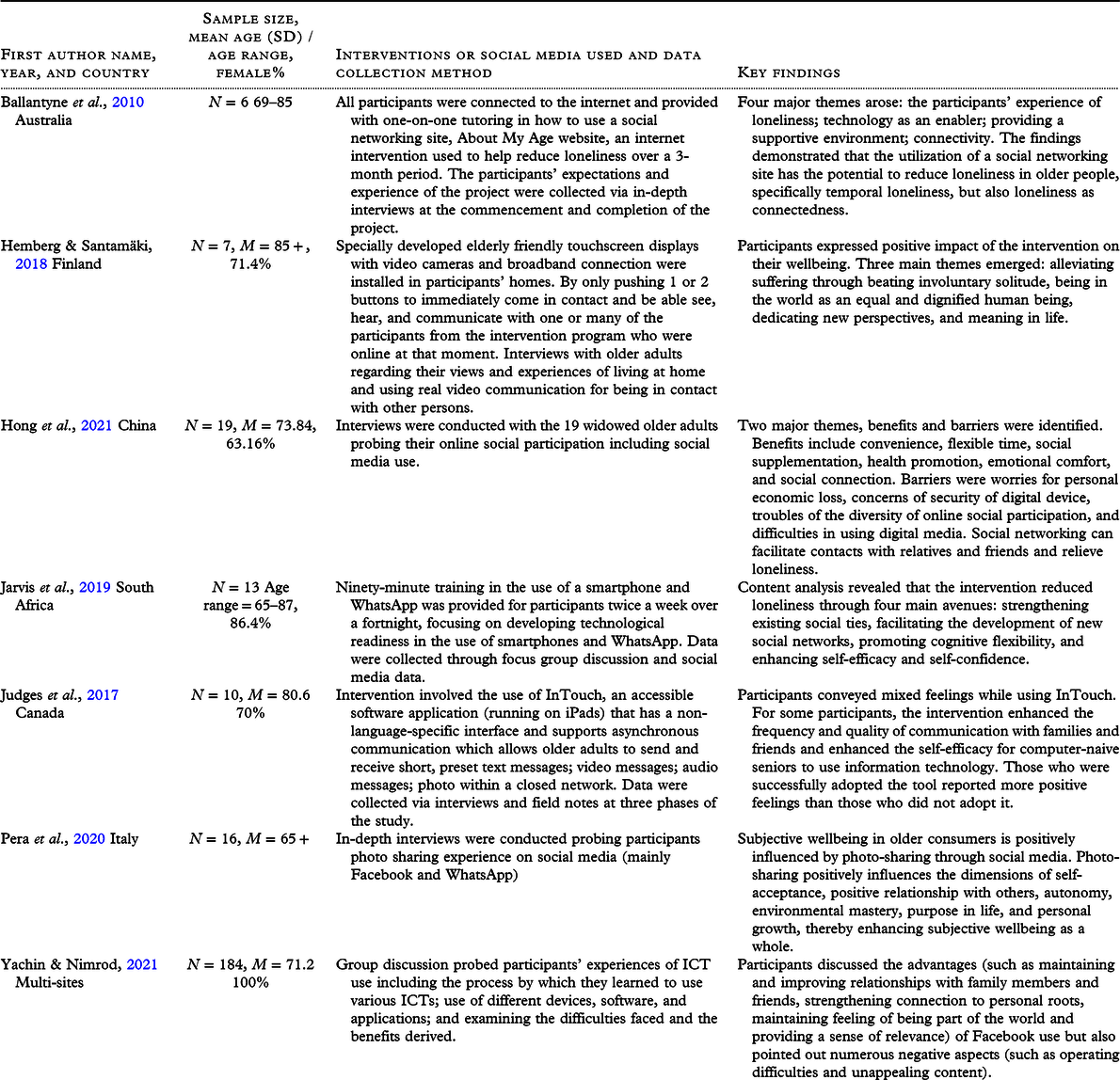
Seven studies used qualitative methods, and all had relatively small sample sizes (n = 6–19) except one multi-site study (n = 184). The majority of participants were females in all but one sample.
Four of the seven qualitative studies used interventions (i.e. trained participants to use social media). Participants’ experience of the interventions was gathered via interviews or focus group discussions. Overall, their experience was positive, and the interventions were effective in reducing and managing loneliness (Ballantyne et al., Reference Ballantyne, Trenwith, Zubrinich and Corlis2010), facilitating network building (Jarvis et al., Reference Jarvis, Chipps and Padmanabhanunni2019), enhancing the frequency and quality of communication with friends and family (Judges et al., Reference Judges, Laanemets, Stern and Baecker2017), and improving subjective wellbeing (Hemberg & Santamäki, Reference Hemberg and Santamäki Fischer2018). However, for participants who were not motivated to communicate with others or had difficulty using an iPad, fewer positive effects were reported (Judges et al., Reference Judges, Laanemets, Stern and Baecker2017).
The remaining three qualitative studies were noninterventional, in which older adult social media users were recruited and interviewed. Participants reported multiple benefits of social media use, including improved subjective wellbeing (Pera et al., Reference Pera, Quinton and Baima2020), enhanced connectedness with relatives and friends, reduction in loneliness (Hong et al., Reference Hong, Fu, Kong, Liu, Zhong, Tan and Luo2021), and enhanced feeling of being part of the world and sense of relevance (Yachin & Nimrod, Reference Yachin and Nimrod2021).
Four studies used mixed-methods, and all had small sample sizes (n = 8–28) and used interventions (i.e. training and support in using Skype, customized communication apps, and an online discussion forum). Psychosocial outcomes examined include loneliness, depression, social support, and general mental health. Only one study showed quantitatively that using a customized online social interaction platform reduced participants’ self-reported loneliness (Johansson-Pajala et al., Reference Johansson-Pajala, Gusdal, Eklund, Florin and Wågert2023), and the remaining studies showed no significant effect of the interventions on the outcome variables measured. However, participants reported benefits gained through the interventions in interviews or open-ended questions, such as enjoyment of seeing or talking with close family or friends via Skype (Siniscarco et al., Reference Siniscarco, Love-Williams and Burnett-Wolle2017), enhanced sense of wellbeing (Barbosa Neves et al., Reference Barbosa Neves, Franz, Judges, Beermann and Baecker2019), increased sense of belonging, emotional support, and facilitation in offline network building (Torp et al., Reference Torp, Hanson, Hauge, Ulstein and Magnusson2008). See Tables 4 and 5 for summaries of all included studies.
Summary of quantitative studies including mixed-methods studies

Summary of qualitative studies
Mediators
Eleven of the identified studies investigated mediators of the relationship between social media use and psychosocial outcomes in older adults to understand the key mechanisms underlying this relationship. Nine of these studies found that social support and social contact/engagement mediated the relationship between social media use and loneliness, depressive symptoms, quality of life, and life satisfaction (Byrne et al., Reference Byrne, Anaraky, Dye, Ross, Chalil Madathil, Knijnenburg and Levkoff2021; Lin et al., Reference Lin, Kobayashi, Tong, Davison, Arora and Fuller-Thomson2020; Nam, Reference Nam2021; Sims et al., Reference Sims, Reed and Carr2017; Szabo et al., Reference Szabo, Allen, Stephens and Alpass2019; Wu & Chiou, Reference Wu and Chiou2020; Yang et al., Reference Yang, Huang, Zhang, Zhang and Zhao2021; Zhang et al., Reference Zhang, Kim, Silverstein, Song and Burr2021; Zhou, Reference Zhou2018). Two studies found that increased feeling of competence mediated the relationship between social media use and loneliness and wellbeing (Francis, Reference Francis2022; Jung & Sundar, Reference Jung and Sundar2022).
Discussion
This review examined the findings from 64 studies examining social media use and psychosocial outcomes in older samples. Overall findings were mixed, and it is likely due to wide variations in study designs, outcome variables examined, the way in which social media use was measured and the confounding variables that were controlled for in analyses. Despite the variation in findings, there was some consistency to suggest social media use was associated with better outcomes in cross-sectional, interventional, and qualitative studies, but findings were mixed in longitudinal study designs.
Most of the cross-sectional studies revealed that social media use was associated with lower levels of loneliness and fewer depressive symptoms, higher life satisfaction, and higher quality of life. While causal conclusions cannot be drawn from studies using cross-sectional methods, it is possible that frequent social media use maintains good psychosocial wellbeing by facilitating and supporting access to social interactions. However, this association might also occur if poorer mental health is associated with reduced use of social media. For example, people with depression are likely to socially withdraw in person, and this may also include avoiding or withdrawing from socially engaging online. Several cross-sectional studies reported that older adults’ social media use was unrelated to psychosocial outcomes, suggesting that the associations may be context-dependent. Demographic variables including age, nationality, education, health condition, etc., and factors such as technology familiarity, access to devices, privacy concerns, financial constraints, and internet reliability (such as in rural/remote areas) may all influence older people’s use of social media and its impact. Moreover, specific social media functions, such as video conferencing or chat, may have greater impact on psychosocial outcomes than other social media functions. Further research is required to explore these associations, particularly through designs that enable causal conclusions such as longitudinal and randomized controlled trial (RCT) studies.
Only a small number of studies utilized longitudinal study designs, and across these studies mixed results were found. In general, the longitudinal studies reported mixed findings on loneliness and depression with some reporting that social media use led to decreased loneliness and depression over time, while some studies found no significant effect on depression or loneliness over time. Studies reported no significant effects of social media use over time on life satisfaction or relatedness. Outcomes for anxiety are unknown, and further research is needed to examine the impact on anxiety and socially relevant subtypes such as social anxiety, as well as to explore whether particular components of social media use are more likely to be associated with changes in symptoms over time.
Most interestingly, the interventional studies predominantly showed positive effects of increased social media use on psychosocial outcomes. Social media-related interventions were mostly shown to lead to reduced depression and anxiety, and increased life satisfaction over time. Interestingly, interventions designed to target loneliness were associated with mixed findings. Notably, social media interventions that encouraged communication with family and friends specifically, as opposed to people in general, were associated with positive mental health outcomes (Nakagomi et al., Reference Nakagomi, Shiba, Kondo and Kawachi2022; Szabo et al., Reference Szabo, Allen, Stephens and Alpass2019). Further, there was some evidence across studies that interventions focused on using video chat/video conferencing (also especially with family members) were more effective in relieving older adults’ loneliness and depressive symptoms than other functions of social media (Teo et al., Reference Teo, Markwardt and Hinton2019, Tsai et al., Reference Tsai, Tsai, Wang, Chang and Chu2010; Tsai & Tsai, Reference Tsai and Tsai2011; Tsai et al., Reference Tsai, Cheng, Shieh and Chang2020). It is not clear whether the communication format or the encouragement to communicate with family members was more effective in improving psychosocial outcomes. If it is the format, this suggests that social media communication that more closely mimics face-to-face interaction (such as video conferencing) might be of particular importance. Alternatively, increased contact with family members may have led to the positive psychosocial outcomes, which is consistent with previous studies showing that older adults prefer smaller online social networks comprised of their family and friends (Rylands & Van Belle, Reference Rylands and Van Belle2017; Sims et al., Reference Sims, Reed and Carr2017). Given only a small number of longitudinal and interventional studies were identified, more studies are needed to tease apart these potential social media components so that further interventions can be developed to improve psychosocial outcomes in later life.
Participants in qualitative studies generally reported positive experiences of social media use or interventions. Again, while no causal conclusions can be drawn from these studies, the results demonstrate the reasons some older adults are inclined to use or not use social media regularly. Three of the four mixed-methods studies did not show any significant benefit in psychosocial outcomes in the quantitative evaluations of the interventions used. As these studies all had very small samples, the results may be biased by sampling variability and not generalizable.
In the 11 studies that investigated mediators of the relationship between social media use and psychosocial outcomes, 9 studies found that social support and social contact/engagement mediated the associations between social media use and loneliness, depressive symptoms, quality of life, and life satisfaction. Indeed, social support plays a central role in enhancing psychosocial outcomes among diverse age groups and populations, serving as an intermediary element in the connection between loneliness and a range of health consequences, such as depression, anxiety, physical symptoms, and overall psychological wellness (Chen et al., Reference Chen, Hicks and While2014; Harandi et al., Reference Harandi, Taghinasab and Nayeri2017; Hutten et al., Reference Hutten, Jongen, Vos, van den Hout and van Lankveld2021; Liu et al., Reference Liu, Gou and Zuo2016; Wan Mohd Azam et al., Reference Wan Mohd Azam, Din, Ahmad, Ghazali, Ibrahim, Said, Ghazali, Shahar, Razali and Maniam2013; Werner-Seidler et al., Reference Werner-Seidler, Afzali, Chapman, Sunderland and Slade2017). It is possible that social media use or interventions help older adults maintain and improve social contact and engagement, which facilitates their access to social support and reduces their social isolation which in turn reduces depression and improves psychosocial wellbeing or life satisfaction. Two of the included studies showed feeling of competence mediated the relationship between social media use and loneliness and wellbeing. According to Self-Determination Theory (Ryan & Deci, Reference Ryan and Deci2017), experiencing competence through successful challenges and tasks boosts self-esteem and wellbeing, fostering intrinsic motivation linked to positive mental health outcomes. It is possible that social media use increases self-efficacy/confidence, leading to increased confidence in initiating or positively responding to social contact and social support, thereby reducing older adults’ depression and improving their wellbeing. Future research should test these potential pathways to gain a deeper understanding of how social media use improve psychosocial outcomes in older adults.
The diversity within the literature and studies considered in this review complicates the synthesis of clear conclusions. Studies reviewed exhibit variation across multiple dimensions, including definitions of social media and how its use was assessed, the outcomes measured, and measurement tools used, the research methodologies employed, the characteristics of the study participants, and the variables controlled for that could influence the results. A primary source of this heterogeneity arises from the wide-ranging approaches to measure the exposure, involving choices regarding which social media platforms were examined, the user status of participants, the frequency of social media usage, the number of different online applications used, the amount of time spent on social media, and the frequency of engaging in specific social media functions. For example, in the study by Simons et al. (Reference Simons, Reijnders, Janssens, Lataster and Jacobs2023), the use of WhatsApp was linked to reduced loneliness, while the use of SNSs was not. The authors made a distinction between WhatsApp and SNSs whereas many other studies classified WhatsApp within the category of SNSs (e.g. Gaia et al., Reference Gaia, Sala and Cerati2021). This multiplicity of measurement approaches poses challenges in drawing generalizable conclusions, as the consequences of employing different platforms and usage patterns may substantially differ. The multitude of assessed outcomes, including loneliness, depression, anxiety, life satisfaction, quality of life, and social connectedness, further adds to the complexity. Given the overlapping variance between emotional symptoms such as depression, anxiety, and loneliness, without controlling for each of these constructs, it is difficult to differentiate the effects on individual symptoms conclusively. Further, the mechanisms through which engagement with social media affects these outcomes can substantially vary. For instance, when considering the connection between social media usage and loneliness, factors such as the quality of online social interactions, perceived social support, and the extent of offline social engagement may play distinctive roles. In contrast, when examining the link between social media engagement and anxiety, the mediating factor might involve one’s sense of competence.
Clear findings are elusive due to variations in exposure, outcome measures, methodology, sample characteristics, confounding variables, measurement instruments, and methodological limitations. Addressing this heterogeneity through standardized approaches (such as greater standardization in measuring social media exposure, outcome variables, and methodology) and more rigorous research (e.g. using more longitudinal and RCT studies to explore causal pathways and inform the development of interventions that promote positive outcomes and mitigate negative ones) can help advance our understanding of the complex relationships between social media use and psychosocial outcomes in older adults.
Limitations
First, in general, most of the studies relied on self-reported data to assess participantsʼ social media use and mental health outcomes which could lead to biased results. Future studies may gain advantages from utilizing SNSs data in real time and longitudinally. Second, most of the included studies were cross-sectional, preventing causal inference. Third, participants in qualitative studies may over-report positive experiences due to social desirability bias or social acceptability bias. Fourth, in interventional studies, interventions often involve face-to-face and/or online socialization between participants and/or between participants and trainers (e.g. Ballantyne et al., Reference Ballantyne, Trenwith, Zubrinich and Corlis2010), which may obscure the origin of the effect on the dependent variables. Fifth, few studies controlled for general internet use, intelligence, network size, or computer confidence which may all be relevant confounds to consider. Additionally, the search was conducted across three databases, in one language, and search terms focused on Western social media platforms, which may have potentially limited the number of studies identified.
Conclusion and implications
This review examined studies using a wide range of study designs investigating the effect of social media use on older adultsʼ psychosocial outcomes. Although the findings were mixed, there was some evidence that social media use has the potential to improve older adultsʼ psychosocial outcomes. Insights from this systematic review may benefit practitioners in understanding the common benefits and challenges associated with social media use in older adults. That is, social media use has mixed benefits for older adults’ psychosocial outcomes, with some evidence that frequent social media use that increases community and family engagement and a sense of social support and belonging are the key targets for maintaining psychosocial wellbeing in later life. More longitudinal and interventional studies with adequate methodological rigor are needed to confirm this trend and to identify the factors that prevent some older adults from benefiting from social media use to inform policy for improving the life quality of older people.
Conflicts of interest
None.
Source of funding
The project was funded by a “Road to Research” Research Training Program Scholarship for a Master of Research degree awarded to Xiaojing Lei and a Medical Research Future Fund Fellowship awarded to Viviana Wuthrich (APP1197846).
Description of author(s)’ roles
Xiaojing Lei, Diana Matovic, and Viviana Wuthrich designed the search strategy and prepared the manuscript. Xiaojing Lei, Diana Matovic, Wing-Yin Leung, and Abhirami Viju screened and evaluated the studies, extracted data, and completed quality assessments. Xiaojing Lei conducted the database search, removed duplicates, and synthesized the results.
Supplementary material
For supplementary material accompanying this paper visit https://doi.org/10.1017/S1041610223004519


 Open access

