





1. Introduction
Dense suspensions composed of micron-sized, non-Brownian solid particles immersed in a viscous fluid are known to exhibit shear thickening. This characteristic is marked by a rise in viscosity with an increase in the applied stress, $\tau$
, or strain rate,
$\tau$
, or strain rate, $\dot {\gamma }$
(Guazzelli & Pouliquen Reference Guazzelli and Pouliquen2018; Morris Reference Morris2020). Recent studies have associated this behaviour with the formation of frictional contacts when the applied stress exceeds a characteristic threshold,
$\dot {\gamma }$
(Guazzelli & Pouliquen Reference Guazzelli and Pouliquen2018; Morris Reference Morris2020). Recent studies have associated this behaviour with the formation of frictional contacts when the applied stress exceeds a characteristic threshold, $\tau ^{*}$
, which is determined by interparticle repulsion (Seto et al. Reference Seto, Mari, Morris and Denn2013; Wyart & Cates Reference Wyart and Cates2014; Clavaud et al. Reference Clavaud, Bérut, Metzger and Forterre2017). The constitutive curve of such a suspension typically displays an S-shape, indicating a transition from a low-viscosity, lubricated state at low stresses to a high-viscosity, frictional state at high stresses. Despite this average observation in experiments, the flow is not steady. The thickening process is characterised by significant fluctuations in bulk stress or strain rate (Lootens et al. Reference Lootens, Van Damme and Hébraud2003; Hermes et al. Reference Hermes, Guy, Poon, Poy, Cates and Wyart2016). Recent studies with spatially resolved experiments have discovered considerable spatiotemporal structures linked to these fluctuations (Rathee, Blair & Urbach Reference Rathee, Blair and Urbach2017; Saint-Michel, Gibaud & Manneville Reference Saint-Michel, Gibaud and Manneville2018; Ovarlez et al. Reference Ovarlez, Le, Anh, Wilbert, Fall, Mari, Chatté and Colin2020). These findings challenge the current understanding of the shear-thickening phenomenon and call for a more nuanced interpretation.
$\tau ^{*}$
, which is determined by interparticle repulsion (Seto et al. Reference Seto, Mari, Morris and Denn2013; Wyart & Cates Reference Wyart and Cates2014; Clavaud et al. Reference Clavaud, Bérut, Metzger and Forterre2017). The constitutive curve of such a suspension typically displays an S-shape, indicating a transition from a low-viscosity, lubricated state at low stresses to a high-viscosity, frictional state at high stresses. Despite this average observation in experiments, the flow is not steady. The thickening process is characterised by significant fluctuations in bulk stress or strain rate (Lootens et al. Reference Lootens, Van Damme and Hébraud2003; Hermes et al. Reference Hermes, Guy, Poon, Poy, Cates and Wyart2016). Recent studies with spatially resolved experiments have discovered considerable spatiotemporal structures linked to these fluctuations (Rathee, Blair & Urbach Reference Rathee, Blair and Urbach2017; Saint-Michel, Gibaud & Manneville Reference Saint-Michel, Gibaud and Manneville2018; Ovarlez et al. Reference Ovarlez, Le, Anh, Wilbert, Fall, Mari, Chatté and Colin2020). These findings challenge the current understanding of the shear-thickening phenomenon and call for a more nuanced interpretation.
The inherent instability of the uniform flow in a thickened state, as indicated by the S-shaped constitutive curve, leads to the formation, percolation and collapse of localised contact networks of particles. Numerical simulations have confirmed this underlying mechanism (Nabizadeh, Singh & Jamali Reference Nabizadeh, Singh and Jamali2022; van der Naald et al. Reference van der Naald, Singh, Eid, Tang, de Pablo and Jaeger2024; Goyal et al. Reference Goyal, Martys and Del Gado2024). Experimental observations have revealed intermittent, spatially localised jamming events (Rathee et al. Reference Rathee, Blair and Urbach2020, Reference Rathee, Miller, Blair and Urbach2022), which may be interpreted as macroscopic manifestations of contact-network percolation. These processes are fundamental to the response of a shear-thickened state to external drivings. The importance of frictional contacts between the particles suggests a shared framework that includes both shear thickening and shear jamming (Brown & Jaeger Reference Brown and Jaeger2014; Peters, Majumdar & Jaeger Reference Peters, Majumdar and Jaeger2016; Han, James & Jaeger Reference Han, James and Jaeger2019). Boundary confinement is thus deemed critical to the evolution of the contact network in the flow (Brown & Jaeger Reference Brown and Jaeger2012). However, previous studies have largely overlooked the potential impact of boundary compliance on the thickening behaviour (Hu & Zhao Reference Hu and Zhao2024), which is a substantial limitation not only for understanding shear-thickening, but also for controlling its dynamics in numerous natural and industrial settings where soft boundaries or free surfaces are commonly encountered.
In this study, we explore the influence of boundary compliance on the evolution of heterogeneities in shear-thickening suspensions. Our findings reveal distinct regimes of dynamics; compliant boundaries lead to persistent heterogeneity due to dynamic instability, while resistant confinement results in the emergence of transient, load-bearing clusters through localised spanning events.
2. Experimental protocol
To investigate the influence of boundary compliance on flow instabilities, we design an experiment using a stratified shear cell, which was driven by orbital oscillations of the bottom at a moving speed denoted as $U$
. This specific set-up was chosen to avoid the stress gradients that commonly occur in the vorticity direction in parallel-plate rheometry. As depicted in figure 1(a), a thin layer of silicone oil was introduced between the suspension and the fixed top plate, which has a diameter of
$U$
. This specific set-up was chosen to avoid the stress gradients that commonly occur in the vorticity direction in parallel-plate rheometry. As depicted in figure 1(a), a thin layer of silicone oil was introduced between the suspension and the fixed top plate, which has a diameter of $110\,\textrm{mm}$
. The thickness of this oil layer, denoted as
$110\,\textrm{mm}$
. The thickness of this oil layer, denoted as $h_o$
, is set to
$h_o$
, is set to $2\,\textrm{mm}$
, while the thickness of the suspension, denoted as
$2\,\textrm{mm}$
, while the thickness of the suspension, denoted as $h_s$
, is set to
$h_s$
, is set to $3\,\textrm{mm}$
. The local thickness of suspension can be measured on demand via a laser displacement sensor. By altering the oil viscosity
$3\,\textrm{mm}$
. The local thickness of suspension can be measured on demand via a laser displacement sensor. By altering the oil viscosity $\eta _o$
, we realise a smooth transition from weak to strong interfacial constraints.
$\eta _o$
, we realise a smooth transition from weak to strong interfacial constraints.
(a) A schematic of the experimental set-up. (b) Rheogram of the dense cornstarch suspension for $\varPhi =0.42$
. For detailed description, see the text. (c–e) Snapshots of three different states of inhomogeneity (see supplementary movies for multimedia views). The red arrows indicate the instantaneous drive direction. The blue arrow refers to the instantaneous directions of high-
$\varPhi =0.42$
. For detailed description, see the text. (c–e) Snapshots of three different states of inhomogeneity (see supplementary movies for multimedia views). The red arrows indicate the instantaneous drive direction. The blue arrow refers to the instantaneous directions of high- $\phi$
regions’ motion. The yellow one indicates the propagating event in the vorticity direction. Inset of panel (b) shows a comparison of independently measured rheological curves,
$\phi$
regions’ motion. The yellow one indicates the propagating event in the vorticity direction. Inset of panel (b) shows a comparison of independently measured rheological curves, $\eta _s(\dot {\gamma }_s)$
, and results obtained in our experiments with silicone oils of different viscosities.
$\eta _s(\dot {\gamma }_s)$
, and results obtained in our experiments with silicone oils of different viscosities.

A key quantity in our experiment is the interfacial velocity field $\boldsymbol{U_0}(x,y)$
, measured using particle image velocimetry (PIV) with
$\boldsymbol{U_0}(x,y)$
, measured using particle image velocimetry (PIV) with $50\,{\unicode{x03BC}} \textrm{m}$
hollow tracer particles dispersed at the oil–suspension interface. These particles were tracked using PIV. The amplitude of the mean interfacial velocity,
$50\,{\unicode{x03BC}} \textrm{m}$
hollow tracer particles dispersed at the oil–suspension interface. These particles were tracked using PIV. The amplitude of the mean interfacial velocity, $\bar {U_0}$
, was obtained by averaging over a measurement area of
$\bar {U_0}$
, was obtained by averaging over a measurement area of $25\,\textrm{cm}^{2}$
and one oscillation period. The averaged shear rates in the suspension and oil layers were then calculated as
$25\,\textrm{cm}^{2}$
and one oscillation period. The averaged shear rates in the suspension and oil layers were then calculated as $\dot {\gamma }_s=(U - \bar {U_0})/h_s$
and
$\dot {\gamma }_s=(U - \bar {U_0})/h_s$
and $\dot {\gamma }_o = \bar {U_0}/h_o$
, respectively. Under low-Reynolds-number conditions, the averaged shear stress at the suspension–oil interface is determined by
$\dot {\gamma }_o = \bar {U_0}/h_o$
, respectively. Under low-Reynolds-number conditions, the averaged shear stress at the suspension–oil interface is determined by $\tau =\eta _o \dot {\gamma }_o$
, and the apparent suspension viscosity,
$\tau =\eta _o \dot {\gamma }_o$
, and the apparent suspension viscosity, $\eta _s=\tau /\dot {\gamma }_s$
, was derived from the continuity of the shear stress
$\eta _s=\tau /\dot {\gamma }_s$
, was derived from the continuity of the shear stress $\tau$
across the interface. However, when local quantities are of interest (e.g. the local stress field or
$\tau$
across the interface. However, when local quantities are of interest (e.g. the local stress field or $\dot {\gamma }_s$
under heterogeneous states), the corresponding local velocity field
$\dot {\gamma }_s$
under heterogeneous states), the corresponding local velocity field $\boldsymbol{U_0}(x,y)$
is used instead.
$\boldsymbol{U_0}(x,y)$
is used instead.
The suspension is prepared by suspending cornstarch particles (Aladdin S116030) in deionised water, with caesium chloride added to achieve density matching. These dry starch particles have a mass density of $\rho _p=1.5\,\textrm{kg m}^{-3}$
and an average diameter of
$\rho _p=1.5\,\textrm{kg m}^{-3}$
and an average diameter of $d_p=15\,{\unicode{x03BC}}\textrm{m}$
. The volume fraction is maintained at
$d_p=15\,{\unicode{x03BC}}\textrm{m}$
. The volume fraction is maintained at $\varPhi =0.42$
. The suspension was illuminated from beneath by a monochrome LED panel, with inhomogeneous spatial transmission of light indicating uneven density, as demonstrated by Shi, Hu & Zhao (Reference Shi, Hu and Zhao2024). Specifically, darker regions correspond to higher density of particles (as shown in figure 1
c,d). Therefore, the onset and evolution of heterogeneity can be quantitatively characterised by the spatial standard deviation of the transmission light, as shown in the Appendix. Rheological measurements are carried out separately using a parallel-plate rheometer (Anton Paar MCR 302) in stress-controlled mode (figure 1
b). These measurements indicated that shear thickening starts at
$\varPhi =0.42$
. The suspension was illuminated from beneath by a monochrome LED panel, with inhomogeneous spatial transmission of light indicating uneven density, as demonstrated by Shi, Hu & Zhao (Reference Shi, Hu and Zhao2024). Specifically, darker regions correspond to higher density of particles (as shown in figure 1
c,d). Therefore, the onset and evolution of heterogeneity can be quantitatively characterised by the spatial standard deviation of the transmission light, as shown in the Appendix. Rheological measurements are carried out separately using a parallel-plate rheometer (Anton Paar MCR 302) in stress-controlled mode (figure 1
b). These measurements indicated that shear thickening starts at $\tau ^{*}=2\,\textrm{Pa}$
corresponding to an apparent suspension viscosity of
$\tau ^{*}=2\,\textrm{Pa}$
corresponding to an apparent suspension viscosity of $\eta _{s1}=0.33\,\textrm{Pa}\,\textrm{s}$
. The onset of discontinuous shear thickening (DST), accompanied with pronounced fluctuations in the bulk strain rate, occurs at
$\eta _{s1}=0.33\,\textrm{Pa}\,\textrm{s}$
. The onset of discontinuous shear thickening (DST), accompanied with pronounced fluctuations in the bulk strain rate, occurs at $\tau _c=15\,\textrm{Pa}$
, corresponding to an apparent suspension viscosity of
$\tau _c=15\,\textrm{Pa}$
, corresponding to an apparent suspension viscosity of $\eta _{s2}=0.86\,\textrm{Pa} \,\textrm{s}$
. These two characteristic viscosities define the critical boundary compliance, which will be discussed in further detail later.
$\eta _{s2}=0.86\,\textrm{Pa} \,\textrm{s}$
. These two characteristic viscosities define the critical boundary compliance, which will be discussed in further detail later.
3. Results
We first take an overview of the experimental observations. As $\dot {\gamma }_s$
increases, the suspension exihibits heterogeneities in density (see the Appendix). Depending on the viscosity of the bounding silicone oil
$\dot {\gamma }_s$
increases, the suspension exihibits heterogeneities in density (see the Appendix). Depending on the viscosity of the bounding silicone oil $\eta _o$
, we identify three distinct heterogeneous flow states (states 1–3), as illustrated in figure 1(c–e), within two regimes.
$\eta _o$
, we identify three distinct heterogeneous flow states (states 1–3), as illustrated in figure 1(c–e), within two regimes.
For relatively low viscosity, where $\eta _o \lt \eta _{s2}$
, the suspension develops inhomogeneities as shear thickening progresses. The emergence of these non-uniformities is accompanied by the deformation of the oil–suspension interface, with a typical peak-to-valley height difference of
$\eta _o \lt \eta _{s2}$
, the suspension develops inhomogeneities as shear thickening progresses. The emergence of these non-uniformities is accompanied by the deformation of the oil–suspension interface, with a typical peak-to-valley height difference of $\Delta h \approx 0.5\,\textrm{mm}$
. These inhomogeneities travel along the mainstream and self-organise into a hexagonal pattern (figures 1
c and 1
d). Such patterns can persist throughout the entire experimental duration (see supplementary movies 1 and 2 available at https://doi.org/10.1017/jfm.2026.11305). In contrast, as
$\Delta h \approx 0.5\,\textrm{mm}$
. These inhomogeneities travel along the mainstream and self-organise into a hexagonal pattern (figures 1
c and 1
d). Such patterns can persist throughout the entire experimental duration (see supplementary movies 1 and 2 available at https://doi.org/10.1017/jfm.2026.11305). In contrast, as $\eta _o\gt \eta _{s2}$
, the heterogeneous dynamics are more violent, often causing substantial density gradients upstream (figure 2
c) and interface deformation (
$\eta _o\gt \eta _{s2}$
, the heterogeneous dynamics are more violent, often causing substantial density gradients upstream (figure 2
c) and interface deformation ( $\Delta h \approx 0.8\,\textrm{mm}$
). In this regime, high-density regions move almost in phase with the container and are frequently followed by secondary propagating events along the vorticity direction as seen in figure 1
e and supplementary movie 3. The differing persistence of the inhomogeneities in these states can be quantified by the variance of the backlight transmission ratio and the time series of interface deformation (see the Appendix).
$\Delta h \approx 0.8\,\textrm{mm}$
). In this regime, high-density regions move almost in phase with the container and are frequently followed by secondary propagating events along the vorticity direction as seen in figure 1
e and supplementary movie 3. The differing persistence of the inhomogeneities in these states can be quantified by the variance of the backlight transmission ratio and the time series of interface deformation (see the Appendix).
(a–c) Local flow fields corresponding to state 1, state 2 and state 3, respectively. Note that $\widetilde {U}_0={\lvert \boldsymbol{U}_0(x,y)\rvert }/{U}$
refers the scaled interface velocity and
$\widetilde {U}_0={\lvert \boldsymbol{U}_0(x,y)\rvert }/{U}$
refers the scaled interface velocity and $u_h$
denotes the speed of the heterogeneous structure.
$u_h$
denotes the speed of the heterogeneous structure.

Further insight comes from the local interface flow fields, as shown in figure 2(a–c), which reveals a clear distinction among these heterogeneous states. In state 1, the tracer particles velocity remain lower than that of the heterogeneous structures, suggesting that the motion of the inhomogeneity propagates as kinematic density waves (Shi et al. Reference Shi, Hu and Zhao2024). In contrast, for state 2, the tracer particles move synchronously with the high-density region (figure 2
b), as if forming locally jammed clusters (Shi & Zhao Reference Shi and Zhao2024). While the exact dimensions of the clusters remain under investigation, they likely do not span the entire shear-gradient (vertical) direction. One indication is their slower motion compared with the bottom driving velocity $U$
. This feature contrasts sharply with state 3, where, once formed, the structures move in phase with the driving. As shown in figure 2(c), in state 3, the amplitude of the scaled interfacial velocity
$U$
. This feature contrasts sharply with state 3, where, once formed, the structures move in phase with the driving. As shown in figure 2(c), in state 3, the amplitude of the scaled interfacial velocity $\widetilde {U}_0$
(where
$\widetilde {U}_0$
(where $\widetilde {U}_0=\lvert \boldsymbol{U_0}(x,y)\rvert /U$
) approaches 1. This indicates that they are locally jammed and extend the gap thickness. As they evolve, low-density tails develop upstream and
$\widetilde {U}_0=\lvert \boldsymbol{U_0}(x,y)\rvert /U$
) approaches 1. This indicates that they are locally jammed and extend the gap thickness. As they evolve, low-density tails develop upstream and $\widetilde {U}_0$
decreases, marking the progressive dissolving of these structures.
$\widetilde {U}_0$
decreases, marking the progressive dissolving of these structures.
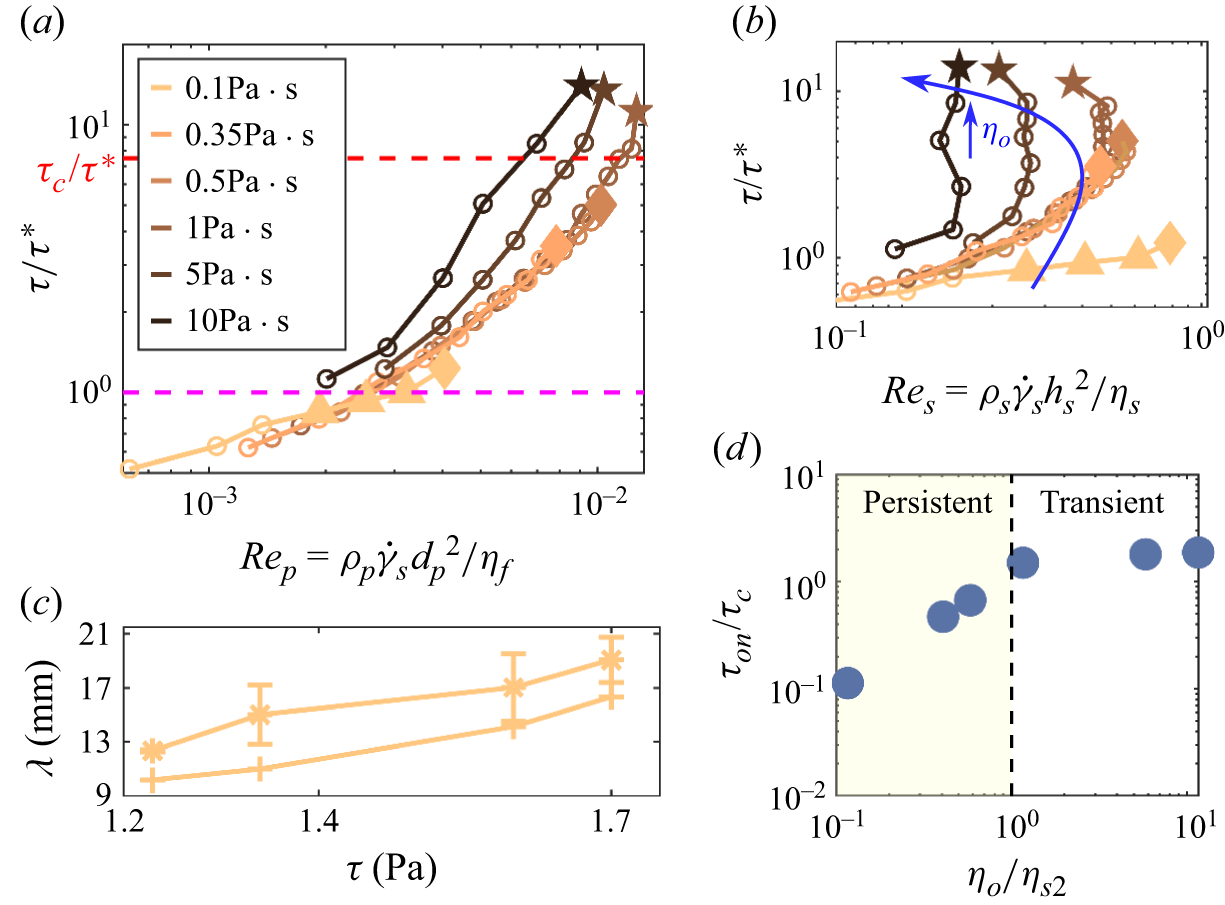
(a) State diagram illustrating distinct unsteady regimes observed at varying silicone oil viscosities and their relation to the particle Reynolds number. Symbols represent different dynamical states: $\circ$
represents the uniform state,
$\circ$
represents the uniform state, $\blacktriangle$
denotes state 1,
$\blacktriangle$
denotes state 1, $\blacklozenge$
indicates state 2 and
$\blacklozenge$
indicates state 2 and $\bigstar$
corresponds to state 3. (b) Normalised shear stress plotted against the suspension Reynolds number, with data and symbols consistent with those in panel (a). (c) Comparison of wavelengths
$\bigstar$
corresponds to state 3. (b) Normalised shear stress plotted against the suspension Reynolds number, with data and symbols consistent with those in panel (a). (c) Comparison of wavelengths $\lambda$
(defined as the distance between adjacent low-density regions along the mainstream):
$\lambda$
(defined as the distance between adjacent low-density regions along the mainstream): $+$
indicates the theoretical prediction from (4.2), while
$+$
indicates the theoretical prediction from (4.2), while $\ast$
shows experimentally measured values. Note that the shear stress
$\ast$
shows experimentally measured values. Note that the shear stress $\tau$
is varied by adjusting the thickness of the silicone oil layer while keeping the driving velocity fixed. (d) Variation of onset stress with silicone oil viscosity.
$\tau$
is varied by adjusting the thickness of the silicone oil layer while keeping the driving velocity fixed. (d) Variation of onset stress with silicone oil viscosity.

The origin of these heterogeneous states requires further investigation. In figure 3(a), we plot the average stress, $\tau$
, versus the shear rate,
$\tau$
, versus the shear rate, $\dot {\gamma }_s$
. Here,
$\dot {\gamma }_s$
. Here, $\dot {\gamma }_s$
is non-dimensionalised using the particle Reynolds number,
$\dot {\gamma }_s$
is non-dimensionalised using the particle Reynolds number, ${Re}_p=\rho _p \dot {\gamma } d_p^{2}/\eta _f$
. The observed
${Re}_p=\rho _p \dot {\gamma } d_p^{2}/\eta _f$
. The observed ${Re}_p\ll 1$
indicates negligable inertia effect. Nevertheless, due to the density-dependent constitutive relation, instabilities can be raised by the kinematic accumulation. This type of role of particle inertia in the emergence of unsteady flow in particle suspensions has been documented (Johri & Glasser Reference Johri and Glasser2002; Duru et al. Reference Duru, Nicolas, Hinch and Guazzelli2002). As
${Re}_p\ll 1$
indicates negligable inertia effect. Nevertheless, due to the density-dependent constitutive relation, instabilities can be raised by the kinematic accumulation. This type of role of particle inertia in the emergence of unsteady flow in particle suspensions has been documented (Johri & Glasser Reference Johri and Glasser2002; Duru et al. Reference Duru, Nicolas, Hinch and Guazzelli2002). As ${Re}_p$
(
${Re}_p$
( $\dot {\gamma }_s$
) increases, the suspension progresses towards the shear-thickening regime. As demonstrated in figure 3(a), the critical particle Reynolds number for the onset of instability increases with the viscosity of the bounding silicone oil,
$\dot {\gamma }_s$
) increases, the suspension progresses towards the shear-thickening regime. As demonstrated in figure 3(a), the critical particle Reynolds number for the onset of instability increases with the viscosity of the bounding silicone oil, $\eta _o$
. A similar trend is observed for the corresponding onset stress,
$\eta _o$
. A similar trend is observed for the corresponding onset stress, $\tau _{on}$
. This trend persists within the regime of persistent heterogeneous states, but saturates once
$\tau _{on}$
. This trend persists within the regime of persistent heterogeneous states, but saturates once $\eta _o$
exceeds
$\eta _o$
exceeds $\eta _{s2}$
, beyond which unsteady flow is triggered at a constant stress
$\eta _{s2}$
, beyond which unsteady flow is triggered at a constant stress $\tau _c$
, corresponding to the onset of discontinuous shear thickening (DST). The non-monotonic dependence of the instability onset on
$\tau _c$
, corresponding to the onset of discontinuous shear thickening (DST). The non-monotonic dependence of the instability onset on $\eta _o$
, illustrated in figure 3(d), suggests the existence of distinct underlying mechanisms. In the following, we propose a minimal model to understand these boundary effects.
$\eta _o$
, illustrated in figure 3(d), suggests the existence of distinct underlying mechanisms. In the following, we propose a minimal model to understand these boundary effects.
4. Discussion
These non-uniform flow modes are related to shear-thickening and are fundamentally different from those in Newtonian viscosity-stratified systems, where instability can occur at vanishing Reynolds numbers (Yih Reference Yih1967; Hooper & Boyd Reference Hooper and Boyd1987). In contrast, as shown in figure 3(b), the onset Reynolds number for inhomogeneity in suspensions exhibits a non-monotonic dependence on $\eta _o$
. Experiments using Newtonian viscosity-stratified fluids do not produce similar instabilities, further highlighting the unique nature of the observed phenomena. In the shear-thickening suspension, the instability is governed by the competition between the kinematic accumulation and pressure-driven migration of the particle phase (Shi et al. Reference Shi, Hu and Zhao2024; Shi & Zhao Reference Shi and Zhao2024). Kinematic accumulation promotes the growth of particle clusters, leading to a buildup of stress. The buildup of stress is not necessary aligned with the size growth of the force network (van der Naald et al. Reference van der Naald, Singh, Eid, Tang, de Pablo and Jaeger2024). As the contact network percolates, a sudden rise in local stress may lead to the collapse of the contact network (Goyal et al. Reference Goyal, Martys and Del Gado2024; van der Naald et al. Reference van der Naald, Singh, Eid, Tang, de Pablo and Jaeger2024). The magnitude of stress that the boundary can withstand without deformation determines the actual dynamics (Hu & Zhao Reference Hu and Zhao2024). The apparent viscosity of the inhomogeneous states,
$\eta _o$
. Experiments using Newtonian viscosity-stratified fluids do not produce similar instabilities, further highlighting the unique nature of the observed phenomena. In the shear-thickening suspension, the instability is governed by the competition between the kinematic accumulation and pressure-driven migration of the particle phase (Shi et al. Reference Shi, Hu and Zhao2024; Shi & Zhao Reference Shi and Zhao2024). Kinematic accumulation promotes the growth of particle clusters, leading to a buildup of stress. The buildup of stress is not necessary aligned with the size growth of the force network (van der Naald et al. Reference van der Naald, Singh, Eid, Tang, de Pablo and Jaeger2024). As the contact network percolates, a sudden rise in local stress may lead to the collapse of the contact network (Goyal et al. Reference Goyal, Martys and Del Gado2024; van der Naald et al. Reference van der Naald, Singh, Eid, Tang, de Pablo and Jaeger2024). The magnitude of stress that the boundary can withstand without deformation determines the actual dynamics (Hu & Zhao Reference Hu and Zhao2024). The apparent viscosity of the inhomogeneous states, $\eta _s$
, are maintained at various levels of thickening (cf. figure 1
b inset). To gain a deeper understanding of the non-uniform states, we first examine the regime of
$\eta _s$
, are maintained at various levels of thickening (cf. figure 1
b inset). To gain a deeper understanding of the non-uniform states, we first examine the regime of $\eta _o\lt \eta _{s2}$
, where long-lived heterogeneities are observed.
$\eta _o\lt \eta _{s2}$
, where long-lived heterogeneities are observed.
4.1. Long-lived inhomogeneity for $\eta _{o}\lt \eta _{s2}$

For $\eta _o\lt \eta _{s1}$
, as shown in figure 3(a), a stress around
$\eta _o\lt \eta _{s1}$
, as shown in figure 3(a), a stress around $\tau ^{*}$
triggers the emergence of flow inhomogeneity, which aligns with the onset of shear thickening. In this regime, the system initially exhibits state 1. As
$\tau ^{*}$
triggers the emergence of flow inhomogeneity, which aligns with the onset of shear thickening. In this regime, the system initially exhibits state 1. As $\dot {\gamma }_s$
increases, state 1 transforms into state 2. Conversely, for
$\dot {\gamma }_s$
increases, state 1 transforms into state 2. Conversely, for $\eta _o\gt \eta _{s1}$
, the onset of inhomogeneous flow shifts to higher stresses beyond
$\eta _o\gt \eta _{s1}$
, the onset of inhomogeneous flow shifts to higher stresses beyond $\tau ^*$
and directly manifests as state 2, bypassing the intermediate state 1.
$\tau ^*$
and directly manifests as state 2, bypassing the intermediate state 1.
This variation in flow modes with bounding viscosity can be explained by two characteristic time scales: $t_1=1/{\dot {\gamma }_o}$
, the time for interface deformation, and
$t_1=1/{\dot {\gamma }_o}$
, the time for interface deformation, and $t_2=1/ \dot {\gamma }_s$
, the time taken for particles to pass each other. The ratio of these time scales defines a dimensionless parameter,
$t_2=1/ \dot {\gamma }_s$
, the time taken for particles to pass each other. The ratio of these time scales defines a dimensionless parameter,
 \begin{equation} \epsilon =\frac {t_1}{t_2}=\frac {\dot {\gamma }_s}{\dot {\gamma }_o}=\frac {\eta _o}{\eta _s}, \end{equation}
where the last equality arises from continuity of shear stress across the interface. The dilation of the particle phase can occur if the interface deforms faster than particles move past each other, i.e. $\epsilon \leqslant 1$
.
$\epsilon \leqslant 1$
.
In the case of $\eta _o \lt \eta _{s1}$
, the condition
$\eta _o \lt \eta _{s1}$
, the condition $\epsilon \lt 1$
is always satisfied. Consequently, the stress buildup from growing inhomogeneities is promptly relaxed, preventing it from exceeding
$\epsilon \lt 1$
is always satisfied. Consequently, the stress buildup from growing inhomogeneities is promptly relaxed, preventing it from exceeding $\tau ^*$
(the threshold for shear thickening and the onset of frictional contacts). Particle contacts remain transient and the inhomogeneity manifests as state 1. The transiency of contacts makes the inhomogeneity the only dynamic mode that shows no hysteresis (Shi & Zhao Reference Shi and Zhao2024). Since the viscous resistance of the oil layer (approximately
$\tau ^*$
(the threshold for shear thickening and the onset of frictional contacts). Particle contacts remain transient and the inhomogeneity manifests as state 1. The transiency of contacts makes the inhomogeneity the only dynamic mode that shows no hysteresis (Shi & Zhao Reference Shi and Zhao2024). Since the viscous resistance of the oil layer (approximately $\tau$
) alone cannot balance the particle pressure
$\tau$
) alone cannot balance the particle pressure $\sigma _N \sim \mathcal{O}(\tau ^*)$
, capillary pressure arising from interface deformation must be considered. This pressure scales as
$\sigma _N \sim \mathcal{O}(\tau ^*)$
, capillary pressure arising from interface deformation must be considered. This pressure scales as $2\Delta h \varGamma / (\lambda /2)^2$
, where
$2\Delta h \varGamma / (\lambda /2)^2$
, where $\lambda$
is the wavelength defined as the distance between adjacent low-density regions along the mainstream,
$\lambda$
is the wavelength defined as the distance between adjacent low-density regions along the mainstream, $\varGamma = 20\,\textrm{mN m}^{-1}$
is the interfacial tension and
$\varGamma = 20\,\textrm{mN m}^{-1}$
is the interfacial tension and $\Delta h \approx 0.5\,\textrm{mm}$
is the measured deformation amplitude. The resulting stress balance gives
$\Delta h \approx 0.5\,\textrm{mm}$
is the measured deformation amplitude. The resulting stress balance gives
 \begin{equation} \sigma _N \sim \mathcal{O}(\tau ^*) = \frac {2\Delta h}{(\lambda /2)^2} \varGamma + \tau . \end{equation}
This relationship neglects the vertical fluid drag during particle dilation (i.e. Darcy-type flow) (Jerome, Vandenberghe & Forterre Reference Jerome, Vandenberghe and Forterre2016; Athani et al. Reference Athani, Metzger, Forterre and Mari2022, Reference Athani, Metzger, Forterre and Mari2025). One reason for this omission is that the viscosity of the silicone oil exceeds that of the solvent (water) by more than two orders of magnitude. Another is that, in the present experimental configuration, fluid migration is expected to occur primarily within the flow-vorticity plane. Equation (4.2) implies that the wavelength $\lambda$
adjusts with increasing
$\lambda$
adjusts with increasing $\tau$
to maintain the transient contact state. Experimental measurements support this prediction, showing a monotonic increase of
$\tau$
to maintain the transient contact state. Experimental measurements support this prediction, showing a monotonic increase of $\lambda$
with shear stress
$\lambda$
with shear stress $\tau$
(figure 3
c).
$\tau$
(figure 3
c).
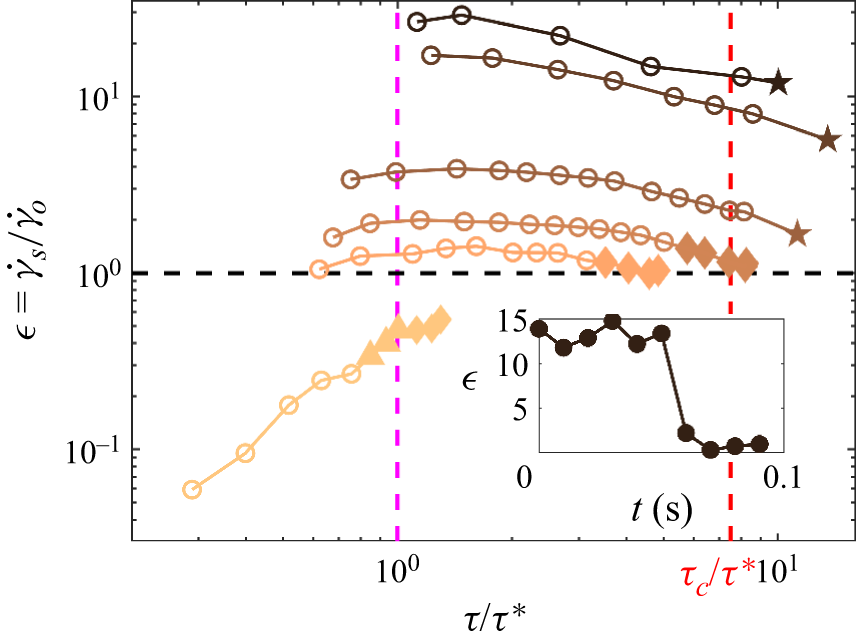
Characteristics of heterogeneity in different values of the dimensionless number $\epsilon =\dot {\gamma }_s/\dot {\gamma }_o$
. The data and symbols here are consistent with those in figure 3. Inset shows a discontinuous drop in local
$\epsilon =\dot {\gamma }_s/\dot {\gamma }_o$
. The data and symbols here are consistent with those in figure 3. Inset shows a discontinuous drop in local $\epsilon$
for
$\epsilon$
for $\eta _{o}=10\,\textrm{Pa}\,\textrm{s}$
. Note that, to determine
$\eta _{o}=10\,\textrm{Pa}\,\textrm{s}$
. Note that, to determine $\epsilon$
locally, the averaged velocity was measured within a fixed
$\epsilon$
locally, the averaged velocity was measured within a fixed $1\,\textrm{mm}^2$
area.
$1\,\textrm{mm}^2$
area.

However, when $\eta _o \gt \eta _{s1}$
, the onset of shear thickening (
$\eta _o \gt \eta _{s1}$
, the onset of shear thickening ( $\tau \approx \tau ^*$
and
$\tau \approx \tau ^*$
and $\eta _s\approx \eta _{s1}$
) yields
$\eta _s\approx \eta _{s1}$
) yields $\epsilon \gt 1$
. In this case, dilation of the particle phase is obstructed, aligning the dynamics with those of a rigid boundary. The growth of the contact network is hindered by the vertical confinement and shear profile, and is likely limited to submacroscopic scale (Goyal et al. Reference Goyal, Martys and Del Gado2024; van der Naald et al. Reference van der Naald, Singh, Eid, Tang, de Pablo and Jaeger2024). These immature contact structures are not readily observable via transmission contrast in our experiments. As
$\epsilon \gt 1$
. In this case, dilation of the particle phase is obstructed, aligning the dynamics with those of a rigid boundary. The growth of the contact network is hindered by the vertical confinement and shear profile, and is likely limited to submacroscopic scale (Goyal et al. Reference Goyal, Martys and Del Gado2024; van der Naald et al. Reference van der Naald, Singh, Eid, Tang, de Pablo and Jaeger2024). These immature contact structures are not readily observable via transmission contrast in our experiments. As $\tau$
increases, shear thickening develops and
$\tau$
increases, shear thickening develops and $\eta _s$
rises, while the oil viscosity
$\eta _s$
rises, while the oil viscosity $\eta _o$
remains constant. This causes the dimensionless parameter
$\eta _o$
remains constant. This causes the dimensionless parameter $\epsilon$
to decrease. As
$\epsilon$
to decrease. As $\epsilon$
approaches 1, the dilation constraint eases, potentially allowing the structures to grow to larger sizes without being abruptly destroyed by a sudden rise in stress. A balance between influx and efflux could eventually be reached, thereby maintaining the inhomogeneous pattern. Since a more viscous bounding requires deeper shear-thickening to achieve
$\epsilon$
approaches 1, the dilation constraint eases, potentially allowing the structures to grow to larger sizes without being abruptly destroyed by a sudden rise in stress. A balance between influx and efflux could eventually be reached, thereby maintaining the inhomogeneous pattern. Since a more viscous bounding requires deeper shear-thickening to achieve $\epsilon =1$
, the onset stress for the inhomogeneity,
$\epsilon =1$
, the onset stress for the inhomogeneity, $\tau _{on}$
, is observed to shift to higher values with increasing
$\tau _{on}$
, is observed to shift to higher values with increasing $\eta _o$
(see figure 3
d). Furthermore, as the dilation constraints are relaxed, further shear thickening becomes unsustainable under low-Reynolds-number conditions. Consequently, the effective suspension viscosity asymptotically approaches that of the bounding oil (see figure 1
b inset), and the time scale ratio
$\eta _o$
(see figure 3
d). Furthermore, as the dilation constraints are relaxed, further shear thickening becomes unsustainable under low-Reynolds-number conditions. Consequently, the effective suspension viscosity asymptotically approaches that of the bounding oil (see figure 1
b inset), and the time scale ratio $\epsilon$
stabilises near 1, exhibiting minimal variation with increasing stress
$\epsilon$
stabilises near 1, exhibiting minimal variation with increasing stress $\tau$
(see figure 4).
$\tau$
(see figure 4).
We clarify two aspects of the long-lived inhomogeneous states discussed previously. First, such persistent structures in state 2 can also emerge from the state 1 regime ( $\eta _o \lt \eta _{s1}$
) upon further increasing
$\eta _o \lt \eta _{s1}$
) upon further increasing $\dot {\gamma }$
and
$\dot {\gamma }$
and $\tau$
(see figures 3
a and 4). However, this evolution involves highly nonlinear dynamics (Shi & Zhao Reference Shi and Zhao2024), distinct from that emerging directly from the uniform state when
$\tau$
(see figures 3
a and 4). However, this evolution involves highly nonlinear dynamics (Shi & Zhao Reference Shi and Zhao2024), distinct from that emerging directly from the uniform state when $\eta _o \gt \eta _{s1}$
. We therefore do not elaborate on this path here. Second, the instability mechanism underlying these inhomogeneous states is fundamentally different from that in Newtonian stratified flows, where the interfacial instability is driven by discontinuities in viscosity and shear profile (Yih Reference Yih1967; Hooper & Boyd Reference Hooper and Boyd1987). In contrast, the inhomogeneity here arises when the viscosities of the two layers become comparable (i.e.
$\eta _o \gt \eta _{s1}$
. We therefore do not elaborate on this path here. Second, the instability mechanism underlying these inhomogeneous states is fundamentally different from that in Newtonian stratified flows, where the interfacial instability is driven by discontinuities in viscosity and shear profile (Yih Reference Yih1967; Hooper & Boyd Reference Hooper and Boyd1987). In contrast, the inhomogeneity here arises when the viscosities of the two layers become comparable (i.e. $\epsilon \to 1$
), corresponding to a transition in the shear profile from the solid white to the dashed red line in figure 1(a).
$\epsilon \to 1$
), corresponding to a transition in the shear profile from the solid white to the dashed red line in figure 1(a).
4.2. Transient jamming for
$\eta _{o}\gt \eta _{s2}$

As previously discussed, the onset stress of inhomogeneity, $\tau _{on}$
, exhibits a positive correlation with
$\tau _{on}$
, exhibits a positive correlation with $\eta _{o}$
. This correlation persists until
$\eta _{o}$
. This correlation persists until $\eta _{o}$
surpasses
$\eta _{o}$
surpasses $\eta _{s2}$
, at which point, the dynamics enters a distinct regime. This new regime is characterised by several unique features. Notably, the viscosity threshold
$\eta _{s2}$
, at which point, the dynamics enters a distinct regime. This new regime is characterised by several unique features. Notably, the viscosity threshold $\eta _{s2}$
corresponds to a stress scale of
$\eta _{s2}$
corresponds to a stress scale of $\tau _c=15\,\textrm{Pa}\,\textrm{s}$
. As per our prior discussion, it is expected that
$\tau _c=15\,\textrm{Pa}\,\textrm{s}$
. As per our prior discussion, it is expected that $\tau _{on}\gt \tau _c$
in this regime, and that
$\tau _{on}\gt \tau _c$
in this regime, and that $\tau _{on}$
increases with
$\tau _{on}$
increases with $\eta _{o}$
to ensure
$\eta _{o}$
to ensure $\epsilon =\eta _{o}/\eta _s$
decreases to 1. However, when
$\epsilon =\eta _{o}/\eta _s$
decreases to 1. However, when $\eta _{o}$
exceeds
$\eta _{o}$
exceeds $\eta _{s2}$
, the onset of heterogeneity remains constant at
$\eta _{s2}$
, the onset of heterogeneity remains constant at $\tau _{on}\approx \tau _c$
, regardless of
$\tau _{on}\approx \tau _c$
, regardless of $\eta _o$
(refer to figure 3
d). Additionally, despite the globally averaged
$\eta _o$
(refer to figure 3
d). Additionally, despite the globally averaged $\epsilon$
remaining larger than 1, locally, the heterogeneity is associated with an abrupt, transient drop to
$\epsilon$
remaining larger than 1, locally, the heterogeneity is associated with an abrupt, transient drop to $\epsilon \sim 0$
(figure 4, inset). This indicates that the local shear rate is temporarily reduced to 0, consistent with the formation of a localised load-bearing cluster spanning the gap, or a transient jamming event.
$\epsilon \sim 0$
(figure 4, inset). This indicates that the local shear rate is temporarily reduced to 0, consistent with the formation of a localised load-bearing cluster spanning the gap, or a transient jamming event.
Simulations (Nabizadeh et al. Reference Nabizadeh, Singh and Jamali2022; van der Naald et al. Reference van der Naald, Singh, Eid, Tang, de Pablo and Jaeger2024; Goyal et al. Reference Goyal, Martys and Del Gado2024) and experiments (Kim et al. Reference Kim, Esser-Kahn, Rowan and Jaeger2023; Horwath et al. Reference Horwath2025) have both demonstrated that the intensification of shear-thickening is underpinned by the growth of the contact network in both size and strength. At high $\tau$
, these clusters percolate across the depth of the suspension, but promptly collapse due to their intense interaction with the confining boundaries. Similarly, in our experiments, as the load-bearing clusters emerge and expand to approach the full gap thickness, they significantly drag the bounding silicone oil, resulting in a sharp increase in local stress. The resulting stress gradient, typically of the order of
$\tau$
, these clusters percolate across the depth of the suspension, but promptly collapse due to their intense interaction with the confining boundaries. Similarly, in our experiments, as the load-bearing clusters emerge and expand to approach the full gap thickness, they significantly drag the bounding silicone oil, resulting in a sharp increase in local stress. The resulting stress gradient, typically of the order of $100\,\textrm{Pa mm}^{{-1}}$
(as shown in figure 5), drives cluster rearrangement and eventual breakup. Their lifetimes do not conform to a single characteristic time scale, but are typically comparable to one oscillation cycle (see supplementary movie 3). As local transient jamming occurs, i.e.
$100\,\textrm{Pa mm}^{{-1}}$
(as shown in figure 5), drives cluster rearrangement and eventual breakup. Their lifetimes do not conform to a single characteristic time scale, but are typically comparable to one oscillation cycle (see supplementary movie 3). As local transient jamming occurs, i.e. $\dot {\gamma }_s\to 0$
locally, the amplitude of local stress is primarily proportional to the viscosity of the bounding oil
$\dot {\gamma }_s\to 0$
locally, the amplitude of local stress is primarily proportional to the viscosity of the bounding oil $\eta _o$
. Thus, a higher
$\eta _o$
. Thus, a higher $\eta _o$
amplifies the stress gradient, accelerating the cluster collapse. Under rigid confinement, their lifetimes become significantly shorter than a single oscillation cycle (Hu & Zhao Reference Hu and Zhao2024).
$\eta _o$
amplifies the stress gradient, accelerating the cluster collapse. Under rigid confinement, their lifetimes become significantly shorter than a single oscillation cycle (Hu & Zhao Reference Hu and Zhao2024).
Snapshot of the stress field of a transient event along the vorticity direction. The red arrow indicate the instantaneous drive direction. The stress field was derived from the measured local interfacial velocity field, $\boldsymbol{U}(x,y)$
, obtained via PIV analysis. In the present experiment,
$\boldsymbol{U}(x,y)$
, obtained via PIV analysis. In the present experiment, $\eta _{o} = {10}\,\textrm{Pa s}^{{-1}}$
and the average shear rate is 38
$\eta _{o} = {10}\,\textrm{Pa s}^{{-1}}$
and the average shear rate is 38 $\textrm{s}^{{-1}}$
.
$\textrm{s}^{{-1}}$
.

The collapse of spanned load-bearing clusters can further trigger secondary stress wave propagation. The collapse may be incomplete, breaking into mesoscopic scale rather than particle scale. Consequently, mesoscopic perturbations induced during breakup may rapidly grow by linking pre-existing force chains dispersed throughout the suspension. This behaviour echoes dynamic jamming fronts observed in wide-gap Couette cell and in impact experiments (Peters et al. Reference Peters, Majumdar and Jaeger2016; Han et al. Reference Han, James and Jaeger2019), although along the vorticity direction rather than the driving or gradient directions. The propagation velocity reaches approximately $1.3\,\textrm{m s}^{{-1}}$
(see figure 5), nearly an order of magnitude higher than the imposed drive speed. It is important to realise that the compliant bounding is critical to both the emergence and the lifetime of this secondary stress wave. Under the viscous boundary conditions studied here,
$1.3\,\textrm{m s}^{{-1}}$
(see figure 5), nearly an order of magnitude higher than the imposed drive speed. It is important to realise that the compliant bounding is critical to both the emergence and the lifetime of this secondary stress wave. Under the viscous boundary conditions studied here, $\eta _{o}\gt \eta _{s2}$
, a characteristic time for their survival is comparable to that defined by the average shear rate (e.g.
$\eta _{o}\gt \eta _{s2}$
, a characteristic time for their survival is comparable to that defined by the average shear rate (e.g. ${\sim} 0.03\,\textrm{s}$
in figure 5), whereas they are rarely visible under rigid confinement (Rathee et al. Reference Rathee, Miller, Blair and Urbach2022; Moghimi, Blair & Urbach Reference Moghimi, Blair and Urbach2025).
${\sim} 0.03\,\textrm{s}$
in figure 5), whereas they are rarely visible under rigid confinement (Rathee et al. Reference Rathee, Miller, Blair and Urbach2022; Moghimi, Blair & Urbach Reference Moghimi, Blair and Urbach2025).
4.3. Further remarks
The understanding of shear thickening, particularly discontinuous shear thickening (DST), has undergone a paradigm shift in recent years. The emerging view emphasises the load-bearing network of frictional contacts. The macroscopic inhomogeneous states described in this study may be interpreted as various evolutionary stages of force network in shear thickening – from the onset of frictional contacts (state 1, $\tau \sim \tau ^{*}$
), to the formation of localised clusters (state 2,
$\tau \sim \tau ^{*}$
), to the formation of localised clusters (state 2, $\tau \gt \tau ^{*}$
), to their spanning the boundary gap (state 3,
$\tau \gt \tau ^{*}$
), to their spanning the boundary gap (state 3, $\tau \gt \tau _c$
). These states correspond to successive stages of viscosity proliferation (see apparent viscosity
$\tau \gt \tau _c$
). These states correspond to successive stages of viscosity proliferation (see apparent viscosity $\eta _s$
in figure 1
b), which, in the light of the nature of DST, may reflect different stages of stress transmission and contact-network development. The emergence and spanning of localised load-bearing structures do not necessarily require density inhomogeneites on macroscopic scales. Rather, their presence could promote kinematic accumulation and amplify density inhomogeneity (Shi et al. Reference Shi, Hu and Zhao2024). The macroscopic inhomogeneity observed here arises from the prolonged lifetime of these structures under compliant boundaries. During the thickening process, stress promotes the growth of load-bearing structures, but also leads to their yielding. Boundary compliance provides a feedback mechanism that determines the stage at which a stress-activated structure becomes sufficiently strong to deform the confinement. We speculate that this feedback prolongs the survival of force chains and allows microscale structural dynamics to manifest as macroscopic non-uniformity. Otherwise, the microscopic structures are quite short-lived and they remain too weak to be detected by techniques such as boundary stress microscopy (BSM). As a result, the suspension appears relatively uniform in experiments for
$\eta _s$
in figure 1
b), which, in the light of the nature of DST, may reflect different stages of stress transmission and contact-network development. The emergence and spanning of localised load-bearing structures do not necessarily require density inhomogeneites on macroscopic scales. Rather, their presence could promote kinematic accumulation and amplify density inhomogeneity (Shi et al. Reference Shi, Hu and Zhao2024). The macroscopic inhomogeneity observed here arises from the prolonged lifetime of these structures under compliant boundaries. During the thickening process, stress promotes the growth of load-bearing structures, but also leads to their yielding. Boundary compliance provides a feedback mechanism that determines the stage at which a stress-activated structure becomes sufficiently strong to deform the confinement. We speculate that this feedback prolongs the survival of force chains and allows microscale structural dynamics to manifest as macroscopic non-uniformity. Otherwise, the microscopic structures are quite short-lived and they remain too weak to be detected by techniques such as boundary stress microscopy (BSM). As a result, the suspension appears relatively uniform in experiments for $\tau \lt \tau _c$
. It is only when
$\tau \lt \tau _c$
. It is only when $\tau \gt \tau _c$
that significant macroscopic stress inhomogeneity is triggered (Rathee et al. Reference Rathee, Blair and Urbach2017, Reference Rathee, Miller, Blair and Urbach2022).
$\tau \gt \tau _c$
that significant macroscopic stress inhomogeneity is triggered (Rathee et al. Reference Rathee, Blair and Urbach2017, Reference Rathee, Miller, Blair and Urbach2022).
Recent simulations further refine the evolution of force networks in shear-thickening phenomena. A close link between DST and shear jamming (SJ) has been established (Peters et al. Reference Peters, Majumdar and Jaeger2016; Moghimi et al. Reference Moghimi, Blair and Urbach2025). Nevertheless, these two transitions remain distinct: DST is characterised by intermittent resistance during flow, whereas SJ is marked by robust, system-spanning arrest. Consequently, differences in the evolution of the force/contact network are expected. Beyond $\tau ^*$
, force chains can connect into networks of system size. As
$\tau ^*$
, force chains can connect into networks of system size. As $\tau$
increases, locally over-constrained or mechanically rigid clusters begin to form within these contact networks. Specifically, Goyal et al. (Reference Goyal, Martys and Del Gado2024) identified over-constrained clusters based on their coordination numbers. There, the percolation of an over-constrained network was proposed as the origin of DST criticality and as the mechanism responsible for significant stress fluctuations. Our experiments are consistent with this picture in several respects. The transient events of
$\tau$
increases, locally over-constrained or mechanically rigid clusters begin to form within these contact networks. Specifically, Goyal et al. (Reference Goyal, Martys and Del Gado2024) identified over-constrained clusters based on their coordination numbers. There, the percolation of an over-constrained network was proposed as the origin of DST criticality and as the mechanism responsible for significant stress fluctuations. Our experiments are consistent with this picture in several respects. The transient events of $\dot {\gamma }_s(\epsilon )\rightarrow 0$
observed for
$\dot {\gamma }_s(\epsilon )\rightarrow 0$
observed for $\eta _{o} \gt \eta _{s2}$
suggest that the abrupt emergence of effectively spanning load-bearing clusters is marked by
$\eta _{o} \gt \eta _{s2}$
suggest that the abrupt emergence of effectively spanning load-bearing clusters is marked by $\tau _c$
, the onset stress of DST. The correlation between these events and stress fluctuations provides further support for this interpretation. This transition is robust against variations in
$\tau _c$
, the onset stress of DST. The correlation between these events and stress fluctuations provides further support for this interpretation. This transition is robust against variations in $\eta _{o}$
, reinforcing its stress-activated nature. The secondary stress waves observed following the failure of these clusters further suggest the presence of abundant mesoscopic load-bearing clusters during DST, consistent with the criticality argument. At the same time, the transient nature of the spanning events highlights the fragility of the underlying force networks. A more stringent definition of mechanical rigidity based on the pebble game shows that the contact network at DST is dominated by sliding contacts, which, despite a relatively high coordination number, do not provide sufficient constraints for mechanical rigidity (van der Naald et al. Reference van der Naald, Singh, Eid, Tang, de Pablo and Jaeger2024; Santra et al. Reference Santra, Orsi, Chakraborty and Morris2025). Mechanically rigid structures percolate only at stresses far beyond DST, constituting another regime in the flow-state diagram. How to interpret these results in systems with large aspect ratios and macroscopic inhomogeneities, as well as the relationship between these two percolation transitions, remains an open question. Under rigid confinement, spanning events are too small and short-lived to be clearly resolved. The viscous confinement protocol used here provides an alternative means to enhance the observability of these processes.
$\eta _{o}$
, reinforcing its stress-activated nature. The secondary stress waves observed following the failure of these clusters further suggest the presence of abundant mesoscopic load-bearing clusters during DST, consistent with the criticality argument. At the same time, the transient nature of the spanning events highlights the fragility of the underlying force networks. A more stringent definition of mechanical rigidity based on the pebble game shows that the contact network at DST is dominated by sliding contacts, which, despite a relatively high coordination number, do not provide sufficient constraints for mechanical rigidity (van der Naald et al. Reference van der Naald, Singh, Eid, Tang, de Pablo and Jaeger2024; Santra et al. Reference Santra, Orsi, Chakraborty and Morris2025). Mechanically rigid structures percolate only at stresses far beyond DST, constituting another regime in the flow-state diagram. How to interpret these results in systems with large aspect ratios and macroscopic inhomogeneities, as well as the relationship between these two percolation transitions, remains an open question. Under rigid confinement, spanning events are too small and short-lived to be clearly resolved. The viscous confinement protocol used here provides an alternative means to enhance the observability of these processes.
The role of boundary compliance emphasised here has broader practical implications. In industrial and natural processes, suspensions are often enclosed by composite confinements with weak points. Even in pipe flow, the outlet acts as an open boundary causing shock waves in stress (Bougouin et al. Reference Bougouin, Metzger, Forterre, Boustingorry and Lhuissier2024). As demonstrated here and by Hu & Zhao (Reference Hu and Zhao2024), deformability tends to concentrate high-density and high-stress regions, while reducing the overall degree of thickening in the bulk. Strategies such as incorporating viscoelastic patterns might be employed to regulate shear-thickening behaviour. It is worthwhile to note that even the weakest elastic confinement tested by Hu & Zhao (Reference Hu and Zhao2024) permits no long-lived heterogeneity. Therefore, future research should carefully distinguish between deformability arising from elasticity and that from viscosity.
5. Conclusion
The experiments presented here demonstrate that the compliance of the confining boundary plays a critical role in controlling the form and persistence of heterogeneous flow in shear-thickening suspensions. By systematically varying the viscosity of the bounding layer, we identified two distinct regimes corresponding to distinct thickening stages. Compliant confinement prolongs the lifetime of load-bearing clusters, allowing them to manifest as persistent, macroscopic density patterns, whereas more resistant confinement promotes transient jamming events with rapid collapse. The dimensionless time scale ratio $\epsilon = \eta _o / \eta _s$
governs the observed transition between these regimes, while the onset of transient jamming events, where load-bearing structures effectively span the system, occurs at a constant stress scale, independent of the bounding viscosity. These observations potentially link boundary deformation mechanics to the stress-driven growth and yielding of frictional contact structures, aligning with the view that the percolation of over-constrained clusters coincides with the onset of discontinuous shear thickening. Beyond the fundamental insight, this study suggests strategies for manipulating suspension behaviour in natural and industrial flows. Moreover, the approach also offers a means to reveal short-lived microscopic processes that remain inaccessible under rigid confinement, opening new directions for research on the interplay among suspension microstructure, flow instabilities and confinement mechanics.
$\epsilon = \eta _o / \eta _s$
governs the observed transition between these regimes, while the onset of transient jamming events, where load-bearing structures effectively span the system, occurs at a constant stress scale, independent of the bounding viscosity. These observations potentially link boundary deformation mechanics to the stress-driven growth and yielding of frictional contact structures, aligning with the view that the percolation of over-constrained clusters coincides with the onset of discontinuous shear thickening. Beyond the fundamental insight, this study suggests strategies for manipulating suspension behaviour in natural and industrial flows. Moreover, the approach also offers a means to reveal short-lived microscopic processes that remain inaccessible under rigid confinement, opening new directions for research on the interplay among suspension microstructure, flow instabilities and confinement mechanics.
Supplementary movies
Supplementary movies are available at https://doi.org/10.1017/jfm.2026.11305.
Funding
This project is supported by the National Natural Science Foundation of China (Grant No. 12172277). L.X.S. is additionally supported by Innovative projects of Key Disciplines of Civil Engineering of Changsha University and Science and Technology (25ZDXK05).
Declaration of interests
The authors report no conflict of interest.
Appendix. Detection of flow heterogeneity via transmitted light intensity
Our previous experiments have shown that the transmitted-light ratio $I_t(x,y)$
provides a measure of heterogeneity and its temporal evolution in the suspension (Shi & Zhao Reference Shi and Zhao2024), where the subscript
$I_t(x,y)$
provides a measure of heterogeneity and its temporal evolution in the suspension (Shi & Zhao Reference Shi and Zhao2024), where the subscript $t$
denotes time. Though a quantitative relation between
$t$
denotes time. Though a quantitative relation between $I_t(x,y)$
and the particle density distribution can be established, we use this observable semi-quantitatively here. At a given time, the spatial standard deviation,
$I_t(x,y)$
and the particle density distribution can be established, we use this observable semi-quantitatively here. At a given time, the spatial standard deviation, $\delta I_t$
, reflects the magnitude of density heterogeneities. The average of
$\delta I_t$
, reflects the magnitude of density heterogeneities. The average of $\delta I_t$
over three oscillation cycles, denoted as
$\delta I_t$
over three oscillation cycles, denoted as $\delta \widetilde {I}$
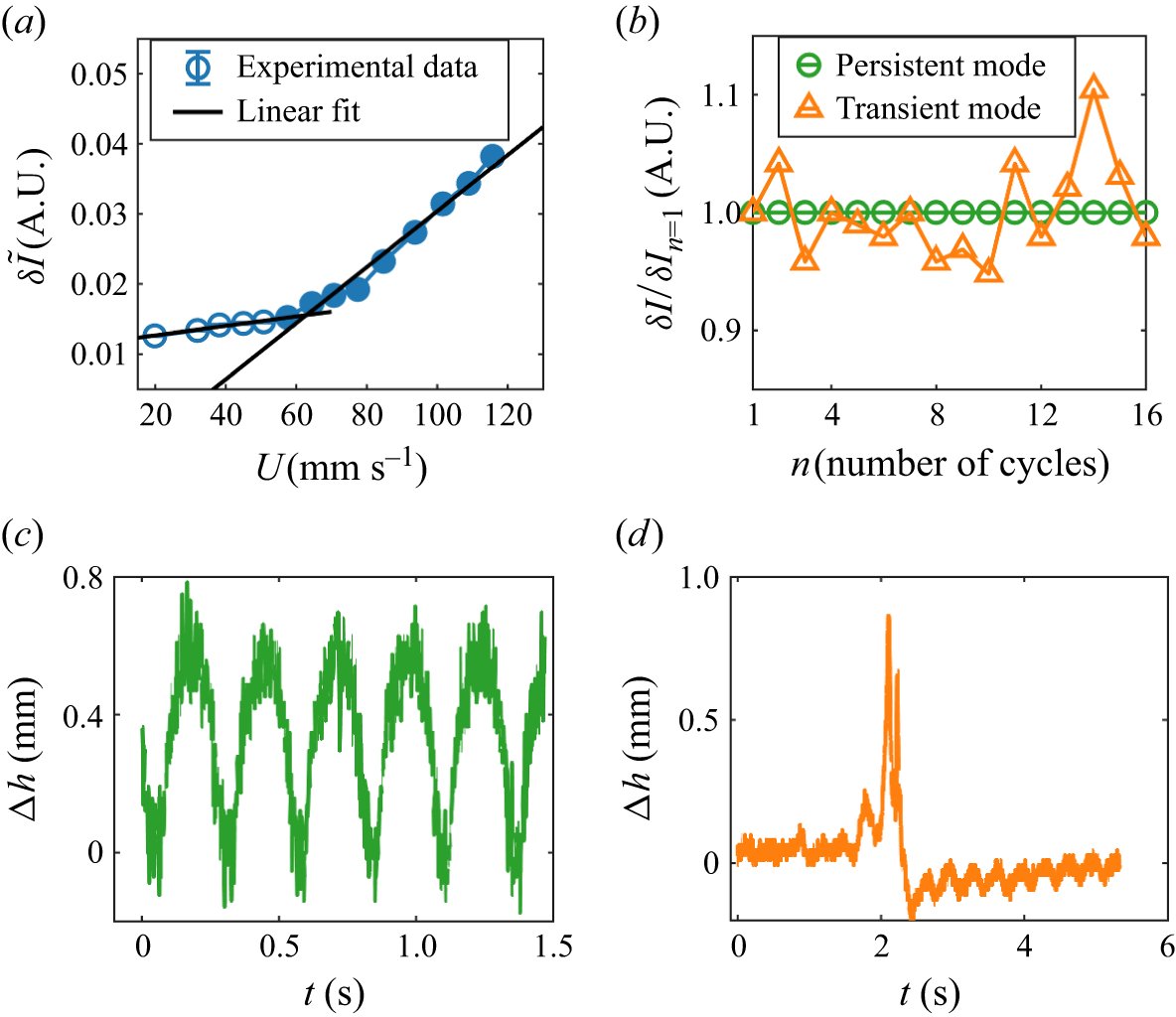
, is used to characterise the heterogeneous states. Figure 6(a) shows the variation of
$\delta \widetilde {I}$
, is used to characterise the heterogeneous states. Figure 6(a) shows the variation of $\delta \widetilde {I}$
as a function of the driving velocity
$\delta \widetilde {I}$
as a function of the driving velocity $U$
. The critical point, which separates the uniform and heterogeneous states, is defined by the intersection of two linearly fitted branches of
$U$
. The critical point, which separates the uniform and heterogeneous states, is defined by the intersection of two linearly fitted branches of $\delta \widetilde {I}(U)$
. In the uniform regime, the gradual increase of
$\delta \widetilde {I}(U)$
. In the uniform regime, the gradual increase of $\delta \widetilde {I}$
is associated with the sidewall effects. Beyond the critical point, the rapid increase in
$\delta \widetilde {I}$
is associated with the sidewall effects. Beyond the critical point, the rapid increase in $\delta \widetilde {I}$
is dominated by the spontaneous bulk heterogeneity.
$\delta \widetilde {I}$
is dominated by the spontaneous bulk heterogeneity.
(a) Spatial standard deviation of the transmitted light intensity as a function of the driving velocity $U$
. Open circles indicate the homogeneous state, whereas filled circles correspond to the heterogeneous state. The critical point is determined from the intersection of two fitted branches of
$U$
. Open circles indicate the homogeneous state, whereas filled circles correspond to the heterogeneous state. The critical point is determined from the intersection of two fitted branches of $\delta \widetilde {I}(U)$
. (b) Time sequences of
$\delta \widetilde {I}(U)$
. (b) Time sequences of $\delta I_t$
for persistent (green) and transient (orange) inhomogeneities. The values are averaged over each oscillation cycle. (c) Time series of interface deformation for the persistent heterogeneities. (d) Time series of interface deformation for the transient heterogeneities.
$\delta I_t$
for persistent (green) and transient (orange) inhomogeneities. The values are averaged over each oscillation cycle. (c) Time series of interface deformation for the persistent heterogeneities. (d) Time series of interface deformation for the transient heterogeneities.

The heterogeneous states exhibit two distinct types: persistent and transient. Figure 6(b) shows representative $\delta I_t$
evolutions of these two types. In the persistent mode (green circles), the standard deviation remains constant over successive oscillation cycles
$\delta I_t$
evolutions of these two types. In the persistent mode (green circles), the standard deviation remains constant over successive oscillation cycles $n$
. However, in the transient mode (orange triangles), it exhibits pronounced fluctuations, reflecting the intermittent formation and dissolution of heterogeneous patterns. The autocorrelation of
$n$
. However, in the transient mode (orange triangles), it exhibits pronounced fluctuations, reflecting the intermittent formation and dissolution of heterogeneous patterns. The autocorrelation of $\delta I_t$
can thus be used to define the lifetime of transient heterogeneities. This distinction is further corroborated by the time series of interface deformation at a fixed position. As shown in figures 6(c) and 6(d), a persistent heterogeneous state leads to periodic interfacial deformation (panel c), whereas a transient event results in only a short-lived deformation (panel d).
$\delta I_t$
can thus be used to define the lifetime of transient heterogeneities. This distinction is further corroborated by the time series of interface deformation at a fixed position. As shown in figures 6(c) and 6(d), a persistent heterogeneous state leads to periodic interfacial deformation (panel c), whereas a transient event results in only a short-lived deformation (panel d).








 Open access

