




Introduction
Uzbek (ISO 639-1: uz) is a Turkic language spoken mainly in Uzbekistan, where the language is accorded the ‘state language’ status (Figure 1). Outside Uzbekistan, ethnic Uzbek populations are scattered across and beyond Central Asia in such countries as Afghanistan, Tajikistan, Kyrgyzstan, Kazakhstan, China, and Saudi Arabia (Balcı, Reference Balcı2004; Yakup, Reference Yakup, Robbeets and Savelyev2020:411). Many Uzbeks in the diaspora speak one or more languages in addition to Uzbek for interethnic communication (Naby, Reference Naby1984:11). Some ethnic Uzbek communities are reportedly being linguistically assimilated to ethnic groups that are dominant in their countries or regions (Shalinsky, Reference Shalinsky1979:12–13; Fevzi, Reference Fevzi2013:256; Yıldırım, Reference Yıldırım2019:64). It is therefore unclear exactly what proportion of ethnic Uzbeks retain Uzbek as their first language today. In the case of ethnic Uzbeks in Xinjiang in China, gauging the extent of linguistic assimilation can be difficult because of the limited range of contrasting features that exist between their variety of Uzbek and Uyghur, the interethnic language of Xinjiang, with which it is generally mutually intelligible (Cheng & Abudureheman, 1987:1–2). The varieties of Uzbek spoken in Afghanistan and China have developed autonomously from those spoken within the borders of the former Soviet Union, and hence differ from the present-day standard Uzbek of Uzbekistan, a former Soviet republic, most notably in lexica but also in phonology, morphology, and syntax (Jarring, Reference Jarring1938; Abdullaev, Reference Abdullaev1979: Reichl, Reference Reichl1983; Cheng & Abudureheman, 1987; Hayitov et al., Reference Hayitov, Sobirov and Legay1992:36; Gültekin, Reference Gültekin2010).
Map of the main area where Uzbek is spoken.

The language variety whose phonology is described in the present article is the standardized variety of Uzbek used in Uzbekistan, where it is a preferred medium of official communication. Many Soviet (Rešetov, Reference Rešetov1964:21; Guljamov, Reference Guljamov1968:8; Shoabdurahmonov, Reference Shoabdurahmonov1976:7; Maxmudov, Reference Maxmudov1986:16; Rajabov, Reference Rajabov1996:26) and non-Soviet (Sjoborg, Reference Sjoborg and Poppe1962:237; Laude-Cirtautas, Reference Laude-Cirtautas1977:41; Waterson, Reference Waterson1980:xiv; Shōgaito, Reference Shōgaito, Kamei, Kōno and Chino1988) scholars have effectively concurred in taking the dialect of Tashkent to be the primary basis of standard Uzbek fonetika ‘phonetics/phonology’ and orfoepija ‘orthoepy’. Attempts at shifting the basis of standard pronunciation away from the Tashkent dialect (Kamol, Reference Kamol1957:14; Rasulov et al., Reference Rasulov, Doniyorov and Hojiev1980:21–22; Sodiqov et al., Reference Sodiqov, Abduazizov and Irisqulov1981:68) emerged continually during Soviet times, but seem to have largely receded in post-Soviet Uzbekistan. Accordingly, all but one of the recordings accompanying the present article are from a speaker of Tashkent Uzbek.Footnote 1 The speaker (henceforth referred to simply as ‘the main informant’) is male, and was born in 1994. He had resided in the Chilonzor district of Tashkent for 21 years since the age of three before moving out of the city in 2018, when the recordings were made. As with most Uzbek speakers brought up in Tashkent, he is fluent in Russian.
Consonants


The digraphs ‹ch›, ‹sh›, and ‹ng› each represent a single phoneme in Uzbek orthography, as does ‹g‘›, in which the inverted comma serves as a kind of diacritic indicating both fricativization and uvularization.
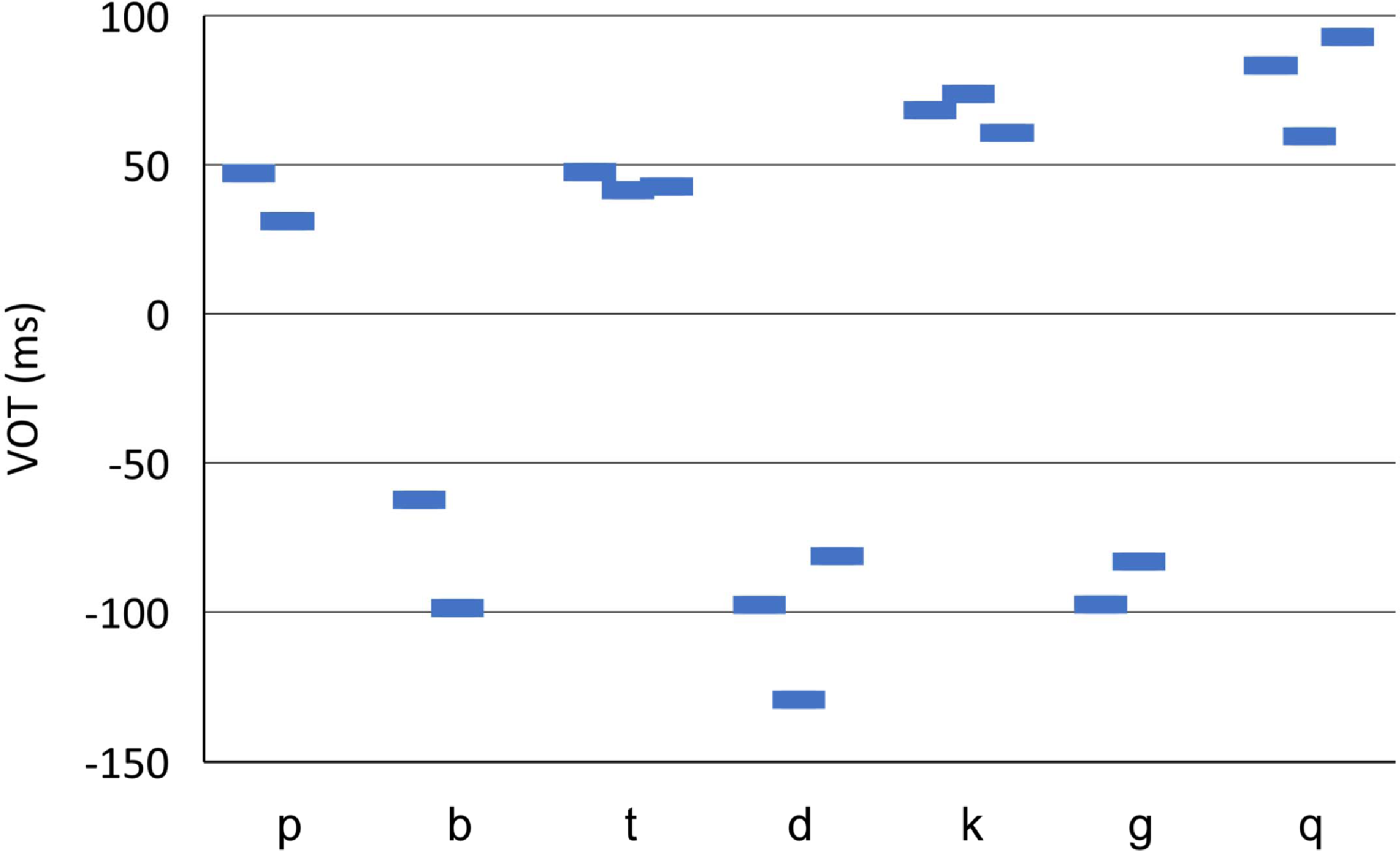
Voice Onset Time (VOT) discriminates between word-initial voiced and voiceless plosives, with the latter set of plosives showing VOT values indicative of a degree of aspiration (Figure 2). The limited amount of data considered here precludes one from drawing firm conclusions about VOT in Uzbek, though they seem to indicate the commonly reported effect of place of articulation on VOT values (Lisker & Abramson, Reference Lisker and Abramson1964) for voiceless plosives.
VOT values of the word-initial plosives in the test words of /peɕ/, /beɕ/, /tɔɾ/, /dɔɾ/, /koɾ/, /ɡoɾ/, and /qoɾ/ as produced by the main informant. Each bar represents a single token/repetition.

The velar plosives /k/ and /ɡ/ in native Uzbek words and loanwords nativized in Uzbek are normally palatalized to [kʲ] and [ɡʲ], respectively, before underlying (/i/, /e/, /ɜ/, /a/) or inserted ([ĭ]; see ‘vowels’) non-back vowels, or where the plosive closure is released in word-final position. Hence, for example, there is palatalization of velar plosives in such words as /kam/ [kʲam] ‘insufficient’, /ɡap/ [ɡʲap] ‘talk’, /teɡdɜ/ [teɡʲ̆dɜ] ‘s/he touched’, in which [ĭ] is an inserted vowel, /buɾt͡ɕak/ [buɾt͡ɕakʲ] ‘corner’, and /keɾak/ [kʲeɾakʲ] ‘necessary’.
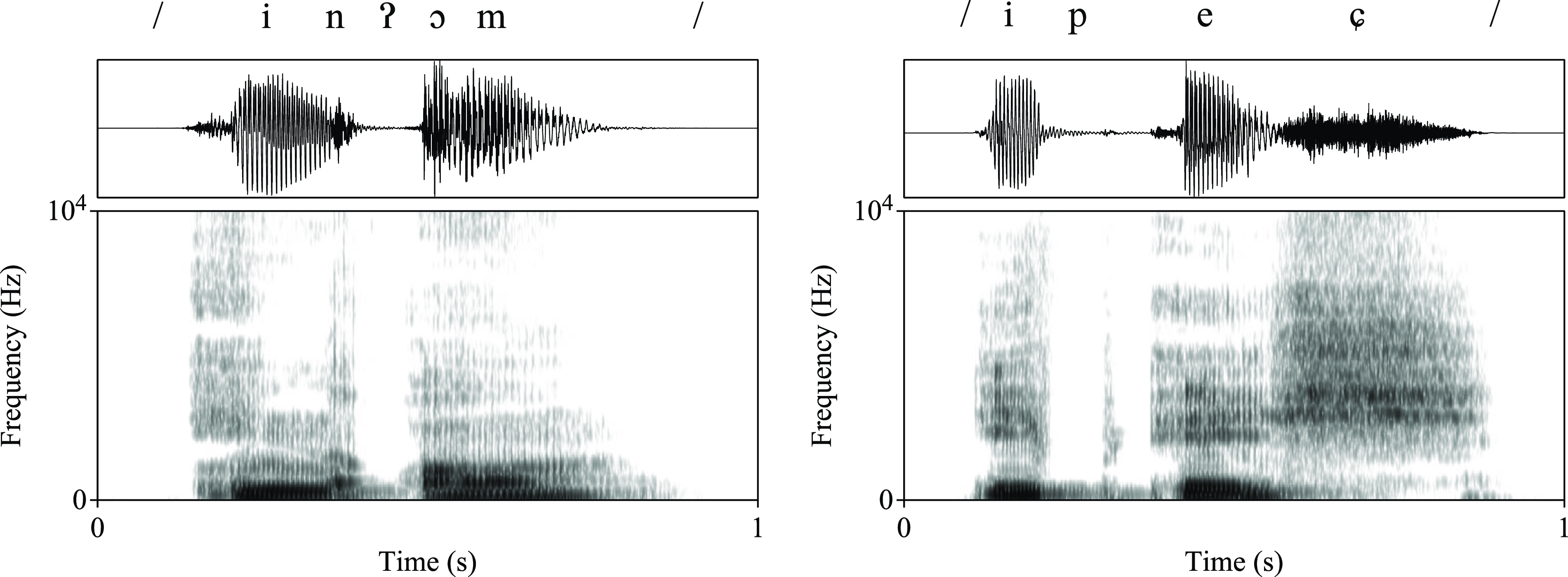
The glottal plosive /Ɂ/ distinguishes few minimal pairs. Its occurrence is limited to a fairly small proportion of loanwords from Arabic whose orthographic representations contain the sequence of a letter, the ‹’› symbol, and a vowel letter, such as san’at /sanɁat/ ‘art’ and in’om /inɁɔm/ ‘gift’ (Figure 3: left side). Note, however, that ‹’› in Uzbek orthography is not a representation of the glottal plosive but is merely a transliteration of Arabic word-medial ‘ayn ‹ع› and hamza ‹ء›, which represent /ʕ/ and /Ɂ/, respectively, in Arabic orthography. Thus, ‹’› may represent not /Ɂ/ but /ː/ when it appears after a vowel letter, or may represent no sound or phonetic feature whatsoever (Tog‘ayev et al., Reference To‘lqin, Tavaldiyeva and Akromova2012:36–37). Non-phonemic [Ɂ] or glottal constriction optionally precedes the word-initial vowel for marking phrase and prosodic boundaries (Figure 3: right side).
in’om /inʔɔm/ ‘gift’ (left), in which a glottal closure/constriction precedes the second vowel for signalling the presence of word-medial ‘ayn ‹ع› in the source language, and /ip eɕ/ [ipʔeɕ] ‘weave (a) thread(s)!’ (right), in which /eɕ/ ‘weave!’ is preceded by a boundary-marking glottal closure.

The velar nasal /ŋ/ does not occur in word-initial position. In careful speech, word-final /ŋ/ can be produced with an audible release burst of the velar closure, as can be observed in the recording of /ɔŋ/ ‘consciousness’.
The phoneme /ɾ/ does not occur word-initially in native Uzbek words. In non-word-initial position, /ɾ/ occurs in both loanwords and native words. Word-initial /ɾ/, which occurs only in loanwords, is realized as [ɾ] or [r], but can also be realized as [ɾ̥̝] (as in the main informant’s pronunciation of /ɾɔl/ ‘role’) or [r̥̝], though the latter are apparently considered less standard. Word-finally, /ɾ/ is usually realized as a trill, as it is in the main informant’s pronunciation of /ɡoɾ/ ‘tomb’. Word-final /ɾ/ can also be either fully or partially devoiced, and can accompany frication (Klimenko, Reference Klimenko1958:53), as it is in the main informant’s pronunciation of /koɾ/ ‘blind’. The trill component of the rhotic is often lost in its word-final realization, leaving only its fricative component intact. The recording of /bɔɾ/ ‘existent’ produced by the main informant exemplifies this type of fricative realization.
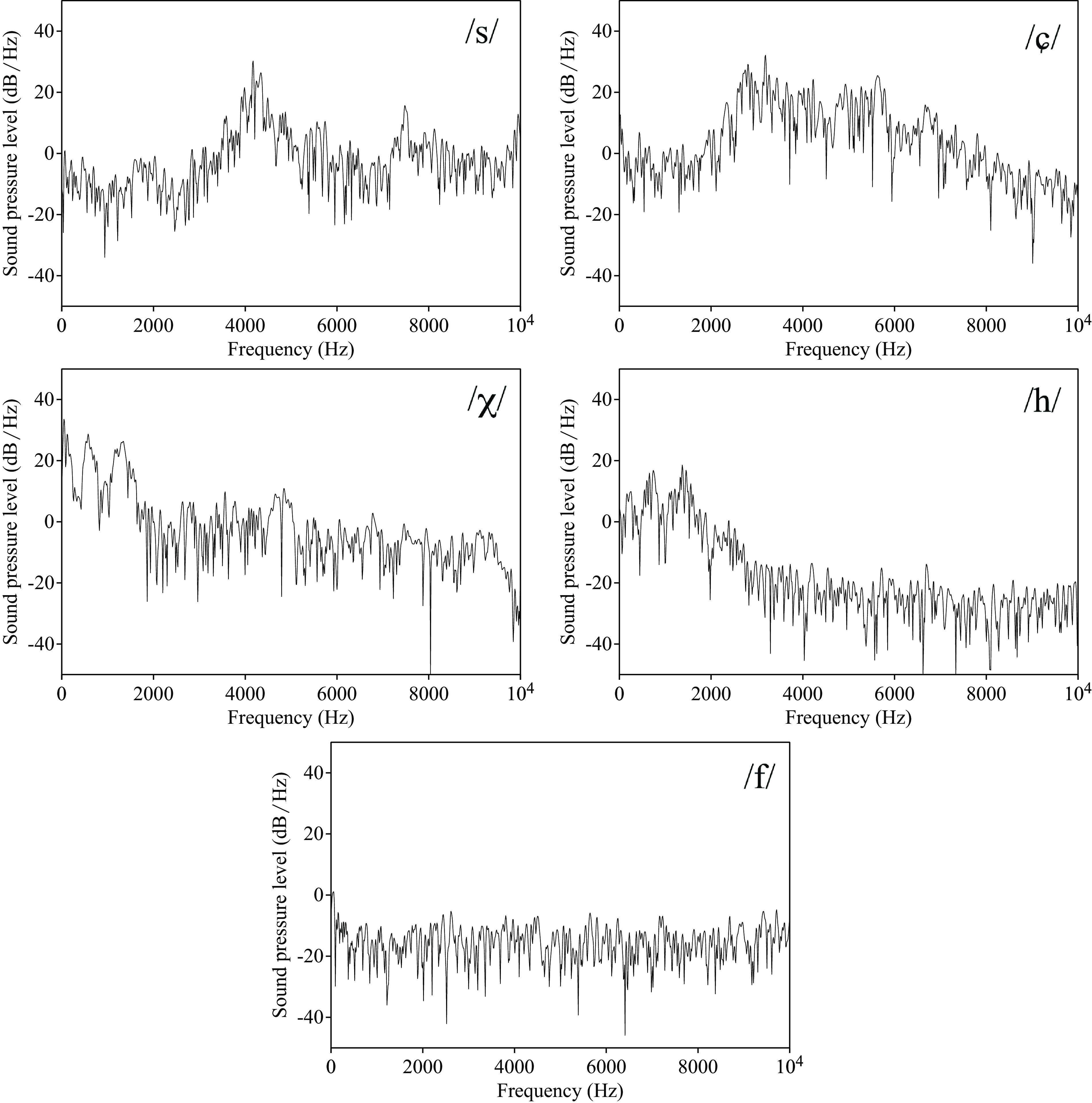
Tashkent Uzbek traditionally lacks a contrast between standard Uzbek /χ/ and /h/ (Rajabov, Reference Rajabov1996:83). The main informant makes this distinction in his careful pronunciation (Figure 4), but often realizes /h/ as [x], as he does in the recording of /vahm/ [vaxɜˇm] ‘fright’ accompanying this article.
Spectra of word-initial /s/, /ɕ/, /χ/, /h/, and /f/ in the test words of /sɔl/, /ɕɔl/, /χam/, /ham/, and /fahm/ as produced by the main informant. Each spectrum was computed from a 40 ms window centred around the beginning to middle of each fricative to reduce coarticulation effects.

A number of descriptive works published in the twentieth century, such as Borovkov (Reference Borovkov1959:682), Rešetov (Reference Rešetov1959:212–214), Kononov (Reference Kononov1960:28–29), and Ismatullaev (Reference Ismatullaev1991:20), endorse the phonemic status of both /ɸ/, the voiceless bilabial fricative, and its voiced counterpart /β/. However, in today’s standard Uzbek, the bilabial fricatives seem to be in the process of being replaced by their labiodental counterparts, namely /f/ and /v/ (Abdurahmonov, Reference Abdurahmonov1992:26; Hamroyev, Reference Hamroyev2004:25; Otamirzayeva & Yusupova, Reference Otamirzayeva and Yusupova2004:40; Matkarimova et al., Reference Matkarimova, Mamatqulova and Mamatjanova2013:10–11), possibly under the influence of Russian, whose own labial fricatives are labiodental. The bilabial fricative [ɸ] is still in use in Uzbekistan at large. For instance, monolingual Uzbek speakers in Bukhara can often be distinguished by their use of [ɸ] from Tajik-dominant Bukharan bilinguals who typically use [f] instead of [ɸ] in their speech. However, in recent decades, [ɸ] appears to be only equivocally perceived as the standard pronunciation for the Uzbek voiceless labial fricative phoneme.
A number of descriptive and pedagogical treatments, including Kissen (Reference Kissen1952:19, 74–76), Borovkov (Reference Borovkov1959:682), Kononov (Reference Kononov1960:30), Safaev (Reference Safaev1965:12), and Ismatullaev (Reference Ismatullaev1991:16), mention ‘softness’, i.e., palatalization, with regard to Uzbek /ɕ/, /t͡ɕ/, and /d͡ʑ/ (or certain major allophones thereof), often putting it in contrast with the ‘hardness’ of Russian /ʃ/ and /ʒ/, which are characterized by posterior articulation and/or a lack of palatalization (Jones & Ward, Reference Jones and Ward1969:134, 137; Kamiyama, Reference Kamiyama2012; Yanushevskaya & Bunčić, Reference Yanushevskaya and Bunčić2015; Kochetov, Reference Kochetov2017). In particular, Kissen (Reference Kissen1952:74–75) describes the articulation of Uzbek /ɕ/ and /d͡ʑ/ as involving the tongue body being moved forward, the front-to-middle part of the tongue being raised towards the hard palate, and the tip of the tongue being lowered. These descriptions strongly suggest anterior tongue position, palatalization, and non-apical (laminal) articulation, for the phonemes.
However, the articulation of /ɕ/, /t͡ɕ/, and /d͡ʑ/ is subject to much inter- and intra-speaker variation, with these phonemes often being realized as [ʃ], [t͡ʃ], and [d͡ʒ]-like sounds, not only by some Tashkent Uzbek speakers but also by a number of newsreaders at the national television and radio broadcasting station. This synchronic variation precludes unequivocal identification of standard Uzbek /ɕ/, /t͡ɕ/, and /d͡ʑ/ as palatalized postalveolar consonants.
The fricative [ʑ] can occur as an allophone of /d͡ʑ/ where it precedes a plosive, e.g., in /ad͡ʑdaɾ/ [aʑdaɾ] ‘dragon’ as well as in some words of onomatopoeic origin. Otherwise, its occurrence is largely limited to loanwords from Russian.
The occurrence of the affricate /t͡s/ is limited to loanwords from Russian.
Vowels

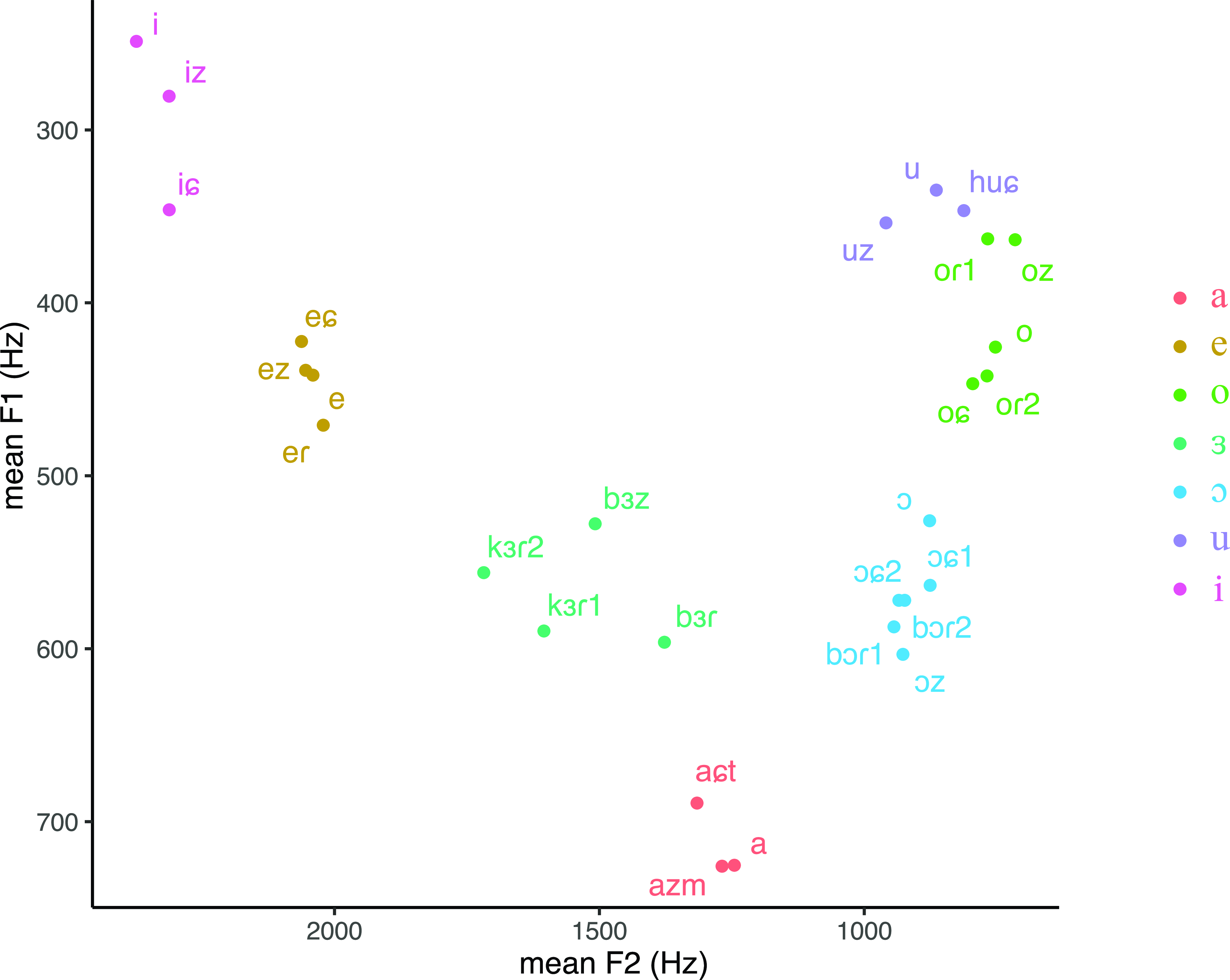
The vowels in the trapezoid above are placed so as to conform to the formant frequency values of the Uzbek vowel phonemes produced by the main informant (Figure 5).
F1 and F2 values of Uzbek vowels produced in isolation and of those vowels produced in isolated words by the main informant. Numbers suffixed to some of the words distinguish between homographs. Each point represents a mean of three to five tokens.Footnote 3 The test words that do not appear in the lists accompanying the consonant and vowel charts are /aɕt/ ‘Asht district’, /bɜɾ/ ‘one’, /bɔɾ/ ‘go!’ (bɔɾ1), /bɔɾ/ ‘existent’ (bɔɾ2), /eɾ/ ‘husband’, /eɕ/ ‘weave!’, /huɕ/ ‘sense’, /iɕ/ ‘matter’, /kɜɾ/ ‘enter!’ (kɜɾ1), /kɜɾ/ ‘dirt’ (kɜɾ2), /oɾ/ ‘braid!’ (oɾ1), /oɾ/ ‘mow!’ (oɾ2), /oɕ/ ‘Osh city’, /ɔɕ/ ‘exceed!’ (ɔɕ1), and /ɔɕ/ ‘pilav’ (ɔɕ2).

The inverted comma serves as a diacritic in ‹o‘›. The diacritic orthographically distinguishes ‹o‘› from ‹o› and indicates the greater closeness of /o/ as opposed to /ɔ/.
The vowels that are transcribed in the present description as /i/ and /ɜ/ distinguish no minimal pairs in standard Uzbek. It is therefore possible to identify them as allophones of a single phoneme, as in fact most textbooks and the current orthography of Uzbek do. The present description, on the other hand, recognizes their phonemic status on the basis of their phonetic distinctiveness and the existence of near-minimal pairs, of which there are not many, e.g., /iz/ ‘trace’ vs. /bɜz/ ‘we’ (see Figure 5). This practice is partly in line with that of Polivanov (Reference Polivanov1922), who proposes that seven vowel symbols including ‘i’ and ‘ə’ be used in transcribing Tashkent Uzbek.
In native Uzbek roots, /o/ occurs almost exclusively in root-initial syllables (Otamirzayeva & Yusupova, Reference Otamirzayeva and Yusupova2004:30). Some interjections which end in /o/ (Qo‘ng‘ulov, 1975) are exceptions to this rule.
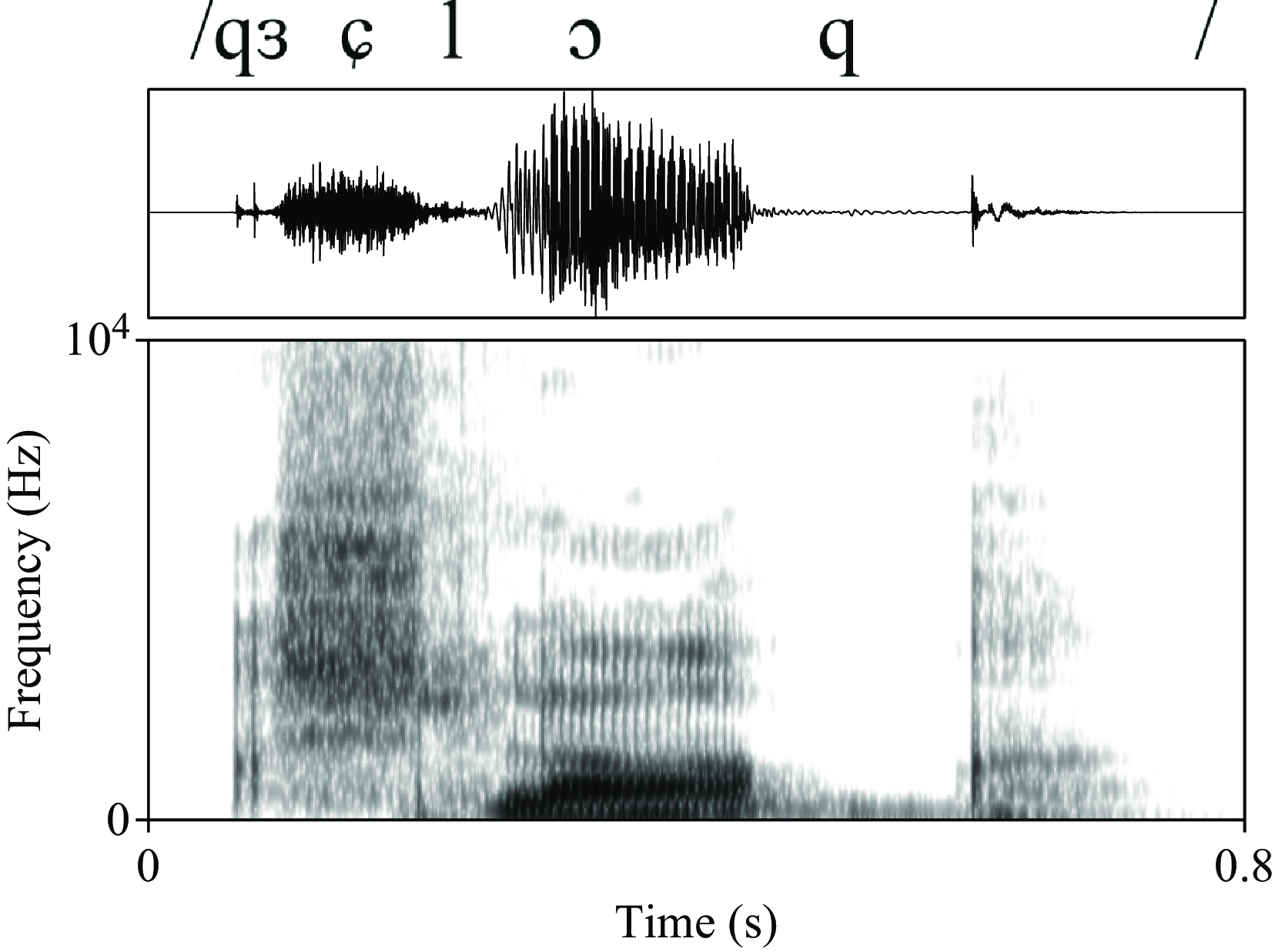
Close vowels and /ɜ/ are frequently devoiced when adjacent to voiceless consonants or are elided outright, especially in unstressed syllables. The elision of /u/ and /ɜ/ in /kut͡ɕli/ ‘strong’ in the ‘North Wind and the Sun’ passage and /qɜɕlɔq/ ‘village’ (Figure 6) serve as examples. They are also highly susceptible to coarticulatory effects from adjacent sounds. Hence, for instance, the close realization of /ɜ/ in the palatal context of /plaɕɜɡa/ [plaɕĭɡʲa] ‘to his/her cloak’ in the same passage.Footnote 4
Elision of /ɜ/ in /qɜɕlɔq/ ‘village’.

The phonetic realization of /ɔ/ ranges between [ɑ] and [ɔ̝]. This variability is observed among words, speakers, and even among utterances from a single speaker. Thus, for example, one speaker may produce [ɑt͡ɕ] and [bɔ̝ɾ] for /ɔt͡ɕ/ ‘hungry’ and /bɔɾ/ ‘existent’, for which another may produce [ɔt͡ɕ] and [bɔ̞ɾ]. Presumably because of this variability, some descriptions characterize the vowel phoneme as unrounded (Reshetov & Shoabdurahmonov, Reference Reshetov and Shoabdurahmonov1957:191; Doniyorov, Reference Doniyorov1980:51, 54) or as weakly rounded (Jamolxonov, Reference Jamolxonov2009:70).
Many Uzbek dialects have front rounded vowels that contrast with back rounded vowels (Reshetov & Shoabdurahmonov, Reference Reshetov and Shoabdurahmonov1978:45–46). Such dialects, which are geographically widely distributed across and beyond Uzbekistan, also exist in some non-urban areas within the Tashkent region (Rešetov, Reference Rešetov1952; Shoabdurahmonov, Reference Shoabdurahmonov1976). Perhaps owing to the existence of such dialects, some descriptive treatments of Uzbek postulate a phonological backness contrast in the non-dialectal (standard) variety (e.g., Coşkun, Reference Coşkun2000:2–5; To‘ychiboev & Hasanov, Reference To‘ychiboev and Hasanov2004:45; Yakup, Reference Yakup, Robbeets and Savelyev2020:414). Such treatments postulate that Uzbek has [ø]/[Œ]/[ө]-like and [y]-like front rounded vowel phonemes, which they often transcribe as ‘ö’ and ‘ü’, as is customary among Turkologists. Thus, for example, Boeschoten (Reference Boeschoten, Johanson and Csató1998:358) writes in his description of Uzbek that ‘there are minimal pairs such as bol- ‘become, be’ vs. böl- ‘divide’ and uč ‘extremity’ vs. üč ‘three’’.
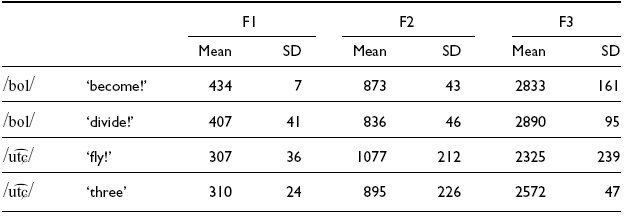
Contrary to this observation, a formant frequency analysis of the close and close-mid rounded vowels produced by the main informant in the test words /bol/ ‘become!’ and /bol/ ‘divide!’, and in /ut͡ɕ/ ‘fly!’ and /ut͡ɕ/ ‘three’,Footnote 5 found no clear or consistent distinction between them (Table 1). This indicates that they are homophonemic in Tashkent Uzbek, hence their identical phonemic transcriptions (/bol/ and /ut͡ɕ/) in the present article and identical orthographic representations (bo‘l and uch) in standard Uzbek. Note that if the backness contrast existed in his speech, the vowels in /bol/ ‘divide!’ and /ut͡ɕ/ ‘three’ would be front vowels with high F2 values and would contrast in backness—and hence also in formant frequency values—with those in their homographic counterparts, namely /bol/ ‘become!’ and /ut͡ɕ/ ‘fly!’.
Mean formant frequency values in Hz of the vowels in two homographic word pairs (three to four tokens per word) produced by the main informant

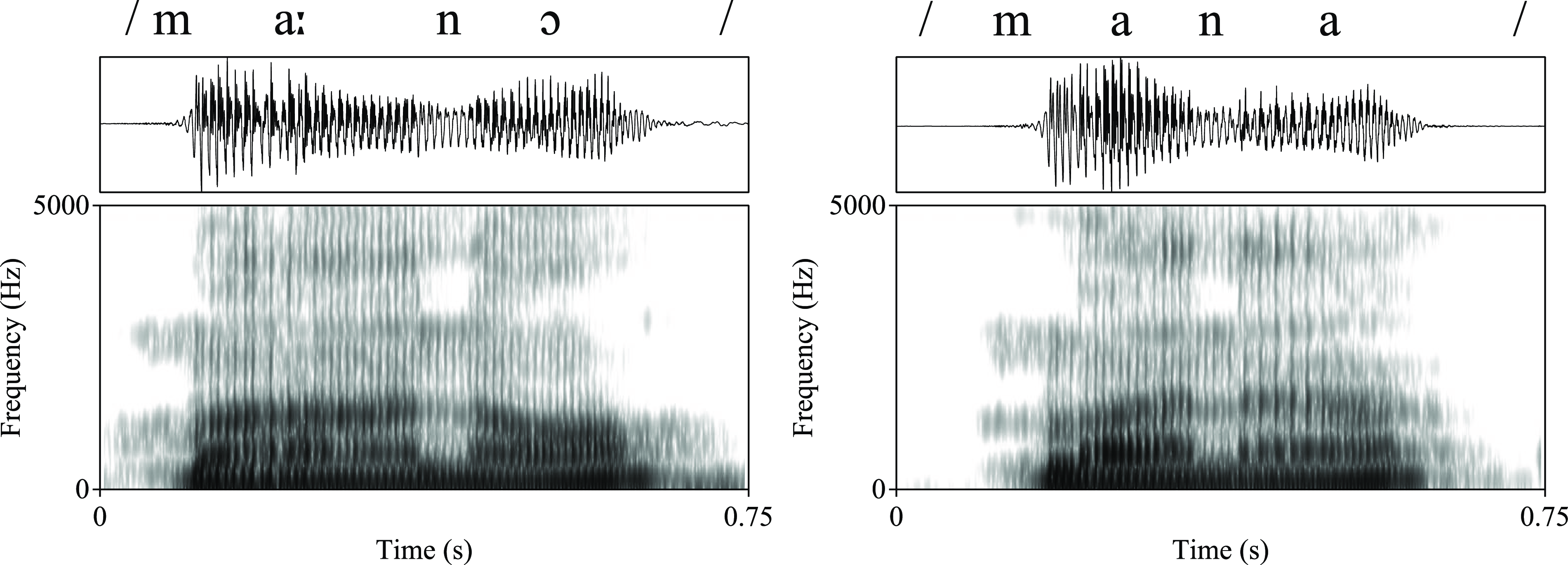
Vowel lengthening occurs in a number of words of foreign origin, though it distinguishes few minimal pairs. For example, /aː/ in /maːqul/ ‘acceptable’ and /maːnɔ/ ‘meaning’, both of which are loanwords, contrasts in length with /a/ in /maqɔl/ ‘proverb’, another loanword, and /mana/ ‘here; look’ (Figure 7). Some instances of vowel lengthening in Arabo-Persian loanwords are orthographically indicated with ‹’›, as in ma’qul /maːqul/ and ma’no /maːnɔ/, where the sequence of ‹a› and ‹’› represents /aː/.
ma’no /maːnɔ/ ‘meaning’ (left), an Arabo-Persian loanword, and mana /mana/ ‘here; look’ (right).

Vowel length distinction in words of native origin exists in a number of Uzbek dialects (Tekin, Reference Tekin1995), such as those spoken in the Khorezm and Iqon-Qorabuloq areas (Abdullaev, Reference Abdullaev1961; Abdullaev, Reference Abdullaev1967; Dobos, Reference Dobos1974; Reshetov & Shoabdurahmonov, Reference Reshetov and Shoabdurahmonov1978:47; Madrahimov, Reference Madrahimov1999). As for Tashkent Uzbek, an Uzbek linguist/folklorist from Tashkent made a claim in 1935 that his native variety had two long (close) vowel phonemes in addition to having six short vowel phonemes (Junus, Reference Junus1935:15). In addition, some dialects spoken in the vicinity of Tashkent, namely in and around Qoraxitoy in the Tashkent region, also reportedly utilize long vowels in native Uzbek words (Shoabdurahmonov, Reference Shoabdurahmonov1976:10), though it is unclear whether their length is phonological.
Perhaps contrary to what might be expected based on these facts, vowel length in native words is not phonological in present-day Tashkent Uzbek or in standard Uzbek. No consistent native vowel length distinction is observed in the main informant’s speech. For example, /bɔɾ/ ‘go!’ vs. /bɔɾ/ ‘existent’ and /ot͡ɕ/ ‘fade !’ vs. /ot͡ɕ/ ‘vengeance’, which would be heterophonemic word pairs in most of the aforementioned dialects, with the first member of the pair having a shorter vowel than the second, are pronounced as homophonemic pairs by the main informant.Footnote 6
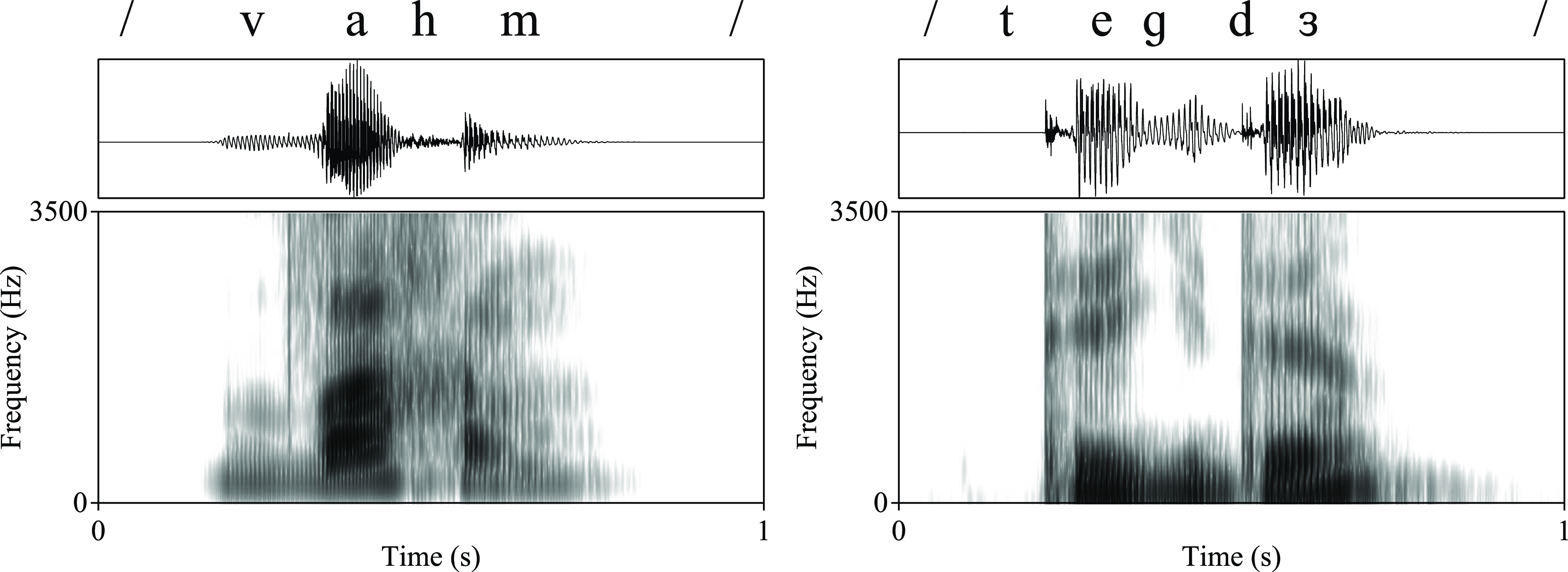
Vowel insertion rarely receives mention in the Uzbek linguistic literature except in relation to vowel epenthesis in loanwords (Kononov, Reference Kononov1960:47–49; Figure 8: left side). However, insertion of vowels in Uzbek is not limited to loanwords. It also takes place in native Uzbek words, though little is known about what motivates it or what determines the quality of the inserted vowel. The audio data elicited from the main informant contain some instances of native Uzbek vowel insertion, of which /teɡdɜ/ [teɡʲĭdɜ] ‘s/he touched’ contains a relatively well-defined and clearly audible inserted vowel (Figure 8: right side).
/vahm/  ‘fright’, an Arabo-Persian loanword, in which the consonant cluster is broken up by an epenthetic vowel (left),Footnote 7 and /teɡdɜ/
  ‘s/he touched’, in which a front vowel occurs between the two voiced plosives (right). /teɡdɜ/ consists entirely of native Uzbek morphemes, thus /teɡ/-/dɜ/ ‘touch-pst.3’.

All the instances of vowel insertion are found in consonant clusters formed at syllable/morpheme boundaries where a velar or uvular plosive is followed by a consonant produced with a more anterior articulation, e.g., in /teɡmɔq/ [teɡʲĭmɔq] ‘to touch’ (/teɡ/-/mɔq/ ‘touch-inf’) and /jɔqdɜ/ [jɔqəˇdɜ] ‘it was to someone’s liking’ (/jɔq/-/dɜ/ ‘be of one’s liking-pst.3’).Footnote 8 This apparent bias towards heterorganic ‘posterior-to-anterior’ consonant clusters and the acoustic variability of the inserted vowels may lead one to a cautious speculation that native Uzbek vowel insertion results from minimization of gestural overlap in the clusters (Chitoran et al., Reference Chitoran, Goldstein, Byrd, Gussenhoven and Warner2002; Hall, Reference Hall2006:407–410). However, the limitations of the data and the fact that native Uzbek vowel insertion is as yet an unexplored topic preclude any general discussion of the phenomenon.
Suprasegmental features
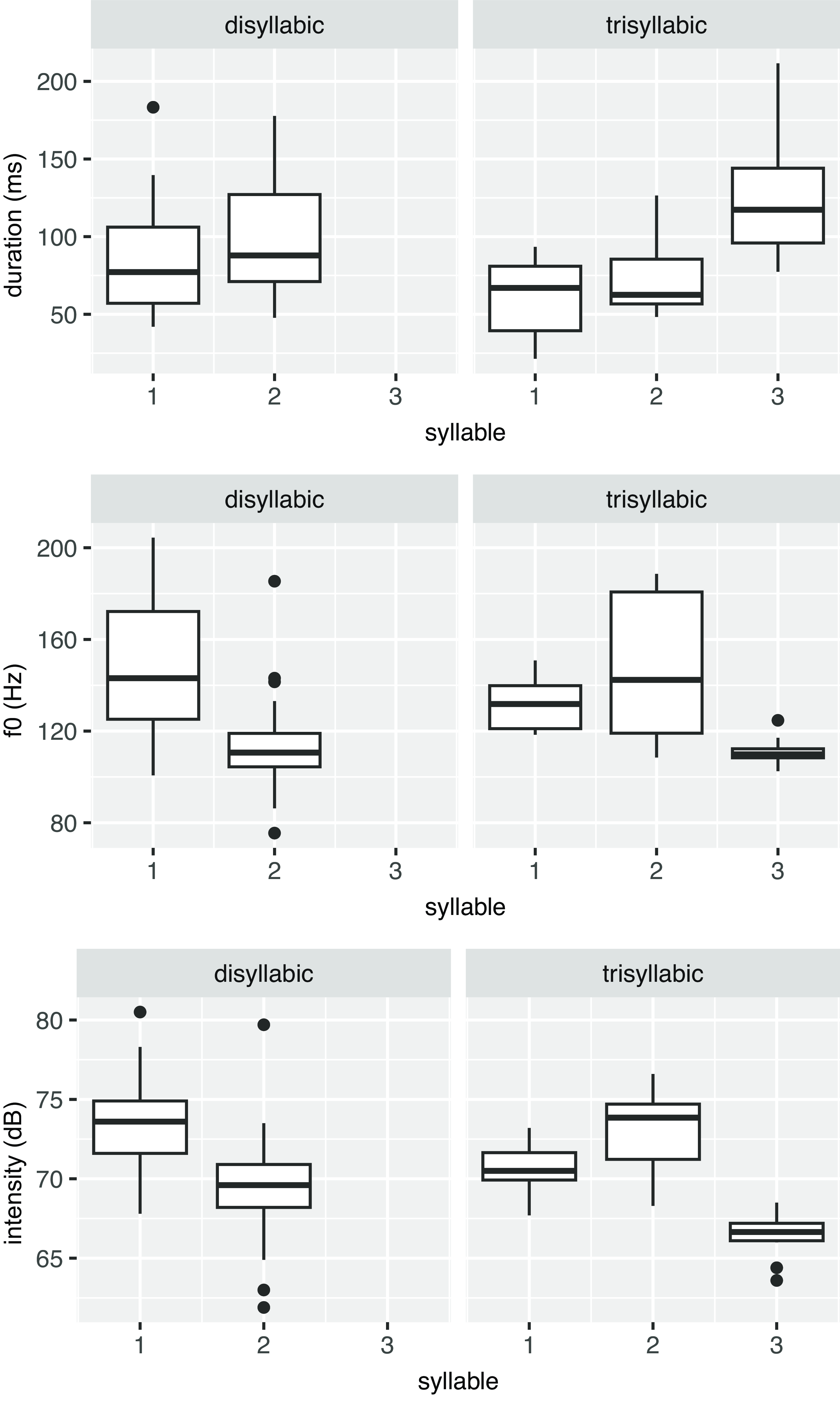
Figure 9 shows three acoustic measurements (duration, mean f0, and mean intensity) taken from the vocalic portions of disyllabic and trisyllabic native Uzbek words recorded in citation form. The words, which the main informant read from a word list, are of different word classes and comprise mono- and multi-morphemic nouns, pronouns, verbs, and participles. It can be observed in Figure 9 that the vowel duration increases in the final syllable and that both the mean frequency and mean intensity are the highest on the penultimate syllable.
Duration, mean fundamental frequency, and mean intensity measures obtained from vocalic portions of syllables in 22 disyllabic and 5 trisyllabic native Uzbek words produced in citation form. The numbers of tokens are 82 for disyllabic words and 30 for trisyllabic words.

Given that previous descriptions of Uzbek are unanimous in locating the primary lexical stress on the final syllable (Kononov, Reference Kononov1960; Sjoborg, Reference Sjoborg and Poppe1962; Bodrogligeti, Reference Bodrogligeti2003), one potentially feasible interpretation of these observations is that vowel duration correlates with lexical stress in native Uzbek words and/or that certain acoustic properties (such as a high f0) of the penultimate syllable contribute to the perceived prominence of the final syllable. However, only words with canonical (final) stress are analysed in this study, due to the scarcity of words with non-canonical stress in the recorded speech of the main informant.Footnote 9 They were also read aloud in isolation. The observed increase in vowel duration could therefore be due to phrase-final lengthening rather than stress, and the penultimate rise in f0 might also result from intonational phenomena such as pitch accents. Future studies are therefore needed to clarify which acoustic properties correlate with lexical stress in Uzbek. In this respect, it may be worth noting that the aforementioned observations align with Athanasopoulou et al.’s (Reference Athanasopoulou, Vogel and Dolatian2020:7–8) findings on Uzbek lexical stress. Their findings are that the vowel in the final syllable is longer than the vowels in the preceding syllables and that f0 is raised in the penultimate syllable (intensity is not examined in their study). Like the present study, Athanasopoulou et al. (Reference Athanasopoulou, Vogel and Dolatian2020) obtained their results from words with canonical (final) stress. Unlike in the present analysis, the words they analysed consist of trisyllabic nouns that occur sentence-medially, within a noun phrase, and as the initial component of a compound noun. The fact that similar results are obtained across these two studies may suggest that Athanasopoulou et al.’s two findings on lexical stress in Uzbek are consistent across certain different phrasal and/or syllabic contexts.
Words which are identified in the literature as having non-canonical stress include some proper names, loanwords, and interrogative pronouns. Uzbek linguists are in agreement that certain morphemes repel stress. A list of such stress-repellent morphemes is found in Bodrogligeti (Reference Bodrogligeti2003:41–43). Some stress-repellent suffixes share their morphemic and orthographic representations with other suffixes that do not repel stress. As a result, there are pairs of words derived from the same stem which are distinguished only by stress. Some textbooks (e.g., Oripov & Obidova, Reference Oripov and Obidova1994:49; Andaniyozova et al., 2012:34) contain (non-exhaustive) lists of such word pairs.
Tashkent Uzbek, and hence also standard Uzbek, exhibit very limited vowel harmony. The near-absence of vowel harmony in Tashkent Uzbek is often ascribed to language contact in Central Asia, where Turkic languages, most of which are harmonizing languages, have been in contact with non-harmonizing Iranian languages for centuries (Polivanov, Reference Polivanov1926:19; Polivanov, Reference Polivanov1933; Menges, Reference Menges1945). The deverbalizing suffix which may be realized as [q, ɜq, oq, uq] depending on phonological context is one of the few affixes that exhibit vestiges of harmony in standard Uzbek, with [uq] being invariably preceded by a stem-final syllable containing /u/.
The North Wind and the Sun (Orthography)
Bir kun shimoliy shamol va quyosh qaysi biri kuchliroq ekanligi o‘rtasida tortishib qolishibdi. Shu paytda ularning ko‘zi plashga o‘ranib yo‘lda ketayotgan yo‘lovchiga tushib, qaysi biri yo‘lovchining plashini birinchi yechishga majbur etsa, o‘sha kuchli hisoblanadi deb kelishibdi. Shunda shimoliy shamol bor kuch-qudrati bilan esishni boshlabdi-yu, lekin shamol qanchalik kuchayganligi sari, yo‘lovchi ham shunchalik o‘z plashiga o‘ranib olibdi va shamol o‘z fikridan qaytishga majbur bo‘libdi. Shunda quyosh porlab chiqibdi va yo‘lovchi asta-sekin isib, tezda plashini yechib olibdi. Shunday qilib, shimoliy shamol quyoshning undan kuchli ekanligini tan olishga majbur bo‘libdi.
The North Wind and the Sun (Phonemic transcription and morphemic gloss)


The North Wind and the Sun (Free translation)
One day, the North Wind and the Sun were disputing which of them was stronger. At that moment, they noticed a passenger who was walking down the road wrapped in a cloak, and they agreed that the one who made the passenger take off his cloak first would be judged the stronger. Then the North Wind began to blow with all its might, but the stronger the wind, the more tightly the passenger wrapped himself in his cloak, and the Wind was forced to abandon this attempt (lit. its idea). Then the Sun shone (in a thorough manner) and the passenger gradually warmed up and soon took off his cloak (to his benefit). Thus, the North Wind was compelled to admit that the Sun was the stronger of the two (lit. stronger than it).
Acknowledgements
I gratefully acknowledge the help of Damira Tinchurina, Alisher Umirdinov, and other informants from Uzbekistan who participated in this study. This research benefited greatly from comments by Marc Garellek, Shinsuke Hidaka, Alan Libert, Adam McCollum, Marija Tabain, and an anonymous JIPA reviewer, and was partially supported by MEXT KAKENHI (25370490) and JSPS KAKENHI (22K00527).
Supplementary material
To view supplementary material for this article, please visit https://doi.org/10.1017/S0025100324000148
 here resulted from Uzbek or Turkic vowel epenthesis, based on the following admittedly circumstantial evidence: 1) New Persian varieties, through which Uzbek is considered to have borrowed the majority of its loanwords from Arabic, permit a wide variety of consonant clusters in the coda position (Xaskašev
  is partially devoiced.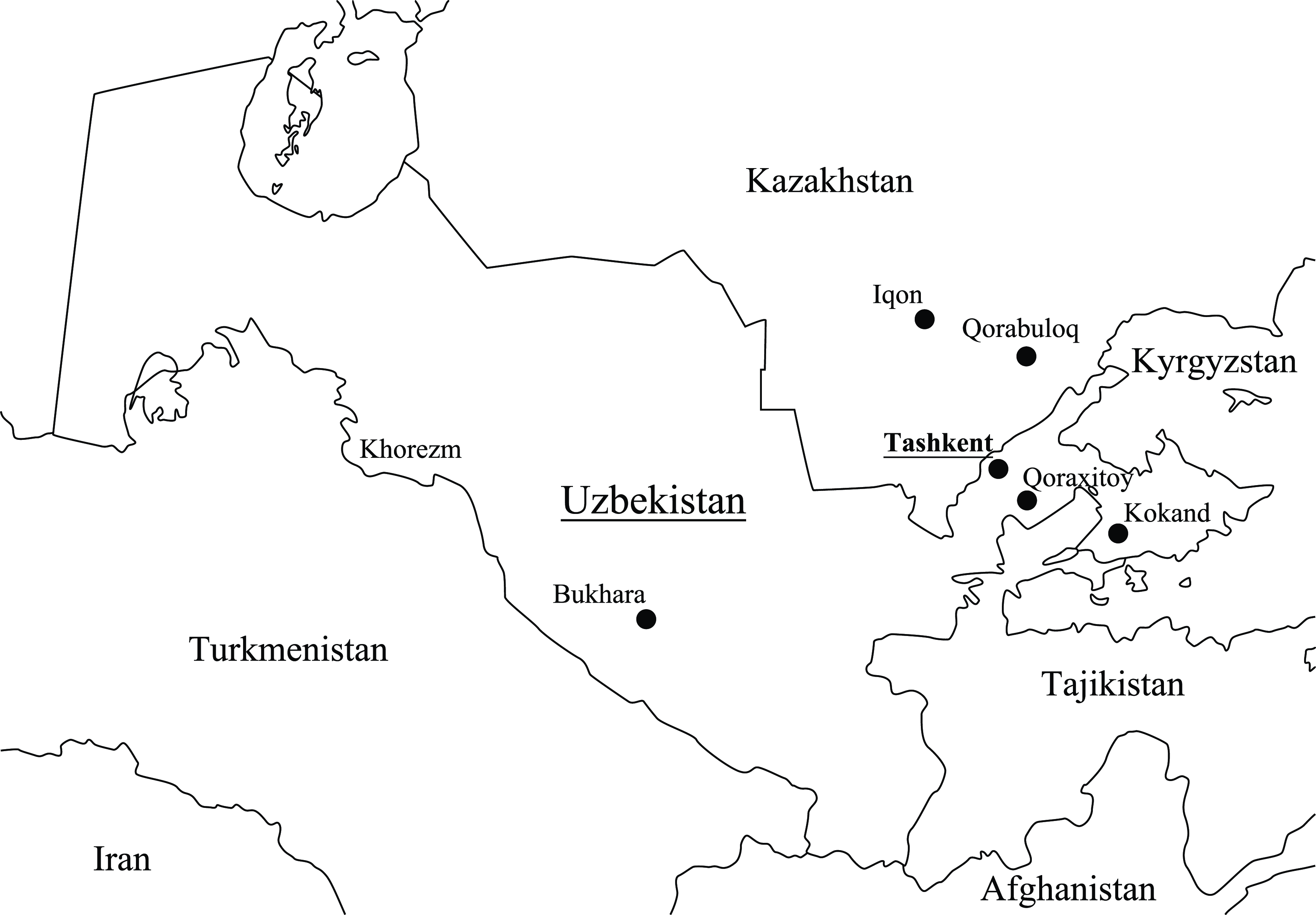


 Open access

