


INTRODUCTION
In March 2017, Aotearoa New Zealand granted legal personhood to the Whanganui River, giving it rights, responsibilities, and legal standing. The river can now own property, borrow money, sign contracts, and file lawsuits against people who violate its rights. It performs these actions through its two legal representatives—one nominated by the Crown, the other by Māori iwi (tribes) with interests in the river. Shortly after the Whanganui became a person, a court in India recognized the Ganges and Yamuna rivers as persons (O’Donnell Reference O’Donnell2018; Srivastav Reference Srivastav2019), and there was a failed attempt to gain legal personhood for the Colorado River (Miller Reference Miller2019). Aotearoa New Zealand has also granted legal personhood to Te Urewera, a former national park, and to Mount Taranaki (Clark et al. Reference Clark, Emmanouil, Page and Pelizzon2018).
Some scholars have lumped these developments together under the heading of “environmental personhood” (Gordon Reference Gordon2018; Łaszewska-Hellriegel Reference Łaszewska-Hellriegel2023; Miller Reference Miller2019). But it is important to note at the outset that granting legal personhood to natural entities need not be solely, or even primarily, motivated by environmental protection. It can be a way of redressing historical injustices and recognizing Indigenous understandings “of people as part of nature, not separate nor above it” (Magallanes Reference Magallanes2015, 325; see also Geddis and Ruru Reference Geddis, Ruru, Varuhas and Stark2019, 257–8). The Whanganui River’s personhood is not narrowly “environmental,” but reparative and broadly “ecological,” in a social as well as a natural sense. As part of redress for breaches of Te Tiriti o Waitangi (the Treaty of Waitangi), the granting of personhood recognizes Whanganui Iwi’s unique relationship with the river and the river’s unique sociocultural and spiritual significance to them (Finlayson Reference Finlayson, La Follette and Maser2019; Morris and Ruru Reference Morris and Ruru2010). We use the term “ecological personhood” to refer to ascriptions of personhood to entities such as rivers, mountains, and forests, with recognition that these ascriptions emerge in different contexts for different reasons and purposes.
Many scholars and activists have argued that ecological personhood is a potentially powerful device for protecting the environment, counterbalancing corporate power, and enshrining Indigenous rights in Western legal systems (Babcock Reference Babcock2016; Gordon Reference Gordon2018; Gray et al. Reference Gray, Wienhues, Kopnina and DeMoss2020; Łaszewska-Hellriegel Reference Łaszewska-Hellriegel2023; Morris and Ruru Reference Morris and Ruru2010). Yet, ecological personhood has also faced criticism. Some legal scholars have argued that natural entities are incapable of being legal persons, no matter what courts or legislatures may proclaim, because they “cannot be wronged, held responsible or exercise legal competences” (Kurki Reference Kurki2022, 537). Others argue that granting rights to natural entities falters on its “incompatibility with existing legal frameworks” (Radziunas Reference Radziunas2022, 141). Western governments have been equally critical. “It is the UK’s firm position that rights can only be held by legal entities with a legal personality,” the United Kingdom’s representative said at the 2024 United Nations Environment Assembly, ruling out the possibility that personhood could be extended to natural entities. “We do not consider that rights can be applied to nature or Mother Earth, and whilst we fully acknowledge that this is not a view held by all, it is a fundamental principle of the UK and one from which we cannot deviate” (UNEA 2024).
This invocation of “a fundamental principle of the UK” is ironic. In this article, we show that a theoretical justification for ecological personhood can be found in the work of one of the United Kingdom’s greatest political philosophers. “A Multitude of men, are made One Person, when they are by one man, or one Person, Represented,” Thomas Hobbes famously wrote in Leviathan, explaining how political representation could transform a crowd of individuals into a commonwealth (L 16.13, 248, emphasis in original).Footnote 1 A few paragraphs earlier, he used the same logic to explain how “Inanimate things, as a Church, an Hospital, a Bridge” and even “An Idol, or meer Figment of the brain, may be Personated” (L 16.9–16.11, 246–8). While a crowd is incapable of speaking or acting as a unit, bridges and idols are incapable of speaking or acting at all. But crowds, bridges, and idols alike can be “personated,” provided that representatives are authorized to speak and act in their names. So, in the same way, can rivers, mountains, and forests be “personated.”
We take up this line of thought and develop a Hobbesian account of ecological personhood. Hobbes lays the groundwork for a political conception of ecological personhood, which is compatible with and allows for negotiation between different ontologies and cosmologies of nature. This delivers three main benefits. First, it provides a powerful response to critics who argue that ecological personhood is incompatible with Western legal and political systems. The Hobbesian account of ecological personhood extends the Western conception of legal personhood while also providing a conceptual bridge between different worldviews and legal orders. Second, the Hobbesian account helps to free us from the fraught analogies that have so far framed the debate about ecological personhood. “One ought, I think, to handle the legal problems of natural objects as one does the problems of legal incompetents—human beings who have become vegetable,” Christopher Stone (Reference Stone1972, 464) wrote in an influential article on the subject. More recently, scholars have justified ecological personhood by analogy with corporate personhood (e.g., Babcock Reference Babcock2016; Gordon Reference Gordon2018; Miller Reference Miller2019). By illuminating the “mechanics” of personhood—the relations of authorization and representation that constitute persons—our Hobbesian account reveals both the conceptual similarities and the normative differences between ecological personhood, corporate personhood, and guardianship. Third, our Hobbesian account of ecological personhood highlights how these relations can break down and helps us anticipate the ways in which ecological persons could be co-opted and subverted. Hobbes not only provides a theoretical justification for ecological personhood, but also a political framework for thinking about the role of power and interests in shaping ecological persons.
The article has four main sections. The first section explains Hobbes’s theory of personhood. The second section applies Hobbes’s theory of personhood to natural entities, using the case of the Whanganui River for illustration. The third section explains how ecological personhood differs in a normative sense from other kinds of personation by fiction, such as guardianship and corporate personhood. The fourth section explores how ecological persons could be impersonated, misrepresented, and otherwise rendered ineffective.
HOBBES’S THEORY OF PERSONHOOD
Christian List and Philip Pettit (Reference List and Pettit2011, 171–2) distinguish two ways of understanding personhood. “Intrinsicist” theories define personhood according to some essential property or cluster of properties. For example, when animal rights activists argue that animals are persons because they are sentient, they are employing an intrinsicist theory of personhood. “Performative” theories, on the other hand, define persons according to their social functions. Corporations are considered to be legal persons not because they are conscious or sentient, but because they are capable of performing as singular entities—for instance, by signing and upholding contracts.
Hobbes developed the classic performative theory of personhood. For Hobbes, as Pettit (Reference Pettit2008, 55) explains, “persons are distinguished not by their metaphysical nature but by the things they can do, the roles they can play.” Contemporary performative theories of personhood, such as List and Pettit’s (Reference List and Pettit2011), focus almost exclusively on corporate entities. But Hobbes was writing at a time when the ecosystem of artificial persons was much more diverse. His theory of personhood shows how a broader range of entities—individual and collective; animate and inanimate; real and imaginary—can be “personated.”
Although much has been written about Hobbes’s theory of personhood, almost all of the literature focuses on his application of this theory to corporate entities, such as states.Footnote 2 Hobbes’s most peculiar examples of personation—of bridges and idols—tend to be treated as mere historical curiosities. Yet, these are the examples that demonstrate the flexibility, generality, and power of his theory of personhood. Using the familiar political vocabulary of authorization and representation, Hobbes explains how virtually anyone or anything can perform as a person.
Hobbes articulates his theory of personhood in subtly different ways in different works, and his terminology is not always consistent (Abizadeh Reference Abizadeh2017, 922–3; Brito Vieira Reference Brito Vieira2009, 168–9; Fleming Reference Fleming2021; Simendic Reference Simendic2012; Tricaud Reference Tricaud and van der Bend1982). Even within Leviathan, he defines “person” in two different ways—as a “Representer of speech and action” in Chapter 16 and later as “he that is Represented” in Chapter 42 (L 16.3, 244; 42.3, 776). In terms of Hobbes’s theatrical analogy, a person is the “actor” who performs the actions by the first definition but the “character” to whom the actions are attributed by the second definition.Footnote 3
For the purpose of applying Hobbes’s theory of personhood, we follow Hobbes’s second definition of “person” as “represented” and simply use “representative” (or actor) to refer to the sort of person who speaks and acts for others. We take his mature definition in De Homine ([1658] Reference Hobbes and Gert1991) as our primary point of reference: “a person is he to whom the words and actions of men are attributed, either his own or another’s: if his own, the person is natural; if another’s, it is artificial” (DH 15.1, 83, emphasis in original). Whereas “natural” persons speak and act in their own names, “artificial” persons speak and act vicariously through others. For example, if a defendant represents herself in court, then she is a natural person. But if she is represented by a lawyer, then she is an artificial person. Note that Hobbes draws the distinction between natural and artificial persons in a way that now seems unusual. In today’s usage, which is implicitly wedded to intrinsicist understandings of personhood, the status of a person as natural or artificial is fixed: an individual human being is always a natural person, and a collective entity is always an artificial person. But in Hobbes’s terms, a person can be natural at one moment, when she speaks for herself, and artificial the next, when she speaks via a representative (L 16.2, 244). “Natural” and “artificial” refer not to any intrinsic features of the person, but to the mode of representation.
Hobbes distinguishes two kinds of artificial persons: those represented “Truly,” by representatives they have authorized; and those represented “by Fiction,” with authority from a third party (L 16.1, 244, italics in original). The simplest sort of artificial person by fiction is a ward of the state. As Hobbes says, “Children, Fooles, and Mad-men that have no use of Reason, may be Personated by Guardians.” Although people without the use of reason are incapable of authorizing their own representatives, “he that hath right of governing them, may give Authority to the Guardian” (L 16.10, 248). For example, if a defendant authorizes her own lawyer, then she is represented truly. But if she is incapacitated, and a judge authorizes a lawyer to represent her, then she is represented by fiction. The fiction here is that the ward acts for herself when, in fact, actions are performed in her name by a third party. Although the representation involves a kind of fiction, the person and the consequences are both very real: guardians are often entrusted to make life-changing and even life-or-death decisions for the wards in their charge.
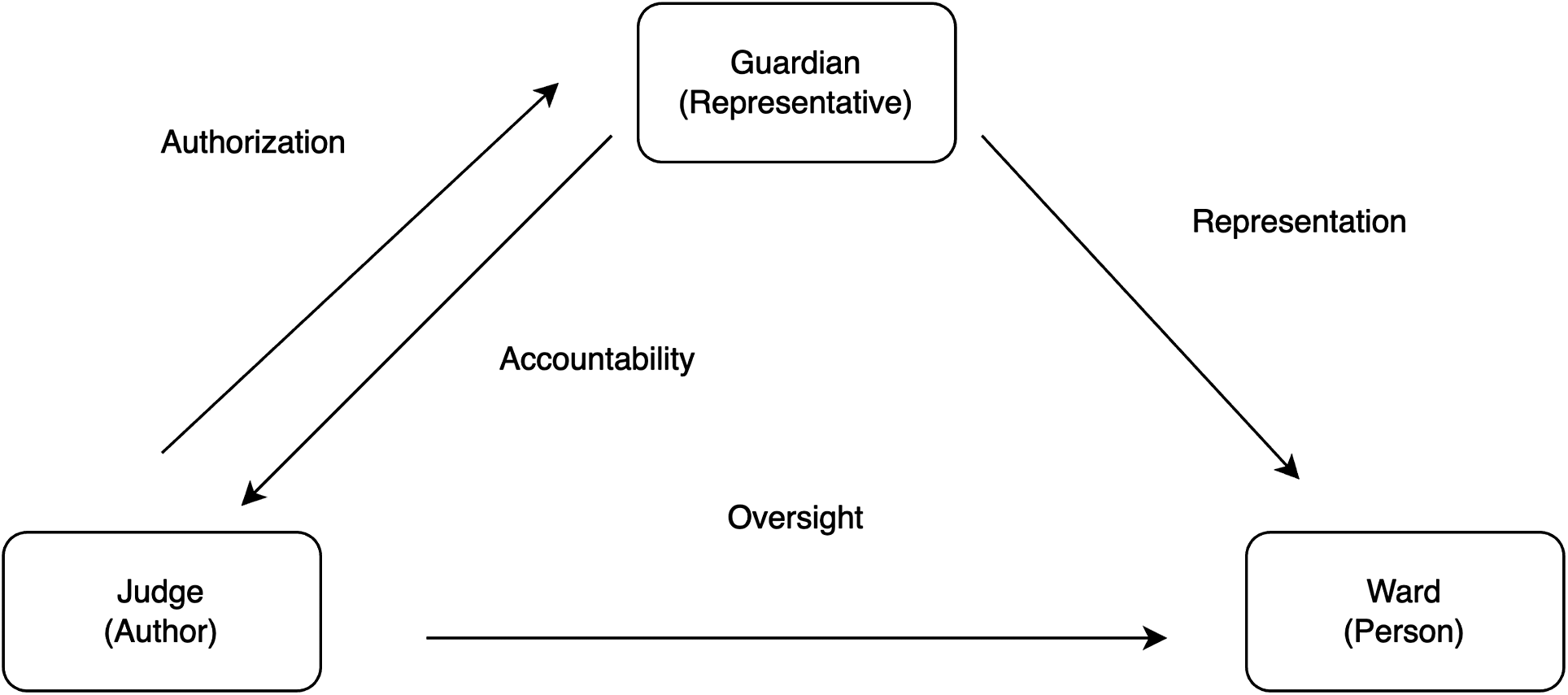
The three kinds of Hobbesian personhood correspond to different relations between action and authority. Natural personhood is a reflexive relation in which actions are authorized and performed by the same entity. When we sign contracts with our own hands, we authorize ourselves to represent ourselves, so to speak. Artificial personhood involves a separation of action from authority. If the person is represented truly, there is a dyadic relation: the client authorizes the lawyer, and the lawyer represents the client. But if the person is represented by fiction, there is a triadic relation: the judge authorizes the guardian; the guardian represents the ward; and the ward–guardian relation is, in turn, overseen by the judge, who can hold the guardian accountable if he fails to uphold his fiduciary duty (Figure 1).
So far, this Hobbesian theory of personhood is in line with contemporary understandings of legal agency and guardianship. But Hobbes shows that the logic of representation by fiction is applicable not only to human beings who cannot speak or act for themselves, but also to things that cannot speak or act for themselves: “Inanimate things, as a Church, an Hospital, a Bridge, may be personated by a Rector, Master, or Overseer.” Although “things Inanimate, cannot be Authors, nor therefore give Authority to their Actors: Yet the Actors may have Authority to procure their maintenance, given them by those that are Owners, or Governours of those things” (L 16.9, 246). Just as a judge can authorize a guardian to represent an incapacitated person, the owner of a bridge can authorize an overseer to represent the bridge. Through the device of representation, inanimate entities “can have possessions and other goods, and can act in law” (DH 15.4, 85). The bridge, acting via its overseer, could borrow money for repairs, levy tolls on travelers, and press charges against trespassers.
If the example of the bridge falls strangely on modern ears, it is because we fail to appreciate how diverse the ecosystem of artificial persons was in Hobbes’s time. Corporations are now abstract juridical entities; they may own objects but are not defined by them. Many “holding companies” and “shell companies” have no physical manifestations other than a post office box. But corporations used to be genuinely corporeal entities, embodied in particular physical objects. Historically, bridge and corporation went together: medieval bridge-building brotherhoods were corporations devoted to the building, maintenance, and fiscal management of bridges for the benefit of pilgrims (Boyer Reference Boyer1964). A brotherhood was not simply a “holding company” that owned the bridge; the bridge itself was incorporated.
The example of the bridge shows that, for Hobbes, “personation” does not entail or require personification. Contemporary theories of personhood, including those that purport to be performative, tend to identify personhood with human characteristics and capabilities. “To deserve the name of persons,” List and Pettit (Reference List and Pettit2011, 178–9) argue, “group agents must have all the abilities associated with the faculty of reason.” Corporate entities are persons insofar as they “form and enact a single mind […] displaying beliefs and desires and acting on their basis” (List and Pettit Reference List and Pettit2011, 177–8). For Hobbes, however, personhood does not require rationality or agency. A bridge has no beliefs, desires, or reasons, let alone the capacity to act on them. But it can nonetheless be “personated,” as long as it has an authorized representative who speaks and acts in its name.
To reinforce the point that personhood is purely performative, Hobbes argues that even imaginary entities can be persons. “An Idol, or meer Figment of the brain, may be Personated; as were the Gods of the Heathen; which by such Officers as the State appointed, were Personated, and held Possessions, and other Goods, and Rights.” Although “idols cannot be Authors: for a Idol is nothing,” the Gods of the Heathen could nonetheless buy and sell property, acting vicariously through state-appointed “Officers” (L 16.11, 248). Similarly, the state itself is dependent on representation for its very existence: “the Common-wealth is no Person, nor has capacity to doe any thing, but by the Representative” (L 26.5, 184). Although actions are attributed to the state—it is said to wage war, sign treaties, and borrow money—it does these things through its sovereign, just as the bridge acts through its overseer and the idol through the state-appointed officer. Hobbes’s use of the unusual verb, “to personate,” underscores that personhood is not a passive status; it is created and sustained by the performance of speech and action. Although personhood is socially ascribed rather than metaphysically given, it is not a matter of legal fiat. Hobbes is not a proponent of what Kurki (Reference Kurki2022, 526) calls the “anything-goes approach,” which holds that “any entity can hold rights and be a legal person if the legislator or some other appropriate legal actor decides to endow that entity with rights or legal personhood.” In addition to legal recognition, Hobbesian personhood requires representation. An idol will remain idle, no matter how many rights it nominally possesses, unless it has an authorized representative who can assert and defend those rights. Likewise, “a Common-wealth, without Soveraign Power, is but a word, without substance, and cannot stand” (L 31.15, 554).
While the personhood of bridges, idols, and the state involves a kind of fiction, it is of great practical importance because it gives continuity to rights and obligations. If debts attach to a bridge, then they can persist despite changes in its owners and overseers. If contractual obligations attach to a corporation, then they can persist despite changes in its employees, shareholders, and executives. Most importantly, since treaty obligations attach to the state, they can survive changes in its population and even the death of the sovereign. The continuity of the person of the state through the succession of sovereigns gives the state an “Artificiall Eternity of life” (Hobbes 19.14, 298).Footnote 4
Hobbes’s diverse examples serve to highlight the general logic of artificial personhood by fiction. In each case, there are at least three entities—the authors (constituents), the actor (or representative), and the person (or represented entity)—and three sets of relations between them. The primary relations are authorization, representation, and oversight: the constituents authorize the actor; the actor represents the person; and the person is overseen by the constituents. There are also secondary relations of signaling and accountability, which serve to guard the integrity of the primary relations.Footnote 5 Both the actor and the constituents receive and interpret signals about the person’s welfare or condition—for instance, financial reports about a child’s estate, or visible signs of a bridge’s structural integrity.Footnote 6 The actor uses these signals to determine how best to represent the person, while the constituents use these signals to determine whether the actor is representing the person appropriately and effectively. If the actor fails to uphold his duty to the person or acts outside of his authority, the constituents can hold him accountable and, if necessary, remove him.
HOBBESIAN ECOLOGICAL PERSONHOOD
Ecological persons could easily be added to Hobbes’s list of artificial persons by fiction. If states, wards, bridges, and idols can speak and act through representatives, then so, in the same way, can rivers, mountains, and forests.Footnote 7 Although rivers “cannot be Authors, nor therefore give Authority to their Actors: Yet the Actors may have Authority to procure their maintenance,” given to them by a third party who stands in an appropriate relationship to the river (L 16.9, 246).
This is how the personhood of the Whanganui River works. The Te Awa Tupua (Whanganui River Claims Settlement) Act (2017) created a new legal entity called Te Awa Tupua, which comprises “the Whanganui River from the mountains to the sea, incorporating its tributaries and all its physical and metaphysical elements” (2017, s. 69.1). Te Awa Tupua “has all the rights, powers, duties, and liabilities of a legal person” (2017, s. 14.1). It can own land; it has a financial endowment, known as Te Korotete; and, in some cases, its income is even taxable. To enable Te Awa Tupua to exercise its rights and powers and to uphold its duties and liabilities, the Act establishes an office called Te Pou Tupua, which “is to be the human face of Te Awa Tupua and act in the name of Te Awa Tupua” (2017, s. 18.2). Through its human face, Te Awa Tupua can sign agreements, borrow money, file lawsuits, petition the government, issue reports, and “take any other action reasonably necessary to achieve its purpose and perform its functions” (2017, s. 19.1.i). It is the unity of this representative body, Te Pou Tupua, that makes the river’s person one.
Although the Whanganui River’s personhood follows the Hobbesian logic of authorization and representation, it complicates Hobbes’s simple model of personation by fiction. Te Awa Tupua is much more complex than a bridge or a ward. It is not just a body of water, but “an interconnected ecosystem,” which encompasses the close relationship between Māori and the river (Ngā Tāngata Tiaki o Whanganui 2023).Footnote 8 In some respects, Te Awa Tupua is like the Hobbesian state: a complex assemblage of people and territory, extended in time, with both tangible and intangible elements. Just as the water is constantly flowing, the people are constantly changing. But in other respects, Te Awa Tupua is emphatically different. Whereas Hobbes understands the components of the state to be discrete and divisible—populations can be conquered or expelled, and territory can be divided—Te Awa Tupua is an indivisible whole. As Cribb, Macpherson, and Borchgrevink (Reference Cribb, Macpherson and Borchgrevink2024, 15) explain, “Tupua te Kawa [the fundamental values of the Act] express the indivisibility of the river and the inseparability of people and river. It grounds the new practices in a relational way of understanding humans and environment.” Whanganui Iwi understand their relationship with the river in terms of identity rather than simple membership: “I am the River, and the River is me” (Te Aho Reference Te Aho2019, 1616).
The office of Te Pou Tupua involves a kind of dual authorization and shared representation that Hobbes did not think was feasible. This office has two members, who are jointly appointed by Whanganui Iwi and the Crown (2017, s. 20). Hobbes insisted that a person had to have a single representative—either an individual or an assembly—and that a representative assembly had to operate according to strict majority rule, so that one voice would reliably emerge from it. He warned that “a Representative of even number, especially when the number is not great, whereby the contradictory voyces are oftentimes equall, is therefore oftentimes mute, and uncapable of Action” (L 16.16, 250). We return to this problem in the final section.
The dual authorization of Te Pou Tupua’s members makes the Whanganui River’s constituency of authors more complex than that of a bridge or an idol. In Hobbes’s examples of personation by fiction, authorization comes from a single source—either private or public. The representatives of “Inanimate things” are authorized “by those that are Owners, or Governours of those things,” while the representatives of “the Gods of the Heathen” are authorized directly by the state (L 16.9–16.11, 246–8). The authority of the river’s representatives is decidedly public, but it is derived from two distinct publics. The two members of Te Pou Tupua are authorized by two sub-constituencies: the citizens of New Zealand, via the Crown; and a subset of Māori, namely “the iwi with interests in the Whanganui River” (Te Awa Tupua Act 2017, s. 20.2).
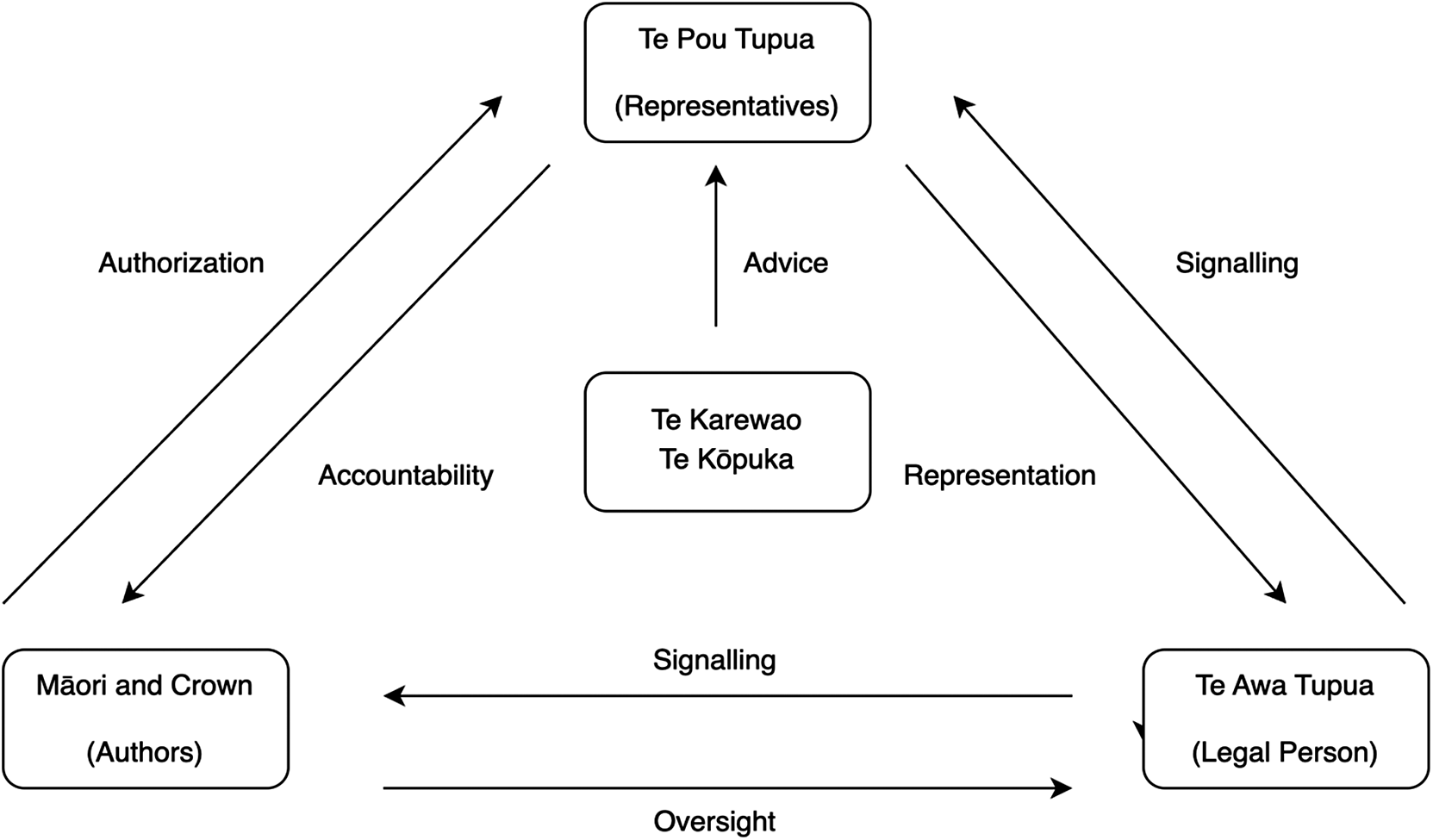
The Whanganui River also has an exceptionally complex system of signaling and oversight.Footnote 9 In a simple case of Hobbesian personation by fiction, there are three entities: the author, the actor, and the person (Figure 1). The owner of the bridge authorizes the overseer; the overseer represents the bridge; and the owner, in turn, oversees the bridge and interprets signals about its condition. The same relations hold between the river’s constituency of authors (Whanganui Iwi and the Crown), the river’s representatives (Te Pou Tupua), and the river’s person (Te Awa Tupua). But the Te Awa Tupua Act (2017, s. 29.1–2) also established two auxiliary bodies that are tasked with ensuring that the river is represented appropriately and effectively. Te Karewao is an advisory group comprising three members—appointed by Whanganui Iwi, other iwi with interests in the river, and local authorities. The other auxiliary body, Te Kōpuka, is a strategy group made up of stakeholders representing “persons and organisations with interests in the Whanganui River, including iwi, relevant local authorities, departments of State, commercial and recreational users, and environmental groups” (2017, s. 29.1–2). Te Kōpuka is in charge of developing and monitoring the implementation of a long-term strategy “to advance the health and well-being of Te Awa Tupua” (2017, s. 29.3).
Artificial Person by Fiction

The personhood of the Whanganui River thus depends on an intricate network of relations of authority, representation, oversight, accountability, and signaling. Māori and the Crown jointly authorize the two members of Te Pou Tupua; Te Pou Tupua represents Te Awa Tupua; and Māori and the Crown, in turn, oversee the river and interpret signals about its condition. Te Karewao facilitates signaling by collecting information and advising Te Pou Tupua, while Te Kōpuka facilitates oversight by monitoring the health of the river on behalf of different constituencies with interests in Te Awa Tupua (Figure 2). If this network of relationships seems overly complex, it is no more so than a corporation’s flow chart. At its core is simple Hobbesian logic: the river speaks and acts through its authorized representatives.
The Whanganui River

The case of the Whanganui River demonstrates the power and flexibility of the performative conception of personhood. Granting personhood to the river came about as a political compromise between Māori and the Crown, after negotiations about its status came to an impasse (Sanders Reference Sanders2018; Geddis and Ruru Reference Geddis, Ruru, Varuhas and Stark2019). To break the deadlock, the two sides created a performative legal person that could accommodate their vastly different intrinsic understandings of the river. For Māori, “Te Awa Tupua is an indivisible and living whole”—“the source of spiritual and physical sustenance” (Te Awa Tupua Act 2017, s. 12, s. 13.a). But in the eyes of the state, it is a framework for governance, much like a corporate entity. Te Awa Tupua is treated as “an institution” for charitable purposes, “a public body” for the purpose of municipal governance, and “a public authority” for the purpose of resource management (2017, s. 17). The personhood of the river is thus “a bridge between worlds,” as Geddis and Ruru (Reference Geddis, Ruru, Varuhas and Stark2019, 274) put it.
Some scholars worry that personating natural entities reproduces the atomistic and anthropocentric logic of Western conceptions of personhood. As Reeves and Peters (Reference Reeves and Peters2021, 496) argue, “rather than representing a shift in human ontological understandings of, and relationship with, the environment, the ascription of legal personality to nature contracts natural things into a mode of being pursuant to anthropocentric norms.” But as we have shown, Hobbesian personation does not require or entail personification. It can apply to inanimate entities, such as bridges, as well as to complex assemblages with both animate and inanimate elements. In the case of Te Awa Tupua, adopting the framework of performative legal personhood was not a capitulation to Western ontologies, but a “principled compromise” between Crown law and Māori cosmology (Geddis and Ruru Reference Geddis, Ruru, Varuhas and Stark2019, 273; see also Magallanes Reference Magallanes2015). Our Hobbesian approach dovetails with “relational” approaches to personhood, which move away from the traditional liberal association between legal personhood and individual autonomy to emphasize the interdependence of persons (Arstein-Kerslake et al. Reference Arstein-Kerslake, O’Donnell, Kayess and Watson2021). Hobbes defined “persons” in terms of relations, and our Hobbesian account provides a detailed map of the specific relations of authorization, representation, signaling, accountability, and oversight on which ecological personhood depends.
While rights-based approaches to the protection of nature place the burden on legal and constitutional provisions, the Hobbesian account places the burden on representation. What makes the Whanganui River a person is that it has a system of representation that enables it to reliably perform as a person—to assert and enact its rights, and to discharge its responsibilities. Te Awa Tupua stands apart from the “rights of nature” movement not only in its motivations and conceptual foundations, but also in its institutional manifestation. For example, the Constitution of Ecuador says that “Nature, or Pachamama, where life is reproduced and occurs, has the right to integral respect for its existence.” It further says that “All persons, communities, peoples and nations can demand public authorities enforce these rights” (quoted in Tǎnǎsescu Reference Tǎnǎsescu2013, 855). These provisions on the rights of nature have successfully been invoked in court to gain redress for damage to the Vilcabamba River (Clark et al. Reference Clark, Emmanouil, Page and Pelizzon2018, 795–800). But without an authorized representative, like Te Pou Tupua, Ecuador’s rivers have to rely on third parties’ ad hoc claims to legal standing to assert their rights. Different “persons, communities, peoples, and nations” can make competing and contradictory claims on a river’s behalf. In a time of lofty proclamations about the rights of nature, Hobbes provides a much-needed reminder that stable representation is necessary to assert and enact these rights. Like “Covenants, without the Sword,” rights without representation “are but Words, and of no strength to secure a man”—or a river—“at all” (L 17.2, 252).
While proponents of “ecodemocracy” or “biocracy” place similar emphasis on representation, they focus almost exclusively on how the interests of nature can be given more weight in democratic decision-making processes (e.g., Ball Reference Ball, Dobson and Eckersley2006; Dobson Reference Dobson, Lafferty and Meadowcroft1996; Gray et al. Reference Gray, Wienhues, Kopnina and DeMoss2020). They also take those interests and nature’s signals as objectively given or simply “out there,” just waiting to be listened to, rather than as constituted and made audible through representation (Ball Reference Ball, Dobson and Eckersley2006; Dryzek Reference Dryzek2000, 149). Our Hobbesian account goes further, emphasizing the transformative power of representation. Representation does not simply respond to signals, nor does it simply give voice to the preexisting interests of nature in preexisting legal and political institutions; it creates persons, which serve as forums for constructing and interpreting the interests of natural entities as well as for negotiating the interests of human beings. In addition, like Stone’s (Reference Stone1972) early account of ecological personhood, some models of ecodemocracy continue to rely on problematic analogies with guardianship, comparing natural entities to “communicatively incompetent humans” (Eckersley Reference Eckersley1999, 44). As we explain in the next section, our Hobbesian account illuminates the normative distinctness of “ecoship” as a form of legal and political authority.
“PROCURE THEIR MAINTENANCE”: GOVERNORSHIP, GUARDIANSHIP, ECOSHIP
Since wards, corporations, bridges, and rivers cannot authorize their own representatives, third parties must authorize representatives for them. For Hobbes, there are two relations of authority (or “dominion,” to use Hobbes’s favored term) that can enable this third-party authorization (L 16.9–16.11, 246–8). Authorization of a bridge’s overseer is based on ownership: the proprietor can authorize a representative for the bridge because he has an exclusive right over it. Authorization of a legal guardian is based on governorship: a judge can authorize a representative for a ward because he possesses the authority to make decisions regarding the ward’s well-being. Whereas ownership is an exclusive right of use and control, governorship is a power of decision-making that must be guided by the preservation or promotion of the interests of the governed. That is, while in ownership the owner’s will reigns supreme, in governorship priority goes to the maintenance or preservation of that which is under authority.
By themselves, ownership and governorship are authority relations, not forms of representation. The owner of a bridge can use or maintain it without speaking or acting for it, and a judge can make decisions about the affairs of an incapacitated person without putting words in her mouth. Governorship without representation gives us stewardship, just as ownership without representation gives us the management of private property. Only when the owner or governor speaks and acts in the name of the entity under her charge—or authorizes someone else to do so—does that entity become “personated.”
Owners or governors grant representatives the authority to “procure the maintenance” of the entities they are entrusted with representing (L 16.9, 246). Hobbes leaves the meaning of “procuring the maintenance” underspecified in terms of the range of tasks it includes. But, even in its generality, it performs two important roles. First, it establishes a target for which to aim and a standard against which to measure the representative’s performance. Although Hobbes does not use the language of “interests,” the idea of “procuring the maintenance” implies that representation must be necessary for or conducive to the represented entity’s functioning and/or flourishing. Second, it distinguishes the representative of an entity from the personal representative of that entity’s owner or governor, which is an essential distinction if the represented are to have a person of their own. A dying parent (governor) can appoint a guardian for their child. In transacting with third parties, the guardian must represent the child’s interests, not their parent’s, just as “[t]he role of Te Pou Tupua is to represent and advocate for the interests of the River, not represent its appointors” (Ngā Tāngata Tiaki o Whanganui 2024).
In a broad sense, “to procure the maintenance” means to seek someone’s or something’s preservation, conservation, upkeep, well-being, and continuance beyond the life and death of its owners or governors. What “procuring the maintenance” implies in practice varies. In the case of the bridge, it takes on a literal sense. The overseer of a bridge is charged with ensuring that the condition of the bridge is regularly inspected for structural integrity, damage, and necessary repairs, so that a team of workers may discharge a suitable scheme of maintenance tasks under his direction. In the case of the child, “procuring the maintenance” involves a distinct set of tasks, most notably managing the child’s property and finances such that her well-being, self-development, and eventual emancipation are secured. In the case of the state, the sovereign is tasked with “the procuration of the Safety Of The People”—and “by Safety here, is not meant a bare Preservation, but also all other Contentments of life” (L 30.1, 520). The normative content of “procuring the maintenance” varies widely depending on the characteristics of the represented entity.
Ecological personhood demands a conception of “procuring the maintenance” that is appropriate for rivers, mountains, and forests. We submit that ecological personhood should be founded on a modified understanding of governorship rather than ownership. “Ecoship” is conceptually similar to guardianship, but it implies different normative standards for representation (in terms of longer timescales, a non-anthropocentric notion of interests, etc.).
First, however, we turn to the reasons for ruling out ownership. The most basic problem with ownership should by now be clear. Ownership allows the owner(s) to use or dispose of their property as they see fit. It is this fact—that the owner’s will and interests are primary—that makes ownership untenable as a normative foundation for ecological personhood.
This is also why ecological personhood should not be modeled after corporate personhood. Ownership constitutes the basis of a corporation’s personation. Shareholders—who own a corporation by owning its shares—have the right to appoint directors to run the corporation. Directors are thus “overseers” in control of the property of others, and, as such, they must remain acutely responsive to those others’ wills and interests. It is the board of directors’ job to maximize shareholder value. While corporate personhood is simply a means to advance the interests of the corporation’s owners, ecological personhood aims to advance the interests of natural entities themselves. Te Pou Tupua’s mandate is not to serve the “stakeholders” who have authorized it, but to promote the well-being of the Whanganui River, understood as a living whole.
There are also a number of more practical reasons why ownership is not an adequate basis for ecoship. River ownership is a deeply contentious matter, with some happily describing rivers and their waters as property, to be used and traded by their owners; and others insisting rivers and their waters are part of the public commons, to be shared and cared for, not owned. In the case of the Whanganui River, the longstanding dispute between the Crown and Whanganui Iwi over river ownership resulted from fundamental differences in their respective understandings of property. For Māori, human and nonhuman nature are not separable, but enmeshed. This entails a notion of owning as belonging rather than the liberal notion of possessive ownership: one is part of the river as much as the river is part of one. The link between parts is here integrative and relational, grounded on duties of care, rather than grounded on “ownership as understood within the logic of capital” (Moreton-Robinson Reference Moreton-Robinson2015, 3). On this basis, Māori have long accused the Crown of not simply depriving them of the right to manage and control their rivers, but of thus dispossessing them of a relation with rivers that is integral to their identity and subjectivity. Restoring that relationship, they claim, implies recognition that they are the traditional owners and stewards of the rivers. In New Zealand, following British common law, naturally flowing water is not owned by anyone; it is a public good. But this is contested by iwi who claim that the Treaty of Waitangi granted them customary rights to resources, including flowing fresh water, and that the introduction of common law to New Zealand did not extinguish those rights. Given the ongoing dispute, transcending the framework of ownership was necessary for the parties to find a way out of the stalemate (Sanders Reference Sanders2018). In the framework of ecological personhood, rivers are “no longer ‘things’ over which human beings exercise dominion,” but “‘persons’ with which humans have a relationship” (Geddis and Ruru Reference Geddis, Ruru, Varuhas and Stark2019, 255).
Disagreement over property rights is not the only challenge presented by the framework of ownership. Property is typically divisible; hence, even if property over different stretches of a watercourse is not contested, the existence of multiple proprietors is likely to compromise the protection of the river as a whole. This is because the river’s interests will be pursued only insofar as they coincide with the riparian owners’ interests, and such a coincidence is far from guaranteed. Stone (Reference Stone1972, 459–60) illustrates this problem with pollution: the riparian owner may be a polluter herself, not particularly care about pollution, be economically dependent on those who pollute, or have more to lose in legal costs than to win from taking polluters to court. While ownership is sometimes sought for nature’s protection—as when conservation groups buy land in order to protect it from development—property rights, by their very logic of possession, are prone to conflict with nature’s rights and the interests they are supposed to protect. This contrast takes us back to where we started: ownership cannot be the normative foundation of ecological personhood because it allows the owner(s) to use or dispose of their property as they see fit.
Let us then turn from ownership to governorship. In its Hobbesian sense, governorship is a form of authority or “rule over,” which implies the right to speak and act for the governed. As such, like ownership, governorship ultimately depends on the authority of the state. Inanimate objects and incapacitated people “cannot be Personated, before there be some state of Civill Government” (L 16.9, 248). Hobbes’s point was that the question of who has the right to speak for someone (or something) that cannot speak for itself must be settled by some preexisting authority; otherwise, there could be competing or contradictory claims of representation. This point is partly affirmed by the form the Whanganui River Settlement took: an act of the Aotearoa New Zealand parliament. But there, the source of authority was twofold. The Crown’s claim was based on territorial jurisdiction and the representation of public interest. The Māori claim was based on their customary and treaty rights and responsibilities with respect to the river. In Hobbes’s formulation, governorship is a top-down, exclusive, paternalistic kind of authority. Applied to natural entities, it would tend to reproduce the anthropocentric logic of resource management, treating humanity as a benevolent “governor” that lords over nature. But the Whanganui River Settlement suggests a different form of governorship, which is plural and relational, and in which the governors depend on and “belong to” the natural entities over which they exercise authority. It is the latter form of governorship that we place at the basis of ecoship.
Governorship can be the basis for several different forms of action on behalf of the governed. The most familiar ones are stewardship and guardianship. Although ecoship is conceptually most similar to guardianship, it is normatively distinct from both.
Stewardship is the careful and responsible management of something entrusted to one’s care, but which one does not own.Footnote 10 While it assigns independent value to what is cared for, this is primarily use-value: good stewardship of natural resources means, fundamentally, preservation for human benefit. This perpetuates nature’s instrumental status. Moreover, stewardship is essentially about caretaking through a series of actions the steward undertakes in his own person (creating protected areas, buying land for conservation, replanting trees, etc.), not about representing (speaking and acting in the name of another person). To take care of a river is not sufficient to personate it. As we have seen, personhood implies performance, performance implies representation, and representation implies action-attribution, not simply caretaking. It is this process of attribution or imputation that enables the bridge, the child, or indeed a river to speak and act in its own right—that is, as a person of its own.
Like stewards, guardians are persons who are conferred the power and duty to take care of someone (namely, a child or an incapacitated adult). But in addition, guardians are tasked with speaking and acting in the names of wards who cannot speak or act for themselves. Hence, as Hobbes stresses, guardianship necessitates representation (L 16.10, 248), and this representation is for the sake of the represented (to procure their maintenance). That is, if in ownership the owner’s will is primary, and if in stewardship human benefit is primary, in guardianship the ward’s interests and well-being are primary. As such, all the guardian’s decisions and actions on behalf of the ward must orient themselves toward, and be justified in terms of, the ward’s well-being and best interests.
While ecoship, like guardianship, establishes the represented as the primary beneficiaries of representation, it differs from guardianship in at least five important ways.Footnote 11 First, guardianship is premised on dependence, ecoship on interdependence. Second, while rivers have immense physical power, they do not (unlike wards) have the actual or latent capacity to form preferences or to engage in intentional communication (Eckersley Reference Eckersley1999). Third, guardianship comes associated with an anthropocentric and individualistic account of interests unfit for complex assemblages with human and nonhuman elements. Fourth, and relatedly, guardianship is bounded by the human lifespan, while ecoship requires a far longer, geological time horizon. This difficulty is compounded by another, our fifth point: it is easier for guardians (who are humans themselves) to identify and even identify with the fundamental interests of wards than it is for them to identify or identify with the interests of natural entities. To borrow Husserl’s ([1950] Reference Husserl1999, 108–13) words, the former makes for a far simpler “analogical apperception,” or “pairing” of the self with the other. We will elaborate briefly on each of these points in what follows.
Let us start with the first point. Guardianship is an asymmetrical relationship between a ward, who lacks the capacity to make choices, and a guardian, who is entrusted to make decisions on the ward’s behalf. It presumes the dependence of the ward and the independence of the guardian, which can be objectifying or even exploitative if adequate safeguards are not put in place. While guardianship begins from a defect or lack, ecoship starts from an affirmation of nature’s “difference as an expression of the richness of earthian life” (Plumwood Reference Plumwood2001, 112). It presumes both “difference from” and “continuity with” as “both sources of value and consideration” (Plumwood Reference Plumwood2001, 200). Rather than treating humans as independent actors and rivers as merely “natural wards,” or passive recipients of care and representation, ecoship views both humans and rivers as agents of some kind and their agency as interdependent and mutually supporting. The Māori notion of kaitiakitanga illustrates the difference between a deficit model of dependency and one of interdependence, relatedness, and mutually supported agency. Although often translated as “guardianship,” kaitiakitanga forgoes guardianship’s assumption of asymmetrical dependence to cut across the anthropocentric–ecocentric divide. It takes humans as an integral part of nature, linked to it through multiple genealogical connections (whakapapa) and through bonds of obligation and responsibility for protecting, restoring, and using it. “Using” is an important word here: preserving nature does not imply its protection from human interference, but maintaining a relationship grounded on reciprocity, wherein the well-being of humans is inseparable from the health of the environment and vice versa (Jonathan Reference Jonathan, Janet, Rauru, Henrik and Rachel2012). As Te Aho (Reference Te Aho2019, 1616) explains, “The ethic of protecting the environment for its own sake, as well as for present and future generations to use and enjoy, is kaitiakitanga. The root word is tiaki, which means to care for, to foster, and to nourish.” Accordingly, it is the role of the kaitiaki (often translated as “guardian”) to treat the river as worthy of care, consideration, and concern for its own sake. The river, in turn, cares for and nourishes Māori. Whereas guardianship is a paternalistic relationship, ecoship is a mutual relationship.
We now turn to the second point. Wards have an actual or (in most cases, at least) potential capacity to form preferences, intentions, and engage in intentional communication; rivers do not. Ecoship distinguishes personation from personification, thus resisting a twofold tendency: to respect nature only for those aspects in which it resembles us; and to make nature’s personhood dependent on its possession of human characteristics, such as “expressed preferences or interests” (Arstein-Kerslake et al. Reference Arstein-Kerslake, O’Donnell, Kayess and Watson2021, 547). A river floods, but it does not intend to flood. A river can have words attributed to it, but it cannot speak or fulfil the requirements of intentional communication by itself. For this reason, signaling and accountability, and the circuit of legitimacy and interactivity between the two, are necessarily different in guardianship and ecoship. In determining what the ward’s daily and longer-term needs and interests might be, the guardian must remain in frequent communication with the ward (insofar as this is possible) and consider the ward’s preferences as well as the ward’s overall intentions. A ward may be capable of making some decisions for herself, on her own or with assistance. Furthermore, the ward may wake up or grow up, and move out of her functional incapacity. She can then bring the guardianship to an end or even bring the guardian to account for past failures in furthering her well-being and interests. In ecological representation, neither of these is a possibility. While attentiveness to and representation of nature’s signals—some of which amount to nonverbal forms of communication—is key in ecoship, representatives will not be similarly “engaged in a dialogical determination of their [natural entities’] interests or of being accountable to them” (Whiteside Reference Whiteside2013, 350). For nature does not speak back. Absent this process of consultation and correction, we can be left with no reliable check on representation, which can then degrade into an exploitative relationship. A river’s signals are easily overridden, by way of neglect or manipulation, leaving the river more vulnerable to capture by constituents and representatives prioritizing their interests in the guise of pursuing the river’s own. Ecoship must guard against this risk (we discuss some precautionary measures in section Failures of Ecoship).
We can now contrast the role of interests within ecoship and guardianship (points three, four, and five). In guardianship, the interests to be advanced are those of an individual human being, the ward. The question of whether rivers have interests is far more disputed. Yet it is an important one: only entities that have interests can be regarded as having legal standing, for it is their interests which are represented in judicial, legislative, and administrative proceedings (Feinberg Reference Feinberg and Blackstone1974). On an intrinsicist account, interests are based on an essential cluster of properties or capacities, such as rationality, sentience, “awareness, expectations, belief, desire, aim, and purpose” (Feinberg Reference Feinberg and Blackstone1974, 61). A performative account of personhood, like Hobbes’s, presumes only a “functional” notion of interest: “x is in A’s interest if x is necessary for and/or conducive to A’s functioning and/or flourishing” (irrespective of A being capable of consciously taking an interest in x) (Ball Reference Ball, Dobson and Eckersley2006, 137; see also Varner Reference Varner1998, 39). The personation of natural entities presupposes basic agreement on their having an interest in their functioning and flourishing. But this basic agreement leaves room for different views or ontologies of what those entities are, and for different substantive conceptions of what “procuring their maintenance” demands.
In ecoship, as in guardianship, the interests of the represented come first, in the sense that they are normatively prior and must guide the representative’s actions.Footnote 12 Without interests there would not be a “behalf to act on” nor a “sake to act for” (Feinberg Reference Feinberg and Blackstone1974, 51). Hence, the ascription of personhood to a natural entity, so that it can act and make claims on and of its own, is premised on that entity being an entity with needs and interests of its own that may sometimes conflict with ours.Footnote 13 Ecoship relies on processes of signaling and oversight to set limits to the ways in which nature’s condition can be plausibly represented. However, it rejects the view that nature’s interests are objectively given (Stone Reference Stone1972, 471). Existing accounts of nature’s representation tend to assume that natural entities have “fixed identities with specifiable interests” (Whiteside Reference Whiteside2013, 352, n. 3), which are objectively given and eminently knowable (Goodin Reference Goodin1996, 837; Dobson Reference Dobson, Lafferty and Meadowcroft1996, 37). Instead, ecoship takes it as a matter of course that nature’s interests are, to a considerable extent, constituted and made knowable in the process of being represented, and that different actors will represent them differently, according to their own positionality, material conditions, value systems, and specific relation to nature (more epistemic, more experiential, etc.). In this sense, interests are an “inter-est” or “the thing that is between” the representative(s) and what is “out there”—that is, natural entities and their signals, themselves requiring representation to become “pervaded with meanings” (Dryzek Reference Dryzek2000, 148) and originate claims. Although a river’s interest in its ongoing existence, survival, and flourishing may be assumed and offer a source of resistance to gross forms of misrepresentation, the substantive content of these interests emerges from “the back-and-forth processes of consultation, persuasion and arranging trade-offs” (Whiteside Reference Whiteside2013, 351). As the governance arrangements for the Whanganui River show, expert, Indigenous, and local actors all have a key role to play in the determination of the river’s interests and what best serves them, from within their distinct knowledge and value frameworks and their specific relationalities with regard to the river. Rivers are, after all, not just “things” of nature nor just living entities, but “dynamic political arenas,” embodying society’s “claims, contradictions and struggles” (Boelens et al. Reference Boelens, Arturo, Karen, Lena, Erik, Barbara and Edward2023, 1132, 1148). Ecoship cannot escape these. Rather, it offers an interface where alliances can be formed and river struggles shared amongst parties who might disagree about what the river is—or what its flourishing ultimately requires.
Ecoship’s emphasis on interdependence is reflected in its conception of interest. The guardianship model lends itself to “biocentric individualism,” which regards individual organisms as the fundamental units of value and possessors of interests (Varner Reference Varner1998). However, rivers are not individuals, but intricate socio-ecosystems with multiple members, human and nonhuman, “set within a web of complexly interdependent interests” (Ball Reference Ball, Dobson and Eckersley2006, 135). This complicates their representation. While interests may be interdependent, they will not always be aligned, and trade-offs will need to take place, raising questions of how harm, injury, or damage may be best distributed, remedied, or compensated. Also, while it is relatively easy for guardians (who are humans) to identify the fundamental interests of wards (who are also humans), identifying a river’s interests requires a far more radical alterity than the one afforded by human empathy, whereby one might seek to “think” or “see” like a river. The problem is compounded by a contrast in timescales. The representation of a ward remains bounded by the human lifespan, whereas the representation of a river must consider much grander time horizons. This presents “formidable representational obstacles” (Nixon Reference Nixon2011, 2), since standard “techniques and methods of imagination, forecasting or anticipation” struggle to grasp the “slow violence” and “power relations of deep-time interactions,” on the one hand; and struggle to deal with the unpredictability generated by an increasingly uncontrollable acceleration of time, on the other hand (Nixon Reference Nixon2011, 2; Hanush Reference Hanush2023, 19, 26). Representation on these multiple timescales is not just more difficult; it is prone to deflection when human and ecological timescales clash, given the human tendency to discount the future.
Yet it is precisely because democratic politics operates on human timescales that we need arrangements “capable of processing deep-time interactions” in the legal and political arenas (Hanush Reference Hanush2023, 25). Ecoship provides one such arrangement. Deep-time representation requires “deep-time organizations” endowed with longevity (Hanush and Biermann Reference Hanush and Biermann2020). Endowing rivers with ecological personhood may be a way to grant them an “artificial eternity of life” (L 19.14, 298). Hobbes uses this expression to describe how the state’s separate personality, sustained by a succession of representatives, gives it continuity over time (Fleming Reference Fleming2020, 110; Brito Vieira Reference Brito Vieira2009, 44). In ecoship, as in stateship, continuity is necessary to address the most challenging and long-term political problem of our time: environmental degradation. In effect, ecoship may resemble stateship more than any other form of representation by fiction, as both are—and need to be—forms of public representation, whereby those with the largest responsibility for and stake in the maintenance of the entity represented must empower representatives to act in its own name and for its own sake. But all this with a difference: the world pushes back more in the case of the river than in the case of the state, which, unlike the river, is purely of our authorship.
FAILURES OF ECOSHIP
There are five main ways in which ecoship can break down: impersonation, ventriloquism, signaling failures, deadlock, and under-empowerment.
Impersonation refers to unauthorized representation. In the case of ecological personhood, this can occur in two ways. The first is when representatives of a river act ultra vires, or beyond their authority. The Whanganui River Claims Settlement imposes strict limits on the alienation of land belonging to the river (Te Awa Tupua Act 2017, s. 43). A representative seeking to sell the river or parts thereof to a mining company would be violating the terms of their mandate. Second, impersonation can occur when parties speak or act in the river’s name without the requisite authority. This might happen if the Crown unilaterally claimed to represent the Whanganui River, in defiance of Te Pou Tupua.
The second way in which ecoship can go awry is “ventriloquism”: a form of misrepresentation in which the authorized representatives of the river simply put words in its mouth, without due regard for the river’s interests (Brito Vieira Reference Brito Vieira2024, 167–8). Although the river’s signals must be interpreted and its interests constructed, not all constructions of interest are equally plausible or equally legitimate. Ventriloquism occurs when the representatives pursue their own interests (or those of their authorizers) under the guise of speaking for the river—for instance, by using their voices to greenwash industrial development, making the river consent to its own exploitation.
Monopoly over representation increases the danger of ventriloquism.Footnote 14 In the case of the Ganges, most of the river’s representatives are government officials. Since the government itself is a major polluter, this creates conflicts of interest (Srivastav Reference Srivastav2019, 159). The Chief Secretary of Uttarakhand (who heads the civil service) is the main “human face” of the river, yet she is equally responsible for industrial licensing and waste management (Jolly and Menon Reference Jolly and Menon2021, 483). In addition, “Ganga’s guardians lack financial and executive autonomy from the government apparatus, severely curtailing their ability to take positions the government does not approve of” (Srivastav Reference Srivastav2019, 163). The risk of ventriloquism is compounded by a lack of independent oversight. While a seven-member body of local community members is supposed to oversee the representation of the Ganges, this body is also vulnerable to ventriloquism, since its members are hand-picked by the Chief Secretary of Uttarakhand (Srivastav Reference Srivastav2019, 161). This points to the need for ecoship to include multiple constituencies, so that they can check each other and resist any unilateral capture attempts.
The third way in which ecoship can break down is through signaling failures. If the river’s representatives are inattentive to the wide variety of signals about the river’s condition, then they are likely to misunderstand the river’s needs and misconstrue its interests. For instance, representatives who rely exclusively on scientific indicators of the river’s health will miss the warning signs afforded by Indigenous peoples’ experiential knowledge. Signaling failures can also result from a lack of oversight. If the river’s constituents cannot independently monitor its condition and interpret the river’s signals for themselves, then their ability to hold the river’s representatives accountable will be limited. This highlights the importance of inclusive governance arrangements open to a variety of actors and informal representatives (e.g., scientists, environmental organizations, local communities), all of whom play a role in interpreting the river’s signals and holding the river’s representatives accountable, either in a court of law or in the court of public opinion.
Deadlock is the fourth way in which ecological personhood can break down. As Hobbes warned, representative assemblies can fail to speak with a single voice, especially where the number of representatives is both small and even. Since Te Pou Tupua is composed of two representatives, one nominated by Whanganui Iwi and the other by the Crown, Te Awa Tupua is highly vulnerable to veto games and deadlock. Where the representatives disagree, the status quo will be maintained, and there is a considerable chance that the status quo favors the interests of one constituency over the other. In addition, unlike Hobbes’s rather dictatorial representatives, Te Pou Tupua does not have the authority to make top-down, unilateral decisions. Te Awa Tupua is governed by “an intricate web of processes and procedures” that require collaboration and consensus-building among many different actors, including iwi, hapū, local authorities, government agencies, industry, and recreational interests (Geddis and Ruru Reference Geddis, Ruru, Varuhas and Stark2019, 271). Cribb, Macpherson, and Borchgervink (Reference Cribb, Macpherson and Borchgrevink2024, 11) find that this requirement for “continuous consensus-seeking” has had great benefits, even for those whose interests in the river are primarily commercial: “Broad and meaningful engagement adds time and costs to the initial phase—a view echoed by the owner of the boatbuilding company—but this mitigated the potential for conflict, cost and delay at later phases.” But there may be cases in which interests are so diametrically opposed that no consensus is possible. In these cases, Te Awa Tupua will be rendered “mute, and uncapable of Action” (L 16.16, 250).
Under-empowerment is the fifth way in which ecoship can fail. Personhood requires the power to act in unison, not just to speak with one voice; the power to implement decisions, not just to make pronouncements. While deadlock can render ecological persons “mute,” a lack of power can render them “lame.” The Ganges is so dependent on the government that it is a virtually powerless person—“a perpetual minor, bereft of the rights, protections and functional autonomy” that “a full-fledged legal person” possesses (Srivastav Reference Srivastav2019, 157). This underscores one of the main problems with the guardianship model. Founding the Ganges’s personhood on parens patriae—the doctrine that allows the state to assert authority over neglected children—has predictably led to the creation of a weak and ward-like legal entity.
The Whanganui River is a more formidable person. The Te Awa Tupua Act claims to confer upon Te Pou Tupua “full capacity and all the powers reasonably necessary to achieve its purpose and perform and exercise its functions, powers, and duties according to this Act” (2017, s. 18.3). In addition to the power to speak for the river, Te Pou Tupua has the power to perform “landowner functions” and to administer Te Korotete, the river’s fund. But the river’s budget is modest, starting at $30 million NZD, and its landowner functions are limited. Rights to the riverbed are vested in Te Awa Tupua, but not exclusive rights to control the water. Ultimate decision-making power over the river remains largely with “elected local authorities, exercising general resource management and other statutory powers” (Geddis and Ruru Reference Geddis, Ruru, Varuhas and Stark2019, 271). Whether Te Awa Tupua is sufficiently empowered to effectively “procure the maintenance” of the Whanganui remains to be seen.
CONCLUSION
Ecological personhood does not require or entail a commitment to a particular understanding of nature. Ascriptions of personhood to natural entities can be justified using the familiar vocabulary of authorization and representation, which serves as a bridge between Western legal and political systems and Indigenous cosmologies. The representation of rivers is conceptually analogous to the representation of wards, bridges, corporations, and states. Yet, as we have argued, ecoship is normatively distinct from guardianship and other forms of representation by fiction. Unlike human beings, rivers have indeterminate boundaries and indefinite lifespans. And unlike states and corporations, rivers are tangible entities that are not wholly of our creation. Representing rivers thus requires a geological time-horizon, an understanding of human interdependence with the natural world, and a non-individualistic conception of interests. Accounting for these asymmetries is essential if ecoship is to protect the river’s well-being rather than simply advance the interests of its representatives and constituents.
Personating nature is a promising way of counterbalancing the power of corporate persons, which currently dominate Western legal and political systems and are responsible for a great deal of environmental damage. But as we have argued, it is no silver bullet. There is a danger that, through impersonation and misrepresentation, ecological persons could become tools for greenwashing. They could be ventriloquized by corporations and states to make nature appear to consent to its own exploitation. Further, the modest budgets typically assigned to ecological persons are dwarfed by the wealth of multinational corporations. The political effectiveness of ecological personhood will depend in large part on how much we are willing to invest in them and on whether the risk of co-optation can be mitigated.
The power of ecological personhood is as much conceptual as institutional. It marks a crucial shift toward thinking of and interacting with natural entities as their own persons—persons with which we must form new, more sustainable relationships. This reframing of nature has the potential to counter what Heidegger ([1954] Reference Heidegger1977, 20–1) called the “enframing” of nature as a set of resources to be commanded, controlled, and exploited. “What the river is now,” Heidegger ([1954] Reference Heidegger1977, 16) wrote of the Rhine, is “a water power supplier.” Representation can transform a river from a mere “standing-reserve” of water power into a person with its own standing—the capacity to “stand up” for its interests and rights. Almost 400 years ago, Hobbes believed his account of personhood and representation offered the conceptual bridge human beings needed to reimagine their relationship to the state. In the Anthropocene, ecological personhood may be the conceptual bridge we need to reimagine our relationship with our planet.
CONFLICT OF INTERESTS
The authors declare no ethical issues or conflicts of interest in this research.
ETHICAL STANDARDS
The authors affirm this research did not involve human participants.

 Open access


Comments
No Comments have been published for this article.