




INTRODUCTION
Much foundational work in sociophonetics has focused on the place of the ‘female’ and ‘male’ voice as it relates to the interplay between the biological and the social. Although the physical body and human sexual dimorphism have been cited as the underlying explanation for gendered linguistic practices, much scholarship, including observations of pitch differences and gendered speech across multiple language families, has demonstrated that purely biological explanations cannot account for the full range of gendered linguistic behavior (Sachs Reference Sachs1975; Simpson Reference Simpson2009; Zimman Reference Zimman2017). Recent research in embodied sociolinguistics and queer linguistics on gender non-normativity in the voice has challenged some of these assumptions about the source of such differences (Calder Reference Calder2020; Zimman Reference Zimman, Hall and Barrett2020). This coincides with a movement in sociocultural linguistics that has begun to examine the role of the body beyond the voice, bringing us to examine language as not just the voice and speech stream itself, but as part of a larger, embodied semiotic system.
Scholars historically have leveraged intersex groups to explain distinctions between sex and gender. Insomuch as human biology is not seamlessly placed into two dimorphic sex categories, it follows that gender as a social category is more complicated (Milani Reference Milani, Hall and Barrett2019). Research on intersex communities, however, has been absent from linguistics and the social sciences more broadly, with the exception of Brian King's work (Reference King and Milani2014, Reference King2022). Intersex populations, therefore, are seen to provide a unique vantage point to examine intersections between gender and biology. This work enters a timely conversation in embodied sociolinguistics that argues that traditional theories in sociolinguistics have been constrained by an overly deterministic view of both social and biological aspects of gender (Bucholtz & Hall Reference Bucholtz, Hall and Coupland2016; King Reference King, Hall and Barrett2019). Through centering a group for whom the body has deep gendered and social consequences, I provide empirical data to bridge these two approaches.
My main interest is in examining the place of the body and biomedical practices in the interaction with fundamental frequency and formants for individuals in Brazil with Turner Syndrome (henceforth TS), one of the most common intersex genetic conditions. TS, which I describe in detail in the following section, occurs when individuals lack a second sex chromosome, and typically results in short stature, undeveloped secondary sex organs, infertility, among other features. Recent medical advances have led to the practice of prescribing growth hormone and feminizing hormones for TS individuals from childhood. To this end, the overarching question I ask is: What do height, hormones, and the voice have to do with being a woman? I first examine discourse surrounding height. I then analyze the interplay between the biological and social through an acoustic analysis of F0 and vowel formants (F1–F3), exploring the interaction between these acoustic measures and biological markers such as chromosome type, growth hormone, and height. Examining biomedical factors in relation to F0 and vowel formants allows for a critical examination of the role of the body in linguistic practices. I argue that it is therefore important for linguists to consider the ways visible and invisible aspects of the physical body shape both identity and linguistic practice. These biological variables suggest that, within this population, the linguistic construction of gender also intersects with constructs of adulthood and age. This work builds on work on embodied sociolinguistics and critical intersex studies, supported by sociophonetic methodologies, by centering a population that has long been ignored within the field. In doing so, it examines the material and linguistic implications of intersex bodies by considering socioconstructivist approaches to the body.
LITERATURE REVIEW
Intersexuality and Turner Syndrome
Intersex is an umbrella term that unites numerous conditions arising from birth that can involve variations in sex chromosomes, sex hormones, and/or sexual anatomy that differ from normative, medicalized expectations about male and female bodies. Such embodiments often disrupt binary understandings of sex and gender. In the case of intersex individuals, whose physiological reality imposes a different set of social experiences, the body contributes to an entanglement between linguistic, material, and embodied resources.
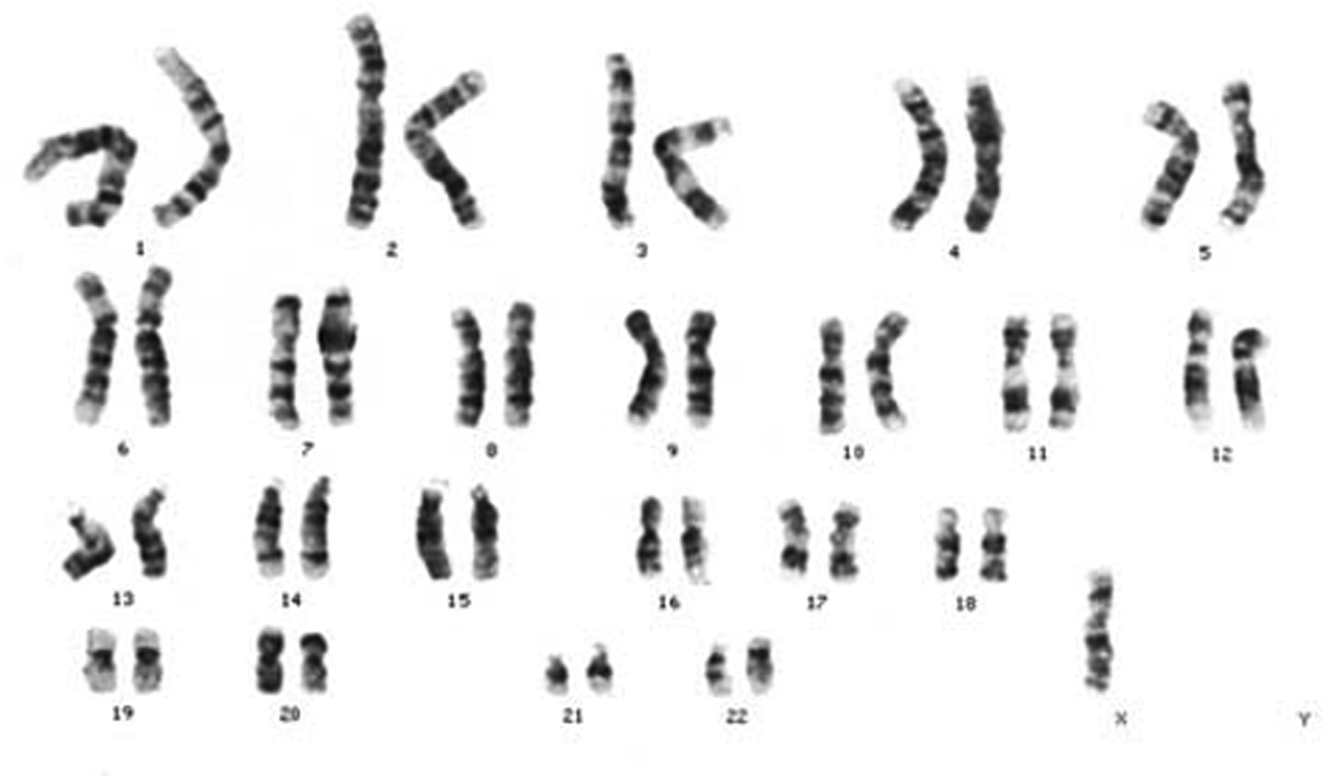
TS is one of the most common intersex conditions and occurs in approximately 1/3000 female-identified births. It is characterized by the presence of only one sex chromosome, X, instead of two (XX, or XY) in all or some of the body's cells (see Figure 1). This produces effects such as short stature (averaging 1.42 meters for TS adults), failure to undergo puberty, infertility, undeveloped ovaries, a lack of naturally occurring sex hormones, and other physical and cognitive effects. This reality has led some TS individuals to report having a precarious relationship to womanhood and femininity, often commenting that they feel like ‘second class women’. In other words, while many of my collaborators identified with aspects of girlhood and femininity, based on their lived experiences, they expressed discomfort with the concept of ‘womanhood’, particularly in the sense of passing into this adult phase or becoming a woman.
Karyotype of classic Turner Syndrome.

The most common medical interventions for TS individuals involve daily injections of growth hormone between the ages of eight and sixteen, replacement of feminizing hormones estrogen and progesterone, and surgery to remove gonadal tissue. Such regimens are time-sensitive and must occur from an early age to be effective. This has led doctors to push for treatment before patients reach the legal age of consent (Souza & Collett-Solberg Reference Souza and Collett-Solberg2011). In Brazil, doctors and parents often report hesitancy to pursue treatment due to cost, difficulty in obtaining hormones, discomfort with administering a syringe daily, and concerns over side effects. Although growth hormone is covered by Brazil's universal healthcare system, the regular availability of growth hormone in pharmacies is not guaranteed, particularly outside of major cities or wealthier neighborhoods. The decision to intervene or to not, in the hands of doctors and parents, has permanent physiological, social, and psychological consequences for TS individuals. Such challenges have obvious intersections with race and class within Brazilian society, which merit a much longer discussion than that which can be accomplished here.
TS's classification as an intersex condition has been debated in various spaces. Many of the arguments against this classification have asserted that with medical treatment, TS individuals ‘grow up to be women’ (Harper Reference Harper2007:171) and do not appear to show ‘ambiguous genitalia or confusion regarding sexual identity’ (Sax Reference Sax2002:176). By contrast, within critical intersex studies, scholars have argued that the inclusion of TS under the intersex umbrella has the potential to do justice to the lived experiences of TS individuals and their embodied realities (Griffiths Reference Griffiths2018). Additionally, bodily autonomy lies at the center of intersex advocacy given the long history of human rights violations stemming from non-consensual surgeries and medical interventions. TS individuals are no strangers to this reality and frequently experience diminished biomedical agency (Dauphinais Reference Dauphinais, Hall and Barrett2021). Among my participants, most understood TS to exist under the intersex umbrella, although not universally. Some were unfamiliar with the concept or declined to take a strong interest or position in either direction. Given this majority consensus, I argue for its classification as an intersex condition on the basis that TS breaks with normative understandings of ‘femaleness’ across multiple aspects of binary sexual categorization, including chromosomes, hormones, reproduction, and anatomy. For a further discussion of TS as intersex, see Dauphinais (Reference Dauphinais, Hall and Barrett2021).
I align with the Darlington Statement (Reference Statement2017) and King's (Reference King2022) call which both advocate for scholarship on intersex communities to place intersex people's needs at the center of research ethics. Although I share a TS diagnosis myself and have been an active member of TS groups since 2008, my collaborators’ priorities and autonomy lie at the forefront. Over six years of fieldwork, I regularly shared my observations and drafts with participants. This allowed me to incorporate community priorities before, during, and after data collection, in addition to establishing the centrality of height and its connections to femininity and adulthood.
Embodied sociolinguistics
Embodiment is a broad term employed in multiple ways across the social sciences (Kimmel Reference Kimmel, Frank, Dirven, Ziemke and Bernárdez2008). From a cognitive perspective, embodiment emphasizes the role of the body in shaping the meaning, concepts, and thought that language depends on and recruits sensory, motor, and affective processes related to the physical body (Johnson Reference Johnson and Newen2018). From an anthropological or gender-theoretical approach, embodiment is understood as the material and social realities surrounding the condition of having a body (Farnell Reference Farnell and Stanlaw2020). Within sociolinguistics, embodiment and its entanglements with linguistic and material resources are still very much a new frontier within the field (Lempert Reference Lempert2013:109).
In response to third-wave feminism and queer theory, which has long understood gender to be discursive and taken a more abstract approach to the body, trans and disability studies have drawn attention to the material and biophysical aspects of gender (Goodley Reference Goodley2013). With relatively few exceptions (Milani Reference Milani2014; Levon Reference Levon, Levon and Mendes2016), queer linguistics has followed the path of third-wave feminist theory and queer theory, examining the ways the body is discursively constructed as opposed to centering the body itself. Embodied sociolinguistics situates itself within the materiality versus discourse discussion by examining how the physical body produces language, while language itself produces and constructs bodies, often focusing on gesture and physical movement (King Reference King, Hall and Barrett2019). As Bucholtz & Hall (Reference Bucholtz, Hall and Coupland2016) argue, while work on gesture has its place, it needs to dialogue with indexicality, discourse, and agency. I take up this call here by examining the ways the bodies are discursively negotiated, and how this interacts with physical aspects of the voice.
While the intersex subject and the inherent messiness of human biology are often referenced in primers on language, gender, and sexuality as foundational to disrupting sex and gender binaries (e.g. Eckert & McConnell-Ginet Reference Eckert and McConnell-Ginet2013; Bucholtz Reference Bucholtz, Ehrlich, Meyerhoff and Holmes2014; McConnell-Ginet Reference McConnell-Ginet, Ehrlich, Meyerhoff and Holmes2014), little work within sociolinguistics has examined the interaction between biological sex and linguistic practice. As King (Reference King and Milani2014) argues, understandings of ‘masculinities’ and ‘femininities’ cannot always be separated from the intersex individual's subjective body experience, with language serving as the vehicle for articulating embodied knowledge. Calder (Reference Calder2020), in their review of the recent landscape of language, gender, and sexuality studies, argues that this body of scholarship has allowed linguists to construct and ideologize the construction of ‘man’, ‘woman’, ‘gay’, and ‘trans’, and expand beyond sexual and gendered binaries. Similarly, Zimman's (Reference Zimman, Zimman, Davis and Raclaw2014, Reference Zimman2017) work, which has focused on embodied aspects such as fundamental frequency and discursive practices surrounding genitals in transmasculine communities, demonstrates how bodies are at the center of negotiations of trans identities and agency. By interrogating such normativities among speakers and researchers, this has provided a fuller picture of the relationship between language and identity.
Pitch, formants, and gender differences in voice
Some of the earliest work in language and gender examined phonetic properties such as high phrase-final boundary tone and creaky voice—features that have been attributed to sexual dimorphism among humans in terms of vocal tract anatomy. Fundamental frequency (F0) and its perceptual correlate, pitch, are particularly fruitful in examining intersections of language, gender, and biology. Ohala (Reference Ohala1984) reports that on average, the male larynx is approximately 50% larger than the female larynx, resulting in a slower rate of vocal fold vibration and lower pitch. He concludes that this ‘frequency code’, or the sound-meaning correlation involves high F0 as a signifier of ‘smallness, nonthreatening attitude, desirous of goodwill of the receiver’, and low F0 as a marker of ‘largeness, threat, self-confidence, and self-sufficiency’ (Reference Ohala1984:343). As Zimman (Reference Zimman2017) argues, this projection comes close to naturalizing patriarchal domination via linguistic practice and does little to explore the way pitch is mediated by local sociocultural ideologies of gender.
Although there is a physiological component to pitch, several studies have shown that body size is not always indicative of F0 measures. Lass & Brown (Reference Lass and Brown1978) and González (Reference González2004), for example, find little correlation between F0 and physical markers such as height or weight, especially among participants of the same gender. These studies document that taller women do not necessarily have reliably deeper voices than shorter women, attributing differences in F0 to gender as opposed to height itself, with similar results for men. That is, size differences do not correlate with F0 when speakers of the same gender are compared.
Differences in F0 also arise across time, age, social groups, and different languages and cultures, while differences between men's and women's fundamental frequency typically arise during puberty (Lee, Potamianos, & Narayanan Reference Lee, Potamianos and Narayanan1999; Whiteside Reference Whiteside2001), with an overall lowering of F0 during this phase of development. Nonetheless, prepubescent children as young as four exhibit gendered differences in the regulation of vocal behavior well before any anatomical dimorphism (Nygren, Tyboni, Lindström, McAllister, & van Doorn Reference Nygren, Tyboni, Lindström, McAllister and van Doorn2012). Other research suggests that adult listeners persistently underestimated the age of older girls in perceptual tasks, suggesting that sociocultural understandings of age and pitch are interrelated (Assmann, Kapolowicz, & Barreda Reference Assmann, Kapolowicz and Barreda2018). Some perceptual studies also indicate that adult listeners use acoustic cues from both F0 and vowel formants to identify the gender of child speakers based on recordings (Perry, Ohde, & Ashmead Reference Perry, Ohde; and Ashmead2001). In Brazilian Portuguese, studies have found a main effect of gender, with women having a higher average F0 than men (Escudero, Boersma, Schurt Rauber, & Bion Reference Escudero, Boersma, Rauber and Bion2009). Escudero and colleagues find an average frequency of 216.63 Hz for women speakers and 125.07 Hz for men. In Brazilian Portuguese-speaking children between seven and eight years old, male-identified children were reported to produce an F0 of 258 Hz, female-identified children, an F0 of 256 Hz, with young girls exhibiting a wider F0 range (Viegas, Viegas, Atherino, & Baeck Reference Viegas, Viegas, Atherino and Baeck2010).
F0 has also been found to be affected by estrogen, hormone replacement therapy, and menstruation (Caruso, Roccasalva, Sapienza, Zappalá, Nuciforo, & Biondi Reference Caruso, Roccasalva, Sapienza, Zappalá, Nuciforo and Biondi2000). Hamden, Tabet, Fakhri, Sarieddine, Btaiche, & Seoud (2018) find that menopausal women on hormone replacement therapy (HRT) have significantly higher pitch than those who are not. This is attributed to changes in vocal fold dystrophy, which HRT can prevent (Caruso et al. Reference Caruso, Roccasalva, Sapienza, Zappalá, Nuciforo and Biondi2000). For trans men who undergo testosterone therapy, notable drops in F0 are recorded as well (Zimman Reference Zimman2017). These studies highlight the fluidity of physiology, particularly in light of biological sex differences, and the role of novel medical interventions on the voice.
Studies in phonetics have also noted gendered variation in fundamental frequency range, observing that women employ a greater range in pitch with faster shifts than men (Lakoff Reference Lakoff1973; McConnell-Ginet Reference McConnell-Ginet1978). Henton (Reference Henton1995) challenges this by arguing that, while women may employ greater acoustic shifts in pitch, it is equivalent to men's pitch ranges on a perceptual level. Vowel formants, while they elicit less metalinguistic commentary and awareness as a characteristic of speech, are aligned with pitch in terms of differences in the gendered voice. From a physiological perspective, the size of the vocal tract determines vowel formant frequencies, with lower frequencies in larger spaces and higher frequencies in smaller spaces. It is important to note that unlike F0, which is just one acoustic cue, the relationship among formants in their perception is also important. Scholarship on vowel formant frequencies and vocal tract size, however, has not found strong evidence for a biological or physiological explanation for gendered differences in formants. Simpson (Reference Simpson2009) argues that other articulatory movements such as tongue and lip position can affect the shape and resonance of formant frequencies, in addition to the descent of the larynx during puberty.
Other studies examine formants of prepubescent children whose vocal tracts do not yet exhibit differences in size. These results show that adult-like gender differences are still found, indicating the role of gendered ideologies on language during socialization (González Reference González2004). In terms of F1 and F2 in Brazilian Portuguese, Escudero and colleagues (Reference Escudero, Boersma, Rauber and Bion2009) find that the F1 vowel space is 1.201 times, and F2 vowel space 1.174 times, larger for women than for men for Brazilian participants. The place of gendered and physiological variation in formants is less clear, and to date, little to no research has been conducted on ideological or social dimensions of formants in Portuguese.
METHODOLOGY
Participants and recruitment
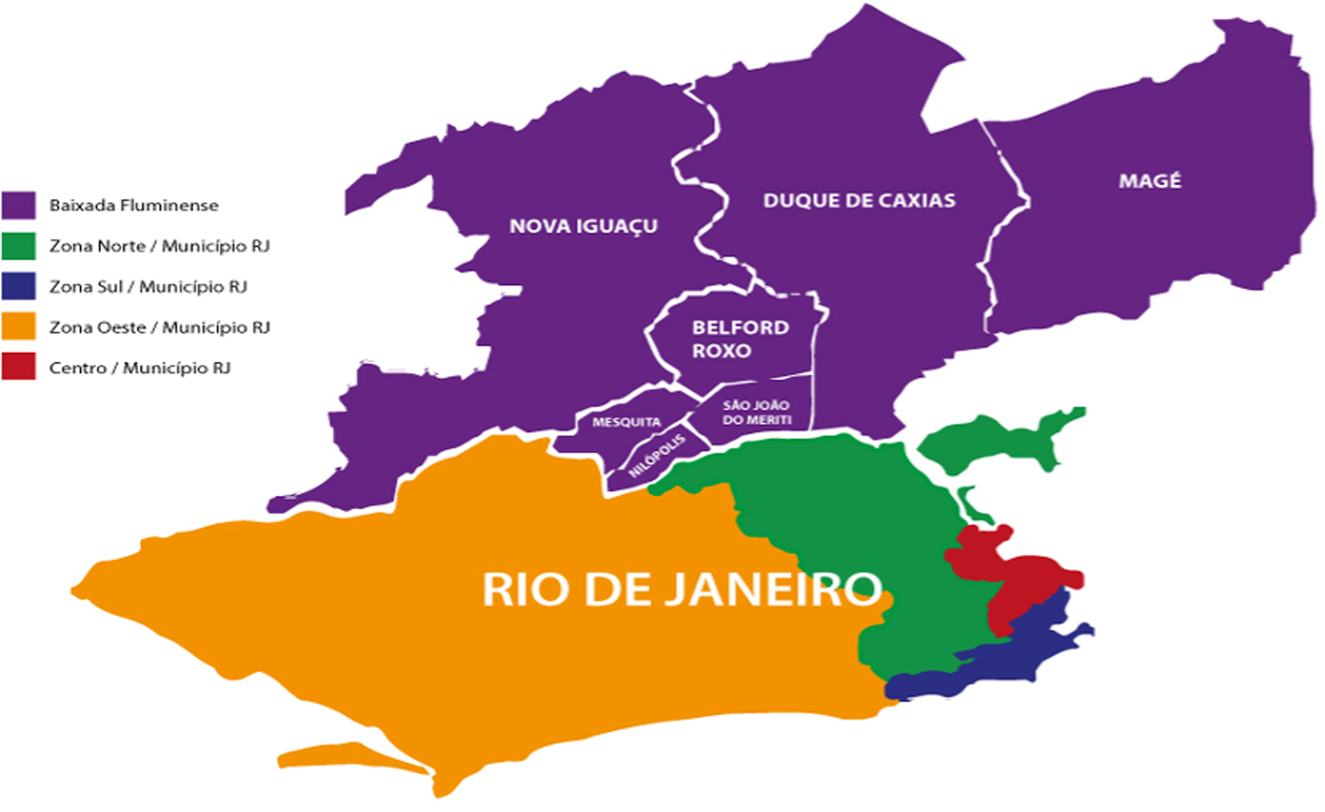
This study contains two data sets: a set of qualitative ethnographic data obtained from fieldwork in TS communities in Brazil (2016–2022), and recordings of a phonetic task from TS and non-TS participants. Participants lived in different areas of Rio de Janeiro, predominantly in the Zona Norte, Zona Sul, Centro, and Baixada Fluminense areas (Figure 2), reflecting a variety of socioeconomic status and racio-ethnic categories that mirror the overall city demographics. I recruited collaborators during my observations at two endocrinology departments in local hospitals and from online TS support groups. While race was occasionally mentioned during fieldwork, participants often located race on themselves and others in complex ways. As a non-Brazilian, I was hesitant to impose my own immediate categories and outsider lens on participants and this data set without deeper methodological and theoretical foundations to do so. Given the depth of research on this topic, a further examination of racial categories within Brazilian TS communities is necessary in future work. All participants are identified here by pseudonyms that they chose during the informed consent process.
Map of regions of Rio de Janeiro (Source: https://www.digitaleconomybrazil.com/digitaleconomy/coworking-spaces-in-rio-de-janeiro-which-neighborhood-to-choose/).

As mentioned earlier, my own TS diagnosis was key to developing trust with participants and forming relationships, as many only agreed to talk to me after they knew that I shared the condition. A few had never discussed TS outside of a medical context before, including with siblings, close friends, and partners. In disclosing this, I align with King's call for language scholars to conduct research both ‘with and for research collaborators’ (King Reference King2022:156), and in conjunction with calls from within linguistics and anthropology for greater researcher transparency (Kovach Reference Kovach2021).
Rio de Janeiro is a site of intense racial, class, gendered, and geographic contrasts, where the body is frequently on display publicly and discursively (Roth-Gordon Reference Roth-Gordon2016; Jarrín Reference Jarrín2017). For bodies deemed ‘non-normative’, such as the Turner body, this social context can result in increased pressure to pursue medical intervention and assimilate to gendered expectations. According to numerous collaborators, this contributed to feelings of isolation or estrangement from local social practices. For example, some participants commented how they disliked activities such as going to the beach, participating in sports like beach volleyball, or partaking in large, public events such as Carnaval, citing a discomfort with feeling exposed and vulnerable. Women with TS must therefore navigate complex social orders of femininity while having a condition that marks them as physically, sexually, and socially different.
HEIGHT AND WOMANHOOD
Here I explore the ethnographic and discursive elements of height among my research collaborators. In addition to being an important part of TS identity with potential correlations to fundamental frequency, I aim to shed light on less obvious aspects of intersex embodiment. Given that a majority of research on intersex communities has focused on sexualized and intimate body parts, which risks fetishizing intersexuality, height represented a less contentious topic for participants. The social interpretation of bodily size, in combination with the medicalization of women with TS, highlights a liminal space of womanhood and adulthood that many TS women report occupying. Short stature was one of the principal factors that participants attributed to their being perceived and treated as significantly younger than peers of the same chronological age, resulting in being infantilized particularly by family members and doctors. As those with TS are unable to participate in medical decision-making at a young age, they are left to deal with the embodied reality of such decisions, particularly in terms of height and development of secondary sex characteristics, which can have profound social and psychological consequences.
To begin to understand height in TS populations, it is important to examine doctors’ ideologies as the gatekeepers of growth hormone replacement. Participants with TS across social categories commonly reference height as being a key issue for them socially, even for those who received hormone replacement therapy. At the same time, doctors at the clinic also show conflicting views on hormone treatment. In the following transcript (1) from an interview with one of the endocrinologists at the clinic, Dr. Eugênia cites gendered differences in evaluations of height for women and men.
(1) Because a short woman puts on a 13cm heel, she grows (DE: Dr. Eugênia, A: Ashlee)

In this transcript, Dr. Eugênia makes a gendered assumption that height is less relevant for women than it is for men, citing a difference of only “5 centimeters”. For those who did receive growth hormone, a common theme emerged whereby participants received it for a short period of time or at a later age, therefore limiting the possibility of further growth. In a conversation with Larissa, a twenty-eight-year-old who has taken an active role in local support groups over the years, she discusses the observations she has made in terms of growth hormone in the various groups she forms a part of. Larissa received growth hormone consistently during several years throughout her childhood and adolescence. In this transcript (2), Larissa elaborates on her view of hormone replacement and its effects on the women she has talked to in the groups.
(2) I see a lot of girls complaining that they had little time to use GH (A: Ashlee, L: Larissa)

Larissa makes a connection between height, a late diagnosis, and insufficient medical attention, discussing her observation that many group members complain that they only received growth hormone for a limited time. She then correlates this with challenges that adults experience later in life. While the responsibility for limited growth hormone treatment is primarily with doctors, she discusses patient-centered factors that relate to following the correct dosages and taking the treatment regularly.
This is also evidenced in the following transcript (3) that comes from an interview conducted at one of the hospital clinics with Carol, a twenty-four-year-old from a town an hour outside the center of Rio de Janeiro. Carol is one of the few participants I met during fieldwork who lives alone and away from her family, leaving home at eighteen to study business administration and work. Carol currently has a height of 1.40 meters, saying she had never received growth hormone because of a late diagnosis. Prior to this portion of the conversation, Carol and I had discussed growth hormone, and she remarked on my own height, following her comment with a question about how tall I was.
(3) I like being short, but… (C: Carol, A: Ashlee)

In her last turn, Carol begins her response to the question of whether she would have liked to have taken growth hormone by framing her relationship with her height in a positive light. “I like being short”, she says, employing the diminutive suffix -inha to indicate an affective stance towards being short. She follows this with, “But I think that I'm really short”, but here, by contrast, does not use the diminutive form of the adjective baixa ‘short’, as if to take an outsider's perspective: she indicates that she is in fact “very small”, citing an additional ten centimeters as an ideal goal height that she would have liked to have reached.
These interactions, while a small portion of the overall discourse on height, are representative of the types of attitudes and perspectives expressed by my research participants. They reflect the disconnect that often exists between doctors and patients, as well as different embodied realities depending on the type of medical treatment TS individuals receive when they are young. In the following section, I complement this qualitative, ethnographic analysis with an acoustic analysis of F0 and vowel formants.
ANALYSIS OF FUNDAMENTAL FREQUENCY
Materials
While the qualitative data comes from a larger data set obtained over a six-year period, the phonetic data comes from recordings made in 2019–2020 from a subset of twenty TS participants. I additionally recruited twenty individuals without a TS diagnosis (ten individuals identifying as women and ten identifying as men). These participants were recruited through snowball sampling, and comprised a representative sample of social and geographical categories across the city that mirrored the age and demographic characteristics of TS participants. Many of the non-TS participants were within the networks of TS participants, allowing me to examine variation within existing social networks.
This analysis of fundamental frequency and vowel formants is based on recordings of twenty-one vowel tokens per speaker that appear in phonetically balanced reading passages. The task involved a reading of “Dudu no zoológico” ‘Dudu in the zoo’ and “O vento sul” ‘The south wind’, two commonly used Portuguese short passages for phonetic research (Jesus, Valente, & Hall Reference Jesus and Rita S2015). I selected three occurrences of the seven principal oral vowels (/i/, /e/, /ɛ/, /a/, /ɔ/, /o/, and /u/) in Brazilian Portuguese (Figure 3), in an inter-consonantal context. Table 1 below contains the analyzed vowels.
Oral vowels of Brazilian Portuguese (Barbosa & Albano Reference Barbosa and Albano2004).

Tokens and vowels measured.

Data analysis methods
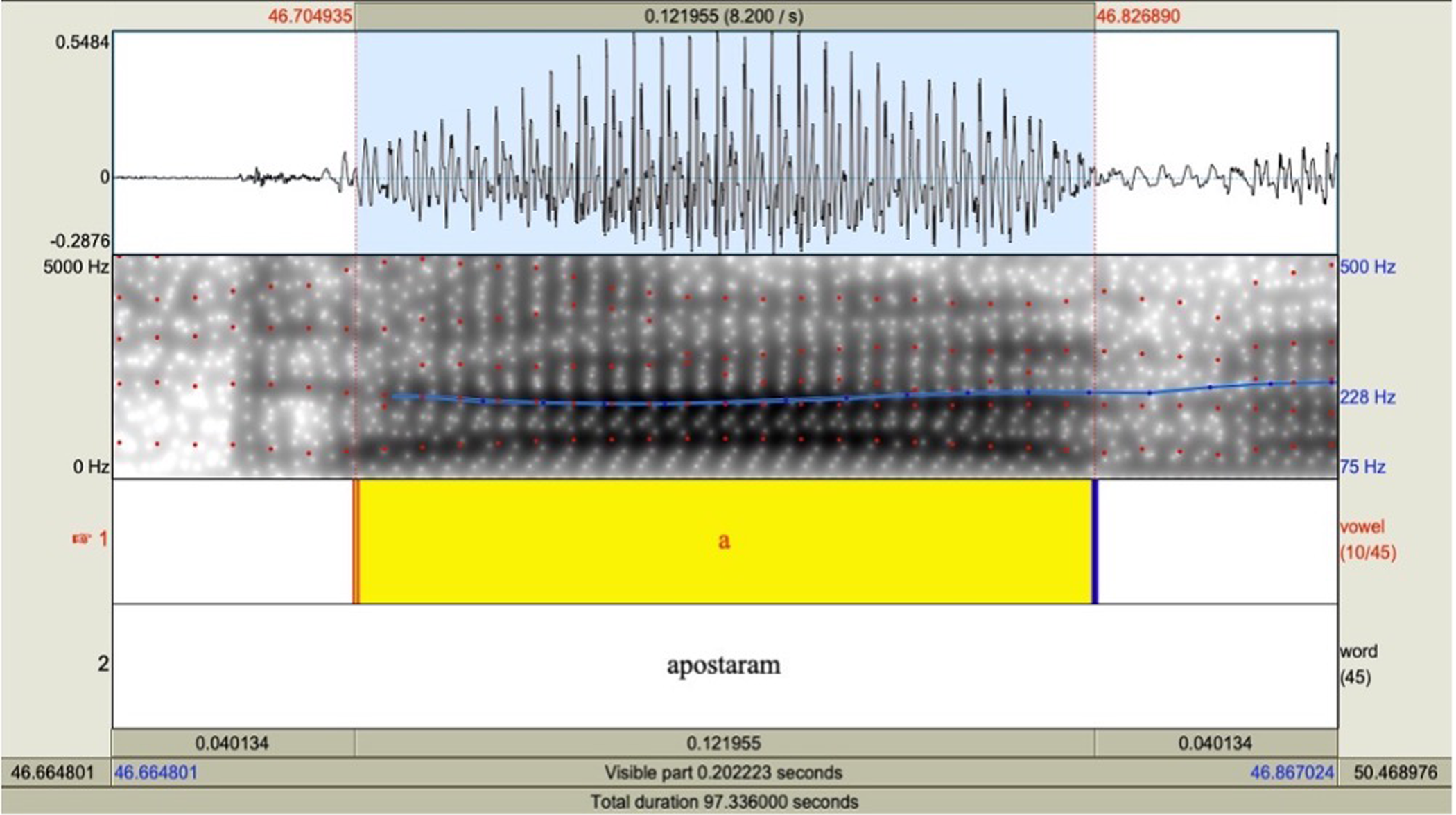
In Praat, I segmented and extracted the vowel tokens of the target words, measuring from the onset to the offset of the vowel, generally from where the wave form shows an increase in intensity, and ending where intensity was lowered (Figure 4). A total of twenty-one tokens were segmented per recording for each speaker. A Praat script was then used to determine the maximum, minimum, and mean F0, as well as F1, F2, and F3 taken at the midpoint of each vowel token.
Segmentation of vowel in Praat.

I then coded all tokens (n = 790) for speaker, vowel, TS diagnosis, gender, karyotype, growth hormone, and height. TS diagnosis included a categorization of Turner or non-Turner. Gender included self-reported gender identity of the participants, as well as karyotype (X0 for TS, as well as XX and XY). For participants with a TS diagnosis, I included growth hormone replacement as a yes/no category, as well as reported height.
Height represents a salient characteristic and forms part of almost all daily conversations among TS groups. TS women frequently compare heights with each other, especially in the context of taking growth hormone, so asking about this was not invasive in the context of TS groups. Growth hormone treatment, while it does impact growth, is also subject to a lot of external variables. All but two of the TS participants who received intravenous growth hormone as children in this portion of the study were treated by the same set of doctors operating in the same clinic over their lifespan, reducing the number of variables, in terms of growth hormone replacement therapy, that might have influenced growth. I did not include estrogen replacement as a variable, as participants were not always consistent in their present usage and presented too much variability in terms of dosage, method of replacement, and reported medication adherence. I did not collect height data for non-TS participants in the study, given that many of the participants, particularly men, gave rough approximations or hedged significantly. By not probing further, I was able to respect participant privacy.
After coding, I used mixed-effects linear regression models in R to explore the relationship between the acoustic measures and factors including TS diagnosis, gender, and karyotype, with speaker and word as random effects. These three factors present a degree of overlap, although I examine them in this way to further establish which is most at stake in fundamental frequency and vowel formant production. For each dependent measure (F0, F1–F3), I ran a mixed effects linear regression model using the lmer function in the package lme4 (Bates, Mächler, Bolker, & Walker Reference Bates, Mächler, Bolker and Walker2015) in R for fitting linear mixed-effects models. An analysis of variance (ANOVA) using the ANOVA function was then conducted to compare the fit of different models. I then constructed a separate analysis to investigate the effects of growth hormone and height on fundamental frequency, which was only included for participants with TS. In a third analysis, I compared results for only participants identifying as women to explore the effect of karyotype on fundamental frequency.
For all of the analyses, I obtained marginal R-squared (R2m) and conditional R-squared (R2c) values for each model to assess the goodness-of-fit of the variation per measure using the MuMIn (Multi-Model Inference) package (Bartoń Reference Bartoń2002). R2m is a measure of the variation accounted for by just fixed factors, while R2c includes both fixed and random effects. Images for descriptive statistics were created with ggplot2 (Wickham Reference Wickham2016).
STATISTICAL ANALYSIS OF ACOUSTIC DATA
Results of fundamental frequency (F0)
Results of the statistical analysis of formant frequency reveal that based on karyotype (45,X0; 46,XX; 46,XY), individuals with a TS karyotype (X0) have the highest F0 out of the three groups, with an average of 225.7 Hz. Participants with an XX karyotype had an average of 201.6 Hz, and those with XY karyotypes averaged 128.7 Hz, with fundamental frequency for X0 and XX closer to each other than to XY (Figure 5).
Mean fundamental frequency (F0) by karyotype.

Examining participants’ individual F0 productions overall followed this pattern with some outliers across groups. In Figure 6 below, we see that participants within different karyotype groups exhibit varying levels of interspeaker variation, with participants with TS karyotype exhibiting the greatest range of mean F0 across participants, 134.6 Hz between the participant with the highest mean F0 and the participant with the lowest F0. Participants with 46,XY karyotype on average exhibited a smaller range of variation in F0, with 60.9 Hz difference between participants with the highest and lowest F0. For participants with the karyotype 46,XX, there was a difference of 84 Hz between the participant with the highest F0 and the participant with the lowest.
Fundamental frequency by individual participant.

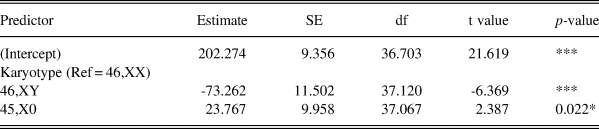
In the first set of mixed linear regression models, I examined the relationship between mean F0 of all forty participants and the variables TS diagnosis, gender, and karyotype as fixed effects, with speaker and word as random effects. TS diagnosis and gender were not included in the best-fit model, although karyotype does overlap with these two variables. The significant variables included karyotype as a fixed effect with participant and word as random effect. Positive estimates indicate a higher F0 compared to the reference value, while negative estimates represent a lower F0. The main effect of karyotype reflects observations from Table 2, which indicates that participants with a TS diagnosis (45,X0) have a significantly higher fundamental frequency (p < 0.001) compared to participants with both a 46,XX (p < 0.001) and 46,XY karyotype.
Summary of linear mixed effects regression model for fundamental frequency (R2m: 0.423, R2c: 0.621).

Note: * p = 0.05, ** p = 0.01, *** p = 0.001
In a second mixed-effects linear regression model, I only included data from participants with 45,X0 and 46,XX karyotype, all participants self-identifying as women, to further establish karyotype differences among participants of the same identified gender, to see if there was an effect of gender influencing the previous model. In the results for this model (see Table 3 below), karyotype turned out to be a significant predictor of higher fundamental frequency (p = 0.035) when just including these two groups.
Summary of linear mixed effects regression model for fundamental frequency (R2m: 0.559, R2c: 0.437).

Note: * p= 0.05, ** p = 0.01, *** p = 0.001
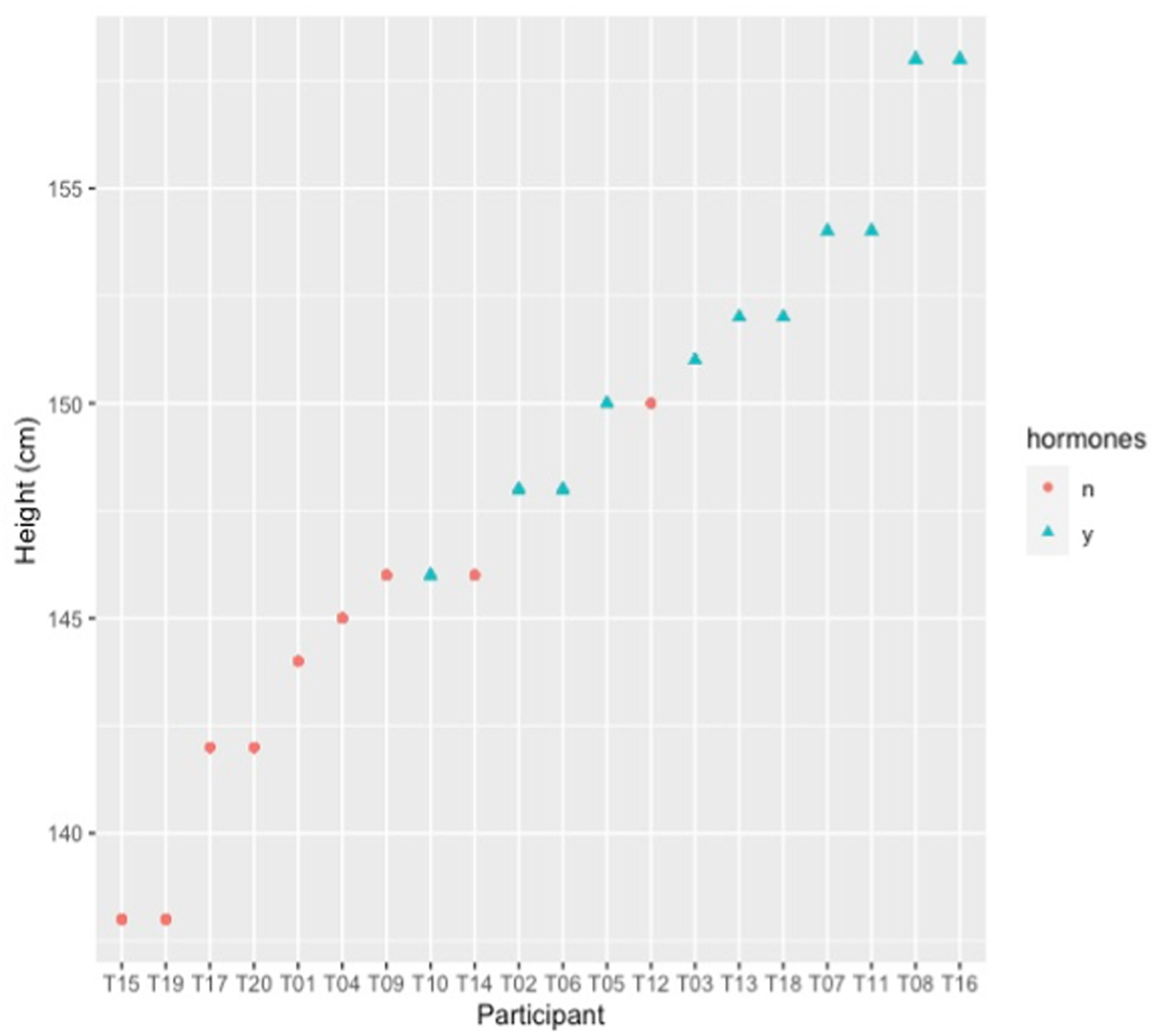
In examining the effect of biomedical factors such as height and growth hormone, overall, TS participants who received growth hormone during childhood had a higher adult height, as is to be expected (see Figure 7 for height by individual participant). It is important to keep in mind that the effectiveness of growth hormone is dependent on a variety of social factors outside the control of the individual who has been prescribed hormone replacement therapy.
TS participants and height (with hormones).

In the mixed linear regression analysis examining the relationship between mean F0 of TS participants, I included the variables TS height and hormone as fixed effects, with speaker and word as random effects. Within each model, nonsignificant independent variables were removed, and once again an ANOVA was performed to compare models. Height was included in the best-fit model, while growth hormone was not, despite the possible interaction between these two predictors, in that growth hormone is related to height in TS. The data reflects a significant overall trend where taller TS participants produced on average a lower mean fundamental frequency (p < 0.01) (see Figure 8). Results of the regression model are included below in Table 4.
Fundamental frequency and height.

Summary of linear mixed effects regression model for fundamental frequency for TS (R2m: 0.125, R2c: 0.426).

Note: * p = 0.05, ** p = 0.01, *** p = 0.001
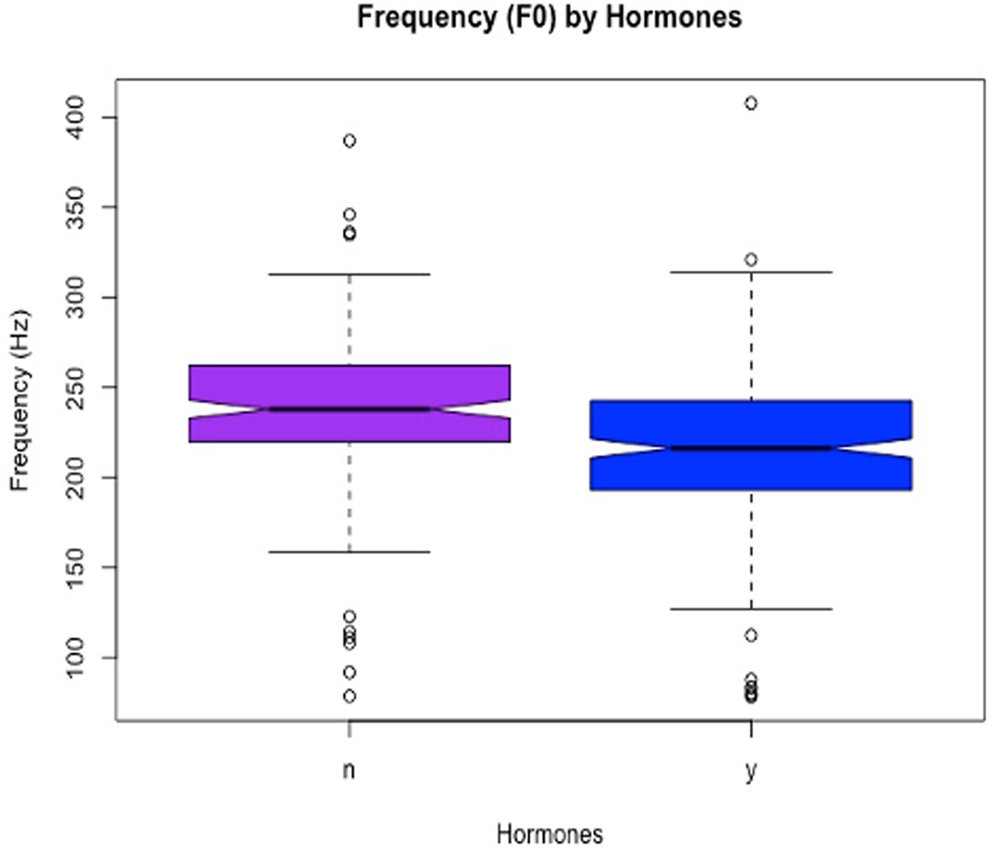
Although hormone was not a significant predictor of F0, descriptive analysis did reveal differences in mean fundamental frequency between TS participants who had received growth hormone replacement (average of 215.1 Hz) and those who did not (average of 239 Hz), with a difference of 23.9 Hz (Figure 9).
Mean fundamental frequency and growth hormone replacement.

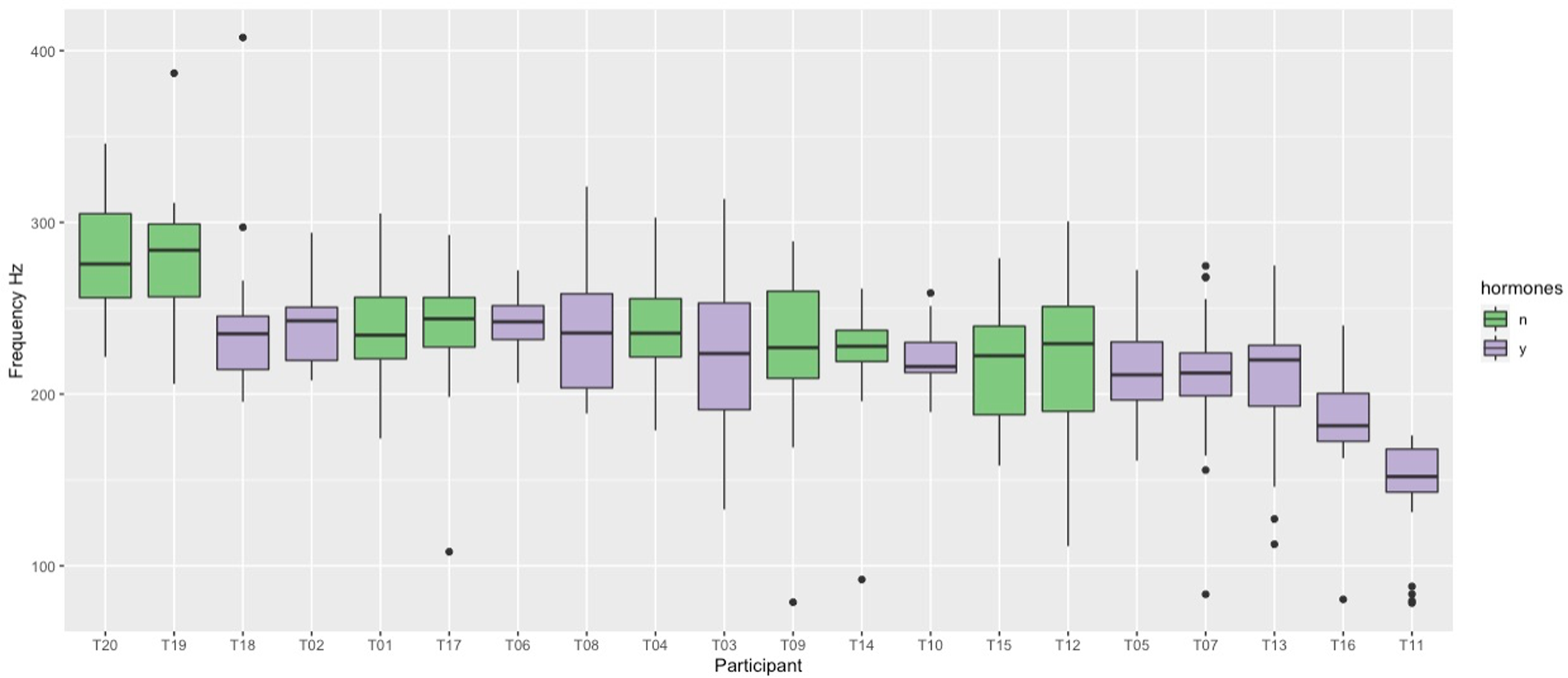
An examination of mean fundamental frequency by individual participant, coded for growth hormone (Figure 10), reveals that participants who were administered growth hormone, while as a whole having a lower mean F0 than those who did not receive growth hormone, exhibited intraspeaker variation across a wide range of frequencies.
Fundamental frequency of TS participants coded for growth hormone replacement.

Results of formant values (F1–F3) analysis
In this section, I present the analysis of vowel formants (F1, F2, and F3) for the same set of vowel tokens described in the above section. I followed the same process as for F0, in which I examined data from all participants, then participants identifying as women, and then just TS participants. Although descriptive statistics revealed slight differences in formants, mixed effects regression models and ANOVA demonstrated no significant effects of the fixed factors examined (karyotype, gender, hormones, height) for F1 (Figure 11) and F2 (Figure 12). Average F1 among different karyotype groups was 623.3 Hz for X0 karyotype, 588.9 Hz for XX karyotype, and 619.9 Hz for XY karyotype. For F2, the average was 1781.9 Hz for X0, 1738.1 Hz for XX, and 1852.5 Hz for XY. Changes in F1 and F2, therefore, do not follow patterns observed in the results from fundamental frequency (F0). This aligns with results from studies such as Zimman (Reference Zimman, Zimman, Davis and Raclaw2014).
Mean F1 by participant karyotype.

Mean F2 by participant karyotype.

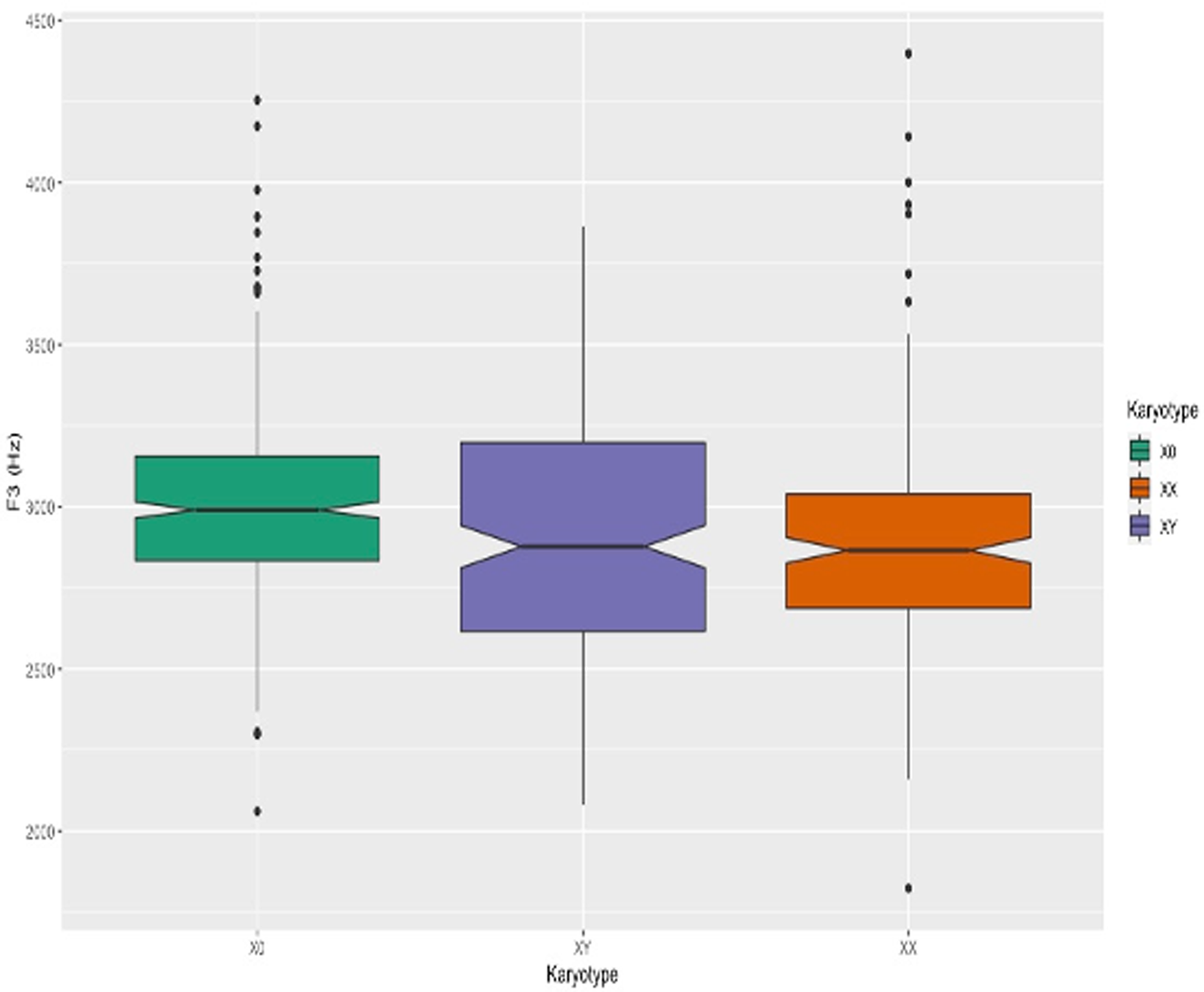
For F3, the average value for X0 participants was 3005.7 Hz, for XX the average was 2889.6 Hz, and for XY the average was 2922.2 Hz (Figure 13). The results for this are presented below.
Mean F3 by participant karyotype.

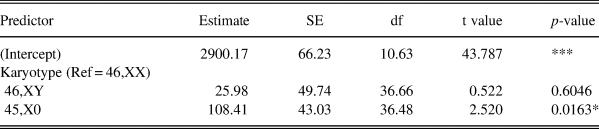
In the best fit regression model for all participants, the factor of karyotype was a significant predictor of F3 (p < 0.05), shown in Table 5. In examining only data from TS participants, none of the fixed effects (height, hormones) were selected as significant predictors of F3.
Summary of linear mixed effects regression model for F3 (R2m: 0.02063841, R2c: 0.2843312).

Note: * p = 0.05, ** p = 0.01, *** p = 0.001
DISCUSSION OF ACOUSTIC DATA
The acoustic data suggest the physiological influence of different aspects of TS, such as height and karyotype, on linguistic practices. In terms of fundamental frequency (F0), overall, TS participants exhibited a higher average fundamental frequency than non-TS participants (both non-TS men and women), showing a difference based on karyotype. Differences among non-TS men and non-TS women were also found. Among TS women, differences in F0 emerged based on height, with taller TS participants having a lower F0. In looking at Figure 5, TS women overall had higher F0 values than non-TS women, regardless of height, although further data for non-TS women would be needed to further investigate this claim. Growth hormone replacement was not a significant effect, however this could be due to collinearity with height, as they are connected. While F0 ranges for non-TS participants align with previous work in Brazilian Portuguese (Escudero et al. Reference Escudero, Boersma, Rauber and Bion2009), TS collaborators exhibited significantly higher F0 values than non-TS participants. This is true even for those who had received growth hormone. This, then, calls into question findings such as Lass & Brown (Reference Lass and Brown1978) and González (Reference González2004), which describe little variation in fundamental frequency between speakers of the same gender regardless of height.
For F1 and F2, no significant effects were found for the fixed factors included in the analysis, with no significant difference based on gender or karyotype. In terms of F3, a significant difference was found for the fixed effect of karyotype, with TS participants having the highest F3, followed by non-TS male participants, and then non-TS female participants. This difference in F3 could correspond to differences in vocal tract length between TS and non-TS speakers (Nordström & Lindblom Reference Nordström and Lindblom1975; Lammert & Narayanan Reference Lammert and Narayanan2015), or could be the effect of a high-arch palate common to TS (Kasagani, Jampani, Nutalapati, Mutthineni, & Ramisetti Reference Kasagani, Jampani, Nutalapati, Mutthineni and Ramisetti2012).
CONCLUSIONS
In examining the results, we see two related biological and biomedical markers with different levels of interactions that in many ways are mediated by doctor and parent decisions. Given the nature of height for TS women, the interaction between height and pitch is not necessarily surprising. Even among participants whose bodies are closer to established norms of femininity and womanhood, height remains a salient feature within TS communities, with many participants reporting a precarious relationship with ‘womanhood’ on both a physiological and social level. Indeed, considering the role of height in constructing womanhood for women with TS in a broader social context allows us to look at the role of the body in linguistic practices from an alternative perspective.
The data from this study reveal that not only were there differences in participants who identified as women based on karyotype (TS vs. non-TS), but there were also differences between TS women in F0 based on height. Given the snowball sampling employed in this study, differences were also found among participants within the same network. These results, as a whole, call into question a strictly social lens for the examination of voice pitch that has been found in work focused on sociolinguistic style, which often assumes a certain level of agency over biomedical practices (Yuasa Reference Yuasa2008; Zimman Reference Zimman2017; Drager, Hardeman-Guthrie, Schutz, & Chik Reference Drager, Hardeman-Guthrie, Schutz, Chik, Moore, Hall-Lew and Podesva2021). Given that height and growth hormone are the direct result of the actions of doctors and parents, it also raises an important question regarding the role of agency in individuals being able to construct themselves medically and biologically and issues surrounding bodily autonomy and integrity, which are often at the center of intersex human rights advocacy (Darlington Statement Reference Statement2017; King Reference King2022). More generally, given that intersex populations may exhibit different linguistic behavior than non-intersex participants, I suggest that they merit further consideration in sociolinguistics.
In the ethnographic data on the role of height and growth hormone in constructing womanhood for women with TS, it became evident that the body was central to the linguistic and social construction of the ‘female’ body or of ‘womanhood’. This in turn was mediated by biomedical practices. As there is an indexical relationship between height, age, and pitch, the results of the analysis of fundamental frequency in TS populations is also significant for thinking about how medical practices shape social realities vis-à-vis pitch and fundamental frequency. Previous perceptual studies involving F0 have shown that participants frequently underestimate the age of young girls based on voice alone. Given the embodied reality of TS women, then, delayed puberty and short stature may contribute to the infantilization that they experience from family, friends, and medical practitioners. In the data that I present here, this may be compounded by linguistic behavior such as fundamental frequency. This demonstrates an often-overlooked intersection with gender—that of age and development.
I argue, therefore, that linguistically and socially, ‘womanhood’ is not just the condition of identifying as a woman, but also refers to having reached a socially ratified level of maturity and adulthood as this is ‘read’ on the body by the individual and by the broader social milieu. We see here the way that sex and gender interact with age, development, and their accompanying biological markers. Moreover, because TS women may not be ratified as ‘women’ due to their perceived level of maturity, they end up occupying a ‘liminal gendered space’. Liminality, in the context of (dis)ability, has been defined as being symbolically ‘caught and fixated in a passage through life that has left them socially ambivalent and ill-defined’ (Murphy, Scheer, Murphy, & Mack Reference Murphy, Scheer, Murphy and Mack1988:235). Intersex individuals often occupy this kind of liminal space, given that they do not neatly fit into prescribed biological or social categories, and, as demonstrated here, also challenge a priori linguistic and discursive categorization. Thus, while intersexuality is regularly depicted as if it exists ‘in between’ the sexes, the liminal nature of these categories shows that in many senses, intersexuality occupies another space entirely.
The question of how we group or classify individuals has been fundamental to the fields of sociolinguistics and linguistic anthropology. Practices such as sorting participants into binary gender identifiers often form the ‘unspoken basis of most linguistics research’ (Holmes & Meyerhoff Reference Holmes and Meyerhoff1999:178). That is, the very notion of how we define languages and understand linguistic change is based on how we understand different groups of speakers and their interactions. Much like poststructuralist work such as Butler (Reference Butler1993) and Foucault (Reference Foucault1978), I seek to situate the body in culturally and historically significant ways (Milani Reference Milani, Hall and Barrett2019). I hope to have shown how bodies are produced, medically and socially, not just by the individual, but also by the decisions of others and by larger social structures. This work differs, however, from related work on acoustic properties of transmasculine voices (Zimman Reference Zimman, Zimman, Davis and Raclaw2014, Reference Zimman2017) in that many of the medical decisions that affect TS individuals’ relationship to sex and gender are made by doctors and parents rather than the person seeking treatment, contributing to a different lens through with to understand agency in terms of ‘constructing’ sex, gender, and linguistic practice. For intersex communities, underlying biological and medical realities may have a larger impact on linguistic practice than previously thought, especially when these interactions may be less visible or obvious, such as in the case of hormones and chromosomes. In certain cases, such confounding variables might not even be readily apparent to researchers without deep ethnographic work.
In re-centering the physical body, my intent is by no means to essentialize any particular embodiment. For the intersex person, however, our bodies are subject to much scrutiny within the public domain in the form of medical, social, and gendered commentary. To ignore such realities in considering the way the body shapes our experience with others would be to miss a large portion of social interactions and indeed a lens through which to interpret linguistic data. It would therefore behoove linguists to take a longitudinal, ethnographic approach to recruitment to gain a more profound understanding of less obvious factors that may interact with social and linguistic practices. Given that many intersex individuals may not be comfortable disclosing their embodied realities, it is a reminder of the multitudes that each of us contain that are not immediately visible, regardless of however foundational they may be to our bodily form and identity. It is important, therefore, for researchers to consider from both a theoretical and methodological perspective the ways visible and invisible aspects of the body contribute to identity formation and linguistic practices.










 Open access

