





1 Introduction
The pursuit of high-coherence light sources is a central theme in modern photonics, driving advancements in fields from precision metrology to optical communications[ Reference Turitsyn, Babin, El-Taher, Harper, Churkin, Kablukov, Ania-Castañón, Karalekas and Podivilov1– Reference Babin4]. A fundamental challenge in this endeavour, particularly within nonlinear fibre optics, lies in the inherent conflict between leveraging nonlinear effects for power scaling and mitigating their negative impact on spectral purity[ Reference Radic5]. This challenge becomes particularly acute in cascaded Raman fibre lasers (CRFLs). In these systems, temporal noise from pump light propagates through successive Stokes conversions, and competitive nonlinear effects such as four-wave mixing (FWM)[ Reference Agrawal6, Reference Fan, Yao, Hao, Li, Leng and Zhou7], cross-phase modulation (XPM)[ Reference Jiang, Messerschmidt, Scheiba, Tyulnev, Wang, Wei and Rossi8, Reference Sato, Horiguchi, Tateda, Koyamada and Izumita9] and self-phase modulation (SPM)[ Reference Ye, Ma, Zhang, Xu, Zhang, Yao, Leng and Zhou10] collectively drive substantial spectral broadening in higher-order Stokes waves. While existing technical approaches[ Reference Zhou, Pan, Qi, Cao, Cheng and Feng11– Reference Balaswamy, Aparanji, Arun, Ramachandran and Supradeepa16] have enhanced power and wavelength tunability, these advancements often come at the expense of comprehensive spectral purity, particularly failing to suppress broadening in the spectral wings, thus impeding simultaneous control over power and spectral shape.
To address this limitation, researchers have turned to wavefront shaping concepts[ Reference Tzang, Caravaca-Aguirre, Wagner and Piestun17– Reference Rothe, Chen, Ahmadi, Lee, Wisal, Ercan, Vigne, Stone and Cao20], which can also be implemented in a passive, fixed manner for spectral tailoring. Their core principle demonstrates that even in highly disordered systems, deterministic control over the input wavefront can transform randomness from a nuisance into a resource, enabling selective mode excitation through feedback optimization[ Reference Wei, Jing, Shen and Wang21– Reference Gu, Zhang, Yu and Zhang23]. Although successfully applied in areas such as spatial imaging and micromanipulation[ Reference Liu, Wang, Jin, Ma, Li, Bian and Situ24– Reference Nixon, Katz, Small, Bromberg, Friesem, Silberberg and Davidson26], the extension of wavefront shaping to control spectral dynamics in nonlinear fibre systems represents a significant and less explored opportunity[ Reference Sirleto, Vergara and Ferrara27]. The emerging lab-on-fibre concept provides a promising platform for implementing such built-in control strategies[ Reference Zitelli, Couderc, Ferraro, Mangini, Parra-Rivas, Sun and Wabnitz28– Reference Yuan31]. This approach focuses on integrating functional micro-/nano-structures directly onto/into the optical fibre, enabling the development of customized optical components that function as passive wavefront shapers to automatically select and enhance the most coherent spatiotemporal modes[ Reference Cruz-Delgado, Antonio-Lopez, Perez-Leija, Fontaine, Eikenberry, Christodoulides, Bandres and Amezcua-Correa2, Reference Zitelli, Couderc, Ferraro, Mangini, Parra-Rivas, Sun and Wabnitz28]. Among these, fibre Bragg gratings with tailored responses represent a particularly promising candidate for spectral wavefront shaping[ Reference Yuan31]. Unlike conventional Bragg gratings, random fibre gratings (RFGs) feature aperiodic refractive index modulations, creating a multitude of reflection channels with random phases and amplitudes over a broad bandwidth. Each nano-scale imperfection acts as a reflector, collectively forming a complex multiple-scattering network within the fibre[ Reference Han, Cheng, Tao, Ma, Liang, Ma, Qi, Zhao, Wang and Wu32].
Critically, we reconceptualize the role of randomness in this context. Previous research has primarily focused on exploiting randomness for random lasing or treated it as a noise source to be suppressed, largely overlooking its potential as an intrinsic optical field mode selector in nonlinear conversion processes[ Reference der Weid, Correia, Tovar, Gomes and Margulis33, Reference Pahlavani, Spence, Sharp and Mildren34]. In contrast, we propose that rather than being a drawback to be eliminated, the inherent spectral nonuniformity, namely random reflectance fluctuations across wavelengths in fibre gratings, serves as the fundamental mechanism enabling passive, self-organized spectral tailoring in the spectral domain for cascaded Raman systems[ Reference Tzang, Caravaca-Aguirre, Wagner and Piestun17]. When coupled with nonlinear effects[ Reference Qiu, Cao, Liu, Yu, Levy, Lendaro, Wang and You35], this spectral nonuniformity triggers a dynamic, self-organized mode competition process that directly addresses the spectral broadening challenges in multi-Stokes conversion. Wavelength components experience vastly different feedback strengths depending on their spectral position relative to the random reflectance peaks[ Reference Dostovalov, Wolf, Munkueva, Skvortsov, Abdullina, Kuznetsov and Babin36, Reference Yatseev, Zotov and Butov37]. Wavelengths that align well with high-reflectance regions experience longer photon lifetimes and more efficient nonlinear interactions, helping them dominate in mode competition that finally may result in single-frequency operation[ Reference Skvortsov, Wolf, Dostovalov, Egorova, Semjonov and Babin38]. This process is analogous to a passive self-optimizing wavefront shaping system, where the fixed random grating structure pre-codes the feedback matrix and the nonlinearity serves as the selective amplification mechanism[ Reference Ye, Zeuner, Li, Reineke, He, Qiu, Liu, Wang, Zhang and Zentgraf39]. Together, they collaboratively purify and select the most coherent modes from the broad noisy background, enabling effective spectral control. In this work, the wavefront shaping concept is extended to imply deterministic manipulation of the spectral field in the frequency domain using fixed, disordered micro-structures, representing a passive, built-in control strategy.
In this paper, we report a linewidth management technique for the cascaded Raman fibre oscillator based on passive spectral tailoring via RFGs. Diverging from conventional approaches that rely on external spectral shaping or active modulation, we strategically design and utilize the inherent spectral randomness of RFGs, transforming it into a powerful tool for passive coherent control throughout the multi-Stokes conversion process. By implementing an asymmetric cavity configuration with specifically engineered random grating elements, we demonstrate effective mitigation of noise transfer, reduction of nonlinear interference and suppression of spectral broadening in a two-stage cascaded Raman fibre oscillator. Our work offers a new path to developing high-power CRFLs with effectively controllable linewidth, devoid of complex active controls. More importantly, it extends the principle of passive spectral tailoring into the realm of all-fibre (free of bulk-optics) nonlinear dynamical systems. This approach provides a new technical scheme for controlling complex light fields across both temporal and frequency domains throughout cascaded nonlinear processes.
2 Theoretical model and simulation results
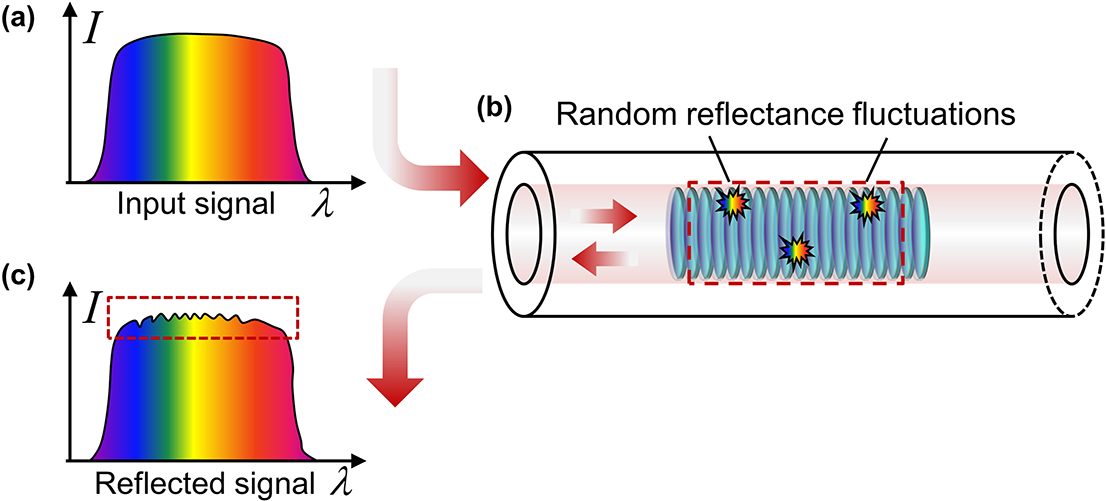
To focus on exploring the core physical mechanism of random-feedback-assisted spectral control, we developed an effective model describing the spectral evolution of a single target Stokes order. For a comprehensive description of the power evolution across multiple Stokes orders, reference is made to established cascaded models[ Reference Jackson and Paul40, Reference Feng41]. We have included Appendix A in the paper to present a comparative analysis. The operating principle of the RFGs is illustrated in Figure 1. The proposed model offers a method for all-fibre spectral control in CRFLs through RFG-assisted spectral redistribution. By tailoring the spectral characteristics of the low-order Stokes signal light via the random grating feedback within the CRFLs, effective regulation of the spectral linewidth of the high-order Stokes light is achieved. Figure 1(a) shows the initial spectrum of the low-order Stokes light, which serves as the starting point for the spectral tailoring process. Unlike conventional deterministic feedback, this approach utilizes intentionally introduced randomness in the grating’s reflectance profile to facilitate spectral redistribution and noise suppression, as shown in Figure 1(b). The underlying mechanism relies on randomized feedback to initiate a dynamic mode competition process of low-order Stokes light, as illustrated in Figure 1(c), which provides wavelength-selective enhancement for coherent components of high-order Stokes light while suppressing broadband noise. Mathematically, this behaviour is described by a modified propagation equation incorporating a stochastic convolution term that concentrates energy from sidelobes towards the centre, thereby effectively counteracting spectral broadening, and a complementary virtual loss term that suppresses spontaneous emission.
Operating principle of the random fibre gratings (RFGs). (a) Spectrum of the input low-order Stokes light. (b) Schematic of random refractive index fluctuations within the RFGs. (c) Reflected low-order Stokes light spectrum after RFG feedback.

2.1 Theoretical model of RFG-assisted passive spectral tailoring
The theoretical model for analysing the RFG-assisted passive spectral tailoring mechanism in CRFLs is based on coupled time-domain equations. These equations model how spectral properties change over time. This model not only includes the conventional gain–loss dynamics of laser systems but also accounts for the critical spectral redistribution effects induced by random feedback. The evolution of the signal light spectral intensity ${I}_{\mathrm{s}}\left(\lambda, t\right)$
is described by the following partial differential equation:
${I}_{\mathrm{s}}\left(\lambda, t\right)$
is described by the following partial differential equation:
 $$\begin{align}\frac{\partial {I}_{\mathrm{s}}\left(\lambda, t\right)}{\partial t}=\left[{g}_{\mathrm{R}}\left(\lambda \right)-\alpha \left(\lambda \right)\right]{I}_{\mathrm{s}}\left(\lambda, t\right)+\gamma \left[\xi \left(\lambda \right)\otimes {I}_{\mathrm{s}}\Big(\lambda, t\Big)\right].\end{align}$$
Here, ${g}_{\mathrm{R}}\left(\lambda \right)$
denotes the wavelength-dependent Raman gain coefficient. In silica fibres, the peak Raman gain occurs near 13.2 THz, and in this model, we use its normalized maximum intensity. Further,
${g}_{\mathrm{R}}\left(\lambda \right)$
denotes the wavelength-dependent Raman gain coefficient. In silica fibres, the peak Raman gain occurs near 13.2 THz, and in this model, we use its normalized maximum intensity. Further, $\alpha \left(\lambda \right)$
represents the intracavity loss, including fibre scattering, absorption and grating insertion loss. For simplicity, the loss is taken to be 1/10 of the peak gain value in our simulations. In addition,
$\alpha \left(\lambda \right)$
represents the intracavity loss, including fibre scattering, absorption and grating insertion loss. For simplicity, the loss is taken to be 1/10 of the peak gain value in our simulations. In addition, $\gamma$
is a positive parameter characterizing the strength of random feedback introduced by the RFGs. The first term on the right-hand side,
$\gamma$
is a positive parameter characterizing the strength of random feedback introduced by the RFGs. The first term on the right-hand side, $\left[{g}_{\mathrm{R}}\left(\lambda \right)-\alpha \left(\lambda \right)\right]{I}_{\mathrm{s}}\left(\lambda, t\right)$
, describes the basic evolution of the signal light under gain–loss balance. The second term,
$\left[{g}_{\mathrm{R}}\left(\lambda \right)-\alpha \left(\lambda \right)\right]{I}_{\mathrm{s}}\left(\lambda, t\right)$
, describes the basic evolution of the signal light under gain–loss balance. The second term, $\gamma \left[\xi \left(\lambda \right)\otimes {I}_{\mathrm{s}}\Big(\lambda, t\Big)\right]$
, is introduced to phenomenologically represent the wavelength-selective feedback arising from the random grating. It applies a wavelength-dependent weighting to the spectral intensity, reflecting the random reflectance profile of the grating. This term, together with the gain and loss, models the effect of wavelength-selective feedback: spectral components aligned with higher feedback strengths experience enhanced net gain and dominate through mode competition, while others are suppressed. The stochastic perturbation
$\gamma \left[\xi \left(\lambda \right)\otimes {I}_{\mathrm{s}}\Big(\lambda, t\Big)\right]$
, is introduced to phenomenologically represent the wavelength-selective feedback arising from the random grating. It applies a wavelength-dependent weighting to the spectral intensity, reflecting the random reflectance profile of the grating. This term, together with the gain and loss, models the effect of wavelength-selective feedback: spectral components aligned with higher feedback strengths experience enhanced net gain and dominate through mode competition, while others are suppressed. The stochastic perturbation $\xi \left(\lambda \right)$
is designed to emulate the random reflectance fluctuations of the RFGs, with statistical properties defined by a zero mean (ensuring unbiased feedback) and a variance proportional to
$\xi \left(\lambda \right)$
is designed to emulate the random reflectance fluctuations of the RFGs, with statistical properties defined by a zero mean (ensuring unbiased feedback) and a variance proportional to $\gamma$
, linking the perturbation strength to feedback intensity.
$\gamma$
, linking the perturbation strength to feedback intensity.
To quantitatively capture its influence, the evolution of spontaneous emission noise ${I}_{\mathrm{N}}\left(\lambda, t\right)$
, which is a primary contributor to spectral broadening in high-power fibre lasers, should be considered. Its dynamic behaviour is described by the following:
${I}_{\mathrm{N}}\left(\lambda, t\right)$
, which is a primary contributor to spectral broadening in high-power fibre lasers, should be considered. Its dynamic behaviour is described by the following:
 $$\begin{align}\frac{\partial {I}_{\mathrm{N}}\left(\lambda, t\right)}{\partial t}=\beta +\left[{g}_{\mathrm{R}}\left(\lambda \right)-\alpha \left(\lambda \right)\right]{I}_{\mathrm{N}}\left(\lambda, t\right)-\gamma {\left|\xi \left(\lambda \right)\right|}^2{I}_{\mathrm{N}}\left(\lambda, t\right).\end{align}$$
In the absence of random feedback (γ = 0), spectral broadening in our simulations arises primarily from the amplification of spontaneous emission noise within the Raman gain bandwidth – a simplified representation of noise accumulation in conventional CRFLs without feedback. In this equation, $\beta$
is a constant representing the initial generation rate of spontaneous emission, which is assumed to be continuous and uniform across the noise spectrum. The first two terms on the right-hand side are the same as the gain–loss dynamics of the signal light, modelling how the noise is amplified or attenuated in the cavity. The critical third term,
$\beta$
is a constant representing the initial generation rate of spontaneous emission, which is assumed to be continuous and uniform across the noise spectrum. The first two terms on the right-hand side are the same as the gain–loss dynamics of the signal light, modelling how the noise is amplified or attenuated in the cavity. The critical third term, $-\gamma {\left|\xi \left(\lambda \right)\right|}^2{I}_{\mathrm{N}}\left(\lambda, t\right)$
, introduces a wavelength-dependent virtual loss. This term arises from the random feedback of the gratings and reduces the effective gain available for noise amplification. This virtual loss mechanism limits the buildup of spontaneous emission noise, particularly at wavelengths distant from the central wavelength. As a result, it maintains the spectral purity of the signal, which is important for suppressing spectral broadening.
$-\gamma {\left|\xi \left(\lambda \right)\right|}^2{I}_{\mathrm{N}}\left(\lambda, t\right)$
, introduces a wavelength-dependent virtual loss. This term arises from the random feedback of the gratings and reduces the effective gain available for noise amplification. This virtual loss mechanism limits the buildup of spontaneous emission noise, particularly at wavelengths distant from the central wavelength. As a result, it maintains the spectral purity of the signal, which is important for suppressing spectral broadening.
The stochastic perturbation term $\xi \left(\lambda \right)$
, which drives both spectral redistribution and noise suppression, is defined as follows:
$\xi \left(\lambda \right)$
, which drives both spectral redistribution and noise suppression, is defined as follows:
 $$\begin{align}\xi \left(\lambda \right)={\mathrm{\mathcal{F}}}^{-1}\left\{C\left(k;{L}_{\mathrm{c}}\right)\cdot \mathrm{\mathcal{F}}\left\{W\left(\lambda \right)\right\}\right\}.\end{align}$$
Here, $\mathrm{\mathcal{F}}$
and
$\mathrm{\mathcal{F}}$
and ${\mathrm{\mathcal{F}}}^{-1}$
represent the Fourier and inverse Fourier transform operators, respectively, which convert signals between the wavelength domain and the wavevector domain
${\mathrm{\mathcal{F}}}^{-1}$
represent the Fourier and inverse Fourier transform operators, respectively, which convert signals between the wavelength domain and the wavevector domain $\left(k=2\pi /\lambda \right)$
. Further,
$\left(k=2\pi /\lambda \right)$
. Further, $W\left(\lambda \right)$
is a white noise process with zero mean and variance
$W\left(\lambda \right)$
is a white noise process with zero mean and variance ${\sigma}_{W}^2\propto \gamma$
, modelling the inherent randomness in the gratings’ reflectance profiles. The function
${\sigma}_{W}^2\propto \gamma$
, modelling the inherent randomness in the gratings’ reflectance profiles. The function $C\left(k;{L}_{\mathrm{c}}\right)$
is a Gaussian spatial correlation kernel in the wavevector domain, with its correlation length
$C\left(k;{L}_{\mathrm{c}}\right)$
is a Gaussian spatial correlation kernel in the wavevector domain, with its correlation length ${L}_{\mathrm{c}}$
determining the degree of spectral smoothing. The correlation length
${L}_{\mathrm{c}}$
determining the degree of spectral smoothing. The correlation length ${L}_{\mathrm{c}}$
corresponds to the reflection bandwidth of the designed grating. A larger
${L}_{\mathrm{c}}$
corresponds to the reflection bandwidth of the designed grating. A larger ${L}_{\mathrm{c}}$
results in broader correlation, promoting slower spectral variations and enhanced energy concentration towards the central wavelength. Conversely, a smaller
${L}_{\mathrm{c}}$
produces sharper spectral features and stronger random fluctuations. The correlation length
${L}_{\mathrm{c}}$
results in broader correlation, promoting slower spectral variations and enhanced energy concentration towards the central wavelength. Conversely, a smaller
${L}_{\mathrm{c}}$
produces sharper spectral features and stronger random fluctuations. The correlation length ${L}_{\mathrm{c}}$
is closely related to the grating period, and thus directly affects the statistical properties and spectral reshaping capability of
${L}_{\mathrm{c}}$
is closely related to the grating period, and thus directly affects the statistical properties and spectral reshaping capability of $\xi \left(\lambda \right)$
.
$\xi \left(\lambda \right)$
.
In the absence of feedback $\left(\gamma =0\right)$
, the system reduces to conventional laser rate equations. The signal light evolves solely under gain–loss competition, and multi-Stokes nonlinearity drives significant spectral broadening. Meanwhile, noise is rapidly amplified (via the
$\left(\gamma =0\right)$
, the system reduces to conventional laser rate equations. The signal light evolves solely under gain–loss competition, and multi-Stokes nonlinearity drives significant spectral broadening. Meanwhile, noise is rapidly amplified (via the $\left[{g}_{\mathrm{R}}\left(\lambda \right)-\alpha \left(\lambda \right)\right]{I}_{\mathrm{N}}\left(\lambda, t\right)$
term), further degrading spectral quality. When feedback is applied
$\left[{g}_{\mathrm{R}}\left(\lambda \right)-\alpha \left(\lambda \right)\right]{I}_{\mathrm{N}}\left(\lambda, t\right)$
term), further degrading spectral quality. When feedback is applied $\left(\gamma >0\right)$
, both spectral redistribution and virtual loss come into play. The convolution term in the signal equation moves energy from the sidelobes to the central wavelength, effectively mitigating spectral broadening, while the virtual loss term in the noise equation limits the buildup of spontaneous emission noise. Together, these mechanisms enable self-organized spectral cleanup, leveraging intentionally introduced randomness to counter nonlinear spectral degradation. Essentially, this process acts as a form of passive spectral tailoring in the spectral domain. Random feedback is harnessed to achieve both high power and high spectral purity, two goals that are usually difficult to reach simultaneously in conventional CRFLs. Equations (1) and (2) model the evolution of the spectral intensity for a given Stokes order under the influence of gain and loss, and the critical addition of random feedback. This approach allows us to analytically describe the spectral reshaping process, which is the primary focus of this study.
$\left(\gamma >0\right)$
, both spectral redistribution and virtual loss come into play. The convolution term in the signal equation moves energy from the sidelobes to the central wavelength, effectively mitigating spectral broadening, while the virtual loss term in the noise equation limits the buildup of spontaneous emission noise. Together, these mechanisms enable self-organized spectral cleanup, leveraging intentionally introduced randomness to counter nonlinear spectral degradation. Essentially, this process acts as a form of passive spectral tailoring in the spectral domain. Random feedback is harnessed to achieve both high power and high spectral purity, two goals that are usually difficult to reach simultaneously in conventional CRFLs. Equations (1) and (2) model the evolution of the spectral intensity for a given Stokes order under the influence of gain and loss, and the critical addition of random feedback. This approach allows us to analytically describe the spectral reshaping process, which is the primary focus of this study.
2.2 Numerical simulation results
To quantitatively validate the theoretical model and elucidate the impact of key parameters on system performance, the numerical simulation was conducted. The results provide crucial insight for the dynamics of spectral redistribution and noise suppression mediated by the RFG’s random feedback.
Figure 2 presents the comprehensive numerical simulation results of RFG-assisted spectral control. Specifically, the spectral cleanup process achieved by introducing random feedback is clearly illustrated in Figures 2(a)–2(f). These spectra were obtained by performing a fast Fourier transform (FFT) on the simulated field distribution at each discrete time point, yielding the temporal evolution of the normalized spectral intensity for both the signal and spontaneous emission noise. The simulated normalized spectral distribution in Figures 2(a) and 2(b) demonstrates the effective redistribution of energy from the sidelobes (spectral regions from 1175 to 1180 nm and from 1190 to 1195 nm) towards the central wavelength of the target-order Stokes wave. Here, Figures 2(a) and 2(b) employ a local normalization approach (each time slice normalized to its own peak) to better illustrate the evolution of spectral shape. The underlying energy redistribution is confirmed by quantitative analysis of the intensity trends. This process achieves significant power concentration, producing a dominant output peak, as shown in Figure 2(c). For the proposed theoretical model in Equation (1), its underpinning mechanism is visually confirmed through the action of the stochastic convolution term, which effectively redistributes energy from spectral regions around the central peak. This process results in over 99% of the total integrated power residing within the main lobe, consistent with efficient passive spectral tailoring in the frequency domain. Concurrently, the virtual loss term in Equation (2) suppresses broadband spontaneous emission noise, as evidenced by its significantly reduced normalized distribution in Figures 2(d)–2(f). Similarly, Figures 2(d) and 2(e) employ the same local normalization method. Further details regarding these dynamics are provided in Appendix B Figures 10 and 11.
Numerical simulation results of RFG-assisted spectral control: (a) 3D locally normalized spectral distribution; (b) top view of the locally normalized spectral distribution; (c) normalized signal spectrum at the output; (d) 3D locally normalized noise distribution; (e) top view of the locally normalized noise distribution; (f) result of the normalized spontaneous emission noise at the output; (g) heatmap of the final 3-dB linewidth versus correlation length and feedback strength (colour bar: 3-dB linewidth (nm)); (h) heatmap of the final 3-dB linewidth versus correlation length and initial linewidth; (i) heatmap of the final 3-dB linewidth versus feedback strength and initial linewidth.

To comprehensively analyse the parameter dependence of RFG-assisted spectral control, Figures 2(g)–2(i) present heatmap distributions of the final 3-dB laser linewidth under varying combinations of key parameters. The colour scale in these panels represents the linewidth in nanometres (nm). In Figure 2(g), the synergistic effects of feedback strength $\gamma$
and correlation length
$\gamma$
and correlation length ${L}_{\mathrm{c}}$
are examined. Cooler colours (blue hues) indicate narrower linewidths, highlighting an optimal region (enclosed by the white dashed curve) where
${L}_{\mathrm{c}}$
are examined. Cooler colours (blue hues) indicate narrower linewidths, highlighting an optimal region (enclosed by the white dashed curve) where $\gamma$
ranges between 0.3 and 0.7 and
$\gamma$
ranges between 0.3 and 0.7 and ${L}_{\mathrm{c}}$
falls within 2–4 nm, resulting in significantly narrowed linewidths. Structurally,
${L}_{\mathrm{c}}$
falls within 2–4 nm, resulting in significantly narrowed linewidths. Structurally, $\gamma$
governs the intensity of stochastic energy redistribution, thereby strengthening the convolution effect that transfers energy from the sidelobes towards the central wavelength, while
$\gamma$
governs the intensity of stochastic energy redistribution, thereby strengthening the convolution effect that transfers energy from the sidelobes towards the central wavelength, while ${L}_{\mathrm{c}}$
controls the degree of spectral smoothing. Excessively short
${L}_{\mathrm{c}}$
controls the degree of spectral smoothing. Excessively short ${L}_{\mathrm{c}}$
introduces disruptive spectral fluctuations, whereas overly long
${L}_{\mathrm{c}}$
introduces disruptive spectral fluctuations, whereas overly long ${L}_{\mathrm{c}}$
suppresses the stochasticity essential for mode competition. Thus, effective spectral narrowing requires a careful balance between these two parameters. Figure 2(h) explores the interplay between the correlation length
${L}_{\mathrm{c}}$
suppresses the stochasticity essential for mode competition. Thus, effective spectral narrowing requires a careful balance between these two parameters. Figure 2(h) explores the interplay between the correlation length ${L}_{\mathrm{c}}$
and the initial source linewidth
${L}_{\mathrm{c}}$
and the initial source linewidth ${\sigma}_0$
. The white dashed region denotes the narrowest final linewidths (e.g., 0.47 nm), occurring mainly when a small initial linewidth (
${\sigma}_0$
. The white dashed region denotes the narrowest final linewidths (e.g., 0.47 nm), occurring mainly when a small initial linewidth ( ${\sigma}_0$
< 0.5 nm) is coupled with an optimized
${\sigma}_0$
< 0.5 nm) is coupled with an optimized ${L}_{\mathrm{c}}$
around 2–4 nm. This trend underscores that initial coherence is essential, as a spectrally concentrated source enables more efficient spectral cleanup by the RFG. Although
${L}_{\mathrm{c}}$
around 2–4 nm. This trend underscores that initial coherence is essential, as a spectrally concentrated source enables more efficient spectral cleanup by the RFG. Although ${L}_{\mathrm{c}}$
can enhance spectral smoothing, it offers limited compensation for a broadly incoherent initial state, as indicated by the persistent red regions where
${L}_{\mathrm{c}}$
can enhance spectral smoothing, it offers limited compensation for a broadly incoherent initial state, as indicated by the persistent red regions where ${\sigma}_0$
remains large.
${\sigma}_0$
remains large.
The compensation mechanism between feedback strength $\gamma$
and initial linewidth
$\gamma$
and initial linewidth ${\sigma}_0$
is illustrated in Figure 2(i). The optimal zone (within the white curve) shows that narrow final linewidths can be achieved even with moderate
${\sigma}_0$
is illustrated in Figure 2(i). The optimal zone (within the white curve) shows that narrow final linewidths can be achieved even with moderate $\gamma$
values when
$\gamma$
values when ${\sigma}_0$
is small. For larger
${\sigma}_0$
is small. For larger ${\sigma}_0$
, stronger feedback (
${\sigma}_0$
, stronger feedback ( $\gamma$
approaches 1) is required to drive sufficient energy redistribution, although the resulting linewidth remains broader than those obtained from the highly coherent initial source. This confirms that
$\gamma$
approaches 1) is required to drive sufficient energy redistribution, although the resulting linewidth remains broader than those obtained from the highly coherent initial source. This confirms that $\gamma$
functions as an active tuning parameter that can partially relieve poor initial coherence through enhanced stochastic convolution. Figures 2(g)–2(i) collectively reveal the multi-parameter synergy underlying RFG-assisted spectral control. An optimal parameter regime, clearly demarcated by the dashed contours in the heatmaps, exists where these factors cooperate to minimize spectral broadening. These simulations not only validate the theoretical model but also provide a practical roadmap for optimizing experimental parameters to achieve targeted spectral performance.
$\gamma$
functions as an active tuning parameter that can partially relieve poor initial coherence through enhanced stochastic convolution. Figures 2(g)–2(i) collectively reveal the multi-parameter synergy underlying RFG-assisted spectral control. An optimal parameter regime, clearly demarcated by the dashed contours in the heatmaps, exists where these factors cooperate to minimize spectral broadening. These simulations not only validate the theoretical model but also provide a practical roadmap for optimizing experimental parameters to achieve targeted spectral performance.
3 Experimental setup
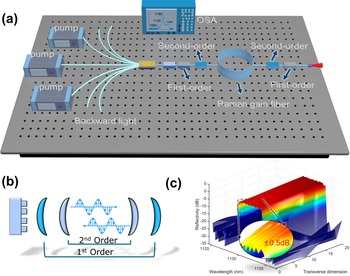
Figure 3 illustrates the experimental setup designed to implement and validate the proposed concept of RFG-assisted passive spectral tailoring within a CRFL. As shown schematically in Figure 3(a), the pump source was three 1080 nm ytterbium-doped fibre lasers (YDFLs) with an output fibre core/cladding diameter of 20/400 μm. Its output was injected into the cascaded Raman resonator via a commercial (6 + 1) × 1 pump-signal combiner, whose output fibre had a core/cladding diameter of 50/400 μm. A customized RFG, serving as a first-order Stokes passive spectral tailor, is integrated after the combiner to introduce spatially incoherent feedback within a cascaded Raman system. The laser cavity is constructed in a nested configuration: the FBGs with a central wavelength of the first-order Stokes wave (1130 nm) form the outer cavity, while the FBGs with a central wavelength of the second-order Stokes (1185 nm) wave are situated inside. The Raman fibre and all the fibre gratings used in the system are fabricated in passive graded-index fibres with core/cladding diameter of 100/140 μm. Both the 1130 and 1185 nm high-reflectivity fiber Bragg gratings (HR-FBGs) exhibited a reflectivity of more than 99% and a reflection bandwidth of 4 nm. To enhance the conversion efficiency from the first (1130 nm) to the second (1185 nm) Stokes order, the reflectivity of the 1130 nm output coupler (OC) was set to more than 90%, while the 1185 nm OC had a lower reflectivity of 4%, facilitating power extraction. Output spectra are monitored using an optical spectrum analyser (OSA). A simplified representation of this architecture is provided in Figure 3(b), emphasizing the cascaded Stokes conversion process from 1080 to 1130 nm and subsequently to 1185 nm.
Experimental setup: (a) schematic diagram of the CRFL experimental setup; (b) simplified schematic of the experimental setup; (c) measured random reflectance profile of the engineered RFG used in the experiment.

The key element enabling passive spectral tailoring is the engineered RFG, fabricated via femtosecond laser inscription, whose measured reflectance profile is presented in Figure 3(c). Notably, femtosecond laser inscription leverages the spatial locality of nonlinear absorption, which endows it with stronger three-dimensional (3D) structuring capabilities. It features a random flatness fluctuation of approximately ±0.5 dB across its 3.5 nm reflection bandwidth centred at 1130 nm, with a peak reflectivity exceeding 90%. This intentionally introduced randomness provides the spatially varying feedback essential for stimulating mode competition and spectral redistribution. The asymmetric resonator design incorporates both conventional high-reflection FBGs and an RFG. This configuration ensures that random feedback is applied primarily at the first-Stokes order. At this stage, spectral tailoring most effectively suppresses nonlinear broadening and noise accumulation, thereby enabling spectral cleanup. This customized RFG thus serves as the key passive spectral tailor, enabling passive control over the spectral phase and amplitude during cascaded Raman conversion. These spectra were acquired after the output beam passed through two dichroic mirrors (high reflection below 1100 nm and high transmission above 1100 nm, followed by high reflection below 1150 nm and high transmission above 1150 nm). This arrangement selectively extracts the second-Stokes band centred at 1185 nm for spectral and power analysis.
4 Results and discussion
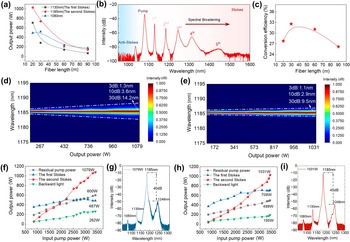
This study focuses on a two-stage cascaded Raman oscillator designed for high-power output at the second-Stokes wavelength (1185 nm). The spectral and power analyses presented in this section pertain specifically to this target output. The impact of feedback on higher-order Stokes waves (beyond the second order) is beyond the present scope and is noted as a direction for future work. Figure 4 systematically investigates the influence of fibre length and random feedback on the performance of the CRFLs. As summarized in Figure 4(a), output power strongly depends on fibre length. At 90 m, limited conversion to the second-Stokes order was observed, with only 142 W output at the second-order Stokes (1185 nm) and significant residual pump (176 W at 1080 nm) and first-Stokes power (65 W at 1130 nm), indicating inefficient energy transfer beyond the first-Stokes threshold. Figure 4(b) displays the system without RFG feedback, serving as a visual reference for the severe spectral broadening problem inherent in conventional CRFLs that our work aims to address. Reducing the fibre length improved second-Stokes power extraction; however, at 20 m, although pump depletion increased, first-Stokes conversion was incomplete due to insufficient nonlinear interaction length, leading to elevated power at 1130 nm. Consequently, the careful selection of fibre length is needed to obtain maximum output power while effectively mitigating parasitic losses. The optimal balance between power and efficiency occurs for fibre lengths of 20–30 m. While higher output power at 1185 nm is measured at shorter fibres length (Figure 4(c)), the conversion efficiency declines below this range.
Output power and spectral manipulation with fibre length and feedback optimization: (a) output power optimization versus fibre length; (b) spectral broadening in a 90 m fibre due to accumulated nonlinear effect without RFG feedback; (c) second-Stokes conversion efficiency at different fibre lengths; (d), (e) spectral evolution (d) without and (e) with random feedback, in which feedback suppresses broadening and narrows linewidth; (f), (g) without feedback: 1079 W, 1.3 nm linewidth, 40 dB suppression; (h), (i) with feedback: 1031 W, 1.1 nm linewidth, 45 dB suppression.

Beyond the output power characteristics, we now turn to the effectiveness of spectral manipulation under different feedback conditions. The spectral evolution under different feedback conditions is presented in Figures 4(d)–4(i), which directly demonstrates the effectiveness of our passive spectral tailoring approach. As shown in Figure 4(d), without the optimized random grating feedback, the output spectrum exhibits pronounced broadening with increasing power. In particular, this behaviour is evident at a 90 m fibre length in Figure 4(b), resulting from the cumulative impact of nonlinear effects including XPM and FWM. Such broadening represents the typical challenge in achieving high spectral purity in conventional CRFLs. In contrast, with the engineered random feedback, shown in Figure 4(e), spectral narrowing is maintained across all power levels, highlighting the effective noise suppression and mode selection mediated by the RFG-based spectral tailor.
A direct comparison of the output spectra at the maximum power reveals a marked improvement in the overall spectral quality. As quantified in Figures 4(d) and 4(e) and shown in Figures 4(f)–4(i), the introduction of random feedback not only narrows the 3-dB linewidth from 1.3 to 1.1 nm but, more importantly, induces a significant compression of the spectral wings. Notably, this represents an approximately 15% reduction in the 3-dB linewidth and a clear visual compression of the spectral profile. The 10-dB linewidth is reduced from 3.6 to 2.9 nm and, notably, the 30-dB linewidth is nearly halved, from 14.2 to 9.5 nm. This comprehensive spectral cleanup is concurrent with an improved higher-order Stokes suppression from 40 to 45 dB. This comprehensive spectral reshaping, quantified by the marked compression of the 10-dB and 30-dB linewidths and the improved Stokes suppression, is achieved concurrently with an optimized redistribution of intracavity energy flow (see the full power budget in Figures 4(f) and 4(h)), validating the effectiveness of the passive spectral control mechanism.
These results provide experimental validation of the theoretical model of passive spectral tailoring via random feedback. The random grating introduces wavelength-selective feedback that promotes intracavity mode competition, favouring spectral components aligned with higher feedback strengths and counteracting nonlinear broadening mechanisms. A detailed power analysis (see Figures 4(f) and 4(h)) confirms that the random feedback optimizes the energy partition among pump (1080 nm), first-Stokes (1130 nm) and second-Stokes (1185 nm) components rather than introducing significant loss. Notably, the random feedback reduces backward-propagating power by approximately 26%, raising the overall power conversion efficiency (total usable forward output) and improving pump utilization. This demonstrates a net gain in system-level efficiency while achieving spectral cleanup. The improved spectral performance, as evidenced by the comparable second-Stokes output power (1079 W without feedback versus 1031 W with feedback) and the significantly narrowed linewidths in the normalized spectra (measured from the filtered second-Stokes band), demonstrates that the feedback primarily suppresses nonlinear spectral broadening. Thus, the combination of optimized fibre length and deliberate random grating feedback enables simultaneous high-power and high-spectral-purity operation in CRFLs.
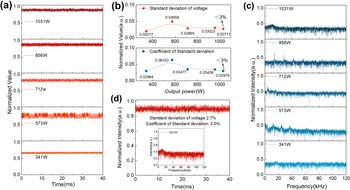
Figure 5 characterizes the temporal dynamics and intensity properties of the random-grating-controlled Raman laser, providing critical insights into the stability of the passive spectral tailoring approach. The temporal measurements were conducted to verify that the spectral control mechanism did not degrade output stability, with performance compared to the typical operational baseline for conventional Raman oscillators[ Reference Fan, Hao, Li, Fu, Chen, Yao, Leng and Zhou42] (normalized intensity fluctuations <10%). To capture these dynamics, the temporal intensity was recorded using a photodiode (PD) detector and an oscilloscope, with a maximum detection bandwidth of 1 GHz and a sampling rate of 1 GS/s. As shown in Figure 5(a), the temporal trace of the output intensity stabilizes significantly with increasing power. A reproducible transient fluctuation observed near the 573 W threshold is attributed to inherent nonlinear energy redistribution between the first- and second-Stokes orders, characteristic of cascaded Raman conversion; the system stabilizes thereafter at higher power levels. Quantitative analysis in Figure 5(b) tracks the evolution of intensity stability. The standard deviation of the normalized intensity at the final, steady-state maximum power is below 0.03, indicating excellent stability. The broader variations at lower powers reflect the dynamic stabilization process.
Temporal stability and intensity properties: (a) temporal intensity stabilizes with power; (b) intensity standard deviation and variation remain below 0.03; (c) Fourier transform spectra of the time-domain output characteristics; (d) stable temporal and RF spectra at maximum power.

The FFT spectra of the temporal signals offer further insight into the intensity properties, as shown in Figure 5(c). The low-frequency peaks (<0.2 MHz) observed at intermediate power levels are attributed to relaxation oscillations and transient energy exchange between Stokes orders during the cascaded Raman conversion process, a kind of dynamic behaviour analogous to the modal fluctuations observed and analysed in high-power fibre amplifiers[ Reference Johansen, Laurila, Maack, Noordegraaf, Jakobsen, Alkeskjold and Lægsgaard43]. Importantly, these transient fluctuations are significantly suppressed at the maximum output power of 1031 W, where the radio frequency (RF) spectrum exhibits a flattened background with no prominent peaks, as shown in Figure 5(d), indicating stable continuous-wave operation without self-pulsing[ Reference Feng and Ueda44]. This trend is confirmed in Figure 5(d), which shows both the smooth temporal trace and flattened RF spectrum at full power. These results demonstrate that the random feedback introduced by the random grating not only narrows the spectral linewidth but also contributes to improved temporal stability. Compared to a conventional cascaded Raman oscillator[ Reference Hao, Huang, Fan, Li, Leng, Yao, Lei and Zhou45] (showing ~8% maximum fluctuations), the present RFG-based system (maximum ~5%, average ~3%) exhibits notably better stability, suggesting the feedback mitigates intensity noise. The suppression of intensity fluctuations and transient oscillations across the cascaded conversion process confirms that the passive spectral tailoring mechanism effectively stabilizes the system at high-power operation. The combination of spectral cleanup and temporal stability highlights the dual role of random feedback in enabling high-power, high-coherence fibre laser operation. In summary, the key advancement demonstrated here is a marked improvement in the overall spectral profile, extending beyond a marginal narrowing of the core peak. Our results show that the random grating feedback effectively suppresses the nonlinearity-induced spectral pedestal, leading to a steeper, more concentrated spectrum. This is clearly reflected in the significantly compressed linewidths at higher decibel levels, which are critical metrics for evaluating spectral purity in high-power applications.
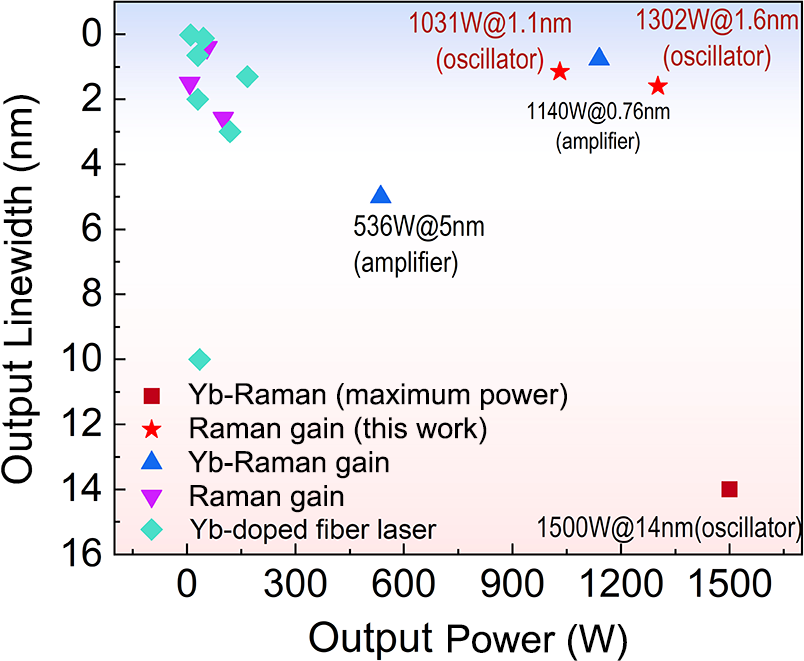
Figure 6 provides a performance summary of fibre lasers operating at the 1180 nm waveband under different gain schemes, including the rare-earth (RE) doped (ytterbium) gain scheme[ Reference Heinzig, Palma-Vega, Walbaum, Schreiber, Eberhardt and Tünnermann46– Reference Kashiwagi52], Yb-cascaded Raman hybrid gain[ Reference Zhang, Zhou, Xiao, Wang and Xu53– Reference Peng, Ma, Song, Zheng, Li, Liu, Du, Liu, Wang and Xu55] and pure cascaded Raman gain[ Reference Xu, Zhou, Leng, Wu and Zhang56– Reference Dash, Deheri, Choudhury and Supradeepa59]. For RE-doped fibre lasers, the output power in this waveband is typically confined to the hundred-watt level with a linewidth around 1 nm. Existing CRFLs suffer from the power–linewidth trade-off, typically delivering hundred-watt level power with narrow linewidth or scaling to kilowatt levels at the expense of significant spectral broadening[ Reference Wang, Xiao, Huang, Tian, Li, Yan and Gong54]. It is worth noting that while Yb-cascaded Raman hybrid gain systems can achieve kilowatt-level output[ Reference Peng, Ma, Song, Zheng, Li, Liu, Du, Liu, Wang and Xu55], their performance is severely constrained in radiation environments due to the vulnerability of RE ions. Radiation-induced[ Reference Xiang, Zhang, Wang, Zhang, Chen, Lin, Ye, Hua and Chen60] damage to the Yb3+ energy levels leads to severe power degradation, often reducing output by more than half. In contrast, the pure Raman gain mechanism presented in this work, free of RE dopants, inherently bypasses this vulnerability, suggesting a superior potential for radiation-hard operation. Our demonstration of a 1031 W, 1.1 nm linewidth pure Raman gain oscillator thus represents a promising alternative, achieving a performance envelope previously accessible only with complex single-frequency master oscillator power amplifier (MOPA) systems[ Reference Peng, Ma, Song, Zheng, Li, Liu, Du, Liu, Wang and Xu55]. This result indicates that random feedback can effectively control nonlinear spectral dynamics without compromising power scalability. The proposed method provides a robust and simplified route to achieving high-power, narrow-linewidth laser emission, with potential applicability in environments demanding both high spectral purity and operational resilience, such as space-based lidar, nuclear sensing and high-energy physics diagnostics. By alleviating traditional performance trade-offs, this work offers a promising approach to developing practical high-performance CRFLs that concurrently deliver power, coherence and reliability.
Summary of the fibre lasers operating at the 1180 nm waveband under different gain schemes.

5 Conclusions
In conclusion, we have proposed and experimentally validated an all-fibre strategy for the high-power cascaded Raman oscillator using intentional spatial randomness for passive spectral control. By incorporating a randomized grating as a built-in spectral shaper, we achieved passive spectral control without deterministic feedback. A comprehensive theoretical model supports the dual mechanisms of spectral redistribution and virtual loss underpinning the noise suppression and spectral broadening suppression. The system delivered 1031 W at 1185 nm with a narrow 3-dB linewidth of 1.1 nm and, more notably, significantly suppressed spectral wings. This work shows that controlled randomness, combined with nonlinear gain, can serve as an effective method for coherence control. The success of this architecture demonstrates the potential of the lab-on-fibre concept for integrating advanced functionalities directly into the fibre. It provides a practical strategy for developing high-performance cascaded Raman fibre oscillators that unify high power with high spectral purity, with promising applications in nonlinear frequency conversion, precision spectroscopy and directed energy systems.
Appendix A: Steady-state power balance equations for CRFLs
To validate the introduced spectral redistribution model, we compare it with the standard time-domain slowly varying field approximation model for CRFLs[ Reference Jackson and Paul40, Reference Feng41]. This theoretical model provides a foundation for analysing power conversion in multi-Stokes systems.
Under steady-state conditions, it describes the spatial evolution dynamics of energy transfer between pump and Stokes fields through a set of coupled ordinary differential equations by representing each Stokes order as a single spectral component. An extended model that resolves the spectral content within each Stokes order has been developed to capture more spectral dynamics, including linewidth evolution and detailed redistribution processes. Our approach conceptualizes each Stokes band as comprising seven discrete longitudinal modes, spaced at 0.2 nm intervals around the central Stokes wavelength. The cascaded process involves pump ( ${\lambda}_0^{\mathrm{c}}=1080\ \mathrm{nm}$
), first-order (
${\lambda}_0^{\mathrm{c}}=1080\ \mathrm{nm}$
), first-order ( ${\lambda}_1^{\mathrm{c}}=1130\ \mathrm{nm}$
), second-order (
${\lambda}_1^{\mathrm{c}}=1130\ \mathrm{nm}$
), second-order ( ${\lambda}_2^{\mathrm{c}}=1185\ \mathrm{nm}$
) and third-order (
${\lambda}_2^{\mathrm{c}}=1185\ \mathrm{nm}$
) and third-order ( ${\lambda}_3^{\mathrm{c}}=1246\ \mathrm{nm}$
) Stokes central wavelengths. The kth longitudinal mode within the nth order is defined as follows:
${\lambda}_3^{\mathrm{c}}=1246\ \mathrm{nm}$
) Stokes central wavelengths. The kth longitudinal mode within the nth order is defined as follows:
 $$\begin{align}{\lambda}_k^{(n)}&={\lambda}_n^{\mathrm{c}}+{\delta}_k,\nonumber\\&\quad {\delta}_k\in \left\{-0.6,-0.4,-0.2,0,0.2,0.4,0.6\right\}\kern0.1em \mathrm{nm}.\end{align}$$
For forward propagation, the equations become the following:
 $$\begin{align}\frac{\mathrm{d}P_{0,m}^{+}}{\mathrm{d}z}=-{\alpha}_0{P}_{0,m}^{+}-\sum \limits_{n=1}^7\frac{\lambda_{1,n}}{\lambda_{0,m}}{g}_{\mathrm{R}}^{0m,1n}\left({P}_{1,n}^{+}+{P}_{1,n}^{-}\right){P}_{0,m}^{+},\end{align}$$
 $$\begin{align}\frac{\mathrm{d}P_{1,n}^{+}}{\mathrm{d}z}&=-{\alpha}_1{P}_{1,n}^{+}+\sum \limits_{m=1}^7{g}_{\mathrm{R}}^{0m,1n}\left({P}_{0,m}^{+}+{P}_{0,m}^{-}\right){P}_{1,n}^{+}\notag\\&\quad -\,\sum \limits_{k=1}^7\frac{\lambda_{2,k}}{\lambda_{1,n}}{g}_{\mathrm{R}}^{1n,2k}\left({P}_{2,k}^{+}+{P}_{2,k}^{-}\right){P}_{1,n}^{+},\end{align}$$
 $$\begin{align*}\frac{\mathrm{d}P_{2,k}^{+}}{\mathrm{d}z}=-{\alpha}_2{P}_{2,k}^{+}+\sum \limits_{n=1}^7{g}_{\mathrm{R}}^{1n,2k}\left({P}_{1,n}^{+}+{P}_{1,n}^{-}\right){P}_{2,k}^{+}\end{align*}$$
 $$\begin{align}-\sum \limits_{l=1}^7\frac{\lambda_{3,l}}{\lambda_{2,k}}{g}_{\mathrm{R}}^{2k,3l}\left({P}_{3,l}^{+}+{P}_{3,l}^{-}\right){P}_{2,k}^{+},\end{align}$$
 $$\begin{align}\frac{\mathrm{d}P_{3,l}^{+}}{\mathrm{d}z}=-{\alpha}_3{P}_{3,l}^{+}+\sum \limits_{k=1}^7{g}_{\mathrm{R}}^{2k,3l}\left({P}_{2,k}^{+}+{P}_{2,k}^{-}\right){P}_{3,l}^{+}.\end{align}$$
The backward-propagating equations have similar forms. In these equations, ${P}_{i,m}^{\pm }$
represents the forward/backward power of the mth longitudinal mode within the ith Stokes band, and
${P}_{i,m}^{\pm }$
represents the forward/backward power of the mth longitudinal mode within the ith Stokes band, and ${\lambda}_{i,m}$
is the corresponding wavelength. The Raman gain coefficients
${\lambda}_{i,m}$
is the corresponding wavelength. The Raman gain coefficients ${g}_{\mathrm{R}}^{im, jn}$
are wavelength-dependent. The effective gain between a pump mode at
${g}_{\mathrm{R}}^{im, jn}$
are wavelength-dependent. The effective gain between a pump mode at ${\lambda}_{\mathrm{p}}$
and a Stokes mode at
${\lambda}_{\mathrm{p}}$
and a Stokes mode at ${\lambda}_{\mathrm{s}}$
is modelled as follows:
${\lambda}_{\mathrm{s}}$
is modelled as follows:
 $$\begin{align}{g}_{\mathrm{eff}}\left({\lambda}_{\mathrm{p}},{\lambda}_{\mathrm{s}}\right)={g}_{\mathrm{R}}^0\cdot f\left(\Delta \lambda -\Delta {\lambda}_{\mathrm{R}}\right),\end{align}$$
where ${g}_{\mathrm{R}}^0$
is the peak Raman gain coefficient for the respective Stokes shift. We take
${g}_{\mathrm{R}}^0$
is the peak Raman gain coefficient for the respective Stokes shift. We take ${g}_{\mathrm{R}}^0=2.0\times {10}^{-13}\ \mathrm{m}/\mathrm{W}$
, which is close to the values reported for silica-based multimode fibres[
Reference Feng41, Reference Polley and Ralph61]. Here,
${g}_{\mathrm{R}}^0=2.0\times {10}^{-13}\ \mathrm{m}/\mathrm{W}$
, which is close to the values reported for silica-based multimode fibres[
Reference Feng41, Reference Polley and Ralph61]. Here, $\Delta \lambda ={\lambda}_{\mathrm{s}}-{\lambda}_{\mathrm{p}}$
,
$\Delta \lambda ={\lambda}_{\mathrm{s}}-{\lambda}_{\mathrm{p}}$
, $\Delta {\lambda}_{\mathrm{R}}\approx 50\ \mathrm{nm}$
is the nominal Raman shift and
$\Delta {\lambda}_{\mathrm{R}}\approx 50\ \mathrm{nm}$
is the nominal Raman shift and $f$
is a normalized Gaussian line shape function. At the input end, the reflection condition for the first-order Stokes becomes the following:
$f$
is a normalized Gaussian line shape function. At the input end, the reflection condition for the first-order Stokes becomes the following:
 $$\begin{align}{P}_{1,n}^{-}(0)={R}_1\left({\lambda}_{1,n}\right){P}_{1,n}^{+}(0),\end{align}$$
where ${R}_1\left(\lambda \right)$
denotes the random reflectivity profile. This preferentially reinforces certain spectral components, initiating the spectral purification that cascades to higher-order Stokes outputs. In this work,
${R}_1\left(\lambda \right)$
denotes the random reflectivity profile. This preferentially reinforces certain spectral components, initiating the spectral purification that cascades to higher-order Stokes outputs. In this work, ${R}_1\left(\lambda \right)$
is directly constructed from the measured reflectance profile of the actual RFG. The same experimental data is also used to construct the random perturbation kernel in the reduced model (Equations (1)–(3)), ensuring both models are grounded in the same physical feedback characteristics.
${R}_1\left(\lambda \right)$
is directly constructed from the measured reflectance profile of the actual RFG. The same experimental data is also used to construct the random perturbation kernel in the reduced model (Equations (1)–(3)), ensuring both models are grounded in the same physical feedback characteristics.
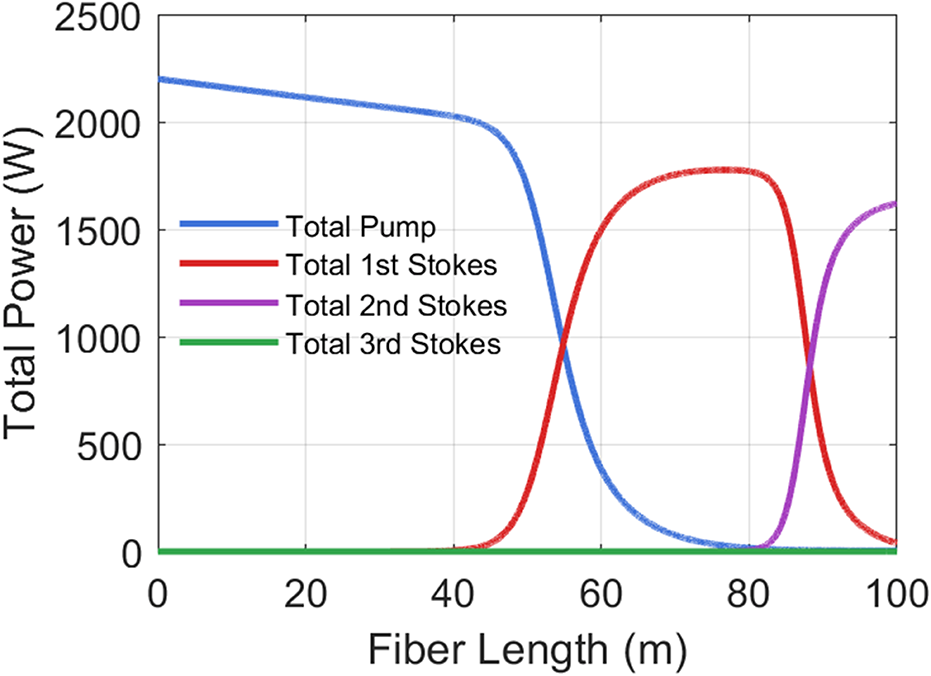
The extended classical model was implemented via the Runge–Kutta method within an iterative shooting approach. The simulation parameters include a 2200 W pump at 1080 nm, a 100 m fibre and OC reflectivities of 8% and 4% for the first- and second-order Stokes, respectively. The fibre loss is 0.002 m–1. Figure 7 illustrates the cascaded conversion of each Stokes order’s power in the CRFL simulated based on this extended model.
Power evolution in the CRFL.

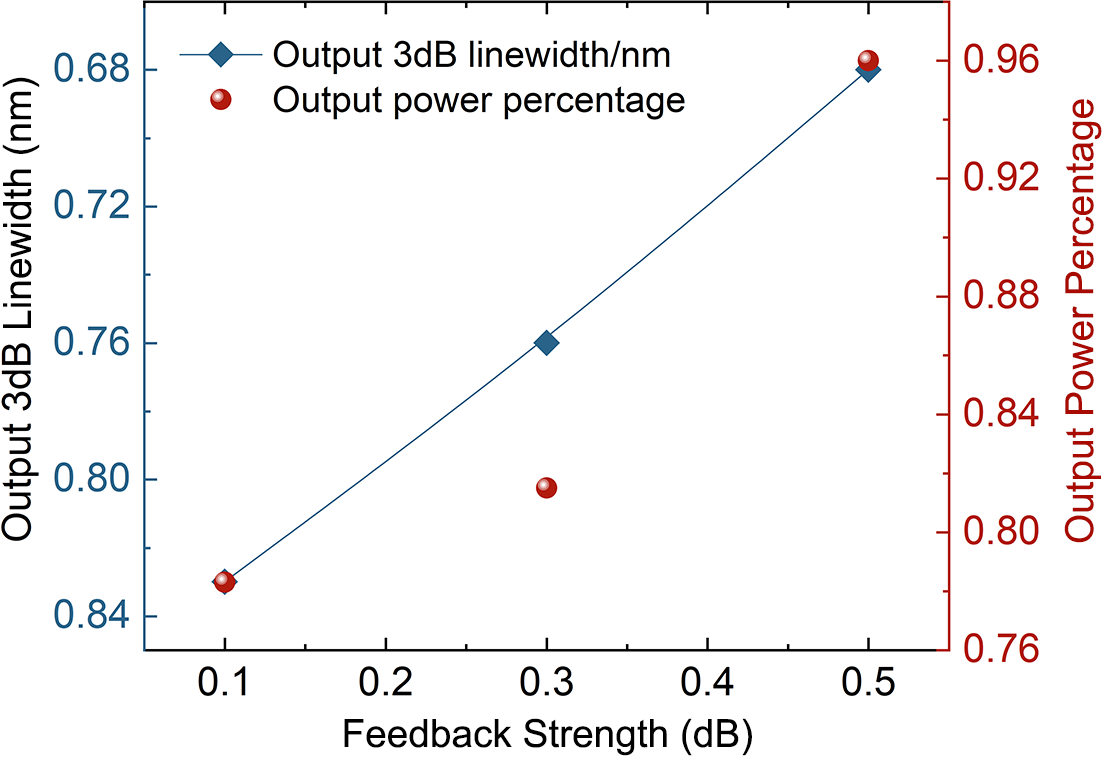
Figure 8 compares the output power percentage of the second-order Stokes wave under different RFG feedback conditions simulated using the extended classical model. As the random fluctuation amplitude increases from 0.1 dB (Figure 8(d)) to 0.3 dB (Figure 8(e)) and 0.5 dB (Figure 8(f)), the power fraction concentrated at the central wavelength progressively rises from 78.3% to 81.5% and finally to 96%. The resulting spectrum, with its enhanced central peak and suppressed sidelobes, matches the trend predicted by the random feedback model (Equation (1)). The agreement between the two models validates the physical mechanism represented by the proposed model. The classical model provides a comprehensive physical description including full spatial propagation, although its computational cost, which involves solving 56 coupled equations for the seven-mode, three-order case, limits extensive parameter studies. Our model can serve as a simpler reference alternative.
Simulation results from the extended classical model under different random feedback conditions. Power evolution of the (a) pump, (b) first-order Stokes and (c) second-order Stokes longitudinal modes along the fibre. Normalized output power percentage of the second-order Stokes for random fluctuation amplitudes of (d) 0.1 dB, (e) 0.3 dB and (f) 0.5 dB.

The seven-longitudinal mode discretization employed here is a rather coarse discrete approximation of the continuous spectrum. It allows us to preliminarily investigate the spectral competition effects induced by wavelength-selective feedback within the classical model. This extended model is not intended to serve as a high-precision spectral prediction tool, but rather to confirm, within a physically self-consistent framework, the spectral redistribution mechanism described by our random feedback model (Equations (1)–(3)). The consistency in spectral narrowing trends between the two models improves our understanding of the physical mechanism underlying random feedback, and indicates that the random feedback model preserves the core physical picture while enabling more efficient exploration of the parameter space.
To directly validate the reduced model against the established classical theory, we compare the output characteristics predicted by both models under identical random feedback conditions. Figure 9 shows this comparison for three representative fluctuation amplitudes (0.1, 0.3 and 0.5 dB). Although the reduced model provides continuous spectra while the classical model tracks discrete longitudinal modes, both models exhibit consistent trends. This agreement confirms that the reduced model captures the essential physics of how wavelength-selective feedback suppresses spectral broadening, while offering significantly lower computational cost for parameter studies.
Direct comparison of output characteristics predicted by the reduced model and the extended classical model under identical random feedback conditions.

Appendix B: Output spectral evolution under different feedback conditions
Figure 10 shows normalized intensity noise and spectral evolution under different random feedback strengths γ simulated with the reduced model. Figures 10(a1)–10(a4) show the evolution of normalized intensity noise for γ of 0.1, 0.5, 0.7 and 1.0, respectively. Figures 10(b1)–10(b4) show the corresponding normalized spectral evolution. The output spectrum broadens significantly when feedback is too weak or too strong, while spectral broadening is effectively suppressed for moderate feedback strengths.
Simulation results from the reduced model under different random feedback strengths γ. (a1)–(a4) Normalized intensity noise evolution for γ = 0.1, 0.5, 0.7 and 1.0, respectively. (b1)–(b4) Corresponding normalized spectral evolution under the same γ values. (c1)–(c4) Corresponding 3-dB linewidth evolution over time for each feedback strength.

Figure 11 shows the normalized intensity noise and spectral evolution under different correlation lengths ${L}_{\mathrm{c}}$
simulated with the reduced model. Figures 11(a1)–11(a4) show the evolution of normalized intensity noise for
${L}_{\mathrm{c}}$
simulated with the reduced model. Figures 11(a1)–11(a4) show the evolution of normalized intensity noise for ${L}_{\mathrm{c}}=1$
,
${L}_{\mathrm{c}}=1$
, $3$
,
$3$
, $5$
and
$5$
and $7$
nm, respectively. Figures 11(b1)–11(b4) show the corresponding normalized spectral evolution. Figures 11(c1)–11(c4) show the corresponding 3-dB linewidth evolution over time. As
$7$
nm, respectively. Figures 11(b1)–11(b4) show the corresponding normalized spectral evolution. Figures 11(c1)–11(c4) show the corresponding 3-dB linewidth evolution over time. As ${L}_{\mathrm{c}}$
increases, the output spectrum first narrows, reaching an optimal point, and then broadens again.
${L}_{\mathrm{c}}$
increases, the output spectrum first narrows, reaching an optimal point, and then broadens again.
Simulation results from the reduced model under different correlation lengths L c. (a1)–(a4) Normalized intensity noise evolution for L c = 1, 3, 5 and 7 nm, respectively. (b1)–(b4) Corresponding normalized spectral evolution under the same L c values. (c1)–(c4) Corresponding 3-dB linewidth evolution over time for each feedback strength.

Acknowledgements
The authors thank Dr. Yang Li for technical support in the experiments. This work was supported by the National Natural Science Foundation of China (Grant No. 12174445), the Russian Science Foundation (Grant No. 21-72-30024-II) and Hunan Province Graduate Innovation Research Project (Grant No. CX20240103).




 Open access

