

Implications
The implications of this review are both for the animal science community and the policy community. For the animal science community (funders and scientists) the review highlighted the paucity of holistic data to enable the total consequences (in terms of both reduced greenhouse gas (GHG) emissions and the contribution of livestock products to global food security) of specific changes in livestock production systems to be assessed either qualitatively or quantitatively. Such information is needed to help prioritize research to meet policy needs. For the policy community, the review highlights the potential risks to food security of applying too stringent targets to reduction in GHG emissions from livestock production.
Introduction: the need to mitigate climate change
The production and assimilation of carbon dioxide are part of the natural cycles of life on earth, but the increasing ratio of production to consumption associated with human activity has led to unprecedentedly high levels of carbon dioxide in the atmosphere (Intergovernmental Panel on Climate Change (IPCC), 2007a). The fact that carbon dioxide in the earth’s atmosphere increases heat retention has been known since the work of John Tyndall in the 19th century (Fleming, Reference Fleming1998), but political acceptance of the connection between global warming and human-generated greenhouse gas (GHG) emissions and the need to take action took nearly a century. At the Earth Summit held in Rio de Janeiro in 1992, a Framework Convention on Climate Change was signed, under the auspices of the United Nations, but a protocol to limit gases generated by humans and which absorb heat in the atmosphere was not agreed until 1997, as the Kyoto Protocol. The Protocol established legally binding commitments for the reduction in emissions of the ‘basket of six’ greenhouse’ gases (GHG: carbon dioxide, methane, nitrous oxide (N2O), hydrofluorocarbons, perfluorocarbons and sulphur hexafluoride).
It is now over 10 years since adoption of the Kyoto Protocol, and 4 years since it came into force in February 2005 with Russia’s ratification, and despite progress in reducing the rate of production of GHGs in some countries, the carbon dioxide concentration in the atmosphere has continued to rise (IPCC, 2007a). The former Chief Scientific Adviser to the UK Goverment, Prof. Sir David King, stressed the severity of the situation in 2004: ‘There is no bigger problem than climate change. The threat is quite simple, it’s a threat to our civilization’ (King, Reference King2004). Science was essential both to confirming that there is a change in the earth’s climate which needs to be addressed, and to identifying the human activities which are the major contributors (IPCC, 2007a), but it was the translation of the science into an economic framework through the Stern Report (Her Majesty’s Treasury (HMT), 2006) which formed the platform for governments to increase national activity with the commitment during 2008 to the development of climate change bills at the level of both the UK government and the devolved administrations. All sectors will need to contribute reductions to achieving the targets being set: in the UK a bill to legislate for 80% reductions from a 1990 baseline by 2050 became law in 2008 (Office of Public Sector Information (OPSI), 2008). Whilst there are no sector-specific targets established, it is likely that the percentage contribution will differ between sectors.
This paper is concerned solely with emissions associated with the agriculture sector and with exploring the reliability of the evidence base, which will be used to inform government of the options for decreasing emissions. At a global level, the evidence base has been provided by the IPCC reports (IPCC, 2007a and 2007b), but the assumptions made for agriculture at a global level (a closed system) will not hold at a national level, where the farming industry consists of a large number of small- to medium-sized businesses whose carbon emissions will depend both on the natural resources available and their response to technology and markets, with varying levels of imports and exports over time. The volatility of those markets was demonstrated in 2008, when increasing competition for agricultural land between food and non-food uses was highlighted (Searchinger et al., Reference Searchinger, Heimlich, Houghton, Dong, Elobeid, Fabiosa, Tokgoz, Hayes and Yu2008). This has consequences for the evidence base required by the policy community, who increasingly have to balance the need to address climate change with the need to maintain food security.
The aim of this paper is to identify areas where animal scientists can help the development of policy through the provision of robust and objective evidence on the contribution of livestock to GHG emissions, in the context of growing global demand for livestock products (Delgado, Reference Delgado2005).
Agriculture and climate change mitigation at global and UK levels
Key starting points for considering agriculture and climate change are the reviews conducted by the United States Environmental Protection Agency (USEPA) (2005) and for the IPCC by Smith et al. (Reference Smith, Martino, Cai, Gwary, Janzen, Kumar, McCarl, Ogle, O’Mara, Rice, Scholes, Sirotenko, Howden, McAllister, Pan, Romanenkov, Rose, Schneider and Towprayoon2007a, Reference Smith, Martino, Cai, Gwary, Janzen, Kumar, McCarl, Ogle, O’Mara, Rice, Scholes, Sirotenko, Howden, McAllister, Pan, Romanenkov, Schneider and Towprayoon2007b and Reference Smith, Martino, Cai, Gwary, Janzen, Kumar, McCarl, Ogle, O’Mara, Rice, Scholes, Sirotenko, Howden, McAllister, Pan, Romanenkov, Schneider, Towprayoon, Wattenbach and Smith2008). Globally, agriculture (livestock and crop production) accounted for 12% of human-induced GHG emissions in 2005 (Smith et al., Reference Smith, Martino, Cai, Gwary, Janzen, Kumar, McCarl, Ogle, O’Mara, Rice, Scholes, Sirotenko, Howden, McAllister, Pan, Romanenkov, Rose, Schneider and Towprayoon2007a). But this does not take into account the contribution to GHG emissions of changes in land use (e.g. deforestation to provide grazing land) or associated costs such as food processing, fuel for cultivation and energy in livestock housing, which are accounted for in the industry, transport and energy sectors, respectively.
Mitigation at a global level
Bellarby et al. (Reference Bellarby, Foereid, Hastings and Smith2008) estimated total global emissions of GHG by world agriculture (including land-use change emissions) to be between 8.5 and 16.5 gigatonnes (Gt) CO2e (carbon dioxide equivalent)/annum (IPCC, 2007b; Bellarby et al., Reference Bellarby, Foereid, Hastings and Smith2008), or between 17% and 32% of all global human-induced emissions (Smith et al., Reference Smith, Martino, Cai, Gwary, Janzen, Kumar, McCarl, Ogle, O’Mara, Rice, Scholes, Sirotenko, Howden, McAllister, Pan, Romanenkov, Rose, Schneider and Towprayoon2007a; IPCC, 2007b). This compares with 12 Gt CO2e from the industry sector (Bernstein et al., Reference Bernstein, Roy, Delhotal, Harnisch, Matsuhashi, Price, Tanaka, Worrell, Yamb and Fengqi2007).
There is, however, considerable potential for mitigation of global agricultural emissions, particularly in Asia and South America (Smith et al., Reference Smith, Martino, Cai, Gwary, Janzen, Kumar, McCarl, Ogle, O’Mara, Rice, Scholes, Sirotenko, Howden, McAllister, Pan, Romanenkov, Schneider, Towprayoon, Wattenbach and Smith2008). Estimates from the IPCC 2nd Assessment Report (IPCC, 1996) suggested that between 1.4 and 2.9 Gt CO2e/annum could be sequestered in agricultural soils, while Smith et al. (Reference Smith, Martino, Cai, Gwary, Janzen, Kumar, McCarl, Ogle, O’Mara, Rice, Scholes, Sirotenko, Howden, McAllister, Pan, Romanenkov, Schneider, Towprayoon, Wattenbach and Smith2008) illustrated a total biophysical potential of mitigation of agricultural emissions of 5.5 to 6 Gt CO2e/annum. This would require improvements in both cropland and grazing land management, the restoration of cultivated organic soils and degraded land, changes in land use and manure management as well as reductions in direct emissions of GHGs by ruminants. Smith et al. (Reference Smith, Martino, Cai, Gwary, Janzen, Kumar, McCarl, Ogle, O’Mara, Rice, Scholes, Sirotenko, Howden, McAllister, Pan, Romanenkov, Schneider and Towprayoon2007b) considered that this potential was unlikely to be reached due to constraints such as social, educational, institutional and economic, in addition to policy constraints of both climate change and non-climate-related nature.
Mitigation at a UK level
Estimates of the emissions of GHGs in the UK are submitted as ‘stand-alone inventories’ on an annual basis, to the Secretariat of the United Nations Framework Convention on Climate Change (UNFCCC) and are peer-reviewed by technical experts (Table 1). Emissions are dominated by the production and consumption of fuels including oil, gas, coal and electricity. Agriculture, land use, land-use changes and forestry together accounted for net emissions of 42 million tonnes (Mt) CO2e in 2005, some 6% of total UK emissions (Table 1). However, this is an underestimate of total GHG emissions produced by UK agriculture, since it does not include GHG emissions arising from the consumption of fuels by agriculture, land use and forestry as well as agriculture-associated emissions counted in other sectors (e.g. buildings, transport, industry). Further, there is uncertainty in the estimation of non-CO2 emissions. This uncertainty is dominated by variability in emissions of N2O from agricultural soils, which occur over relatively long periods of time and at rates which are dependent on the weather (National Audit Office, 2008). Emissions of N2O and methane by agriculture are estimated annually using agreed methodology to produce an inventory (IPCC, 2008).
UK greenhouse gas emissions (million tonnes of carbon dioxide equivalents (Mt CO2e)) 2005Footnote 1

a Includes energy used by agriculture.
1 National Audit Office (2008).
Smith et al. (Reference Smith, Martino, Cai, Gwary, Janzen, Kumar, McCarl, Ogle, O’Mara, Rice, Scholes, Sirotenko, Howden, McAllister, Pan, Romanenkov, Schneider, Towprayoon, Wattenbach and Smith2008) showed that ‘biophysical mitigation potential’ varies in different parts of Europe. Departments of the UK Government and the Devolved Administrations have been active in commissioning reviews and reports of ways to mitigate GHG emissions in a range of sectors with this work now being led by the UK Climate Change Committee, whose first report was published in December 2008 (Committee on Climate Change, 2008). The report identified a realistically achievable ‘abatement potential’ of up to 15 Mt CO2e in 2020, while noting that ‘analysis of opportunities in agriculture is at an early stage and the policy framework for delivering abatement is undeveloped’.
Associated with the publication of some of these reports is continuing press interest in the production of methane by ruminants and suggestions by some lobby groups that the most effective way for agriculture to decrease its impact on GHG emissions is through reduced meat consumption, despite the continuing upward trend in global demand for meat (Delgado, Reference Delgado2005). The livestock industry can, however, take steps to decrease its impact and the evidence base for the contribution of livestock to GHG emissions is considered in the next section.
Greenhouse gas emissions by livestock
Globally, agricultural livestock account directly for about 9% of total anthropogenic GHG emissions (IPCC, 2007b). If all parts of the livestock production lifecycle are included (burning fossil fuel to produce mineral fertilizers used in feed production; methane release from the breakdown of fertilizers and from animal manure; land-use changes for feed production and for grazing; land degradation; fossil fuel use during feed and animal production; fossil fuel use in production; and transport of processed and refrigerated animal products), livestock production and associated activities (including land-use change) are estimated to account for ∼7.1 Gt CO2e per annum or 18% of global anthropogenic emissions (Steinfeld et al., Reference Steinfeld, Gerber, Wassenaar, Castel, Rosales and de Haan2006). Methane emissions account for 2.2 Gt or ∼30% of these emissions, similar to the relative contribution of N2O, while land use and land-use change, together with deforestation related to provision of grazing, account for 2.7 Gt (38%).
At a national level, the inventories (UNFCCC, 2009) are not constructed to separate the carbon costs associated with the feed grown for livestock from the carbon costs associated with cropping as a whole. It is possible, however, to estimate these costs, starting from estimates of the carbon cost per kg of livestock product. Williams et al. (Reference Williams, Audsley and Sandars2006) estimated the GHG emissions (in terms of CO2e) of food products to the farm gate in a report to DEFRA (Department for Environment, Food and Rural Affairs) in 2006, but have since updated these estimates (A. Williams, personal communication, based on a DEFRA-funded project) and it is these later estimates which are quoted in Table 2. The data highlight the much higher emissions associated with meat from ruminant livestock (cattle and sheep) v. monogastrics (pigs and poultry) which do not emit large quantities of methane. The values per kg product were then converted into GHG emissions per unit of energy and protein, to bring liquid milk onto a more equitable basis with meat. Choosing values for the conversion proved difficult, given the variety of values available for energy contents of meat, dependent on the proportion of fat and these must be regarded only as ‘ballpark’ figures. Uncertainty around the figures is also introduced by the higher avoidable waste levels reported for pig and poultry meat (13% and 8% for multiple adult households, respectively) v. beef and lamb (8% and 3%, respectively) (Department for Environment, Food and Rural Affairs (DEFRA), 2008). Expressing the data in this way is of relevance when considering demand, which is considered in more detail in a later section.
Green house gas (GHG) emissions per unit of livestock productFootnote 1

CO2e = carbon dioxide equivalents.
1 A. Williams (personal communication, based on DEFRA (Department for Environment, Food and Rural Affairs) project 2022) for GHG per kg product, and USDA (United States Department of Agriculture) Handbook 8 on nutrient composition of foods for conversion factors to energy and protein. The USDA Handbook figures for energy and protein content of meats and milk were used, as these were the basis of the conversions to human-edible protein and energy used in the CAST (Council for Agricultural Science and Technology) report.
Livestock production figures are generally reported, however, in kg of product and thus taking the estimates for GHG emissions per kg product (Williams et al., Reference Williams, Audsley and Sandars2006 and personal communication), together with FAO (Food and Agriculture Organization) production figures for individual livestock species (FAOSTAT, 2008), the total GHG emissions for livestock production in the UK can be estimated. This gave a figure of 47 or 36 Mt CO2e, or 7.1% or 5.5% of total UK GHG emissions in 2006, using the two estimates. Subtracting figures for the UK contributions of enteric fermentation and manure management from the 2006 UK inventory enabled the contribution from non-direct costs to be estimated as 57% or 44% of total livestock emissions (Table 3). The National Audit Office figures give methane as contributing only 2.4% of total UK GHG emissions, while non-direct emissions such as the energy associated with production of feed and housing of animals accounting for around 4% or 2.4% depending on the figure taken for GHG emissions per kg product.
Relative contributions of enteric fermentation and manure management to total greenhouse gas (GHG) emissions by UK livestock in 2006 calculated from FAOSTAT data on production per species multiplied by the carbon costs per kg livestock product from Williams et al. (Reference Williams, Audsley and Sandars2006) and A. Williams (personal communication, based on DEFRA (Department for Environment, Food and Rural Affairs) project 2022)

Mt CO2e = million tonnes carbon dioxide equivalents.
1Emissions (GHG kg CO2e) per kg milk 1.32, per kg poultry meat 4.57, per kg pig meat 6.35, per kg beef 13, per kg lamb 17.4.
2Emissions per kg product as in Table 2.
Such estimates are a useful starting point for identifying the livestock production systems with the highest carbon cost, but to build an evidence base of the consequences of farming systems adjusting to contribute to the low carbon economy, the diversity of farming across the UK needs to be considered. For example, 84% of Scotland’s agricultural land is classed as Less Favoured Area (LFA) compared to 17% in England and 75% in Wales (Scottish Government, 2008). Even within the Scottish LFA, net farm income for 2006–07 ranged from −£10 222 for the lowest quartile to £37 644 for the highest quartile of specialist beef producers, implying large differences in breeding efficiency (number of offspring per breeding unit per annum), and in daily weight gain which affects the length of time from birth to slaughter. The next section explores the potential of known technologies that could be applied to improve the efficiency of livestock production and thereby help to decrease emissions per kg product, as well as the potential for new technologies to decrease direct emissions.
The potential for mitigation of greenhouse gas emissions from livestock
The Committee on Climate Change (2008) adopted an approach of identifying three routes for abatement potential in relation to the GHG emissions by agriculture:
• lifestyle change (i.e. less reliance on products with a high carbon cost associated with their production);
• changing farming practice; and
• using new technologies.
These are discussed in turn below.
Lifestyle change
Attention has been drawn to the high ‘cost’ of livestock products in terms of broader environmental impacts for the last decade or more (e.g. Brown, Reference Brown1997; Steinfeld et al., Reference Steinfeld, Gerber, Wassenaar, Castel, Rosales and de Haan2006). In recent times, the focus has been on the ‘cost’ in terms of GHG emissions as discussed earlier. At a global level, these concerns have not stemmed the increasing demand for livestock products, especially in those countries where meat and milk have until recently made relatively small contributions to total daily human food consumption (Steinfeld et al., Reference Steinfeld, Gerber, Wassenaar, Castel, Rosales and de Haan2006). Global consumption of meat is projected to increase from 201 Mt in 1997 to 334 Mt in 2020. Similarly, global production of milk is projected to increase from 445 to 661 Mt in the same period (Delgado, Reference Delgado2005).
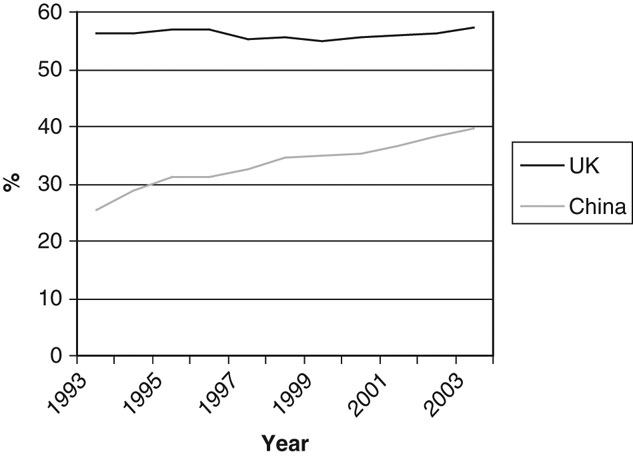
A relatively high proportion of these increases reflect trends in China and India, which mirror the trends in food consumption in the dietary changes which occurred in Western Europe, North America and Australasia in the first half of the 20th century (Grigg, Reference Grigg1999). When forecasting future trends, therefore, it is worth noting both the impact of health messages (links between animal fats and diseases in humans) and the divergence between regions as noted by Grigg (Reference Grigg1999). In the UK, animal protein accounted for a steady percentage of total dietary protein between 1993 and 2003 (Figure 1; FAOSTAT, 2008) compared with the increase in percentage of animal protein consumed in China over the same time period.
Trends in animal protein consumption as a percentage (%) of total protein consumption in UK and China from 1993 to 2003 (FAOSTAT, 2008).
Figures for meat consumption by species are given in Table 4, showing the dominance of monogastric species in terms of both production and consumption. Interestingly, while poultry meat forms a smaller percentage of meat production at a global level (31% compared to 48%), the ratio of production of ruminant to monogastric meat is similar to that in the UK (FAOSTAT, 2008). In recent years, the number of ruminant livestock in the UK has been declining in response to changes in the Common Agricultural Policy (change from payments per head of livestock to payments on an area basis). This contributes to decreasing GHG emissions appearing in the UK inventory, but unless demand changes, the impact on global GHGs will depend on the carbon cost associated with the production system used to produce the imports to replace domestic consumption.
Percentage contribution to total meat production and consumption by different livestock species in the UK and their relative contributions (%) to greenhouse gas (GHG) emissions

The typical UK diet is higher in saturated fat and sugar than recommended by official dietary guidelines and Arnoult (Reference Arnoult2006) undertook a modelling exercise to explore what changes in dietary components would best achieve the recommended diet. If consumers were to comply strictly with UK health recommendations, and at the same time minimize changes in their dietary preferences to do so, there would be decreases in the consumption of milk and milk products (particularly cheese), carcass meat, confectionery and soft drinks (Arnoult, Reference Arnoult2006). The result would be a decrease in the demand for livestock products, especially those with relatively high concentrations of saturated fat. This suggests that a decrease in production would be more likely in terms of dairy systems than meat production. The relatively stable consumption of animal products in recent years, despite health recommendations and lobbying by environmental groups suggests, however, that such a change is unlikely unless the costs of livestock products to the consumer are considerably increased
Another way in which demand might be influenced, however, is through the reduction in food waste. There are strong policy incentives for moving to a ‘zero-waste’ society, which could help to decrease the current level (5% to 13%) of avoidable or partially avoidable food waste associated with livestock products (DEFRA, 2008).
Changing farming practice
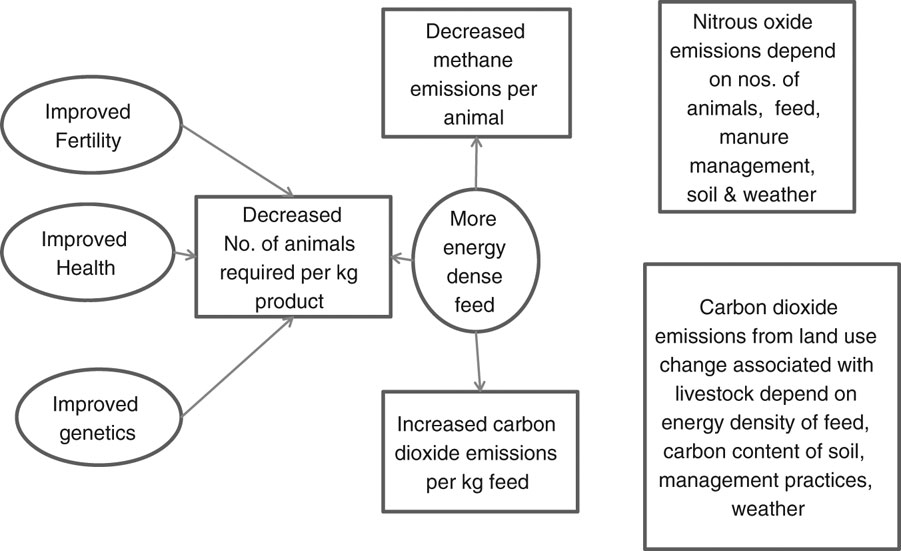
As with food waste, there is significant scope for decreasing the ‘waste’ associated with low on-farm productivity. Improvements in production efficiency all have the potential to decrease the carbon footprint of livestock production as illustrated in Figure 2. The basic principle throughout is that animals emit methane (ruminants) and produce manure which results in release of further methane and N2O (all livestock) from the day they are born to the day they die: all of these emissions will be attributed to production. Emissions per unit of product can thus be decreased either by increasing the efficiency of the animal production system itself or by direct action on the route of emissions (e.g. through feed or by using new technologies such as methane or N2O inhibitors). The potential mitigation which is still to be captured from improved productivity is obviously dependent on the basal level of productivity and is greater in developing countries as illustrated by Smith et al. (Reference Smith, Martino, Cai, Gwary, Janzen, Kumar, McCarl, Ogle, O’Mara, Rice, Scholes, Sirotenko, Howden, McAllister, Pan, Romanenkov, Schneider, Towprayoon, Wattenbach and Smith2008). The impacts of improved genetics, fertility and health all contribute to reducing the number of animals required to meet a steady demand for animal products, while the issues of feed, manure and grazing management are rather more complex and will be considered separately below.
Routes for impact of management and technology interventions designed to improve productivity on greenhouse gas emissions from livestock where total emissions = (no. of animals times emissions per animal) plus associated emissions from manure and land management.
Improved productivity through breeding, fertility and health
In the case of the UK dairy herd, the same quantity of milk was produced in 2005 from a million fewer animals than 20 years earlier, because average annual milk yield per cow increased from 5000 to almost 7000 l, a 2% increase per year. Garnsworthy (Reference Garnsworthy2004) calculated that the total methane (t/year) associated with the production of one million litres of milk from cows producing 9000 l/cow per year was just over 50% of the methane which would be associated with cows producing 6000 l/cow per year, taking into account the differing nutritional requirements and the concentrate intake and neutral detergent fibre concentration of the least cost ration formulated to meet the requirements. The same principles apply to whether the increased productivity is due to health, fertility or breeding, provided that the emissions associated with feeds are accounted for.
Livestock breeding. Recent modelling studies in the UK by Genesis-Faraday (Genesis-Faraday Partnership, 2008; Jones et al., Reference Jones, Warkup, Williams and Audsley2008) have indicated that past selection for production traits such as growth rate, milk production, fertility and efficiency of feed conversion has resulted in decreases in GHG production per unit of livestock product of about 1% per annum. These have been greatest in those species in which the greatest genetic gains have been achieved – poultry, dairy cows and pigs. The authors predicted that the trends are likely to continue in future at least at the rate achieved over the past 20 years. Genetic improvement is continuous and cumulative, and the technology is readily transferable via selected germplasm. There are economic incentives to use improved breeding stock, so reductions in GHGs are likely to be achieved without major changes in current farming practices – at least in non-ruminants. The adoption of routine determinations of efficiency of feed conversion in ruminants could produce acceleration in both rate of genetic gain and reduction in GHG emissions per unit of product, provided that the information was incorporated in indices of breeding value.
Livestock fertility. While breeding has resulted in increases in milk yield per cow year-on-year, fertility has decreased. Garnsworthy (Reference Garnsworthy2004) estimated the impact of fertility on GHG emissions, through the construction of a model, which linked changes in fertility to herd structure, number of replacements, milk yield and nutrient requirements to GHG emissions. He reported that replacements contributed up to 27% of the methane and 15% of the ammonia attributed to dairy cows in the UK. Improving fertility would lead to decreased numbers of replacements required, with a consequent significant decrease in GHG emissions.
Animal health. The impact of disease on livestock productivity is highly variable between countries dependent on the incidence of endemic diseases, and between years on the incidence of infectious diseases, particularly when these are associated with the culling of animals. Since the carbon costs are directly associated with the impacts on productivity, economic frameworks such as that developed by McInerney et al. (Reference McInerney, Howe and Schepers1992) could be used to explore the likely impacts of different diseases. An added complication for livestock disease, however, is that climate change is also likely to impact on the incidence of disease, as seen for example, in the recent incidence of Bluetongue virus in the UK (Gale et al., Reference Gale, Drew, Phipps, David and Wooldridge2009).
Attention needs to be drawn to the distinction between decreasing numbers of livestock associated with increased productivity, and decreasing numbers in response to policy changes. In the former, similar levels of domestic demand can be met, while the latter situation may lead to increased imports, which may have higher or lower associated GHG emissions, depending on the relevant production systems.
Mitigation through management of feeding, manure and land use
Livestock feeds. One area that receives considerable attention (particularly from the media) is manipulation to decrease methane emissions from enteric fermentation. Research on methane was common in the 1960s when various ruminant researchers tried to decrease methane production as a means of achieving increased feed conversion ratios (unit of feed in : unit of product out), since eructation of methane represents a loss of energy to the animal. Both the amount of digestible nutrients ingested and the composition of the diet were found to be major factors governing methane production (Blaxter and Clapperton, Reference Blaxter and Clapperton1965). More recently, equations have been developed by Yates et al. (Reference Yates, Cammell, France and Beever2000). These equations demonstrate that increasing the energy density of the diet (e.g. by increasing ratio of concentrates to forage) decreases methane production per unit of digestible energy ingested. Increasing energy density also increases productivity, thereby also contributing to decreased carbon per unit of product.
The composition of livestock diets can also affect the amount and ratios of nitrogenous components excreted in manure (Paul et al., Reference Paul, Dinn, Kannangara and Fisher1998), providing another route by which livestock feed can influence GHG emissions. One recent study (Misselbrook et al., Reference Misselbrook, Powell, Broderick and Grabber2005) has looked at the potential of increasing the tannin level in diets to decrease the rate of release of N2O, but the net benefit is likely to depend on the composition of the manure and the ambient conditions.
The different rations offered to livestock can change in composition and in efficiency of utilization in a number of ways, but with many individual feed components being imported, complexity will also be added by changes in the availability of ration components.
Manure management. One of the uncertainties associated with the potential benefits to net GHG emissions of increasing land under pasture, is the uncertainty associated with losses of N2O from fertilizer or manure. The key principle is to maximize the uptake of nutrients by the pasture plants. Factors such as the amount of manure applied (Scholefield et al., Reference Scholefield, Tyson, Garwood, Armstrong, Hawkins and Stone1993) and the intensity of grazing (Ryden et al., Reference Ryden, Ball and Garwood1984) are known to influence nitrogen leaching and were included in a model developed by Hansen et al. (Reference Hansen, Kristensen, Grant, Hogh-Jensen, Simmelsgaard and Olesen2000) to compare organic v. conventional farming. However, due to lack of data, such models are not yet at a stage of development though to be able to deal with all the processes involved.
Impact of land use. Smith et al. (Reference Smith, Martino, Cai, Gwary, Janzen, Kumar, McCarl, Ogle, O’Mara, Rice, Scholes, Sirotenko, Howden, McAllister, Pan, Romanenkov, Schneider, Towprayoon, Wattenbach and Smith2008) estimated the potential of a range of land management practices to mitigate GHG emissions, identifying restoration of organic soils, management of cropland and grassland as having particularly high potential, though there are issues associated with permanence and saturation of the carbon sink (Smith, Reference Smith2005). The key principles in this respect are to avoid loss of carbon from the soil and to manage the application of nutrients in fertilizers and manure to maximize uptake by plants. In terms of soil, the type of soil is closely associated with the amount of carbon it contains and there is a huge variability across the UK with Scotland holding around a half of the organic carbon content of soils in Great Britain (Bradley et al., Reference Bradley, Milne, Bell, Lilly, Jordan and Higgins2005). Recent research has shown that there is little change in soil carbon under permanent pasture (Hopkins et al., Reference Hopkins, Waite, McNicol, Poulton, Macdonald and O’Donnell2008), with the major changes being related to changes in land use (Smith, Reference Smith2008). Soil monitoring networks exist across Europe, but they are unable to detect changes at a level of use to policy-makers (Saby et al., Reference Saby, Bellamy, Morvan, Arrouays, Jones, Verheijen, Kibblewhite, Verdoodt, Berenyi Uvegess, Freudenschuss and Simota2008). There is, therefore, considerable research activity in predicting changes in soil carbon in response to land-use change (e.g. ECOSSE; Smith et al., Reference Smith, Smith, Flynn, Killham, Rangel-Castro, Foereid, Aitkenhead, Chapman, Towers, Bell, Lumsdon, Milne, Thomson, Simmons, Skiba, Reynolds, Evans, Frogbrook, Bradley, Whitmore and Falloon2007c), but this knowledge is not yet at a stage at which it can be incorporated into the national inventory for the UK. The potential advantages in decreasing net carbon emissions of changing land use from arable to grass are thus challenging to estimate at the farm level, and cannot yet be captured in the metrics used by policy-makers. Thus while more land under pasture is a clear winner in terms of decreased GHG emissions from soil, grazing the grass leads to methane emissions, and the loss of arable land has implications for food security.
The potential for new technologies
Discussion in the previous section and in Figure 2 has highlighted the close relationship between opportunities to decrease GHG emissions from livestock and those to increase productivity. Many evolving technologies being developed to increase productivity will thus also have a beneficial effect in terms of the indirect contribution of livestock to GHG emissions. This section will concentrate on technologies that focus primarily on direct emissions, i.e. on decreasing the emission of methane and N2O.
Methane. Attempts to find ways of inhibiting methane production in the rumen have been made for over 30 years (e.g. Czerkawski and Breckenridge, Reference Czerkawski and Breckenridge1975), with interest rekindled more recently, particularly in New Zealand where the large numbers of ruminants make a significant contribution to the country’s GHG emissions (Judd et al., Reference Judd, Kellier, Ulyatt, Lassey, Tate, SheltonI, Harvey and Walker1999). Apparently significant successes in decreasing methane production have been achieved in experiments in vitro or in single animal feeding trials (e.g. Lopez et al., Reference Lopez, Valdos, Newbold and Wallace1999; McGinn et al., Reference McGinn, Beauchemin, Coates and Colombatto2004) but these have not proved to be robust when applied to a variety of feeding regimes and some methods such as the use of ionophores are banned in the European Union. Research is continuing in New Zealand using a variety of approaches co-ordinated through the Pastoral Greenhouse gas Research consortium (PGgRc, 2009). Such research needs to adopt a systems approach, however, since Hindrichsen et al. (Reference Hindrichsen, Wettstein, Machmüller and Kreuzer2006) reported a negative correlation between enteric methane production v. methane released from the slurry of cows offered forage-only diets compared to those offered forage supplemented with concentrates. The potential benefits to the cattle and sheep industries globally of finding a compound that would reduce methane production without decreasing productivity or increasing methane and N2O emissions from manure and that could be applied in pastoral systems with low labour inputs are huge. The challenge is that ruminants evolved 40 million years ago with a pre-gastric digestion system to enable them to feed on cellulose, with methane produced as a by-product (see e.g. Van Soest (Reference Van Soest1994)) and there is no advantage per se to that ecosystem of avoiding methane production.
Nitrification inhibitors
Less attention has been paid over the years to technologies for controlling the emission of N2O, since the benefits that would accrue at first inspection, appear to be purely environmental. However, nitrification inhibitors have been used in New Zealand to promote early-season herbage growth (due to soil nitrogen retention over winter). Solving this problem should be easier than trying to adjust the ecological balance within the rumen and indeed research at the scale of individual urine patches has shown very significant reductions (PGgRc, 2009). Inhibitors showing particular promise for inhibition in pasture-based systems are: dicyandiamide and 3,4-dimethylpyrazole phosphate.
Human nature dictates that there will always be more media interest in the potential large wins of new technologies to solve problems rather than in the more mundane approaches of improving management efficiencies, but the reality is that both approaches need to be pursued to deal with both the urgency and the scale of the need to reduce GHG emissions. If neither approach is shown to be delivering sufficient reductions from the livestock sector, the pressure to decrease meat consumption will continue to increase. However, such a pressure ignores another major challenge of the 21st century that of increasing the amount of food produced at a rate sufficient to meet the growing demand.
Livestock and food security
Food security was defined at the World Food Summit in 1996, as: ‘Food security exists when all people, at all times, have physical and economic access to sufficient, safe, and nutritious food to meet their dietary needs and food preferences for an active and healthy life’. Yet, at a national level, food security is often confused with self-sufficiency – the ability to feed a nation’s people through domestic production alone. At a global level, food security is increasingly an issue, with the number of malnourished people estimated at close to one billion (World Bank, 2008), despite a belief by many that the world could produce enough food for its current population. There is often a presumption that global trade in food is a relatively recent phenomenon, but in the UK, in the last part of the 19th century and in the 1930s, we were importing more than 70% of total wheat supply (Blaxter and Robertson, Reference Blaxter and Robertson1995). Blaxter and Robertson gave a number of reasons for the decrease in grain production in the 1870s such as ‘cold and wet springs’ and the importation of cheap grain from North America and Australia. The reaction of farmers was to turn to livestock, since the abandoned arable land turned to grass, which ruminants can turn into human-edible products. This ability of livestock to turn human-inedible products into human-edible products may become increasingly important in terms of global food security, given that globally there are 3.4 billion ha of grazing land and only 1.5 billion ha of cropping land (FAOSTAT, 2008).
So far in this paper, based on a climate change perspective, efficiencies of livestock production have been considered in relation to GHG emissions: if we add in the dimension of food security, efficiency also needs to be expressed in terms of the resources converted by livestock into human-edible food.
Livestock species and food production
Table 2 illustrated the greater efficiency of monogastric species compared to ruminants in producing meat with lower outputs of GHGs per unit of meat production. These efficiencies relate to the higher productivity efficiencies associated with the development of intensive systems. The majority of pigs (69%) and poultry (80%) in developed countries are reared in intensive (landless) systems (Steinfeld et al., Reference Steinfeld, Gerber, Wassenaar, Castel, Rosales and de Haan2006), heavily dependent on the consumption of energy-dense feeds. For ruminants, only 12% of meat from cattle is produced in intensive systems and only a negligible amount of meat from sheep. Thus, most of the diet of pigs and poultry is human-edible, whilst most of the diet of ruminant livestock (grass and forage crops) is not human-edible. Thus, since most of the growth in demand for pig and poultry meat is projected to come from developing countries, Food and Agriculture Organization (2003) predicted that the growth in use of concentrated feeds is projected to grow faster than growth in meat production, potentially exacerbating the food security situation at a global level.
Re-parameterizing efficiencies
To provide options to avoid such trends, there is a need to quantify holistically the impacts of different ways of producing food, taking into account the net benefit to human food supply. This approach was explored by the Council for Agricultural Science and Technology (CAST) (1999) in the report of a task force study of animal agriculture and global food supply, quantifying not simply the contribution to food supply, but to the nutrients supplied by food, namely protein and energy. The group examined the relative efficiencies of production of different livestock products from a range of production systems from the grain-based systems of the US to the roughage-based systems of Kenya. Energy efficiency was calculated in two ways – either as total efficiency (MJ total food metabolizable energy input/MJ livestock product output) or as human-edible efficiency (MJ human-edible food metabolizable energy input/MJ livestock human-edible product output). The group also calculated total and human-edible protein efficiencies based on inputs of dietary crude protein and outputs of protein in animal products. The comparisons for the US and South Korea are given in Table 5.
Comparative efficiencies of different livestock production systems in the USA and South KoreaFootnote †

1 Total efficiency calculated as outputs of human-edible energy and protein divided by total energy and protein inputs.
2 Human-edible efficiency calculated as outputs of human-edible energy and protein divided by human-edible inputs.
† CAST (Council for Agricultural Science and Technology) (1999).
In terms of total energy efficiency and total efficiency of protein production, in all cases inputs exceed outputs. Beef production systems are considerably less efficient than monogastric livestock systems in terms of total energy consumed (Table 5). Differences between the systems of livestock production in the USA and South Korea systems are relatively small, most likely reflecting similarities in daily live weight gain, days to slaughter and egg mass per hen between the two countries. However, in terms of human-edible return, outputs exceed inputs for milk and beef protein in both the USA and South Korean systems of production. Human-edible outputs also exceeded inputs for milk energy in both the USA and South Korean systems, and for beef energy and poultry meat protein in the South Korean system. The use of non-human-edible sources of feed (grass and forage crops) in milk and beef production, and the use of non-human-edible sources of feed protein in South Korean poultry meat production are reflected in the positive human-edible returns from these production systems. Further, the lower inputs of grain in South Korean milk and beef production than in the USA are reflected in considerably higher human-edible returns than in the USA system (Table 5). Thus, although monogastric livestock are more efficient in terms of total food resource use than ruminants, when diets based on forages and food by-products are used to feed ruminants, then these systems can be net contributors of human-edible food.
Conclusions
There is no doubt that livestock contribute significantly to GHG emissions, and the demand for livestock products in developing countries where economies are growing continues to increase. The difficulty for the policy community in setting targets for the livestock sector is three-fold. First, the evidence base connecting possible policy interventions and their consequence on emissions from livestock is weak. Secondly, changing the behaviour of food consumers is notoriously difficult and thirdly in a global market, any significant changes in one part of the food supply chain can have marked consequences on global prices, and hence on food security.
The most immediate action for the short-term, for both animal scientists and policy-makers, is to hasten the dissemination of knowledge on improving the efficiency of livestock production systems both to farmers and consumers, to enable choices to be made which will lead to decreased emissions. For the medium-term, there is a need for animal scientists to work with scientists from other disciplines to bring together knowledge at a national level of the economic, social and environmental consequences of livestock agriculture, in a way which can be understood and used by the policy community to underpin future decisions, not just in relation to climate change, but also in relation to food security For the longer-term, there is a need for continued investment in the development of new technologies which have the potential to decrease emissions, not only those related to methane production, but also those which might lead to radical changes in livestock production systems.
Acknowledgements
This paper builds on presentations given at the Annual meeting of the British Society of Animal Science (BSAS) in Scarborough 2008 and the meeting on Livestock and Global Climate Change held in Tunisia in May 2008. The authors are grateful to many colleagues who have advised them on specific parts of those presentations or the preparation of this paper, in particular: David Beever, Phil Garnsworthy, Richard Grant, Liam Kelly, Adam Krawczyk, Caspian Richards, Phillip Skuce, Mike Theodorou and Adrian Williams.



