





Introduction
Ethical concerns related to livestock production are on the increase (Hartmann and Siegrist, Reference Hartmann and Siegrist2020). A number of farm practices that were hitherto acceptable to the public are now considered unethical (Alonso et al., Reference Alonso, González-Montaña and Lomillos2020). This is partly due to the increased recognition that farm animals are sentient and have ability to experience different emotions (Nawroth et al., Reference Nawroth, Langbein, Coulon, Gabor, Oesterwind, Benz-Schwarzburg and von Borell2019). The rise of the ethical consumer and the increasing disconnect of the mostly urban segment from agriculture creates information gaps and expectations that can be challenging to meet (Schröder and McEachern, Reference Schröder and McEachern2004; Cornish et al., Reference Cornish, Raubenheimer and McGreevy2016). For the dairy industry, public concerns about a number of practices appear to be on the increase, and many instances of farm animal welfare (FAW) issues have been highlighted in the popular press. A recent news article chronicled some of the issues:
‘Dairy cows are repeatedly impregnated by artificial insemination and have their newborns taken away at birth. Female calves are confined to individual pens and have their horn buds destroyed when they are about eight weeks old. The males are not so lucky. Soon after birth, they are trucked off to veal farms or cattle ranches where they end up as hamburger meat.’ (Jacobs, Reference Jacobs2020).
In light of increasing FAW concerns and competition from non-diary alternatives, providing an adequate level of FAW consistent with consumer expectation is critical for the dairy industry. Previous studies found that consumer willingness to pay (WTP) for FAW appears to be positive but small (Clark et al., Reference Clark, Stewart, Panzone, Kyriazakis and Frewer2017; Alonso et al., Reference Alonso, González-Montaña and Lomillos2020; Lai and Yue, Reference Lai and Yue2020). In addition, consumers are not well-informed about many FAW related practices and are heterogeneous in their response to information (Sumner et al., Reference Sumner, von Keyserlingk and Weary2018; Boaitey and Minegishi, Reference Boaitey and Minegishi2020). The effect of information may be amplified for contentious production practices. One of the contentious ethical issues in dairy production is the practice of separating calves from their dams (mothers) shortly after birth. This practice is common on both conventional and organic farms and has elicited varying views from key industry stakeholders, i.e., consumers, farmers and veterinarians (Ventura et al., Reference Ventura, von Keyserlingk, Schuppli and Weary2013). This has led to the emergence of the so-called ethical dairy farming and calf-at-foot sectors in Europe and Australia (Levitt, Reference Levitt2019). This notwithstanding, the values that the public attach to dairy systems that allow for greater calf-dam contact are not well-understood.
The primary objective of this paper is to examine preferences for additional calf-contact in consumers' milk purchase decisions under different information treatments. We estimate consumer willingness-to-pay (WTP) for four alternative calf-dam systems and examine consumer preference segmentation. We employ a best-worst scoring (BWS) approach to address the objectives of the study. The BWS approach is particularly well-suited to elicit respondents' ‘best’ and ‘worst’ choices amongst an array of options. We implement Case 3 BWS design (also known as the multi-profile case) (Louviere et al., Reference Louviere, Flynn and Marley2015). This design closely resembles the standard discrete choice experiment, but it is more efficient, i.e., achieving higher level of Fisher information with the same number of choice scenarios (Marley et al., Reference Marley, Louviere and Flynn2015).
To the best of the authors' knowledge, this study is the first to evaluate consumer preferences for calf-dam contact practices in milk choice using a multi-profile BWS design. We generate important insights that can assist farmers in designing production processes to attenuate public concerns and improve the perceived welfare of farm animals. This is particularly relevant for the livestock industry as addressing consumer FAW concerns often requires costly changes to current production practices. This paper also contributes to literature on the elicitation of consumers' choices for contentious agricultural production attributes that includes text and visual representations.
The rest of the paper proceeds as follows. In the next section, we provide a brief overview of key calf welfare issues. We also discuss BWS applications in food choice. In section four, we outline the empirical approach and data collection methods. The results of the study are presented in section five. This is followed by a final section that concludes the paper.
Calf-dam separation and dehorning practices in dairy production
Many aspects of calf management on dairy farms remain an ethical concern for the public. The premise is that if farm animals are sentient (Proctor et al., Reference Proctor, Carder and Cornish2013; Nawroth et al., Reference Nawroth, Langbein, Coulon, Gabor, Oesterwind, Benz-Schwarzburg and von Borell2019), then the most vulnerable such as newborn animals should be a matter of important concern. Practices that can impact dairy calf welfare includes, calf housing, the welfare of male dairy calves raised as veal, dehorning and early calf-dam separation (Misch et al., Reference Misch, Duffield, Millman and Lissemore2007, p. 7; Vasseur et al., Reference Vasseur, Borderas, Cue, Lefebvre, Pellerin, Rushen, Wade and De Passillé2010; Hristov et al., Reference Hristov, Stanković, Joksimović-Todorović, Mekić, Zlatanović, Ostojić Andrić and Maksimović2011; Compassion in food business, 2013; Wikman et al., Reference Wikman, Hokkanen, Pastell, Kauppinen, Valros and Hänninen2013; Ventura et al., Reference Ventura, von Keyserlingk and Weary2015; Costa et al., Reference Costa, Von Keyserlingk and Weary2016; Renaud et al., Reference Renaud, Duffield, LeBlanc, Haley and Kelton2017). This study focuses on the latter two practices—dehorning and early calf-dam separation. Early calf-dam separation refers to the separation of a calf from its mother (dam) shortly (⩽24 h) after birth. The practice is motivated by the fact that the primary purpose of dairy farming is to produce milk for sale hence, separating calves and dams allows ready access to milk. Once separated, calves are raised artificially either in groups or individually (Krohn, Reference Krohn2001). The practice has become commonplace in the U.S. since the 1950s and remains the standard practice in many other countries (Vasseur et al., Reference Vasseur, Borderas, Cue, Lefebvre, Pellerin, Rushen, Wade and De Passillé2010; Le Cozler et al., Reference Le Cozler, Recourse, Ganche, Giraud, Danel, Bertin and Brunschwig2012; Kälber and Barth, Reference Kälber and Barth2014; USDA, 2014; Fruscalso et al., Reference Fruscalso, Antillón and Hötzel2017; Beaver et al., Reference Beaver, Meagher, von Keyserlingk and Weary2019).
Several concerns relating to the impact of the practice on calf-dam wellbeing have been raised. For example, it has been reported that the interaction between dams and calves at early stages of the latter's life can have a number of positive animal welfare effects on their social behavior, growth and feeding behaviors (Flower and Weary, Reference Flower and Weary2001; Krohn, Reference Krohn2001; Beaver et al., Reference Beaver, Meagher, von Keyserlingk and Weary2019; Meagher et al., Reference Meagher, Beaver, Weary and von Keyserlingk2019). The counterargument is that early separation interferes with the development of the bond between calf and dam thereby reducing the emotional distress when separation eventually occurs (Flower and Weary, Reference Flower and Weary2003; Stěhulová et al., Reference Stěhulová, Lidfors and Špinka2008). There are also concerns regarding the potential exposure of calves to environmental pathogens and the limited ability to manage calf-dam pairs on farms (Vasseur et al., Reference Vasseur, Borderas, Cue, Lefebvre, Pellerin, Rushen, Wade and De Passillé2010; USDA, 2014; Busch et al., Reference Busch, Weary, Spiller and von Keyserlingk2017; Beaver et al., Reference Beaver, Meagher, von Keyserlingk and Weary2019). Evidence from multiple countries indicate that whilst public awareness of the practice is low (Hötzel et al., Reference Hötzel, Cardoso, Roslindo and von Keyserlingk2017), the public generally opposes the practice (Boogaard et al., Reference Boogaard, Oosting and Bock2008; Ventura et al., Reference Ventura, Von Keyserlingk, Wittman and Weary2016; Busch et al., Reference Busch, Weary, Spiller and von Keyserlingk2017). A significant aspect of the public's opposition relates the perceived unnaturalness of the practice (Boogaard et al., Reference Boogaard, Oosting and Bock2008). The ability to perform natural behaviors is an integral component of positive FAW (Browning, Reference Browning2020).
The second calf welfare-related practice evaluated in the present study is the dehorning of calves. Dehorning is a routine procedure undertaken on dairy farms to remove the horns of calves. Despite the painful nature of the procedure the use of pain mitigation on dairy farms is low (Vasseur et al., Reference Vasseur, Borderas, Cue, Lefebvre, Pellerin, Rushen, Wade and De Passillé2010; Le Cozler et al., Reference Le Cozler, Recourse, Ganche, Giraud, Danel, Bertin and Brunschwig2012; Robbins et al., Reference Robbins, Weary, Schuppli and Von Keyserlingk2015). Dehorning can reduce the risks of injury posed by horned calves to other cows and farm workers. Research shows that calves exhibit negative physiological and behavioral responses when dehorned without pain mitigation (American Veterinary Medical Association, 2014). It is therefore unsurprising that the pain associated with the practice is the major concern of the public (Robbins et al., Reference Robbins, Weary, Schuppli and Von Keyserlingk2015). Freedom from pain, injury and disease is one of the five pillars of positive animal welfare (Brambell, Reference Brambell1965). In response to societal concerns, a number of options have been proposed for mitigating the pain associated with dehorning. These include the use of pain relievers such as local anesthesia. There is also the possibility of genetically selecting for calves that are hornless (polled) (Spurlock et al., Reference Spurlock, Stock and Coetzee2014). The views of the public regarding the latter practice remain unclear. For example, segments of the public who are supportive of the need to reduce the pain associated with dehorning also oppose genetically selecting for polled calves, considering it unnatural (McConnachie et al., Reference McConnachie, Hötzel, Robbins, Shriver, Weary and von Keyserlingk2019).
From the foregoing, the present study examines public preferences for dehorning and calf-dam contact attributes in milk choice. The dehorning practices examined are, dehorning with and without pain relievers, and polled calves. There are a number of alternatives to early calf-dam separation. These alternatives attempt to balance access to milk and the social bond between calf and dam (Daros et al., Reference Daros, Costa, von Keyserlingk, Hötzel and Weary2014). Consideration must also be given to the potential reduction in milk productivity as well as the structural and labor cost implications of modifying dairy barns to create additional contact for calves and dams. Four alternative calf-contact systems are examined relative to the conventional practice which is early calf-dam separation: (1) free dam-calf contact; (2) foster cow system; (3) restricted suckling contact; and, (4) half day calf-cow contact. Johnsen et al. (Reference Johnsen, Zipp, Kälber, de Passillé, Knierim, Barth and Mejdell2016) provided a detailed overview of the four alternative methods. Free dam-calf contact is the direct alternative to early calf-dam separation. Here, calves have unrestricted access to dams. Social bonding and access to milk is highest. This is followed by half-day systems where calves and dams are housed together for half of the day. Calves have unrestricted access to milk during this period. In restricted suckling contact systems, milking only occurs during short daily calf-dam interactions. In the foster cow system, a late lactation cow with excellent mothering ability nurses a small group of calves usually without milking (Johnsen et al., Reference Johnsen, Zipp, Kälber, de Passillé, Knierim, Barth and Mejdell2016). Figure 1 illustrates the access to milk—social bonding tradeoff for the different alternatives.
Social bonding and access to milk trade-offs for alternative calf-dam systems.

Given the low level of public awareness about the practice we also examine the extent to which the provision of information impact preferences (Mørkbak and Nordström, Reference Mørkbak and Nordström2009; Cornish et al., Reference Cornish, Briley, Wilson, Raubenheimer, Schlosberg and McGreevy2020). The public tends to express lower values for attributes they are not familiar with (Imamura et al., Reference Imamura, Takano, Kumagai, Yoshida, Yamano, Fujii, Nakashizuka and Managi2020). The impact of information however, varies by format (e.g., text versus visual), public attitudes and across different subpopulations (Shr et al., Reference Shr, Ready, Orland and Echols2019; Imamura et al., Reference Imamura, Takano, Kumagai, Yoshida, Yamano, Fujii, Nakashizuka and Managi2020; Jansen et al., Reference Jansen, Claassen, van Kamp and Timmermans2020; Cao et al., Reference Cao, Cranfield, Chen and Widowski2021).Footnote 1 In the rest of the paper, we evaluate public preferences for calf-dam contact and dehorning attributes, and the role of information using a BWS approach.
Methods
Study design and data description
We applied the BWS to examine consumer preferences for calf-dam separation practices. Since its application by Finn and Louviere (Reference Finn and Louviere1992), the BWS approach has been used to evaluate preferences in many contexts. Compared to conventional choice experiment, BWS is considered cognitively less burdensome (Scarpa et al., Reference Scarpa, Notaro, Louviere and Raffaelli2011) and captures both the strength and relative importance of choices (Liu et al., Reference Liu, Li, Steele and Fang2018). This makes it suitable for many choice contexts in food. Several previous studies have applied the BWS to examine animal welfare related issues. For instance, Hansson and Lagerkvist (Reference Hansson and Lagerkvist2016) examined how farmers prioritize productivity considerations and animal wellbeing. de-Magistris et al. (Reference de-Magistris, Gracia and Barreiro-Hurle2017) applied Case-3 BWS to examine consumer preferences for food-labelling schemes that includes animal welfare related labels.
We designed two blocks of BWS experiments, and each block consisted of six BWS scenarios.Footnote 2 The experiment design was approximated with a marginal model specification:

Please refer to section ‘econometric model’ for a detailed definition of the model and notations. The above specification assumes that respondents choose the best and worst option sequentially, where each respondent signaled the best and the worst option independently and the choice set for the worst scenarios excludes the best option. Given the above specification, the Fisher information matrix can be derived similarly to a conventional choice experiment (Huber and Zwerina, Reference Huber and Zwerina1996). We generated the experimental design by maximizing D-efficiency with modified Fedorov algorithm (Cook and Nachtsheim, Reference Cook and Nachtsheim1980).Footnote 3 We considered three milk attributes, i.e., per gallon milk price, calf -dam contact and dehorning practices. Table 1 is a summary of the main milk attributes evaluated and their levels.
Milk attributes and levels
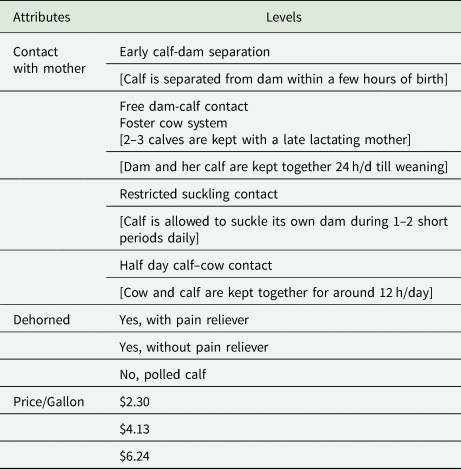
Respondents were randomly assigned to one of the two blocks of BWS experiments. In addition, the order of the options, i.e., which combination of attributes assigned to option A, B and C (see Fig. 2) was randomized, to allow for testing and controlling for the potential ordering effects. We employed a vertical format, namely option A, B and C to take the top, middle and bottom positions, respectively (see Fig. 2 for an example). The experiment was framed in the following way:
‘Suppose you are conducting regular grocery shopping, and you are faced with the following milk choices produced by three different farms. The farms are similar in all aspects of management except the practices highlighted in each scenario. For each of the following 6 scenarios, select your most preferred option as well as your least preferred option. Consider each of these options as the milk you would regularly buy at the store.’
Example of best worst scoring task in stated preference exercise.

Figure 2 is an example of a task.
BWS is potentially subject to the bias generated by people's tendency to associate importance with positions. For instance, when facing an array of similar options, people tend to choose the middle item (Shaw et al., Reference Shaw, Bergen, Brown and Gallagher2000; Attali and Bar-Hillel, Reference Attali and Bar-Hillel2003). See evidence of position bias in Campbell and Erdem (Reference Campbell and Erdem2015). As a check for robustness, the present study reports estimates (Appendix 1) that account for the position of the different option in the BWS design. One critique of case 3 BWS is that it does not include an opt-out option, which potentially creates bias. However, in the context of choice experiments (CE), the discrepancies between forced (CE without opt-out) and unforced (CE with opt-out) are not yet fully understood. Carlsson et al. (Reference Carlsson, Frykblom and Lagerkvist2007) found no difference, while Veldwijk et al. (Reference Veldwijk, Lambooij, de Bekker-Grob, Smit and de Wit2014) found statistically significant differences.
An important objective of this paper is to explore whether the provision of additional information about early calf-dam separation and its alternative practices, impact consumer preferences. This is particularly important given the lack of awareness about the practice amongst the public. Respondents were randomly assigned to control (n = 493) and treatment (n = 527) groups. Respondents in both groups were provided with the following textual information outlining the key arguments for and against the practice:
‘Dairy farmers generally remove the calf from their dams within the first few hours of birth. Proponents of this practice argue that: allowing the cow and calf to bond will result in greater separation distress when the separation does occur later; the calf may become infected from pathogens carried by the cow or her environment; the calf may become injured by adult cows/ barn equipment as farms are often not well designed for cow-calf pairs; reductions in the cow's milk yield.
Others oppose this practice and argue that: calf-dam contact is an important element of natural behavior; early calf-dam separation cause emotional distress to both calf and dam and that keeping them together is beneficial to both the dam and calf.’
Respondents in the treatment group were also shown images of the different calf-dam contact practices (see Figs A1–A5 in Appendix 2 for graphical depictions). The combination of text and visual formats allows us to assess whether the additional layer of information impacts preferences. Figure 3 is a schematic representation of the information treatment design. Different from the previous studies that examined the effects of information, this study does not include a sample without information treatment. We chose this approach for two reasons. First, calf-dam separation is an issue that consumers likely know little about. The results of the survey question on consumers' awareness are consistent with this claim. Second, the effect of information has been established by previous studies, and this study intends to examine whether the format of information matters and by how much.
Allocation of respondents to information treatments, n = 1020.

Econometric model
In the BWS approach, respondents are presented with a subset of choices and asked to rank them based on their perceived importance (worst-best) (Campbell and Erdem, Reference Campbell and Erdem2015). We used the attribute-based variant (Case 3) in which the choices differ in attributes. The marginal utility of each attribute can be estimated as follows. Let n = {1, …, N} denote the respondent. Each respondent will signal the most and the least preferred option from each choice scenario t = {1, …, T}. Let x nkt denote the product attributes for option k in choice scenario t assigned to respondent n. Assume a linear utility function with βs being the marginal utilities:

Let i and j denote the best and worst option from the choice set C t, respectively. Assuming random utility shocks ɛnjt are type I extreme value distributed, we can then specify the probability of choosing i as the best option and j as the worst t as:

In Equation (2), $v_{nit} = x_{nkt}^{\rm ^{\prime}} \beta _i$ . Equation (2) is a paired specification for BWS estimation. With the respondent's likelihood function defined, one can define the log likelihood function as follows:

where y nt is the binary response if the best and the worst choice are i and j, respectively.
In addition to the specification as Equation (2), this study also applied the mixed logit model. Mixed logit model allows consumers' taste parameter to vary by some distribution, and it relaxes the independence of irrelevant alternatives assumption (Revelt and Train, Reference Revelt and Train1998; McFadden and Train, Reference McFadden and Train2000). The log likelihood for the mixed logit model is defined as:

In Equation (5), F(β n) is the density function of parameter β n, which is assumed to be multivariate normal distribution without correlation between the parameters. The above equation is simulated with 1000 Halton draws as suggested by (Train, Reference Train2009).Footnote 4
Lastly, we estimate the latent class logit model (Train, Reference Train2009) to investigate consumer segmentation. The latent class logit model (LCM) assumes that consumers can be segmented into a prespecified number of latent classes. Consumer preferences are heterogeneous across different classes, while homogeneous within classes. Different from the mixed logit model which assumes parametric parameter distributions, the LCM identifies consumer unobservable heterogeneities from their estimated likelihood with a semiparametric approach and groups respondents into discrete segments. The LCM is useful for examining the proportion of consumers that are responsive to calf-dam contact practice, dehorning practice and information treatments. We intend to assess consumer preferences with different methods to provide a comprehensive characterization.
A formal specification of the LC model is given as follows. The probability of respondent n is in class g = {1, …, G} is given by:

In Equation (6), γ is a vector of parameters for class membership estimation, and z i is a vector of individual characteristics. The parameters can be estimated with a maximum likelihood procedure that maximizes the following log likelihood function:

In Equation (7), L nt(β g) is the likelihood contribution from respondent n given n is in class g, and thus have marginal utility parameter β g.
We model the mean of random marginal utility parameters as linear functions of information treatment status and positions of the options. More specifically, the parameter vector β i ~ N(μ, Σ), i.e., follows a multivariate normal distribution with mean vector μ and variance matrix Σ. For a given parameter β ik, its mean μ ik is:

In the above equation, β k is the overall average marginal utility, z i is the vector of dummy variables that indicates if participant i received information on calf-dam contact or not, and the position of options. In other words, the specification in Equation (8) allows heterogeneous responses conditional on information and option position. In practice, we assume that Σ is diagonal, i.e., no correlation between marginal utility parameters. Consumer WTP for each attribute is defined as:

WTPk is the WTP for attribute k; β k is the marginal utility of attribute k; and β p is the marginal utility of price. The standard error of WTPk is estimated using the Delta Method.
Following previous studies (Lusk and Briggeman, Reference Lusk and Briggeman2009; Clark et al., Reference Clark, Stewart, Panzone, Kyriazakis and Frewer2017; Boaitey and Minegishi, Reference Boaitey and Minegishi2020) we evaluate the role of heterogeneity in FAW preferences due to differences in respondents' sociodemographic characteristics (e.g., age, income, residence and education) and location in the US (Midwest, Northwest, South and West).
Results and discussions
A national sample of respondents (N = 1020) was drawn from a panel of adult consumers maintained by Qualtrics, LLC. The study was limited to adult respondents who regularly shopped for groceries for their household. The survey instrument consisted of four sections. In the first section, information on respondents' consumption patterns and FAW perceptions was collected. The second section was the BWS experiment. The design of the alternative calf-dam treatments was done based on available literature and in consultation with animal scientists and extension specialists. Section 3 consisted of a contingent valuation exercise, questions on trust in food institutions and consumer food values. The final section elicited information on respondents' sociodemographic characteristics. The survey was pre-tested on a small scale (n = 100) before the full rollout.
Table 2 is a summary of demographic characteristics of the respondents. We also report the weighted America Community Survey (ACS) 2019 (for ages 18 and above) sample accessed via the IPUMS USA (Ruggles et al., Reference Ruggles, Flood, Goeken, Schouweiler and Sobek2022) project at the Minnesota Population CenterFootnote 5. As evident from Table 2, the gender and regional distribution of the data is comparable to the ACS data. The age distributions are also similar. The level of educational attainment in our sample is however relatively higher than in the ACS sample with fewer respondents have high school or less education. We categorized income into three groups, i.e., income lower than $40,000, between $40,000 and $79,999, and income higher than $79,999. The income distribution of our sample is more concentrated in the median and high-income category as compared to the ACS. Table 2 also presented subsample demographics with and without information treatment. To demonstrate that the random assignment of respondents to receive information is effective, we performed a logistic regression that used information treatment as dependent variable, intercept only as the restricted model, and intercept plus all demographics variables as the unrestricted model. Likelihood ratio test (P-value equals 0.1955) suggests that we failed to reject the null hypothesis that the unrestricted model is preferred, which indicates that demographic variables do not predict group assignments.
Summary statistics.

Note: ACS sample restricted to age 18 and above. The lower panel summaries the statistics for subsample with and without information treatment. Likelihood ration test (P-value equals 0.1955) for logistic regression that predicts with or without information treatment by intercept and demographics versus intercept only suggests that we failed to reject the null hypothesis that all demographics variables have coefficient equals 0.
The BWS estimates are preceded by an assessment of consumers' awareness of early calf-dam separation. Approximately 60% of the sample of respondents reported being unaware (46%) or vaguely aware (15%) of the practice. Our results are consistent with previous studies which found that 65–67% of respondents in other countries reported being unaware of the practice (Ventura et al., Reference Ventura, Von Keyserlingk, Wittman and Weary2016; Cardoso et al., Reference Cardoso, Von Keyserlingk and Hötzel2017; Hötzel et al., Reference Hötzel, Cardoso, Roslindo and von Keyserlingk2017). The lack of awareness provides a justification for testing the effects of additional information.
Table 3 is a summary of the coefficient estimates of the mixed logit models. Model I shows that the price coefficient is negative and statistically significant. This implies that consumers prefer less expensive milk. Relative to early calf-dam contact, respondents are more likely to choose milk produced under the other four contact systems indicating a positive preference for more calf-dam contact. Respondents are less likely to purchase milk if produced by cows dehorned without pain relievers, when reference attribute is dehorned with pain relievers. Consumer preference for polled calf was not significant at 95% level of significance. Based on the above estimates, it appears that consumers attach positive utility to practices perceived as being more humane towards dairy calf welfare.
Random parameter logit coefficients.
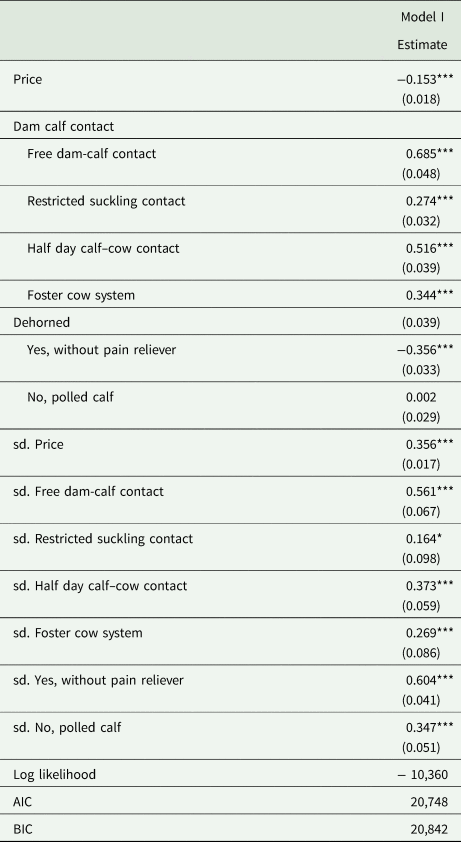
Note: *P < 0.1, **P < 0.05, ***P < 0.01. Standard error in parentheses. Dam-calf contact attributes refer to Early calf-dam separation as the reference. Dehorned attributes refer to ‘Yes, with pain reliever’ as reference.
Following Equation (9), the WTP estimates for the milk attributes are derived from the estimates in Table 3. Relative to early calf-dam separation, consumers are willing to pay a premium of $4.5 per gallon for milk from cows raised in a free calf-dam contact system. This is higher than the $3.4 for half-day calf-cow contact, $2.2 to $2.3 for foster cow system, and $1.8 for restricted suckling. With respect to dehorning, the result indicates that consumers are willing to pay $2.3 more per gallon for milk from cows dehorned with pain reliever relative to those without.
Information treatment effects
Table 4 presents the random parameter logit coefficients for the visual information treatment (‘with visual information’) and control (‘without visual information’) groupsFootnote 6. Here, we make two observations. First, respondents in the information treatment sample, signaled noticeably higher utility for calf-dam contact attributes. Given that the difference in price coefficient between the group with and without information is small, we expect respondents provided with additional information to have higher premiums for calf-dam contact-related attributes. Second, the provision of additional information on calf-dam contact (i.e., showing images) may have a signaling effect on other practices. In the present case, it appears to impact preferences for dehorning. Recall that the textual information regarding calf-dam separation is irrelevant to dehorning practices. However, respondents in the control group discounted polled calf relative to dehorning with pain reliever, while those in the treatment sample had positive preference for polled calves. It is unclear whether the particular images shown to the respondents invoked a greater awareness of calf welfare or whether the respondents' assumed complementarities between the two attributes.
Random parameter logit coefficients, with and without calf-dam contact information
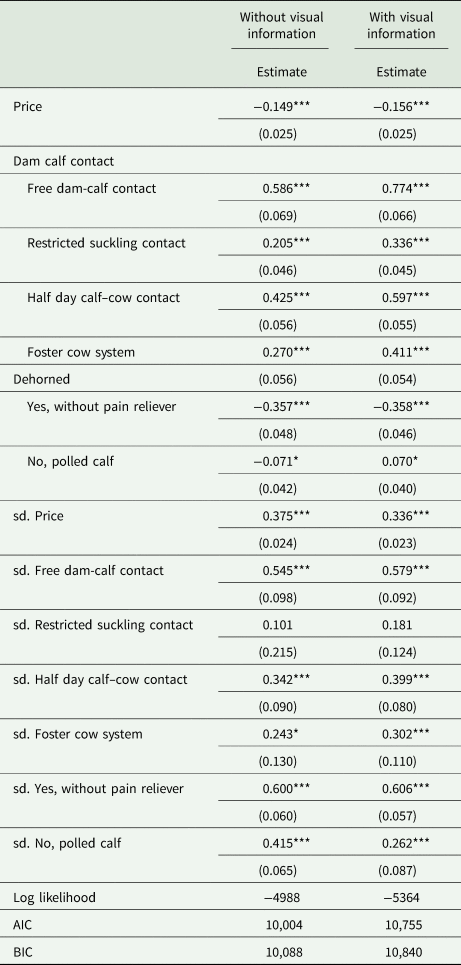
Note: *P < 0.1, **P < 0.05, ***P < 0.01. Standard error in parentheses. Dam-calf contact attributes refer to Early calf-dam separation as the reference. Dehorned attributes refer to ‘Yes, with pain reliever’ as reference.
Table 5 summarizes the WTP derived from the coefficient estimates reported in Table 4. Table 5 indicates that respondents in the information treatment sample were consistently willing to pay a higher premium for practices that allow for more calf contact. Information induced the largest WTP difference for free dam-calf contact, i.e., respondents who received information were willing to pay about $1 more per gallon. The WTP differences between the treatment and control samples are, $1.03, $0.78, $1.00 and $0.83 per gallon for free dam contact, restricted suckling, half-day calf-cow contact and foster cow system, respectively. The potential spillover effect of information is evident from the dehorning estimates; WTP for the control group for polled calf is not significantly different from zero compared to a $0.45 per gallon premium in the information treatment group.
Willingness-to-pay estimates, with and without calf-dam contact information.
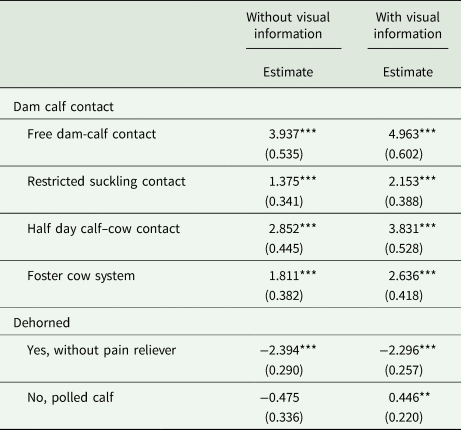
Note: *P < 0.1, **P < 0.05, ***P < 0.01. Standard error in parentheses. Standard error estimated using the delta method. Dam-calf contact attributes refer to Early Calf-Dam Separation as the reference. Dehorned attributes refer to ‘Yes, with pain reliever’ as reference.
Variation of information impacts by respondents' demography
Table 6 reports estimates of the effect of information on different contact practices by the demographic characteristics of respondents. This allows us to assess whether the provision of the visual information has a stronger impact on specific segments of the sample as compared to others. In general, the effect of the additional information is effective in shifting the mean marginal utilities of specific subgroups within the sample. Age, city residence and gender are most susceptible to the provision of additional information. The mean marginal utilities for the different calf contact practices are negatively impacted by the additional information for male respondents and respondents living in the city. Conversely, the effect is positive for female and older respondents.
Estimates of marginal utility coefficients by visual information and demographics.
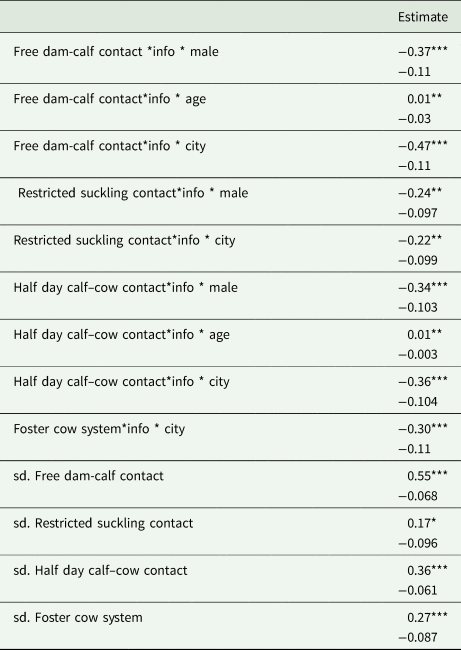
Note: *P < 0.1, **P < 0.05, ***P < 0.01. Standard error in parentheses.
Heterogeneity in preferences for milk attributes
Based on the estimates of the LCM model, three classes were identified using the Bayesian information criterion (BIC). Table 7 presents a summary of the results of the LCM estimations. We summarizes the identified classes as follows:
-
Class 1—The price sensitive and low animal welfare-concerned consumers: Respondents in Class I, with class membership probability of 12.38%, are price sensitive. These respondents discounted or were insensitive to the calf welfare attributes. Regarding the effect of information, respondents in Class I generally responded positively to additional information for calf-dam contact and stated higher preferences for the related attributes. They had a positive preference for polled calf after being exposed to pictures of different calf-dam contact systems.
-
Class 2—The moderate animal welfare-concerned consumers: Respondents in Class II has the largest class probability, i.e., 69.39%. These respondents are price sensitive and signaled a positive and statistically significant preference for calf-dam contact related attributes. Their preferences for dehorning practices were not significant. This segment of consumers were moderately insensitive to information treatment—the calf contact attributes and information interaction terms are either non-significant or only weakly significant. However, their preferences for dehorning are impacted by additional information on calf contact. In other words, the potential spillover effect of information plays a more prominent role than the direct effect of information on respondents in this class.
-
Class 3—The high preference for animal welfare consumers: Respondents in the last cluster (Class III) has membership probability of 18.23%. They tended not to be price sensitive, as their marginal utility of price is statistically insignificant. They exhibit strong preferences for calf-dam contact related attributes. The calf-dam contact attributes are not only statistically significant, but also large in magnitude relative to price. This segment of consumers also cared about dehorning and discounted milk produced by calves that are dehorned without pain reliever. Respondents in this class were sensitive to information. The marginal utility from contact related attributes and information interactions are positive and statistically significant. They were more tolerant of dehorning without pain reliever and discounted polled calves (relative to dehorning with pain reliever) under the information treatment scenario.
Latent class logit coefficients.
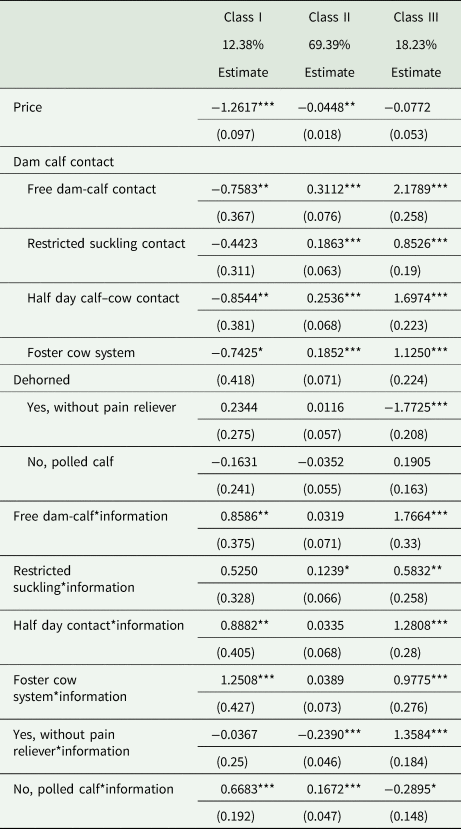
Note: *P < 0.1, **P < 0.05, ***P < 0.01. Standard error in parentheses. Dam-calf contact attributes refer to early calf-dam separation as the reference. Dehorned attributes refer to ‘Yes, with pain reliever’ as reference. Number of class selected based on BIC.
Table 8 shows the effect of personal characteristics on class membership. Class I is used as reference. Respondents in Class II are less likely to be in the South and West US. Class II respondents are more likely to be in the high-income group and less likely to live in a city. Class III respondents are less likely to live in the Northeast or South US. They are also less likely to have some college education or have a college degree, and less likely to live in a city (as compared to Class I).
Effect of demographic characteristics on class membership.
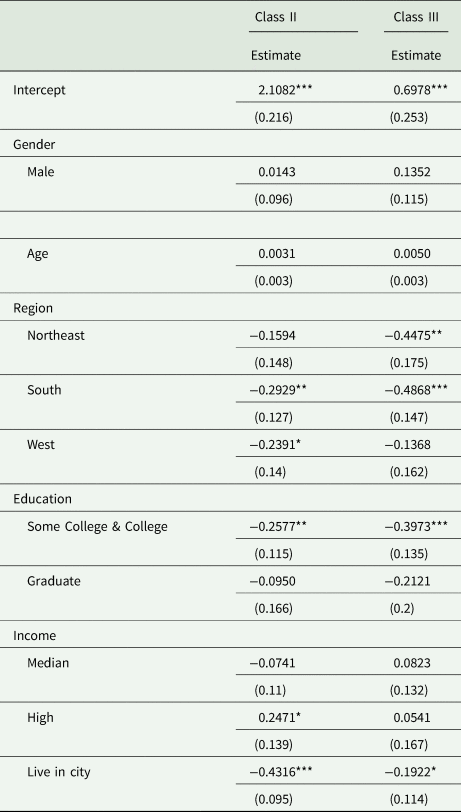
Note: * P < 0.1, ** P < 0.05, *** P < 0.01. Standard error in parentheses. Reference group for region is Northwest. Reference group for education level is high school or lower. Reference group for income is low income (lower than or equal to $39,999).
Overall, our findings offer several important insights with respect to the calf welfare attributes and the impact of information. In case of calf-contact attributes, the highest premiums (~$4/gallon of milk) were associated with free calf-dam contact. Consumers were also WTP ~$3/gallon, ~$2/gallon and ~$1.4/gallon more for milk produced by cows raised in half-day contact, foster cow and restricted suckling systems, respectively. It appears that consumers value systems that allow for social bonding between calves and dams and access to milk (Daros et al., Reference Daros, Costa, von Keyserlingk, Hötzel and Weary2014; Johnsen et al., Reference Johnsen, Zipp, Kälber, de Passillé, Knierim, Barth and Mejdell2016). Consumers discount milk produced by cows dehorned without pain reliever and attached little value to polled calves. The relatively low valuation of polled calves despite its potential positive animal welfare impacts may be consistent with the perceived unnaturalness of the practice (McConnachie et al., Reference McConnachie, Hötzel, Robbins, Shriver, Weary and von Keyserlingk2019).
Preferences are however not uniform for all consumers. Indeed, we identify a segment of consumers ‘The high preference for animal welfare consumers’ who give major importance to animal welfare and are insensitive to the cost of milk. This is sharp contrast to ‘The price sensitive and low animal welfare-concerned consumers’ segment who attach low importance to animal welfare. The former group may represent the so-called citizen-consumers who are very concerned about ethical production practices (Ricci et al., Reference Ricci, Marinelli and Puliti2016). They are also the most susceptible to the provision of additional information, indicating their level of interest in FAW. Most consumers (~70%) have moderate preferences for calf-dam attributes and are sensitive to price.
Our findings also suggest that information treatment plays a significant role. This is evidenced by the change in consumer preferences in the image vs the text only treatments. This implies that exposure to imagery led to stronger opposition to the conventional practice of early calf-dam separation. This outcome is consistent with previous literature (Ventura et al., Reference Ventura, Von Keyserlingk, Wittman and Weary2016; Hötzel et al., Reference Hötzel, Cardoso, Roslindo and von Keyserlingk2017) that showed increased awareness of calf-contact practices led to stronger public opposition. The results further infer that the impact of information is stronger for urban dwellers and female consumers, who represent a critical segment of the milk market in terms of purchasing power and role in household food choice, respectively. The implication is that greater awareness of practice may invoke opposition driven by curiosity or emotional attachment to the wellbeing of calves. The unequal impacts of information are consistent with the findings of Cao et al. (Reference Cao, Cranfield, Chen and Widowski2021). The spillover effect on the marginal utility of dehorning perhaps suggests that images on specific attributes (i.e., calf and dam) may convey accidental information on others (i.e. dehorning) (Jansen et al., Reference Jansen, Claassen, van Kamp and Timmermans2020).
Conclusion
The ethics of many farm practices are increasingly becoming contentious, thus eliciting diverse viewpoints from stakeholders. At the same time, the credence nature of farm production processes and the gaps in public awareness has significant implications for the role of additional information on consumer preferences. This paper conducts a BWS experiment looking at consumers’ preferences for calf-dam contact and dehorning attributes in milk choice. With two information treatments (text only and text with images), we examined the impacts of different information formats and consumer heterogeneous responsiveness to information. We also examined the heterogeneity in preferences for the different attributes.
Our findings reveal that consumers value additional calf-dam contact and place a premium on practices that provide longer contact periods for calves. Consumers also expressed positive preferences for dehorning with pain mitigation. The largest segment of consumers appears to care about calf welfare and the cost of milk. Smaller segments of consumers are either price sensitive or animal welfare focused without consideration for price. We also found that additional information is positively associated with consumer WTP for improved animal welfare. There is, however, considerable heterogeneities in consumer preferences and the impact of additional information on consumer choice.
The implication of these results is the existence of a high value segment in the milk market who care about calf contact attributes and may have an effective demand for the product. At present, milk is not marketed with information about calf management practices. Given that both conventional and organic dairy farms practice early calf-dam separation, there could be an entire value segment that has not been developed. This is likely to increase as concerns and information about the ethicality of calf-dam practices increases. This could also be an opportunity for processors to design tailor-made market strategies for the different consumer segments. The transition to systems with more contact will partly depend on the costs of the structural changes needed to house calf-dam pairs. Some farmers may be more open to a middle ground, say, a half-day system as compared to a free contact system. Transitions to alternatives such as restricted suckling using technological innovations may however be the most feasible. This is especially true as the average dairy farm in the US increases in scale and production systems get more intensive. A useful extension of the present work is the consideration for the cost associated with these alternative systems. This will help provide a more holistic view of the cost and benefits associated with the alternatives analyzed in this study. Our study has also shown that visual representation can be incorporated into Case 3 BWS design to elicit preferences. However, care must be taken to avoid potential pitfalls such as accidental cues and task complexity (Shr et al., Reference Shr, Ready, Orland and Echols2019; Jansen et al., Reference Jansen, Claassen, van Kamp and Timmermans2020).
Supplementary material
The supplementary material for this article can be found at https://doi.org/10.1017/S1742170522000333.
Financial support
This work was supported by the Wisconsin Dairy Innovation Hub.
Conflict of interest
The author(s) declare none.


 Open access

