

Introduction
This essay presents a methodology for the analysis of a small selection of late Byzantine and Medieval artefacts and examines their implications for female agency in the period. Building on an established scholarly tradition that has focused on written evidence and literary sources, such an approach seeks to investigate what lies beyond the frontiers of text, by exploiting visual and material evidence. Scholars have adopted similar methods in the past, as we shall discuss below, but such an approach still requires systematization, by bringing into the research frame disciplines that are at the periphery or beyond the traditional boundaries of medieval and Byzantine studies.
The methodology employs the anthropological notion of agency and applies it to three art case studies with ties to three women who lived between the mid- to late fourteenth century and the first half of the fifteenth, and who were part of the same Mediterranean, Greek-Latin elite socio-cultural context. This approach is inspired by Leslie Brubaker's scholarship, which I developed during my PhD at University of Birmingham, applying it to the study of the Latin basilissai of Palaiologan Mystras and of the role these queens had in the late Byzantine Morea, reassessing their agency and showing how Moreote despots were the ‘husbands’ of relevant social agents.Footnote 2
After the methodological section, the case studies discussed show how this form of art history sets out to extract women from the shadows and from the partiality of texts by engaging with a variety of primary and secondary sources from Byzantine visual culture, thus dislocating the male-logocentric nature of most of primary written sources. The first case study is based on an early-fourteenth century micro-mosaic diptych, now in the Museo dell'Opera del Duomo of Florence (Fig. 1).Footnote 3 It is a short illustration of the nature of inference and the relationship between female agency and objects. The second and main case study, based on two fragments of a stone-carved architrave in the Museum of Mystras (Fig. 2),Footnote 4 is an application of the methodology to an artefact, which is then discussed in relation to the third example, based on a coat of arms used as decorative elements on the façade of the church of St Catherine of Alexandria in Galatina (Figs. 3, 4).Footnote 5 More generally, these case studies show how interrogating heterogenous art objects through the lens of an agency-based framework can usefully direct research questions and inform the multi-dimensional classification of such objects. Finally, I draw some conclusions, returning to the scholarship of Leslie Brubaker.
A–B. Dodekaorton diptych, micro-mosaic, early fourteenth century, Museo dell'Opera del Duomo of Florence (photograph by the author).

Stone-carved architrave, late fourteenth century, Museum of Mystras (photograph by the author).

Maria d'Enghien-Brienne coat of arms, glass roundel, first half fifteenth century, Saint Catherine of Alexandria, Galatina (photograph by the author).

Maria d'Enghien-Brienne coat of arms, decoration on the inside façade wall, first half fifteenth century, Saint Catherine, Galatina (photograph by the author).

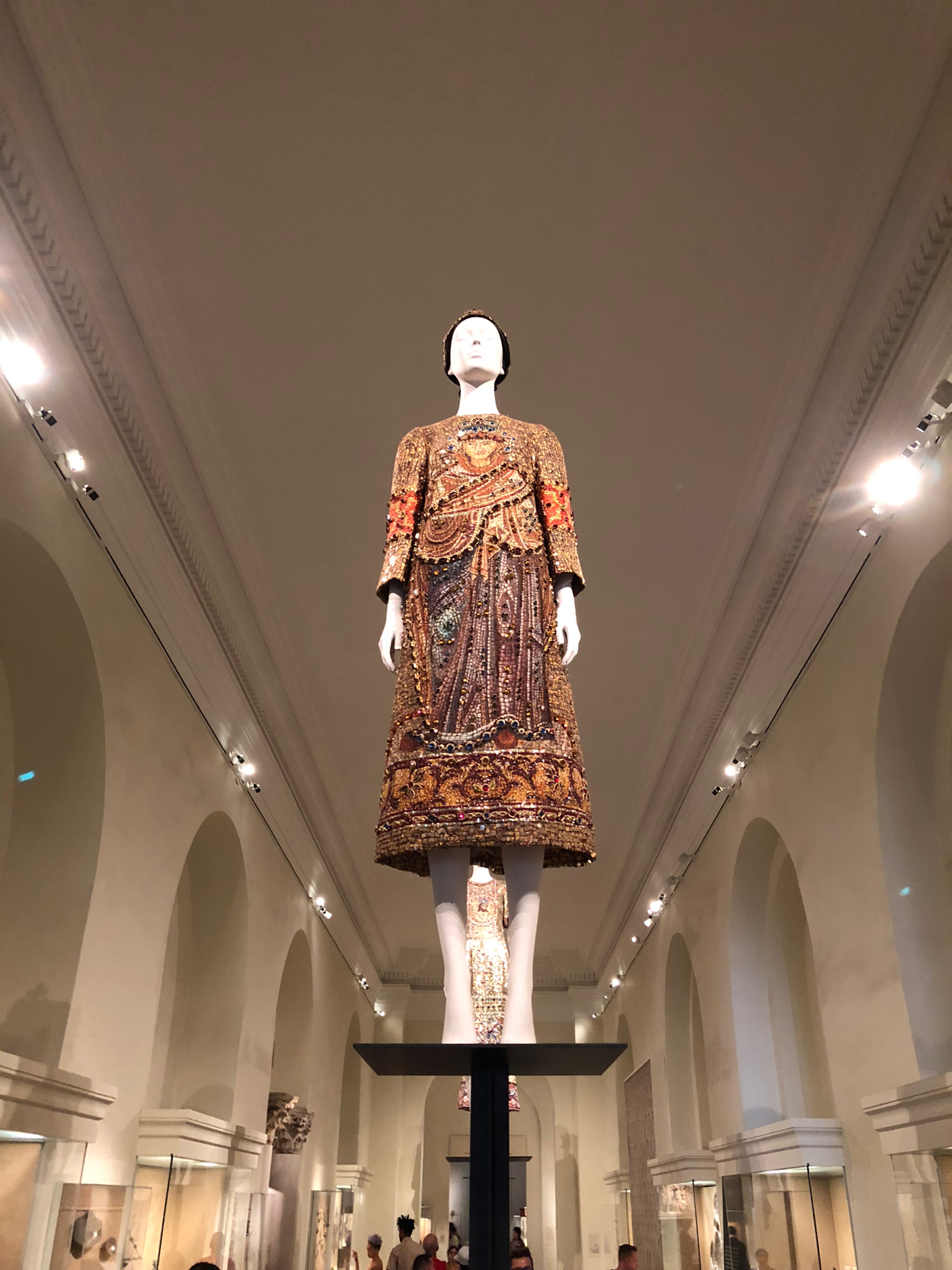
This essay has two aims: to promote discussion about the frontier between Byzantine and Western medieval art history; and to engage specialists and audiences that could contribute to the advancements and promotion of the disciplines and might find inspiration from the rich repertoire of Byzantine and medieval art. In this sense, it shares the agenda of the 2018 Heavenly Bodies exhibition at the Metropolitan Museum in New York, which explored the close relationship between contemporary fashion and religious art by pairing garments with treasures from the Jaharis collection and the Byzantine galleries (Fig. 5).Footnote 6 The Metropolitan Museum showed the general public how Byzantine art and images are a stratified iconographic repertoire which carries a web of significations that are still relevant today. To a trained specialist this might seem obvious, but it bears repeating. The juxtaposition chosen by the Metropolitan Museum has particular significance for Byzantine studies, a discipline so profoundly imbued with the dialogue between the logos and the sensorial (mostly visual) world, that any stimulus to interrogate visual and aesthetic culture and to venture towards new gnoseological frontiers has the potential to open novel avenues of inquiry on the aesthetic, authoritative and generative power of the Byzantine visual repertoire. Such questions are cogently analysed in Brubaker's scholarship on iconoclasm.Footnote 7 Such avenues of inquiry in scholarly research can foster opportunities to engage the public inside and outside academic walls, employing new form of museology and performative practices. I am referring here to the long tradition of the performing arts devoted to historical contexts, not only in the tradition of the narrative historical plays – of which examples are many but, within Byzantine studies, significant is the case of the 1884 play Théodora by Victorien Sardou based on Prokopios’ Secret History – but also in the multisensorial contemporary theatrical and performance art traditions masterfully exemplified by directors like Robert Wilson with his 1976 opera Einstein on the Beach.Footnote 8
Dolce and Gabbana's evening dress autumn/winter 2013-14 collection, as seen at Heavenly Bodies exhibition, 2018, Metropolitan Museum New York (photograph by the author).
The study of women in the Middle Ages has been shaped by historical written evidence about notable individuals, such as imperial women, queens, or women linked to important religious establishments, who were the subjects of the seminal scholarship of scholars like Donald Nicol and Thalia Gouma-Peterson.Footnote 9 Medieval and Byzantine historiography on women and gender has discussed such cases with a high degree of sophistication. The edited volumes by Cordelia Beattie, Women in the Medieval World,Footnote 10 and, in the Byzantine context, the volume Female Founders in Byzantium and Beyond, edited by Theis, Mullett and Grünbart,Footnote 11 are notable, as is the scholarship of Leslie Brubaker, who, along with Angeliki Laiou, Alice-Mary Talbot, Mati Meyer, Judith Herrin, and Sharon Gerstel, has defined the field for the last forty years.Footnote 12 All these scholars have reshaped the nature and boundaries of gender studies in Byzantium, overcoming previous limitations and biases, extending the scholarship also to previously little regarded liminal female historical figures.
The power of images and the conceptions of gender are two crucial frontiers of inquiry in Brubaker's scholarship, which has embraced Byzantine visual culture and gender studies, and the authority of icons as activators of logocentric and performative actions. Her work has transcended the boundaries of formal art history, systematically investigating images, and widening the social implications of art objects to include gender.Footnote 13 In her academic scholarship, as in dramatic, performative, and visual arts, the use of inference is essential, especially when dealing with the history of elusive figures with small or non-existent primary sources. And Brubaker's scholarship has been, in turn, foundational for my own work on the agency of medieval women.
Nonetheless, a significant limitation in the field persists. Women in history tend to hide, and not by choice, behind men, as brilliantly discussed by Brubaker’ essay ‘Sex, lies and textuality: the Secret History of Prokopios and the rhetoric of gender in sixth-century Byzantium’.Footnote 14 More needs to be done to reverse this narrative, to go beyond texts and bring women to the fore. This can be done by looking more at art objects to extract evidence thus far ignored.
Art and agency
Most research on the history of women during the Middle Ages focuses on textual sources that provide at best a partial perspective. This is because these sources are mostly dominated and mediated by men, even when women are authors or authorities.Footnote 15 Many attempts have been made to overcome partiality due to male biases by incorporating art and material culture to refine our reading of women in Byzantine society: a stimulating example of this was the exhibition Byzantine Women and Their World curated by Ioli Kalavrezou at Harvard in 2003.Footnote 16 In medieval studies, a recent and interesting attempt is Femina by Janina Ramirez.Footnote 17
Potential future developments and meaningful exchanges of Byzantine and medieval studies should rely on cross-disciplinary, comprehensive surveys, systematic reassessments, and shared research agendas which collectively reconsider textual evidence in relation to art and material visual culture to get a better sense of women in history. This will embrace the reassessment of the contribution of liminal figures, such as elite women engaging with multi-national contexts, and discuss them as international/intercultural agents across courts, as seen through their agency.Footnote 18 To overcome male partiality, such a multidisciplinary approach and methodology can be built on the anthropological notion of ‘social agency’, as an effective tool to complement and challenge written primary sources by exploiting art history, archaeology, anthropology, and semiotics.
A particularly useful articulation of what agency is comes from Alfred Gell's anthropology of art, where a social agent is generally described as ‘one who “causes events to happen” in their vicinity’.Footnote 19 Gell worked in response to linguistic or semantic models of art history, and to established aesthetic categories. Like others before him (Warburg, Panofsky, Bourdieu) he drew on a number of fields – psychology, semiotics, aesthetics – to build an anthropology of art, seeking to explain both its conception and its realization.Footnote 20 In his theory, an art nexus made of artists, prototypes, indices and recipients relate to each other in an agent-patient relationship. A chart in Gell's posthumous publication exemplifies how data indexed in any given artefacts and produced within diverse social and cultural relations,Footnote 21 can become elements of a nexus of associations organized on the cognitive process of abduction, a form of inference distinct from induction or deduction, where we can plausibly link one element to another.Footnote 22 It is this nexus of associations that is capable of both highlighting overseen information, particularly of a non-textual nature, reassessing little documented historical figures as well as written sources.
One of the most profound implications of Gell's work is the idea that the agent-patient relationship can be established between any of the elements of the art nexus. So, not only the artist or the patron can be an agent: art objects – as indices – can exercise agency too, as can prototypes and recipients. This is a methodology that has already been employed to some extent by Byzantinists,Footnote 23 and it should be more widely adopted in the study of Byzantine art and visual culture, especially when auxiliary primary sources are sparse.
The three case studies of this essay are exemplary because they each bear a distinct nexus of agent-patient relations with three notable women with important similarities: they lived in the same period; they shared a similar Greek-Latin socio-cultural context; and they are poorly and uncritically represented in primary sources. The first is the Venetian Nicoletta di Antonio Grioni (d. Venice 1409).Footnote 24 The second is the basilissa of Morea, Isabelle de Lusignan (d. Cyprus 1382 or 1387).Footnote 25 The third is Maria d'Enghien-Brienne (1369-1446) Countess of Lecce and later Queen of Naples.Footnote 26 The art objects examined in what follows were produced in a Greek-Latin context and carried pluri-cultural Mediterranean values.Footnote 27 Their association with each of these women made them capable of exercising the agency of their owner on those who valued and observed them.
Nicoletta Grioni: a Byzantine micro-mosaic
The early fourteenth-century micro-mosaic diptych with the Dodekaorton cycle in the Museo dell'Opera del Duomo in Florence is a good example of female agency seen through an art object (Fig. 1). The diptych represents twelve exquisitely rendered scenes in micro-mosaic with the life of Christ and the Virgin corresponding to great liturgical feasts, and it was part of the treasury of the Baptistery of St John Baptist in Florence. The diptych was donated in 1394 to the Florentine Calimala Guild, the guild of the foreign cloth finishers and merchants, responsible for the Baptistery, by the Venetian Nicoletta di Antonio Grioni, widow of a koubikoularios (κουβικουλάριος), a high official – perhaps the Florentine Pietro Torrigiani. He had served at the Constantinopolitan court during the reign of (1341-1354) of John VI Kantakouzenos (b. Didymoteichon 1332, d. Constantinople 1391): the diptych was probably acquired around this time and brought back to Venice by Nicoletta.Footnote 28
The diptych demonstrates the appreciation that existed in Venice and Florence for aristocratic Byzantine art. It also shows how a notable woman, who was part of a network of individuals exposed to the important cultural centres of Venice and Constantinople, could exercise her agency through it: Nicoletta received significant financial support in exchange for donating the diptych, along with sacred relics of Saint John, to the Baptistery. Secondary written accounts related to this diptych, reconstructed recently by Michele Bacci,Footnote 29 point to a network of Florentine and Venetian merchants expressing agency through sacred relics and high-quality artefacts, which they imported from Byzantium and gifted to important religious establishments in exchange for connections, revenue, and prestige.
In this case study the art nexus provided by Gell works like this: the agent Nicoletta, as either patron or owner, commissioned or acquired the diptych from a Byzantine patient artist. The diptych was then brought to Florence and became an agent Index towards the patient/recipient, the Calimala Guild, which then granted the annuity in ducats to Nicoletta. To understand the importance of this diptych along with the other objects donated by Nicoletta, one ought not only to consider secondary accounts, as discussed by Bacci, but also decipher the indexes of her agency embedded in the object.
A close material and formal analysis of the micro-mosaic and its context establishes a complex network of agencies linking Nicoletta, the Imperial office in Constantinople, and the Baptistery in Florence. The qualities of the diptych and of the other objects donated by Nicoletta were such that they led the Baptistery to grant her the significant annuity of forty-eight Venetian ducats. Over a period of fifteen years, this allowed Nicoletta to collect an amount almost double the average dowry of noblewomen of her time.Footnote 30 It not only expressed her financial agency but showed her to be part of a network of other notable individuals linking Italy to Byzantium in the late fourteenth century. Nicoletta's agency and her historical traits, while only partially recognized in secondary accounts, are clearly indexed in the data embedded in the diptych.
If applied in a historical method, the notion of agency constructs a series of logical steps that can link objects to notable women, and women to contexts across the late medieval Mediterranean.Footnote 31 This approach has been occasionally adopted, for instance by Antony EastmondFootnote 32 or Judith Herrin.Footnote 33
Isabelle de Lusignan and Maria d'Enghien-Brienne: Latin coats of arms and Greek inscriptions
To illustrate further the power of this approach, I will discuss a case study linked to a basilissa of the Morea, Isabelle de Lusignan (b. after 1330 – d. Cyprus 1382/7).Footnote 34
Despite the lack of primary sources, the political and cultural agency of Isabelle de Lusignan can be established by examining a fractured architrave, now in the Museum of Mystras, and found in two pieces in the nineteenth century in the premises of Agios Demetrios, the metropolitan church of Lakedaimonia.Footnote 35 The two stone blocks were carved out of a larger grey marble block and are now displayed together in the museum. The original architrave has a front carved with decorations and a flat undecorated bottom, and the top shows marks indicating it was meant to be mounted along other stone components or, alternatively, mounted with metal graphs on a masonry structure.
The two fragments were found at different times within the metropolitan complex. According to Gabriel Millet, the first of the two stone blocks was found ‘on the ground, near the inner wall of the Metropolis, towards the southwest corner, next to a large arcade’.Footnote 36 The second was found by a collaborator of Millet in 1905, while working in the same location on the masonry of the wall surrounding the metropolitan complex, inserted into the masonry as a re-used construction piece.Footnote 37 Based on the location of the finding and their trapezoid transversal section, the two blocks could have been conceived as a stone architrave topping either a portal or an entryway within the metropolitan complex,Footnote 38 meant for use but then discarded, and subsequently used as building material.Footnote 39
The fully decorated front of the architrave consists of a long triple-lined thread, interlacing in four portions of the surface. The thread interlaces creating a decorative motif of a binding ribbon, sometimes described as lemniskos.Footnote 40 Similar decorative patterns can be found in many configurations, both on sculptural reliefs, mosaics and painted decorations.Footnote 41 The decorative pattern suggests that the ribbons are figuratively holding in place other decorative elements such as rosettes and crosses.Footnote 42 This interlaced pattern shows a sculptural treatment similar to those on architraves found in other areas of the Morea.Footnote 43 The rendition of the motif, especially on the details of curls of the free ends of the ribbons, resembles the interlaced motif decorating other monuments near Mystras, such as the decorative patterns of the carved screen in the Church of St George in the Geraki castle,Footnote 44 or the carved ribbon decoration of a marble proskynetarion with an icon of Christ enthroned, originally from the church of the Peribleptos and now in the Museum of Mystras.Footnote 45
The well-rendered decoration on the architrave also bears another distinctive feature. The binding ribbons stretching across the whole of the front function as a single device. The ribbons seem to be holding in place three roundels, one on the left portion of the architrave, one at its the centre, and one on its right. The two on the sides are well preserved; the one in the centre is broken along the middle vertical line. The left and right roundels delimit two monograms, while the one in the centre bears a coat of arms.
The letters in the first of the two monograms read ζαμπεα, and the second ντε λεζηναω. Together, as Millet suggests implying the repetition of the letter “ν”, they read as ζαμπεα ντε λεζηνανω, zabea de lezinano. This is Isabelle de Lusignan, whose name was transliterated into Greek in the monograms.Footnote 46
The central roundel is divided into two portions, both bearing heraldic insignia. The left portion depicts a crowned rampant lion, while the right has the remains of the vertical and right arms of a cross, with two small crosses above and below the right arm. Recomposing the two parts allows us to decipher the coat of arms of the Lusignan families of Little Armenia and Cyprus: the rampant lion as a unifying visual emblem for the different branches of the dynasty, and the Jerusalem cross associated with the emblem of the King of Cyprus.Footnote 47
Associating the name of a ruler, as Isabelle was, with a stone inscription usually implies an act of patronage or dedication of a building. The architrave, then, was prepared to commemorate a foundation act or an intervention on an existing building. Even if its exact position can only be suggested, the architrave with Isabelle de Lusignan's monograms was commissioned to mark her patronage. In sponsoring the construction or restoration of a building she merged two traditions: Byzantine, by having two roundels with Greek transliteration of her name, and Latin, by having her coat of arms as an appropriating act. Associating a patron to a building, or to different artefacts, by means of visual insignia was frequent practice in the Latin/Catholic context of the time, while finding progressive affirmation in the late Byzantine Empire – especially with the double-headed eagle of the Palaiologan coat of arms. Due to this practice, by the second half of the fourteenth century, the coat of arms of different branches of the Lusignan dynasty were in use in different polities linked to the dynasty.
Henry II of Cyprus (1285-1324), for instance, used a combination of the rampant lion and the Jerusalem Cross in his gros petits.Footnote 48 The coat of arms on the architrave in the museum of Mystras can be linked to several coins related to the Lusignan of Cyprus, as well as to the coat of arms of other related families, such as the Durazzo of Naples. The two families were linked by the marriage of the king of Naples Ladislao I of Durazzo (1377-1414) and Mary de Lusignan (1381-1404). An example of the Durazzo's coat of arms features in the tempera cassone panel by Master of Charles of Durazzo in the Metropolitan Museum of Art in New York (Fig. 6).Footnote 49 The panel shows the conquest of the city of Naples in 1381 by Charles and includes depictions of the coat of arms combining the Durazzo and the Jerusalem Cross.Footnote 50 This combination has historical relevance since it shows that, in the decades when Isabelle was associating herself with the coat of arms of the King of Cyprus and Jerusalem, in Italy Charles of Durazzo, in promoting himself, was using a similar coat of arms, also bearing the Jerusalem Cross.Footnote 51
Master of Charles of Durazzo, The Conquest of Naples by Charles of Durazzo, 1381–82, Metropolitan Museum of Art, New York (photograph by the author).

Isabelle was engaged in a programme of appropriation, using a blended form of her insignia – the coat of arms and her name – to index to the communities residing in Mystras (the patients in Gell's theory) her political and social agency. The architrave shows the basilissa promoting her role through the most durable medium available. Similar acts of self-promotion through sculpted programmes were pursued by other Byzantine rulers in other contexts such as Arta and Trebizond.Footnote 52 Indices such as Isabelle's name, written in Greek monograms and associated with her coat of arms, were not unfamiliar to her Cypriot background. A similar coat of arms in a religious context appears in the wooden templon of the church of Hagios Ioannis Lampadistis, in Kalopanagiotis,Footnote 53 and it relates to other known female patronage acts associated with her large and influential family.
Particularly significant as act of self-promotion is the third case in this essay, that of Maria d'Enghien-Brienne (1369-1446),Footnote 54 countess of Lecce, who became queen of Naples after marrying, in 1407, the king of Naples Ladislao I of Durazzo (1377-1414), previously married to Isabelle's third cousin, Mary of Lusignan.Footnote 55 Maria d'Enghien-Brienne, while not directly linked to the Lusignan family, was part of a dynastic environment where the use of emblems was highly codified and broadly understood.Footnote 56 Her first husband, Raimondo (Raimondello) Orsini Del Balzo (1350/5-1406), prince of Taranto,Footnote 57 sponsored the construction of the church of St Catherine of Alexandria in Galatina, Apulia, in the last quarter of the fourteenth century.Footnote 58 Maria was at Raimondo side's while he was at war against King Ladislao I. In 1406 Raimondo died, and Maria d'Enghien-Brienne married Ladislao so as to end the war. After becoming queen of Naples in 1407, she completed and decorated the church of St Catherine, and Raimondo's funerary monument was included in the apsidal area of the church. The marriage of Maria and Ladislao was signalled by two indices, which remain on the façade of the church, mirroring those used by Isabelle de Lusignan in her architrave in Mystras. First, Maria d'Enghien-Brienne used her coat of arms, merging her own emblems with those of the Durazzo, to decorate the glass roundel above the portal of the church, at the centre of the rose window decorating the main façade (Fig. 3). Second, a Greek inscription was carved above the right entrance to the church.Footnote 59 As was the case for Isabelle, Maria chose to communicate her role as ruler to the Greek-speaking Orthodox people of Galatina in Salento, the patients of her agency,Footnote 60 while identifying with them through their language in the inscription. At the same time, by combining her own title with that of Naples, she presented herself as responsible for bringing a resolution to the conflict.
Maria d'Enghien-Brienne also marked her presence inside the church, by inserting the arms of d'Angiò Durazzo and d'Enghien-Brienne in the frescoed decoration on the inside façade wall, below the rose window, above the central portal (Fig. 4). Other female members of her family did the same, such as her niece, Caterina Orsini Del Balzo, who used her arms on the decoration of an early fifteenth-century chalice now in the Museo Diocesano, in Bitonto, Apulia.Footnote 61
Isabelle and Maria were certainly embracing a broader fashion of the period, in which heraldic images were associated with the general idea of the West, and were adopted by the Byzantine elite of Constantinople and other major centres of the Empire.Footnote 62 Examples of this fashion, specific to the use of the fleur-de-lis as a decorative sculpted motif rather than a specific statement, include fragments of reliefs from the churches of the Chora and Kyriotissa Monasteries in Constantinople, and the church of the Paregoretissa in Arta.Footnote 63 In the late thirteenth-century interior decoration of the latter, the use of such decorative motifs was accompanied by other sculpted decorations, on arches, column bases and slabs, representing mythical animals, human figures, beasts linked to the thirteenth-century art of Puglia and Athens.Footnote 64
While we agree with Robert Ousterhout when he writes, of this fashion, that ‘we might describe the rampant lion as “heraldic”, for the Byzantine audience it connoted power and prestige only in a general way’,Footnote 65 in the case of Isabelle's use of a crown rampant lion in Mystras, with or without a sword, it was not a generic act to associate her family with a patronage act, but a way of transferring the authority of her role at court into a signal of her power. Coming from a powerful foreigner at court, it must have had a stronger directness and specificity.
The use of the Lusignan coat of arms was not only a direct index of the association between a certain issuer and the family but a way to emphasize rulership and authority in an economic context where individuals from multiple social, linguistic and religious backgrounds interacted in regional trade. By transliterating her name into Greek and using the coat of arms of her family, Isabelle was presenting herself as a unifying ruler capable of bridging the Byzantine court of Mystras and the Latin Kingdom of Cyprus.
Her mark on the architrave – her Greek name – is the equivalent visual strategy her cousin Hugh IV used while impressing the family coat of arms on a metal bowl, now held at the L.A. Mayer Museum of Islamic Art in Jerusalem.Footnote 66 The bowl is made of a copper alloy, with silver inlays and engraving. It is a metal vessel decorated with floral motifs and an Arabic inscription and is decorated with the coat of arms of Hugh IV de Lusignan. A platter from the Musée du Louvre in copper alloy, with silver, gold, and black-paste inlays, also with heraldic device of the Lusignan, has an Arabic inscription of good wishes. Even though these objects were probably meant for the Western market, the use of a family mark on an object originating from the Arabic-speaking regions – both objects are from either Syria or Egypt – suggests that the family arms of the Lusignan indicated their intermediary role with the Mamluk elite and positioned the family as an international power.Footnote 67
The basilissa of Morea Isabelle used the dynastic indices, her coat of arms, and her name in Greek, to index to the communities residing in Mystras her political and social agency with a formula also used by other members of Isabelle's large and influential family network.
Conclusion
Isabelle, in the Byzantine Morea, embraced the idea of a Greek-Latin cultural koine, as revealed by the discussion on agency and the cross-referencing of the three case studies presented here.Footnote 68 This koine was not limited to the Peloponnese. It extended to other areas of the Mediterranean,Footnote 69 and was shared by others who belonged to families linked to hers, such as Maria d'Enghien-Brienne in Galatina. It was also indexed in the micro-mosaic that belonged to Nicoletta Grioni and that travelled between Constantinople, Venice, and Florence. By transliterating her name into Greek and using the coat of arms of her family, Isabelle presented herself as a unifying ruler, an authority capable of bridging the Byzantine court of Mystras and the Latin Kingdom of Cyprus, a leading figure of her time. By carefully reassessing and contextualizing artefacts like the architrave as a complex historical index, Isabelle, whom Zakythinos called the ‘princesse française à la cour de Mistra’, comes back into the history of the late medieval Mediterranean as a more rounded figure and as a prominent intercultural ambassador beyond written documents.
The ‘art and agency’ approach briefly described in this paper has enormous potential to reveal hitherto hidden female stories. However, it needs to be further developed and systematized so as to integrate what social history, archaeology, DNA research, and statistical analysis are doing to shake up history. As Janina Ramirez points out in Femina, this can contribute to emancipating history from texts that ‘tend to favour the few’ in favour of approaches that ‘search for the many’.Footnote 70
Leslie Brubaker's scholarship has been receptive of experiment. Her work has ventured to reach the frontiers of her field, integrating a critical reading of the authority of images as windows on social history. This is, as she points out in Vision and Meaning in Ninth-Century Byzantium, to ‘try to understand the socially constructed meaning of images for certain defined groups’ and to articulate ‘the ties that bind objects to their producers, context, and audience’ through the ‘assessment and comparison of recurring patterns in both verbal and visual communications’. Brubaker understands how art making, especially that of images/icons, is never a mere process of imitation. Rather it renders ‘original holy figures as prototypes, and differed from them only in substance […]’ being reproductions ‘of the original, and inspired “from above”; if inspiration came from the artisan alone, the result would have been an idol, not an icon’. While commenting on Photios' sermon commemorating the completion of the mosaic icon of the Theotokos in Hagia Sophia, Brubaker points out that the author links image and prototype: ‘for Photios, the mosaic is a window to a real woman, and he is exploring his reactions to her as mediated through the image.’Footnote 71 His reactions are what matter. Brubaker rightly points out that our contemporary response to Byzantine iconography is different than of Photios’ own. However, it is our similarly gnoseological and performative response to current artistic production that makes Byzantine art so contemporary.
Byzantine images penetrate contemporary culture in many ways, from fashion to mainstream entertainment, as briefly discussed in reference to the 2018 Heavenly Bodies exhibition. But to be truly understood and read they need better contextualization. That is one crucial role for scholarship on Byzantium. Objects ‘speak’: we need to listen to them as a coordinated and stratified collection of agencies. It is through this coordinated, scientific research, which questions and listens to texts and objects, that the lives of women from the past, such as those of Nicoletta Grioni, Isabelle de Lusignan and Maria d'Enghien-Brienne, can rightly move from the margins of historical discourse to the core of late Byzantine studies.
Appendix
It may be of interest to the reader that my research on the Latin basilissai originated in a performance titled Cleophe – CM Lacerations, a collaboration with the choreographer Sandhya Nagaraja, with a dramaturgical structure based on the life of Cleophe Malatesti (b. Pesato – d. Mystras, 1433) and inspired by the scholarship of Silvia Ronchey on the diplomatic alliances of the Palaiologan dynasty through interfaith marriages and on the painting known as The Flagellation by Piero della Francesca. See S. Ronchey, ‘Malatesta - Paleologhi: un'alleanza dinastica per rifondare Bisanzio nel quindicesimo secolo’, Byzantinische Zeitschrift 93 (2000) 521–67; S. Ronchey, L'enigma di Piero: l'ultimo bizantino e la crociata fantasma nella rivelazione di un grande quadro, 1. ed. (Milano 2006); S. Ronchey, ‘L'enigma di Piero: Regesto Major’, http://mediaronchey.it/materiali/pdf/regesto.pdf, accessed 5/16/2023; on interfaith marriages see recently P. Melichar, Empresses of late Byzantium: foreign brides, mediators and pious women (Berlin 2019). On the Flagellation by Piero della Francesca, see T. Gouma-Peterson, ‘Piero della Francesca's Flagellation: an historical interpretation’, Storia dell'Arte 28 (1976) 217–33; C. Ginzburg, The enigma of Piero: Piero della Francesca: The baptism, The Arezzo cycle, The Flagellation (London 1985); J. Pope-Hennessy, ‘Whose Flagellation?’, Apollo 124.295 (1986) 162–5; C. Pertusi, La flagellazione di Piero della Francesca e le fonti letterarie sulla caduta di Costantinopoli (Bologna 1994); C.Z. Laskaris, L'enigma inesistente: lettura iconografica della Flagellazione di Piero della Francesca (Alessandria 2021). The piece rehearsed in summer 2009 used elements derived from art historical scholarship on late Palaiologan visual culture, demonstrating just how far juxtaposition of art historical objects could be generative of new artistic inquiries. Cleophe's character was developed from Ronchey's studies and from her own words, using letters she wrote from Mystras to her sister Paola Malatesti Gonzaga in Mantua, see A. Falcioni (ed.), Le donne di casa Malatesti (2 vols, Rimini 2005), esp. vol II, 955-68. The costumes for the performance were based on the reconstruction of a fifteenth-century dress found in Mystras and studied by Μπακούρου and Martiniani-Reber, see A. Bakourou and M. Martiniani-Reber (eds), Parure d'une princesse byzantine: tissus archéologiques de Sainte-Sophie de Mistra. Το ένδυμα μιας βυζαντινής πριγκίπισσας: Αρχαιολογικά υφάσματα από την Αγία Σοφία του Μυστρά (Geneva 2000) esp. 35–44. The choreography was partly inspired by Palaiologan court's standard elucidated by the Pseudo-Kodinos, see R.J. Macrides, J.A. Munitiz, and D. Angelov, Pseudo-Kodinos and the Constantinopolitan court: offices and ceremonies (Farnham 2013). As well as the iconography of Byzantine empresses like Helena Dragaš in the miniature at fol. 2r of the manuscript with works of Dionysios the Areopagite, at Musée du Louvre MR 416. The main stage prop used by the choreographer and dancer was inspired by Pisanello's rendition of the bow of a Venetian galea, the vessel that brought Cleophe to Byzantium, see Pisanello (Antonio di Puccio di Giovanni de Cereto), ‘Coque d'un navire porté par un dragon, vus de profil, et esquisse du dragon, Musée du Louvre, INV 2289, Recto’, https://collections.louvre.fr/ark:/53355/cl020003061, accessed 9/5/2023. While the performance piece was not meant as academic research, it created a contemporary performative iconic tableaux vivant of a historical figure, and was intended as an intellectual inquiry steeped in art historical scholarship. This is a practice with a long tradition inspired by the work of Pier Paolo Pasolini, who drew on the scholarship of art historian Roberto Longhi when creating a tableaux vivant for his film La Ricotta, based on the Deposition by Rosso Fiorentino.
Andrea Mattiello holds a PhD from the Centre for Byzantine, Ottoman and Modern Greek Studies, University of Birmingham, and another PhD from the School for Advanced Studies in Venice. He has published and lectured on medieval, modern, and contemporary art and architecture; queer art in Antiquity; female agency in Byzantium; and Greek-Italian exchanges in fifteenth-century Humanism. He has held a number of research fellowships and has lectured at Università IUAV of Venice, the University of Birmingham, Università di Salerno, Christie's Education London and the Courtauld Institute of Art. He co-edited the volume Late Byzantium Reconsidered.


 Open access

