

Implications
The perspective of a possible ban on surgical castration of male pigs in the EU is a real challenge for pork production systems aiming at (very) high-quality products. Potential sensitivity to the use of entire male pigs as an alternative to surgical castrates was evaluated in 272 situations in 16 European countries. No, or marginally higher, potential risk compared with conventional production was found in 47% of the situations. High-potential sensitivity was observed in 30% of them. In the remaining 24%, the risks were mostly associated with fat quantity and quality for processing into dry products.
Introduction
As surgical castration of male pigs without pain relief is painful and castrated male pigs perform less efficiently than entire male pigs, this practice is more and more questioned (Prunier et al., Reference Prunier, Bonneau, von Borell, Cinotti, Gunn, Fredriksen, Giersing, Morton, Tuyttens and Velarde2006). Among the various possible alternatives, rearing entire male pigs is favoured by most chain actors and stakeholders, provided that the drawbacks attached to these animals can be addressed successfully (Oliver et al., Reference Oliver, Gonzalez, Font i Furnols, Gil, Velarde, Ouedraogo, Lundström, Prunier, Tuyttens, Migdal and Bonneau2008; Čandek-Potokar et al., Reference Claus, Weiler and Herzog2015).
Boar taint, an unpleasant odour and flavour perceived during the cooking and consumption of pork from some entire male pigs is one of the main reasons hindering the development of the production of entire male pigs (Bonneau, Reference Bonneau1998). Many factors control the levels of the boar taint compounds, androstenone and skatole (Zamaratskaia and Squires, Reference Zamaratskaia and Squires2009). The production of androstenone is low in young pigs but increases with sexual development (Claus et al., Reference Čandek-Potokar, Škrlep and Batorek-Lukač1994). Androstenone levels are poorly correlated to slaughter weight and age in conventional production where these parameters are constrained within small ranges (Walstra et al., Reference Walstra, Claudi-Magnussen, Chevillon, von Seth, Diestre, Matthews, Homer and Bonneau1999). In some production situations, such as Italian heavy pig and Spanish Iberian pig, animals are slaughtered at a higher weight and older age, which increases the likelihood of high androstenone levels. Fat skatole levels are dependent on nutritional and environmental factors. However, because androstenone inhibits the degradation of skatole, high androstenone levels are likely to result in elevated skatole levels (Zamaratskaia and Squires, Reference Zamaratskaia and Squires2009).
The levels of malodorous compounds are not the only factor influencing boar taint perception. Androstenone and skatole being high molecular weight lipophilic molecules, boar taint is more easily perceived by consumers when fat content is high, no masking ingredients are used and pork is cooked at home and/or consumed warm (Font i Furnols, Reference Font i Furnols2012). Still, boar taint can be perceived in dry (dry-cured or dry-fermented) products that are not cooked at home and consumed cold (Bañón et al., Reference Bañón, Gil and Garrido2003; Corral et al., Reference Corral, Salvador and Flores2016).
Boar taint is not the only meat quality problem associated with entire male pig production (Lundström et al., Reference Lunde, Egelandsdal, Choinski, Mielnik and Kubberød2009). It is well known that entire males deposit less fat (including intramuscular) than surgical castrates and the fat is also more unsaturated (Pauly et al., Reference Pauly, Luginbühl, Ampuero and Bee2012). Quantity and quality of fat is an important aspect for all dry products undergoing a long maturation process. Insufficient level of fat increases salt penetration and water losses; together with higher unsaturation, this negatively affects the final quality of dry products (Čandek-Potokar and Škrlep, 2012; Corral et al., Reference Corral, Salvador and Flores2016; Kaltnekar et al., Reference Kaltnekar, Škrlep, Batorek Lukač, Tomažin, Prevolnik Povše, Labussière, Demšar and Čandek-Potokar2016; Škrlep et al., Reference Škrlep, Čandek-Potokar, Batorek Lukač, Prevolnik Povše, Pugliese, Labussière and Flores2016), which are very common in pig production situations aiming at high-quality products. Finally, the production of entire male pigs may result in a number of management and welfare issues related to aggressive and mounting behaviour (von Borell et al., Reference von Borell, Baumgartner, Giersing, Jäggin, Prunier, Tuyttens and Edwards2009) and unwanted pregnancy in female pigs (Andersson et al., Reference Andersson, Hullberg, Malmgren, Lundström, Rydhmer and Squires1999) when the two sexes cannot be separated, for instance in outdoor conditions. These problems increase dramatically when the animals become sexually mature.
The aim of this study was to evaluate the extent to which situations related to high-quality products and/or to differentiated pig production systems are potentially sensitive to the use of entire male pigs. To achieve that, information was collected from a total of 272 situations in 16 European countries in order to evaluate them along four dimensions of potential sensitivity to entire male production: (i) Is there a higher likelihood of increased levels of boar taint compounds compared with conventional production of entire male pigs? (ii) To what extent are (some of) the related pork products susceptible to perception of boar taint by consumers? (iii) Is the quality of (some of) the associated products likely to be decreased due to the lower fat quantity and quality traits observed in entire male pigs? (iv) Is there an increased likelihood of animal management and welfare problems compared with conventional production of entire male pigs? It was also checked whether castration of male pigs is written down as mandatory in the specifications constraining the production of the animals. In this paper, ‘conventional production’ refers to the definition given by Bonneau et al. (Reference Bonneau, Antoine-Ilari, Phatsara, Brinkmann, Hviid, Christiansen, Fàbrega, Rodríguez, Rydhmer, Enting, de Greef, Edge, Dourmad and Edwards2011): ‘Systems considered as conventional closely resemble the world-wide dominant production system aiming at minimizing production costs … [and targeting] the standard meat market’. Conventional production in this paper is a worldwide definition; it does not designate within country or within regions dominant production systems.
Material and methods
Sources of information
The information used in the present study originated from the Database of Origin & Registration (DOOR) database and the CASTRUM network. The DOOR database (DOOR, 2016) contains the specifications attached to all the EU protected designations. The DOOR project supports the agricultural product quality policy by providing a modern IT system for the dissemination of public data with regard to registered Protected Designations of Origin (PDOs), Protected Geographical Indications (PGI) and Traditional Specialities Guaranteed (TSG) through Europe (DOOR, 2017). A total of 170 situations (40 PDO, 116 PGI and 14 TSG) related to pork products were selected. The information used for the DOOR situations was extracted from the specifications in the database and completed as needed by national documents and/or the expertise of the national contact persons (see below).
The CASTRUM network was built within the CASTRUM project (CASTRUM, Reference Čandek-Potokar and Škrlep2017 and acknowledgement section). The national contact persons identified in each of the 16 countries included in the study identified 102 other situations that were added to the 170 extracted from the DOOR database. The information used for the 102 situations came from national or chain specifications, literature and the expertise of the national contact persons themselves and/or other experts enlisted for the study. National contact persons were mostly scientists with a good knowledge of pork production chains in their respective countries, whereas the other experts were mostly actors in the studied production chains (industry, extension services, etc.).
Basic information collected and aggregation into four dimensions of potential sensitivity to entire male pig production
Four dimensions of potential sensitivity to entire male production were considered: (i) BT-Inc: likelihood of increased incidence of high levels of boar taint compounds compared with conventional production of entire males, (ii) BT_Per: likelihood of boar taint perception, (iii) FatQQ: likelihood of fat quantity and quality issues and (iv) Manag: likelihood of increased management issues compared with conventional production of entire males. The way in which the four dimensions were calculated from the collected basic information is illustrated in Figure 1. In situations related to several products, the BT_Per and FatQQ dimensions were calculated for the most sensitive product.
Chart showing the basic information collected and how it was aggregated into four dimensions of potential sensitivity to entire male pig production. 1Manag=BT_Inc×(1+[Outdoor]).
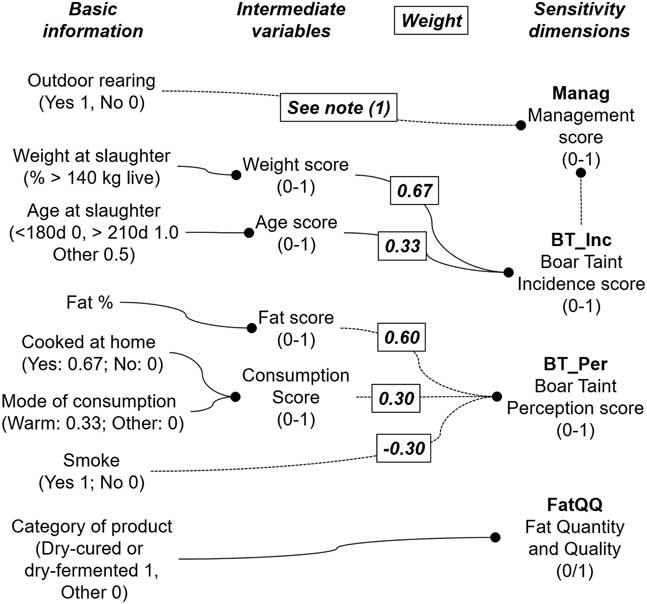
The intention behind the BT_Inc dimension was to evaluate the extent to which the incidence of high levels of boar taint compounds is likely to be increased compared with conventional production of entire males, due to higher weight and age at slaughter. It was calculated as 0.67×[Weight score]+0.33×[Age score] (Supplementary Figure S1). [Age score] was set as 0 in situations where most animals are slaughtered at ˂180 days, 1 where most animals are slaughtered at more than 210 days and 0.5 in all other cases. [Weight score] was defined as the proportion of animals slaughtered at ˃140 kg live weight. This limit was chosen by reference to the highest slaughter weights currently achieved in conventional production chains rearing entire male pigs on a large scale in a manageable way. The French conventional production of entire male pigs was chosen as reference because the information on the slaughter weight of entire males is available (Uniporc Ouest, 2017) and the weight range is higher than in countries that have been rearing entire males for many years (UK, Ireland, Spain, Portugal). The 2 404 693 entire males slaughtered in France in 2016 were slaughtered at an average carcass weight of 95.3 kg (122 kg live weight) with a SD of 7.5 kg (10 kg live weight). In total, 96% of the animals were slaughtered at ˂109 kg carcass weight, corresponding to 140 kg live weight.
In each of the 272 situations, the proportion of animals slaughtered above 140 kg live weight was derived from the available information, under the assumption of a normal distribution. Carcass weights were divided by 0.78 to convert them to live weights. Situations where only the average weight was known were assigned a default SD of 10 kg live weight. In situations where only a range of values was given, the average was calculated as (minimum+maximum)/2 and the SD as (maximum−minimum)/4. In situations where only a minimum live weight was provided, the SD was given a default value of 10 and the average was calculated as minimum+20 kg (2 SD). In cases where the information on weight at slaughter was missing, it was considered that the animals were slaughtered at the average slaughter weight for the country (Eurostat, 2017).
The intention behind the BT_Per dimension was to evaluate the extent to which consumer perception of boar taint is likely to be enhanced because of (i) a high percentage of fat in the product, and/or (ii) because the product is cooked at home and/or consumed warm. The presence of smoke in the product was considered to decrease the likeliness of boar taint perception. BT_Per was calculated as 0.6×[Fat score]+0.3×[Consumption score]−0.3×[Smoke]+0.23 (Supplementary Figure S2). The 0.23 coefficient was used to keep BT_Per between 0 and 1. [Fat score] was fat content in the product with a minimum of 0.1; for products where fat content was not provided but known to be relatively low (e.g. loin cuts), [Fat score] was set as 0.1. Consumption score was calculated as [Cooked at home]+[Mode of consumption]. [Cooked at home] was set as 0.67 when the product is cooked at home and 0 otherwise. [Mode of consumption] was set as 0.33 when the product is consumed warm and 0 otherwise. [Smoke] was set as 1 when smoke was listed in the ingredients and as 0 otherwise.
The FatQQ dimension was set as 1 for dry products and 0 for all other products. The intention behind the Manag dimension was to evaluate the likeliness of increased management problems because more animals become sexually mature as age and weight at slaughter increase in comparison with conventional production. It was considered that outdoor rearing substantially increases the management problems associated with sexual maturity. Manag was calculated as (1+[Outdoor])×(0.67× [Weight score]+0.33× [Age score])/2 (Supplementary Figure S3). [Outdoor] was set as 1 in situations where animals are raised outdoor during and after sexual maturation and 0 in all other cases, including those where pigs are mostly raised indoor but have access to a restricted area outside of the building.
Attention is drawn on the difference between (i) the BT_Inc and Manag dimensions that are evaluated in comparison with conventional production of entire male pigs and (ii) the BT_Per and FatQQ dimensions that are evaluated on an absolute basis. In addition to the potential sensitivity dimensions, it was also checked whether castration was specified as mandatory. [Castration mandatory] was set as ‘Yes’ in all situations where castration of male pigs was written down as mandatory in the specifications. It was set as ‘No’ in all other cases, including those where other specifications cannot be fulfilled unless males are castrated and those where all males are actually castrated but this is not written down in the specifications.
Multiple correspondence analysis and ascending hierarchical clustering
The four dimensions of potential sensitivity to entire male production (BT_Inc, BT_Per, FatQQ and Manag) were used as active variables in a multiple correspondence analysis, using the MCA procedure of R (R Core Team, 2013). As stated by Abdi and Valentin (Reference Abdi and Valentin2007), ‘MCA is an extension of correspondence analysis (CA) which allows one to analyse the pattern of relationships of several categorical dependent variables. As such, it can also be seen as a generalization of principal component analysis when the variables to be analysed are categorical instead of quantitative’.
The quantitative sensitivity dimensions were converted to four classes in such a way as to fit the observed peaks in distributions (Supplementary Figure S4). The results of the multiple correspondence analysis were then used to perform an ascending hierarchical clustering, using the AGNES procedure of R (R Core Team, 2013). Hierarchical clustering is a method of analysis which seeks to build clusters of individuals (here situations) that have a maximum of similarity within cluster and a maximum of differences between clusters; more information can be obtained from Manly and Navarro Alberto (Reference Manly and Navarro Alberto2016).
Analysis of differences between groups
Differences between groups were analysed with the χ 2 test for discrete variables and ANOVA for the other variables, using the LM procedure of R (R Core Team, 2013). Multiple comparison of the means of the various clusters was conducted using Tukey contrasts in the glht procedure of the multcomp library of R (R Core Team, 2013).
Results
Situations included in the study
Out of the 202 designations related to pork products that were first extracted from the 1566 designations contained in the DOOR database, 170 situations were included in the study. In addition, 102 situations were suggested by national contact people, resulting in a total of 272 situations included in the analysis, located in 16 European countries (Table 1; Supplementary Table S1). Mediterranean countries accounted for most of the situations and, among them, four countries (France, Portugal, Italy and Spain) accounted for 64% of the situations. Dry products were, by far, the most common products, representing 59% of the total situations and 79% of the DOOR situations. Fresh products (Fresh meat+Fresh processed) represented more than half of the non-DOOR situations. The characteristics of the individual situations are provided in Supplementary Table S2.
DistributionFootnote 1 of the 272 analysed situations according to country, inclusion in the DOORFootnote 2 database and category of productFootnote 3

Dry=dry cured and dry fermented; Past.-steril.=pasteurized–sterilized.
1 Number of situations. Zero values were omitted for better legibility.
2 The Database of Origin & Registration (DOOR) database (http://ec.europa.eu/agriculture/quality/door/list.html) contains the specifications attached to the EU protected designations.
3 In cases where a situation corresponded to several products, it was represented by the product that was the most sensitive to entire male production.
Comparison between DOOR and non-DOOR situations
The compared characteristics of the DOOR and non-DOOR situations are presented in Table 2. Castration was mandatory in 36% of the DOOR situations and in 19% of the other ones. The higher weight (0.45 v. 0.15) and older age (0.62 v. 0.27) at slaughter resulted in a higher BT_Inc (0.51 v. 0.19) and Manag scores (0.35 v. 0.15). The slightly higher occurrence of outdoor rearing (34% v. 24%; P=0.065) also participated, although to a lower extent, in the higher Manag. BT_Per was lower in DOOR situations (0.35) than in the other ones (0.52). This can be associated with a more frequent use of smoke in the products (44% v. 13%) and a lower [Consumption score] (0.32 v. 0.67). Cooking at home and warm consumption occurred in one-third of the DOOR products compared with two-third of the other products. FatQQ was higher in DOOR situations than in the other ones (79% v. 25%).
Compared characteristicsFootnote 1 of DOOR and non-DOOR situations
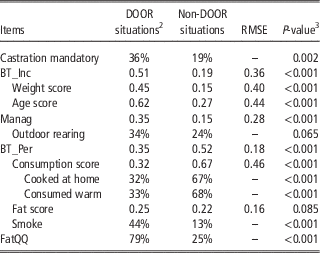
RMSE=root mean square error; BT_Inc=boar taint incidence score; Manag=management score; BT_Per=boar taint perception score; FatQQ=fat quantity and quality.
1 Average level for continuous variables ranging from 0 to 1; percentage of yes for discrete variables.
2 Situations extracted from the Database of Origin & Registration (DOOR) database (see Table 1).
3 ANOVA for continuous variables; χ 2 test for discrete variables.
Comparison between situations for which castration is mandatory and those for which it is not.
BT_Inc and Manag were higher in situations where castration is mandatory (Table 3) in line with higher weight and age at slaughter. BT_Per was lower because of the lower [Consumption score], despite less frequent use of smoke. FatQQ was much higher in the situations where castration is mandatory. In spite of the highly significant differences between situations where castration is mandatory and those where it is not, there was a substantial overlap of the distributions (Supplementary Figure S5): 22% of the situations where castration is not mandatory had a BT_Inc>0.5 and 12% had a Manag>0.5. Moreover, 49% of them were sensitive to FatQQ (Table 3).
Compared characteristicsFootnote 1 of the situations according to whether castration is mandatory
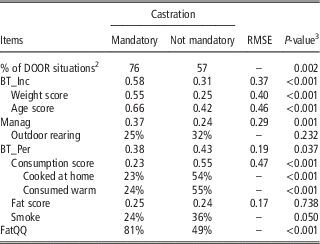
RMSE=root mean square error; BT_Inc=boar taint incidence score; Manag=management score; BT_Per=boar taint perception score; FatQQ=fat quantity and quality.
1 Average level for continuous variables ranging from 0 to 1; percentage of yes for discrete variables.
2 Situations extracted from the Database of Origin & Registration (DOOR) database (see Table 1).
3 ANOVA for continuous variables; χ 2 test for discrete variables.
Cluster analysis
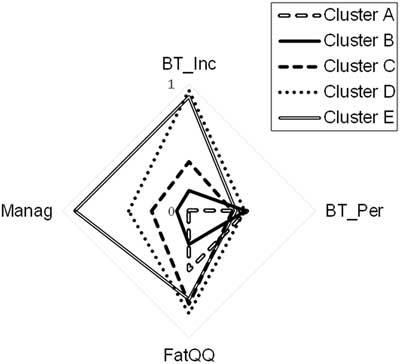
Five clusters were identified from the ascending hierarchical clustering. The profiles of the five clusters according to the four dimensions of potential sensitivity to entire male pig production are presented in Figure 2. BT_Per differed significantly between clusters (Table 4) but the numerical differences were quite low from 0.34 in cluster C to 0.46 in cluster A. Situations in cluster A exhibited very low BT_Inc (0.01) and Manag (0.00) and a moderate FatQQ (47%). They comprised 31% of fresh and 47% of dry products (Supplementary Figure S6). They were mostly found in Spain (24), Bulgaria (24), United Kingdom (8), Denmark (7) and Slovenia (7; Table 5).
Average scores obtained by the five clusters of situations along the four dimensions of potential sensitivity to entire male pig production (Boar taint incidence score (BT_Inc); Boar taint perception score (BT_Per); Fat quantity and quality (FatQQ); Management score (Manag)). The five clusters were determined by ascending hierarchical clustering following multiple correspondence analysis.
Compared characteristicsFootnote 1 of the situations in the five clusters identified from ascending hierarchical clustering

RMSE=root mean square error; BT_Inc=boar taint incidence score; Manag=management score; BT_Per=boar taint perception score; FatQQ=fat quantity and quality.
a,b,c,d.eValues within a row with different superscripts differ significantly at P<0.05.
1 Average level for continuous variables ranging from 0 to 1; percentage of yes for discrete variables.
2 Situations extracted from the Database of Origin & Registration (DOOR) database (see Table 1).
3 ANOVA for continuous variables; χ 2 test for discrete variables.
Distributions of the five clusters of situations in the countries included in the study

The clusters were determined by ascending hierarchical clustering following multiple correspondence analysis. zero values are omitted for legibility.
The profile of situations in cluster B was quite similar to that of cluster A with a slightly higher BT_Inc (0.16 v. 0.01) and Manag (0.10 v. 0.00) and a substantially lower FatQQ (26% v. 47%; Table 4), in line with the lower proportion of dry (26% v. 47%) and the higher proportion of fresh products (58% v. 31%; Supplementary Figure S6). They were mostly found in France (27) and Slovenia (6; Table 5). Situations in cluster C had moderate BT_Inc (0.39) and Manag (0.30), in line with the higher weight and age at slaughter and more frequent outdoor rearing, compared with clusters A and B (Table 4). FatQQ was high (73%), close to that found in clusters E and D. Cluster C comprised 73% of situations related with dry products (Supplementary Figure S6). Cluster C situations were mostly found in Portugal (30), France (9) and Poland (6; Table 5).
Situations in cluster E had very high BT_Inc (0.90) and Manag (0.90), as a result of very high age and weight scores and very frequent use of outdoor rearing (Table 4). FatQQ was also very high in line with the high proportion of dry products (Supplementary Figure S6). Cluster E was mostly represented in Portugal (12), France (11) and Spain (7; Table 5). The profile of situations in cluster D was quite similar to that of cluster E with a substantially lower Manag score (0.48 v. 0.90) because of the absence of outdoor rearing (0% v. 100%; Table 4). They also comprised a large majority of dry products (81%; Supplementary Figure S6). They were mostly found in Italy where they represented 38 out of the 41 analysed situations. Supplementary Figure S7 shows that the most problematic situations (clusters D and E) were mainly found in Portugal, France, Spain and Italy.
Discussion
Limitations to the evaluation of the dimensions of potential sensitivity to entire male pig production
The four dimensions of potential sensitivity to entire male pig production that were considered in this study cover most, but not all, of the potential problems associated with entire male pig production. The review by Lundström et al. (Reference Lunde, Egelandsdal, Choinski, Mielnik and Kubberød2009) pointed to other substantial meat quality issues such as higher incidence of dark, firm, dry meat, lower dressing percentage and less favourable joint proportions in entire male pigs compared with castrates; these parameters could not be taken into account with the information collected in this study. Newer studies also indicate issues with water holding capacity and meat toughness (Batorek et al., Reference Batorek, Škrlep, Prunier, Louveau, Noblet, Bonneau and Čandek-Potokar2012; Pauly et al., Reference Pauly, Luginbühl, Ampuero and Bee2012; Škrlep et al., Reference Škrlep, Batorek, Bonneau, Prevolnik, Kubale and Čandek-Potokar2012; Aluwé et al., Reference Aluwé, Langendries, Bekaert, Tuyttens, De Brabander, De Smet and Millet2013).
Genetic, nutritional and management factors that have a major influence on androstenone and skatole levels (Zamaratskaia and Squires, Reference Zamaratskaia and Squires2009) could not be taken into account with the limited information available in this study. Weight and age at slaughter have a limited role in accounting for boar taint compound levels in situations where their range of variation is limited (Walstra et al., Reference Walstra, Claudi-Magnussen, Chevillon, von Seth, Diestre, Matthews, Homer and Bonneau1999). These factors are expected to have a bigger influence in this study including many differentiated production systems where there are very large variations in age and weight at slaughter. The information on age and weight at slaughter was not precise and the coefficients applied to age and weight to calculate the BT-Inc score are somewhat arbitrary. Our approach only gives some insight on the likelihood of increased incidence of high levels of boar taint compounds compared with conventional production.
The same comments on age and weight apply to the calculation of the Manag dimension. The difficulties associated with the aggressive and mounting behaviour of entire males and unwanted pregnancy in females are likely to be exacerbated in outdoor conditions due to mixed sexes and prolonged fattening, but the doubling of the score is an arbitrary coefficient. Moreover, many other factors related to breed, feeding and management conditions (Bee et al., Reference Bee, Chevillon and Bonneau2015) that may also play an important role could not be taken into account with the limited information available in this study. Here also, our approach only gives some insight on the likelihood of aggravated management problems compared with conventional production of entire males.
The calculation of the BT_Per dimension in this study also has important limitations. [Consumption score] was only a rough approach of product temperature, which together with fat content is a critical factor governing boar taint perception (Lundström et al., Reference Lunde, Egelandsdal, Choinski, Mielnik and Kubberød2009). Among the possible masking ingredients (Lunde et al., Reference Lunde, Skuterud, Lindahl, Hersleth and Egelandsdal2008 and Reference Lundström, Matthews and Haugen2013; Martínez et al., Reference Martínez, Rubio, Viera, Linares, Egea, Panella-Riera and Garrido2016), smoke was the only one that could be considered in this study and information on the level and quality of smoke was not available. The relative importance given to the various components of the BT_Per dimension is somewhat arbitrary. Another important limitation is that many situations are related to more than one product and that only the one considered as the most sensitive to boar taint perception was taken into account. The BT_Per dimension only gives some insight on the likelihood that consumers can perceive boar taint compounds more or less easily.
A very simple approach was used to evaluate the FatQQ dimension by considering that all dry products, and only them, are potentially sensitive to entire male pig production because of the lower fat content and higher unsaturation of the lipids (Lundström et al., Reference Lunde, Egelandsdal, Choinski, Mielnik and Kubberød2009, Pauly et al., Reference Pauly, Luginbühl, Ampuero and Bee2012; Mörlein and Tholen, Reference Mörlein and Tholen2015). This is a simplistic way of evaluating the issue; not all dry products are sensitive in the same way, depending on the duration and conditions of maturation.
On the whole our calculation of the dimensions of potential sensitivity to BT-Inc, Manag, BT_Per and FatQQ is not precise enough for a reliable evaluation of individual situations. Our ambition in this study is limited to giving insight on the likelihood that non-conventional situations in general can be particularly sensitive to entire male pig production, whether DOOR situations or situations where castration is mandatory are potentially more sensitive, which are potentially the most sensitive situations and which sensitivity dimensions are the most affected.
Are DOOR situations potentially more sensitive to entire male pig production?
The rationale for raising this question is that it may be of interest for the EU to know the status of EU-protected situations, in comparison with other situations, relatively to the production of entire males. On average, DOOR situations were found to be potentially more sensitive to BT_Inc, Manag and FatQQ, and slightly less sensitive to BT_Per. A greater proportions of DOOR situations belonged to the most problematic clusters D and E (41% v. 11%) and 69 of the 80 situations in clusters D and E were DOOR situations. Yet one-third of the DOOR situations belonged to the potentially less problematic clusters A and B (Supplementary Figure S8).
Are situations where castration is not mandatory potentially less sensitive to entire male pig production?
Situations where castration is not formally specified as mandatory were, on average, potentially less sensitive to BT-Inc, Manag and FatQQ, although they were potentially more sensitive to BT_Per. There was, however, some overlap in the distributions, with 20% of the situations where castration is not mandatory belonging to the potentially most problematic clusters D and E (Supplementary Figure S9). It may be speculated that some of the specifications, particularly the old ones, were written down without the authors envisaging that the males could be left entire, so that they did not think of including castration in the specifications. Conversely, surgical castration was specified as mandatory in 24 situations belonging to clusters A and B where the potential sensitivity to entire male pig production was evaluated as low (Supplementary Figure S9).
There are different patterns of potential sensitivity to entire male pig production
The five clusters of situations defined by the ascending hierarchical clustering can be summarized in three main patterns of potential sensitivity to entire male pig production. Before examining them, it is important to remind that the BT_Inc and Manag dimensions were evaluated in comparison with conventional production, whereas the BT_Per and FatQQ dimensions were evaluated on an absolute basis. Because of the above-mentioned limitations to our approach, the small numerical differences observed for BT_Per cannot be considered as practically significant, even though statistical significance has been reached. BT_Per will therefore not be considered in the below discussion on patterns of situations.
A first pattern (clusters A and B) shows no increased potential risk regarding BT_Inc and Manag, compared with conventional production of entire males. The sensitivity to FatQQ is low to moderate and likely similar to that observed for conventional production systems using part of the meat for dry products (Supplementary Figure S7). This pattern includes 53 of the 170 DOOR situations and 75 of the 102 non-DOOR situations (Supplementary Figure S8). In the second pattern (cluster C) the situations have moderate potential sensitivity to BT_Inc and low potential sensitivity to Manag but the products are potentially highly sensitive to FatQQ (Supplementary Figure S7). Entire male pig production in these 48 DOOR situations and 16 non-DOOR situations could not be envisaged unless technically efficient and economically feasible solutions are found to compensate the lower fat content and higher unsaturation of fatty acids of meat from entire male pigs. The third pattern corresponds to clusters D and E which cumulate high scores for BT_Inc and FatQQ with moderate to high scores for Manag (Supplementary Figure S7). It seems quite difficult to envisage the production of entire male pigs for the 69 DOOR situations and 11 non-DOOR situations in this pattern.
As a conclusion, subject to further evaluation of individual situations with more accurate approaches using more precise and more comprehensive information, the use of entire males could be envisaged with no, or marginally higher risks than in conventional production of entire males in 128 (47%) of the 272 situations included in this study. Yet castration is specified as mandatory in 24 of them. It could also be envisaged provided that solutions are found to compensate the lower quantity and quality of fat in 64 (24%) of the situations. It must be reminded here that the production of entire male pigs in conventional production is not without difficulties. In the countries that recently developed entire male production (the Netherlands, Belgium, Germany and France), the presence of boar taint is checked on the slaughter line to avoid highly tainted carcasses from being used in sensitive products such as fresh meat and fresh processed products. The use of entire male pork for dry products is still problematic because of unresolved fat quantity and quality issues and increased proteolysis (Corral et al., Reference Corral, Salvador and Flores2016; Kaltnekar et al., Reference Kaltnekar, Škrlep, Batorek Lukač, Tomažin, Prevolnik Povše, Labussière, Demšar and Čandek-Potokar2016; Škrlep et al., Reference Škrlep, Čandek-Potokar, Batorek Lukač, Prevolnik Povše, Pugliese, Labussière and Flores2016). It seems difficult to envisage the use of entire males in the remaining 80 situations (30%) where this would likely result in the accumulation of many difficulties related to high incidence of boar taint, management problems and fat quality and quantity issues.
Acknowledgements
The authors acknowledge financial support from the project CASTRUM, commissioned by the EU DG Santé. The following people were members of the CASTRUM network and had a significant contribution to the present study: Christine Leeb, University of Natural Resources and Life Sciences, Austria; Evert Heyrman, ILVO, Belgium; Todor Stoyanchev, Trakia University, Bulgaria; Goran Kušec, Faculty of Agriculture in Osijek, Croatia; Susanne Støier, DMRI, Denmark; Patrick Chevillon, IFIP, France; Csaba Szabo, Debrecen University, Hungary; Luca Buttazzoni and Sebastiana Failla, CREA, Italy; Leonardo Nanni Costa, Department of Agricultural and Food Sciences, University of Bologna, Italy; Gé Backus, ConnectingAgriandFood, the Netherlands; Bente Fredriksen, Animalia, Norway; Katarzyna Skrzymowska, Polski Zwiazek Hdowcow i Producentow Trzody Chlewnej, POLSUS, Poland; Sandra Cavaco-Gonçalves, Instituto Nacional de Investigacão Agraria e Veterinaria, INIAV, Portugal; Mercedes Izquierdo, Centro de Investigaciones Científicas y Técnologicas de Extremadura, CICYTEX, Spain; Galia Zamaratskaïa, SLU, Sweden; Rex Walters, British Pig Association, BPA, United Kingdom. The authors acknowledge the financial support of the EU, COST action CA15215, which made possible to publish this paper as an Open Access publication. The co-author Maria Font i Furnols acknowledges CERCA Programme/Generalitat de Catalunya.
Supplementary material
To view supplementary material for this article, please visit https://doi.org/10.1017/S1751731117003044


 Open access

