

I. Introduction
Pythagoras and Empedocles, the Presocratic thinkers most closely associated with the doctrine of metempsychosis, are both known to have accounted for their own souls’ many previous existences. While both sets of lives are attested in very many texts from the classical era to Late Antiquity, their representation is relatively stable, not least in their privileging of enumerative modes: previous lives are listed or catalogued, and typically do not take the form of any grand récit. As such, they resemble our own curriculum uitae in bullet points; I shall therefore refer to this type of list of former lives as curriculum uitarum (CVV).
Such catalogues of multiple incarnations, by their very nature, are implicitly also catalogues of multiple deaths; they are thus related to the catalogues of the dead that we find in many literary depictions of the underworld. The CVV at the heart of this paper offers a vertical or collapsed version of such horizontal panoramas of past populations and folds different historical times not into the library-like space of the underworld but into a single, encyclopaedic soul.
At the heart of this paper lies the observation that the curricula of both Pythagoras and Empedocles engage with Homeric poetry. This engagement is not just in the interest of harnessing the authority of that first poet to underpin any claim to have lived many lives before, or to signal literary succession. Rather, there is an intense exegetical dialogue with Homeric poetry, in which Homeric oddities are exploited. I will proceed in three steps. First, I will discuss the many accounts, which typically take the form of a list, of the incarnations of Pythagoras (section II). Second, I will turn to Empedocles’ much-cited ‘epigram’ (B117 DK) on his former lives, or rather life forms, arguing that its enumerative logic, together with specific Homeric echoes, promotes the philosopher’s totalizing vision (section III). Against this backdrop, I will, thirdly, focus on the Iliad’s Trojan hero Euphorbus, the one incarnation that persists through all reformulations of Pythagoras’ curriculum, exploring the nexus of philosophical speculation and poetical exegesis that is likely to have inspired the appropriation of Euphorbus by Pythagoras and his followers (section IV). The concluding section (section V) will argue that it is the in-depth engagement with Homer and Homeric exegesis that forms a link between the Pythagorean and Empedoclean teachings on metempsychosis, and that both philosophers use Homer to shape innovative philosophical discourse and claim him as the first poet of metempsychosis.
II. Listing lives (Pythagoras)
There is no doubt that the immortality of the soul (ψυχή) and the interrelatedness of all ensouled beings (τὰ ἔμψυχα) were central tenets for Pythagoras and his followers.Footnote 1 Ιt is with good reason that the related idea of metempsychosis, that after death the soul would migrate from one body to another, has been called ‘the one most certain fact in the history of early Pythagoreanism’.Footnote 2 Dicaearchus, mediated by Porphyry in his Life of Pythagoras, confirms that this was also ‘especially well-known’ in antiquity, and this despite the usual caveat that the Pythagoreans were far from forthcoming with their beliefs (Dicaearchus, fr. 40 Mirhady ap. Porph. Vita Pythagorae 19):Footnote 3
When these things happened [sc. Pythagoras’ reception in Croton], fame grew great around him and he won over many followers from this city, not only men but even women, one of whom at least, Theano, made a famous name for herself, and also many from the neighbouring non-Greek territory, both kings and rulers. What he said to those with him, however, it is not possible for anyone to say exactly, for there was extraordinary silence among them. However, it was especially well-known by all (μάλιστα μέντοι γνώριμα παρὰ πᾶσιν ἐγένϵτο), first, that he said that the soul is immortal, then that it transmigrates into other kinds of animals (μϵταβάλλουσαν ϵἰς ἄλλα γένη ζῴων), and in addition that what happens happens again at some time according to certain cycles, that, in short, there is nothing new, and that it is necessary to believe that all ensouled beings are of the same kind (καὶ ὅτι πάντα τὰ γινόμϵνα ἔμψυχα ὁμογϵνῆ δϵῖ νομίζϵιν). For it appears that Pythagoras was the first to bring these teachings into Greece. (tr. Mirhady (Reference Mirhady2001), modified)
Dicaearchus and/or Porphyry leave no doubt that the Pythagoreans accepted that non-human life forms, too, are to be considered ‘ensouled’ and have a share in the transmigration of souls. Accordingly, one might expect such ‘trans-species migration’ to feature prominently in accounts of the former lives of Pythagoras himself. If one surveys the wide array of texts that tell of Pythagoras’ past lives, however, as we shall do presently, this turns out not to be the case. Many such accounts do not include non-human lives at all; in others, the migration of Pythagoras’ soul into other life forms marks an uneasy contrast with his human incarnations. Arguably, this corresponds to two different modes of enumeration and their respective affordances: Pythagoras’ former human lives invariably appear as a series of named individuals; their representation resembles genealogical catalogues, with the enumerative form suggesting specificity and precision. The depiction of Pythagoras’ non-human incarnations, by contrast, is usually limited to genera or species, with the enumerative form thus expressing a sense of generality and totality. The tension between these two modes informs much of the tradition of Pythagoras’ incarnations.
Already the earliest testimony for the Pythagorean doctrine of metempsychosis (and indeed the earliest testimony for Pythagorean doctrine tout court)Footnote 4 concerns the migration of a human soul into an animal body: Xenophanes seems to mock a Pythagoras who claims to recognize the soul of an old friend in a hapless puppy. While Xenophanes’ verses evidently do not talk about Pythagoras’ own soul but that of another, they are cited by Diogenes as pertaining to Pythagoras’ own previous lives (Xenophanes B7 DK ap. Diog. Laert. 8.36):Footnote 5
πϵρὶ δὲ τοῦ ἄλλοτ’ ἄλλον αὐτὸν γϵγϵνῆσθαι Ξϵνοφάνης ἐν ἐλϵγϵίᾳ προσμαρτυρϵῖ … ὃ δὲ πϵρὶ αὐτοῦ φησιν οὕτως ἔχϵι·
καί ποτέ μιν στυφϵλιζομένου σκύλακος παριόντα
φασὶν ἐποικτῖραι καὶ τόδϵ φάσθαι ἔπος·
“παῦσαι μηδὲ ῥάπιζ’, ἐπϵὶ ἦ φίλου ἀνέρος ἐστὶ
ψυχή, τὴν ἔγνων φθϵγξαμένης ἀΐων.”
Xenophanes confirms the statement about [Pythagoras] having been born as different beings at different times in an elegiac poem … What he says about him is as follows:
And once he passed by when a puppy was being beaten, / they say, and he took pity and said the following word: / ‘Stop! Don’t beat him, for this is the soul of a man dear to me / which I recognized when I heard it howling.’
For all their irony, Xenophanes’ verses offer important testimony for Pythagorean metempsychosis and the questions it raises: the fundamental tenet that the soul persists across its various incarnations is literalized, and comically undermined, both in the idea that Pythagoras can glean the puppy’s former identity from its (soul’s)Footnote 6 yelping and that he owes the dog the duties of friendship he had established with the man. The brief scene also gestures towards the educational and therapeutic role of the CVV in Pythagoras’ teachings: knowledge of one’s previous lives was considered conducive to, or indeed a prerequisite for, other forms of knowledge and understanding. Pythagoras is said to have told his audiences not only of his own former lives but equally of theirs.Footnote 7
The question of how one’s former lives relate to the present one, and of how their identity can be ascertained, also applies to Pythagoras himself: any list of his incarnations implicitly challenges us to ponder their similarities and differences and to speculate on the rationale behind his soul’s migration from one to the next. In modern scholarship, there have been extensive discussions on how Pythagoras’ former incarnations, in particular his former existence as/in Euphorbus and Aethalides, which are present across almost all permutations of his CVV, might relate to his life and teachings ‘as Pythagoras’, and the present article is no exception in offering its own explanation. Ancient authors, however, are remarkably reticent on the question of the ‘identity’ that cuts across all of Pythagoras’ lives. If anything, it is predominantly comical or satirical responses that address the problem, including the scathing attacks Pythagoras’ teachings later drew from Christian apologists.
The issues raised by Xenophanes’ verses, the soul’s migration across genera or species and the question of identity, are also present in the (now fully fledged) curriculum that Diogenes Laertius attributes to Heraclides of Pontus (fr. 89 Wehrli = 86 Schütrumpf ap. Diog. Laert. 8.4–5):
Heraclides of Pontus says that [Pythagoras] used to say the following about himself: that he had once been born as Aethalides and was considered to be Hermes’ son, and that Hermes had told him he might choose whatever he wanted except immortality; so he had asked to retain through life and through death a memory of his experiences. Hence in life he could recall everything, and when he died he would still preserve the same memory. Later in the course of time his soul entered into Euphorbus, and he was wounded by Menelaus. Now Euphorbus used to say that he had once been Aethalides and had obtained this gift from Hermes, and then he told of the wanderings of his soul, how it had migrated hither and thither, into how many plants and animals it had come (καὶ ϵἰς ὅσα φυτὰ καὶ ζῷα παρϵγένϵτο), and all that it had experienced in Hades and that the other souls there have to endure. After Euphorbus died, his soul migrated into Hermotimus … After Hermotimus died, he became Pyrrhus, a fisherman from Delos, and again he remembered everything, how he was first Aethalides, then Euphorbus, then Hermotimus and now Pyrrhus. But after Pyrrhus died, he became Pythagoras, and still remembered all of the aforementioned.
Heraclides’ account offers a remarkable degree of detail in a simple, straightforward manner; this puts into relief the tension between different enumerative modes. On the one hand, it is defined by its insistence on named individuals: in a form of concatenation resembling genealogical lists in epic, one name leads to the next.Footnote 8 The mention of Aethalides stands out as it prompts the brief narrative of how Hermes gave his son the power to ‘retain his memory through life and death’ (ζῶντα καὶ τϵλϵυτῶντα μνήμην ἔχϵιν). Aethalides’ story offers the aetiology of Pythagoras’ persistent memory and thus also embodies the mnemonic logic, cumulative and nursery-rhyme-like, that informs the CVV. At the same time, however, the account includes unspecified plants and animals (φυτὰ καὶ ζῷα) in a way that runs counter to the logic of the list of names (what animals had he been, what plants? and how many?). That Pythagoras is said to have told his followers ‘into how many (ϵἰς ὅσα) plants and animals his soul had come’ leaves open whether or not his own account would have offered more precision than is allowed for by Heraclides (or Diogenes).
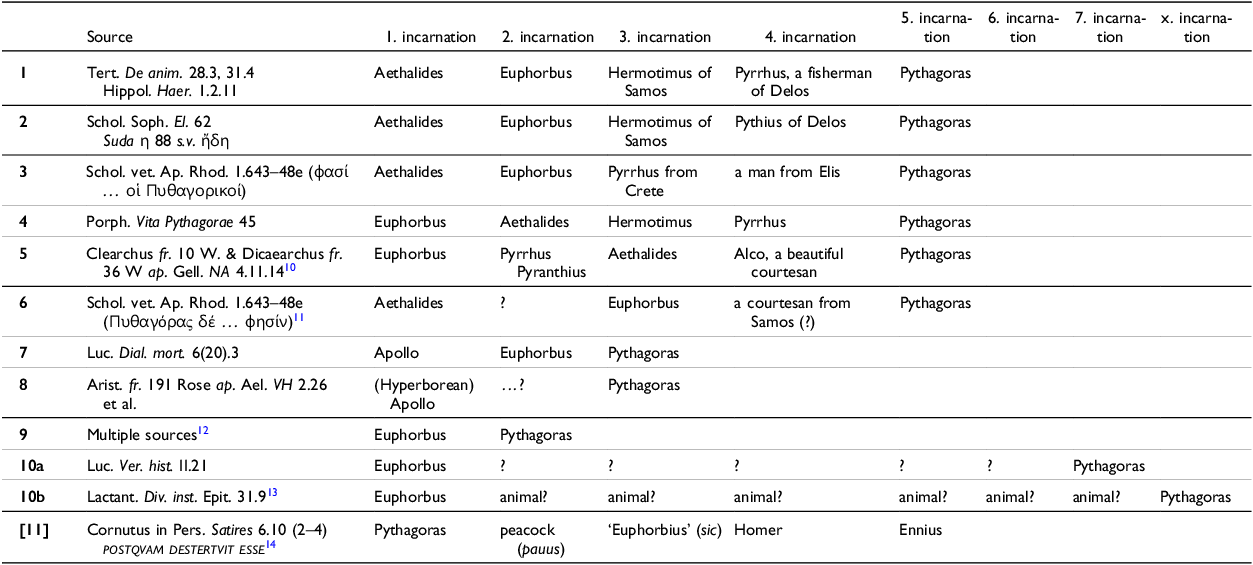
The same sequence of names recurs with some variation in many other sources (collated in table 1); strikingly, however, a number of these, including Tertullian’s De anima and the Refutation of All Heresies, which offer the exact same list of names as Heraclides, do not feature animals or plants at all.Footnote 9 There is a great disparity between the few texts that emphasize the large number and diversity of his former lives, and the majority of texts that are defined by an entirely anthropocentric, or rather androcentric, approach, limiting themselves to lists of named men.
Lists of Pythagoras’ lives
The absence of ‘cross-species’ metempsychosis seems at odds with the earliest sources for Pythagorean lore. We have already seen Xenophanes’ response to the Pythagorean doctrine of metempsychosis and the idea that it connects humans and animals. Similarly, cross-species metempsychosis is at issue in the notorious passage in Herodotus’ Histories which traces the Greek belief in the immortality and transmigration of the human soul to the Egyptians (2.123.2–3):
The Egyptians are in fact the first to have claimed that the human soul is immortal, and that it, upon the death of a body, always enters into another, newborn living being (ἐς ἄλλο ζῷον αἰϵὶ γινόμϵνον ἐσδύϵται); and after passing through all the creatures of the land and of the sea and the flying ones (ἐπϵὰν δὲ πάντα πϵριέλθῃ τὰ χϵρσαῖα καὶ τὰ θαλάσσια καὶ τὰ πϵτϵινά), it enters again into a newborn human body (αὖτις ἐς ἀνθρώπου σῶμα γινόμϵνον ἐσδύνϵι). It completes this cycle in three thousand years. There are Greeks, some earlier, some later, who made use of this doctrine as if it were their own; I know their names but will not write them down (τῶν ἐγὼ ϵἰδὼς τὰ οὐνόματα οὐ γράφω).
Much has been written about who might be the Greeks whose names Herodotus suppresses here, but Pythagoras, and presumably also Empedocles, can safely be placed among their ranks.Footnote 15 Given the role that lists of names play in Pythagorean lore, Herodotus’ tantalizing silence (‘I know their names but will not write them down’) may be especially pointed: his is a list under erasure.Footnote 16 Perhaps this reflects the difficulty of naming somebody who claims to have been, and to become, many others (see further below); moreover, Herodotus’ silence may also be an early instance of the avoidance of naming Pythagoras, as later became standard practice among Pythagoreans, who referred to their master simply as ὁ θϵῖος, αὐτός (cf. the formulaic αὐτὸς ἔφα, ‘he himself said it’), ἐκϵῖνος ὁ ἀνήρ vel sim. (Iambl. VP 88, 150).Footnote 17
In any case, Herodotus emphasizes that the soul is thought to migrate between different genera or species but there is no attempt at differentiating between individual lives; rather the claim that it passes ‘through all the creatures of the land and of the sea and the flying ones’ shares the totalizing generality we have observed in Heraclides’ treatment of the animals and plants among Pythagoras’ lives.
The exclusion of animals (and plants) in the majority of Pythagoras’ CVVs is also puzzling in the light of another locus classicus on metempsychosis: at the outset of the first book of De anima, Aristotle sweepingly criticizes all theories of the soul that precede his own and compares them to the ‘myths of the Pythagoreans’ which, in his eyes, are no doubt laughable (407b20):
But they [sc. previous thinkers in their theories about the soul] only try to say what kind of thing the soul is, without bothering to specify about the body which is to receive it, as if it were possible, as the Pythagoreans’ myths suggest, for just any soul to clothe itself in just any body (ὥσπϵρ ἐνδϵχόμϵνον κατὰ τοὺς Πυθαγορικοὺς μύθους τὴν τυχοῦσαν ψυχὴν ϵἰς τὸ τυχὸν ἐνδύϵσθαι σῶμα).Footnote 18 (tr. based on Burkert (Reference Burkert1972) 121)
As has been argued, Aristotle takes aim at the Pythagorean belief in the incarnation of the soul in non-human life forms and the interrelatedness of all ‘ensouled beings’.Footnote 19
In stark contrast, Pythagoras’ CVVs are surprisingly uniform, if not downright exclusionary, as we have already seen. This point did not go unnoticed in antiquity: it emerges with particular clarity from the writings of that unlikely advocate of diversity and equality, Tertullian. In his long and scathing refutation of Pythagorean doctrine in On the Soul he asks at one point (31.5 Waszink):
Iam nunc de tanto Graeciae censu quattuor solae animae recensentur. Sed et quid utique de solo Graeciae censu, ut non ex omni gente et ex omni aetate ac dignitate, ex omni denique sexu, et metempsychosis et metensomatosis cotidie existant…?
From the enormous number of souls in the Greek world only four are mentioned. But why only those from the census lists of Greece? Why isn’t there metempsychosis and metensomatosis on a daily basis from any nation, from any age or rank, and also from any gender…?
Tertullian’s account is obviously tendentious, if not misleading: when he speaks of ‘four souls’ he must mean Aethalides, Euphorbus, the fisherman Pyrrhus and Hermotimus, whom he has listed as Pythagoras’ incarnations in an earlier passage (28.3; cf. table 1, variant 1), but their bodies are thought to have successively housed one soul, not ‘four’; similarly, Tertullian ignores the fact that not all four incarnations are Greek (Euphorbus is a Trojan) nor from a particular ‘rank’ (Pyrrhus is a fisherman). All these inaccuracies notwithstanding, Tertullian has a point: the list is not particularly diverse or cosmopolitan, and it does not feature a single woman.
The inclusion of female incarnations in some versions of the CVV is the exception that proves the rule. Gellius notes that Dicaearchus and Clearchus included the ‘beautiful courtesan Alco’ in their lists of Pythagoras’ previous incarnations (table 1, variant 5).Footnote 20 This is, usually, explained as an ad hoc invention on part of the Peripatetics to pour scorn on Pythagoras.Footnote 21 But again the joke (if a joke it was)Footnote 22 may point to something important: it stands to reason that Pythagorean metempsychosis was originally more gender-fluid than later sources cared to acknowledge. The well-documented inclusion of females in Pythagorean circles would certainly lead us to expect consideration of both sexes.Footnote 23 Not only is there no discernible reason why the same soul could not migrate into male and female bodies at different times, but female incarnation would necessarily come into play in the teaching of female pupils whose souls, at least in their most recent reincarnation, had entered a female body. That women were routinely introduced to metempsychosis, and told of their former lives in the process, is highly likely given the propaedeutic character ascribed to the students’ recognition of their former lives (see Iambl. VP 63, quoted in section V) and the general fact that, as Catherine Rowett puts it, ‘Pythagoras did not just teach women to be faithful wives, but made them part of his intellectual project.’Footnote 24
While we have so far seen that lists of Pythagoras’ lives are often characterized by the tension between two enumerative modes (the precision and differentiation afforded by a list of individual names and the totalizing generality of a list of life forms), it is important to note that these are not necessarily distinct forms but rather the opposite ends on a continuum of enumerative practice. For all its seeming definitiveness, the catalogue of names is fundamentally open, as is many a form of enumeration: on the one hand, it is always possible to interpolate other lives; on the other, the accounts end with Pythagoras as their telos, and thus blatantly undermine the idea of the cycle of incarnations. Has he been reborn since? Where, and who, might he be now?
Lucian’s Dream, or the Rooster shamelessly exploits these tensions as he projects the curriculum into a post-Pythagorean future, all the while playing up ideas of cross-gender and cross-species metempsychosis: Pythagoras is no longer the telos, but no more than one of very many predecessors of the speaking rooster. The rooster bookends his account, which is interrupted multiple times by his interlocutor, the cobbler Micyllus, with Unsagbarkeitstopoi familiar from catalogic poetry. He refuses to relate how his soul initially left Apollo to enter a human body, as that ‘would make a long story’ (μακρὸν ἂν ϵἴη λέγϵιν) and only offers to tell of his lives starting from Euphorbus (Gallus 16), before he launches into an increasingly breathless list that leads up to the non-telos of repeated, and repeatable, incarnations in the form of a rooster (Gallus 20):Footnote 25
[T]hen [I was] a king, then a poor man, and soon a satrap; then a horse, a jackdaw, a frog, and a thousand things besides (καὶ ἄλλα μυρία); it would take too long to enumerate them all (μακρὸν ἂν γένοιτο καταριθμήσασθαι ἕκαστα). But of late I have often (πολλάκις) been a rooster, for I liked that sort of life.
Even the rooster himself acknowledges that he is not the end-point in any emphatic sense, and ultimately negates the possibility, or validity, of a comprehensive account. Consequently, the rooster places little value on named individuals and only includes some of the figures that feature in other CVVs while omitting others: he begins with the familiar Euphorbus–Pythagoras sequence but mentions no lives between these two. The first post-Pythagorean incarnation which Lucian’s rooster reports is the Milesian courtesan Aspasia, much to Micyllus’ astonishment: Lucian here appears to draw on the comic potential of the tradition that goes back to Dicaearchus or Clearchus (see above).Footnote 26 The mention of Aspasia allows him to launch into an excursus on female life in general; indeed, the rooster claims that incarnation into females is a matter of course and tells the sceptical Micyllus that he too ‘will be a woman again and again (πολλάκις) in the long cycle’ of his existences (Luc. Gallus 19).
Ultimately, however, Lucian’s rooster dismisses the relevance of his former names altogether by insisting that what counts is their fundamental identity: ‘It will make no difference whether you call me Euphorbus or Pythagoras, Aspasia or Crates; I am all of them (πάντα γὰρ ἐγὼ ταῦτά ϵἰμι)’ (Gallus 20).Footnote 27 It is thus once more a satirical text that alerts us to fault-lines and oddities in the ‘standard’ accounts. Not only does the rooster gleefully inject the diversity back into Pythagoras’ CVV that is so obviously lacking elsewhere but he also alerts us to its fundamental openness and malleability.
III. Listing life forms, lasting fame (Empedocles)
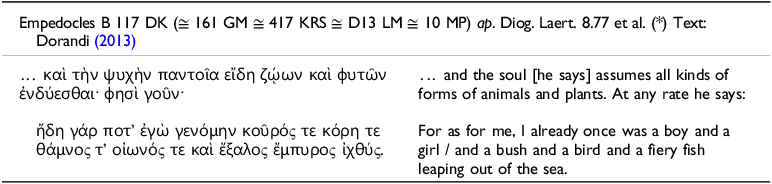
The case of Empedocles is quite different. Accounts of Pythagoras’ former lives, as we have seen, are dominated by lists of names which seem, at least at first glance, predicated on specificity and precision. The idea of the sage’s incarnation in plants and animals, however, has only been accommodated in some of the many attestations of his CVV, typically in the form of a list of life forms that we have seen to be at odds with the logic of the list of names. For Empedocles, no such catalogue of names exists. Instead, his curriculum is defined exclusively by a list of life forms: it finds expression in two hexameters which have been cited throughout antiquity and beyond so frequently that they have taken on a life, or rather lives, of their own as an epigram of sorts (B117 DK):Footnote 28
ἤδη γάρ ποτ’ ἐγὼ γϵνόμην κοῦρός τϵ κόρη τϵ
θάμνος τ’ οἰωνός τϵ καὶ ἔξαλος ἔμπυρος ἰχθύς.
For as for me, I already once was a boy and a girl
and a bush and a bird and a fiery fish leaping out of the sea.
Empedocles, whose name designates ‘persisting fame’, here emphasizes a maximum of dynamism and change.Footnote 29 Names are absent from the list of incarnations; instead, the two lines consist almost exclusively of generic terms. Their arrangement in the list, which at first seems defined by static binaries, is itself subject to change and progressive revision: at first, two pairs of opposing terms imply the presence of different sexes (boy, girl), neatly expressed with two forms of the same noun, and then of different species: the generic terms ‘bush’ and ‘bird’ serve as synecdoche for the entirety of plant and animal life, so that at this point κοῦρός τϵ κόρη τϵ can be understood as designating human life in opposition to non-human life forms.Footnote 30 With the fifth element, however, the fish, this new binary gives way to the traditional tripartite order of all beings: on the earth (boy, girl, bush), in the air (bird) and in the sea (fish). In the space of two hexameters, ‘Empedocles’ thus lays claim to the totality of life. He speaks with the authority of one who has embodied ‘all possible life forms’: παντοῖα … ϵἴδϵα θνητῶν, as it is put elsewhere (B115.7 DK).Footnote 31
The ‘fifth element’, however, stands out for another reason: while the preceding four elements in the list appear unadorned, the fish alone is afforded two epithets, ἔξαλος and ἔμπυρος. Not only do these contribute a sense that the last element is of special importance, but they shed further light on the entire list. To be sure, the text of B117 is far from stable across its many citations, and there is a great deal of variation in the transmission of the fish’s epithets, in particular the second of the two (cf. the apparatus in table 2). All transmitted variants, however, make sense of a kind, and perhaps we had best acknowledge the originality of the ‘epigram’ in the very proliferation of readings it has spawned. The ἔμπορος (‘trading’ or ‘voyaging’) fish, for example, resonates with visions of Empedocles the wandering philosopher-poet and the long-wandering daimones he preaches about. ἔμπυρος,Footnote 32 on the other hand, adds to water, earth and air (which are all metonymically represented in the other life forms listed) the fourth root of Empedoclean cosmology, fire.
The transmission of Empedocles’ ‘epigram’
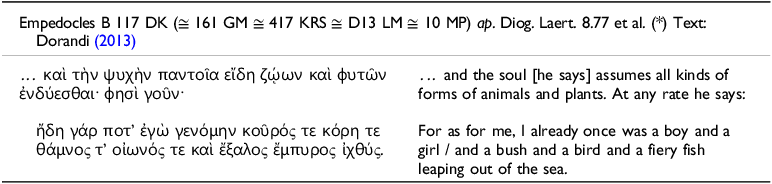
(*) With some variations the lines are also quoted in Clem. Al. Strom. 6.24.3; Ath. 8.365e; Hippol. Haer. 1.3.2–3; Them. in Arist. De an. 35.13; Philoponus in Arist. De an. 140.7; Sophon in Arist. De an. 24.39; Eust. Od. 18.79; Olympiodorus in Pl. Phd. 58.17; Anth. Pal. 9.569.1–2; Cyril. Adv. Iul. 872C; Chalcid. In Tim. 197 // first line: Philostr. V A 1.1.3; Suda ϵ 1003 s.v. Ἐμπϵδοκλῆς, π 3121 s.v. Πυθαγόρας // second line: Procl. In R. II.333.8; cf. further, for example, Tert. De anim. 31 [cf. section III, n.34].
Main variants: ἤτοι μὲν γὰρ (Hippol.) for ἤδη γάρ ποτ’ | ϵἰν ἁλὶ (Clem. Al.) or ἐξ ἁλὸς (Hippol., Eust.) for ἔξαλος | ἔλλοπος (‘mute’ or ‘scaly’; Clem. Al.; Ath.), ἔμπορος (‘travelling’; Hippol., Ath.), ἔμπνοος (‘alive’, Eust.), ϕαίδιμος (‘radiant’ or ‘glorious’, Cyril.) for ἔμπυρος
The first of the two epithets, by contrast, is relatively stable across the many attestations of the two lines: ἔξαλος, ‘leaping out of the sea’.Footnote 33 The adjective both reinforces and undermines the idea that the list represents the four elements: the fish is assigned to the element of water but it leaves it behind, its movement emblematic of the idea of transformation. It is perhaps futile to ask whither the fish is headed: into the air? onto the earth? … or into Aetna, as Empedocles himself eventually would be headed, according to the biographical tradition? In his blistering critique, Tertullian indeed conflates, perhaps rightly, the ‘epigram’ with the bios tradition of the man himself, suggesting that the fish leapt into the volcano ‘so that the whole business of metensomatosis came to an end like a summer feast with the barbecue’.Footnote 34 Be that as it may, what matters is that the last element of Empedocles’ CVV itself encapsulates the dynamic change and diversity that drive the entire list and thus corresponds to the all-encompassing ἐγώ at its beginning.
While Empedocles’ list is certainly an extraordinary text in the Greek literary tradition, its focus on incarnation into different species resembles accounts of multiple metamorphosis. First and foremost, the Homeric ‘old man of the sea’, Proteus, can be seen as a model for Empedocles’ CVV: both Eidothea’s warning about her father’s shape-shifting and Menelaus’ report of how his encounter with Proteus unfolded hinge on similarly breathless lists of animals and elements into which the sea-god could, and indeed did, turn:
πάντα δὲ γιγνόμϵνος πϵιρήσϵται, ὅσσ’ ἐπὶ γαῖαν
ἑρπϵτὰ γίγνονται, καὶ ὕδωρ καὶ θϵσπιδαὲς πῦρ.
For try [to escape] he will, and will assume all shapes of all things that move upon the earth, and of water, and of wondrous blazing fire. (Od. 4.417–18)Footnote 35
… οὐδ’ ὁ γέρων δολίης ἐπϵλήθϵτο τέχνης,
ἀλλ’ ἦ τοι πρώτιστα λέων γένϵτ’ ἠυγένϵιος,
αὐτὰρ ἔπϵιτα δράκων καὶ πάρδαλις ἠδὲ μέγας σῦς·
γίγνϵτο δ’ ὑγρὸν ὕδωρ καὶ δένδρϵον ὑψιπέτηλον.
… nor did that old man forget his crafty wiles, but first he turned into a bearded lion, and then into a serpent, and a leopard, and a huge boar; then he turned into flowing water, and into a tree, high and leafy. (Od. 4.455–58)
Arguably, these Homeric lists of the forms assumed by Proteus read like a CVV in ‘fast forward’. While neither metamorphosis nor shape-shifting can be equated with metempsychosis, a conceptual overlap between them is indisputable; the place Ovid assigns to Pythagoras (and, implicitly, Empedocles)Footnote 36 and the doctrine of metempsychosis in the last book of his Metamorphoses is only the most eye-catching example of an ancient text that draws attention to this overlap. More relevant to the concerns of the present paper is Philostratus, who in his Life of Apollonius of Tyana not only puts significant weight on the indebtedness of his hero to Pythagoras’ doctrine of reincarnation (1.1–2), but also quotes the first line of Empedocles’ ‘epigram’ in the opening chapter (1.1.3) and prefaces the Life with the story of Proteus appearing to Apollonius’ mother to announce that her son will be none other than he, Proteus, himself (1.4).Footnote 37
The connections between Homer’s Proteus and Empedocles’ couplet on his previous lives go deeper still. The Homeric lines on Proteus and Eidothea attracted significant attention from ancient exegetes, and it was variously suggested that the particular life forms Proteus assumes, like those in B117, represent the four elements, and that the story of Eidothea and Proteus offers a cosmogony in an allegorical mode. Pseudo-Heraclitus in his Homeric Problems 64–67 notes that Homer lays out ‘the primordial origin of the universe, whence the whole system on which we now look has its roots’ (65) and this line of interpretation has left traces elsewhere.Footnote 38 Particularly intriguing is the case of Sextus Empiricus, who in Against the Physicists 1.4 even suggests that Empedocles, like Anaxagoras and others, followed Homer in adopting the cosmological teachings allegorized in the story of Proteus.Footnote 39
This closeness to the Odyssean Proteus, however, is only one aspect of Homer’s presence in the Empedoclean lines. There is also a clear-cut intertextual link with the Iliad. While Empedocles’ dependence on, and creative subversion of, the diction and ethos of Homeric epic has received ample treatment,Footnote 40 an Iliadic echo in the famous ‘epigram’ has escaped scholarly attention. The four-word sequence at the beginning of the two lines, ἤδη γάρ ποτ’ ἐγώ (all the more noticeable once the verses circulated as a stand-alone couplet), is attested only once in the entire corpus of early Greek epic: in Nestor’s famous first speech in the Iliad, where he puts Agamemnon and Achilles in their place (1.254–84). Nestor, whose old age and rich experience are emphasized (he ‘had already seen two generations pass away, who long ago were born and reared with him in sacred Pylos’ and was now ‘king among the third’),Footnote 41 tells them of past men far better than them who had heeded his advice (Il. 1.259–63):
ἀλλὰ πίθϵσθ’· ἄμφω δὲ νϵωτέρω ἐστὸν ἐμϵῖο.
ἤδη γάρ ποτ’ ἐγὼ καὶ ἀρϵίοσιν ἠέ πϵρ ὑμῖν
ἀνδράσιν ὡμίλησα, καὶ οὔ ποτέ μ’ οἵ γ’ ἀθέριζον.
οὐ γάρ πω τοίους ἴδον ἀνέρας οὐδὲ ἴδωμαι,
οἷον Πϵιρίθοόν τϵ Δρύαντά τϵ, ποιμένα λαῶν…
But listen to me; you are both younger than I. For as for me, I once joined with warriors who are better men than you, and never did they make light of me. Such warriors have I never since seen, or shall see, as Peirithous was, and Dryas, shepherd of the people…
The authority of Empedocles’ voice, then, is constructed in dialogue with Nestor’s. Nestor is the only human character in the Iliad to adduce his own past as an exemplum for others,Footnote 42 and this emphatic turn to his own life (and his experience of the past lives of others) is marked in his speech by ἤδη γάρ ποτ’ ἐγώ. This explains why Empedocles, whose invocation of past lives has been described as a claim to a ‘surpassingly rich repertoire of experiences’ and thus ‘epistemic authority’,Footnote 43 chose to evoke in his autobiographical ‘epigram’ a pivotal line from Nestor’s first speech in the Iliad.Footnote 44
Just as Nestor’s didactic credentials rest on his experience of generations of men, so do Empedocles’ on his former lives and the experiences he has had across them all. A similarly Nestorian configuration of authority appears in Empedocles’ praise of ‘the man’ who was ‘knowledgeable beyond measure’ (ἀνὴρ πϵριώσια ϵἰδώς, B129.1 DK).Footnote 45 Whether or not Empedocles here pays homage to Pythagoras, as many ancient and modern authorities have it,Footnote 46 his praise again centres on the superlative accumulation of ‘life experiences’. While Nestor derives his authority from his acquaintance with two or three generations of men, ‘the man’ of B129 can boast knowledge acquired ‘in ten lives of men, and in twenty’ (καί τϵ δέκ’ ἀνθρώπων καί τ’ ϵἴκοσιν αἰώνϵσσιν, B129.6). Even if the connection with metempsychosis is not spelt out, it is highly plausible that authority based on such remarkably far-reaching experience relates to,Footnote 47 or rather flows from, the very idea of the CVV. Arguably, Empedocles thus makes explicit the epistemological claims already inherent in the list of Pythagoras’ lives.Footnote 48
IV. Lamenting death (Homer)
The in-depth engagement with Homeric epic and its exegesis which we have seen in Empedocles’ list in fact unites the Empedoclean and Pythagorean CVVs. If we return to the Pythagorean CVV, we find that across its many variations two lives persist (cf. table 1): first, the Trojan hero Euphorbus, who always appears as a previous incarnation of Pythagoras; and second, the Argonaut Aethalides, who appears in the first slot in several accounts (table 1, variants 1, 2, 3, 6). Through both figures, Pythagoras’ former lives are grounded in the world of heroic epic and, as we shall see, in Homeric poetry in particular.
To start with Aethalides, his presence underscores Pythagoras’ quasi-divine credentials. Always closely related to Apollo, and indeed seen as Apollo incarnate by his followers (Diog. Laert. 8.11),Footnote 49 Pythagoras-as-Aethalides boasts another Olympian connection: Hermes, whose roles as psuchopompos and divine messenger are immediately relevant to Pythagoras’ beliefs and teachings. As we have already seen, the hero Aethalides, who has impeccable epic credentials as an Argonaut, is famous for his superlative mnemonic faculties (see above, section II). His memory, which itself seems to be mirrored in Pythagoras’ descent from one Mnesarchos or Mnesarchides (‘he who remembers his origin’),Footnote 50 doubles as a foundational myth of Pythagorean metempsychosis. Apollonius of Rhodes spells out Aethalides’ relevance in a way that irreducibly combines both aspects (1.640–49):Footnote 51
But in the meantime, the heroes had sent Aethalides forth from the ship, the swift herald to whose care they entrusted their messages and the sceptre of Hermes, his father, who had granted him an imperishable remembrance of all things (ὅς οἱ μνῆστιν πόρϵ πάντων | ἄφθιτον). And not even now, after his departure to the unspeakable eddies of Acheron, has forgetfulness come over his soul, but it is destined to change abodes endlessly, sometimes being numbered among those beneath the earth, at other times in the sunlight among living men. But what need have I to tell at length stories about Aethalides?
The herald of the Argonauts has been invested with ‘an imperishable remembrance of all things’ (643–44), a universal memory which not only withstands the oblivion of the underworld but also intersects with the commemorative power of epic poetry itself to convey κλέος ἄφθιτον.Footnote 52 Apollonius puts the relation between Aethalides’ memory and that of the epic genre to the test when he juxtaposes Aethalides’ extraordinary mnemonic faculties with his own ostentatious refusal to linger on it: ἀλλὰ τί μύθους | Αἰθαλίδϵω χρϵιώ μϵ διηνϵκέως ἀγορϵύϵιν; (648–49). Rather like Herodotus’ marked silence (above, section II), it offers another potential list that is not realized. Does Apollonius gesture towards the Pythagorean tradition that Aethalides had not ‘departed to the eddies of Acheron’ for good? Scholiasts on the passage were certainly quick to supply the CVV Apollonius refuses to recount.Footnote 53 At the same time, Apollonius’ use of the word διηνϵκέως (a key term in Hellenistic debates on epic poetry)Footnote 54 suggests that he avoids a retelling of the ‘myths on Aethalides’ lest it turn into the kind of lengthy narrative that could exhaust the possibilities of epic itself.
Homer’s presence in the list of Pythagoras’ lives seems more straightforward, at least at first. It hinges on the inclusion of the Iliadic warrior Euphorbus among the sage’s early incarnations. But why Euphorbus? The Trojan is not exactly a big hitter among the cast of the Iliad.Footnote 55 Rather, he is a minor hero who gets mixed up in a major scene: he first appears, out of the blue, at the end of Iliad 16, where he wounds Patroclus, retrieves his spear and vanishes into the crowd, before Hector appears and finishes the job. Euphorbus re-emerges at the beginning of book 17, provokes Menelaus, and is dispatched with one throw of his spear.Footnote 56
The paradox that Euphorbus would go on to have such a rich afterlife, or rather afterlives, after this short-lived appearance in the Iliad has puzzled scholars of Pythagoreanism.Footnote 57 At the same time, Euphorbus has also puzzled scholars of Homer (who typically tend to ignore his later Pythagorean credentials): why does a nobody such as Euphorbus appear at the crucial junction of the narrative that is the killing of Patroclus? Despite the firewall that seems to separate them, both sets of scholars draw on similar arguments in their attempts to answer their respective questions.
Homerists have explained the strangely short-lived and self-effacing appearance of Euphorbus in two main ways. On the one hand, scholars have argued, following in the footsteps of various ancient scholiasts, that Euphorbus was inserted into the narrative with the sole function of undermining Hector’s achievement: Hector’s role in the killing of Patroclus is marginalized as he is preceded by another.Footnote 58 On the other hand, Euphorbus has been read as a doublet of other Iliadic characters. Particularly influential was the theory of Hugo Mühlestein that Euphorbus is an ad hoc invention modelled on Paris to assimilate Patroclus’ death to the death of Achilles as it is related in the Aethiopis.Footnote 59 On Roberto Nickel’s reading, in turn, Euphorbus serves as a doublet emphatically not of Paris but of Achilles.Footnote 60 I only note in passing the remarkable fact that the idea of Euphorbus as a hero who has a share in, or is composed of, the roles of several others has emerged in discussions entirely unconcerned with Pythagorean lore.
Among ‘Pythagoreanists’, by contrast, the debate has focused on the semantics of the name Euphorbus and the possible Apolline associations of his parents. Interpreting the name as ‘he who eats the right food’, or ‘he who is well-fed’, some have argued that Euphorbus was seen to embody Pythagoras’ notorious association with dietary taboos.Footnote 61 Others have understood Euphorbus to be the one ‘who feeds well’ or ‘who provides good pasture’, and argued that such a shepherd’s name resonates with the care with which Pythagoras guided his followers.Footnote 62 As for Euphorbus’ possible Apolline associations, scholars referred in the first instance to his father Panthous, a priest of Apollo,Footnote 63 and his mother Phrontis,Footnote 64 whose name smacks of Apolline ‘power of thought’.Footnote 65
Against this backdrop, Karl Kerényi suggested that the importance Pythagoras and the Pythagoreans attributed to Euphorbus was indeed to do with his Apolline credentials, but that these may have their roots in Homeric exegesis rather than in Homer. According to this suggestion, which was taken up by Walter Burkert, the identification was prompted by a puzzling moment in the dying words of Patroclus (Il. 16.849–50):
ἀλλά μϵ μοῖρ’ ὀλοὴ καὶ Λητοῦς ἔκτανϵν υἱός,
ἀνδρῶν δ’εὔφορβος·σὺ δέ μϵ τρίτος ἐξϵναρίζϵις.
It was destructive Moira and the son of Leto who slew me,
and of men Euphorbus, while you are the third in my slaying.
In his final taunt, Patroclus gets the numbers wrong. Or does he? To ancient critics, this would not seem likely, given the age-old belief that the souls of those about to die have prophetic abilities.Footnote 66 The scholia show that the problem of these numbers that do not add up (‘one, two, three and thirdly’) was widely discussed.Footnote 67 While some ancient scholars suggested that Moira and Apollo count as one, Kerényi and Burkert argued that in a Pythagorean reading of the passage, the Homeric zētēma could be solved by identifying, not just associating, Euphorbus with the god Apollo.Footnote 68
Such interaction between philosophical doctrine and poetic exegesis is hardly singular. In fact, another scholion on the death of Patroclus shows that the traffic goes both ways. When Patroclus’ soul flees his body ‘bewailing its own fate, leaving behind its manliness and youth’ (ὃν πότμον γοόωσα, λιποῦσ’ ἀνδροτῆτα καὶ ἥβην, Il. 16.857) a scholiast notes, and then quickly dismisses, a Pythagorean interpretation (Schol. Hom. Il. 16.857a2 b(BE3) Erbse):Footnote 69
λυπϵῖται ἡ ψυχή, μή ποτϵ ἀνάξια πράξασα ἑαυτῆς †ἀναξίως† πϵριπέσῃ καὶ ὅτι σῶμα ἐᾷ ἀκμάζον. ὁ δὲ Πυθαγόρας κακῶς φησιν ὅτι ἡ ψυχὴ μϵτὰ τὸ ἐξϵλθϵῖν ϵἰς φυτά τινα καὶ σώματα καὶ θάμνους μϵταβάλλϵται, b(BCE3) ὅθϵν καὶ λϵλύπηται. πρὸς ἀρϵτὴν δὲ μᾶλλον ὁ ποιητὴς συγκαλϵῖ, μή ποτϵ κακὰ διαπραξάμϵνοι τοῖς αὐτοῖς πϵριπέσωμϵν.
The soul is distressed lest, having done things which are unworthy of itself, it falls †unworthily† and because it is leaving a body in its prime. Pythagoras wrongly says that, after departure, the soul is transformed into plants or bodies or bushes, and it is for this reason that it is distressed. Rather, the poet urges us to virtue, lest by once having acted evilly we chance upon the same.
The soul, in this interpretation, is not distressed by the fact that it is separated from the body, but rather at the prospect of its later, potentially undignified, embodiment in ‘some plants, bodies, or bushes’ (note the Empedoclean θάμνοι here!).Footnote 70 Such an interpretation, in fact, may also lie behind the story of the howling puppy in Xenophanes (see section II): emphatically attributed to the soul in the puppy, rather than the puppy itself, the wailing may betray distress at the fact of the soul’s canine incarnation rather than the puppy’s momentary maltreatment. In any case, we witness here how the Homeric personification of the ψυχή, particularly in death scenes, is susceptible to Pythagorean interpretation.
But more can be said about Euphorbus and Apollo in the Iliad. Patroclus’ last moments in battle are particularly instructive (16.787–817). He is on a killing spree when first Apollo and then Euphorbus intervene. Both act, quite literally, in a strikingly similar way: the god ‘stands behind’ Patroclus (στῆ δ’ ὄπιθϵν, 791), strikes his back (μϵτάφρϵνον) and shoulders (ὤμω), that is he strikes him between the shoulders,Footnote 71 with the flat of his hand, and hurls the helmet from Patroclus’ head. Apollo then vanishes from the text without another word when ‘a Dardanian’ sneaks up ‘from behind’ (ὄπιθϵν, 806), strikes Patroclus with his spear on ‘the back’ (μϵτάφρϵνον, 806) ‘between the shoulders’ (ὤμων μϵσσηγύς, 807). The man, Euphorbus, is introduced with a pompous string of epithets (808–11) but vanishes almost as quickly as the god before him; he retrieves his spear and is gone (814–15).
The similar behaviour of god and man is perhaps most conspicuous in the parallelism of the verse-ends βάλϵ Φοῖβος Ἀπόλλων (793) and βάλϵ Δάρδανος ἀνήρ (807). This is all the more remarkable as it results in the unique and slightly oxymoronic junctura σχϵδόθϵν βάλϵ (807): βάλλϵιν, βαλϵῖν typically denotes fighting from a distance (you cannot throw a spear at someone from close up).Footnote 72 Euphorbus’ agency is completely effaced when Patroclus retreats, ‘overcome by the blow of the god and by the spear’: θϵοῦ πληγῇ καὶ δουρί (816) suggests that the spear, too, is Apollo’s.
We are but a step here from the idea that Euphorbus is a doppelgänger of Apollo. The two figures act in very similar ways in battle, and never appear together but in immediate succession; this holds true in the continuation of the story in Iliad 17, where Apollo re-emerges on the scene just after Euphorbus’ death and exhorts Hector to protect the body (71–81). Apollo’s choice of words is peculiar: he calls Euphorbus Τρώων τὸν ἄριστον (80). We have here nothing less than the only instance in the entire Iliad where an individual warrior is referred to, in the singular, as ‘best of the Trojans’. This is an exceptional seal of Apolline approval.Footnote 73
But let us look more closely at Euphorbus’ Pythagorean credentials. For one, he does not obviously kill anyone. He pushes 20 off their horses (16.810) and wounds Patroclus but emphatically does not kill him (οὐδὲ δάμασσ’, 813); he does ‘not await Patroclus’, even though he is ‘naked’, that is stripped of his armour (οὐδ᾿ ὑπέμϵινϵ | Πάτροκλον γυμνόν πϵρ ἐόντ, 814–15); in his second and final appearance, Euphorbus asks Menelaus to step aside lest he hit and kill him (17.13–17). Is it the withholding of lethal force here that makes Euphorbus a likely predecessor of Pythagoras, who famously abhorred slaughter?Footnote 74
The most important scene, however, is that of Euphorbus’ death. It creates a tender and touching moment in the midst of fierce battle (Il. 17.51–60):
αἵματί οἱ δϵύοντο κόμαι Χαρίτϵσσιν ὁμοῖαι
πλοχμοί θ’, οἳ χρυσῷ τϵ καὶ ἀργύρῳ ἐσφήκωντο.
οἷον δὲ τρέφϵι ἔρνος ἀνὴρ ἐριθηλὲς ἐλαίης
χώρῳ ἐν οἰοπόλῳ, ὅθ’ ἅλις ἀναβέβροχϵν ὕδωρ,
καλὸν τηλϵθάον· τὸ δέ τϵ πνοιαὶ δονέουσι
παντοίων ἀνέμων, καί τϵ βρύϵι ἄνθϵϊ λϵυκῷ·
ἐλθὼν δ’ ἐξαπίνης ἄνϵμος σὺν λαίλαπι πολλῇ
βόθρου τ’ ἐξέστρϵψϵ καὶ ἐξϵτάνυσσ’ ἐπὶ γαίῃ·
τοῖον Πάνθου υἱὸν ἐυμμϵλίην εὔφορβον
Ἀτρϵΐδης Μϵνέλαος ἐπϵὶ κτάνϵ, τϵύχϵ’ ἐσύλα.
Drenched in blood was his hair that was like the Graces, and his tresses that were braided with gold and silver. And as a man rears a luxuriant sapling of an olive in a lonely place where water wells up abundantly, a noble sapling and fair-growing; and the breezes of all the winds make it quiver, and it burgeons out with white blossoms; but suddenly the wind coming with a mighty tempest tears it out of its hollow, and lays it low on the earth; even so did Menelaus, son of Atreus, slay Panthous’ son, Euphorbus of the good ashen spear, and began to strip him of his armour.
The young hero’s death is described in an unusually long and varied chain of similes (17.51–60, 61–69) which associate him with divinities female and male, a plant and one or more animals.
Although drenched in blood, Euphorbus’ ‘hair was like the Graces’ (κόμαι Χαρίτϵσσιν ὁμοῖαι, 17.51). This is not just a striking application of the formula Χαρίτϵσσιν ὁμοίην/αι/ας, which is otherwise exclusively applied to mortal women or nymphs;Footnote 75 it is the one and only moment in early Greek epic where the description of a man’s beauty involves the Charites, the goddesses,Footnote 76 rather than just charis, ‘grace’.Footnote 77
While κόμαι Χαρίτϵσσιν ὁμοῖαι is the stock example in modern grammar books and commentaries for comparatio compendiaria or ‘brachylogy of comparison’ (whereby ‘hair like the Graces’ stands for ‘hair like the hair of the Graces’),Footnote 78 the full line 17.51 served in ancient and Byzantine metrical treatises as an example of the μαλακοϵιδής type of hexameter. While these treatises gloss μαλακοϵιδής as ‘soft-sounding’, ‘easy on the ears’, it is surely not a coincidence that μαλακοϵιδής, literally ‘of soft/effeminate appearance’, and the comparison of Euphorbus with the Graces thus travel together.Footnote 79
The D-Scholia explain Χαρίτϵσσιν ὁμοῖαι as a comparatio compendiaria, before offering another explanation which leads into the realm of botany: ‘charites’ is a dialectal variant for myrtle wreathes. The latter explanation thus connects the first image of Euphorbus with the elaborate comparison with an ἔρνος (53) that dominates the death scene. It is an olive sapling, planted by caring human hand, but exposed to the force of the elements: water, welling up in abundance, whirling winds that make it blossom and a wind so forceful that it uproots the young tree and makes it fall to the earth. The Scholia (Il. 17.53–56b (BCE3E4)T Erbse) dwell on the elaboration of the simile:
But here, when describing Euphorbus in the bloom of youth, he uses for comparison an olive tree, a beautiful tree which, being an evergreen (τῷ ἀϵιθαλϵῖ), retains its beauty. Note how elaborate this is in detail. First, he does not use a term of gardening for the tree, but uses τρέφϵσθαι [‘to raise, rear’] as if for an ensouled being (ὡς ἐπὶ ζῴου ἐμψύχου), making plain the tameness and pliability of the plant’s nature.
These interpretations show that the Homeric passage is susceptible to philosophical allegoresis. The scholiast recognizes that the metaphorical usage of τρέφϵσθαι, and the personification of a plant that goes with it, blurs ontological categories: that the plant is treated ‘as if it were an ensouled being’ resonates with the idea of the interrelatedness of all life forms that lies at the heart of the Pythagorean doctrine of metempsychosis.Footnote 80 The detail that the olive is evergreen, ἀϵιθαλές, is likely not just a gloss on ἐριθηλές (17.52),Footnote 81 but also hints at Aethalides, the other, similarly constant presence in Pythagoras CVV (see section II and table 1). With its welling waters, whirling winds and the storm, the simile might even be a distant ancestor of the tempestuous cycle of reincarnations the Empedoclean daimones are forced to undertake in accordance with the ‘ancient oracle of Necessity’ (B115.9–11).Footnote 82
Euphorbus’ beauty, and especially his hair braided with gold and silver, was later claimed as an Apolline feature.Footnote 83 Doubtless, this was facilitated by the frequent use of the epithet χρυσοκόμης/-ας,Footnote 84 or even the epiclesis ὁ χρυσοκόμας,Footnote 85 for Apollo. Euphorbus’ πλοχμοί, ‘locks’ (17.52), are another Homeric hapax. Apollonius of Rhodes, I should like to think, shows that he has understood that Euphorbus could be identified with Apollo when he, too, uses πλοχμοί just once, for the golden hair of the silver-bowed Apollo in his epiphany to Orpheus and the Argonauts (2.674–78):Footnote 86
τοῖσι δὲ Λητοῦς υἱός, ἀνϵρχόμϵνος Λυκίηθϵν
τῆλ’ ἐπ’ ἀπϵίρονα δῆμον Ὑπϵρβορέων ἀνθρώπων,
ἐξϵφάνη· χρύσϵιοι δὲ παρϵιάων ἑκάτϵρθϵν
πλοχμοὶ βοτρυόϵντϵς ἐπϵρρώοντο κιόντι·
λαιῇ δ’ ἀργύρϵον νώμα βιόν…
To them the son of Leto, on his way up from Lycia far off to the countless folk of the Hyperborean people, appeared. His golden locks flowed in clusters over both cheeks as he went; in his left hand he held his silver bow…
Herein, I suggest, lies the appeal of the Iliadic death scene for Pythagoras and his followers. In their combination and intense interaction, the chain of similes itself reads like a cycle of reincarnations, which now encompasses all life forms: from the dying young man to Apollo and the Graces to the olive sapling exposed to the elements and then to the heifer, which appears in the continuation of the passage, in the simile likening Euphorbus’ attacker Menelaus to a lion (Il. 17.61–62). Perhaps the Homeric hapax ἐσφήκωντο (52) even brings a winged creature, the σφήξ (‘wasp’), into the mix. Seen in this light, the implicit comparison of Euphorbus with a leopard, a lion and a wild boar in Menelaus’ flyting words at lines 19–23 take on a deeper significance.Footnote 87
V. Conclusion: the many lives of Euphorbus
In this paper I took as a point of departure the observation that the tradition of Pythagoras’ CVV is marked by the tension between two modes of enumeration and their respective affordances: the list of names, which strives for precision and specificity, and the list of life forms, which expresses generality, if not totality. As we have seen, both forms coincide in Heraclides of Pontus’ CVV of Pythagoras (fr. 89 Wehrli, see above, section II): structured as a concatenation of names, it also includes the idea of Pythagoras’ soul migrating into plants and animals. I consider it no coincidence that, of the five named individuals in Heraclides’ list, it is precisely Euphorbus who is said to have told others of the journey of his soul into non-human life forms: ‘Euphorbus used to say that he had once been Aethalides and had obtained this gift from Hermes, and then he told of the wanderings of his soul, how it had migrated hither and thither, into how many plants and animals it had come, and all that it had experienced in Hades …’. Euphorbus’ presence books 16 and 17 of the Iliad, the scene of his death in particular, must have held a special appeal for the Pythagoreans: Euphorbus, not unlike Empedocles’ ἐγώ (Β117.1), marks a stage in Pythagoras’ CVV which comprises in itself many if not all others. At the pivotal moment of his death,Footnote 88 the extraordinary sequence of images marshalled by the poet of the Iliad connects Euphorbus with the full range of life forms: male, female, plant, animal, and crucially also the divine.
Against this backdrop, we may appreciate the role that Euphorbus’ death scene plays in an anecdote recorded by Porphyry (Vita Pythagorae 26) and Iamblichus (VP 63):
Ἀλλὰ μὴν τῆς γϵ τῶν ἀνθρώπων ἐπιμϵλϵίας ἀρχὴν ἐποιϵῖτο τὴν ἀρίστην, ἥνπϵρ ἔδϵι προϵιληφέναι τοὺς μέλλοντας καὶ πϵρὶ τῶν ἄλλων τὰ ἀληθῆ μαθήσϵσθαι. ἐναργέστατα γὰρ καὶ σαφῶς ἀνϵμίμνησκϵ τῶν ἐντυγχανόντων πολλοὺς τοῦ προτέρου βίου, ὃν αὐτῶν ἡ ψυχὴ πρὸ τοῦ τῷδϵ τῷ σώματι ἐνδϵθῆναι πάλαι ποτὲ ἐβίωσϵ, καὶ ἑαυτὸν δὲ ἀναμφιλέκτοις τϵκμηρίοις ἀπέφαινϵν εὔφορβον γϵγονέναι Πάνθου υἱόν, τὸν Πατρόκλου καταγωνιστήν, καὶ τῶν Ὁμηρικῶν στίχων μάλιστα ἐκϵίνους ἐξύμνϵι καὶ μϵτὰ λύρας ἐμμϵλέστατα ἀνέμϵλπϵ καὶ πυκνῶς ἀνϵφώνϵι, τοὺς ἐπιταφίους ἑαυτοῦ.
For his education of humans he chose an excellent starting point, which had to be understood before one was to learn the truth also in the other matters: in the most vivid and clear way he reminded many of those he conversed with of the earlier life which their soul had lived long ago, before it was bound to this present body, and as for himself he would demonstrate by indubitable evidence that he had once been Euphorbus, son of Panthous, the conqueror of Patroclus. And the following verses of Homer [Il. 17.51–60] he praised in highest terms and sang them most melodiously to the accompaniment of the lyre and recited them frequently, it was the epitaph on himself.
It is an extraordinary scene of Homeric reception: the hero himself enjoys the kleos that Homer has conferred on him, and in turn heaps praise on Homer as he performs Homer’s verses, preposterously celebrating his own death scene (frequently).
The figure of Euphorbus embodies the potent interface between Homeric poetry, poetic exegesis and philosophical speculation that similarly defines the Empedoclean CVV which evokes the shape-shifting of Proteus and appropriates the authoritative voice of Nestor. Such engagement with Homer, as well as with Homeric exegesis, serves multiple aims: it underscores the claim of both philosophers to have lived many lives, it roots their ideas in the past enshrined in Homer’s poetry and stakes their claim in the debates on these foundational texts of Greek culture.
Acknowledgements
I am grateful to Lin Foxhall for her most generous support with the production of this piece, to the JHS copy-editor and the anonymous referees for their very helpful comments and to audiences in Cambridge, Giessen, Cologne, Oxford and St Andrews for their questions and comments on earlier versions of this paper. I owe warmest thanks to Emily Gowers for that chat in the sunshine at Indigo and to Richard Hunter for reading and commenting on very many versions. Most of all, I thank Cédric Scheidegger Laemmle for invaluable advice and help from first to last.

 Open access

