





Introduction
Chagas disease (CD) is a neglected tropical disease (NTD) described by Carlos Chagas in 1909, an unprecedented achievement in the history of science and medicine by uniquely describing not only the clinical aspects of the disease but also its causative agent, the protozoan parasite Trypanosoma cruzi, and vectors, triatomines of the Reduviidae family (Chagas, Reference Chagas1909). During and even soon after a blood meal, the vector eliminates metacyclic forms into faeces and urine, which can infect cells close to the wound and even directly through mucous membranes (Coura and Junqueira, Reference Coura and Junqueira2015; Pérez-Molina and Molina, Reference Pérez-Molina and Molina2018). In addition to classical vector transmission, other routes include oral transmission through the consumption of beverage contaminated with the parasite (Coura, Reference Coura2015; Coura and Junqueira, Reference Coura and Junqueira2015; Silva-Dos-Santos et al., Reference Silva-Dos-Santos, Barreto-de-albuquerque, Guerra, Moreira, Berbert, Ramos, Mascarenhas, Britto, Morrot, Villa-Verde, Garzoni, Savino, Cotta-de-almeida and de Meis2017), maternal-foetal route, blood transfusion, organ transplantation and laboratory accidents, among others (Gascon et al., Reference Gascon, Bern and Pinazo2010; Brenière et al., Reference Brenière, Buitrago, Waleckx, Depickère, Sosa, Barnabé and Gorla2017; Silva-Dos-Santos et al., Reference Silva-Dos-Santos, Barreto-de-albuquerque, Guerra, Moreira, Berbert, Ramos, Mascarenhas, Britto, Morrot, Villa-Verde, Garzoni, Savino, Cotta-de-almeida and de Meis2017).
CD has 2 clinical consecutive stages: acute and chronic phases. The acute phase lasts 4–8 weeks and is characterized by patent parasitaemia. It is usually asymptomatic or may present nonspecific symptoms, which is a challenge since current treatments are most effective when administrated at this early stage (Albajar-Viñas and Dias, Reference Albajar-Viñas and Dias2014; Rassi et al., Reference Rassi, Grimshaw, Sarwal, Sah, Shah, Higuita, Rassi, Corbisiero, Kyllo, Stellern, Kaplan, Marcos, Ramírez-García, Martin Casapia, Peter Hotez, Bottazzi, Patel, Franco-Paredes, Marin-Neto and Henao-Martínez2024). In immunocompetent individuals, parasitism is controlled but not cured, and the subsequent step, the chronic phase, begins. The chronic phase is characterized by subpatent parasitaemia and positive serology, and the vast majority remain asymptomatic. However, due to mechanisms that are not yet fully understood, after years or decades, 30–40% of those infected people manifest symptoms with progressive cardiac and/or digestive insults (Rassi et al., Reference Rassi, Rassi and Marcondes de Rezende2012; Pérez-Molina and Molina, Reference Pérez-Molina and Molina2018). More than 6 million people worldwide live with CD, concentrated mainly in endemic areas of 21 countries of Latin America, leading to 10 000 deaths each year (WHO, 2025). CD also plagues non-endemic regions due to population migration with more than 240 000 cases in the USA and more than 70 000 in Spain (Hochberg and Montgomery, Reference Hochberg and Montgomery2023; Meymandi et al., Reference Meymandi, Hernandez, Park, Sanchez and Forsyth2023).
The available treatment for CD is the same as that introduced in the early 1970s, the nitroderivatives benznidazole (BZ) and nifurtimox (Coura and de Castro, Reference Coura and de Castro2002). Both have major limitations regarding safety and efficacy. They are less effective in the later phase of the disease and require long periods of administration and exhibit side effects that result in treatment abandonment in approximately 20% of patients (Crespillo-Andújar et al., Reference Crespillo-Andújar, Venanzi-Rullo, López-Vélez, Monge-Maillo, Norman, López-Polín and Pérez-Molina2018; Kratz et al., Reference Kratz, Bournissen, Forsyth and Sosa-Estani2018). Drug development is a long process, requires high investments, involves a large team of professionals and exhibits very high failure rates. Thus, repositioning approach is a promising alternative for NTD (Soeiro MNC, 2022). Imatinib (IMB) is a tyrosine kinase inhibitor used in the treatment of cancers, such as chronic myeloid leukaemia. Some IMB derivatives are very active against T. cruzi being even more potent than BZ (Nesic de Freitas et al., Reference Nesic de Freitas, da Silva, Intagliata, Amata, Salerno and Soeiro2023). Also, some physicochemical parameters were predicted to be acceptable and with a good chance of a favourable oral bioavailability (Nesic de Freitas et al., Reference Nesic de Freitas, da Silva, Intagliata, Amata, Salerno and Soeiro2023). These promising results prompted further studies that were performed presently by the in vitro screening against T. cruzi and further in silico analysis of 23 novel IMB derivatives.
Materials and methods
Compound
The IMB derivatives (Fig. 1) from PLDC series were synthetized by Dr Nubia Boechat team (Farmanguinhos, Fiocruz, RJ) and characterized according to the methodology as reported (De Azevedo et al., Reference de Azevedo LD, Leite, de Oliveira AP, Junior, Dantas, Bastos, Boechat and Pimentel2024). For the in vitro assays, the stock solution of the test compounds and BZ (LAFEPE, Brazil) were prepared in dimethyl sulfoxide at 20 mm and at 50 mm, respectively.
Chemical structure of the studied compounds.

Figure 1 Long description
The image displays a grid of 2D skeletal structures of PLDC derivatives, each labeled with a unique identifier ranging from PLDC 019 to PLDC 237. Each structure includes a printed chemical formula and exact molecular weight beneath it. The compounds feature aromatic and heteroaromatic rings, including six-membered rings and various functional groups such as halogens, methoxy and nitro groups. Key bonding features include aromatic rings, carbonyls, amides and double bonds. No stereochemistry is indicated. Each structure is accompanied by its chemical formula, such as C subscript 24 H subscript 26 N subscript 4 O subscript 2 and molecular weight, ranging from 390.11 to 444.50. The layout repeats these elements across the series, highlighting variations in substituents and molecular weights.
Solubility assays
Compounds were serially dissolved (2:1) in RPMI culture medium supplemented with 5% foetal bovine serum (FBS; v/v). The solutions were incubated at 37 °C for 24 h and then observed by light microscopy. If no precipitation was observed, the compound was considered a stable colloidal solution at that concentration, and the compound was considered virtually soluble at that concentration.
Mammalian cell cultures
L929 cells (mouse fibroblasts) are a standard and reliable model for in vitro cytotoxicity and anti-T. cruzi activity in phenotypic assays of new drug candidates. Then, for cytotoxicity analysis and T. cruzi infection, L929 cultures were maintained at 37 °C in an atmosphere of 5% CO2, sustained in RPMI culture medium supplemented with 5% FBS (Romanha et al., Reference Romanha, de Castro, Soeiro, Lannes-Vieira, Ribeiro, Talvani, Bourdin, Blum, Olivieri, Zani, Spadafora, Chiari, Chatelain, Chaves, Calzada, Bustamante, Freitas-Junior, Romero, Bahia, Lotrowska, Soares, Andrade, Armstrong, Degrave and Andrade2010). The assays were run 3 times in triplicate.
Cytotoxicity assays
For this bioassay, 4000 uninfected L929 cells in 200 µL of RPMI-1640 medium (pH 7.2–7.4) (Gibco BRL) supplemented with 10% FBS and 2 mm glutamine were added to each well of a 96-well microtiter plate that is incubated for 3 days at 37 °C. The culture medium was replaced with solutions of the testing compounds (diluted in 200 µL supplemented culture medium without phenol red) and the plate further incubated during 4 days at 37 °C. After this period, 20 µL of alamarBlue™ was added to each well and the plate incubated for 4–6 h. Then the absorbance (at 570 and 600 nm) was measured to determine LC50 values (drug concentration that reduces in 50% of the number of viable cells; Soeiro et al., Reference Soeiro, Sales-Junior, Pereira, Vannier-Santos, Murta, de Sousa, Sangenis, Moreno, Boechat, Castelo Branco, Holetz, Ávila and Pereira2024). Controls with untreated and with BZ-treated cells were run in parallel. Three individual experiments were performed in triplicate.
Parasites
Trypomastigote forms of T. cruzi (Y strain – Discrete Typing Unit – DTU II) were obtained by cardiac puncture of infected mice at the parasitaemia peak (Meirelles et al., Reference Meirelles, de Araujo-jorge, Miranda, de Souza and Barbosa1986). Tissue culture-derived trypomastigotes of Tulahuen (DTU IV – strain expressing the Escherichia coli β-galactosidase gene) were maintained in L929 cell lines. Briefly, infective trypomastigotes were obtained from the supernatant of mouse L929 fibroblasts sustained in RPMI-1640 medium (pH 7.2–7.4) without phenol red (Gibco BRL) supplemented with 10% FBS and 2 mm glutamine (Romanha et al., Reference Romanha, de Castro, Soeiro, Lannes-Vieira, Ribeiro, Talvani, Bourdin, Blum, Olivieri, Zani, Spadafora, Chiari, Chatelain, Chaves, Calzada, Bustamante, Freitas-Junior, Romero, Bahia, Lotrowska, Soares, Andrade, Armstrong, Degrave and Andrade2010; Soeiro et al., Reference Soeiro, Sales-Junior, Pereira, Vannier-Santos, Murta, de Sousa, Sangenis, Moreno, Boechat, Castelo Branco, Holetz, Ávila and Pereira2024).
Activity on trypomastigote forms
Bloodstream trypomastigotes (BT) were incubated in 96-well microplates: 100 μL of a suspension (in RPMI medium + 5% FBS) containing 107 parasites/mL was added to the same volume of each compound (diluted in RPMI + 5 % FBS) at twice the desired final concentration (up to 20 µm). After 2 and 24 h of compound incubation, the number of live and moving parasites was evaluated by light microscope quantification using a Neubauer chamber. The antiparasitic activity was expressed by the EC50 and EC90 values after 24 h of incubation, which represents the concentration capable of inducing a 50 and 90% of parasite lysis, respectively. Controls were carried out with parasites kept under the same conditions, in the absence of the compounds. BZ was run in parallel. Three independent repeats (in duplicate) were performed.
Activity on intracellular forms of T. cruzi in mammalian cell cultures
For the analysis of the effect of the compounds against intracellular forms of Tulahuen strain, after 2 h of parasite-host cell interaction (10:1 parasite:host cell ratio), the infected L929 cultures were washed to remove non-internalized parasites and further incubated for 24 h at 37 °C. The infected cultures were exposed for 96 h with increasing concentrations of the test compounds and BZ (up to 10 µm) at 37 °C in an atmosphere of 5% CO2 and fresh culture medium replaced every 48 h. Then, chlorophenol red glycoside (500 µm) in 0.5% Nonidet P40 was added to each well, and the cultures were incubated for another 18 h at 37 °C and absorbance measured in the spectrophotometer SpectraMaxM3 at 570 nm. Uninfected and T. cruzi-infected cultures submitted to only vehicles and BZ were run in parallel. The results are expressed as the percentage of parasite growth inhibition in compound-tested cells as compared to the infected cells and untreated cells. The activity of the tested compounds was determined by their respective EC50 and EC90 values that correspond to drug concentration that reduces by 50 and 90% of the number of viable intracellular forms (Romanha et al., Reference Romanha, de Castro, Soeiro, Lannes-Vieira, Ribeiro, Talvani, Bourdin, Blum, Olivieri, Zani, Spadafora, Chiari, Chatelain, Chaves, Calzada, Bustamante, Freitas-Junior, Romero, Bahia, Lotrowska, Soares, Andrade, Armstrong, Degrave and Andrade2010; Soeiro et al., Reference Soeiro, Sales-Junior, Pereira, Vannier-Santos, Murta, de Sousa, Sangenis, Moreno, Boechat, Castelo Branco, Holetz, Ávila and Pereira2024). Three individual experiments were performed in triplicate.
Data analysis and EC50, EC90 and LC50 calculation
EC50, EC90 and LC50 calculation, as well as the 95% confidence interval presented in lieu of standard deviation, were performed by Prism GraphPad Version 9.1.0 using nonlinear regression with data obtained in 3 assays in triplicate (activity against intracellular forms) and in duplicate (activity against BT). Statistical analyses were conducted using the ANOVA test (P ≤ 0.05).
In silico studies
In silico analysis was performed using the SwissADME platform, developed by the Swiss Institute of Bioinformatics. This platform has 6 different algorithms for estimating the partition coefficient, and the iLogP model was selected as this presented a closer estimate to the mother molecule (IMB; Daina et al., Reference Daina, Michielin and Zoete2017). Lipinski’s rules of 5 and Veber’s rules violations were assessed for estimating drug likeness and oral bioavailability (Veber et al., Reference Veber, Johnson, Cheng, Smith, Ward and Kopple2002; McKerrow and Lipinski, Reference McKerrow and Lipinski2017).
Ethics
All animal studies were carried out in strict accordance with the guidelines established by the Fiocruz Committee of Ethics for the Use of Animals (CEUA L038-2017) and were approved by CTNBio and CIBIO/IOC/Fiocruz for a Biosafety Quality Certificate (CQB 105/99) for the use of GMOs (T. cruzi strain Tulahuen transfected with β-galactosidase gene), in addition to registration in the SisGen (A5825BF).
Results
The first approach was evaluating some chemical properties of PLDC derivatives by in silico studies. The analysis showed that all compounds slightly violated Lipinski’s rules of 5 with respect to molar mass and the number of hydrogen bond acceptors (Table 1). On the other hand, no compounds violated the rule regarding the number of hydrogen bond donors and the partition coefficient. The compliance related to favourable oral bioavailability predicted that except PLDC 01/19, PLDC 02/19, PLDC 03/19, PLDC 04/19 and PLDC 05/19, all the other 18 derivatives complied with Veber’s rule regarding total polar surface area. Likewise, all compounds were compliant with the limit on rotatable bonds (Table 1). The prediction models showed that most molecules presented low solubility in water (Table 2). Regarding parameters of inhibition, absorption and permeability, except for PLDC 01/19, PLDC 02/19, PLDC 03/19, PLDC 04/19 and PLDC 05/19, all compounds were predicted to have high gastrointestinal absorption and not able to be permeated by the blood–brain barrier, displaying similar predictions as the parent molecule (Table 3). In the parameters of inhibition of metabolic enzymes, the results varied significantly between the compounds and the parent molecule. For example, unlike IMB, none of the compounds were predicted to inhibit the metabolic enzyme CYP2D6 (Table 3).
In silico physicochemical parameters of imatinib (IMB), its derivatives and benznidazole

Table 1 Long description
The table lists predicted physicochemical properties for PLDC 01/19 through PLDC 23/19, benznidazole (BZ), and imatinib (IMB): molar mass, iLogP, hydrogen bond acceptors and donors, total polar surface area, and rotatable bonds, alongside common Lipinski and Veber reference limits. All PLDC compounds have molar mass above the Lipinski reference of 500, ranging from about 526 to 649, whereas IMB is about 494 and BZ about 260. iLogP values are below the Lipinski limit of 5 for every compound, with PLDC values roughly 2.9 to 4.1, IMB about 4.0, and BZ about 1.15. Hydrogen bond donors are low across the set (PLDC and IMB have 2; BZ has 1), and acceptors range from 6 to 9 for PLDC and 6 for IMB, which is above the Lipinski reference of 5, while BZ has 4. Total polar surface area is high for PLDC 01/19 to 05/19 at about 150, exceeding the Veber reference of 140, while PLDC 06/19 to 23/19 are lower (about 105 to 118) and within that reference; IMB and BZ are lower still (about 86 and 93). Rotatable bonds are within the Veber reference of 10 for all entries, with PLDC mostly 5 or 6, IMB 8, and BZ 6. Values are in silico estimates and the reference limits are screening guidelines, so exceeding a limit suggests potential risk but does not by itself determine suitability.
In silico analysis of solubility parameters analysed by different prediction models
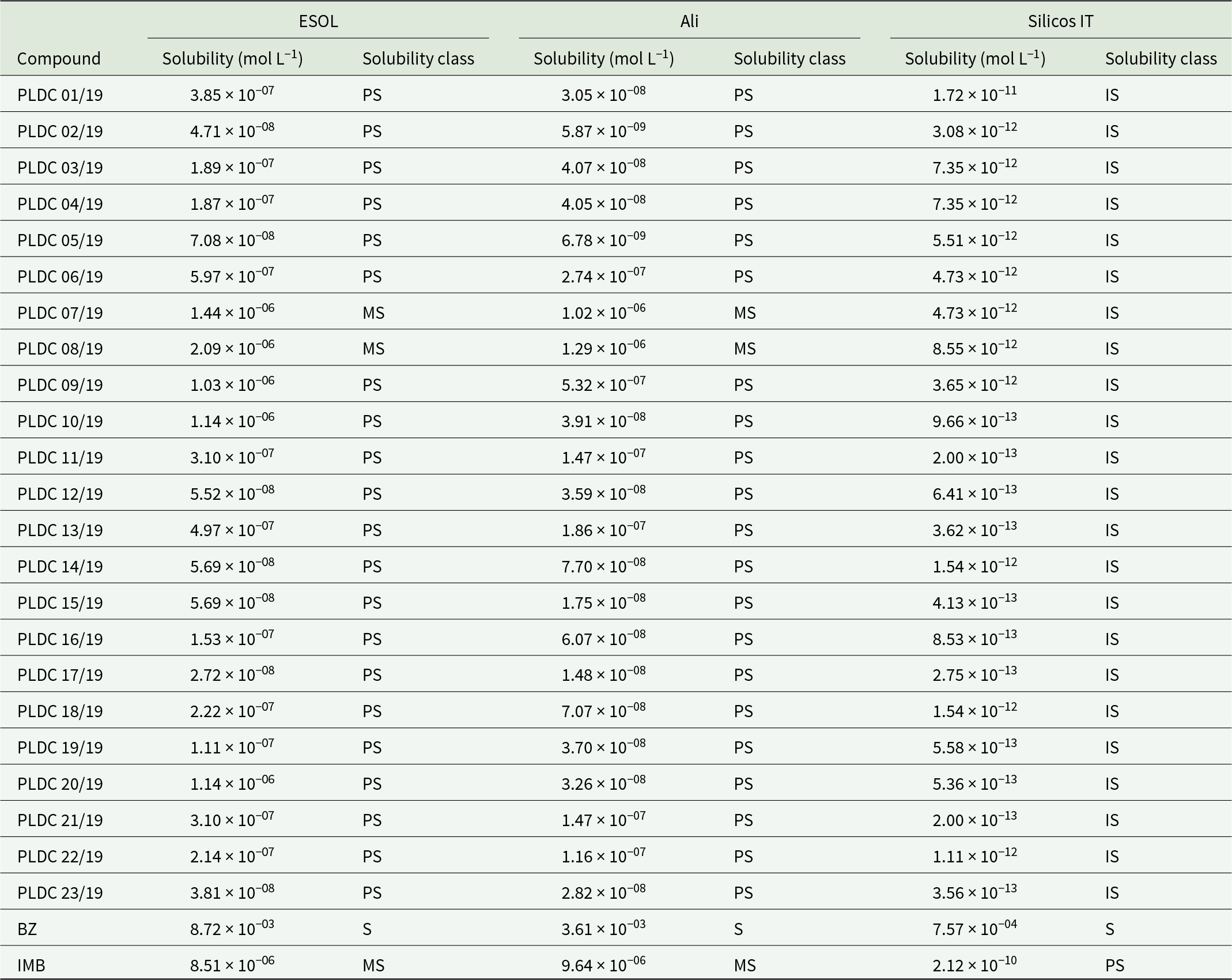
Table 2 Long description
The table lists predicted aqueous solubility values (in moles per liter) and categorical solubility classes for each compound using three models: ESOL, Ali, and Silicos IT. For the PLDC 01/19 to PLDC 23/19 series, ESOL and Ali mostly classify compounds as poorly soluble, with only PLDC 07/19 and PLDC 08/19 classified as moderately soluble by both models. In contrast, Silicos IT classifies every PLDC compound as insoluble, with solubility values many orders of magnitude lower than the other two models. The reference compound BZ is classified as soluble by all three models and has the highest predicted solubility values in the table. IMB is classified as moderately soluble by ESOL and Ali but only poorly soluble by Silicos IT, again reflecting lower Silicos IT estimates. Overall, the main trend is strong agreement between ESOL and Ali and systematically lower solubility predictions from Silicos IT, so conclusions depend on which model is used.
IS, insoluble; PS, poorly soluble; MS, moderately soluble; S, soluble; VS, very soluble; HS, highly soluble.
Parameters of inhibition of metabolic enzymes

Table 3 Long description
The table summarizes predicted gastrointestinal absorption, blood–brain barrier permeability, Pgp substrate status, and inhibition of five CYP enzymes for eleven PLDC compounds. Blood–brain barrier permeability is consistently absent for every compound. CYP2D6 inhibition is consistently absent across all compounds. Gastrointestinal absorption is low for PLDC 01/19 through 05/19 and high for PLDC 06/19 through 11/19. Pgp substrate status is mostly yes, with exceptions for PLDC 02/19 and PLDC 05/19, which are not Pgp substrates. CYP1A2, CYP2C19, and CYP2C9 inhibition are marked yes for all compounds. CYP3A4 inhibition is yes for most compounds, but it is no for PLDC 02/19, PLDC 10/19, and PLDC 11/19. These entries are categorical predictions and do not indicate inhibition strength or clinical relevance.
When evaluated at light microscopy, most of the IMB derivatives presented limited solubility in culture medium especially at concentration higher than 25 µm. Then, the following phenotypic steps were carried out up to 10 µm. The cytotoxicity analysis demonstrated that at this concentration, no PLDC derivative was toxic against L929 cells (Table 4).
Toxicity against L929 cells (LC50 in μm), activity against intracellular forms of Tulahuen strain of T. cruzi (EC50, EC90 values in μm, with 95% confidence interval) and respective selectivity index (SI − LC50/EC50) after 96 h of exposure
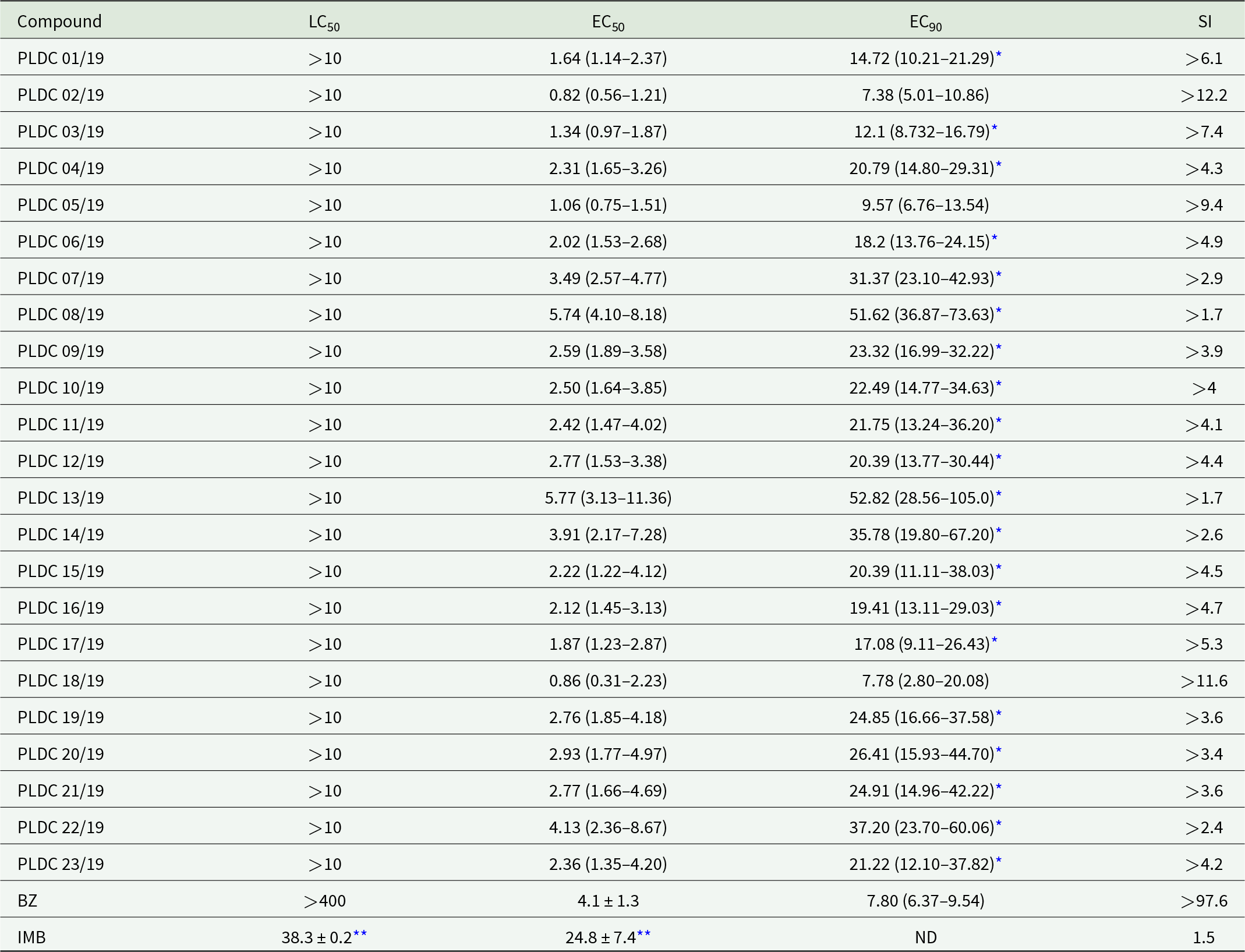
Table 4 Long description
The table reports cell toxicity in L929 cells (LC50) and anti Trypanosoma cruzi activity in infected cells (EC50 and EC90, with confidence intervals), plus selectivity index after 96 hours. All PLDC compounds have LC50 values above 10 micromolar, indicating no measurable toxicity up to the highest tested dose. Among PLDC compounds, the lowest EC50 values are for PLDC 02/19 at 0.82 micromolar and PLDC 18/19 at 0.86 micromolar, followed by PLDC 05/19 at 1.06 micromolar and PLDC 03/19 at 1.34 micromolar. PLDC 08/19 and PLDC 13/19 are least potent, with EC50 values around 5.7 micromolar and EC90 values above 50 micromolar. Selectivity indexes for PLDC compounds are reported as greater-than values because LC50 exceeded the test limit; the highest are PLDC 02/19 above 12.2 and PLDC 18/19 above 11.6. The reference drug benznidazole shows much higher LC50 above 400 micromolar but weaker potency than the best PLDC compounds, with EC50 about 4.1 micromolar and selectivity above 97.6. IMB shows LC50 about 38.3 micromolar and EC50 about 24.8 micromolar, with no EC90 reported and a low selectivity index of 1.5. Some EC90 values are extrapolated beyond the highest tested concentration, so those higher-end potency estimates are less certain.
* Values above the greatest concentration tested (10 µm) projected by PRISM.
** Data from Simões-Silva et al. (Reference Simões-Silva, De Araújo, Peres, Da Silva, Batista, De Azevedo, Bastos, Bahia, Boechat and Soeiro2019).
Next, the derivatives were screened against intracellular forms present in L929 cell lines, and all displayed high potency against intracellular forms of T. cruzi, with EC50 similar or even smaller than the reference drug that gave EC50 = 4.1 µm (Table 4). PLDC 02/19 and 18/19 were about 5-fold more potent than BZ and up to 30-fold more active than IMB (Table 4). The most active derivatives were PLDC 02/19, 05/19 and 18/19 reaching EC50 values of 0.82, 1.06 and 0.86 µm, respectively (Table 4). The high parasitic activity gave considerable selectivity, with Selectivity Index (SI) around or higher than 10. Also, EC90 values were lower than 10 µm as BZ (Table 4).
However, against BT only PLDC 23/19 was active presenting EC50 value = 18.8 µm, while BZ gave 14.4 µm. All the other derivatives did not show activity against BT up to 20 µm (data not shown).
Discussion
In addition to testing already licensed drugs, it is possible to optimize their chemical structures by adding, deleting or replacing chemical groups and even generating isomers to increase their efficacy and selectivity (Ashburn and Thor, Reference Ashburn and Thor2004). Currently, the trypanosomicidal activity of 23 novel IMB derivatives was assessed against the different forms of T. cruzi relevant to human infection (amastigotes and trypomastigotes), as recommended for the profile of a new drug for CD (Soeiro et al., Reference Soeiro, Sales-Junior, Pereira, Vannier-Santos, Murta, de Sousa, Sangenis, Moreno, Boechat, Castelo Branco, Holetz, Ávila and Pereira2024).
IMB is used in the treatment of chronic myeloid leukaemia. It is a competitive inhibitor of the Abl tyrosine kinase and the BCR-ABL gene. IMB occupies the ATP-binding site, inhibiting the phosphorylation of the enzyme and consequently the activation of the signalling cascade, impacting cell division and inhibiting the proliferation of tumour cells (Cohen et al., Reference Cohen, Cross and Jänne2021). Recent studies reported IMB derivatives as anti-T. cruzi drug candidates, showing considerable activity and selectivity (Simões-Silva et al., Reference Simões-Silva, De Araújo, Peres, Da Silva, Batista, De Azevedo, Bastos, Bahia, Boechat and Soeiro2019; Nesic de Freitas et al., Reference Nesic de Freitas, da Silva, Intagliata, Amata, Salerno and Soeiro2023). These results motivated the additional synthesis and screening of 23 novel IMB derivatives, which were tested in in vitro models of T. cruzi infection, besides investigating their toxicity profile on mammalian cells to determine selectivity. In addition, some drug characteristics were predicted by in silico analysis.
In fact, the repositioning process can also be time-consuming if done blindly. Thus, several techniques for identifying a ‘hit’, i.e. a promising drug, have been applied, including the qualitative selection of drugs with desirable properties, e.g. the ability to inhibit enzymes like those of the parasite (Katsuno et al., Reference Katsuno, Burrows, Duncan, van Huijsduijnen, Kaneko, Kita, Mowbray, Schmatz, Warner and Slingsby2015; Chatelain and Ioset Reference Chatelain and Ioset2018). This selection can be optimized by in silico analysis based on the molecular structure of the compound of interest and statistical tests can be performed with adequate rigor to screen these molecules more efficiently. In this sense, it is also possible to predict likely physicochemical properties, such as their orally bioavailable using Lipinski’s rule of 5, which is one of the guidelines in drug discovery. Although not providing definitive conclusions, in silico analysis is a preliminary approach in the search of new drug candidates (McKerrow and Lipinski, Reference McKerrow and Lipinski2017). The present analysis predicted that most compounds have favourable characteristics since all compounds only slightly violated Lipinski’s rules of 5 with respect to molar mass and the number of hydrogen bond acceptors, and none violated the rule regarding the number of hydrogen bond donors and the partition coefficient. In addition, a favourable oral bioavailability was predicted as except PLDC 01/19, PLDC 02/19, PLDC 03/19, PLDC 04/19 and PLDC 05/19, all the other 18 derivatives complied with Veber’s rule regarding total polar surface area. Likewise, all compounds were compliant with the limit on rotatable bonds.
The prediction models showed that most molecules presented low solubility in water. Only PLDC 07/19, PLDC 08/19 and PLDC 09/19 were predicted as being moderately soluble in at least one of the models. The in silico predictions are consistent with our direct observation by light microscopy analysis. In fact, previous studies from our group already reported that IMB, the parent molecule, precipitated at concentrations higher than 50 µm when diluted in culture medium (Simões-Silva et al., Reference Simões-Silva, De Araújo, Peres, Da Silva, Batista, De Azevedo, Bastos, Bahia, Boechat and Soeiro2019). Currently, similar results have been observed for the studies derivatives of the PLDC series. The precipitation of the compounds when diluted in culture medium made it impossible to analyse their activity against blood forms at concentrations above 25 µm.
The in silico analysis predicted that all PLDC compounds except PLDC 01/19, PLDC 02/19, PLDC 03/19, PLDC 04/19 and PLDC 05/19 have high gastrointestinal absorption, as the parent molecule (IMB) and as the parent molecule, none were predicted to permeate the blood–brain barrier. Also, regarding predictions related to the inhibition of metabolic enzymes, the results varied significantly between the compounds and the parent molecules. For example, unlike IMB, no derivative was predicted to inhibit the metabolic enzyme CYP2D6. The cytochrome P450 CYP2D6 is one of the most characterized polymorphic drug metabolizing enzymes that accounts for the metabolism of approximately 25% of all clinically used drugs, playing a role in the therapeutic/adverse effects activity of several medications including psychiatric, antiarrhythmics, antiemetics, β-adrenoceptor antagonists (β-blockers), opioids and anticancer drugs. The inhibition of this enzyme may lead to several-fold higher exposure of drugs with increased risk of dose-dependent adverse effects (Bertilsson et al., Reference Bertilsson, Dahl, Dalén and Al-Shurbaji2002). Thus, metabolic studies (and predictions) are required to establish the dosages to be administrated individualized based on the patients’ genotype and whether this would improve treatment outcome and be cost-effective (Bertilsson et al., Reference Bertilsson, Dahl, Dalén and Al-Shurbaji2002).
Regarding toxicity, at the maximal test concentration, no derivative was toxic, with all compounds presenting LC50 > 10 µm. The bulk of our data show that IMB derivatives are highly active against the multiplicative intracellular forms of T. cruzi being similar or even more potent than the reference drug for CD. It is worth noting that all derivatives of this series were much more active than the parent molecule (4–38 times more potent than IMB) when evaluated in L929-infected cell cultures but unfortunately not active against bloodstream forms except PLDC 23/19 that present EC50 value like BZ (18.8 µm and 14.4 µm, respectively). The high parasitic activity against intracellular forms led to considerable selectivity, with SI around or higher than 10 demonstrating their hit characteristic. Another relevant characteristic is their low EC90 values (<10 µm), which is a relevant issue regarding the ability to suppress parasite load (Soeiro et al., Reference Soeiro, Sales-Junior, Pereira, Vannier-Santos, Murta, de Sousa, Sangenis, Moreno, Boechat, Castelo Branco, Holetz, Ávila and Pereira2024). However, due to limited solubility, additional optimization is necessary to promote their solubility and move to further nonclinical in vivo experimental infection by T. cruzi in animal models.
Author contributions
L.N.d.F. and D.d.G.J.B. contributed equally to this work. M.d.N.C.S. and N.B. conceived and designed the study. L.N.d.F., D.d.G.J.B., C.F.D.S., M.M.B., L.D.A., L.P., M.B., N.B., and M.d.N.C.S. conducted data gathering. L.N.d.F. performed statistical analyses. L.N.d.F., D.d.G.J.B., and M.d.N.C.S. wrote the article. L.N.d.F., D.d.G.J.B., L.D.A., L.P., M.M.B., N.B., and M.d.N.C.S. revised the final version of the paper.
Financial support
Fundação Oswaldo Cruz, PROEP, CNPq and FAPERJ. MNCS and NB are CNE/FAPERJ and researchers’ fellows of CNPq.
Competing interests
The authors declare that there are no conflicts of interest.
Ethical standards
All animal studies were carried out in strict accordance with the guidelines established by the Fiocruz Committee of Ethics for the Use of Animals (CEUA L038-2017).


 Open access

