


Becoming pregnant and giving birth are life-changing events accompanied by physiological, emotional, behavioral, and cognitive developments, as well as challenges at times. How do such experiences influence political engagement?
From earlier research, we know that women are disproportionately affected by parenthood. However, not all indicators of political behavior among parents show gender gaps; gaps can also fluctuate over the course of parenthood. Importantly, the very first stages of parenthood, particularly around the time of pregnancy and childbirth, have not been studied as political processes, although these experiences are assumed to be the origins of gender gaps in politics.
Using a panel design with a matched control group, our data from a large-scale Swedish citizen panel record political engagement before, during, and after pregnancy. Twice a year between 2015 and 2019, we asked respondents whether they or their partner were pregnant, enabling us to create a pool of pregnant women and partners of pregnant women to follow over time. This unique dataset allows us to study the political consequences of the earliest parenthood stages.
By political engagement, we refer to the resources one needs to be active in politics, such as political interest and information seeking, as well as the political actions one takes such as participating in political discussions, trying to change things, engaging in political consumerism, and sharing content online. We measure an encompassing array of these indicators repeatedly over the phases of pregnancy and childbirth until the child is four years old.
Our central interest is in understanding whether and how the earliest stages of parenthood mobilize or demobilize political engagement. This analysis does not just bring one of the most important lifetime experiences into political focus; it can also reveal the extent to which this experience creates, expands, or maintains gender gaps in various forms of political behaviors.
PREGNANCY AS A POLITICAL PROCESS
No systematic research has examined the specific effects of pregnancy and childbirth on political engagement; however, there is plenty of work on the more general role of parenthood (see overview in Burns, Schlozman, and Verba Reference Burns, Schlozman and Verba2001). Being a parent tends to correlate with lower engagement levels in politics and society (Ferrín, Fraile, and García-Albacete Reference Ferrín, Fraile and García-Albacete2019; Nesbit Reference Nesbit2012; Quaranta and Dotti Sani Reference Quaranta and Sani2018), although important studies find very small or no influence of parenthood on political engagement (Schlozman, Burns, and Verba Reference Schlozman, Burns and Verba1994; Verba, Burns, and Schlozman Reference Verba, Burns and Schlozman1997; Voorpostel and Coffé Reference Voorpostel and Coffé2012), and several note increased engagement in school boards and groups connected with having children (Jennings Reference Jennings1979; O’Neill and Gidengil Reference O’Neill, Gidengil, Thomas and Bittner2017; Schlozman et al. Reference Schlozman, Burns, Verba and Donahue1995). Recent work has more specifically looked at different parenthood stages (see e.g., Quaranta and Dotti Sani Reference Quaranta and Sani2018), thus underlining the importance of understanding how and when during parenthood gender gaps in political behavior emerge (see also Banducci et al. Reference Banducci, Elder, Greene and Stevens2016; Elder and Greene Reference Elder and Greene2012; Ferrín, Fraile, and García-Albacete Reference Ferrín, Fraile and García-Albacete2019; Greenlee Reference Greenlee2014). Never has the time of pregnancy been the extended focus of such an analysis. The claim of the present study is that already the earliest stages of parenthood—also the pregnancy and the childbirth—might be related to disengagement from society, and most clearly among mothers.
Much theorizing on the political consequences of parenthood is based on the time commitments that come with having children (Schlozman et al. Reference Schlozman, Burns, Verba and Donahue1995). These costs prevent women, who often spend more time with their children, from engaging with and thinking about politics. Furthermore, the identification as a parent and the emerging new interests that come with having a child have been found to influence mothers more than fathers (Langner, Greenlee, and Deason Reference Langner, Greenlee, Deason, Thomas and Bittner2017; Schneider and Bos Reference Schneider and Bos2019; compare, Klar Reference Klar2013). Although similar arguments can be made about pregnancy and childbirth, these experiences also represent deep cognitive and affective investments that are accompanied, for women, by unique hormonal and bodily changes. What we do not know is how these experiences, which can take attention and focus away from societal interest, convert into political engagement empirically.
This article clarifies whether pregnancy and childbirth cause political disengagement and whether they contribute to more pronounced gender gaps in engagement in society. By focusing on first-time experiences of pregnancy and childbirth, we compare pregnant women to expecting fathers, testing the following hypotheses:
Pregnancy and childbirth for first-time parents
Hypothesis 1 cause political disengagement, and this is especially true for women.
Hypothesis 2 create new and strengthen already existing gender gaps in diverse political engagement measures.
DATA AND ANALYTICAL STRATEGY
Data
Our data were collected from the online Swedish Citizen Panel (SCP). The SCP, established in 2010, is administered by the Laboratory of Opinion Research at the University of Gothenburg and consists of 75,000 active respondents who all gave informed consent online before participating in the panel. Every six months for five years, we asked the panelists whether they or their partner was pregnant. Between 500 and 800 people in each survey confirmed that this was the case (around 2% of the sample). Table A.2 in the supplementary online information (SI) gives more details. In total, 4,270 respondents indicated that they were pregnant or had a pregnant partner at least once during the study period. Of these, 2,108 said that it was their first time becoming a parent, and they comprised our treatment group. Pregnancies that did not result in the birth of a child were excluded from the analyses (see the details in the SI, Section A). Ninety-nine percent of the pregnant women’s male partners answered that they were the biological fathers of the expected child. The rest were an adoptive parent, a step parent, or other. All male partners are included in the analyses. We compare the first-time parents with a matched control group that did not have children and were not pregnant during the study period ( $ N=\mathrm{11,022} $
), described further below.
$ N=\mathrm{11,022} $
), described further below.
Measures of Political Engagement
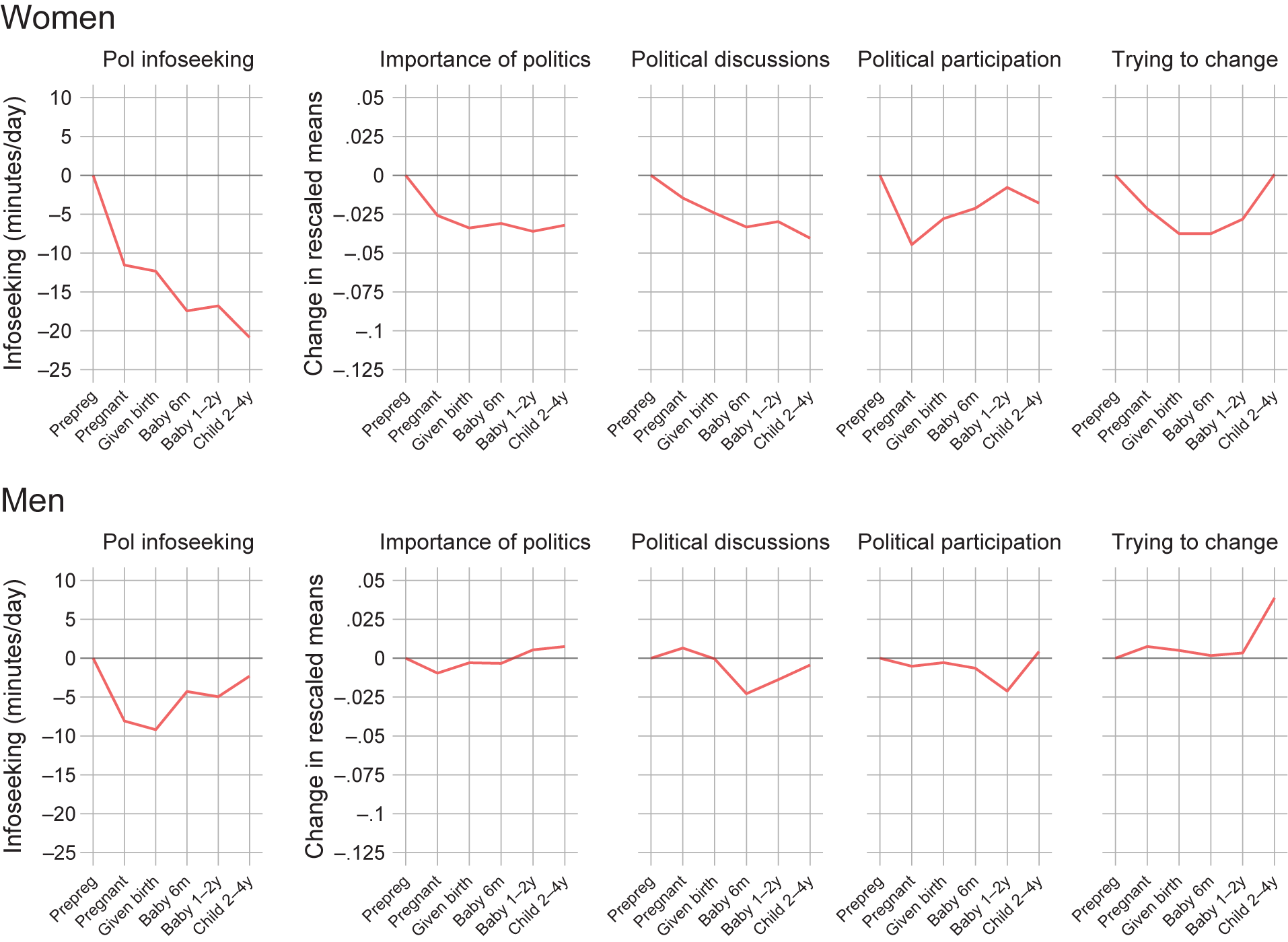
Our measures of political engagement are categorized into five indices: the seeking of news and information about politics, attitudes about the importance of politics, political discussion, political participation, and trying to change things (see exact formulations in the SI, Section B [Question formulation], and the summary in the note to Figure 1). We measure each of our dependent variables across at least four waves, but the participants in the SCP respond in surveys at different time points for a different number of times and items, so our sample is unbalanced. Table A.4 in the SI illustrates the number of times the respondents were asked the different items during the study period.
Observed Differences in Means Relative to the Prepregnancy Stage
Note: The following indices are visualized here: political information seeking (Cronbach’s $ \alpha =0.81 $
) includes the following items: local, national, and world politics; attitudes on the importance of politics (
$ \alpha =0.81 $
) includes the following items: local, national, and world politics; attitudes on the importance of politics ( $ \alpha =0.75 $
) includes political interest, the importance of being politically knowledgeable, and pondering societal development; discussing politics (
$ \alpha =0.75 $
) includes political interest, the importance of being politically knowledgeable, and pondering societal development; discussing politics ( $ \alpha =0.67 $
) includes with partner, colleagues, other friends and acquaintances, and people you do not know; political participation (
$ \alpha =0.67 $
) includes with partner, colleagues, other friends and acquaintances, and people you do not know; political participation ( $ \alpha =0.55 $
) includes boycotting/buycotting, sharing content online, signing petitions, and visiting political organizations’ websites; and trying to change things (
$ \alpha =0.55 $
) includes boycotting/buycotting, sharing content online, signing petitions, and visiting political organizations’ websites; and trying to change things ( $ \alpha =0.62 $
) includes schools, childcare, health care, volunteer associations, and political parties. See SI Table B.1 for the exact wordings of the questions.
$ \alpha =0.62 $
) includes schools, childcare, health care, volunteer associations, and political parties. See SI Table B.1 for the exact wordings of the questions.
Analytical and Methodological Strategy
We estimate the average treatment effect of the different stages of first-time pregnancy and childbirth on political engagement. The treated are women who become pregnant and male partners of women who become pregnant. They are compared at six early parenthood stages to an untreated group consisting of people who do not become pregnant in the study period and who do not have children (for a similar method, see Fitzenberger, Sommerfeld, and Steffes Reference Fitzenberger, Sommerfeld and Steffes2013). Because the untreated cannot randomly be assigned to birth months or an equivalent time marker, our causal identification strategy relies on close matching of when the treated and untreated are interviewed as well as wave-fixed effects. Specifically, to create the matched group, we use coarsened exact matching (Blackwell et al. Reference Blackwell, Iacus, King and Porro2009) to produce matching weights that balance the distribution of gender, age, education, and the timing of answering the engagement items. We describe the matching methodology further in the SI, Section C.
We also analyze how the gender gap develops across pregnancy stages. The gender gap is calculated by comparing the difference between untreated men and men who experience one of the early parenthood stages with the same difference among untreated and treated women. For a deeper discussion on the analytical strategy, see the SI, Section E.
For the analysis, we first show the observed means of the political engagement indices for treated men and women across various stages of early parenthood relative to the prepregnancy stage. However, as these results could be due to period effects influencing all respondents in the online panel over the five-year period of our study, we add a second step. This step entails regressing political engagement on six stages of early parenthood compared with the matched control by using a weighted regression approach:
 $$ y=\alpha +\beta \hskip0.3em \overline{pregstage}+\delta \hskip0.3em \mathrm{gender}+\unicode{x03C4} \hskip0.3em \overline{pregstage}+\gamma X+\varepsilon, $$
where $ \beta =\left\{{\beta}_1,\dots, {\beta}_6\right\} $
;
$ \beta =\left\{{\beta}_1,\dots, {\beta}_6\right\} $
; $ \overline{pregstage} $
is the vector of the six pregnancy stages,
$ \overline{pregstage} $
is the vector of the six pregnancy stages, $ \tau =\left\{{\tau}_1,\dots, {\tau}_6\right\} $
is the coefficient of pregnancy stage interacted by whether the respondent is a pregnant woman or a partner, and
$ \tau =\left\{{\tau}_1,\dots, {\tau}_6\right\} $
is the coefficient of pregnancy stage interacted by whether the respondent is a pregnant woman or a partner, and $ X $
is the vector of control variables
$ X $
is the vector of control variables $ \gamma =\left\{{\gamma}_1,\dots, {\gamma}_5\right\} $
.
$ \gamma =\left\{{\gamma}_1,\dots, {\gamma}_5\right\} $
.
The regression results indicate how engagement unfolds across six stages relative to the matched control group, coded 0 in the $ pregstage $
variable. The six stages are prepregnancy (1), pregnancy (2), and four postpregnancy categories: 0–6 months after birth (3), 6–12 months after birth (4), 1–2 years after birth (5), and 2–4 years after birth (6). Our control variables were age, income, education, partnership status, and survey wave. They help account for survey-specific effects and ensure that the matching balance is maintained.
$ pregstage $
variable. The six stages are prepregnancy (1), pregnancy (2), and four postpregnancy categories: 0–6 months after birth (3), 6–12 months after birth (4), 1–2 years after birth (5), and 2–4 years after birth (6). Our control variables were age, income, education, partnership status, and survey wave. They help account for survey-specific effects and ensure that the matching balance is maintained.
Section E in the SI reports robustness checks, including alternative matching algorithms, showing that the results are robust. We used clustered standard errors at the individual level to account for the interdependence between responses given by the same individuals.
RESULTS
Figure 1 shows the unadjusted means of political engagement at each stage relative to the prepregnant stage. The figure displays measures that are rescaled so that they are all on a range of [0,1]Footnote 1 for four of our five engagement indices (see also SI, Section A) as well as the differences in the number of minutes searching for political information. There is a clear decrease in information about politics over the course of pregnancy and early parenthood, especially for women. There is also a drop in engagement for women at the onset of pregnancy for the four other indices. For men, the changes seem smaller or nonexistent.
In Table 1, we report estimates that include our matched control group as a reference point. The political engagement indices are listed in the columns, and the rows of the first section indicate mean changes at each early parental stage compared with the matched control group. Positive coefficients indicate political mobilization, whereas negative coefficients indicate demobilization.
Early Parenthood Changes in Political Engagement (b/SE)

Note: Standard errors clustered at the individual level within parentheses. Dependent variables were rescaled to a 0–1 range, except the information-seeking measure (minutes/day). The gender gap is calculated by comparing the difference that we find between men during a given pregnancy period and nonpregnant men to the same difference among women. Nonpregnant means are predicted values using main model specifications. The number of observations deviate from the total reported because we use different subsamples for each model. *p $ < $
0.05, **p
$ < $
0.05, **p $ < $
0.01.
$ < $
0.01.
The coefficients in the second part of the table show the gender gap created for each stage. The following example will clarify how to read the table. Looking at the coefficient for the summary index of political information seeking during pregnancy, we see $ -10.15 $
, which indicates that pregnant women seek 10 fewer minutes of political information per day during pregnancy relative to the matched control group. That is about the time it takes to read an editorial or listen to two Swedish hourly radio news updates. We also see that the effect is significant and remains as such when the baby is born, and even increases to 15 minutes as the baby grows older. Similarly, negative coefficients at the pregnancy and birth stages for men indicate that they also spend less time seeking political information. The decrease is around eight minutes but snaps back at a much faster rate than that for women.
$ -10.15 $
, which indicates that pregnant women seek 10 fewer minutes of political information per day during pregnancy relative to the matched control group. That is about the time it takes to read an editorial or listen to two Swedish hourly radio news updates. We also see that the effect is significant and remains as such when the baby is born, and even increases to 15 minutes as the baby grows older. Similarly, negative coefficients at the pregnancy and birth stages for men indicate that they also spend less time seeking political information. The decrease is around eight minutes but snaps back at a much faster rate than that for women.
Other indices are not measured in minutes and so need to be interpreted differently. The coefficient for the pregnancy stage on political participation is $ -0.05 $
and remains at a similar level at later stages until the baby is two to four years old. This means that pregnant women are around 5% less likely to engage in political participation during pregnancy and beyond. For men, no such effect is detected.
$ -0.05 $
and remains at a similar level at later stages until the baby is two to four years old. This means that pregnant women are around 5% less likely to engage in political participation during pregnancy and beyond. For men, no such effect is detected.
There are also significant negative effects of early parenthood on women’s tendency to discuss politics but only at later stages; again, no such effects are noted for men. For the trying to change and attitudes indices, the estimates are negative but nonsignificant for women. For men, positive significant effects are seen at the later stages; fathers with babies try to change institutions more and perceive politics to be somewhat more important. The effect on trying to change is driven by the item childcare, shown in SI Table D.5, which is plausible, as children will most likely go to daycare then. Furthermore, women also increase their engagement for that specific item.
Our analysis likewise shows when demobilization sets in. The decrease in political engagement (information seeking and political participation) among first-time mothers occurs already during pregnancy. These changes seem to stick and last into the toddler age. Other changes occur only after the baby is born, such as the case for the trying to change or political discussion indices for women.
It is important to note that the size of the individual effects are small. Changes in the indices (except the seeking of news) range from 0.02 to 0.05 points between the different early parenthood stages. This signifies a difference of 2 to 5 percentage points in the full range of scales, which corresponds to about a twelfth to a sixth of a scale point on a five-point scale. Furthermore, the R 2 coefficients are small, ranging from 0.01 to 0.05. Individual effects and R 2 coefficients are small compared with what tends to be found between individuals with a larger variation in social and economic background for similar variables (Burns, Schlozman, and Verba Reference Burns, Schlozman and Verba2001). They are also small compared with changes seen in adolescence, when the individual’s political engagement is often formed (Jennings and Niemi Reference Jennings and Niemi1974). The small size of the coefficients is likely connected to the fact that we look at a very short period in adult life. The overall image and joint direction of the results are of theoretical and empirical importance, though; together, they illustrate that parenthood consists of rather small but numerous effects that jointly turn mothers away from politics and societal issues compared with the case for fathers (cf. Burns, Schlozman, and Verba Reference Burns, Schlozman and Verba2001).
The results in the second part of Table 1 reveal how the earliest stages of parenthood shape the gender gap in political engagement. Table 1 shows the change in gender differences for each early parenthood stage relative to the same gender gap in the nonpregnant group. A positive number indicates that men have a greater increase (or smaller decrease) than women, on average, and a negative number indicates a greater increase among women than men.
Three main points can be made regarding the gender gap. First, in the nonpregnant control group, women are less likely than men to judge politics important and to seek out information but participate slightly more than men. There are no gender differences in our nonpregnant sample for indices on discussing politics and trying to change. These results confirm previous work on overall gender differences in political engagement (Prior Reference Prior2009). Second, gaps in engagement are both created and increased during early parenthood; the gap in participation that is in favor of women in the nonpregnant group is reversed during pregnancy and remains throughout childbirth and beyond (3–5% on our scale); childbirth accentuates the gender gap in information seeking by 13 minutes when the baby is six months and by almost 20 minutes when the child is four years; the gap in importance of politics is larger when the child is one year and continues to be larger up to when the child is four years (4% on our scale); around the time when the baby is two to four years old, a gap in discussing politics is seen (5% on our scale). There was no change in the gap on the variable trying to change. Third, gaps are most prominent when the child is two to four years of age. The reasons are a combination of increased and lingering effects among women over time, and that effects on men are smaller to begin with, and that they do not stick.
DISCUSSION
Three major insights from our article enrich the literature on parenthood and gender gaps. First, we have shown that the life events of pregnancy and childbirth demobilize women more than men from politics. This result was anticipated by the literature but has so far not been tested with respect to the earliest parenthood stages. Although men also demobilize, the effect is not as strong and not as lasting compared with women, and not across a broad array of indicators.
Second, this demobilization occurred as early as the onset of pregnancy, something that has not been theorized or empirically shown before. The fact that changes in political behavior set in already during pregnancy means that scholars need to reconsider how and why parenthood makes a difference for political behavior. For example, disengagement might be based not just on the additional time investment that children require or breaks in employment, or on identification and interest, but also potentially on physiological and hormonal changes (cf. Hoekzema et al. Reference Hoekzema, Barba-Müller, Pozzobon, Picado, Lucco, García-García, Soliva, Tobeña, Desco and Crone2017). More research needs to investigate how pregnancy causes female disengagement from politics.
Third, our research shows that gender gaps existed before pregnancy for several engagement indices; thus, children are not the only cause of engagement gaps. Even so, we find that gender gaps are created for political participation and political discussion and that gaps in information seeking and attitudes about the importance of politics are strengthened during these early parenthood stages. Several of these effects last until our last measurement, suggesting that they might be there to stay. Indeed, no gender gaps are reduced during this time of life. Although for some measures, both women and men move in the same direction, overall, our data show that women become more different from men and, in some cases, with lasting consequences.
Our findings matter not only because they shed light on an unexplored experience in life but also because our research design has several advantages. We measure respondents before, during, and after pregnancy, so we can better understand how mothers and fathers differ at various early parenthood stages and how they compare with men and women who are not expecting a child. To further ensure internal validity, we have provided several robustness tests in the SI.
As for external validity, the question remains whether these effects from the earliest stages of parenthood travel beyond the context of our analysis. Sweden has high levels of gender equality, and it is a strong welfare state oriented toward helping parents and reducing stereotypical gender bias. This might mean that our results on the demobilizational effects on pregnant and birth-giving women represent conservative estimates compared with contexts with less equality and less extensive welfare states. However, comparative work by Quaranta and Dotti Sani (Reference Quaranta and Sani2018) and Coffé and Bolzendahl (Reference Coffé and Bolzendahl2010), which includes Sweden, does not report different effects of life-course events in gender-equal societies compared with other societies; instead, women engage more in politics, overall.
Furthermore, future research should look more into heterogeneous experiences among expecting and new mothers and fathers. Expecting parents might differ with respect to contacts with social programs/services or different financial pressures, physical and psychological burdens, and couple dynamics. Our work has opened a new research agenda into the political consequences of pregnancy, childbirth, and the earliest parenthood phases.
Supplementary Materials
To view supplementary material for this article, please visit http://doi.org/10.1017/S0003055422000430.
DATA AVAILABILITY STATEMENT
Research documentation that support the findings of this study are openly available at the American Political Science Review Dataverse: https://doi.org/10.7910/DVN/64HPWB. Limitations on data availability are discussed in the appendix.
ACKNOWLEDGMENTS
We thank the participants of the Swedish Citizen Panel and the Laboratory of Opinion Research. Earlier versions of the paper have benefited from audience members’ comments at the American Political Science Association’s Annual meeting, the European Consortium for Political Research, the Centre for the Study of Democratic Citizenship at McGill University, the Gothenburg Research Group on Elections, Public Opinion and Political Behavior, the Robert Schumann Centre at the European University Institute, and in meetings of the Gothenburg Research Program on Pregnancy and Politics (PregDem). We are also grateful for comments from anonymous reviewers and from Mattias Agerberg and Erica Metheney.
FUNDING STATEMENT
This research was funded by the Swedish Research Council, project number 2015-01546, and Knut and Alice Wallenberg Foundation, project number KAW 2017.0245.
CONFLICT OF INTEREST
The authors declare no ethical issues or conflicts of interest in this research.
ETHICAL STANDARDS
The authors declare the human subjects research in this article was reviewed and approved by the Swedish Ethical Review Authority, certificate numbers Dnr 189-14 and Dnr 1016-18.
The authors affirm that this article adheres to the APSA’s Principles and Guidance on Human Subject Research.


 Open access


Comments
No Comments have been published for this article.