

Introduction
This article investigates dictionary usage with Year 7 students of Latin. During my lesson observations I noticed how much students relied on looking up words in the dictionary when working on translation from Latin to English. I wanted to find out if there was the potential for a more interactive and/or memorable way for students to work with their dictionaries.
This action research project was carried out in an all-boys, secondary, selective school. The students in the school are of a very high academic ability and there are few with Special Educational Needs and Disability (SEND). In instances of students who do have SEND considerations, it is usually high functioning educational needs, such as high-functioning Autism Spectrum Disorder (ASD) or those who have English as an Additional Language (EAL), although their English is always of a very high standard. In the school's cohort of Year 7 students, there are three separate Latin classes each with 30 students. Latin is a compulsory subject from entry in Year 7, becoming optional from the beginning of Year 9.
In Years 7 and 8, language content is taught via a set of purpose-written Latin course booklets, developed by the current head of the department. There is a separate booklet for each term – Michaelmas, Lent and Summer. Each of these booklets includes its own dictionary in the back, comprising of all the words encountered in that booklet. As well as this, smaller lists of vocabulary are scattered throughout the booklets when new words are being introduced. The type of the dictionary used in the Year 7 booklets is not a ‘full’ dictionary. For example, not all forms of the verb are included (such as, for example: amo, amare, amavi, amatus – I love). The dictionary is more basic, where it only includes the necessary information for the student to complete activities and translation in the course booklets (for example: amare, amavi – love, loved).
I noticed that when students were set to work on translation from Latin to English, they spent a significant amount of time looking up words in the dictionary at the back of the booklet. Often by the time they had looked up the word in question and then turned back to the translation, they had already forgotten the meaning of the word they had looked up. Additionally, the words they were looking for were words that they had already encountered several times but forgotten the meaning of since the last time they had looked it up or seen it.
Literature review
Initial issues encountered
When embarking on the reading, the first issue I encountered was with the literature itself. There has been a very limited amount which has been written about dictionary usage within the context of Latin language learning. In my attempt to try and narrow down what I wanted to focus on for my assignment, I started to research about the different methods that can be used to gain vocabulary information, together with the advantages and disadvantages of how effective these may be.
Tall and Hurman (Reference Tall and Hurman2002), regarding dictionary usage in the study of Modern Foreign Languages, discuss how in the context of examinations dictionary usage may be a hindrance: if a dictionary is made available, often students will take the opportunity to look up words or phrases which they do know but feel that they ought to double check. From my own observations, I have similarly noticed that students are inclined not to try to recall basic vocabulary knowledge by themselves, but look up words which they have frequently come across before, apparently to save themselves from recalling the knowledge. It seems to be that if they skip the extra step, they fear they would be wrong and be forced to look up the word anyway.
Bartelds (Reference Bartelds2021), writing about Latin and Ancient Greek language learning specifically, also comments on students looking up words unnecessarily. This doubt then leads to students checking answers which results in a loss of time to complete the task. It also means that students' mental fluency can be disrupted by the constant interference of stopping and looking something up. This concern of the students' cognitive thread being interrupted by looking up words in a dictionary is also mentioned by Knight (Reference Knight1994). Bartelds (Reference Bartelds2021, Reference Bartelds2022) also expresses concern about needing to help students to manage their cognitive load when using a dictionary. When translating a singular sentence or phrase, students are required to hold a vast amount of information in their heads, such as case, gender, number, tense, person, and mood, for both nouns and verbs respectively. Moreover, then they are also tasked with having to remember the various meanings of the words they have in front of them. This results in a huge amount of strain on students, which can often result in cognitive overload. Bartelds (Reference Bartelds2021, Reference Bartelds2022) says that when using a dictionary, it should help manage this cognitive load, rather than be an activity which contributes to or exacerbates it further. Having to write down translations is a further step and an extra weight upon a students cognitive load. Mertens (Reference Mertens2010) points out that the task of writing is one of the most strenuous activities for the brain to carry out, on top of all of the processes which the brain is already undertaking to try and translate.
Dictionary usage – goals, advantages and disadvantages
In my mind, dictionary usage goes hand in hand with the necessity to know vocabulary when learning any language. For me, the dictionary is a tool which aids and enhances the users' experience of a language. Even for an individual where they are using their first language, dictionary usage is often required to confirm word spellings, find context-appropriate or idiomatic meanings and even simply to recall/learn new words which they come across in everyday life. Even within an individual's usage of their first language, it is near impossible to be able to spell, comprehend and correctly use every single word that is in their language. When we turn to look at those who are trying to learn a second or new language, the dictionary becomes an even more integral and necessary piece of equipment to be able to navigate the words used in the target language. Knight (Reference Knight1994) mentions that more heavy dictionary usage is required by those in the initial stages of learning a language, which in the case of this research project, is a prominent point for those who are just beginning to learn Latin in Year 7. Sarigül (Reference Sarigül2016) specifically notes the importance of dictionary usage not only in language learning in general, but particularly for those who are at the start of language learning – like my Year 7 students. It is important, then, that dictionaries are used in an effective and meaningful way – it is not really practicable to constantly be looking words up in a dictionary. Sarigül (Reference Sarigül2016) discusses this idea that dictionaries only become a useful tool in the classroom if they are implemented in an effective way. Sarigül (Reference Sarigül2016) also notes that if used incorrectly, dictionary usage can obstruct students if they are careless in looking up words or incorrectly identify a word. This issue is one which I encountered, where students struggled to use their dictionaries effectively due to not finding the form of the word which they saw in the passage.
The necessity to teach students an effective way of using their dictionaries is also discussed by Bartelds (Reference Bartelds2022). I have often observed in the classroom myself how students (especially of Latin and Ancient Greek) often produce very disjointed translations due to their use of a dictionary. Bartelds (Reference Bartelds2022) observes how students often only choose the first definition of a word when they look it up in the dictionary, and not consider the other meanings given. This is again an issue which I have witnessed myself in the classroom. Knight (Reference Knight1994) agrees on the need for dictionaries to be used in a meaningful way and adds that it is often the case that language courses which use original texts (such as Latin in this case) do not have the same priority on vocabulary knowledge as those which do not. If this is so, then it is even more important that dictionary use is done correctly and effectively for students to absorb the vocabulary knowledge as much as possible. Sarigül (Reference Sarigül2016) also states how the use of a dictionary within large classes is of merit, as it enables the students to work in a self-sustained way. The idea of being able to take some of the onus from the teacher by giving students the means of working by themselves, as well as encouraging them to work and think for themselves is a point to consider. In this way, if used effectively, the dictionary can encourage students' independent learning, as well as being an assistant for teachers with large classes.
Angle of investigation
Although I am aware that this is a literature review, and I am explaining how my reading and findings from the research made a large contribution to my decisions; I also feel, that it is necessary for me to state that an ongoing dialogue between my PGCE subject lecturer and myself had the largest input towards the direction of my assignment.
Hulstijn et al. (Reference Hulstijn, Hollander and Greidanus1996) speak of the idea of ‘incidental learning’, where students of Modern Foreign Languages pick up on words and their meanings as a by-product of other activities when learning the target language. It was within the discussion in this article that the idea of learning vocabulary through repetition came to my attention as a possible focus of an action research project. Hulstijn et al. (Reference Hulstijn, Hollander and Greidanus1996) particularly stress the importance and significance of words repeatedly being exposed to students for their meaning to be absorbed properly. Not only this but the idea of actively helping to facilitate this repeated exposure of words for students by marking words in the dictionary when they are looked up, to draw their attention to these words more, is discussed. This was an idea that I did consider doing for my action research; however, due to the time constraints I had, I was not able to have a long enough time frame to carry out this sort of research. Instead, I decided to do a variation of this, where I would incorporate the aspect of students actively being exposed to the repetition of the words by copying them out multiple times.
Knight's (Reference Knight1994) research indicates that those who used a dictionary both learnt more of the words when tested and that their comprehension of the language was improved. It seemed to me that doing an action research project on dictionary usage would be beneficial, as although some writers express their concern for dictionary usage affecting students' cognitive sequence after research was carried out, using the dictionary in a meaningful way can really help students with vocabulary acquisition and understanding of texts. One of the largest issues which guided my decisions was the potential of cognitive overload (see Bartelds (Reference Bartelds2021, Reference Bartelds2022)). If a dictionary is used by a student learning a language, which is almost always the case, then it is most important to consider the most effective way for the dictionary to be a tool of assistance rather than a hindrance. The dictionary must serve to enhance and make efficient the user's experience of the language and to achieve this, each time the dictionary is picked up and a word is looked up, it must serve a meaningful purpose.
Research questions
My interest in doing something on the topic of students' dictionary usage when learning Latin was initially piqued upon my discovery of the lack of research and material on this topic when I was doing my preliminary reading. On deciding that this would be the focus of my research, I proceeded to turn my attention towards who I would conduct the research with. I landed on a year 7 class, thinking that the research into dictionary usage would be the most useful at the inception stages of language learning when dictionary usage is the most frequent as a result of the language being completely new to the students.
To answer the overarching question ‘An action research project to evaluate a simple dictionary usage tool with year 7 students of Latin’ I chose some smaller research questions which would help me to answer it.
Q1: Do students' vocabulary test scores increase the more students are exposed to the vocabulary?
Q2: How do students use a dictionary as a tool in translation?
Q3: Do students recognise the cause of improved vocabulary retention?
Methodology
Grouping
I believed that using a whole class of 30 year 7 students, rather than a smaller focus group, would supply the research project with a larger sample size of information that I could use. Another issue with using a focus group, as Taber (Reference Taber2013) reports, is that the opinions of individuals can fall to the wayside.
Qualitative vs quantitative data
I thought that the quantitative data from the pre- and post-vocabulary tests would provide me with concrete evidence. This would enable me to use these numbers to create statistical or visual data and be able to more easily spot if there were any trends or improvements that might become apparent between the two tests.
Using questionnaire data which is both qualitative and quantitative will allow for a more thorough insight into how effective the introduction of an alternative measure is. Combining these two different means of data collection also would aid in providing me with suggestions for my third Research Question, by comparing students' test score data with their own thoughts. Even if the quantitative data suggested that the method was unsuccessful in improving students' retention/recall of the vocabulary, the students still might have considered that the method had some worth in their own personal practice.
I supplied the passages for translation in isolation to ensure that there was no other interference or distractions for the students when completing the tasks, ensuring that the students would be forced to only look up words in the dictionary in the way in which I desired for the research.
Tests
Other measures were put in place to try to make sure that the data would be as reliable as possible, such as asking only ten words of vocabulary each for both the pre- and post-tests; using translations of as similar length as possible; keeping the structure of the two stages the same; and making the students work on their own.
My choice to include the first stage of my data collection was so that this could function as a ‘control’ set of data. Stage one was to act as the standard benchmark in my data for how effective the familiar way of using the dictionary was. From this, the data from stage two could then be analysed in comparison of this initial information. I asked students to work on their own and in silence, to try and avoid any interference due to students supplying each other with vocabulary words, rather than them using the dictionary as I wanted.
Despite my efforts to try to control as many aspects of my data collection as much as possible, there are still several variables which could influence the data – as is the case with any action research investigation. Within my data collection, the main variable which may cause a discrepancy is the ten words tested in the pre-vocabulary test as opposed to the post-vocabulary test. I cannot know all the words which each individual student might need to look up, but my selection of the words was taken from throughout the whole corresponding passage to try and combat this issue.
Questionnaires
I used two questions which were the same for both the Stage 1 and 2 questionnaires. This question was ‘How easy or difficult did you find remembering the words for the vocabulary test on a scale of 1–10? Circle the number.’ This first question was followed by a Likert Scale, where the numbers one to ten with ‘easy’ written above 1 and ‘difficult’ written above 10. I used a Likert scale as Joshi et al. (Reference Joshi, Kale, Chandel and Pal2015) and Denscombe (Reference Denscombe2017) say that this would provide a between representation of actual thought/opinion but in a quantifiable medium. I used a more moderate increment of numbers as Joshi et al. (Reference Joshi, Kale, Chandel and Pal2015) report that this would allow for a more precise representation of data. This was followed by the question ‘why did you circle this number?’. These two questions allowed the students to rate how easy or difficult they found the experience in a numerical format with a wide variety of increments.
The only difference then, was that in Stage 2 there was an additional set of questions. For the Stage 2 questionnaire, there was a third question, asking ‘do you think that using the ‘copy’ method when looking up words helped you to remember the vocabulary any better than usual? Circle the number’. Again, using the same format as the first question, underneath question number 3 was a scale of numbers from one to ten with ‘easy’ above 1 and ‘difficult’ above 10. The fourth and final question for the Stage 2 questionnaire was once again, ‘why did you circle this number?’. My thinking was that keeping the formats of these questions which included a scale as very similar meant that the students would find the familiarity easier to manage, as there were multiple parts to the data which I was collecting so that the students could have easily become confused.
Observation
My final form of data collection was my own observations of the students' actions, behaviour and what they said. As Taber (Reference Taber2013) says, ideally observers are an ‘unseen’ entity, to avoid any interference with how the subjects behave. However, I was not able to do this. To try and be as unobtrusive as possible, I instead just tried to interact with the students as little as possible while I was observing. I decided to include observation in the data I was collecting, as this would help to provide me with answers for my second Research Question, regarding how students used their dictionaries as a translation tool.
Teaching sequence
Due to a limited amount of time with the students and therefore a limited latitude within the curriculum in which I could conduct my data collection, I completed the data collection for this research project in one lesson. I chose to conduct my data collection with one out of three of the year 7 Latin classes, each of which are full classes of 30 students apiece. The majority of the students in year 7 only began to learn Latin when they arrived at the school in September, at the beginning of year 7. I am conducting this research in the month of February, which means that the students have had five months of experience but are still relatively novices to the subject.
The order of completion of these activities was a translation of a short section of the Latin text, a pre-vocabulary test and then a pre-questionnaire. After completing this first stage, I then explained the suggested method of using the dictionary by copying out any of the words they looked up five times. The students would then complete the second stage which was the second small translation, post-vocabulary test and then the post-questionnaire.
After collecting this data, I then marked the pre- and post-vocabulary tests to give me a set of numerical data which I could analyse, as well as opinion-based questionnaires which I could read and analyse.
The passages for translation would be supplied on separate pieces of paper and in isolation from any running vocabulary or other information. For looking up any unknown words, the students would use the dictionary which they have been accustomed to using, which is the one supplied in the back of their course booklets.
Research method
Session 1
I then handed out the passage to the students, which was nine lines long and was an extract from one of the passages from the school's Latin course booklet. After allowing ten minutes for the students to attempted to complete a translation of this passage, I then took the passage sheet in and handed out the vocabulary test, which comprised of ten words which appeared in the passage. I allowed students another five minutes for this and then took the tests in. Finally, I handed out the questionnaire sheet and provided the students with five minutes to complete it and then collected these in.
Session 2
To try and keep my data collection as similar as possible, I repeated the activities in the same way, with the same timings. The only differences were that three students were missing who were there at the previous session, the passage for the second session was only seven lines long, the tested words were ten different ones to the previous session, and the questionnaire contained an additional question and Likert scale.
Data and findings
Vocabulary tests
Stage 1
I will start off by looking at the vocabulary test scores. For the ‘control’ test, which was Stage 1, all 30 students in the class were present. The data collected from the vocabulary tests helped me to answer Research Question 1. The data gave me clear information for how many words students did or did not manage to recall both before implementing the method and then recording the effect that the method had. The results of the test are as followed in Figure 1:
Stage 1 vocabulary test.
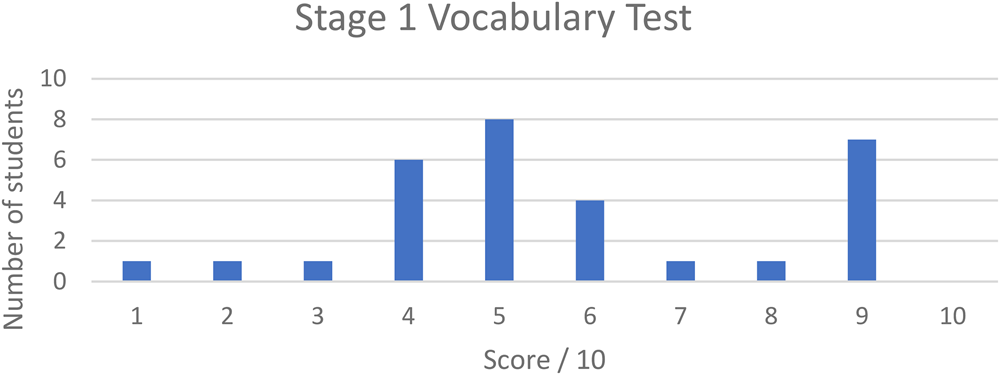
As we can see from the data in Figure 1, the most common score out of ten was achieving half of the answers. A respectable number of seven students managed to get almost all of the answers, scoring nine out of ten of the correct words. It is clear, however, that, overall, the majority of the class struggled with the vocabulary test. None of the students managed to achieve a full score of ten out of ten and a total of 17 students (57%) scored five out of ten or less – half the class.
Stage 2
Moving on to look at the vocabulary test scores for the second stage, where the method of copying out words which the students looked up was implemented, the results are in Figure 2. It is also important for me to make clear that three students were absent from the lesson in this stage, meaning that the results are only out of 27 participants, vs the full class of 30 from the first stage.
Stage 2 vocabulary test.
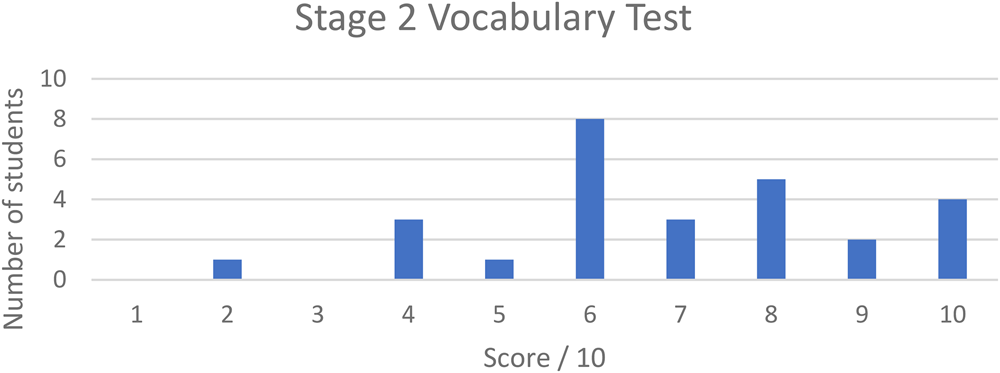
From the data in Figure 2, we can see that the scores out of ten for the vocabulary test are positioned much more towards the top end than the results found in Figure 1. The most common score, with again eight out of 27 students, achieving six out of a potential ten marks. This is not a huge improvement: only from five out of ten to six out of ten. It is important to consider the cumulative effect that this could have, however. If students are remembering at least one more word every time they complete an activity, then this one extra word would add up over time to mean that the student is absorbing a greater number of words in the long run. It is noticeable that there is also less of spread of results in Figure 2, where the scores out of ten are more ‘bunched up’ towards the higher end of the results' scale. In Figure 1, we saw that more than half of the class (57%) achieved 5/10 or less in the vocabulary test. From Figure 2, however, we can see that only five students achieved 5/10 or less, reduced to only 19% of the total class. This means that 82% of the students present in the Stage 2 test achieved over half of the correct answers in the vocabulary test after using the ‘copying’ out method. Not only this, but in Figure 1 we saw that none of the students managed to achieve a score of 10/10 correct answers. In contrast, in Figure 2 we can see that four students (15%) managed to achieve all correct answers.
From the data collected from the vocabulary tests themselves, we can now see that in terms of data, the method of copying out words when they look them up in the dictionary has seemed to have a positive effect on the students' test scores. It is important, however, to take into consideration that students did say to me that they were expecting the second stage to have something to do with vocabulary. This Hawthorne effect, as Schwartz et al. (Reference Schwartz, Fischhoff, Krishnamurti and Sowell2013) report, meant that some students were perhaps trying to remember the words more carefully when translating the Stage 2 passage, in anticipation of another vocabulary test.
Questionnaires
Stage 1
For the first question, which was ‘How easy or difficult did you find remembering the words for the vocabulary test on a scale of 1–10? Circle the number’, I tallied up how many students circled each of the numbers. The data collected from the questionnaire questions helped me to provide answers for Research Question 2, helping me to gain an insight into how using a dictionary did or did not help the students to better recall the words that appeared in the passages. As a reminder, 1 was easy and 10 was difficult. The data for this is shown in the following table:
As we can see from Figure 3, most of the numbers circled were found toward the more difficult end of the scale. Only 3 students (10%) who took the questionnaire found the vocabulary test to be easy, whereas over half of the class, 17 students (57%), chose numbers 6–9 on the scale, finding the test to be on the more difficult side.
Stage 1 responses to questionnaire (Likert Scale 1–10).
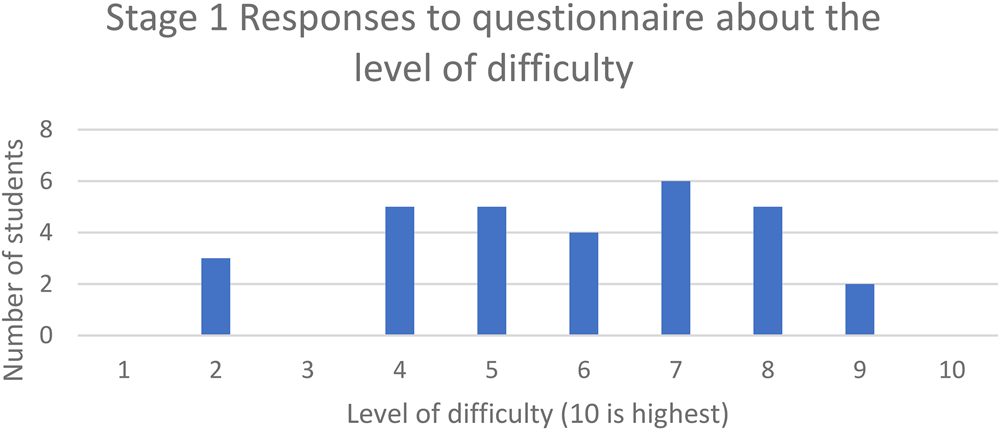
I find it interesting that 57% of the students circled numbers that indicated that the found the vocabulary test on the more difficult side, yet 70% of the students managed to achieve 50% or more correct answers in the vocabulary test. It seems to me that the students have evaluated their own skill and / or the difficulty of the vocabulary test itself to be more of a barrier to them than the actual results seem to show.
Stage 2
Again, the Stage 2 questionnaire had the same first question, in exactly the same format. The results from this question for Stage 2 are found in the following Figure 4:
Stage 2 responses to questionnaire (Likert Scale 1–10).
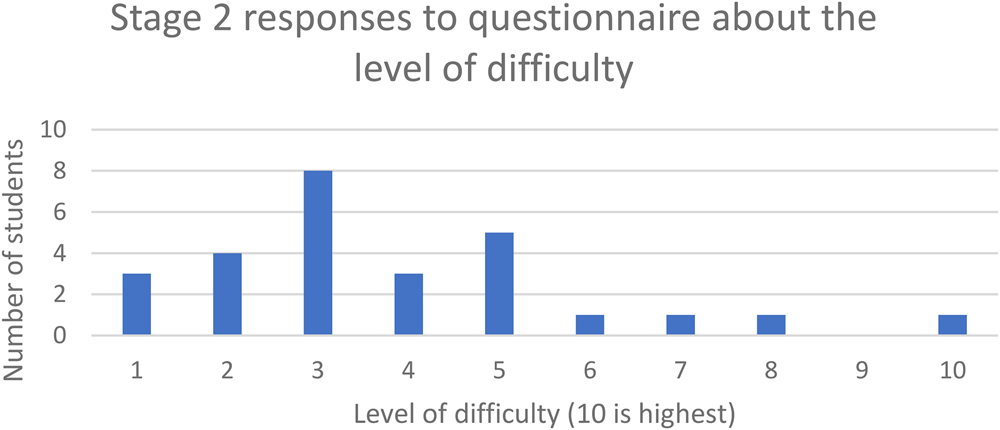
From Figure 4, we can see a similar sort of shift to that which we saw in the vocabulary tests from Stage 1 and Stage 2. Most of the questionnaire numbers which have been circled and shifted to the ‘easy’ end of the scale, whereas in Figure 3, the majority was in the ‘difficult’ end. A total of 18 students (60%), which is over half of the class which was present for the data collection in that lesson, chose numbers from 1–4. In Figure 3, the percentage which chose the same numbers was only 27%, giving a sizable 33% increase in those who thought that the second vocabulary test was easier to complete. This time, only 15% of the students (4) circled numbers 6–10, in Figure 3 this same group was a much larger 57%.
In Stage 2, students were more willing to commit themselves to the extremes of the scale: three students circled number 1, meaning that they found the test to be very easy to complete; similarly, one person also circled the number 10, indicating that they found the test very difficult to complete. I am unsure if the students' willingness to commit to the extremes of the scale is to do with an effect from the ‘copying’ method which they were using, or due to growing more comfortable and familiar with the format of the data collection.
There was also the additional question with a scale for the Stage 2 questionnaire. This was Research Question 3, which was, ‘Do you think that using the ‘copying’ method when looking up words helped you to remember the vocabulary any better than usual? Circle the number’. This question was again followed by exactly the same scale as I had used for question 1. The results from this question are found in Figure 5:
Question 3: Perceptions of the copying method (Likert Scale 1–10).
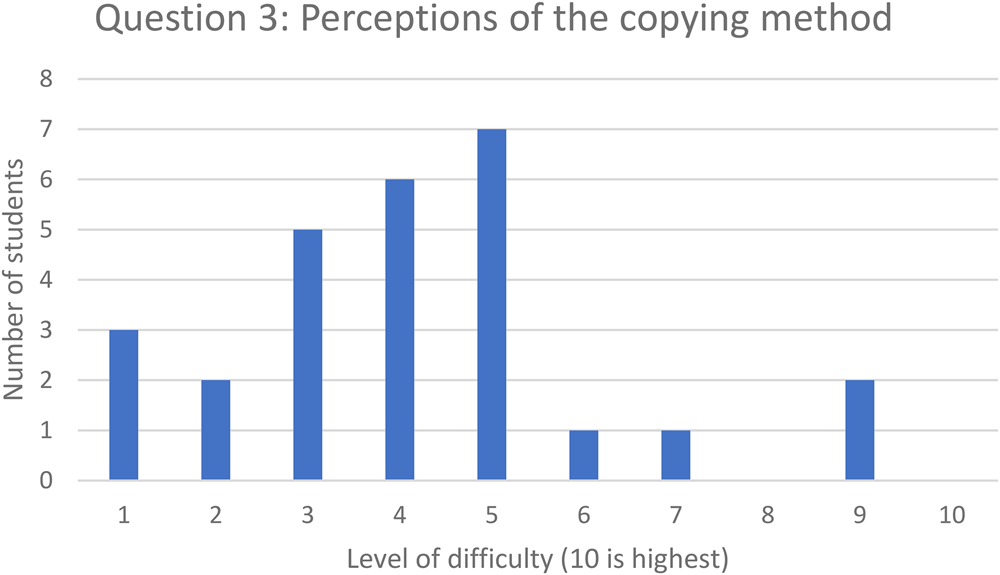
The general pattern of the results of this question seem to me to coincide with the general opinion from Question 1 of Stage 2. Most of the students circled that they found the vocabulary test to be easier to complete when using the copy method, as most of the numbers circled are at the ‘easy’ end of the scale, being numbers 1–4. A total of 16 students, which is 53% and over half of the class, circled the numbers which suggested that they found the vocabulary test easier from using the ‘copying’ method. This matches up with the data from Figures 2 and 4 which showed that, generally, students achieved more correct answers and found the vocabulary test easier in the second stage, which was when the ‘copying’ method was introduced.
Written answers
I have separated Questions 2 and 4 when discussing the questionnaire data and findings, as these were the written responses where students had the opportunity to explain why or why not they found the vocabulary test difficult to complete. Students' written answers provide some insight for me about students' opinions of using the method, and then allows me to compare their opinion with their vocabulary test scores. This would allow me to determine that, if students' vocabulary test scores did increase, whether they thought themselves that this was down to the intervention of the method.
It is important to state that not all students gave a written response as well as circling a number on the scale; however, most students did write something (but everyone who wrote something only wrote a very small amount). I will not be able to discuss all the written responses, and so I will just pick out a few that were of note.
I will start by looking at the answers from Stage 1 which caught my attention when commenting on why they had circled their chosen number regarding how difficult they found completing the vocabulary test. Student One stated that:
The first task did help learning some words, but there was no time to revise or remember them.
The ‘first task’ which Student One is referring to is the translation task. This struck me as interesting as the student clearly views revising vocabulary as the primary means which they use to recall it. This was a common sentiment that was stated by a few students, who either said to me or wrote in their questionaries that they felt despondent about the ‘test’ as they had no revision time. This also helped me in answering my first Research Question, as the student seems to believe that repeatedly revising the words is what helps them to remember. They also seem to think, however, that the activity of translating the passage, which must also include the simple task of looking up the words, is a way which helped them to remember words.
A second student stated:
Most of the words I had only seen once before. I have bad short-term memory.
Again, a point of interest in what Student Two says is that they believe that being exposed to the words multiple times helps them in their recall and remembering. This means that in theory, the ‘copying’ method when using the dictionary should have helped them as they were being exposed to words which they looked up multiple times, as well as actively engaging with these words.
Now changing to look at the written answers, which were Questions 2 and 4 for Stage 2, again we can see a few interesting things. Student Four stated as an answer to Question 2 (which was the same question as Stage 1), said that they had circled number ‘1’ (on the easier side of the scale), saying that they did so ‘because of the method’. We can clearly see here that the student found completing the test in the second stage easier as a direct result of using the ‘method’, a frequent thought among the responses. Question 4 was where the students were again asked to circle a number depending on whether they found the vocabulary test easier to do after using the ‘copying’ method and then to comment on why they circled their number. Student Four circled number 2, on the ‘easy’ end of the scale, and said that they circled this number ‘because it helped drill it into my brain’. Student Four very plainly seems to show that they found the repeated method of copying out a target word to be beneficial to them in their vocabulary recall.
Another student in Stage 2 similarly seemed to share the same sentiments as Student Four. As an answer to Question 4, Student Five answered with:
Yes I think it helped as it stook [stuck, sic] in my head.
Just as Student Four, Student Five seems to feel like the repetition of interacting with the word as a result of the method had helped the words to stay in their memory.
Finally, I will end this section with a statement from a sixth and final student, again from Stage 2. In an answer to Question 4, Student Six plain and simply stated:
This method helped.
It appears from these written answers that students seemed to find that the method helped them, or at least if they did not think that the method itself helped them as a direct result, that they found the vocabulary test much easier to do.
Observations
My observations were useful to me in being able to provide some insight into my second Research Question, regarding how students actually use the dictionary for a tool in their translation work. The main matter that I observed, which stood out to me the most, was that students could not convert words in a passage back to their root forms. It was an issue which I had not considered myself when designing the research which I would carry out. Sarigül (Reference Sarigül2016) speaks about dictionary usage becoming time-consuming and potentially problematic if students do not identify words correctly. In the instance of my research, students were often putting their hands up to inform me that a word in the passage was not in their dictionaries. It was only after I had pointed out to them the nominative, dictionary form, that they then realised that the word in the dictionary and the word in their passages were in fact the same. This then brought to my attention the need to teach students about the root forms of words which they come across, as well as teaching them effective ways of using their dictionaries. It seems, however, that the main issue is one of applying knowledge which they already have in their minds and metaphorically ‘putting two and two together’. For nouns and verbs, the students have been taught and can recite their verb endings. Despite this, students could not recognise the words as the same when confronted with the endings – they would see them as completely different entities, rather than a word which they know the meaning of with an ending they know the meaning of attached to the word.
I also observed that for both the pre- and post-vocabulary tests, students worked through the vocabulary quite quickly. I think that this is because the knowledge was quite fresh in their minds, having only just completed the translations moments before taking each of the vocabulary tests. I did, however, particularly notice that students worked and were finished with the second vocabulary test particularly quickly.
For both tests, after three out of the five minutes, I checked up on the students, asking them to show me who (if anyone) was finished with the test. In the pre-test, all students were still working at the three-minute mark. However, in the post-test, 17 out of the 28 students who were present, had already completed the vocabulary test. Due to the students' fast progress, I then asked one minute later (four minutes in), who had completed the vocabulary test. By this time, the number who had completed the test had risen to 24, meaning that 7 students had completed the text in only one minute. I think that the students' ability to be able to recall the vocabulary was in part due to the method of copying down the words which they looked up; which in turn made it easier for the students to remember the meanings as they had been actively interacted with more times than in the pre-test. Some of the students did, however, tell me that they anticipated that the second stage of research would be like the first, and that they would have to recall some vocabulary. This means that students were in anticipation of having to remember the vocabulary they came across, which will have affected my results, as some of them will have been making a concerted effort to try and put to memory the words from the passage.
Conclusion
In conclusion, I am glad that I chose to do an action research project which focuses on dictionary usage for learning Latin. I was initially unsure if this topic was an area which I should choose to do my research in, since there has been very little done so far and so I had less existing material to investigate. When I did begin my research of literature which discussed similar issues, as well as after my conversation with my subject lecturer, who gave me lots of ideas for avenues I could go down, I feel like this research project can offer some interesting things to think about in the future.
It is difficult to conduct a completely unaltered sequence of data collection and research, due to the Hawthorne effect, where so many different factors which can alter results; which was a problem that I encountered as students had pre-empted what I would ask them to do for the second stage of data collection. It is also difficult to come to any concrete conclusions about what the research I have conducted might mean, as it was carried out in such a small-time scale. Despite these issues, I do think that the results of my research could offer some suggestions which could be thought about in the future.


 Open access

