


Introduction
The North American model of wildlife conservation (Geist et al., Reference Geist, Mahoney and Organ2001) is based on the doctrine that wildlife resources are held in the public trust and managed by government agencies according to the law. This public trust doctrine, which is rooted in Roman law and was first invoked by the U.S. Supreme Court in the mid 19th century, is now enshrined in laws that preclude personal or communal profit from wildlife (Organ & Mahoney, Reference Organ and Mahoney2007). Implementation of management and enforcement of laws by state and provincial wildlife agencies is funded by license revenue, so although the purpose of the model is to protect wildlife from overexploitation, it is also dependent upon state-regulated hunting and angling. As a consequence, populations of wildlife species with high trophy value are typically managed according to hunting objectives, subject to resistance from ranchers concerned about competition with their livestock. This command-and-control, top-down management approach is credited with having brought several iconic wildlife species back from the brink of extinction, yet it represents the traditional population-focused paradigm of wildlife management, which is now being challenged (Chapin et al., Reference Chapin, Carpenter, Kofinas, Folke, Abel and Clark2009; Allen et al., Reference Allen, Cumming, Garmestani, Taylor and Walker2011; Curtin & Parker, Reference Curtin and Parker2014). Reconciling conservation, agriculture and other competing land uses involves changing the culture of the relevant management agencies, and calls for an integrated approach at the landscape scale (Sayer et al., Reference Sayer, Sunderland, Ghazoul, Pfund, Sheil and Meijaard2013).
Lessons in integrating community participation into wildlife management can be learnt from the developing world (Hill, Reference Hill, Manfredo, Vaske, Brown, Decker and Duke2009), where experience has shown that conservation efforts generally fail if local communities are denied access to, or benefits from, their traditional resources (Newmark & Hough, Reference Newmark and Hough2000). In such situations community-based conservation approaches have sought to incentivize local communities to become active participants in conservation by enabling them to derive direct sustainable benefits in the process (Spiteri & Nepal, Reference Spiteri and Nepal2006). For decades, integrated conservation and development projects have been advocated, funded and technically supported by foreign aid agencies and international NGOs but the best practices are seldom applied in developed countries (Garnett et al., Reference Garnett, Sayer and du Toit2007). Here we suggest how cattle ranching on public rangeland could be at least partially integrated with the management of American bison Bison bison, the iconic species of the North American model (Organ et al., Reference Organ, Mahoney and Geist2010).
Once numbering in the millions, bison populations across North America declined to < 100 wild individuals in total by the late 1800s (Hedrick, Reference Hedrick2009). Of the c. 500,000 bison in North America at present, only c. 20,000 are in conservation herds (Gates & Ellison, Reference Gates, Ellison, Gates, Freese, Gogan and Kotzman2010). Despite the success of many conservation herds and the large number of commercial herds, bison as a wildlife species has not recovered ecologically (Freese et al., Reference Freese, Aune, Boyd, Derr, Forrest and Gates2007; Sanderson et al., Reference Sanderson, Redford, Weber, Aune, Baldes and Berger2008). Competition, disease and genetic introgression give rise to conflict between bison conservationists and livestock managers, and thus most bison herds are separated from cattle by fences and hazing practices (Meagher, Reference Meagher1989; Aune & Wallen, Reference Aune, Wallen, Gates, Freese, Gogan and Kotzman2010). One of the few places in the USA where free-ranging bison share a public rangeland with cattle is in the Henry Mountains of southern Utah (Fig. 1).
The Henry Mountains area of southern Utah, USA, with the area used by the bison Bison bison herd delineated by the black line. The shaded rectangle on the inset indicates the location of the main map in Utah.

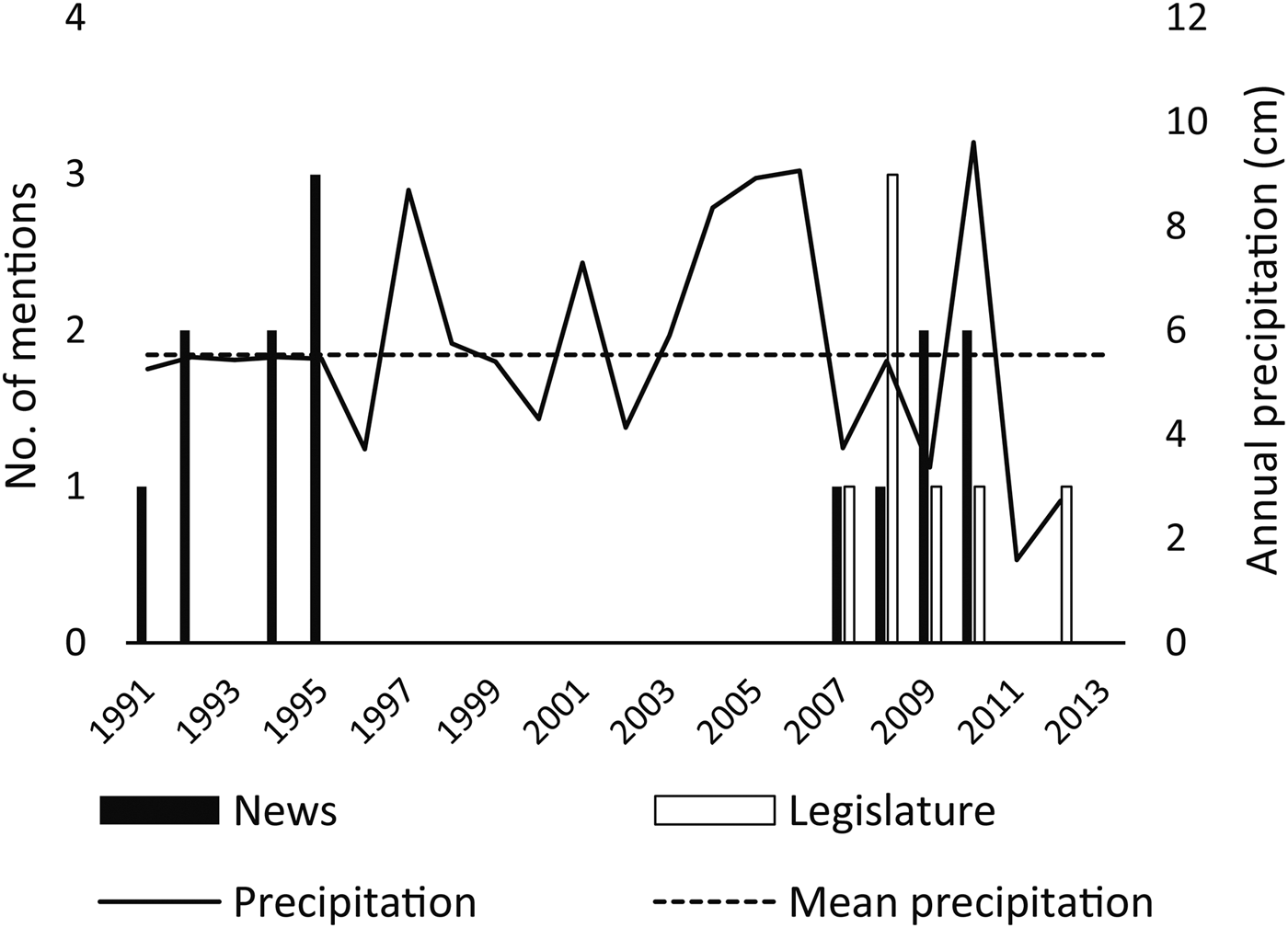
Established in the early 1940s with bison from Yellowstone National Park (Popov & Low, Reference Popov and Low1950; Nelson, Reference Nelson1965), the Henry Mountains bison herd comprises c. 325 adults (post-hunt) and is controlled primarily by sport hunting. The presence of bison on public allotments leased for cattle grazing has become a source of contention between local cattle ranchers and the state and federal management agencies (UDWR, 2007; Ranglack et al., Reference Ranglack, Durham and du Toit2015). A search for mentions of the Henry Mountains bison in a major daily newspaper in Utah (Deseret News), and the archives of the Utah State Legislature, revealed that the contention diminishes when rangeland conditions are good but returns when annual rainfall returns to average or below-average levels (Fig. 2). Earlier work showed that bison and cattle have 91% dietary similarity in the Henry Mountains (van Vuren & Bray, Reference van Vuren and Bray1983). This, combined with their conspicuous presence on the landscape as a result of their herding behaviour, dust wallowing, trampling, and large dung pats, has led to a local perception that bison are important competitors with cattle for grazing resources.
The number of mentions of the Henry Mountains bison conflict in a major Salt Lake City newspaper (Deseret News) and the Utah State Legislature during 1991–2013, plotted with annual precipitation and mean annual precipitation at the nearby Hanksville airport. The conflict was in the news in the early 1990s but became quiescent during a decade of mostly favourable precipitation. The re-emergence of the conflict, now in the legislature as well as the news, coincided with the onset of a dry period in 2007.
The Henry Mountains lie within one of the most important conservation priority areas of the roadless Bureau of Land Management lands in the western USA (Dickson et al., Reference Dickson, Zachmann and Albano2014). With the only free-ranging, disease-free, genetically pure, and huntable wild bison herd in the world, the rugged environment offers a unique opportunity to sportsmen, and thus there is high demand for hunting permits (tags). At the Western Hunt Expo in Salt Lake City in 2014, Sportsmen for Fish and Wildlife sold two Henry Mountains bison tags under the state's conservation permit programme at auction for USD 19,000 and USD 18,500. These funds were primarily for use by the state in projects that benefit bison, with oversight from Sportsmen for Fish and Wildlife. In 2013, 8,135 prospective hunters (5,618 Utah residents, 2,517 non-residents) applied for permits to hunt bison on the Henry Mountains, and 95 permits were issued through a lottery programme, generating almost USD 50,000 of license revenue for the state.
The current management objective for the Henry Mountains bison is to maintain a stable population size by harvesting, with an escapement threshold (Lande et al., Reference Lande, Sæther and Engen1997) of 325 adults as agreed upon by state and federal agencies and the Henry Mountains Grazing Association (UDWR, 2007). At the current population size, the Henry Mountains bison are neither major consumers of the forage resources used by cattle nor competitors for the habitats that local ranchers consider to be most important for their cattle (Ranglack et al., Reference Ranglack, Durham and du Toit2015; D.H. Ranglack & J.T. du Toit, unpubl. data). Nevertheless, while they continue to derive no benefits from the bison, local ranchers can be expected to continue using their contention of bison–cattle competition to attract political attention to their ranching interests. Allowing a fair system for the local ranching community to benefit directly from the bison that share the public rangeland with their cattle, while also securing bison conservation, may be a solution. Implementation would require the negotiation of legal, political, organizational and economic barriers but that process would be contingent upon an ecologically and economically feasible plan. Our objective is to investigate the feasibility of incrementally raising the escapement threshold for the Henry Mountains bison population, commensurately reducing the stocking rate of cattle, and using benefits from bison hunting to compensate the affected ranchers and provide a fund for community development.
Study area
The Henry Mountains study area in south-central Utah (Fig. 1) includes arid, semi-arid and subalpine habitats for bison, which migrate seasonally between northern (summer) and southern (winter) parts of the range and utilize almost all vegetation types and elevations. Apart from bison, cattle are the only other large grazers in the region. Mule deer Odocoileus hemionus are present but their preference for forbs suggests competition with the grazers is negligible (van Vuren & Bray, Reference van Vuren and Bray1983). Black-tailed jackrabbits Lepus californicus and desert cottontail rabbits Sylvilagus audubonii are common at low and mid elevations. Mountain lions Puma concolor and coyotes Canis latrans are the only large predators but their population densities are limited by well-established predator control efforts implemented by both government and private entities. For a description of the study area see Nelson (Reference Nelson1965) and van Vuren & Bray (Reference van Vuren and Bray1986).
Methods
Bison population data The Henry Mountains bison population has been surveyed annually by the Utah Division of Wildlife Resources (in July or August) since 1949 to estimate the pre-hunt population size (N). Since 1983 the population has been harvested according to a fixed escapement strategy; the escapement threshold (c) has been adjusted several times by agreement among representatives of the Utah Division of Wildlife Resources, the Bureau of Land Management, and the Henry Mountains Grazing Association. The number of bison harvested (H) each year is the sum of the number killed by hunters and the number of live bison removed by the Utah Division of Wildlife Resources for translocation (Fig. 3).
The Henry Mountains bison population trajectory during 1949–2012, with the total pre-hunt population count from the summer bison surveys conducted by the Utah Division of Wildlife Resources, the total harvest of hunted and removed (live) bison, and the escapement threshold as it was adjusted during 1983–2012.
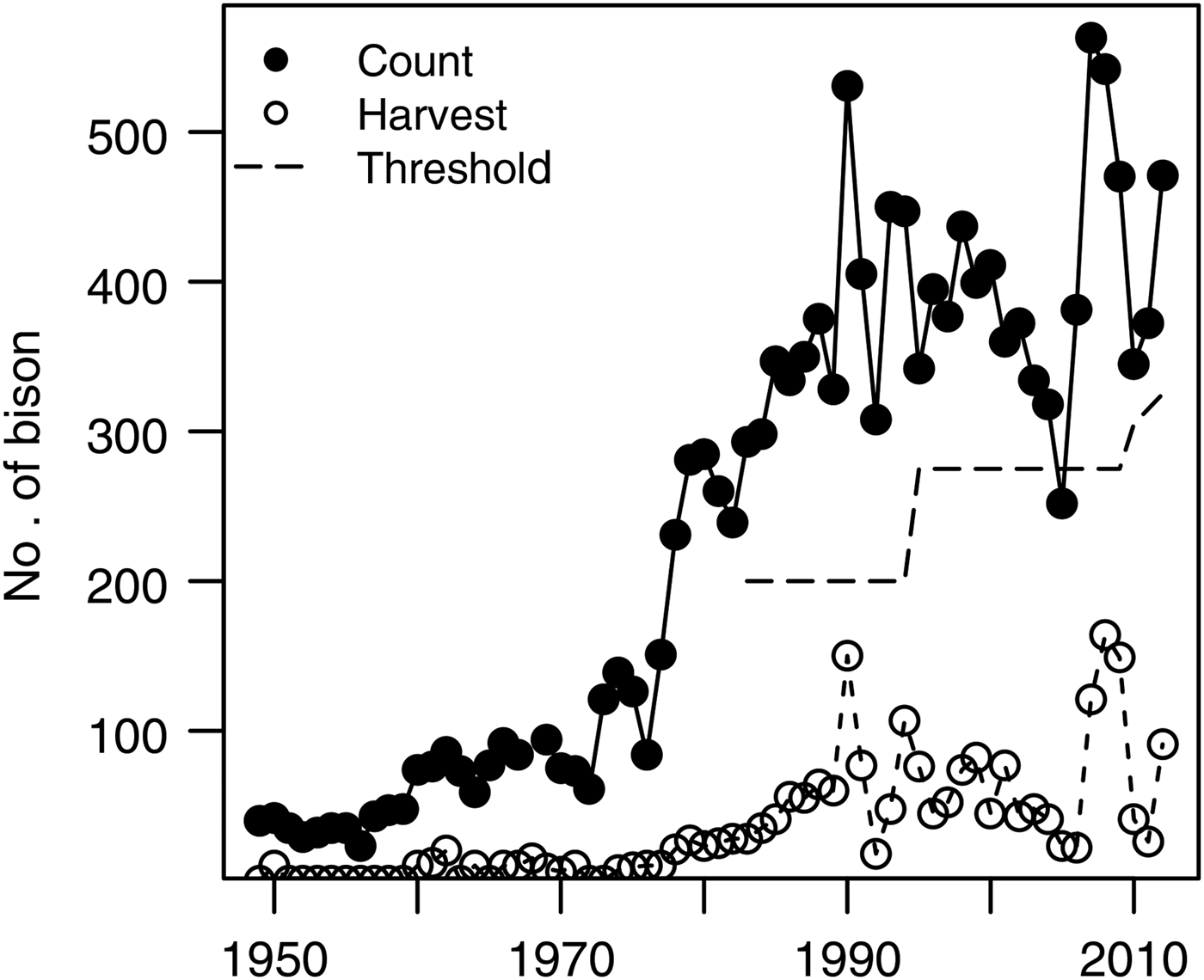
Harvest calculations We performed a hypothetical exercise in which we allowed the pre-hunt bison population to increase above the level at which it is maintained by the current escapement threshold (c = 325), considering incremental escapement thresholds up to c = 500. To quantify the actual harvesting rate (h) that had been applied to the population during its history, we calculated h = H/N and then the mean h over the 30 years (1983–2012) during which an escapement threshold strategy has been in place. This yielded h = 0.20 ± SE 0.015, or 20% of the adult population harvested, on average, each year. By comparison, the maximum intrinsic population growth rate (r max ) for bison can be estimated from mean adult body mass (M) as r max = 1.5M −0.36 (Caughley & Krebs, Reference Caughley and Krebs1983); using M = 500 kg (Reynolds et al., Reference Reynolds, Gates, Glaholt, Feldhamer, Thompson and Chapman2003) yields r max = 0.16. Applying the historical harvesting rate annually (h = 0.20) would be unsustainable in the long term, therefore, and so we made the conservative assumption that h = r max and used this theoretical value (h = 0.16) for our calculations of future potential harvesting. With a fixed harvesting rate (h) and a series of incremental values of escapement threshold (c) the hypothetical pre-hunt population size (N) was calculated for each threshold as N = c/(1 − h), and the annual potential yield (H) with that threshold as H = N − c.
Financial calculations With the current escapement threshold (c = 325) holding the bison population at the maximum size tolerated by the Henry Mountains Grazing Association because of concerns regarding competition with cattle (the veracity of which is immaterial to this exercise), we assumed that any raising of the threshold (c > 325) would have to be accompanied by destocking of cattle, for which the ranchers would have to be compensated. For simplicity we followed Bureau of Land Management practice in considering bison and cattle as equivalent animal units, so one bison on the Henry Mountains rangeland for 1 year is equivalent to 12 animal unit months in terms of grazing effect. Thus, each additional bison allowed to remain on the Henry Mountains rangeland for 1 year would require 12 animal unit months to be released from cattle grazing, and those animal unit months would have to be purchased elsewhere to maintain the rancher's level of animal production. We assumed those animal unit months would be purchased on the open market from private landowners, and therefore we used the 2013 market rate for Utah of USD 14.50 per animal unit month (NASS, 2014). To provide the revenue to compensate for destocking cattle on the Henry Mountains rangeland, we arbitrarily allocated one bison tag for auction each year if the escapement threshold was raised to c = 350, and one additional tag per year for each increment of 50 above that (0 tags for c = 325, 1 tag for c = 350, 4 tags for c = 500). We used the 2014 auction value of USD 19,000 per tag. As a notional benefit distribution scheme, we assumed all of the auction proceeds would go to the Henry Mountains Grazing Association, from where they would be distributed on a pro rata basis to affected permittees as direct compensation in market terms for the animal unit months they gave up, with the remainder going into a community fund such that no individual would derive personal financial profit.
Results
Allowing the bison population to increase by raising the escapement threshold and reducing the number of cattle on the rangeland commensurately could ultimately provide a larger annual yield of bison. This could provide financial compensation for affected ranchers, and an annual community dividend (Table 1). Once the bison population had become regulated at a new escapement threshold, and assuming current market conditions, the local community could derive a minimum net benefit of USD 10,300 annually (after ranchers had been compensated for animal unit month reductions) for every increment of 50 bison in the escapement threshold. The state wildlife management agency could also increase its annual offtake of bison through any combination of hunting and live removal.
The required harvest (H) to maintain the Henry Mountains bison Bison bison population under various potential escapement thresholds, using a conservative harvesting rate (h = 0.16), where N is the hypothetical pre-hunt population size, with number of animal unit months, cost, number of tags, and net benefit.
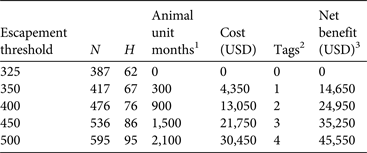
1 The commensurate reduction in cattle grazing (animal unit months) would incur the cost of purchasing grazing rights elsewhere on the open market, calculated using 2013 mean market rates for Utah. Compensation could be from the proceeds of an annual public auction of bison hunts (tags), which could be distributed on a pro-rata basis to affected ranchers, after which a net benefit could go to the community for local projects.
2 An illustrative minimal number of tags for the community for each harvesting threshold
3 Calculated assuming the 2014 auction value of USD 19,000 per tag
Discussion
Even with a more conservative harvesting rate than has been applied in the Henry Mountains historically, each increase of 50 bison in the escapement threshold could result in nine more bison harvested each year. Of those, at least one could be allocated to the community for auction and up to eight could be added to those available for the state wildlife management agency to allocate to hunters via their lottery system or to remove for metapopulation management. As the Henry Mountains bison population is currently < 10% of the size of the cattle population permitted on the Henry Mountains rangeland, and with each increase in the bison escapement threshold matched with a commensurate decrease in the cattle population, we are assuming no density dependent effects. As with all harvesting strategies involving community-based wildlife management, the initial calculations are to establish a starting point from where adaptive management could proceed (du Toit, Reference du Toit2002). Nevertheless, our conservative calculations demonstrate that a policy change could benefit both the local community and the state wildlife management agency.
From a conservation perspective the implications are that the Henry Mountains bison population could be increased to reduce the risk of small population syndrome (Gross & Wang, Reference Gross and Wang2005). Additional animals could then become available for translocation as founders in other suitable habitats, to augment existing subpopulations, as exchange for genetically pure bison from elsewhere (metapopulation management), or as exchange for batches of animals of other species of concern. Genetically pure, disease-free bison, such as those in the Henry Mountains, are valuable to conservation, with few other populations meeting those requirements (Halbert & Derr, Reference Halbert and Derr2007; Aune et al., Reference Aune, Gates, Boyd, Gates, Freese, Gogan and Kotzman2010).
If some financial benefits from the Henry Mountains bison were channelled directly to the local community this could incentivize local ranchers to adjust their cattle management to improve conditions for the bison population. There could also be opportunities for the local community to diversify operations to protect against future changes in the livestock market or as a buffer against changing environmental conditions; for example, the community could stipulate that a hunter who purchases their tag(s) at auction must use one of the local ranchers as a guide. The community fund could also be used for projects that benefit the entire community, such as scholarships for local students, or improving community infrastructure (Frost & Bond, Reference Frost and Bond2008).
From global analyses it is evident that conserving wildlife on rangelands depends on the active involvement of local communities (Deutsch, Reference Deutsch, du Toit, Kock and Deutsch2010). Integrated science-based management planning that takes into account the complexities of the social–ecological system is key for managing populations of large ungulates on rangelands shared with domestic livestock (Weisberg et al., Reference Weisberg, Hobbs, Ellis and Coughenour2002). Also, even where wildlife resources are publicly owned, wildlife management planning should take into account negative impacts (whether perceived or actual) on the communities that live with the wildlife resource (Madden, Reference Madden2004). Offsetting such negative impacts is best achieved with a direct and tangible benefit that varies depending on the overall health or size of the wildlife population(s) in question (Berkes, Reference Berkes2007). Allowing a local community to become an active partner in, and beneficiary of, a wildlife management programme builds trust among partners and enhances the adaptive capacity of the social–ecological system (Berkes, Reference Berkes2004).
Although the Henry Mountains bison example demonstrates the ecological and financial feasibility of a staggered incentive system, we recognize the challenges to implementation within local, state and federal institutions. This represents a significant change to the present management system for wildlife resources on public lands in North America. Our purpose is to explore and describe the possibilities so that representatives from the community and state and federal agencies have a basis for ongoing dialogue and planning. Management of the Henry Mountains bison is a contentious issue that needs additional inputs from policy specialists, resource economists and social scientists, but our simple population analysis (Table 1) points to a solution. It is crucial that wildlife managers and cattle ranchers work together for American bison conservation (Freese et al., Reference Freese, Aune, Boyd, Derr, Forrest and Gates2007). The same applies for European bison Bison bonasus, for which there is abundant suitable habitat outside protected areas (Kuemmerle et al., Reference Kuemmerle, Radeloff, Perzanowski, Kozlo, Sipko and Khoyetskyy2011). In a broader context we present the Henry Mountains bison as a case study of how wildlife management in North America could begin to adapt at a time of increasing challenge to the historically successful North American model (Duda et al., Reference Duda, Bissell and Young1998; Manfredo et al., Reference Manfredo, Teel and Bright2003; Teel & Manfredo, Reference Teel and Manfredo2009; Organ et al., Reference Organ, Mahoney and Geist2010).
Acknowledgements
Bison population data were provided by the Utah Division of Wildlife Resources. P. Adler, M. Fisher, F. Howe, D. Koons, K. Redford and an anonymous reviewer provided valuable comments.
Biographical sketches
Dustin Ranglack is interested in the ecology and conservation of large mammals in terrestrial ecosystems. He aims to help solve conservation problems by studying use of space by animals, predator–prey interactions, and human–wildlife interactions. Johan du Toit is interested in the conservation of terrestrial ecosystem processes through the fusion of science and management.


 Open access

