




Introduction
Climate change threatens archaeological resources globally. Many sites have already been affected and this number will only increase in the future. Current management practices and mechanisms are unlikely to be able to respond to a situation where the breakdown of inter-related climate processes impacts numerous archaeological sites at the same time. The term ‘climate change adaptation’ refers to the process of adjusting to actual or expected climate change and its effects by reducing risks and/or harnessing opportunities (Intergovernmental Panel on Climate Change 2018). The 2015 Paris Agreement established a “global goal on adaptation”, whereby all signatories (196 countries) agreed to engage in adaptation planning and implementation (United Nations Framework Convention on Climate Change 2015: 9). The importance of climate change adaptation policies in relation to archaeology and cultural heritage is increasingly acknowledged in the scholarly literature (e.g. Fatorić & Biesbroek Reference Fatorić and Biesbroek2020; Fatorić & Egberts Reference Fatorić and Egberts2020; Daly et al. Reference Daly2021). The cultural heritage and archaeology communities, however, have been slow in adopting this approach and implementing policies for the management of archaeological sites. To date, only a limited number of monitoring and planning initiatives aimed at responding to the impacts of climate change on archaeological sites have been reported; moreover, their global distribution is uneven and concentrated in Europe and North America (e.g. Rockman et al. Reference Rockman2016; Ministry of the Environment, Land and Sea 2017; Daly Reference Daly2019; Department of Culture, Heritage and the Gaeltacht 2019; Riksantikvarieämbetet 2019; Dawson et al. Reference Dawson2020; Harkin et al. Reference Harkin2020; Nelson et al. Reference Nelson2020). Some of the barriers that have slowed and/or prevented the wider implementation of climate change adaptation in the heritage sector have been analysed in the literature, although, again, with a focus on Europe and North America (e.g. Phillips Reference Phillips2015; Fatorić & Seekamp Reference Fatorić and Seekamp2017; Sesana et al. Reference Sesana, Gagnon, Bertolin and Hughes2018; Fatorić & Biesbroek Reference Fatorić and Biesbroek2020).
Meanwhile, many of the adaptation plans that have been prepared circulate outside of the traditional commercial or academic publishing and distribution channels—so-called ‘grey literature’—thus adding to the difficulty of sharing knowledge and expertise. More generally, the multiplicity and scales of governance systems, along with their varied and overlapping responsibilities, make it difficult to achieve an overview of how such adaptation plans are being approached globally. An added complication is that, for legal and management purposes, national agencies and other authorities typically regard archaeological sites and landscapes as a subset of ‘cultural heritage’, making it difficult to single out what specific actions are being taken to prepare for, and adjust to, the impacts of climate change on the archaeological record.
In this article, we aim to provide a more balanced global perspective on climate change adaptation planning for cultural heritage and archaeological resources, in order to highlight relevant research gaps and policy barriers. We do this by concentrating on the under-reported low- and middle-income countries (LMICs) that are, with a few exceptions (e.g. Brooks et al. Reference Brooks, Clarke, Ngaruiya and Wangui2020; Shaheen et al. Reference Shaheen, Othman, Ismail and Kamel2020; Vousdoukas et al. Reference Vousdoukas2022), largely absent from the scholarly literature and therefore often excluded from wider discussions of climate change adaptation. Currently, the World Bank categorises 154 countries as either low (gross national income (GNI) per capita <$1036) or middle incomes (GNI per capita <$12 536) (World Bank 2019). Using a variety of approaches, we explore both the policy and site-level challenges relating to climate change adaptation for cultural heritage in LMIC countries and highlight some priorities for future action.
Methods and materials
To gather information relevant to the aim of this study, a qualitative research approach was used. This involved a review of national adaptation plans together with expert survey and case study research. Two sampling strategies, recommended by Ford and Berrang-Ford (Reference Ford and Berrang-Ford2016), were adopted and applied because they developed key methodological considerations for monitoring and evaluating climate change adaptation research. The first looks to target areas that are under-represented in the literature, in this case LMICs, while the second seeks to identify innovative data sources, such as expert surveys, that can provide information not readily available elsewhere.
Review of national adaptation plans
National adaptation plans identify climate change adaptation needs, options and priorities. As each one covers a single country, their contents can be easily compared. LMICs and other developing countries can submit their national adaptation plans to the central online repository of the United Nations Framework Convention on Climate Change. As of November 2021, 30 developing countries had submitted plans to the repository. For this study, a manual search of these documents was conducted for the keywords ‘heritage’, ‘archaeology/archaeological’ and ‘culture/cultural’ (and their equivalents in Spanish and French); and each occurrence was assessed via a thematic analysis approach (Bryman Reference Bryman2012).
Expert survey
To obtain an overview of if and how cultural heritage and archaeological resources are included within national climate change policies, we undertook a survey of experts. The survey was designed and implemented as part of a larger Climate Heritage Network project (Guzman & Daly Reference Guzman and Daly2021). For the present study, however, we focus on a sample consisting of the 52 LMICs that had named climate change ‘focal points’ on their International Council on Monuments and Sites (ICOMOS) national committees. These focal points are national committee members who have volunteered to lead on particular issues and who would be familiar with the technical language found in plans and policies (ICOMOS is a global, non-governmental organisation of heritage professionals who span the private and public sector, and is one of three advisory bodies to the World Heritage Convention; ICOMOS 2011).
An online questionnaire was developed and administered in English, French and Spanish (the operational languages of ICOMOS), using Qualtrics survey software. Twenty-two questions were posed, including open and closed, and multiple-choice questions (for details, see online supplementary material (OSM)2). For the purpose of this study, we included a question aimed at identifying case studies of climate change adaptation plans for archaeology and cultural heritage produced at different governance levels (see the ‘Adaptation at a local scale’ section, below). In addition, one multiple-choice question relating to barriers or obstacles experienced in policy development was also included for the present study (see the ‘Expert questionnaire: barriers to climate change adaptation’ section, below). The survey response rate was 23 per cent (n = 12) of the LMIC national committees approached. When following up with respondents, we also asked those who had not completed the survey to explain why they had not participated.
Results
Inclusion of archaeology and cultural heritage in LMIC national adaptation plans
The results from our review of LMIC national adaptation plans are summarised in Table 1. Only five of the plans specifically refer to archaeology—namely those of Brazil, Colombia, Nepal, Palestine and Sri Lanka. Impacts and/or adaptation for generic ‘heritage’ resources are mentioned in 17 plans, however, and in most cases, this encompasses archaeological resources (e.g. coastal vulnerability, loss and damage, community approaches and heritage tourism). In line with the results of a recent analysis by Guzman and Daly (Reference Guzman and Daly2021), references to archaeology in the plans were found to be mostly of a strategic or notional nature, with only those of Nepal, Palestine and Sri Lanka describing specific actions.
Summary of inclusion of cultural heritage in LMIC national adaptation plans (n = 17). For links to the national adaptation plans, see OSM4.

Adaptation strategies are necessarily place-specific; thus, where plans have been developed, the reasons for the inclusion of cultural heritage and archaeological resources are diverse. ICOMOS has previously highlighted the importance of the inclusion in successful climate change adaptation plans of both communities and sustainable development models (ICOMOS 2019). This synergy of people and development is a recurring theme in the national adaptation plans and is clearly reflected in the strong link between tourism and heritage in many of them (Table 1). The Sri Lanka plan, for example, includes recommendations for the tourism industry to develop strategies with key stakeholders, including the national Department of Archaeology, to adjust tourism operations in different locations based on an analysis of climate change risks. In the Palestine adaptation plan, cultural heritage sites are not one of several components of the tourism sector but are instead its sole focus, as the outlined actions all aim to increase the resilience of historical, cultural and religious sites, which are seen as important potential tourist attractions. Finally, in Timor-Leste, Nepal and South Sudan, cultural heritage tourism is proposed as a climate change adaptation strategy that could help communities to diversify away from traditional sources of income, such as farming, fishing and nature-based tourism, which are potentially at risk due to climate change.
The LMIC national adaptation plans also demonstrate a strong role for traditional place-based approaches, local and Indigenous knowledge, cultural identity and social cohesion in climate change adaptation. Sri Lanka's adaptation plan, for example, proposes a role for local stakeholders in the identification of “religious, cultural and archaeological assets vulnerable to climate change impacts” in order to build the adaptive capacity of communities (Climate Change Secretariat 2016: 51). Meanwhile, the Timor-Leste adaptation plan emphasises the use of Tara Bandu, a customary law that regulates people's relationship with their surrounding environment. In this plan, Tara Bandu is cited as an important entry point for strengthening engagement with, and involvement of, local communities in building resilience. It is envisaged that this cultural mechanism will encourage communities to plan and implement locally appropriate climate change adaptation measures as part of the national adaptation plan process.
Similarly, the stated vision of the Kiribati adaptation plan is that its “unique culture, heritage and identity are upheld and safeguarded through enhanced resilience and sustainable development”. The plan has 12 strategy areas, one of which is “[m]aintaining the sovereignty and unique identity and cultural heritage of Kiribati” (Government of Kiribati 2019: 75). The priorities under this strategy are to protect the rights of people to their marine resources and to protect, preserve and promote the cultural heritage of Kiribati. The foregrounding of the exclusive economic zone (the marine resources around the island) under this strategy for “culture, heritage and identity” demonstrates the strongly perceived interdependence between traditional cultural practices and economic sustainability.
Expert questionnaire: barriers to climate change adaptation
To analyse respondents’ views on barriers and obstacles to climate change adaptation, we calculated the frequency of reference to each named barrier. Next, drawing on the work of Fatorić and Biesbroek (Reference Fatorić and Biesbroek2020), these barriers were classified into three categories: institutional, technical and financial. The respondents from LMICs (n = 12) identified 10 distinct barriers hindering the initiation of and support for climate change adaptation planning, or policy for cultural sites (Figure 1).
Frequency of mentions for institutional barriers (in blue), technical barriers (in green) and financial barrier (in orange) by low- and middle-income country (LMIC) respondents. CH = cultural heritage; CCA = climate change adaptation; CC = climate change (figure by S. Fatorić).

The most frequently cited barrier is a lack of coordination and recognition of climate change adaptation processes for cultural heritage within environmental programmes at multi-level governance scales. The next most frequently noted barriers are insufficient financial resources for managing and protecting cultural sites against climate change impacts, and a lack of political support for considering and developing climate change adaptation measures for heritage. Respondents also perceived that climate change adaptation plans or policies are hindered by insufficient information about the effects of climate change on various types of cultural heritage, the lack of technical skills or training related to the intersections between climate change and cultural heritage, and inadequate support from elected officials for climate change adaptation implementation for cultural heritage. Similarly, the lack of professional methodologies and tools for assessing the intersections between climate change and cultural heritage, as well as the lack of connectivity between government agencies, are seen as impediments to the development of climate change adaptation plans or policies. This echoes the reasons given by those who did not complete the survey, the majority of whom indicated that they lacked the required knowledge of and/or access to information on the inclusion of cultural heritage in climate change adaptation plans. Insufficient understanding of how to engage and communicate with multi-level government agencies, along with climate change scepticism or denial, were perceived as the least significant barriers to implementing climate change adaptation plans or policies in LMICs.
Adaptation at a local scale
Of the LMIC responses to the ICOMOS questionnaire (n = 12), only four cited examples of adaptation plans that included specific measures for cultural heritage and archaeology. Despite the fact that two-thirds could not identify plans with specific measures for heritage, the examples provide an entry point for understanding the merits and problems associated with different approaches to climate change adaptation across the globe. These four examples are based mainly on expert local knowledge; we discuss two of them below (Thailand and Iran) and two in OSM1 (Nigeria and Colombia). Indigenous heritage is a significant feature of LMIC planning, being referenced in seven of the national adaptation plans. To ensure coverage of this theme, we include an additional case study, Australia, below. Although Australia is not a LMIC, the often precarious economic and political position of First Nations peoples within developed economies blurs this definition (Mitrou et al. Reference Mitrou2014).
Case study one: Pasargadae, Iran
The World Heritage Site at Pasargadae is located near the city of Shiraz in southern Iran. It was the first imperial capital of the Achaemenid Empire (550–330 BC) and today preserves many outstanding examples of early Achaemenid art and architecture (Boucharlat Reference Boucharlat2002). In Iran, responsibility for the World Heritage Sites lies with the national Ministry of Cultural Heritage, Tourism and Handicrafts; climate change adaptation programmes, however, are implemented by regional authorities.
Climate change projections for Iran suggest an increase in the frequency and severity of extreme weather events, such as storms, heavy precipitation events and dry periods (Naderi Reference Naderi2020). Increased aridity is likely to lead to a rise in the number of sandstorms, as well as extreme soil erosion and massive water runoff, all of which will lead to faster erosion and loss of the Pasargadae monuments’ value (Borna & Arbabi Reference Borna and Arbabi2011; Zarenistanak et al. Reference Zarenistanak, Dhorde, Kripalani and Dhorde2015; Naderi Reference Naderi2020).
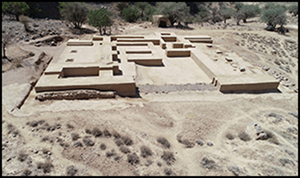
Adaptation measures have been implemented to reduce the exposure and improve the resilience of several of Pasargadae's earthen and stone monuments, including the Tal-e Takht citadel (a fortified stone platform), the Darius pavilion in the Tang-e Bolaghi Valley (Figure 2C–D) and the bas-reliefs of the palace doorways. Since 2017, a multidisciplinary team has implemented a range of climate change adaptation measures, including:
• protecting earthen structures through the application of adobe and earthen plaster;
• diverting surface water using pipes and ceramic channels;
• reburying some previously excavated archaeological resources; and
• constructing protective shelters to cover discrete areas.
These strategies prioritise sustainable solutions, including the reuse of soil from past archaeological excavations. Since 2017, the interventions have been monitored and documented after seasonal rains and any necessary maintenance carried out.
A & B) River and surface water flooding at Pasargadae World Heritage Site in 2019, and adaptation of earthen structures at Tal-e Takht (C) and at Tang-e Bolaghi pavilion (D) (photographs by M. Hosseini).

At a local level, however, there have been no significant attempts to raise awareness among surrounding communities of the threat of climate change to the site, or to engage local people in conservation and adaptation measures. Limited efforts to consult with the local community on adaptation strategies have achieved only low levels of participation, resulting from a lack of both awareness of vulnerability of the site to the risk of extreme climate events and a sense of ownership or belonging. This limited community involvement poses a significant threat during extreme weather events. During a flood in 2019, for example, local farmers directed surface water away from agricultural land to Pasargadae, due to a lack of awareness about the value and vulnerability of the World Heritage Site (Figure 2A–B). Tools and methods are therefore urgently needed to stimulate local participation in risk management.
Case study two: Ayutthaya, Thailand
The city of Ayutthaya—today a World Heritage Site—replaced Sukhothai to become the second capital (AD 1350–1767) of the Kingdom of Siam (Baker & Phongpaichit Reference Baker and Phongpaichit2017). Built within the Chao Phraya River basin, the city is surrounded by three rivers, creating a kind of an artificial island. In 2011, Ayutthaya experienced severe flooding, with over 150 monuments affected. Flood management has since been developed to protect the archaeological features and other cultural heritage in and around the ancient city. Adjustable flood walls at Wat Chaiwatthanaram, a Buddhist temple in the city, demonstrate how engineering solutions can be adapted to respect archaeology and heritage landscapes. Permanent 3m-high flood defence walls have also been built at the temple site (Figure 3) in a collaboration between the Fine Arts Departments of Thailand, the World Monuments Fund and the US Ambassadors Fund for Cultural Preservation. To date, defences built in and around the city of Ayutthaya to protect the ancient town from flooding have therefore relied predominantly on hard engineering infrastructure (e.g. concrete dams and walls) that is costly to maintain and often unable to cope with increasingly unpredictable floodwater levels. In addition, while often effective at protecting the site, the defences actively channel the water elsewhere, resulting in conflict between the site management team and the surrounding communities. For a more resilient future, Ayutthaya will require an integrated climate change adaptation approach that is interdisciplinary, and which includes nature-based solutions and community participation.
Flood wall disguised as walkway (A) and activated flood defence (B) at Wat Chaiwatthanaram in 2015 (photographs by W. Pittungnapoo).

Case study three: Bawinanga Rangers, Australia
The Djelk Indigenous Protected Area (Djelk IPA) comprises 14 000km2 of land and sea in the Arnhem Land region of northern Australia. Arnhem Land preserves records of human habitation stretching back 50 000 years; rock art depicting hunting, gathering and social rituals date from 28 000 years ago through to the present. Other sites include shell and earth middens, as well as a rich, intangible heritage, such as the cosmological (Dreaming) stories attached to most natural and human-made features of the landscape (Carmichael et al. Reference Carmichael2017a).
The cultural and natural resources of the Djelk IPA are managed by the Bawinanga Rangers, who comprise approximately 30 Indigenous men and women, most of whom are Traditional Landowners (Carmichael et al. Reference Carmichael2017b). Bawinanga Rangers are a major contributor to the local economy, generating income through funding from the Australian government and from the sale of carbon credits earned through wild-fire abatement work. In 2017, these Rangers developed a cultural site adaptation plan to address:
• sea-level rise and increasingly extreme storm surges, which are eroding coastal middens and the middens and rock art located on the fringes of the floodplains;
• more intense cyclones, which are impacting on coastal middens; and
• more extreme and frequent precipitation events, which are eroding rock art located along inland rivers and contributing to the erosion of middens and rock art on the floodplain fringes.
The Rangers devised and used a novel risk-assessment method that evaluates risk via exposure, sensitivity and significance parameters (Figure 4). They subsequently developed and tested a participatory decision-making approach to identify and appraise adaptation actions for inclusion in the plan (Carmichael et al. Reference Carmichael2020). The Rangers considered it impractical to protect and preserve sites with physical barriers, instead proposing the use of inexpensive drones to make 3D-digital models of rock art sites at high risk of loss. In the future, if rock paintings are washed away, augmented reality headsets could be used to visualise these digital models over the blank rock surfaces. Visualising these digital records in situ may help to maintain cultural connections to sites and traditional lands.
Bawinanga Rangers conduct risk analysis for riverine rock art (left) and coastal middens (right) (photographs by Bethune Carmichael).

Discussion
Above, we have utilised several approaches to shed light on climate change adaptations for archaeological sites in regions that are currently under-represented in the scholarly literature. We found that 17 out of 30 LMIC national adaptation plans lodged with the United Nations Framework Convention on Climate Change include some acknowledgement of archaeology and/or cultural heritage at a strategic level, but only three (Nepal, Palestine and Sri Lanka) include specific actions to be implemented. This limited operationalisation of adaptation measures can be explained when we consider the key barriers cited by the respondents to our questionnaire—namely the lack of recognition and coordination of climate change adaptation for cultural heritage in terms of governance and political support. This situation means that, even when heritage intersections are recognised, relevant professionals are often not involved in the design and implementation of climate change adaptation planning (Guzman & Daly Reference Guzman and Daly2021). The low response rate to the ICOMOS questionnaire and the reasons given for this (that is, lack of knowledge of and/or access to information) emphasise a worrying disconnect worldwide between climate change policy-makers and the cultural heritage sector.
Learning from the example of Ayutthaya, integrated collaboration across multiple-disciplines and organisations is imperative in order to cope with climate change and to protect heritage and archaeological sites through more resilient approaches. When climate change adaptation is place-based and participatory, the results are more likely to be acceptable and effective. This fact was frequently recognised in the LMIC national adaptation plans, with 10 of them referencing the importance for climate change adaptation of traditional and/or Indigenous cultural knowledge. The Djelk IPA case study provides one model for how this can be achieved; local traditions, such as Tara Bandu, detailed in the Timor-Leste national adaptation plan, have the potential to encourage communities to plan and implement locally appropriate climate change adaptation measures (Secretariat of State for Environment, Coordinating Minister for Economic Affairs 2021).
A lack of financing options was the second most cited barrier by respondents to the questionnaire, and the COVID-19 pandemic, together with a worsening climate emergency, may make it increasingly difficult to fund adaptation actions. Given the many threats posed by climate change—indeed, an existential threat for some small island nations—it is perhaps unsurprising that archaeology is low on the climate change adaptation agenda of many LMICs. Yet there are clear synergies between cultural sites and sustainable development, and between traditional economies and tourism, present in some of the LMIC national adaptation plans. The potential for cultural heritage, including archaeology, to contribute to climate resilient development has been explored in a recent report by the United Cities and Local Governments organisation (Potts Reference Potts2021). This report emphasises the need for an integrated approach to adaptation and sustainable development, adopting measures that address poverty and social inequalities alongside climate change vulnerabilities (Potts Reference Potts2021: 16).
At Pasargadae, adaptation works were implemented solely in response to climate change impacts rather than as part of an integrated approach. Here, a lack of engagement with local stakeholders led to a reduced sense of ownership and increased conflict with the community, further exposing the site to more extreme weather events in the future. In addition, a lack of awareness of climate change impacts and of adaptation capacity has led to the migration of local people due to the decline in their livelihoods and a consequent loss of traditional knowledge, making the site's cultural landscape increasingly vulnerable. Conversely, the cases of the Bawinganga Rangers (discussed above) and of Cartagena (see OSM1) show that landscape-based and people-centred approaches can produce positive results. Harnessing community knowledge to gain a full appreciation of risks and undertaking locally informed adaptation design, appraisal and implementation have the potential to overcome national shortages in heritage conservation resources. Avoiding the imposition of top-down adaptation measures will also reduce any unforeseen negative consequences for local communities.
Three of the case studies discussed here are World Heritage Sites and these iconic and well-documented places are likely to be better protected than most cultural heritage and archaeological resources. In the case of Lagos (see OSM1), for example, although vulnerability assessments have been planned for each sector as part of a regional climate change adaptation strategy, there is no evidence that cultural heritage has been considered. The lack of data necessary for assessment of heritage vulnerabilities was a problem noted by the Kuwait national adaptation plan. This situation is a particular problem for unexcavated archaeology and landscape features, which may be poorly understood and have low visibility in the landscape. Archaeological research can, however, support present and future climate change adaptation by highlighting past adaptability to environmental change and relating it to current experiences (Nakhaei & Correia Reference Nakhaei and Correia2020). In Ayutthaya, for example, original water management systems, which had fallen out of use, are being restored, and historical coastal defences at Cartagena have been incorporated into the current climate change adaptation strategy. As the climate crisis deepens and more sites are exposed to the risks of climate change, coordinated national planning based on all available knowledge (i.e. academic, technical, traditional, Indigenous and archaeological) will become increasingly valuable and, at the local level, it is critical that the solutions chosen are place-based and sustainable.
Conclusion
Archaeological resources are finite and non-renewable, and climate change represents a significant and immediate threat to them. Climate change adaptation actions to reduce exposure and increase resilience in LMIC countries are evidenced in the case studies presented here, but both the national adaptation plan analysis and expert survey carried out as part of this study suggest that such actions are not yet widespread. In addition to overcoming financial barriers and a lack of recognition of cultural heritage and archaeological sites in climate change adaptation policy, those working with cultural heritage and archaeological sites must now seek actively to address the apparent gaps in knowledge and practice. These include developing people-centred approaches, culturally appropriate technologies and nature-based solutions, and strengthening the use of Indigenous, traditional and archaeological knowledge in conservation. Global climate change is a shared challenge and the best route to finding solutions will undoubtedly be a shared path.
Acknowledgements
Many thanks are due to our survey respondents and those that helped with its development and administration, along with Álvaro Gómez-Ferrer Bayo, Maureen Thibault, Andrew Potts, CHN members and the ICOMOS Secretariat.
Funding statement
This research received no specific grant from any funding agency or from commercial and not-for-profit sectors.
Supplementary materials
To view supplementary material for this article, please visit https://doi.org/10.15184/aqy.2022.114.


 Open access

