




Introduction
Situated at the heart of East Asia and along the first island chain in the Indo-Pacific, Taiwan is frequently portrayed as a democratic barricade against authoritarian China in global discourse (The Economist 2021). Yet beyond these headline framings and geopolitical flashpoints, Taiwan is also an exemplary case of the third wave of democratization (Huntington Reference Huntington1993), with a vibrant and internally diverse democracy with its own social dynamics and political tensions. Since the democratization of the 1980s, a wide range of social movements—advocating for civil rights, environmental protection, women’s equality, and labor justice—have flourished, cultivating a pluralistic civic sphere (Hsiao Reference Hsiao1990).
Although political and military pressure from China has intensified since the early 2000s, Taiwan’s deepening engagement with the global democratic community has opened up the chance for a variety of concerns and values to flourish. These conditions have allowed previously marginal issues to become politicized. Over the past decade, controversies over same-sex marriage, the death penalty, surrogacy, and transitional justice have evolved into national debates and electoral battlegrounds (e.g., Li Reference Li2022; Chang, et al. Reference Chang, Wu and Lee2023; Fan Reference Fan2024; Chen Reference Chen2024), mobilizing new political competition and drawing new boundaries of social conflict.
Despite mounting evidence of such cultural divisions, research on Taiwan politics has largely continued to treat Cross-Strait relations as the only significant political cleavage (Achen and Wang Reference Achen and Wang2017; Wang Reference Wang2019). Analyses of Taiwanese electoral behavior and party competition have been dominated by frameworks rooted in national identity and the unification–independence divide. Meanwhile, scholarship on cultural polarization and “culture wars” has focused primarily on Western contexts (e.g., Ford and Jennings Reference Ford and Jennings2020; Hunter Reference Hunter1991), presuming that religious-driven moral controversy do not translate easily to Asia. This study addresses both of these gaps by examining how cultural and moral issues have become politicized in Taiwan, thereby expanding the theoretical and empirical implication of cultural polarization literature.
With a historical lens, I first discuss how civic groups and political parties in Taiwan behave at critical moments open the opportunity for cultural polarization and embed moral issues into partisan competition. The moves and responses of political parties and civic groups at two key events—the same-sex marriage (SSM) campaign and the Sunflower Movement— actually elevated moral debates into nationwide political controversies in the mid-2010s.
With two decades of data from the Taiwan Social Change Survey (TSCS), I then examine trends in polarization and issue partisanship across four domains: civil rights, family values, Cross-Strait relations, and economic redistribution. The results show a clear pattern: while Cross-Strait relations remain the most predictive factor for supporting two major parties— Democratic Progressive Party (DPP) and the Kuomintang (KMT)— in Taiwan, civil rights and family values have become increasingly aligned with party affiliation. Specifically, DPP supporters become more liberal, while KMT supporters become more conservative.
This study offers the first analysis of cultural issue partisanship in Taiwan and highlights the co-constitutive role of political parties and civil society in shaping new axes of political division. More broadly, it demonstrates how cultural polarization can emerge and consolidate even when overshadowed by dominant geopolitical conflicts. Meanwhile, it calls for an often ignored facet of East Asian political development—beyond economic performance and national identity—and towards the struggles that increasingly effect democratic life.
Polarization in moral values
The global diffusion of culture wars
Over the past few decades, a growing body of literature has pointed to the increasing centrality of moral and cultural conflict in the political landscapes of advanced democracies. In the United States, scholars have often described this phenomenon as “culture war,” emphasizing the polarizing ideological divides across issues such as abortion, sexuality, religion, and education (e.g., Abramowitz and Saunders Reference Abramowitz and Saunders2008; Fiorina, et al. Reference Fiorina, Abrams and Pope2005; Hunter Reference Hunter1991). Democrats and Republicans have increasingly diverged across a broad array of policy attitudes—including civil rights and moral values—while moderate voices in Congress have gradually disappeared (Baldassarri and Park Reference Baldassarri and Park2019; Wolfe Reference Wolfe1998). The resulting political climate is defined not only by disagreement over policies but by the value-based cleavages that shape identities (Broćić and Miles Reference Broćić and Miles2021; Fukuyama Reference Fukuyama2018).
This pattern is not unique to the United States. In Western Europe, scholars have identified a parallel reordering of political conflict. The traditional left–right divide has gradually declined and, in some cases, it has been replaced by a new dimension of ideological conflict along with emerging issues such as mass migration, globalization, and new lifestyle (Kriesi Reference Kriesi1998). This emerging divide pits “Green-Alternative-Liberal” (GAL) values against “Traditional-Authoritarian-Nationalist” (TAN) values (Ford and Jennings Reference Ford and Jennings2020; Hooghe and Marks Reference Hooghe and Marks2018).
In the East Asian and Taiwan context, the structural drivers commonly associated with emerging cultural cleavages operate quite differently from those observed in Western democracies. First, immigration—one of the most prominent sources of cultural polarization in Western democracies—plays a more limited political role due to the region’s smaller immigrant and ethnic minority populations (Igarashi and Ono Reference Igarashi and Ono2022). Although labor shortages have recently prompted policy liberalization and given rise to new nativist or sectarian actors (Jung Reference Jung2025; Schäfer Reference Schäfer2025), immigration has not yet crystallized into a major societal cleavage. Second, economic sectoral realignments driven by globalization in the West (Hooghe and Marks Reference Hooghe and Marks2018) have been less pronounced across East Asia. The region’s development trajectory—characterized by coordinated state-led industrial policies and a long-standing development-first orientation—has muted sector-based antagonisms (Slater and Wong Reference Slater and Wong2022), rendering economic-sector divisions comparatively weak as a fuel of cultural polarization. Third, in Taiwan in particular, religion—a central moral boundary in many Western societies—is far less politically salient. Religious pluralism and ambivalence are widespread in Taiwan, and more than half of the population does not identify with a formal religious tradition (Fu Reference Fu2016a).
Instead, Confucian ethics and familistic moral expectations shape the central contours of cultural conflict in East Asia. Traditional Confucian ideology emphasizes deference to authority and the prioritization of family and community over individual autonomy (Huang Reference Huang2024), and scholars have long debated whether these values may constrain the development of liberalism and democracy (e.g., Dalton and Ong Reference Dalton and Ong2005; Nathan and Chen Reference Nathan and Chen2004). Under modernization and capitalist transformation, “conservatism” in East Asia has sometimes been associated with nostalgia for authoritarian rule and the support for Confucian social norms, rather than the religious foundations of the West (Jou Reference Jou2012; Rozman Reference Rozman1991).
One of the most prominent sites of cultural contestation in East Asia is found in gender issues. During the early stages of democratization, civic groups sought to address progressive gender issues, such as women’s workplace rights and political participation, through various means. However, partisan divides on gender issues in Taiwan and South Korea were not sharply defined at that time (Fan Reference Fan2003; Go Reference Go2025). In recent years, these divides have become more pronounced. In the 2018 mid-term election in Taiwan, SSM became a contentious political issue. In the 2022 presidential election in South Korea, the conservative People Power Party (PPP) campaigned against the Ministry of Gender Equality and Family, bringing gender politics to the forefront (Jenkins and Kim Reference Jenkins and Kim2024; Lee Reference Lee2024). While some studies note an emerging link between gender attitudes and party support, systematic analysis of how broader moral issues become embedded in party cleavages remains limited.
Overall, although the contours of cultural conflict vary across contexts, these cases point to a broader global trend. Political antagonism has increasingly crystallized around moral and identity-based issues, transforming cultural disagreements into partisan divisions. The concept of a “culture war” captures conflicting visions of morality: one rooted in inherited norms and traditions, upholding moral standards based on religious or patriarchal authority, and the other advocating pluralism, individual autonomy, and social reform (Broćić and Miles Reference Broćić and Miles2021; Hunter Reference Hunter1991). These divergent moral frameworks have become increasingly central, not only in political discourse, but also in people’s daily lives and social relationships (Broćić and Miles Reference Broćić and Miles2021; DellaPosta, et al. Reference DellaPosta, Shi and Macy2015).
Polarization in a sociological view
Discussions of political polarization in political science often focus on bimodal distribution, or what is commonly referred to as “U-shape distribution”—the idea that opinions in a dimension are dispersed into two extremes, making consensus in policy-making or values more difficult (Fiorina and Abrams Reference Fiorina and Abrams2008). Yet, as DiMaggio, Evans and Bryson (Reference DiMaggio, Evans and Bryson1996) argue in their foundational work, bimodality is only one of several meanings of polarization. In addition, the consolidation principle offers particularly important sociological insights into how polarization may reshape the fabric of social life.
Consolidation refers to the increasing alignment between individuals’ social identities (such as religion, race, or party affiliation) and their attitudes toward issues. From a sociological perspective, it matters because they reduce the degree of cross-cutting affiliations within a society. When people’s attitudes are tightly bundled with their social identities or ideological worldviews, opportunities for dialogue, empathy, and mutual understanding across political lines diminish (Baldassarri and Gelman Reference Baldassarri and Gelman2008; DellaPosta Reference DellaPosta2020).
Baldassarri and Gelman (Reference Baldassarri and Gelman2008) further operationalize the principle with the concept of issue partisanship, referring to the increasing association between respondents’ political party affiliation and specific issue positions in surveys. As this association strengthens, cross-party communication becomes more difficult, and disagreements are reinforced through political activities. When issue positions can be clearly sorted on two-party sides, polarization becomes socially entrenched, reducing opportunities for cross-cutting dialogue and social integration.
From this perspective, two forms of cultural polarization are both important: bimodal distribution and issue partisanship in moral and cultural issue stances. Taken together, they illuminate not only how individuals diverge in their value orientations but also how these orientations increasingly align with partisan identities. This framework provides a crucial basis for analyzing how cultural attitudes and party competition interact to generate new cleavages in society.
Why culture polarization happens
Several factors have been identified as contributing to the widening gap between moral values. Societal changes, such as generational replacement, along with values like post-materialism and liberal worldviews, are considered important (Kriesi Reference Kriesi1998; Norris and Inglehart Reference Norris and Inglehart2004). Educational expansion is also seen as a significant factor, as it fosters a greater receptiveness to progressive moral values (Broćić and Miles Reference Broćić and Miles2021). Immigration also enhances tensions between those who embrace multiculturalism and those who view immigration as a threat to national cohesion (Ford and Jennings Reference Ford and Jennings2020). Globalization, in turn, generates backlash among those who feel disempowered by global economic and cultural flows (Norris and Inglehart Reference Norris and Inglehart2019). These structural changes can lead to the widening of cultural differences and, ultimately, to long-term political antagonism.
While structural change sets the stage for cultural conflict, an alternative explanation highlights the role of political elites. Rather than being spontaneous, they claim that these divisions are often politically activated and amplified by political elites and interest groups. Hunter (Reference Hunter1991) and Wolfe (Reference Wolfe1998) argue that politicians and advocacy organizations often exploit moral controversies to mobilize constituencies and consolidate power. By framing social issues and disagreements in moralized terms, elites transform latent differences among constituents into polarizing worldview battles. Drawing on long-term survey data, Baldassarri and Gelman (Reference Baldassarri and Gelman2008) even claim that public opinion has actually remained stable, and culture war reflects that polarizing political parties increase their effectiveness in “sorting” individuals along issues.
Cultural issues are especially potent tools for political mobilization because they are symbolic, emotionally charged, and deeply tied to personal and group identities (Evans Reference Evans1997). Parties and advocacy organizations frequently rely on these issues to energize their bases, stimulate media attention, and raise funds. As such, the culture war is not merely a spontaneous reflection of societal divisions—it is a politically constructed and strategically reinforced phenomenon (De Leon, et al. Reference Leon, Cedric and Tuğal2009).
This mobilization view reveals the importance of electoral institutions and party strategies in structuring political cleavages. Rather than simple societal divisions, cultural conflict may result from how parties choose to emphasize, articulate, and mobilize around certain issues (e.g., Lotesta and de Leon Reference Lotesta, de Leon, Janoski, de Leon, Misra and Martin2020, Mudge and Chen Reference Mudge and Chen2014). In the following section, I review two critical events in Taiwan to illustrate how the interaction between political parties and civic groups articulated moral debates and opened the window for the trend of cultural polarization that the subsequent quantitative analysis seeks to verify.
Cultural conflict under geopolitical tension: The case of Taiwan
Paradox of geopolitical pressure and vibrant democracy
Taiwan presents a compelling case for analyzing how cultural cleavages emerge and evolve under persistent geopolitical pressure. The island’s political development has been profoundly shaped by its historical ties to Mainland China and its unresolved relationship with the People’s Republic of China (PRC), which not only denies Taiwan’s sovereignty but also poses an explicit military threat (Achen and Wang Reference Achen and Wang2017). For a long time, the KMT (or pan-blue) has been perceived as pro-China, while the DPP (or pan-green) has been seen as taking a stance against China.
As Soehl and Karim (Reference Soehl and Karim2021) argue, geopolitical threats influence not only national identity but also domestic political agendas. Using cross-national experiments, Wimmer et al. (Reference Wimmer, Bonikowski, Crabtree, Fu, Golder and Tsutsui2024) similarly show that geopolitics can shape attitudes toward immigrants more strongly than cultural or economic factors. In Taiwan, this dynamic has made Cross-Strait issues—such as unification versus independence, trade and cultural exchange with China, and competing historical narratives—the dominant axis of political discourse, often overshadowing other forms of social conflict.
At the same time, Taiwan is one of the most developed and democratic societies in the region, ranking among the global top in GDP per capita and literacy rate.Footnote 1 Its economic openness and long-standing cultural ties with the West have further exposed it to secularization and liberal political trends (Chen Reference Chen2023; Fetzer and Soper Reference Fetzer and Soper2012; Lee Reference Lee2024). This creates a paradoxical setting: while geopolitical pressure might be expected to foster ideological consolidation, democratization, and globalization have instead expanded the space for value-based conflicts.
I now turn to two events—the campaigns for same-sex marriage legalization beginning in 2013 and the Sunflower Movement in 2014—that illustrate how latent cultural and moral tensions in Taiwan broke through the dominance of geopolitical concerns and were brought into the political foreground. Building on the mobilization framework, I highlight how civic groups and political parties subsequently articulated these emerging disagreements into more durable cleavages. Notably, these critical events did not create new divisions from scratch; rather, they elevated long-standing but often overlooked tensions—rooted in Confucian familism, generational value change, and competing visions of collectivism and individuality—thereby setting the stage for the subsequent rise of cultural polarization and paving the way for similar issues to gain political traction in later years.
The legalization of same-sex marriage
Ten years after the first LGBTQ pride parade held in Taiwan, and seven years after the first public hearing on same-sex marriage in the Legislative Yuan, the year 2013 marked an unprecedented moment of public attention to the issue of same-sex marriage. DPP legislator Cheng Li-Chun introduced the Marriage Equality Act, which was drafted by the civic group Taiwan Alliance to Promote Civil Partnership Rights (TAPCPR). This breakthrough, however, triggered strong opposition from conservative forces, particularly religious organizations, leading to an unprecedented mobilization against the bill (Ho Reference Ho, Chiavacci, Grano and Obinger2020).
The anti-LGBTQ movement pressured the legislature to shelve the bill for more than a year. In response, pro-equality groups—including NGOs and student organizations—formed the Marriage Equality Revolution Front (MERF) and staged the 2014 “Rainbow Siege” protest. Despite these efforts, the KMT-controlled committee refused to schedule a reading of the bill (Chen Reference Chen2023). What began as an unfamiliar issue gradually became one of the most salient political controversies, culminating in a subsequent constitutional court decision and national referendum. As one DPP insider recalled, even in 2017, a significant portion of respondents still expressed “no opinion” on the issue, highlighting how public salience was built through advocacy, media campaigns, and sustained mobilization (Chang, et al. Reference Chang, Wu and Lee2023).
During this process, the two major parties reacted asymmetrically. DPP party-list legislators actively advanced marriage-equality legislation and collaborated with civic organizations, while KMT lawmakers responded more passively or signaled opposition during committee deliberations with some blatantly discriminatory remarks (Cheng Reference Cheng2021; Watchout 2016). This uneven responsiveness gradually undermined civic groups’ initial bipartisan lobbying strategy, pushing movement actors closer to the DPP and reducing the feasibility of cross-party coalition-building. As party positions diverged, an initially nonpartisan rights claim became increasingly interpreted through partisan alignments.
Two characteristics stood out in this process. First, LGBTQ advocacy groups worked closely with feminist organizations, framing marriage equality in terms of gender equality, family norms, and human rights. Conversely, conservative groups framed their campaign as resisting “sexual liberation” and defending traditional values and family order (Ho Reference Ho, Chiavacci, Grano and Obinger2020; Lin Reference Lin2013). This framing strategy proved effective in a religiously ambivalent society where more than half the population did not identify with any formal religion (Reference FuFu 2016a). Over time, this framing expanded a single policy debate into a broader antagonism over values.
Second, there is no doubt that civic groups play an initiating role in the campaign for same-sex marriage legalization. However, as both advocacy and counter-movements responded to asymmetric political parties’ reaction, civic groups were forced to revise their original bipartisan strategies. This shift underscores the decisive role of political parties: the DPP’s endorsement after 2015 signaled partisan alignment on the issue, transforming same-sex marriage into a clear axis of issue partisanship.
The Sunflower Movement
Compared to same-sex marriage, the Sunflower Movement was more directly tied to the dominance of Cross-Strait politics in the 2010s. In March 2014, KMT legislator Chang Ching-Chung declared that the Cross-Strait Service Trade Agreement (CSSTA) had completed review in just thirty seconds, violating a prior agreement to deliberate clause by clause. This triggered a wave of student protests and the unprecedented occupation of the Legislative Yuan for twenty-four days, turning a procedural controversy into a national political crisis (Ho Reference Ho2015; Rowen Reference Rowen2015).
The impact of the movement extended far beyond 2014. It reshaped Taiwan’s civil and political landscape by stimulating grassroots activism and fueling the rise of new political parties. Civic Groups played a crucial role in and after the movement. In the end of the occupation, the Black Island Nation Youth Front (BIY), a student-led movement network declared that it launched a series of “grassroots forums” and “deliberative assemblies,” and would continue promoting the idea of a “citizens’ constitutional conference” nationwide (BYI 2014).
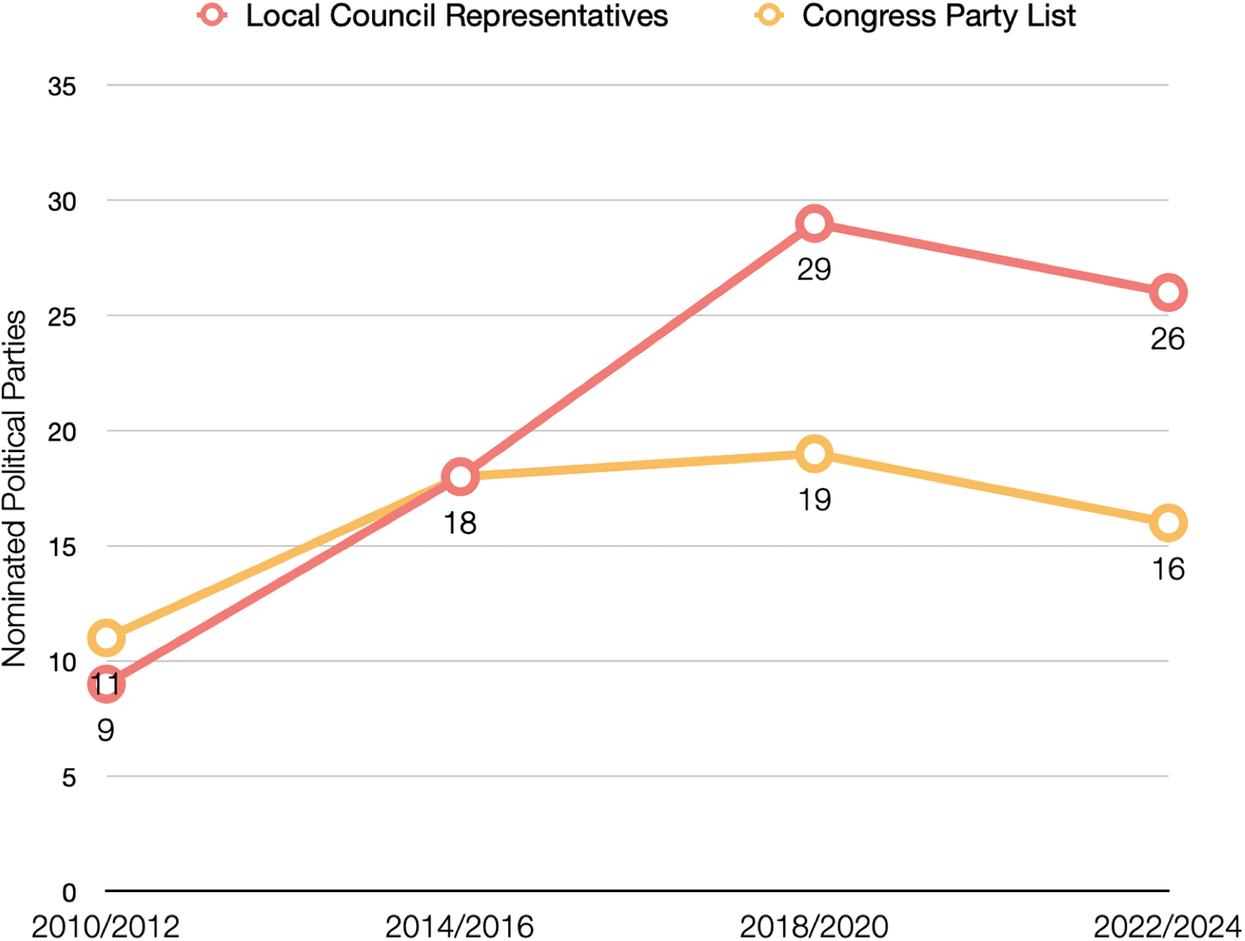
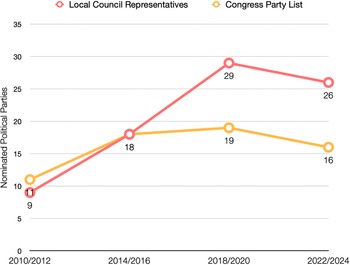
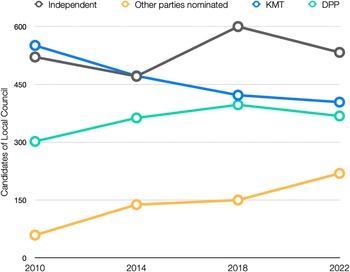
The movement’s momentum also led directly to the emergence of movement-based political parties (Ho and Huang Reference Ho and Huang2017). These new formations rallied around the vision of decentralizing political power and promoting civic participation, giving birth to new movement-based parties such as the New Power Party (NPP), the Social Democratic Party (SDP), and the Green Party (GP)—collectively self-identifying as the “third force.”Footnote 2 In the 2014 local elections, the number of candidates representing minor parties surged from 59 to 138, and the number of contesting parties increased from 13 to 23 (see Figures 1 and 2) (Central Election Commission 2024).
Numbers of political parties nominating local council representatives and party-list legislators from 2010 to 2024.
Number of candidates in the election of local council representatives by political parties.
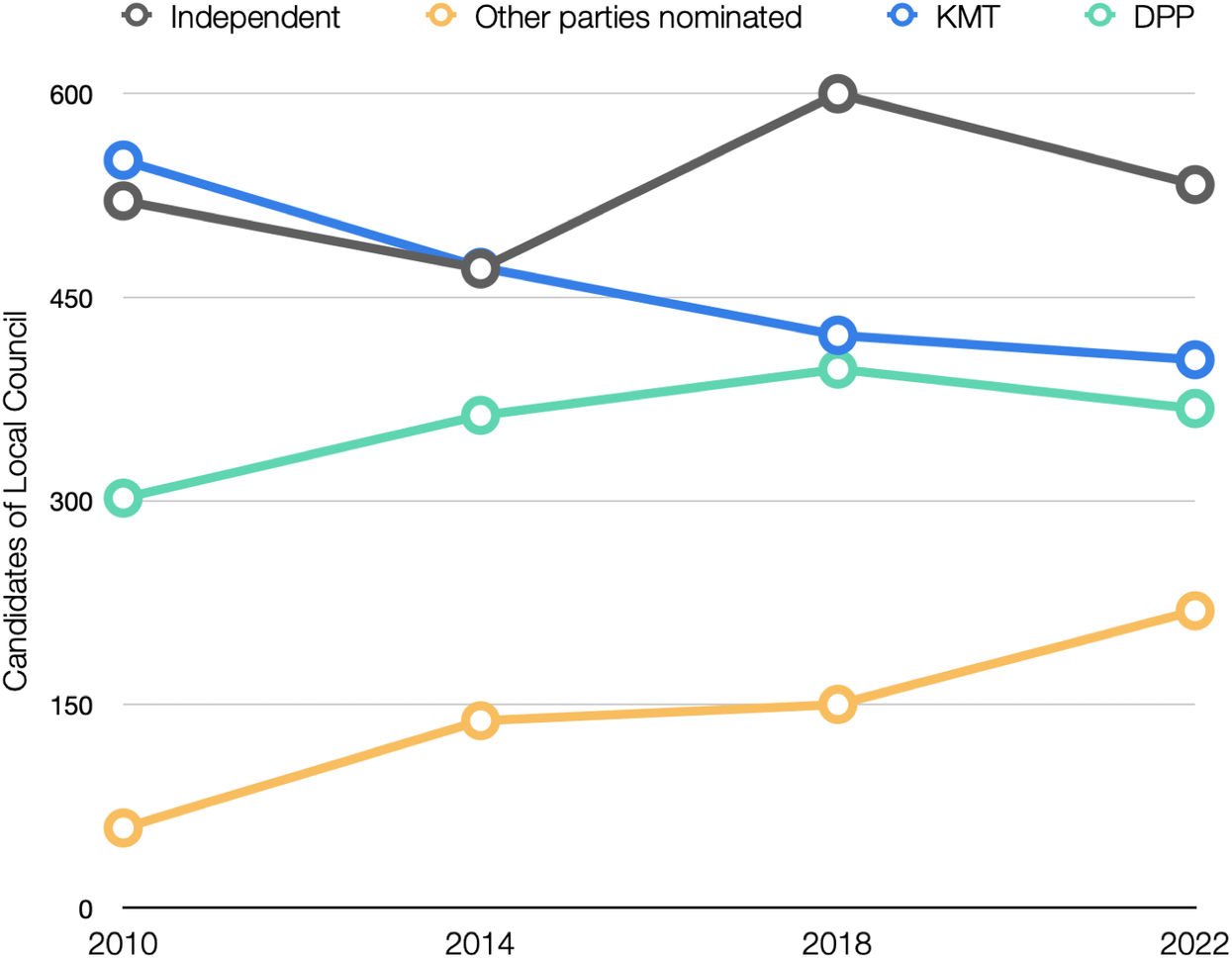
Figure 2. Long description
The y-axis represents the number of candidates from 0 to 600 in increments of 150. The x-axis lists election years 2010, 2014, 2018, and 2022. The legend at the top identifies four groups: Independent in dark gray, Other parties nominated in orange, K M T in blue, and D P P in teal.
* Independent: Starts at approximately 525 in 2010, dips slightly in 2014, peaks at 600 in 2018, and ends at approximately 530 in 2022.
* K M T: Shows a steady linear decrease from a peak of approximately 550 in 2010 down to approximately 400 in 2022.
* D P P: Shows a gradual increase from 300 in 2010 to a peak of approximately 400 in 2018, followed by a slight decline to approximately 375 in 2022.
* Other parties nominated: Shows a consistent linear increase from approximately 60 in 2010 to approximately 220 in 2022.
At the same time, the DPP, then the main opposition party, strategically positioned itself to earn political credit from the Sunflower Movement. The party actively sought to signal solidarity with civic forces in ways that would strengthen its standing among liberal constituencies. For example, during the occupation of the Legislative Yuan, DPP legislators guarded the entrances to prevent police intervention and provided logistical support to students inside. In the 2016 legislative elections, the DPP formed a “Progressive Alliance,” strategically yielding more than ten district seats to allied small parties and independents; the NPP won all three district races in which the DPP chose not to nominate candidates. In addition, the DPP incorporated more civil society representatives and professionals into its own party-list nominations, producing what was widely praised as the party’s most credible and least factionalized list in its history (Lin et al. Reference Lin, Chen-kai and Hui-chen2015; Wang Reference Wang, Templeman, Chu and Diamond2020).
In summary, the Sunflower Movement was a social protest ignited by concerns over China, reflecting the centrality of the Cross-Strait cleavage in Taiwanese politics. Yet civic groups deliberately reoriented the movement after the occupation by advocating for grassroots reform and challenging the traditional two-party structure. This strategic shift reframed the conflict: civic rights issues tied to “pluralism, freedom, and reform” confronted the values of “order and social stability,” gradually crystallizing into a new axis of social division. This trajectory vividly illustrates the historical-institutionalist view of conjuncture (Mahoney Reference Mahoney2000), in which an existing cleavage—in this case, Cross-Strait politics—served as a gateway for the political articulation of new societal conflicts (Hooghe and Marks Reference Hooghe and Marks2018).
These two events represent critical junctures that pave the way for cultural issues to become politically salient in Taiwan, reframing partisan conflict increasingly in terms of liberal versus conservative stances. Two dynamics stand out. First, advocacy strategies deliberately transformed narrow policy debates into broader ideological confrontations in order to expand their constituencies and mobilization networks. In the case of same-sex marriage, campaigns on both sides re-contextualized the issue within wider frames of gender equality, family values, and human rights, thereby engaging a public that was initially unfamiliar with the issue. Similarly, during the Sunflower Movement, activists emphasized procedural injustice and linked it to a larger struggle over political reform and participatory governance.
Second, the responses of political parties played a pivotal role in shaping institutional channels for these mobilizations. On same-sex marriage, the DPP’s proactive stance—particularly through its legislators—signaled alignment with liberal constituencies and pressured LGBTQ groups to take sides, while the KMT’s passive stance positioned it as the channel for conservative resistance. In the Sunflower Movement, the DPP rebranded itself as a credible partner of civic activism, simultaneously absorbing political merit from the movement. These strategic responses by political parties consolidated the articulation of cultural conflict into partisan competition, gradually institutionalizing a new terrain of cultural cleavage within Taiwan’s evolving political landscape.
Research question and hypotheses
The preceding sections highlighted how mobilization strategies and partisan responses reframed specific issues into wider ideological debates. What remains to be examined is whether these dynamics are reflected in long-term shifts in public opinion. Building on the theoretical discussions and the historical analysis of SSM and the Sunflower Movement, I now examine whether the cultural conflicts articulated by civic groups and political parties have translated into broader patterns of polarization and issue partisanship in Taiwanese society.
Using representative survey data, the following sections investigate two empirical questions: (1) whether public opinion on cultural and moral issues has polarized and become associated with party preference in the recent twenty years, and (2) how the salience of these issues compares with the long-standing dominance of Cross-Strait politics. Beyond the empirical scope, the analysis also addresses a broader theoretical concern: under what conditions cultural cleavages become politically meaningful in democracies that remain constrained by external geopolitical pressures. As a vibrant democracy situated in a contested geopolitical environment, Taiwan offers a valuable case for exploring this question.
Drawing on the theoretical discussions and the historical analysis of Taiwan’s context, I propose the following hypotheses:
Hypothesis 1: Polarization on cultural and moral issues in Taiwan has increased since the mid-2010s.
Hypothesis 2: Cultural and moral issues have become significantly associated with party affiliation since the mid-2010s, producing clear patterns of issue partisanship.
Hypothesis 3: Despite the emergence of cultural and moral cleavages, Cross-Strait relations continue to serve as a significant axis of partisan competition.
Data, variables, and methods
For the analysis, I use the Taiwan Social Change Survey (TSCS), conducted over a span of two decades from 2000 to 2020, encompassing five waves (Fu Reference Fu2016b; Wu Reference Wu2021; Chang Reference Chang2001; Chang Reference Chang2016a; Chang Reference Chang2016b). During this period, Taiwan underwent three power transfers, which solidified a stable bi-party system characterized by mutual checks and balances between two primary political camps. The TSCS general edition, conducted every five years, consistently employs a well-designed questionnaire covering a wide range of topics, making it an ideal tool for analyzing evolving trends in Taiwan’s political and social values. Key variables that I incorporate into the analysis include: (1) party affiliation, (2) social issues in four domains—civil rights, family values, Cross-Strait relations, and economic distribution—and (3) socio-demographic factors such as gender, age, and education. For descriptive statistics for all variables, see the online supplement, Table A.
Party Affiliation is categorized into three groups: KMT Supporters, DPP Supporters, and Independent Voters. These are treated as categorical variables. Although Taiwan’s political landscape has undergone subtle changes over the years,Footnote 3 the general public still broadly classifies parties into the pro-KMT (pan-Blue) and pro-DPP (pan-Green) camps (Ho and Huang Reference Ho and Huang2017; Wang Reference Wang2019). Even after the emergence of the New Power Party (NPP) in 2015 and the Taiwan People’s Party (TPP) in 2019, which gained recognition as “the third parties,” two major political parties still manage to secure over 85 percent seats in Congress in every election. For additional details about the party coding, see the online supplement, Table B.
Based on Baldassarri and Gelman’s (Reference Baldassarri and Gelman2008) framework and adaptation for Taiwan’s specific context, I categorize people’s opinions towards social issues into four domains: (1) Civil Rights, (2) Family Values, (3) Cross-Strait Relations, and (4) Economic Distribution. All sixteen survey questions are measured on a five-point scale, from which I take the average and form a 1–5 point index for each of the four issue domains. For survey items details, see the online supplement, Table C.
Civil rights addresses the relationship between individuals and society. According to Broćić and Miles (Reference Broćić and Miles2021), conservatives prioritize societal norms and order over personal freedom, while liberals advocate for personal rights and promote a diverse society. In Taiwan, social constraints stem from the country’s authoritarian heritage, which emphasizes stability and economic prosperity (Slater and Wong Reference Slater and Wong2022). However, social movements and democratization introduced human rights and other liberal ideas, which gradually prevailed and deepened in Taiwanese society. This study uses six survey questions that cover (1) individuals’ views on social order (lawfulness and regulation compliance), (2) evaluations of the impact of pluralistic speech, political organizations, and advocacy groups on societal stability, and (3) attitudes toward punishing serious offenders.
Family values are a significant battleground for the clash between different moral values. In a Taiwanese context, this tension also represents the conflict between Confucian ideology and Western culture, while the former emphasizes maintaining close familial bonds, fulfilling responsibilities to care for parents, and preserving the family lineage, the latter challenges these traditional norms, prioritizing individual happiness and freedom (Qi Reference Qi2013; Tsui and Farh Reference Tsui and Farh1997). This study employs six survey items to measure respondents’ evaluations of various issues related to family ethics, including ancestral rites, parental care, marriage concepts, mother-in-law relationships, and procreation.
Cross-Strait Relations consistently play a central role in Taiwan’s political and social landscape, shaped by complex historical and geopolitical factors. Before democratization in the 1980s, the Kuomintang (KMT) tied Taiwanese destiny to the “territory to be recovered” across the strait, shaping Taiwan’s unique attitudes toward Mainland China (Chen Reference Chen2023). Nowadays, the Beijing Regime has consistently sought to annex Taiwan by suppressing Taiwan’s international legitimacy while promoting economic and cultural exchanges to cultivate a good impression of the Taiwanese toward the regime. To trace Taiwanese perspectives on China, I use two survey questions measuring stances on unification versus independence. See also Appendix G in the online supplement for a more holistic measurement in Cross-Strait Relations.
Economic Distribution is often considered the primary factor in social cleavages in Western countries (Hooghe and Marks Reference Hooghe and Marks2018). Globalization has also influenced the role of economic distribution in domestic politics (Ford and Goodwin Reference Ford and Goodwin2014; Mudde and Kaltwasser Reference Mudde and Kaltwasser2018). However, in Taiwan, the link between class stance and party preference is less pronounced, with no clear class divisions emerging (Ho Reference Ho2008). This study captures public views on government welfare expenditure and income equality using two survey items.
Socio-demographic variables like gender, age, and education are included in the model to control for potential confounding factors that might cause a spurious association. Gender is represented as a binary variable; age is categorized into three groups: under 35, 35 to 60, and above 60; and education is represented as a continuous variable indicating the number of years of education.
For examining trends in political cleavages, a multinomial logistic regression model is used (Alvarez and Bedolla Reference Alvarez and Bedolla2003). This model is suitable for categorical dependent variables, where the dependent variable is represented by the log-odds ratio of each pair of choices relative to an independent variable’s linear combination. In this case, I estimate the probability of respondents supporting the KMT or DPP compared to being an independent voter, given their stance on specific social issues and the year they respond to the survey. The model equation is as follows:
 $$ \mathit{\log}{\left({P}_{\mathrm{part}.}/{P}_{\mathrm{indp}.}\right)}_i={\beta}_0+{\beta}_1\mathrm{S}+{\beta}_3\mathrm{T}+{\beta}_3\left(\mathrm{S}\times \mathrm{T}\right)+\alpha X+{\varepsilon}_i $$
The outcome is the log odds ratio of supporting the KMT or DPP compared to being an independent voter. The explanatory variables include the stance on social issues (S), survey year (T), the interaction between stance and year, and demographic control variables such as gender, years of education, and age (X). By incorporating interaction terms, it shows whether and to what extent the association between social issue stances and party support changes over time.
Results
Descriptive statistics
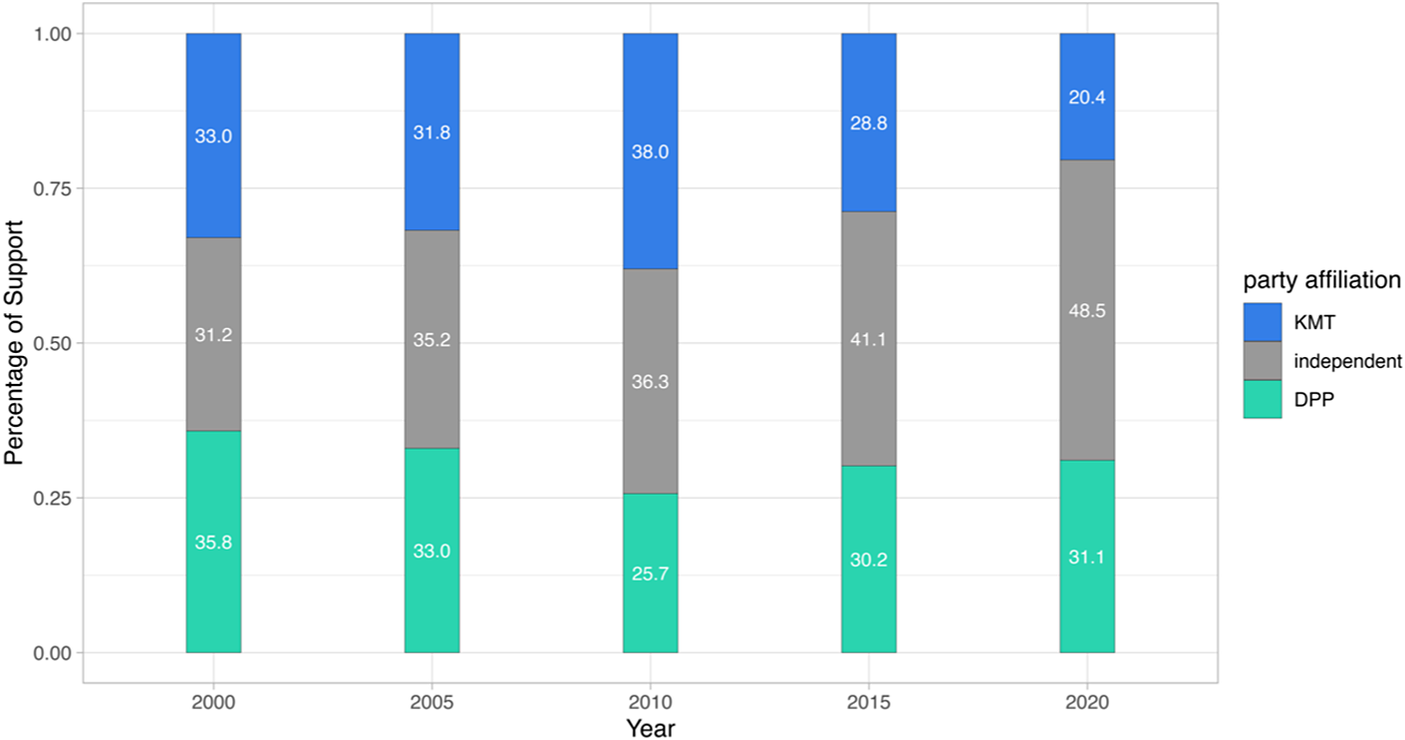
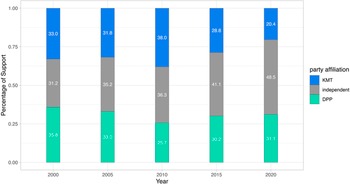
Before jumping into the regression model, I first examine the evolving political landscape over the past two decades. Figure 3 illustrates the gradual growth of the independent voter base, which rose from 31.2% in 2000 to 48.5% in 2020. In contrast, the DPP’s base remained relatively stable, fluctuating within 25% to 35%, while the KMT’s base experienced an expansion in 2010 but then significantly declined in the recent decade, reaching only 20.4% in 2020. This trend, accompanied by the rise of a third party, serves as a warning about the potential erosion of the two-party system. It may also suggest a loss of specific social groups within the KMT’s support base (Wang Reference Wang2019).
Trends of party affiliation rates over a twenty-year period. As a repeated cross-sectional dataset, the TSCS only presents the aggregate trend of supporting rates for the political parties rather than the individual changes in party affiliation.
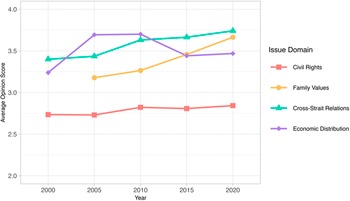
On the other hand, how have public attitudes overall changed over the past two decades? Figure 4 presents the average attitude scores from 2000 to 2020. Due to missing data on family ethics in the first wave (year 2000), the comparison begins with the second wave. Among the four domains, family values experienced the most substantial increase of 0.5 out of 5 points over a fifteen-year period, which shows similar liberalization trends to those in the United States (Baldassarri and Park Reference Baldassarri and Park2019). Cross-Strait relations also showed a slight rise of 0.3 points. Notably, the civil rights score remains relatively steady.
Trends of responses to four societal issue domains over a twenty-year period. The lines represent the mean scores of the combined 16 survey questions utilized in the analysis. For the four domains, 1–5 points respectively represent 1 Conservatism—5 Liberalism (Civil rights); 1 Conservatism—5 Liberalism (Family values); 1 Pro-unification—5 Pro-independence (Cross-Strait relations); 1 Right—5 Left (Economic distribution).
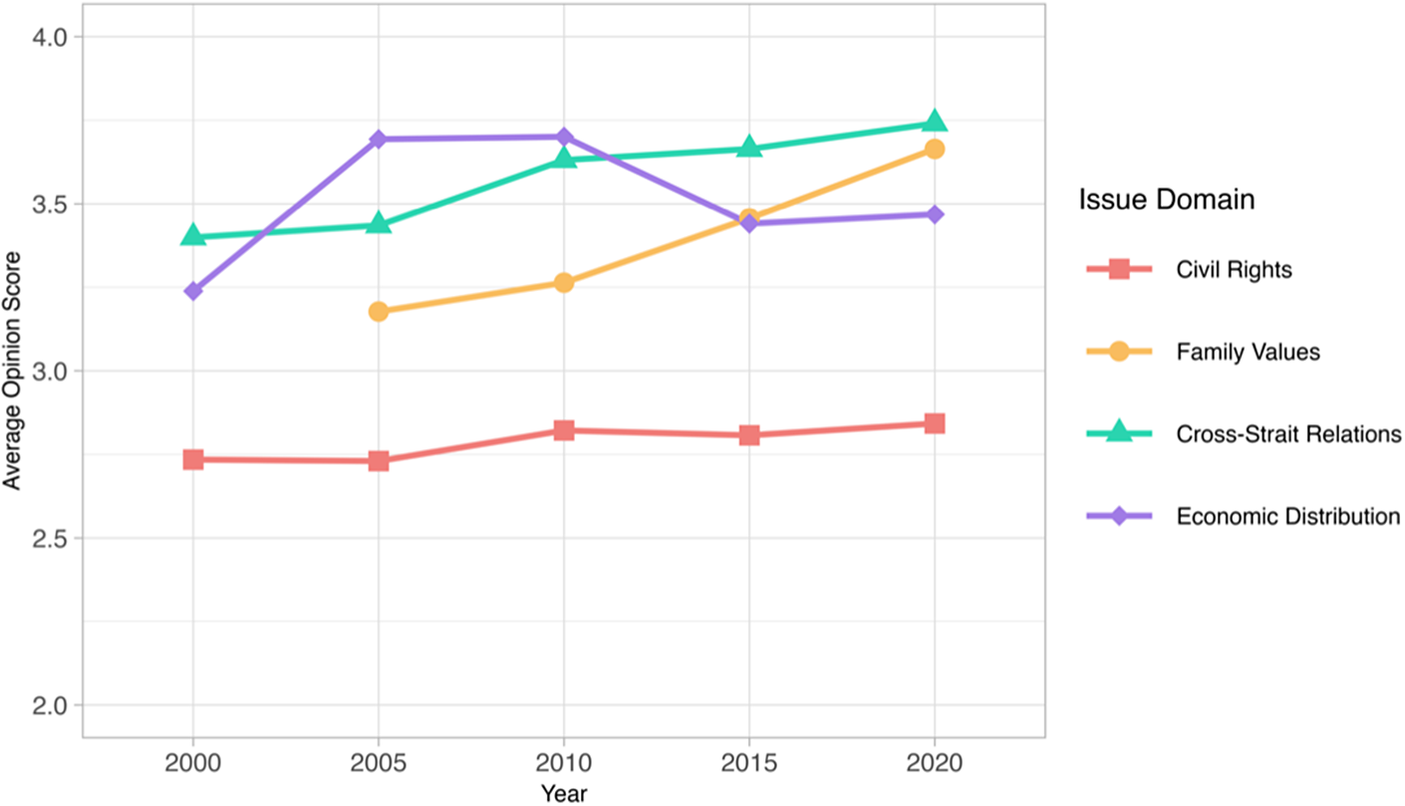
Figure 4. Long description
The x-axis represents the Year from 2000 to 2020 in five-year increments. The y-axis represents the Average Opinion Score ranging from 2.0 to 4.0.
* Civil Rights (red line with square markers) remains the lowest and most stable, starting at approximately 2.7 in 2000 and ending slightly higher at 2.8 in 2020.
* Family Values (yellow line with circle markers) begins in 2005 at approximately 3.2 and shows a steady linear increase to approximately 3.7 by 2020.
* Cross-Strait Relations (teal line with triangle markers) shows a consistent upward trend, starting at 3.4 in 2000 and reaching the highest point of all domains at approximately 3.75 in 2020.
* Economic Distribution (purple line with diamond markers) starts at 3.25 in 2000, peaks sharply at 3.7 in 2005 and 2010, then drops to 3.45 in 2015 before stabilizing at 3.5 in 2020.
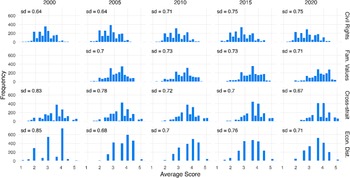
Figure 5 illustrates the distribution and variation across four domains over time. Baldassarri and Gelman (Reference Baldassarri and Gelman2008) do not find any evidence of public opinion polarization in the United States, which leads to their argument of party sorting. However, in Taiwan’s data, there is a slight difference in the variation change across domains. The standard deviation decreases from 0.83 to 0.67 in Cross-Strait relations, suggesting a narrowing gap in opinions. Conversely, the standard deviation of civil rights increases from 0.64 to 0.75, indicating a slight polarization in this domain. Finally, family values remain relatively stable throughout the period. In the online supplement (Figure D), I provide additional analyses of subgroup means and standard deviations across the four issue domains—disaggregated by age, education, and gender—which show that the patterns observed at the aggregate level are largely consistent across demographic groups.
Distribution and standard deviation of four societal issue domains over a twenty-year period. The X axis represents each respondent’s mean scores of the combined survey questions utilized in the analysis. For the four domains, 1–5 points respectively represent 1 Conservatism—5 Liberalism (Civil rights); 1 Conservatism—5 Liberalism (Family values); 1 Pro-unification—5 Pro-independence (Cross-Strait relations); 1 Right—5 Left (Economic distribution).
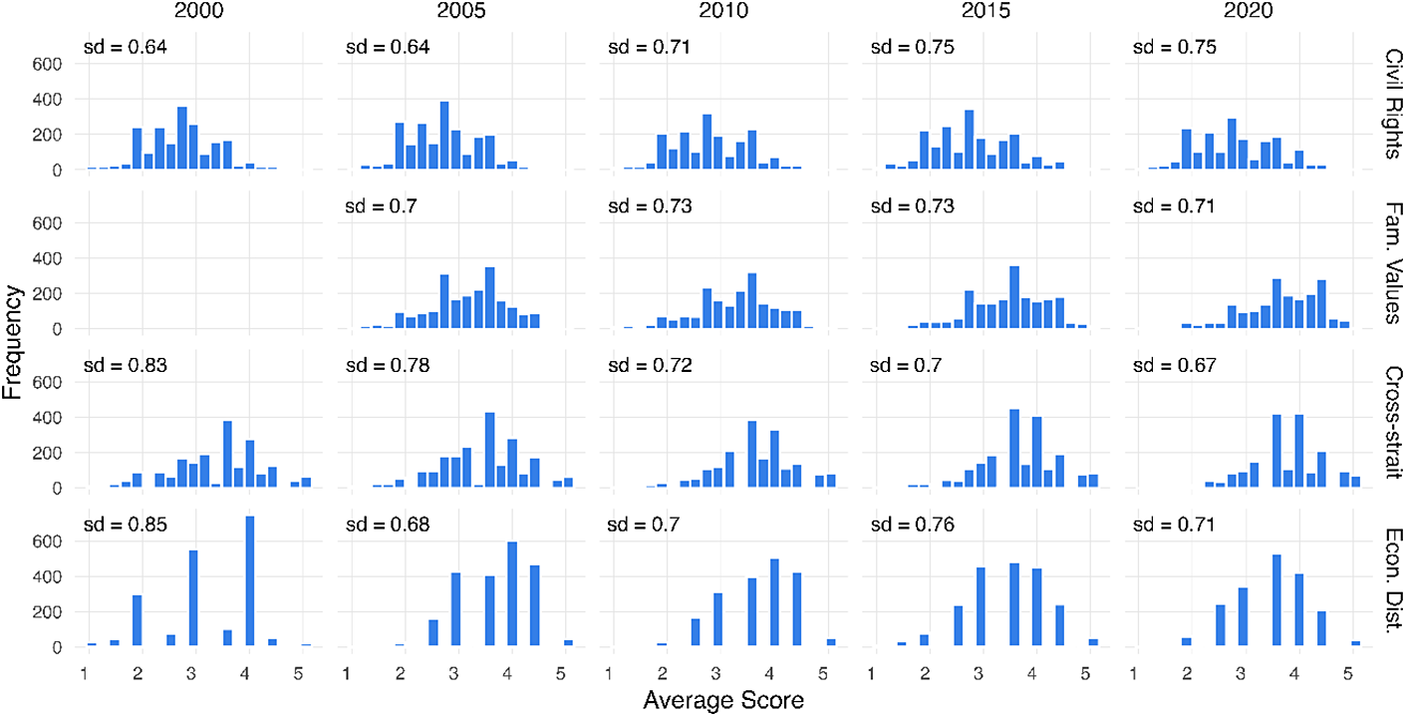
Figure 5. Long description
The grid consists of four rows representing societal domains and five columns representing years from 2000 to 2020. The Y axis measures Frequency from 0 to 600, and the X axis measures Average Score from 1 to 5.
* Civil Rights row: The distribution remains centered around a score of 3. Standard deviation s d starts at 0.64 in 2000 and 2005, increases to 0.71 in 2010, and plateaus at 0.75 in 2015 and 2020.
* Fam. Values row: Data is missing for 2000. From 2005 to 2020, the distribution shows a rightward shift toward higher scores. The s d values fluctuate from 0.7 in 2005, to 0.73 in 2010 and 2015, and down to 0.71 in 2020.
* Cross-strait row: The histograms show a gradual shift from a wider distribution in 2000 to a more concentrated peak around score 4 by 2020. The s d decreases steadily from 0.83 in 2000 to 0.67 in 2020.
* Econ. Dist. row: This row features the most distinct vertical bars. In 2000, there is a sharp peak at score 4 with an s d of 0.85. By 2020, the distribution becomes more bell-shaped around score 4 with an s d of 0.71.
To sum up, descriptive data reveal distinct trends in public attitudes across various issue domains. Attitudes toward civil rights display increasing divergence, indicating a growing polarization around questions of social order and diversity, partly supporting the first hypothesis. In contrast, views on family values remain relatively stable in variance and show a discernible trend toward secularization across the general population. On Cross-Strait issues, there is a modest convergence in opinion with a trend toward pro-independence, suggesting the potential for broader consensus (Wang Reference Wang2019). To assess whether cultural issues have the potential to form new political cleavages, a regression model is employed to examine the relationship between issue stances and party affiliation.
Regression results
How do attitudes toward social issues relate to political affiliation? Next, I used multinomial logistic regression models to analyze the relationship between the four social issue domains and party affiliation over time.
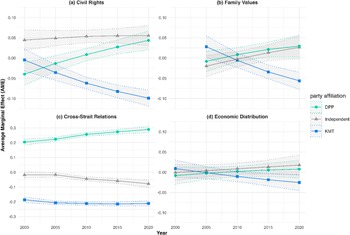
Figure 6 presents the average treatment effect (ATE) of the four issue domains’ scores on predicting party preference probabilities (see the regression table in the supplement, Table E1). Figure 6a shows a gradual rise in support for civil rights as a predictor of DPP affiliation, increasing from -0.04 to around 0.05 between 2000 and 2020. Those with more liberal views increasingly supported the DPP, while the conservatives started showing their support to KMT, making the AME decline from 0 to -0.1. Figure 6b reveals that liberal views on family values had a modest increase in effect on DPP support, rising from 0 to 0.025 over two decades. However, the effect for KMT support dropped more sharply from around 0.025 to -0.05, which makes a cross with DPP supporters and independent voters in 2015. It suggests that the KMT had appealed to liberals before, but that it now appeals more to conservatives with family values.
Average marginal effects (AME) of four societal issue domains on party preference while the time variable is conducted as continuous.
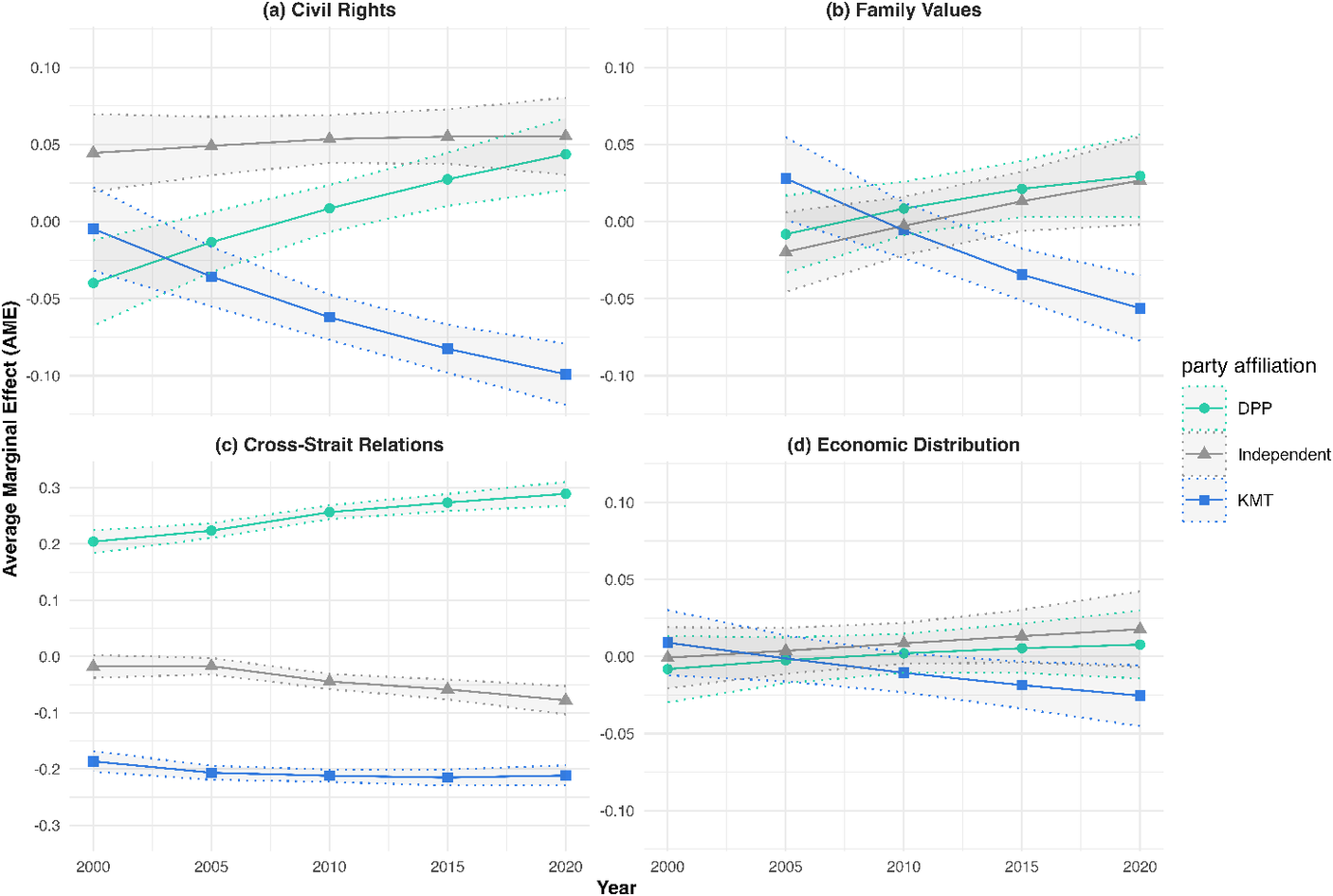
Figure 6. Long description
The multi-panel graph consists of four panels labeled a through d. The Y axis represents Average Marginal Effect A M E and the X axis represents Year from 2000 to 2020. A legend on the right identifies three groups: D P P with teal circles, Independent with grey triangles, and K M T with blue squares. Shaded areas and dotted lines indicate confidence intervals.
* Panel a Civil Rights: D P P shows a linear increase from negative 0.04 to positive 0.04. K M T shows a linear decrease from 0.00 to negative 0.10. Independent remains relatively stable near 0.05.
* Panel b Family Values: D P P and Independent both show a slight linear increase, converging near 0.03 in 2020. K M T shows a sharp linear decrease from 0.03 to negative 0.06.
* Panel c Cross-Strait Relations: D P P maintains a high positive A M E, increasing from 0.2 to 0.3. K M T remains low and stable near negative 0.2. Independent shows a slight decline from 0.0 to negative 0.08.
* Panel d Economic Distribution: All three groups show relatively flat trends near the 0.0 baseline. Independent and D P P show very slight increases, while K M T shows a slight decrease toward negative 0.03.
Compared to cultural issues, Figure 6c shows that Cross-Strait relations remain the most influential factor in predicting party preference. A pro-independence stance consistently increased a respondent’s likelihood of DPP support, and the AME increased from 0.2 in 2000 to 0.3 in 2020. Conversely, the treatment effect for KMT support remained negative (-0.2), indicating that individuals with pro-unification stances were more likely to support the KMT. This finding suggests that Cross-Strait relations continue to be a dominant political cleavage in Taiwan. Figure 6d indicates that support for redistributive economic policies affected both DPP and KMT supporters similarly, with no significant changes over time.
While figure 6 captures the trends of average effects over time, this approach might not fully reflect reality. As discussed earlier, political cleavages are often shaped by critical events such as policy implementation and political reforms. To capture these nonlinear shifts, I treat the year variable as categorical in the next regression model (see regression table in the supplement, Table E2), revealing critical turning points and allowing for more nuanced interpretations.
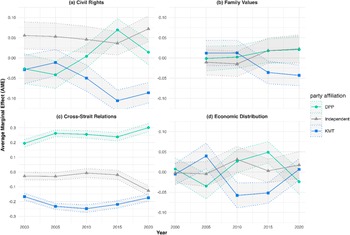
Overall, Figure 7 highlights key moments aligned with Taiwan’s recent history. The civil rights domain (Figure 7a) displayed a crossover effect between party preferences in 2010, with the largest divergence occurring between 2010 and 2015. That is, in the period between 2005 and 2015, those who advocated for civil rights and social diversity shifted their support from the KMT to the DPP. As time passed, the impact of the issue of civil rights diminished to some extent, and with the DPP’s return to power in 2016, liberals’ support for the DPP had somewhat recovered. However, there is still a substantial difference between the DPP and the KMT, indicating that this shift might become a defining characteristic of political cleavage.
Average marginal effects (AME) of four societal issue domains on party preference while the time variable is conducted as a dummy variable.
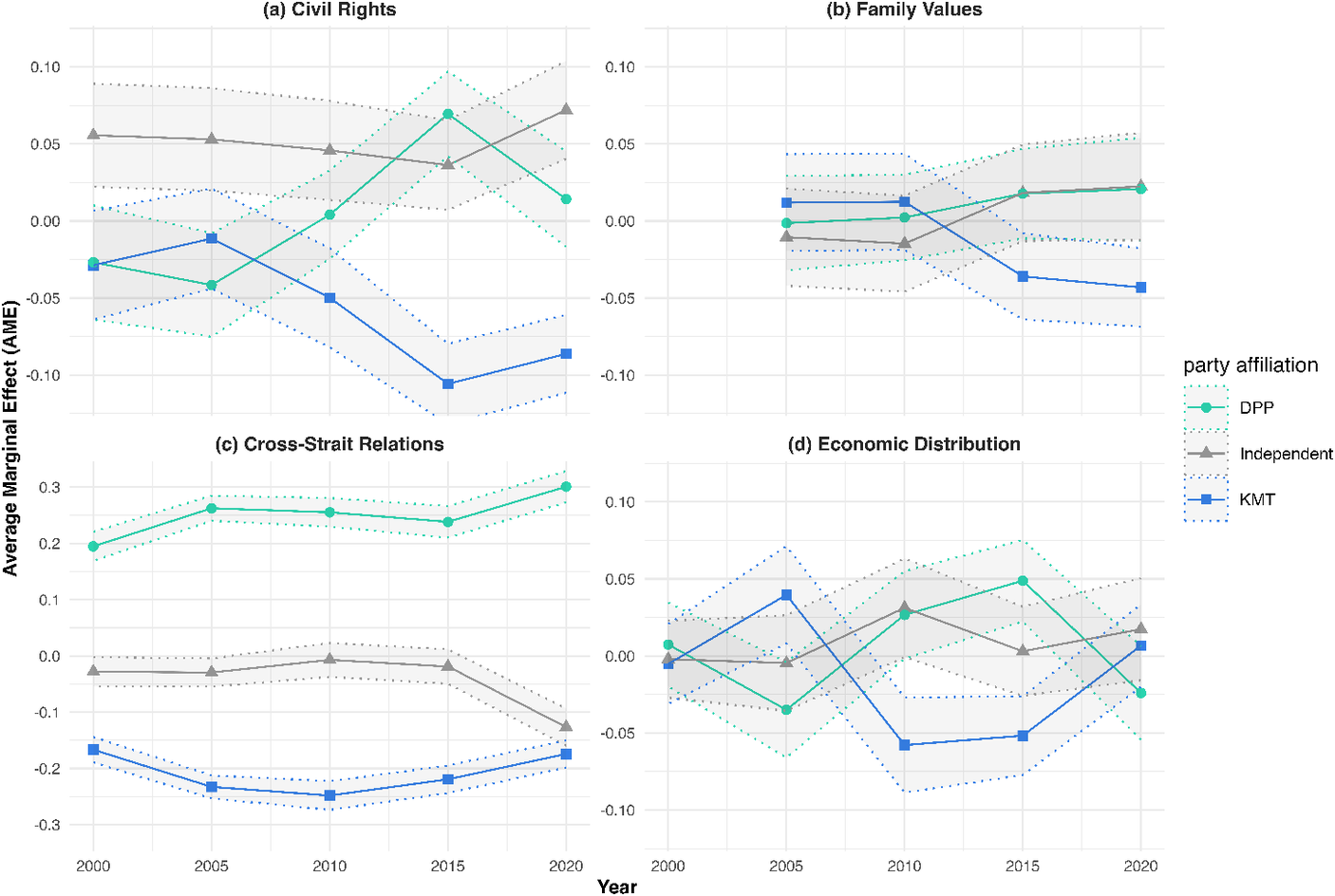
Figure 7. Long description
The four panels are arranged in a two-by-two grid. The y-axis for all panels represents Average Marginal Effect A M E, and the x-axis represents Year from 2000 to 2020. A legend on the right identifies three groups: D P P represented by teal circles, Independent by grey triangles, and K M T by blue squares. Each line includes shaded confidence intervals bounded by dotted lines.
Panel a, Civil Rights: D P P starts at negative 0.03, peaks at 0.07 in 2015, and drops to 0.02 in 2020. K M T fluctuates near zero before dropping sharply to negative 0.11 in 2015. Independents remain relatively stable between 0.04 and 0.07.
Panel b, Family Values: Data begins in 2005. D P P and Independent lines remain near zero until 2010, then both rise slightly to 0.02 by 2020. K M T starts at 0.01 and trends downward to negative 0.04 by 2020.
Panel c, Cross-Strait Relations: D P P shows a high positive A M E, rising from 0.2 to 0.3. K M T shows a significant negative A M E, dipping to negative 0.25 in 2010 before rising to negative 0.18. Independents remain near zero, dropping slightly to negative 0.12 in 2020.
Panel d, Economic Distribution: All three groups show high volatility and overlapping confidence intervals. D P P and K M T exhibit inverse fluctuations between 0.05 and negative 0.06. Independents stay closest to the zero baseline throughout the period.
As for family values, the overturn and divergence became evident between 2010 and 2015 (Figure 7b), overlapping the period of the aforementioned SSM campaign. Regarding the overall liberalization in family values shown in Figure 2, this increase in treatment effect suggests that the DPP’s stance shifted concomitantly with societal trends, while the KMT increasingly garnered support from individuals with traditional family values. Furthermore, the impact did not diminish as it did in the case of civil rights, showing the potential for issues around family values to become a new political cleavage. These two findings jointly support the second hypothesis of cultural issue partisanship.
Compared to cultural issues, the AME of Cross-Strait opinion on political affiliation (Figure 7c) diverged after three rounds of maintenance in 2020. This phenomenon is noteworthy, and it was likely influenced by the 2019 Hong Kong extradition movement and the escalating Cross-Strait antagonism (for example, the continuous aggression of PCR flight jets toward Taiwan), which was considered a significant factor in the Tsai government’s successful reelection in 2020. This suggests that Cross-Strait relations remain a sensitive and potent influence on Taiwanese citizens’ political preferences, supporting the third hypothesis.
Finally, regarding economic distribution (Figure 7d), relaxing the linear assumption revealed fluctuating effects. DPP supporters were more inclined toward redistribution in 2010 and 2015 but less so in 2005 and 2020, corresponding with periods when the DPP governed, and vice versa for the KMT. This pattern suggests that Taiwan’s economic policies don’t create a distinct political divide as they do in Western countries. However, individuals who support redistribution often oppose the ruling party due to the pro-capitalist policies across parties in charge, including the 22K minimum wage policy (2010), the Cross-Strait Service Trade Agreement (2013), and the amendment to the Labor Act (2016).
In addition to the average marginal effects, Figure F in the online supplement presents the predicted probabilities of supporting each party across societal issue scores ranging from 0 to 5, in 0.5-point increments. This allows for a more nuanced examination of how support for political parties varies across different segments of the issue attitude spectrum.
In summary, descriptive statistics and regression analyses jointly reveal several indications of cultural polarization in Taiwan. First, among the four issue domains, civil rights stands out with a clear trend of polarization over time, not only in the sense that public attitudes have increasingly diverged toward two poles, but also in how these attitudes have come to correlate with party affiliation. This pattern resonates with observations from Broćić and Miles (Reference Broćić and Miles2021) and Baldassarri and Park (Reference Baldassarri and Park2019) on the United States, where conservative emphasis on social order often clashes with liberal commitments to civil rights and diversity. According to Hunter (Reference Hunter1991), conservatism tends to be committed to moral ideals “inherited from the past.” In Taiwan’s context, this pattern is reflected in how the KMT has increasingly drawn support from socially conservative voters. It may be linked to the party’s past authoritarian legacy, where “social stability ensured prosperity” was a central ideology (Slater and Wong Reference Slater and Wong2022). As society liberalizes, people with moral nostalgia may lean toward the KMT in defense of a perceived erosion of social order and traditional norms.
Second, public opinion about family values has shown a general trend toward liberalization across the population without signs of polarization. This pattern aligns with studies of secularization in Western societies (Baldassarri and Park Reference Baldassarri and Park2019; Norris and Inglehart Reference Norris and Inglehart2004). However, when partisanship is taken into account, a different picture emerges. While society as a whole becomes more liberal, KMT supporters move in the opposite direction, revealing what may be called a “party sorting” rather than a purely attitudinal one. That is, the KMT has increasingly differentiated itself on the conservative side of these issues, making it easier for conservative voters to align themselves with the KMT. The model result also shows that the timing matters. Issue partisanship in both civil rights and family values emerged in the mid-2010s, which overlaps with the timing of the two impactful events in civil society, which is likely to pave the road for the expansion of public opinion divergence.
Notably, the decline in KMT identifiers during this period (see Figure 3) suggests that a portion of newly nonpartisan voters may be “detaching partisans”—former KMT supporters with more moderate views exiting the party. This compositional shift is consistent with Wang (Reference Wang2019), who shows that the departure of moderate pan-blue voters contributed to polarization after 2014 in cross-strait issues. In this context, the overall conservative shift among remaining KMT supporters may reflect not only individual-level attitudinal change but also the changing composition of the party’s support base.
Lastly, Cross-Strait relations remain the most salient dimension of political division, with a consistently stronger predictive power—its average marginal effect remains three times that of civil rights. This enduring dominance reflects the PRC’s increasing military threats and diplomatic antagonism since the DPP came to power. With rising geopolitical tensions, the unification–independence debate continues to dominate the public agenda (Achen and Wang Reference Achen and Wang2017; Sheng and Liao Reference Sheng, Liao, Achen and Wang2017). If, as Lipset and Rokkan (Reference Lipset and Rokkan1967) argue, parties reflect social conflict structures, then it is likely that Cross-Strait positions will remain central to policy-making and political agendas. This may come at the cost of public space for deeper moral and cultural debates. For example, the KMT often criticizes the DPP for using the “resisting China to defend Taiwan” slogan to avoid the debate of socioeconomic issues.
Conclusion
On May 24, 2017, Taiwan’s Constitutional Court declared that the legal prohibition of same-sex marriage was unconstitutional, declaring Taiwan to become the first country in Asia to recognize same-sex marriage. Yet within a year, conservative groups launched a counter-referendum, advocating for a legal definition of marriage as exclusively between a man and a woman. The proposal passed with over 70 percent of the vote, prompting claims that “public opinion had overturned the constitutional decision.” Eventually, on May 17, 2019, the legislature passed a law separate from the Civic Code to legalize same-sex marriage, striking a compromise between judicial authority and mass opinion (Chen Reference Chen2023).
The process of same-sex marriage legalization exemplifies Taiwan’s shift toward a new political structure. While the policy change marked a milestone in Asia’s human rights landscape, the fierce public backlash and political parties’ responses revealed that moral and cultural issues were becoming increasingly salient in Taiwan’s political discourse.
The notion of a “culture war” has come to define much of Western political discourse since the early 2000s. Traditional alignments based on economic redistribution have gradually been replaced with divisions centered around religion, morality, and identity (Hunter Reference Hunter1991; Park Reference Park2017). These cultural cleavages tend to be deep and enduring, transforming the logic of political conflict and making cross-partisan empathy more difficult. In contrast, experts in Taiwanese politics have long held that party competition and voter alignment in Taiwan are overwhelmingly dominated by one issue: Cross-Strait relations (Achen and Wang Reference Achen and Wang2017).
Drawing on two decades of nationwide representative survey data, this study shows that polarization on cultural and moral debates began to emerge between 2010 and 2015 and has remained salient. In particular, attitudes toward civil rights have grown more polarized: DPP supporters have become increasingly liberal, while KMT supporters have moved in a more conservative direction. Meanwhile, family values issues have shown a general trend toward liberalization as a whole, yet KMT supporters have shifted in the opposite direction, resulting in statistically significant partisan divergence. These patterns suggest a potential cultural polarization. Nonetheless, the data also confirm that Cross-Strait relations continue to constitute the most dominant political divide, underscoring the importance of geopolitical forces.
This study also discusses how political parties acted within broader social dynamics (Greif and Laitin Reference Greif and Laitin2004; Mudge and Chen Reference Mudge and Chen2014). I emphasize the interaction between civic groups and political parties on two critical issues broaden the tension between liberals and conservatives. The push for SSM entered formal politics via legislative lobbying by civic groups, introduced to the public through legal reforms and referendums, and catalyzed broader debates over family and moral values. Similarly, while the Sunflower Movement initially arose in opposition to China-friendly trade agreements, civic actors transformed it into a broader project of political reform and civic empowerment, which subsequently elevated civil rights concerns in the political agenda.
Implications for research on cultural polarization
This study contributes two implications to the study of cultural polarization. First, it bridges the analytical focus of political sociology and party politics by examining how parties operate within broader social contexts. While classical political sociology often emphasizes the state and social movements, the role of parties and public opinion is frequently overlooked (see Lotesta and de Leon Reference Lotesta, de Leon, Janoski, de Leon, Misra and Martin2020; Manza and Brooks Reference Manza and Brooks2012). Conversely, research on party politics has often abstracted parties from the social contexts in which they are embedded (see Mudge and Chen Reference Mudge and Chen2014).
Combining evidence from survey datasets and historical analysis, this study uses Taiwan’s case to examine how civic groups interact with parties under critical events, and how public opinion reflects on these dynamics. Together, it offers a framework for understanding cultural polarization in a broader social context, one that integrates bottom-up forces with elite responsiveness (Goldstone Reference Goldstone and Goldstone2003).
Second, the case of Taiwan expands the theoretical boundaries of culture wars. On one hand, as a society deeply embedded in global economic and cultural flows yet situated within a political environment shaped by persistent geopolitical threats from China, Taiwan illustrates how geopolitics influence the salience and politicization of domestic issues (Sheng and Liao Reference Sheng, Liao, Achen and Wang2017; Wang Reference Wang2019). Such geopolitical conditioning is not unique to Taiwan. As Soehl and Karim (Reference Soehl and Karim2021) argue, geopolitical factors play a key role in shaping public sentiments worldwide (see also Wimmer et al. Reference Wimmer, Bonikowski, Crabtree, Fu, Golder and Tsutsui2024).
On the other hand, Taiwan offers a distinctive perspective on moral values within the contemporary East Asian context. Rather than religiosity, Confucian ethics constitute intergenerational familial duty and collective obligation as the primary moral principle (Bian Reference Bian, Cook, Lin and Burt2017; Tsui and Farh Reference Tsui and Farh1997), which, to some extent, clash with liberal ideals of individual rights and political pluralism in East Asian democracies. This suggests a more pluralistic and culturally embedded understanding of what constitutes a “culture war.” Meanwhile, it highlights the theoretical innovation potential of East Asia in moral politics.
Limitations and future directions
This study has several limitations that also point to directions for future research. First, the concept of Cross-Strait relations in Taiwan is actually multifaceted. While often treated as a stance of unification versus independence, it in fact encompasses competing narratives of national history, linguistic and cultural identity, the delineation of ethnic boundaries, and divergent visions of foreign policy (Wu, et al. Reference Wu, Yang, Huang and Wang2016; Wang Reference Wang2008; Chen Reference Chen2023). Due to constraints in survey design and measurement, this complexity is difficult to fully capture in my main analysis. I conducted a robustness check in Appendix G in the online supplement to test for various relevant concepts. Future studies may develop more nuanced instruments that reflect the multidimensionality of Cross-Strait politics.
Second, while attitudes toward social order are often interpreted as cultural concerns in Western contexts, this interpretation becomes more ambiguous in East Asia. In particular, it is difficult to decompose concerns about social order from sentiments of authoritarian nostalgia (Wu Reference Wu2008). Evaluations of past authoritarian regimes remain one of the most salient lines of partisan division in young democracies like Taiwan and South Korea (Jou Reference Jou2012). Future research may investigate the nuances of legacies of authoritarianism and contemporary moral issues relevant to social order in order to clarify the phenomenon and the effect size.
Third, this study relies on repeated cross-sectional data, which limits the ability to observe how individuals change their political attitudes and affiliations over time. Prior studies proposed alternative explanations of culture-war dynamics, concerning the causal pathways linking moral attitudes and political preferences (e.g., Abramowitz and Saunders Reference Abramowitz and Saunders1998; Baldassarri and Gelman Reference Baldassarri and Gelman2008; Hunter and Wolfe Reference Hunter and Wolfe2006). Recent work by Wang et al. (Reference Wang, Carter, Benjelloun, Banerjee and Cervantes2026), using longitudinal data in the United States, further highlights the importance of distinguishing among loyal partisans, detaching former partisans, and newcoming partisans when evaluating polarization. Their findings show that compositional changes—particularly the exit of moderates— significantly reshape the ideological profile of party supporters. Whether it is also the case in Taiwan is worth further exploration.
Fourth, while this study highlights the emergence of new cultural cleavages without the displacement of the old, it does not examine how these cleavages interact with one another. Sheng and Liao (Reference Sheng, Liao, Achen and Wang2017) have suggested that economic redistribution or social welfare may be absorbed into dominant Cross-Strait cleavages. In this case, cultural and geopolitical issues may likewise become entangled in ways that reshape their political significance. For example, LGBTQ+ activists frame Taiwanese independence as a precondition for safeguarding civil rights, arguing that “without a country, there can be no LGBT rights” (Wang Reference Wang2023). These evolving linkages between issue domains need further exploration.
Finally, future research would benefit from more innovative measurement approaches to cultural and moral attitudes. Cultural issues often involve subtle normative orientations and are subject to social desirability bias. In both elite and mass surveys, a range of more innovative approaches to measuring cultural and moral attitudes has recently emerged. These include new measurement strategies (Graham, et al. Reference Graham, Haidt and Nosek2009; Hoffman Reference Hoffman2019) as well as alternative data processing techniques (Baldassarri and Goldberg Reference Baldassarri and Goldberg2014; DellaPosta Reference DellaPosta2020). Future research on cultural attitudes in East Asia would benefit from adopting innovative tools to better capture the nuanced, often implicit nature of cultural and moral orientations.
The politicization of cultural issues is a double-edged sword. It may entrench moral divisions and foreclose empathy across ideological boundaries. Yet bringing cultural conflicts into the political arena also opens space for public deliberation and the possibility of social progress. In Taiwan, where democratic institutions are shaped not only by internal demands but also by persistent geopolitical pressure, the emergence of cultural cleavages may paradoxically deepen democratic engagement and expand the scope of mass political participation. Rather than viewing cultural conflict as a democratic failure, it may be more proper to see it as a manifestation of democracy’s capacity to absorb and structure moral disagreement. The story of Taiwan’s culture wars is still unfolding, and with it, new possibilities continue to emerge for this young and dynamic democracy.
Supplementary material
The supplementary material for this article can be found at http://doi.org/10.1017/jea.2026.10032.
Acknowledgements
I am grateful to Prof. Gi-Wook Shin and Prof. Kiyoteru Tsutsui at Stanford University, and Prof. Kuo-Ming Lin at National Taiwan University (NTU), for their insightful advice, as well as Shengfu and peers at NTU for their valuable comments. I also benefited from feedback received from participants at the NTU Quantitative Lab, the 2024 ISSM, and the 2025 IPSA World Congress, where parts of this research were presented. I further thank the anonymous reviewers and the journal editor for their constructive feedback, as well as the editorial staff for their assistance throughout the publication process. Any remaining errors or shortcomings are the sole responsibility of the author.
Funding statement
This research received no specific grant from any funding agency, commercial or not-for-profit sectors.
Competing interests
The author declares none.
Ethical standard
This study adheres to the publishing ethics guidelines of the Journal of East Asian Studies. All data sources, including survey datasets and legislative records, are publicly accessible and properly cited. The research design, data analysis, and interpretations are the sole responsibility of the author.


 Open access

